Brief History of Hindi Cinema.

In the course of its long history, the Hindi Cinema has gone through constant evolutions and is still witnessing massive socio-cultural changes, however, from substantive and insular point of view; the Hindi Film Industry still retains its own unique and peculiar characteristics. Since the beginning, the Hindi Cinema has drawn its inspiration from the styles and aesthetics of the mega diverse Indian culture.

In general great emphasis has been put on classical Indian traditions over the years including Indian storytelling, epics, and poems and like. Although movies came to India in July 1896 as famous French Lumiere Brothers screened their short films in Watson Hotel, Mumbai, the first ever Indian film was ‘Raja Harishchandra’, a mythological film released in 1913 directed by Dada Saheb Phalke, who is often called as the father of Indian Cinema.
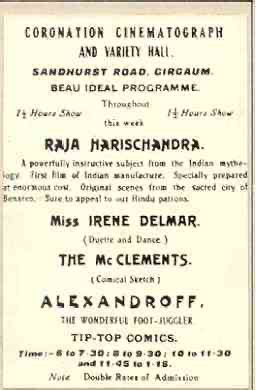
Film Poster of Raja Harishchandra, 1913.

Raja Harishchandra being a silent film had Hindi, Marathi and English interfiles. In 1905, filmmaker Hiralal Sen documented “Swadeshi Movement of India” and screened it at Town Hall, Calcutta on 22nd of September which is considered as India’s first political film. H.S. Bhatavdekar’s first movie and the first film by an Indian Filmmaker was shot in 1899 in which he shot a Wrestling Match in Mumbai’s Hanging Gardens. By the 1930s, the industry was producing 200 films per year and it was in 1931, the industry had its first sound film named ‘Alam Ara’ by director Ardeshir Irani which had a mixture of both Hindi and Urdu.
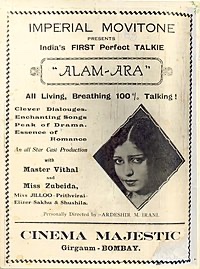
Alam Ara, India’s first Sound Film. (1931)

Since then the talkie films quickly were in high demand by the audience mostly in big cities and hence the industry permanently switched to sound films. The first ever Hindi color film was released in 1937 by Ardeshar Irani named “Kisan Kanya ”, however the colour films became popular among the audience only in late 1950s and early 1960s. The industry has also witnessed the breakdown of the studio system and complete on location shooting over the years. At present, Hindi Cinema produces over 1000 movies per year.
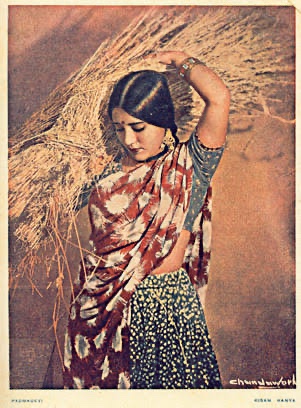
A still from Kisan Kanya (1937).

The Song and Dance Sequences

As mentioned earlier, the Hindi movies have always been a reflection of Indian culture and so hasn’t been any Hindi movie without a song till date. Two of the major characteristics of Hindi Cinema are songs and dance sequences. In fact, these two unique features are considered as the ‘peculiarities’ of Hindi Cinema which separates it from Hollywood or any other foreign film industry. In earlier times whenever there was a requirement of steamy scenes in movies, the protagonists, that is the hero and the heroine used to indulge into a song and dance sequel. The song and dance sequences pop up here and there according to necessary requirements and situations. The 1932 movie Indra Sabha was one of the first Indian movies with over 70 songs.
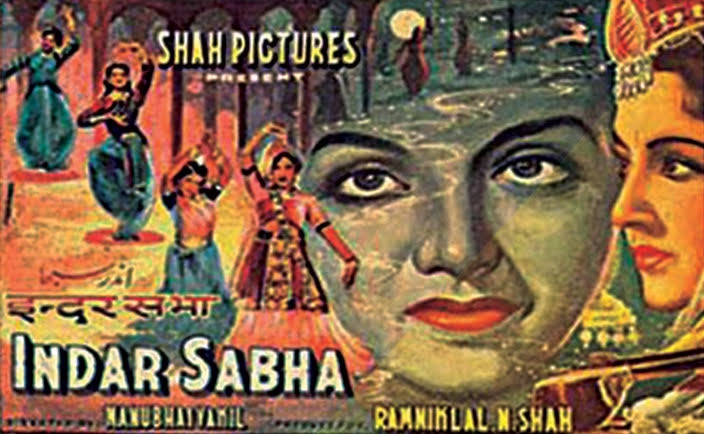
Film Poster of Indra Sabha (1932).

Truly, Hindi Cinema has entertained audiences worldwide for more than a century now. Informally and popularly known as Bollywood, Hindi Films will always have a special place in hearts of millions of Bollywood fans!

Types Of Painting Books

We as a whole like being imaginative. Our bustling timetable barely gives us any an ideal opportunity to invested energy with our self’s. Consistent spotlight on work makes our life dull. A standout amongst other approaches to make your life vivid is by doing some painting in your extra time. A Painting Book comprises of some excellent and enriching compositions. In the event that you are a craftsman it will help your motivation.

Face Painting Book

Face Painting Book will give you every one of the tips and methods that expert face painter craftsman use. The work of art book furnishes you with all the remarkable face painting plans, straightforward and simple strategies and helpful stepwise rules. The work of art books comprises books like inventive artistic creation books, facial workmanship books, wild creature face books, frightening face books, FX face books, and so forth These books contain various instructional exercises on painting creature’s countenances, unnerving appearances, and so on

Tole Painting Book

Tole painting is a craft of ornamental canvas of metallic articles like tins, coffeepots, and other comparative family things. This society craftsmanship started in the eighteenth century in New England. The canvases are a brilliant work of art done on the surfaces of many metal articles. Today one can discover number of online stores that give such composition books. These canvas books comprise of numerous beautiful and exquisite works of art. The work of art book likewise contains numerous excellent presentations of craftsmanship for workmanship darlings.

Oil painting books

Oil painting books can fill in as a total aide that will assist you with understanding the entire cycle associated with oil painting. The book will cause you to learn the majority of the dull insider facts of oil painting. You will figure out how to begin your canvas, legitimate arrangement, appropriate timings of stops and breaks, when to let dry, why such a lot of time is taken, and numerous significant things. Moreover, oil painting book likewise gives information about cash killers, what brush ought to be utilized, and so on It additionally gives helpful hints on your ranges, tube oil paints, medium impacts, boards, material, and so on.

DIY

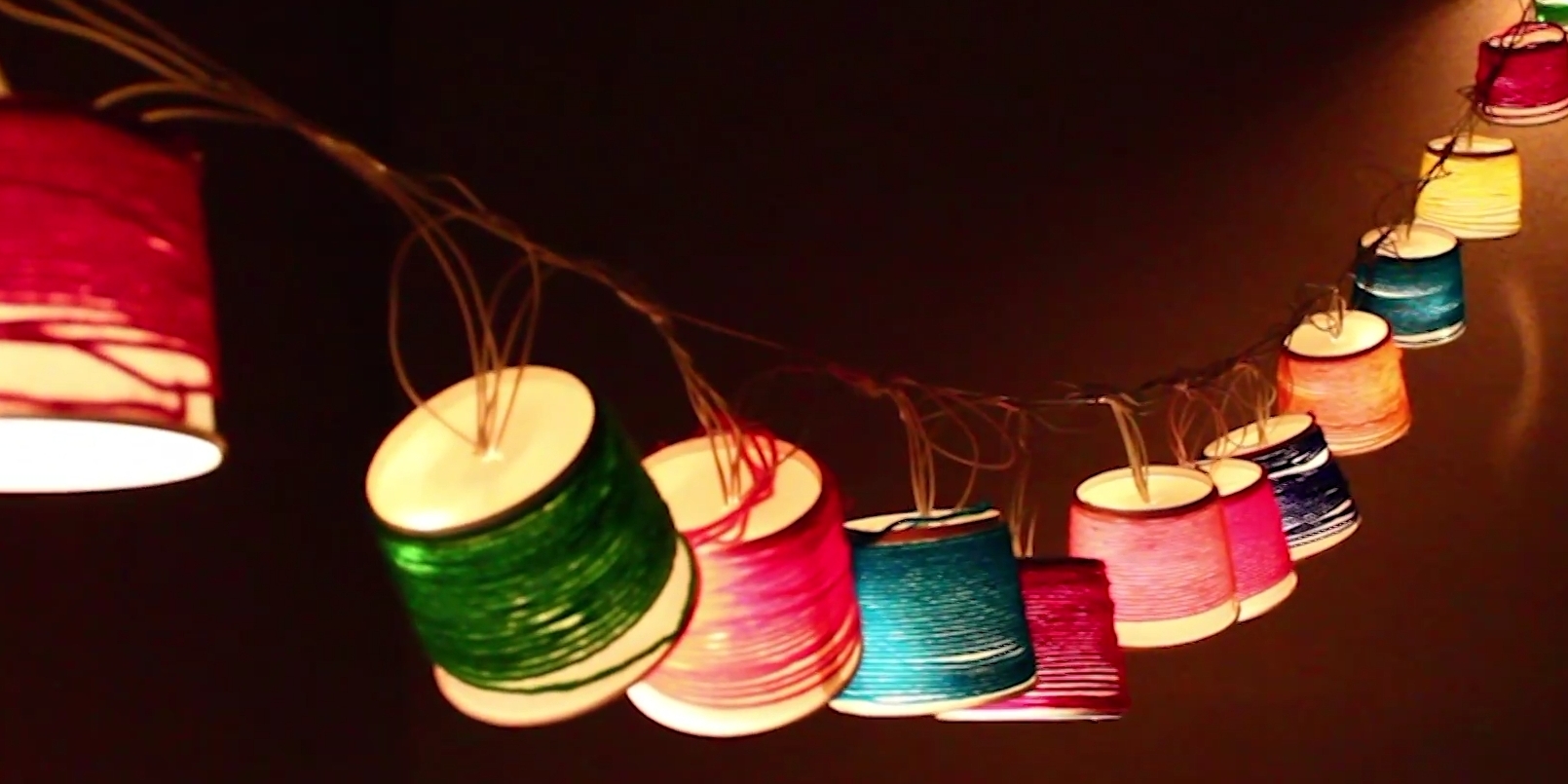
Do you Want to make your room cute and personalized without the cost of expensive room decor?

Here is an idea!

Supplies required
disposable cups
#2  woolen yarn (or) fabric/acrylic paints
LED lights
glue

Directions
Step 1
Decorate the cups with woolen yarn with the help of the glue.
(or)
Paint the outer side of the paper cup with shades of your choice.

Step 2
Make a small hole on the bottom of the cup for inserting the LED lights.

Step 3
Now, it looks like a garland.
Decorate this light garland the way you like.

Comment and let me how this turned out!

Keats’ ‘Ode on a Grecian Urn’

John Keats was an exemplary second-generation romantic poet who lived in the early 19th century. The romantic period refers to several literary movements that were characterised by their highly subjective form of writing, which was essentially a breakaway from the traditions of more rigid writing followed by the Neoclassical poets. Keats belonged to a group of poets who were later dubbed as the ‘second-generation romantics’ and it included other poets like Shelly, Wordsworth and Byron. The romantic age in England is generally marked by the publishing of ‘Lyrical Ballads’ by Coleridge and Wordsworth in 1789.

Thou still unravish'd bride of quietness,
       Thou foster-child of silence and slow time...

One of the main characteristics that set the romantics apart from the others is their intensely personal subject matter. It ranged from their own internal conflicts, to their philosophical thoughts, to praising the glory of nature and its effects on humans. Their poetic style was free and untamed (not that it did not have any metrical compositions, they were comparatively flexible in relation to the neoclassic poets.) like the vast untamedness of nature. They found their sources of poetry from particularly unique and seemingly unlikely experiences. For them, poetry conveyed its own truth and the sincerity was the true criterion for judging a poetry.

Heard melodies are sweet, but those unheard
       Are sweeter; therefore, ye soft pipes, play on;
Not to the sensual ear, but, more endear'd,
       Pipe to the spirit ditties of no tone:...

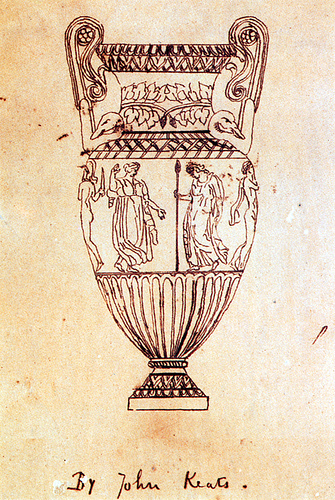
Several of Keats’ poetry questions the mortality and impermanence of human life with relations to art and its everlasting life on earth. In ‘Ode on a Grecian Urn’, the speaker comes across an old Grecian artefact and admires all the paintings on it. The urn contains several pictures of characters including a fair youth who sings beneath an evergreen tree, two lovers who are almost kissing, a melodist playing a pipe, a town of people on a procession with a sacrificial cow and so on. He takes a moment to think about each of their stories and wonders how it is to remain immortal.

For ever panting, and for ever young;
All breathing human passion far above,
         That leaves a heart high-sorrowful and cloy'd,
                A burning forehead, and a parching tongue...

He starts off the poem by describing the beautiful shape of the urn. He addresses it by several names and revels in the beauty and satisfaction that it gives him. He then addresses the sweetness of the music that might be coming out of the painted instruments. He assures himself by saying that the unheard melodies are sweeter because it speaks directly to our inner soul. He then moves onto the loves and assures them that though they may never kiss, they will forever remain young and fair. He complements the beautiful boughs of the trees and tells them that they will never wilt and will forever remain beautiful. In the later stanza, the poem takes a little turn as the speaker as he examines how they will live forever while humans living in the real world are all eventually bound to die one day. He then examines a procession of people who are carrying a sacrificial heifer and wonder which town or village is empty of this folk.

  "Beauty is truth, truth beauty,—that is all
                Ye know on earth, and all ye need to know."

In the final stanza of the poem, the speaker once again admires the beauty of the urn and decides that even after his lifetime, the urn will forever remain and tell its story for generations to come. The speaker finally neds the poem with one of the most beautiful verses in the poem going “Beauty is truth, truth beauty” which he confirms is the only eternal truth that one needs to know on earth.        

Reference Links:


THE RIGHT TO BE PRIDE

It takes no compromise to give people their rights ... it takes no money to respect the individual. It takes no political deal to give people freedom. It takes no survey to remove repression.

Pride is the stand for dignity, equality and justice for the people who are in relationship or prefer same gender .

Pride has lent its name to LGBT-themed organizations, institutes, foundations, book titles, periodicals, a cable TV station, and the Pride Library.

Pride Month

THE HISTORY OF PRIDE MONTH

During the time of 1950s and 60s the LGBTQ community in United State of America . The initiative to Fight against the odds was taken by two homophile organizations Daughter of Bilitis and Mattachine Society. These two pioneered in carrying out pickets called Annual Reminders. These two organization woke up people to inform and reminded that LGBTQ community didn’t receive civil rights protection.

Gay Is Good
The anti-LGBT discourse of these times equated both male and female homosexuality with mental illness. Inspired by Carmichael’s “Black is Beautiful“, gay civil rights pioneer and participant in the Annual Reminders “Gay is Good” a slogan Originated by Frank Kameny in 1968 to counter social stigma and personal feelings of guilt and shame.

CRITICISM FACED BY LGBTQ COMMUNITY.

The criticism faced by the community outside And inside is against the movement of Pride Events. In Many countries the initiative to promote LGBTQ community was taken by the Government officials. Brazil In August 2011, Carlos Apolinário the Aldernman of Sao Paulo City the right-wing Democrats Party sponsored a bill to organize and sponsor “Heterosexual Pride Day” on the third Sunday of December. Apolinário, an Evangelical Protestant, stated that the intent of the parade was a “struggle … against excesses and privileges“. Members of Grupo Gay da Bahia and the Workers’ Party opposed the bill as enhancing “the possibility of discrimination and prejudice”. The bill was nevertheless passed by the city council, but never received the signature of mayor . Turkey. In 2015 police dispersed the LGBT Pride Parade using tear gas and rubber bullets.

In 2016 and 2017, the Istanbul Governor’s Office did not allow the LGBT Pride Parade to take place, citing security concerns and public order.

The Pride March

CONCLUSION.

• people are marginalized and suffer a lot for their human rights. •Their are several Anti-Gay bills passed by some States and some states fought against the odds and help the LGBTQ community to attain their human rights.The issues, challenges and the opportunity experienced by this group in the labor force will draw the attention towards the issues.

What’s special about Mona Lisa?

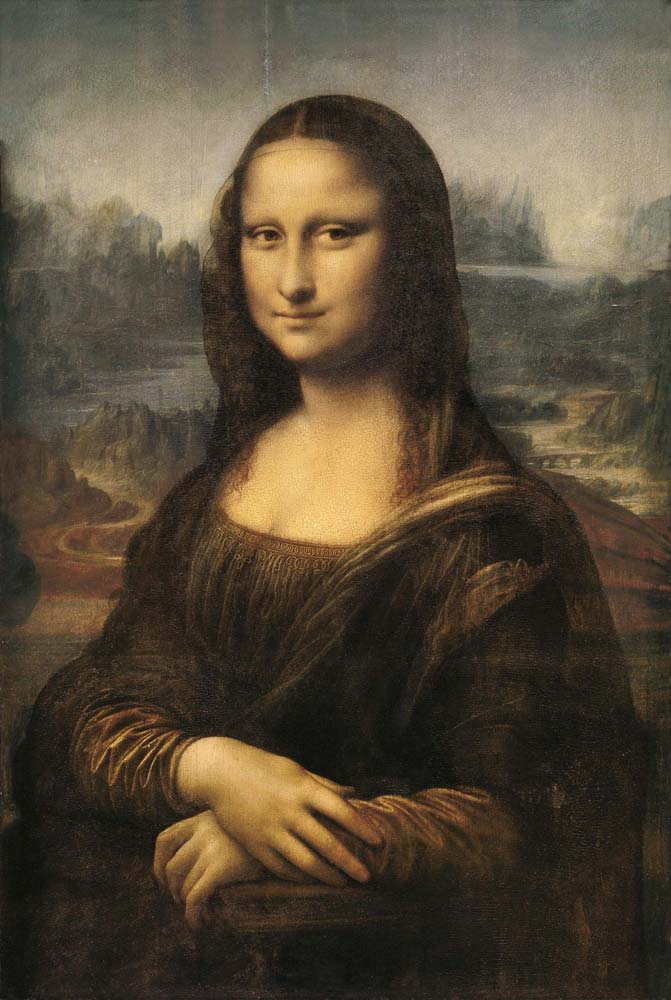
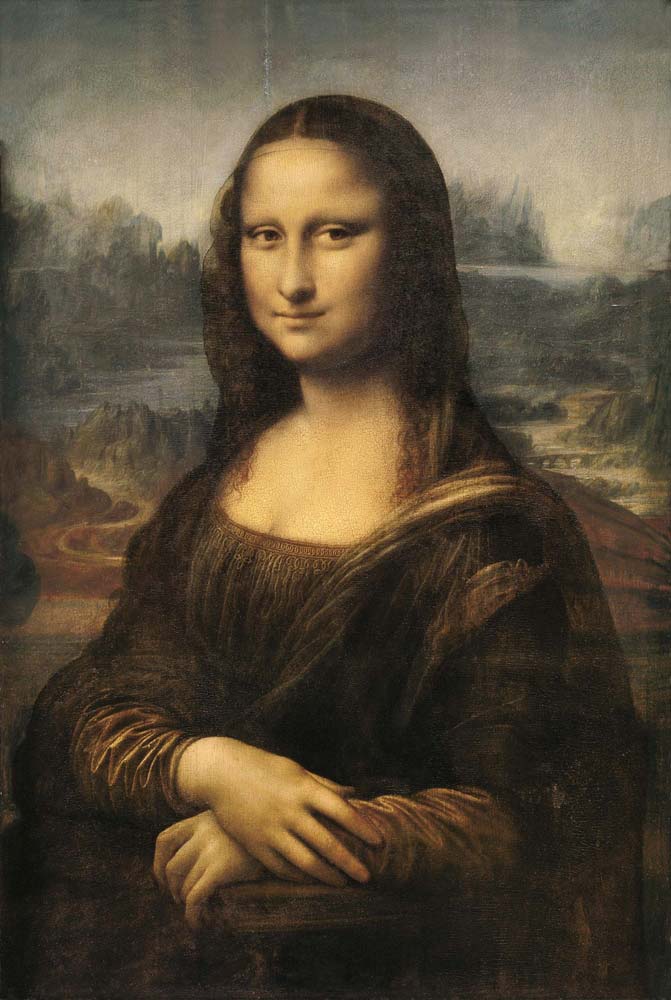
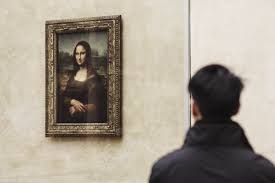
Most people feel disappointed when they see the most famous painting in the world “Mona Lisa”. Questions like ‘Why is this painting famous?’, ‘Is it worthy enough to be called a masterpiece?’, ‘What makes her unique?’ arise in the minds of hundreds. But if we ignore it all and just look at the painting, we see the greatest psychological portrait ever painted. A portrait that is much more ahead of time that we are still trying to figure out.

Leonardo da Vinci in his sixties moved to the Chateau of Amboise in France with his sketchbooks and one painting “The Mona Lisa”. Because he knows how important the painting was for him.

Leonardo is one of the greatest inquisitive minds in history, a self-made man with an unquenchable appetite for knowledge, and dedicated his life to studying anatomy, geology, and philosophy.

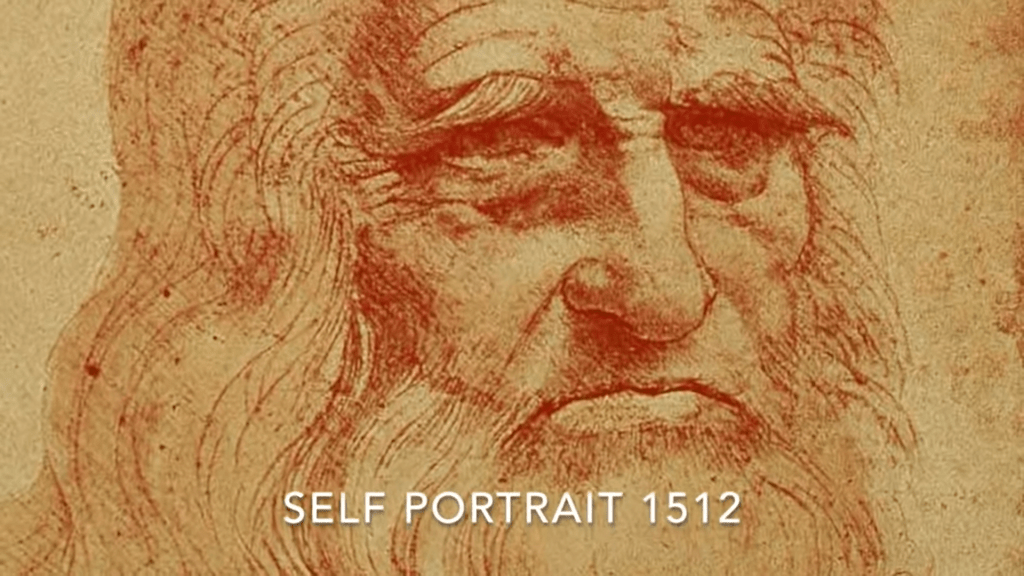
Leonardo da Vinci

The Painting

Mona Lisa was painted on a thin-grained piece of a poplar tree and a layer of lead white. He used glazes that have a very small amount of pigment mixed with the oil. This brought depth and luminosity as the white undercoat of lead reflects the light through the glazes. He used tiny brushstrokes applied super slowly over years. Leonardo pioneered many brushing techniques which brought the paint to life.

Mona Lisa

Clothes and Jewelry

Unlike any other commissioned portraits of the aristocracy we usually see with expensive outfits, Mona Lisa is a pretty simple wealthy woman with no jewelry, clothes that are nothing special, and simple hair.

Leonardo uses the classic pyramid-shaped composition that was introduced during the renaissance. The structure provides stability and provides a central focus. In this painting, the focus is directed towards her face.

What makes her different?

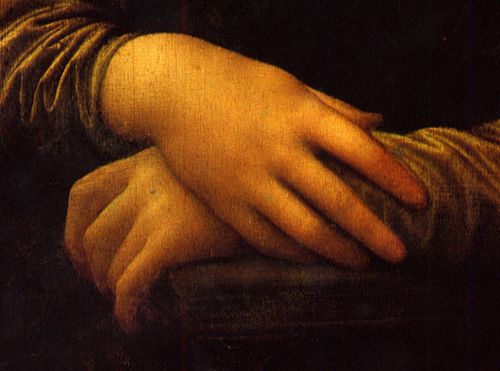
Instead of a full-length pose, Leonardo had painted Mona Lisa in a three-quarter length to cut down the distractions. Today this pose is normal but on those days it was groundbreaking. Previously the people in the portrait are erect, but Mona Lisa is relaxed with hands resting gently.

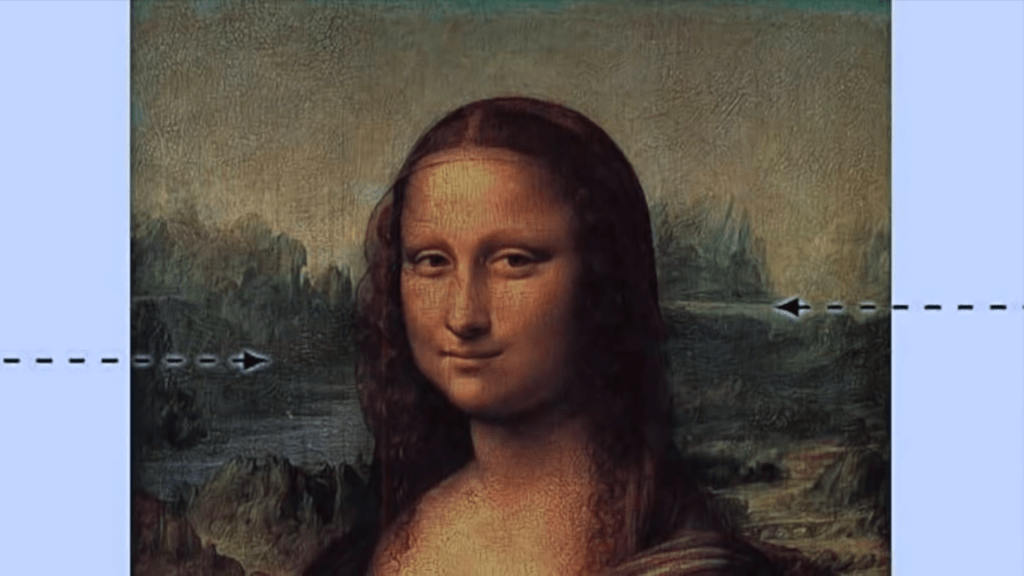
If you look at Mona Lisa’s eyes you see they are staring at you, but women in paintings never did that. The background of any other portrait has a simple background of either an open sky or a room but the background of the Mona Lisa is a complex aerial perspective of a landscape. The curves of her hair and clothing reflect the valleys and river flowing connecting humanity and nature. If you look at the background and compare the horizons on both sides you see it is not lined up. This visual trick gives an illusion of movement.

level of horizons

Her eyes and smile follows you

Leonardo has used the Sfumato technique to paint Mona Lisa’s eyes. It creates a depth near the eyes of Mona Lisa which is unusual in the case of other paintings and sculptures. Leonardo has studied human anatomy, the structure of a human face, and smiles exposing the muscles and nerves. He started researching how a smile works and analyzed every possible movement of the face. Artists never painted a smiling face before, portraits are generally serious. When you look into her eyes first she smiles then she is not. The smile comes and goes as we look deep into her face. When we look away smile stays.

Leonardo from his optic studies observed that the light comes and hits the whole retina instead of hitting at one point. This was the key to her mysterious smile.

The human eye has two different regions for seeing the world one is a central area called the fovea(to read colors) and the other is the peripheral area(to see the black and white motion and shadows). When we focus on the eyes the peripheral vision is on the smile and pick up the shadows from her cheekbones. When you look at her smile directly you cannot see the shadows, and she isn’t smiling but smirking. This is not your imagination, but it is about how you see.

Her eye’s on you!
Inner part of the eye

Sfumato technique

Sfumato is a blending technique for softening the transition between colors to make sure there are no sharp lines, layer by layer he blended everything in Sfumato style.

Chiaroscuro

chiaroscuro is an effect of contrasted light and shadow that gives a 3D effect.

These styles were never seen before Mona Lisa. Hence, seeing Mona Lisa for the first time must have been astonishing. How genius Leonardo da Vinci is that he understood this 500 years ago.

credits to the right owners of the pictures used.

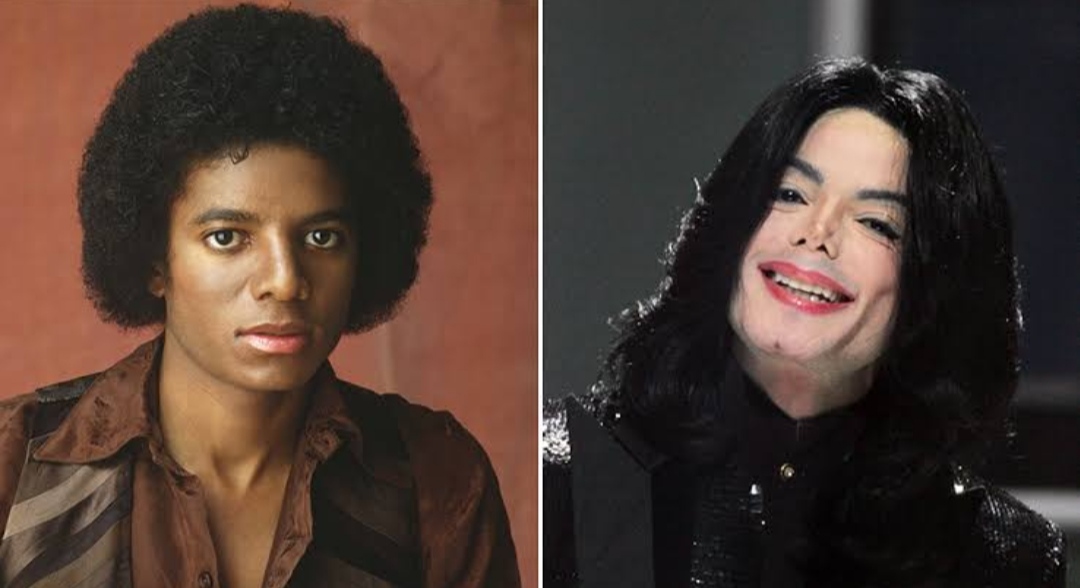
Michael Jackson

Michael Joseph Jackson(1958-2009) also popularly known as Michael Jackson,was an American singer, songwriter, and dancer. He is famously known as king of pop,he is regarded as one of the most significant cultural figures of the 20th century. 

His contributions to music, dance, fashion, and philanthropy, made him a global figure.

He influenced many people, many genres across the world through stage and video performances.

His popularized dance moves like moon walk , still this complicated dance gestures is creating popularity, records.He is the most awarded music artist in history.

Jackson is one of the best selling music artists of all time, with estimated sales of over 350 million records worldwide. For his incredible contribution to music,dance he was honoured with 15 Grammy awards, six Brit awards, a golden globe award, and 39 Guinness world records.

Michael Jackson, also known as most commercially successful entertainers of all time. At the age of 50, Michael Jackson passed away,at his home in Los Angeles, California, after suffering from cardiac arrest caused by a fatal combination of drugs given to him by his personal doctor.

World Photography Day

What’s a photograph?


It’s a memory, an idea, an experience, a feeling, an expression. In simple words, photographs are the medium that allows us to see the world from another person’s point of view. Isn’t it magical, I believe photography is one of the greatest inventions of mankind. That’s why it has been said; a photograph is worth a thousand words.

Every year World Photography Day is celebrated on the 19th of August to inspire all the shutterbugs to share a single photo and share their world with the world. Let’s have a look at photography over the years.

It originates from the invention of the photographic process called Daguerreotype developed by Frenchmen Louis Daguerre and Joseph Nicephore Niepce in 1837. Later, on the 9th of January 1839, the Daguerrotype process has been announced by the French Academy of Sciences. And on the 19th of August, the French government purchased the patent and declared the invention as a gift “free to the world”. 

But Daguerrotype was not the first photographic process. In 1826, Nicéphore Niépce invented a process called heliography, which he used to create the earliest known surviving photograph from nature; View from the Window at Le Gras.

On the 19th of August 2010, World Photography day hosted its first online gallery globally. In which approximately 300 shutterbugs shared their pictures and people from more than 100 countries visited the website. This marked the first official, globally reaching World Photography Day.

Some interesting photography facts:

★ In 1861, the first durable colored photograph was taken by Thomas Sutton. It was a combination of three black and white pictures taken through red, blue, and green filters.

★ The first selfie was taken in 1839 by an amateur chemist and photography enthusiast from Philadelphia named Robert Cornelius.

★ The first digital photograph was taken in 1957, almost 20 years before Kodak invented the first digital camera.

Don’t forget to share your world with the world on the coming World Photography Day.

“For me, the camera is a sketchbook, an instrument of intuition and spontaneity.”
– Henri Cartier-Bresson

Fans demanding Padma Shri for shushant singh rajput

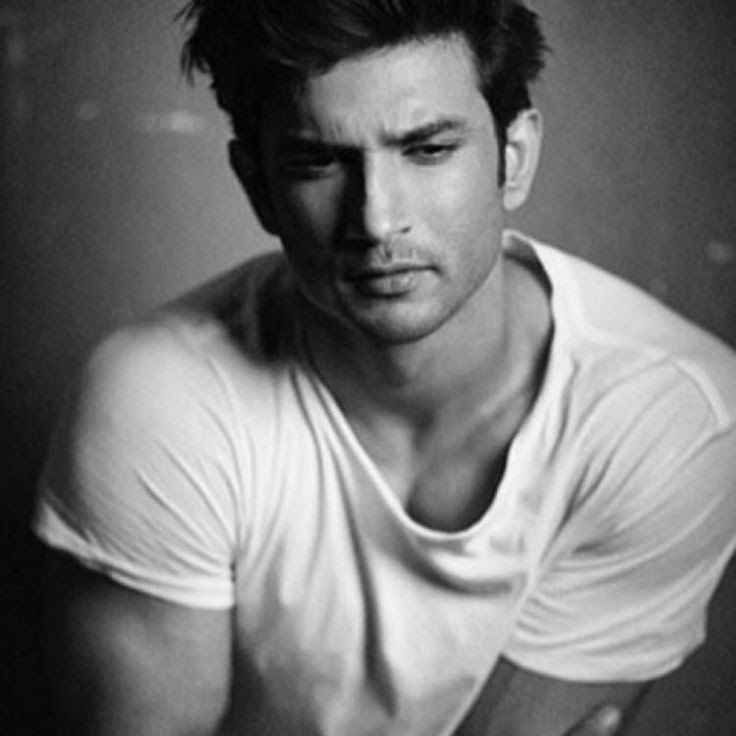
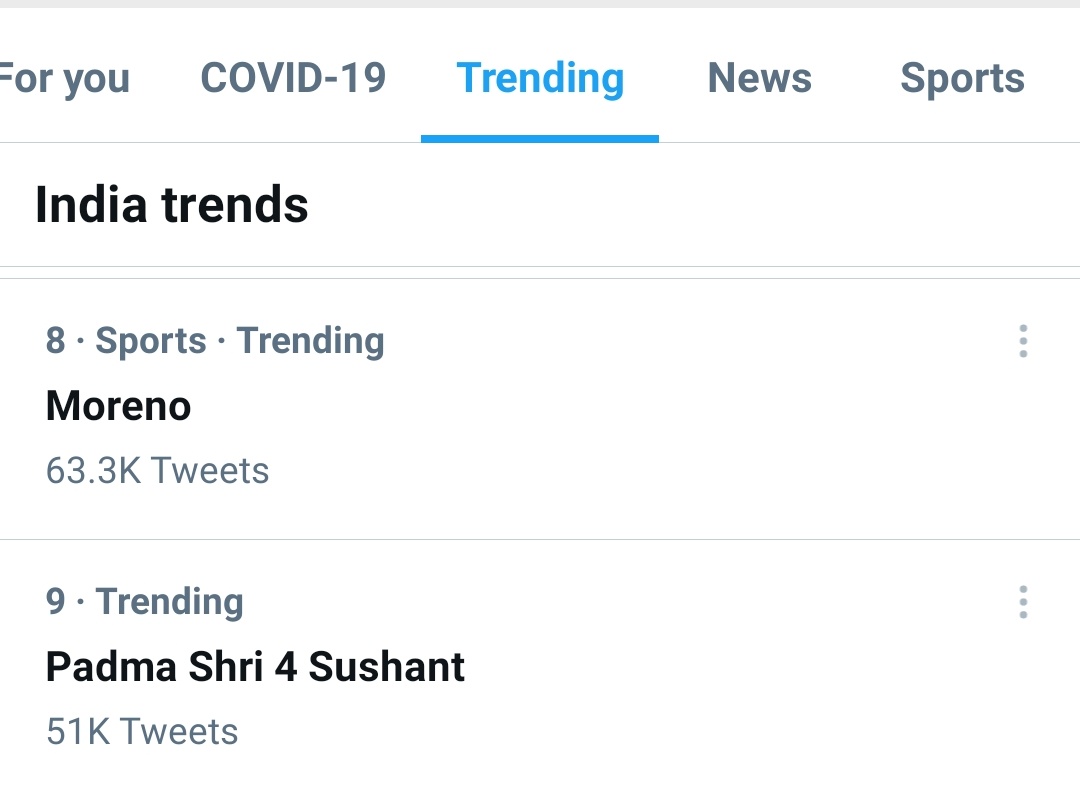
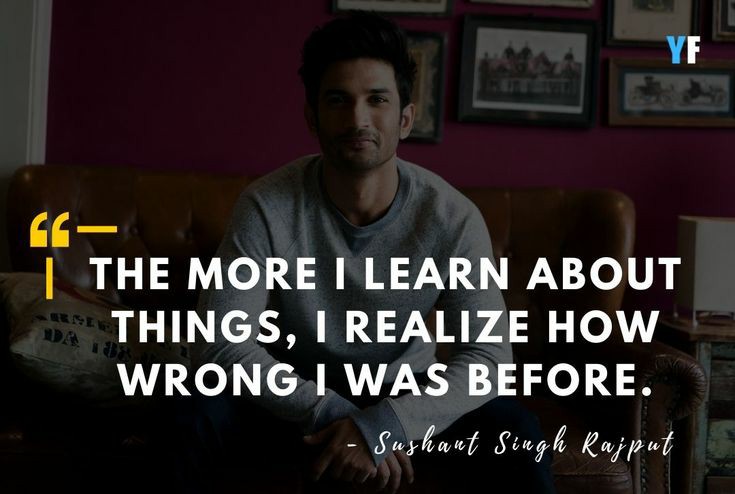
It’s been more than a year since we lost one of the most talented and humble actor of bollywood, Sushant Singh Rajput. He starred in a number of commercially successful Bollywood films such as m.s Dhoni : The untold story (2016) , kedarnath (2018) and  chhichhore (2019). Because of his pure acting & submissive behaviour may people still can’t believe the he is no more around us. Though it’s very unfortunate that his death mystery still remain unsolved and questionable but his fans & netizen never let his presence settle down. This time shushant’s name has been over the news because of recent trend over the tweet. We already know that #justiceforshushantsinghrajput & #ssrArmy has been on twitter for very long. According to recent trending tweet the fans of shushant are demanding Padma Shri for shushant. According to Twitter “Padma shri 4 shushant ” is in top ten tweets in india , with tweets more than 50k.

The acting of shushant entangled his fans in sush a way that no one is satisfied with the end he got. Twitterati & his fans feels that he deserves an honorary award from central government for his contribution to films& cinema.
Apart from acting shushant was interested in astrophysics and space. In an interview he said that coding is something which everyone needs to know because he believed that coding is the future and predicted that in a few years, coding will be made mandatory in the school curriculum.

Unknown Facts about shushant singh rajput

  • Sushant was an ambidextrous person who could write with both hands.
  • Sushant was supposed to play an astronaut in the space movie Chanda Mama Door Ke. He had even visited NASA to train himself for the role. Unfortunately, the film was cancelled.
  • Sushant was a National level Olympiad winner in Physics. He had cleared as many as 11 engineering entrance exams. After completing 3 years in Delhi School of Engineering, he dropped out to chase his dream of becoming an actor. He also stood at 7th Rank AIEEE in 2003.
  • Many think Sushant’s television debut was the popular daily soap, Pavitra Rishta. However, that’s not true. Many still don’t know that the actor started his acting career with the role of Preet Juneja in the serial ‘Kis Desh Mein Hai Dil Mera’.
  • Sushant Singh Rajput, received Scholarship Offer to join Stanford University, California

**👆👆 check out this video of shushant singh rajput at iit Bombay

For more news related to bollywood vist 👇👇

https://indianexpress.com/about/sushant-singh-rajput/

https://youtube.com/c/BollywoodHungama

An Art of Hope

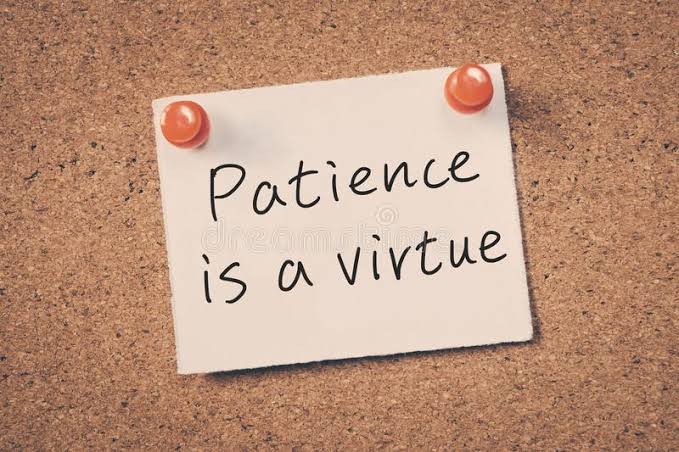
Do you get annoyed when somebody doesn’t respond to your calls? or Do you feel frustrated when you are unable to finish a task? These emotions are faced within you when you lack patience.
Patience is when an individual can bring these emotions under control and it is also a skill or an ability to tolerate delay and act accordingly.


Impatience leads to anger issues, it also acts as an obstacle between you and your goals, it increases the chances of making wrong decisions and it may also lead to a negative attitude and constant complaining.

Whereas patience will help you to stay calm, it will increase the chances of making proper decisions and may create a positive attitude within you and a positive environment around you.


Patience is a skill which should be taught by parents to their children. A child should learn to wait even for the littlest craving. It will increase their ability to wait and would definitely help them to get closer to their goals and dreams in the future.

The importance of patience is also given in some holy books like Bible, Bhagavad Gita, and Quran.
It focuses on the ability to be calm with your loved ones as well as your foes.

How to foster patience?
There are various ways to develop patience.

 • Learn to wait
 • Take a long view before making any decisions
 • Stay calm even during difficult stages of life.
 • Smile even during facing challenges
 • Relax between tasks
 • Also be a patient listener


A child’s patience is tested when he doesn’t get his favourite toy , a man’s patience is tested when he doesn’t get his job promotion.Patience is tested of every person at every stage of life and one should know how to tackle it perseverance can bring patience to life.
Patience comes to us when we practice it in our daily lives. It is a virtue to be exercised with repeated efforts to create long-term goals and be successful. So, have patience!

Life Of Mercury

Close your eyes and envision yourself standing on the stage and singing in front of a countless crowd while they cheer for you. Indeed, you are a rockstar!
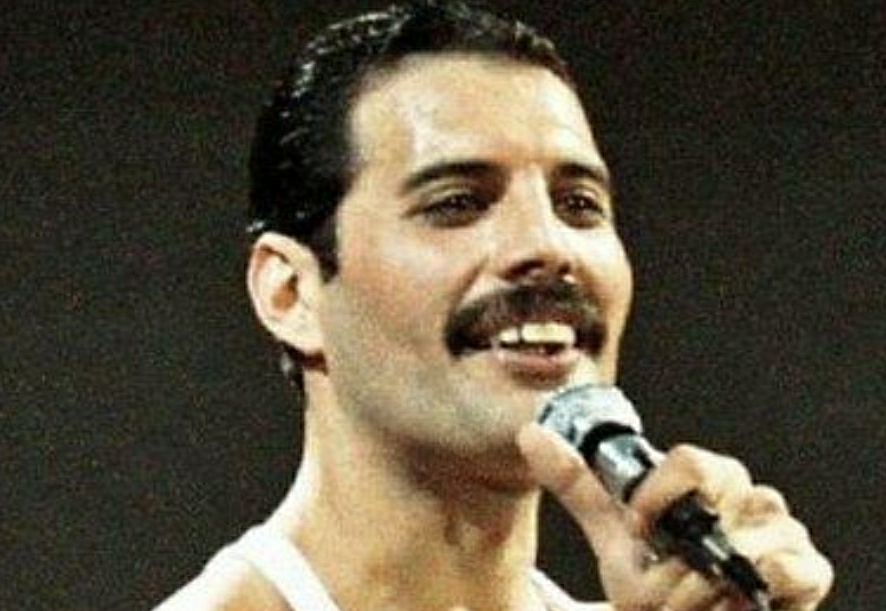
The first Indian Rockstar to experience this was Freddie Mercury, original name Farrokh Bulsara. It is said that he was given this name by his teachers and classmates. He was born to Parsi parents and spent the majority of his adolescence in India. He later moved with his family to England, where his music career began. He formed a band with Brian May and Rodger Taylor and named it Queen. Bassist John Deacon joined the following year. Initially, the band failed to draw much notice however, the album Sheer Heart Attack( 1974) and A Night At The Opera (1975) made them internationally famous. ‘Bohemian Rhapsody’ is considered Queen’s most mysterious and beloved song.

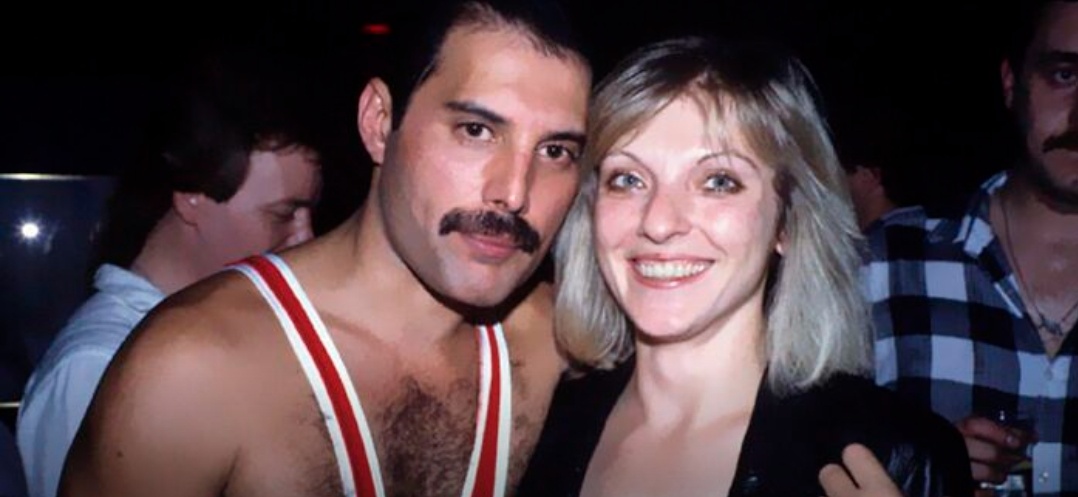
When it comes to his personal life Mary Austin stole Mercury’s heart in 1969 and they became inseparable after that. He always mentioned Mary Austin whenever he talked about the only love of his life.

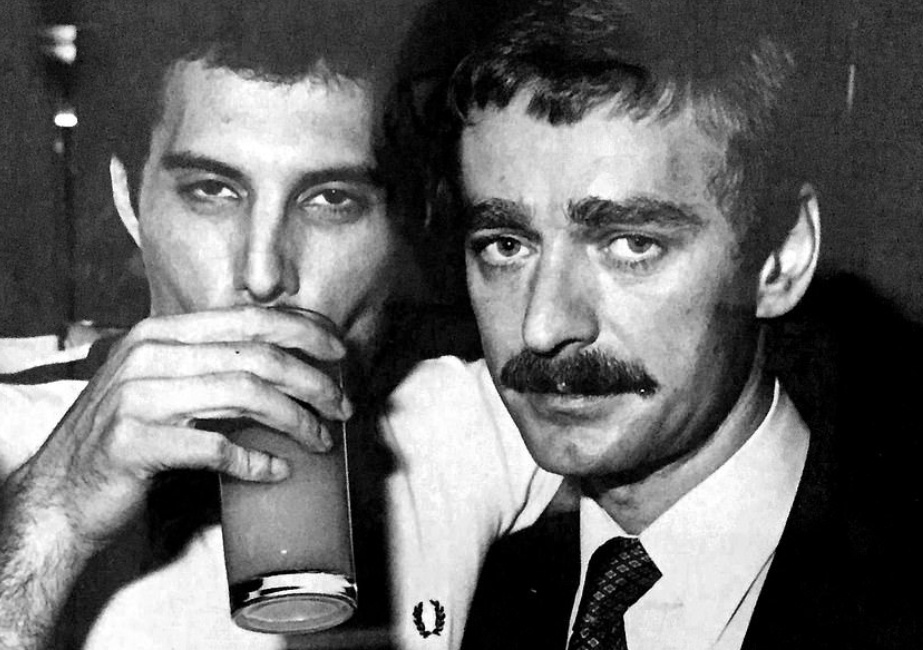
Paul Prenter played a significant role in his life too. He was his former manager and he double-crossed him by selling a story to a national newspaper about his personal life. He ruined his life by claiming that Freddie slept with hundreds of men and furthermore gave profound insights regarding his personal life which forced him to fire Paul. His last day on earth was 24th November 1991, he passed away due to bronchial pneumonia due to AIDS-related complications.

Without a doubt, he was a courageous, gallant, and defiant Rockstar in the history of music.

THE ART OF NATURE

Helloooo guys!! Hope you all are doing good😊.

Before we jump right into the topic .

I have a few questions to ask.

What do you think is the most popular pick for any photographer or an artist?
From where do you think are the musicians getting inspired from?

Why is the sun shining so bright in the morning and it’s so dark in the night?
Why are the water bodies blue? Why are trees green?

Ok ok I asked too many questions, haha sorry guys
I will ask only one question .

Why is the nature so beautiful?

All this points to only one thing that is

” The art of NATURE”

It’s the art of nature because the nature is deciding the beautiful and colourful strokes needed for the beings to live.

Nature has everything that is needed to be learnt by us humans .Every aspect of it is something special.

Nature is magic.”

Nature has many qualities like discipline, strictness, sincerity, love, care
The definition of beauty is nature.”


Nature is so free, boundless.
But at the same time it is not reckless or careless.

Nature is has its own will but it also bends the will if needed .
It forms it’s rules and abides by it but when it breaks those rules the living beings have to face dire consequences.

It’s as if the process of crafting is so beautiful that your in awe .

It’s make you feel every bit of emotion that exists but you cannot express all in it few words.


The ocean, sea, rivers, all forms of water bodies are like vast blankets that cover the earth as if protecting us .

The sky so free that when we stare at it makes you feel as if the limiter we have set is broken .When we stare at nature there is an immense silence and its as if nothing can stop you from experiencing the freedom .

The clouds are like the drawings that kids draw with pure heart although not perfect, it fills our heart.

We definitely have to talk about the starry night skies that fill our eyes with glitters ,words are not enough describe the beauty of the nature.

This feeling of satisfaction is similar to that of watching an art piece of your favourite artist in an art museum .

Nature gives food, water, what not it gives everything that we need so that we can sustain our lives on earth .

Because of its unconditional love we are leading happy lives .

Everyone calls it “mother nature” .In my view nature is god because of its pure love towards every being living or non living. It doesn’t discriminate anyone on any basis . Nature embraces us, protects us, even when we destroy, pollute it still accepts us.

So in return our only responsibility as on the receiver side is to protect the nature and its beauty
so our next generations can also see the “Art of nature”
.

THANKYOU^^

The Art of Rogan Painting

India is a diverse country, rich in age-old traditions and culture. Throughout its history, India has witnessed the emergence of many exotic art forms and craftsmanship. However, with the rise of cutting-edge technology of industrial textiles, many traditional craft forms have taken a massive hit. Rogan painting is a classic example of an enthralling yet sadly dying art. 

What is Rogan Painting?

Rogan painting is a 400-year old inherited traditional textile craft of Gujarat. It is considered to be the oldest and most challenging printing art in the history of textile. The word Rogan means oil in PersiaWith origins in Persia, it was brought to India around 300 years ago, even though there is not enough historical evidence to support the statement. 

Preparation of the Ingredients

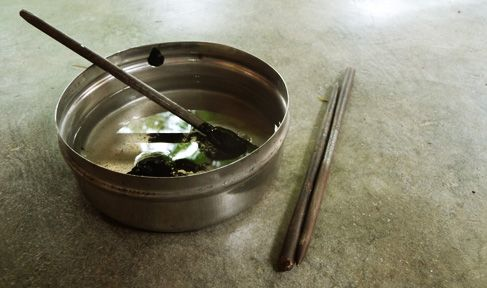
The chief ingredients required for Rogan painting are castor oil, wood, kerosene oil and dyes. The first step in the painting is the preparation of Rogan paste. 

After preparing a furnace and selecting a suitable aluminium container, the local craftsmen boil a litre of castor oil for a minimum of four hours. The time required for boiling may vary depending upon the quantity of the oil taken. Then, they continuously stir the oil until it is time to remove the container from the furnace to let it cool down. While boiling, the castor oil may catch fire, after which it is immediately taken out and covered with a lid. During this, the impurities present in the oil gets thrown out in the form of fumes. This process is repeated several times until the oil forms a thick, gelatin-like consistency and turns yellowish. 

Traditionally, the dyes used in Rogan painting were derived from organic, natural sources such as stones and plants. But today, synthetic dyes are used too. Red, yellow, blue, white, green, and brown are the primary colours used in the painting. 

A manual stone grinder was used to mix naphthol dyes and white chalk powder and prepare the colour paste. With the gradual addition of water, the required consistency of the paste is reached. The Rogan paste is added to the colour paste and ground until it forms the desired soft, smooth, gelatinous dye paste. 

Process of Rogan Painting

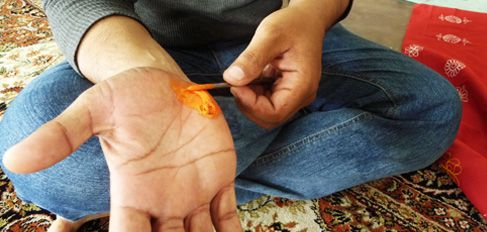
The process of painting is a very tedious and cumbersome task. Initially, the craftsmen lay the fabric to be painted on the floor. Next, they take a lump of the dye paste and put it on the palm of one hand. They hold a suya rod or a metal stylus in the other hand and mix the thick paste till it stretches into a thread-like structure. 

They carefully twist the rod to create beautiful motifs and patterns across the fabric without the rod touching the cloth. After that, they fold the fabric and press it evenly to obtain an identical impression on the other half of the fabric. Lastly, the fabric is left out in the sunlight for about six to seven hours to let it dry.

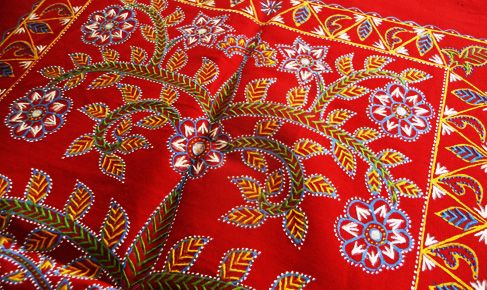
The intricate motifs that embellish the fabric, such as geometric flowers, peacocks, the tree of life, etc., are inspired by the history and folk culture of the Kutch region of Gujarat.

Originally, the Rogan Art was used to adorn the trousseau of a bride. But due to the limited resources, meeting the market demand has become a challenge. From almost becoming a dying art to gaining worldwide recognition, Rogan Art sure has come a long way.

Indian Art Style

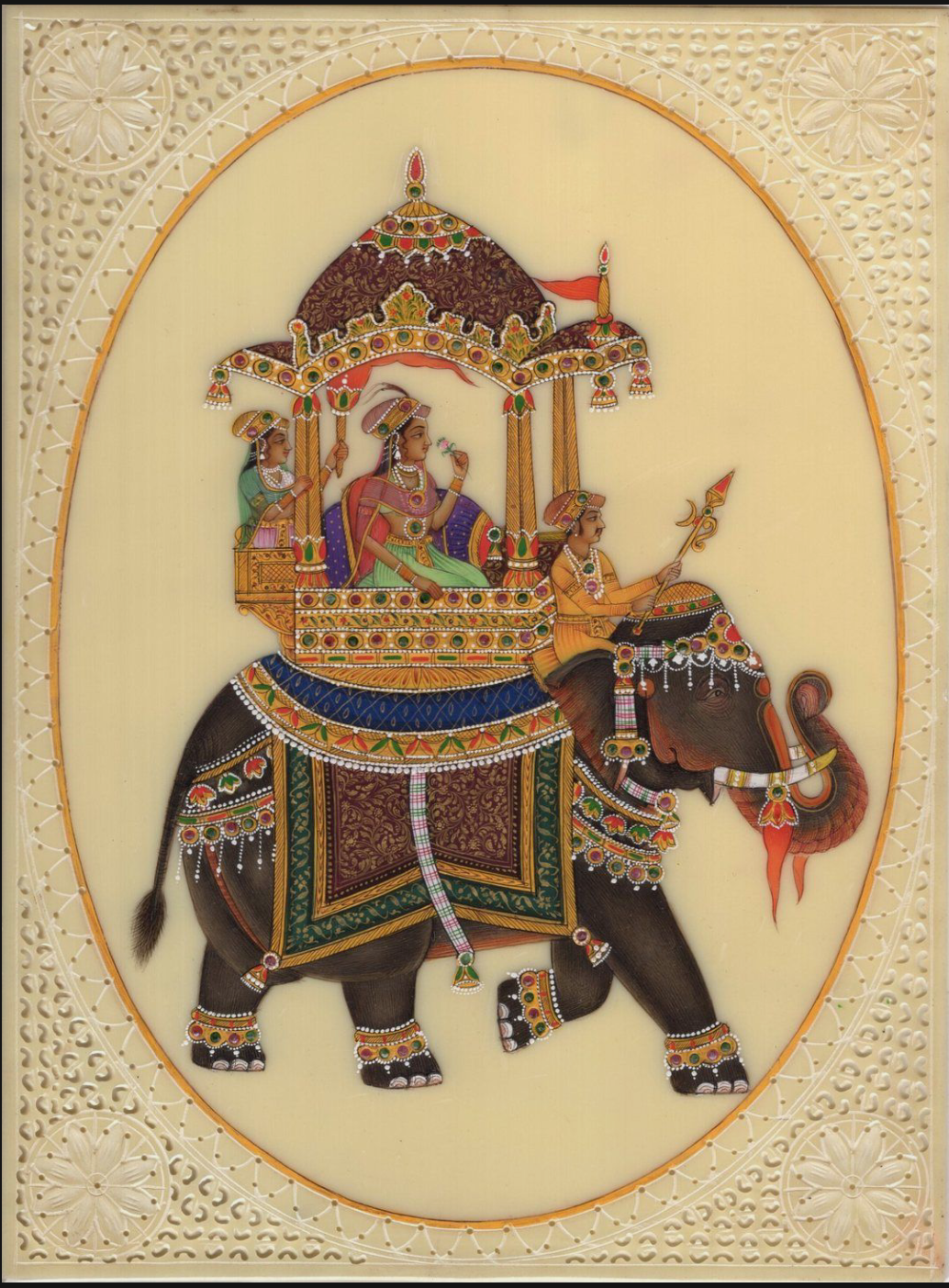
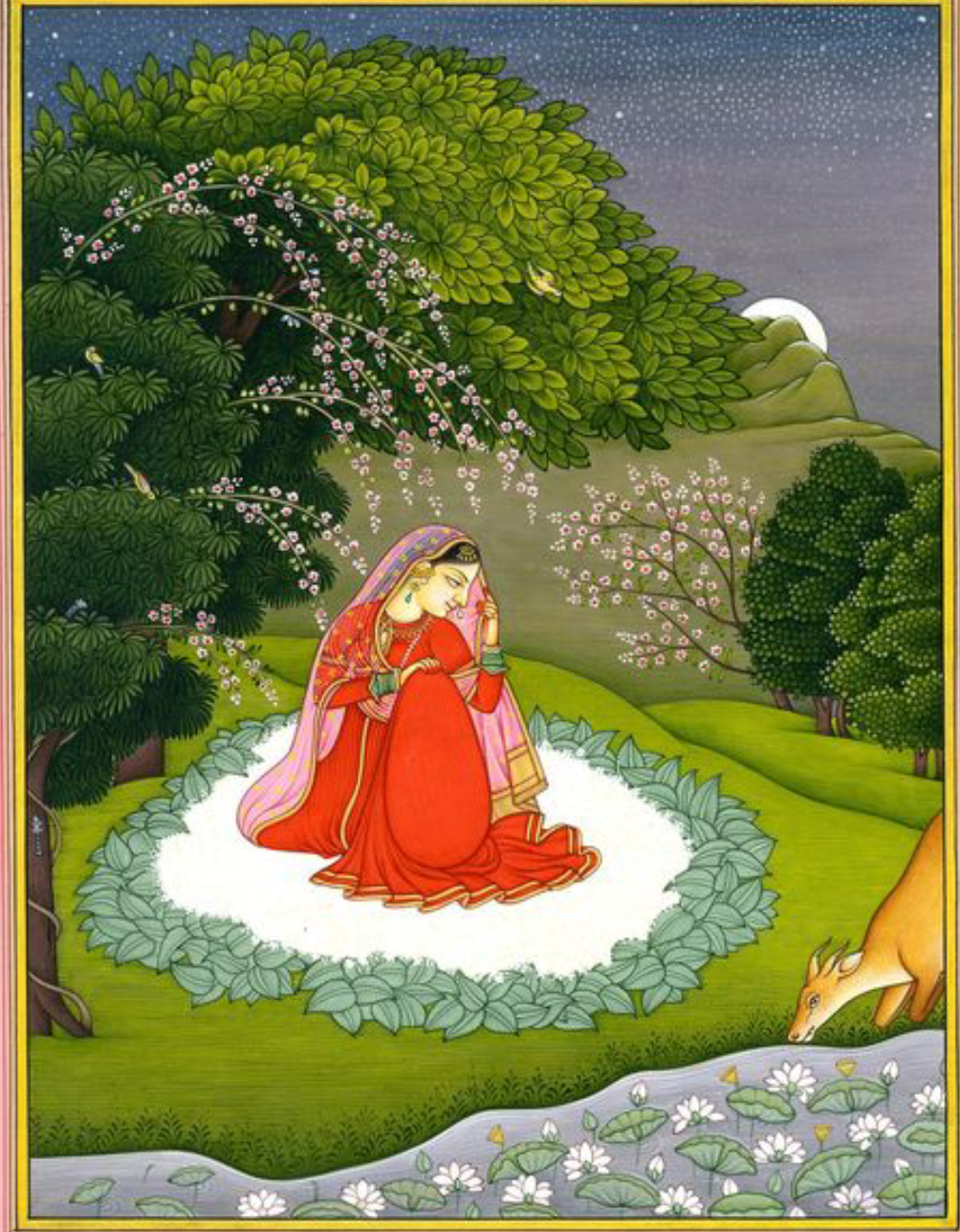
• Rajasthani miniature art

Rajasthan is one of the pioneer seats of miniature painting in India. Rajput painting, also known as Rajasthani painting, is a style of Indian painting evolved and flourished in the royal courts of Rajputana, India. Each Rajput kingdom evolved a distinct style but with certain common features. Rajput paintings depict a number of themes, events of epics like the Ramayana and the Mahabharata, Krishna’s life, beautiful landscapes and humans.

Miniatures in manuscripts or single sheets to be kept in albums were the preferred medium of Rajput painting but many paintings were done on the walls of palaces, inner chambers of the forts, havelis, particularly the havelis of Shekhawati, the forts and palaces built by Shekhawat Rajputs. The colours were extracted from certain minerals, plant sources and conch shells and were even derived by processing precious stones. Gold and silver were also used. The preparation of desired colours was a lengthy process, sometimes taking weeks. The brushes used were very fine.

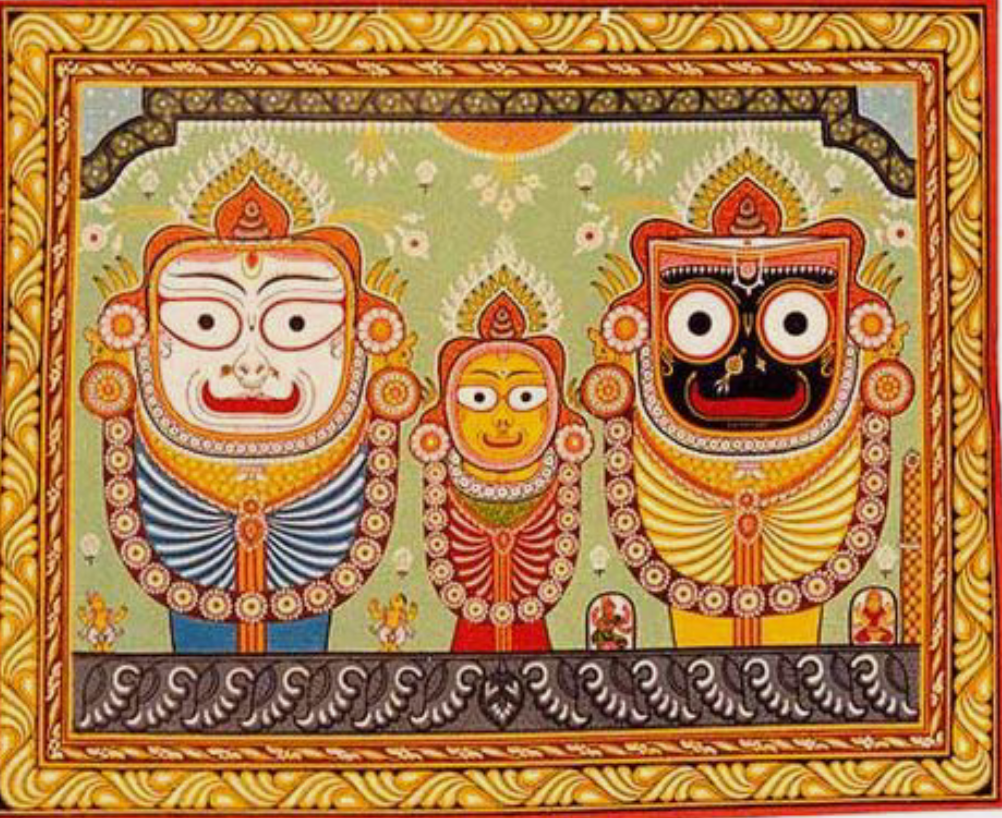
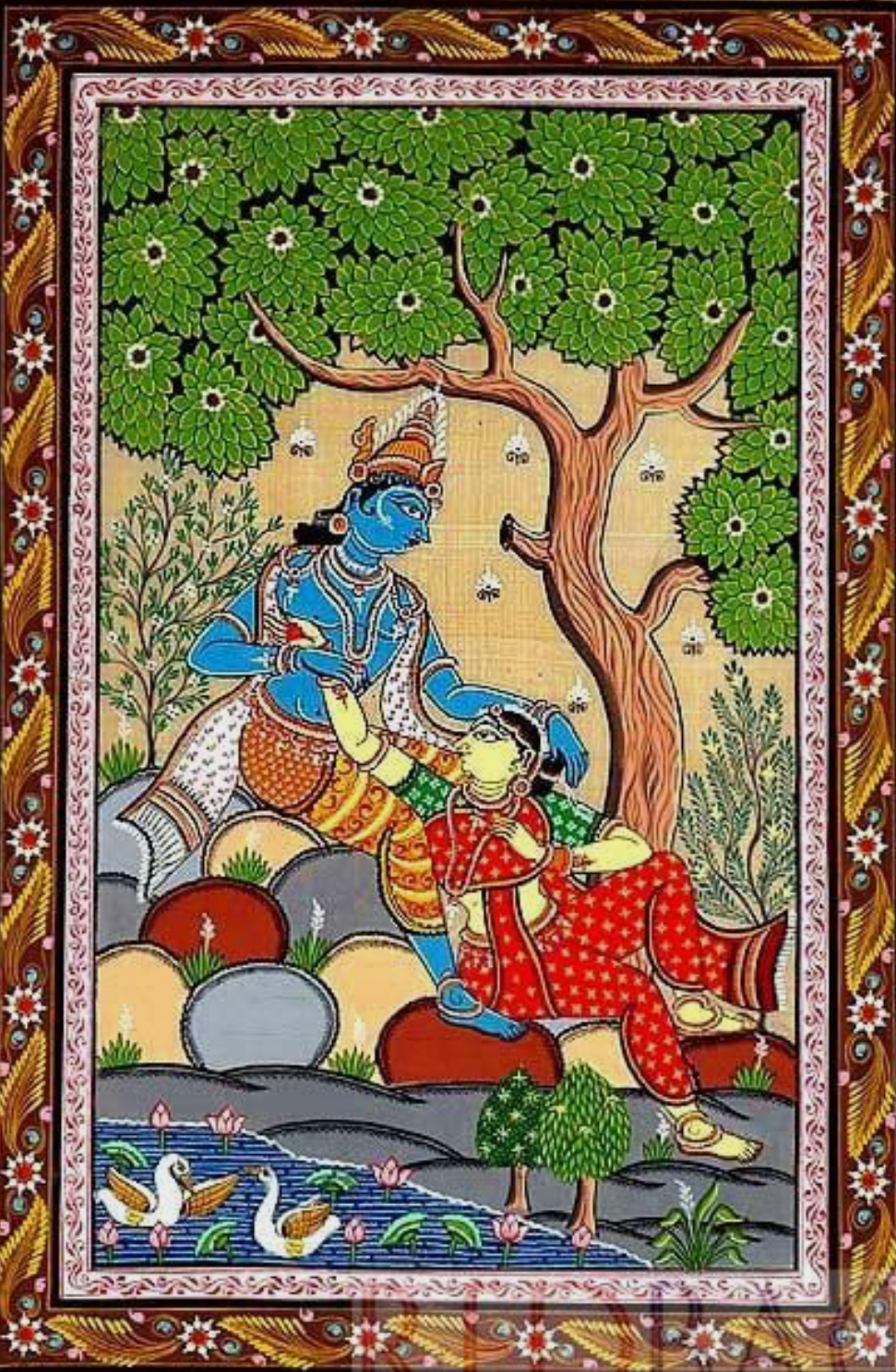
• Pattachitra

‘Pattachitra’ is a general term for traditional, cloth based scroll painting based in the eastern Indian state of Odisha. In the Sanskrit language, ‘patta’ literally means ‘cloth’ and ‘chitra’ means ‘ picture’. The pattachitra style of painting is one of the oldest and most popular art forms of Odisha.

All colours used in the paintings are natural and the paintings are made fully in the old traditional way by chitrakaras who are Oriya painters. Pattachitra is manifested by a rich colourful application, creative motifs and designs and portrayal of simple themes mostly mythological in depiction. The traditions of pattachitra paintings are more than a 1000 years old. Pattachitra paintings resemble the old murals of Odisha, especially those from the religious centres of Puri, Konark and Bhubaneswar regions, dating back to the 5th century BC. The best works are found in and around Puri, especially in the village of Raghurajpur. The theme of Oriya painting centers round the Jagannath cult and the Vaishnava cult. Since the beginning of pattachitra culture, Lord Jagannath, who is an incarnation of Lord Krishna, has been the major source of inspiration. In the 16th century, with the emergence of the Bhakti movement, the paintings of Radha and Krishna were painted in vibrant shades of orange, red and yellow. There are typical scenes and figures like Krishna, Gopi’s, elephants, trees and other creatures portrayed in these paintings. Krishna is always painted in blue and Gopis in light pink, purple or brown.

Thank you for reading. Have a nice day!🌼

Indian Folk Art

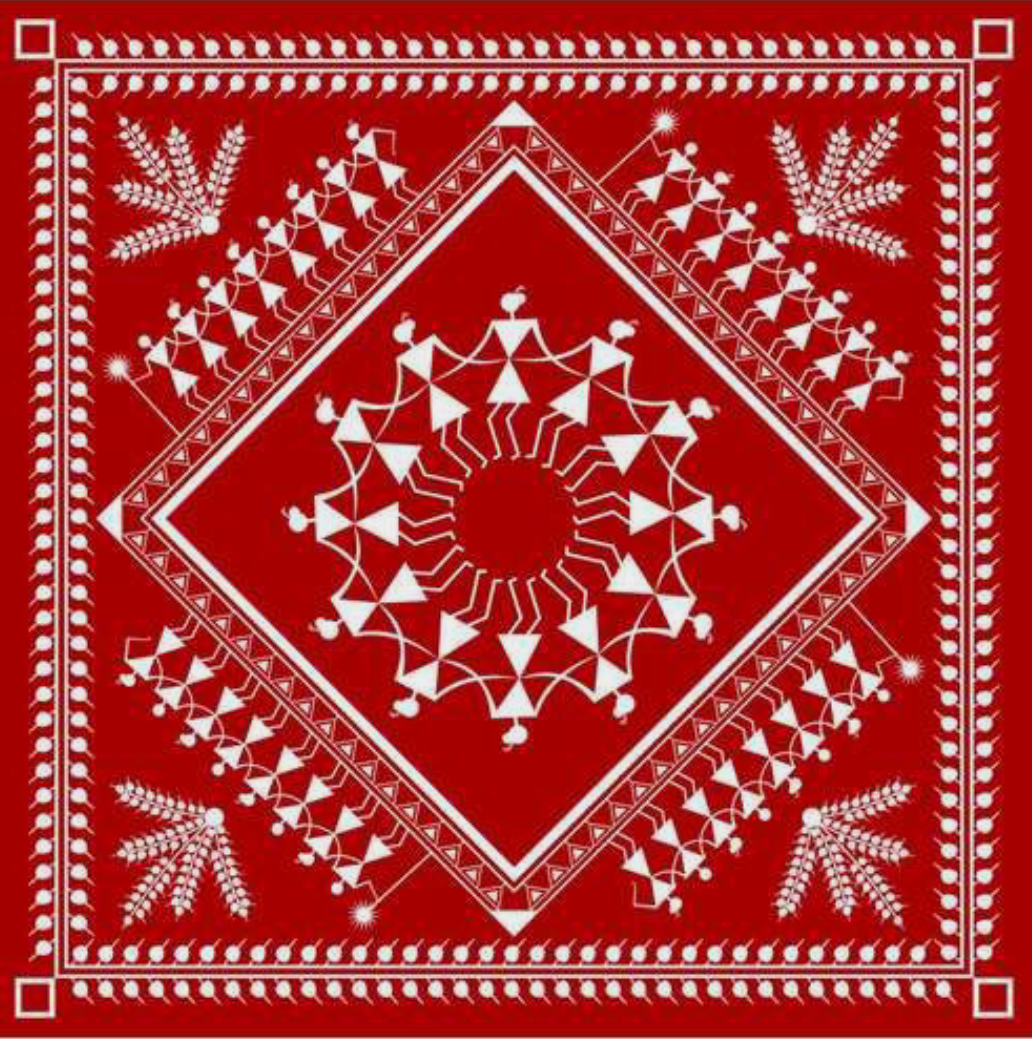
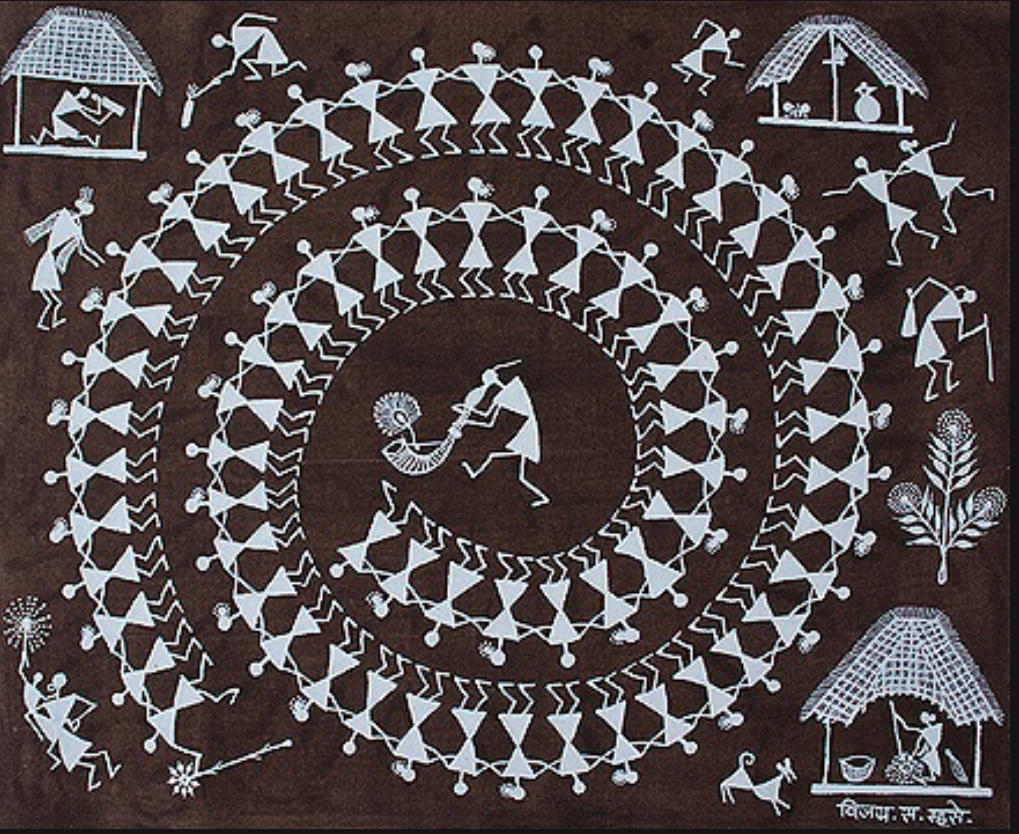
• Warli paintings

Warlis or Varlis are an indigenous tribes or adivasis living in the mountainous as well as coastal areas on the Maharastra-Gujarat border and surrounding areas. They have their own animistic beliefs, life, customs and traditions. As a result of acculturation, they have adopted many Hindu beliefs. Their extremely rudimentary Wall paintings use a very basic graphic vocabulary a circle, or triangle and a square. Their paintings were monosyllabic. The circle and the triangle come from the observation of nature, the circle representing the sun and the moon, the triangle derived from mountains and pointed trees. Only the square seems to be a different logic and seems to be a human invention, indicating a sacred enclosure or a piece of land.

The ritual paintings are usually done inside their huts. The walls are made of a mixture of branches, earth and cow dung making a red ochre background for wall paintings. Warlis use only white in their paintings. The white pigment used by them is a mixture of rice paste and water with gum as a binding. As the brush, they use a bamboo stick chewed at the end to make it as supple as a paintbrush. The wall paintings are done only on special occasions such as weddings or harvests. Warli art is the cultural intellectual property of the tribal community. Today, there is an urgent need for preserving this traditional knowledge in tribal communities across the globe. Now, Warli painting is registered with a geographical indication under the intellectual property rights act. With the use of technology and the concept of social entrepreneurship, tribals established the Warli Art Foundation, a non-profit company dedicated to Warli art and related activities.

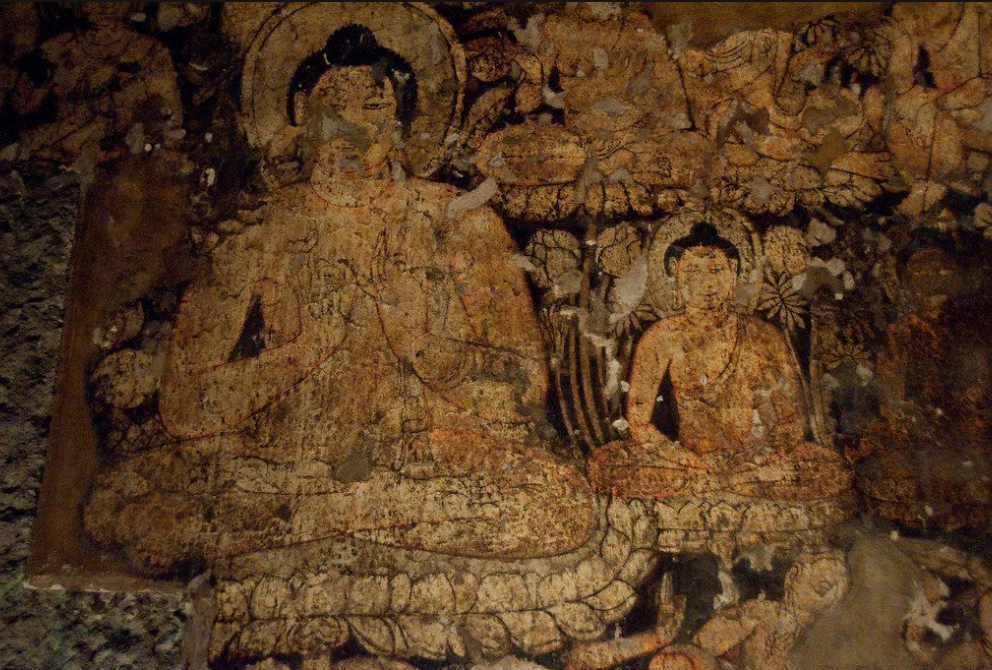
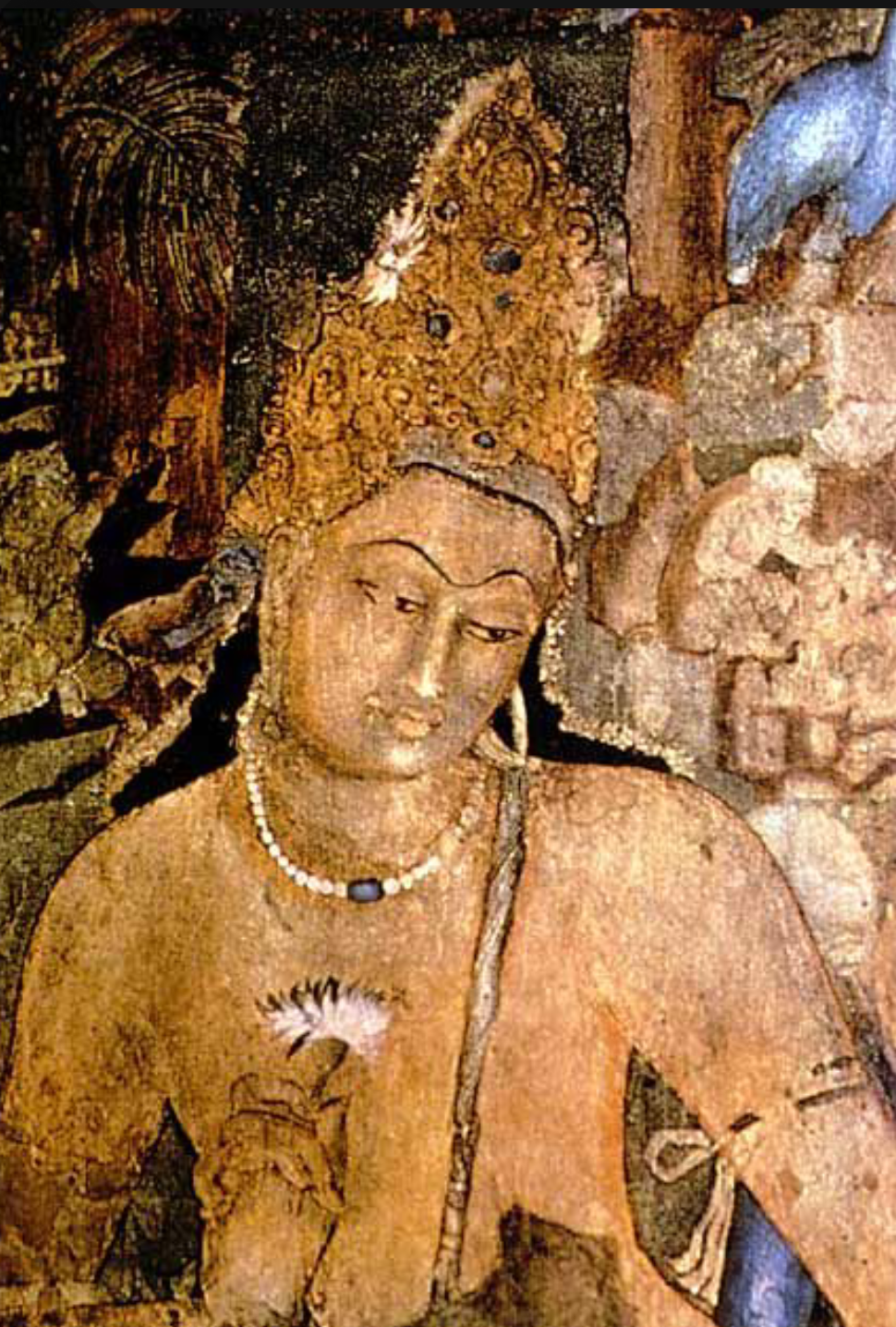
• Cave paintings in India

Almost all early painting in India survives in caves, as very few buildings from ancient India survive. The history of cave paintings in India or rock art range from drawings and paintings from prehistoric times – beginning around 30000 BCE in the caves of Central India, typified by those at the Bhimbetka rock shelters – to elaborate frescoes at sites such as the rock cut artificial caves at Ajanta and Ellora, prevalent as late as the 8th – 10th century CE. The frescoes of Ajanta are paintings in the Ajanta caves, which are situated near Aurangabad in Maharashtra. The caves are carved out of large rocks. Inside many of the caves are frescoes. Frescoes are paintings which are done on wet plaster in which colours become fixed on the walls and ceilings at Ajanta.

The paintings reflect different phases of Indian culture from Jain tirthankar Mahaveer’s birth to his Nirvana in the 8th century AD. The frescoes have degraded slightly due to the effect of flash photography. Photography here is not banned. The paintings depict themes of court life, feasting, processions, men and women at work, festivals and various natural scenes including animals and birds and flowers. The artists used shading to give a three-dimensional effect.

Similarly, beautiful frescoes have been found at the Bagh caves, 150 km away to the North of Ajanta. Though the themes in these paintings are both secular and religious, they do depict some aspects of Buddhist life and rituals. One of the most famous paintings show a procession of elephants. Another depicts a dancer and women musicians. These have been influenced by the Ajanta style of painting. These frescoes show a strong resemblance to the frescoes of Sigriya in Sri Lanka.

Thank you for reading. Have a nice day!🌼