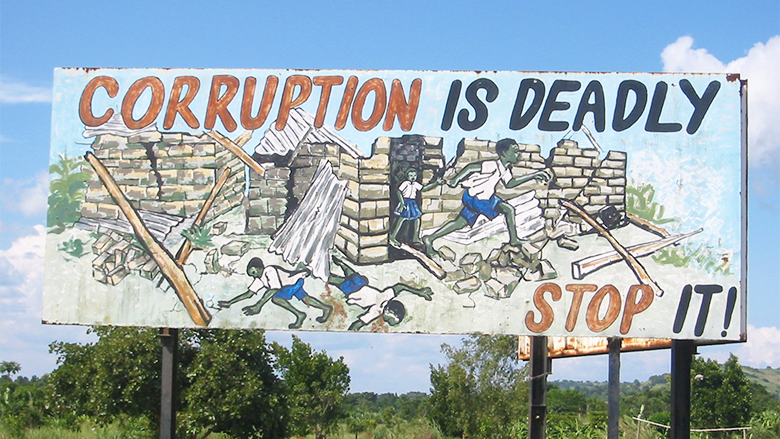
Corruption

Corruption is a form of dishonesty or criminal offense undertaken by a person or organization entrusted with a position of authority, to acquire illicit benefit or abuse power for one’s private gain. Corruption may include many activities including bribery and embezzlement, though it may also involve practices that are legal in many countries. Political corruption occurs when an office-holder or other governmental employee acts in an official capacity for personal gain. Corruption is most commonplace in kleptocracies, oligarchies, narco-states and mafia states.[citation needed]
Corruption can occur on different scales. Corruption ranges from small favors between a small number of people (petty corruption), to corruption that affects the government on a large scale (grand corruption), and corruption that is so prevalent that it is part of the everyday structure of society, including corruption as one of the symptoms of organized crime. Corruption and crime are endemic sociological occurrences which appear with regular frequency in virtually all countries on a global scale in varying degree and proportion. Individual nations each allocate domestic resources for the control and regulation of corruption and crime. Strategies to counter corruption are often summarized under the umbrella term anti-corruption.

Everyone censures corruption at a societal stage but that does not mean that anyone has escaped from the flu of corruption. It is not an infection in one country. People worldwide are involved in the act of corruption. India is no exception to it. Corruption in India has even crossed the alarming stage. From the officials of the highest rank to a peon everyone is corrupt.

It is a term known to all of us precisely meaning an illegal, immoral or unauthorized act done in due course of employment. But literally it means “Inducement (as of a public official) by improper means (as bribery) to violate duty (as by committing a felony)”.

Corruption is a termite in every system. Once it enters the system, it goes on increasing. Today it is rampant and has gradually become routine. Worldwide, bribery alone is estimated to involve over 1 trillion US dollars annually.

This shows how big a problem is corruption. It is indeed the biggest challenge in front of any government because the system itself is handicapped as its own employees are slaves of another. In the author’s view view corruption is the root cause of all other problems that a country faces. Let us look at it with reference to India. Many big problems such as poverty, unemployment, illiteracy, pollution, external threats, underdevelopment etc. are posed in front of the Indian government. But having a glimpse at all these problems faced by India, one might notice that corruption plays an important role in making these problems even bigger. India is still facing poverty due to corruption.

The government and its employees all are corrupt so the schemes floated by the government for the betterment of poor are not properly implemented and just because corruption comes into play the grant advanced to the poor does not reach them and they remain the same and so does the problem of poverty. The same principle applies to the problem of external threats. India’s neighbouring countries are also a threat to the country and its sovereignty. Because of the officials or even citizens being corrupt either for their personal gain or enmity towards their home country the neighbours prove to be even more dangerous. Such officials may leak important information to the neighbours which gives them an upper hand. The same was hinted post 26/11 attack in India. According to the sources the attack couldn’t have been possible without the help of the insiders.

Corruption is not just limited to administration. It is very much prevalent even in legislation and judiciary so much so that it is probably the biggest challenge and needs to be eradicated from its grass root. For the same purpose the Prevention of Corruption Act, 1988 has been enacted.

This Act incorporated the Prevention of Corruption Act, 1947, the Criminal Law Amendment Act, 1952, and sec. 161 to 165-A of the Indian Penal Code. The Prevention of Corruption Act, 1988, thereby widened the coverage, strengthened the provisions and made them more effective.

This Act in particular defines the act of bribery, prescribes its punishment and also deals with the intricacies of law such as appointment of special judges, their powers, summarily triable cases etc.

The Act describes, defines, discriminates different forms and stages of corruption and prescribes punishment for the same. Under Section 7 of the Act, any public servant expecting or accepting any gratification other than his legal remuneration from any person to favour or disfavour or service or disservice any other person shall be punishable with imprisonment not less than 6 months but may extend to 5 years and also with fine.

Section 8 deals with the cases of public servants accepting gratification by illegal means to influence public servant. The same provision prescribes punishment up to 5 years imprisonment and fine. The maximum punishment prescribed under the Act is up to seven years imprisonment and fine under Section 14 that deals with those habitual of getting involved in the act of corruption in one or the other way.

Corruption is a big reason to worry for the Indian government. The Act is technically drafted in a beautiful way, but it has not effectively come to the aid of the government to curb corruption. So the punishment prescribed in the Act shall be much stricter to deter the intending violators.

Are products really ‘Made In China’ ???

Made in China. We’ve become accustomed to seeing the label on products manufactured in the world’s second biggest economy. But buying one of these products in China instead of say, the U.S., doesn’t guarantee you’re getting a better price. Chinese tourists have built a reputation for being big spenders abroad, spending a whopping $277 billion in 2018, much more than any other nationality. A lot of times, people think that purchasing something in China will be inexpensive, but that isn’t always the case. So how much of a difference are we talking? If we bring four products from four popular western brands to compare. Starbucks, H&M, Adidas store, a Godiva store. To keep things consistent, we will be using 2019’s average foreign exchange rate. The products compared are:

  1. A standard black t-shirt at H&M.
  2. Starbucks Grande Cappuccino.
  3. Godiva Chocolates.
  4. An Adidas hat.

Now let’s compare:

  1. The shirt at H&M is priced nearly the same in the U.S. and China.
  2. A Grande Starbucks cappuccino will cost you $4.63 in Beijing, but in Los Angles, California, $3.95.
  3. This case of Godiva chocolates, called Pearls, is priced at $7.24 in Beijing, but only $3.95 in LA.
  4. The Adidas hat will set you back $42.27 in China, nearly double the price of a similar hat in the U.S.

This experiment has made clear that pricing are complicated. So much so, that websites have popped up like the Mac Index, a site that compares Apple product prices from around the world. So many ads for Apple here in this area. According to an analysis done by Tech Insights, the cost to make an Apple iPhone 11 Pro is $490.50. Yet according to The Mac Index, the price to buy one is $1,318 in Japan, $1,477 in the U.S., $1,658 in Mainland China and more than $2,000 in Turkey and Peru. Prices vary across countries due to factors like demand, tariffs and tax refunds. And then there’s the supply chain: the network of people, organizations, activities, information and resources involved in the creation of a product.

close up of camera over black background
Photo by ATC Comm Photo on Pexels.com

Apple’s current CEO Tim Cook is considered by some to be a mastermind in supply chain. He first joined Apple in 1998 with a mandate to clean up the company’s manufacturing and distribution. Over time, he closed factories and warehouses, instead opting for contract manufacturers in China. That’s great for Apple’s profit margins, but it’s certainly not praised by President Trump, who has asked Apple to make its products in the U.S. If, say, iPhone production was moved to the U.S., instead of China, different analyses show the price for the consumer could go up from anywhere from $30 or $40 to hundreds of dollars to even $30,000-100,000. That’s partially why, despite Apple pledging to invest more money in American manufacturing, it maintains China as its hub for making its gadgets.

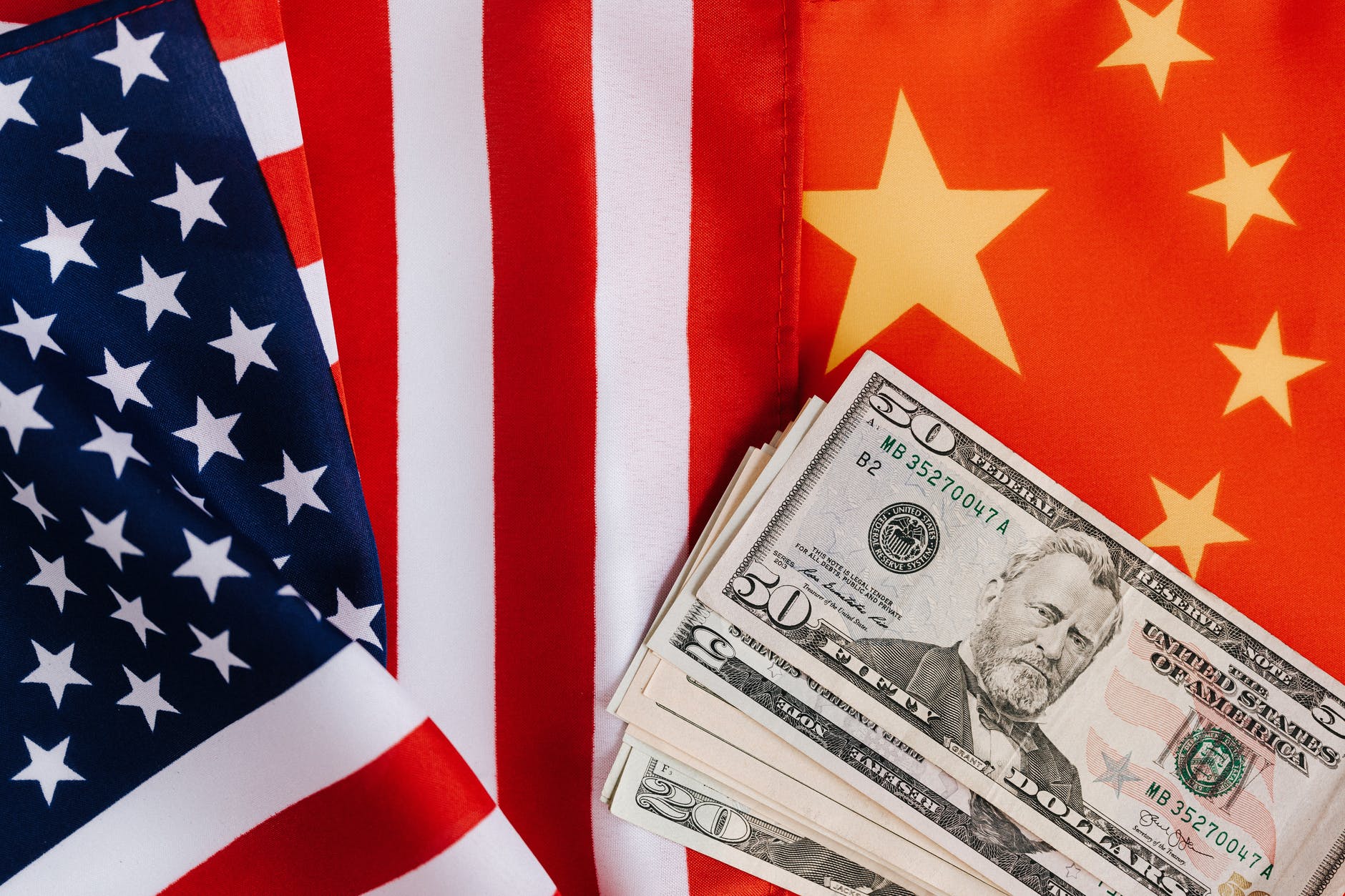
american and chinese flags and usa dollars
Photo by Karolina Grabowska on Pexels.com

That’s Omar Slim, a senior portfolio manager at global asset manager, PineBridge. When you hear about made in this country or that country is really quite relative and it’s a simplification of things because it’s most likely made in a number of countries. Here’s an example. Let’s say we want to make lasagna for dinner. If Jeff cooks the ground beef and prepares the cheese, Sarah makes the tomato sauce and layers the ingredients into a pan; and Blair, who bought all the ingredients, puts it in the oven, who gets the credit for making the lasagna? Now, let’s apply that to Apple’s iPhone. While the phone might say ‘Made in China,’ some of its parts come from other parts of Asia, Europe and even the U.S. Even though an iPhone may be assembled in China, it’s still tariffed in China as a U.S. product because Apple is an American company. The brand makes that clear with by, ‘Designed by Apple in California. How they’re treated in terms of customs, they will be treated as a U.S. product. So regardless of where they come, it’s essentially a U.S. product. Same for Chinese products going into the U.S. and same for, for instance, European cars.

India simply cannot afford to boycott Made in China — Quartz India

China became a popular manufacturing hub in the 1980s after it started to open to the world. It became known for its cheap labor costs, lax regulations and business-friendly environment. As China’s manufacturing sector grew, it took the crown from Germany as the world’s top exporter in 2010. While Made in China has become synonymous with cheap and low-quality products, China is hoping to change that. In 2015, it launched a Made in China 2025 initiative, which aims to shift its economy from low-end manufacturing to high-end, high-tech products. In 2017, Tim Cook said China lost its place as a low labor cost manufacturing nation many years ago. The U.S.-China trade war resulted in a tit-for-tat increase in tariffs on many products.

Petition · Political Parties: Boycott 'Made in China' products in ...

With increasing costs being passed on to consumers, many companies are looking to diversify their supply chain, instead of being so reliant on China. That sentiment has only grown, following the coronavirus pandemic’s hit on the global manufacturing industry. Along that supply chain, there will be some companies, that instead of manufacturing it in China, if they could, they could try to replace. In fact, companies including Apple, Microsoft and Google are reportedly looking into moving some of their hardware production from China to Vietnam or Thailand. But that might be harder than it sounds. The other countries will have a hard time to compete along with the fact that the infrastructure is shown that it’s quite good, along with the fact that in certain countries would not want to compromise the relationship with China.

70 Reasons that makes us Proud to be Made In India - Sanjay Dalmia

The reality today is that a product likely has many components which are sourced globally. A phone may be designed in the U.S, but its screen is sourced from South Korea, the sensors and microchips may be from Taiwan or Germany, with its assembly in China. So, the next time you see a product with the words, “Made in China,” remember that the full story is seldom pure, and never simple.

India reels from police brutality

Police brutality, ever since the death of George Floyd, the world had been reeling from the inhumane way police treat the “suspects”. Since then a number of protests have surged throughout the world regarding the brutality of police and thus moving to the broader spectrum of overall racism faced by the African-American community in America. While such a movement has done a lot of good, it has also spread a false sense of ease, projecting that such cases of the police brutalizing people is limited to America only. However, that is not the case, in countries such as India the problem is much larger and much more multi-faceted. Here the police do not target by race but by the Social status of a person, i.e. your monetary worth determines how the police treat you.

Photo by NEOSiAM 2020 on Pexels.com

People are often seen chanting the same old things such as know your rights, no one can arrest you without a warrant after such cases, however the problem is, that it isn’t the case of ground reality. Very often at the mere mention of their rights, the “alleged suspects” are beaten to an inch of their lives. Less than a month since the killing of George Floyd, another incident has the world reeling at the blatant lack of humanity within those who call themselves police. The case of P. Jeyraj and J. Fenix shows how these uniformed thugs terrorise the common folk. The cause of their arrest was an alleged violation of Covid-19 Curfew; however, several eyewitnesses deny to that as the arrest took place 30 mins before that. After the arrest of his father, Fenix reaches the station to inquire and is taken into custody. The father-son duo is beaten, nay brutalized by the police. They are tortured beyond imagination and after three days of constant torture the two succumb to their injuries. However, in order to cover up their crime the police file a hospital notice that the two allegedly fell and rolled over and had a subsequent hearth attack, however upon a closer look at the bodies by eyewitnesses that was no the case. The two had injuries throughout their bodies, their chest hair had been ripped out in tufts, their knees completely smashed by lathis, their faces pushed against the walls and blows rained upon their backsides and buttocks until they bled and ripped and subsequently the were stripped naked and thrown into jail. This is way to excessive just for a curfew break and just for this, the responsible police should have been sentenced to the maximum. However, this was not the case as the two were tortured way beyond this by someone who shouldn’t even be considered human. Their cries were heard throughout the time they were tortured. Behind the bars, where there are no CCTV cameras, these goons did their evil deed, they showed up iron tipped lathis or batons up their buttholes several times and their genitalia and backsides were completely ripped and mangled. Three times during the course of this torture, their blood-soaked clothes were sent back to their homes and fresh ones were demanded and then they would be sent back and so on. After a phony trial with a magistrate by the police, the two were taken back to custody and the torture upon their bodies and souls resumed. Two days after the phony trial the two were admitted into a hospital, and were pronounced dead due to heart failure and fever. This shows that even the medical practitioners hand out fake reports for the police. Since this issue came to light even after the blatant trying of Tamil Nadu police to cover it up, a mere two sub inspectors have been suspended and a few have been transferred. That seems like way below the bare minimum that the responsible authorities could do. To define how small the heinous crime’s punishment is, let us compare it to the sentencing of any given rapist. Nirbhaya case’s culprits dragged their cases for eight years. People arguing no matter how irrefutably inhumane their crime was they deserved the treatment of human beings. How is it that Indian society gives better treatment to bloody rapists than lower middleclass working people? How is it that even a terrorist is treated with better respect than a common folk. This wasn’t just a murder, this was a brutalizing work of psychopaths, who have no shred of human morality. No one should be treated like this, much less people who have “allegedly” committed such a small crime. We as a society must question ourselves that how can we progress further if we turn a blind eye to such events.

I feel that I speak about a vast majority of people who are going to see something like this, feel sad for about a minute or so and forget about it because it hasn’t happened to them. However, to them I say, you are even worse than these scums because the only one worse than someone who commits such a crime is someone who can act upon it but doesn’t.

India as a country has rotten to its core, rape, murder and now torture has become common place. In today’s India, Might makes Right. It is up to us, the future generation to change it, but by the looks of it we don’t have the ability to do so.

IS THERE END TO CORRUPTION?

People think that we may catch scam after scam and this country will not change. There must be a sense of urgency and restlessness because we need and want to make a corruption-free India. The other name of ‘just the way things are in India’ is corruption. Corruption is the misuse of power or public property for personal gains, like taking bribery. We see that even the simplest daily- routine administrative tasks cannot be performed without a bribe to the civil servant in charge of the paperwork. If you need your work done, don’t forget your bribe money. This situation leads to many issues, but there are two significant issues in it.

Firstly, if we get our work done through bribery, that means we are not paying our taxes rightly, and the person who is receiving it is also not paying taxes. It generates black money. Some people cannot afford bribe. When their work doesn’t get done, and some person with money gets his job done, the divide between have, and have-not widens. This exercise is also contagious. Others get influenced, and they decide that paying a little bit more will get their work done, and so they jump on the bandwagon. It creates a big chain of people who give rise to corruption and black money.

Secondly, we are developing a habit of getting our work done on our own and not informing an authority about something wrong in administration. After this becomes a habit, any new policy will face resistance because we deal with things in our way. So, subsequent procedures or instructions for the collective goodwill not work and so everyone who is connected with that system suffers.

Luxury, convenience and comfort are some offerings that lure us into becoming corrupt. The government allocates let’s say anti-poverty funds, resources for infrastructure development. Why is it that a minor percentage of the entire sum reaches us? It is because, throughout the channel of resource distribution, people are sitting who want an extra taste of all these offerings. The force of this desire is so immense that they snatch money without considering people for whom it was destined.

Corruption in India worsens poverty. A good portion of our taxes gets collected in few hands when it is meant for everyone. Corruption also gives rise to inflation. Since people have black money now and their purchasing power has increased, they demand more for things. When there is a huge demand for materials and objects due to surge in black money, pressure comes on supply which creates inflation. People with money will consume resources since now they have additional money (all thanks to black money and corruption) and ultimately the poor will be deprived of things that he deserves. There is more poverty which leads to a deficit of public trust in government and law.

India’s goal to transform itself into a market for foreign companies and attract investment is increasingly being challenged by corruption and red-tape”.[1] The culture of bribery creates uncertainty for foreign investors. They don’t know if their investment is safe anymore and so become reluctant. Why isn’t everyone alarmed about it and doing something required at own level? Indeed, we Indians are a ‘low arousal’ people. We endure injustice and unfairness. The poor suffer inhuman conditions, and we say ‘that is how it works here’. We must stand up peacefully and resist corruption. It is an epidemic tearing into India’s foundation and economic wellbeing. We can only fix it by real Indians. There is only one-step- we must do it at our level.


[1]Siddharth Chatterjee, Corruption- An Epidemic of Epic Scale in India, The Huffpost, April 4, 2014, available at: https://www.huffpost.com/entry/corruptionan-epidemic-of-_b_5083293.