

A quiet change in how commercial images are made
For most of the twentieth century, a commercial image meant a photograph. Someone arranged a physical object, lit it, and captured it. Today a substantial share of the product imagery in circulation was never photographed. It was built in three-dimensional software, lit by simulated light, and rendered by calculating how that light would behave.
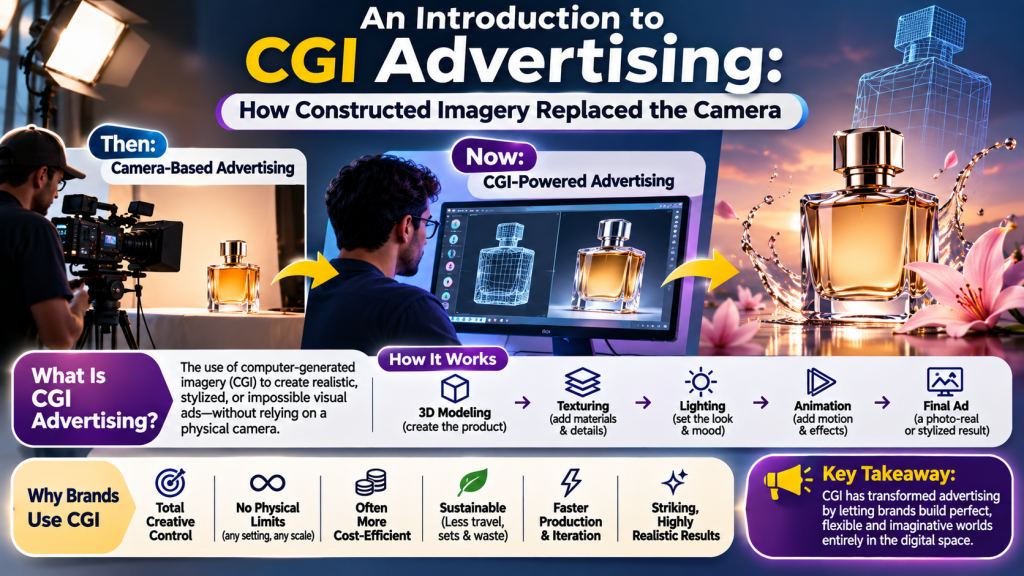
The shift matters beyond advertising. It changes what is possible to depict, what it costs to depict it, and — increasingly — what audiences can reasonably assume about the images they encounter.
How the process works
Production follows a consistent sequence. An artist builds geometry, a digital model of the object’s shape. Materials are then assigned: data describing how each surface responds to light, its roughness, reflectivity, transparency. Lights are placed in the virtual scene, and a camera is positioned with properties borrowed directly from physical optics — focal length, aperture, depth of field.
Rendering is the computational step. The software traces the paths light would take through the scene, bouncing off and through surfaces, and calculates the colour of every pixel. This is why photorealism is expensive: physically accurate light transport requires enormous numbers of calculations, and a single frame of complex work can occupy a processor for hours.
Why advertisers adopted it
Three reasons, each practical. Imagery can be produced before a product physically exists, which matters for launches and pre-orders. Variants cost little once the model is built, so one asset serves dozens of markets and formats. And some images cannot be captured at all — a cutaway of a sealed mechanism, a product at impossible scale, liquid behaving in ways liquid does not.
The economics differ sharply from photography. Photography has a relatively flat cost per shoot. Three-dimensional production front-loads the investment into building the asset, after which additional outputs are inexpensive. Firms producing CGI advertising at scale rely on exactly this asymmetry, reusing a single well-built model across years of campaigns.
The questions this raises
Constructed imagery sits in an interesting position regarding accuracy. A rendered product can be made to look better than the manufactured item — richer colour, flawless finish, perfect proportion. Advertising standards bodies in several jurisdictions have begun examining whether this constitutes misrepresentation, and the answer is not yet settled.
There is a second question about disclosure. Audiences generally understand that advertising is stylised, but it is not clear that most viewers know how much of what they see was never in front of a lens. As generative tools lower the barrier further, that gap between what audiences assume and what is actually the case is likely to widen before it narrows.
Why it is worth understanding
For students of media, marketing or design, this is a useful case of a technology quietly changing an industry’s economics without changing its surface appearance. The images look broadly as they always did. What changed is who can make them, how quickly, and at what marginal cost — and those are usually the changes that matter most.
It is also a reminder that visual literacy now includes understanding production methods. Reading an image critically increasingly means asking not only what it shows and who made it, but whether anything in it was ever physically there at all.
How do you define success in life?
View all responses


You must be logged in to post a comment.