Why developing countries are so poor?

Natural, economic and social resources are the major components of economic development. But it is observed that some countries have limited resources yet development has taken place, for e.g. Switzerland, Denmark, Japan, etc. This is mainly due to human efforts and advance technology. On the other hand some countries have lot of resources yet they are less developed. 

Source – Blogger

In these countries, the wealth is unevenly distributed among the people. Rich people have excessive wealth, which is continuously increasing, while the poor are becoming more poor. Most of the people in these countries are engaged in subsistence agriculture. It is associated with low productivity. Manufacturing and employment is low. The geographical distribution of the population is mostly rural, despite recent rapid urban growth. Due to high birth rate and death rate, the structure of the population has a high proportion of non-productive people under the age of fifteen. Due to poverty, people get insufficient and low quality food, therefore, there is a serious problem of malnutrition. Due to the type of food they get, their energy level is low and they develop diseases related to malnutrition. As a result, there is low life expectancy. Infant mortality rate is extremely high.

Most of the countries are facing environmental problems. Climate has a direct effect on human activities. Many developing countries are in regions where activity rates are reduced and the body is more prone to diseases, because of the hot and humid climate. Uncomfortable climate along with poverty, diseases, ignorance and poor diet has led to very less development.

The climate affects agriculture, transport and other economic activities, that influences the development of country. Tropical countries have frequent droughts and occasional heavy rainfall that result in erosion and leaching of soils. Extreme climatic conditions also affect transport facilities, especially roads, which are easily washed out. Similarly heat, dust and water can badly affect transport machinery such as vehicles or railway locomotives.

Natural resources are very important in the process of development, providing a base for industrial growth or earning foreign currency from their export. However, the distribution of the world’s energy resources, especially coal and oil is very uneven. Many developing countries lack the raw material. Whereas the developed countries grow their wealth and power with these resources. On the other hand, the potential for hydro-electric and solar-generated energy is quite considerable in many parts of these countries. For example, Africa possesses 40 per cent of the world’s hydro-electric power potential. The difficulty is to realize this potential.

Despite their importance, lack of resources is not a problem of underdevelopment, because countries like Denmark, Switzerland and Japan have achieved high levels of development on a very limited resource base. Resources are neutral and only can be useful, when it applies technology & will to use it. Many of the problems arising from climatic difficulties can also be solved by the use of medical facilities, pesticides, scientific farming practices and so on. Those countries with an abundance of natural resources certainly have much better prospects for development, than those which do not have them. But in the regions where natural resources are in abundance, but the region is socio- economically backward, such regions fails to take advantage of the favorable environment. Hence regions remain underdeveloped.

There is a serious shortage of capital in the developing countries to finance the establishment of industry, agricultural improvement, and transport systems and so on. The size of the domestic market in these countries is often not large enough to sustain industrial development, because the purchasing power of the consumer is too low. The problem is compounded by the fact that, it is extremely difficult for a developing country to break into international markets, where they have to compete with the advanced industrial producers of the developed world.

The infrastructure in the less developed countries of the world is poorly developed. Power supply, transport networks, industrial and commercial services, education facilities are the elements that form the framework for the economic activity to develop. Such facilities are very expensive to establish and they give only small returns. The economies of most developing countries are imbalanced and inefficient. Despite the fact that at least 50 to 90 per cent of employment is in agriculture. On the other hand, some primary commodities, such as oil or scarce minerals, are rapidly becoming expensive, so the poor countries cannot afford to buy them. For example, minerals such as Copper, Tin, Zinc, and fuels such as mineral oil have become very expensive. The developing countries may not be able to compete with the developed countries to buy them. It might be argued that, there is a vast hydroelectric power potential in the tropics, which will help to solve these problems, but such installations are very expensive.
Slum tourism in developing country

[8:25 PM, 7/14/2021] Priyanshi: Slum tourism in developing country

What comes to your head when you listen to the word developing country? How do you imagine developing countries? Some say developing countries are the countries lacking in capital, resources, infrastructure, revenues, and many more things. So with this, the main target of developing countries becomes to grow in the capital, money.
Now here comes the slums that exist in abundance in these developing countries. What do you think can slum tourism help the people of slums and these developing countries in any way?
let’s discuss, firstly we need to understand that most people consider slum people completely helpless and they don’t even prefer going there for tourism and instead they prefer going in the urban areas. Sometimes people from foreign countries do want to visit these slums and the government of developing countries must encourage slum tourism.
The benefit that will come to these slum people when slum tourism will be encouraged will be that they will get the opportunity to grow economically, when foreigners will purchase something from the residents, then their sell will surely increase. Slum people will also be able to show their talents to others and there will be chances for more job creation. And when there will be job creation, the country will automatically develop as in the sense people will have a better lifestyle and a developing country will move towards being the developed one.
Slum tourism will help the people change their perception towards the people living over there. These slums are called slums because there is a lack of connectivity, the horizon of vision of people is very much limited for these slum people. People don’t even bother to show some visit or any kind of awareness for these people. But when slum tourism will be there, people will come to know about the problems these people face and will try to connect to these people. When this connectivity will increase then definitely government will start focusing more on these areas and will pay more heed to the developmental tasks that should be performed for the benefit of these people.
We all are very well aware that westernization has completely taken place in the urban area and robbed the national culture. But when tourists want to see the national culture then they will only be able to see that in the slum areas because their people live simply and are not at all aware of the determination and perform all the customs and rituals.
So, we just can’t remove the slums but at least we can try to make the slum people grow and so that they can also try to put some effort into making their country a developed one. We can simple just not stop slum tourism just because we want to hide our poor sides of the country from the world instead we should make others as well as socially aware and give them a chance to grow, chance to improve because hiding the flaws won’t let us get rid of them but working on them will help us to get them slowly fade away.

What comes to your head when you listen to the word developing country? How do you imagine developing countries? Some say developing countries are the countries lacking in capital, resources, infrastructure, revenues, and many more things. So with this, the main target of developing countries becomes to grow in the capital, money.
Now here comes the slums that exist in abundance in these developing countries. What do you think can slum tourism help the people of slums and these developing countries in any way?
let’s discuss, firstly we need to understand that most people consider slum people completely helpless and they don’t even prefer going there for tourism and instead they prefer going in the urban areas. Sometimes people from foreign countries do want to visit these slums and the government of developing countries must encourage slum tourism.
The benefit that will come to these slum people when slum tourism will be encouraged will be that they will get the opportunity to grow economically, when foreigners will purchase something from the residents, then their sell will surely increase. Slum people will also be able to show their talents to others and there will be chances for more job creation. And when there will be job creation, the country will automatically develop as in the sense people will have a better lifestyle and a developing country will move towards being the developed one.
Slum tourism will help the people change their perception towards the people living over there. These slums are called slums because there is a lack of connectivity, the horizon of vision of people is very much limited for these slum people. People don’t even bother to show some visit or any kind of awareness for these people. But when slum tourism will be there, people will come to know about the problems these people face and will try to connect to these people. When this connectivity will increase then definitely government will start focusing more on these areas and will pay more heed to the developmental tasks that should be performed for the benefit of these people.
We all are very well aware that westernization has completely taken place in the urban area and robbed the national culture. But when tourists want to see the national culture then they will only be able to see that in the slum areas because their people live simply and are not at all aware of the determination and perform all the customs and rituals.
So, we just can’t remove the slums but at least we can try to make the slum people grow and so that they can also try to put some effort into making their country a developed one. We can simple just not stop slum tourism just because we want to hide our poor sides of the country from the world instead we should make others as well as socially aware and give them a chance to grow, chance to improve because hiding the flaws won’t let us get rid of them but working on them will help us to get them slowly fade away.

U.S. Defense Economy…

The police, obviously, they’re not in the business of of profiting from private acquisitions. We’ve seen extensive lobbying from defense industries who produce educational videos for police who were spending hundreds of millions of dollars to directly lobby Congress for defense spending, but also for these police programs. The police also have their own lobbying organizations that work toward security budgets and equipment for local law enforcement. The National Fraternal Order of Police is one of them and has lobbied in favor of federal grants that are responsible for the militarization of police. It’s really a variety of Homeland Security grants administered by the cops office, the home, the Department of Homeland Security, etc., that have allowed departments to directly purchase military grade equipment. And this has been essential to stimulating a domestic law enforcement market for military contractors. In some cases, the folks who provide the equipment actually directly assist police departments in making these grants. There’s even a Web site that is sponsored by these defense contractors and other providers of police equipment to aid departments in the production of these grant proposals. This whole industry grew significantly during the War on Drugs campaign in the 1970s.

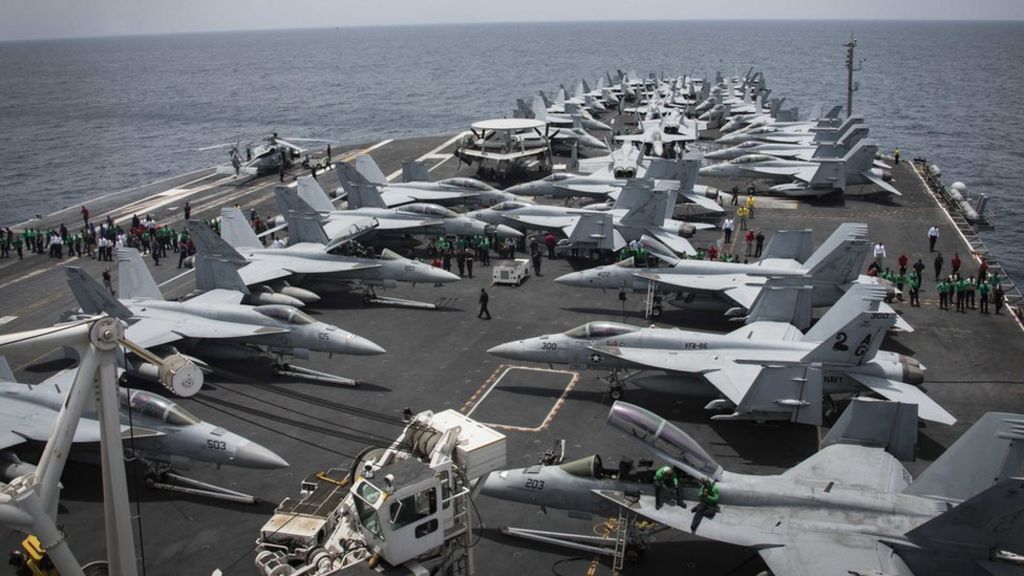
Iranian threats 'put on hold', says US defence chief - BBC News
Congress passed a law that focused on incorporating cooperation between the military and the local law enforcement, particularly related to countering drug crimes and the war on drugs. Right. That was sort of the first connection between the military and domestic law enforcement. In 1989, Congress passed the National Defense Authorization Act, temporarily allowing the Department of Defense to transfer excess military equipment to federal and state agencies. The program continued until the 1997 National Defense Authorization Act expanded it to include local law enforcement and made it permanent under a new name. The 1033 program that began a massive transfer of military equipment to local police departments free of charge as long as they paid for shipping and maintenance. That 1033 program was the congressional authorization that allowed police departments to basically go online. There were catalogs of of weapons and vehicles and aircraft and watercraft and any kind of military surplus military equipment was available for the asking. And it was at no cost to law enforcement agencies.

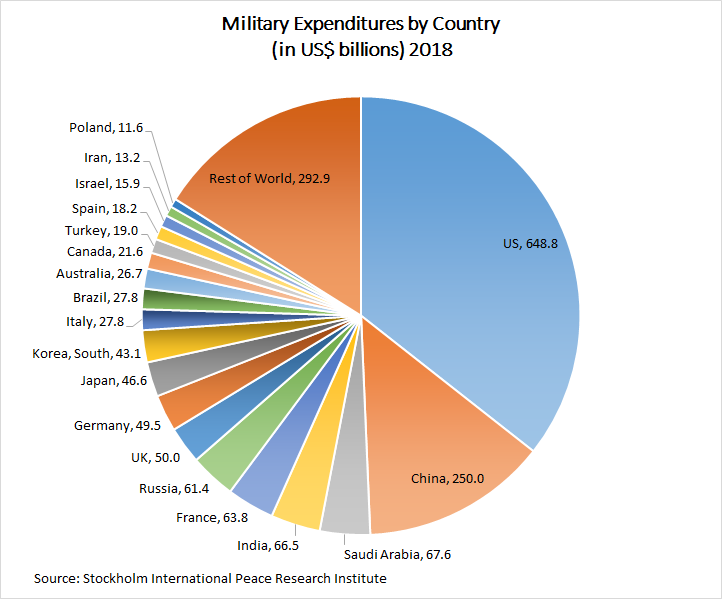
Military budget - Wikipedia
Departments may purchase shotguns that are placed in police vehicles as a routine matter, and some departments are purchasing a variety of less lethal weaponry with their own resources. But when we see sniper equipment, armored vehicles, large amounts of body armor, this is often the result of federal spending. Since its inception, over 11,500 domestic law enforcement agencies have taken part in the ten thirty three program, receiving more than 7.4 billion dollars in military equipment. What you end up seeing is as a result of the 1033 program, local law enforcements continue to ramp up what we call special task force, like SWAT teams, gang task force, drug task force. Right. That all utilize this excess military material. In July 2014, Congressman Alan Grayson proposed that legislation to limit the transfer of certain weapons through the 1033 program. The amendment was met with immense opposition failing on a bipartisan vote of 62 to 355.
The people who voted not to change the 1033 program received 70 percent more money in campaign contributions from the defense sector than those who wanted restrictions. One of the really troubling developments about the involvement of the federal within the direct subsidy of purchases of militarized equipment is that this is often really about creating a new marketplace for defense contractors instead of really putting questions of public safety first. Besides providing free military equipment, the federal government also allows the police to purchase new equipment using their own funds. Under the 1122 program, it also gives local police departments the same discounts enjoyed by the federal government. We’ve seen instances across the country where local governing bodies, like boards of selectmen and mayors and city councilors are often unaware that tax dollars have been expended to acquire these kinds of military weapons and military vehicles. What makes both 1033 and 1122 programs so powerful is the lack of clear oversight and accountability.

Trump says 'revved up' economy will fund $54bn rise in military ...
The 1122 program, as an example , isn’t a grant or transfer program and thus isn’t required to be monitored by the federal . Meanwhile, the 1033 program has put lethal weapons within the hands of officers who haven’t any justifiable need for such equipment. We’ve seen instances reported of some small towns, even some college and university police departments that were acquiring military grade weapons with none demonstrable need for the utilization of these or the acquisition of these weapons. After the events in Ferguson, the Obama administration sought to tighten the 1033 program with additional requirements and restrictions after months of confrontations on America’s streets. President Obama today banned the federal government from giving some types of military equipment to local police. We’ve seen how militarized gear can sometimes give people a sense like there’s an occupying force as against a force that’s a part of the community that’s protecting them and serving them. And this led to calls in Congress to eliminate 1033 and eventually measure an executive order by the Obama administration to place some limits on the type of equipment that could be used, things like bayonets and turreted armored vehicles.
The Obama administration also required police agencies to justify purchases of equipment considered potentially lethal. President Trump, however, rescinded all of those measures within two years in office. Obama administration made some efforts to increase accountability in auditing of this. But even then, the restrictions and oversight were quite limited. Under the Trump administration, there’s even less evidence of any oversight. Any sense that we know how this equipment is being used or whether or not officers are being properly trained and how to use it. In some cases, equipment transfer through these programs has simply vanished due to a lack of oversight and poor bookkeeping.

Maximising the economic benefit of Australia's defence projects ...

There’ve been a number of situations where there have been audits of local police departments to try to figure out what they’ve done with this equipment. And these departments have been unable to provide adequate records. We don’t know if this is a local sheriff taking home camping supplies or if this is about, you know, stuff that’s really gone missing, has been resold or has just simply been lost. Oftentimes, the militarization of the police force might be what’s distracting them from their original purpose, protecting our communities.

Success of Digital India Initiatives a Hope for Poor and Developing Countries

In a very encouraging endorsement of the success of Digital India programme initiated by the Government led by the Prime Minister Shri Narendra Modi, the Secretary General of the Commonwealth Ms. Patricia Scotland has expressed her appreciation for this initiative and has called it as a new hope for other developing and aspiring countries of the Commonwealth.

Ms. Scotland, in an interaction with a private news channel recently said that the way India has tried to address the aspirations of the people with innovation and opportunities by offering affordable digital services is commendable. She further said, “if you look at our poorer countries, our smaller, our developing countries, many of them look to the developed nations and they fear that they cannot aspire to do or replicate what the developed countries have done because of the cost. But when they look at India and fact that India is developing these things at scale and at a cost which looks accessible to so many. That brings hope.”

She also mentioned about her visit to India during January, 2020 where she interacted with the Ministers in Government of India and technology experts. During these interactions she got to understand that India was really focusing on helping the small, the vulnerable and the developing. “I very much welcome that”, she added further.

Conveying her appreciation for the contributions made by Sh. Ravi Shankar Prasad, Union Minister for Electronics and IT, in the success of Digital India, Ms. Scotland further added that the Minister has been in the forefront of these developments. Talking about what Ravi Shankar Prasad has done she remarked, “he has electrified the other members of our Commonwealth family.”