Universal Design

Universal design is the approach of designing products and environment so that it can be used by broad number people irrespective of age, disability, ability, status in life and various other factors.

Usually, products are designed to be suitable for average users whereas products designed under the principle of universal design try to be suitable for the maximum number of users. The purpose of universal design is not to create a design that can work for 100 percent of the people because it is almost impossible to have a ‘One size fits all’ design. The purpose is to create a design that can serve solutions that are more inclusive. Designers have to look at those designs that push the boundaries as far out as possible without compromising the quality and integrity of the product.

There are many instances where a designer will have to choose between different designs and determine the more suitable design according to UD principles. For instance, if there is a choice to choose between a lever-design handle and a knob-design handle. It is preferable to choose the former rather than the latter as the lever design can accommodate more people’s daily usage. The lever design feature will be a more inclusive element compared to the latter. It can accommodate various usages like opening the door with closed fists or the elbow or so that a person can easily access the door while carrying something as well as people with finite strength.

There are briefly 7 Principles of Universal Design. These were developed in 1997 by a team of architects, designers, engineers, and environmental design researchers.  The team was led by the late Ronald Mace who was an internationally recognized American Architect and designer in North Carolina State University.

The seven principles are:

  • Equitable use

While designing, the product should be kept in mind that it should be accessible by every person including disabled people.  

  • Flexibility in use

The design needs to be configurable to accommodate everyone’s preferences, needs, and abilities.

  • Simple and intuitive

This means that the design should be easy to understand for everybody. The person can easily figure out a well-designed product or an environment without thinking too much about it.

  • Perceptible information

The design can communicate all of its necessary information to everybody irrespective of the environmental conditions or the user’s sensory abilities.

  • Tolerance for error

It refers to safety so that the design minimizes hazards, accidents or unintended actions.

  • Low physical effort

The design in use needs to be comfortable and efficient rather than being exhausting and fatiguing to use.

  • Size and space for approach and use

The design irrespective of user’s body size, posture, or mobility should not restrict anybody by its size or space.

Universal design can really make the lives of people much more comfortable, safer, and efficient in the long run. There are still many areas that are not designed well and poorly designed products, buildings or the environment can be a safety hazard as well. It is usually the job of a universal designer to design new products from the ground up and many also renovate existing designs to make them more accommodative and accessible.

References:

http://universaldesign.ie/What-is-Universal-Design/The-7-Principles/
https://www.washington.edu/doit/what-universal-design-0

DISABILITY ETIQUETTES

Disability Etiquette - United Spinal Association

Disability etiquette is a set of guidelines dealing specifically with how to approach persons with disabilities . Before knowing about disability etiquettes , it is essential to understand certain basic things such as if someone has a disability don’t assume he/she needs help . In fact , adults with disabilities wants to be treated as an independent persons , So offer help only if the person with disability seems to need it . Physical contact should be avoided . Always speak directly to the person with a disability , not to his/her friend . Persons with disabilities are the best judge of what they can or can’t do .

General Disability Etiquettes

Disability Etiquette | OSU TOPS Program

The general disability etiquettes are stated below :

  • Always put the person first , i.e., say ‘person with disability ‘ rather than ‘disabled person’ . Always avoid the outdated words like handicapped , retarded , physically challenged or differently – abled . For example , refer to ‘person who are blind ‘ rather than ‘ blind person ‘.
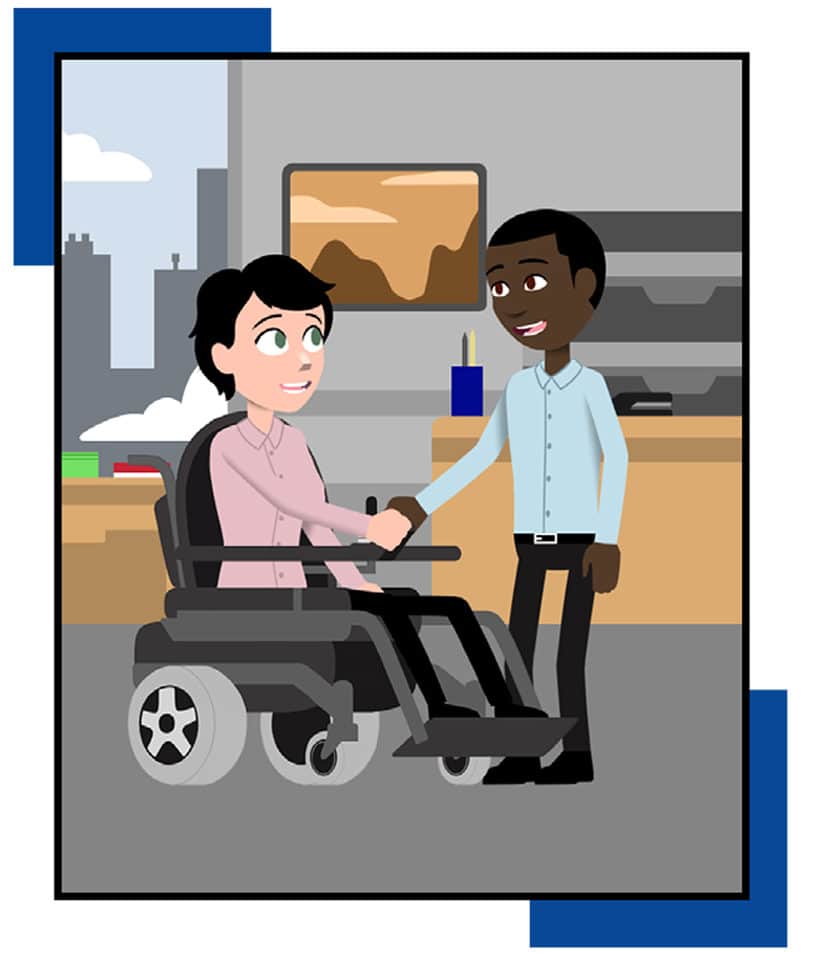
  • In case of introduction to a person with a disability , it is appropriate to shake hands .
  • When you meet a person with a visual impairment , always identify yourself and others who may be with you .
  • Leaning or hanging on a person ‘s wheelchair should always be avoided because such act is generally considered annoying . In fact , the chair is the part of the personal body space of the person who uses it.
  • Always listen carefully as well as attentively when you are having conversations with a person who has difficulty in speaking . Have patience and wait for the person to finish rather than correcting or speaking for that person . Generally , ask short questions that require short time .
  • When talking with a person who is on a wheelchair or person who uses crutches , keep yourself at eye level in front of the person to facilitate the talk .
  • To get the attention of a person who is deaf or having hearing impairment , tap the person on the shoulder or wave your hand . You should look directly at the person and speak clearly .
  • Never patronize person who use wheelchairs by patting them on the head or shoulder .
  • Always introduce yourself to persons who are blind using your name .
  • Always avoid asking personal questions to an individual who is differently-abled .
  • Always give additional time to a person with any disability to do or to say something .
  • Always have conversation at a normal tone of voice . Don’t talk in high pitch to such individuals .
  • Don’t pretend to understand if you are facing problem in doing so .
  • If you need to leave a person who is blind , inform him that you are leaving and ask him if he needs anything before you leave .

LEARNING DISABILITIES AMONGST CHILDREN.

Learning disabilities are due to genetic and/or neurobiological factors that alter brain functions in a manner which affects one or more processes related to learning. These processing problems can interfere with learning basic skills such as reading, writing and/or math. They can also be related to with higher level skills such as organization, time planning, abstract reasoning, long or short term memory and attention. It is important to realize that learning disabilities can affect an individual’s life beyond academics and can impact relationships with family, friends and in the workplace. It can also be a source of bullying amongst smaller children.

“If a child can’t learn the way we teach, maybe we should teach the way they learn”. Learning disability, learning disorder or learning difficulty, is a condition in the brain that causes difficulties comprehending or processing information and can be caused by several different factors. Given the “difficulty learning in a typical manner”, this does not exclude the ability to learn in a different manner. Symptoms of dyslexia usually become more obvious when children start school and begin to focus more on learning how to read and write. People are often also quite unaware about this topic .The unknown factor is the disorder that affects the brain’s ability to receive and process information. This disorder can make it problematic for a person to learn as quickly or in the same way as someone who is not affected by a learning disability. People with a learning disability have trouble performing specific types of skills or completing tasks if left to figure things out by themselves or if taught in conventional ways.

Preschool children

In some cases, it’s possible to detect symptoms of dyslexia before a child starts school. Symptoms can include: delayed speech development compared with other children of the same age (although this can have many different causes) speech problems, such as not being able to pronounce long words properly and “jumbling” up phrases (for example, saying “hecilopter” instead of “helicopter”, or “beddy tear” instead of “teddy bear”) problems expressing themselves using spoken language, such as being unable to remember the right word to use, or putting sentences together incorrectly little understanding or appreciation of rhyming words, such as “the cat sat on the mat”, or nursery rhymes difficulty with, or little interest in, learning letters of the alphabet.

School children

Symptoms of dyslexia usually become more obvious when children start school and begin to focus more on learning how to read and write. Symptoms of dyslexia in children aged 5 to 12 include: problems learning the names and sounds of letters spelling that’s unpredictable and inconsistent putting letters and figures the wrong way round (such as writing “6” instead of “9”, or “b” instead of “d”) confusing the order of letters in words reading slowly or making errors when reading aloud visual disturbances when reading (for example, a child may describe letters and words as seeming to move around or appear blurred) answering questions well orally, but having difficulty writing the answer down difficulty carrying out a sequence of directions struggling to learn sequences, such as days of the week or the alphabet slow writing speed poor handwriting problems copying written language and taking longer than normal to complete written work poor phonological awareness and word attack skills.

Word attack skills

Young children with dyslexia can also have problems with word attack skills. This is the ability to make sense of unfamiliar words by looking for smaller words or collections of letters that a child has previously learnt. For example, a child with good word attack skills may read the word “sunbathing” for the first time and gain a sense of the meaning of the word by breaking it down into “sun”, “bath”, and “ing”.

Causes of disabilities

The causes for learning disabilities are not well understood, and sometimes there is no apparent cause for a learning disability. However, some causes of neurological impairments include:

Heredity and genetics Learning disabilities are often linked through genetics and run in the family. Children who have learning disabilities often have parents who have the same struggle.

Problems during pregnancy and birth A learning disability can result from anomalies in the developing brain, illness or injury. Risk factors are fetal exposure to alcohol or drugs and low birth weight (3 pounds or less). These children are more likely to develop a disability in math or reading.

Conclusion

Learning disabilities is a field that is constantly changing. With the advent of techniques that allow scholars to study the brain in action, we may understand not only the normal process of reading but also what happens when the system is not working. The hope is that we will be able to prevent learning disabilities or, at the least, to develop innovative and successful interventions. It is also hoped that we will become more adept at identifying children at earlier ages to prevent some of the emotional and social difficulties that can be associated with a learning disability. Neuroscience is now promising new avenues in our study of learning disabilities as is genetics. Families who have a history of learning disability need further study to provide appropriate support for them as well as to assist with early interventions

Media, Disability & COVID-19

According to United Nations, about 1 billion people all over the world come under the category of “disabled” and that is 15% of the global population. Now, the question is, shall we as a society neglect 15% people in the world just because they happen to be in minority?

Media being one of the crucial facets of society has a major role to play when it comes to disseminating information and making people aware about significant and ignored issues. Now, let us go through what media has done to represent people with disabilities and their issue since the beginning of the pandemic.

1) Disability and Broadcast Media


A Look: Public Broadcasters of various countries

In 2020, the World Federation of the Deaf noted that 80 governments in the world have been providing sign language interpretations while Covid-19 press briefings.

For example, in order to curb Covid-19 pandemic, South Korean government aimed to strengthen the ways disabled people could be informed during the pandemic and other related disasters. The country’s public broadcaster KBS during the pandemic announced that it would work to expand the reach of information in its disaster countries. During the pandemic, the public radio in the country had continued to provide programmes dedicated to disabled community with daily news and health updates and general life advice.

When it comes to India’s public television broadcaster Doordarshan and public radio-All India Radio, very minimal representation of disabled community took place during the pandemic. Even though the objective of the these broadcasters is social welfare, disabled community was one of the most ignored ones as “no special programmes” were held for this community, nor was their issue highlighted specifically anywhere. News Bulletins with sign language were held for the disabled community though. More has to be done to ensure social inclusion of all communities including the disabled ones.

Private Broadcasters: nothing matters, but profits!

Media all over the world, including the Indian ones either portray disabled people as “nothing” or “everything” and both of them are dangerous. In 2019, Ministry of Information and Broadcasting in India directed the private channels to include special schemes for disabled community. Although some channels have started news bulletins for disable people but there was almost equal to zero representation of the disabled community during the pandemic.

There should be open space for the disabled community such as they should be invited for panel discussions and debates relating to different happenings in the world from politics to entertainment and like.

Digital Media: A hope in every way!

This is probably the best when it comes to serving and representing the disabled community during the pandemic. Digital and online media were the perfect mediums through which disabled people got proper spaces to talk about the issues they were facing during the pandemic.

One of the online apps called “News Hook” became increasingly popular among the disabled audience which used sign language specifically for the audience with hearing impairment. It covered headlines relating to technology, politics, entertainment, business and sports during the pandemic. It should also be noted that 65% of the staff here were from the disabled community.

Moreover, web portals of Indian Newspapers like The Indian Express and The Business Standards and many more gave enough of space to the disabled people so that they can talk freely about the issues they faced during the lockdowns.

The same above mentioned media channels also used platforms like YouTube to sensitise the audiences regarding the hindrances faced by the disabled community. Some reporters and even famous YouTube personalities covered the terrible times disabled people in India went through during the pandemic.

It should also be noted that online media was comfortable for disabled people as well as the medium is now more easily accessible with good quality content and also because of its low price rates.

Media, especially the mainstream media should be more responsible and sensitive in dealing with issues relating to the disabled community. More representation about the disabled community should take place in the mainstream media. Disabled people “aren’t incapable” and therefore they should be given proper employment in the media. They should be engaged and involved in live discussions and debates. Together, as society which includes the media we should create an environment which is inclusive, anti- discriminatory and diverse.