Top Universities in Andhra Pradesh

 Andhra Pradesh is home to several renowned universities known for their academic excellence and research contributions. Here are some of the top universities in the state:

  1. Indian Institute of Technology (IIT) Tirupati: One of the newest IITs in India, offering high-quality programs in engineering, sciences, and research, with a focus on innovation and cutting-edge technology.

  2. Andhra University, Visakhapatnam: One of the oldest universities in India, offering a wide range of undergraduate, postgraduate, and doctoral programs in arts, science, engineering, law, and management.

  3. Sri Venkateswara University, Tirupati: A prominent public university offering diverse programs in arts, science, commerce, management, and engineering, known for its strong academic and research culture.

  4. Jawaharlal Nehru Technological University (JNTU), Kakinada: A leading technical university affiliating numerous engineering colleges across the state, offering programs in engineering, technology, and management.

  5. Sri Venkateswara Institute of Medical Sciences (SVIMS), Tirupati: A premier medical university known for its high-quality medical education, research, and healthcare services.

  6. Acharya Nagarjuna University, Guntur: Offers a variety of programs in arts, science, commerce, law, and management, with a focus on research and academic excellence.

  7. Vignan’s Foundation for Science, Technology & Research (Deemed University), Guntur: A well-regarded private university offering programs in engineering, technology, management, and sciences, known for its innovation and industry connections.

  8. GITAM (Gandhi Institute of Technology and Management) University, Visakhapatnam: A leading private university offering diverse programs in engineering, management, humanities, and health sciences, with a focus on research and global collaborations.

  9. Dr. NTR University of Health Sciences, Vijayawada: Specializes in medical and health sciences education, offering programs in medicine, dentistry, nursing, and allied health sciences.

  10. Krishna University, Machilipatnam: A growing public university offering programs in arts, science, commerce, and management, with a focus on regional development and research.

These universities are well-regarded for their academic programs, research contributions, and strong alumni networks, making them top choices for students in Andhra Pradesh and beyond.

Top Universities in Madhya Pradesh

 Madhya Pradesh is home to several esteemed universities known for their academic excellence, research contributions, and diverse range of programs. Here are some of the top universities in the state:

  1. Indian Institute of Technology (IIT) Indore: A premier engineering and technology institute known for its research-oriented approach and strong academic programs in engineering, sciences, and humanities.

  2. Maulana Azad National Institute of Technology (MANIT), Bhopal: A top engineering institute offering undergraduate, postgraduate, and doctoral programs in engineering, technology, and management.

  3. Rajiv Gandhi Proudyogiki Vishwavidyalaya (RGPV), Bhopal: A leading technical university in Madhya Pradesh, affiliating many engineering colleges and offering programs in engineering, technology, and applied sciences.

  4. Devi Ahilya Vishwavidyalaya (DAVV), Indore: One of the oldest and most respected universities in the state, offering a wide range of programs in arts, science, commerce, law, and management.

  5. Barkatullah University, Bhopal: A well-known university offering diverse programs in arts, science, commerce, law, and management, with a strong focus on research and development.

  6. Jiwaji University, Gwalior: Offers a variety of undergraduate, postgraduate, and doctoral programs in arts, science, commerce, and social sciences, and is known for its academic and research contributions.

  7. Madhya Pradesh Bhoj Open University, Bhopal: Specializes in distance education, providing flexible learning opportunities across various disciplines.

  8. Atal Bihari Vajpayee Indian Institute of Information Technology and Management (ABV-IIITM), Gwalior: A premier institute focusing on information technology and management education, with a strong emphasis on research and innovation.

  9. Makhanlal Chaturvedi National University of Journalism and Communication, Bhopal: A specialized university offering programs in journalism, mass communication, and media studies.

  10. Dr. Harisingh Gour University, Sagar: One of the oldest universities in Madhya Pradesh, known for its comprehensive programs in arts, science, commerce, law, and education.

These universities are well-regarded for their academic programs, research output, and contributions to higher education in Madhya Pradesh.

Top Ten Universities in the World

 Ranking the top universities globally can vary based on different criteria and methodologies used by various ranking organizations. However, here’s a list, not necessarily in any order, that often features among the top-ranked universities:

  1. Harvard University (USA): Renowned for its academic excellence across various disciplines, Harvard consistently secures top positions globally. It’s known for its research, influential alumni, and world-class faculty.

  2. Massachusetts Institute of Technology (MIT) (USA): Highly regarded for its emphasis on science, technology, engineering, and mathematics (STEM) disciplines, MIT is a hub of innovation and groundbreaking research.

  3. Stanford University (USA): A leader in entrepreneurship and technology, Stanford excels in diverse fields, boasting a strong academic reputation and a dynamic learning environment.

  4. University of Oxford (UK): One of the oldest universities globally, Oxford has a stellar reputation for its academic rigour, research contributions, and its tutorial-based teaching methodology.

  5. University of Cambridge (UK): Renowned for its contributions to research and academia, Cambridge excels in various disciplines, emphasizing innovation and intellectual pursuit.

  6. California Institute of Technology (Caltech) (USA): A small yet prestigious institution, Caltech is known for its scientific and technological breakthroughs, fostering a highly specialized academic environment.

  7. ETH Zurich – Swiss Federal Institute of Technology (Switzerland): Internationally acclaimed for its focus on science, technology, engineering, and mathematics, ETH Zurich consistently ranks among the top in Europe.

  8. University College London (UCL) (UK): UCL is renowned for its interdisciplinary approach, research contributions, and a diverse student body, offering a range of academic programs.

  9. University of Chicago (USA): Known for its academic rigor and emphasis on critical thinking, the University of Chicago boasts influential research and a strong intellectual community.

  10. Princeton University (USA): Renowned for its undergraduate teaching and research programs, Princeton is recognized for its academic excellence in various fields.

These universities often rank high due to their exceptional faculty, research contributions, resources, and the quality of education they offer across a wide spectrum of disciplines. Keep in mind that rankings can vary based on different factors and methodologies used by different ranking bodies.

Self-Paced Mathworks Courses for Engineering Students

MATLAB is a proprietary multi-paradigm programming language and numeric computing environment developed by MathWorks. MATLAB allows matrix manipulations, plotting of functions and data, implementation of algorithms, creation of user interfaces, and interfacing with programs written in other languages.

  1. MATLAB Onramp: This is a free, interactive introductory course that teaches you the basics of MATLAB. You’ll learn how to navigate the MATLAB environment, write and run basic code, and work with arrays, matrices, and plots. The course takes about two hours to complete.

  2. MATLAB Fundamentals: This is a more comprehensive course that covers the basics of MATLAB programming in more detail. You’ll learn about data types, control structures, functions, and debugging. You’ll also get hands-on experience working with MATLAB’s built-in functions and toolboxes.

  3. Simulink Onramp: The Simulink Onramp course is an interactive online learning resource designed to help users get started with Simulink, a graphical programming environment for modeling, simulating, and analyzing dynamic systems. The course is offered by MathWorks and is intended for individuals who are new to Simulink and have limited experience with the software.

  4. Simscape Onramp: Learn the basics of Simscape for modeling dynamic systems in various physical domains. Use the physical network approach to quickly represent models of physical systems without explicitly deriving equations. It covers fundamental concepts such as physical networks, components, and how to create and simulate models using Simscape.

  5. Stateflow Onramp: Stateflow Onramp is an introductory tutorial or course offered by MathWorks. Stateflow is a graphical programming environment within Simulink that allows you to model and simulate complex systems with state machines and flow charts. The Stateflow Onramp is designed to help beginners get started with Stateflow and understand its basic concepts and features.

You can refer to the below link that is directed to the courses discussed in this article.

FACT Devices; Statcom & its working

FACT is an abbreviation for Flexible
AC transmission system. It is a system composed of static equipment used for

the alternating current (AC) transmission of electrical energy and is
a power electronics based system.

Series compensation – In this we connect
the fact devices in series with power system. Here, the line impedance is
modified, that means net impedance is decreased and increasing the
transmittable active power.

Shunt compensation – It is used to
improve the power factor. In this we connect the fact devices in parallel with
power system. It also works as a controllable for the current source. Eg-
Statcom (Static synchronous Compensator) and SVC (Static VAR compensator). They
are further classified into two types –

  1. Shunt capacitive compensation: This method is used to
    improve the power factor. Whenever an inductive load is connected to
    the transmission line, power factor lags because of lagging load current.
    To compensate, a shunt capacitor is connected, which draws the current
    leading to the source voltage. The net result is an improvement in
    power factor.
  2. Shunt inductive compensation: This method is used
    either when charging the transmission line, or when there is a very
    low load at the receiving end. Because of very low, or no load–very low current
    flows through the transmission line. Shunt capacitance in the transmission
    line causes voltage amplification (Ferranti effect). The receiving end
    voltage may become double the sending end voltage (generally in case of
    very long transmission lines). To compensate, shunt inductors are
    connected across the transmission line. 

A few advantages of FACT devices
are:
• Helps in improving power transfer capability
• Used for transient and dynamic stability improvement.
• Used for damping of power system oscillations.
• For better voltage regulation.
• For flexible operation and control of the system.

What
is a Statcom?

The STATCOM (or SSC) is a
shunt-connected reactive-power compensation device that can generate and/ or
absorbing reactive power and in which we can vary the output to control the
specific parameters of an electric power system. It is a solid-state switching
converter capable of generating or absorbing independently controllable real
and reactive power at its output terminals when it is fed from an energy source
or energy-storage device at its input terminals. Voltage-source converter that,
from an input of the voltage, produces a set of 3-phase AC-output voltages,
each in phase with and coupled to the corresponding AC system voltage through a
relatively small reactance.

How
does a statcom work?

Now suppose we have a load connected
to the grid; the load takes the power as P + jQ, where P is active power and Q
is reactive power. Now we have to make the Q= 0. So that the power factor is
always unity (PF = 1). For that, we connect statcom at the load, so that the
reactive power is supplied by the statcom and active power is given by the
Grid. This is how a statcom works for reactive power compensation.

The different softwares in which we
can simulate and analyze FACT devices are:
• MATLAB
• PSCAD
• ETAP

Top 10 Engineering Collage in India

 Top 10 Engineering collage in India

Getting admission to an engineering college is a dream for a lot of students in India. IITs and NITs are engineering colleges that provide education in the field of engineering.


These are the top ten engineering collage in India:

1. Indian Institute of Technology, Madras

It is an internationally complemented institution and stands in the top five engineering institutions by the ranking system of NIRF. The IIT Madras has all the basic amenities including a beautiful garden which is always taken care of and the Central library present at the hostel. As the students are excellent in their technical efficiency and have a very good practical knowledge in their field of engineering, there are always pre-placement offers and many workshops are conducted by these companies to hire the students. Interaction seminars are also conducted and internships are also a medium for the placement procedure.

2. Indian Institute of Technology, Delhi      

 Indian Institute of Technology Delhi has bagged the second position in the NIRF ranking for its efficient faculties and excellent teaching content. The knowledge provided is not only commendable but also layered up with technical enhancements so that theoretical, as well as practical knowledge, grows up simultaneously. A total of 11 hostels for the boys and three hostels for the girls are present on the campus with the facilities of a beautiful launch, areas of gaming, computer rooms, and study rooms provided. The placements are based on a procedure and over 500 companies come to the campus to hire the students. The placement is totally on campus and more than 60% of the students get selected for the offers which provide a dream package. Unlike all other IITs, it has a beautiful robotics room, a gymnasium for fitness awareness, and swimming pools with a central library that is always open. All the laboratories work according to the latest technologies.

3.Indian Institute of Technology, Bombay 

As it is one of the most reputed engineering institutions in India, it stands within the top 10 engineering institutions by the ranking system of NIRF. Not only it is highly qualified faculty members but also innovative methods in the field of teaching and practical application. A total of 16 hostels with all the facilities are provided on the campus. Generally, the placement records show a 100% placement rate, and the companies which offer and provide packages in lakhs are very popular including Amazon, Flipkart, and Cadbury. The placement as well as the professional board of IIT Bombay with all the companies is not only strong but also provides commendable statistics for building up the career of the students. The infrastructure is not only beautiful but has all the amenities including the staff room, library, lecture halls and seminar halls, and E consortium.

4.Indian Institute of Technology, Kanpur  

Academically, the IIT Kanpur bags its position in the top five of the NIRF ranking and it is also complimented for its extracurricular activities. Students not only better themselves in the field of engineering but also polish their extracurricular talents. The placement records stand is very high and the packages of the salary increase arithmetically each year. Sometimes there are international companies that provide packages in crores.


5. Indian Institute of Technology, Kharagpur

Like all other IITs, it also provides quality education along with commendable teachers Who are highly educated in the field of teaching with many years of experience. Apart from this, it is fully facilitated with fans that work according to the Wi-Fi and the campus LANs. The highest packages are offered to the students in lakhs and around 15 LPA is the average score of the batch Income.       

6. Indian Institute of Technology, Roorkee

It has multi-variant courses along with 14 undergraduate and 24 post-graduate courses. It also provides Ph.D. courses which is not only restricted to engineering but also extend to the field of science and architecture, social studies, and business management. With a total of 13 hostels among which two are for girls and 11 are for male students, it facilitates the mess, stationery shop, a salon, gymnasium, gaming room, reading space, and laundry. It also facilitates a guest room which is provided in every single hostel. For the history of placements, 85% of the students are completely placed and both international, as well as domestic offers, are received. The average amount goes to INR 2.17 crores for the international packages and 1.92 crores for the domestic packages.

7. Indian Institute of Technology, Guwahati

It has highly skilled professors along with experienced teachings are provided in the IIT Guwahati. It comprises a canteen, mess, a juice corner, an in-campus shop of stationery, a gymnasium, and a laundry room. The central library and TV room are common in every IIT. The Wi-Fi connections are very efficient. For the enhancement of the sports activities, various basketball, football, and volleyball courts are available on the campus.


8. Birla Institute of Technology and Science (BITS)

The Birla Institute of science and technology has a very good bond with both the students as well as the teachers. The first campus was situated at Pilani on the year 1943. Later it stretched its branches all over India and outside like Dubai, Hyderabad, etc. The BITS Pilani is the most famous institution for the engineering field and various courses including BE, management, B pharma, M.Sc. Every year, the Birla Institute of technology and science conducts its entrance examinations for the students to get admitted for these courses.


9. Vellore Institute of Technology

 This institute provides many courses including graduate, postgraduate, and also research programs. It also gives dual integrated courses for the students. The placement records are excellent and the whole average batch is being offered jobs from various companies. The B.Tech courses are the most popular in the field of biotechnology, electronics and communication, and computer science engineering. The Vellore Institute of Technology conducts its examination and students have to achieve the minimum cut-off to get admitted to this college.

10. Delhi Technological University

This college was previously known as Delhi College of engineering. After it had got its affiliated with the University of Delhi the year of 1962 it came to be known as Delhi Technological University. It also provides a lot of courses including BTech, MTech, MBA, and BBA courses, and offers research programs. The facility of both shifts is provided while conducting the classes. The mode of admission is by the scores of the joint entrance examination and students have to achieve the minimum cut-off to get into this college.

Thus, if you want to get admission to an engineering college you can choose the best collage of your choice.


Nanotechnology

Nanotechnology is defined as fabrication of devices with atomic or molecular scale precision. Devices with minimum feature sizes less than 100 nanometers (nm) are considered to be products of nanotechnology. A nanometer is one billionth of a meter (10-9 m) and is the unit of length that is generally most appropriate for describing the size of single molecules.The nanoscale marks the nebulous boundary between the classical and quantum mechanical worlds; thus, realization of nanotechnology promises to bring revolutionary capabilities. Fabrication of nanomachines, nanoelectronics and other nanodevices will undoubtedly solve an enormous amount of the problems faced by mankind today.Nanotechnology is currently in a very infantile stage. However, we now have the ability to organize matter on the atomic scale and there are already numerous products available as a direct result of our rapidly increasing ability to fabricate and characterize feature sizes less than 100 nm. Mirrors that don’t fog, biomimetic paint with a contact angle near 180°, gene chips and fat soluble vitamins in aqueous beverages are some of the first manifestations of nanotechnology. However, immenant breakthroughs in computer science and medicine will be where the real potential of nanotechnology will first be achieved.

Nanoscience is an interdisciplinary field that seeks to bring about mature nanotechnology. Focusing on the nanoscale intersection of fields such as physics, biology, engineering, chemistry, computer science and more, nanoscience is rapidly expanding. Nanotechnology centers are popping up around the world as more funding is provided and nanotechnology market share increases. The rapid progress is apparent by the increasing appearance of the prefix “nano” in scientific journals and the news. Thus, as we increase our ability to fabricate computer chips with smaller features and improve our ability to cure disease at the molecular level, nanotechnology is herestorage (or other uses) is enormous. As first described in a lecture titled, ‘There’s Plenty of Room at the Bottom’ in 1959 by Richard P. Feynman, there is nothing besides our clumsy size that keeps us from using this space. In his time, it was not possible for us to manipulate single atoms or molecules because they were far too small for our tools. Thus, his
speech was completely theoretical and seemingly fantastic. He described how the laws of physics do not limit our ability to manipulate single atoms and molecules. Instead, it was our lack of the appropriate methods for doing so. However, he correctly predicted that the time would come in which atomically precise manipulation of matter would inevitably arrive.Nanomachines can also be incorporated into various materials to make those materials respond to their environment, or to outside commands. Examples of such materials would be “smart” fabrics that respond to the environment to become warmer or cooler, or walls and furniture that can move or change shape on command. Nanomachines could also be used as tools both in industry and by consumers. Such tools could cut apart or glue together material far more efficiently than anything large-scale that is used today. Nanomachines could also repair cars, furniture, applicances, or almost anything else quickly and efficiently. Or these objects could be designed with nanomachines to repair themselves should the need arise. Life would be greatly simplified by relieving people of the need to repair objects at home or at work.


In thinking about nanotecnolog today, what’s most important is understanding where it leads, what nanotechnology will look like after we reach the assembler breakthrough.

-K. Eric Drexler

School of Engineering and AtalBihari Vajpayee School of Management and Entrepreneurship at J.N.U

 Union Education Minister of India, ShriRameshPokhriyal ‘Nishank’ laid the foundation stone of the buildings for School of Engineering and Atal Bihari Vajpayee School of Management and Entrepreneurship at Jawaharlal Nehru University today through a virtual program.Vice Chancellor, JNU, Prof. M. Jagdish Kumar,Rector I Prof.ChintamaniMahapatra, Rector II Prof. Satish Chandra Garkoti, Rector III Prof. Rana Pratap Singh and the deans of the new schools, Prof. UnnatPandit and Prof. SatyavratPatnaik were present on the occasion.

ShriPokhriyal expressed his delight at the  naming the School of Management on the name of late Atal Bihari Vajpayee, who was not only an efficient and visionary Prime Minister of India, but an inspiring author too. The Minister mentioned that engineering and management education will complement each other and willinspire the youth to become entrepreneurs and self-reliant.He hoped that the proposed building with world-class facilities will be endowed with technology-based pedagogy and development of learners.

ShriPokhriyalalso congratulated Prof. M. Jagadesh Kumar for taking the University to new heights of progress and initiating realization of National Education Policy 2020 with new initiatives.

Covid effected the Engineering students and ways to cope up once the college’s reopens

Since the start of 2020 the world has been witnessing a health calamity with uncertain implications.
The coronavirus pandemic or covid-19 has created havoc causing immense damage in terms of loss
of human lives, financial and economic shortfalls and affected student’s education.

We, the students, I feel, are among those whose lives took an unalterable turn. The school or
college going community had to suddenly shift in-class action to onscreen lectures and
demonstrations. The students understood that theory classes can be done from home. Students can
get notes and study materials online. But the Engineering students or students from technical
background are lacking behind as they are not attending the practical classes. Practical classes are of
utmost importance for any technical students to work further in any technical field after graduation.

So, when the colleges will reopen now, the students need to focus on some topics and need to know
where they need to focus now.

Students need to attend more laboratory/practical classes once the college reopens, as we know
now that theory can be done online and we can gain theoretical knowledge by attending different
online video lectures, PDF notes etc. available on the internet.

Students must participate in events or exhibitions, they should know what projects can be made, the
topics that are needed in order to have a strong grip on the subjects. One must take technical fests
seriously and make new projects. If one is not making them, at least he/she can spectate others’
work or the events.

Once the college reopens, start looking for industrial training, start looking for companies or
workshop jobs (odd/even jobs) which one needs to gain experience.
If students want to start their own company, they must start once the college reopens, especially
the final year students can start their own projects or can start-up with innovation and implement
their skills and potential.

There would always be an increasing demand for creative reasoning, design thinking and problem-
solving skills looking at the current recruitment trends.

In a nutshell, the whole engineering fraternity will have to let go of the traditional mindset and think
out of the box to find innovative solutions to the way forward.

As the dust settles down on these outbreaks, the new dawn would bring in new challenges of
survival and those who adapt and adopts faster will win the race.

The most interesting things about Pune

For new-comers Pune may appear to be arrogant, rude and not-so-friendly, but after spending some time in Pune you will realize that they are actually sweet, a bit arrogant but kind. When you login in Pune you can’t logout.
For them who wants to live in Pune, here are some most interesting things about Pune you should know.

Pune, formerly known as Poona is the second-largest city of Maharashtra, after Mumbai and eighth-most populous city in India.

India’s first indigenously-run girl’s school was started in Pune by Savitribai Phule along with her associate Fatima Sheikh.

Pune is widely regarded as the second major “IT hub of India” and the top “automobile and manufacturing hub of India”
Pune is where Badminton originated in India.

Pune has 21 engineering colleges, which is highest in the world in a given city. There are many popular and old institutes in Pune and because of this in our Marathi language we called Pune as “ Shikshanache Maherghar ” it means Hometown of Education.

Pune has the highest number of software companies in India.

Beside this Pune has some unique things that you will only see in Pune.

1. Puneri Patya

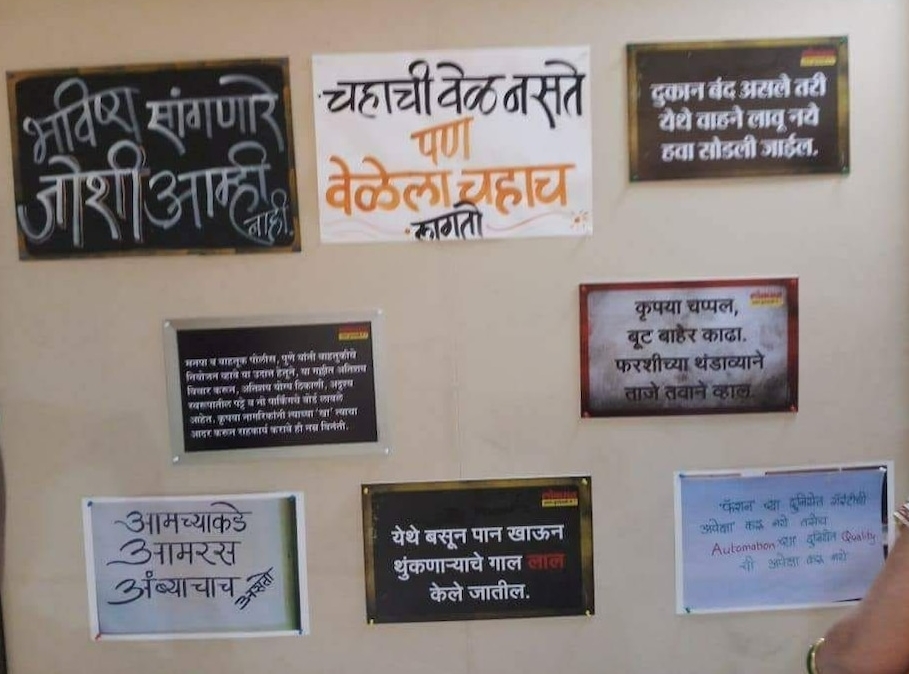
People who mostly come from outside the city come across those ubiquitous Puneri Patya, which are known for their bluntness and arrogance, while they appear funny to the uninitiated. A typical Punekar thinks and acts as though they have the sole right to educate people in their own ways. A Punekar believes in calling a spade a spade. They want order and discipline around them, which is absent when it comes to traffic though. They don’t want to repeat the same thing to visitors or passers-by. Hence, the Patya culture has been thriving in Pune dishing out advice, warnings and at times, threats to those who have not adopted the city’s culture.
From this unique way of expressing their thought we can say that Punekars love to educate others and finding the mistakes of other peoples.
Being a Punekar myself, I never found these Patya strange. However, some people from other cities always made fun of these signages. It seems pun is part of Pune’s life as these signages indicate.

2. Puneri Misal

Famous Puneri Misal you should definitely try if you are traveling to Pune. Misal is like full time meal for Punekars, they can eat Misal all day without getting bored. Misal the local spicy snack of Punekars. It is the all time favourite dish of Punekars and you would find every restaurant and even the smallest hotel at the corner serving them.

3. No work between 1pm to 4pm

In Pune during some time in afternoon like about 2 hours from 1pm to 4pm you will notice that every shop even the smallest one at nook is closed.
Outsiders an those who are new at Pune think this habit of Punekar a bit weird, outsiders find it strange that almost all shops are closed for some hours in the afternoon since their owners take a nap during that time.

4. Puneri Chaha

Pune’s most favourite and famous tea destination “Yewale Amruttulya”. You will find it strange that, a tea shop is as famous as Starbucks. Many people travel far away just to taste “Yewale Amruttulya”, you have to stand in long lines just to taste a tea.

4 Most Sought After Fields in Germany

German education standards are pretty high. Germany is known for the quality of education it provides as well as its globally recognized qualifications. German universities are highly regarded worldwide, besides being among the highest-ranked in the world.

Planning to study in Germany? Here are the four most popular courses to study there!

Engineering

Every student in the world who wants to do Engineering, for them Germany is like a dream country, all of them wants to complete their Engineering in Germany.

Of course you saw this coming, didn’t you? if you didn’t, where do you think most of your luxury cars are made? Comprising nearly 25% of international students, it is one of most popular courses in Germany. Specializations include – Automobile, mechanical and electrical engineering amongst others. Technical University of Munich, RWTH Aachen University, Karlsruhe Institute of Technology, and the Technical University of Berlin are some of the most renowned universities for this course. 

It takes more or less than 4.5 or 5.5 years to complete your Engineering program in Germany including the time required for learning German and the foundation courses. According to recent statistics, Germany has the second highest number of Engineering workers among all employees in the EU. German Universities offers numerous scholarship opportunities for Engineering students, while studying Engineering in Germany you can research and collaborate with the Engineering Industry. If the student manages to secure a position in any of the public university, study in Germany is free for Indian students, just like students from other part of the world. Students just have to pay a nominal semester fee (around 250 to 500 Euros) per semester        

Humanities

Surprised to see this on the list? Well, Germany offers around 6000 courses in the field of humanities. With some of the best- ranked universities in the world for courses in the Humanities. more than 11,000 international students in Germany were seeking a degree in the humanities, in 2019 only.

A majority of the humanities degree programmes in Germany offer integrated modules which give students the opportunity to obtain the necessary practical skills, besides the theoretical ones. German universities make sure to provide students with both, theoretical and practical skills, in order to ensure that once these students graduate, they will be fully equipped to enter the job market with confidence. Humanities programmes will comprise of professionally related events, study semesters abroad, as well as research projects or internships so students understand exactly what they will encounter in the future, in their professions. Students can also choose from a variety of combinations, which further enhances the experience.  There are many best universities where you can purse your love for languages and the social sciences in Germany. Studying the humanities in Germany, in comparison to other countries, slightly more affordable.

Business and Finance

Boasting of one of the best economies in Europe, Germany is one of the best countries to earn a degree in Business and finance and gain practical knowledge. The strong German economy means a constant influx of educated workers – including many English speakers, who are highly sought in Frankfurt’s finance and business communities. The nation’s GDP has continued to grow in recent years. Economic freedom is partly responsible for why the city has become a seedbed for innovation and entrepreneurial initiative. According to Eurostat, amongst the 28 countries in the European Union more than 40% of all patents are held by Germany. Half of the cities in top-30 metropolitan areas for patents are in Germany.

Germany also has one of the lowest unemployment rates at just over 5%. Germany is a global leader in R & D investment that further assures access to top – notch training and resources.

Computer sciences and Mathematics

Due to Germany’s extremely advanced technology, disciplines intertwined with it are always in demand. Germany is an excellent place to work as a computer engineer, as it’s companies invest heavily in development and research, maintaining the country’s results as the biggest economy in Europe and the third in the world. In a 2015 OECD/PISA study, Germany ranked 16th in mathematics as well as in science.

In turn, the employability rate for careers related to these degrees is also extremely high. Once again, these aren’t restricted to these, one can explore course like Scientific computing, knowledge – Based Systems and robotics among other!

What is Data Science?

As the world entered the era of big data, the need for its storage also grew. It was the main challenge and concern for the enterprise industries until 2010. The main focus was on building a framework and solutions to store data. Now when Hadoop and other frameworks have successfully solved the problem of storage, the focus has shifted to the processing of this data. Data Science is the secret sauce here. Data Science is a blend of various tools, algorithms, and machine learning principles with the goal to discover hidden patterns from the raw data. But how is this different from what statisticians have been doing for years? The answer lies in the difference between explaining and predicting. 

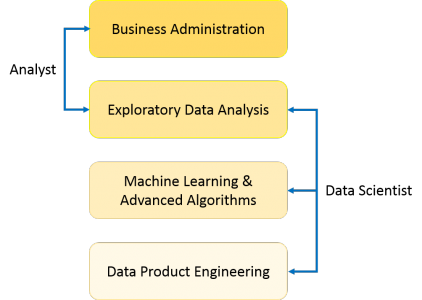
From the above image, it is clear that a Data Analyst usually explains what is going on by processing history of the data. On the other hand, Data Scientist not only does the exploratory analysis to discover insights from it, but also uses various advanced machine learning algorithms to identify the occurrence of a particular event in the future. A Data Scientist will look at the data from many angles, sometimes angles not known earlier.

So, Data Science is primarily used to make decisions and predictions making use of predictive causal analytics, prescriptive analytics (predictive plus decision science) and machine learning.

  • Predictive causal analytics – If you want a model that can predict the possibilities of a particular event in the future, you need to apply predictive causal analytics. Say, if you are providing money on credit, then the probability of customers making future credit payments on time is a matter of concern for you. Here, you can build a model that can perform predictive analytics on the payment history of the customer to predict if the future payments will be on time or not.
  • Prescriptive analytics: If you want a model that has the intelligence of taking its own decisions and the ability to modify it with dynamic parameters, you certainly need prescriptive analytics for it. This relatively new field is all about providing advice. In other terms, it not only predicts but suggests a range of prescribed actions and associated outcomes.
  • Machine learning for making predictions — If you have transactional data of a finance company and need to build a model to determine the future trend, then machine learning algorithms are the best bet. This falls under the paradigm of supervised learning. It is called supervised because you already have the data based on which you can train your machines. For example, a fraud detection model can be trained using a historical record of fraudulent purchases.
  • Machine learning for pattern discovery — If you don’t have the parameters based on which you can make predictions, then you need to find out the hidden patterns within the dataset to be able to make meaningful predictions. This is nothing but the unsupervised model as you don’t have any predefined labels for grouping. The most common algorithm used for pattern discovery is Clustering.

Why Data Science?

Traditionally, the data that we had was mostly structured and small in size, which could be analyzed by using simple BI tools. Unlike data in the traditional systems which was mostly structured, today most of the data is unstructured or semi-structured. One can understand the precise requirements of your customers from the existing data like the customer’s past browsing history, purchase history, age and income. No doubt you had all this data earlier too, but now with the vast amount and variety of data, you can train models more effectively and recommend the product to your customers with more precision. The self-driving cars collect live data from sensors, including radars, cameras, and lasers to create a map of its surroundings. Based on this data, it takes decisions like when to speed up, when to speed down, when to overtake, where to take a turn – making use of advanced machine learning algorithms. Data from ships, aircraft, radars, satellites can be collected and analyzed to build models. These models will not only forecast the weather but also help in predicting the occurrence of any natural calamities. It will help you to take appropriate measures beforehand and save many precious lives.

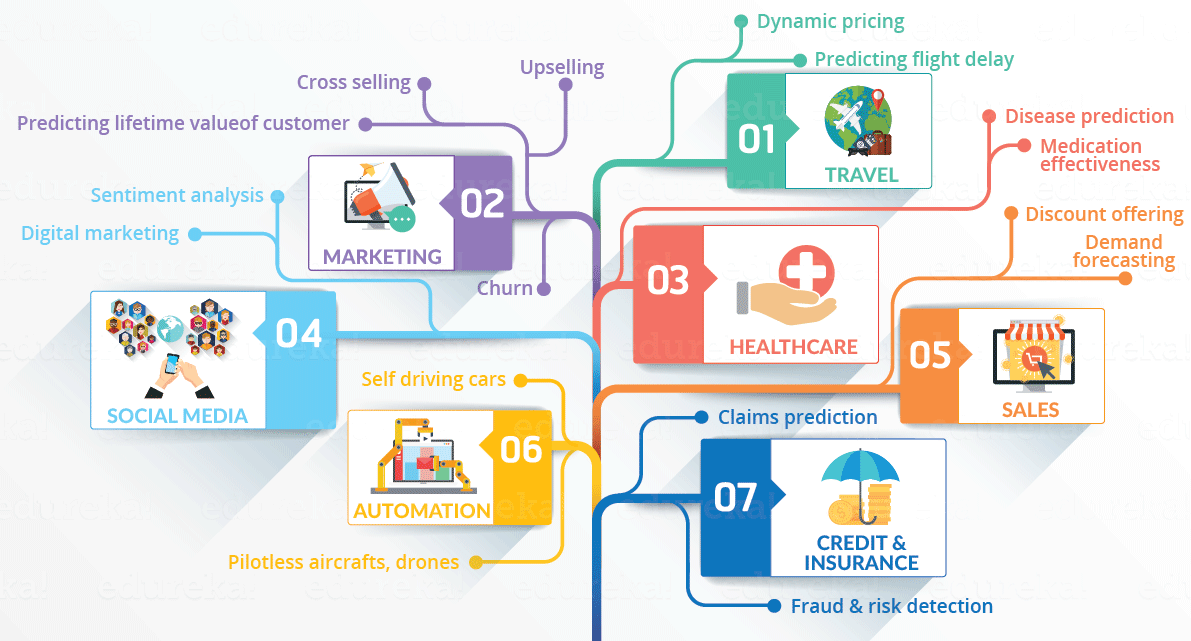
The following infographic shows the various domains in which Data Science is creating its impression:

Role of a Data Scientist

Data scientists are those who crack complex data problems with their strong expertise in certain scientific disciplines. They work with several elements related to mathematics, statistics, computer science, etc (though they may not be an expert in all these fields). They make a lot of use of the latest technologies in finding solutions and reaching conclusions that are crucial for an organization’s growth and development. Data Scientists present the data in a much more useful form as compared to the raw data available to them from structured as well as unstructured forms.

WHAT DOES AN ENGINEER ACTUALLY DO?

BY:VAIBHAVI MENON

Engineers, as practitioners of engineering, are professionals who invent, design, analyze, build and test machines, complex systems, structures, gadgets and materials to fulfill functional objectives and requirements while considering the limitations imposed by practicality, regulation, safety and cost. The word engineer (Latin ingeniator) is derived from the Latin words ingeniare (“to create, generate, contrive, devise”) and ingenium (“cleverness”). The foundational qualifications of an engineer typically include a four-year bachelor’s degree in an engineering discipline, or in some jurisdictions, a master’s degree in an engineering discipline plus four to six years of peer-reviewed professional practice (culminating in a project report or thesis) and passage of engineering board examinations.

The work of engineers forms the link between scientific discoveries and their subsequent applications to human and business needs and quality of life. A professional engineer is competent by virtue of his/her fundamental education and training to apply the scientific method and outlook to the analysis and solution of engineering problems. He/she is able to assume personal responsibility for the development and application of engineering science and knowledge, notably in research, design, construction, manufacturing, superintending, managing and in the education of the engineer. His/her work is predominantly intellectual and varied and not of a routine mental or physical character. It requires the exercise of original thought and judgement and the ability to supervise the technical and administrative work of others. His/her education will have been such as to make him/her capable of closely and continuously following progress in his/her branch of engineering science by consulting newly published works on a worldwide basis, assimilating such information and applying it independently. He/she is thus placed in a position to make contributions to the development of engineering science or its applications. His/her education and training will have been such that he/she will have acquired a broad and general appreciation of the engineering sciences as well as thorough insight into the special features of his/her own branch. In due time he/she will be able to give authoritative technical advice and to assume responsibility for the direction of important tasks in his/her branch. Engineers develop new technological solutions. During the engineering design process, the responsibilities of the engineer may include defining problems, conducting and narrowing research, analyzing criteria, finding and analyzing solutions, and making decisions. Much of an engineer’s time is spent on researching, locating, applying, and transferring information. Indeed, research suggests engineers spend 56% of their time engaged in various information behaviors, including 14% actively searching for information. Engineers must weigh different design choices on their merits and choose the solution that best matches the requirements and needs. Their crucial and unique task is to identify, understand, and interpret the constraints on a design in order to produce a successful result.

Engineers apply techniques of engineering analysis in testing, production, or maintenance. Analytical engineers may supervise production in factories and elsewhere, determine the causes of a process failure, and test output to maintain quality. They also estimate the time and cost required to complete projects. Supervisory engineers are responsible for major components or entire projects. Engineering analysis involves the application of scientific analytic principles and processes to reveal the properties and state of the system, device or mechanism under study. Engineering analysis proceeds by separating the engineering design into the mechanisms of operation or failure, analyzing or estimating each component of the operation or failure mechanism in isolation, and recombining the components. They may analyze risk.

McLaren F1: The Ultimate Road Car Ever

McLaren F1 was the fastest production car for 12 straight years from 1993 to 2005. At the time of its unveiling, McLaren F1 was an engineering marvel with numerous pioneering technological innovations. It was designed by the legendary designer and engineer Gordon Murray.

McLaren F1 Rear

It was the first road production car to be fully built carbon fiber. The entire Carbon fiber monocoque weighs just fewer than 220 pounds and 5000 pieces of carbon fiber pieces were used to mold the final frame.  This gives it double the strength of steel but it makes it five times lighter than traditional frames.

The car has a central seating position which is unique to this car. While developing McLaren F1, Gordon Murray drove and tested all the contemporary supercars of that time and he realized that their three-pedal boxes were somewhat offset. So He wanted to eliminate that. To solve this problem he placed the seat in the central driving position similar to a traditional F1 racing car. The central position also helps in increasing the visibility of the driver.

It has a naturally aspirated 6.1-liter V12 engine, but initially, McLaren has asked Honda to supply an engine for them as they were also the supplier for their F1 racing team at that time. But Honda didn’t follow the specification stated by Gordon Murray. Later they asked BMW to supply them with the engine of their car. BMW had to make a new engine as per the specification and the final results were incredible. The Engine is called BMW Motorsport S70/2

 The engine possesses extremely efficient heads. It also has continuous variable inlet valve timing and an emission-control system and four catalytic converters with ‘Lambda’ exhaust gas analysis control. Even with a 6064 CC displacement and a power output excess of 550bhp, the engine is quite efficient. The engine created so much heat that it had to be covered with a good heat deflecting material and to solve that problem the engine bay was covered with 16 grams of gold foil.

On 31 March 1998, Andy Wallace drove the McLaren F1 XP5 prototype at Volkswagen’s test track in Ehra-Lessen, Germany, and broke the record created by McLaren F1 itself in 1993. The car reached the top speed of 391 kilometers per hour or 243 Miles per hour. As of today, the F1 remains the fastest naturally aspirated production car in the world.

https://www.autozine.org/Archive/McLaren/old/F1.html

The car had a limited production of 106. Of those only 64 of them were road-going cars and 28 of them were racecars and the remaining of them were prototypes and special editions like the LM and longtail version. Rowan Atkinson (Mr. Bean) was for one period the owner of McLaren F1 as well.

Back in 1993, a brand-new McLaren F1 cost £540,000. In today’s money it would be approximately 1.1 million pounds but due to the rarity and the special status and engineering feat of the car. McLaren F1 has steadily climbed in value since then. As of today a McLaren F1 costs around £16 million and special versions can fetch even more. This car has also stood the test of time in its design, engineering, and craftsmanship.

References:

Basics of Software Engineering

What is a Software ?

  • It is a set of instructions (computer programs) that when executed provide desired function and performance.
  • It is a Data structures that enable the programs to adequately manipulate information.
  • It is a Documents that describe the operation and use of the programs.

What is Embedded Software ?

 Intelligent products have become commonplace in nearly every consumer and industrial market.
 Embedded software resides in read-only memory and is used to control products and systems for the
consumer and industrial markets.
 Embedded software can perform very limited and esoteric functions (e.g., keypad control for a
microwave oven) or provide significant function and control capability (e.g., digital functions in an
automobile such as fuel control, dashboard displays, and braking systems).
 A function point extension called feature points.
 It is a superset of the function point measure that can be applied to systems and engineering software applications.

 The feature point measure accommodates applications in which algorithmic complexity is high. Real-
time, process control and embedded software applications tend to have high algorithmic complexity and are therefore amenable to the feature point.

Changing Nature of Software

 Whenever one starts with the software implementation changes can occur any time.
 The software can be change due to any reason.
 But while implementing software one should be ready for such changes as if changes occur there shall not be drastic change in the system.
 The development team should manage to implement/mould the implemented system so that the
changes can be reflected and the user requirements meet.
 When change occur the team look for the current status of the system and from there onwards they starts implementing a system with new requirements of a user or changes which is to be implemented in a system.