Insolvency and Bankruptcy Code, 2016:- An Indian Context

Insolvency and Bankruptcy Code
Constitutionality of the provisions of the Code

Introduction

The Code was enacted in 2016 following decades of recommendations suggesting improvements to the previous insolvency regime, which was fragmented, fraught with delays and resulted in poor recoveries for creditors. [1]

The insolvency resolution process in India has in the past involved the simultaneous operation of several statutory instruments.

These include the Sick Industrial Companies Act, 1985, the Securitisation and Reconstruction of Financial Assets and Enforcement of Security Interest Act, 2002, the Recovery of Debt Due to Banks and Financial Institutions Act, 1993, and the Companies Act, 2013.[2]

Broadly, these statutes provided for a disparate process of debt restructuring, and asset seizure and realization in order to facilitate the satisfaction of outstanding debts. [3]

As is evident, a plethora of legislation dealing with insolvency and liquidation led to immense confusion in the legal system, and there was a grave necessity to overhaul the insolvency regime.

All of these multiple legal avenues, and a hamstrung court system led to India witnessing a huge piling up of non-performing assets, and creditors waiting for years at end to recover their money. [5]

The Bankruptcy Code is an effort at a comprehensive reform of the fragmented regime of corporate insolvency framework, in order to allow credit to flow more freely in India and instill faith in investors for speedy disposal of their claims. [4]

The Code consolidates existing laws relating to insolvency of corporate entities and individuals into a single legislation.

The Code has unified the law relating to enforcement of statutory rights of creditors and streamlined the manner in which a debtor company can be revived to sustain its debt without extinguishing the rights of creditors[5]:-

1) The scheme of the Code marked a sea change from the previous regime. In respect of corporate entities, the Code introduced a creditor-in-control regime (with a focus on empowering financial creditors), a time-bound resolution process and reduced scope for judicial intervention, and established institutions such as the Insolvency and Bankruptcy Board of India, insolvency professionals and information utilities.[6]

Since the implementation of this new regime, the constitutional validity of various provisions of the Code has been challenged before various High Courts, and the Supreme Court.

Applicability

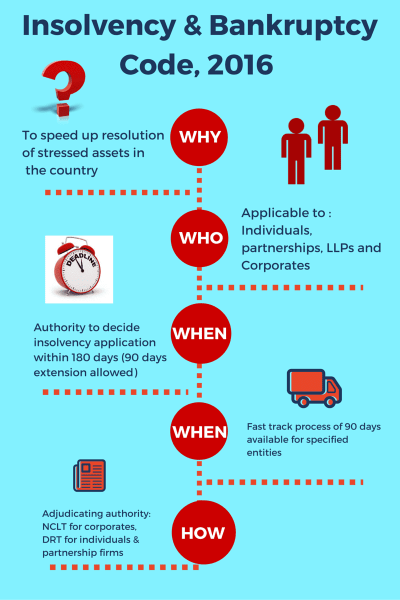
The Code provides creditors with a mechanism to initiate an insolvency resolution process in the event a debtor is unable to pay its debts. The Code makes a distinction between Operational Creditors and Financial Creditors. [7]

A Financial Creditor is one whose relationship with the debtor is a pure financial contract, where an amount has been provided to the debtor against the consideration of time value of money (“Financial Creditor”).

Recent reforms have sought to address the concerns of homebuyers by treating them as ‘financial creditors’ for the purposes of the Code. [7]

By a recently promulgated ordinance, the Insolvency and Bankruptcy Code (Amendment) Ordinance, 2018 (“the Ordinance”), the amount raised from allottees under a real estate project (a buyer of an under-construction residential or commercial property) is to be treated as a ‘financial debt’ as such amount has the commercial effect of a borrowing.[7]

The Ordinance does not clarify whether allottees are secured or unsecured financial creditors. Such classification will be subject to the agreement entered into between the homebuyers and the corporate debtor.

In the absence of allottees having a clear status, there may be uncertainty about their priority when receiving dues from the insolvency proceedings. [7]

An Operational Creditor is a creditor who has provided goods or services to the debtor, including employees, central or state governments (“Operational Creditor”). A debtor company may also, by itself, take recourse to the Code if it wants to avail of the mechanism of revival or liquidation. [7]

In the event of inability to pay creditors, a company may choose to go for voluntary insolvency resolution process – a measure by which the company can itself approach the NCLT for the purpose of revival or liquidation. [7]
What was the judicial approach to the Insolvency and Bankruptcy Code?

SERIES OF JUDICIAL PRONOUNCEMENT

With almost more than two years since the introduction of the Code, there have been various challenges in the effective implementation of the Code. However, constructive interpretation by the judiciary coupled with effective amendments to the Code has helped in eradicating most of these teething issues. [8]

Some of the key judicial pronouncements are discussed below:

The Insolvency and Bankruptcy Board of India which is the regulatory and supervisory body in charge of the IBC, has done a commendable job in proactively spreading awareness and regulating the space. [9]

Many important judgments were pronounced throughout the year, including certain landmark cases, where in the Supreme Court has tried to ensure that the spirit of the Code is given primacy over procedural requirements. [9]

Suspended Board of Directors of Corporate Debtor Entity are entitled to access the resolution plan and other related documents:-

In a significant judgments delivered on January 31, 2019, the Hon’ble Supreme Court of India decided on an important aspect with respect to the rights of the suspended board of directors of the Corporate Debtor Entity to receive and access the resolution plan and other related documents, whose case has been admitted by the Adjudicating Authority under the relevant provisions of the Code. [10]

Facts of the Case:
In respect of Mr. Vijay Kumar Jain, Director of Corporate Debtor (‘Appellant’) vs. Standard Chartered Bank and Ors. (As ‘Financial Creditors’), the NCLT had approved the appointment of Resolution Professional (‘RP’) to conduct Corporate Insolvency Resolution Process of Corporate Debtor Company i.e. Ruchi Soya Industries Limited (‘RSIL’). [10]

The appellant, being a member of the suspended board of RSIL, was given notice and agenda for the first meeting of Committee of Creditors (‘CoC’) and was permitted to attend the meeting of CoC. The appellant alleged that he was not granted permission to participate in subsequent meetings of CoC. [10]

As a result, the appellant filed a miscellaneous application before the NCLT to allow his participation in the subsequent meetings of CoC. The appellant also executed a Non-Disclosure Agreement (‘NDA’) to keep information received through participation in the CoC meeting strictly confidential and even undertook to indemnify RP. [10]

However, NCLT vide its order dated August 1, 2018 dismissed the said application of appellant with liberty to the appellant to attend the COC meetings, but not to insist upon the CoC or RP to provide information which is considered as confidential by the CoC or RP. [11]

Against the said order of NCLT, the appellant filed an appeal before the Appellate Tribunal, which recognized the right of appellant to attend and participate on the CoC meetings but Appellate Tribunal vide its order dated August 9, 2018 [12] denied the prayer of the appellant to have access to certain documents including sensitive resolution plan.

The appellant aggrieved by the order of the NCLAT, filed an appeal before the Hon’ble Supreme Court of India. [13]

Apex Court Observations and Findings:

On advertising relevant provisions of the Code and arguments of parties to the dispute, the Supreme Court opined that notice of each meeting of the CoC will have to be given to the suspended board of directors of the corporate debtor entity. [14]

The Supreme Court further noted that the statutory scheme of IBC makes it clear that though the suspended board are not members of the CoC, yet, they have a right to participate in each and every meeting held by the CoC and also have a right to discuss along with members of the CoC, resolution plan that are presented at such meeting. [14]

The Supreme Court further observed that Section 31(1) of the Code make it clear once the resolution plan is passed by the Adjudicating Authority, it shall be binding on the corporate debtor together with guarantors and other stakeholders. [14]

This being the case, it is clear that the erstwhile board of directors, which consists of persons who may have given personal guarantees for the debts owed by the corporate debtor, will be bound by the resolution plan, and therefore, have a vital stake in what ultimately gets passed by the CoC’s.[14]

The Supreme Court also made it clear that so far as confidential information is concerned, RP can take an undertaking in the form of NDA from suspended board of directors of the corporate debtor entity with an objective to maintain strict confidentiality in regard to resolution plan and other related documents. [14]

Further, according to Regulation 39(5) of IBBI (Insolvency Resolution Process for Corporate Persons) Regulations, 2016, the RP shall forthwith send a copy of the order of the Adjudicating Authority approving or rejecting a resolution plan to the participants and resolution applicant. The term ‘Participants’ includes members of the erstwhile Board of Directors of Corporate Debtor. [14]

Thus in view of the above, the Supreme Court allowed the appeal and set aside the impugned order of the Appellate Tribunal. [14]

What was the result of Insolvency and Bankruptcy Code in the present scenario? Also cite relevant case laws.

IBC came into being repealing SICA (Sick Industrial Companies Act), SICA was repealed with effect from 1 December 2016. [15]

To know the background of IBC, it is important to know more about SICA and why it failed to prevail as a law. [15]

This is the exact rationale for the existence of The Insolvency and Bankruptcy Code in India which has been into effect since 2016. [15]

To know the background of IBC, it is important to know more about SICA and why it failed to prevail as a law. [15]

The journey from SICA to IBC

The SICA, 1985:-

The name SICA, itself connotes the reason for its actuality. India witnessed an atmosphere of rampant industrial sickness in the 1980s in furtherance of which the Government of India came up with key legislation i.e. the Sick Industrial Companies Act to combat the issue. [15]

Widespread industrial sickness affects the economy in a number of ways, thus The Act came into being to spot the sick or potentially sick companies owning industrial undertakings and take speedy remedial measures for their revival or in a scenario where there is no such measure, close such units. [15]

This was an action to get the locked up investment in such industrial units released and use them in a more productive manner. SICA was repealed and replaced by the Sick Industrial Companies (Special Provisions) Act of 2003, which diluted certain provisions of SICA and filled certain gaps. [15]

One of the main changes to the new law was that, in addition to combating occupational diseases, it also aimed to reduce the growing incidence by ensuring that companies do not use a medical certificate simply to evade legal obligations and access concessions granted to financial institutions to receive. [15]

The comprehensive performance of the Act did not live up to the expected results and thus, IBC was notified as on 28th May 2016 and the repeal of SICA came into full effect from December 1, 2016. [15]

IBC Kicks In
Mistakes of the past were taken in view and The Insolvency and Bankruptcy code came into being with a wider scope and aiming to resolve the issues via more effective provisions and implementation. It is an act to consolidate and amend the laws having reorganization and insolvency resolution issues as the subject-matter. [15]

The provisions of the Act shall apply to the following in case of insolvency, liquidation, voluntary liquidation or bankruptcy; [15]

“An Act to consolidate and amend the laws relating to reorganisation and insolvency resolution of corporate persons, partnership firms and individuals in a time bound manner for maximisation of value of assets of such persons, to promote entrepreneurship, availability of credit and balance the interests of all the stakeholders including alteration in the order of priority of payment of Government dues and to establish an Insolvency and Bankruptcy Board of India, and for matters connected therewith or incidental thereto.

CASE LAWS:-

1) Mobilox Innovations (P) Ltd. Vs. Kirusa Software (P) Ltd.- Supreme Court

Whether the expression “and” occurring in section 8(2)(a) may be read as “or”?

The Court held that the expression “and” occurring in section 8(2)(a) may be read as “or” in order to further the object of the statute and/ or to avoid an anomalous situation – once the operational creditor has filed an application, which is otherwise complete, the adjudicating authority must reject the application under Section 9(5)(2)(d) if notice of dispute has been received by the operational creditor or there is a record of dispute in the information utility – So long as a dispute truly exists in fact and is not spurious, hypothetical or illusory, the adjudicating authority has to reject the application – A “dispute” is said to exist, so long as there is a real dispute as to payment between the parties that would fall within the inclusive definition contained in Section 5(6). [16]

2) Surendra Trading Company Vs. Juggilal Kamlapat Jute Mills Company Ltd. & Others- Supreme Court:
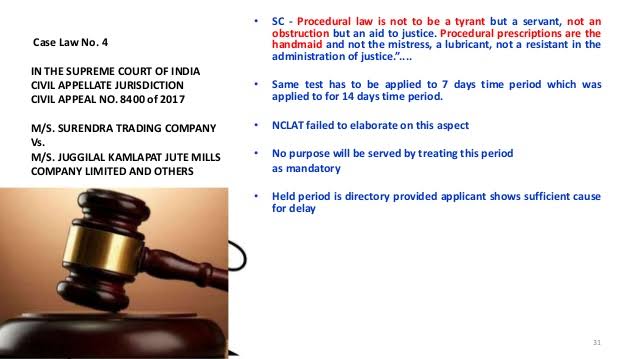
The time limit prescribed in IBC, 2016 for admitting or rejecting a petition or initiation of CIRP under proviso to sub-sec. (5) of Sec. 9, is directory. [17]

The question before the NCLAT was to whether time of fourteen days under section 9(5) given to the adjudicating authority for ascertaining the existence of default and admitting or rejecting the application is mandatory or directory. [17]

NCLAT hold that the mandate of sub-section (5) of section 7 or sub-section (5) of section 9 or sub-section (4) of section 10 is procedural in nature, a tool of aid in expeditious dispensation of justice and is directory. [17]

Further question (with which supreme Court is concerned) was as to whether the period of seven days for rectifying the defects under proviso to sub-section (5) of Section 9 is mandatory or directory. The aforesaid provision of removing the defects within seven days is directory and not mandatory in nature. [17]

3) Essar Steel India Ltd. Vs. Reserve Bank of India-
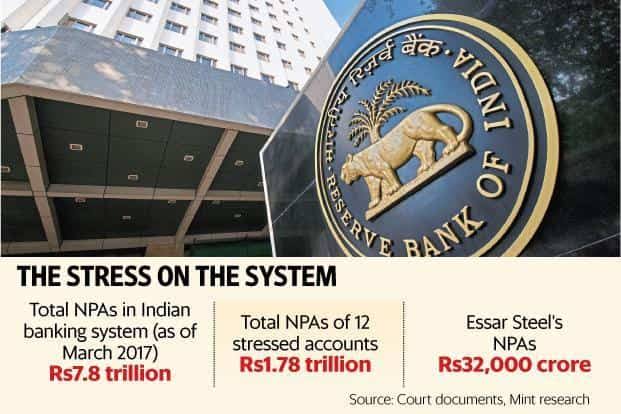
RBI is authorized to direct any banking company to initiate insolvency resolution process- Gujarat High Court. [18]

A long-drawn legal battle for Essar Steel ends with this Supreme Court judgment. In one of the most discussed cases under IBC i.e. the case of Essar Steel Limited, the Supreme Court delivered its judgment which would probably be the final judgment of the case. Key highlights of the Essar Steel Supreme Court judgment are as follows: [19]

The requirement of completing the corporate insolvency resolution process within 330 days from the insolvency commencement date as introduced by the 2019 Amendment Act was held as non-mandatory. [19]

CoC can delegate its administrative powers or power of negotiation with the resolution applicants to a smaller committee (sub-committee) since such acts would be ultimately required to be approved and ratified by the CoC. [19]

Prospective resolution applicant has a right to receive complete information as to the CD, debts owed by it, and its activities as a going concern and as such it cannot suddenly be faced with “undecided” claims after the resolution plan submitted by it has been accepted. [19]

To put an end to uncertainty, parameters were laid down for limiting the scope of interference of Adjudicating Authority and Appellate Authority with the commercial decision taken by the requisite majority of CoC. [19]

The Supreme Court has re-emphasized the primacy of the commercial wisdom of the CoC in relation to resolution of the corporate debtor as well as difference in treatment of unequally placed creditors based on its earlier decisions in Swiss Ribbons and K. Sashidhar cases. [19]

Why are the judgments of the Insolvency and Bankruptcy cases pending with court?

The judgments of the cases are pending with the Court due to the Causes for the delays which range from frivolous challenges by operational creditors and promoters to basic issues like shortage of judges. [20]

There is no stipulated time-line for operational creditors to challenge the rejection of their claim, shortage of members at the bench, allowing intervention by promoters at the admission stage and long gaps between conclusion of hearing and passing of written orders are all causing delays,” said Sapan Gupta, national head banking and finance practice at Shardul Amarchand and Mangaldas. [20]

To be fair, delays are not a peculiarly Indian phenomenon. Many advanced countries struggle to provide quick, high-quality justice to citizens. But in India the scale of the problem is unprecedented. Focusing on capacity alone won’t reduce delays. [21]

A pervasive reason for the delays is adjournments. Many advanced countries struggle to provide quick, high-quality justice to citizens. But in India the scale of the problem is unprecedented.[21]

Conclusion
In conclusion, the Insolvency and Bankruptcy Code, 2016, is a progressive legislation that is intended to improve the efficiency of insolvency and bankruptcy proceedings in India. The new legislation provides for the early detection of financial distress and a time bound process for resolution. [22]

However, many details on the IBC’s implementation need to be worked out in the regulations, and its success will depend to a large extent on how quickly a high quality cadre of insolvency resolution professionals will emerge and on whether the time bound process for insolvency resolution will be adhered to in practice. [22]

The IBC has taken its first steps to regularize the insolvency process in India. It has amended over 11 legislations in India, bringing about one of the most significant changes to commercial laws in India in recent times. However, the 22 months of this nascent legislation have been ridden with controversies and speedy resolutions. [23]

It has also become a very important tool for banks to regularize multitudes of non-performing assets plaguing the country’s economy. Within 7 months of the enactment of the IBC, the Reserve Bank of India released a list of 12 companies which held about 25% of the gross non-performing assets of the country.[23]

With more than 11% of all loans in India being terms as bad loans, the IBC has become the need of the hour. The IBC has brought a plethora of changes to insolvency laws in India and aims to reduce the amount of bad loans that has saddled the economy over the last few years. [23]

We are beginning to see this through various companies successfully concluding their insolvency process. The first successful case of a CIRP was that of Bhushan Steel wherein TATA Steel agreed to purchase Bhushan Steel for Rupees Thirty-Two Thousand Five Hundred Crores. [23]

With many more insolvency resolution processes in the pipeline, only time will tell if the IBC will prove to be a successful tool with its objective of streamlining the insolvency process in India. [23]

WEBSITES REFERRED

1)https://www.google.com/url?sa=t&source=web&rct=j&url=https://www.ibbi.gov.in/webadmin/pdf/whatsnew/2019/Jun/190609_UnderstandingtheIBC_Final_2019-06-09%252018:20:22.pdf&ved=2ahUKEwiU2JqyvuPqAhX7yTgGHc8mBksQFjAkegQIEhAB&usg=AOvVaw028QlNt1CmtrH3vznorDJF

2)https://www.google.com/url?sa=t&source=web&rct=j&url=http://www.nishithdesai.com/fileadmin/user_upload/pdfs/Research_Papers/A-Primer-on-the-Insolvency-and-Bankruptcy-Code.pdf&ved=2ahUKEwiU2JqyvuPqAhX7yTgGHc8mBksQFjAlegQIDhAB&usg=AOvVaw1bdWB2crZi6wk9gjU0wz5X

3)https://www.mondaq.com/india/insolvencybankruptcy/829988/ibc-insolvency-and-bankruptcy-code-2016-the-bankruptcy-law-of-india

4)https://ibclaw.in/landmark-judgements-in-insolvency-and-bankruptcy-codeibc-2016/

5)https://www.mondaq.com/india/insolvencybankruptcy/903124/the-insolvency-and-bankruptcy-code-in-2019-recent-amendments-and-key-judgments

6)https://www.google.com/amp/s/m.economictimes.com/industry/banking/finance/banking/delay-becomes-the-norm-in-insolvency-bankruptcy-cases/amp_articleshow/70693319.cms

7)https://www.google.com/amp/s/m.economictimes.com/news/politics-and-nation/hidden-factors-that-slow-our-courts-and-delay-justice/amp_articleshow/57887726.cms

8)https://www.google.com/amp/s/taxguru.in/corporate-law/series-judicial-pronouncement-insolvency-bankruptcy-code-2016.html%3famp

9)https://ibclaw.in/case-name-hc/essar-steel-india-limited-vs-reserve-bank-of-india/

10)https://gamechangerlaw.com/ibc-2016-overview-of-the-insolvency-and-bankruptcy-code-2016/

11)https://economictimes.indiatimes.com/news/economy/policy/rbi-identifies-12-accounts-with-25-per-cent-of-bank-npas-for-insolvency/articleshow/59130725.cms

12)https://www.mondaq.com/india/insolvencybankruptcy/627706/insolvency-and-bankruptcy-cod

13)https://www.google.com/amp/lawtimesjournal.in/why-insolvency-and-bankruptcy-code-is-enacted/%3famp

14)https://www.google.com/amp/s/lexisnexisindia.wordpress.com/2019/11/22/streamlining-operational-debt/amp/

15)http://lawjournals.stmjournals.in/index.php/jbil/article/view/147

16)http://www.nishithdesai.com/information/news-storage/news-details/newsid/5289/html/1.html#:~:text=The%20Insolvency%20and%20Bankruptcy%20Board,awareness%20and%20regulating%20the%20space

17)https://www.khuranaandkhurana.com/2019/07/22/ibc-insolvency-and-bankruptcy-code-2016-the-bankruptcy-law-of-india/

18)https://ibclaw.in/supreme-court-of-india-mobilox-innovations-private-limited-vs-kirusa-software-private-limited-date-of-order-21-09-2017/

19)https://ibclaw.in/case-name/m-s-surendra-trading-company-vs-m-s-juggilal-kamlapat-jute-mills-company-limited-and-others/#:~:text=5)%20of%20Sec.-,9%2C%20is%20directory-%20Surendra%20Trading%20Company%20Vs.,%26%20Others-%20Supreme%20Court&text=On%20admission%20of%20the%20application,(1)%20of%20the%20Code

20)https://ibclaw.in/banking-company-is-entitled-to-initiate-insolvency-proceedings-without-the-directions-of-the-rbi-u-s-35aa-of-banking-regulation-act-essar-steel-india-limited-vs-reserve-bank-of-india-gujarat-hc/#:~:text=45%2C000%20Crores%2C%20it%20is%20clear,to%20initiate%20insolvency%20resolution%20process.&text=Therefore%2C%20there%20is%20no%20direction,any%20particular%20company(ies)

21)https://www.mondaq.com/india/insolvencybankruptcy/903124/the-insolvency-and-bankruptcy-code-in-2019-recent-amendments-and-key-judgments

22)https://arihantcapital.wordpress.com/2016/05/20/insolvency-and-bankruptcy-code-2016-highlights/amp/

23)http://lawgyaan.in/faq-insolvency-bankruptcy-code-2016-ibc/

24)https://www.google.com/amp/s/ibcode2016.com/%3fp=6510&amp=1

25) https://main.sci.gov.in/

26)https://www.slideshare.net/mobile/jyothiish/sick-industrial-companies-act-1985

27)https://www.centrik.in/blogs/mobilox-vs-kirusa-supreme-court-interprets-existence-of-dispute-as-per-ibc

28)https://smeadvisors.in/insolvency-and-bankruptcy-code-2016-ibc-2016-a-ray-of-hope-for-distressed-smes-in-india/

29)https://www.slideshare.net/mobile/CSRahulSahasrbauddhe/recent-ruling-on-ibc

30)https://www.google.com/amp/s/www.livemint.com/Companies/0jEBwZ04t2G97mWzb8bj4M/Gujarat-high-court-dismisses-Essar-Steel-petition.html%3ffacet=amp

31)https://stock.adobe.com/sk/search/images?k=femida

32)https://images.app.goo.gl/ovLsp8Yjf5qUxJ8f6

FOOTNOTES

1) Bankruptcy Law Reforms Committee, The Interim Report of the Bankruptcy Law Reforms Committee (2015).

2) Rule 2.1.1. of RBI Master Circular – Prudential Norms on Income Recognition, Asset Classification and Provisioning – Pertaining to Advances defines an NPA as ‘An asset, including a leased asset, becomes non-performing when it ceases to generate income for the bank. A ‘non-performing asset’ (NPA) was defined as a credit facility in respect of which the interest and/ or installment of principal has remained ‘past due’ for a specified period of time.

3) It must be noted that creditors having outstanding debts continue to have the right to approach an appropriate forum like civil courts or arbitral tribunals for recovery of debts which would be a contractual right of recovery.

4) As cited in the “Abstract” of “Emerging Jurisprudence on Corporate Insolvency” by Shipra Sayal Institute of Law, Nirma University, Ahmedabad, Gujarat, India.

5) As cited in the “Introduction” Para of “A Primer on the Insolvency and Bankruptcy Code, 2016” by Nishith Desai Associates:- The Legal and Tax Counseling Worldwide.

6) As cited in the “Introduction” para of “Understanding the Insolvency and Bankruptcy Code, 2016:- Analysing the developments in jurisprudence” by “Vidhi Bankruptcy Research Programme” at the Vidhi Centre for Legal Policy and the Legal Division of the Insolvency and Bankruptcy Board of India.

7) As cited in the “Applicability” Para of “A Primer on the Insolvency and Bankruptcy Code, 2016” by Nishith Desai Associates:- The Legal and Tax Counseling Worldwide.

8) As cited in the “4th Para ,viz, Series of Judicial Pronouncement” of “Series of Judicial Pronouncement – Insolvency and Bankruptcy Code, 2016” written by Rushabh Ajmera on TaxGuru.

9) As cited in the “Introduction” Para of “Insolvency and Bankruptcy Hotline:- ANALYSING 2018 THROUGH THE LENS OF THE INSOLVENCY CODE” written on January 17, 2019 by Nishith Desai Associates.

10) As cited in the “4th Para” viz, Series of Judicial Pronouncement” of “Series of Judicial Pronouncement – Insolvency and Bankruptcy Code, 2016” written by Rushabh Ajmera on TaxGuru Website India 11 months ago.

11) As cited in “NCLT pronounced order on August1, 2018”.

Click to access STANDARD%20CHARTERED%20BANK%20MA%20518-2018%20CP%201371-2018%20%20NCLT%20ON%2001.08.2018%20FINAL_2018-08-09%2009:46:45.pdf

12) As cited in “NCLAT pronounced order on August 9, 2018”.

Click to access 9th%20Aug%202018%20in%20the%20matter%20of%20Vijay%20Kumar%20Jain%20Vs.%20Standard%20Chartered%20Bank%20Ltd.%20&%20Ors.%20CA%20(AT)%20No.%20442-2018_2018-08-20%2011:14:26.pdf

13) As cited in “Facts of the Case Para” of “Series of Judicial Pronouncement – Insolvency and Bankruptcy Code, 2016” by Rushabh Ajmera 11 Months ago on TaxGuru India Website.

14) As cited in ” Apex Court Observations and Findings Para” in “Series of Judicial Pronouncement – Insolvency and Bankruptcy Code, 2016” by Rushabh Ajmera 11 Months ago on TaxGuru India Website.

15) As cited in “IBC (Insolvency and Bankruptcy Code, 2016) – The Bankruptcy Law of India” written by Vidushi Trehan, LL.M from Symbiosis Law School, Pune , Intern at Khurana & Khurana, Advocates and IP Attorneys.

16) As cited in “Brief about decision para” in ” “and” occurring in section 8(2)(a) may be read as “or”- Mobilox Innovations (P) Ltd. Vs. Kirusa Software (P) Ltd.- Supreme Court” written by IBC LAWSon September 21, 2017.

17) As cited in “Case Name: M/S. Surendra Trading Company Vs. M/S. Juggilal Kamlapat Jute Mills Company Limited and Others” written by IBC LAWS on September 18, 2017

18) As cited in “RBI is authorised to direct any banking company to initiate insolvency resolution process- Essar Steel India Ltd. Vs. RBI- Gujarat High Court” written on July 17, 2017 by IBC LAWS.

19) As cited in “The Insolvency And Bankruptcy Code In 2019 : Recent Amendments And Key Judgments” written by Mayur Shetty and Chintan Gandhi of Rajani Associates on 12th March 2020.

20) As cited in “Delay becomes the norm in insolvency & bankruptcy cases” by Joel Rebello & Saikat Das, ET Bureau on Aug 15, 2019 at 11:25pm.

21) As cited in “Hidden factors that slow our courts and delay justice” written by Arghya Sengupta.

22) As cited in “Insolvency And Bankruptcy Code” written on 12 September 2017 by Samvad Partners.

23) As cited in “2016: Overview Of The Insolvency And Bankruptcy Code, 2016” written by Namrata Bhagwatula , Senior Associate on 20 September, 2018.

Parle G is the largest selling biscuit brand in the world !

Parle-G is a brand of biscuits manufactured by Parle Products in India. A 2011 Nielsen survey reported it is the best-selling brand of biscuits in the world. Parle G or Parle Glucose is one of the most popular brands of biscuits not only in India but the entire world. Parle G is a brand of biscuits manufactured by Parle Products in India, and it has been in the market for decades.

In 2011, Nielsen, a market research company, published a report stating that Parle G has consolidated its position as the world’s largest selling biscuit brand. In fact, Parle G has topped other leading brands such as Kraft’s Oreo, Mexico’s Gamesa and Wal-Mart’s private labels. This may come as a surprise to many but India is the world’s leading market for biscuits, moving past some of the biggest markets in the world – the US, Mexico, China, Italy and Spain.

History

Parle Products was established as a confectionery maker in the Vile Parle suburb of Mumbai, in 1929. Parle Products began manufacturing biscuits in 1939. In 1947, when India became independent, the company launched an ad campaign, showcasing its Gluco brand of biscuits as an Indian alternative to British-branded biscuits.

Parle-G biscuits were earlier called ‘Parle Gluco’ Biscuits until the 1980s. The “G” in the name Parle-G originally stood for “Glucose”, though a later brand slogan also stated “G for Genius”. In 2013, Parle-G became India’s first FMCG brand to cross the ₹ 5,000 crore mark in retail sales.

Popularity

Primarily eaten as a tea-time snack, Parle-G is one of the oldest brand names in India. For decades, the product was instantly recognized by its iconic white and yellow wax paper wrapper. The wrapper features a young girl (an illustration by Everest creative Maganlal Daiya back in the 1960s).

Parle-G has recently become available in plastic wrapping. The modern packaging retains its traditional design. The change in materials was promoted with advertisements showing a Parle-G packet placed into a fish tank.

As of January 2013, Parle-G’s strong distribution network covered over 6 million retail stores in India. The Brand Trust Report ranked Parle-G as the 42nd most trusted brand of India in 2014.

The low price is another important factor in Parle-G’s popularity.Outside India, it is sold for 99 cents for a 418  gram pack as of 2012. A more common 80-gram “snack pack” is sold for as low as 15 cents (5 INR) at Indian grocers, and 40 cents at major retailers. By 2016, smaller 56.4-gram packs were being sold as eight for one dollar at Indian grocers in the United States. Also the first TV commercial for Parle-G was made in 1982. Kids favorite Indian superhero Shaktiman also endorsed the brand in the 1990s

Parle G came into existence in 1939 and today, it is a household name when it comes to biscuits. In fact, it is consumed by people of all ages and all classes. It is not only one of the oldest brands of biscuits in India but it is also the most trusted brand in this category. The reason why Parle G has made its way into so many homes is because of its diverse ways of consumption. Many people view biscuits as snacks or teatime food, but Parle G has changed this perception. Today, Parle G is not just seen as an accompaniment for tea but as a substitute for meals.

This is especially beneficial in India where malnutrition is rampant. So, when poor people are unable to afford meals, they can consume a few biscuits and they will get the required nutrients for the day – one pack of Parle G biscuits offers 450 calories.

In addition, Parle G can be consumed by diabetics too. So, Parle G biscuits can be consumed by anyone and everyone. This is how Parle Products has positioned this product and it has proven to be beneficial for the company. Apart from providing the necessary nutrients, Parle G is value for money. Parle G biscuits are sold in various packs ranging from Rs 1 to Rs 50, making it affordable for the masses. Parle G’s positioning as a brand for the masses has enabled it to be the largest selling biscuit brand in the world.

Today, Parle G is exported to Afghanistan, Bangladesh, Bhutan, Sri Lanka, Maldives, Nepal, the US, Europe, and Africa. Parle G is valued at over Rs 2,000 crores and enjoys a 70 percent market share in the glucose biscuit industry. Two brands that are strong competitors of Parle G are Britannia Tiger and ITC’s Sunfeast Glucose.

In India, Parle Products is not just a commercial entity; it is an organisation that cares about the people. Apart from producing world-class biscuits that are unmatched in terms of taste and nutritional value, Parle Products carries out corporate social responsibility (CSR) programmes throughout India. It conducts free eye check-up and treatment in rural areas, develops facilities such as libraries for children and plants trees as a way of promoting clean and green environment.

Parle G is a biscuit brand that not only satisfies one’s hunger and tantalises the taste buds but it also looks into the welfare of the community. This is a great differentiating point between Parle G and other biscuit brands, and all these factors combined together have bestowed upon Parle G its deserving position in the world.

Honour Killing


‘Honor crimes are acts of violence, usually murder, committed by male family members against female family members, who are held to have brought dishonor upon the family. A woman can be targeted by (individuals within) her family for a variety of reasons, including refusing to enter into an arranged marriage, being the victim of a sexual assault, seeking a divorce — even from an abusive husband — or (allegedly) committing adultery. The mere perception that a woman has behaved in a way that “dishonors” her family is sufficient to trigger an attack on her life.’

‘Honor killings are not new to the rural India especially in the regions of Hariyana, Uttar Pradesh and Rajasthan. But then such cases are not just restricted to the rural areas. They are also heard of in our capital and in the southern states like Kerela, Tamil Nadu etc. The Aarushi Talwar Case and the killing of Kuldeep and Monica are speculated to be such killings.

Our country has been very selective about the kind of development she has undergone. On an international level with the nuclear deal, 8% growth rate and the recognition India is enjoying to voice its opinion, it seems that ‘India is shining’. But dig deeper into the dark secrets of this developing nation and we still find rampant killings of young couples by their own family members to save their honor because of the incest committed by the couple. Their crime: living in the same village and getting married.

According to the ‘conservative’ khap panchayat, marriage between people of the same village is considered incest as they are siblings and hence these marriages are not valid. So the panchayat orders the murder of the couple and hangs their body in the village crossing as an example to other straying couples.

In India, with its patriarchal society, women are considered as property and the vessel of family’s honor. And any act which might blot the family’s prestige renders an absolute right to the male members to murder the girl, undo her wrongs and win back the honor.

Such crimes as well as such criminals have been breeding under the political blessings of the political parties mainly interested in the vote banks of these villages and the support of the khap panchayat. 

In order to find a solution for such killings, it is necessary to analyze it from the very core. The solution to this problem mainly lies in the eradication of myths in the minds of people. They need to be educated with the provisions given in the Hindu Marriage Act and what kinds of marriages are actually considered invalid. Khap Pachayats should at last be ripped out of all its power so that it is unable to wrongly influence the naïve people and to instigate them to commit such inhuman acts.

It is time India finally developed in the real sense. Building malls and increasing the standard of living of the common man is not really development. Cases on Honour killing show that more than half of the Indians still lead lives within the strong crutches of caste system and even today youths don’t have the power to make decisions regarding their own lives. To see that even today, people blindly commit such barbaric crimes and consider it as an act of sanctifying the impure shows that India has really not modernized.   Development has to be from the very base, the core. Or else it’s just a hollow wooden structure eaten on the inside by the termites that eventually comes crashing down.

Rights of a Consumer


Every year 15th of March is celebrated as National Consumer Rights Day marking the day when Bill for Consumer Rights were moved in the US Congress. The Consumers International (CI), recognizes eight rights, which in a logical order reads:

1. Basic Needs
2. Safety
3. Information
4. Choice
5. Representation
6. Redress
7. Consumer Education and
8. Healthy Environment.

However the Consumer Protection Act (COPRA) in 1986 in India recognises only six of these eight rights:

1. The right to be protected against marketing of goods and services which are hazardous to life and property i.e. Right to Safety:
The Consumer Protection Act 1986 defines this right as the ‘right to be protected against marketing of goods and services which are hazardous to life and property’. The right are significant in areas of healthcare, food processing and pharmaceuticals and spans across any domain that could have impact on consumers health or well being. Violation of this right is mostly in medical malpractice lawsuits in India. Every year in India not less than millions of Citizen are killed or severely hurt by unscrupulous practices by hospitals, doctors, pharmacies and the automobile industry yet the Indian Government due to its callousness fails to acknowledge this fact or make an attempt at maintaining statistic of these mishaps. The Government need to have world class product testing facilities to test drugs, cars, food, and any other consumable that could potentially be life threatening.

In developed countries such as the United States, stalwart agencies oversee the safety of consumer product. The Food and Drug Administration (FDA) for food and drugs, the National Highway Traffic Safety Administration (NHTSA) for automobiles and the Consumer Product Safety Commission (CPSC) for all other consumer products, just to name a few. This right requires each product that could potentially endanger our lives to be marketed only after sufficient and complete independent verification and validation.

2. The right to be informed about the quality, quantity, potency, purity, standard and price of goods or services, as the case may be, so as to protect the consumer against unfair trade practices:
This consumer right is defined as the ‘the right to be informed about the quality, quantity, potency, purity, standard and price of goods or services, as the case may be so as to protect the consumer against unfair trade practices’ in the Consumer Protection Act of 1986. In the Indian market place, consumers get consumer information through two popular, yet unreliable means, namely advertising and word of mouth. Due to this, the consumers in India seldom have accurate and complete information to assess the true value, suitability, safety or reliability of any product. Mostly we find out hidden costs, lack of suitability, safety hazards and quality problems only after we have purchased the product. Another right again trumpeted by our government on paper, this right should ideally ensure that all consumable products are labelled in a standard manner which contains the cost, the ingredients, quantity, and instructions on how to safely consume the product. Unfortunately, even the medicines in India do not follow a standard labelling convention. Unit price publishing standards need to be established for consumer market places where costs are shown in standard units such as per kilogram, or per litre. We, as consumers, should be informed in a precise yet accurate manner of the costs involved when availing a loan. For benefit to the society from this right, advertisers should be held against the product standards in the advertisements, pharmaceuticals need to disclose potential side effects about their drugs, and manufacturers should be required to publish reports from independent product testing laboratories regarding the comparison of the quality of their products with competitive products, just to name a few.

3. The right to be assured, wherever possible, of access to a variety of goods and services at competitive prices:
Consumer Protection Act, 1986 defines this right as ‘the right to be assured, wherever possible, to have access to a variety of goods and services at competitive prices’. Competition, invariably, is the best regulator of a market place. Existence of oligopolies, cartels and monopolies are counterproductive to consumerism. Our natural resources, telecommunications, liquor industry, airlines have all been controlled by a mafia at some point. Coming from a socialistic background, tolerance of monopolistic market forces are ingrained in the blood of Indian Consumers. It is not very often we can say we are going to switch the power company, when we have a blackout at home! Interestingly, even micro markets such as the fish vendors in particular cities have known to collude to drain the bargaining power of the consumers. In any size, any form, or any span, collusion of companies selling a similar type of product is unethical, less illegal. India has about 20 years more of stride to empower our citizens fully in this right.

4. The right to be heard and to be assured that consumers’ interests will receive due consideration at appropriate forums: According to the Consumer Protection Act 1986, ‘the right to be heard and to be assured that consumer’s interests will receive due consideration at appropriate forums’ is referred to as the right to be heard. This right is supposed to empower Indian consumers to fearlessly voice their complaints and concerns against products and companies to ensure their issues are handled efficiently and expeditiously. However, to date the Government of India has not created a single outlet for the consumers to be heard or their opinions to be voiced. If a consumer makes an allegation about a product, the onus is on the dealer, manufacturer or supplying company to disprove that the allegation is false. In other words, the consumer is heard, and the burden of proof rests with the company. Feeble attempts have been made by the government to empower our citizens with this right.

5. The right to seek redressal against unfair trade practices or restrictive trade practices or unscrupulous exploitation of consumers:
The right ‘to seek redressal against unfair trade practices or restrictive trade practices or unscrupulous exploitation of consumers’ is defined as the right to redressal in the Consumer Protection Act 1986. The Indian Government has been slightly more successful with respect to this right. Consumer courts such as District Consumer Disputes Redressal Forums at the district level, State Consumer Disputes Redressal Commissions and National Consumer Disputes Redressal Commissions have been established through the consumer protection act. Each of these consumer grievance redressal agencies has fiduciary and geographical jurisdictions to address consumer cases between consumers and businesses. Consumer cases less than 20 lakhs are heard in the district consumer forum, between 20 lakhs and one crore are heard in the state consumer court and cases more than one crore are heard in the national consumer court. On paper these sound nice; but hold on before you rejoice. Once started as the guardians of consumer protection and consumer rights in India, these courts have today been rendered ineffective due to bureaucratic sabotages, callousness of the government, clogged cases and decadent infrastructure. Very few of the district forums have officials appointed in a timely manner, and most of them are non-operational due to lack of funding and infrastructure. Estimates put the open legal cases in India at 20-30 million, which will approximately take 320 years to close. With the legal system in this manner compromised, consumer cases that form mere civil litigations will be pushed down the bottom of the priority list.

6. The right to consumer education:
The right of each Indian citizen to be educated on matters related to consumer protection and about his/her rights is the last right given by the Consumer Protection Act 1986. This right simply ensures that the consumers in India have access to informational programs and materials that would enable them to make better purchasing decisions. Consumer education may mean both formal education through school and college curriculums and also consumer awareness campaigns run by both governmental and non governmental agencies (NGO). Consumer NGOs, with little support from the Indian government, primarily undertake the ardent task of ensuring this consumer right around the country.

JOB WORK UNDER GST

Introduction

The Indian economy is one of the most robust economies in the World and one of the key components which constitutes it significantly is known as Job work. So what’s the definition of Job Work?

Definition

As per Section  2(68) of the CGST Act, 2017 Job Work is defined as ‘any treatment or process undertaken by a person on goods belonging to another registered person’. 

Meaning

Job-work means it is the processing of goods supplied by principal. The job worker is required to carry out the process specified and it includes outsourced activities that may or may not culminate into manufacture. 

The one who does the said job would be termed as ‘job worker’. The ownership of the goods does not transfer to the job worker but it rests with the principal.

About the Concept

The concept of job work is stated and explained in the Central Excise. It is a concept wherein a principal manufacturer can send an input or semi-finished good to a job worker for further processing. 

Many facilities and procedural concessions have been given to the job workers as well as the principal supplier who sends goods for job work.

The whole idea behind this is that the principal must be made responsible for meeting the compliances on behalf of the job worker on the goods processed by the worker.

One must also consider the fact that typically the job-workers are small persons who are unable to comply with the discrete provisions of the law.

The most relevant and pertinent point is what are the Procedural aspects that have to be dealt with in regards to the Job Work?

Certain facilities with the specific conditions are offered in relation to job work some of which are as under:

a) A registered person (Principal) can send inputs/capital goods under intimation and subject to the certain conditions without payment of tax to a job worker and from there to another job worker and after completion of job work bring back such goods without payment of tax.

The principal is not required to reverse the ITC availed on inputs or capital goods dispatched to job worker.

b) Principal can send inputs or capital goods directly to the job worker without bringing them to his premises, still the principal can avail the credit of tax paid on such inputs or capital goods. 

c) However, inputs and/or capital goods sent to a job worker are required to be returned to the principal within 1 year and 3 years,respectively, from the date of sending such goods to the job worker.

d) After processing of goods, the job worker may clear the goods to-

(i) Another job worker for further processing;

(ii) Dispatch the goods to any of the place of business of the principal without payment of 

(iii) Remove the goods on payment of tax within tax;

(iv) India or without payment of tax for export outside India on fulfilment of conditions.

The facility of supply of goods by principal to the third party directly from the premises of the job worker on payment of tax in India likewise with or without payment of tax for export may be availed by the principal on declaring premise of the job worker as his additional place of business in registration. In case the job worker is a registered person under GST, even declaring the premises of the job worker as additional place of business is not required. 

Before supply of goods to job worker, principal would be required to intimate the Jurisdictional Officer containing the details of description of inputs intended to be sent by the principal and the nature of processing to be carried out by the job worker.

The said intimation shall also contain the details of another job worker, if any. The inputs or capital goods shall be sent to the job worker under the cover of a challan issued by the principal. 

The challan shall be issued even for the inputs or capital goods sent directly to the job worker. The challan shall contain the details specified in Rule 10 of the Invoice Rules.

The responsibility for keeping proper accounts for the inputs or capital goods shall lie with the principal.

Input Tax credit on goods supplied to job worker under Section 19 of the CGST Act, 2017 provides that the principal (a person supplying taxable goods to the job worker) shall be entitled to take the credit of input tax paid on inputs sent to the job- worker for the job work. 

Further, the proviso also provides that the principal can take the credit even when the goods have been directly supplied to the job worker without bringing into the premise of the principal.

The principal need not wait till the inputs are first brought to his place of business.

Time Limits for return of processed goods

As per section 19 of the CGST Act, 2017, inputs and capital goods after processing shall be returned back to principal within one year or three years respectively of their being sent out.

Extended meaning of input

As per the explanation provided in section 143 of the CGST Act, 2017, where certain process is carried out on the input before removal of the same to the job worker, such product after carrying out the process to be referred as the intermediate product.

Waste clearing provisions

Pursuant to section 143 (5) of the CGST Act, 2017, waste generated at the premises of the job worker may be supplied directly by the registered job worker from his place of business on payment of tax or s such waste 

may be cleared by the principal, in case the job worker is not registered. 

Transitional provisions 

Inputs or partially processed inputs which are sent to a job worker prior to introduction of GST under the provisions of existing law [Central Excise] and if such goods are returned within 6 months from the appointed day i.e. 1st July, 2017 no tax would be payable. 

If such goods are not returned within prescribed time, the input tax credit availed on such goods will be liable to be recovered. 

If manufactured goods are removed, prior to the appointed day, without payment of duty for testing or any other process which does not amount to manufacture, and such goods are returned within 6 months from the appointed day, then no tax will be payable. 

For the purpose of these provisions during the transitional period, the manufacturer and the job worker are required to declare the details of such goods sent/received for job work in prescribed format GST TRAN-1, within 90 days of the introduction of the GST.

Conclusion

The tax treatment of job work under GST remains largely similar to the current regime. An important point to note is that the period within which inputs should be brought back or supplied from the job worker’s place is now 1 year instead of 180 days earlier. 

Similarly, the period within which capital goods should be brought back or supplied is now 3 years instead of 1 year earlier. Also, GST will now be levied on processing charges charged by the job worker.

For the manufacturing industry, these provisions are positive and in line with the Government’s all-out support for the sector.

WEBSITES REFERRED

  1. https://www.google.com/url?sa=t&source=web&rct=j&url=https://www.cbic.gov.in/htdocs-cbec/gst/Job_Work.pdf&ved=2ahUKEwiM4NO6weDqAhXyzjgGHczlBlEQFjAAegQIBRAB&usg=AOvVaw2keJbawF1WoGvEOssOT6H9
  1. https://blog.saginfotech.com/job-work-under-gst
  1. https://www.google.com/amp/s/blogs.tallysolutions.com/job-work-under-gst/amp/
  1. https://www.simpletaxindia.net/2017/07/job-work-under-gst.html?m=1
  1. https://www.google.com/amp/s/www.taxscan.in/job-work-gst-need-know/12594/%3famp
  1. https://www.slideshare.net/mobile/VijayaKumarKavilikat/central-goods-and-sales-tax-act-overview

Lok Adalat/People’s Court


Lok Adalat is one of the alternative dispute redressal mechanisms, it is a forum where disputes/cases pending in the court of law or at pre-litigation stage are settled/ compromised amicably. Lok Adalats have been given statutory status under the Legal Services Authorities Act, 1987. Under the said Act, the award (decision) made by the Lok Adalats is deemed to be a decree of a civil court and is final and binding on all parties and no appeal against such an award lies before any court of law. If the parties are not satisfied with the award of the Lok Adalat though there is no provision for an appeal against such an award, but they are free to initiate litigation by approaching the court of appropriate jurisdiction by filing a case by following the required procedure, in exercise of their right to litigate.

There is no court fee payable when a matter is filed in a Lok Adalat. If a matter pending in the court of law is referred to the Lok Adalat and is settled subsequently, the court fee originally paid in the court on the complaints/petition is also refunded back to the parties. The persons deciding the cases in the Lok Adalats are called the Members of the Lok Adalats, they have the role of statutory conciliators only and do not have any judicial role; therefore they can only persuade the parties to come to a conclusion for settling the dispute outside the court in the Lok Adalat and shall not pressurize or coerce any of the parties to compromise or settle cases or matters either directly or indirectly. The Lok Adalat shall not decide the matter so referred at its own instance, instead the same would be decided on the basis of the compromise or settlement between the parties. The members shall assist the parties in an independent and impartial manner in their attempt to reach amicable settlement of their dispute.

Nature of Cases to be Referred to Lok Adalat

1. Any case pending before any court.

2. Any dispute which has not been brought before any court and is likely to be filed before the court.

Provided that any matter relating to an offence not compoundable under the law shall not be settled in Lok Adalat.

Which Lok Adalat to be Approached

As per section 18(1) of the Act, a Lok Adalat shall have jurisdiction to determine and to arrive at a compromise or settlement between the parties to a dispute in respect of –

(1) Any case pending before; or

(2) Any matter which is falling within the jurisdiction of, and is not brought before, any court for which the Lok Adalat is organised.

Provided that the Lok Adalat shall have no jurisdiction in respect of matters relating to divorce or matters relating to an offence not compoundable under any law.

How to Get the Case Referred to the Lok Adalat for Settlement

(A) Case pending before the court.

(B) Any dispute at pre-litigative stage.

The State Legal Services Authority or District Legal Services Authority as the case may be on receipt of an application from any one of the parties at a pre-litigation stage may refer such matter to the Lok Adalat for amicable settlement of the dispute for which notice would then be issued to the other party.

Levels and Composition of Lok Adalats:

At the State Authority Level –

The Member Secretary of the State Legal Services Authority organizing the Lok Adalat would constitute benches of the Lok Adalat, each bench comprising of a sitting or retired judge of the High Court or a sitting or retired judicial officer and any one or both of- a member from the legal profession; a social worker engaged in the upliftment of the weaker sections and interested in the implementation of legal services schemes or programmes.

At High Court Level –

The Secretary of the High Court Legal Services Committee would constitute benches of the Lok Adalat, each bench comprising of a sitting or retired judge of the High Court and any one or both of- a member from the legal profession; a social worker engaged in the upliftment of the weaker sections and interested in the implementation of legal services schemes or programmes.

At District Level –

The Secretary of the District Legal Services Authority organizing the Lok Adalat would constitute benches of the Lok Adalat, each bench comprising of a sitting or retired judicial officer and any one or both of either a member from the legal profession; and/or a social worker engaged in the upliftment of the weaker sections and interested in the implementation of legal services schemes or programmes or a person engaged in para-legal activities of the area, preferably a woman.

At Taluk Level –

The Secretary of the Taluk Legal Services Committee organizing the Lok Adalat would constitute benches of the Lok Adalat, each bench comprising of a sitting or retired judicial officer and any one or both of either a member from the legal profession; and/or a social worker engaged in the upliftment of the weaker sections and interested in the implementation of legal services schemes or programmes or a person engaged in para-legal activities of the area, preferably a woman.

National Lok Adalat

National Level Lok Adalats are held for at regular intervals where on a single day Lok Adalats are held throughout the country, in all the courts right from the Supreme Court till the Taluk Levels wherein cases are disposed off in huge numbers. From February 2015, National Lok Adalats are being held on a specific subject matter every month.

Permanent Lok Adalat

The other type of Lok Adalat is the Permanent Lok Adalat, organized under Section 22-B of The Legal Services Authorities Act, 1987. Permanent Lok Adalats have been set up as permanent bodies with a Chairman and two members for providing compulsory pre-litigative mechanism for conciliation and settlement of cases relating to Public Utility Services like transport, postal, telegraph etc. Here, even if the parties fail to reach to a settlement, the Permanent Lok Adalat gets jurisdiction to decide the dispute, provided, the dispute does not relate to any offence. Further, the Award of the Permanent Lok Adalat is final and binding on all the parties. The jurisdiction of the Permanent Lok Adalats is upto Rs. Ten Lakhs. Here if the parties fail to reach to a settlement, the Permanent Lok Adalat has the jurisdiction to decide the case. The award of the Permanent Lok Adalat is final and binding upon the parties. The Lok Adalat may conduct the proceedings in such a manner as it considers appropriate, taking into account the circumstances of the case, wishes of the parties like requests to hear oral statements, speedy settlement of dispute etc.

Mobile Lok Adalats are also organized in various parts of the country which travel from one location to another to resolve disputes in order to facilitate the resolution of disputes through this mechanism.

As on 30.09.2015, more than 15.14 lakhs Lok Adalats have been organized in the country since its inception. More than 8.25 crore cases have been settled by this mechanism so far.

MOST LOW-PRICE & AFFORDABLE INTERNET IN THE WORLD

Internet has become the most essential virtual commodity due to the Global Pandemic 2020. Its demand has reached a peak now more than ever. It has been declared as the basic necessity along with Food, Clothing, Shelter and Education.

In most Countries, schools and colleges are functioning through digitalized classrooms which require high speed data. 75% of office goers are working from home and the servers that connects the employers to the employees is kept alive on internet connections.

How can everybody afford the Internet? A recent report by Visual Capitalist reveals how much 1GB of mobile data costs in every country. Let’s have a look at what it costs to stay virtually connected in many Countries of the World:


1) India:

The Visual Capitalist report states that India has the most-affordable mobile data plans worldwide. India offers 1GB mobile data for just under Rs. 7, which is the cheapest in the world.

 Why is data so cheap in India? A significant factor is the country’s intense market competition, driven by Reliance Jio—a telecom company owned by Reliance Industries, one of the largest conglomerates in India. Reliance Jio launched in 2016, offering customers free trial periods and plans for less than a $1 a month. This forced other providers to drop their pricing, driving down the overall cost of data in the region.


2)  Sri Lanka:

Mobile internet in India’s southern neighbouring country, Sri Lanka, costs roughly Rs 38 per 1GB data. Some of the biggest Telcos in the country are Dialog, Airtel Lanka, SLT Mobitel, etc.


3)  Russian Federation:

1GB of mobile data plan in Russia costs roughly Rs 39. This makes Russia the ninth most-affordable country for cheap mobile data plans. Some of the biggest telecoms in the country, which is the fourth biggest smartphone market, are Mobile TeleSystems (MTS), Beeline, MegaFon, etc.


4)  Vietnam:

Mobile Internet in Vietnam costs roughly Rs 43, which according to the latest data, ranks 10th in the list of countries that offer the most affordable 1GB data plan. The biggest telecom operators in the Asian country are Viettel, MobiFone, Vinaphone.


5)  Italy:

Italy ranks fourth in the list of countries that offer the most affordable data plans worldwide. In Italy, 1GB of mobile data Rs.32.


6)  Israel:

 1GB of mobile data in Israel costs roughly Rs 8, making it the second most-affordable nation for internet usage.


7)  Ukraine:

Ukraine shares a similar per GB mobile data tariff cost as Kazakhstan, where 1GB mobile data costs Rs 34.


8)  Somalia:

1GB mobile data in Somalia costs roughly Rs 38, slightly cheaper than Sri Lanka’s per GB cost. The biggest telecom operators in the African country are Hormuud, Telecom Somalia, etc.


There has been a significant surge in the number of internet users over the last few years, which has led to telecom service providers competing against each other and lure consumers with the most value-for-money packs. the internet in India is quite affordable if you compare it with the rest of the world. 

The New Consumer Protection Act,2019 in India is an upper hand and an added advantage for the consumers in manifold ways

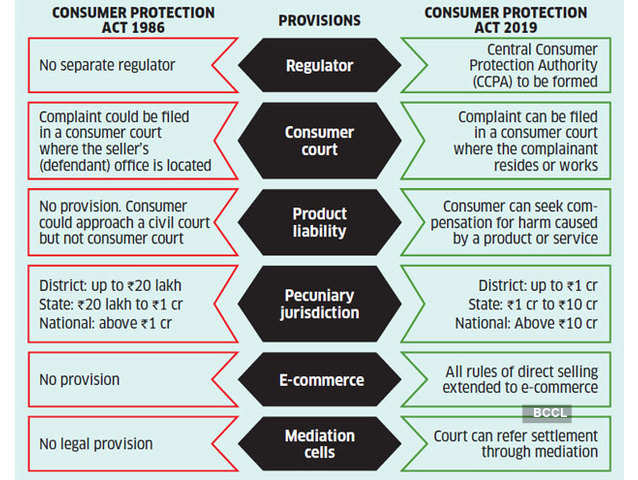
The Consumers can now cheer as the Consumer Protection Act, 2019 has recently replaced the three decade old Consumer Protection Act, 1986. The Consumer Protection Act, 2019 which came into effect on Monday (July 20) has replaced the earlier Consumer Protection Act, 1986.

The new Act as per the Experts say that “it gives more power to the consumers”. It seeks to revamp the process of administration and settlement of consumer disputes, with strict penalties, including jail term for adulteration and misleading ads by firms.

On July 20, 2020 certain provisions of the Consumer Protection Act, 2019 came into force as notified by the Central Government. Following the the key features of the relevant provisions:-

Key features of the Consumer Protection Act, 2019 which came into effect on July 20, 2020:-

1) Consumers can now institute a complaint from where they reside or work for gain.

2) The original pecuniary jurisdiction of the District Commissions has increased upto ₹1 crore from ₹20 lakh earlier.

3) The Pecuniary jurisdiction of State Commissions has been increased from ₹1 crore to Rs. 10 crore.

4) The National Commission can hear cases above ₹10 crore when compared to above ₹1 crore earlier.

5) While the provisions relating to e-commerce are not yet notified, a section relating to electronic service provider (covering software services, electronic payments) is notified.

6) The opposite party needs to deposit 50% of the amount ordered by the District Commission before filing an appeal before the State Commission. Earlier, the ceiling was a maximum of ₹25,000, which has been removed.

7) The limitation period for filing of appeals to the State Commission has been increased from 30 days to 45 days.

8) The Parties can be allowed to settle the disputes through mediation.

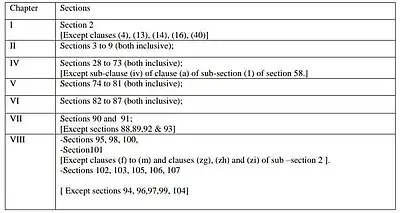
Following are the Sections which came into force:

Consumer Protection Act 2019- Sections to come into force from July 20,2020

Above mentioned provisions pertain to the Consumer Protection Councils, Consumer Disputes Redressal Forum, Mediation, Product Liability, punishment for manufacturing, selling, distributing etc spurious good or products which contain adulterant.

As per the rules, the e-commerce players will have to display the total ‘price’ of goods and services offered for sale along with break-up of other charges. Only a few certain miscellaneous provisions with regards and respect to the powers of the Central and State Government to make the rules and regulations have also been enforced.

On misleading advertisements there is provision for jail term and fine for manufacturers. There is no provision for jail for celebrities but they could be banned for endorsing products if it is found to be misleading.

For the first time there will be an exclusive law dealing with Product Liability. A manufacturer or product service provider or product seller will now be responsible to compensate for an injury or damage caused by the defective product or deficiency in services.

The Act has also defined an “e-commerce” as the buying or selling of goods or services including the digital products over digital or electronic networks. The existing definition of e-commerce has been adopted from India’s FDI Guidelines on e-commerce.

The definition of ‘e-commerce Entity’ as provided under the FDI Guidelines includes inventory and market place models.

There is also a provision for class action law suit for ensuring that rights of consumers are not infringed upon. The authority will have power to impose a penalty on a manufacturer or an endorser of up to 10 lakh rupees and imprisonment for up to two years for a false or misleading advertisement.

WEBSITES REFERRED

1)https://consumeraffairs.nic.in/acts-and-rules/consumer-protection

2)https://www.barandbench.com/news/law-policy/provisions-under-consumer-protection-act-2019-to-come-into-force-on-july-20-2020-centre-notifies

3)https://www.google.com/amp/s/www.thehindu.com/news/national/tamil-nadu/new-consumer-protection-act-gives-more-power-to-consumers-experts-say/article32135908.ece/amp/

4)https://www.google.com/amp/s/www.livemint.com/news/india/consumer-protection-act-rules-for-e-retailers-to-be-effective-by-this-weekend/amp-11595291549084.html

5)https://www.google.com/amp/s/zeenews.india.com/economy/new-consumer-protection-act-2019-comes-into-force-today-know-how-it-will-benefit-you-2297012.html/amp

6)https://www.google.com/amp/s/m.economictimes.com/wealth/spend/heres-how-consumers-will-benefit-under-the-new-consumer-protection-act/amp_articleshow/70711304.cms

7)https://www.google.com/search?q=consumer+protection+act%2C2019&tbm=isch&ved=2ahUKEwjOhv7-sN7qAhVIH3IKHTOCBfMQ2-cCegQIABAC&oq=Consumer&gs_lcp=ChJtb2JpbGUtZ3dzLXdpei1pbWcQARgAMgQIIxAnMgUIABCxAzIFCAAQsQMyBQgAELEDMgUIABCxAzoHCCMQ6gIQJzoCCAA6BwgAELEDEEM6BAgAEENQ0xRYzipg1jBoAnAAeACAAZABiAGHCJIBAzAuOJgBAKABAbABBcABAQ&sclient=mobile-gws-wiz-img&ei=e-QWX47dJsi-yAOzhJaYDw&bih=682&biw=393&prmd=ivn#imgrc=eILduqMFjleJaM

8)https://www.vecteezy.com/free-vector/consumer

9)https://www.google.com/amp/s/www.livelaw.in/amp/news-updates/most-provisions-of-consumer-protection-act-to-come-into-force-160003

HBSE 12th result to be declared today

Vaishali Singh

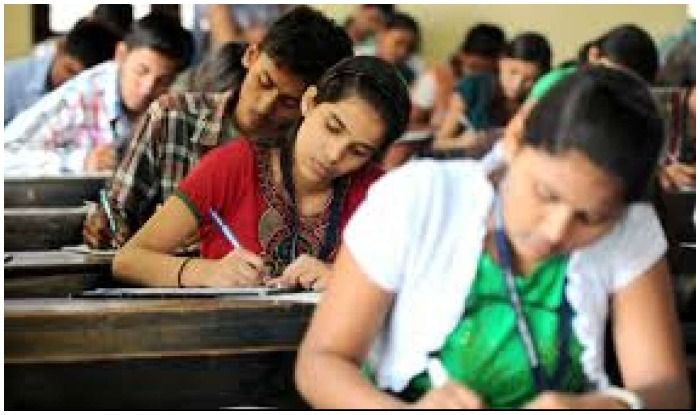
Haryana Board of Secondary Education 12th standard results will be declared today. As per the official announcement, officials from the Board of Secondary Education, Haryana has confirmed the Haryana 12th result 2020 declaration date and time has been confirmed to media agencies. To ensure easy access to the students, Haryana 12th Result 2020 will be declared online on the official website bseh.org.in.

Around 2.2 Lakh students have been waiting for their HBSE results.  To make the process of check HBSE Class 12 Results 2020 even easier for the students, a direct link to the result checking page is provided below, which will allow them to access the same conveniently. 

https://bseh.org.in/

As per the latest media reports, the declaration date and time for Haryana Board 12th Result 2020 has been confirmed by senior board officials. Times Now Report claims that Haryana Board / BSEH Secretary Rajiv Prasad informed reporters over a call that the HBSE 12thResult 2020 will be announced on 21st July 2020, Tuesday.

Scheme for the Cancelled Exams

According to the official datesheet of Haryana Board, the HBSE 12th Exam 2020 began on 3rd March wouod last till 31st March 2020, but the declaration of nation-wide lockdown due to COVID-19 outbreak in the country lead to cancellation of a few papers for Class 12. As per the HBSE announcement, students whom papers have been cancelled, will be assessed and marked on the basis of an alternative assessment scheme. Details coming from Bhiwani office suggests that these students would be marked based on the average score they have received in the already appeared exams.

Timeline of India’s Prime Minister’s

Prime Minister of India is the head of the government. He is appointed by the Indian President after the political party wins a general election and nominates a candidate for the post. The leader of that political party is thereafter appointed as the Prime Minister of India.

Jawaharlal Nehru (15 August 1947 – 27 May 1964)

Jawaharlal Nehru referred as the Constructor of Modern India. He was the Longest serving prime minister of India (17 Years) and also he was the first prime minister to died in office. 

Gulzarilal Nanda (Acting) (27 May 1964 – 9 June 1964)

Gulzarilal Nanda is the First Acting Prime Minister of India. He was the shortest serving Prime Minister of India. 

Lal Bahudur Sastri (9 June 1964 – 11 January 1966)

Lal Bahadur Sastri was PM after sudden death of the Jawaharlal Nehru. He was given the famous slogan Called “Jai Jawan Jai Kisan”. He was the only Prime minister to die in abroad.

Gulzarilal Nanda (Acting) (11 January 1966 – 24 January 1966)

Gulzarilal Nanda is second Acting Prime Minister too of India.

Indira Gandhi (24 January 1966 – 24 March 1977)

Smt Indira Gandhi was the first female Prime Minister of the India. She was famous for her remarkable financial and foreign inclusions like Nationalization of Banks and divide East and West Pakistan in 1971 War.

Morarji Desai (24 March 1977 – 28 July 1979)

Morarji Desai was the Oldest Prime Minister of India. He was also first Prime Minister to resign from Office. He was the only the Prime Minister to celebrate his birthday for every 5 years since his birthday is on 29 February.

Charan Singh (28 July 1979 – 14 January 1980)

He was the first Prime Minister Who did not attend the single session of parliament. He was well known for his remarkable steps towards welfare of the Farmers.

Indira Gandhi (14 January 1980 – 31 October 1984)

Indira Gandhi was the First Prime to get assassinated and First Prime Minister to lost her seat in a General Elections. 

Rajiv Gandhi (31 October 1984 – 2 December 1989)

Rajiv Gandhi was the Youngest prime minister of the India. In his reign Anti-Defection was proposed and came into existence. 

V.P Singh (2 December 1989 – 10 November 1990) 

His full name is Viswanath pratap Singh. He was referred as the pioneer of the Reservation System for Employment and Education system in India.

Chandra Shekhar (10 November 1990 – 21 June 1991)

He was the Second least serving Prime Minister of India after the Charan Singh.

P.V Narasimha Rao (21 June 1991 – 16 May 1996)

P.V Narasimha Rao was referred as the father of Modern Economic Reforms. He was well known for his tax system in India with help of his Cabinet Finance Minister Dr Manmohan Singh. He was the first Prime minister from southern India.

Atal Bihari Vajpayee (16 May 1996 – 1 June 1996)

Atal Bihari Vajpayee was the 14 days Primebecause his government was collapsed the after Jayalalitha Led AIADMK withdrawn its support from coalition. 

H.D Deve Gowda (1 June 1996 – 21 April 1997)

Before becoming a Prime minister of India he was the Chief Minister of Karnataka.

I.K Gujral (21 April 1997 – 19 March 1998)

Inder Kumar Gujral was the one of the well educated Prime Ministers of India. He was served as Cabinet Minister for different portfolios like Ministry of Planning, Tele-communications, Minister of Information and Technology.

Atal Bihari Vajpayee (19 March 1998 – 22 May 2004)

This was the Second term for him as the Prime Minister. He was well known for his remarkable achievements in Nuclear Tests. 

Manmohan Singh (22 May 2004 – 26 May 2014)

Manmohan singh was the first Sikh PrimeMinister. He was worked as both FinanceMinister, RBI Governor. He was the FinanceMinister one who introduced the Service Taxsystem In India in 1993-94 Budget session. 

Narendra Modi (26 May 2014- Till date)

His full name is Narendra Damodar Das Modi. In his reign BJP Could get the full majority both in 2014 and 2019 General Election (Loksabha Elections) to form the Government without help of the other Parties. He was the most influent Prime Minister in India. He known as tough guy who takes tough decisions like demonetization, Gst, etc.

‘WILL’ under Indian Law


Meaning:

A Will is a solemn document by which a dead man entrusts to the living to the carrying out of his wishes. Section 2(h) of Indian Succession Act, 1925 provides that Will means the legal declaration of the intention of a person with respect to his property, which he desires to take effect after his death Will has been defined in Corpus Juris Secundum as A ‘Will’ is the legal declaration of a man’s intention, which he wills to be performed after his death, or an instrument by which a person makes a disposition of his property to take effect after his death.

Essential Features of a Will

A Will can be made at any time in the life of a person. A Will can be changed a number of times and there are no legal restrictions as to the number of times it can be changed. It can be withdrawn at anytime during the lifetime of the person making the Will. A Will has to be attested by two or more witnesses, each of who should have seen the testator signing the Will.
The essential features are:

1.     Legal declaration: The documents purporting to be a Will or a testament must be legal, i.e. in conformity with the law and must be executed by a person legally competent to make it. Further the declaration of intention must be with respect to the testator’s property It is a legal document, which has a binding force upon the family.

2. Disposition of property: In a Will, the testator bequeaths or leaves his property to the person or people he chooses to leave his assets/belongings. A Hindu person by way of his Will can bequeath all his property. However, a member of an undivided family cannot bequeath his coparcenery interest in the family property

3. Takes effect after death: The Will is enforceable only after the death of the testator

Under section 18 of the Registration Act the registration of a Will is not compulsory. Also, the SC in Narain Singh v. Kamla Devi has held that mere non-registration of the Will an inference cannot be drawn against the genuines of the Will. However it is advisable to register it as it provides strong legal evidence about the validity of the Will. Once a Will is registered, it is placed in the safe custody of the Registrar and therefore cannot be tampered with, destroyed, mutilated or stolen. It is to be released only to the testator himself or, after his death, to an authorized person who produces the Death Certificate

Since a testamentary disposition always speaks from the grave of the testator, the required standard of proof is very high. The initial burden of proof is always on the person who propounds the Will.

Kinds of Wills

Ø Conditional Wills: A Will maybe made to take effect on happening of a condition. In Rajeshwar v. Sukhdeo the operation of the Will was postponed till after the death of the testator’s wife. However if it is ambiguous whether the testator intended to make a Will conditional, the language of the documents as well as the circumstances are to be taken into consideration.


Ø Joint Wills: Two or more persons can make a joint Will. If the joint Will is joint and is intended to take effect after the death of both, it will not be admitted to probate during the life time of either and are revocable at any time by either during the joint lives or after the death of the survivor.


Ø Mutual Wills: Two or more persons may agree to make mutual Wills i.e. to confer on each other reciprocal benefits. In mutual Wills the testators confer benefit on each other but if the legatees and testators are distinct, it is not a mutual Will. Mutual Wills are also known as reciprocal Wills and its revocation is possible during the lifetime of either testator. But if a testator has obtained benefit then the claim against his property will lie. Where joint Will is a single document containing the Wills of two persons, mutual Wills are separate Wills of two persons.


Ø Privileged Wills: Privileged Wills are a special category of Wills and other general Wills are known as unprivileged Wills. S.65 of ISA provides that a Will made by a soldier or a airman or a mariner, when he is in actual service and is engaged in actual warfare, would be a privileged Will. S.66 provides for the mode of making and rules for executing privileged Wills. Ss. 65 and 66 are special provisions applicable to privileged Wills whereas other sections relating to Wills are general provisions which will be supplementary to Sections 65 and 66 in case of privileged Wills.


Who Can Make A Will
S.59 of Indian Succession Act provides that every person who is of sound mind and is not a minor can make a Will.

Execution of a Will

On the death of the testator, an executor of the Will (executor is the legal representative for all purposes of a deceased person and all the property of a testator vests in him. Whereas a trustee becomes a legal owner of the trust and his office and the property are blended together) or an heir of the deceased testator can apply for probate. The court will ask the other heirs of the deceased if they have any objections to the Will. If there are no objections, the court grants probate. A probate is a copy of a Will, certified by the court. A probate is to be treated as conclusive evidence of the genuineness of a Will. It is only after this that the Will comes into effect.

Signature of The Testator

S.63(a) of ISA provides that the testator shall sign or affix his mark. If the testator is unable to write his signature then he may execute the Will by a mark and by doing so his hand maybe guided by another person. In another words a thumb impression has been held as valid.

Attestation of Will:Attesting means signing a document for the purpose of testifying the signature of the executants. Therefore an attesting witness signing before the executants has put his mark on the Will, cannot be said to be a valid attestation. It is necessary that both the witnesses must sign in the presence of the testator but it is not necessary that the testator have to sign in their presence. Further it is not necessary that both the witnesses have to sign at the same time. It is also not necessary that the attesting witnesses should know the contents of the Will.

ICSE, ISC exam result 2020 to be announced tomorrow at 3 PM. All you need to know

ICSE, ISC Exam 2020 Result to be Declared Tomorrow at 3 PM | All You Need to Know

ICSE, ISC Exam 2020 Result: The Council for the Indian School Certificate Examination (CISCE) on Thursday said that ICSE (class 10) and ICS (class 12) exams results will be declared tomorrow at 3 PM, on the official website ‘cisce.org’ and ‘results.cisce.org. All students who have appeared for the exams are advised to keep an eye on the website and check their results.

To check the results once they are out, follow this steps:

step 1-Visit the official website at https://www.cisce.org/

step 2-Go on the ‘Careers’ portal on the homepage.

Step 3: Now, click on the relevent exam link.

Step 4: Enter all the details asked including your roll number, click submit

Step 5: You result will now appear on the screen.

Step 6: Download and take a print-out for a future reference.

Icse result 2020, icse board result 2020, isc result 2020, isc board result 2020

To get results on SMS, students can send their Unique id to 09248082883 in this format: ‘ICSE/ISC (Unique ID)’.

Earlier in the day, the CISCE board reduced 25 per cent syllabus from this year’s curriculum in view of the coronavirus pandemic.

According to the latest notification issued by the ICSE Board, the decision to reduce the syllabi will be applicable for Class 9 to Class 12 students and has been taken to reduce the burden amid limited teaching via online classes. The CISCE stated that the reduced syllabus aims to cope with the loss of instructional hours due to the difficulties faced in the academia in the lockdown situation.

City vs Village

City Life :-

City derives from a French word meaning citizenry. A city is a large or important town. In the United States, cities are incorporated municipalities with local governments. In Great Britain, a borough with a bishop’s seat is called a city. As with the words village and town, city can also refer to the its inhabitants. It’s like watching Paris from an express caboose heading in the opposite direction—every second the city gets smaller and smaller, only you feel it’s really you getting smaller and smaller and lonelier and lonelier, rushing away from all those lights and excitement at about a million miles an hour.

City Expressions

Many interesting uses of the word city exist in English. For example, imagine you see a place with a lot of stray dogs. You might call it “dog city” to indicate that it is full of or indicative of dogs. A city slicker is someone who doesn’t know much about country life. If you say that you can’t fight city hall, you are saying there’s no way you will win in a battle against bureaucracy.

Advantages of City Life:-

  • City life has an advanced and well-equipped environment. People migrate to cities because of better job opportunities, stability and a decent income which is a lack in villages.
  • Cities have a huge number of schools, colleges or universities established. Hence, the city folks get proper quality education which is a primary factor for standard living.
  • Recreation and entertainment are plenty in the cities. People also get adequate opportunities to establish and showcase their talents here.
  • City life provides commercialization, banking systems, and entrepreneurial businesses. This attracts more people from townships to settle in cities.
  • Better transportation, sanitation, availability of water and drainage systems are seen in cities. The drainage of polluted water goes through treatment before getting dumped in lakes or rivers. This keeps a small check on pollution too.
  • Medical help is at fingertips when required. There are a number of hospitals and clinics and well-equipped doctors and nurses for people in need.
  • Anonymity in cities helps in escaping from the judgements of people.

Disadvantages of city life:-

  • Urbanization is increasing at a rapid pace, and currently, about 30-33% of Indians lives in cities. This rate tends to be around 40% by 2030. With the high population density, the quality of life in cities is expected to degrade and become unfit for living.
  • City life is a very busy one, developing every second to a better version of itself. This results in a loss of cultural qualities and flavours.
  • High demand for city life has resulted in congestion. Human population has increased a lot in city areas.
  • The city’s population increases day by day. This leads to an environment with polluted air, smog, unclean water supplies, noise pollution
  • It follows from the previous point that an increase in pollution rates in the cities brings in more health issues. People tend to fall sick more in cities due to the polluted environment which is unfit for living.
  • Unfair competition among businesses, an increase in crime rates and immorality of the people is more in the cities.
  • Increase in costs and expenditure is a vital problem for city dwellers. This creates a reason for more competition for gaining wealth and hence increases stress and crimes too.

Village Life

The word village comes from a French term referring to a group of buildings. That’s exactly what a village is—a small community in a rural area. Sometimes, larger towns incorporate the houses of a village as a municipality. Village can also refer to inhabitants of a village and is even applied to groups of animal dwellings.

Advantages of village life:-

  • A pollution-free environment is available in the rural/village areas only.
  • Scenic beauty and greenery of rural areas are prominent. This also attracts tourists from around the globe.
  • Rural areas have a scope for socio-economic benefits like reduction in prices of agricultural and consumer products, access to markets, public transport, employment opportunities, and better education and healthcare facilities.
  • The essence of folk and culture is prominent in these areas. This defines the rural areas uniquely.

Disadvantages of village life:-

  • Lack of higher education is a backlog for rural lives. This creates the main hurdle for better standards of living.
  • Rural areas have poor road connectivity. Over 40 per cent of India’s rural population remains outside the rural road network. According to the Planning Commission’s Working Group on Rural Roads, there are over 3.3 lakh rural habitations with no road connection.
  • Limited medical help persists in these areas. A counted number of hospitals and even lesser doctors are available. Hence at times, people are bound to move to city areas for sustaining life.
  • Rural life is difficult for women more because of lack of proper sanitation and toilets. The primary reason for this has to be the lack of educational opportunities.

Conclusion:-

  • Though the city life has many disadvantages, people flock there more for its advantages.
  • Improper road connectivity is one of the main reasons for stopping growth in rural areas. But the government is making situations better for rural India. The Pradhan Mantri Gram Sadak Yojana (PMGSY) is a step towards improving road connectivity in rural parts of the country.
  • Hence, the reduction of pollution in cities and the development of roads and infrastructure in rural areas will bring a balance between the two.

The Implications of COVID-19 effect on the Compliances under The Companies Act, 2013:- The Indian Context

COMPANY COMPLIANCES DURING THE COVID-19 ERA: AN INTRODUCTION

The global outbreak of the novel coronavirus has taken the world by storm. While the issue pertaining to the public health is the talk of the town, the impact of COVID-19 on businesses and corporates seems to be least talked about.

Day to day business of the corporates is being affected due to decreased inflow of the human resource and a decrease in the workflow. While technologies have provided a relief to the human resource for physical attendances and conferences, there seemed to be unsettled trouble regarding legal compliances that required various filings and physical meetings.

Pursuant to the ongoing global COVID-19 pandemic and the Finance Minister, Ms. Nirmala Sitharaman’s announcements on March 24, 2020, the Ministry of Corporate Affairs (“MCA”) has issued various circulars to provide relief to companies from certain compliances under the Companies Act, 2013 (“Act”) and associated rules. This has been done as a measure to reduce the compliance burden on entities during the unprecedented health and economic situation caused by COVID-19. Following are the measures:-

1. Company Affirmation of Readiness towards COVID-19

Social distancing has gained its importance as a way to contain the spread, morbidity, and mortality of COVID-19. Government of India (“GOI”), responsible for the public welfare at large, has realised that social distancing can be achieved in its true sense only if the employers of the Indian public make the same application in their respective premises.

Considering that major employers of the nation belong to the companies or limited liability partnership (“LLP”) type entity, GOI as part of disaster management have advised all companies/LLPs to put in place an immediate plan to implement the “work from home” policy as a temporary measure up till March 31, 2020.

Further, in case of a requirement of physical visits of the essential staff to such offices by the employers, staggered timings may be followed in order to minimize physical interactions of all kinds.

A simple webform for companies/LLP shall be deployed by MCA on March 23, 2020, in order to confirm the readiness of the employers to deal with COVID-19 threat. The webform shall be called CAR (Company Affirmation of Readiness towards COVID-19) and would be required to be signed and submitted by the authorised signatory of the company/LLP.

Therefore, it shall be expected by each company/LLP to ensure reporting of the compliance through CAR instantly from the date of its deployment.

2. Companies Fresh Start Scheme 2020

The MCA issued a circular on March 30, 2020, introducing the Companies Fresh Start Scheme, 2020 which, inter alia, grants a one-time opportunity to defaulting companies to complete all belated filings, including, without limitation, annual filings and filings required under IEPFA (Accounting, Audit, Transfer and Refund) Rules, 2016 in relation to transfer of money remaining unpaid or unclaimed for a period of seven years under Section 124(5) of the Act and transfer of relevant shares in the name of the ‘Investor Education and Protection Fund’ under Section 124(6) of the Act, with the MCA21 registry, without incurring additional fees on account of any delay.

This scheme came into force on April 1, 2020, and is valid till September 30, 2020. The application for seeking immunity for belated filings under this scheme should be made within a period of six months from September 30, 2020, through Form CFSS-2020. Thereafter, an immunity certificate will be provided by the designated authority on the basis of the declarations made in such form.

However, no immunity shall be provided under the scheme in a matter where (i) an appeal or management dispute is pending before any court or tribunal, or (ii) a court has ordered a conviction, or the adjudicating authority under the Act has imposed a penalty, and in respect of such orders, no appeal has been filed prior to the scheme coming into force.

Further, the scheme shall not apply: (i) where an application has been filed or an action for final notice for striking off the name of the company has already been initiated; (ii) where the company has been amalgamated; (iii) when application of obtaining dormant status has been filed; (iv) to vanishing companies; and/or (v) where charge related documents or an increase in authorised capital is involved.

3. CSR Spending

The MCA has by way of circular dated March 23, 2020 and the office memorandum dated March 28, 2020, clarified that the spending of CSR funds by companies in relation to COVID-19, including by way of contribution to the PM CARES Fund, is an eligible CSR expenditure under the Act.

The MCA has further clarified by way of FAQs dated April 10, 2020 that contributions made to the State Disaster Management Authority will also be eligible CSR activity, but contributions towards (a) ‘Chief Minister’s Relief Fund’ or ‘State Relief Fund for COVID-19’; and (b) payment of salary/ wages to employees and workers (including contract labour/ temporary/ casual/ daily wage workers) during the lockdown period will not be considered as eligible CSR expenditure.

However, ex-gratia payment over and above the disbursement of wages to temporary/ casual workers/ daily wage workers, specifically for the purpose of fighting COVID-19, will be admissible towards CSR expenditure, provided there is an explicit declaration to that effect by the board of the company, which is duly certified by the statutory auditor.

4. Meetings of Board and the Shareholders

  • The Companies (Meetings of Board and its Powers) Rules, 2014 were amended by a notification dated March 19, 2020, to enable companies to hold board meetings on the following matters (which earlier had to be necessarily held at a physical meeting) through video-conferencing or other audio-visual means (collectively “VCC”) till June 30, 2020: (i) approval of annual financial statements and board’s report; (ii) approval of prospectus; (iii) audit committee meetings for consideration of financial statements; and (iv) approval of amalgamation, merger, demerger, acquisition and takeover.
  • MCA has, by way of a general circular dated April 8, 2020, requested companies to pass all decisions of an urgent nature requiring shareholder approval, other than those of ordinary business or business where any person has right to be heard, through postal ballot/ e-voting in accordance with the relevant statutory provisions without holding a physical general meeting. However, in cases where holding an extraordinary general meeting (“EEGM”) is unavoidable, these have now been permitted to be held through VC until June 30, 2020. The circular further lays down certain conditions to be met for conducting an EGM through VC and the key conditions, inter alia, include: (i) attendance of at least one independent director (where a company is required to appoint one) and auditor (or his authorised representative who is qualified to be the auditor); (ii) maintenance of recorded transcripts of the EGM and, in case of a public company, such transcripts to be uploaded on the company website (if any); and (iii) e-voting facility being available. All other provisions relating to general meetings under the Act (and relevant rules) will continue to apply.
  • Due to difficulties faced by various stakeholders in serving and receiving notices/responses by post on account of COVID-19, the MCA, on April 13, 2020, provided that notice of EGMs to be held through VC (and for passing shareholder resolutions through postal ballot/ e-voting) may now be given to shareholders only through email addresses of the shareholders registered with the company or with the depository participant/ depository. This circular also specifies various conditions which companies must comply with while sending email notices to shareholders.

CONCLUSION

Business entities in India are requested and expected to keep an eye on the major government websites to ensure timely compliance with all such immediate requirements and mandates issued by GOI as need of the hour from time to time.

WEBSITES REFERRED:-

1)  MCA General Circular No. 10/20 dated March 23, 2020 on Clarification on spending of CSR for COVID-19.

2) MCA General Circular No. 12/20 dated March 30, 2020 on Companies Fresh Start Scheme, 2020

3) MCA Notification dated March 19, 2020 on Companies (Meetings of Board and its Powers) Amendment Rules, 2020

4) MCA General Circular No. 14/2020 dated April 8, 2020 on Clarification on passing of ordinary or special resolutions by companies under the Companies Act, 2013 and rules made thereunder on account of threat posed by Covid-19.

5) MCA General Circular No. 17/20 dated April 13, 2020 on clarification on passing ordinary and special resolutions by companies under the Companies Act, 2013 and rules made thereunder on account of threat posed by COVID-19.

6)http://www.conventuslaw.com/report/india-implications-of-covid-19-on-compliances/

7)https://www.lexology.com/library/detail.aspx?g=7862d71f-35ae-443c-964b-a381d11102bc

8)https://www.google.com/search?q=COMPANY+COMPLIANCE+India+Images+Copyright+Free+and+Royalty+Free&tbm=isch&ved=2ahUKEwjK6fe59tvqAhVZOCsKHTZKCh0Q2-cCegQIABAC&oq=COMPANY+COMPLIANCE+India+Images+Copyright+Free+and+Royalty+Free&gs_lcp=ChJtb2JpbGUtZ3dzLXdpei1pbWcQAzoECB4QCjoECCEQClCMPljJiQFgoIwBaARwAHgAgAHIAYgB4x2SAQYwLjI3LjGYAQCgAQHAAQE&sclient=mobile-gws-wiz-img&ei=qpoVX8rsBdnwrAG2lKnoAQ&bih=682&biw=393&client=ms-android-xiaomi-rev1&prmd=insv#imgrc=UEkUjY7KpsptxM

9)https://studycafe.in/2020/04/companies-fresh-start-scheme-2020-or-cfss-2020.html

10)https://www.a2ztaxcorp.com/mca-introduces-companies-fresh-start-scheme-2020-for-non-compliant-companies/

11)https://www.istockphoto.com/illustrations/corporate-social-responsibility?mediatype=illustration&phrase=corporate%20social%20responsibility&sort=mostpopular

12)https://www.istockphoto.com/illustrations/shareholders-meeting?mediatype=illustration&phrase=shareholder%27s%20meeting&sort=mostpopular

COVID-19 PANDEMIC: BIO-MEDICAL WASTE AND HOW THE HOSPITALS ARE LIABLE

Biomedical Waste Management & Handling Rules, 1998 (“1998 Rules”) in India govern the handling, disposal and management of bio-medical waste (“BM Waste”)in India have been notified by the Central Government in the exercise of the powers conferred by Section 6,8 & 25 of the Environmental Protection Act, 1986. These rules provide for the framework of the management and Handling of disposal and scientific management of BM Waste

In wake of the COVID-19 pandemic, the Centre Pollution Control Board (“CPCB”) recently issued guidelines dated March 27, 2020 for handling, treatment and safe disposal of BM Waste generated during treatment, diagnosis and quarantine of patients confirmed or suspected to have COVID-19 (“Guidelines”).

The Guidelines have been necessitated due to the super infectious nature of the Novel corona virus and provide for a mechanism for the segregation, packaging, transportation, storage and disposal of BM Waste in order to avoid further spread of the virus through BM Waste.

So what do you mean by the BM Waste and what are the categories of BM Waste that the hospitals generate?

The Bio-Medical Waste Management Rules 2016[1] (“2016 Rules”) define the BM Waste as any waste, which is generated during the diagnosis, treatment or immunisation of human beings or animals or research activities pertaining thereto or in the production or testing of biological or in health camps, including the categories mentioned in Schedule I the 2016 Rules.

The 2016 Rules apply to all persons who generate, collect, receive, store, transport, treat, dispose, or handle bio medical waste in any form. The next imminent question that comes to our minds is what are the categories of BM Waste that the hospitals generate?

BM Waste generated from a hospital could be human anatomical waste, animal waste- microbiology & biotechnology, waste sharps, discarded medicines and cytotoxic drugs, solid & liquid waste.

Now that we know what’s the meaning and various categories of BM Waste, the most pertinent question arises that how is it supposed to be treated and disposed of by the hospitals in India during the ongoing COVID-19 pandemic? 

While the hospitals in their usual course deal with the segregation, management and storage of BM Waste, the situation in times of COVID-19 is extraordinary the reason being the highly contagious nature of the virus and also it’s transmission cycle and multiplicity rate.

As the hospitals are being flooded with the suspected and confirmed cases, the Ministry of Health and family welfare (“MoHFW”) and the CPCB have issued various guidelines for the handling and management of waste generated from the COVID-19 facilities.

Under the 2016 Rules, while the hospitals are required to ensure that there is a secured location within its premises for a spill/pilferage free storage of segregated BM Waste in labelled/coloured bags or containers, the duty to transport the stored BM Waste from the hospital premises onwards to the common BM Waste treatment and disposal facility is of an ‘operator’ as defined in the Rules.

Specifically, in wake of COVID-19, the CPCB has issued Revision 1 to the Guidelines dated March 25, 2020 for Handling, Treatment and Disposal of Waste Generated during Treatment/Diagnosis/ Quarantine of COVID-19 Patients (“CPCB Guidelines”).

[2] The said CPCB Guidelines inter-alia, state that hospitals are required to depute separate BM Waste sanitation workers to COVID-19 isolation wards and maintain records of all waste generated in such isolation wards and ensure that the BWM generated is collected and separately stored in separate leakproof color-coded double layered bags or bins /containers labelled as “COVID-19 waste” as per the 1998 Rules and the Guidelines.

In fact the Bombay High Court in a recent pending public interest litigation has, while issuing notices to local municipal corporations and the State Pollution Control Board, also directed the Maharashtra government to clarify whether it was ensuring that all COVID-19 related biomedical waste generated in the state was being disposed of in a safe manner[3].

Now that we have a thorough understanding of how the BM Waste is supposed to be treated and disposed of the most important and the widely discussed about topic is that what are the measures that a hospital is required to take for the safety of its employees doctors, nurses and other support staff who are known as the (“healthcare personnel”) from the dangerous diseases like COVID-19?

In order to answer this pertinent question which is often there in the limelight, one must keep in mind that the Healthcare personnel who are the Frontline workers have a high risk of contracting the COVID-19.

While the hospitals are taking precautions and measures to control any spread of infection within the premises, it is particularly difficult given the highly super-infectious nature and hyper-speed feature of the virus. Due to this feature it spreads widely and it becomes a bit difficult to contain it in an over-crowded environment but it’s not impossible to achieve that as we all have been deterrent enough to contain it’s spread but still there is always scope for improvement.

The first steps towards controlling the spread of a virus is personal protective equipment also known as PPE which should preferably be a two-layered fluid-resistant apron and basic items like N-95 masks, face shield, full cover gowns  and sanitisers but the same are rendered ineffective against the COVID-19 if the quality of these equipments is not up to the standard as required.

Greater emphasis is also to be laid upon the proper training and awareness of healthcare personnel towards proper use and disposal of the equipment. The spread of the COVID-19 virus is also particularly fast due to the heavy load of asymptomatic patients coming into the hospital and hence a greater need for the formulation of national COVID-19 protocol.

The MoHFW has vide its revised guidelines for clinical management of COVID-19 dated March 31, 2020[4] (“Clinical Management Guidelines”) impressed upon strict compliance of Infection prevention control (IPC) protocol for Hospitals and a consequent effect of the same is prevention and management of COVID-19 in the hospital staff.

This protocol inter-alia,  standard precautions such as hand hygiene, use of PPE to avoid direct contact with patients’ blood, body fluids, secretions (including respiratory secretions) and non-intact skin, prevention of needle-stick or sharps injury, safe waste management, cleaning and disinfection of equipment and cleaning of the environment around a COVID-19 patient.

The 2016 Rules also provide as follows that in order to and for ensuring the safety of the healthcare workers and others involved in the segregation and pre-treatment of BM Waste, the hospital is required to train to all its healthcare workers, immunise them for protection against diseases which likely to be transmitted by handling of BM Waste, in the manner as prescribed in the National Immunisation Policy[5].

Also, hospitals are required to ensure occupational safety of all its health care workers and others involved in handling of BM Waste by providing appropriate and adequate PPE and also they must conduct health check ups at the time of induction and at least once in a year maintain the records for the same.

Now due to the pandemic if one is an employee ie the Healthcare personnel of the hospital one must understand the Legal aspect and angle also and the most important aspect of all is that what is the Legal obligations of the hospital, if and when an employee of the hospital tests positive for COVID-19.

Let’s answer this as it’s the most crucial and critical aspect. The present COVID-19 pandemic is an unprecedented event and is unlike any other infectious disease known to mankind and the medical world which is yet to fully decipher its modus operandi of infecting humans.

In a hypothetical situation wherein a hospital employee contracts COVID-19, it will be imperative for the employee in such a situation to establish that his possible exposure to COVID-19 was in the Hospital itself not in the community after considering that the employee is spending time outside as well apart from the hospital premises.

While in an ideal case, if it is proved that a hospital staff has contracted it ,i.e., it shall amount to ‘a hospital acquired infection’, then the hospital would be ordinarily liable. However, in the case of COVID-19 since it is seemingly impossible to trace down the exact source of the infection, in absence of such evidence and in light of utmost safety measures and precautions taken by the hospitals as per the guidelines, fastening of any liability on the hospital would be peculiarly difficult.

The defence available to the hospital may be culpability and negligence of the employee and proving that the hospital itself took all possible measures to avoid any mass spread of the infection.

The next relevant point to be analysed and answered is that when a Non COVID-19 patient contracts the virus during his term of being admitted in the hospital what are the Legal obligations of the hospital when this happens?

The National Consumer Dispute Redressal Commission in the matter of Apollo Emergency Hospital vs Dr. Bommakanti Sai Krishna & Anr.[6] observed that “As already observed, the infection occurred during the stay of the Complainant at the hospital. On the other hand, there is nothing to show that the source of infection lay outside the hospital. Thus, there is preponderance of possibilities of the infection having been acquired in the hospital itself. We therefore, do not accept the contention that it was necessary for the Complainant to produce expert evidence to prove negligence on the part of the concerned doctors in the hospital.

The afore-stated judgement implies a presumption of liability on the hospital that in cases where the probability of acquiring the infection is much higher inside the hospital than from other sources. However, the same may not apply in COVID cases in light of the peculiar difficulty of tracing the source of acquiring the COVID-19 infection. Therefore, the presumption rendered by the aforesaid judgement will not be ipso facto applicable to cases of COVID patients.

As we have discussed the various pertinent relevant questions another one is that what are the legal obligations of the hospital, if and when a patient is misdiagnosed positive or negative for COVID-19 by the hospital due to a fault in the COVID-19 rapid testing kit (“testing kits”)?

The liability of a hospital in cases of misdiagnosis depends on the methodology of procuring of testing kits. A hospital may procure testing kit either from third party manufacturer or may manufacture them internally i.e. by itself or its subsidiary.

In cases where the misdiagnosis is on account of faulty testing kit procured externally, the hospital cannot be held directly liable as the liability may be shifted upon the manufacturer.

In cases where the misdiagnosis is on account of faulty testing kit is due to testing kits produced internally the hospital may be liable subject to it being proved that the misdiagnosed patient was indeed positive. However, factors such as the success rate of any testing kit not being 100% may have an interplay in determining the liability.

We have to be aware of what are the Legal liability of a hospital in a situation where the hospital discharges a mild/very mild/pre-symptomatic COVID patient to ramp up the capacity for serious COVID-19 patients.

 A hospital will not be held liable for a systematic discharge of a mild/very mild/pre-symptomatic/moderate COVID-19 patient as the same is directed by the Central Government. On May 8, 2020, the MoHFW released its revised policy for the discharge of COVID-19 patients.[7] This revised policy provides that hospitals can discharge mild/very mild/pre-symptomatic in accordance with the protocols given therein.

In the earlier advisory[8], COVID-19 patients could be discharged only after chest radiograph clearance, viral clearance in respiratory samples, and if two of the patient’s specimens were negative within a period of 24 hours. The discharged patient would then have to home quarantine themselves in accordance with the revised policy.

So what is the protocol to be followed by a Hospital while disposing of the dead bodies of the COVID-19 patients?

The corpses are a source of infection for healthcare personnel/ other patients and cannot be disposed of by usual methods of disposal and therefore, the MHFW issued guidelines dated March 15, 2020 on dead body management in COVID-19.[9] The guidelines provide inter-alia, the protocol to be followed at the time of removal from the isolation room or area, put in bio-hazard bag and disinfection. Further, all surfaces of the isolation area (floors, bed, railings, side tables, IV stand etc.) should be wiped with 1% Sodium Hypochlorite solution and then it should allow a contact time of 30 minutes, and allow it to air dry as well.

While treating patients infected with the COVID-19 virus, what is the protocol for the treatment?

The All India Institute of Medical Sciences (AIIMS) has issued clinical protocol dated April 21, 2020 for treatment of Covid-19 patients and states such as Madhya Pradesh and Delhi have directed Hospitals and health centres dedicated to treating COVID-19 patients to follow the said clinical protocol.[10]

Treatment must be affordable for all. One must know whether or not there is a standardisation of costs of treatment of a COVID-19 for private hospitals?

Government hospitals are reaching their intake capacities and for that reason COVID-19 patients have been resorting to treatment in private hospitals. While some private hospitals are charging exorbitant amounts as costs of treatment, the same is worrying not just for the patients but also to the insurers.[11] 

In a first, the State government of Maharashtra has capped treatment costs in private hospitals for people without medical insurance and for other patients, the capped prices will come into effect once they exhaust their medical insurance cover.[12]

The Hon’ble Gujarat High Court has vide its order dated May 22, 2020 directed the state government to issue a notification making it mandatory for all multi-speciality hospitals private/ corporate hospitals in Ahmedabad and on its outskirts to reserve 50% of their beds (or such other capacity as maybe specified by the state government) for COVID-19 patients.

In view of the same, the Government of Gujarat may come up with similar caps on costs as Maharashtra.[13]  The Hon’ble Gujarat High Court also observed that the certain private hospitals authorised by the government to treat COVID-19  patients in Ahmedabad are charging exorbitant fees which is unaffordable for a massive section of the society and directed the state government to ensure that private hospitals do not  charge exorbitant fees. [14]

Also in light of the same The Hon’ble Bombay High Court recently directed a charitable hospital to make court deposit of monies in a case pertaining to levy of exorbitant charges for treatment of COVID-19 patients belonging to poor strata of the society despite reserving 20% of its beds for poor and the needy.[15]


[1] Available at – https://dhr.gov.in/sites/default/files/Bio-medical_Waste_Management_Rules_2016.pdf last accessed on June 27, 2020 at 1000 hours.

[2] Available at https://www.mohfw.gov.in/pdf/63948609501585568987wastesguidelines.pdf last accessed on June 26, 2020 at 1243PM.

[3] https://www.hindustantimes.com/mumbai-news/bombay-hc-seeks-state-govt-s-reply-on-disposal-of-covid-19-biomedical-waste/story-ivVDDnsp6yMKgfqIYk2TEN.html last accessed on July 03, 2020 at 1243PM. As per reports, replies have to be filed by July 14, 2020.

[4]https://www.mohfw.gov.in/pdf/RevisedNationalClinicalManagementGuidelineforCOVID1931032020.pdf ; pre-revision guidelines are at https://www.mohfw.gov.in/pdf//National%20Guidelines%20for%20IPC%20in%20HCF%20-%20final%281%29.pdf

[5]Available at https://main.mohfw.gov.in/sites/default/files/108481119000.pdf last accessed on June 26, 2020 at 1400Hours.

[6] The Apollo Emergency Hospital vs Dr. Bommakanti Sai Krishna & Anr., MANU/CF/0051/2013

[7] Available at https://www.mohfw.gov.in/pdf/ReviseddischargePolicyforCOVID19.pdfhttps://www.mohfw.gov.in/pdf/FAQsonRevisedDischargePolicy.pdf last accessed on May 12, 2020 at 1300 Hours.

[8] Available at https://www.mohfw.gov.in/pdf/Corona%20Discharge-Policy.pdf ; also refer to https://www.mohfw.gov.in/pdf/FinalGuidanceonMangaementofCovidcasesversion2.pdf last accessed on May 13, 2020 at 1800 Hours.

[9]Available  at https://www.mohfw.gov.in/pdf/1584423700568_COVID19GuidelinesonDeadbodymanagement.pdf last accessed on May 4, 2020 at 1200Hours.

[10] Available at https://health.economictimes.indiatimes.com/news/hospitals/mp-hospitals-to-follow-aiims-protocol-for-covid-19-care/75470554; last accessed on May 23, 2020 at 1200Hours; Available at https://timesofindia.indiatimes.com/city/bhopal/mp-hospitals-to-follow-aiims-protocol-for-covid-19-care/articleshow/75463520.cms last accessed on May 23, 2020 at 1300Hours.

[11] Available at  https://www.livemint.com/money/personal-finance/insurers-want-standard-covid-19-treatment-cost-11589734285328.html last accessed on May 23, 2020 at 0214Hours.

[12]Available at  https://economictimes.indiatimes.com/news/politics-and-nation/regulate-fees-of-private-hospitals-treating-covid-19-patients-hc/articleshow/75758648.cms?from=mdr last accessed on May 23, 2020 at 1200Hours.

[13] Refer to order dated May 23, 2020 passed by the Hon’ble Gujarat High Court passed in  W.P.PIL No. 42 of 2020.

[14] Refer to order dated May 14, 2020 passed by the Hon’ble Gujarat High Court passed in  W.P.PIL No. 42 of 2020.

[15]https://www.thehindu.com/news/cities/mumbai/cant-expect-patients-to-submit-proof-of income/article31936388.ece ; https://www.thehindu.com/news/cities/mumbai/coronavirus-mumbai-charitable-hospital-treated-just-four-poor-patients-bombay-high-court-told/article31877330.ece  last accessed on July 3, 2020 at 2000 hours.

(16)https://corporate.cyrilamarchandblogs.com/2020/07/bio-medical-waste-and-liability-of-hospitals-in-wake-of-the-covid-19-pandemic/#more-3982

(17)https://www.civilsdaily.com/news/pib-regulation-of-bio-medical-waste/amp/

(18)https://www.google.com/search?q=Treatment+and+Disposal+of+Bio+Medical+Waste+Generated+by+COVID-19+virus+Animated+Image+Royalty+free+and+Copyright+free&tbm=isch&ved=2ahUKEwjnosG22tnqAhXWTCsKHeBjDqIQ2-cCegQIABAC&oq=Treatment+and+Disposal+of+Bio+Medical+Waste+Generated+by+COVID-19+virus+Animated+Image+Royalty+free+and+Copyright+free&gs_lcp=ChJtb2JpbGUtZ3dzLXdpei1pbWcQAzoECCMQJzoECB4QClCN8gFYjL0CYNnFAmgDcAB4AIABogGIAcQMkgEEMC4xMZgBB6ABAcABAQ&sclient=mobile-gws-wiz-img&ei=13AUX6fbDtaZrQHgx7mQCg&bih=682&biw=393&client=ms-android-xiaomi-rev1&prmd=inv#imgrc=f6k4LiLl7qKKwM