Launch of the warship Mahendragiri in Mumbai


The launch of Mahendragiri is a significant milestone in our maritime history. It is the last of the seven warships of the Nilgiri-class stealth frigates built under Project 17A. Last month, Hon’ble President, Smt. Droupadi Murmu ji launched ‘Vindhyagiri’, the sixth frigate and the predecessor of this ship, which was built by Garden Reach Shipbuilders & Engineers Ltd. in Kolkata, the City of Joy.

A pleasant coincidence, a year ago, we had attained a new milestone. On 2nd September 2022, Hon’ble Prime Minister, Shri Narendra Modi ji had commissioned the country’s first indigenous aircraft carrier INS Vikrant at Cochin Shipyard Limited. It was just a year ago. Reflecting the aspirations of new Bharat, Vikrant stands as a symbol of indigenous potential, indigenous skills and our ambitions to ride over high-tides.

Let me share another accomplishment today that makes us all proud. It reflects our technological promise and deep penetration. UPI recorded over 10 billion transactions worth Rs. 15 trillion as of August 30, according to data issued by National Payments Corporation of India. Friends, this will make all of us very proud. Indeed a phenomenal feat that epitomises a big change taking place all over India.

The launch of a warship – Mahendragiri – is some kind of record, this indicates the best of progress we are having in this country, and this will mean five launches of the same class of warships in about 15 months- a feat that makes us all proud.

The warship Mahendragiri, named after a mountain peak in Eastern Ghats located in Odisha, is an engineering marvel, with state-of-the-art features and cutting-edge technologies. This majestic warship is a remarkable symbol of our nation’s strength and maritime prowess. A testament to the unwavering commitment and indomitable spirit of the Indian Navy that has ever made us proud in all kinds of situations.

The speed of manufacturing warships has improved ever since the new method of “integrated construction” has been adopted and this has yielded geometric results for the nation’s welfare.

The Nilgiri-class warships have been designed in-house by the Indian Navy’s Warship Design Bureau, the pioneer organisation for all warship design activities. Friends, this was not without many that the Naval Chief said ‘Made in India, Made for India, Made by India.’ And that is something which you could not object or contemplate a few decades ago. This is a great moment of joy for all of us.

Aligning with the country’s resolute commitment to ‘Aatma Nirbharata’, a substantial 75% of the orders for equipment and systems of the Nilgiri class have been made to indigenous firms. This is an important, but what is more important, what is more significant, the greatest impactful situation is that this job has been given to small, micro and medium enterprises; their contribution in this state of art Mahendragiri is commendable, which speaks about inclusive growth and involvement of our small enterprises.

The launch of Mahendragiri is an apt testament to the incredible progress our nation has made in building a self-reliant naval force. Amid evolving power dynamics in the Indian Ocean Region (IOR), this launch gains added strategic importance. India’s recent phenomenal economic rise and global ascendancy imperatively call for a modern Navy to protect its maritime interests and shoulder additional responsibilities, particularly in the current geo-political and security situation that prevails in the Indian Ocean region. It is soothing to note that the issue is being very well attended by the Government and the Navy.

Congratulations to all officials, engineers, workers and all other small and micro enterprises that have fructified this great occasion today. It is only apt that this symbol of India’s growing maritime power is being unveiled here in Mumbai.

The docks with a rich history of 250 years, will make anyone proud in the world and the journey of 250 years has been negotiated, traversed by the skill, hard work, dedication of the human resource and the competent leadership that has resulted in this great day. Therefore, it is very apt, befitting, and imminently stable that this is taking place in Mumbai. The docks with a rich history of a social and economic trajectory of the Diamond City and of the nation.

There is no city in the world as vibrant as Mumbai. Mumbaikars are never in complaint mode. They are always in gear to perform. This is one such testimony.

Friends, not many countries have the kind of history which we have. Our civilization dates back to thousands of years but when it comes to the maritime past, oceanic influence has been there for 2000 years.

Since the time of Indus Valley Civilization, we have been a seafaring nation. One of the earliest docks in the world was at Lothal– which connected the city to an ancient course of the Sabarmati River on the trade route between Harappan cities in Sindh and the peninsula of Saurashtra. Today, our nation stands at the cusp of remarkable growth.

The Naval Chief focused that we are going to be the third largest global economy. In September, 2022, we became the fifth largest global economy and in the process we all took over our colonial rulers; they ruled us for 200 years. उनको  पछाड़ कर, पांचवे पायदान पर आना, हर भारतीय के लिए गर्व का मौका है और ये हमने तब हासिल किया जब कुछ दशकों पहले इसकी कल्पना नहीं की जा सकती थी । The credit goes to the Government, the leadership, the vision, and every Indian who has contributed to this great growth.

Friends, by all consideration India will be the third largest global economy by the end of this decade. Now, when the economy grows, when trade grows, what we are doing today has great relevance. A growing economy means higher volumes of trade. Over 90% of the India’s trade by volume and over 68% by value, moves through maritime routes at present. This further underlines the importance of Navy and what we are doing today. हर भारतीय आज एक बात देख रहा है कि दुनिया में जो भारत का नाम है वो परकाष्ठा पर है। भारत के पासपोर्ट की क्या कीमत है, भारतीय होने में क्या अभिमान है, वो हम अपनी आँखों से देख रहे है । In such a situation, our eyes are well set for Bharat@2047 – the centenary celebration of its independence. I have no doubt some of us may not be around but youngsters will be around, Bharat will surely emerge as a global leader and a stabilizing force.

India’s maritime strength is quintessential for our economic and strategic upsurge. It is heartening to note that the stealth frigates of Project 17 Alpha have over 75% indigenous content. This is a significant contribution towards Prime Minister, Shri Narendra Modi ji’s vision of Make in India & ‘Aatma Nirbhar Bharat’. These are not empty slogans, these slogans have resulted in mega big ticket infrastructure projects in this country, what we have is at par with the best in the world today.

It shows the steadfast dedication to foster and believe in our own skilled people, their technique, their contribution, their innovation, and this is taking place in different sectors as well. The multi-mission frigates of this series would be capable of dealing with all kinds of threats to our maritime interests. The threats are multiplying and the role of India is increasing. The world is looking at us to secure these areas and it is gratifying to note Bharat has risen to the challenge, Indian navy has risen to the challenge, Mazagon Dock builders has risen to the challenge and that is why our country will ever be on the rise. The rise is unstoppable.

The Government of India has created an enabling policy architecture to promote the domestic defence sector. Go to Uttar Pradesh and Tamil Nadu you’ll see the defence corridors, they are functional, they indicate the times that are being seen by us.

It is indeed a matter of pride that the value of defence production in India has crossed the figure of Rs. One lakh crore for the first time ever during the financial year 2022-23 on our home front which is bound to geometrically increase. I have no doubt about it.

The Government had launched the Innovations for Defence Excellence (i-DEX) scheme to involve Start-ups, research institutions and academia in designing innovative solutions for our defence sector. This has resulted in big impactful development. More than 300 Start Ups have been engaged through i-DEX. Each of them will be contributing qualitatively in a significant area.

I congratulate the Indian Navy that they have the Directorate of Indigenisation – with the motto ‘Ideate, Innovate, indigenize’. This is an impactful step in the right direction. This motto very captures what Bharat is today.

Friends, when there is increased capability, when there is growth, when the world looks up to you, when you become a real global power, the challenges are not far behind. The challenges pursue you, they call upon you to be ever prepared to sustain the place and enhance your position.

India has emerged as a Net security provider in the Indo-Pacific region. Thanks to the capability of our naval force and its infrastructure. Today, we are an important global player to secure and ensure a peaceful, Rule-Based Maritime Regime across the nations. When there is something in the ocean, it becomes very imperative to ensure there is Rule-Based Maritime Regime, which is under stress at the moment, which is challenging at the moment. Therefore, what we are doing today is a step in the right direction to sustain, generate, and evolve a wholesome mechanism of Rule-Based Maritime Regime.

The security in the Indian Ocean Region, and the larger Indo-Pacific has diverse challenging aspects. That is known to all connected with the geopolitics of the region. This has attracted global attention also, as it has an element of strategic and economic aspects. These encompass concerns like piracy, smuggling of narcotics, human trafficking, illegal migration and natural disasters. All these are up to the Navy to perform, and the good part is that our Navy has vindicated in an exemplary fashion, thanks to the commitment of the Human Resource involved therein.

The discharge by the Indian Navy of the mandate to protect, preserve, and promote India’s maritime interests, could not have been more able. It is at the highest peak. I congratulate our naval force, I have full confidence that they will keep improving themselves for the security of the world at large.

Friends, like our country, like our civilizational ethos, like our belief that the world is one family, we stand for peace, harmony and global development. Our Navy has been a vehicle of peace and goodwill during the crisis. As Governor, state of West Bengal, I can tell you, I had first-hand experience of seeing the performance of our Navy and Coast Guard. There was not a single mortality on the high seas, when we had a number of cyclones. The damage to property was also absolutely limited.

Under the overarching vision of SAGAR (Security and Growth for All in the Region), India is cooperating with multiple partners to ensure economic growth & security in the region while also tackling threats.

Ladies and gentlemen, going beyond cutting-edge technology, the key asset that gives the Indian Navy an edge over others is our rich human resource. Their courage, competence and commitment make them the Navy’s true force multiplier. Other things can be there, but if there is no spinal strength of human resource, things can’t be productive. We as a nation are lucky that our human resources are dedicated, competent, skilled and quick to learn, we are proud of it.

We are also proud of the significant and laudable role that the women are playing in our defence forces. A few decades ago, when I was elected to the Parliament in 1989, this was unthinkable, I am a product of Sainik School, Chittorgarh, but it was beyond our contemplation that women would be playing such a significant role. Look at where we have come now. With a strong presence of over ten thousand women across the army, navy, and air force, the Indian armed forces have made considerable strides in gender equality.

We are an example to the developed world, with the kind of assignment that women are handling. Notably, women are now actively serving in combat roles in all branches, underlining their capabilities and commitment to serving the nation. The cementing of women’s position in the Indian Navy showcases a remarkable timeline: from the establishment of Short Service Commission in 1992, to June 2023, which saw the integration of women into all branches, cadres, and specializations of the Navy and other defence forces. Today, women are ably taking up roles on-board warships. This is a qualitative change because we are having involvement of 50% humanity. This is a turning point.

The launch of the warship today carries the clear message that India will continue to invest in her maritime power. It was a proud moment for me as Rajya Sabha Chairman, when the Hon’ble Defence Minister responded, “When it comes to the Defence budget, we do not go by the percentage of budget spending, we go by what is needed & it shall be done”. That was a Policy statement, reflecting the attitude of our government that our defence aspects are always a Priority and shall never be compromised.

This will further the nation’s strategic reach while ensuring safe and prosperous maritime order for all. I am sure that Mahendragiri, once commissioned, will proudly fly the Tiranga across the oceans, as an ambassador of India’s maritime might. When it comes to Tiranga, when it comes to Shiv Shakti point, you know what we saw recently, we stamped these two very important aspects even on the moon, something the world has never seen before.

Once again, congratulations to the Indian Navy, MDL, the designers, engineers, workers and everyone involved in the construction of this magnificent warship. Bharat is really proud of all those who have toiled hard to bring this ship to reality.

May Mahendragiri prove – Jalameva Yasya Balameva Tasya! (जलमेव यस्यबलमेव तस्य)- जिसका समंदर पर कब्जा है वही सबसे बलवान है!

मेरे मन में कोई शंका नहीं हैहजारों साल पहले जहां भारत थाविश्व की पराकाष्ठा पर थाविश्व का Economic Giant थाज्ञान का भंडार थादुनिया हमारी तरफ देखती थी. अब बदलाव आ गया हैजो लोग हमको राय दिया करते थेवह हमसे आज राय लेते हैंवह दिन दूर नहीं है… We will be at Number-1, and that will be the best that can happen to this planet because we stand for peace, prosperity, harmony and growth of all and treat world as one family.

Jai Hind!

*****

Air India introduces new flights

Air India is one of the most talked about airlines in India. After the takeover by the Tatas, the airline is being put on a road to revival.

The first signs regarding the recovery of this airline are showing up. In October, the airlines got the top spot in terms of punctuality. Tata has three airlines all of which are occupying the top three slots in the punctuality index. Other than that, AI Express is not on the chart because it generally operates on international routes.

In recent developments, Air India is also planning to introduce some international flights to some important destinations.

Flights to New York, Paris and Frankfurt have already been announced. These flights were new on the route chart. Other than these, some non-flights have been introduced on other routes also Vienna, Milan and Copenhagen.

All the new flights are taking the tally of regular flights between India and the US to 47 and it will be around 79 to European countries and including Britain.

The new flights have been introduced and they will be using the new Dreamliners from Boeing. These introductions will ensure that the major cities in India get more connectivity with the other major cities of the world. It will also give people from other countries the to experience the hospitality and the friendly nature that Indians have.

https://unsplash.com/photos/0dvPFzubryE

Apart from all these, there has also been some news that Air India is also planning to hire more foreign pilots to fly its fleet of Boeing 777. It has come as a setback for the Indian-origin pilots who claim that India has sufficient skilled widebody aircraft pilots. A senior pilot also argued that India has no scarcity of able pilots and the pay the Indian pilots get is also lower than the global average.

The new hiring offer is also going to be costlier for the airlines as the foreign pilots usually get 40% extra that their Indian counterparts. According to the latest developments, the offer will be $11500 for a month of service. There will also be an extra payment of $134 for every hour flown above the stipulated limit of 70 hours on ultra–long–haul flights.

It has come at a point when Air India is planning to acquire more flights on lease from other airlines. These flights will ensure to fulfil of the long-haul-flight plans of the Maharaja. There are also some speculations that the prestigious airline is also on the lookout for some well-trained cabin crew for its long-haul- flights.

All of these are coming as a welcome change for the Maharaja. The airlines are currently going through a transition phase. The changes have been planned by keeping in mind a 5-year cycle. These changes will bear fruits for the airline in the long run. But in recent times. These changes will be difficult for some. There have also been some positive changes. For example, the airline is planning to retain some of these experienced pilots for a longer duration. Currently, their pilots retire at the age of 58. But some will be offered to extend their services until the age of 65.

Metro Region Concept

 A metropolitan area (metropolis) is a region consisting of a densely populated urban core and its less populated surrounding territories, sharing industry, infrastructure and housing. A metro area usually comprises multiple jurisdictions and municipalities, neighborhoods, townships, boroughs, cities, towns, exurbs, suburbs, counties, districts, states and even nations. As social, economic and political institutions have changed, metropolitan areas have become key economic and political regions. Metropolitan areas include satellite cities, towns and intervening rural areas that are socioeconomically tied to the urban core, typically measured by commuting patterns. 

At first, the ‘metropolitan district’ was used in 1910 in the Census of Population carrying a central city of 50,000 or more population and all adjacent minor civil divisions having a population density of 150 or more persons per square mile. By 1940, the concept of the metropolitan district had lost favour because the possibilities of correlating local data with district data were limited. 

Besides this, the metropolitan district did not truly represent social and economic integration with the central city. Therefore, a new areal unit, the standard metropolitan area, came into vogue in 1949. It was defined as made up of counties instead of minor civil divisions. It was succeeded by the ‘Standard Metropolitan Statistical Area’ (SMSA).It is defined below as it existed in 1970. 

A contiguous county will be included in an SMSA if: 

(a) At least 75% of the resident labour force in the county is in non-agricultural labour sector 

(b) At least 30% of the employed workers living in the county work in the central county or counties of the area. 

A contiguous county which does not meet the foregoing requirements will be included in an SMSA if at least 75% of the resident labour force is non-agricultural and meets two of the following additional criteria of metropolitan character and one of the following criteria of integration. 

(i) Criteria of Metropolitan Character 

(a) At least 25% of the population is urban. 

(b) The county had an increase of at least 15% in total population during the period covered by the most recent two censuses. 

(c) The county has a population density of at least 50 persons per square mile. 

(ii) Criteria of Integration 

(a) A least 15% of the employed workers living in the county work in the central county or counties of the area, or 

(b) The number of people working in the county who live in the central county or counties of the area is equal to at least 15 per cent of the employed workers living in the county, or 

(c) The sum of the number of workers commuting to and from the central county or counties is equal to at least 20% of the employed workers living in the county.

As stated above it seems that metropolis is primarily a demographic concept. But this may be emphasized once again that metropolis is much more than an agglomeration. It possesses distinct character and functions which are not likely to be found either in agglomeration or in conurbation. In metropolitan cities each function has benefited from the conditions which brought about the other functions and has found reasons for developing there itself. 

There the powers of attraction make them bigger and bigger, and consequently enormity of their size increases their power of attraction. This is happening in Mumbai which has grown tremendously during 1901-1991 by 1000 times. Mumbai has simultaneously an international port, one of the biggest commercial marts, an important industrial node of the country and a cosmopolitan centre. After analyzing the conditions of this development, it may be observed that out of 300 cities with population over one million in the world (1991), more than 50% are sea ports. In reality, ports possess immense potentials to concentrate functions, because, on the one hand, they are by definition commercial places, and on the other, they attract manufacturing industries by the materials of all sorts which they receive from various parts of the country. 

Even in the days of the ancient Mediterranean civilizations, and also, during the colonial times, the great commercial connections were then maritime links with the metropolis. The eastern and western sides of the Atlantic in Europe and America therefore, have great ports. Metropolitan cities acquire a sort of permanence and remain evergreen over time.

Metropolitan Cities in India 

The Constitution (74th Amendment) Act, 1992 defines a metropolitan area in India as, an area having a population of ten lakhs or more, comprised in one or more districts and consisting of two or more municipalities or panchayats or other contiguous areas, specified by the Governor by public notification to be a Metropolitan area. 

In India, the Census Commission defines a metropolitan city as one having a population of over four million. Delhi, Mumbai, Kolkata, Chennai, Hyderabad, Bangalore, Ahmedabad, Pune, Surat and Nashik are those Indian cities that have over 4 million people. For these million plus cities the Census definition of an urban agglomeration requires that it should be a continuous urban spread constituting a town and its adjoining urban growths or two or more physically contiguous towns together with adjoining outgrowths. 

There are 53 urban agglomerations in India with a population of 1 million or more as of 2011 against 35 in 2001. As per the preliminary results of the Census 2011, released by the Registrar General of India, Greater Mumbai with a population of 18,414,288 continues to be India’s biggest city, followed by Delhi – 16,314,838 and Kolkata- 14,112,536. These three cities are India’s mega-cities with 10 million plus population. But, when we consider Urban Agglomeration as an extended city comprising built up area of central core and any suburbs linked by continuous urban area, we have a change at the top. Delhi NCR, with the inclusion of Gurgaon, Faridabad, Noida and Ghaziabad becomes the No.1 urban agglomeration with a population of 21,753,486, ahead of 20,748,395. 

As of 2011 census of India, there are 46 metropolitan cities in India and the top ten are, Mumbai, Delhi, Kolkata, Chennai, Hyderabad, Bengaluru, Ahmedabad, Pune, Surat and Visakhapatnam.

Tourist Attractions In The City Of Dreams

MUMBAI – The financial capital of India is fondly known as the city of dreams and a city that never sleeps. The city has got such sobriquets as migrants from various places enter here in search of better education and job opportunities. It is a home to many people who have come here from across the borders to accomplish their dreams. Even during the wee hours, people can notice the hustle, bustle and euphorious atmosphere here. All this extravaganza adds up to the glory of this city. Let us have a look at the major tourist attractions here.

THE GATEWAY OF INDIA

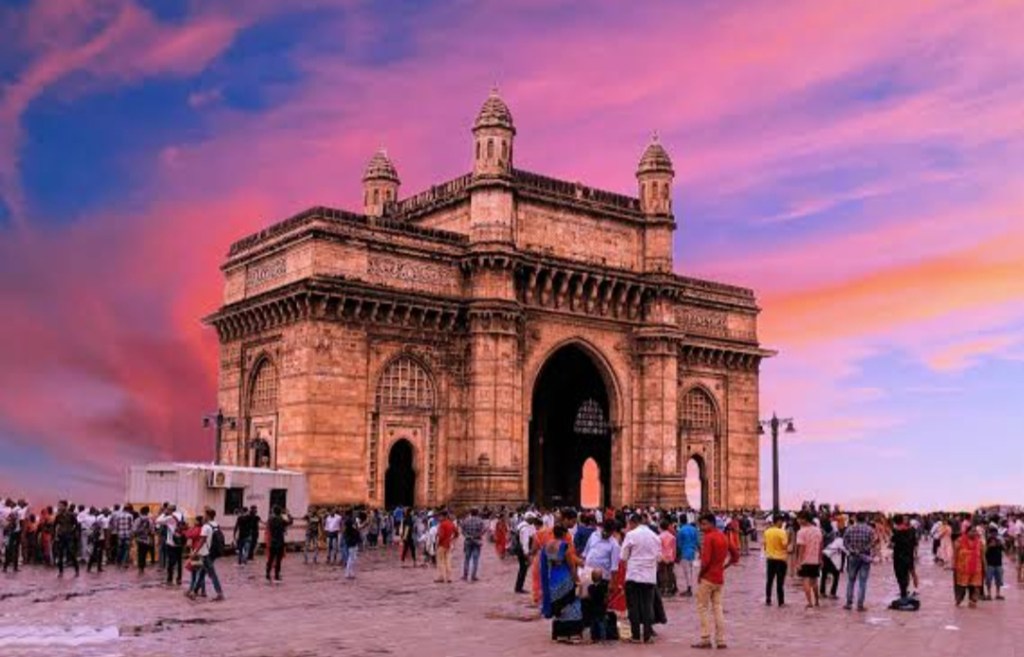
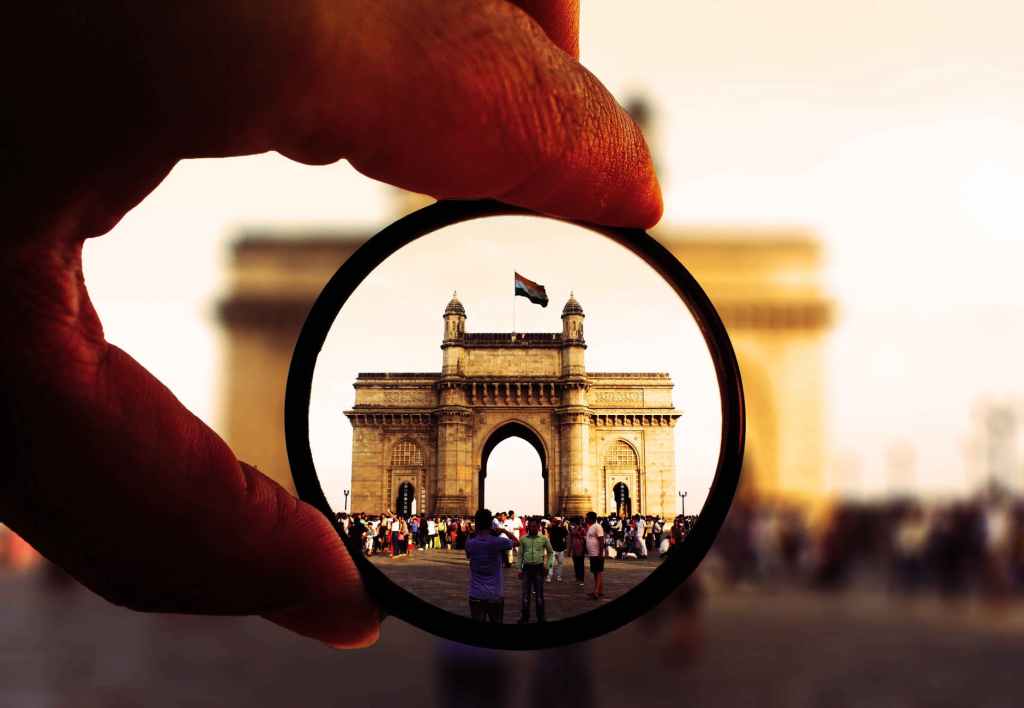
This monument facing the magnificent Arabian Sea in Colaba was built by the British to have it as a symbolic entrance of the colonials into the city. It was also the gate from which the British left India in 1948. The structure is an adaptation of the Arc De Triomphe of Paris. It is a hub for tourists, vendors, historians, vloggers and avid photographers. Two of the five jetties located here are used for commercial ferry purposes and cruises are available too. The Archaeological Survey of India protects the monument and several big firms have come forward to help in restoration of this monument under Corporate Social Responsibilty.

MARINE DRIVE

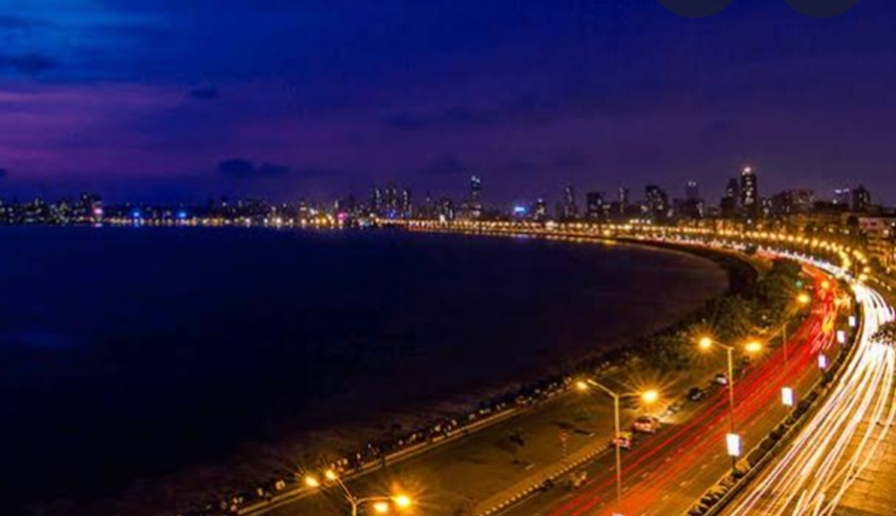
This 3.9 km long C-shaped stretch in Mumbai is also referred to as the Queen’s Necklace. During the dusk hours, the placement of lights along this natural bay resemble a shining necklace. Cemented sitting spaces allow visitors to have a relaxed time here while facing the waves gently drenching the sand. Plenty of snacking options are available here, ranging from lip smacking Chaat to soothing Ice-creams. Uphill, Tourists can explore the Walkeshwar area (an affluent location with an expensive cost of living) where one can find a number of well built houses and a rich lifestyle. Several sports clubs also exist in the vicinity.

CHHATRAPATI SHIVAJI MAHARAJ TERMINUS

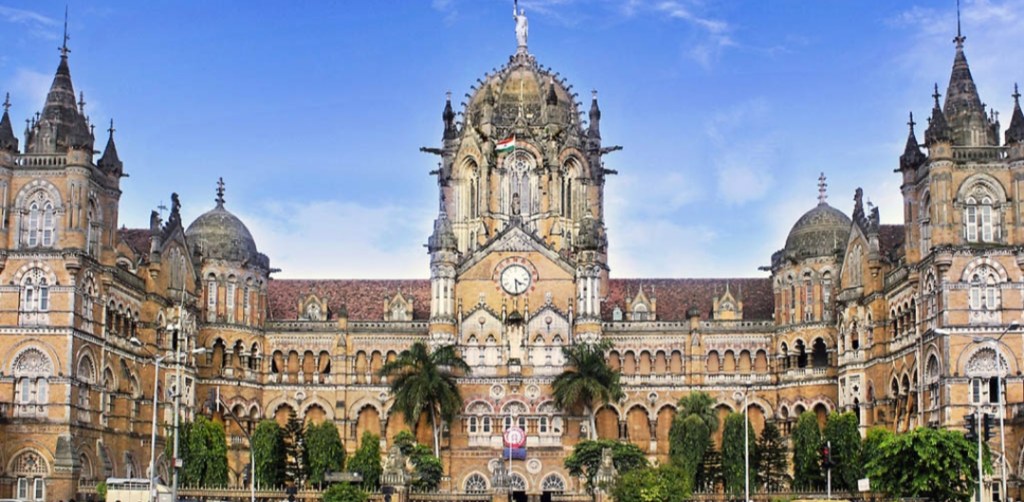
Previously known as the Victoria Terminus, this railway station is included in the UNESCO World Heritage Sites. The completion of the construction was done on the day when Queen Victoria completed 50 years of rule in India. This picturesque structure has been designed in the Victorian Gothic style by students of JJ School of Art. In the year 1996, this place was renamed from Victoria Terminus to Chhatrapati Shivaji Terminus. Later on, the the title of Maharaj (Emperor) was also added. It is the second most photographed monument in Mumbai. There’s a lot to do here. From experiencing a journey in the iconic Mumbai Locals with an unbelievable flurry of passengers to capturing scenic moments in a camera near the Terminus.

SANJAY GANDHI NATIONAL PARK

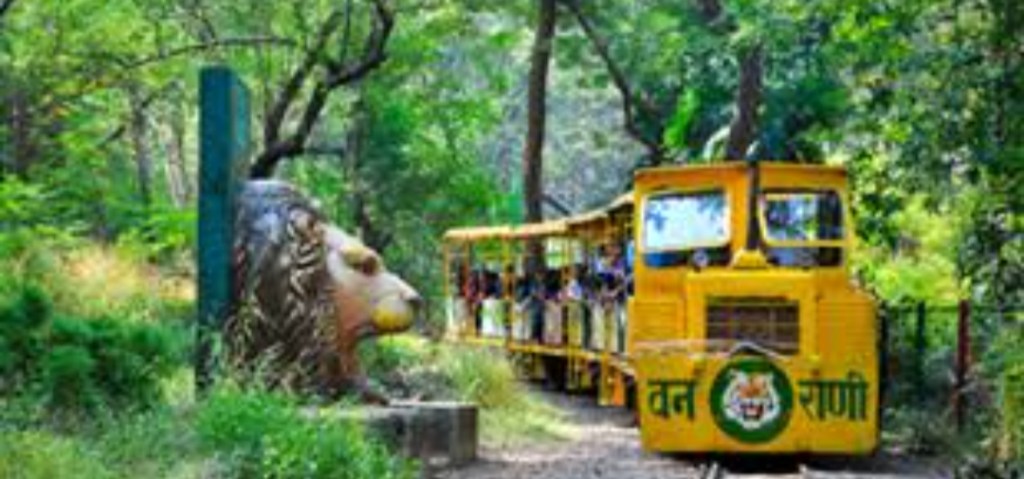
This is the most accurate place for fauna, flora and wildlife lovers. Away from the commotion, this place on the outskirts of Mumbai, provides for ample activities. Visitors can visit the Vanrani Forest, lion and tiger enclosures, butterfly garden, enjoy boating in a paddleboat or go hiking in any of the seven nature trails. The 65 mile long park is divided into three different zone – Tourist Area, Buffer Area and Core Area. Tourist guides and bicycles are available for anyone who does not wish to venture solo.

Mumbai has also been given the sobriquet of Tourist’s Paradise. With abundant tourist locations such as places of worship (Haji Ali Dargah, Siddhi Vinayak Temple, Iskon Temple), for having a leisurely family time (Bandra-Sealink, Juhu Beach, Hanging Gardens), for reasearch enthusiasts (RBI Coin Museum, Nehru Planetarium, Nehru Science Centre, Jehangir Art gallery) and many more. About 6 Million people visit Mumbai annually to see the city’s beautiful locations and to experience the culture, cuisines and lifestyle. All this has made Mumbai the 30th most visited place in the entire world.

Tourist Places in Mumbai

Photo by Darshak Pandya on Pexels.com

Mumbai, which is the capital of Maharashtra, is known as ‘the city of dreams’. Many tourist attractions will appeal you to visit the place again and again. From the common street food taste to the gleaming Bollywood, the city is just going to leave you open-mouthed.

Gateway of India: The Gateway of India is a landmark that denotes India’s main ports and is a noteworthy vacation destination for guests who touch base in India surprisingly. At a certain point in time, this landmark spoke to the greatness of the British Raj in India. A most loved spot for visitors, these days, and this landmark pulls in vendors, food stalls and also the photography buffs. The passing of the First Battalion of the Somerset Light Infantry; was recorded as the primary headliner that occurred at the Gateway of India.

Marine Drive: Are you a person who wants to sit back and relax from your busy day in a city that never sleeps? This is one of the most breath-taking places which calm your soul with the silence and beauty of the Arabian sea is the Marine Drive. It is a 4 km long promenade that lights up at night and looks like Queens Necklace. Because of the streetlights that make the road look like a pearl necklace.

Colaba Causeway Market- Colaba Causeway is also known as Shahid Bhagat Singh Road. If you are a shopping kind of person then this place is for you. Along with the small shops of garments, shoes and other materials to big boutiques all available in this market. You should know how to bargain and get some good stuff home.

Elephanta Caves- The perfect place to indicate the Indian Culture and architecture is the Elephanta Caves. It is built with solid rocks and delicately sculptured idols. There are seven caves present. The first big cave is made up of rock-cut stone sculptures dedicated to Lord Shiva. Further, there are six small caves with rock-cut sculptures representing Buddhism. 

Haji Ali: The structure of Haji Ali was on an arrangement of high rising rocks and was given its present day shape in the mid-nineteenth century after the Trust was lawfully framed as an element in 1916. Haji Ali Dargah is the complex that holds the tomb of the Muslim Saint Pir Haji Ali Shah Bukhari (R.A.). Alongside the tomb, there is likewise a Masjid at Haji Ali. This landmark has been the sentinel to the shores of Mumbai for quite a while. The structure has white vaults and minarets reminiscent of the Mughal architecture of the period and is a prominent historical monument of Mumbai

Elephanta Caves: Towards the northern end of Marine Drive lies one of the most seasoned seafronts called Chowpatty Beach, which is acclaimed for its bazaars and dinners.  Here one can find hundreds of salesmen are seen walking over the shoreline to sell various items of things, particularly on Sunday nighttimes. One can see stalls highlighting fast food and snacks, like Bhel Puri, Pav Bhaji, and so forth are set up in the territory each and every day. Going further down the path, is Walkeshwar, an exceptionally well-off and elegant range that gets its name from the popular and very loved Walkeshwar Temple.

Water and No Water: Wastage, Shortage and mismanagement.

Mumbai is facing a shortage of water with a third of its residents not having drinking water as per a recent report. This comes in heels with the news of massive water-logging across the city and flood-like situations. This is reminiscent of the Chennai Water Crisis in 2019 when a flood had hit the city in 2018 and in May 2019, the city declared a zero-water day – no water left in any of its reservoirs. As per statistics, in the coastal city with a medium size river flowing right through it (the famed Anna University is actually partially built on lands claimed from the river), 60% of its population relies on bottled water for drinking all year long. Was this always the case? History suggests no. But it has been so for about a decade now. This is not very shocking given that Mawsynram, the place with the highest recorded average rainfall on the planet also faces water shortage during summers!!!

Maharashtra received 17 per cent excess rainfall since June: IMD | India  News,The Indian Express
A lot of rain, and yet no water to drink

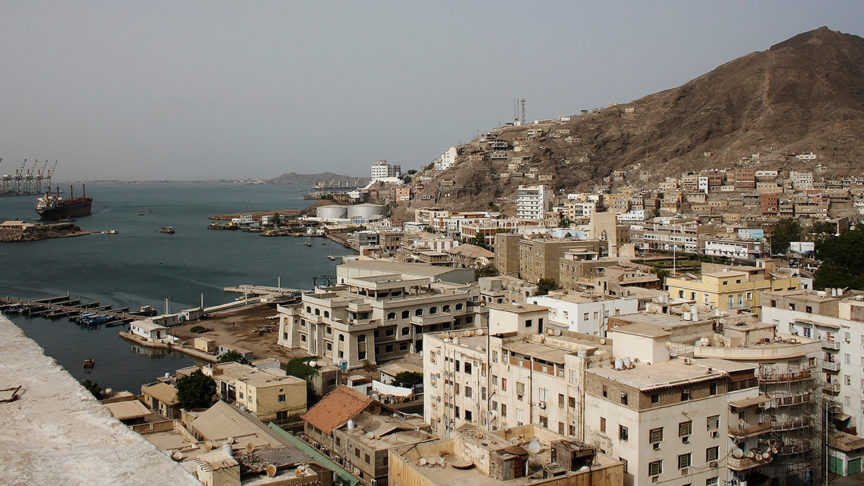
Yemen – the poorest of Arab nations and a region marred by civil war and international interference for more than a decade now might also have the root of its civil war as water shortage. Let us understand that the Yemeni factions are the Houthis, the republicans – with both basically supporting their tribal interests – and a swinging group of Saudi-led forces. Records suggest that there existed blood feud between villages just because a village constructed a well very close to that of the other village. As per data, Yemen has the least water availability per capita on the planet, even inviting statements like – if water were to get exhausted on Earth, this process would begin in Yemen. This is odd, given the fact that Dubai is a sprawling metropolis situated in the same Saudi desert.

War and pieces: Political divides in southern Yemen – European Council on  Foreign Relations
Yemen is the most water depreciated nation on the planet.

The situation is actually grim in many more places – Northern India – a land abundant with rivers and lakes – most of them, technically all of them polluted beyond potability. Go to Africa and the nations with rainforests and rivers are dry.

What is the cause then? We often hear of climate change. A reader would agree about the reality of climate change but would certainly not let go of the sheer amount of mismanagement involved in the handling of water resources. Governments all over the world have tried in their own way to clean water bodies – the money ending up in their coffers owing to balant corruption. In India, for instance, the Save Ganges Movement or ‘Ganga bachao abhiyaan’ in the vernacular has been a project spanning over three decades and costing lakhs of crores – the best part – to no result. NGOs and villagers have often revived water bodies across the planet showing the importance of public participation in government or local initiatives. But, the people aren’t really very concerned about this issue it seems. It might find itself in discussions during summers or in newspapers – but people refuse to consider it as a problem as grim as climate change. No one can imagine the change Chennai saw with themselves.

LONAVALA

Mumbai’s Heaven

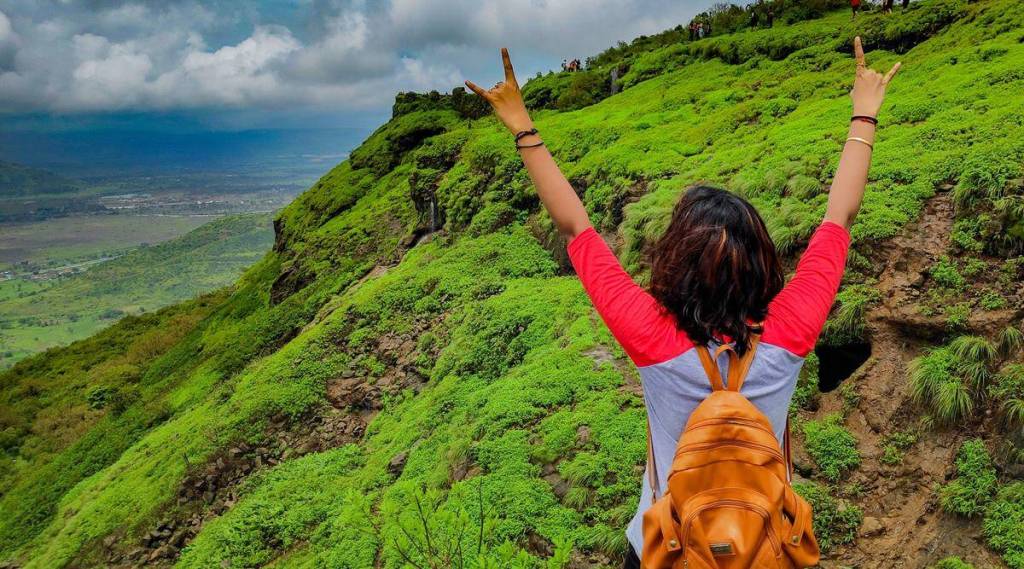
If one thing is known to help you get through a tough week or month, it is travelling. Travelling gives you the much needed break from the hustle and bustle of life. Even if that’s not the case, travelling is very essential for your self growth. It opens up your mind and makes space for new thoughts and adventures. If you are planning your next trip, Mumbai would be the place for you. The city is a combination of beaches and mountains, and there is nothing better than that.

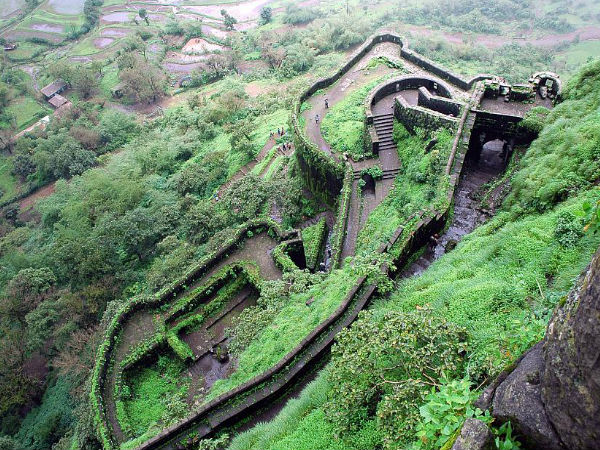
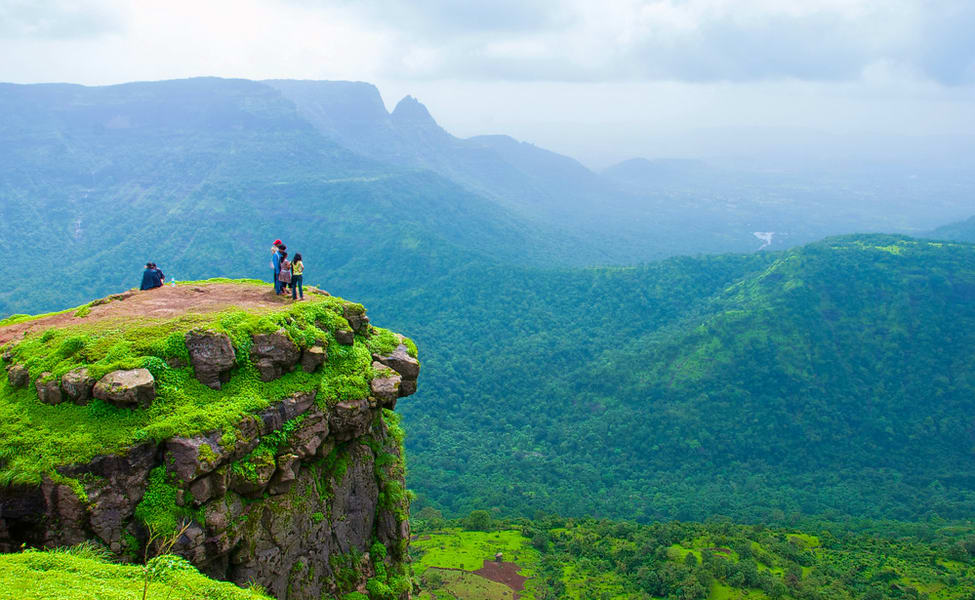
When you think of Mumbai, the first place that pops up in your mind is Lonavala. Monsoon and Lonavala go together like peanut and jelly. Lonavala is a place you think of when you are planning a weekend long trip to unwind from your daily life. This place has something to offer for everyone. The huge landscapes are great for kids to play on, the mountains are a treat for adrenaline junkies, forts and caves for our history lovers and last but not the least a place with breathtaking views for all those who are just looking to relax and sip their drink all day. Needless to say, Lonavala is much more than a hill station. There are several tourist attractions which you don’t want to miss. Some of the best places that will surely make your holiday more interesting are:

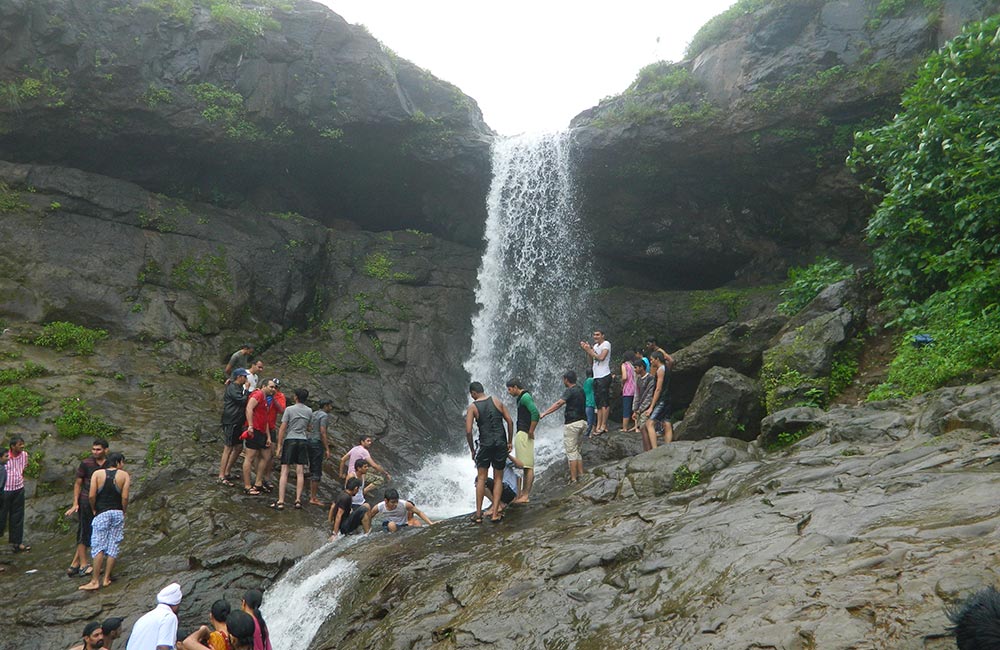
  • Tiger’s Leap- Situated near I.N.S. Shivaji Base, Lonavala: This spot is an attraction for people who are into trekking and hiking. The waterfall in the valley is an added advantage. The sound of water rushing down the mountain is all you need to forget everything about your work.
  • Bhaja Caves- Situated in Bhaja village of Lonavala: This spot is believed to be one of the oldest caves in India and has been declared as a national monument. There are 22 entrances to the cave. The architectural design of this place is something you wouldn’t want to miss.This place is a real gem for everyone who is interested in knowing more about India’s trade history.
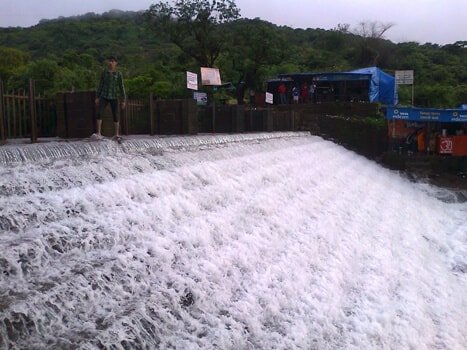
  • Bhushi Dam- Situated near I.N.S. Shivaji Base, Lonavala: Bhushu dam is just a 15-minute drive from Tiger’s leap. It is a magnificent dam built in the 1860s. It is situated on the Indrayani river in Lonavala. The place is always crawling with localities and tourists and to enjoy your visit it is suggested to go during the monsoon season when there are light rains.
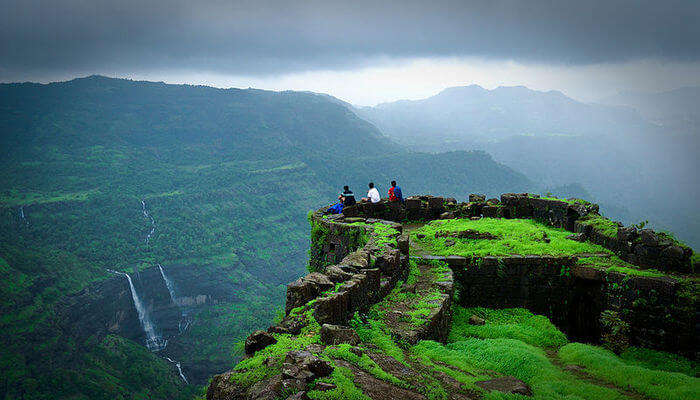
  • Rajmachi Fort- Situated in Rajmachi Village, Lonavala: This spot undoubtedly tops the list of the favorite tourist destination with its breathtaking view. Visitors trek to reach the highest point and all the hassle is totally worth it.
  • Lohagad Fort- Another tourist favorite destination would be the Lohagad Fort. It is 52 km from Lonavla and is close to other sites such as Bhaja Caves and Karla Caves.
  • Pawna Lake- Situated 30km from Lonavala: This spot is best for camping and picnic. Its wide landscape offers a breath of fresh air and much-needed peace and calm.

Lonavala is no wonder the favorite tourist destination. This place is a hot-spot for the localities to escape their daily life and enjoy everything that the place has to offer, be it the nature or the history lessons. Doesn’t matter if you enjoy gazing the stars or watching the sunrise, Lonavala is the place for you.

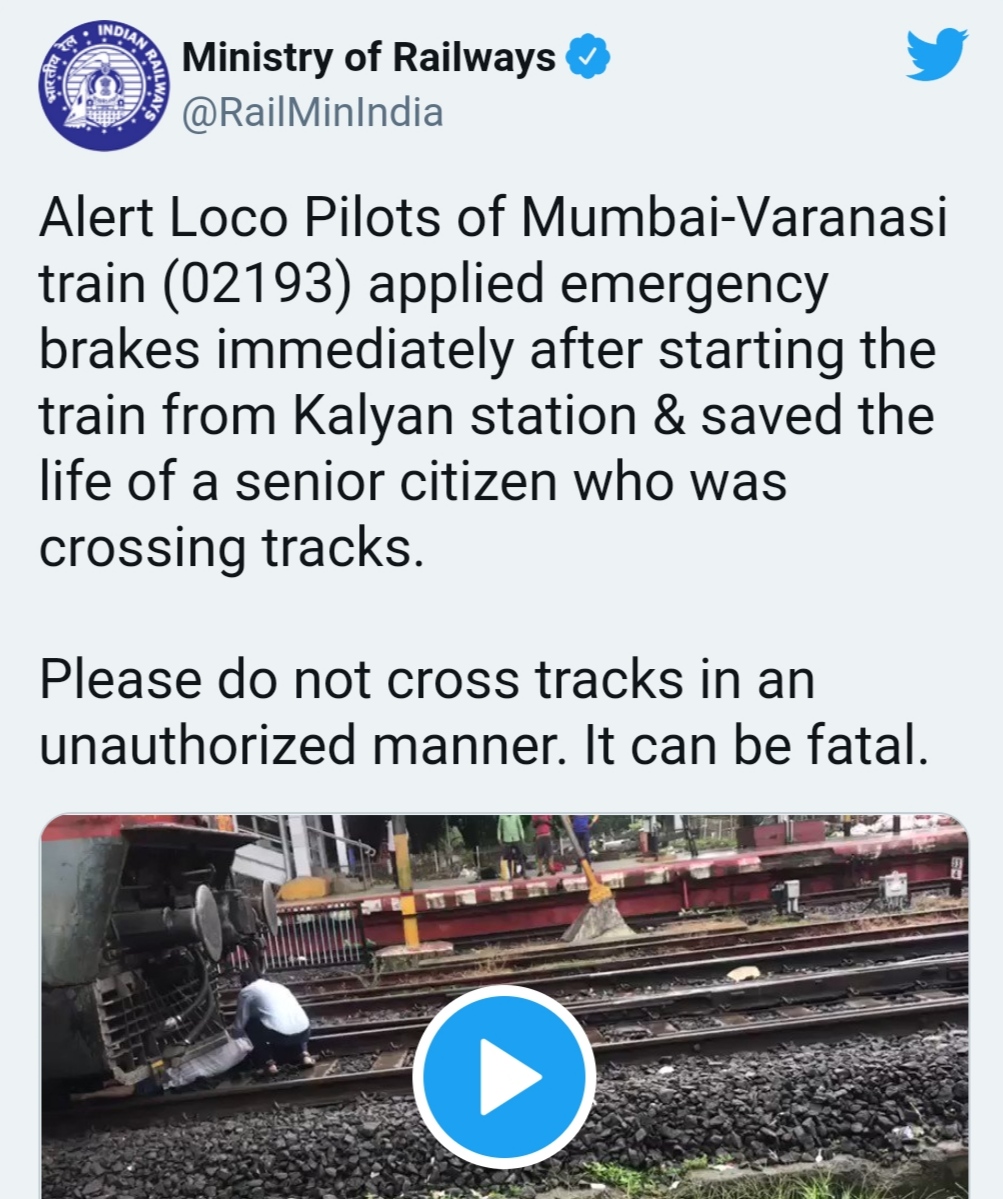
Loco pilots stopped Mumbai to Varanasi train midway to save elderly man.

In a shocking incident, an elderly man trying to cross rail tracks was saved by the quick action of loco pilots of a running train. A video of the railway staff rescuing the elderly man stuck between the tracks was shared on Twitter by the official Twitter handle of the Ministry of Railway. The incident took place near Kalyan station, Mumbai.

In above picture, we can see it.

“Alert Loco Pilots of Mumbai-Varanasi train (02193) applied emergency brakes immediately after starting the train from Kalyan station & saved the life of a senior citizen who was crossing tracks,” captioned alongside of the video. The picture shows the staff helping the man out from under the railway engine. The man came out without a scratch.

“Please do not cross tracks in an unauthorized manner. It can be fatal,” adds the caption.

Please be careful while crossing the railway tracks, we can get into grave danger if we are not alert.

A rainy July for 2 Indian cities

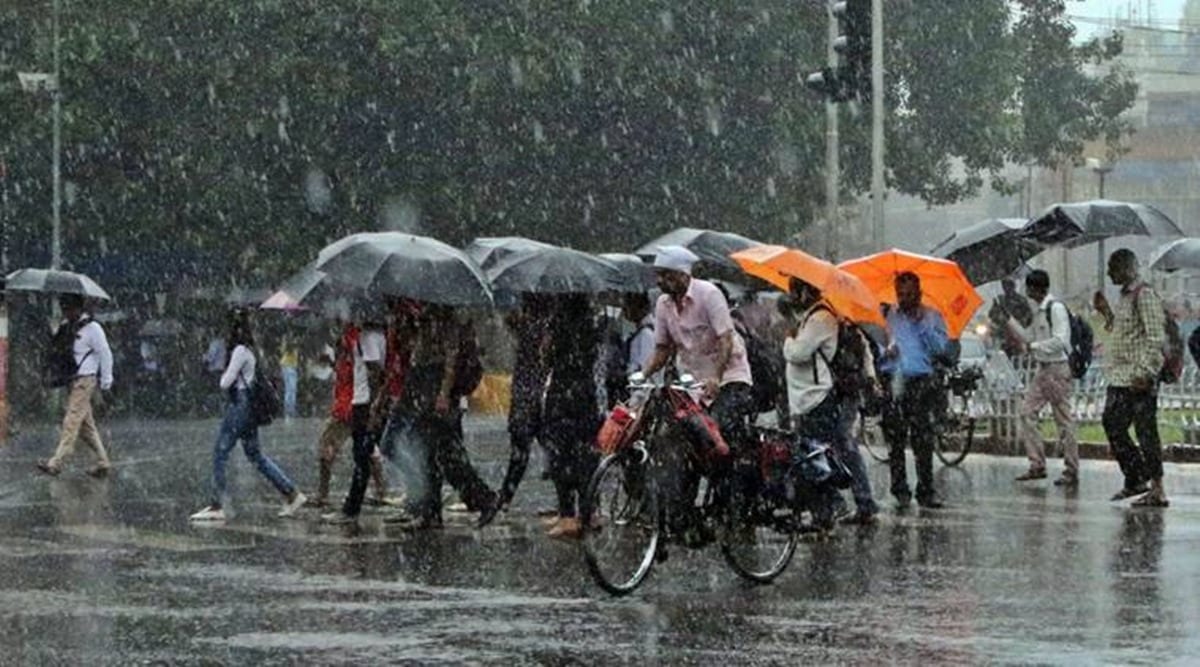
Indian monsoon, the most prominent of the world’s monsoon systems, which primarily affects India and its surrounding water bodies. It blows from the northeast during cooler months and reverses direction to blow from the southwest during the warmest months of the year. This process brings large amounts of rainfall to the region during June and July.

After meagre rains were received, Mumbai saw a downpour through the night and in the early hours of July 16th, leading to 27 roads being inundated, 85 bus routes diverted and 250 people evacuated from the Mithi River banks. Extremely heavy rain was recorded at the India Meteorological Department (IMD) Santacruz observatory at 253.3mm, which is the second highest 24-hour rainfall in a decade.

In 2019, the city had recorded 375.2mm which was the highest 24-hour rain in the months between 2015 and 2020. In 2018, it was 184.3mm, 163.4mm (2017), 114.5mm (2016) and 61 mm in 2015.

The meteorological department classifies 15.6-64.4mm in 24 hours as moderate rain; 64.5-115.5mm rain as heavy; 115.6-204.4mm as very heavy; and over 204.5mm as extremely heavy rain. Moderate to heavy rain is likely in the city and suburbs with the possibility of heavy to very heavy rain at isolated places, said the IMD.

The Extremely heavy rain left 27 city roads waterlogged— areas like Hind Mata, Gandhi Market, Sion Road number 24, Wadala Bridge, Chunabhatti, Siddharth Nagar in Goregaon, RCF, Chembur Phatak, Milan Subway, roads leading to eastern freeway. As per the BMC (Brihanmumbai Municipal Corporation) data, between 4am to 7 am, the city recorded 36mm rainfall, 73mm in the western suburb and the highest 75mm in the eastern suburb of Mumbai.

The Mithi River crossed a dangerous mark following which so far about 250 people have been evacuated from Kranti Nagar slum which is located at the bank river. After the rains took a break following the evacuation of people, the water level of the river went down to 2 metres from 3.7 metres. After that, most of the evacuated people returned to their places. The IMD has predicted moderate rain in the city and suburbs with possibility of heavy rainfall at isolated places, the civic official said, adding that the city will witness high tide of 4.08 metres on Friday at 4.26 metres.

Meanwhile, the city of Hyderabad witnessed heavy rains on the night of July 14th, which went on till the next morning. According to the IMD, Hyderabad records, at 69mm, this day was the third rainiest July day for Hyderabad in the last 10 years. The city recorded 115.1mm of rain on July 21, 2012 followed by 86.4mm on July 12, 2013. It was after seven years that Hyderabad witnessed this kind of rain in 24 hrs.

Several localities in the city, including Hayathnagar, Uppal, Saroornagar and Saidabad received heavy rains overnight. Meanwhile, Bandlaguda, Uppal received the maximum rainfall of 212.5 mm, followed by Vanasthalipuram, which witnessed 192.3 mm rain. Kapra, Serilingampally, Khairatabad, Golconda and Marredpally also experienced moderate rains.

Several other districts including Rangareddy, Medchal-Malkajgiri, Yadadri-Bhuvanagiri, Jangaon, Rajanna Sircilla and Jagtial also received heavy rainfall. Chegunta in Medak received the highest rainfall of 227.5 mm on Wednesday. According to the forecast by Indian Meteorological Department (IMD), Hyderabad, the city will witness cloudy sky throughout the day, accompanied with light showers at isolated places.

Pride of Mumbai

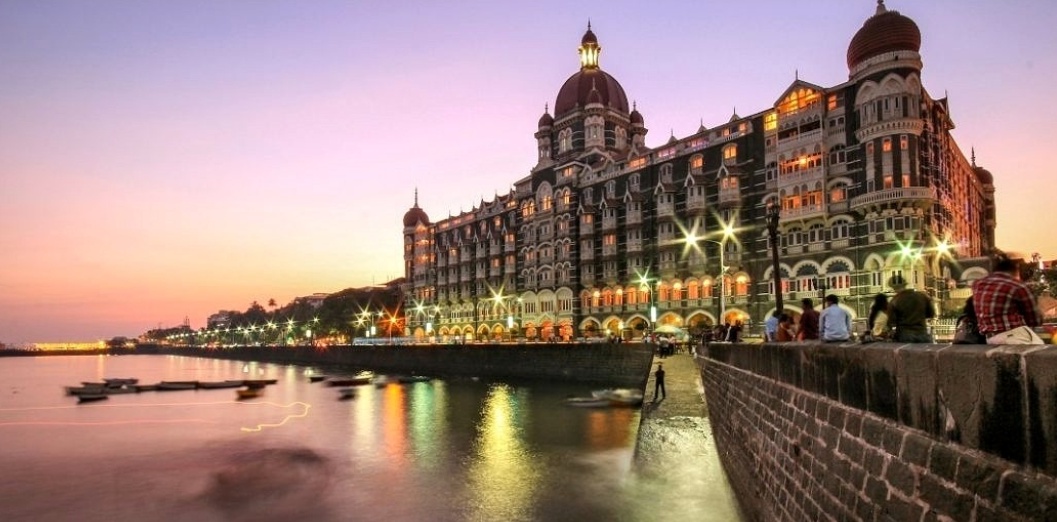
Taj Mahal Palace Hotel is the pride of Mumbai. Mumbaikars and other people around the globe dream of spending a night in this marvelous hotel. The hotel is built in the Saracenic Revival style, situated next to the Gateway of India.

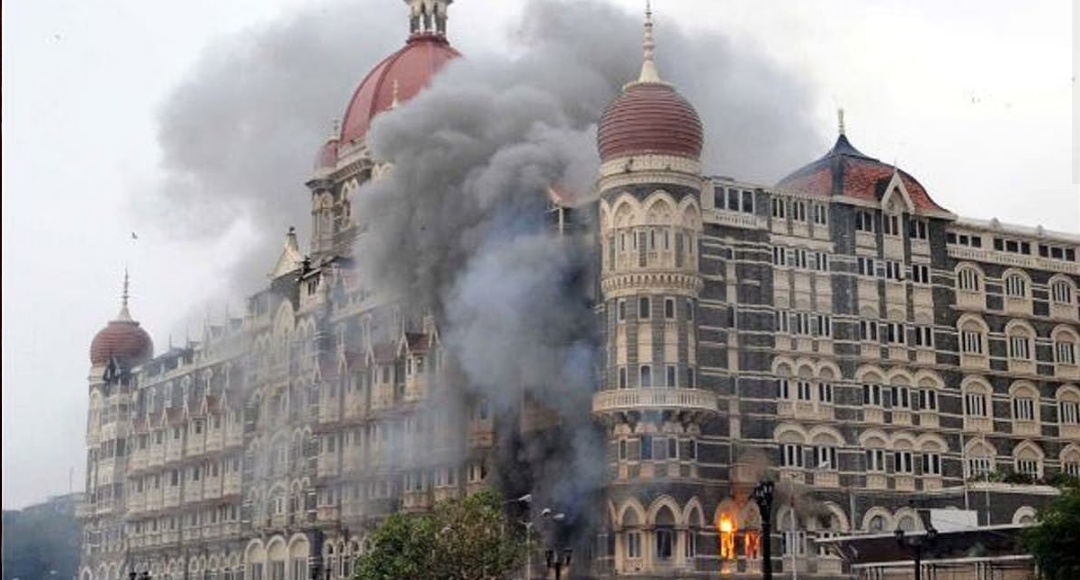
But unfortunately, we saw the hotel burning and getting damaged on 26 November 2008 by a bunch of terrorists. These terrorists attacked five locations in Mumbai, one of which was The Taj Hotel. Two of the terrorists entered from the front door and started throwing explosives and shooting. The attackers brutally killed the guests as well as the staff members of the hotel. It is said that 31 people were killed at the hotel, out of which 17 were staff members. Hemant Oberoi, the head chef, and the other staff helped a lot of guests and kept them safe. He stayed calm throughout the situation and acted bravely. More than 150 guests were rescued from the hotel on 27th November.

The hotel was rebuilt within a month after the attack. The heritage wing of the hotel was severely damaged therefore, it was opened in phases. It took around $38 million to reconstruct the hotel. The hotel is solid to such an extent that no man on this planet could stop it and that’s the reason it is known as the pride of Mumbai.

Ambani – The Indian tycoon

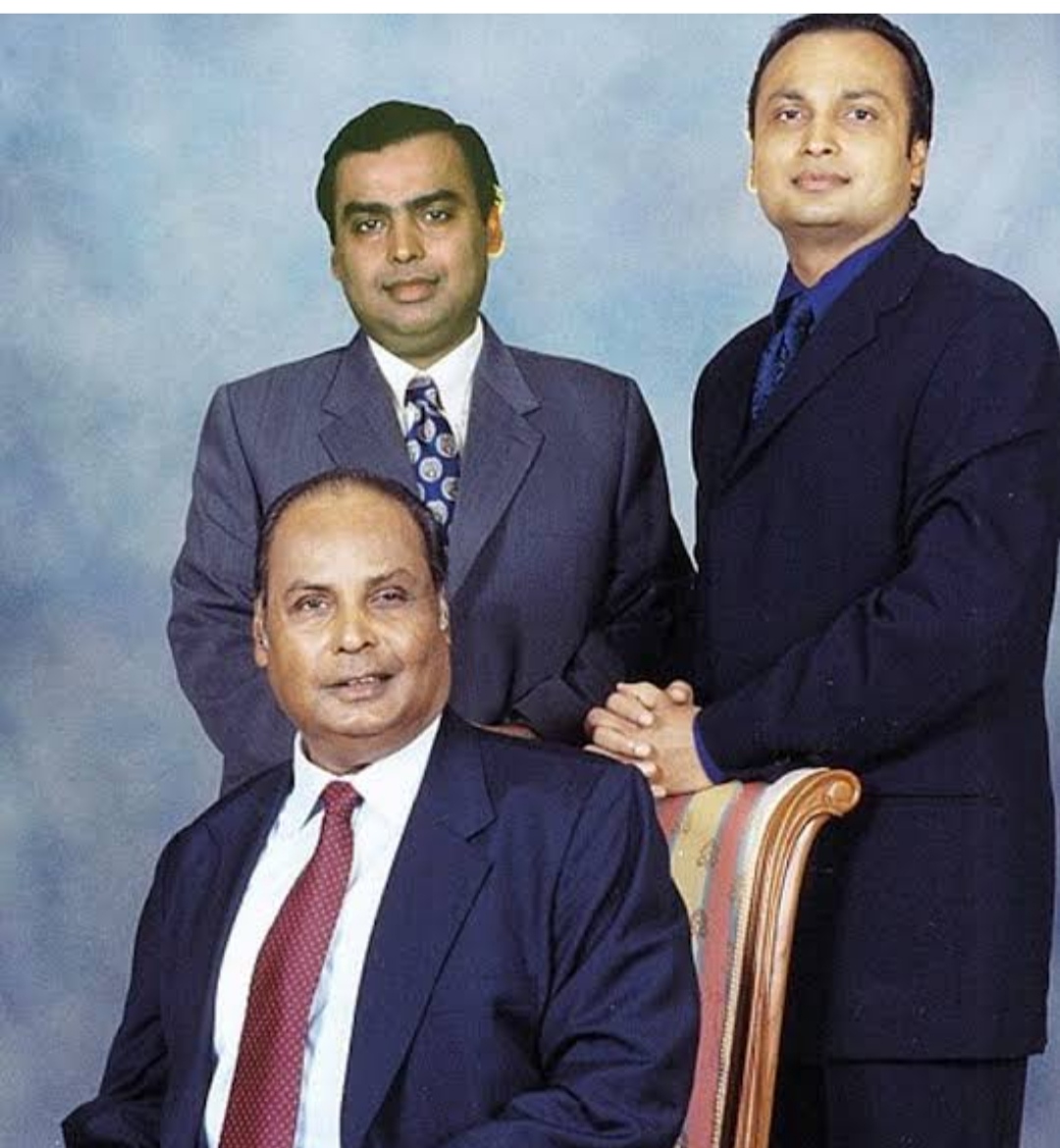
Dhirajlal Hirachand Ambani, popularly known as Dhirubhai Ambani. He is the father of Mukesh Ambani and Anil Ambani

Dhirubhai Ambani was a successful Indian business tycoon who founded Reliance Industries.

Dhirubhai Ambani,Indian industrialist,the founder of Reliance Industries, a giant petrochemicals, communications, power, and textiles.

Reliance is the biggest exporter in India and the first privately owned Indian company.

Dhirubhai Ambani passed away in 2002, before his death itself in 1980’s he handover the reliance corporation to his sons Mukesh Ambani and Anil Ambani.

Reliance Power Limited (R-power), formerly known as Reliance Energy Generation Limited (REGL) is a part of the reliance Anil Ambani Group. It was established to develop, construct, operate and maintain power projects in the Indian and international markets.

Mukesh Ambani runs Reliance industries which has interests in petrochemicals, oil and gas, telecom and retail.

Reliance industries limited, diverse businesses include petrochemicals, natural gas,retail, telecommunications,mass media and textiles. Reliance is one of the most profitable companies in India.

Reliance’s Mukesh Ambani and Nita Ambani are the owners of the second most expensive home in the World, ANTILIA, Mumbai.

City of Dreams

Mumbai, what can I say about this city?
It’s a place where dreams are born and are converted into reality.
Staying in Mumbai is itself a dream for thousands of people but very few of them can make it here. Even after facing thousands of difficulties, one will always say, “we will adjust”. The city will challenge you in different ways and once you pass the test, you will never think of leaving it.
Every year thousands of people come to Mumbai with a suitcase full of clothes and eyes full of dreams. These dreamers constitute about 37% of Mumbai’s population.

Every Megacity has skyscrapers, mass transport, infrastructure. opportunities, same as Mumbai, Then what so special here?
It is special because it never stops working. Days and nights have no difference and the energy seen in the Mumbaikars is next level.

It’s where you will find people from every corner of the world.
And yet you may never lose yourself in the crowd.

It’s where you cross a road with orange Hindu flags hung up to walk into a Muslim community and Green flags hung while you walk into a Hindu community.
It’s a place where you shall find a beautiful church next to a gurudwara, or a mosque next to a temple.

It’s where you can enjoy the best, cheapest food; and how can one forget about the vada-pav and chai stalls which make the city complete.

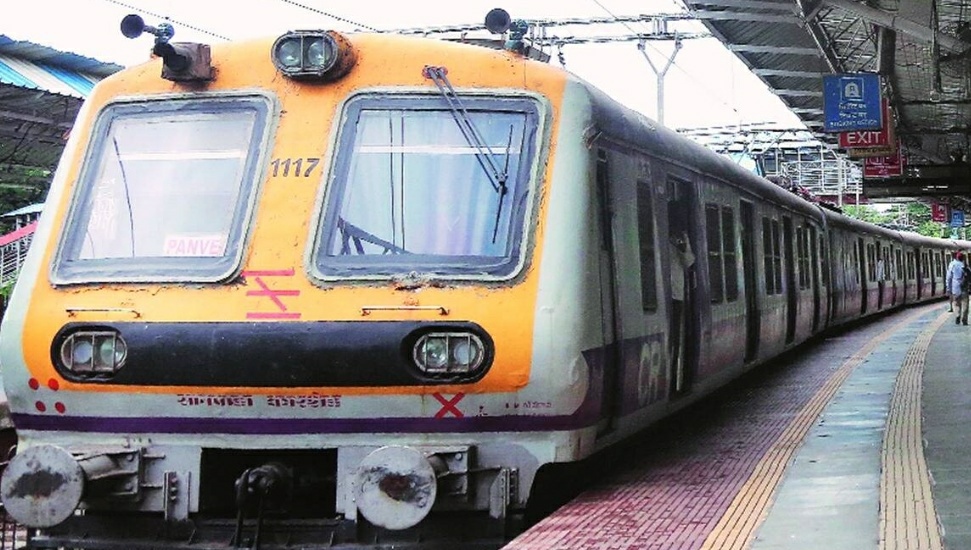
Travel in a chock full bus filled with sweaty men and women. Then find it fun while swinging in it, and miss it when you leave. The “local railways” the lifeline of the city which commutes 3.7 million passengers every day.

Burn your wallets in top brand shops and in buying exotic products. Find the same things available on the road, with substantially good quality at a much cheaper price.

Want to fill that empty hole in your stomach even at midnight. And find food vendor’s around every corner of the street waiting for you.

Chillax on a beach, drive by the sea, enjoy the breeze, feel cold in winter, feel wet in monsoon, sweat the hell out in summer, and still enjoy it all.

Ask the next person for directions, and be surprised to find that person accompanying you to your destination,
Learn Marathi by just daily journeying around, speak Gujarati without knowing it with friends, hear some French, and experience one of the best English knowledge the world can offer.

Still, what can one say about it because it’s “Aamchi Mumbai”

How a grassroots organization in India got a six-sigma certification

Prince Charles once wanted to meet the Mumbai dabbawalas,so he did–on a footpath.
The dabbawalas are a tiffin delivery service.They collect homemade food from houses and deliver it to the offices at lunchtime.But here’s a catch,they do not use any kind of fuel or modern technology.An organisation where average literacy standards of workers is grade 8 and probably only 15 % might have attended senior secondary school,the story of mumbai dabbawalas started more than 130 years ago.

Mumbai,then known as Bombay, took shape in the 19th century. During the latter half of this century, Bombay was a centre of cotton trade especially during the American Civil War and that created a pool of wealth among Indians. Much of this money was channelled into rebuilding the core of this city.
An increasing number of migrants had started to move to Bombay from different parts of the country. They belonged to different communities, and had different tastes that could only be satisfied by their own home-cooked meals. So, in 1890, Mahadeo Havaji Bachche started a lunch delivery service in Bombay with about a hundred men,and The dabbawalas were born.Unlike most other companies in the same field , dabbawalas have a very straight forward mission–To provide healthy homemade food to people.

Everyone in the organisation earns the same salary regardless of his job role i.e. approximately INR 12,000 per month.Currently, a minimum of 5,000 dabbawalas are involved in the business.Most of the dabbawalas come from the Varkari community of Maharashtra. They worship lord vitthal and therefore find their jobs of feeding people very spiritually fulfilling. They live simple lives,most of them reside in the slums of mumbai.

The Dabbawala got Six Sigma Certified, which means, error ratio is 1 in 16 million i.e. 1 mistake in 1,60,00,000 tiffin. In 1998, Forbes Global magazine conducted a quality assurance study on operation of dabbawala and gave a six sigma efficiency rating of 99.999999.

Here is how they operate:
The food dabbas that they carry have a shelf life of 4 -5 hours. The total delivery time is 6 hours – 3 hours from house to office and 3 hours from office to house.Each box shifts hands in transit 6 times and same in return as an empty tiffin. On a daily basis one worker covers a distance of 60 – 70 km. Since most of the dabbawalas are not educated,they use a simple code system.The dabbas are first collected from the homes of the costumes mostly on bicycles.The dabbawala then takes them to a sorting place, where he and other collecting dabbawalas sort the lunch boxes into groups. The gathered boxes are put within the coaches of trains, with markings to recognize the destination of the box . The markings incorporate the railroad station to empty the boxes and the destination building delivery address. At each station, boxes are given over to a neighborhood dabbawala, who delivers them. The purge boxes are collected after lunch or the another day and sent back to the individual houses. Speed and accuracy taking care of the boxes, timely conveyance to the correct proprietor makes a difference them keep up their benefit quality

The dabbawalas even deliver in the pouring rain or during political strikes.They have become the symbol of discipline in mumbai.However the pandemic has proved damaging for them. With no one needing their services anymore ,the dabbawalas have returned to their village.

I hope to see the annadaatas of mumbai again soon, laughing and chattering by the footpath before getting into a hurried segregation and loading of tiffins onto the bicycles.

WATSON HOTEL

Watson’s Hotel, currently acknowledged as the Esplanade Mansion, is India’s oldest sustaining cast-iron building. It is located in the Kala Ghoda area of Mumbai (Bombay). Named after its original owner, John Watson, the building was fabricated in England and built on-site between 1867 and 1869.

The hotel closed in the 1960s and the building was sold to a private owner. It was later divided and partitioned into smaller cubicles that were let out on rent as homes and offices. Negligence of the building has resulted in corrosion and, despite its listing as a Grade II–A heritage structure, the building is now in a rundown state.

Design:

Watson’s hotel was planned by the civil engineer Rowland Mason Ordish, who was also linked with the St Pancras Station in London. The structure was fabricated in England from cast iron components and was congregated and constructed on-site. The external cast-iron frame closely resembles other high-profile 19th century buildings such as London’s Crystal Palace. The main façade of the hotel is characterized by building-wide open balconies on each floor that connected the guest rooms, which were constructed around the atrium in a courtyard arrangement.

History:

John Watson opened the hotel as an exclusive whites-only hotel, and it was the most expensive hotel in the city in those days. The five-storied building housed 130 guest rooms, as well as a lobby, restaurant, and a bar at the ground level. The hotel also had a 30 by 9 meters (98 ft × 30 ft) atrium, basically used as a ballroom, with a glass skylight. At its peak, Watson’s hotel employed English hostesses in its restaurant and ballroom, sparking a common joke at the time: “If only Watson had imported the English weather as well.”

After Watson’s death, the hotel lost its fame to the rival Taj Hotel. In the 1960s the hotel was closed and sold to a private owner. Sometime after this, it was subdivided and partitioned into small cubicles with independent access and let out on rent. Over the years, indifference toward the building by the residents has resulted in the structure decaying, and it is now in a neglected state. The atrium was consequently used as a dumping area and has various unauthorized constructions. In 2005, the building had 53 families and 97 commercial establishments. Most of the business enterprises are chambers of advocates attached to the nearby Bombay Civil & Session Courts and the nearby Bombay High Court.

  • Notable guests:

Among the hotel’s notable guests was Mark Twain who wrote about the city’s crows he saw outside his balcony in Following the Equator. It was also the first place in India to screen the Lumière Brothers’ Cinematograph invention in 1896. However, this was witnessed only by Europeans.

A popular myth surrounds the hotel was that the staff at Watson’s Hotel denied Indian industrialist Jamsetji Tata access to the hotel. In retaliation, he opened the Taj Hotel, a hotel that stands near the Gateway of India, in 1903. However, author and historian Sharada Dwivedi debunks this legend. She points out a lack of evidence to prove that Tata was a man of vengeance.

  • Current state:

The building’s poor state of affairs has been commonly remarked, and efforts by heritage activists to persuade its present owner to invest in restoration have been unsuccessful. One of the possible reasons proffered for apathy is the fact that the rent collected is low as it has been frozen by government legislation. The condition of the building was publicized by Italian architect Renzo Piano, and as a result of his efforts, the building was listed in June 2005 on the list of “100 World Endangered Monuments” by the World Monuments Fund, a New York-based NGO. Just a few days after its proposal, part of the building’s western façade, originally galleries evolved into small offices, collapsed, killing one person and crushing several cars and motorcycles parked in the street below. The building is currently listed as a Grade II–A heritage structure.

MUMBAI – A SENSATIONAL CITY

I will always cherish my visit to Mumbai, the city of dreams, and a city after my heart. Known for beautiful places and some UNESCO heritage sites like Gateway of India, Elephanta Caves, Juhu Beach, Marine Drive, Chhatrapati Shivaji Maharaj Terminus, Galleries, Victoria and Art Deco buildings and Colaba Causeway, the iconic Crawford Market, Amazing Street food, and a lot more. The people of Mumbai are termed as “Mumbaikar”. Mumbai surrounded by the Arabian Sea was first known as Bombay which is located in a peninsular on the Western coast of Maharashtra state. Mumbai has tropical humidity, from March to May the weather is hot and dry, from June to November Mumbai has heavy rains, and from December to February, the temperature is cool.

Mumbai is the financial capital of India, making it one of the expensive cities in Asia. I think Mumbai is the best place to restart your life in India but you’ll have to work on your budget. For fitness freaks in the dawn to enjoying the nightlife, Marine Drive is the best place you will see in Mumbai. The soothing sound of waves helps you to unwind, well you can enjoy the beauty of the sea, but not relax as the emotion-struck couples engaged in PDA will make you gag, and believe me, it’s not at all romantic as you see in Bollywood films and speaking about movies. Mumbai is the base of the Bollywood industry with the largest producer of films, making Mumbai India’s largest entertainment capital, and who knows you may spot an actor in a diner or club. Acting and Drama hold special interest for Mumbaikars and one famous place is NCPA (National Center Of Performing Arts). People here are helpful and friendly and makes sure that you feel comfortable. Shopping buffs will love this place from Colaba Causeway to Bandra Linking road to Crawford Market for the street shopping. Each building has a history behind it, Be it Gateway of India or the Taj Hotel. Street food is one popular sensation of Mumbai. Mouthwatering Vada pav, Pani puri Falooda, Pav Bhaji, Ragda puri, Missal Pav, Snow Cones (Gola), Sev puri, to Chines food, and the list goes on. To budget-friendly eateries to posh Restaurants and Bars, Mumbai has it all. Some 5 Star hotels such as Trident, The Oberoi, Taj Mahal Hotel are just so classy.

Well, there are a lot more facts to know about, like Mumbai has a Coastline of about 150 Kilometers, Dharavi in Mumbai is the biggest slum in Asia, The famous network of Dabbawalas (lunchbox delivery system) that is only seen Mumbai, first bus service in India was started in Mumbai, etc. Even though Mumbai is a beautiful place, there are a lot of disadvantages too. The dense population has been causing a lot of damage to the environment like Land pollution, Air pollution, Water Pollution, Deforestation leading to drastic climate change. With proper care, awareness, and solution, we can restore its natural beauty. Mumbai will always remain my forever favorite. Even though there are problems within the city, I would say heaven is where your heart is.