Muna Madan

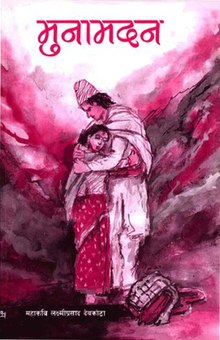
Almost no one hasn’t heard of Devkota’s most well-known creation, the Muna Madan. This short epic about Muna and Madan is well-known in Nepali, but its English translation is equally well-known. Madan, a hopeless rancher, decides to go to Tibet as a vendor in order to get money, leaving behind his elderly mother and lovebird wife, Muna. Muna begs her husband to stay, but Madan withdraws in the hopes of accumulating wealth for the family. The hardships Muna and Madan have while trying to reunite with one another are depicted in a horrible way in sonnet. Muna Madan, while being a short epic, has become a commercial success and is regarded as a model of Nepali writing.

Plot

Muna Madan is a Nepalese epic that tells the heartbreaking story of Muna and Madan. It was written in a melodious version in 1935 by Nepalese writer Laxmi Prasad Devkota. It is one of the most well-known works of Nepali literature. Not long before his death in 1959, Devkota observed, “It would be fine if every one of my works were singed, except for Muna Madan.” In terms of deals, it is the best Nepali book ever written. It’s not a Jhaurey song in the traditional sense. The plot revolves around a man (Madan) who abandons his significant other (Muna) and travels to Lhasa in order to bring in money. Madan represents all Nepalese young people who migrate abroad to make ends meet.

Muna, Madan’s wife, is the queen of sacrifice and love. She adores her Madan and is devastated that she must send him to Lahsa, a dangerous and difficult region. However, she accepts the challenge and decides to remain in the country with her elderly and weak mother-in-law. On his way back to his residence, Madan becomes unwell. His friends abandon him on the road and come home to tell him he has died. Finally, a Nepalese man from a lower caste comes to his aid. That is why a guy is said to be magnificent because of his heart, which is full of love and humanity, rather than his caste or ethnicity.

Madan returns to Kathmandu after regaining his health only to discover that both his mother and beloved wife had died. Madan ultimately comes to the realization that money has no meaning at the time. The story also recounts the life of a poor widow who suffered greatly without her husband and died in sorrow. In this poem, Devkota addresses the most important challenges plaguing Nepalese society at the moment. Through the story of Muna and Madan, Laxmi Prasad Devkota hopes to stabilize the truths of archaic societies, unscientific notions, and the negative impacts of unemployment and poverty in Nepalese society. The poet has brilliantly characterized love by writing about Muna and Madan’s connection.


ENRICHMENT AND REFINEMENT THROUGH LITERATURE

“That is part of the beauty of all literature. You discover that your longings are universal longings, that you’re not lonely and isolated from anyone. You belong.”
― F. Scott Fitzgerald

In today’s world of cut-throat competition and skills-based learning, parents, particularly in India, encourage their children to pursue higher education in the sciences, especially in engineering and medicine as the number of job opportunities in these fields are far more than in any other field. Consequently, there is a predominant idea among large sections of the society in India that those who pursue subjects related to Humanities and Social Sciences are less intelligent and that these subjects are only of academic importance, having no real value in the practical world as they offer limited employment opportunities.

However, such people are mostly ignorant or not highly educated as they tend to make injudicious comparisons between fields of studies, most of them do not realize that the Arts and the Sciences are interconnected. As there have been scientific movements in the course of history, whereby earlier pseudo-scientific notions were replaced with modern inventions and discoveries, so there also have been artistic and literary movements that have displaced the age-old concepts in a similar manner, transposing them with newer approaches. Accordingly, even the study of literature has become more practical in approach and has adopted the experiential method of learning. Few people are aware of the fact that the inspiration behind Einstein’s theory of Relativity was the writings of the sixteenth century philosopher and visionary, Giordano Bruno.

The study of literature has actually had a humanizing effect on people. It has opened the eyes of people to the problems of the world and has enabled them to empathize with the victims of an unequal social order. Knowledge of these has induced many industrialists and business people to involve themselves in philanthropic activities. Also, literature has provided us insights into the cultures and practices of different countries across time Through the study of literature, we have come to know about the social orders of ancient Greece, India and Mesopotamia as well as of Medieval Europe and Early Modern America and Europe.

A Literature also provides us with a welcome respite from the hectic day-to-day lives because it is also a source of entertainment in the form of theatrical productions and films. Good films and plays provide families the opportunity to be together, even if for a short while. This is important in maintaining the familial bond because every individual is always busy in chasing his or her dreams.

Lastly, one cannot help but admit that good stories are always welcomed and they are an integral part of human existence, and all good stories are nothing but literature. Thus, we cannot deny the fact that literature helps in enhancing the whole personality of a reason. It has the power to lead the whole society towards the right path.

15 Books Everyone Should Read At Least Once In Their Lives

1.To Kill a Mockingbird, by Harper Lee

2. 1984, by George Orwell

3.The Lord of the Rings, by J.R.R. Tolkien

4.Pride and Prejudice, by Jane Austen

5.The Book Thief, by Markus Zusak

6.The Hobbit, by J.R.R. Tolkien

7.Fahrenheit 451, by Ray Bradbury

8.Jane Eyre, by Charlotte Bronte

9.Animal Farm, by George Orwell

10. Gone with the Wind, by Margaret Mitchell

11.The Catcher in the Rye, by J.D. Salinger

12.The Grapes of Wrath, by John Steinbeck

13.The Kite Runner, by Khaled Hosseini

14.A Tale of Two Cities, by Charles Dickens

15.Romeo and Juliet, by William Shakespeare

Is love depleting from the world of humans?

Photo by Min An on Pexels.com

“Love will find a way through paths, where wolves fear to pray”, as beautifully quoted by Lord Byron. Indeed “Love”, is one of the purest elements in the whole universe, which makes our world more beautiful.

Why do we love? Is it important to love others? Should we love ourselves? There are endless unexplored questions that make us think about it. For a poet, love is like seeing those dazzling stars at night, for a painter, love is beauty gifted by nature, for a philosopher it is something beyond existence. But one common thought which provokes in every human is that love makes us unite, it gives us harmony and a sense of comfort towards each other.

Love is illusioned in our minds, in our hearts, but yet it is fading somewhere from the world of humans.  Somewhere, we humans have forgotten how to love each other.

 We are living in a generation where humans are rebellious and have detached from the emotional state of being. In the Contemporary world, people have forgotten about love and its profoundness. Whether it is self-love, to love others, Humans are having a neglecting behavior when it comes to love and gratitude.

This era is an era of remorse! An era where we are afraid of each other. Humans are toxic to each other. Where people don’t care for each other.

Gone are the days when the world was a beautiful place with all the precious jewels of mother nature. Now our world is a place filled with hatred, jealousy, evilness towards each other. Humans are in a motive to devastate each other for their desires and to let down other humans.

The love is no more the love that was there in the 18th century when Romeo loved Juliet had an eternal for each other. This was the time when love was the most prominent role for all humans to perform. Humans are the most threatening creature on our earth which is not only depleting love but also depleting humankind.

Love is no more than the love we had!

We have lost all our ethics and norms and living a misleading life. Often, we are living a life that has become a misfortune. We are living beings with shallow hearts. We have created a world where faith and trust no longer exist, and if it all is found we are burdened with societal pressure that we fall apart from our convictions.

Love is considered feeble, rather is one of the most vigorous things in the universe.

But as we say there is always hope for all. Love never dies and so we are alive till love exists. It all depends upon us and our convictions that how we perceive it.

In the end, to conclude we can say that why to deplete such a beautiful thing from the world. Let’s make a world more alluring than it is. Let’s make the world a paradise by loving and caring for each other.

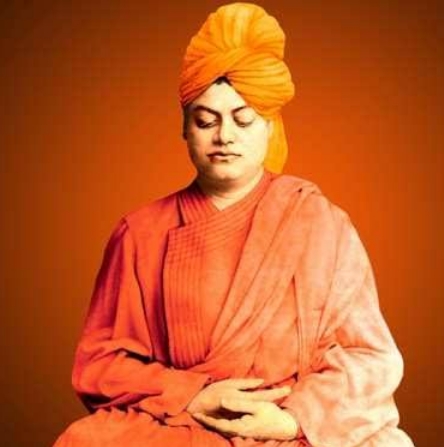
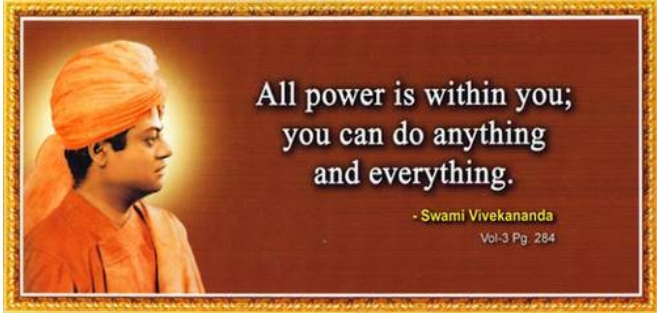
Swami Vivekanand

Swami Vivekananda’s inspiring personality was well known both in India and in America during the last decade of the nineteenth century and the first decade of the twentieth. 

Born as Narendranath Datta in a Bengali Kayastha family,  he is the chief driving force behind various religious reform movements during the times of Colonial India. He introduced Hinduism to the world in a famous speech that he spoke in Chicago in 1893.

He was born on January 12, 1863 and His father was Vishwanath Datta, an attorney at the Calcutta high court while his mother, Bhubaneswari Devi was a housewife. From a very young age, Vivekananda was interested in spirituality and would meditate in front of the images of Hindu Gods and Goddesses.

He is regarded as a one of the finest spiritual leaders and intellects India has produced.

He was a devout follower of an Indian saint named Sri Ramakrishna Paramhansa. Not only that, he was a devout follower of Sri Ramakrishna Paramhansa, whose ideologies he followed till the day he breathed his last. Inspired him, he even formed the Ramakrishna Math and the Ramakrishna Mission. He went to the United States of America to teach modern Hindu philosophy.

His vast knowledge of Eastern and Western culture as well as his deep spiritual insight, fervid eloquence, brilliant conversation, broad human sympathy, colourful personality, and handsome figure made an irresistible appeal to the many types of Americans who came in contact with him. People who saw or heard Vivekananda even once still cherish his memory after a lapse of more than half a century.

The Swami’s mission was both national and international. A lover of mankind, he strove to promote peace and human brotherhood on the spiritual foundation of the Vedantic Oneness of existence. A mystic of the highest order, Vivekananda had a direct and intuitive experience of Reality. He derived his ideas from that unfailing source of wisdom and often presented them in the soulstirring language of poetry.

To the Hindus he preached the ideal of a strength-giving and man-making religion. Service to man as the visible manifestation of the Godhead was the special form of worship he advocated for the Indians, devoted as they were to the rituals and myths of their ancient faith. Many political leaders of India have publicly acknowledged their indebtedness to Swami Vivekananda.

In America Vivekananda’s mission was the interpretation of India’s spiritual culture, especially in its Vedantic setting. He also tried to enrich the religious consciousness of the Americans through the rational and humanistic teachings of the Vedanta philosophy. In America he became India’s spiritual ambassador and pleaded eloquently for better understanding between India and the New World in order to create a healthy synthesis of East and West, of religion and science.

The natural tendency of Vivekananda’s mind, like that of his Master, Ramakrishna, was to soar above the world and forget itself in contemplation of the Absolute. But another part of his personality bled at the sight of human suffering in East and West alike. It might appear that his mind seldom found a point of rest in its oscillation between contemplation of God and service to man. Be that as it may, he chose, in obedience to a higher call, service to man as his mission on earth; and this choice has endeared him to people in the West, Americans in particular.

Swami Vivekananda focused on channelling the energy of the youth. He said that Youth is the most important segment of any country.

In the course of a short life of thirty-nine years (1863-1902), of which only ten were devoted to public activities-and those, too, in the midst of acute physical suffering-he left for posterity his four classics: Jnana-Yoga, Bhakti-Yoga, Karma-Yoga, and Raja-Yoga, all of which are outstanding treatises on Hindu philosophy. In addition, he delivered innumerable lectures, wrote inspired letters in his own hand to his many friends and disciples, composed numerous poems, and acted as spiritual guide to the many seekers, who came to him for instruction. He also organized the Ramakrishna Order of monks, which is the most outstanding religious organization of modern India. It is devoted to the propagation of the Hindu spiritual culture not only in the Swami’s native land, but also in America and in other parts of the world.

Swami Vivekananda passed away on July 4 in the year 1902. He was just 39 years old. Even almost 120 years after his demise, he is still alive in many people’s hearts and minds as they fondly remember his ideologies and what he taught.

National Youth Day is celebrated on January 12, every year in India to honor the birth anniversary of Swami Vivekananda.

ALL YOU NEED TO KNOW ABOUT MENDEL

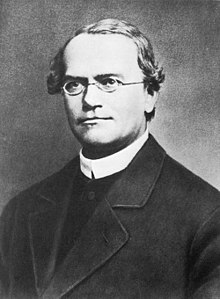
Once in a while we all have gone through the term ‘genes’. We know that genes are the basic physical and functional unit of heredity which determine the nature of protein formed and those expressing the characteristics passed on from one generation to another generation. Least do we know about who experimented and discovered the same. Gregor Johann Mendel, also known as the father of modern genetics, discovered the ‘factors’ that were responsible for the transfer of characters from parents to off springs, which were later known to be the genes.

WHO WAS GREGOR MENDEL?

Gregor Johann Mendel was an Austrian Monk, a meteorologist, mathematician, biologist born in 1822 near Brunn in Austria. Born to a family with limited means in German-speaking Silesia, Mendel was raised in a rural setting. His academic abilities were recognized by the local priest who urged his parents to send him away to school at the age of 11. His Gymnasium studies(grammar school) completed in 1840, Mendel entered a two-year program in philosophy at the Philosophical Institute of the University of Olemouc, Czech Republic, where he excelled in physics and mathematics completing his studies in 1843. His initial years away from home were hard, because his family could not sufficiently support him. He tutored other students to make ends meet and twice he suffered serious depression and had to return home to recover from the same. As his father’s only son, Mendel was expected to take over the small family farm, but he preferred a different solution to his predicament, choosing to enter monastery(local community or residence of a religious order) where he was given the name Gregor.

However, in 1850 Mendel failed an exam- introduced through new legislation for teacher certification and was sent to the University of Vienna for 2 years. There he devoted his time in physics and mathematics and also studied botany. In 1854, Abbot Cyril Napp permitted Mendel to plan a major experimental program in hybridization at Monastery. The aim of this program was to trace the transmission of hereditary characters in successive generations of hybrid progeny. Mendel chose to conduct his studies with the edible pea(Pisum sativum).

From 1854 to 1856 he tested 34 varieties for constancy of their traits. In order to trace the transmission of characters, he chose seven traits that were expressed in a distinctive manner, such as:-

  1. plant height(short or tall)
  2. seed color(green or yellow)
  3. seed shape(smooth or wrinkled)
  4. pod color(green or yellow)
  5. pod shape(inflated or pinched)
  6. flower color(purple/grey or white)
  7. flower position(axial or terminal)

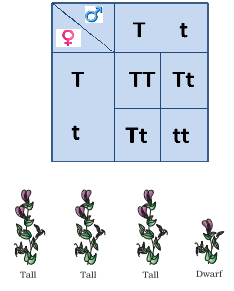
He crossed the varieties that differed in just one trait- tall plant with short plant(monohybrid cross). The first generation of hybrids(F1) displayed the character of one variety but not that of the other. In Mendel’s term, one character was dominant and the other was recessive. In the second generation(F2), however, the recessive character reappeared, and the proportion of off springs bearing the dominant and recessive trait was in the ratio 3:1.

WHY DID MENDEL CHOOSE PEA PLANT FOR HIS EXPERIMENTS?

  • Flower structure of pea plant ensured self-pollination and also had a well defined male and female reproductive structures.
  • pea plant is a single season crop.
  • they can be grown easily.
  • emasculation and pollination of flowers is quite easy
  • these plants reproduce sexually.
  • they have easily distinguishable pair of characters.

Day Out With Chip- The Robot!

There is no rule on how to write. Sometimes, it comes easily and perfectly; sometimes it’s like drilling rock and then blasting it out with charges.”

  • Ernest Hemingway

Today’s article discusses all about writing with Chip – The Robot. I had officially booked a day out with him and he seemed welcoming. We had a long conversation which I will try to compress in this article. So, let us begin.

Hello Chip. So, My Very First Question For You Is That What Do You Think About Writing?

Writing is an art which only a few are blessed with. Certain talented people around the globe are able to compose creative and fictitious worlds and make people visualize them through their amazing description. That is exactly what writing is all about. You make people reflect through your writing. Thus, it becomes an art and can’t be learnt. The creative and imaginative aspects sprout from within.

Totally! I Agree To This. However, What Do You Think Makes Writing An Entertaining Task?

This totally depends on the interest levels of the individual. Writing is fun for people who are completely inclined towards it while those who hesitate to read even a page, aren’t going to like it. So, the thing is that you need complete love for the process before initiating it. The second stage could be that you are interested in the process but aren’t able to concentrate and come up with certain new ideas and topics to write on. In such cases, you could take inspiration from the pettiest things around you. You just need to open your inner eye to notice that. And that, I tell you honestly, is an amazing job. Sitting and pondering over the petty objects and coming up with some imaginative character or story of your own, in itself is so entertaining. Another reason maybe that you aren’t able to concentrate could be that your mind is disturbed and aren’t focused. Thus, all you could do is practice meditation or do tasks that would soothe your senses. In short, I would state that indulging into the process of imagination is one of the best experiences when it comes to writing which is enough to make writing an entertaining task.

That Was So Helpful! Which Is Your Favourite Genre When It Comes To Writing?

My favourite genre shall always be fiction because it makes writing all the more interesting. You get to weave your own imagination and there aren’t any limits in the framing of thoughts onto that sheet of paper. Fiction introduces a new world, not only to the readers but also to the writers.

True That! So, What Are The Effective Ways Of Writing Fiction?

Fiction as a genre needs extremely insightful and creative people to frame a good story. You need to think outside the box when it comes to fiction. People don’t admire the same boring mythological concepts. Instead, when added a spice of an entirely new world of fictitious characters and incidents, the story begins to gain certain amount of popularity. The effective way of writing fiction is to never force on writing it. Sit and ponder over the outline of your story. Don’t try to be creative when your brain is stressed. Don’t set a deadline to writing a story when working on fiction. Just be cool, calm and devoted to your manuscript. Don’t give up easily on manuscript. You could always give some time to thinking effectively. However, if you wish to launch your book at a specific date then it is advisable to start as early as possible so that you don’t have to overdo on the last minute and can work with peace.

So, Important! Would You Like To Speak About Some Other Favourite Genre Of Yours?

Certainly! Mystery catches my attention every single time. It is because of the intense suspense factor that makes reading such a fun task. Here too, you need to have the creativity to frame the suspense appropriately. A single mistake can disclose the entire sequence and thereby disrupt your attempt of maintaining suspense. So, this is another genre, you need to be careful with. Give proper amount of time to thinking and don’t rush. Your manuscript isn’t yelling at you to finish it as soon as possible, nor is anybody else urging you to be prompt. Unlike writing prompts which don’t stress on the topic, other types of write ups don’t require you to be prompt. So, work with peace and eliminate all the pessimistic thoughts before you choose to begin with these genres.

That Was So Helpful! Lastly, Would You Like To Conclude On A Good Note?

Certainly! I would like to thank you for choosing to go out with me. I request each and every reader of this article to definitely write and not hesitate in the process. The more you write, the more efficient you shall be. You just need to be faithful and devoted to the process. Your thoughts need to be refined, in order to make writing a fun task. Maintaining effective sanity is quintessential for writers who must hibernate from chaos. So, go surrender yourself to the lap of mother nature and write for hours together, trusting that one fine day a highly creative idea would grace you with its presence on that blank sheet of paper!

Thank You So Much Chip!