In India, poverty is presently estimated by fixing a poverty line based on a differentiated calorie-norm. This means that the level of poverty depends upon the capacity of a person to purchase food and a person who can buy specific amount of food to cross the poverty line margin for nutrients and calorie intake is above the poverty line. Whereas, the person who cannot buy enough food to meet the required nutrition value of calories and carbohydrates is below the poverty line. This level is not the correct parameter to check the level of poverty.
A task force of the Planning Commission in 1979 defined the poverty line as that per capita expenditure at which the average per capita per day calorie intake was 2400 calories in rural areas and 2100 calories in urban areas. Average per capita expenditures incurred by that population group in each State which consumed these quantities of calories, as per the 1973-74 survey of NSSO, were used as the poverty lines.
The debate on the extent of poverty in India has been a matter of global interest in the recent years. The primary reason for the global interest in the debate is that the levels of poverty in India and China have come to exert significant influence over the trends in world poverty itself.
Within India too, there has been growing contestation around poverty estimates, particularly in the period of economic reforms. First, there are persistent disagreements among economists on whether the rate of poverty decline after economic reforms was slower than in the preceding period. Secondly, the shift to targeted, rather than universal, welfare schemes has witnessed the use of poverty estimates to decide on the number of households eligible to access these schemes. The report of the Expert Group on the estimation of poverty, chaired by Suresh Tendulkar, is the latest input to the “Great Indian Poverty Debate.”
It is to be noted here that many subsidies and programs are launched by the government but these additional increments do not reach the actual people that are in need of them. Instead it is sent back to the businessman and thus a lot of profit is earned on these subsidized goods. Thus, to lower the level of poverty in India, schemes have to be launched in order to directly benefit the people in need.
The Hindu states that, “A final issue with the report, of much long-term consequence, relates to the wisdom of abandoning the calorie norm. It is indeed true that the levels of calorie intakes are not well correlated with nutritional outcomes. However, abandoning the calorie norm altogether and taking solace from the fortuitous fact that calorie intakes appear adequate at the new poverty lines is an arbitrary proposition. It is unclear whether there is any basis, theoretical or empirical, for this relationship to hold true across time.”
the Tendulkar Committee has pitched for a policy position that is stranded between the harsh realities of poverty in India and the fiscal conservativeness of a neo-liberal framework. The real challenge lies in preserving the positives from the report, and strongly persisting with the demand for a universal social security system.
Over the past several weeks, a number of important developments have taken place which may appear disconnected at a glance but in fact add up to a significant shift in regional and global geopolitics.
ONE, the withdrawal of US and NATO forces from Afghanistan and the complete takeover of the country by the Taliban. This resulted in chaos and overall disruption of the semblance of peace the country earlier possessed. With the Taliban claiming the residents of the country are happy with their takeover and the disrupted president on the run, the future of the country appears in shambles.
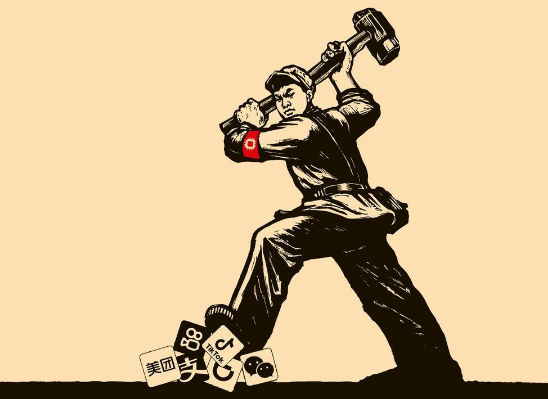
TWO, significant domestic political changes in the People’s Republic Of China. This includes the ideological and regulatory assault against its dynamic private high-tech companies and now recently, its real estate companies. As a result, it has a heightened risk perception among international business and industries which had seen China as a huge commercial opportunity until now. While the economical affairs of the country are entirely their own to manage and govern, there will be a lasting impact on the general job opportunities.
THREE, the announcement of the Australia-UK and US (AUKUS) alliance which represents a major departure in US strategy by its commitment to enable Australia to join a handful of countries with nuclear submarines. The alliance clearly portraits Australia’s strategic choice to firmly support USA despite its considerable economic and commercial equation in China.
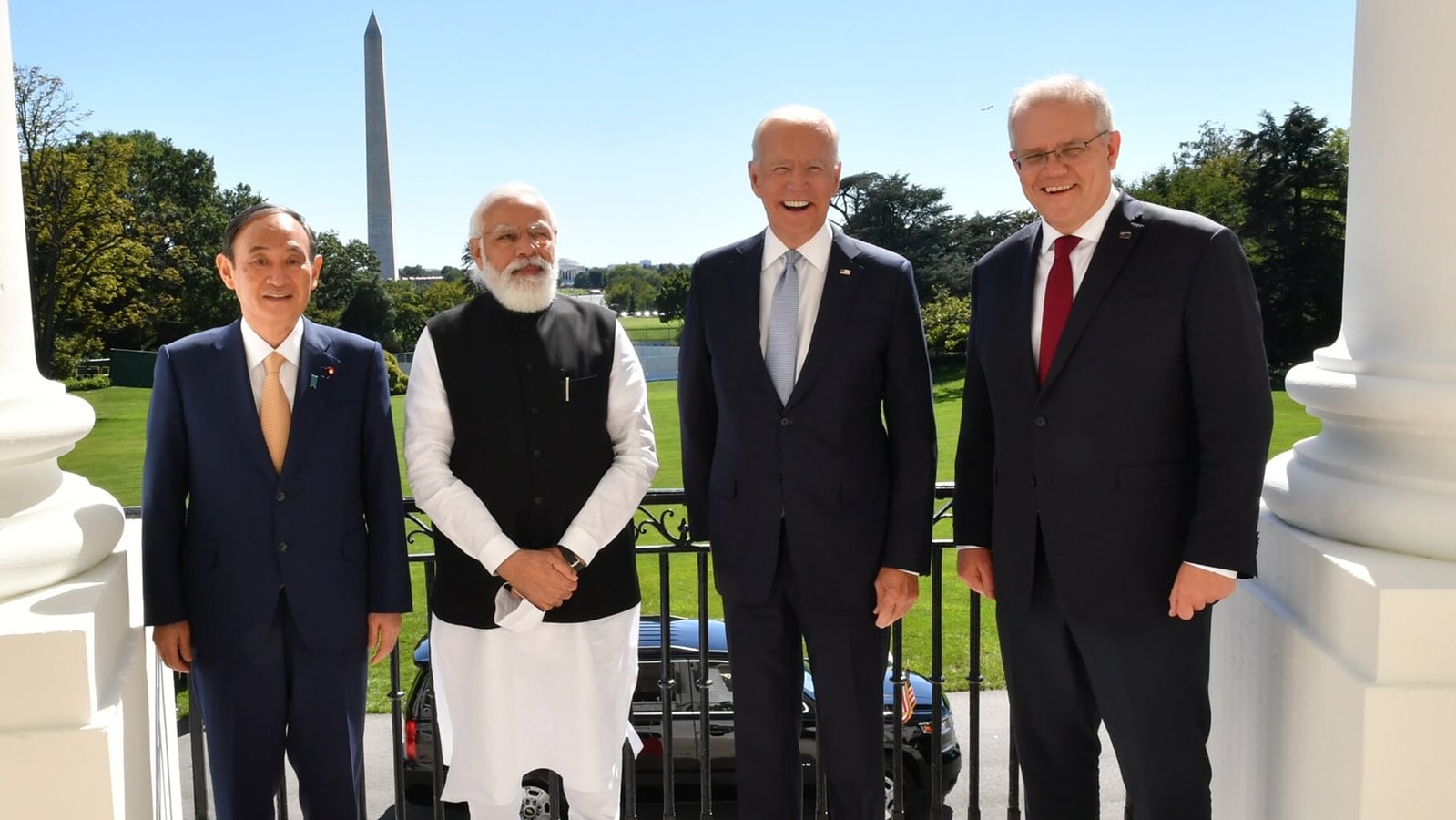
FOUR, the convening of the four nation Quad physical summit (India, Australia, Japan and the US) IN Washington. This reflected a major step towards its formalization as an influential grouping in the Indo-Pacific going beyond boundaries and into a personal level of safeguarding.
These four developments together present India with both risks and opportunities. While the latter outweighs the risks henceforth. It would indeed be fitting to say a future of uncertainties awaits the entire world. Are these measurements a preparation of the unseen future or simply precautions is something only time will reveal.
In the United States, an ‘on-air battery has been created that can hold electricity generated by wind or solar power plants for days before gently discharging it to the grid.
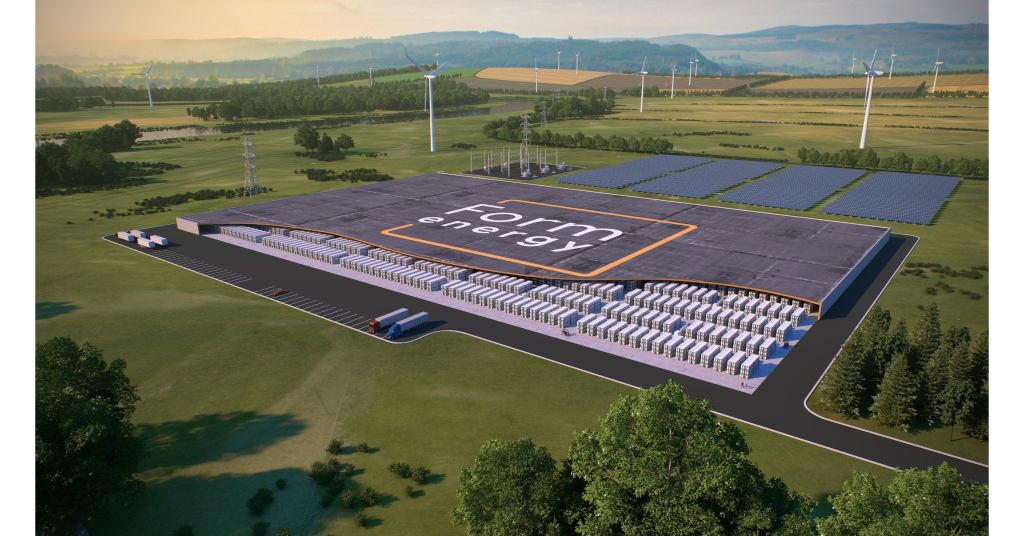
Form Energy intends to stack thousands of its “iron-air” batteries together in massive warehouses, as seen in this illustration.
According to Form Energy, a technological firm based in Massachusetts, it will help combat climate change by eliminating the demand for fossil fuel power plants.
The Iron-Air battery is a ‘new kind of cost-effective, multi-day energy storage device,’ capable of supplying electricity for 100 hours at a fraction of the cost of lithium-Ion, the renewable energy technology’s “holy grail.”
It’s constructed of iron, one of the most abundant elements on the planet, and it operates by inhaling oxygen, changing iron to rust, and then converting rust back to iron.
It is charging and discharging the battery as it takes in oxygen and transforms iron back and forth, a process that allows the energy to be held for longer.
According to the company, the batteries are too hefty for use in electric automobiles since they are intended to handle the difficulty of maintaining a consistent power supply.
This will address one of the renewable energy’s most vexing problems: how to store vast amounts of electricity inexpensively and provide it to power networks when the sun isn’t shining for solar panels or the wind isn’t blowing for turbines.
Solar and wind resources are the cheapest sources of energy in much of the globe, but unlike fossil fuel power plants, they do not provide a consistent supply.
The electric grid now has to figure out how to deal with this supply unpredictability while maintaining electricity dependability and cost.
According to Form Energy, their innovative battery technology is the answer to this rising problem.
According to Mateo Jaramillo, CEO and Co-Founder of Form Energy, the company performed a thorough analysis of all existing technologies and ultimately redesigned the iron-air battery.
This was done to ‘optimize it for multi-day energy storage for the electric grid,’ according to the researchers.
According to the company, the battery they are creating would enable governments to retire thermal assets such as coal and natural gas power facilities completely.
‘We’re attacking the largest obstacle to deep decarbonization with this technology: making renewable energy accessible when and where it’s required, even over several days of harsh weather or grid disruptions,’ Jaramillo explained.
It will also be less expensive, according to the company. Nickel, cobalt, lithium, and manganese minerals are used in lithium-ion battery cells, which can cost up to $80 per kilowatt-hour of storage.
Form hopes to reduce mineral prices for each cell to less than $6 per kilowatt-hour by using iron and to maintain the cost of a whole battery system to less than $20 per kilowatt-hour of energy storage by cramming them into a full battery system.
Renewables will eventually be able to replace traditional fossil-fuel power facilities at this pricing range, according to experts.
Breakthrough Energy Ventures, a climate investment fund sponsored by Bill Gates, Jeff Bezos, and others, is one of the firm’s investors. They’ve also received investment from ArcelorMittal, the world’s largest iron-ore producer.
HOW DOES AN IRON-AIR BATTERY WORK?
According to the company, the primary concept of functioning is reversible rusting.
The battery takes in oxygen from the air during discharging and transforms ferrous metal into rust.
The introduction of an electrical current during charging transforms the rust to iron, and the battery exhales oxygen.
They collect energy from renewable sources, store it for up to 150 hours, and then discharge it to the grid when renewables are unavailable.
Each battery is just around the size of a washing machine.
Each of these modules is filled with a non-flammable, water-based electrolyte similar to that found in AA batteries.
Stacks of 10 to 20 meter-scale cells, which comprise iron electrodes and air electrodes, the elements of the battery that enable electrochemical processes to store and release electricity, are contained within the liquid electrolyte.
Thousands of battery modules are joined together in modular megawatt-scale power blocks, which are housed in an environmentally protected container.
Tens to hundreds of these power blocks will be linked to the energy grid, depending on the scale of the system.
A one-megawatt system, in its most compact form, takes roughly one acre of land.
3MW/acre can be achieved with higher density designs.
Mahasweta Devi is a Bengali writer and activist who is known for her strikingly social and poignant stories. She wrote several works ranging from novels and plays to essays and short stories. Her most notable works include Hajar Churashir Maa, Rudali, Aranyer Adhikar etc. She has received highest literary merits in India like Jnanpith Award and Padma Vibhushan. As an activist, she has also worked towards the empowerment and rights of tribal people from West Bengal, Bihar, Madhya Pradesh, and Chhattisgarh.
Rudali is a thought-provoking short story that deals with the underlying class and caste issues prevalent in India. Originally written in Bengali, it follows a raw narrative that depicts the struggles of the subaltern in a vastly power-imbalanced society. Rudali follows the story of Sanichari who labours hard all her life to make ends meet. The story begins by establishing her caste and how despite being the majority, the Ganjus and Dushads live in desperate poverty. They work as cheap labourers for the ‘Malik Mahajan’ who are the wealthy landlords and money lenders of the village. After losing her in-laws and her husband, she works hard to sustain for her son. But after his marriage, he slowly deteriorates due to tuberculosis and eventually after his death, his wife leaves, leaving Sanichari to look after their new born son. Later after he runs away from home, Sanichari finds an unlikely partnership with Bhikni, an old friend.
The two women forge a strong companionship and together they play a cunning game of getting back at their exploiters. ‘Rudali’ refers to a particular Rajasthani culture wherein women of lower castes are hired as professional mourners by the upper-class to mourn the deaths of their family members. The two women build a business together, harnessing this profession to get jobs to local lower-caste women who have been exploited and ostracised and exploited by the society. In no time, the upper-class people try to one up each other even in funerals and even go as far as purposefully killing themselves or the elders to hold grand funerals.
Entitled by the power of money, Devi reinforces the fact that people in power compromise morality to maintain their position through the shenanigans of the upper-class folks who are known as the ‘Malik Mahajan’. Historically, they were Rajput soldiers who pillaged and killed innocent tribes and conquered these lands. And then, Dulan says that “From century to century, their holdings and power increased. Even now, they take possession of land…” (Devi 73) They built up their power over the tribes and the lower caste through violence and debt traps. They spend lavishly on funerals to ‘uphold honour’ and ‘raise prestige’ by extracting money from the poor. Their greed for more lessens their humanity even with respect to their own kind. In this society, the rich are constantly rich while the poor are perpetually poor.
Where the privileged are divided amongst themselves due to greed for more, the powerless, though diverse, are united in their struggles against the elite. In Rudali, the lower caste and the shunned women look out for one another due to their shared resistance against the Malik Mahajan. Mahasweta Devi narrates this story of oppression without overtly emotionalising it and yet, it affects the readers in such a way that it provokes these emotions within us. To bring out maximum impact, she portrays reality as it is in all of its rawness which makes us question the power play prevalent in the society.
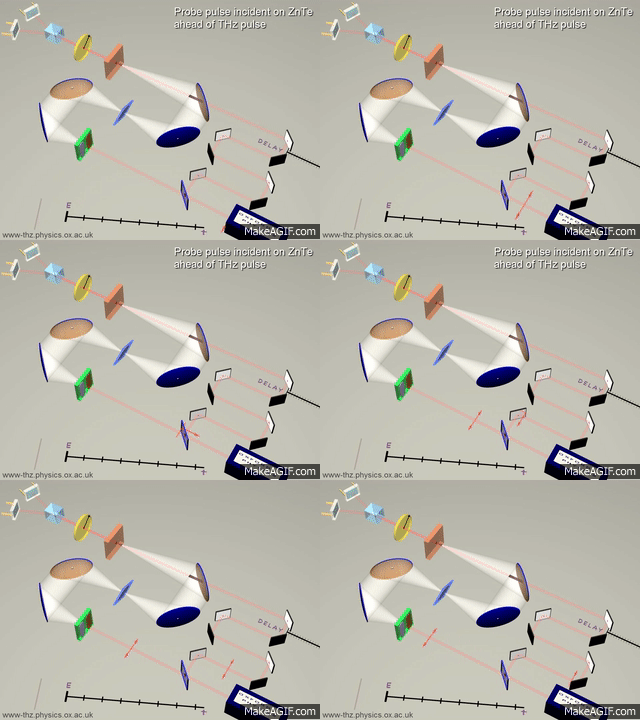
Device for harnessing terahertz radiation might help power some portable electronics.
Terahertz waves are electromagnetic radiation with a frequency somewhere between microwaves and infrared light. Also known as “T-rays,” they are produced by almost anything that registers a temperature, including our own bodies and the inanimate objects around us.
Terahertz waves are pervasive in our daily lives, and if harnessed, their concentrated power could potentially serve as an alternate energy source. However, to date there has been no practical way to capture and convert them into any usable form.
Now physicists at MIT have come up with a blueprint for a device they believe would be able to convert terahertz waves into a direct current, a form of electricity that powers many household electronics.
Their design takes advantage of the quantum mechanical, or atomic behavior of the carbon material graphene. They found that by combining graphene with another material, in this case, boron nitride, the electrons in graphene should skew their motion toward a common direction. Any incoming terahertz waves should “shuttle” graphene’s electrons, like so many tiny air traffic controllers, to flow through the material in a single direction, as a direct current.
The researchers have published their results today in the journal Science Advances, and are working with experimentalists to turn their design into a physical device.
“We are surrounded by electromagnetic waves,” says lead author Hiroki Isobe, a postdoc in MIT’s Materials Research Laboratory. “If we can convert that energy into an energy source we can use for daily life, that would help to address the energy challenges we are facing right now.”
Isobe’s co-authors are Liang Fu, the Lawrence C. and Sarah W. Biedenharn Career Development Associate Professor of Physics at MIT; and Su-yang Xu, a former MIT postdoc who is now an assistant professor chemistry at Harvard University.
Breaking graphene’s symmetry
Over the last decade, scientists have looked for ways to harvest and convert ambient energy into usable electrical energy. They have done so mainly through rectifiers, devices that are designed to convert electromagnetic waves from their oscillating (alternating) current to direct current.
Most rectifiers are designed to convert low-frequency waves such as radio waves, using an electrical circuit with diodes to generate an electric field that can steer radio waves through the device as a DC current. These rectifiers only work up to a certain frequency, and have not been able to accommodate the terahertz range.
A few experimental technologies that have been able to convert terahertz waves into DC current do so only at ultracold temperatures — setups that would be difficult to implement in practical applications.
Instead of turning electromagnetic waves into a DC current by applying an external electric field in a device, Isobe wondered whether, at a quantum mechanical level, a material’s own electrons could be induced to flow in one direction, in order to steer incoming terahertz waves into a DC current.
Such a material would have to be very clean, or free of impurities, in order for the electrons in the material to flow through without scattering off irregularities in the material. Graphene, he found, was the ideal starting material.
To direct graphene’s electrons to flow in one direction, he would have to break the material’s inherent symmetry, or what physicists call “inversion.” Normally, graphene’s electrons feel an equal force between them, meaning that any incoming energy would scatter the electrons in all directions, symmetrically. Isobe looked for ways to break graphene’s inversion and induce an asymmetric flow of electrons in response to incoming energy.
Looking through the literature, he found that others had experimented with graphene by placing it atop a layer of boron nitride, a similar honeycomb lattice made of two types of atoms — boron and nitrogen. They found that in this arrangement, the forces between graphene’s electrons were knocked out of balance: Electrons closer to boron felt a certain force while electrons closer to nitrogen experienced a different pull. The overall effect was what physicists call “skew scattering,” in which clouds of electrons skew their motion in one direction.
Isobe developed a systematic theoretical study of all the ways electrons in graphene might scatter in combination with an underlying substrate such as boron nitride, and how this electron scattering would affect any incoming electromagnetic waves, particularly in the terahertz frequency range.
He found that electrons were driven by incoming terahertz waves to skew in one direction, and this skew motion generates a DC current, if graphene were relatively pure. If too many impurities did exist in graphene, they would act as obstacles in the path of electron clouds, causing these clouds to scatter in all directions, rather than moving as one.
“With many impurities, this skewed motion just ends up oscillating, and any incoming terahertz energy is lost through this oscillation,” Isobe explains. “So we want a clean sample to effectively get a skewed motion.”
One direction
They also found that the stronger the incoming terahertz energy, the more of that energy a device can convert to DC current. This means that any device that converts T-rays should also include a way to concentrate those waves before they enter the device.
With all this in mind, the researchers drew up a blueprint for a terahertz rectifier that consists of a small square of graphene that sits atop a layer of boron nitride and is sandwiched within an antenna that would collect and concentrate ambient terahertz radiation, boosting its signal enough to convert it into a DC current.
“This would work very much like a solar cell, except for a different frequency range, to passively collect and convert ambient energy,” Fu says.
The team has filed a patent for the new “high-frequency rectification” design, and the researchers are working with experimental physicists at MIT to develop a physical device based on their design, which should be able to work at room temperature, versus the ultracold temperatures required for previous terahertz rectifiers and detectors.
“If a device works at room temperature, we can use it for many portable applications,” Isobe says.
He envisions that, in the near future, terahertz rectifiers may be used, for instance, to wirelessly power implants in a patient’s body, without requiring surgery to change an implant’s batteries.
“We are taking a quantum material with some asymmetry at the atomic scale, that can now be utilized, which opens up a lot of possibilities,” Fu says.
This research was funded in part by the U.S. Army Research Laboratory and the U.S. Army Research Office through the Institute for Soldier Nanotechnologies (ISN).
“Your intuition knows what to write, so get out of the way.”
– Ray Bradbury
Today’s article speaks about being a Tiger and Capturing your Prey. I’m sure you are left wondering as to how a tiger is related to writing. Let’s quickly delve into the topic to learn how!
Consider the entire concept of Writing as a Forest and the Tiger as a writer. A tiger succeeds in capturing his prey efficiently and is thus, proficient. Similar is the case with Writing. We have to Capture Creative Wordings in order to prove our efficiency. In short, the way you write is all that matters. Your Content is the prey! Capture it and be the king! Capturing the prey could also mean capturing the ‘X’ factor in the writing process!
However, some aspects are necessary to cover when aspiring to reach the ‘X’ factor. Let us view some of them!
Read More And More!
Consider reading books of famous authors who use native English vocabulary because they sometimes tend to make use of interesting phrases and go – to lines which you could use for your content.
Subscribe To YouTube Channels For English Learning!
YouTube, a widely used video platform comes with all the remedies, doesn’t it? All you’ve got to do is, type in the search bar “English learning for beginners” and vast options are available for you to scroll by!
Audio Books Are Bae!
A new concept is out in the market! You could purchase audio books and read them while listening. Sounds cray cray, doesn’t it? But that’s exactly what you can do if you aren’t much of a bookworm and would prefer listening rather than reading!
Try Conversing More In English!
Conversation is the key where vocabulary is the lock,
Go about framing interesting sentences as you talk!
Said by The Laconic Writer! 😉 This may be said by me, but isn’t it true? Go about framing interesting sentences which you picked up from the above mentioned sources. After all, when you learn something, you should implement it for further enhancement. That’s how conversation comes in handy! When you learn some advanced words, try using them in your day to day conversation so that you capture that particular phrase or word in your head for next use. However, make sure you don’t use heavy oxford dictionary words during regular conversations. After all, you don’t want your friends wondering the meaning of your emotions and expressions! 😉
Hold That Pen!
Another way is to hold the pen and write as much as you can think of and resolving to incorporate as many advanced words in your write up as possible! This helps develop your vocabulary.
Make A Note Of Certain Interesting Facts!
Try noting down certain mind boggling and humorous facts which you could use for your content. When you incorporate fun facts, your content becomes all the more engaging. Clutch an important topic and write an amazing fact on the basis of that!
Try Inventing Some Of Your Own Peculiar Phrases And Quotes!
That works! That really does work! Readers consider it interesting to read something new that you come up with. You could frame your own acronyms, come up with creative illustrations by dragging your mundane daily life elements or using natural aspects. For instance, helping caterpillars bloom into a butterfly meaning helping novices become experts 😉
These are some of the ways to effective English learning. All that matters is how well you Capture the Prey at the end while remembering that it comes from within and requires utmost imagination.
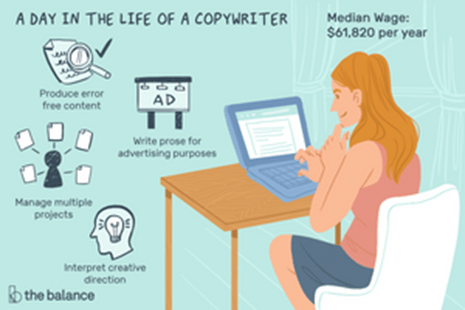
After you have gained expertise and strong hold on the reigns of vocabulary, remember to use your talent in copywriting. Don’t know what that is? Well, let me introduce you to it. Copywriting is content intending to make sales. It is solely used for marketing wherein you provide ample information regarding your services or products thereby compelling people to buy your facilities through the incorporation of various calls to action!
Call to action includes involvement of various links for customers to be redirected to the “buying” page. It also comprises of boosting content at the end that usually starts with a verb like, Try our products now and you won’t regret. You introduce discounts for your customers and create a sense of urgency by involving limited time periods for a specific offer or purchase of goods. You provide incentives to customers thereby getting them acquainted with the benefits of the product or service. You try creating convenient situations for them by providing money back guarantees. In short, customer satisfaction and well – being becomes your goal because marketing is all about understanding the pain points and desires of the mob.
Content is thus, the basis of digital marketing and to master copywriting, one needs to work on the creativity aspect of this interesting English language. Basic English vocabulary gives birth to intermediate expertise in it which in turn opens the doors to creativity and later helps you climb the advanced ladder of English language wherein you hop into copywriting.
A copy mustn’t ever include incorrect punctuations or grammar because that is enough to let your marketing efforts go down the drain!
Avoid redundancy or repetition of words. For instance, ‘We provide goods that are good enough for daily life.’ Sounds crazy doesn’t it?
Improper punctuation or overuse of it like, “We, provide, high quality, goods, and services.” Enough to infuriate the reader, isn’t it? That’s exactly why, it is advisable to work on enhancement of English before resolving to move towards copywriting.
Thus, now you know why improvement of vocabulary was stressed upon in the earlier part of this article.
What if you already are an ardent English fan and copywriting isn’t at all a monotonous or tedious task for you? Set up your own website and get marketing.
Do you ever look back on your decisions and think, “Why I on earth did I do that?”
We all make bad decisions.
Buying an SUV that sucks up all your cash
Starting a relationship without being in love
Saying yes to a job that you’re not passionate about
Creating products that no one needs
Shit happens (the above examples are all about me). But the funny thing is that bad decisions never seem like bad decisions at the moment.
I’ve been reading about the decision-making process of Warren Buffet and Charlie Munger, two of the most successful investors of all time.
In Alice Schroeder’s biography of Warren Buffett, I read that Buffet and Munger have a learning strategy that’s based on what you should avoid doing. They identify mistakes and do their best to avoid those mistakes. But as Charlie Munger says:
“Smart people do dumb things.”
You can never avoid making a mistake. However, you can do your best to avoid making dumb decisions.
I recently spoke to a friend who wanted to make a career move. I asked him to walk me through his thinking process:
“I like the company I work for, but my job isn’t engaging anymore. I’ve been doing this work for four years. And sure, I’ve been promoted twice, but it’s still the same work. So I’ve been looking at other companies. But what if I go somewhere else and that doesn’t work out? I’ll have to move on quick. And that won’t look good on my resume.”
I remained silent.
“Just hearing myself talk leads me to another thing: Overthinking it.”
We both laughed our asses off. I can do the same with overthinking. And I bet you’ve been there too.
When you overanalyze every single decision, you become paralyzed. Result? Nothing. Now, that’s a bad outcome!
That’s how people end up wasting their lives.
The only way you can stop overthinking is by making yourself aware of your thinking process. When I asked my friend about his thinking, he became aware of how irrational his process was.
Do This Instead: Make Small Decisions. Decide Often.
I recently read Seeking Wisdom by Peter Bevelin. It’s about the way Charlie Munger thinks. One of his decision-making strategies is to avoid mistakes. But that can be interpreted in different ways.
You can fear decisions altogether because you might make mistakes. What happens is that you don’t make decisions at all. As Munger says:
“The difference between a good business and a bad business is that good businesses throw up one easy decision after another. The bad businesses throw up painful decisions time after time.”
You can interpret that Munger quote in different ways. I interpret it as follows:
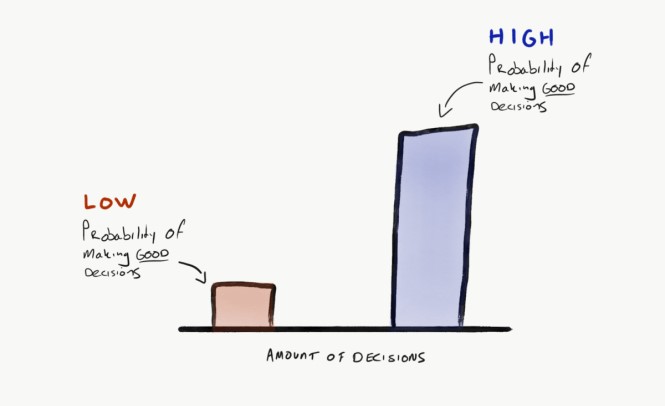
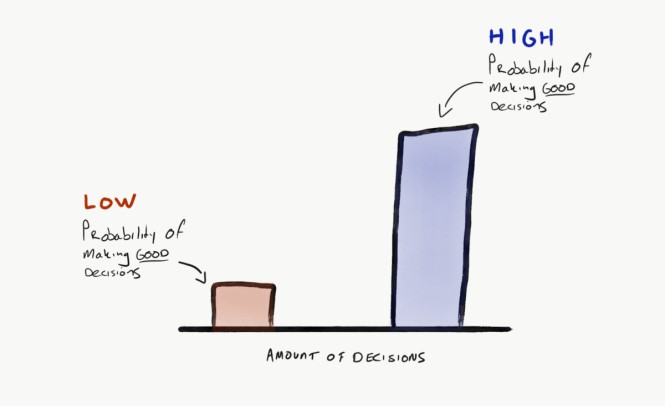
When you make small decisions early, before they become big — it’s easy. When you put off decisions, they become big — and painful.
For example, I’m not happy with the email provider I use to send out my newsletter. Their support is slow, there’s no good integration with my online courses platform, and readers have complained about not getting my newsletter.
This is something that’s on my radar for more than 1.5 years. At the time my list was less than half of the size it’s today. I also had only one online course. Now, I have three.
The hassle of moving to another provider gets bigger every day. Had I moved early, it was easy. By now, it’s a painful process.
In life, it’s exactly the same. The longer you stay in a bad relationship, the harder it gets to leave. It’s also true for your job.
Earlier Decisions Lead To Better Decisions
The earlier and more you decide, the more chance that you make better decisions.
I often say that there are no right or wrong decisions — only decisions. That’s not entirely accurate. Of course, there’s a difference in the quality of our choices. That’s the topic of another article.
But here’s the thing: NOT making a decision is also a decision. If that’s a conscious move, that’s okay. You think about something, and you decide that doing nothing is the best option.
However, I’m referring to not making a decision as in “I’ll put it off until another time.”
No matter what, you’re making decisions all the time. Instead of making fewer conscious decisions, we need to make them earlier.
Because all you need are a few good choices in your lifetime anyway. What will be your best? You only find out after, you guessed it, you’ve made a decision.
The relationship between violence and politics has always been very problematic and complex. As it is often said- world history is the history of violence. The number of wars that have been fought, the level of violence that has been perpetrated is unthinkable and often the greatest wars that have ever been fought were for political power. However, it cannot be denied that the relationship between violence and power must be re-evaluated in the post-industrial, post ideological and a highly integrated world.
So, what is it about today’s times that violence and politics have almost become impossible to separate? To begin with ultimate hope of the liberals that democracy will reduce violence hasn’t been realised. The paradox here is very hard to overlook as in an era of unprecedented democratization and economic growth, we have also witnessed an unprecedented increase in violence. But why this paradox? It was expected that democracy will give people a safe outlet to voice their opinions. As more and more people get involved in politics, there will be lesser need for them to express their grievances through unconstitutional means. To answer this question, thinkers like Jack Snyder pointed out that as more people took part in politics, ethnic conflict within the country became even more probable. This argument is in line with the fact that although the number of interstate wars have reduced since the second world war, the number of civil wars and ethnic conflicts have increased manifold. While talking about intrastate conflicts, violence during the time of regime transition needs a special mention. In many countries’ violence becomes an integral part of regime transition. While the formal symbols of democracy remain, most countries are threatened by corruption, political pacts etc.
Violence persists in well-established and economically advanced democracies as well. Such violence highlights general trends of internal violence as well as particular national histories. We have seen in many third world nations where severity of violence has diverted a transition away from democracy towards a new form of authoritarianism.
There is also violence in other political arenas which may not be directly related to the state. There is an obvious relationship between economics and violence. Violence has become embedded in the class and market relations among social groups and in the societal effects on global economic trends. In many countries economic polices also trigger violence among classes. Not only economics and states, violence has also become an intrinsic characteristic of inter-societal relations. Such violence maybe caused by state power and policy or as a reaction to it but often takes on its own momentum. Social groups often use violence in their interaction with the state.
Even though governments may often act as major perpetrators of violence, living in a state we are all dependent upon the government to make laws and thus, it is also important for the government to find solution to the problem of increasing violence. It must try to achieve the wider aim of disassociating violence from politics as much as possible no matter how Utopian the idea might seem.
So here in this blog I have mentioned the ways through which you can hack the 5 people rule which states that you’re the average of the 5 people you spend most of your time with. So to know more read ut till the end.
They say you’re an average of the 5 people you spend your most of the time with. It’s somewhere true that people have their influences on you, whether the wrong influences or the right ones and I have witnessed it through my eyes. I’ll take you to the time when I went to the University for the first time, I was highly motivated and very sincere, though I’m same today 😀 but I have seen that your friends or the people you spend your time with have impact on your mindset, and somehow they leave their prints on your subconscious, here the painting of the white wall rule comes into play, this particular rule states that, when you’re a kid your mind is as clean as a white wall, but overtime your experiences, the things people did to you and the things they’ve said to you paints your white wall with multiple colours and your mind or perhaps or subconscious mind start to put limits based upon your life experiences and the things done by the people, now to prevent your white wall or your clear mind to be painted by the wrong colours you have 2 options the one is to stay away from such negative people, but that’s not possible every time and the option 2 takes you to the spiritual concept and i.e. meditation, meditation can help you to get rid of all the unwanted collection of garbage you’ve collected overtime inside your head. Well I think, I got deviated from the topic I had to tell you about the 5 people rule, so let’s get back to the topic, it’s better to be alone than being with the wrong minded people, that means the ones who have different mindset, never be with them.
So what to do now?? You might be thinking this, to solve your mind puzzle I have some concepts, keep yourself busy in the stuffs you like and follow your dream path always keep working towards your goals and just Unfollow every single account on social media whether it instagram, whatsapp or facebook or any other platform which doesnt inspire you and follow the accounts which inspires you and pushes you to follow your dreams and the accounts which teaches you something or motivates you, and also be involved in some of the entertaining activities to keep your mind healthy and happy, it was the 1st hack, now listen to the podcasts, watch great and valuable content, read good stuff reading is the major factor in the path of success, learn new things through internet also do sometimes write your thoughts out, share your knowledge and experiences with the world. Talking to your parents and family members, spending time with your siblings, cooking and consuming the right food to keep your body and mind fit, do yoga and workout, just spend your whole time with yourself and do what you like to do, no matter what is is but never get influenced by the wrong things ( I hope you’ve got my point), there is a phase in our lives where we get attracted towards the wrong things, but deep down our heart knows what’s right or what’s wrong, the choice is always ours. The time we don’t value is the time we’ll crave to get back later, remember this, lil bud.
All these things can help you to hack the people rule where you cannot be physically connected to them but can be digitally connected thanks to this modern digital world.
Your work is your identity, your work is everything.
I want to tell you that, your work ethics, the way you work is everything, a person is only identified by his or her actions, the things he or she has done, the values he or she has given to the society.
Life is like an illusion, no one has discovered the real meaning of life yet. We don’t even know why the God has created this world, and what is the purpose of life, but one thing I have observed so far is that your words are imperishable even after life, people will remember you by your work ethics by the values you have given to them, by the words you’ve spoken out, and it’s explicit that no matter how intelligent you’re unless you haven’t done anything no one would value your sayings.
A person is not identified by the cast he or she has born in, not by the amount of money he or she earns, not by the brands he or she wears, not by the phone he or she uses, a person is identified by his or her karmas only. There is no scale to measure one’s intelligence, like you can’t judge somebody’s intelligence based upon his or her English speaking skills, language is just a medium of conveying feelings or nothing else.
Now, I am sharing 2 examples down below to convey my message:-
(I) A.P.J. Abdul Kalam :- We always remember him as Missile Man of India, for his work and development of ballistic missile, as a visionary, a hardworking, a pragmatist, a great leader and as a person who has influenced the life of many. We never remember him by his cast, by his face, by the car he used to drive, or by the brand he used to wear.
Let’s take another example of an extremely popular writer named Premchand, he was famous for his modern Hindi- Urdu literature. He is one of the most honoured writer of the Indian subcontinent, and regarded as one of the foremost Hindi writers of early 20th century. Premchand’s writing are very famous till date, as you have definitely read some of his stories in your textbooks, many of the directors filmed Premchand’s stories as series and aired them on television. For your ease let me tell you that he was a very simple man, he never had the most expensive clothes, and a writer named Harishankar Parsai wrote a story named “Premchand ke phate joote” / Premchand’s torn shoes” about him, that story was an irony on Premchand, in which Harishankar Parsai wrote that Premchand was a very grounded and simple man, in the story Harishankar Parsai highlighted Premchand’s personality in a way as he wanted to show that Premchand wasn’t an ostentatious person, in simple words he wasn’t a show off favourite person. Once he got clicked a picture with his wife and in that picture his shoes were torn out, and the writer used that incident as the story he plotted as PREMCHAND’S TORN SHOES, eventhough he didn’t supported him if you will read it in depth you would understand that it was an ironical story, anyway I don’t want to bother you much about Premchand and Harishankar Parsai but my motive of stating it here was to make you understand that your personality builds with your work not with your dressing sense or the things and the stuff you have.
The world will never remember you by the things and stuff you have, people will always remember you by the work you’ve done. – Vaishali Singh.
There are only two animals on the planet that the creator identified himself with the first one is the eagle and the second animal is the lion and when we study these two animals because if he is the leader of the universe and we want to be a leader on earth we need to better find out the nature of these animals and also the up attitude of those animals.
If we discover that both of them are the kings of their domain the Eagle is the king of the bird Kingdom and the lion is the king of the animal kingdom but let’s talk a little bit about the lion, the lion has the spirit of leadership and this word spirit here is referring to attitude everybody’s attitude a leader has attitude that makes him or her different from followers now the lion is the king of the jungle but the lion to is a great source of encouragement to all of us. I want you to write down this down remember this as long as you reside favorite the lion isn’t the tallest animal within the jungle number two the lion is not the largest animal in the jungle number three the lion is not the heaviest animal in the jungle number four the alliant is not the smartest animal or the foremost intelligent animal within the jungle and yet when he shows up all of them run away.
It really brings home the purpose a military of sheep led by a lion will always defeat a military of lions led by a sheep and therefore the answers thereto dilemma is that this because leadership can transform cowards into violent warriors the proper quite leadership can transform a timid into bold people that are fellows leadership is that powerful leadership can walk into a camp of depressed people on in 20 minutes. They are turned on into unbelievable powerful armies because leadership determines everything the lion is that the king of the jungle due to one-word attitude.
Lion features a different attitude that creates every animal scared of him now we do not want to steer by fear but it does take respect for you to become a leader once I use the word fear within the jungle we’re talking about respect the elephant respects the lion the hyenas respect the lion they the giraffes they respect the life what makes these massive animals respect such a small cap the attitude is the difference for example, a lion will see an elephant and the thing that counts with mine one word lunch I could eat this thing and he acts the way he thinks now here’s another amazing mystery the elephant is larger, bigger, stronger, more powerful, heavier and more intelligent and yet when the elephant sees the lion one word involves mind eater attitude may be a product of belief you can’t have an attitude beyond your belief so your attitude comes from your belief system the lion is that the king due to what he believes about himself.
Positive thinking sounds useful on the surface. Most of us would prefer to be positive rather than negative, but, “positive thinking” is also a soft and fluffy term that is easy to dismiss. In the real world, it rarely carries the same weight as words like “work ethic” or “persistence.”
But those views may be changing.
Research is beginning to reveal that positive thinking is about much more than just being happy or displaying an upbeat attitude. Positive thoughts can actually create real value in your life and help you build skills that last much longer than a smile.
The impact of positive thinking on your work, your health, and your life is being studied by people who are much smarter .
What Negative Thoughts Do to Your Brain
Let’s say that you’re walking through the forest and suddenly a tiger steps onto the path ahead of you. When this happens, your brain registers a negative emotion — in this case, fear.
Researchers have long known that negative emotions program your brain to do a specific action. When that tiger crosses your path, for example, you run. The rest of the world doesn’t matter. You are focused entirely on the tiger, the fear it creates, and how you can get away from it.
In other words, negative emotions narrow your mind and focus your thoughts. At that same moment, you might have the option to climb a tree, pick up a leaf, or grab a stick — but your brain ignores all of those options because they seem irrelevant when a tiger is standing in front of you.
This is a useful instinct if you’re trying to save life and limb, but in our modern society we don’t have to worry about stumbling across tigers in the wilderness. The problem is that your brain is still programmed to respond to negative emotions in the same way — by shutting off the outside world and limiting the options you see around you.
For example, when you’re in a fight with someone, your anger and emotion might consume you to the point where you can’t think about anything else. Or, when you are stressed out about everything you have to get done today, you may find it hard to actually start anything because you’re paralyzed by how long your to–do list has become. Or, if you feel bad about not exercising or not eating healthy, all you think about is how little willpower you have, how you’re lazy, and how you don’t have any motivation.
In each case, your brain closes off from the outside world and focuses on the negative emotions of fear, anger, and stress — just like it did with the tiger. Negative emotions prevent your brain from seeing the other options and choices that surround you. It’s your survival instinct.
What Positive Thoughts Do to Your Brain
When you are experiencing positive emotions like joy, contentment, and love, you will see more possibilities in your life. These findings were among the first that proved that positive emotions broaden your sense of possibility and open your mind up to more options.
But that was just the beginning. The really interesting impact of positive thinking happens later…
How Positive Thinking Builds Your Skill Set
The benefits of positive thoughts don’t stop after a few minutes of good feelings subside. In fact, the biggest benefit that positive thoughts provide is an enhanced ability to build skills and develop resources for use later in life.
Let’s consider a real-world example.
A child who runs around outside, swinging on branches and playing with friends, develops the ability to move athletically , the ability to play with others and communicate with a team , and the ability to explore and examine the world around them (creative skills). In this way, the positive emotions of play and joy prompt the child to build skills that are useful and valuable in everyday life.
These skills last much longer than the emotions that initiated them. Years later, that foundation of athletic movement might develop into a scholarship as a college athlete or the communication skills may blossom into a job offer as a business manager. The happiness that promoted the exploration and creation of new skills has long since ended, but the skills themselves live on.
As we discussed earlier, negative emotions do the opposite. Why? Because building skills for future use is irrelevant when there is immediate threat or danger (like the tiger on the path).
All of this research begs the most important question of all: if positive thinking is so useful for developing valuable skills and appreciating the Big Picture of life, how do you actually get yourself to be positive?
The Power of a Constraint You Believe In
Every decision is made within some type of constraint. Maybe it’s how much knowledge you have. Maybe it’s how much money you have. Maybe it’s how many resources you have. Why not what values you have?
Making better choices is often a matter of choosing better constraints. By limiting your options to those that fit your values, you are taking an important step to ensuring that your behavior matches your beliefs.
Know your principles and you can choose your methods.
How to Put This Into Practice
Most people never take the time to think about their values, write them down, and clarify them. Maybe it sounds too simple or unnecessary. keep pushing. Don’t chalk things up to “just a dream.” It can be something small like making it to the gym or something big like buying that one-way ticket to Buenos Aires, but if you keep pushing enough, it’s going to be a reality instead of a dream.

















 Eduindex
You must be logged in to post a comment.