Benefits of learning different languages. [Part 1]

[Bhoomika Saini]

Knowing more than one language is nearly vital in today’s world. Companies are all global, and the demand for multilingual applicants is high. But not all languages are created equal; some will get you further than others.

What Makes A Language Useful To Learn?

Feed Your Brain

The many cognitive benefits of learning languages are undeniable. People who speak more than one language have improved memory, problem-solving and critical-thinking skills, enhanced concentration, ability to multitask, and better listening skills. They switch between competing tasks and monitor changes in their environment more easily than monolinguals, as well as display signs of greater creativity and flexibility. If that weren’t enough, as we age, being bilingual or multilingual also helps to stave off mental aging and cognitive decline.

Number Of Speakers

Unsurprisingly, it is very important to know how many speakers there are of a language before you set your heart on learning it. Most people opt to learn languages spoken by the largest number of people. You should also consider how many people speak the language as a second language. With this information, you will open more doors to global communication.

Geographic Region

This is where your goals and interests come into play. Do you plan to travel in one particular region for a while? If so, look into what languages are commonly spoken there. If you want to learn a language that is widely spoken throughout the world, you may want to opt for English, French, or Spanish, which are spoken on all continents.

Usability And Versatility

When choosing a language, you may want to look at versatility. Mainly, can you use this language both at home and abroad? What about in both business and social contexts? Ask yourself, “How much will I use this language?” It takes time and effort to learn a language, and you will want to learn the one with the most usability for you!

Career Opportunities

Think of your current or future field, and location of business. If you are working in the United States, Spanish is a very useful language to learn. If you expect your industry or company will do a lot of international business, learn languages that will be useful in your field. It could be Chinese, Japanese, Italian, or German.

Education System Suffering during pandemic

Online education in this pandemic

The Covid created lockdown damaged very badly to education system. schools were closing down and online learning is not everywhere working.

There are some statics

  • Estimated 1.5 million schools across India closed down due to the pandemic A switch to large-scale digital education is not possible now.
  • according to a 2019 government survey.Only 24 per cent house-holds have access to the internet,
  • In rural India, the numbers are far lower, with only 4 per cent households having access The education ministry’s budget for digital e-learning was slashed to Rs 469 crore in 2020-21—the year Covid struck—from Rs 604 crore the previous year

According to world bank :

before the COVID-19 pandemic, world was living in a educational crisis . 258 million children and youth of primary and secondary school age were out of school. quality of education also was very low , meant many who were in school learned too little. The COVID-19 pandemic threatens to make education outcomes even worse. The pandemic has already had profound impacts on education by closing schools almost everywhere in the planet, in the largest simultaneous shock to all education systems in our lifetimes. The damage will become even more severe as the health emergency translates into a deep global recession.

Deepesh Bisht is a first-year student of BAMS in Doon Institute Of Medical Science . He is 18-year-old hasn’t set foot on campus even once since he took admission in 2020 sept . He has taken a virtual tour of the college and has been taking lessons through his laptop and mobile phone. Deepesh isn’t alone in this. That’s how the batch of 2020-the Covid-19 generation-has been experiencing institutional education in a world disrupted by an unprecedented pandemic. Because of this, 47 per cent students have decided against migrating to another city for higher education, revealed a study titled the ‘Big Qs Student Survey’. 50% respondents have also abandoned plans to pursue higher education abroad.

states like Delhi are still confined to homes, spending long hours online, leading to concerns over physical health and stress triggered due to the prolonged use of electronic devices.Even in the national capital, when government schools started online classes during the lockdown, the attendance hovered between “25 and 30 per cent”. students in Assam and several other states have gradually returned to schools and colleges . The education ecosystem of India, already weighed down by myriad issues such as school dropouts, learning deficiencies, teacher absenteeism, gender disparity and lack of infrastructure, now faces yet another big challenge-the widening digital divide.

Hence , this pandemic made our education system digital . This digital education is giving benefit to a part of society only . Poor students were fading away from education. This will create a huge disparity in our society.

Comparative Study b/w Parliamentary and Presidential System of Government

Parliamentary system is a democratic form of government in which the party with the greatest representation in parliament (legislature) forms the govt., its leader becoming prime minister or chancellor. Presidential form of govt. is a democratic and republican govt. in which a head of govt. leads an executive branch. The head of govt. is in almost cases also the head of the state, which is called the President. India follows a parliamentary form of govt. modelled on Britain’s.

Features

Features of Presidential system are that the executive can veto acts by the legislature, the President has a fixed tenure and cannot be removed by a vote of no confidence in legislature. The President has the power to pardon or commute judicial sentences awarded to criminals and the President is elected directly by the people or by the people or by an electoral college whereas features of parliamentary system are- close relationship b/w the legislature and the executive, executive is responsible to the legislature, there are two executive i.e. real executive and titular executive, bicameral legislature, no fixed tenure, leadership of Prime Minister.

Merits

Merits of Presidential system are- seperation of powers, expert govt., stability and less influence of the party system.

Merits of Parliamentary system are- better coordination b/w executive and legislature, prevents authoritarianism, responsible govt., represents diverse groups, flexibility in the system.

Demerits

Demerits of Presidential system are- less responsible executive, deadlocks b/w executive and legislature, rigid govt., spoils system as the system gives the President sweeping powers of patronage.

Demerits of Parliamentary system are- no seperation of powers, unqualified legislators, instability, failure to take prompt decision because there is no fixed tenure, party politics is more.

Conclusion

The Presidential system is better for one because of its seperation of powers, the role of judiciary and the govt. accountability to its people. We should ensure a system of govt. whose leaders can focus on governance rather than on staying in power. The present parliamentary system has been tried and tested for nearly 70 years. It can be reformed thoroughly to remove the challenges thrown up by it. Also, there is a need to reform the electoral processes to make democracy more robust.

Pomodoro Technique for productive study/work

” Time and tide wait for none”. No matter how many times we hear or see this clichéd quote, not all of us actually understand the essence of these words. Time management is an essential skill for aspirants of all kinds. In this fast-evolving world, one must keep up par with others to achieve their goal. The fact that smart work is better than hard work is of the essence. Productivity is smart work. One such method to maintain productivity in our daily life is the Pomodoro technique.

Pomodoro technique is a time management method where a timer is used to break down the work at hand into intervals, separated by short breaks. This method was developed by Francesco Cirillo in the late 1980s. Each interval is called a ‘Pomodoro’ the Italian word for tomato, the tomato-shaped kitchen timer that Cirillo used as a college student.

The original technique has 6 steps

1. Choose a task you would like to get done

No matter how small or big the task is, it deserves your full undivided attention.

2. Set the timer for 25 minutes

Keep a promise to yourself that you don’t interrupt yourself for just 25 minutes. You can use your mobile timer or a good old clock for timing your session.

3. Work on the task until the timer rings

Immerse yourself. Meanwhile, if you remember anything other than the work at hand, write it down on a sheet of paper. You can give them thought later.

4. When the timer rings, tick off your completed task

Hurray! You have given your undivided attention to the task for 25 minutes.

5. Take a short break

Take a deep breath, meditate, grab a cup of your favourite beverage go for a stroll or do something that is relaxing for your brain to reward yourself.

6. After every 4 Pomodoros take a longer break

A break of 20 to 30 minutes is good enough to rest, preview the information and prepare yourself for the next set of Pomodoros.

To make the best out of these Pomodoro sessions you can:

  • Use the first few minutes of the session to review what you have done earlier.
  • Set up a timetable and try to be devoted to it.
  • You can use airplane mode or do not disturb mode on your mobile. (Apply only if you are not accountable for not picking up calls 🙂
  • Be mindful of the shorter breaks. They might prolong at times, thus unsettling your next Pomodoro cycle.
  • Understand your body — find out which part of the day you are most productive. This can work wonders and get a lot of things done.

The rules of the Pomodoro technique are not necessarily rigid. If you are not able to pull up 4 Pomodoros continuously, opt for one or two Pomodoros in a day. At the end of the day, what matters the most is how much productive and focus you are in those sessions and how much work gets done. You can also vary the time interval as 50/10 (50 minutes of focus and 10 minutes of break) instead of the traditional 25/5 technique if you are quite confident about your focus.

This technique is useful if you feel distracted or overwhelmed to focus on what matters to you. It has worked well for me in this lockdown and has helped a lot in my exam preparations. Hope it works for you too!

Canada on fire!

“195 percent rise in sudden deaths within 5 days”, “toll tops 800”, “On Tuesday, June 29, 2021 Lytton recorded a blistering temperature of 121.1 degrees” “the hottest moment ever seen anywhere in Canada since record-keeping began”. … Well, these headings are spread across the news channels currently; akin to the heat wave that has spread it’s wings over Canada. Let’s spread more light about the basics of the Heat wave.

The town of Lytton has just a few hundred residents and is known for being one of the hottest locales in Canada because of its dry climate and low elevation. But during the epic heatwave that has swept western North America this month, Lytton’s previous high temperature records have been absolutely shattered by nearly ten degrees Fahrenheit.

Lytton and nearby Lillooet share the second highest temperature ever recorded in Canada. In July 1941, temperature reached a record of 44.4°C. On August 14, 2004, tempaerature again reached around 41°C. The minimum temperature the mercury touched was 31°C.

Causes of Temperature inflation

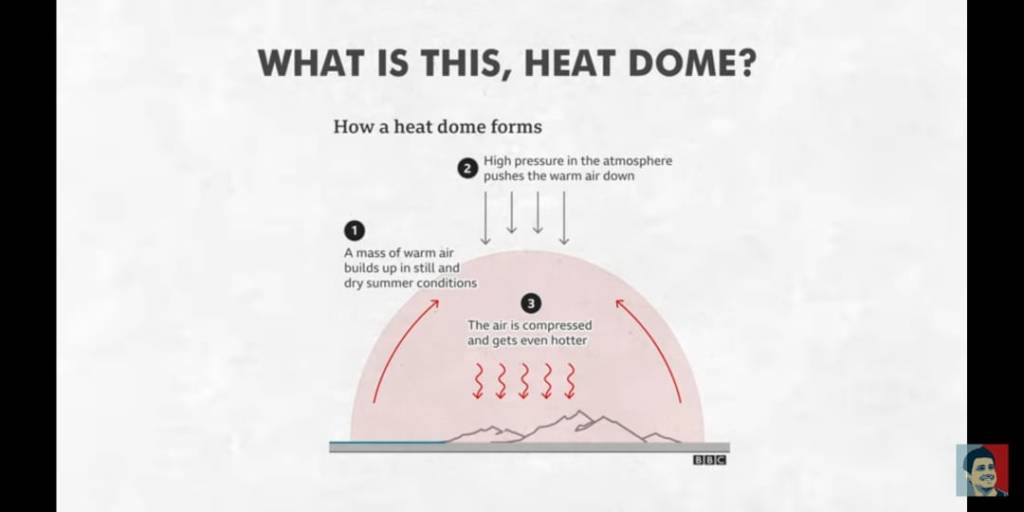
Picture source: Dhruv Rathee https://youtu.be/o-TMOeCDeus

Climate change is being said the root cause. In technical terms, the condition is called Heat Dome. The warm air generally rises up but the high pressure in atmosphere from above, pushes down towards land. The pushed down air becomes even hotter. Extreme weather conditions are escalated with climate change.

West Pacific area has seen significant rise in heat as compare to the East Pacific. The strong change in ocean temperature from west to east is believed to be the core reason of heat dome. Hot air is trapped by the high pressure fronts and as it is pushed to the ground it heats up even more. The condition also prevents formation of clouds thereby giving sun more space to radiate heat on the ground.

The condition of heat dome produces heat wave. Heat wave is a period of abnormally high temperatures which lasts more than 2 days.

Effects of heat dome

Temperature becomes unbelievably high leading to catastrophic deaths, crop damage, droughts. The rising temperature will demand high energy which will in turn increase the rate of electricity. Forest fires are no exceptions. In fact, the current situation is that half of the Lytton village is charred.

Fact

The temperature of Earth has already risen by 1° (totally a bad omen). The rise resultantly increases the chances of natural disasters exponentially. The studies show climate change can affect high-altitude regions at a faster rate. In the past 20 years, temperatures above 13,000 feet have warmed 75% faster than at altitudes below 2,000 metres (credits: Rutgers Today).

Possible Solutions

On an individual level, climate change cannot be solved anymore. Only government policy changes can prove most effective. Subsidies on fossil fuels should be removed, electric cars must be promoted, carbon tax to be imposed, more and more awareness to be raised on individual level.

WHAT IS LINGUISTICS ?

Linguistics is the systematic study of language. Its focus is on language, in general , not on any individual language. The word linguistics is derived from Latin lingua meaning tongue and istics meaning knowledge or science. It studies language as a universal and recognizable part of human behavior . It investigates how the language is constructed, how it varies through space , how it is used, and how it is related to other languages. Hence the linguist studies the origin , organization ,nature and development of language descriptively ,historically , comparatively and explicitly and formulates general rules related to language . The linguist is one who studies language objectively , observing it scientifically , recording facts about language objectively , observing it scientifically , recording facts about language and deriving general principles for them. First study the language and second it tries to describe the language apply those theory in language .

The facts about language that interest a linguist are its sounds ,forms of words and the arrangement of words to form meaningful utterances. There are various approaches to the study of linguistics : historical, descriptive and comparative.

HISTORICAL LINGUISTICS :-

It studies the facts about a language for the purpose of describing the development of the language for a period of time. It traces language change and the causes and results of such changes that occurred from time to time.

DESCRIPTIVE LINGUISTICS:-

It deals with the description and analysis of the ways in which a language operates and is used by a given set of speakers at a given time. it is based on a structural approach to language.

COMPARATIVE LINGUISTICS:-

It is concerned with comparing two or more languages .It traces the evolution of language and by comparing one with another , establishes the relationship between them .

Linguistics may be considered as science . Like any other branch of science it has a well – defined subject matter called language. It makes use of methods like observation , recording and analysis of the various phenomena related to the study of language.

Impact of E-Learning on Students

COVID-19 has challenged the physical health as well as the mental health of people. The children and the elderly are the ones most affected. The pandemic has brought a lot of changes in the lives of almost every individual. From working on your desk to working from the comfort of your, everything has flipped. Everybody’s life has been impacted by the sudden arrival of the pandemic. Working from home, which was initially feeling comfortable has now become bored and irritating. Even the students have lost interest in their online classes.


Earlier children had the access to playgrounds to play with their friends, which has now been limited to the boundaries of their homes because of the coronavirus, due to which the screen time of children has increased. Playing outdoors kept them physically fit and mentally healthy.
The children are becoming irritated and moody being inside their home for such a long time. To keep up their mood, the children have to resort to mobiles and laptops; to play games, watch videos and shows. This has increased their screen time, which has further led to other issues.

Constantly using gadgets and glaring on the screen affects eyesight. Which can lead to blurry vision, and in severe cases can even lead to partial or complete blindness. The screen radiates blue light, which also hampers sleep.

Schools, universities, and colleges are places where the students not just study, but also interact with their peers and dwell together. They don’t just grow here intellectually but also culturally and morally through various activities taking place; contributing to their holistic development.

Be it, school-going children or college students, all have to be on their phones and laptops for their online classes because of the inability to resume on-campus learning due to COVID-19. Initially, online classes seemed interesting as it was a change in the conventional education process. But lately, students have become bored and have lost interest in their studies, as it has become a monotony now.

Students’ sleep cycle has been impacted a lot. The overuse of phones has impacted their quality of sleep and resulted in either too little sleep or too much sleep. The students from the underprivileged areas are unable to attend their classes properly due to bad network quality. This is stressing them out and taking a great toll on their mental health.

Students are overly stressed about whether they would be able to graduate on time or not as many institutions postponed their exams. This is a concern for the timely completion of their degrees, which decides their further step; be it getting into a university for their higher studies or getting into a job.

Stress and anxiety have become a problem in students, which is a reason for their distraction and reduced concentration level. Online classes are also causing social isolation, which is also triggering stress in the students. Lack of communication is causing them distress. Procrastination has become another issue among the students, which is resulting in lower grades.

The students are facing various issues. However, the educator’s and parent’s support can lower the negative impact due to the pandemic through proper communication and guidance.

4 Quick learning tips for students!

Hey! Today we will talk about how can we sharpen our memory. Here are some tips and tricks that will help you learn quickly anything!!

  1. Choose a quite place for study

we all know that a little bit of noise can disturb us. So you have to make sure that you are in a good quite place, Where no one can disturb you.

2. Note down all the important information

it’s proved that if you note down important notes, you can remember better! So , try this!

3. Read, close your eyes and recite it

For quick learning, you should try this trick! Just read your lines , close your eyes and recite it.

4. Again read and recite loudly

Now that’s your turn to recite everything loudly. It can help you memorize more better.

5. A cup of tea or coffee for freshness

One thing! It isn’t important to take tea or coffee every hour! So just relax your mind and if you feel tired and want some freshness, go ahead with your favourite drink!

Isn’t it a good idea for a break with a cup of tea or coffee! Again and again memorization can decrease our strength of memorizing anything.

So it’s a great way to have some break between every hour.

I hope all these tricks will work for you! So try all these tips from today and let me know, whether it worked for you or not!

All the best!!!

INSEAD vs HBS

Institut Européen d’Administration des Affaires (INSEAD) and Harvard Business School (HBS) are two extremely famous management institutions among students seeking admission in management courses in foreign universities. Both are ranked among the top B-schools across the globe providing various opportunities in the field of management.

Let’s have a brief overview of the two.

INSEAD is a private university having campuses in France, Singapore and Dubai. It offers masters programs, doctoral programs, certificate program and executive education programs such as open programs, online programs etc.

HBS is a branch of Harvard University situated in Boston, Massachusetts. Apart from a two year MBA programs it offers doctoral programs, executive education programs and online certificate courses.

Considering the following points of difference one can decide upon a suitable option:

>Duration of MBA

INSEAD– It offers a 10 months MBA program. Admissions are made in two cycles in the month of January (which comes along a month summer break) and September.

HBS– It offers a full time two-year MBA program.

>GMAT score

INSEAD– Approximately 80% i.e. a score of 670-750 out of 800 is mandatory for admission and has one of the highest admissions acceptance rate.

HBS– 90% i.e. a score of 724 out of 800 is mandatory for admission. Selection process is way too selective compared to other B-schools making the admission acceptance rate low.

>Cost of MBA

INSEAD– The annual fees of a typical MBA program is 106,505 USD.

HBS– The annual charge is around 111,542 to 155,300 USD.

>Geographic diversity

INSEAD– The campuses of INSEAD are present across Europe, Asia, Middle East, and North America which brings in students of diverse backgrounds.

HBS– Since the institute is based in the USA the majority students are Americans.

>Scholarships

INSEAD-Two types of scholarships are provided: (a) Need-based i.e. financial needs and (b) Non need based i.e. based on merit, gender, profession, background

HBS– Need based scholarships, fellowships and student loans are available.

>Internships

INSEAD– Paid summer internships are available with salary around 300-15000 USD.

HBS– Paid internships of around 800 USD are available.

>Campus exchange

INSEAD– INSEAD has a widespread network making campus exchange convenient.

HBS– HBS has its only campus situated in Boston.

>Recruiters

INSEAD– 300+ recruiters

HBS– over 600 recruiters

>Base salary

INSEAD– Average salary offered is 105,900 USD.

HBS– Average salary offered is 150,000 USD.

>Career opportunities

INSEAD– Having global network especially across Europe and Asia INSEAD provides greater opportunities and exposure.

HBS– Job opportunities are more concentrated in the USA which makes it ideal for those seeking settlement in the USA.

Tips for online studying during lockdown

Photo by Julia M Cameron on Pexels.com

Transitioning to online studies can be a hard move, especially if you are completely new to online or cloud-based learning. Here are my top 5 tips to help you adapt to online studies and keep your motivations up throughout the semester.

1: Prepare your study area

When you are transitioning from classroom-based learning to studying from home, it is important to have a dedicated space for your learning. This will help you settle in and get into the mindset of studying.

The first thing I did to help me transition to online study was setting up a dedicated desk. I ensured all the important tools for my study were kept there such as my headphones, hard drives, stationery and books. I also added some small decorations to personalise the area so I can feel more relaxed. This has greatly helped me get into the mindset of ‘showing up for work’ at home.

If you live in a shared or confined space, this might not be possible or easy to accomplish. If this is the case, try to claim an area of the kitchen or dining room table and make sure your family or housemates are aware of the space you are claiming for your studies.

Once you’ve setup your study area, treat it like a productive workspace. Make sure you keep your study area tidy and organised as clutter is very distracting and can cause you to lose focus. If your space is not tidy, then set yourself 15-30 minutes before you start to tidy up the area around you. Don’t give yourself too long as that can be a form of procrastinating.

2: Establish a routine – and stick to it!

Once you have created a study space, it is important to establish a regular study routine. Remember, we are all creatures of habit and you can use this to help you get into the mindset to study. Setting aside dedicated and regular blocks of time is just as important as creating your study space.

We all have different preferences on how and when we like to learn, and this is one of the benefits of online or home study. It is important to find out when you are most productive, and if you prefer long study sessions or a lot of short bursts.

Once you have established your preferences, then remember to schedule in your study time accordingly. How much time you devote to each of your study sessions will depend on your subject’s estimated study hours, workload and work/family commitments.

3: Block out distractions

One of the biggest productivity killers when you’re transitioning to online study is distraction, and our homes tend to be filled with distractions. There’s social media, TV, internet, video streaming, games, YouTube, family, books, and the list goes on…

Blocking out distractions is much easier said than done, but there are some tips and applications that can help you. My first tip is to leave your phone on the other side of the room or in another room. The most important thing is to keep it out of arm’s reach and make it harder for you to procrastinate.

4: Track your progress in milestones, not minutes

When you’ve started up your study routine, it’s tempting to track your progress on the time you’ve spent at your desk, but this might not be the best way to track how you are going.

Make sure you track your progress against your actual study goals as opposed to how long you spent re-reading the same paragraph over and over again.

The easiest way is to set your goals before you start your study session. Think about what you want to accomplish in your study session and break it down into achievable milestones. An example of this can be the goal of catching up on a week’s worth of reading, so your individual milestones might be the articles or chapters you need to read.

Remember to keep your milestones realistic and achievable. Don’t give yourself too much to set yourself up for failure, and don’t give yourself too little that you are done in half the time.

A good way to track your progress is on a to-do list. This can be on your desktop, Word document or using pen and paper. If you want a task tracker with additional features, virtual kanban boards such as NotionTrello or Asana can help with this. I use Notion since the paid version is free for students. Whatever system you decide to use, just remember to keep it close to you so you’re reminded of all the ‘right’ things you should be working on.

5: Start or join a virtual study group

Making a sudden switch from a bustling classroom environment to the solitude of home study can be a very daunting and difficult switch. Just because you are self-isolating, this doesn’t mean you are alone, many of your classmates are in the same situation as you.

If you’re new to your university or class, then contact your teacher or lecturer to see if there are any groups going, or a way for them to assist you with reaching out to your peers to start a study group.

I hope these tips help you.

Thank you.

Effective study tips for board exams.

Photo by cottonbro on Pexels.com

It is that time of the year again as board exams for classes 10 and 12 are in the horizons and students as well as parents are working hard to prepare well for the examination. This year, the exams are scheduled to begin from the third week of February and students have already started feeling the anxiety and stress that inevitably accompanies one of the most important exams they will ever take, the result of which will in impact the evolution of their career and shape the course of their life.

Here are some practical tips to help the students prepare more effectively for the upcoming board exam and achieve desired results in the exam:

1. Learn to be stress-free:

It is true that performance in the board exams is a cause for enormous anxiety for students which often leads to stress and sometimes rash action on their part. The immediate and most important outcome of good grades in board exams is that it enables a student to pick up subjects of his or her choice. At this critical juncture, getting bogged down by skepticism and stress is a real threat.

2. Manage/plan your time:

Time management is an important life skill that plays a key role in preparing for exams and beyond. Planning of schedule and its implementation leads to a more effective utilization of available time.

With time management, we can spare time for both studies as well as physical activities. Therefore, the strategy for preparing for the exam should be a perfect blend of learning and revising the syllabus with sufficient time remaining to attempt sample papers successfully.

3. Take care of your health:

Health is a corollary of getting enough sleep, maintaining a predictable schedule, sufficient physical activity and eating right. Go to bed early and get up early. Kick start your day off with exercise and a healthy breakfast that will boost your energy and will help you stay active through the day. Mental health is as important as physical health and must not be ignored.

4. Set targets:

Setting practical targets would be immensely helpful for students as one can maintain momentum and achieve the goals. Therefore, by setting daily, weekly, and monthly study targets, one can equally focus on subjects he/she is weak at and understanding them while solving different level of questions. Enrolling for the best crash courses available would be a good way to gain sufficient practice on the subject.

5. Practice previous year’s question:

A good way to prepare for an exam is to know the exam pattern and the kind of questions that could appear in the exam. Attempting previous years questions helps in practicing and revising questions, understanding patterns of questioning that can be expected and introduces students to the time limits they will be exposed to on the day of their exam. Practice taking mock tests as much as possible to be conversant with the examination.

6. Choose your material and follow the pattern:

Examinations are an art in their own unique way, in that questions are set to certain parameters such as difficulty levels, time required to provide an answer etc. Try to begin with the 5 marks questions and set a time limit to complete that.

Questions based on Laboratory diagram are important and must be practiced beforehand. Diagrams carry a good percentage of marks so be very careful while drawing and labeling them.

7. Utilize gadgets productively:

Gadgets such as smartphones and computers are often condemned as distractions when one is preparing for an exam and for good reasons. However, that need not always be the case as the right usage of the same can be productivity booster and a handy source of information when necessary. From alarm clock to countdown timers, there are positive ways in which gadgets can impact exam preparations.

Apart from the points mentioned above, there are some basic hygiene that when maintained evokes a positive impression. Maintaining a legible handwriting, maintaining margins and keeping answer sheets neat and tidy is a practical advice. While they may not add marks, they do induce a positive vibe.

I hope these tips help you.

Thank you.

Proven Study methods to Ace your Exams

Photo by RODNAE Productions on Pexels.com

Scoring good marks and acing the exams should be easy if you have studied every lesson by heart, solved the questions and had good revision schedules. But majority of the students do not seem to be getting that amount of time and motivation to keep up. To keep up with the massive amount of syllabus seems impossible and as a result we have to leave out some parts of the syllabus or do not get a chance to revision the lessons. And then add procastination to it even worse. However modern research has been able to crack the code to score well in exams while eliminating inefficiency and increasing efiiciency.

So, while studying the two most important aspects are-

  1. Understanding
  2. Memorising

The first aspect is understanding. If we do not understand what we are studying we will never be able to produce the lessons in our exams. It is quite common that if we understand the lesson once we will be to remember it better. Understanding is truly the most crucial step to acing the exams.

The best scientific method to understand our lessons have been given by an American psychologist Richard Feynman. He gave a pretty simple technique or method. He said that if we are able to explain what we are studying to a 5-year-old clearly, we have understood it. And if we have understood it, we are good to go. We need to get the basic concepts clear in our head. Children like stories and easy explanations so that is what is going to help us. Get to the core of the subject. This was the main idea given by him but it is not practical to get a 5-year old to listen to you. So a better and more appropriate way to inculcate this approach is to get your friends listen to you explaining a concept. It will be beneficial for both you and your friend.

Alright, the next essential thing to studying is memorizing. The two most helpful study methods are

  1. Active Recall and
  2. Spaced Repetition

So the idea behind spaced repetition is that the more we actively recall something, the brain cells register them better in our memory. This is the main idea behind active recall. The ways by which you can practise this method is by first understanding a topic and then answering all the possible questions from it. If you cannot answer a question it is completely fine, go back and check the answers. This will strengthen the brain connections and you will be good to go for a long time. Just be active with your studies even if you sit to study for just 30 minutes.

Another great method that is extremely good for memorizing is Spaced Repetition. To follow this technique is by studying a lesson deliberately at intervals. So if say you decide to study something for the first time then the next time study it for revision only when you have forgotten it to a certain extent. So again the idea behind this technique is to actively strengthen the brain cells when you have forgotten them. A study has shown that with time the brain connections seem to fade away. So the best way to recall is to delay the study only when you have forgotten some parts of it.

Ali Abdaal, a famous youtuber explains these concepts in his videos really well, do not forget to check them out.

I hope this article helps me as much it did to me.

Curiosity (science)

• Why do we wake up from sleep?

Sleep is essential to give the brain and nerves some rest. While we sleep, our bodies too, get a chance to recover from the fatigue caused by daily activities. When we are well rested, both physically and mentally, we wake up. Sometimes, we wake up because we feel cold or hungry or because a bad dream has made us afraid.

To sum up, we all have an internal body clock that tells our brain to wake our bodies up after a certain amount of time. However, some things or situations such as noise, temperature in the room or sunshine interrupt our sleep and wake us up too.

• Why doesn’t glue stick to the insides of the bottle?

The regular white glue that we use is made up of a variety of chemicals that are either sticky or stretchy. White glue also contains water. Water acts as a solvent that keeps the glue liquid until you want it to stick. When you put glue on a piece of paper, the water in it is exposed to air. The water eventually evaporates and as it does so, the glue dries and hardens and holds the things that need to be glued, stuck together.

When the glue is inside the bottle, there’s not enough air inside the bottle to cause the water to evaporate to make the glue sticky. The bottle protects the glue from the air and keeps the glue runny. This is also why if you’ve ever left the top off a glue bottle for a while, the next time you try to use the glue, it would have dried up.

• Why do the lights of a distant town appear to twinkle?

When you are traveling at night, the lights of towns in the distance appear to twinkle. This is because of the constant movement of air above towns. The air above towns is warm, as a result of the heat given off from buildings. Warm air keeps moving up to be replaced by cold air which then gets heated and rises. This constant movement of air is known as turbulence.

When we are near a town or in it, we don’t notice the turbulence because it is quite small and the lights are nearly. However, when we are some distance away, the lights are far away too. They appear as only pinpricks. The warm and cold air that make up the turbulence above the town have different densities and light passing through the layers is bent at different angles because of this difference. As a result it appears as though the lights of the distant town are twinkling.

• Why do clouds have different shapes?

Clouds are made up of tiny droplets of water vapour or ice particles or both. The shape of the cloud depends on its height and temperature. Cumuliform clouds are shaped liked mushrooms and are formed when rising warm air cools as it goes up. Stratiform clouds come in flat, dull layers and are formed when air sinks in a high pressure area, creating a layer of cold air near the ground that doesn’t rise or rises only very slowly. Cirriform clouds are clouds that have risen on a front or tropical cyclone and frozen into ice crystals at very high altitude. They look like thin hair. The shape of cloud also depends on the time of the day.

Towards evening, clouds tend to be thinner and flatter than during daytime. Changes in wind patterns also change the shapes of cloud.

Thank you for reading. Have a nice day!🌼

How to learn effectively and efficiently

 Imagine studying so hard for a test and ending up getting lesser marks than expected, that’s quite disappointing right? Each and every time we learn something new, it is important to learn it in an effective way. Focusing on the right points and methods can make us all memorize things very easily. It will also become easier for us to score more marks too.

Methods of studying can vary from student to student but the most common and reliable methods are mentioned below.

  • Learn at your own pace

Learning capacity for every single person is different from each other. Some people have the ability to memorize much more than others can possibly do. But don’t be afraid of that. Always take your time in learning but make sure to not waste your time too. Learn as much as your brain can take and do not stress over it because if you do there are higher chances that you might not recall what you have learned.  Learning Is a process that requires a lot of brain power, so never exhaust yourself in the process.

  • Make a time table

Always make a time table for your course of study so that you will be regular at it, it can be exhausting to follow a time table but if you really try, you would fall into pace very easily in a week or two’s time. When a time table is made, your brain functions accordingly, the body also knows that it is your time study. Studying then will become a habit and much easier too.

  • Getting proper sleep

A very important aspect of learning is getting proper sleep, students must make sure to sleep at least 7-8 hours a day to lead a healthy life. Proper sleep and food makes your body function properly, this way it will become easier for you to learn too.

  • Making notes

When attending a lecture, always make notes of what is taught in the class. When you listen to the teacher and write notes, it gets registered in your brain so that it will become easier to recall when you are revising.

  • Short notes

When reading a book or a study material, make short notes, use highlighters, little pop ups so as to learn easily. Making eye catching notes will make it easier for the brain to learn. Also in the process of making it we all also be revising. Carry this short note always with you, so that you can read through it whenever you are free.

  • Taking breaks

Taking breaks between studying makes studying more effective. It will make our brain function properly. It helps the brain cells arrange the important information and filter out what’s needed to be studied and not.

  • Always drink water and eat healthy food

During the times of exam or when your studying make sure to drink water regularly. Eating healthy food should be made a habit. When during exams avoid eating food from outside, so as to avoid any kind of food poisoning of any sorts.

  • Practice

Just like the quote ‘ practice makes a man perfect’, it is to be made a habit of practicing and writing down what is learnt every day. When you are regular at it, memorizing will be an easier.

  • Learning by experience.

Learning something by experience makes sure that we do not forget it, it is always better than simply memorizing it in our minds. When you experience something there are higher chances you might not forget it.