THE POWER OF PERSEVERANCE 2 SUCCESS

 THE POWER OF PERSEVERANCE 2 SUCCESS, the journey to our dreams and great ambition are often mixed with hardships and failures and this where the true test of perseverance unfold. Perseverance is the stubbornness with a great purpose. Perseverance is to persist in anything undertaken, maintain their purpose no matter how much difficulty or obstacles may occur in their path and it is the perseverance and courage which make their difficulties magically disappear.

“THE WILL TO PERSEVERANCE IS OFTEN THE DIFFERENCE BETWEEN FAILURE AND SUCCESS”

Perseverance is the ability to go on when the things seem to be completely hopeless and the continuous effort is the key to unlock our inner potential. To achieve our great dreams there are no shortcuts and no easy way outs. Against all the odds perseverance reminds us of the highest hopes and reminds us the picture of our dreams and provokes us to forge ahead despite setbacks that threaten to undermine all efforts to succeed.

The essence of perseverance is rising every time we fail and finding a strong will to get up more intelligently and wisely even though you know you are knocked down. The goals need hard work to be accomplished and when you work hard even after you are discouraged and tired of doing the same is perseverance. The great scientist Thomas Alva Edison is the true inspiration for perseverance who failed ninety nine times and got up more wisely than before and made it happen in the hundred time so a little more effort and persistence made him achieve what seemed to be impossible.

THE POWER OF PERSEVERANCE 2 SUCCESS IN THE FLOW OF WATER

Perseverance is largely influenced by the flow of water. Water does not stop flowing rather it always keep moving. When you try stopping the flow by putting your hands into it all you feel is the water flowing. So the water beautifully tries us to explain that “if you cant go through the obstacle then go around it.” A person with perseverance and patience never admits his or her defeat as a failure rather they take it as their learning and come up more wisely.

THE POWER OF PERSEVERANCE 2 SUCCESS: HOW TO BE PERSEVERANT?

    1. Be clear with your desires
    2. Be optimistic : do checkout OPTIMISM- THE NEED OF THE HOUR
    3. Believe in yourself
    4. Don’t get easily dragged by misguiders
    5. Listen to your conscience
    6. Learn from your mistakes and never repeat them
    7. Give your health the first priority to keep your mind clear:  do checkout YOGA AND MEDITATION: 2 PILLARS OF HEALTHY LIFE

THE POWER OF PERSEVERANCE 2 SUCCESS: SUCCESS STORIES WITH PERSEVERANCE

  1. JACK MA :   He is the richest man in the entire Asia but this took him a lot of effort and perseverance as he didn’t do overnight . He faced a lot of rejections , each and every step he faced a lot of failures and handful of rejections but the best part was he NEVER GAVE UP.
  2. COLUMBUS:  He is yet another example of perseverance. He struggled a lot to reach his destination and never gave up whenever he had a low motivation . In a long run he discovered the way from Spain to America and surprised the world with a new route of communication with America             
  3. WALT DISNEY: While everyone knows the iconic brand of Disney, the story of how Walt Disney created the empire is very inspiring. At young age Walt Disney was fired from a local newspaper as his boss was not satisfied with his work. After failing in the company he was not able to pay his bills and struggled a lot but he too never gave up and went on to grow the company with amusement parks, feature films, and is known as a cultural icon.

do checkout some more stories of perseverant people: https://www.growthink.com/content/7-entrepreneurs-whose-perseverance-will-inspire-you

Man’s success stories does not depend on his achievements rather the failures which they used as a learning tool and never gave up. The key to success is action and the essential in action is perseverance.

 

HARDWORK IS THE KEY TO SUCCESS

 hard work is the key to success essay

“Focus, hard work is the real key to success. Keep your eyes on the goal, and just keep taking the next step towards completing it. If you aren’t sure which way to do something then do it both ways and see which works better.” – John Carmack

‘Hard work is the key to success’ is a statement that has been said to us over and over again and it may be commonly used in workplaces or schools. Team leaders, managers, coaches, teachers, and parents are most likely to use the statement than other people.
We are talking about consistent and focused work, which means saying no to distractions for a long time, without expecting fast results. Be patient and believe in the process while changing your strategies and approach, and try new things while you stick to your initial vision. Success takes strategic actions in the right direction to get there and it does not happen by chance or overnight.

Hard work is the most important key to success. Achievements without hard work are impossible. An idle person can never gain anything if they sit and wait for a better opportunity to come. The person who is working hard is able to gain success and happiness in life. Nothing is easy to be achieved in life without doing any hard work.

Failures are sometimes a part of the journey to the success, but in the end of the day, it is all about how hard you have worked on the right thing and this will get you closer to your goal.

Most of the successful individuals had put in enough productive work before they received success in return. Just by working hard on what you believe in, you can understand its true value. That’s when you start to respect the work itself and when you start to learn important life lessons.

You learn to appreciate all you have, but in the meantime, you learn to be patient, to take action instead of waiting and take responsibility for anything you have or don’t have in your life.

Hard work is the key to success! #TuesdayThoughts #TuesdayMotivation  #charitytuesday | Hard work beats talent, Hard work quotes, Hard quotes

Hard work helps you overcome procrastination, insecurities, fear of failure and bad habits, and it gives you a purpose.

There is nothing else that brings more results and progress on a consistent basis than the hard work. The action itself leads to more action. At any moment of the day, you are building and make sure your journey continues. When you see the results of your own work, you feel grateful, accomplished and truly satisfied with what you are doing. That makes the whole process really enjoyable and you find the strength to persevere.

Never doubt the power and necessity of hard work! Create your strategy, make your plan and take the first step towards success today. You are not gonna regret it! Work your way up!

Hard work is a great quality. All work is noble. Work is worship. Hard work is the key to success. We can progress by doing hard work. Those countries whose citizens are hard-working make great progress.

An idle person depends too much on chance. He thinks that some miracle will happen and he will become rich and prosperous. But this is not possible without hard work.

All great men of the world were very hard-working persons. By hard work, man progresses and the country progresses. Seventy years ago, Japan was a backward country. Today, Japan is one of the most prosperous countries of the world. This prosperity has been possible by means of hard work. We should all, therefore, work hard to achieve success.

Quotes: Hardwork Is The Key To Success

So the hard work, together with the time it takes, is a must on your journey to success. It makes you who you have to turn into in order to live the better life that’s awaiting for you. What’s more, the harder you work on your dream, the more confident you become.

The very first key to success is to make a plan. This means having a clear picture of what a successful life looks like to you and putting together a well-defined set of goals to get you to that life. Planning well starts with figuring out what you want and writing it down in detail.

Every one of us has goals in life. To fulfil the goals we need to be hard working. Sitting idly does not help fulfilling one’s aim. We all must respect the chance we get in life. Respecting the chance means doing hard work.

We must not fear failure. Failure is natural to our life. When we fail, we must not stop working hard. We all should believe in ourselves and keep trying hard until we achieve our aims.

We can work hard if we have the determination and focus in life. Concentration in work is very important. If one concentrates fully while doing work, the work gets finished successfully and very soon. We must work to increase our concentration level. Hard work is very much important to develop our concentration power.

To develop the sense of hard-working in children, parents or teachers should tell them the stories of successful persons of a country. The children should choose a role model for their life so to focus on their own life. This will help them study hard with interest.

 Success + Hard work = More Success! 

THE POWER OF PERSEVERANCE 2 SUCCESS

 THE POWER OF PERSEVERANCE 2 SUCCESS, the journey to our dreams and great ambition are often mixed with hardships and failures and this where the true test of perseverance unfold. Perseverance is the stubbornness with a great purpose. Perseverance is to persist in anything undertaken, maintain their purpose no matter how much difficulty or obstacles may occur in their path and it is the perseverance and courage which make their difficulties magically disappear.

“THE WILL TO PERSEVERANCE IS OFTEN THE DIFFERENCE BETWEEN FAILURE AND SUCCESS”

Perseverance is the ability to go on when the things seem to be completely hopeless and the continuous effort is the key to unlock our inner potential. To achieve our great dreams there are no shortcuts and no easy way outs. Against all the odds perseverance reminds us of the highest hopes and reminds us the picture of our dreams and provokes us to forge ahead despite setbacks that threaten to undermine all efforts to succeed.

The essence of perseverance is rising every time we fail and finding a strong will to get up more intelligently and wisely even though you know you are knocked down. The goals need hard work to be accomplished and when you work hard even after you are discouraged and tired of doing the same is perseverance. The great scientist Thomas Alva Edison is the true inspiration for perseverance who failed ninety nine times and got up more wisely than before and made it happen in the hundred time so a little more effort and persistence made him achieve what seemed to be impossible.

THE POWER OF PERSEVERANCE 2 SUCCESS IN THE FLOW OF WATER

Perseverance is largely influenced by the flow of water. Water does not stop flowing rather it always keep moving. When you try stopping the flow by putting your hands into it all you feel is the water flowing. So the water beautifully tries us to explain that “if you cant go through the obstacle then go around it.” A person with perseverance and patience never admits his or her defeat as a failure rather they take it as their learning and come up more wisely.

THE POWER OF PERSEVERANCE 2 SUCCESS: HOW TO BE PERSEVERANT?

    1. Be clear with your desires
    2. Be optimistic : do checkout OPTIMISM- THE NEED OF THE HOUR
    3. Believe in yourself
    4. Don’t get easily dragged by misguiders
    5. Listen to your conscience
    6. Learn from your mistakes and never repeat them
    7. Give your health the first priority to keep your mind clear:  do checkout YOGA AND MEDITATION: 2 PILLARS OF HEALTHY LIFE

THE POWER OF PERSEVERANCE 2 SUCCESS: SUCCESS STORIES WITH PERSEVERANCE

  1. JACK MA :   He is the richest man in the entire Asia but this took him a lot of effort and perseverance as he didn’t do overnight . He faced a lot of rejections , each and every step he faced a lot of failures and handful of rejections but the best part was he NEVER GAVE UP.
  2. COLUMBUS:  He is yet another example of perseverance. He struggled a lot to reach his destination and never gave up whenever he had a low motivation . In a long run he discovered the way from Spain to America and surprised the world with a new route of communication with America              
  3. WALT DISNEY: While everyone knows the iconic brand of Disney, the story of how Walt Disney created the empire is very inspiring. At young age Walt Disney was fired from a local newspaper as his boss was not satisfied with his work. After failing in the company he was not able to pay his bills and struggled a lot but he too never gave up and went on to grow the company with amusement parks, feature films, and is known as a cultural icon.

do checkout some more stories of perseverant people: https://www.growthink.com/content/7-entrepreneurs-whose-perseverance-will-inspire-you

Man’s success stories does not depend on his achievements rather the failures which they used as a learning tool and never gave up. The key to success is action and the essential in action is perseverance.


Women organizations and their role in India

Women’s Organisations emerged in India as a result of the spread of education and the establishment of the notion of the new woman. There was an improved level of communication among women which made them aware of the different problems that they faced and their rights and accountabilities in society. This awareness led to the upsurge of women’s organizations that fought for and signified women’s causes

An exclusive feature of the Indian women’s crusade is the fact that early efforts at women’s liberation were set in motion by men. Social reformers such as Raja Ram Mohan Roy, Maharishi Karve, and Swami Dayanand Saraswati challenged the conventional subservience of women, stimulated widow remarriage, and supported female education and impartiality in matters of religion, among other issues. Mahila mandals organized by Hindu reformist organizations such as the Arya Samaj and Brahmo Samaj encouraged women to go out of the boundaries of their homes and interact with other members of society. Pandita Ramabai, who was considered as one of the innovators of the feminist movement, with the help of Justice Ranade established the Arya Mahila Samaj in 1882. She envisioned creating a support network for newly educated women through weekly lectures and lessons at homes, where women could learn and gain confidence through interactions.

Women’s auxiliaries of general reform associations also served as a ground for women to deliberate social issues, express opinions, and share experiences. The Bharata Mahila Parishad of the National Social Conference was the most protruding among such opportunities. Though the National Social Conference was formed at the third meeting of the Indian National Congress in 1887, the Mahila Parishad was launched only in 1905.

These initiatives greatly influenced the social status of women. Early attempts at encouraging women to converse outside their families and local committees thus, stemmed from the broader social reform movement and efforts to upgrade the conditions of women.

The pre‐Independence period saw women’s issues related to the nationalist agenda at various junctures. In this period, a major enhancement of women was in terms of political participation of women, calling for a redefinition of conventional gender roles. Women began openly demonstrating their opposition to foreign control by supporting civil disobedience actions and other forms of protest against the British. Opportunities to organize and participate in agitations gave women much‐needed confidence and a chance to develop their leadership skills. Cutting across communal and religious barriers, women associated themselves with larger problems of society and opposed sectarian issues such as communal electorates. Political awareness among women grew, owing to a general understanding that women’s issues could not be separated from the political environment of the country. During this period, the initial women’s organizations formed within the historical background of the social reform movement and the nationalist movement were as follows.

•The Women’s India Association (WIA).
National Council of Women in India (NCWI).
•The All India Women’s Conference (AIWC) in 1917, 1925, and 1927 correspondingly.
Each of these organizations emphasized the importance of education in women’s progress.
•The WIA, created by Margaret Cousins in Madras, worked widely for the social and educational emancipation of women. •Associated with the Theosophical Society, it encouraged non‐sectarian religious activity and did creditable work in promoting literacy, setting up shelters for widows, and providing relief for disaster victims.
•Women in Mumbai, Chennai, and Kolkata through networks developed during World War I work, allied their associations together, and created the NCWI in 1925. A national branch of the International Council of Women, its most prominent member was Mehribai Tata, who aggressively campaigned against inert charity and advised men to support female education.
•The most important of the women’s organizations of the time was the All India Women’s Conference. Though its initial efforts were directed towards improving female education, its scope later extended to include a host of women’s issues such as women’s franchise, inheritance rights.

The Constitution of India enlisted in 1950 which permitted equal rights to men and women. Rights such as the right to vote, right to education, right to enter into public service, and political offices brought in satisfaction among women’s groups. In this period, there was limited activity in the area of women’s rights. Many women’s organizations such as the National Federation of Indian Women (1954) the Samajwadi Mahila Sabha (1559) were formed to work for supporting the cause of Indian women. Since the country was facing a social, political crisis after British rule, many demands of the women activists were not supported by the Government. But during this period from 1945, the Indian women got an opportunity to participate in confrontational politics.


In post-independent India, the women’s crusade was divided, as the common opponent, foreign rule, was no longer there. Some of the women leaders formally joined the Indian National Congress and took a powerful position as Ministers, Governors, and Ambassadors. Free India’s Constitution gave universal adult franchise and by the mid-fifties, India had fairly liberal laws concerning women. Most of the demands of the women’s movement had been met and there seemed few issues left to organize around. Women’s organizations now observed that there was an issue of implementation and consequently there was a pause in the women’s movement.

Some women organizations such as the Banga Mahila Samaj, and the Ladies Theosophical Society functioned at local levels to promote contemporary ideas for women. These organizations deal with issues like women’s education, abolition of social evils like purdah and Child marriage, Hindu law reform, moral and material progress of women, equality of rights and opportunities.

It can be believed that the Indian women’s movement worked for two goals.

•Uplift of women.
•Equal rights for both men and women.

Currently, there are many women organizations in India:

•All India Federation of Women Lawyers
•All India Women’s Conference
•Appan Samachar
•Association of Theologically Trained •Women of India
•Bharatiya Grameen Mahila Sangh
•Bharatiya Mahila Bank
•Confederation of Women Entrepreneurs
•Durga Vahini
•Friends of Women’s World Banking
•Krantikari Adivasi Mahila Sangathan

The major objective of this organization is:

•Strengthening and building new initiatives, networks, forums, etc., for protecting women’s rights
•Monitoring the Government of India’s commitments, implementing the Platform for Action with special focus on the eight-point agenda discussed at the Conference of Commitment, CEDAW, the Human Rights, and other United Nations Convention.
•Advocacy, lobbying, and campaigning on women-related issues.
•Information Dissemination and Documentation.
•Solidarity and linkages with other regional and global forums.


Another women organization in India is Swadhina (Self-esteemed Women) which was formed in 1986. It is principally a civil society organization focused on the Empowerment of women and Child Development based on Sustainable Development and Right Lively hood. At Swadhina, it is believed that positive social change has a direct effect on the lives of women and that change is possible only through equal and spontaneous participation of Women. Organization members are active in five states across the country in remote tribal districts of Singbhums in Jharkhand, Purulia, and West Midnapur in West Bengal, Kanya Kumari in Tamil Nadu, Mayurbhanj in Orissa, and East Champaran in Bihar.

Due to the women’s movement, several legislations were passed like the Equal Remuneration Act, Minimum Wage Act, Maternity Benefit Act, etc. to ensure equal status to women in society & more importantly at work. However, illiteracy amongst the major women workforce (87% of women are employed in the unorganized sector), fear of losing employment & lack of awareness of the laws enacted to protect them, make it difficult for women to benefit from them.


A girl should be two things:

who and what she wants.

best ways to overcome laziness

Hello friends, today we are going to tell you the most effective and best ways to remove laziness, in which if you do any work, you will not feel lazy at all and you will be able to do every task in a better way.

Avoiding laziness is a very difficult task and this habit is a little bit in every person and it can be more in some people, due to this you are not able to do any of your work in such a great way if you can get rid of laziness. If you become capable, then you become capable of achieving all kinds of success, every problem or problem related to life is related to laziness somewhere, because of this, it is necessary for you to first overcome your laziness. For this, you can use the method given by us.

best ways to overcome laziness

best ways to overcome laziness

There are many reasons for laziness, which can make you lazy and you are not able to complete that work even if you want, the reason for laziness can also be your daily routine and your food and most important is the environment around you. If you live in contact with lazy people or your living is in the middle of a lazy atmosphere, then you can soon become a victim of laziness.

We are now telling you some of the best and most effective ways through which you can get rid of laziness and for this, you follow all the methods mentioned by us.

1. Pure environment

If you want to keep laziness away, and thoughts about success, then you stay in a pure environment, this will not affect you due to laziness Spend it, you will get rid of laziness in a few days and you will start feeling active.

2. Pure Eating

If your food is not pure, then you will become a victim of laziness very quickly and so to avoid laziness, first of all, you must improve your diet and avoid mass etc. and consume more green vegetables, this will not help your laziness. And you can do every task in the best possible way.

3. Drug Abuse

It is a habit of most people they do some kind of intoxication. If you do, then you have to stay away from all kinds of intoxicants and if you have become a habit of intoxication, then you will have to leave it too.

4. Sufficient Sleeping Time

Many people do not even take nought or take very little to complete their work, due to this you become very lazy and you are not able to do your work in a better way, so you must sleep for at least 8 hours every day and in the morning Try to get up as early as possible.

5. Break Big Tasks into Smaller Parts

If you are doing some big work or doing some difficult task, then you start getting laziness more, thinking that when you will be able to complete that work and how it will be completed, due to work etc., you start getting laziness more. If you are doing big work, then do it in small parts, then you can complete that work and you will not even get lazy.

6. Take inspiration from successful people

If you are doing some work or are thinking of doing that work, then you must take inspiration from the successful people by doing that work or read about them in books etc. New hope of getting success will start waking up.

7. Exercise Regularly

The best way to overcome laziness is that you must exercise regularly in the morning with your will, this gives you new energy and exercising daily will never make you lazy, so you must exercise daily.

8. Take Time for Yourself

Many people only work and become careless about their health, I d like to tell you that take as much time as you can for yourself and at that time at the place of your choice. Go, remember you’re happy moments and talk to friends or family, this will give you new energy.

9. Keep calm

Most people are angry about their work and because of this they are not able to do their work properly, if you do any work, be calm towards it and do this work calmly, it will not make you lazy towards that work.

10. Always think about profit and success

If you do any work, then forget about the difficulty of that work and think about the benefits you will get after being successful in that work, by this, you will be able to do that work in a very good way and you will come.

There will not even be laziness in the ripe mind towards that work.

11. Control Yourself

If you want to get rid of laziness, then you need to control controlling yourself, you can easily do even bigger tasks, so it is important for you that you should learn to control yourself. You will be able to avoid laziness to a great extent.

I hope that you must have liked our best ways to overcome laziness information, you can comment us and if you like the information, then definitely share it so that other people also know about it. can be obtained.

Why do I wake up very early in the morning

Hello friends, today we are telling you about this Why do I wake up very early in the morning , if you want to get up early in the morning, then there are many different ways for this, by adopting this you can very easily get up every day at the desired time, we can give you the easiest And we are telling you about the best ways, by adopting which you will be able to get up in the morning whenever you want, for this you should read our article carefully.

Why do I wake up very early in the morning

Why do I wake up very early in the morning


Getting up early in the morning is the desire of many people and you can wake up early in the morning in many ways, but we will tell you the methods that we adopt to get up in the morning and in this way, you will be able to get up early every day at your fixed time in the morning. To get up, first of all, you have to prepare yourself. If you get ready and make sure, then you will be able to get up early in the morning.

Benefits of Getting up early in the morning


Waking up early in the morning is beneficial for health in many different ways and if you wake up early in the morning then you get to see many good results. But it is obtained as follows

sharp brain

Waking up early in the morning is very important for a sharp mind. So you will remember what you have read for a long time and you will not even have to remember them again and again, people believe that the right time to read or study anything is to wake up early in the morning and read.

2. Increase in Concentration

If you wake up early in the morning, then it also increases your concentration and if you want to increase your concentration during work time, then you can wake up early in the morning and do yoga, due to this you will be able to increase your concentration a lot during work time and many more. People have also got good results in terms of concentration by getting up in the morning.

3. Pure Oxygen

You also know this thing that you get the best and purest oxygen throughout the day only in the morning time because most of the vehicles and factories etc. If you wake up early in the morning, you are also protected from all the diseases of the heart due to pure oxygen and with this, you will also be saved from other diseases.

4. More time to work

Many people say that they do not get time for any work and many students also say that they do not get much time to study, due to which their numbers are useful, then the best way for all these is that you get up early in the morning. This will give you more time and you will be able to study and do any work for a longer time, if you wake up 2 hours earlier than every day and do some work, then you will be able to do that work for 2 hours more, then by getting up early in the morning, this is also a lot. There is a great benefit.

5. Increased Willpower

Waking up early in the morning also increases your willpower and it increases your thinking power. If you want, you can wake up in the morning and do yoga every day, this is also a great way to increase your willpower.

6. Positive Thinking

In many people, you must have seen that there are a hundred more negatives in them regarding any work, these times we also feel inside ourselves, by getting up late in the morning, negative thinking starts increasing in the body and if you wake up early in the morning then your Negative thinking will start working slowly and positive thinking will start growing in you at the same place, through yoga or exercise, you can get the best results in work time and this is the only way to grow positive thinking.

7. Good Health

Waking up in the morning is very good for health and even the child knows about it because it is told at home, school and any other place that waking up in the morning keeps your health very good, if you wake up early in the morning, then this Your health will be very good, you will also be saved from diseases in many ways and if you want, you can wake up early in the morning and do yoga or exercise. You can also delete it.

How to wake up very early in the morning


If you want to get up early in the morning, then there are many different ways, by adopting which you can easily get up early in the morning and what you will have to do for this and what methods you will have to adopt.

We are telling you that by adopting them, you will be able to get up early in the morning.

1. Sleep early at night

To get up early in the morning, it is very important to sleep on time and early at night, if you sleep early at night, then you will be able to get up early in the morning. Special care should be taken and if you sleep late at night and wake up early in the morning, it can also spoil your health, so if you sleep early every night, you will be able to get up early in the morning very easily.

2. Keep a fixed time to wake up in the morning

To get up early in the morning, you should set a time to wake up early in the morning, as if you want to get up at 4.15 every day, then you have to keep this time for daily, this will make you get used to it in a few days and later you will help without any alarm. Will be able to get up at 4.15 in the morning.

3. Keep the alarm a little away from the bed

If you wake up early in the morning with the help of an alarm, then you should take special care that when you set the alarm, then keep it away from yourself as much as possible because often we try to turn it off when the alarm sounds in the morning. If the alarm is near, then we close it and go to sleep, but if you keep the alarm away, then you will not be able to turn off the alarm in the morning and for this reason, you will also be able to get up early in the morning.

4. Sleep with a glass of water near you at night

If you do not get up early in the morning, then you should sleep with a glass of water because when you wake up in the morning, there is a lot of sluggishness which makes it very difficult to get up, but if you have a glass of water then you wake up as soon as you wake up. You will be able to wash your face, this will not make you sleep again and if you want, you can drink water after getting up in the morning.

5. Have a light meal at night

To get up early in the morning, you also have to keep this thing in mind that you should eat light food the night time, this will make it easier for you to get up early in the morning and it also maintains your health and if possible, do some work at night. Take food in quantity, like if you take 4 rotis every day, then take only 3 rotis in the night time, it is not only necessary for your health and at the same time, you will also get it easy in the early morning.

6. Workout

If you have to make a habit of getting up early, then you need to do workouts, due to this the circulation of blood starts well in your body and it also saves you from problems like stress and sleeplessness, due to which you can get full sleep and in the morning. You will also find it easier to get up early, as well as after having dinner, you should start working out.

Conclusion – In this article, we have told you the best ways to get up early in the morning and the benefits of getting up early in the morning. Do share with us and if you want to ask any kind of question related to it, then you can also tell through a comment.

Operation Cactus by Indian Armed Forces which saved Maldives freedom.

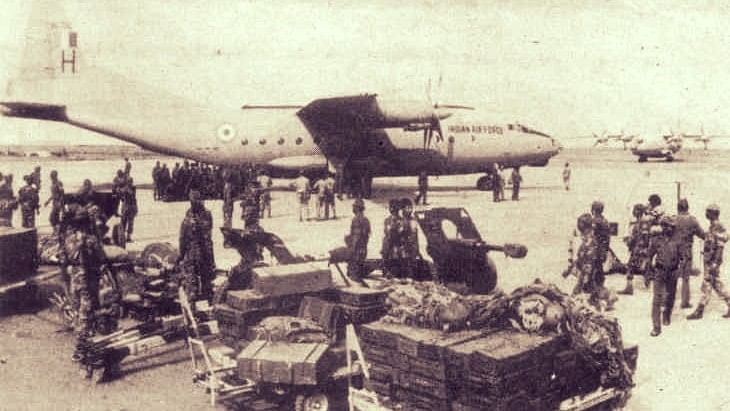
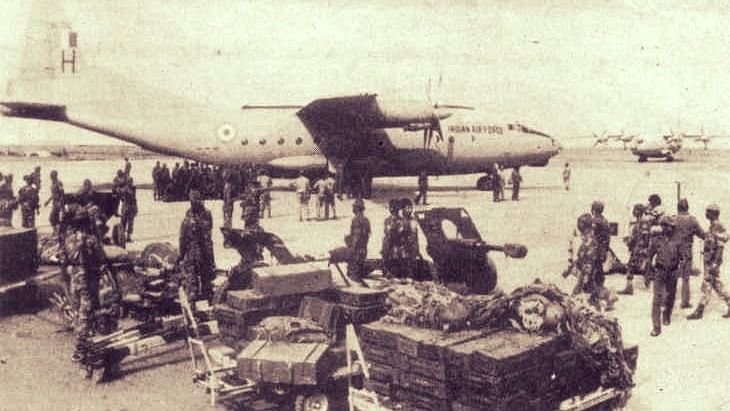
Operation Cactus, led by the Indian Armed Forces in 1988, to stop a group of Maldives mercenaries led by businessman Abdullah Rutufi, and armed mercenaries of the Tamil Elam People’s Liberation Organization (PLOTE), a separatist Tamil organization in Sri Lanka. It’s strategy was to overthrow the government in the Maldivian island republic.

Thier were two coup attempr done before 1988.The 1980 and 1983 coup attempts against President Maumoon Abdul Game were not considered serious, but the third coup attempt in November 1988 surprised the international community. About 80 armed PLOTE mercenaries boarded a speedboat from a Sri Lankan cargo ship hijacked in the capital Male before dawn. A similar number has previously invaded Male in the guise of a visitor. The mercenaries soon gained control of the capital. This includes major government buildings, airports, ports, television and radio stations. The mercenaries then marched to the presidential residence, where President Gayoom lived with his family. However, before they arrived at the presidential residence, President Gayoom was escorted to the Defense Minister’s house by a Maldivian national security forces. The Secretary of Defense then took the president to a safe home.

Meanwhile, the mercenaries occupied the presidential residence and managed to take the Maldivian Minister of Education hostage. President Gayoom called on Sri Lanka and Pakistan government to intervene in the military, but both refused to help because of lack of military power. The president then demanded Singapore’s intervention, but Singapore refused for the same reason. He then contacted the United States and was told that it would take a couple of days for the US military to reach the Maldives from the nearest military base in Diego Garcia, which was almost 1000 km away. The president then contacted Britain and who advised them to seek help from India. After that, President Gayoom sought help from the Indian government. India soon accepted their request and an emergency meeting was convened at the Secretariat Building in New Delhi. Within 16 hours of SOS, India was ready for thier missions.

Rejaul Karim Laskar, a member of India’s then ruling party, the Indian National Congress, said that intervention of India in coup d’etat was necessary because without India’s intervention, outsiders powers were tempted to intervene and establish base in the Maldives. . Therefore, India intervened through “Operation Cactus”. On the night of November 3, 1988, the Ilyushin Il-76 aircraft of the Indian Air Force took elements of the 50th Independent Parachute Regiment, the 6th Parachute Regiment Battalion, and the 17th Parachute Field Paratrooper Regiment under Brigadier General Farsala from Agra Air. He flew non-stop for over 2,000 kilometers (1,240 miles) and landed at Male International Airport on Hulhule Island. Indian Army paratroopers arrived in Hulhule nine hours after President Gayoom proceedings.

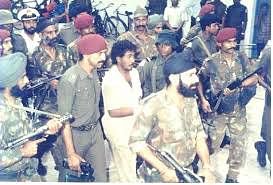
Indian paratroopers quickly secured an airfield and sailed to Male on a confiscated boat to rescue President Gayoom . Paratroopers handed over control of the capital to President Gayoom ‘s government within hours. Some of the mercenaries fled to Sri Lanka on a hijacked cargo ship. Those who could not arrive at the ship in time were immediately rounded up and handed over to the Maldivian armed Forces and government. According to reports, 19 people died in battle, most of them mercenaries. The dead included two hostages killed by mercenaries. And Operation Cactus took 18 hours for Indian Armed Forces from start to finish. Indian Navy frigate Godavari and Betwa intercepted a cargo ship off Sri Lanka and captured mercenaries. The swift intervention and accurate intelligence of the Indian Army was able to successfully subdue the coup attempted in the island nation.

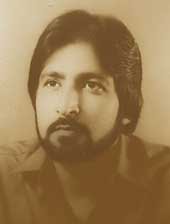
“Black Tiger” Of India Ravindra Kaushik.

Ravindra Kaushik who served in (R&AW) ,famously known as Black Tiger was born in Sri Ganganagar, Rajasthan on 11 April 1952 in a Brahmin family.
Ravindra during his graduation days used to do drama plays and during this time Kaushik displayed his talent at the national level dramatic meet in Lucknow, Uttar Pradesh, which was witnessed by officials from the Research and Analysis Wing. After which he was contacted and offered a job of being an undercover Operative for Research and Analysis Wing in Pakistan.

After agreeing to work for R&AW Kaushik was given extensive training in Delhi for two years. He underwent circumcision so he could pass as a Muslim. He was taught Urdu, given Islamic religious education and acquainted with the topography and other details about Pakistan. Being from Sri Ganganagar, a city near Rajasthan’s border with Punjab, he was well versed in Punjabi, which is widely understood in Punjab and Pakistan as well., India. In 1975, at the age of 23, He was sent to Pakistan.
Kaushik was given the cover name “Nabi Ahmed Shakir” and entered Pakistan in 1975. He was successful in getting admission in Karachi University and from where he completed his LLB. He then joined Pakistan Army as a commissioned officer and eventually promoted to the rank of a major. While living in Pakistan under his cover he married a local girl named Amanat, the daughter of a tailor in one of the army units, and with whom he fathered a boy .

From 1979 to 1983, while working as an officer, he passed on valuable information to R&AW which was of great help to India. He was given the title of ‘Black Tiger’ by India’s then home minister late S. B. Chavan.

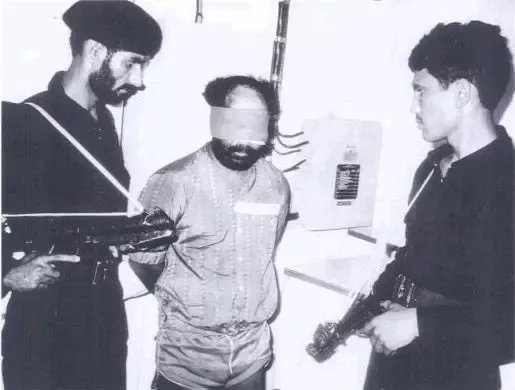
In September 1983, R&AW sent a low-level operative, Inyat Masih, to get in touch with Kaushik. However, Masih was caught by Joint Counterintelligence Bureau of Pakistan’s ISI and blew Kaushik’s cover. Kaushik was then captured, tortured for two years at an interrogation center in Sialkot. He was given the death sentence in 1985. His sentence was later commuted to a life term by the Supreme Court of Pakistan. He was kept in various jails in various cities, including Sialkot, Kot Lakhpat and in Mianwali jail for 16 years. He managed to secretly send letters to his family in India, which revealed his poor health condition and the trauma faced by him in Pakistani jails.He also adresses his thoughts on his country and department. In one of his letters he wrote:
“Kya Bharat jaise bade desh ke liye kurbani dene waalon ko yahi milta hai?” (Is this what people who sacrifice their lives for a big country like India get?”
In November 2001, he was caused with pulmonary tuberculosis and heart disease in Central Jail Mianwali in Pakistan.
He served for Research and Analysis Wing from 1975 to 1983.

“Writing about magic is harder than writing about spies because you’re dealing with something that doesn’t really exist.”

-Anthony Horowitz

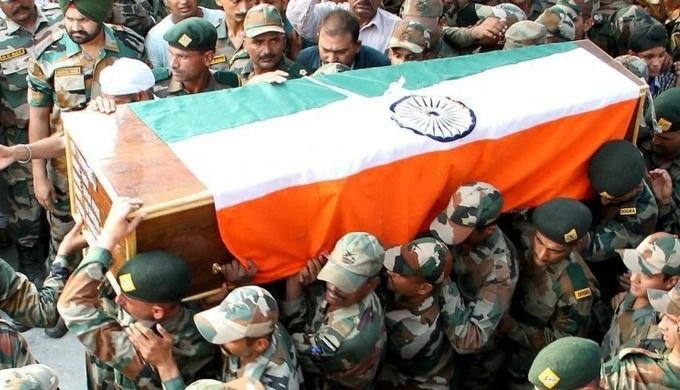
No use of ‘Martyr’ word in Army for death of on duty soldier .

History of the use of the word martyr:
The government has claimed for nearly a decade that the word “martyr” has not been officially recognized. In 2013 and 2014, in response to RTI’s request, the Ministry of Home Affairs revealed that the words “martyr” and “shahid” were not defined anywhere by the Government of India.
In December 2015, then Home Affair Minister Kireen Rijiju said in Lok Sabah that it is advised that the word “martyr” is not refer to any of the victims of the Indian army. He added that such terms were not used by Central Armed Police Forces (CAPF) and Assam Rifles personnel either.
In December 2021, Minister of State Home Nityanand Rai told Rajya Sabha again that there was no formal term like “martyr.”


Objections to the use of martyrs’ words:
The word “martyr” has religious implications and has historically been used to refer to people making sacrifices for their religious beliefs like in Christianity . The word “Shahid”, which is used as a Hindu alternative to the word “Martyr”, also has a religious meaning and is associated with the Islamic concept of Shahadat. The word “martyr” is said to be derived from the Greek word “martur”. In various dictionaries, “martyr” is defined as a person who is willing to die as a punishment for refusing to abandon religion.
Since the Indian army is not affiliated with any religion and does not sacrifice their lives for religious principles, the use of such words for their sacrifice is found wrong,including the supreme leader of the army. Using words like martyr may not be correct in context to armed forces especially in India according to many legal experts and prominent officers of army and retired officers.

Steps Taken By Government To Stop Use Of Martyr Word:
Despite the repeated assertions of the government about the word martyr having no official recognition, it was mostly used in government statements issued by various PR Officers for the defence services and the CAPFs. Many senior serving and retired officers also used it frequently to describe the death of soldiers in action. Thus, the word remained in common use.
The Army in 2022 issued a letter to all its commands asking them to abstain from using the word martyr as it may not be appropriate for soldiers who die in the line of duty. They have been, instead, asked to use phrases such as killed in action, supreme sacrifice for the nation, battle casualty, laid down their lives,veergati etc.

“Either I will come back after hoisting the tricolor, or I will come back wrapped in it, but I will be back for sure. “

-Late Captain Vikram Batra (PVC)

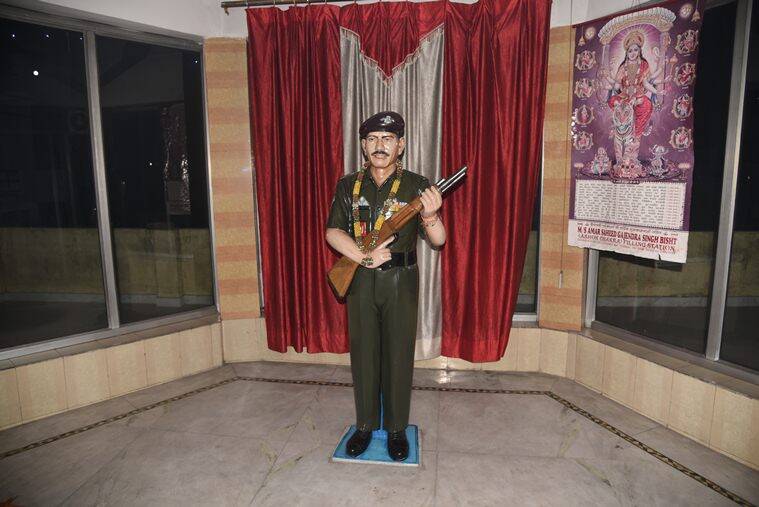
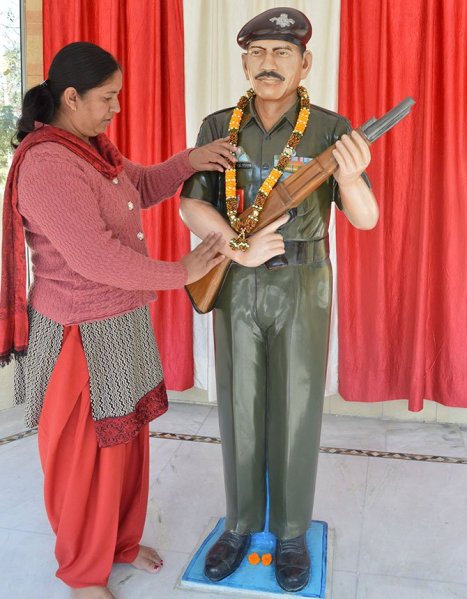
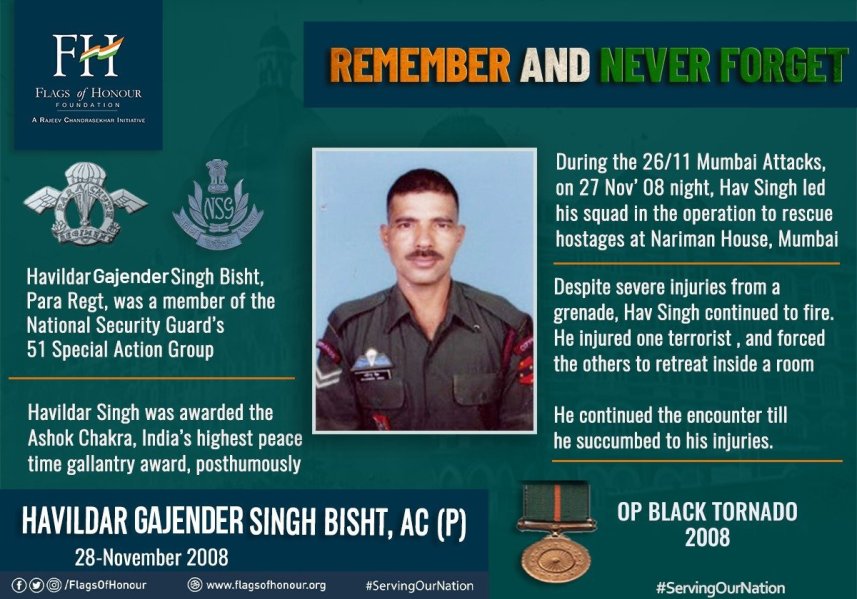
A warrior who can not be forgotten Hav. Gajender Singh Bisht.

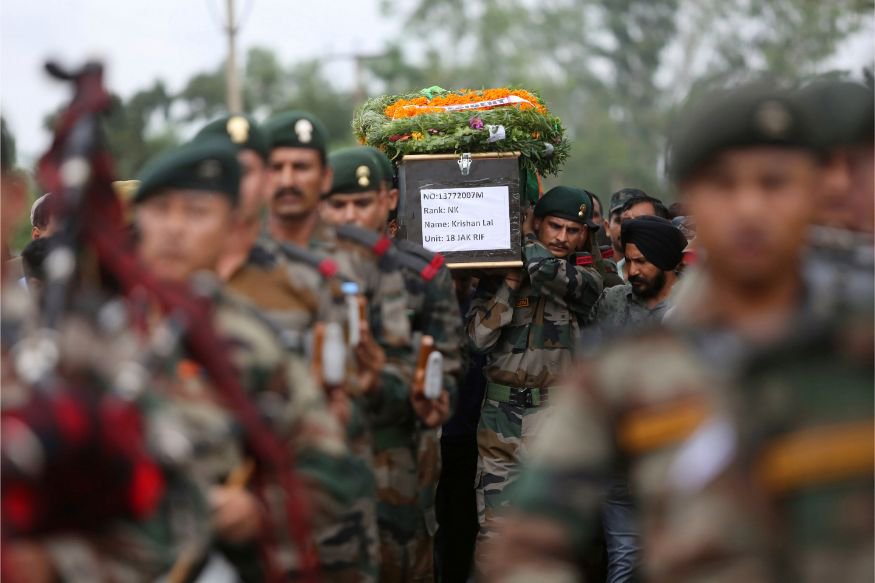
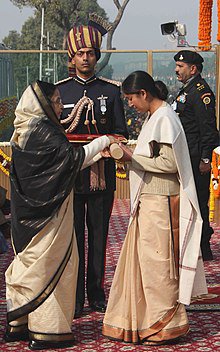
Havaldar Gajender Singh Bisht was an NSG commando who was martyred in the 2008 Mumbai attack. His bravery received the Ashoka Chakra Award from the President of India on January 26, 2009, on the Anniversary of the Republic of India.
He was born on 1 July,1972 in Dehradun, Uttarakhand.

He persued his education from the Janata Inter College in Naya Gaon.As a student he used to participate in every event organised in the school, sports or cultural activities. But he had a particular interest in boxing. Havaldar Gajendra Singh joined Garhwal Rifles in 1991 and later decided to become part of the 10 Para (Special Forces). Havaldar Gajendra also actively participated in Operation Kargil in 1999. Havaldar Gajendra was a trained commander of the Indian Army Special Forces, but he was commissioned to serve the National Security Guard’s Elite Special Action Group.
Gajendra Singh Bisht was a member of the 51st Special Action Group of the National Guard. He was part of a team of NSG Command rushed to the roof of Nariman’s house to neutralize an terrorist inside the building who had at least six hostages.


According to NSG Secretary Jyoti Krishna Dutt, Bisht led one of the teams entering the building. The team was hit by a violent terrorist attack and returned to fire while trying to contain the situation. Terrorists also threw some grenades at Commando. At this point,Bisht had the opportunity to retire with his team. But he realized they needed to seize this opportunity and went forward with thier mission.Instead of turning his back on the militants, he made the way to other troops instead, despite the grenades being thrown. He suffered multiple gunshot wounds in the process, but moved forward and was eventually injured. This allowed his team to secure a dominant position in the encounter. On the night of November 27, 2008, Havildar Gajender Singh Bisht led his army in an operation to rescue hostages from terrorists at the Nariman House in Mumbai. While securing the Nariman House during Operation Black Tornado, Bisht got fatally injured at Jewish center attack and died.

Agnipath Scheme a new vision for future India?


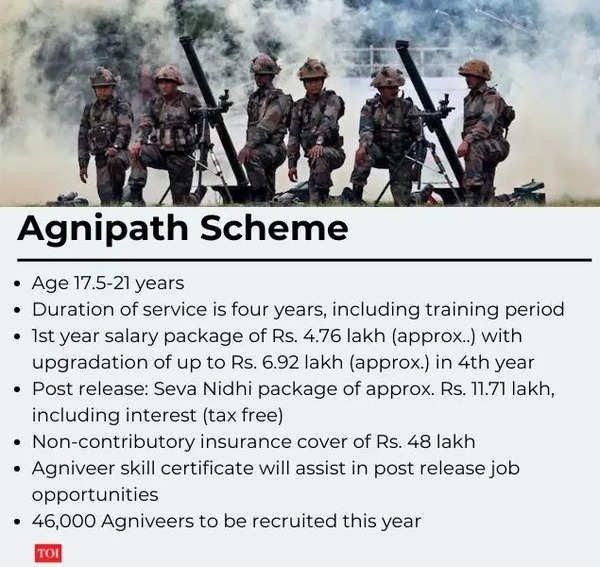
The Agnipath Program is a new program launched by the Government of India on June 14, 2022 to recruit soldiers under Corporal into three armies. The Agnipath program will be the only means of recruiting the military. All new employees will only be hired for 4 years. The personnel hired under this system are called Agniveers, a new military rank. The introduction of this system has been criticized for lack of consultation and open debate. The program is scheduled to start in September 2022. The Agnipath program was approved by the Government of India in June 2022 and will be implemented from September 2022. The announcement was made on June 14, 2022. This program is intended for both male and female applicants between the ages of 17.5 and 21. In widespread protests against the Agnipath program, the central government raised the cap from 21 to 23, but only in 2022. Recruitment under this program is held twice a year by the Indian Army, Indian Navy, and Indian Air Force. The available posts are below the executive list. The Agnipath program is the only way to serve in the army.


New employees, under the Agnipath scheme will be called “Agniveers,”who will have a four-year tenure, including six months of training followed by a 3.5-year deployment. After leaving the service, they have the opportunity to apply to continue in the army. Less than 25 percent of the retired group’s total strength is selected for the permanent roster. Employees who retire after four years of work are not eligible for a pension, but will receive a lump sum of approximately Rs 11,71,000 at the end of their tenure. The Government of India plans to hire 45,000-50,000 new employees each year through this program. In September 2022, 46,000 young people will be hired through this program. Prior to the start of the Agnipath program, soldiers were in the army for more than 15 years of service on a lifetime pension. As of 2019, there was no military recruitment for three years. The Government of India quoted the COVID-19 pandemic in India tye reason for no recruitment. Meanwhile, 50,000 to 60,000 soldiers continued to retire each year, leading to labor shortages and beginning to affect the military’s operational capabilities.


On June 16, 2022, fierce protests took place in several Indian states, where military candidates who were preparing for the armed forces were angry at the new system, demanding its rollback, and damaging public property. By June 17, 12 trains had been fired, affecting the movement of 300 trains. 214 trains were canceled, 11 trains were detoured, and 90 trains ended short of their destination. This scheme does not include long-term holdings, pensions and other benefits that existed in the old scheme. Individuals who wanted to join the army were disappointed with the rules of the new system. Of particular concern were short tenure, no early retirement pension, and an age limit of 17.5-21 years, making many of the current candidates unsuitable for serving in the Indian Army.

On June 20, a national strike called Bharat Bandh was summoned by a protesting organization calling for the withdrawal of the program. The call was made via social media without naming the organization. More than 600 trains were canceled due to a strike. Section 144 was imposed in parts of Rajasthan, Punjab, Uttar Pradesh and Haryana.

HUSTLE CULTURE A TREND OR TRENDING PROBLEM FOR THE YOUTH?

Image courtesy : thesolmag.com
http://thesolmag.com

The youth are more affected by this culture & it’s making their life miserable and the most important thing is they just don’t know how to stop worrying enough about it. 

The Orthodox or popular opinion of becoming successful and achieving it all very fast ; the ultimate respect status that comes with being the all achiever is Hustle culture, driven by the desire for more. 

We are compelled to believe that time is running out and that we must do more, achieve more in less time. The most essential goal in your life should be to prioritise achievement over anything else. It shouldn’t be a big deal to sacrifice your mental and physical health for your life satisfaction. As a consequence, the youth begins to believe. We are constantly seeking more from ourselves, others, and our life. Hustle culture arose from this constant desire for more. It’s also on the upswing.

Now wanting more isn’t necessarily a bad thing, but when it becomes excessive, it’s time to act.

Signs that you are a hustler :

1. You never stop overthinking –
Overanalyzing your life and ambitions lead you to constantly put self-limiting beliefs on yourself. Resulting in dread of the judgement, and assumption of the consequences which makes it worse.


2. You want to accomplish everything in one day – Being impatient with your goals and believing that completing more tasks more quickly than others will give you greater recognition and popularity.

3.You want to attain long-term goals in the short term- You focus on making the big leap instead of comprehending that it takes time, patience, and efforts to accomplish anything. Trying to skip the intermediate phases but fail and are left feeling unmotivated.


4. Trying to do all and more at once – You multitask all the time and put your work and aspirations before your needs for rest, sleep, and self-care.


5. Validation is what matters most to you – when people appreciate your achievements and proficiencies, your desire is stoked, but when it doesn’t, you spiral into self-doubt.

6.You are a materialistic life seeker – Quality of life and ideas don’t interest you & latest trends do. You are leading a typical life because you don’t know how to live otherwise

7.You feel guilty for not being productive enough– Often you feel terrible for putting comfort before your goals. Exhausting yourself completely is part of the process towards success.

8. Being ignorant about you mental health– As you pursue a career-oriented lifestyle, believing that this is the only way to gain respect and prestige, you start comparing yourself to others who are ahead of you and the seeds of self-doubt begin to grown in you.

9.You don’t put your health first – Your health is your most valuable asset and should always be prioritised above all else. Unfortunately, people frequently disregard this and endanger it in pursuit of mediocre accomplishments.

If you think you’re hustler, it’s time to take a moment and reflect. Hope you found this helpful.

Integration of Indian States of Independent India.

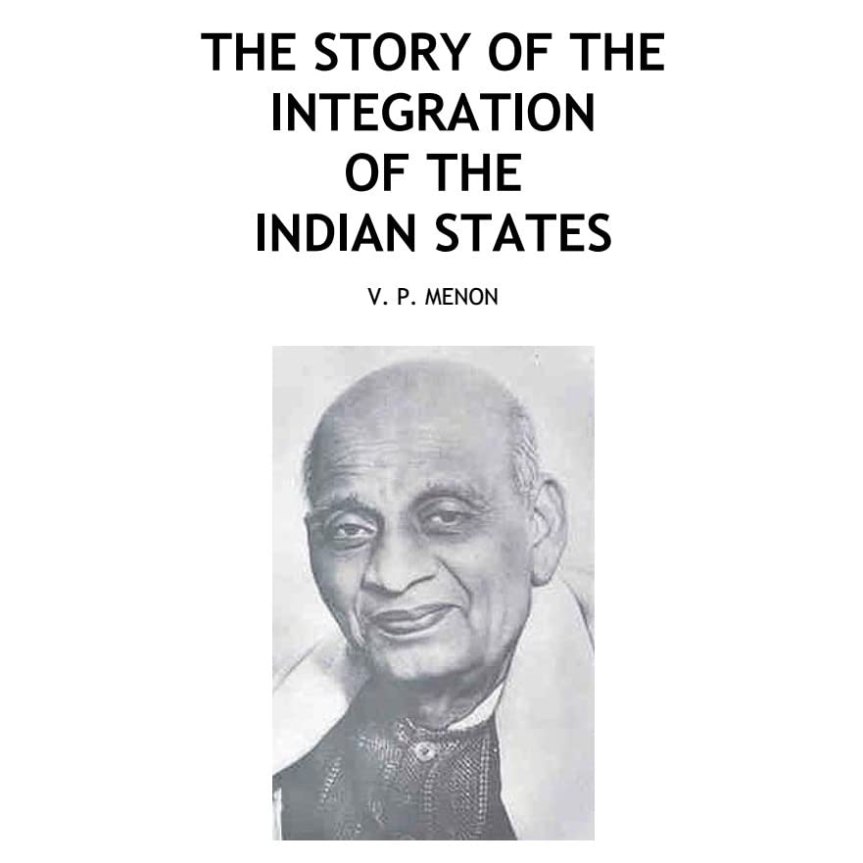
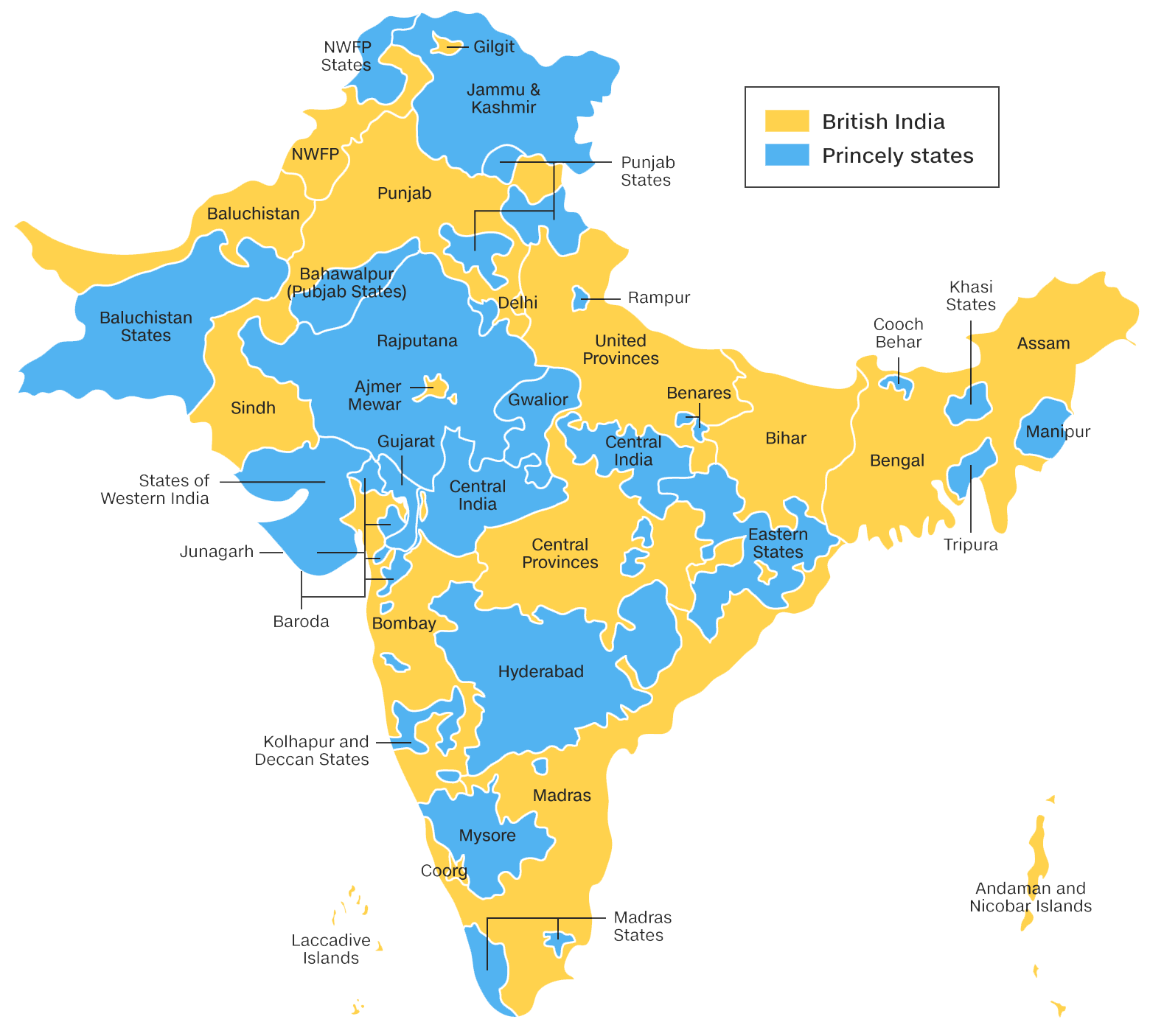
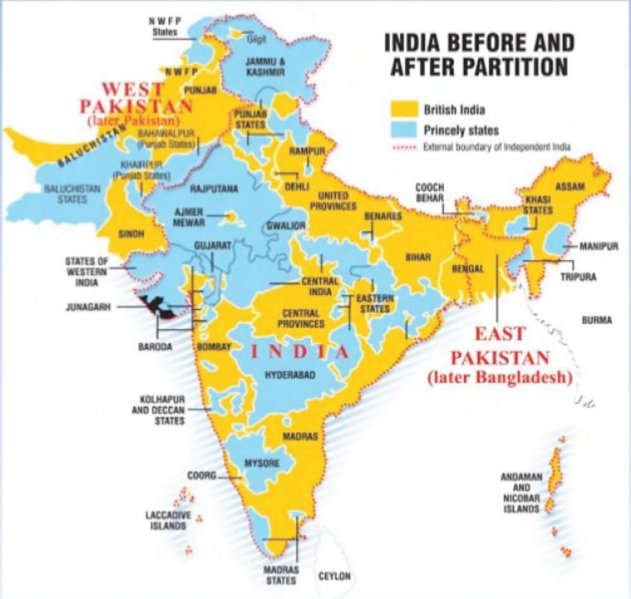
Sardar Vallabhbhai Patel played an important role in the integration of the princely state into the Dominion of India. This achievement laid the foundation for Patel’s popularity in the post-independence era. He is still remembered as the man who united India today. In this respect he is compared to Otto von Bismarck, who united many German states in 1871. The June 3 plan gave more than 565 princely states the option of joining India or Pakistan or choosing independence. Most Indian nationalists and the masses were afraid that most people and territories would be fragmented without the participation of these states. Parliament and British officials considered Patel to be the best man on a mission to secure the conquest of the princely state from Indian rule. According to Gandhi only Patel could solve this problem. Patel had practical insight and determination to accomplish monumental work. Patel asked V.P. Menon, a senior official involved in the division of India, to become his right-hand man as Principal Secretary of State. Patel used a social gathering and informal setting to involve most monarchs and invite them to their home in Delhi for lunch and tea. At these meetings, Patel stated that there was no essential conflict between Congress and the prince’s order. Patel aroused the patriotism of the Indian monarchs and urged them to embrace the independence of their country and act as responsible rulers who care for their people’s future. He persuaded the rulers of 565 states about the impossibility of independence from the Republic of India, especially in the face of rising opposition from their subject. He proposed favorable conditions for the merger, including the creation of a secret purse for the descendants of the ruler. Patel encouraged the rulers to act patrioticly, and to thought about his states people and their futur, but he did not rule out violence. He emphasized the need for the princes to join India in good faith and gave them to sign the membership certificate until August 15, 1947. All but three states were willing to join the Indian Union. Only Jammu and Kashmir, Junagad and Hyderabad were States which were tough to brought under Indian Dominion.


Junagadh being situated in Gujrat it was very important for Patel to bring it under Indian’s dominion. This was also important because there was the super-rich Somnath Temple (a temple where different stones were their including emeralds, diamonds, and gold which were looted by Mohd. Ghazni) in the Kathiawar district. Bieng under the pressure from Sir Shah Nawas Bhutto, a Nawab who joined Pakistan. However, it was far from Pakistan, with 80% of its state population being Hindus.Patel combining diplomacy and power, Pakistan invalidated Pakistan’s accession and demanded that Nawab join India. Patel sent troops to occupy the three principalities of Junagadh to show his determination. After widespread protests and the formation of the civilian government, or Aarzi Hukumat, both Bhutto and Nawab fled to Karachi, and under Patel’s orders, Indian troops and police forces invaded the state. A later organized referendum resulted in 99.5% of the votes in favor of the merger with India. After taking over, Patel, who spoke at the University of Bahauddin in Junagad, emphasized his sense of urgency regarding Hyderabad. He believes this is more important to India than Kashmir.


Hyderabad was the largest of the princely states and which included States parts of which are now Telangana, Arndra Pradesh, Karnataka and Maharashtra. Its ruler, Nizam Osman Ali Khan, was Muslim, but more than 80% of the population of state was Hindu. Nizam called for independence or accession to Pakistan. Under Kasim Razvi, an army of Nizam-faithful Islamic troops called Razakar urged Nizam to confront India and at the same time organize an attack on the people of India’s soil. The standstill agreement was signed by Lord Mountbatten’s in desperate efforts to avoid the war, but Nizam refused to trade and changed his position. At a cabinet meeting in September 1948, Patel emphasized that India should stop speaking and reconciled Nehru and Governor Chakravarti Rajgoparachari with military action. After preparation, Patel ordered the Indian troops to invade Hyderabad (in his position on behalf of the Prime Minister) when Nehru traveled to Europe. This action, called Operation Polo, in which thousands of Razakar troops were killed , but Hyderabad was secured and integrated into the Republic of India. Mountbatten and Nehru’s main goal was to avoid forced annexation to prevent the outbreak of Hindu and Muslim violence. Patel argued that if Hyderabad was allowed to survive as an independent state surrounded by India, the government’s fame would decline and neither Hindus nor Muslims would feel reassured in their empire. After defeating the Nizam, Patel held him as the head of state of the ritual and met with him. India had 562 princely states after addition of Junagarh, Heydrabad and Jammu& Kashmir.

Article 370 & Article 35A

Article 370
The first accession of Jammu and Kashmir, like all other princely states, involved three issues: defense, diplomacy, and communications. All princely states were invited to send representatives to the Constitutional Parliament, which drafted the Constitution across India. They were also encouraged to establish a constituent parliament for their own state. Most states were unable to establish a parliament in time, but some states, especially Saurashtra Union, Travancore-Cochin, and Mysore. The State Department had drafted a model state constitution, but on May 19, 1949, the governors and Chief ministers of each state met in the presence of the State Department and agreed that no separate state constitution was needed. They accepted the Indian Constitution as their own constitution. The state in which the elected constituent council proposed some changes that were accepted. Therefore, the status of all states has been placed on par with the status of ordinary Indian states. In particular, this meant that the subjects available for legislation by central and state governments were consistent and same throughout India.

In the case of Jammu and Kashmir, state politicians have decided to establish a separate constitutional council for the state. Representatives of the Indian Constitutional Assembly applied only the provisions of the Indian Constitution corresponding to the original accession documents to the state, and demanded that the state Constitutional Assembly decide on other matters. The Government of India agreed to the request shortly before its meeting with the other states on 19 May. Therefore, Article 370 was included in the Constitution of India, which provided that other provisions of the Constitution empowering the central government would apply to Jammu and Kashmir only with the approval of the State Constitutional Assembly.This was a “provisional provision” because it was applicable until the State Constitution was enacted and adopted. However, the State Constitutional Assembly was dissolved on January 25, 1957, and did not recommend the abolition or amendment of Article 370. This article was considered an integral part of the Indian Constitution, as confirmed by various recent April 2018 rulings by the Supreme Court of India and the Supreme Court of Jammu & Kashmir.

Article 35A
Article 35A of the Constitution of India was a provision authorized by state to define the “permanent residents” of Jammu and Kashmir State and to give them special rights and privileges. It was added to the Constitution by an Executive Order, the 1954 Constitutional Order (application to Jammu and Kashmir). It was issued by the President of India under Article 370. Jammu & Kashmir has these privileges, the ability to acquire land and real estate, vote and participate in elections, pursue government employment, and receive the benefits of other governments such as higher education and medical expenses. Defined to include. Non-permanent residents of the state were not eligible for these “privileges”, even if they were Indian citizens.

Korean wave in India.

The  Korean wave has certainly seen a significant  rise in India during the pandemic, and K-Drama and K-Pop are seeing massive demand from fans and new followers as well. In response to the growing popularity of the Korean wave in the country, many  online and offline events are held to show people  what they are consuming online. And these extend not only  to K-Drama and K-Pop, but also  to food, beauty and culture in general.
Korean singer PSY’s 2012 viral hit “Gangnam Style” may have started the Korean wave in India, but it certainly wasn’t the origin. The existence of K-POP in India dates back to the late 90’s when in Northeastern part  in Manipur Bollywood films were not allowed to watch because law imposed by the Separatist group Revolutionary Peoples Front to make Manipur independent.Not so much offered, the locals turned to Korean content and it got it’s popularity from their on.

Increasing demand for Korean content is fueling competition between India’s Amazon Prime Video and Netflix. Amazon Prime Video is the first company to launch Parasite and Minari in the country. Hotstar, MX Player, Viki and Viu are also involved in the Korean wave effect. Discovery + launched the “Star vs Food” series featuring the Korea Tourism Organization (KTO) and K-POP idols to introduce Korean food to India. Some prominent dramas are: Crash Landing on You, Squid Games, Descendants of the Sun and many more more , the reason of these Korean content popularity is that as an audiance, Indian’s  find Korean content relatable to them.

According to Hyun Woo, Kross Komix co-founder, president and CEO Thomas Kim predicts that South Korea’s webtoon, or digital comics, will be the next big thing.Kross Komics is India’s only webtoon platform  launched in December 2019. In just about 1.5 years of operation, the app has been downloaded more than 4.5 million times, about half of which are women. “With the numerous webtoons in the romance / romantic comedy category and the world’s best-selling stories, this new format of content has become a very interesting alternative to the dramas and movies”.

“In 2020, the blockade caused by Covid-19 is said to be one of the reason to the popularity and acceptance of Korean culture in India through dramas available on multiple video streaming platforms and the different Korean music band whose craze is extraordinary. South Korea’s food exports hit a record high,  boosted by social media posts from Asian celebrities and the popularity of the movie like “Parasite” and drama like”Crash Landing on You”. The widespread  of k-pop, k-movies, and k-drama has evolved into a  fan culture, especially among the  urban youth of the country. Following k-pop music and movies, K-Food and cooking have undergone a major makeover to reach the larger Indian market. K-cuisine is all the rage, especially on social media, in the form of food challenges like Mukbang, “said Hwang Il-young, director of the Korean Culture Center India .

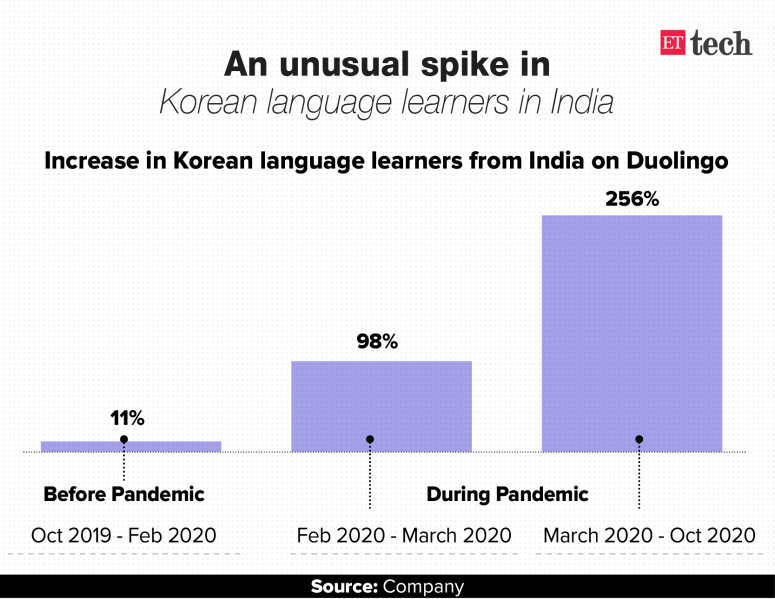
The Korean wave,  the growing global popularity of  Korean culture, swept India a few years ago, but  exploded during a pandemic. Supported by the OTT platform, which has a large investment in Korean programs, the number of people who started watching K-Drama and listening to K-Pop has skyrocketed. Recently, the language learning app Duolingo surveyed 1,013 people in 10  cities in India and found that Korean is  the fastest growing language in India. It was the 7th most popular language for Indians in 2020, but it has risen to the 5th in 2021 and will  continue to rise. Duolingo’s 2021 audio report attributed this primarily to the release of Squid Game in 2021.