Brief steps for innovation in the era of E-commerce

As the Economist Joseph Schumpeter said Entrepreneurs can’t sit idle and try to innovate. They are the people who have an uncanny sense of using the resources from less productive use to more productive use. They are the ones who do Value creation, this is what we call innovation.

E-commerce belongs to this generation and Technology is irreversible; no one can hold it back and only curiosity won’t help us. Research activity is also needed. Scientific knowledge is essential (supported). Research is also supplemented by Developmental activities (R&D), closer to practical uses.

The Technological Innovation world involves product and process development activities (converted into manifestation forms). Then it transcends to the market/people with practical uses. Invention and discoveries constitute the technology world/innovation world- product process- market development activities (Administrative capabilities needed as well).

This all has to be assembled holistically and make the tech happen/forward driven with innovation. Business world needs tech entrepreneurship and administrative skills.

We have to question what value the tech will bring to our product. Simple innovation without value creation cannot create Blue Ocean/has no meaning.

Technological importance means the value that the technology brings to a product/potential product

We have to ensure not to bring value to other products in the competition. We need technological positioning. Frontier-ending R&D investment is needed to compete with the rival companies that are deeply entrenched in technology. Keep competitive parity is not an advantage.  

A technology portfolio consists of- Bet, Draw, Cash, and Fold

Regime of Appropriability

Is the effectiveness of legal mechanisms of protection of technology, Patents, copyrights, trade secrets, tacit knowledge, and codified knowledge.

Process innovation can’t be protected by patents.

Codified knowledge is very prone to industrial espionage, in other words, Hiring people from other companies. The regime of appropriability can be from high to low depending on the technology. E.g. KFC spice formula (easy to safeguard) or a new search algorithm (hard to seep safe).

Any innovation passes through two stages-

Pre Paradigm and Paradigm stage

Pre Paradigm is when a technology is in the process of innovation. Every innovation goes through this stage when it remains in the domain of the innovators and scientists.

In the Paradigm stage product designs are fluid and the manufacturing process is loosely organized whereas in the Paradigm stage less uncertainty for the design emerges and a final design emerges. The focus is now on process design.

Our objective is to transit from the pre paradigm stage to the paradigm stage as fast as possible. Successful transit of tech to practical use is called commercialization and has to be ensured with another set of capabilities called complementary assets.

The tinkering or invention needs to be followed by research and then a complimentary stage in development. Entrepreneurs have to ensure that complementary assets have to be built around innovation to be successful. Innovators need to have certain complementary assets which are not generic (highly specialized).

There is a third category of assets called Co specialized. These assets have a bilateral dependence. These assets have no other use other than their intended use. E.g.: A spacecraft manufacturing facility.

Many innovators fail and succumb and they don’t have the complementary assets. To counter that, entrepreneurs can do collaborative strategy by collaborating with partners with complementary assets. It should exclude the possibility of any other collaboration.  

Technology has to be adopted by people otherwise, it has no meaning. Early adopters need to leverage by patronizing the products. This gives way to the early majority who are more market-orientated. If they are satisfied they give way to the late majority. This transition will secure our position in the market.

But there is a catch, when technology falls between the transition space of early adopters and the early majority. This is known as ‘Chasm’. This change in emphasis poses a problem for innovating firms since incumbents are often much better equipped to meet the desire for complete products and low-risk purchases,and once you fall into this space. It gets really difficult to get out of it. A tornado (another group of people) is needed to take it out of the chasm and hit it into the mainstream.

E-commerce implementation can have two strategies:

Bottom-up approach and Top-down approach

Introduction of Ecommerce has complemented traditional business. This has also made traditional businesses more competitive.

Top-down approach implementation is preferred on a large scale and national level but when it comes to administrative (meeting the requirements of civil services), local trade and commerce services are suited to have a bottom-up approach.

Digital infrastructure is essential for making e-commerce successful. Cradle to grave digital identity is emerging as the new measure to the unique identification of people.

Common service center: Helps in providing e-Services to rural and remote locations where availability of computers and Internet is negligible or mostly absent. With the help of Interoperability and common information center data and information can be accessed at any location.

Mobile banking is another approach that is also increasing its proliferation.  But it’s still in its nascent stages.

Another concept that is emerging is Cashless transactions where all the POS and banking services can be attained remotely. Although the security issue remains which has to be taken care of by a central agency (Government).

One of the most important things to consider is Digital literacy. A certain amount of literacy is needed for availing all these digital infrastructure and access. For a widespread utilization of digital services, we have to ensure that more people are digitally literate.

We also have to keep in mind that common support ICT infrastructure and adequate private and public partnership will help to make these services more efficient and better.  With the help of aforementioned knowledge, an E-commerce can certainly endure in the realm of digital world.

References:

https://www.reed.edu/economics/parker/f10/201/cases/appropriability.html

https://smallbusiness.chron.com/stages-paradigm-shift-organization-78904.html
The ‘holy grail’ of batteries: Scientists create a ‘iron-air’ battery that rusts and stores power for days at a tenth of the price of lithium-ion batteries.

In the United States, an ‘on-air battery has been created that can hold electricity generated by wind or solar power plants for days before gently discharging it to the grid.

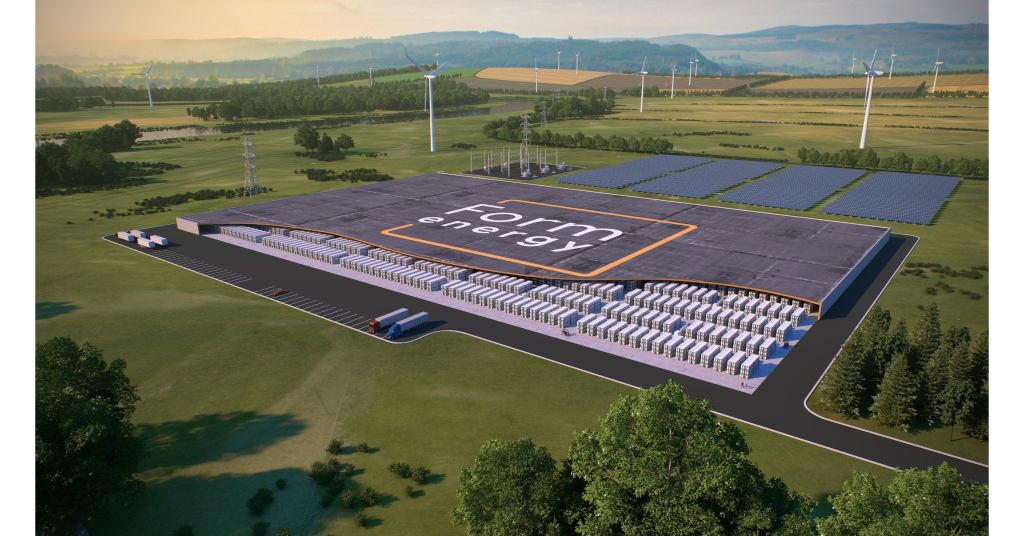
Form Energy intends to stack thousands of its “iron-air” batteries together in massive warehouses, as seen in this illustration.

According to Form Energy, a technological firm based in Massachusetts, it will help combat climate change by eliminating the demand for fossil fuel power plants.

The Iron-Air battery is a ‘new kind of cost-effective, multi-day energy storage device,’ capable of supplying electricity for 100 hours at a fraction of the cost of lithium-Ion, the renewable energy technology’s “holy grail.”

It’s constructed of iron, one of the most abundant elements on the planet, and it operates by inhaling oxygen, changing iron to rust, and then converting rust back to iron.

It is charging and discharging the battery as it takes in oxygen and transforms iron back and forth, a process that allows the energy to be held for longer.

According to the company, the batteries are too hefty for use in electric automobiles since they are intended to handle the difficulty of maintaining a consistent power supply.

This will address one of the renewable energy’s most vexing problems: how to store vast amounts of electricity inexpensively and provide it to power networks when the sun isn’t shining for solar panels or the wind isn’t blowing for turbines.

Solar and wind resources are the cheapest sources of energy in much of the globe, but unlike fossil fuel power plants, they do not provide a consistent supply.

The electric grid now has to figure out how to deal with this supply unpredictability while maintaining electricity dependability and cost.

According to Form Energy, their innovative battery technology is the answer to this rising problem.

According to Mateo Jaramillo, CEO and Co-Founder of Form Energy, the company performed a thorough analysis of all existing technologies and ultimately redesigned the iron-air battery.

This was done to ‘optimize it for multi-day energy storage for the electric grid,’ according to the researchers.

According to the company, the battery they are creating would enable governments to retire thermal assets such as coal and natural gas power facilities completely.

‘We’re attacking the largest obstacle to deep decarbonization with this technology: making renewable energy accessible when and where it’s required, even over several days of harsh weather or grid disruptions,’ Jaramillo explained.

It will also be less expensive, according to the company. Nickel, cobalt, lithium, and manganese minerals are used in lithium-ion battery cells, which can cost up to $80 per kilowatt-hour of storage.

Form hopes to reduce mineral prices for each cell to less than $6 per kilowatt-hour by using iron and to maintain the cost of a whole battery system to less than $20 per kilowatt-hour of energy storage by cramming them into a full battery system.

Renewables will eventually be able to replace traditional fossil-fuel power facilities at this pricing range, according to experts.

Breakthrough Energy Ventures, a climate investment fund sponsored by Bill Gates, Jeff Bezos, and others, is one of the firm’s investors. They’ve also received investment from ArcelorMittal, the world’s largest iron-ore producer.

HOW DOES AN IRON-AIR BATTERY WORK?

According to the company, the primary concept of functioning is reversible rusting.

The battery takes in oxygen from the air during discharging and transforms ferrous metal into rust.

The introduction of an electrical current during charging transforms the rust to iron, and the battery exhales oxygen.

They collect energy from renewable sources, store it for up to 150 hours, and then discharge it to the grid when renewables are unavailable.

Each battery is just around the size of a washing machine.

Each of these modules is filled with a non-flammable, water-based electrolyte similar to that found in AA batteries.

Stacks of 10 to 20 meter-scale cells, which comprise iron electrodes and air electrodes, the elements of the battery that enable electrochemical processes to store and release electricity, are contained within the liquid electrolyte.

Thousands of battery modules are joined together in modular megawatt-scale power blocks, which are housed in an environmentally protected container.

Tens to hundreds of these power blocks will be linked to the energy grid, depending on the scale of the system.

A one-megawatt system, in its most compact form, takes roughly one acre of land.

3MW/acre can be achieved with higher density designs.

Visual Culture: How Visual is always contaminated by Non-Visual?

A creator may create an image but that single image can have multiple meanings for different individuals that may or may not go with what the creator was trying to convey. Such is the situation today where “visual” holds massive influence and power on the masses. The meaning of whatever we see around us is very subjective in nature, that is, it depends from person to person. And all the meanings that we derive from seeing something around us depends on our personal experiences and backgrounds we come from. The visuals can be decrypted by many according to their own thoughts.

https://whatzviral.com/wp-content/uploads/2019/01/19-2.jpg

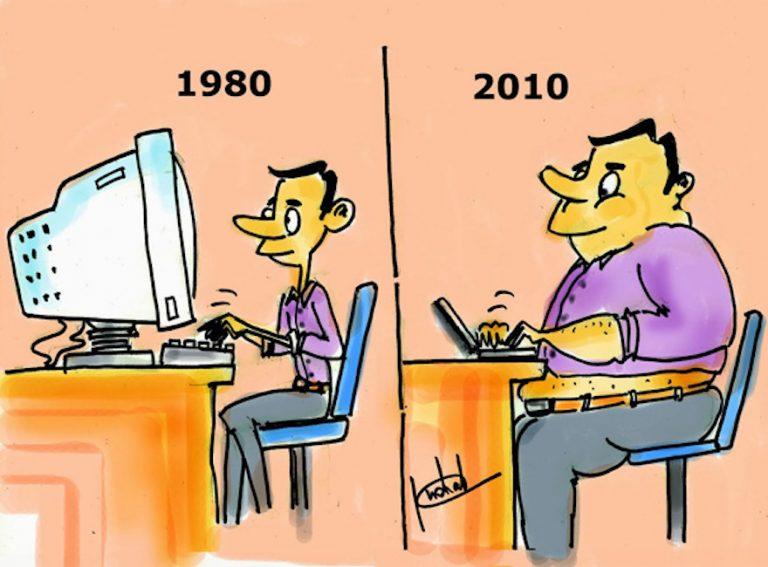
In the above picture, the creator was trying to convey how over the time we have so much indulged ourselves in technology that we have forgot to give time to ourselves and stopped caring about our health. However different people may interpret the image in different ways using their own understandings and logics like some may think this image shows advancement of technology from heavy computers to light weight laptops, some may think this picture shows the same person who has grown old in these 30 years.

The visual has risen steadily in importance in our culture. The presence of visual images has progressed from the high art of painting through various media such as still photographs, play television, video games etc. The increasing availability of various technologies has led to a massive presence of visuals around us.

Reading an image is about interrogating and playing with the separate elements that compose it to provide some private meaning. If we consider an “image” to be a combination of characteristics, then each one of us reading an image would construct and combine those characteristics attached to it and analyse it in new and unique ways.

The act of reading an image produces myths. It assembles in our minds various characteristics of image, some of which may change on subsequent readings and some of which may be undesirable. When we try to study an image, the image is brought into the world of discourse and meanings are constructed from and through them. . Images can become valuable if they generate powerful connotative meanings or if they are manipulated easily. Images acting as signifiers can evoke different meanings and examination of these images introduce the discourse.

Another example could be:

JapaneseGP: electric mini bike race - YouTube

The above picture is from a mini bike race in Japan, in which the creator wanted to convey the “peculiarness” of the picture, that is, adults on mini bikes. Some may just focus on those mini bikes or some may just see it as a normal bike race or some may see how the one in the far right is going out of the lane or some may see all of the above mentioned and all of this depends upon the interests and thinking capacity of individuals.

Conclusion: Every picture says something and every picture is trying to convey us a message, even though a picture may not look thought provoking, it carries come thought or meaning in some or the other way. Several factors are involved in the evolution or what we can say is “contamination” or pollution of image or visuals. What a creator is trying to convey through a message can be completely different from how the viewer interprets and decrypts it. Every individual can have several different meanings about the same visual that can be positive, negative or both depending on his interests and background.

MEANING OF LEARNING

Why Learning Experience Matters | Litmos Blog

Generally people think that learning through practice is to make someone better than what he/she was earlier . To think so is not complete appropriate . However, it cannot be denied that there is an improvement as a result of learning . But it can lead towards unwanted or undesired changes . A child who plays football, may also learn wrong technique . Indeed , learning has a detailed explanation . The process of learning begins from the birth and continues throughout life. That is why it is said that learning takes place from womb to tomb. Learning means to adjust or adapt oneself according to the situation . There is a change in the behaviour of an individual after learning and he changes himself according to situations . The various psychologists have defined learning in different ways. However, they reach approximately at the same point . There are following definitions of learning by some eminent psychologists.

  • According to Guilford, ”We may define the term very broadly in saying that learning is any change in behaviour resulting from behaviour.”
  • According to R.S. Woodworth and D.G. Marquis, Learning consists in doing something new provided, this something new to be retained by the individual and reappears in his later activities.’
  • According to G. Murphy , ‘‘From this point of view it would be legitimate to regard learning as modification both of behaviour and of the way of perceiving.”
  • According to Whitkar, ”Learning may be defined as the process by which behaviour originates or is altered through training or experience.”

On the basis of the above-mentioned definitions, the following conclusions can be drawn :

  • Learning is adaptation and adjustment .
  • Learning is a continuous process.
  • Learning is universal.
  • Learning is a change in behaviour.
  • Learning is improvement and development .
  • Learning is a new organisation of experiences.
  • Learning is purposive and goal directed.

IIT-MADRAS, AVISHKAR HYPERLOOP TEAM QUALIFIES FOR EUROPEAN HYPERLOOP WEEK

A group of students with team named “AVISHKAR” from IIT Madras have been working tremendously towards the technology behind the future of transportation, HYPERLOOP. The team comprises of forty students from various department of IIT, madras. They have been working on this new prototype hyperloop project since last November.

BUT, WHAT IS HYPERLOOP?

Basically, hyperloop is a high speed mass transportation system. A hyperloop is a super speed ground-level transportation system in which people could travel in a hovering pod inside a vacuum tube at speeds as high as 760 mph (1220 km/h).

While talking about the product, Neel said, “Hyperloop is a proposed mode of transportation in which many pods will be traveling inside a vacuum tube, capable of attaining high speeds due to no air friction and reduced air drag.” It IS the fifth and most efficient mode of transportation that the world is moving towards, he added. Further he said, “Because Hyperloop is sustainable, it works on electrical energy, we can install Solar panels on top of the tube, which could store energy and the same energy could be used to propel the hyperloop. This is way more sustainable .”

HOW DOES A HYPERLOOP WORK?

It has three major components: a tube, pod, and terminal. The tube is a large low pressure system that is sealed and tube can be constructed either above or below the ground. A pod is a coach that runs inside this controlled system and this pod employs magnetic or aerodynamic levitation along with electromagnetic or aerodynamic propulsion to glide along a fixed guideway. The terminals are used for arrivals and departures. Hyperloop is based on simple science called Magnetic levitation. But one thing that needs to be noted is, that it requires complex machinery and sensors to make a Pod travel at nearly 1000 km/h inside a vacuum tube. However the team has cracked that and named their pod “GARV”, which translates to “PRIDE”. It consists of Carbon Fiber shell, packed with advanced machinery and sensors.

STATEMENT:

Pranit, who is Head of Braking Module, said that Garv is their second Pod which is more efficient and lighter than the one they designed for SpaceX. “This time we are introducing several technologies like linear induction motor to achieve ‘contactless propulsion’ and ‘contactless braking. The motor produces a magnetic field which makes the Pod move forward and the contactless Braking has magnets which come closer to the rail, creating a Braking force and decelerating the Pod,” Pranit added.

Parth, a member of the Controls team, said, “Our team started in November. Everything we did online such as brainstorming sessions and discussions about the simulations. Once we were confident, we came back to the institute and started working on the Pod.” He said, “We are participating in European Hyperloop Week which will be conducted on 19th – 25th July and Valencia, Spain. Because of the pandemic, we are forced to compete virtually, but that is not a setback for us.”

EUROPEAN HYPERLOOP WEEK SELECTION:

With all their hard work, they have now crossed the hurdle and are qualified for the European Hyperloop Week that is to be held in Valencia, Spain from July 19 to 25. The team will participate virtually due to pandemic restrictions. With upgraded prototype, the team estimates the travel time between Chennai and Bangalore to be a mere 30 minutes ride instead of a six hours journey. They are also working on the study of energy, costs, demands and other aspects of hyperloop so as to access the economic feasibility of hyperloop in India.

India is pressuring Twitter with requests for user data and content removal.

This year, Twitter is under a lot of pressure in India. However, even before the country imposed stringent new regulations on tech firms, the corporation was bombarded with requests from the government to delete material or disclose user data.

Indian authorities requested more account information from Twitter in the final six months of 2020 than any other nation, according to the Silicon Valley-based company’s newest transparency report released on Wednesday. The number of requests for content removal submitted by India increased by 152% to over 7,000.

This journalist explains why one of her tweets vanished.

India’s demands for user information amounted to 25% of the total it received during the reporting period, which runs from July 1 to December 31, 2020, according to Twitter (TWTR). Over 99 percent of the requests were ignored by Twitter.

“Notably, this is the first time since we began releasing our transparency report in 2012 that the US is not the top worldwide requester,” the firm stated, adding that the US came in second in terms of global volume.

According to the company, the information requests comprised normal legal demands as well as emergency requests from government agencies and law enforcement authorities.

“Where appropriate, Twitter will push back on requests for account information that are incomplete or inappropriate,” according to the firm, such as those that are “invalid or overbroad in scope.” In the event of an emergency involving the risk of death or serious harm, the firm may reveal account information if sufficient proof is presented that such information will prevent the hazards.

Just over 150 information requests from India were classed as emergencies by Twitter. According to the firm, the United States sent the most such requests in the globe, with 822.

Meanwhile, legal requests from India to delete or withhold information increased by 152% in the latter six months of 2020 compared to the previous reporting period. Just over 9% of the 6,971 demands were met, according to Twitter.

After Japan, which made over 16,000 requests mostly connected to narcotics, obscenity, or money lending, India became the world’s second-highest submitter of such requests. The number of requests from Japan decreased by 16 percent from the previous quarter, but it still accounted for 43 percent of all worldwide requests.

According to the firm, 361 requests for information removal were made on 199 verified journalist and news outlet accounts throughout the world. It went on to say that India accounted for 128 of the requests.

The research excludes 2021 when Twitter is embroiled in a heated standoff with the Indian government over new information technology regulations.

During a series of farmer demonstrations in February, the business fought with the Ministry of Electronics and Information Technology over accounts that the agency wanted to be taken down. Some of the requests were granted, but Twitter declined to take action against accounts belonging to journalists, activists, or politicians.

Weeks after the feud, India issued new rules requiring social media companies to establish three roles in the country: a “compliance officer” who will ensure that their platforms comply with local laws, a “grievance officer” who will handle complaints from Indian users about their platforms, and a “contact person” who will be available to Indian law enforcement 24 hours a day, seven days a week. They are all required to live in India. If authorities demand it, companies must track out the “first originator” of messages.

In May, the firm raised worries about “fundamental components of the new IT Rules” as well as the country’s “potential threat to freedom of speech.” It promised to fulfill the new standards a few days later.

A Delhi court recently chastised Twitter for failing to comply with the new guidelines promptly. In a court filing last week, the business stated that it had appointed an interim compliance officer. It also stated in the filing that it will “attempt in good faith to make an offer of employment to a qualified candidate” for all of the positions within eight weeks.

The company’s website featured a complaints officer and a Bangalore location where Twitter could be reached as of last weekend.

Personal Software Process (PSP) – In Short

What is PSP ?

 PSP (Personal Software Process) provide a standard personal process structure for software developers.
 PSP consists of a set of methods, tables, scripts etc. that serve as a guideline for software developers to
plan, measure and manage their work, including how to define their processes and measure quality and productivity.
 PSP provides software engineers disciplined methods for improving personal software development process.

PSP helps software engineers to –

 Improve their estimating and planning skill.
 Make commitment they can keep.
 Manage the quality of their product.
 Reduce the number of defects in their work.
 PSP represents metrics based approach to software engineering.
 PSP deals with software engineers to identify the errors early and to understand the types of errors.

  1. PSP Activities
  1. Planning: This activity isolates requirements and specifications to be decided prior to the development
    and estimates the size and the cost of the project. Defect estimation is also made. Development tasks
    are identified and scheduled is created.
  2. High-Level Design: External specifications and requirements for each component to be constructed
    and developed. Component design is also created. Prototypes are developed if requirements are
    complex.
  3. High Level Design Review: Formal verification methods are applied to uncover errors in the design.
  4. Development: The component level design is reviewed and refined. The code is generated, reviewed,
    compiled and tested.
  5. Postmortem: Using Metrics and measures the effectiveness of the process is determined. It provides
    guidance for modification of process and its improvement.

2. Goal of PSP

The goal of PSP is to provide software engineers with disciplined methods for improving personal
software development.

3. Advantages of PSP

  1. PSP represents a disciplined, metrics-based approach to software engineering.
  2. PSP resulting improvement in software engineering productivity and software quality are significant.
  1. It helps the software engineers in developing high quality software products.
  2. It guides the engineer for personal improvement.
  3. It gives the confidence to do the job the way you know you should.
  4. The PSP gives the command over your work.

4. Disadvantages of PSP

  1. PSP is intellectually challenging and demands a level of commitment which is always not possible
    to obtain.
  1. Training for PSP is lengthy and costs for the training are high.
  2. Required level of measurement is culturally difficult.

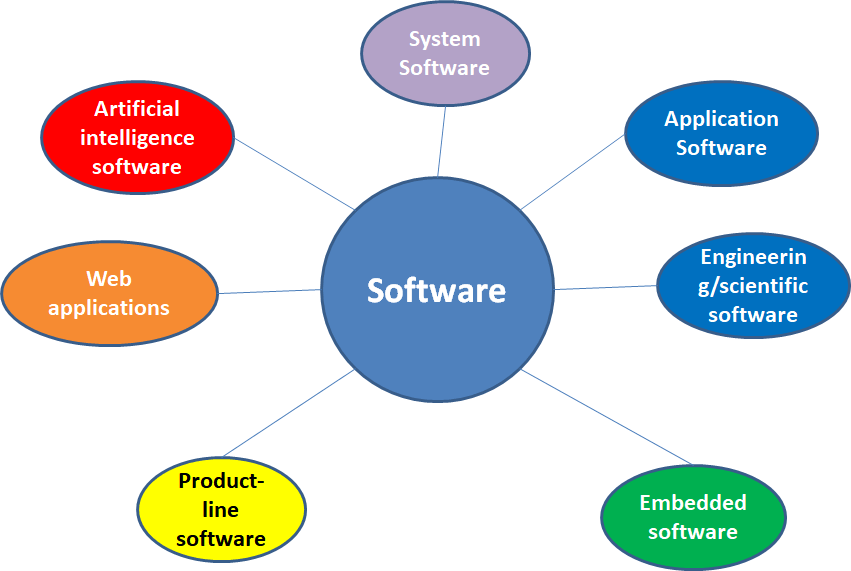
Types of Software

Software categories are groups of software. They allow software to be understood in terms of those categories, instead of the particularities of each package. Different classification schemes consider different aspects of software. 

  1. System Software

 System software is a collection of programs written to service other programs.
 Ex. Compilers, Editor, operating system, drivers etc

2. Real – Time Software

 Software that monitors or analyzes or controls real-world events as they occur is called real time.
 Elements of real-time software include a data gathering component that collects and formats
information from an external environment, an analysis component that transforms information as
required by the application.
 A control/output component that responds to the external environment and a monitoring component
that coordinates all other components so that real-time response can be maintained.
 Ex. Weather Forecasting

3. Application Software

 Application software consists of standalone programs that solve a specific business need.
 Application software is used to control the business function in real-time.
 Application software processes business or technical data.

 Ex. Transaction Processing, Sales Processing, Manufacturing Software etc.

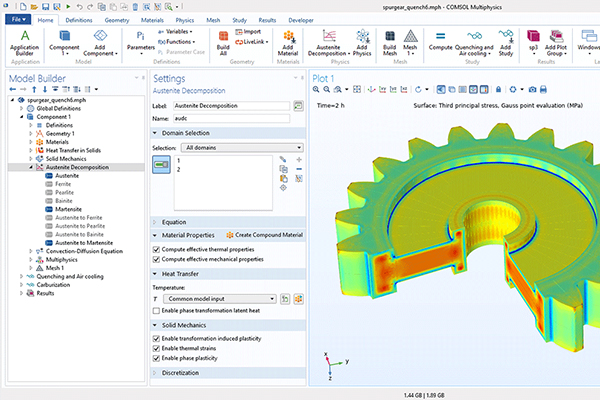
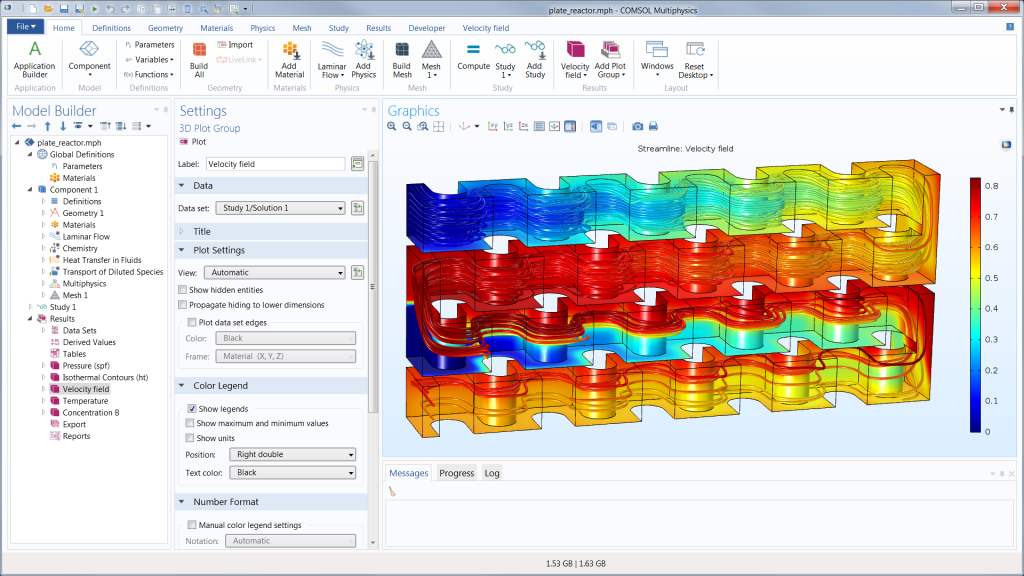
4. Engineering/Scientific Software

 Characterized by “number crunching” algorithms.
 Application software is set of programs designed for engineering and scientific purposes.
 Applications range from astronomy to volcano logy, from automotive stress analysis to space shuttle
orbital dynamics, and from molecular biology to automated manufacturing.
 Ex. Computer Aided Design (CAD), system stimulation etc.

5. Embedded Software

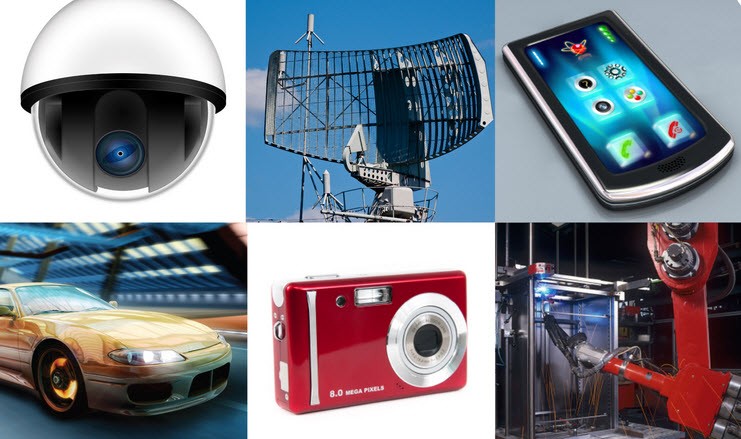
 Intelligent products have become common place in nearly every consumer and industrial market.
 Embedded Software resides within product and is used to control products and systems for the
consumer.
 Embedded software can perform limited and esoteric functions.
 Ex. Keypad control for a microwave oven, digital functions in an automobile such as fuel control,
dashboard displays, and braking systems.

6. Product line Software

 Designed to provide a specific capability for use by many different customers.
 Product line software can focus on a limited and esoteric marketplace.
 Ex. Word processing, spreadsheet, CG, multimedia, etc.

7. Web Based Software

 The Web pages retrieved by a browser are software that incorporates executable instructions and data.
 Web apps can be little more than a set of linked hypertext files.
 It evolves into sophisticated computing environments that not only provide standalone features,
functions but also integrated with corporate database and business applications.

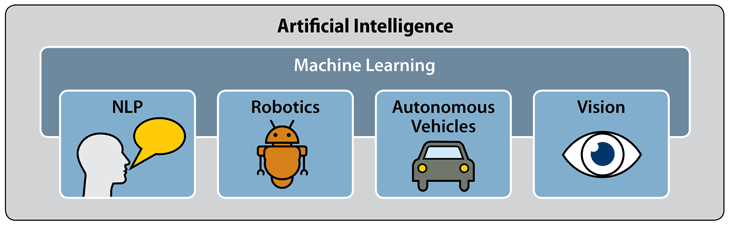
8. Artificial Intelligence Software

 AI software makes use of non-numerical algorithms to solve complex problems that are not amenable
to computation or straightforward analysis
 Ex. Robotics, expert system, game playing, pattern recognition, theorem providing etc.

How artificial intelligence is replacing humans?

Artificial intelligence, this is not a new name. This is the most trending subject in this 21st century. Examples of artificial intelligence Alexa, google assistant, Siri etc. In this blog, we are going to see what is artificial intelligence? Type of artificial intelligence, Can machines think? How artificial intelligence is replacing humans? Advantages and disadvantages of AI?

WHAT IS ARTIFICIAL INTELLIGENCE ?

Artificial Intelligence commonly known as AI is the intelligence represented by machines, as opposed to natural intelligence display by humans. AI is an interdisciplinary science with multiple approaches. Based on capabilities AI can be classified into weak AI, strong AI, and super AI. Weak AI can focus on only one task and it cannot go beyond its limitations. Strong AI can understand and learn that much of a human. Super AI suppresses human intelligence and can perform task better and beyond human intelligence.

TYPES OF ARTIFICIAL INTELLIGENCE

There are four types of artificial intelligence, they are Reactive machines, Limited memory, Theory of mind, Self awareness.

  1. Reactive machines

This is the simplest level of Artificial Intelligence. Reactive machines performs basic operations. No learning occurs in this type. This is the first stage of artificial intelligence system. It doesn’t have past memory and cannot use past memory for future actions. Examples of reactive memory are Static machine learning models, and IBM chess program.

2. Limited memory

Limited memory of AI has the ability to store past memory and predictions and use the data to make future predictions. With limited memory, machine learning architecture become more complex. The examples of limited memory are self-driving cars are the best example. There are three types of limited memory –

i) Reinforcement learning

ii) Long short term memory(LSTM)

iii) Evolutionary Generative Adversarial Networks(EGAN)

3. Theory of Mind

This is the advanced type of artificial intelligence. Theory of mind refers to the ability of human mind to attribute mental states or others is a key component of human cognition.

4. Self awareness

Self awareness is more advanced type of artificial intelligence. It is the final step of AI development to build systems that can form representation of themselves.

CAN MACHINES THINK?

The biggest question in our mind is can machines think like humans? machines do not have feeling, emotions and consciousness. Therefore the artificial intelligence cannot think like us. The artificial intelligence is in the beginning stage in this world right now. But in future when artificial intelligence is in the advanced stage, scientist suggests that there may be a possibility. AI is programmed by humans into every machine to perform a certain task. Therefore AI cannot think and take decisions on its own. Therefore AI cannot think.

HOW ARTIFICIAL INTELLIGENCE IS REPLACING HUMANS?

In earlier day, people used to work in the factories but now machines are working in place of humans. Now the question comes Can artificial intelligence is replace humans? the answer is yes, we have seen robots replacing human works in a organization. As we known that AI is in the beginning stage of development. Experts suggest that AI can replace human work in the future. A study suggests that AI will replace 30 percent of human labor in 2030.

ADVANTAGES OF ARTIFICIAL INTELLIGENCE

  1. AI takes only certain time to perform a task.
  2. AI can do the complex tasks in seconds.
  3. AI is available for 24×7 by a day.
  4. AI can reduce error and increase accuracy.

DISADVANTAGES OF ARTIFICIAL INTELLIGENCE

  1. Creating a machine that could simulate human intelligence requires a lot of time and lot of money.
  2. AI cannot think beyond its box. There is no creativity for AI.
  3. AI will increase the unemployment rate, as it will replace human labor.

Steam Deck: Nintendo Switch's newest competitor

Steam is a digital marketplace and is owned by Valve Corporation. Valve Corporation has published numerous games but in recent years they have been trying to enter the space of hardware. On November 10, 2015 Valve launched its first game controller for connecting to PCs and their own Steam machines (A prebuilt PC developed by Valve which was designed to operate Valve’s Linux-based SteamOS via the Steam client). The Steam controller was discontinued in 2019 and with modest sales.

Steam deck is Valve’s foray into the handheld console space. The Handheld space is currently dominated by Nintendo Switch. With 84.59 million of units sold since its launch in 2017, Switch has been one of the most successful consoles in the current gaming generation.  The most unique thing about Switch is that it can be switched from a handheld design to a home console with the help of a dock accessory.

Steam deck is essentially a PC on the go with very impressive hardware specifications. The handheld is equipped with a 7-inch diagonal display with 1200x800 pixels and 60 Hz refresh rate. It has an AMD APU (Processor) with Zen 2 architectures and 4 cores/8 threads. With 16GB LPDDR5 RAM and storage options ranging from 64GB eMMC($399) , 256GB SSD($ 529) and 512GB SSD($ 649).

Since the late 80s, Nintendo has been the reigning king in the portable gaming space. After the success of Switch, Nintendo revealed the new switch pro which has an OLED display upgrade. This will surely enhance the experience in the console but many were disappointed with no hardware upgrade. Nintendo Switch is still running an Nvidia Tegra custom chip which is severely underpowered and the console struggles to even play Nintendo’s core games with 30 FPS. This means that compromises have to be made to make a game run of the system. Another aspect is that the failure of Sony’s PS Vita (Sony’s portable handheld) failed against the Nintendo 3DS of the previous generation. Sony did not attempt to compete against Nintendo. This meant that there were no major competitors against Nintendo and the company has become somewhat complacent. The launch of Steam Deck also means that there is another competitor against the Switch and this will lead to healthy competition and ultimately it’s a win for the consumers. With 1.6 TFLOPS of GPU power its significantly more powerful than the Switch. Another point to be noted is the versatility that the Steam ex provides. The Deck essentially is a PC and this means that it runs on Valve’s version of Linux OS and by connecting it to a dock via a USB C and it also has full Bluetooth 5.0. This means that you can use it to hook the device up to a full-sized monitor and work on any productivity applications as well. Due to its open nature, even Windows can be installed on the deck. This means that it will be much more flexible than any of its competitors. There have been many recent smaller projects that have attempted a similar portable gaming PC, but Valve (Steam’s parent company) has a much deeper pocket and experience in its hands. The console will be shipped by the end of December 2021. There is no guarantee that this system will be a success but it surely will make the handheld space more exciting.    

What if we are living in a Video Game?

Kids these days are so head over heels into video games, do you ever think what if we are pawns in a video games ourselves, some alien species with the controller?

Rizwan Virk, a computer scientist and video game designer, published a 2019 book, The Simulation Hypothesis, that traces the path from today’s technology to what he calls the “Simulation Point,” the moment at which we could realistically build a Matrix-like simulation.

I know nothing about computer science, but this idea that we’re all characters in an advanced civilization’s video game is, well, kind of awesome.

Pretend I know absolutely nothing about the “simulation hypothesis.” What is the simulation hypothesis?

The simulation hypothesis is the modern equivalent of an idea that’s been around for a while, and it is the idea that the physical world that we live in, including the Earth and the rest of the physical universe, is actually part of a computer simulation.

You can think of it like a high resolution or high-fidelity video game in which we are all characters, and the best way to understand it within Western culture is the movie The Matrix, it’s become a cultural phenomenon now beyond the film industry.

In that movie, Keanu Reeves plays the character Neo, who meets a guy names Morpheus, who is aptly named after the Greek god of dreams, and Morpheus gives him a choice of taking a red pill or a blue pill. And if he takes the red pill, he wakes up and realizes that his entire life, including his job, the building he lived in, and everything else, was part of this elaborate video game, and he wakes up in a world outside of the game, which he did. That is the basic version of the simulation hypothesis.

Are we living in a simulated universe right now?

There are lots of mysteries in physics that are better explained by the simulation hypothesis than by what would be a material hypothesis.

The truth is that there’s much we simply don’t understand about our reality, and I think it’s more likely than not that we are in some kind of a simulated universe. Now, it’s a much more sophisticated video game than the games we produce, just like today World of Warcraft and Fortnite are way more sophisticated than Pac-Man or Space Invaders. They took a couple of decades of figuring out how to model physical objects using 3D models and then how to render them with limited computing power, which eventually led to this spate of shared online video games.

I think there’s a very good chance we are, in fact, living in a simulation, though we can’t say that with 100 percent confidence. But there is plenty of evidence that points in that direction.

Watch season 18, episode 7 of South Park if you haven’t gotten the hint already!

Think of how sometimes when you walk into a room with a purpose but the moment you enter, you forget the reason you walked in for? Who knows some work might have come up so the gamer playing you had to leave? So, you go blank for a few seconds, but when the gamer comes back, you are back on track as well.

Think of how every time you fell down. Who knows that isn’t because the controller from the gamer’s hand maybe because he was balancing his plate of food in his hand while playing?

What if the old people are being played by the gamers with low frame rate and bad internet connectivity?

When I say there are aspects of our world that would make more sense if they were part of a simulation, I mean there are a few different aspects, one of which is quantum indeterminacy, which is the idea that a particle is in one of multiple states and you don’t know that unless you observe the particle.

Probably a better way to understand it is the now-infamous example of Schrödinger’s cat, which is a cat that the physicist Erwin Schrödinger theorized would be in a box with some radioactive material and there was a 50 percent chance the cat is dead and a 50 percent chance the cat is alive. Now, common sense would tell us that the cat is already either alive or it’s dead. We just don’t know because we haven’t looked in the box. We open the box and it’ll be revealed to us whether the cat is alive or dead. But quantum physics tells us that the cat is both alive and dead at the same time until somebody opens up the box to observe it. The cardinal rule is the universe renders only that which needs to be observed.

Isn’t the hypothesis that we’re living in a flesh-and-blood physical world the simpler explanation?

A very famous physicist, John Wheeler, was one of the last physicists who worked with Albert Einstein and many of the great physicists of the 20th century. He said that physics was initially thought to be about the study of physical objects, that everything was reducible to particles. This is what’s often called the Newtonian model.

But then we discovered quantum physics and we realized that everything was a field of probabilities and it wasn’t actually physical objects. That was the second wave in Wheeler’s career.

The third wave in his career was the discovery that at the core level, everything is information, everything is based on bits. So Wheeler came up with a famous phrase called “it from bit,” which is the idea that anything we see as physical is really the result of bits of information. He didn’t live to see quantum computers come into reality, but it’s looking more like that.

So I would say that if the world isn’t really physical, if it’s based on information, then a simpler explanation might in fact be that we are in a simulation that is generated based on computer science and information.

How close are we to having the technological capacity to build an artificial world that’s as realistic and plausible as The Matrix?

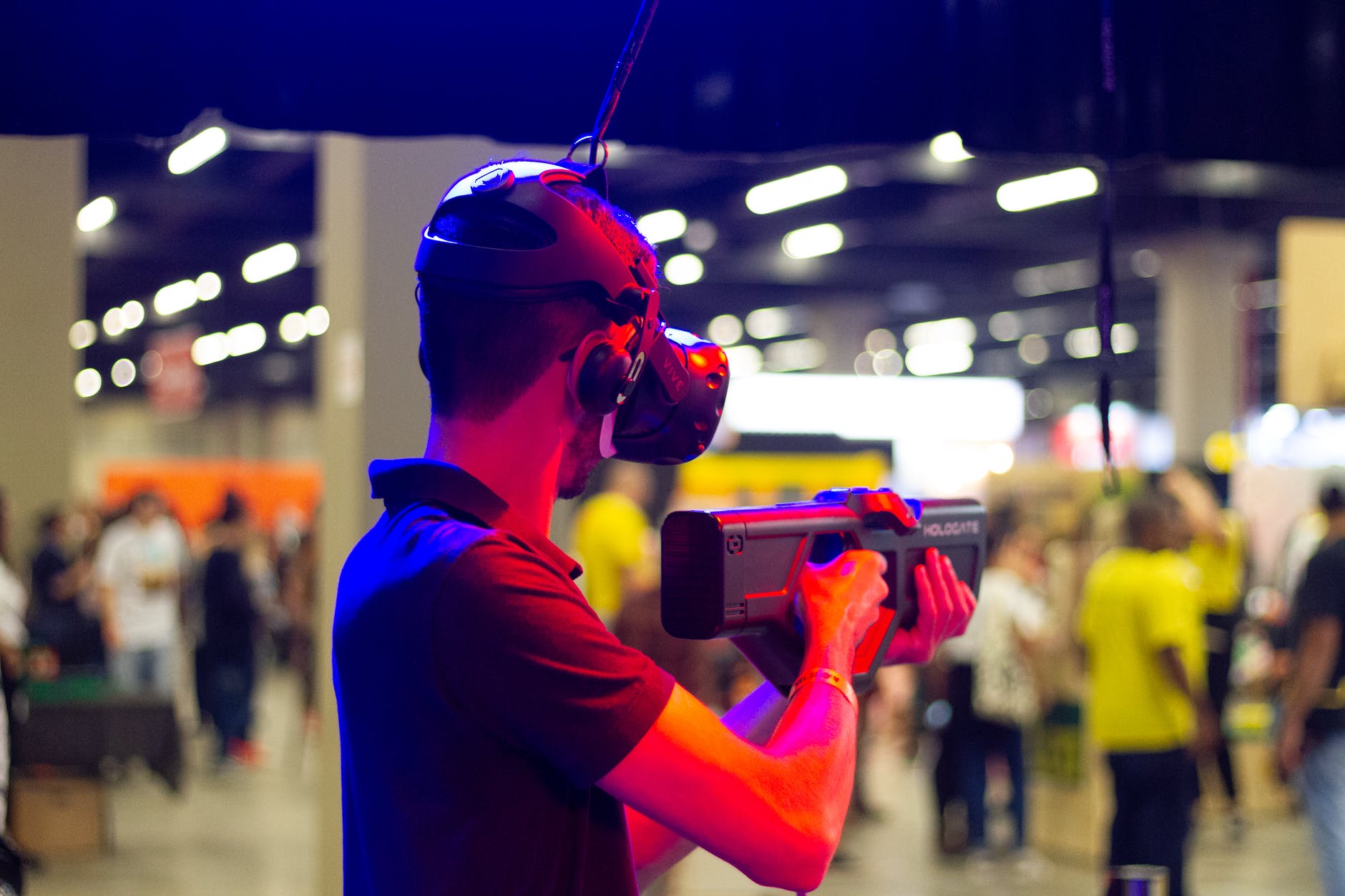
There are 10 stages of technology development that a civilization would have to go through to create a hyper realistic simulation. We’re at about stage five, which is around virtual reality and augmented reality. Stage six is about learning to render these things without us having to put on glasses, and the fact that 3D printers now can print 3D pixels of objects shows us that most objects can be broken down as information.

But the really difficult part — and this is something not a lot of technologists have talked about — is in The Matrix, the reason they thought they were fully immersed was they had this cord going into the cerebral cortex, and that’s where the signal was beamed. This brain-computer interface is the area that we haven’t yet made that much progress in, but we are making progress in it. It’s in the early stages.

So my guess is within a few decades to 100 years from now, we will reach the simulation point.

GRAMMARLY vs PROWRITINGAID

What is grammarly?

Grammarly is AI-powered application. It help people communication more effectively, millions of users rely on grammarly everyday to make their message, document, and social media post.
Grammarly is an app that you can use to improve your grammar and vocabulary.

Usage grammarly

Grammarly has simple user interface that allows anyone to use it without any hindrance.

FEATURES

• Grammarly offers a great keyboard for IOS and android, a desktop and web version, and add-in for Microsoft word.

• Grammarly checks your work in following categories, including but not limited for to spelling, grammar, punctuation, word variety, vocabulary and style.

Translate features grammarly
• It is necessary to translate text sometimes according to the requirements of the clients. But unfortunately, grammarly does not support this feature.

Plagiarism checker grammarly
• It supports this valuable feature that is known as plagiarism checker. This tool is so helpful that is saves the time, money and reputation in the market.It supports this valuable feature that is known as plagiarism checker. This tool is so helpful that is saves the time, money and reputation in the market.

Pricing

Grammarly charges $29.95  monthly and discounts to $11.66 on monthly basis when you go for the 1 year plan

What is pro-writingAid?

• Pro-writingAid offers world-class grammar and style checking, combined with more in-depth reports to help you strengthen your writing.

• It allows you to checker grammatical and punctuation mistakes while also checking for structural issues like overuse, repetition, clinches, and a writing style and sentence length.

Usage ProwritingAid

• ProwritingAid is little bit difficult user interface, it takes times to understand it. It does not facilitate every of user.

Features
• Pro-writingAid offers for more grammar and spelling checks than grammarly. “spelling, grammar, style, overused words, diction, dialogue checks and homonyms.

Translate feature ProwritingAid
• It provides this amazing features like ginger. It helps to translate the text in different language.

Plagiarism checker ProwritingAid

• It also supports plagiarism checker feature like every online proofreading tool but there is one issue.
• It provides this support to only premium plans.
• It is not for basic plans.

Pricing
• Pro writing aid premium plan is available for $ 40 on annual basis and premium plus plan is available for $45 on annual basis.

Which one is the best?
• Grammarly is highly advanced and effectively available in market.
• Pro-writingAid is also a good tool to improve your grammar and vocabulary.
• Both app are doing good in market people use both app.

IMPORTANCE OF SOCIAL MEDIA

                                                 ROLE PLAYED BY MEDIA IN CONNECTING US

The virtual world for people nowadays to stay updated, be aware of uprising events or issues happening all over the country and Globe. It connects viewers mutually to support or protest against problems that will create a tremendous impact on culture, traditional, safety or any other primary aspect of every individual.

Media has power to gather and publish information preciously to outworld to reveal the injustice, criminal and ill-legal kinds of acts in society. A platform that unites human beings together without any type of discrimination.” A world inside a gadget that literally reflects us a future upcoming”. You create connections based on your active performance via these online portals as you spread your awareness to others.

An expanding and yet growing platform to share talents, request support for any motive of happenings of our own and much more. In this pandemic even education and guidance are taken to teenagers via this media platform visually or just as speeches. Social media has the power of connecting people more than you can do in reality with much as possible.

Make sure you deliver your speech with a reason and a situation that must be told to the society. This platform is used as an age-restricted one where from infants till elders are addicted to it. “Let the addiction of media be because of you but you don’t be a victim of addiction”. Media consists from small areas (videos) till big platforms like Bollywood that keeps public entertained. In 2021 there is an enhanced usage of 99.8% in these portals and guides even market fields to promote their brand by sharing with consumers every product. Each individual has each requirement to be utilized under this platform but the concept is how you use them wisely to travel and train you in better ways.

Various application with wide range of viewers along with unique features and with special specifications are created generally to help and improve connectivity among every individual by uniting them as a society for a fruitful environment. Hence a key component for mingling every emotion and industry with various amenities embedded in it.

Software Engineering – A Layered Approach

What is layered approach of Software Engineering ?

Software engineering deals with process, methods, and their implementation tools and finally the quality of the product.This is known as the layered approach of software engineering

  1. Quality Focus

 Software engineering is a layered technology. Referring to Figure 1.1, any engineering approach must
rest on an organizational commitment to quality.
 Total quality management, Six Sigma and similar principles help a continuous software process
improvement, and this ultimately leads to the development of increasingly more mature approaches to
software engineering.
 The bedrock that supports software engineering is a quality focus.

2. Process Layer

 The foundation for software engineering is the process layer.
 Software engineering process is the glue that holds the technology layers together and enables balanced
and timely development of computer software.
 Process defines a framework for a set of key process areas that must be established for effective
delivery of software engineering technology.
 Process defines the context in which technical methods can be applied, work products are produced,
milestones are established, quality is ensured etc.

3. Method Layer

 Software engineering methods provide the technical how-to’s for building software.
 Methods encompass a broad array of tasks that include communication, requirements analysis, design,program construction, testing, and support.

4. Tools Layer

 Software engineering tools provide automated or semi-automated support for the process and the
methods.
 Tools are combines so that information created by one tool can be used by another, a system that is
developed for the support of software development, is called as computer-aided software engineering(CASE). CASE combines software, hardware, and a software engineering database.

Characteristics of a Good Software

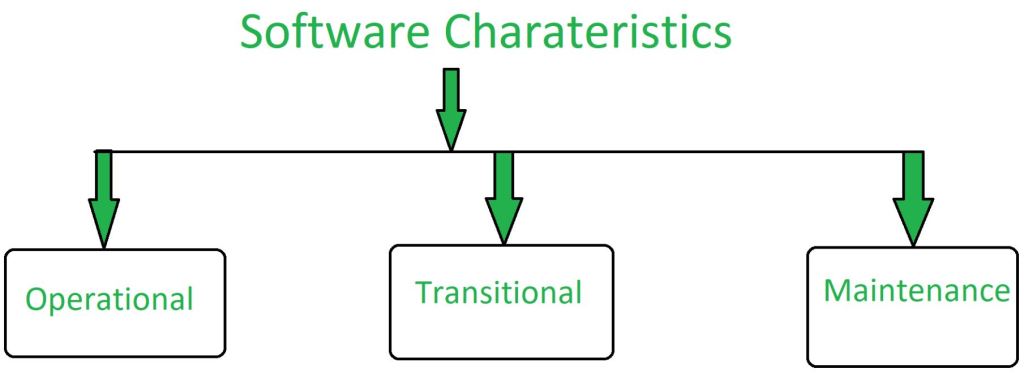
A software product can be judged by what it offers and how well it can be used. This software must satisfy on the following grounds: Operational, Transitional, Maintenance Well-engineered and crafted software is expected to have the following characteristics:

  1. Operational:

This tells us how well software works in operations. It can be measured on:

  • Budget
  • Usability
  • Efficiency
  • Correctness
  • Functionality
  • Dependability
  • Security
  • Safety

2. Transitional:

This aspect is important when the software is moved from one platform to another:

  • Portability
  • Interoperability
  • Reusability
  • Adaptability

3. Maintenance:

This aspect briefs about how well software has the capabilities to maintain itself in the ever-
changing environment:

  • Modularity
  • Maintainability
  • Flexibility
  • Scalability