Time management

Time is nothing but the count of the life. It is measured in Hours, minutes and seconds. It is very important to manage the time as it is very precious and cannot come back once it is lost. It is also very important to utilize the time properly.

Managing the time is very important. Many of the people don’t know how to manage the time. Let us now know some of the time management techniques and how to use them.

•Make schedules:-

Making schedules is one of the best methods to manage the time. All you have to do is, think of the things what you have to do on a particular day and allot some particular time for each activity. Complete particular activity in the allotted time. When the work takes too much time, then leave it aside and go for another work. Whenever all the work is finished, go for the work which is unanswered in the beginning and complete it. This is how schedules helps for time management and makes the proper use of the time.

•Don’t spend much time on one thing:-

Spending much time on a particular thing disturbe the individual and disturbs the concentration. So, to focus on the work, an individual must go for some another work whenever they get bored on a particular work. So, it helps to focus on the work and for not wasting the time.

Time management is the process of planning and controlling how much time to spend on specific activities.
BENEFITS OF TIME MANAGEMENT :
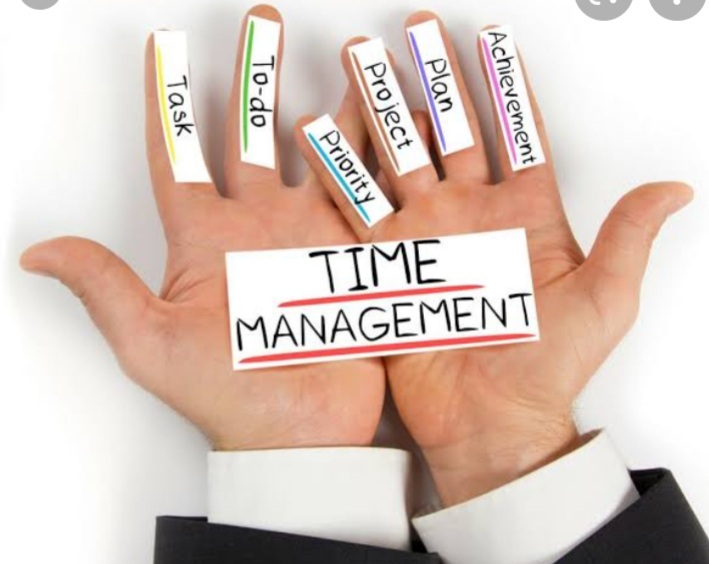

The ability to manage your time effectively is important. Good time management leads to improved EFFICIENCY and productivity, less stress, and more success in life. Here are some benefits of managing time effectively:

  1. STRESS RELIEF :
    Making and following a task schedule reduces anxiety. As you check off items on your ” to- do” list, you can see that you are avoid feeling stressed out with worry about whether you’re getting things done.

  2. 2.MORE TIME :
    Good time management gives you extra time to spend in your daily life. People who can time- manage effectively enjoy having more time to spend on hobbies or other personal pursuits.
  3. MORE OPPORTUNITIES:
    Managing time well leads to more opportunities and less time wasted on trivial activities. Good time management skills are key qualities that employes look for. The ability to prioritize and schedule work is extremely desirable for any organisation.

  4. 4.ABILITY TO REALIZE GOALS :
    Individuals who practice good time management are able to better achieve goals and objectives, and do so in a shorter length of time.

  5. LIST OF TIPS FOR EFFECTIVE TIME MANAGEMENT:
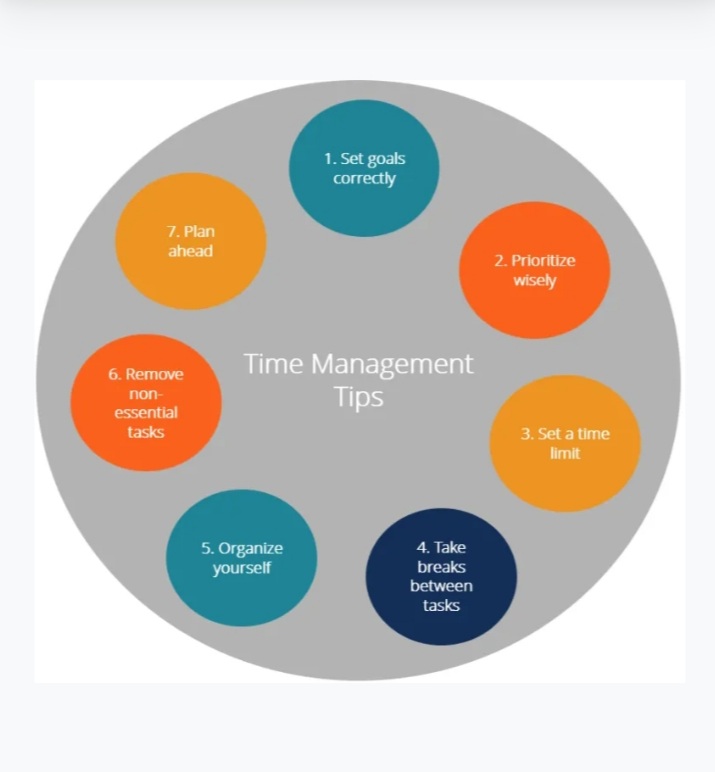

  1. 1.SET GOALS CORRECTLY:
    Set goals that are achievable and measurable. Use the SMART method when setting goals. In essence, make sure the goals you set are specific, Measurable, Attainable, Relevant, and Timely.

  2. 2.PRIORITIZE WISELY :
    Prioritize tasks based on importance and urgency. For example, look at your daily tasks and determine which are :
  • Important and urgent : Do these tasks right away.
  • Important but not urgent : Decide when to do these tasks.
  • Urgent but not important: Delegate these tasks if possible.
  • Not urgent and not important : set these aside to do later.

  • 3.SET A TIME LIMIT TO COMPLETE A TASK :
    Setting time constraints for completing tasks helps you be more focused and efficient. Making the small extra effort to decide on how much time you need to allot for each task can also help you recognise potential problems before theyv arise. That way you can make plans for dealing with them.

  • 4.TAKE A BREAK BETWEEN TASKS:
    When doing alot of tasks without a break, it is harder to stay focused and motivated. Allow some downtime between tasks to clear your head and refresh yourself. Consider grabbing a brief nap, going for a short walk, or meditating.

  • 5.ORGANISE YOURSELF :
    Utilise your calendar for more long term time management. Write down the deadlines for projects, or for tasks that are part of completing the overall project. Think about which days might be best to dedicate to specific tasks. For example, you might need to plan a meeting to discuss cash flow on a day when you know the company CFO is available.

  • 6.REMOVE NON- ESSENTIAL TASKS :
    It is important to remove excess activities or tasks. Determine what is significant and what deserves your time. Removing non- essential tasks frees up more of your time to be spent on genuinely important things
  • IMPLICATIONS OF POOR TIME MANAGEMENT :
  • Let us consider the consequences of poor time management ;
  1. PLAN AHEAD :
    Make sure you start everyday with a clear idea of what you need to do- what needs to get done THAT DAY. consider making it a habit to, at the end of each workday, go ahead and write out your ” to- do” list for the next workday. That way you can hit the ground running the next morning.
  2. POOR WORKFLOW :
    The inability to plan ahead and stick to goals means poor efficiency. For example, if there are several important tasks to complete, an effective plan would be to complete related tasks together or sequentially. That translates to reduced efficiency and lower productivity.
  3. WASTED TIME :
    Poor time management results in wasted time. For example, by talking to friends on social media while doing an assignment, you are distracting yourself and wasting time.

  4. 3.LOSS OF CONTROL :
    By not knowing what the next task is, you suffer from loss of control of your life. That can contribute to higher stress levels and anxiety.

  5. 4.POOR QUALITY OF WORK :
    Poor time management typically makes the quality of your work suffer. For example, having to rush to complete tasks at the last minute usually compromises quality

  6. 5.POOT REPUTATION :
    If clients or your employer cannot rely on you to complete tasks in a timely manner, their expectations and perceptions of you rely adversely affected. If a client cannot rely on you to get something done on time, they will likely take their business elsewhere.

The Pomodoro Technique

We all have trouble concentrating in our lives. Many of us have to sit and study/work for hours on end, especially after the COVID-19 pandemic which locked everyone inside their homes. However, most of us find it very hard to concentrate very long on our work or studies, and we lose focus or start procrastinating after a short while. The result of this is that we complete minimal work, and end up being unproductive for most of the day because of our loss of concentration. However, there is one simple method, called the Pomodoro Technique, which helps improve productivity and focus.

What is it?

The Pomodoro method is very simple. It requires you to work/study for 25 minutes, and then take a 5-minute break. The reason this method works is also simple: evolutionary biology. The human brain is not designed to focus for extended periods of time on singular task, and is made to consider many different things in our lives. This is a result of survival instincts that have developed within us. To protect us from looming threats, the brain is in a constant state of alertness. This makes focusing on one thing for a long time very hard for your brain. So, adhering to this basic instinct, the Pomodoro method makes it possible for us to work in short bursts of time with full concentration, and then take a few minutes to relax or focus on something else so as to not tire ourselves out. This can be repeated for hours on end and helps retain focus, especially if studying for an exam or completing some work.

Also, this technique has been known to increase the quality of your work. When you take a break, you force yourself to take a few seconds to revaluate and rethink certain things. Sometimes, you find that you have to adjust your work to increase the quality of it. In contrast, when you work on a task without a break, it is easy to lose focus and get lost in the work. That is why the 5-minute breaks are equally important as the 25 minutes of work. You must take your breaks seriously and see them as a reward.

What makes it effective?

  • It makes it easy to get your work started: We may often find it uncomfortable to start a big task or project, and try to avoid doing it as much as possible until the last minute. The most effective way to break out of this avoidance cycle is to just simply start the work, even if it is with a small step. This procrastination-busting strategy is exactly what the Pomodoro technique asks you to do: break down your big tasks or projects into something you only have to do for the next 25 minutes.
  • Helps combat distractions: As mentioned earlier, it very easy to get distracted while doing your work and most of us can’t focus on the task at hand for long periods of time continuously. The Pomodoro Technique helps you resist all of those self-interruptions and re-train your brains to focus.
  • Makes us more aware of time: When most of us are planning out our work, we usually underestimate the time needed to complete the tasks, even when we know similar tasks have taken longer in the past. The Pomodoro technique can be a valuable weapon against this problem, as working in short, timed sessions is not an abstract concept but a concrete event that helps keep track of the time.
  • It is easy to do: The Pomodoro technique is an accessible technique for everyone as it is more about consistency than perfection. Each session is a fresh start to revaluate your goals, challenge yourself to focus, and limit distractions. You can make the system work for you.

Hence, in case you are having trouble with staying focused and productive, give the Pomodoro technique a try to see if it helps you, just as it as helps so many people.

Pomodoro Technique for productive study/work

” Time and tide wait for none”. No matter how many times we hear or see this clichéd quote, not all of us actually understand the essence of these words. Time management is an essential skill for aspirants of all kinds. In this fast-evolving world, one must keep up par with others to achieve their goal. The fact that smart work is better than hard work is of the essence. Productivity is smart work. One such method to maintain productivity in our daily life is the Pomodoro technique.

Pomodoro technique is a time management method where a timer is used to break down the work at hand into intervals, separated by short breaks. This method was developed by Francesco Cirillo in the late 1980s. Each interval is called a ‘Pomodoro’ the Italian word for tomato, the tomato-shaped kitchen timer that Cirillo used as a college student.

The original technique has 6 steps

1. Choose a task you would like to get done

No matter how small or big the task is, it deserves your full undivided attention.

2. Set the timer for 25 minutes

Keep a promise to yourself that you don’t interrupt yourself for just 25 minutes. You can use your mobile timer or a good old clock for timing your session.

3. Work on the task until the timer rings

Immerse yourself. Meanwhile, if you remember anything other than the work at hand, write it down on a sheet of paper. You can give them thought later.

4. When the timer rings, tick off your completed task

Hurray! You have given your undivided attention to the task for 25 minutes.

5. Take a short break

Take a deep breath, meditate, grab a cup of your favourite beverage go for a stroll or do something that is relaxing for your brain to reward yourself.

6. After every 4 Pomodoros take a longer break

A break of 20 to 30 minutes is good enough to rest, preview the information and prepare yourself for the next set of Pomodoros.

To make the best out of these Pomodoro sessions you can:

  • Use the first few minutes of the session to review what you have done earlier.
  • Set up a timetable and try to be devoted to it.
  • You can use airplane mode or do not disturb mode on your mobile. (Apply only if you are not accountable for not picking up calls 🙂
  • Be mindful of the shorter breaks. They might prolong at times, thus unsettling your next Pomodoro cycle.
  • Understand your body — find out which part of the day you are most productive. This can work wonders and get a lot of things done.

The rules of the Pomodoro technique are not necessarily rigid. If you are not able to pull up 4 Pomodoros continuously, opt for one or two Pomodoros in a day. At the end of the day, what matters the most is how much productive and focus you are in those sessions and how much work gets done. You can also vary the time interval as 50/10 (50 minutes of focus and 10 minutes of break) instead of the traditional 25/5 technique if you are quite confident about your focus.

This technique is useful if you feel distracted or overwhelmed to focus on what matters to you. It has worked well for me in this lockdown and has helped a lot in my exam preparations. Hope it works for you too!

WHY DO WE NEED TO BE PUNCTUAL?

Know the true value of time; snatch, seize, and enjoy every moment of it——-Lord Chesterfield

ITS MEANING

Punctuality means doing a work at the proper time. To account an engagement at 10 o’ clock in the morning and to arrive at the place to keep it at 10-30 does not become a gentleman. It annoys the other party and it harms the future of the caller. No one who is unpunctual in attendance to work can be depended on or trusted in. On the other hand, a punctual man is one who knows the value of time. Such a man is a perfect gentleman and everybody has faith in his efficiency and character.

IT GIVES A MEANING TO YOUR LIFE

Punctuality is important in every sphere of life. it is rightly said that punctuality is the crown of a king. It is the most precious jewel to the character of a man. A student has to be punctual at school or college. The manager of a big firm or its common clerk has to be punctual in his office. Equally it is necessary for a factory worker, a politician, or a statesman. The greatest value of punctuality is that it is a great time-saver. An unpunctual man is always worried about time. A student who is unpunctual in his class lags behind others in his studies, he creates confusion both for himself and for others in the class. He is considered a disturbing element and is looked down upon by his teachers as well as his classmates.

MISS IT AND WELCOME YOUR HARM

Many battles have been lost on account of unpunctuality. Many Cases in Courts of Law have been lost, because one of the parties did not come in time; many a train has been missed and business lost to unpunctuality. So, unpunctuality leads to dangerous consequences. Relation of free people knows the value of punctuality. Indians are now a free people and they should cultivate punctuality in everywhere. Unpunctuality is a vice and out of it are born other vices like dishonesty, falsehood, idleness and shirking of one’s duty.

So, we observe how punctuality plays a foremost role in anyone’s life. being unpunctual is a curse, we cannot be as winner as others. Besides, this rhythmic world demands punctuality so that all of us can be successful in life.

Stop Giving Toxic People Your Time

BE CAREFULL!

Do you ever get upset about the nasty behavior of your co-workers, friends, or even family? Well, if you let others upset you, it’s not their fault.

“It’s not me, it’s him!” is what most of us say. We’re always quick to blame others for how we feel.

We say that others make us feel that way. But that’s false. You decide how you feel about the things that happen in your life.

Events can’t harm us. Our perception of an event harms us. That’s one of the most important ideas of Stoic philosophy.

In other words, you decide what meaning you give to the things that happen in your life. If your friend tells lies about you behind your back, and you get upset, that’s because you decided to get upset.

After all, you don’t control others. That’s why who you spend your time with is a matter of life and death.

The great Stoic philosopher, Epictetus, said this in his Manual For Living:

“Avoid fraternizing with people who don’t share your values. Prolonged association with those with false ideas can only tarnish your thinking.”

It’s something I truly live by. I’ve seen others destroy people’s lives too often to take this idea carelessly.

And I bet that you’ve had your share of, for lack of a better term, “toxic” people in your life.

There Are Two Kinds Of People

  • People with values
  • People without values

I think that less than 1% of the population has values. Values entail nothing more than answers to questions like:

  • How do you treat people?
  • How do you treat yourself?
  • What’s right and what’s wrong?

Here’s an easy way to detect people without values: When you see that someone becomes an entirely different person in a heartbeat — that’s when you know someone has no values.

For example, at our company, we recently hired a toxic intern. The intern turned out to be a different person from the person we thought we hired.

Of course, that’s our mistake. Even though we talked extensively about values during the interview process, we didn’t detect any warning signals.

And everything was fine during the first week. But as soon as the intern found a partner in one of our other interns, things started to change.

All of a sudden, with this new-found support, the intern started gossiping, trying to manipulate others, and causing mayhem. Fortunately, we identified it quickly and communicated that we have a zero-tolerance policy for toxic behavior.

It’s not an unusual thing in organizations. People often hide their true colors. I should say, they hide the fact that they don’t have colors.

When you lack values, you automatically gravitate towards natural human behavior. And that’s very dark. I recently read 12 Rules For Life by Dr. Jordan Peterson, a clinical psychologist, and a professor at the University of Toronto.

His fundamental proposition is that people are malevolent and that life is suffering. To prove that statement, Peterson shares compelling examples of human history with us.

He’s right. People have always lied, killed, and deceived their way through life.

But There’s An Alternative

Look, you can easily go down the rabbit hole of nasty behavior. Just spend enough time with bad people — eventually, you will become one of them.

You can also fill your days with gossiping, lying, and manipulating others. And you’ll probably also feel good when you do it. A sense of power, no matter how it’s achieved, gives people satisfaction. That’s how our minds work.

So when you recognize someone who doesn’t have principles, shows nasty behavior, and has multiple personalities — step away.

Instead, surround yourself with people who want the best for you.

Not with people who are jealous, can’t see your success, and thrive off negativity. I think this is important to realize for anyone who wants to live a good life.

A few years ago, when I started to live a conscious life, I had to say goodbye to people who only wanted to live a life of pleasure.

And I’ve also seen other friends that started to change their life for the better but were dragged back into the bottomless pit of darkness by others.

But as you and I both know, life is also full of warm and caring people. It’s not all bad.

Be Stingy With Your Time

“You’re the average of the five people you spend your time with.” It has become such a cliché. But I don’t think that we truly understand the impact that other people can have on us.

Like Epictetus said, others can tarnish your thinking. Is that worth it?

Look at it this way. Would you give $1000 to the people in your life if they asked for it? If the answer is no, stop giving the people who don’t share the same values as you, your time.

I’ve narrowed down the list of people I spend 90% of my time with to my direct family and my two best friends. Other than that, I spend my time working and exercising. That’s what I mostly do. And I’ve never enjoyed my life this much.

So if you have a job you love, and a few people in your life who you love, you don’t even have more time to spend.

Nothing else gives more satisfaction than having a meaningful career and a strong family.

“But what if my family is toxic?”

Inspire them to change for the better. I don’t give up on my family. Even if it takes 10 years, I will still try to help them.

Create Your Values, And Stick To Them

To live a virtuous life, you need principles. Without principles (or values), we have no character. And without character, we’re nothing.

“Who cares!”

Well, you should care. You’re the one who looks in the mirror every day. Are you happy with what you see?

That’s the only measure I have for my life. I must like the person I see in the mirror. If I don’t like that guy, I’ll change. That’s what I’ve always done. And that’s what I still do every day.

Improve Yourself

What’s the alternative? Like Peterson concludes in his 12 Rules For Life, there’s no other viable option for life.

There’s only one path to happiness: Forward motion.

You need the promise of what could be. You need a path to a better life. None of us is perfect.

It doesn’t matter if we ever reach our desired destination or not. What matters is that we keep improving.

Dig Deeper

If you want to hear more thoughts on why you should surround yourself with good people, listen to my podcast episode about it.

Time Blocking: Improve Your Focus And Get More Meaningful Work Done

Do you have a list of priorities or goals that you want to achieve this year? And do you struggle with allocating time to them? Time blocking might be helpful.

It certainly helped me. Look, I’m not any different from you. Life can be messy. Most of us juggle a lot of different things at the same time. Even though the simple solution is to stop juggling, it’s not always realistic. Or even needed.

What if you could do more things without losing your time? It’s possible. But you must work in an organized way.

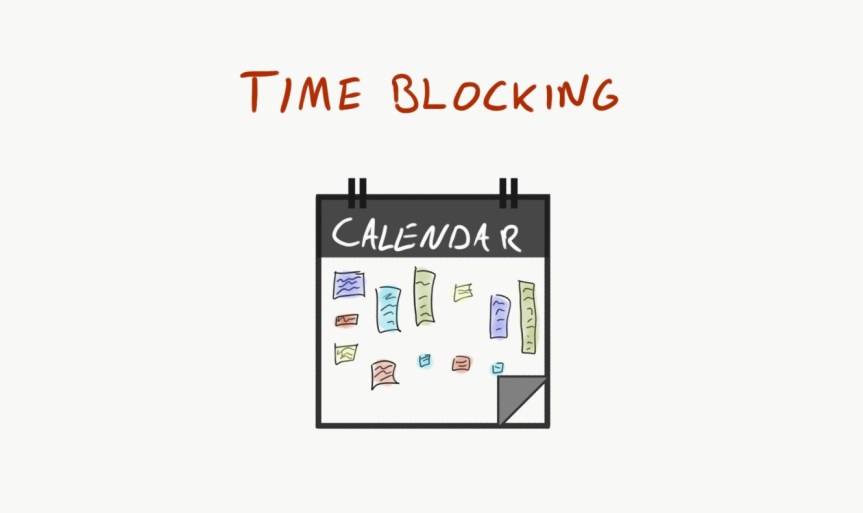
Time Blocking a simple productivity exercise that many people use. It’s not fancy or revolutionary. The only thing you need is a calendar, which is something everyone with a smartphone and computer has.

Time Blocking is simply using your calendar to block time for your most important priorities. During that time, you only work on that one thing. And, you let your calendar lead the way. That way, you don’t have to think, “What should I do next?”

But Time Blocking is more than just a productivity tool. It’s about self-awareness.

The road to high productivity starts with awareness.

For instance, one of my priorities this year is to write a book on pragmatic thinking. However, there’s a problem: I haven’t been writing.

How did I come to this conclusion? I simply looked at my list of priorities for 2017, and I then I looked at my calendar.

I hadn’t scheduled any time for writing in a while. Now, you might think, “do you really have to look at your calendar to realize that?”

Yes, I do. I’m not some kind of supercomputer that remembers everything. I’m a regular human being. I think of something to do, start working on it, life gets in the way, and then I FORGET about it.

It happens to all of us. We need self-awareness and tools that keep us in check. And that’s why I like Time Blocking.

Some people love Time Blocking. Some people hate it.

Computer science professor and author of Deep Work, Cal Newport, also uses time blocking. He says:

“I take time blocking seriously, dedicating ten to twenty minutes every evening to building my schedule for the next day. During this planning process I consult my task lists and calendars, as well as my weekly and quarterly planning notes. My goal is to make sure progress is being made on the right things at the right pace for the relevant deadlines.”

The last sentence is exactly why I schedule everything I want to do. Working is not the same thing as making progress. And Time Blocking helps me to improve my focus so I can get meaningful things done. Things that have an actual impact on my life.

I know there are a lot of successful people who work with empty calendars. I’ve read the articles. They simply work two, three or four hours per day.

And to be honest, that sounds very attractive to me too. However, one must look at his/her own life situation.

What are you trying to achieve?

And more importantly: What resources do you have?

Often, people who don’t have a lot of money, do have a lot of time. So why not use it wisely? Either way, I think that planning serves a purpose.

I plan my days and weeks in advance because I want to make sure I’m working on the RIGHT things. Too often, I get lost in completing daily tasks.

Think about it this way. I’m pretty organized already. And I only work on one big thing per area of my life.

But there are many different areas of my life: My family business, my blog, podcast, online courses, relationship, friends, investments, etc.

It might sound like I’m doing many different things. But it depends on how you look at it. Everything I do leads to one thing: Living a meaningful and independent life.

But let’s not get philosophical here. If you’re lacking focus, not making progress, and want to work in a more organized way, give time blocking a try.

Here are some things I’ve learned that may help:

  • Take 10 minutes every evening and plan your next day. Rearrange blocks if you must create time for other important things.
  • Use recurring blocks for recurring tasks. For instance, I’ve scheduled two hours to write my new book every Tuesday and Thursday.
  • Don’t over-schedule. Realistically, you can’t be productive 10 hours straight. Give yourself some time between tasks.
  • And always schedule more time than you think you need.

“Wow, time blocking sounds like too much planning to me.”

No problem. Plan less. There’s always a counter-movement for everything. People who do the exact opposite and advocate an anti-productivity lifestyle. You know, folks who claim they have empty calendars and don’t care about anything.

People who pretend they are always “enjoying” themselves. They like to go with the flow and daydream.

You know what that reminds me of? Those kids in school always said, “Ah dude, I didn’t have time to study for this class,” but always ended up getting straight A’s.

People just want to make you believe they don’t work hard. It’s facade. And when they do well in life, it seems like it came easy.

As far as I know, achieving meaningful things is hard. I don’t think there’s anything cool about pretending it’s easy. Nor do I believe that it’s cool to work yourself to death.

I often think of this question: Are you an amateur or a pro?

It’s Steven Pressfield’s famous analogy, from his book The War Of Art, for getting work done.

The amateur-only works when inspiration strikes. The pro sits down every day and puts in steady work. The key is steady. Not irregular or extreme.

Pressfield says:

“The sure sign of an amateur is he has a million plans and they all start tomorrow.”

Don’t start tomorrow.

Time Management – 4 Best tips for you

Time Management must be a skill that must be considered one of the most important aspects of one’s life. From school to the contemporary setting, managing time has to be given the top priority. It is a skill that is actually quite easy to learn. To start with getting your time management skills on track, you have to ask yourself, do you know what it actually means? Time management actually means that you keep track of time always and assign certain tasks to be done at certain times of the day. You will use each minute of your waking hours to do something productive and useful. Continue reading “Time Management – 4 Best tips for you”

Creation of Time: Time Management


Time management is concerned with managing your time efficiently so that all your daily tasks can be completed in a systematic system. One who can follow his timetable correctly can complete almost any task successfully. This is the reason that time management is necessary and it is very important for people from different walks of life.

Time management is important in every field

Time management is essential for people belonging to different walks of life. Whether it is a student or a homemaker, working professional, freelancer or business professional, everyone should manage time to successfully carry out their tasks. Here is detailed information on the importance of time management for each of these groups:


Importance of time management for students

Many such activities are included in this list from the time the student participates in various activities throughout the day and from getting involved in self-study to being fit by participating in additional exercise activities. In such a situation, if you do not arrange your time properly, then you will not be able to do any work efficiently.

Importance of time management for business personnel

If you are planning to start a business, discipline is the first thing that needs to be kept in mind and the first step to discipline is respecting time. In your business, you are the owner yourself, so you have more responsibilities on you rather than working for someone else. To handle everything efficiently you have to start everything by streamlining your time resources.

Importance of time management for homemakers

Housemakers toil throughout the day. Their task list is endless and if they do not manage their tasks properly then it may take them a long time to finish the work. Since they have to do different kinds of tasks every day, they need to prepare a list in the morning. They can prioritize tasks on their list and do them one by one. This will not only enable housemakers to manage their time efficiently but they will also feel a sense of satisfaction in their work.

Importance of time management for freelancers

Freelancers who do household chores, in particular, should ensure that they make a daily schedule and follow it faithfully. Most people who do household chores choose this option because they have to complete some other chores in the house. It is quite challenging to fulfil your systematic duties and professional tasks simultaneously. The key to handling both tasks together is managing your time efficiently. Identify the hours in the day when you can concentrate the most so that you can finish your business tasks diligently.

Importance of time management for professionals

Working professionals also need to perform well in their fields with increasing competition. They are expected to do something different so that their image will remain good in the eyes of their superiors, beating their fellow personnel. Professionals need to schedule their time so that they not only take time out for their normal work but also have enough time to do something different/new.

Tips for efficient time management

• List the work that is necessary

• Finish important tasks first

• Focus only on current work

• Learn to say ‘no’

• As soon as you start your work, put your phone aside

• Get 7-8 hours of sleep a day

• Have a healthy diet

• Exercise regularly

Conclusion

It may appear simple to look at but efficient time management demonstrates a person’s great qualities. You need to always be disciplined and constantly remind yourself why it is important to complete your tasks on time properly.