Are teachers villains or victims?

At some point or the other in their lives, almost everyone has held the view: \’If only teachers did their work better, so many problems would be solved…\’  Schools would be so much better off, isn\’t it? Education would be great and our lives very different as a result; in fact, society itself would change, if only teachers did their work better.

People who think thus are, of course, only being \’nice\’. Because there are any number of others who have less \’nice\’ ways of putting it. \’Bloody teachers, curse them, they don\’t work at all. They\’re never there in school, and when they\’re there they don\’t teach. And if they teach, they don\’t teach properly, beat children, and don\’t even know themselves what they\’re supposed to teach. All they\’re interested in is their salaries, and making money from the grants that flow to the school.\’

In fact, this is unfortunately a very widely held view, especially among officials, supervisors, trainers and others who are in any way responsible for and towards teachers. Condemn them, point out all their flaws (exaggerate where it helps) and hold them accountable for all the ills of the education system. Teacher condemnation remains the starting point of many discussions related to improving education.

Anyone who spends time in school trying to implement what teachers are asked do on a daily basis soon finds that motivation has a way of evaporating rather rapidly. You\’re supposed to teach children of one class, but you find yourself teaching more than one class, of children at different ages, with huge variations among them.  Often, you don\’t know their language, and whatever you do, so many of them seem not to be getting it at all (partly also because they cannot attend regularly). Far from support, you get indifference (often derision) from those who are supposed to support you (head teachers, community representatives, supervisors, officials). Soon, if you happen to be from another area than your posting, you start trying to get yourself transferred.

Those \’above\’ them are not immune to exploiting teachers either – using their services to support their own administrative tasks, or even asking them to pay bribes for getting their travel allowance or even school grants (I came across a state where teachers used to be paid only Rs.400 as the TLM grant, with someone siphoning off Rs.100!).

But this doesn\’t mean teachers should absent themselves from school or beat children up, you would say. It\’s true, they shouldn\’t. It\’s just that it\’s so hard (and rare) to experience success as a teacher that it\’s not so surprising. Perhaps our system is victimizing teachers such that they\’re becoming villains? Or do you think they\’re only victims? Or are they really villains?
The Qualities of a Change-Maker

Improving educational quality ends up being about change rather than tinkering with some elements. 

What then are the qualities of those involved in bringing about this change? 

Here are my guesses. As can be expected, this is a long wish-list! I need your help to identify which ones are really important. And suggestions, too, about how to generate these qualities in the people we work with.
A change-maker:
  1. is sharp, can quickly see what needs to be changed, and has effective ways of helping others see this too, but without getting into a conflict!
  2. can spot opportunities for introducing change
  3. does not have a sense of hierarchy; does not discriminate
  4. has a sense of humour, which gives her/him the ability to live with the difficulties and slow pace of change
  5. at the same time, s/he can take quick decisions and act fast if needed
  6. is aware that he may himself by a victim of the old ways of thinking and living; so is constantly examining himself and trying to improve himself
  7. can help a person see what is wrong without feeling bad or without that person feeling he is being disliked.
  8. has a sense of strategy – that is, of actions that will slowly, perhaps indirectly, bring about the change desired, in stages
  9. is honest and has the greatest accountability to herself, on behalf of those she works for
  10. is aware that there will be some conflicts, and has a plan and ability to deal with this; if necessary, generates conflict, though in a calibrated manner
  11. is aware that his role is that of enabling others to deliver rather than deliver on their behalf
  12. knows how long change takes, and does not give up
  13. Can work as a team member, and also get others to work as a team – for which, helps by:
  • Sharing goals

  • Sharing information

  • Recognizing, utilizing and balancing the strengths and weaknesses of the group

  • Ensuring recognition as a team


What kind of process would help develop these qualities? 
What kind of reflection, debate and conversation do you think is needed? 
And can it be done in the kind of time-frames we usually have

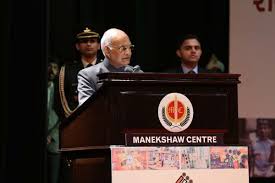
Address by the Hon’ble President of India Shri Ram Nath Kovind on the Occasion of the Inauguration of the Constitution Day

  1. feel honoured to be here today to inaugurate the Constitution Day celebrations. Today I feel doubly blessed as before coming to the Supreme Court, I addressed a joint session of parliament on the occasion of the 70th anniversary of adopting the Constitution. I have the rare privilege of being associated with both the institutions, Parliament and the Supreme Court, which are temples of our Republic.
  1. On this occasion I also feel humbled when I recall our Founding Fathers. Guided solely by the light of liberty and justice, they sat down to write this document of our destiny amid historic events and challenges. They created institutions and designed the right balance among them to ensure that their core objectives are not compromised. The co-existence of our fully independent judiciary with a vibrant parliamentary democracy is a testimony to their sagacity and foresight.
  1. These sages put in words the noble vision of our Republic in the Constitution after marathon deliberations over three years. The nation will always remain grateful to all the members and office-bearers of the Constituent Assembly, particularly its President, Dr Rajendra Prasad, and the Chairman of the Drafting Committee, Dr Babasaheb Bhimrao Ambedkar, who is rightly known as the architect of the Constitution. Their zeal and devotion to meet the task of such magnitude was matched by contributions from the titans like Jawaharlal Nehru and Sardar Vallabhbhai Patel. They headed various committees and sub-committees, along with ‘Acharya’ Kripalani, H. C. Mookerjee, Gopinath Bordoloi and Amritlal Thakkar.
  1. I would like to also pay homage especially to the 15 women members of the Constituent Assembly. They included Sarojini Naidu, Rajkumari Amrit Kaur, Hansaben Jivraj Mehta, Sucheta Kripalani and G. Durgabai, who spoke of equal rights for one and all, when women in many parts of the world were denied basic rights.
  1. In his speech before the Constitution was adopted, Dr Rajendra Prasad rightly noted that the successful working of democratic institutions requires willingness to respect the views of others, and capacity for compromise and accommodation. He said, [quote] “Many things which cannot be written in a Constitution are done by conventions. Let me hope that we shall show those capacities and develop those conventions.” [Unquote] Seventy years later, we have reasons to believe that the nation has lived up to his hopes to a fair degree.
  1. As Rajen Babu, Babasaheb and many others pointed out that day, a Constitution is after all a mere document, recording in words the inspired ideas. It can come alive and enter our world only when it is translated into life of the nation and its ideals put into practice. It is the scripture of our nation that has to be read in a sensitive and delicate manner. The Constitution gave this onerous task to the judiciary. Keeping the role of the Supreme Court as final interpreter of the constitution and the laws enacted under it, the judiciary assumes the role of its guardian. The authors of our Constitution took extra care in providing it the necessary powers and freedoms to function without any undue influence. Over these eventful seven decades, the judiciary has remained alive to the high responsibility placed on it. I am aware of the fact that it has initiated several innovative measures to reach out to people.
  1. But for a large section of people, justice is still beyond reach. While we celebrate the 150th birth anniversary of Mahatma Gandhi, let me refer to his views on the issue. Neither was the Father of the Nation a member of the Constituent Assembly, nor do we know his views on our founding document. What we know for sure is that he had played a crucial role in the making of the Constituent Assembly and blessed this historic endeavour. In a sense, the Constitution is the product of the values inspired by the Freedom Struggle. It, thus, very much reflects the democratic virtues Gandhiji lived by. Still, the closest we have as his views on a possible Constitution is a book called ‘Gandhian Constitution for Free India’. Shriman Narayan Agarwal wrote it in 1946, based on his understanding of Gandhian principles. The book had the benefit of being read and approved by Gandhiji himself, even though the words are not his.
  1. The book is critical of the British judicial system in India. In panchayats of the old times, it says, [Quote] “Justice was cheap and fair. Modern courts, on the contrary, are very expensive; even very ordinary cases are disposed of only after months, if not years.” [Unquote] What I wish to point out here is that Gandhiji would have been unhappy at the high cost of justice.
  1. Indeed, the Constitution itself calls for making justice accessible to all. Consider the Preamble, which is the ‘seed text’ of the whole document. Why did ‘We, the People of India’, solemnly resolve to constitute India into a republic”? Obviously this pledge seeks, “To secure to all its citizens: JUSTICE—Social, Economical and Political”. Like any religious scripture, this grand statement or “Mahavakya” of the constitution aims to secure liberty, equality and fraternity along with justice.

Ladies and gentlemen,

  1. On today’s occasion, let us deliberate how we can make justice accessible to all. One way out of the high cost is the provision of free legal aid. Pro-bono service is a subject close to my heart. As many of you know, during my days as a Supreme Court advocate, I provided pro-bono aid to weaker sections of society in general, and women and the poor in particular. I remain grateful to veteran lawyer Ashoke Sen who showed me the way. In the multiple roles he played in the field over a long career, his sole objective was the pursuit of justice, for one and all. I hope more and more law professionals will take inspiration from the example of Shri Sen and distribute freely the fruits of their knowledge among the needy. I would like to stress here that the task of making justice more accessible to all has to be a collective effort of all the stakeholders in the bench and the bar.
  1. The question of access is not limited to the cost factor alone. Language too has been a barrier for many, for a long time. On this count, however, I am happy that the Supreme Court has followed up my suggestion and started making its judgments available in nine regional languages. In the days to come, the list can include more languages, so that common people can read the verdicts of the highest court.
  1. Another hurdle in the way of justice is the delay and the resulting backlog. Clearing this bottleneck requires detailed deliberations and systemic efforts. I also understand it is an ongoing process. Information and communication technology can bring about amazing results in this domain, and I am happy to learn that beginnings have been made to take help of technological innovations. In this context, I am glad to learn that three apps for mobile phones are being launched today. This litigant-friendly move will bring the portals of the apex court closer to the people.

Ladies and gentlemen,

  1. In listing the obstacles before the delivery of justice, I have in mind the words of Dr Ambedkar. In his concluding speech before the Constituent Assembly, he exhorted us not to be tardy in the recognition of the evils that lie across our path and not to be weak in our initiative to remove them. He said, [QUOTE] “That is the only way to serve the country. I know of no better.” [UNQUOTE]
  1. To answer Babasaheb’s call, we should also strive to spread the awareness about the making of the Constitution, its provisions and its fundamental principle of equality. We need to especially narrate to the young generation the grand vision of our founding fathers. After all, we stand as a mere link between two generations in the continuing saga of this nation. Interpretation of the Constitution is a work in progress, and it will be up to the youth of the nation to carry forward the task of realizing its ideals.

Ladies and Gentlemen,

  1. Let me share something with you on a personal note. As I mentioned before, I come here after having addressed the Parliament. Standing before you, I recall that in 1993-94, I had made a journey from here to there; from being an advocate here to being a member of the Upper House. Such journeys have enriched my perspectives on the functioning of the republic. The framers of our Constitution rightly underlined the doctrine of separation of powers among the organs of the state. This, however, was not to be a hurdle in serving the people. Indeed, it was meant to serve the people better. Observing the life of the nation from more than one station in my journey, I now better appreciate the vision of our Founding Fathers.
  1. I thank you for inviting me to share my views. I congratulate the nation on the occasion of the Constitution Day, and extend my best wishes to all of you for the celebrations.


Thank you,

Jai Hind!

Cabinet approves India’s Approach to UN Climate Change Conference to be held in Spain next week

The Union Cabinet chaired by Prime Minister Shri Narendra Modi today approved the negotiating stand of India at the 25th Conference of Parties (COP) to the United Nations Framework Convention on Climate Change (UNFCCC) scheduled to be held in Madrid, Spain (under the Presidency of Chile) from 2-13 December 2019.

The Indian delegation will be led by Shri Prakash Javadekar, Hon’ble Minister, Environment, Forest and Climate Change. COP 25 is an important conference as countries prepare to move from pre-2020 period under Kyoto Protocol to post-2020 period under Paris Agreement. India’s approach will be guided by principles and provisions of UNFCCC and Paris Agreement particularly the principles of Equity and Common But Differentiated Responsibilities and Respective Capability (CBDR-RC).

India’s leadership on climate change has been evident and well recognised across the globe. Government of India has been undertaking several initiatives to address climate change concerns under the leadership of Hon’ble Prime Minister, Shri Narendra Modi and these initiatives reflect India’s commitment and ambition towards climate action. In the recently held Climate Action Summit convened by United Nations Secretary General, the Prime Minister announced India’s plan on scaling up of renewable energy target to 450 GW and called for responsible action by all on the principles of equity and CBDR-RC. India has been leading the world in its pursuit of enhanced solar energy capacity through International Solar Alliance (ISA).

In addition to ISA, two new initiatives have been launched by India as part of its efforts to mobilize world on climate action. These include Coalition for Disaster Resilient Infrastructure, which will serve as a platform to generate and exchange knowledge on different aspects of climate and disaster resilient infrastructure and ‘Leadership Group for Industry Transition’ launched jointly by India and Sweden, which will provide a platform for government and the private sector in different countries to work together on accelerating low carbon growth and cooperation in the area of technology innovation.

India has been ambitious in its actions and has emphasized that Developed countries should take lead in undertaking ambitious actions and fulfil their climate finance commitments of mobilizing USD 100 billion per annum by 2020 and progressively and substantially scale up their financial support to inform Parties for future action through NDCs. India will further stress upon need for fulfilling pre-2020 commitments by developed countries and that pre-2020 implementation gaps should not present an additional burden to developing countries in the post-2020 period.

Overall, India looks forward to engaging in negotiations with a constructive and positive outlook and work towards protecting its long-term development interests.

***

The Big Myth that Educationists hold – about others: Myth # 6 of the 7 Myths of Highly Ineffective Education Systems –

Myth # 6 – Stakeholders are concerned about education (as educationists understand it)
Curriculum developers, educationists, policy makers, thinkers on education, many ‘NGO types’, reformers and other highly respected people often talk of the ‘aims of education’ – be it in terms of creating a more democratic society or a more evolved person etc. Somehow, those who are actually affected by education are unable to get this. For the masses at large, the purpose of education is to make life better, go up the social ladder by getting a job or being able to earn a stable livelihood. This is nothing to sneer at or term as a ‘wrong’ or ‘limited’ expectation. In fact, this is what millions of parents are slaving away for, sacrificing a bit every day so that their next generation may attain a better life. By looking down upon this view, by treating the situation as if ‘we are doing education to them’ instead of with and for them (or perhaps us), those who design education tend to marginalize the very people education is meant for.  They also end up with curriculum, textbooks and processes that do not build on the experiences that children from less privileged backgrounds bring, something that is an enormous resource being wasted, which then continues the cycle of marginalization.
Like parents, teachers too have their own idea of what they would like. Despite what is often said, most teachers do want to succeed – what they would like is some practical (not philosophical) advice on how to handle the really difficult situation they face – increasing diversity, the changing nature of student population as more and more ‘left out’ groups join school (in Delhi slums, migration is leading to 7-10 home languages in the classroom, including Punjabi and Odia which are not contiguous in the ‘normal’ world), changing curricular expectations they haven\’t had time or support to absorb.  Even after attaining the PTR norms mandated by the RTE, we are going to have well over 50% schools with around 80-100 children, with 2-3 teachers handling 5 classes – that is, a very large proportion of teachers already are and will continue to work in multi-grade settings in the foreseeable future (while curriculum, pedagogy and materials continue to assume a mono-grade situation). Given that we are still short of 14 lakh teachers (the number was reported to have come down to 10 lakh, but with increased enrolment, is up again, the situation being much worse at the secondary level), the effect is felt by the 56 lakh who are there.  As mentioned, educationists may want high levels of learning to be attained using their policies and curriculum, but teachers just want to survive the day and, if possible, succeed in generating some learning.
And what kind of school would children want? Exercises on this have been few and far between. Most of the time children end up having to manage with whatever ‘we’ give out – from mid-day meals to ‘child-friendly elements’ to colourful books or whatever else. It is in the nature of children to find interest in whatever is made available, which is why there is a tendency to assume we have an idea of what they need. But engaging with them on the issue might reveal a lot more. For instance, talking with secondary school girls in a remote area in UP, we were discussing the need for toilets – but the girls said, “We can manage without the toilets, but what we can’t accept is that we are forced to choose Home Science and are not offered Mathematics.” This is surely something the authorities are not working on.
Simply listening to stakeholders might be a good idea. It would be revealing and educative for \’experts\’, helping reduce their arrogance and bringing their relationship with the stakeholders on a somewhat more equal footing.
What would you say if an expert approached you? And if you are an expert, how would you approach the stakeholder?

International Conference On Entrepreneurship and Management: Challenges, Issues and Opportunities in the Global Economy

About the International Conference-
The International Conference aims to connect the academia and the corporate world with an
the objective of creation of linkages between both for the benefit of all stakeholders in education
industry and the corporate world.

Objectives of the Conference-

 To provide an inter-disciplinary platform to corporate personnel, managers, media
personnel, academicians, practitioners, professionals, industrialists, policymakers,
research scholars and students, etc. for deliberations and discussions.
 To explore the challenges and issues faced by entrepreneurs and managers in the global
Economy.
 To discover new opportunities for global entrepreneurs and managers in the present
times.
 To unearth the future potential of the opportunities in changing the global environment.
 To provide a forum to exchange experiences and ideas amongst participants.
 To provide networking opportunities to the participants.
 To find out various entrepreneurial opportunities in the global future.
Session Plan-
Session I: Entrepreneurial and Managerial Challenges and Issues in the Global Economy
Session II: Entrepreneurial and Managerial Issues in the Global Economy
Session II: Entrepreneurial and Managerial Opportunities in the Global Economy
Sub Themes-
 Labour Issues in the Global Economy
 Strategic Business Leadership
 Responsible Business & Sustainability
 Artifact-making and entrepreneurship
 Strategic entrepreneurship and growth issues of entrepreneurial companies
 Entrepreneurial finance and venture capital
 Social entrepreneurship and corporate social responsibility
 Entrepreneurial endeavors in the family or household contexts
 Business Leadership Initiatives for Engaging Youth
 Business Implications of Various Restructuring Plans
 Entrepreneurial Opportunities & Challenges in the World
 Dynamics of World Economy & Sectoral Development
 Skill Development & Youth
 Global Challenges in the Face of Economic Uncertainty
 Strategic Management Issues and Opportunities
 Marketing Management Issues and Opportunities
 Financial Management Challenges and Prospects
 Production and Operations Management in the Changing global economy
 Legal issues affecting entrepreneurs and managers
 Advancements in Information Technology
 Business Ethics, Governance & Sustainability
 New Avenues in Management in today’s Changing Global Economy
 Strategic HR issues in Changing Environment
 Banking, Financial Services, and Financial Inclusion

How Do We Measure Change?

We repeatedly find ourselves saying that working on improving education implies change. That is because the very core of education – in terms of key relationships, processes and the critical outcomes desired – itself is expected to undergo a transformation. Some of the biggest differences expected are in terms of

  • undoing the existing hierarchy,
  • increasing accountability,
  • evolving the role of the key stakeholders such as children and community from passive to active,
  • in fact even a reversal of the notion of the \’beneficiary\’ (especially after the RTE, children and the community are the reasons why the education system exists; and teachers, educational officers and others in the system are the beneficiaries in that they get their salaries because children have a right to education)
  • preparing children for life rather than just for examinations.


Thus it is not just a case of revision in components such as curriculum or textbooks or training or assessment but bringing about much deeper changes that will then manifest themselves in the different components. Change, therefore, in the underpinnings or the foundations themselves, implies major shift in emphasis, ways of working, the means used, the technical and human / social capabilities required, and a myriad other things. All this adds up to one word: change.

Much has been said on the issue of what this change is and the different ways of bringing it about (and more will appear too). But the one unresolved question confronting us is: how will we know if real change is actually happening, and to what extent? Is there any way in which we can capture / describe and \’measure\’ such deep change? As of now, the question really has us stumped. Any suggestions? 

Anti-Americanism goes mainstream

“Why do they hate us?” This question is repeated ad nauseam in the press, in intellectual journals, and in the broadcast media. For those on the Left, this question holds a peculiar importance that reveals a deeply felt notion about America and its place in the world today. It’s a fundamental sense that we are wrong in our relation to the rest of the world; and that our country’s moral standing has more than eroded.
It was this spirit – a spirit of national shame – that permeated the 2004 Democratic Presidential campaign, not as an overt doctrine but as a leitmotiv continually punctuating the campaign via angered insinuation, undue disparagement, absurd vilification, and incessant whining. There was the oft repeated canard that we suddenly lost the world’s sympathy, so prevalent for a few moments after the attack of 9/11. There was the silly notion that we alienated all of our allies and “went it alone,” because we did not wait for France. There were charges of willful deception, because our intelligence agencies, like every other country’s, failed to give an accurate snapshot of Saddam’s current WMD programs. And then there was the insinuation that we are the aggressor, having undertook a “war of choice” in defiance of the standards of the ”international community”, supposedly all honorable bastions of the rule of law.
Most of all, Mr. Kerry, with a deep resonant scornful voice, conveyed a sense of moral condemnation and shame – a shame for our nation. Over and over again his moral posturing turned minor practical drawbacks – the loss of a few French troops, the lack of one final UN resolution, or the lost of the world’s “love” – into gross negligence if not outright moral failure. “Why do they hate us?” The tacit message, that he would never overtly acknowledge, is that their hatred is understandable. It’s not something wrong with them; it’s something wrong with us. Whether or not he truly feels that way we can only surmise, but it is clear he is pandering to the far left, his core constituency. Why does the left hate America?
In all fairness, traditional social democrats were not completely ready for this harsh view. This posed a problem for Mr. Kerry as he needed wider support than just the hate-America left. During the last days of the campaign, he emphasized the themes of competency and effectiveness. Now it was only a question of the implementation, rather than a profound moral disagreement or a fundamental difference of purpose. However, this isn’t a flip-flop, as is often said; he holds antithetical positions simultaneously by explicitly denying that there’s a fundamental disagreement while insinuating that we are shamefully fighting a “wrong war” – a morally wrong war – in Iraq. His far left core gets his underlying message, loud and clear, as he explicitly contradicts that message in a desperate attempt to gain late-deciding voters.
Mr. Kerry’s core constituency has distinguished itself for showing more sympathy for the enemy than our fighting men and women. According to the left, the few thugs and jihadists, whose daily terrorist bombings kill scores of Iraqis, are the authentic indigenous freedom fighters – not the 100,000 men in the Iraqi security force trying to bring stability to their country. The terrorists, often called insurgents, hate us for invading their land and justifiably target our GIs, according to the left. “Fahrenheit 911”, which got rave reviews from the Democratic Party from Terry McAuliffe on down, portrays a peaceful Iraq made bloody by America. It’s become so common place to vilify America that one is hardly shocked at the hatred and viciousness displayed over the last year. As I point out elsewhere, in many quarters, it is virtually a cliché to refer to America as being evil.1
Sadly few Democrats will repudiate Mr. Kerry’s message of a shameful America. One exception is Zell Miller.2 On the notion that we are oppressors, not liberators, Zell Miller responds: “But don’t waste your breath telling that to the leaders of my party today. In their warped way of thinking America is the problem, not the solution. They don’t believe there is any real danger in the world except that which America brings upon itself through our clumsy and misguided foreign policy.”

Élection présidentielle 2017

France goes to the polls on Sunday to elect a new President. If you haven\’t been following this election, then you are missing something. It\’s a very crucial election and is much more fun for an outsider to follow than the US Presidential elections.

This blog largely tries to steer clear of political issues and focuses on the economic ones. So, although this blogger has strong views on the candidates and knows who he would vote for if he had a vote, he will avoid discussing that here. Instead, the focus is strictly on economic policies, which is of course, only one dimension of evaluating any candidate.

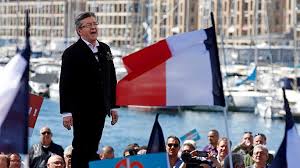
Who\’s the most dangerous of them all economically ? If the pat answer is Marine Le Pen, a more polished version of Trump, think again. Introducing Jean-Luc Mélenchon, the far left candidate who is currently surging in the polls . Nearly 20% of France want him as President .


Here are his economic policies, without comment

  • 90% tax rate for those earning more than Euro 400,000 a year
  • 273 billion Euros higher spending over 5 years
  • 16% rise in minimum wage to Euros 1326 a month (Rs 90,000 a month)
  • 35 hour work week.
  • Exit the Euro
  • Abolish the treaties prescribing a target of deficit to GDP . In other words, simply print money
  • Exit EU, a la Britain, if necessary
  • Join Alba the economic pact between Cuba and Venezuela. Honourable observers of this pact are Iran and Syria
  • Right to housing to become a constitutional right
  • Nationalise utility companies

There is more, but this is enough for the time being.

The system of French elections is such that that he is unlikely to get through even in the first round. But it should give a pause for thought that a full 20% of the French electorate is willing to subscribe to such lunacy.

The right to vote is a heavy responsibility. Concepts like protest vote, angry voter, etc are deadly pitfalls. You are supposed to consider the options carefully and vote according to what you think is best for your country. You can have differing views, but irresponsible exercise of the franchise is catastrophic.

If you are of the view that this is all fear mongering, capitalism has failed, and we should give such a philosophy a try (yes, I am talking to you , if you have felt the Bern), then all I will say is that this has been tried before and the example is there for all to see. Venezuela.
The loony left is even more dangerous than the rabid right.

Immigration and Agriculture

There are some basic facts about agriculture. One ; you cannot do away with agriculture; you have to eat after all. Two; However much you mechanise agriculture, there are large portions of it that have to be done by hand and you need manual labour. Three; agricultural labour is hard hard work. You and I cannot do it. Four; everywhere in the world, the natives do not want to do agricultural labour. Five; You therefore have to \”import\” labour – poor people from places other than where the farms are and usually from another country. Six; the natives do not want these \”immigrants\” to come.
This is a real problem, which as stated, does not have a solution. Witness what\’s happening in the UK.
The Brits don\’t want to work in the fields. Therefore most of the agricultural labour comes from Eastern Europe (white Christians, mind you; the problem is compounded in the US because the labour is Hispanic). The Brits have voted to leave the EU and don\’t want anybody coming into their country. End result – fruit is rotting in the fields as reported in the article linked. 
This was not even about illegal immigration – these workers all came perfectly legally from Eastern Europe and since it was seasonal work, actually often went back to their countries after the picking was over. And yet the Brits have spat on their face and told them they are not welcome.
The same rural folk in the UK are the ones who voted for Brexit. London overwhelmingly voted for staying. And the main reason for voting exit ? Immigration. We don\’t want foreigners; period.
The UK farming lobby wants to reinstate the seasonal workers scheme. The deal is , please come and do the dirty work we don\’t want to do, stay in some ghetto so that we don\’t see you, give us all the fruit and then bugger off to where you came from. Couching it in polite language does not detract from what it really is meant to be.
Agricultural labourers should simply organise themselves and show the middle finger to the UK. If you want us to work, treat us as decent human beings and give us the respect we deserve. Or else, you can do your own dirty work.
To paraphrase the Duke of Norfolk – you cannot have your fruit and eat it too !

The Real Issue With Tech In Ed

If doctors\’ interest and ability in diagnosing and helping patients improve were limited, if the medicines themselves were not always known to work, and if the patients didn\’t have much ability to pay – how much do you think \’tech\’ would work? Moreover, if \’tech\’ took over the mistakes usually made by teachers, it would work even less, isn\’t it?
This is what is happening in the case of \’technology in education\’….
Vendors can be excused for touting their \’solutions\’ as real solutions – educators and decision-makers are the ones to be blamed for willingly falling into the trap of believing that technology will motivate teachers, overcome corruption, deal with the hierarchies that operate at the point of learning and perpetuate the hegemony of a few, tailor education to the needs and the experiences of the marginalized, solve the issue of huge and increasing diversity that teachers face, and overcome the indifference of the political / administrative establishment to poor educational performance.
A common finding in an analysis of most tech in ed efforts would likely show that after the initial enthusiasm and perhaps even use, the actual interaction / utilisation declines – eventually, it lies locked up or disused or misused (teachers use computers as a means of keeping children busy while they do something else). Sometimes a new wave of tech in ed displaces the old one but then neither end up making a sufficient difference.
It\’s not as if technology cannot make a difference, but it needs to be thought through differently. Usually, the thought process is – \’what can we do with tech\’? This is like saying: \’now that we have a car, where should we go?\’ You might end up going somewhere you didn\’t want to go. Instead, the question should be – \’what do we desperately want to do / need to do (and why), in which technology can play a part?\’ Examples of this are relatively rare!

Planning Regions


A planning region is a segment of territory  over which economic decisions apply. The term planning here means taking decisions to implement them in order to attain economic development. Planning regions may be administrative or political regions such as state, district or the block because such regions are better in management and collecting statistical data. Hence, the entire country is a planning region for national plans, state is the planning region for state plans and districts or blocks are the planning regions for micro regional plans. 


For proper implementation and realization of plan objectives, a planning region should have fairly homogeneous economic, to zoographical and socio-cultural structure. It should be large enough to contain a range of resources provide it economic viability. It should also internally cohesive and geographically a contagion area unit. Its resource endowment should be that a satisfactory level of product combination consumption and exchange is feasible. It should have some nodal points to regulate the flows. Seven major regions in India are:
(1) South India
(2) Western India
(3) Eastern Central India
(4) North-Eastern India
(5) Middle Ganga Plain
(6) North-Western India
(7) Northern India

Town and Country Planning Organization Regions
In 1968, the Town and Country Planning Organization suggested a scheme of planning regions delineated on the principle of economic viability, self-sufficiency and ecological balance at the macro and meson levels. The emphasis of the scheme was to introduce regional factor in economic development. This approach would complement the macro planning at the national level, with a component of regional policies, aimed at reducing regional disparities in the development. The macro- regionalization sought to link a set of areas, rich in one type of resources with areas having complementary resources or even resource poor areas, so that the benefits of economic activity in the former may flow into the latter. These planning regions cut across the State boundaries, but do not completely ignore the basic administrative units. The 13 macro regions proposed under the scheme include:
(1) South Peninsular (Kerala and Tamil Nadu)
(2) Central Peninsular (Karnataka, Goa, Andhra Pradesh)
(3) Western Peninsular (Western Maharashtra coastal and interior districts)
(4) Central Deccan (Eastern Maharashtra, central and southern Madhya Pradesh)
(5) Eastern Peninsular (Orissa, Jharkhand north-eastern Andhra Pradesh)
(6) Gujarat (Gujarat)
(7) Western Rajasthan
(8) Aravalli Region (Eastern Rajasthan and wasted Madhya Pradesh)
(9) Jammu, Kashmir and Ladakh
(10) Trans Indo-Genetic Plains and Hills (Pune Haryana, Himachal Pradesh, West Uttar
         Pradesh and Uttaranchal)
(11) Ganga-Yamuna Plains (Central and eastern Uttar Pradesh, and northern Madhya Pradesh)
(12) Lower Ganga Plains (Bihar and West Bengal Plains)
(13) North-Eastern Region (Assam and north-eastern states including Sikkim and north 
       Bengal)

Components of Regional planning 
Economy
Housing
Environment

Three Reasons Why The Use Of I.T. In Schools Is NOT Leading to Improved Learning

Recent reports from different parts of the world show that computer / IT supported learning programmes are not yielding the learning improvements expected. 
So why is this happening?
After looking at a fair number of IT-based programmes, software, and reports from different sources, this appears to be because something critical is being ignored: that improved learning requires both improved relationships and processes, and a clearer focus on outcomes considered worthwhile. Let me explain this a little. 
1. IT Use Doesn\’t Seek to Impact Relationships 
Relationships among the key stakeholders – teachers, students, parents / community, school heads, supervisors and administrators, and academic support personnel – cannot be bypassed; without improving them, it is difficult to see learning outcomes improve. Living in the hope that IT usage will make a difference here, is to be unrealistic. For relationships to flourish, apart from changing the teacher\’s role (and several other aspects), activities that require real group thinking would make a difference. At present the IT material has not paid sufficient attention here, though it is uniquely placed to do so, especially in gaming software. 
In addition, of course, several governance changes are required (e.g. in how school \’inspection\’ takes place) as well as in management of learning (through better preparation for teaching, classroom organization and use of assessment). Again, a misplaced emphasis on IT will not see changes here.
2. IT Use Could – But Doesn\’t – Sufficiently Impact Processes:
Some parts of the curriculum require face time between teachers and students, and among students themselves. Some parts are better handled through IT – I believe such an analysis of curriculum has not been done, resulting in everything being dumped on to IT, much of which it is not really in a position to support. (Khan Academy does try to increase the face time by \’reversing\’ the class, but it still does not do this analysis sufficiently and could benefit from it).
3. IT Use Doesn\’t Always Focus On The Outcomes It Should
The tendency is to focus mainly on a limited number of scholastic outcomes. In fact, even within the subjects themselves, higher order learning objectives are often ignored, or under-represented. Believe it or not, this affects the learning of other aspects as well! E.g. children who have the opportunity to make creative use of language end up being better in grammar and spelling than children who get an overdose of grammar and spelling. A great deal of IT material is geared to towards getting children to answer tests / exams rather than help in real, long-term learning.
But other than the subjects, larger curricular goals – such as cooperation, respect for diversity, development of a scientific outlook and an ecological perspective, developing a questioning mind, democratic values – hardly figure in much of the IT based material / activities. Implying that it is, at best, supporting some parts of subject-oriented learning rather than  education as such.
So is all this emphasis on \’modern technology\’ wrong and misguided? No, not necessarily wrong, but our expectations are certainly misplaced. In our desire to find the one single magic solution we have ignored the many other actions that need to be taken before learning improves. Perhaps focusing on IT seems easier and more exciting than than the hard work that the other stuff requires.
At any rate, IT is clearly not the silver bullet that many desperately believe it to be. It needs to be treated as just one more tool to be used, rather than as a solution for problems that it can\’t solve. And even as a tool, it needs to be used much better than is the case at present. 

Thus spake Gates

Regular leaders of the blog know that this blogger is an unabashed admirer of Bill & Melinda Gates. He is of the opinion that they must be sainted – for they have have done more good in the world than many, if not most, religious leaders.
They publish an annual letter which is like a “State of the Union address” in their field. This time they have answered in their letter, the ten toughest questions they get. And yes, Donald Trump is one of them, but if you expect an incendiary answer, well, you don’t know the Gates.
I consider their Annual Letter as required reading for any human being with a heart. Here is this year’s letter.
Its a bit different as it addresses questions, some of which are not developmental in nature – like Trump, or what do they do when they disagree. But it is , as always, an interesting and often motivating read.
May I exhort you to read this one, and then every one of their previous 10 letters. It is a far more productive use of your time, than reading you know what !

PM congratulates ISRO team on successful launch of PSLV-C47 carrying indigenous Cartosat-3 satellite

The Prime Minister, Shri Narendra Modi has congratulated the entire ISRO team on yet another successful launch of PSLV-C47 carrying indigenous Cartosat-3 satellite and over a dozen nano satellites of USA.

“I heartily congratulate the entire ISRO team on yet another successful launch of PSLV-C47 carrying indigenous Cartosat-3 satellite and over a dozen nano satellites of USA.

The advanced Cartosat-3 will augment our high resolution imaging capability. ISRO has once again made the nation proud”, the Prime Minister said.

Narendra Modi

@narendramodi

I heartily congratulate the entire @isro team on yet another successful launch of PSLV-C47 carrying indigenous Cartosat-3 satellite and over a dozen nano satellites of USA.

Narendra Modi

@narendramodi

The advanced Cartosat-3 will augment our high resolution imaging capability. ISRO has once again made the nation proud!

2,832 people are talking about this


***