Fellowship Opportunities for Researchers

1. Extra Mural Research Funding (Individual Centric)

Individual centric competitive mode of funding will be provided under the EMR funding schemes. SERB supports potential scientists for undertaking research in frontier areas of S&T in Life Sciences, Physical Sciences, Chemical Sciences, Engineering Sciences, Earth & Atmospheric Sciences & Mathematical Sciences.

Read More

2.Scheme for funding High Risk -High Reward Research

The Scheme for funding High Risk – High Reward Research aims at supporting proposals that are conceptually new and risky, and if successful, expected to have a paradigm shifting influence on the S&T. This may be in terms of formulating new hypothesis, or scientific breakthroughs which aid in emergence of new technologies.

Read More

3.Empowerment and Equity Opportunities for Excellence in Science

The scheme, Empowerment and Equity Opportunities for Excellence in Science (EMEQ) is aimed at providing research support to scientists belonging to the Scheduled Caste and Scheduled Tribe in undertaking research in newly emerging and frontier areas of science and engineering and thus to involve them in the National Science and Technology development process.

Read More

4.Start-Up Research Grant (Young Scientists)

Start-up grant for Young Scientists is restructured w.e.f. 1st September, 2015 into two new schemes:    Early Career Research Award (ECRA), National Post-Doctoral Fellowship (NPDF)

Read More

5. J C Bose National Fellowship

Nominations are invited for the J C Bose National Fellowships. The fellowship is meant to recognize active scientists and engineers for their outstanding performance and contributions. The fellowships are scientist-specific and very selective.

Read More

6. Ramanujan Fellowship

The fellowship is meant for brilliant scientists and engineers from all over the world to take up scientific research positions in India, i.e. for those scientists who want to return to India from abroad. The fellowships are scientist-specific and very selective. The Ramanujan Fellows could work in any of the scientific institutions and universities in the country and they would be eligible for receiving regular research grants through the extramural funding schemes of various S&T agencies of the Government of India.

Read More

7.National Post Doctoral Fellowship

The SERB-National Post Doctoral Fellowship ( N-PDF) is aimed to identify motivated young researchers and provide them support for doing research in frontier areas of science and engineering. The fellows will work under a mentor, and it is hoped that this training will provide them a platform to develop as an independent researcher

Read More

8.Early Career Research Award

Early Career Research Award scheme aims to provide quick research support to the young researchers who are in their early career for pursuing exciting and innovative research in frontier areas of science and engineering.

Read More

9.SERB Overseas Postdoctoral Fellowship

SERB Overseas Postdoctoral fellowship (SERB-OPDF) aims to build national capacity in frontier areas of Science and Engineering, which are of interest to India by providing postdoctoral fellowship for a period of one year extendable to one more year subject to good performance. The applicant should have completed PhD degree in science and engineering not earlier than the preceding two years from recognized institutions in India. For researchers who are in regular employment, the 2 years� period may be relaxed. The Program admits candidates in *identified areas and sends them to top institutions around the globe, other than USA and also to institutions where internationally acclaimed scientists are working. The applicant should himself/herself correspond with the proposed host institution abroad for their postdoctoral work. He/she is required to produce evidence, in the form of a letter of acceptance from the host institution along with merits/uniqueness of the host institute in the proposed area.

Read More

10.CSIR Young Scientists Awards

11. Scheme for Young Scientists & Technologist (SYST)

12. IYBA Innovative Young Biotechnologist Award

13. Sponsored Research (RESPOND)

The Indian Space Research Organisation (ISRO) has evolved a programme through which financial support is provided for conducting research and development activities related to Space Science, Space Technology and Space Application to academia in India. This programme of Research Sponsored by ISRO is called RESPOND. In special cases research and development projects proposed by non-academic R & D laboratories can also be supported through this programme. The aim of RESPOND is to encourage quality research in areas of relevance to the Indian space programme.

Read More

14. Research Programmes and Projects –  Ministry of Earth Sciences

Read More

15. Indo-U.S. Fellowship for Women in STEMM

Indo-U.S. Fellowship for Women in STEMM (Science, Technology, Engineering, Mathematics and Medicine) is aimed to provide opportunities to Indian Women Scientists, Engineers & Technologists to undertake international collaborative research in premier institutions in U.S.A, to enhance their research capacities and capabilities in global perspective. DST has launched the fellowship (WISTEMM)” jointly with Indo-U.S. Science and Technology Forum (IUSSTF).

Read more
16. 2019-2020 Fulbright-Kalam Climate Fellowship (Announcement[PDF]47.8 KB)

In a September 2014 Joint Statement, the President of the United States of America and the Prime Minister of the Republic of India launched U.S.-India Climate Fellowship Program to build long-term capacity to address climate change related issues in both countries.

In pursuance of the Joint Statement, the Government of the United States of America and the Government of the Republic of India – desiring to promote further mutual understanding between the two peoples by a wider exchange of knowledge and professional talents – intend to partner to build long-term capacity in the United States and India by engaging scientific and technical research scholars from both countries related to climate research and education through the Fulbright-Kalam Climate Fellowship.

The United States-India Educational Foundation (USIEF) administers the Fulbright-Kalam Climate Fellowship on behalf of both the governments.

Read more

Research Awards to promising “Young Scientist” by various Organisation Public and Private

The Scheme provides Opportunities to Young Scientists for pursuing exciting and innovative research in frontier areas. The scheme is focused on young scientists & technologist who have adequate background and training in fields of science and technology and show inclination to undertake socially relevant action research projects. This is also to encourage academic institutions, national labs and other S&T institutions.

Department of Science & Technology (DST)

Department of Science & Technology (DST) was established in May 1971, with the objective of promoting new areas of Science & Technology and to play the role of a nodal department for organising, coordinating and promoting S&T activities in the country. The Department has major responsibilities for specific projects and programmes as listed below:

  1. Formulation of policies relating to Science and Technology.
  2. Matters relating to the Scientific Advisory Committee of the Cabinet (SACC).
  3. Promotion of new areas of Science and Technology with special emphasis on emerging areas.
    1. Research and Development through its research institutions or laboratories for development of indigenous technologies concerning bio-fuel production, processing, standardization and applications, in co-ordination with the concerned Ministry or Department;
    2. Research and Development activities to promote utilization of by-products to development value added chemicals.
  4. Futurology.
  5. Coordination and integration of areas of Science & Technology having cross-sectoral linkages in which a number of institutions and departments have interest and capabilities.
  6. Undertaking or financially sponsoring scientific and technological surveys, research design and development, where necessary.
  7. Support and Grants-in-aid to Scientific Research Institutions, Scientific Associations and Bodies.
  8. All matters concerning:
    1. Science and Engineering Research Council;
    2. Technology Development Board and related Acts such as the Research and Development Cess Act,1986 (32 of 1986) and the Technology Development Board Act,1995 (44 of 1995);
    3. National Council for Science and Technology Communication;
    4. National Science and Technology Entrepreneurship Development Board;
    5. International Science and Technology Cooperation including appointment of scientific attaches abroad (These functions shall be exercised in close cooperation with the Ministry of External Affairs);
    6. Autonomous Science and Technology Institutions relating to the subject under the Department of Science and Technology including Institute of Astro-physics, and Institute of Geo-magnetism;
    7. Professional Science Academies promoted and funded by Department of Science and Technology;
    8. The Survey of India, and National Atlas and Thematic Mapping Organisation;
    9. National Spatial Data Infrastructure and promotion of G.I.S;
    10. The National Innovation Foundation, Ahmedabad.
  9. Matters commonly affecting Scientific and technological departments/organisations/ institutions e.g. financial, personnel, purchase and import policies and practices.
  10. Management Information Systems for Science and Technology and coordination thereof.
  11. Matters regarding Inter-Agency/Inter-Departmental coordination for evolving science and  technology missions.
  12. Matters concerning domestic technology particularly the promotion of ventures involving  the commercialization of such technology other than those under the Department of  Scientific and Industrial Research.
  13. All other measures needed for the promotion of science and technology and their  application to the development and security of the nation.
  14. Matters relating to institutional Science and Technology capacity building including setting  up of new institutions and institutional infrastructure.
  15. Promotion of Science and Technology at the State, District, and Village levels for grass- roots development through State Science and Technology Councils and other mechanisms.
  16. Application of Science and Technology for weaker sections, women and other disadvantaged sections of Society.

Government of India & AIIB sign agreement


The Government of India and the Asian Infrastructure Investment Bank (AIIB) signed a US$ 500 million “COVID-19 Emergency Response and Health Systems Preparedness Project” here today to help India to respond to the COVID-19 pandemic and strengthen its public health preparedness. This is the first ever health sector support from the Bank to India.

This new support will cover all States and Union Territories across India and address the needs of infected people, at-risk populations, medical and emergency personnel and service providers, medical and testing facilities, and national and animal health agencies.

The agreement was signed by Shri Sameer Kumar Khare, Additional Secretary, Department of Economic Affairs, Ministry of Finance, on behalf of the Government of India and Mr Rajat Misra, Director General (Acting) on behalf of the AIIB.

Shri Khare said that AIIB’s timely assistance will help Government in its efforts to respond to the threat posed by COVID-19 and strengthen the national health systems for preparedness in India. Responding to the urgency of the pandemic, this project was prepared in record time, underlying the efforts of the officials from the Finance and Health Ministries and the AIIB.

The project will enable the Government of India to slow and limit as much as possible the spread of COVID-19 in India by providing immediate support to enhance disease detection capacities by scaling up procurement of PPE, oxygen delivery systems, and medicines, build resilient health systems to provide core public health, prevention, and patient management functions to manage COVID-19 and future disease outbreaks, support research on COVID-19 by Indian and other global institutions working in collaboration with the Indian Council of Medical Research, address significant negative externalities expected in the event of a widespread COVID-19 outbreak and strengthen public structures for the coordination and management of the project.

The primary project beneficiaries will be infected people, at-risk populations, medical and emergency personnel, service providers at medical and testing facilities (both public and private), and public and animal health agencies engaged in India’s COVID-19 response.

Mr D.J. Pandian, AIIB vice-president (Investment Operations), said that building a resilient health system that can effectively treat COVID-19 patients and prevent its spread is the immediate priority. This funding will address this need and strengthen India’s capacity to effectively manage future disease outbreaks.

He further said that facing this unprecedented global challenge, AIIB will play its part and work closely with international financial institutions to help the Government of India with urgent financing they need to shore up their healthcare systems and help their economies recover as quickly as possible.

The project will also enhance the resilience of India’s health system to provide core public health prevention and patient care to better manage COVID-19 and future disease outbreaks. It will help strengthen India’s Integrated Disease Surveillance Program, revamp infectious disease hospitals, district, civil, general and medical college hospitals, and build a network of high containment Biosafety Level 3 laboratories.

Today, about 75 per cent of new infectious diseases begin with human-to-animal contact, including HIV/AIDS, Ebola, and SARS. The project will develop capacity and systems to detect existing and emerging zoonoses, support biomedical research on COVID-19 by Indian institutions, and upgrade viral research and diagnostic laboratories for testing and research.

It will also help address potential significant negative externalities in the event of a widespread COVID-19 outbreak, including comprehensive health awareness and behaviour change campaigns on hygiene practices, wearing masks, social distancing, and mental health and psychological services for vulnerable communities.

The project is being financed by the World Bank and AIIB in the amount of $1.5 billion, of which $1.0 billion will be provided by World Bank and $500 million will be provided by AIIB.

The project will be implemented by the National Health Mission (NHM), the National Center for Disease Control (NCDC) and the Indian Council of Medical Research (ICMR) under the Ministry of Health and Family Welfare.

Food and Public Distribution ensures to supply free food grains

The Government is making efforts to ensure that foodgrains are readily available for distribution in all the States for meeting their requirements under the “Pradhan Mantri Garib Kalyan Anna Yojana (PM-GKAY)”. The Union Minister for Consumer Affairs, Food and Public Distribution, Shri Ram Vilas Paswan said here today the FCI has already loaded a total number of 2641 rakes (including Wheat and Rice) towards this end and the approx quantity loaded is 73.95 LMT (55.38 LMT Rice and 18.57 LMT Wheat). This is an all time record as this heavy / huge movement of foodgrains was accomplished during the period from 24.03.2020 (the date on which lockdown was clamped across the country) to 08.05.2020.


He said 21 States/UT have completed more than 90% distribution for the month of April under PM-GKAY covering nearly 41.35 Crore beneficiaries in these States/UTs. Some States/UTs namely, Andaman Nicobar Island, D&NH and Daman & Diu, Madhya Pradesh, Odisha, Puducherry, Himachal Pradesh etc. are distributing foodgrains for two months in one go under PMGKAY.

The Minister said 6 Crore Special SMSs have also been sent by about 20 States/UTs to NFSA ration card holders for awareness generation about of additional benefit of free foodgrains under PM-GKAY.

PM-GKAY is aimed at ameliorating the hardships faced by the poor due to various economic disruptions caused by the COVID19 pandemic. Under the package the Government aims to ensure no poor vulnerable family/person suffers on account of non-availability of foodgrains due to disruptions in the next three months.

Accordingly, the Department of Food & Public Distribution has also announced the policy decision taken in this regard to distribute additional foodgrains to about  80 Crore NFSA beneficiaries under the PM-GKAY in all States/UTs for a period of three months April to June 2020, including the UTs which are on DBT Cash Transfer mode.


Pulses distribution under PM-GKAY

Besides the food grains, Shri Paswan said the Government is also distributing free one kg of pulses to about 19.50 crore households for three months in the country. He said, this is the first time that the Department of Consumer Affairs is carrying such a massive operation of pulses. Government has allowed use of its stocks lying in about 165 NAFED godowns across the country for this scheme. Over 100 dal mills across the country have been pressed into service by NAFED so far.

The Minister said, as on date, about 51,105 LMT of pluses have been distributed across 21 States and 5 UTs. He said the delay in supply and distribution of pulses is due to late intimation by States/UTs on their choice of particular pulses variety such as Tur Dal, Urad Whole, Moong Whole, Chana hole, Chana Dal and Masur Dal besides the logistics involved in transportation from different States during the lockdown. In many inaccessible locations, such as Vijayanagar in Arunachal Pradesh on the Myanmar border and Ladakh, pulses have been lifted by air route under extremely challenging conditions. Besides, some States like UP have decided to distribute pulses with food grains in order to minimize social contact leading to delayed distribution, he said.


17 States/UTs covered under ‘One Nation One Ration Card’


Shri Paswan said, under the “One Nation One Ration Card” plan,  5 more States/UT of Uttar Pradesh, Bihar, Punjab, Himachal Pradesh and Darda & Nagar Haveli and Daman & Diu, have been asked to integrate with the National Cluster. The cluster already has 12 States namely – Andhra Pradesh, Goa, Gujarat, Haryana, Jharkhand, Kerala, Karnataka Madhya Pradesh, Maharashtra, Rajasthan, Telangana and Tripura w.e.f. 1st January 2020. Now, with a total of 17 States/UTs integrated with the National Cluster, the facility of national/inter-State portability would be enabled for 60 Crore NFSA beneficiaries of 17 States/UTs to lift their entitled quota of foodgrains from any Fair Price Shop of their choice by using their same/existing ration card.


Food grains procurement by FCI on track


Shri Paswan assured sufficient food grains supply is available to meet the increased demands and the procurement process is also on track. As on 08.05.2020, cumulative Procurement of Wheat in Rabi Marketing Season (RMS) 2020-21 is 226.85 LMT whereas corresponding procurement during RMS 2019-20 was 277.83 LMT.  Therefore, procurement of Wheat in current season is less by 18.35% than the previous season in corresponding period, he said. Cumulative Procurement of Paddy, as on 06.05.2020, in terms of Rice in Kharif Marketing Season (KMS) 2019-20 is 439.02 LMT whereas corresponding procurement during KMS 2018-19 was 398.13 LMT. Therefore, procurement of rice in current season is more by 10.27%, he said.

The procurement of Wheat and Paddy / Rice during RMS 2020-21 normally commences on the 1st of April.  But due to COVID-19 situation, most of States could commence their procurement operations around 15th of April.

In view of the prevailing unprecedented situation, it has been decided that procurement of Wheat during the ensuing Rabi Marketing Season (RMS) 2020-21 and Procurement of Paddy / Rice of Rabi Crop in Kharif Marketing Season (KMS) 2019-20 may be carried out on provisional basis, while keeping the target / estimate of procurement the same as during previous RMS -2019-20 and KMS 2018-19 (Rabi crop) in case of wheat and Paddy / Rice, respectively.

States were advised to ensure that the procurement operations take place in a staggered manner so as to avoid congregation of large number of farmers at a time and some kind of token system should be put in place for this.  The number of procurement centres could also be increased to the extent possible so as to disperse the procurement operations for ensuring social distancing and maintaining hygiene at these centres.

Shri Paswan said the Department of Food & Public Distribution has constituted a Task Force to assess the situation arising out of shortage of jute bags / bales for packaging of foodgrains due to the COVID19 lockdown and also relaxed guidelines for packaging of foodgrains in used gunny bags and HDPE /PPE bags (commonly known as plastic bags for packaging of foodgrains, especially Wheat).

Indian Red Cross Society get centenary celebrations

The Union Minister for Health & Family Welfare Dr. Harsh Vardhan took part in centenary celebrations of Indian Red Cross Society(IRCS) in New Delhi today on the occasion of ‘World Red Cross Day’. Dr. Harsh Vardhan garlanded the bust of Mr. Henry Durant the founder of the International Red Crossand flagged off the vehicle carrying relief material to Haryana, consisting of PPEs, masks, wet wipes, body bags etc. to mark the occasion.

Photo by Sangeet Rao on Pexels.com

Addressing the limited gathering at the function as well as IRCS leadership and staff at various state branches across the country through Video Conferencing, he said “It’s an important day for Indian Red Cross Society, as it has not only completed 100 years of existence but has kept its motto of providing medical and humanitarian help while maintaining its prestige and commitment.” He thanked IRCS for providing relief and doing good work in India. He said “Its commendable that IRCS does not wait for orders from anyone but sue-moto acts and provides the relief work in any disaster or humanitarian crisis which requiresimmediate action.”

Dr. Harsh Vardhan lauded the Indian Red Cross Society for sending mobile blood collection vans to the premises of regular blood donors to facilitate them to come forward for blood donation at this point of time. He said, “IRCS is doing yeoman service to the mankind by providing the facility of mobile blood collection, pick & drop facility through mobile van etc. and setting a benchmark for other voluntary organisations by providing blood to terminally ill patients, thalassaemics as well as patients suffering from other blood disorders during these difficult times.”

He also appealed to voluntary organisations, NGOs and common people at large to come forward to promote voluntary blood donation to maintain ample blood stocks to meet any eventuality in the country. He further asked people to donate blood at least once in a year on their birthday or marriage anniversary to make the occasion special for not only themselves but for the people who need blood also.

He further asked IRCS to come forward to spread awareness amongst the masses to not to stigmatise patients and Corona Warriors including doctors, health workers, etc. and promote positive environment for them to work with great zeal.

“I really value Indian Red Cross fraternity having given a great contribution in our fight against COVID-19 too where they have provided equipment, sanitizers, food, PPE kits and N95 masks etc. to several hospitals in India”, he said.

The IRCS was founded in 1920, as a voluntary humanitarian organization. Today with a network of over 1,100 branches across the country, it provides relief in times of disasters/emergencies as well as promotes health and care of the vulnerable people and communities. It is a leading member of the largest independent humanitarian organization in the world, the International Red Cross & Red Crescent Movement.The Mission of the Indian Red Cross is to inspire, encourage and initiate, at all times, all forms of humanitarian activities so that human suffering can be minimized and even prevented and thus contribute to creating more congenial climate for peace.

Dr. Harsh Vardhan said, “Just like Red Cross, it should be our motto to inspire, encourage and initiate all forms of humanitarian activities so that human suffering can be minimized at all times to come.”

Outlining the silver lining in the crisis due to COVID-19, he said, “This situation has also given us good things. It’s an advent of a new era and world order. We are promoting personal hygiene like never before, attending meetings through Video Conferencing as well as using other digital technology to save on costs while taking full care of our families. It has highlighted the value of a clean and clear environment, earth, water and air; nature has taken over the planet world over, like never before.”

At the end, he thanked all those who attended the event. Mr. Udaya Regmi, Acting Head of Country Cluster Office, International Federation of Red Cross (IFRC), Mr. Yahia Alibi, Head of Regional Delegation, ICRC, Mr. R. K. Jain, Secretary General,and other senior officials from IRCS were also present on the occasion.IRCS,Chairmen and Secretaries of various IRCS state branches, IRCS staff and Volunteers across the country connected through Video Conferencing.

Event and Entertainment Management Industry to Remain Positive

Fellowship Opportunities

Union Minister for MSME and Road Transport and Highways, Shri Nitin Gadkari today held meetings via video conferencing with the representatives of Events and Entertainment Management Association and members of Finance Industry Development Council on impact of COVID-19 on their sectors.

During this interaction, the representatives expressed concerns regarding various challenges being faced by MSMEs amid COVID-19 pandemic along with few suggestions and requested support from the government to keep the sector afloat.

Shri Gadkari emphasized that this sector is doing an excellent work and that their talent and vision is widely recognized. As we are fighting war against CORONA, he asked the members of the event and entertainment sector to register themselves as MSMEs to benefit from the schemes in this regard.

There is a huge potential in India for enterprises in the sector. India is rebuilding Pragati Maidan as international exposition Centre. Government is prepared to provide maximum possible support to the industries at all levels. He asked them to submit a detailed representation which he can take up with other Ministries/Departments.

Shri Gadkari also urged the industry to have a positive attitude during this time to tide over this crisis.

The Minister recalled that Government of Japan has offered special package to its industries for taking out Japanese investments from China and move elsewhere. He opined that it is an opportunity for India which should be grabbed.

Some of the major issues highlighted and the suggestions given include introducing a category for event and management to register as MSME, need of dedicated officers at state/district level for MSMEs, assistance to small financing units in sourcing funds, doing away credit rating requirement for smaller financing units to avail guarantees offered under the relevant scheme, etc.

Shri Gadkari responded to the questions from representatives and assured all possible help. He informed that he would examine their representation for consideration relating to his Ministry and also take up with other related departments/ Governments.

He emphasized that industry should take a positive approach and tap the opportunities that will be created when the COVID-19 crisis gets over.

*****

A Swachhata Warrior in Each of Us: Sadhguru

Shri Sadhguru, has said that that there is a Swachhata Warrior in each of us. “The broom is not the tool that will clean India. It is the active participation of citizens that will play a crucial role in keeping our towns and cities clean”, he added. Shri Sadhguru was addressing a live webinar titled ‘Swachhata Warriors with Sadhguru in Challenging Times’ organized by the Ministry of Housing & Urban Affairs (MoHUA), in collaboration with Isha Foundation.  The hour long webinar had Sadhguru interact with District Collectors/ Municipal Commissioners from Ujjain, Surat, East Delhi Municipal Corporation, Agra and Madurai and provide powerful insights on facing the present crisis. The session dedicated to the frontline COVID champions – the Safai Karmacharis, was moderated by Shri Durga Shanker Mishra, Secretary, MoHUA and saw the spiritual Guru also respond to a set of questions posed by sanitation workers. The session was webcast live through YouTube (isha.co/MoHUAwithSadhguru) with simultaneous translation of the same available in Hindi (isha.co/MoHUAwithSadhguruinHindi).

Shri Sadhguru started by acknowledging the critical role that the Swachh Bharat Mission (SBM) has played in significantly improving the levels of cleanliness of the country, and particularly saluted the efforts of the sanitation workers who are at the forefront of the Mission in the past five years.

Along with answering the questions posed by ULB representatives and sanitation workers, Shri Sadhguru highlighted the importance of motivating the Swachhata Warriors along with ensuring the availability of adequate personal protective equipment and uniforms for sanitation workers to allay their fears and provide them with a sense of while on the job. He further added, “Sanitation, needless to say, is a big challenge. Along with the segregation and processing of wet and dry waste, the treatment of waste from industries and discharge of sewage from domestic industries also need to be paid attention to. Besides, dry waste segregation needs to be incentivized in some ways in order to encourage citizens to take it up with more enthusiasm”.

The session was attended by a wide range of stakeholders across 4300+Urban Local Bodies (ULBs) across India which included Municipal Commissioners, Chief Executive Officers, political representatives such as Mayors along with health workers, sanitation workers, self-help group members, and all frontline COVID champions.

Preparedness and containment measures taken for COVID-19

Dr. Harsh Vardhan, Union Minister of Health and Family Welfare in continuation of series of focussed meetings with the States like Uttar Pradesh, Bihar, Delhi, Maharashtra, Gujarat, Madhya Pradesh, West Bengal, Odisha, held a high level meeting today with Dr. C. Vijayabaskar, Health Minister of Tamil Nadu, Shri Etela Rajendra, Health Minister of Telangana and Dr. K. Sudhakar, Medical Education Minister of Karnataka in presence of Sh. Ashwini Kumar Choubey, MoS (HFW) and senior officials from both Centre and the States to review the situation, actions being taken and preparedness for management of COVID-19 in the three States.

At the outset, Dr. Harsh Vardhan appreciated the dedication of all the States in combating COVID-19 in the country. He informed the States about the present situation in the country and the steps taken by the Centre to combat COVID-19 so far. He further added that Hon’ble Prime Minister Shri Narendra Modi is continuously monitoring and guiding all the concerned Ministries/Departments to implement more effective containment plans, surveillance, contact tracing and screening for COVID-19.

Dr. Harsh Vardhan stated, “Appropriate measures are being taken to combat COVID-19 and with the cohesive efforts of both Centre and States, adequately growing numbers of dedicated COVID hospitals, Isolation & ICU beds and Quarantine being identified and developed so far, we are well-prepared to face any eventuality due to COVID-19”. Centre is also supporting by providing sufficient number of masks & Personal Protective Equipments, Ventilators etc. to the States/ UTs / Central Institutions, he further added.

After a brief presentation on the status of COVID-19 cases in the States and its management in the States, Dr. Harsh Vardhan stated, “States need to focus on more effective surveillance, contact tracing and early diagnosis to keep low fatality rate”. He said, “Surveillance for Severe Acute Respiratory Infections (SARI) / Influenza Like Illness (ILI) should be intensified in unaffected districts and districts which have not reported cases from last 14 days and more through the IDSP network in collaboration with Medical Colleges and Hospitals. Such measures will help to indicate the presence of any possible hidden infection at an early stage thus helping in its timely containment”, he added.

Dr Harsh Vardhan stressed, “States need to ensure adoption of Infection, Prevention & Control (IPC) practices in all healthcare settings to avoid/reduce chances of infections to health care workers. States were advised to ensure that all Central Guidelines/Advisories are implemented till the field level in earnest. The States informed about some of the best practices adopted at the District level such as deployment of mobile testing laboratories and distribution of medicines for non-communicable diseases for a period of 2 months in advance in containment zones, home delivery of bleaching powder in slum areas and use of Tele-medicine as an alternative to OPD. Union Health Minister appreciated the best practices shared by the District Magistrates/Commissioners and other officials of various districts like identification of community volunteers for distribution of necessary services, daily items as well as for creating awareness about Behaviour Change Communication (BCC) activities, deployment of mobile units in rural areas for ANC of pregnant women, screening and treatment of elderly patients suffering from non-communicable diseases etc.

Dr Harsh Vardhan appreciated the work done by the State Governments and the erdication shown by frontline health workers, Anganwadi workers, police and paramilitary personnel who are working beyond the call of duty in the interest of nation. He reminded States to provide them preventive medicines and immunity boosters along with testing as and when required.

It was reiterated to the States that attention needs to be accorded to provisioning of non-COVID essential health services such as immunisation drives, TB case tracing and treatment, providing blood transfusion for dialysis patients, treatment of cancer patients, ANC of pregnant women, etc. It was also stated that the Ayushman Bharat-Health & Wellness Centres could be used for screening for hypertension, diabetes and three types of cancers. Telemedicine and tele-counselling could be used for a larger population in view of the lockdown. States have been advised to keep adequate stock of essential medicines. States were also informed that helpline number 104 in addition to 1075 can be used for Grievance Redressal for non-COVID essential services, and for informing regarding availability of these services etc. Adequate measures for prevention of vector borne diseases also need to be taken, they were advised.

Dr Harsh Vardhan also spoke to the DMs of various districts of Tamil Nadu, Telangana and Karnataka and discussed in detail the status and management of COVID-19 in the districts.  He also added that such meetings will help in working more cohesively and also help in filling gaps, if any, and to understand and address the issues more closely and clearly.

Ms. Preeti Sudan, Secretary (HFW), Shri Rajesh Bhushan, OSD (HFW), Ms. Vandana Gurnani, AS & MD (NHM), Dr. Manohar Agnani, Joint Secretary (MoHFW), Dr. S.K. Singh, Director, NCDC along with Principal Secretary (Health)and other senior state health officials participated in the meeting.

Modernisation of infrastructure for airfields of Air Force, Navy, Coast Guard

Ministry of Defence signed contract for Modernisation of Air Field Infrastructure (MAFI) of 37 airfields for Indian Air Force(IAF), Indian Navy (IN) and Indian Coast Guard (ICG) with M/s Tata Power SED (TPSED) at a cost of nearly Rs 1,200 crore here today. The proposal has been duly approved by Raksha Mantri Shri Rajnath Singh.

The MAFI Phase-II is a follow-on programme based on MAFI Phase-I that included upgradation of 30 airfields of IAF. The airfields modernised under MAFI Phase-I have been of immense benefit to both military and civil users.

The project is a turnkey project that includes installation and commissioning of modern airfield equipment like Cat-II Instrument Landing System (ILS) and Cat II Air Field Lightning System (AFLS), etc. The modern equipment around the airfield will also be directly connected to Air Traffic Control (ATC), thereby providing excellent control of the airfield systems to the air traffic controllers. The upgradation of navigational aids and infrastructure under this project would enhance the operational capability by facilitating air operations of military and civil aircrafts even in poor visibility and adverse weather condition while enhancing aerospace safety.

The contract will provide impetus to the domestic industry in the prevailing situation. The project will give a boost to over 250 Micro, Small and Medium Enterprises which will be directly benefited from being involved in execution of various activities of this project. This contract would aid in infusing the much needed capital in the market and boost employment generation in such fields as communications, avionics, information technology, apart from civil and electrical equipment and construction.

Charts, Graphs, And Visual STEAM – Teaching The Super Bowl By The Numbers

Source: Asbury Park Press


Aside from the physical drama and the halftime theatrics, the Super Bowl provides prime fodder for data analytics. The enormous volume of communication and marketing around this shared cultural moment offers a case study for exploring numbers and significance.

These days, graphs are no longer the sole purview of math class. This fall, for example, we spent a “math week” in social studies talking about how historians incorporate statistics and charts in probing the details behind pivotal events. Similarly, the Super Bowl bridges academic disciplines as an appealing touchstone for students to get excited about analytical reasoning and data design. That’s how right-brained and left-brained mindsets can merge perfectly in a contemporary STEAM study.

Some examples of lessons and visual aids that use graphs and charts include:


Source: Yellowfin

On Super Bowl Sunday, 1.25 billion chicken wings are expected to be consumed. The number of tweets is predicted to top 25 million, up significantly from the 13.4 million last year. And the average American is projected to consume 2,400 calories of Super Bowl chow.

The emphasis here is on the visual presentation of numerical sets. Graphic literacy (or “graphicacy”) means that learners can “read” the grammar of lines and bars. Understanding trends and anomalies are key skills in interpreting mathematical and scientific figures.

As every educational institution searches for ways to blend STEAM proficiencies into the curriculum, the pop draw of the Super Bowl can be just the ticket to grab kids’ attentions in discovering the day’s dynamic details. Any of the tables or diagrams below would be terrific examples to show on Monday in kicking off a week of visual STEAM activities. The logical reasoning of numbers meets the illustrative narrative of the liberal arts:

Source: The New York Times


Super Bowl ads often get the most attention from both football diehards and passing revelers alike. This interactive tool from the New York Times allows students to compare a timeline of percentages as they parse the media blitz across the years.

Source: Yellowfin


The media literacy component of Super Bowl mayhem cannot be overlooked. Many avenues exist for teachers to guide students in realizing the emotional tug of advertising during this high profile event. Yellowfin has designed an easily understood graph of Super Bowl ad prices to engage any student.

Source: Yellowfin


For aficionados of the sport itself, Yellowfin has assembled a horizontal bar chart of MVP winners by position. The results are familiar enough to let the content drive the comprehension. In other words, even the youngest mathematicians can expect QBs to win awards, and thus the extended blue bar becomes a visual signifier for their predictions. 

Source: Yellowfin


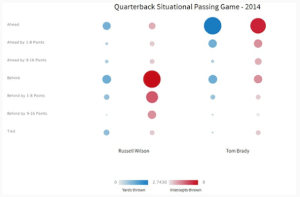
For strategists of team offenses, bubble graphs can blend with traditional tables to illuminate the choices of quarterbacks in certain situations.

For other Super Bowl educational resources, we recommend these posts:

cognitive, social and teacher presence and PLEs

This posting is in response to Derek Wenmouth’s diagram – OLE a school perspective – illustrating a school-based PLE. This is currently being discussed in a very interesting online discussion seminar run by Derek Wenmouth and Derek Chirnside on SCOPE.

It strikes me in all this talk about personal learning ecologies and personal learning environments (PLEs) that we are paying a lot of attention to the structure of the system. I am currently exploring how Derek’s proposed system can help with learning. At the moment the diagram represents a mish mash of ways to collect together content – very important but not enough to stimulate engagement and reflection and deep learning.

Inherent in the use of some of the tools e.g. blogs, is a belief that communication will happen but I think we need to look carefully at this. Just because we keep a blog does not mean that someone will give us feedback on the content. We could also have a collection of tools in a system such as that proposed by D and have no interaction at all with another human being. At least in a classroom, there is a teacher to guide or control the learning.

My question is how can a PLE incorporate teacher presence and scaffolded learning and still enable the learners to have autonomy in their choices?

Is a PLE only really any good for the development of a cognitive presence online? i.e. information processing and can this truly happen without discourse and input from another human? Does a PLE automatically stimulate social interaction? I have found that there is no guarantee of a social presence i.e. interaction with other students, and even if this occurs and is unguided and unstructured, how much learning actually occurs? I believe that if any system such as a PLE is to succeed, teacher presence is very important. There is more about the ideas of cognitive, social and teacher presence in an article called:

Farmer, J. (2004). Communication dynamics: Discussion boards, weblogs and the development of communities of inquiry in online learning environments. In R. Atkinson, C. McBeath, D. Jonas-Dwyer & R. Phillips (Eds), Beyond the comfort zone: Proceedings of the 21st ASCILITE Conference (pp. 274-283). Perth, 5-8 December. http://www.ascilite.org.au/conferences/perth04/procs/farmer.html

Actual example of the use of social networking tools and strategies in a course.In a course where I co-teach design for flexible learning, we have encouraged participants to set up their own PLEs using a blog, del.icio.us account, mailing list and wiki as the backbone. They also have access to a LMS discussion and content on a course wiki,and are encouraged to use a range of open source software e.g. audacity for audio, gimpshop and gimp for image manipulation, CMap and Gliffy for mindmapping, and web-based tools e.g. Flickr (images), BubbleshareslideshareYoutubebliptv. There is variable take-up. Some really explore and try out lots of things to design and create resources and a learning space for themselves, others sit on the fringes.

The blogs which each student is required to keep and the course wiki and mailing list, and del.ici.ous accounts depend very much on an active teacher presence to keep the participants linked and motivated. It also depends on these items being connected to the course assessment. The tools are there, but without facilitation by the “teachers” the participants tend to learn in isolation apart from when they come together for f2f workshops.

We have found that unless guidance is provided by the “teachers” very few of them provide feedback to each others’ blogs, contribute to the wiki or del.ici.ous account or contribute meaningful discussion to the mailing list.

cognitive, social and teacher presence and PLEs

This posting is in response to Derek Wenmouth\’s diagram – OLE a school perspective – illustrating a school-based PLE. This is currently being discussed in a very interesting online discussion seminar run by Derek Wenmouth and Derek Chirnside on SCOPE.

It strikes me in all this talk about personal learning ecologies and personal learning environments (PLEs) that we are paying a lot of attention to the structure of the system. I am currently exploring how Derek\’s proposed system can help with learning. At the moment the diagram represents a mish mash of ways to collect together content – very important but not enough to stimulate engagement and reflection and deep learning.

Inherent in the use of some of the tools e.g. blogs, is a belief that communication will happen but I think we need to look carefully at this. Just because we keep a blog does not mean that someone will give us feedback on the content. We could also have a collection of tools in a system such as that proposed by D and have no interaction at all with another human being. At least in a classroom, there is a teacher to guide or control the learning.

My question is how can a PLE incorporate teacher presence and scaffolded learning and still enable the learners to have autonomy in their choices?

Is a PLE only really any good for the development of a cognitive presence online? i.e. information processing and can this truly happen without discourse and input from another human? Does a PLE automatically stimulate social interaction? I have found that there is no guarantee of a social presence i.e. interaction with other students, and even if this occurs and is unguided and unstructured, how much learning actually occurs? I believe that if any system such as a PLE is to succeed, teacher presence is very important. There is more about the ideas of cognitive, social and teacher presence in an article called:

Farmer, J. (2004). Communication dynamics: Discussion boards, weblogs and the development of communities of inquiry in online learning environments. In R. Atkinson, C. McBeath, D. Jonas-Dwyer & R. Phillips (Eds), Beyond the comfort zone: Proceedings of the 21st ASCILITE Conference (pp. 274-283). Perth, 5-8 December. http://www.ascilite.org.au/conferences/perth04/procs/farmer.html

Actual example of the use of social networking tools and strategies in a course.In a course where I co-teach design for flexible learning, we have encouraged participants to set up their own PLEs using a blog, del.icio.us account, mailing list and wiki as the backbone. They also have access to a LMS discussion and content on a course wiki,and are encouraged to use a range of open source software e.g. audacity for audio, gimpshop and gimp for image manipulation, CMap and Gliffy for mindmapping, and web-based tools e.g. Flickr (images), BubbleshareslideshareYoutubebliptv. There is variable take-up. Some really explore and try out lots of things to design and create resources and a learning space for themselves, others sit on the fringes.

The blogs which each student is required to keep and the course wiki and mailing list, and del.ici.ous accounts depend very much on an active teacher presence to keep the participants linked and motivated. It also depends on these items being connected to the course assessment. The tools are there, but without facilitation by the \”teachers\” the participants tend to learn in isolation apart from when they come together for f2f workshops.

We have found that unless guidance is provided by the \”teachers\” very few of them provide feedback to each others\’ blogs, contribute to the wiki or del.ici.ous account or contribute meaningful discussion to the mailing list.

9 Generic activities for exploiting infographics

Infographics are a great source of information and make reading information from the computer screen much easier, but just showing students an infographic and telling them to study it isn’t the most effective way to exploit the medium.


Creating your own infographic tasks can be time consuming though, so in this posting I’m presenting a number of generic ideas that should work with a number of types of infographic. You can use these ideas with students to help focus their comprehension of the information and give them clear goals for engaging with the information in the graphics.


Peer created questions
Give your students an infographic and get them to create a quiz based around it. Once the students have created their quiz they can use it to check the comprehension or knowledge of other students in their class. You can make this competitive and have teams to quiz each other. You could also have different infographics for each group and they can exchange questions and infographics.

  • This activity has a duel role in that students need to read through the infographic and understand it in order to create the questions, but they also practise formulating questions. The activity also adds an element of competition which some students find motivating and of course it saves you a lot of time creating questions yourself.

Fact finding
Ask your students to find x-number of what they believe are the most important or significant facts in the infographic. Get them to justify their choice and explain why these points are the most significant.

  • This activity encourages students to evaluate and make value judgements about the information they are being exposed to. It also reveals elements of their own value system and exposes them for discussion which can be very enlightening.


Checking sources / corroborating information
Get students to check the sources of any statistics mentioned in an infographic to make sure they are correct and that the sources are valid. You could also get them to find supporting sources on other sites that either authenticate or contradict the statistics stated in the infographic.

  • There’s a common joke that 83% of all statistics are made up. Often students tend to believe any information that they find online. This activity encourages students to be more critical and to check the validity of information they find. It also helps them to develop the necessary research skills to validate online information.

Comparing to yourself
You can get students to find out where they fit within any infographics that contain personal information. You can also use this as a mingle task by asking students to try to find someone in the classroom who fits into any of the same statistics that they do.

  • This encourages the students to apply the information to themselves and by personalising it can make it seem more real, memorable and tangible. This can make data a little less dehumanising. The mingle activity can also help to improve classroom dynamics and help students to get to know each other.

Checking bias and motivation
Ask the students to find out who created the infographic and why they think it was created. This involves them researching the source and thinking about the relationship between the company that created the graphic and the information in it.

  • This encourages students to think more deeply about information and to question the goals and motivation behind it. Students often think of information as neutral, but the way information is displayed and what information is chosen can influence readers. Pushing students to look more deeply at the motivations behind the information can make them more critical readers.

Personal response
You can ask students for a range of personal responses to any infographic. Here are some possible example questions.
What did you find interesting?
What information do you doubt?
What information would you like to share? Who with? Why?

  • This encourages students to think about applying information and making it purposeful for their own lives. Encouraging a personal response from students can also make the lessons more meaningful and memorable for them.

Summary / Writing
Ask your students to take notes about the most important information in the infographic and then use the notes to write a summary. The summary could have some form of publication as a motivation, such as a newspaper report website publication. Once they have finished a first draft they can exchange with another student and compare to see if they chose the same main points. You could also ask them to peer edit the text and then return it before writing a final draft.

  • This can help to develop students process writing skills and academic study skills. It encourages students to evaluate information and make and articulate the connections between different nuggets of information.

Presentation summary
You can ask your students to prepare an oral presentation based on the information they took from the infographic. They can also prepare a presentation deck with images and text to help support their presentation.

  • This can help to develop students speaking and presentation skills. The ability to present and talk about information is also a valuable workplace skill.

Create your own research
Get students to create their own research questionnaire based around the same topic. They can use this either in class or share it through social media and collect the information for their own infographic.

  • This develops students research skills and encourages them to think about the framing of questions to extract information. It also encourages them to think about how they present data once it has been collected.


 I hope you find these tasks useful. You can find more tasks, examples and ideas for using and creating infographics in my ebook – Exploiting Infographics for Digital Literacy and Critical Thinking


Related links:

Best

Collaborative Hearts And Minds Help Kids Cope

Source: ASIDE 2015

With the increasing questions we received from our sixth graders about the abhorrent news this past week, we realized they needed to do something to make them feel they were sending a positive message to help the world be a more peaceful place. Eleven- and twelve-year-olds hear the news, and most have far more access to content than their parents realize. Their questions abound and need an outlet. As middle school educators, we know this.

Source: ASIDE 2015

So with our friend and colleague, Francine Wisnewski (@fwisnewski), we decided to bring hearts and minds together to let the kids create a message to share on social media and with the school community. We asked them that each finished design somehow include a heart, map, and peace sign. That’s it. How they incorporated the criteria and with whom they worked, or not, was up to them.

We cherish the flexibility in our curricula that allows us to stop everything to promote mindfulness with our learners. It does not matter that the schedule listed math and history; we pulled the kids together to address their concerns about world conflict and violence.

Source: ASIDE 2015

We continually try to build the hearts and minds of our young learners to be peace builders, peacemakers, and peacekeepers. As adults, we understand the turmoil in the world, and sometimes we just have to stop to help them cope. It’s worth every minute. If we don’t, we lose the power of positive thinking that the world so much needs.

For other resources, please see:

Creating Logos With Students – Understanding Visual Metaphor And Symbolic Meaning

Source: DesignMantic (click for full-size image)

Logos are short-hand, visual cues that companies use to evoke their brands. Effective logos represent automatic associations between a corporation and a customer. They connect a unique icon with an emotional reaction.

This type of tidy pictorial design can also be employed to winning effect in the classroom. Students can use logos to study visual metaphors and symbolic meanings. They can experiment with thesis and synthesis, in boiling down a range of meanings into a concise, original image.

Source: ASIDE 2015

History students, for example, can sketch logos to embody specific presidents or time periods. We had our U.S. history classes brainstorm logos for the era of the Great Depression. The designs featured in this post range from a juxtaposition of the Empire State Building going up while the stock market goes down, to a financial Dust Bowl of lost dollars.

In studying literature, learners can similarly design logos to accompany a book or a character. It’s no surprise that the Hunger Games mockingjay pin became so popular among fans. Science students can draft logos for key principles or elements, or global thinkers can draw emblems to capture current events.

Source: ASIDE 2015

By translating their understanding into self-created icons, students can climb a level in their comprehension, from decoding to encoding. They can capture the essential significance or recurring tropes via clever designs that will in turn help educate their peers.

Steps for creating logos with students:

  1. Begin by having learners identify logos and brands from current media. We use these sheets of letters and symbols as games to get students excited and to introduce the range of possibilities.
  2. Invite students to rank their favorite logos and explain why some stand out in their minds. For example, we had children rate the logos of presidential candidates in 2012.
  3. Introduce some tips for contemporary design. DesignMantic has a helpful infographic of the “10 Commandments Of Logo Design.” FastPrint also offers a terrific infographic about “How To Design The Perfect Logo.”
  4. Ask them to brainstorm the key characters, themes, or takeaways that they would want a logo to evoke.
  5. Finally, give them a range of tools to use, from hands-on pen and paper to visual apps like Pencil by FiftyThree.
Source: FastPrint

Above all, a logo should present a clear, somewhat unexpected relationship between picture and subject. The video below, “49 Years Of Super Bowl Logos,” reveals how images can evolve with the times to add layers of significance.

For further ideas, we recommend: