Heart-Shaped Maps – Valentine Primary Sources

Source: Wikipedia – Oronce Fine, 1531

It wasn’t until our students started making heart-shaped worlds as part of a way to promote peace that we wondered if there were any historical references. To our surprise, there were plenty. One of the earliest heart-shaped (cordiform) map projections by Oronce Fine, a French mathematician and cartographer, was created in the sixteenth century. According to Wikipedia, this might have been his most famous illustration and one that influenced other cartographers, such as Peter Apian and Gerardus Mercator.

We love when something our learners do triggers a curiosity in us. Instead of showing our students the many infographics we’ve collected about Valentine’s Day that tabulate the amount of money spent by men and women on items such as flowers, chocolate, and jewelry, we chose to show these beautiful heart-shaped maps that so wholly connected to their designs. As expected, our students delighted in seeing the connection to their creations, especially since they had no idea of their connections to history.

We uncovered other examples of cordiform map projections that obviously take their influence from Oronce Fine’s beautiful cartographic design. The maps below, illustrated by Giovanni Cimerlino and Pierre Moulart Sanson, were done more than a century apart.

Source: Rare Maps (Left) and Britain (Right)

Two more recent uses of the heart-shaped map appeared on stamps issued in the United States (1991) and Venezuela (1972). We wonder if the graphic artists knew of Oronce Fine’s hand-drawn map of 1531.

Source: Dan’s Topical Stamps

The “Love” stamp from the United States does not necessarily represent a cordiform projection, whereas the stamp from Venezuela celebrating World Health Day more closely resembles the heart-shaped designs from the fifteenth century.

Source: Biographile

As we probed the Internet for other examples, we discovered a heart-shaped map of Seattle from 1905 and one of the New York City subway system from 2008.

These maps clearly illustrate the change in design from one era to another. The map of Seattle represents a more typical illustration at the turn of the twentieth century, whereas the subway map, completed more than a century later, closely follows the style of a modern visual illustration or infographic.

Source: Zero Per Zero


Sometimes it’s the innocence of children that triggers inquiry in adults. We attribute our curiosity to them. Finding other models based on their creativity led to the discovery of historical references. Connecting history through primary sources reinforced their global view of the world.

With the continued onslaught of violence and terrorism in the news, we could all use a little more heart.

Design Principles For Students As They Create Visual Projects And Digital Stories

Source: DesignMantic (click for full-size image)


Students are producing more projects than ever before. The proliferation of visual apps and the access to easy tech tools have allowed learners to create all sorts of digital stories and custom graphics. Yet, as Marvel Comics teaches us, with great power comes great responsibility.

It is tempting to assume that because children are growing up in a visual world, they automatically know how to decode and encode optical inputs. This proficiency is known as graphicacy, which is the key to visual thinking in a differentiated classroom. If educators are going to ask students to design posters and slideshows, then they also need to guide young learners in the skills of effective design. Any teacher who has seen children layer neon pink fonts on top of vertiginous purple backgrounds knows that kids don’t innately grasp the keys to clean layouts.

Source: DesignMantic (click for full-size image)


The logo design firm DesignMantic has published a series of extremely helpful infographics to help budding artists generate successful visuals. Even though these placards are intended for marketing and business purposes, they perfectly suit the needs of teachers looking for classroom resources.

DesignMantic‘s graphic of the “15 Golden Principles Of Visual Hierarchy” marches through a framework for art and imagination. As the firm notes:

“Visual hierarchy … offers to your eyes visual assistance, suggesting to them, what information to linger on to, as your vision glides through it. It lays down a path for the data to flow in, to get absorbed into the brain smoothly. It guides the human eye from one element of the data to the next, like an invisible pointer moving through the data, to keep the reader free of any visual fatigue.”

Source: DesignMantic (click for full-size image)

The company also offers a primer in “The 10 Commandments Of Visual Communication.” Much like its tenets for quality logos, these guidelines range from line and font choices to arrangement and sizing tips. In essence, it provides “a layperson’s handbook of visual communication.” It reminds us of similar advice from “The Design Of Project-Based Learning – Color Theory For Web 3.0.”

If Parents Can Work From Home, Why Can’t Students? A Snow Day Doesn’t Have To Be A “No” Day

Source: ASIDE 2015
We have another snow day today. The relentless snow this winter has forced many schools into crisis mode. Teachers are panicking about missed curriculum and make-up days. But with today’s access to mobile technology, shouldn’t there be a middle ground between all or nothing learning? Genuine remote learning should be a regular practice, not just a prediction. Even amid record-breaking blizzards, a snow day shouldn’t have to be a “no” day.

Students frequently get sick and miss school. Consider, too, how many times you’ve seen a kid in your classroom who really shouldn’t be there. He has his head down, or has bags under his eyes, or has his mind clearly elsewhere. How many times have you noticed a student who truly needs a break? She’s been burning the candle at both ends, or has been bearing the weight of a bully, or has been negotiating a tough family situation.

Source: ASIDE 2015

A kid sometimes needs a personal day. It used to be that a student’s absence meant a day of missed learning. Today, this not only seems strange, it seems unforgivable.
For parents, “working from home” is a common occurrence. Many companies have no problem with their employees telecommuting at a distance, staying in contact via phone, email, and instant message. With all of the dynamic digital tools available to schools today, why can’t students work from home? Many teachers post all of their assignments online anyway.
Source: ASIDE 2015

Video conferencing and social media and collaborative documents all offer easy avenues to engage a class of home-bound learners. Many teachers use these resources daily inside of the classroom. Why can’t these tools also be tapped to coordinate a corps of kids, either in real-time or at the students’ own paces? 

Backchanneling, for example, has emerged as a valuable way to invite feedback and questions during an in-class lesson. If we can turn backchannels into forechannels, then we can transform these supplemental tools into primary vehicles for distance education.

Tools for remote learning:

Sources: Company Logos

  • TodaysMeet – The leading real-time channel, TodaysMeet creates discussion groups for instant message communication.
  • Twitter – The ultimate social media tool for education, Twitter mimics the classroom environment with chats, text, links, images, and videos.
  • Croak.it – Both teachers and students can create a 30-second audio file with a url that can be embedded in a backchannel, website, or tweet.
  • Remind – This free way for teachers to text students protects everyone’s privacy and instantly reaches kids on their phones.
  • Cel.ly – Cel.ly creates individual social networks via its texting feature that can be moderated directly from a smartphone.

    Sources: Company Logos

    • Verso – Flipped learning with Verso can include videos, images, or links in self-contained classes with rich commenting features.
    • eduCanon – This site collects videos from across the web and allows teachers to add flipped learning elements.
    • EDpuzzle – Teachers can crop videos and add questions and explanations to fit any age group.
    • Zaption – Zaption makes videos interactive by adding assessments.
    • audioBoom – Teachers can record podcasts to pass lessons on to students, and kids can capture their own answers, readings, or projects.
    Sources: Company Logos

    • Nearpod – The teacher guides the presentation, and students on their own devices see the slides progress as they interact from anywhere with polls and assessments.
    • Issuu – Intended to publish webzines, Issuu turns any .pdf into a scrolling web document for students to read and save at their leisure.
    • iBooks Author – The ability to publish customized content on iBooks is becoming easier and easier.
    • Wikispaces – Still one of the most flexible platforms for a class website, Wikispaces accepts any media and any embedded content.
    Sources: Company Logos

    • Skype – Teachers can broadcast themselves in full video and audio to reach students in their homes.
    • Facetime – As more and more schools opt for iPads and Apple TVs, Facetime provides an easy way to videoconference.
    • Google+ Hangouts – Multiple participants from any device can come together in a live-streaming video chat.
    Sources: Company Logos

    • Google Docs – Google Drive keeps getting better and better, and the real-time collaboration is still the industry standard for essays, presentations, and spreadsheets.
    • Padlet – Padlet is an infinitely customizable public space with customized urls to post text, links, images, videos, and student projects.
    • Dropbox – The larger storage capacity of Dropbox makes it ideal for file-sharing.
    • Email – When in doubt, simple email can allow students and teachers to swap instructions, questions, and assignments.

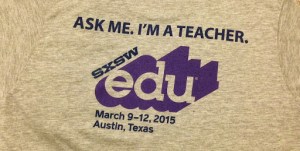
    SXSWEdu 2015: The Boy Who Beeps – Who Can Speak The Language Of EdTech?

    Source: SXSWEdu
    Now in its fifth year, the 2015 SXSWEdu rally in the Texas midland is more inclusive than ever. The panelpicker judges eschewed trendy topics like flipped learning and Big Data in favor of deeper discussions about Social Emotional Learning and Gamification. Major themes that ran through the first day included programming in schools, authentic PBL, and contemporary professional development.
    A major highlight of the day was hearing about the impressive Coded Curriculum implemented by Beaver Country Day School in Chestnut Hill, Massachusetts. The school has embraced a “launch / test / refine” approach to incorporate coding into every academic discipline. The faculty actively seeks to “make excellent mistakes” as they teach children the “New Basics” of open-ended problem solving, non-linear thinking, and collaboration.
    Source: Sunni Brown
    Another centerpiece of the sessions was Sunni Brown‘s mesmerizing workshop about “how to stay curious.” A guru of visual thinking and a doctor of doodling, Brown reminded the crowd that visual language is a river native to cultures across the world that instills a powerful cognitive awareness.  
    The spirit of sharing was genuine today at SXSWEdu. Every attendee was universally open and eager to connect. Yet a question kept trickling through the meandering hallways like the incessant drip of Austin’s rain: How many actual classroom teachers were present at the conference? When Brown asked how many classroom educators were in the room, fewer than ten percent among the hundreds raised their hands.
    Source: ASIDE 2015
    Throughout the day, we met: an online charter school principal, a start-up edupreneur, an NAACP coordinator, a not-for-profit founder, an NEA staffer, a Museum and Library Services researcher, a corporate communications director, a Learning Sciences professor, a former math instructor in Ethiopia, and a doctoral candidate who moonlights at Khan Academy. We met other interesting people, too, but we did not meet one classroom teacher.
    We know they were there. But they seemed few and far between. Maybe this is a good thing. Maybe it signals that SXSWEdu is not for everyday teachers. Maybe the passionate attendees perceive a sea change in education that is more galvanizing than “regular” teachers can see. Or maybe not.
    Either way, it speaks to a road diverging in a not-yet-understood wood. If start-ups and online outlets are careening onto their own edtech on-ramp, what happens to the students and teachers driving in the HOV lane? 
    For example, after participating in one session about a full-scale coding curriculum pushed across all disciplines, we attended a completely different panel about whether edtech really offers any solution at all. It feels strange that this question is still being asked: Is edtech a panacea or a distraction?
    Source: General Electric
    The nuanced nature of this tacit tech tug-of-war reminded us of a General Electric ad from September 2014 called “The Boy Who Beeps.” The touching ad follows the birth of a baby who can speak the language of technology. The commercial intends to tout GE’s omnipresence in electronics, but to us it highlighted the children today who are always plugged in, always wired. 
    Kids are born who can seemingly speak to machines, communicate with the digital world, control their own access to e-learning. What happens, though, when their days become disconnected? Can they muster the skills to navigate a tangible, interpersonal world? Or better yet, can they make things, create their own machines? Are they controlled by the very machines they rely on? And what about children who don’t have machines?
    Source: General Electric
    In the edtech learning space, are there start-ups who talk only to machines – and not to educators? And what about the teachers who cannot (or will not) talk to machines, who can’t negotiate the apps and iPads filling their classes?
    By the end of today, we were encouraged. We decided that educators are indeed emerging as a potent force in the digital economy. American Federation Of Teachers President Randi Weingarten noted a change since last year’s SXSWEdu. She now hears tech companies asking, “How can we get teachers involved in the process?” She emphasized that with the onslaught of shiny edtech tools, the best advice is to know how to teach first, and to learn to use technology second. Brown echoed the same, saying that digital tools are great, but they’re not worth much if we can’t use them. The learning is the key.


    SXSWEdu 2015: Education For All – How Far Have We Come?

    Source: TES Global


    An important and undeniable thrust of the 2015 SXSWEdu conference has been the attempt to reconcile the nation’s educational inequalities. Marquee panels and sofa conversations alike have centered on this notion of access – access to college, to technology, to careers, to mentors, to professional development, to contemporary learning tools.

    Last night’s reception at the Lyndon Baines Johnson Presidential Library made this theme immediate in bringing together historians and educators to commemorate the 50th anniversary of the Voting Rights Act.

    Source: LBJ Presidential Library, ASIDE 2015


    This morning, Second Lady Of The United States Dr. Jill Biden kept this dialogue moving forward in leading a summit by the Bill & Melinda Gates Foundation about redesigning higher education to fuel student success. Dr. Biden noted that education is the great equalizer, the basis for a better life. For this reason, she stressed, “Teaching is not what I do. It’s who I am.”

    A panel discussion later with Jamie CasapTimothy Jones, and Isis Stephanie Cerda focused more intently on the need for diversity within educational technology. Similar messages emerged in workshops on “Equal Opportunity For Deeper Learning,” “My Brother’s Keeper: One Year Later,” and “Teaching A New Narrative For Black Male Achievement.”

    Source: ASIDE 2015


    An equally critical thread appeared in the number of talks about empowering girls and women in technology and entrepreneurship. For example, EdTechWomen was named this year’s official SXSWEdu Change Maker. Other titles included: “Women Disruptors 2.0,” “Paying It Forward: Leveraging Today’s Female Voice,” “Empowering Girls And Women To Lead,” “Digital Diversity: Minority Women In EdTech,” and “EdTech For Educational Inclusion.”

    Another highlight of the day was Kristin Ziemke’s and Cheryl Boes’ presentation of innovative project examples to engage young learners with voice, choice, and audience. Their use of easy apps and elementary blogging revealed the many avenues that let children demonstrate understanding in exciting, authentic ways.

    A later workshop featured a panel of thought leaders who promoted creativity in schools. They championed “less talking and more doing.” The speakers paraded both theoretical and tangible ways to inspire kids as imaginative thinkers. As Jonathan Plucker, Professor at the University Of Connecticut, noted, “creativity is about constraints.” A teacher’s task, therefore, is to help students identify constraints and then decide which ones to get rid of, which ones to ignore, and which ones to live with.

    Ultimately, after a day of education and introspection, of creativity and contemplation, we recalled John Ashbery’s lines from Three Poems, which speak to the impossibility of certainty and the elusiveness of knowing:

    “The term ignorant is indeed perhaps an overstatement, implying as it does that something is known somewhere, whereas in reality we are not even sure of this: we in fact cannot aver with any degree of certainty that we are ignorant. Yet this is not so bad; we have at any rate kept our open-mindedness — that, at least, we may be sure that we have — and are not in any danger, or so it seems, of freezing into the pious attitudes of those true spiritual bigots whose faces are turned toward eternity and who therefore can see nothing.” 

    Most College Athletes Are Failures — Learning From March Madness

    Source: NCAA


    Cheer for the stumbles
    The he-shoulda-had-thats
    And the tears that linger

    For in those moments
    Greatness lies

    There you will find 
    The provoked
    The determined
    The unified

    It’s in those moments 
    That champions are born
    Most NCAA athletes are failures. They don’t win the championship. They don’t enter the pros. They don’t take home a trophy at the end of the season. Only a handful of elite programs reap the acclaim and hardware that accompanies major spectacles like the men’s NCAA basketball tournament. Most Division I, II, and III competitors are well-rounded college students giving a tremendous amount of effort for the love of their sport and their college.

    Just watching one game of the March Madness media blitz is enough to make even a non-fan sympathetic to the kids with their heads hung low after a devastating loss. Anyone in an office pool knows that their bracket will be busted after the first weekend. There are no trophies for participation.
    Yet these are the moments that turn kids into adults, that enforce life lessons of diligence and duty, grit and grace. That’s why the March Madness tournament offers a great chance to talk to students about failure, about perseverance, and about process over product.
    Ad agency Leo Burnett produced an award-winning TV spot for the NCAA last year called “Cheer.” Since then, its aired over 850 times, and it’s in heavy rotation again this week. It’s easy to see why.
    The ad is a brief masterpiece of narration and language to encourage everyone — athletes, kids, and adults — to relish the stumbles of life and the tears of as-yet-unmet goals. As the transcript reads, these moments turn disappointed players into “the provoked, the determined, the unified.”

    Source: NCAA

    Teachers talk a lot about failure with their students, about the unreachable expectation of perfection and the inescapable necessity of hard work. This ad is a perfect companion for homeroom discussions, circle time, advisory conferences, or recess pick-me-ups.

    For more ideas about teaching with the NCAA tournament, check out: “March Madness In The Classroom — Teaching With Tournament Graphics.”

    eFest Day One

    Here we all are at the first day of eFest. The feeling is relaxed and friendly and it looks like the emphasis is going to be on round table conversations – well the set up of the room has set the scene. Lots of familiar faces and it is good to have time to catch up with old friends and eLearning colleagues.

    Presentation from NorthTec introduced by the CEO and several staff – They have six campuses and lots of Learning Centres scattered around Northland. They use Moodle and have set up wireless and computing and video conferencing in all the LC. Also have a staff portal to provide information management, ICT access which is the same for all staff – RSS, document sharing, web space. They have Mobile programmes – f2f courses delivered in communities including on marae – horticulture, forestry, environmental studies, construction, sport and recreation.

    Case studies
    1. Bachelor of Nursing – five semester development, e-capability eCDF funding, team approach. Supported by senior management and evaluated by action research – Dr Nancy George. Video interview with a nursing student illustrated how important it is for a woman with children and a part-time job to be able to study flexibly.

    2. Certificate in eLearning Design and Development (eCDF) – video clips of students talking about what they got out of the programme.

    3. Mobile programmes teach skills as part of a community project. For example, gardening in schools.

    4. Learning support – eTech support, online counselling, online learning objects. also reconfiguring technologies and buildings around the flexible approach.

    Nursing communication scenarios using actors – example in palliative care – appropriate and non-appropriate.

    Also have a student portal – blogs, portfolios. also have virtual classrooms.
    Staff development in staff and student portals.

    Polytechnics and universites are going to be connecting to KAREN (advanced research network) – ultra fast Internet connection.

    Presentation by Murray Brown from Ministry of Educationjoined the dots about what has been happening – funding, eLearning advisory etc.

    Barry Ogilvie from Tertiary Education Commission speaking about eLearning project updateThey have four projects under discussion. Looking for a vision for network capability. Also flexible and distance learning options. Looking for a range of methodologies for assessing capabilities across ITP sector – e.g. maturity model.

    District Health Boards – Wintec and Northgate – nursing education – use mentoring, reflection, innovation. Staff want to have fun when learning. Mandatory training – national online campus, generic material with local contexts. Liked Moodle.

    NorthTec nursing programmeDevelopment and action research of Bachelor of Nursing programme. using a blended model as they do not want to lose face-to-face component. Have students who can study even though they live in isolated areas in Northland. Gave away online discussion as not popular with students.

    Contextualisation of multimedia resourcesDeveloped communication modules. Read information and choose correct answers. simple to change text. Originally created by WELTEC – not available in a repository and not sure abut IP issues. Have Grammar online. have a lesson and go through and choose options. Read information and do a test – so they changed it. Flash object with xml file at the back – replace text here and leave the codes. Could be easy to delete code if staff are unaware. Design perspective given and then pedagogical perspective given. How does it affect the learner?

    Flowering Plant Endemism of Northern Western Ghats

    Scientists at the Agharkar Research Institute (ARI), Pune, an autonomous institute of the Department of Science and Technology have come up with plant data of the Northern Western Ghats which indicates that plateaus, in addition to the forests, should be prioritized for conservation of the Northern Western Ghats.

    It is the plateaus and the cliffs that harbour most of the endemic species, thus increasing their importance in conservation plans.

    ARI team led by Dr. Mandar Datar and Dr. Ritesh Kumar Choudhary has published a paper in the international journal Phytotaxa after thoroughly investigating the Northern Western Ghats to produce an updated checklist of 181 local endemic plant species, including four monospecific genera.

    They have found that a majority of the endemic species are therophytes, which complete their life cycle in a short period during monsoon.

    The Western Ghats of India

    The Western Ghats of India is one of the global biodiversity hotspots owing to the endemism that is sheltered by a chain of mountains. The northern part of this biodiversity hotspot, along with the Konkan region, is considerably different from its southern and central counterparts on account of lesser precipitation and extended dry season.

    A notable geographical feature of the Northern Western Ghats is the presence of plateaus and cliffs that display maximum endemic species, unlike forests. Forests of the Northern Western Ghats harbour many species which are not endemic.

    Figure 1: Abutilon ranadei, a Critically Endangered endemic species from the northern Western Ghats

    Although the Northern Western Ghats region has been floristically surveyed well, the local endemism of the flowering plants in the area is not much explored. Scientists have various estimates about the species that are endemic to the region, and the understanding of habitats, seasons, and plant distribution is limited.

    The study conducted by the ARI team suggested that the Northern Western Ghats is the region of rapid diversification of specific herbaceous endemic genera like Ceropegia, Glyphochloa, Dipcadi, and Eriocaulon.

    Dr. Mandar Datar stated, “To project the Northern Western Ghats prominently on the world vegetation map, it is absolutely necessary to complete the IUCN threat status assessment on priority, which is underrepresented for the region.”

    The team firmly believes that the published data can be used as a proxy for conservation planning and effective protection measures of the Northern Western Ghats.

    [For further details, Dr. Mandar Datar (mndatar@aripune.org, 020-25325057), Scientist, Biodiversity and Palaeobiology Group, and Dr. PK Dhakephalkar, Director (Officiating), ARI, Pune, (director@aripune.org, pkdhakephalkar@aripune.org, 020-25325002) can be contacted.

    Publication:

    Bhushan K. Shigwan, Aboli Kulkarni, Smrithy Vijayan, Ritesh Kumar Choudhary & Mandar N. Datar. 2020. An assessment of the local endemism of flowering plants in the Northern Western Ghats and Konkan regions of India: checklist, habitat characteristics, distribution, and conservation. Phytotaxa, 440 (1): 025–054

    DOI: http://dx.doi.org/10.11646/phytotaxa.440.1.2]

    Integrated Cold Chain Network

    The Cold Chain Infrastructure provides backbone support by storing the perishables and ensuring the availability of fruits and vegetables throughout the year, said Union FPI Minister Smt. Harsimrat Kaur Badal. During a video conference with promoters of MoFPI supported cold chain projects today, Union Minister emphasized the importance of Food processing enterprises, especially the Integrated Cold Chain Network, in the present uncertain and evolving circumstances in view of COVID pandemic. It saves the farmers from uncertain circumstances and also facilitates stabilization of market prices. The Food Processing Industry has the potential to absorb the excess farm produce thereby benefiting the farmers and at the same time, convert the harvest into a value added processed product that can meet the domestic as well as the global demand.

    Sh. Rameswar Teli, MoS, MoFPI was also present in the video conference with the promoters of completed Integrated Cold Chain Projects supported by the Ministry of Food Processing Industries in the States of Haryana, Punjab, Himachal Pradesh, Jammu and Kashmir and Rajasthan. This was the second such interaction (in a series of web meetings) of Union FPI Minister, with the promoters of MoFPI supported projects to facilitate seamless operations of FPIs.

    The promoters of 38 cold chain projects, across 5 states, participated in the Video Conference.  The promoters interacted with the Union Minister and shared their experience gained/ problems faced in completing the projects. Further, the promoters also shared the hardships and problems faced in running the cold chain projects during the lockdown period.

    The promoters expressed their concerns on the decision of the local Government authorities to limit the hours of operations of Mandis to avoid overcrowding. They said that the limited hours of operations have slowed down the procurement process – leading to large waiting queues for farmers who wait to bring their produce to Mandis. They further shared that  delay affects the quality of perishable food products and significantly reduces their price while leading to wastage in certain cases.  They pitched for 24*7 operations of the Mandis to ensure seamless supply of recently harvested fruits and vegetables.

    The promoters involved in export of processed food items expressed their concerns on the rising prices of (sea/air) freight which is rendering their product less competitive in the global arena. They said that the freight charges have gone up by 30 %. They requested the authorities to provide in-land as well as destination freight subsidies in order to support domestic industries to compete globally.

    Citing the low domestic demand amidst the COVID Pandemic, the industry representatives from the Cold Chain sector, unanimously pitched for subsidy in the power tariffs. They urged that a Cold store needs to function 24*7 and the plant compressors cannot be shut at any point of time. They said that movement of perishables to and from cold stores has reduced in the past few days. The promoters further shared that they are experiencing a liquidity crunch due to obligation for the wages and salaries of employees and labourers, and urged for subsidy on power tariffs along with interest subvention on loans.

    Apart from the above, following issues were discussed by Union Minister in the Video Conference:

    1. Raw material availability and its high cost

    2. Impact of Lockdown on operations

    3. Labour and Logistics issues

    4. High inventory costs

    5. Liquidity crisis as payments have to be made to farmers

    Dekho Apna Desh Logo Design Contest

    The Ministry of Tourism, Government of India today launched the ‘DekhoApnaDesh’ logo design contest on the MyGov platform.  The objective of this contest is to have a logo for ‘DekhoApnaDesh’ campaign coming out of  creative ideas of  the citizens of the country.

    map of India with States Boundaries
    map of India with States Boundaries

    DekhoApnaDesh is an initiative of the Ministry of Tourism which was launched by Union Minister for Tourism (IC) Shri Prahlad Singh Patel at Konark, Odisha on 24th January 2020 by releasing the content of the pledge during a function on Mygov platform.  This initiative of the Ministry of Tourism is in line with the appeal of the Honorable Prime Minister made from the ramparts of Red Fort on 15th August 2019 in his speech asking every citizen to visit at least 15 destinations by the year 2022, to promote domestic tourism in India which is intended to enhance tourist footfalls in places of tourist interest so as to help develop the local economy.

    Post lockdown and as the control over the spread of pandemic is achieved, it is widely agreed fact that domestic tourism will recover faster than international tourism.  Focussing on domestic tourism potential, encouraging fellow countrymen to explore their own country, taking a much-needed break within their own borders will be a winning strategy for India.

    During the lockdown period, the Ministry of Tourism, Government of India  as part of its ongoing engagement with industry and its audiences is  organising webinars  on the overall theme of ‘DekhoApnaDesh’ . The objective of this webinar series is to   create awareness about and promote various tourism destinations of India – including the lesser known destinations and lesser known facets of popular destinations.

    DekhoApnaDesh” Logo design Contest activity is live on My Gov, and the  link is :

    https://www.mygov.in/task/dekho-apna-desh-logo-design-contest/

    The winner of the DekhoApnaDesh Logo contest  will get a 5 nights 6 days all expenses covered holiday package for 2 to any destination in India from their residence in India .  The contest terms and conditions are available on MyGov.in

    Civil Services (Preliminary) Exam 2020, scheduled on 31 May, deferred

    New Delhi, 07 May 2020: The Union Public Service Commission (UPSC) held a special meeting today to review the situation after the second phase of the nation-wide lockdown due to COVID-19. Taking notice of the extension of restrictions, the Commission decided that it will not be possible to resume examinations and interviews for the present.

    exam alert from Eduindex News
    exam alert from Eduindex News

    The Civil Services (Preliminary) Examination, 2020, scheduled to be held on 31 May 2020, therefore stands deferred. Since this examination also serves as the screening test for the Indian Forest Service Examination, the schedule for the Indian Forest Service Examination is also deferred. The situation will be reviewed again on May 20, 2020 and fresh dates for these examinations shall be notified on the UPSC website in due course.

    The Commission has already deferred the following: (a) Personality test for remaining candidates for the Civil Services Examination, 2019; (b) Notification for the Indian Economic Service/Indian Statistical Service Examination, 2020; (c) Notification for the Combined Medical Services Examination, 2020; (d) Notification for the Central Armed Police Forces Examination, 2020 and (e) the NDA & Naval Academy Examination, 2020.

    As and when dates are decided for the deferred tests/examinations, it will be ensured that candidates are given a notice of at least 30 days.

    Indira Gandhi Delhi Technical University for Women (IGDTUW) is hiring

    New Delhi: Indira Gandhi Delhi Technical University for Women (IGDTUW) has released recruitment notification to fill up various teaching positions and non-teaching positions. There 20 faculty posts available for five departments: Information Technology (IT); Computer Science & Engineering (CSE); Mechanical and Automation Engineering (MAE); Basic and Applied Science(BAS); and Architecture and Planning (AP).

    government job alert
    government job alert

    The other posts notified for recruitment are as followed: Pro-Vice Chancellor; Controller of Examinations; Deputy Controller of Examinations; System Analyst; Medical Officer (Part-Time on Contact).

    List of Faculty positions with vacant posts

    Department Name of the Post Total Positions (Subject to change)
    Department of Information Technology (IT) Assistant Professor    8
    Department of Computer Science and Engineering (CSE) Assistant Professor    4
    Department of Mechanical and Automation Engineering (MAE) Assistant Professor    2
    Department of Basic and Applied Sciences (BAS) Assistant Professor   3
    Department of Architecture and Planning (AP) Assistant Professor   3


    List of other posts

    Department/Name of the Post Total
    Positions
    Pro-Vice Chancellor 1
    Professor (TPO) 1
    Controller of Examinations
    (On Deputation
    1
    Deputy Controller of
    Examinations
    (On Deputation/Direct)
    1
    System Analyst 1
    Medical Officer
    (Part-Time on contract)***
    1

    For exact qualification, how to apply and other details, interested candidates should refer the official Recruitment Notification, uploaded on the official website of Delhi Technological University (DTU).

    http://www.igdtuw.ac.in/

    About the University: The Indira Gandhi Delhi Technical University for Women (IGDTUW) has been established in May 2013 vide Delhi State Legislature Act 9 of 2012, as a Non-Affiliating Teaching and Research University in Delhi to work in emerging areas of professional education among women, with focus on engineering, technology, applied sciences, management and its allied areas with the objective to achieve excellence in these and related fields.

    eFest Day One

    Here we all are at the first day of eFest. The feeling is relaxed and friendly and it looks like the emphasis is going to be on round table conversations – well the set up of the room has set the scene. Lots of familiar faces and it is good to have time to catch up with old friends and eLearning colleagues.

    Presentation from NorthTec introduced by the CEO and several staff – They have six campuses and lots of Learning Centres scattered around Northland. They use Moodle and have set up wireless and computing and video conferencing in all the LC. Also have a staff portal to provide information management, ICT access which is the same for all staff – RSS, document sharing, web space. They have Mobile programmes – f2f courses delivered in communities including on marae – horticulture, forestry, environmental studies, construction, sport and recreation.

    Case studies
    1. Bachelor of Nursing – five semester development, e-capability eCDF funding, team approach. Supported by senior management and evaluated by action research – Dr Nancy George. Video interview with a nursing student illustrated how important it is for a woman with children and a part-time job to be able to study flexibly.

    2. Certificate in eLearning Design and Development (eCDF) – video clips of students talking about what they got out of the programme.

    3. Mobile programmes teach skills as part of a community project. For example, gardening in schools.

    4. Learning support – eTech support, online counselling, online learning objects. also reconfiguring technologies and buildings around the flexible approach.

    Nursing communication scenarios using actors – example in palliative care – appropriate and non-appropriate.

    Also have a student portal – blogs, portfolios. also have virtual classrooms.
    Staff development in staff and student portals.

    Polytechnics and universites are going to be connecting to KAREN (advanced research network) – ultra fast Internet connection.

    Presentation by Murray Brown from Ministry of Educationjoined the dots about what has been happening – funding, eLearning advisory etc.

    Barry Ogilvie from Tertiary Education Commission speaking about eLearning project updateThey have four projects under discussion. Looking for a vision for network capability. Also flexible and distance learning options. Looking for a range of methodologies for assessing capabilities across ITP sector – e.g. maturity model.

    District Health Boards – Wintec and Northgate – nursing education – use mentoring, reflection, innovation. Staff want to have fun when learning. Mandatory training – national online campus, generic material with local contexts. Liked Moodle.

    NorthTec nursing programmeDevelopment and action research of Bachelor of Nursing programme. using a blended model as they do not want to lose face-to-face component. Have students who can study even though they live in isolated areas in Northland. Gave away online discussion as not popular with students.

    Contextualisation of multimedia resourcesDeveloped communication modules. Read information and choose correct answers. simple to change text. Originally created by WELTEC – not available in a repository and not sure abut IP issues. Have Grammar online. have a lesson and go through and choose options. Read information and do a test – so they changed it. Flash object with xml file at the back – replace text here and leave the codes. Could be easy to delete code if staff are unaware. Design perspective given and then pedagogical perspective given. How does it affect the learner?

    Publishers to rein in informal circulation of newspaper PDFs

    Print news publishers are cracking down on online groups and platforms that have been sharing PDF versions of popular newspapers to readers every day.

    For a lot of newspaper management bodies, these informal circulations on social media are nothing but a form of piracy. Soon only subscribed members will be able to access online newspapers.

    “It has come to our attention that some publications are facing issues with distribution of the print copies and a lot of piracy and theft of newspapers is happening, especially in the digital format,” said Mary Paul, the secretary-general of the Indian Newspaper Society Secretariat.

    Many newspapers are now available in the epaper format online in the morning every day, some of which are free. The availability of the epapers across platforms has been a hit, especially since the beginning of April 2020 when newspaper circulations were forced to stop at several places across the country in the wake of the global pandemic.

    According to the INS, many users are creating PDFs out of newspaper pages and circulate them on WhatsApp and Telegram groups to the readers, leading to a loss in both subscription revenue for the print newspapers as well as epapers digitally.

    The INS also called this circulation of newspaper on social media illegal and said publications are trying to battle it in their own ways.

    The body has also come up with recommendations to stop this:


    1. Communicate clearly in the apps, websites and newspapers that circulating any copy or part thereof, is illegal and strict legal action will be taken along with heavy penalties.

    2. Additionally, also for any legal action taken, publish a few news stories to talk about the huge fines and lawsuits initiated against offenders to deter others from doing it.

    3. Take legal action against offenders, especially against WhatsApp and Telegram admins and trigger legal notices (WhatsApp group admins are liable for anything illegal that happens in their groups).

    4. Build certain product features which prevent piracy or at least slow it down. These include:

    a. Limiting downloads of PDFs, Images

    b. Adding Javascript code on pages to prevent copying

    c. Inserting a user identifier code which is not human visible, so circulated PDFs on Social Media can be tracked back to individuals

    d. Auto-generate a list of users downloading greater than a certain number of PDFs per week and block them

    Some of the newspapers have already started following the recommendations. Hindi daily Dainik Bhaskar has already published a story talking about the piracy of newspapers in the form of online circulation on WhatsApp and Telegram groups.

    “The newspaper is the property of the management of that paper. It can be read by either buying it or subscribing to it online. The industry is already going through a tough time and we do not want our readers to abandon the print media. The newspapers are all together in this and we will soon come out with a plan to combat this. We are sure are patrons will stand by us in this,” said the marketing head of a popular language daily of North India.

    Why No Death Penalty For Gang Rape In India?

    “Brother, please save me, I don’t want to die. I want to live. Those who have done this to me, I want to see them getting a death sentence.”

    These were the most emotional last words of Unnao gang rape victim who was brutally gang raped in March and when police allowed those gang rapists to be released on bail then they decided to burn her while she was on her way to attend the court hearing pertaining to this gang rape case as they were hundred percent convinced that the judiciary of India does not hang gang rapists and it is only once in 15 years that a poor Dhananjoy Chatterjee who could not afford fees to hire lawyers and whose petition was drafted by Tihar jail prisoners is hanged and so the chances of very easily escaping from strict punishment are quite bright! Every Indian will get moved to read what this Unnao rape victim said before dying! What was her fault? That she was a women?

    Why are rapists released on bail for some time as we saw in case of Unnao gang rape case? Why no security is provided to the victim who was raped? Why the life and safety of victim is not cared for by police as we saw most unfortunately in Unnao which resulted in accused burning her 90% which led to her death later? Why should the strictest action not be taken against all those police cops who ensured that the accused were out on bail and who ensured that gang rape victim got no security?

    Should we be proud of our legal justice system which operates at an excruciatingly glacial pace and makes sure that those who commit rape and gangrape coupled with murdering the rape victim by either setting them ablaze as has nowadays become the latest fashion or in some other manner in some cases? All the Judges of Supreme Court, ex Judges, ex-CJIs, legal giants like K Parasaran, Soli J Sorabjee, Kapil Sibal, Harish Salve, Mukul Rohatgi, etc must ponder over it and think of ways by which the waning public faith in our judicial system is restored! If the public faith is destroyed then people will start taking law in their own hands to deliver “instant justice” which can never be good for our country!

    It is most shocking that the incidents of not just rape but even gang rape followed by setting ablaze the victim is increasing very rapidly in our country as we saw most recently in Unnao, Hyderabad and many other cities but still we don’t get to read gang hanging! Are gang rapists immune from death penalty? Why is it that under our penal laws there is no mandatory death penalty for gang rape?

    Why is it that under our penal laws there is no mandatory life imprisonment also for gang rape as stipulated in Section 376D of the IPC? Why the punishment for gang rape as stipulated in Section 376D of the IPC is “shall not be less than twenty years but which may extend to life”? Why this “discretion bomb” in form of “may” is inserted in Section 376D dealing with gang rape?

    Should this “discretion bomb” not be defused promptly by removing it and providing for “mandatory death penalty” considering the irrefutable fact that gang rape incidents are increasing alarmingly in our country followed by even gang burning of gang rape victims as we saw most recently in Unnao and earlier in Hyderabad with a 26-year-old veterinary doctor? Can gang rape be justified under any circumstances? Why then do we see that there is no mandatory death penalty for such offences?

    Why different punishment prescribed for gang rape on woman under 16 years of age as prescribed in Section 376DA and that on woman under 12 years of age as prescribed under Section 376DB of IPC? Why only life imprisonment under Section 376DA and not death? Why option of life and death in Section 376DB of IPC? Why not mandatory death penalty?

    Why even for repeated offenders there is no mandatory death penalty and why the option of life term is added simultaneously in Section 376E of IPC?  All these escape routes must be closed now forever so that rapists are never able to take advantage of the loopholes in our legal system anymore now! But are our politicians, lawmakers and Centre ready to do this or will they be happy with just face saving exercise and lip service? Only time will tell!

    Why is it that about 15 to 16 years ago a poor rapist named Dhananjoy Chatterjee was hanged for rape-cum-murder of a Class XI girl in 2004 and that too on circumstantial evidence alone but no gang rapists are hanged ever? How many times have gang rapists been hanged in our country? Why are they not hanged?

    Why gang rapists who even murder their victim as we saw in Nirbhaya case are not hanged till now? Should we keep feeling proud that just one poor Dhananjoy Chatterjee whose petition was drafted by prisoners of Tihar jail as was pointed out by senior Supreme Court advocate Colin Gonsalves was hanged about 15 years back in 2004? Should we not feel ashamed that many thousands of rapists cum killers escape death penalty by exploiting the legal loopholes in their favour?

    Should we feel proud that since then not a single rapist has been hanged? Should we feel proud that even though thousands and thousands of rape incidents keep happening all across our country but yet we don’t see any hanging since 2004 when Dhananjoy was last hanged? Should our judiciary, lawmakers, Parliament and Centre feel very proud on this?

    Why just recently we saw how people threw flowers on those policemen in Hyderabad who killed those 4 gang rapists when they attacked them as is being alleged and people started celebrating and many politicians started hailing it? Why is it that people are losing faith in the ability of our judiciary to deliver justice in time? Is it not a matter of utmost concern for all of us that encounter killings is being glorified as people believe that the legal system has been designed in such a manner that it ensures that rapists and gang rapists are not hanged for many decades?

    Why is it that Arvind Kejriwal who is Chief Minister of Delhi while expressing concern over people’s loss of faith in the criminal justice system  openly says that, “People across the country are agitated over reports of horrible rape and murder incidents happening across the country that have come to light of late – whether it is Hyderabad or Unnao [where a rape victim was burnt earlier this week]. That’s a reason why people are expressing happiness and satisfaction over the police encounter in Hyderabad?” Why Kejriwal further says that, “It is also something to be worried about, the way people have lost their faith in the criminal justice system. This demands introspection and all governments must come forward and work together strengthening the criminal justice system and investigating agencies?” We all must seriously introspect on this!

    Why is it that even after the killers of Nirbhaya who had been convicted by the Supreme Court and even after five years of death penalty being convicted by the Delhi High Court have not been hanged top death till now? Why their mercy petition keeps hanging? Is this the real beauty of our judicial system for which we should feel proud?

    Why even Supreme Court does not say anything on it? Why even in terror cases like the killing of former PM late Rajiv Gandhi, killing of former Punjab Chief Minister Beant Singh, mercy petition keeps pending for decades? Should we be proud of this and justify it in the name of “due process”?

    The Vice President M Venkaiah Naidu very rightly said that,  “What happens even after punishment is given to convicts. We all are witness… appeal, mercy (petition)… can anybody think of having mercy on such people? This kind of violation of dignity of women cannot go on unchallenged. What is required is not a new bill; what is required is political will, administrative skill and then change of mindset and then go for the kill of the social evil.” He also rightly said that minors who know how to rape should not be given any benefit and must be punished just like others! Rightly so!

    Why should a definite time not be set for completing rape cases? Why should a definite time not be set for deciding rape cases in lower courts, High Court as well as the Supreme Court also? Why should review petition not be abolished or at least time limit set for deciding it?

    Why should mercy petition for heinous crimes like gang rapes and terror cases not be abolished or at least a time limit be set up for deciding it? Why Centre repeatedly ignores such demand made by prominent persons in this regard? Whose interest is served in doing so? Should we be proud of it? Why is it that it takes decades or many years to decide a mercy petition? Why can’t it be decided within few days as pointed out by former Attorney General Soli J Sorabjee?

    It is good to note that even our President Ram Nath Kovind rightly pointed out that incidents of demonic attacks on women have shaken the conscience of the country. He rightly said that women safety is a very serious issue and a lot of work has been done on this but much remains to be done. He also advocated that those convicted under the POCSO Act should be deprived of their right to mercy petition as they do not need any such right. Here I would beg to differ with the President most humbly and add that there should be no discrimination of POCSO and others and all the rapists and all the terrorists deserve no mercy petition under any circumstances and even if it is still not abolished it must be decided within a short span of time say a few days or weeks and not in many decades which only gives a potential tool to our adversaries to take potshots at the manner in which anyone can get away even after killing the former PM of India as we saw in case of late Rajiv Gandhi where mercy petition was not decided even after decades!

    Why can’t strict and speedy justice be provided to people? Why should the 45% of lawmakers who have been elected to Parliament and who are facing themselves serious charges of rape and murder not be debarred permanently from entering politics until their name is cleared of all charges by the top court itself? Why no law has been enacted in this regard?

    Why do we expect that such lawmakers who are themselves facing rape charges will support laws that mandates compulsory death penalty for all rape and terror cases? Are we not foolish? What they will favour is that just a single rapist like the poor Dhananjoy Chatterjee is hanged on the basis of circumstantial evidence alone once in 15 years and no rapists or gang rapists are hanged all these years even after they set the victim ablaze!

    They will advise us that law will take its own course! They will advise us to be patient and have faith in India’s judicial system! It is high time and now the Supreme Court too must speak out most strongly against all the inadequacies in our criminal justice system due to which people’s faith in it is getting steadily dwindled as is being pointed out repeatedly in different newschannels, different newspapers and different magazines which is certainly not a healthy sign for a democratic country like India! Parliament too must seriously debate on it and should give this most sensitive issue of woman’s safety and of according nothing but death penalty to those perpetrate the most horrifying crime against women  the topmost priority instead of just debating trivial issues like that of onion or tomato or radish! Let’s hope so!

    Sanjeev Sirohi, Advocate,

    s/o Col BPS Sirohi,

    A 82, Defence Enclave,

    Sardhana Road, Kankerkhera,

    Meerut – 250001, Uttar Pradesh.