Yemen Crisis Explained

            Yemen Humanitarian Crisis - YouTube

There is a lot going on about the Yemen Crisis from 5 years and now the problem has even got worse with Covid-19. Yemen was once the heart of Ancient Arabia but then became one of the poorest countries in the world. Yemen is located at the edge of Arabian Peninsula and forms a BAB AL MANDAB- a narrow water way from which most of the oil of the world passes. So, who controls Yemen can control the oil around the world.

There are many groups and people responsible for the crises and the first one is Ali Abdullah Saleh who was President of Yemen for 20 years since 1990. Yemenis rose against Saleh because they were unhappy with him but they couldn’t remove him from his position. This is where the next player comes into the picture and that is Saudi Arabia. Saudi Arabia is the most influential member of a club of countries known as the Gulf Cooperation Council(GCC) and it was GCC that forced Saleh out. The GCC’s deal helped install a new government in Yemen and the former VP, ABD-Rabbu Mansour Hadi, became the President of Yemen. However, Yemen continued to suffer even under the leadership of Hadi. The people felt that the initiatives that were taken after the revolution brokered by Gulf powers who simply appeared to return the same old elites to power.

So, by 2014 some the Yemenis began to lose patience and one of the groups was the Houthis, who are another major group in this  war. The Houthis are the Shia Muslim community form Nothern Yemen. They feel that they have been marginalised and therefore often revolt against the government. The Houthis and Saleh both felt that they were sidelined by the GCC’s plan for Yemen’s new government and hence they both joined hands. The Houthis with some of the Saleh’s alliances in the Yemen military took over the capital of Yemen-Sanaa in 2014. Hadi fled to Saudi Arabia and then Saudis formed a coalition with several other countries to return their man Hadi to the power. 

As a result, Saudi intervened and started attacking the capital of Yemen to remove the Houthis. There were many air strikes and Saudis claim that they were attacking enemies, however many civilians were also injured and killed during these attacks. This brings us to the humanitarian crisis in Yemen. In this war, it’s not just the fighting that is causing all the suffering. Even aid is being used as a weapon. In 2015, the Saudi led coalition created a land, sea and air barrier around Yemen making it impossible for Yemen to receive any aid or supplies. The Houthis are also blamed for blocking, destroying or taking aid. The twist in the story comes when the Houthis and Saleh broke their alliance in 2017. Saleh switched sides and wanted to talk to the coalition but the Houthis killed him.

The Houthis are still controlling the capital of Yemen Sanaa and the Saudis think that they are getting help from Iran. Iran has been denying any help but Saudis insist that they are helping the Houthis as Iran’s major community is Shia. Recently, Saudi Arabia’s oil facilities were attacked and the Houthis claim that they were behind this attack . However, the weapons were proved to be Iranian.

Yemen is now in a desperate need of aid. The food is not sufficient, cholera cases are on a rise and with the world stopping due to Covid-19, the situation has gotten worse. In a country of 29 million people, the US says that 24 million people depend on some kind of humanitarian aid. Now, only diplomacy can put an end to this nightmare.

It’s okay not to be okay !

We are all here in this pandemic, most of us are staying at homes. Keeping ourselves away from others for theirs as well as our well being. But staying so long at home results in mental illness as well. 

We go around and start living in new places, sometimes may be due to work or maybe any other reason. Being in a place with completely new people brings difficulties and lessons. There are many observations and analysis you make about people. Some people might have stuck in the place of their work. Staying out means you grow and become a better version of yourself and explore more. Your life becomes quick and fast. You try new things and make memories. But sometimes you just feel that things are not going well. It’s not just about being away from home but it can happen whether you are with your parents or with family things can make you upset.

 Breaking up with people can make you sad, failure in any field you work can make you upset at the end of a month when you are broke and don’t have a single penny to do buy what you want can make you sad. 

Materialistically, emotionally, physically, atmospherically things can get against you and can make you sad. You might not find things going well and you want to isolate yourself from this entire world, you would think that things are not at their best pace, and you are not worth anything.

Accept that you are sad!!

There are times when you feel happy about various things. There are times when small surprises can make you happy and you feel blessed for what is happening around. There are days when you just wake up feeling so fresh about things and you love the day for no reason because you woke up like this. You laugh and sing inside your head all day long and smile. 

And then there are days when you don’t want yourself to be bothered by many people and lay inside your bed for no reason. You feel fine physically but mentally you don’t feel much fresh and happy. 

•It’s okay if you don’t know

Sometimes you know the reason sometimes you just don’t. It’s okay to feel this way. It’s totally fine to feel upset about things. Every time you don’t need to have that smile on your face. It’s your body that accepts that you are sad. Moreover, accept that you can be sad. It’s okay to be sad. It’s normal to feel dejected and not to feel good for yourself. Accept that things went wrong, accept that you failed and you need to work hard. Days have nights and nights have days. Time heals everything. Don’t resist it. Live it and accept it.

•Once you accept it!

You conquer half of the battle just by accepting the fact that you are not happy and you need a break. Don’t just isolate yourself from this world. Don’t resist people and their presence. Think of things you didn’t do because of your work or you just forgot what you used to do. Do them. Get back to work that’s all you need to do. When you are happy, you celebrate but you never leave your work. The same is the case when you are sad. When you are sad just don’t stop working. Start working more. Make yourself busy. Make things go as they were and don’t leave your daily routine. Things will fall into their places give it some time. Have patience and enjoy the phase of your life. Its okay things will become good. 

•Don’t confuse it with depression!

Don’t confuse things with depression. Things might go wrong. But depression is a very large term. Being sad should not be misled with being depressed. Depression is medically proved diseases which can only be assured if taken the proper test and with doctor’s concern. Depression is a disorder which affects a person’s thoughts, behavior, tendencies, feeling, and sense of well-being. Depression is more likely a mental illness and it should not be taken lightly. 

How to be assured?

Let us compare this with having dengue, until and unless your doctor assures that you are suffering from it you just don’t consider that you re affected with it. Similarly, when you are not assured properly with what you are suffering from then you should not consider being in depression. It is a medical statement that should be used when checked properly. Just because you are sad is not necessary that you are depressed. Most of the people in the society and our surrounding have this misconception of being in depression is very common. But this is not true. You must never think like these rather consult a doctor if in doubt.

Best measures to overcome depression.

Sleep. Take proper sleep. Go to bed early and wake up early. Sleep for at most 6 hours daily. Proper sleep is a part of a healthy life and a better mood. This gives new energy to the body and freshens up the mind with new thoughts. It helps in stimulating our immune system as well as our emotional balance.  

Connect to nature and feel the beauty of it, admire it, and listen to what your body tells you. Find a park nearby and go for a walk. Keeping in mind that you need to have proper social distancing. It can be a morning walk or maybe an evening walk, totally depends on you. But try some quality time alone.

Listen to music that fills your heart with joy. Things will go well. Listen to your favorite music. 

Laugh and make people laugh. Laughing is good exercise. It regulates blood circulation, this results in the growth of oxygen in the blood which will make you feel good. You will feel good as your body starts feeling good. Accept, it is life and you need to enjoy every bit and admire it whether it is dark or sunshine. The worth of good times can only be felt by bad ones. God is great. He has plans. And he does things for a good reason.

Start doing yoga. It helps to maintain focus. You will get most of your answers while doing it. It helps to think correctly and maintains positivity in one’s life. 

Connect with your old friends. Remember old times when you all used to laugh around but then don’t make yourself sad by too much remembering those times, joking!!

Tell someone that you are sad. Tell them everything. Talk about your feelings and clear your mind. Let things come out. Talking to your loved ones bring a solution to your problem. Maybe they can bring new opportunities.

If failed consider it as an attempt towards success. Get back to life and work you are the star of your life.

Start writing or reading. This will help you to express without the fear of being judged by someone and you can be yourself.

And before you finish reading this just remember

LIFE IS GOOD, NO MATTER HOW HARD THINGS HIT YOU, AND TIME WILL TAKE CARE OF IT AND THINGS WILL GO WELL.

Don’t be too hard on yourself. Try at least some of the measures to live and feel better. It’s your life, love yourself

Recovery rate of Covid-19 reaches 56.37% in country: Govt

The Government today said that the recovery rate of Covid-19 reached 56.37 per cent in the country and a total of 2,48,190 people have been cured so far.

During the last 24 hours, 10,994 people have recovered from Covid-19.

Presently, the total number of active corona cases in the country is 1,78,014.

As per the World Health Organization’s Situation Report-154, India has one of the lowest deaths per lakh population.

India’s average cases of death per lakh population is one while the global average is 6.04.

Health and Family Welfare Ministry said a total of 14,933 new cases of Covid-19 have been reported in the last 24 hours taking the total number of cases to 4,40,215.

In one day, a total of 312 deaths have been reported taking the nationwide toll to 14,011. The case fatality rate is 3.18 per cent in the country.

Meanwhile, Indian Council of Medical Research, ICMR said one lakh 7,233 tests of corona virus samples were conducted by  various laboratories in the country in the last 24 hours.

So far, a total of 71,37,716 tests have been conducted.

ICMR is continuously increasing its testing facilities for Covid-19 by giving approval to government and private laboratories.

As of now, 992 laboratories across India have been given approval to conduct tests for Covid-19 that includes 726 government laboratories and 266 private laboratory chains.

What World would be Like Without Wars!!!

The past years saw a series of devastating natural disasters, continuing terror attacks and conflict, and the threat of virulent new diseases. These issues affect every one of us with no respect for political or geographical borders; they are perhaps an integral aspect of globalisation. But the most effective search for solutions to these global problems starts with a focus on our immediate, individual realities.

Peace is not simply the absence of war. A peaceful society is one in which everyone can maximise their potential and build fulfilling lives free from threats to their dignity. Rallying public opinion to the cause of peace and disarmament requires people from all walks of life. There needs to be a revolutionary transformation in the way people think about peace.

Humanity has now entered a new era where these assumptions require an overhaul. The major threats to our security now emanate from issues that cannot be dealt with by weaponry, namely global warming, migration, cyber attack and the rich–poor gap. Our security now depends on our ability to cooperate with nations who might previously have been our enemies. We now know enough about preventing armed violence to avoid the catastrophic consequences of recent wars. Attempts to stop war from the top down often fail because of the mindsets – fear, aggression, competition, greed – shared by most of those leaders filtered to the top by our current systems. One of the best ways to overcome the force of these attitudes and emotions is by systematically building trust through dialogue.

Globalization, paradoxically, may one day help put an end to war. In the short term, of course, the rapid expansion of global trade — unregulated and ungoverned by international institutions — has intensified ethnic and religious conflict, widened the gulf between rich and poor, and sparked “resource wars” to control oil and water.

A transformation in the inner life of a single individual can spur similar changes in others. As this extends into society, it generates a powerful vortex for peace that can steadily shape the direction of events. The collective impact of ‘ordinary citizens’, awakened and empowered, can propel humankind towards the goals of genuine disarmament and a flourishing culture of peace.

Prevention of Wars:-

  1. The keys to successful prevention of war are respect, speed of reaction, and developing an understanding of how power works.
  2. The cycle of violence starts with an atrocity, causing terror and trauma, followed by grief and then anger, which leads to the drive for retaliation and revenge, causing an escalation of atrocities. Thus the cycle of violence can continue over generations and even centuries.
  3. The cycle can be broken by tried and tested methods of conflict transformation, including consultation with religious leaders, bridge building, setting up truth and reconciliation commissions, training mediators, freeing child soldiers, trauma counselling and strengthening the rule of law.
  4. Enable women to help make peace. Women are shown to be the most effective and tenacious peace builders. However, more than 90% of negotiators and those in policymaking positions on peace and conflict are male, meaning that the suffering and trauma of women and children in war are not taken into account at the peace table.

Conclusion:-

What becomes evident in this work is that we are living through an age of profound transformation in the human condition. The human-made issues we face in this turbulent age are challenging our human capacity to evolve. We have the opportunity now, as never before, to develop our consciousness – and therefore our way of treating one another – to a new level.

Refrences:-

https://economictimes.indiatimes.com

http://www.resurgence.org

India pledges USD 10 million to UNRWA over next two years

India has announced contributing 10 million US dollar to the United Nations Relief and Works Agency for Palestine Refugees in the Near East (UNRWA) over the coming two years.

Addressing an Extraordinary Virtual Ministerial Pledging Conference for UNRWA, Minister of State for External Affairs V Muraleedharan said yesterday that capacity enhancement through training and building durable institutions is a major plank of our developmental assistance to Palestine.

Asserting that UNRWA needs continued support, Mr Muraleedharan said when certain countries withdrew funding, India had stepped up its annual pledge from  1.25 million US dollar to 5 million US dollar in 2018. He said, for this year, India has  already disbursed  two million dollar  and will soon be remitting the balance three million dollar. He said, India provides 250 annual scholarships to Palestinian youth and officials, apart from regular customised training programmes, and our current project grant is around 72 million dollar. He said, as a steadfast supporter of the Palestinian cause, India deeply appreciates the generous support and untiring work of host countries, donors and UNRWA to ensure millions of our Palestinian brothers and sisters displaced from their homeland lead a life of dignity.

He said, the Covid-19 pandemic continues to wreak havoc across the globe, stretching governments’ resources to address healthcare and socio-economic needs of their own people, and constraining capacities to assist others. He said, but victory over this unprecedented crisis demands collective and concerted action. He said, therefore, despite a surge in domestic demand for medical supplies amidst rising Covid cases, India  is assisting countries in need of critical, life saving drugs. He said, India is  sending a medical shipment to Palestine next week.

Govt to reduce staff strength of Pakistan High Commission in New Delhi by 50 pct

Indian government has decided to reduce the staff strength of the Pakistan High Commission in New Delhi by 50 per cent. The Ministry of External Affairs (MEA) said that the behaviour of Pakistan and its officials is not in conformity with the Vienna Convention and bilateral agreements on the treatment of diplomatic and consular officials. On the contrary, it is an intrinsic element of a larger policy of supporting cross-border violence and terrorism, it added.

MEA referred to the recent abduction at gunpoint of two Indian officials in Pakistan who were subjected to severe ill treatment. Foreign Ministry said that the act underlines the extent to which Pakistan has gone in this direction. The abducted officials after their return to India have provided graphic details of the barbaric treatment that they experienced at the hands of Pakistani agencies. In this connection, the Charge d’ Affaires of Pakistan was summoned to the Ministry of External Affairs yesterday and informed that India had repeatedly expressed concern about the activities of officials of Pakistan High Commission. It said that the Pakistani officials have been engaged in acts of espionage and maintained dealings with terrorist organizations.

The Foreign Ministry also highlighted the activities of the two officials caught red-handed and were expelled last month as a glaring example. It said that Pakistan has engaged in a sustained campaign to intimidate the officials of the Indian High Commission in Islamabad from carrying on their legitimate diplomatic functions. Indian High Commission will also reduce its staff strength in Islamabad to 50 per cent in the next seven days.

Russia supports India’s bid for a permanent seat in UN Security Council

Russia has supported India’s bid for a permanent seat at the United Nations Security Council (UNSC). Russian Foreign Minister Sergei Lavrov said, a Russia, India and China (RIC) meeting discussed probable reforms of the United Nations and India is a strong nominee to become a permanent member of the UNSC. 

He said, Moscow supports India’s candidacy and believes India can become a full-fledged member of the Security Council. Foreign ministers of the RIC discussed reforms of the United Nations during the trilateral meet held through video conferencing. 

UNSC comprises five permanent members and 10 non-permanent members.India has been elected as non-permanent member of the UN Security Council for a two-year term recently. India’s two year term will begin on January 1, 2021. 

Indo Russia ties are based on special and privileged Strategic Partnership: Rajnath Singh

Defence Minister Rajnath Singh has said that India and Russia share relationships based on special and privileged Strategic Partnership. He said Russia has assured that the ongoing military contracts between the two countries will be maintained, and in a number of cases, will be taken forward in a shorter time. Mr Rajnath Singh was speaking to the media in Moscow yesterday after meeting Russian Deputy Prime Minister Yury Borisov. Mr. Singh, who is on a three-day visit to Russia to attend the 75th Anniversary of Victory Day Parade, said his visit to Moscow is the first foreign visit of an official delegation from India after the COVID pandemic.

Terming it as a sign of special friendship, Mr Singh said, despite all the difficulties of the pandemic, bilateral relations between Delhi and Moscow have been keeping good contacts at various levels. He said, during the meeting, Indo-Russian defence cooperation was reviewed and plans to further extend it was discussed. Affirming defence relationship as one the important pillars in the relationship between the two countries, Mr. Singh informed that Indian proposals have received positive responses from the Russian side. He asserted that the traditional friendship between India and Russia remains strong and both countries continue to cooperate on mutual and shared interests. The Defence Minister said, he is looking forward to participating in the 75th Victory Parade wherein an Indian Military contingent will be marching in the Red Square today. He conveyed greetings to the people of Russia and especially the veterans, who he said, have immensely contributed for the common security of both the nations.

He also remembered the Indian soldiers who sacrificed their lives in the second world war and said, many of these soldiers were part of the war efforts to provide assistance to the Soviet Army.

The meeting of Indian and Russian Defence Ministers holds high significance in terms of early procurement of S-400 Anti Missile system from Russia. Russian President Vladimir Putin is likely to visit India later this year.
 

TN: seven-day full lockdown comes into effect in Madurai

In Tamil Nadu, a 7-day full lockdown in Madurai came into effect at midnight last night. It will be in force till the end of this month. The move is aimed at containing the recent surge in fresh Covid-19 cases in the city and its suburbs.

Tamil Nadu witnessed 2516 new Covid-19 cases yesterday, taking the total to 64,603.

AIR correspondent reports, Madurai joins Chennai in the state in going for the complete lockdown, which many say is a lockdown within the lockdown, the reason being the soaring new cases of Covid-19. The measure is aimed at breaking the chain of the spread of the elusive virus. Along with Madurai, its suburbs and adjacent villages also come under the intensified lockdown as they form a contiguous area.

However, retail outlets of essentials can function upto 2 pm including fuel stations. Health facilities can function without any restrictions, though vehicular movement is permitted bare to the minimum.

Meanwhile, the state Chief Minister Edappadi Palaniswamy is slated to interact with all the district collectors today to review the current situation.

Testing labs for Corona goes up to 1,000 across country

Indian Council of Medical Research (ICMR) has said that it has now facilitated setting up one thousand laboratories across the country for testing Covid-19 samples.

In a tweet, ICMR termed it as a major milestone towards enhanced testing in the country. It added that there are 730 government labs and 270 private labs for the testing. The ICMR also said there was only one lab for testing on 23rd January this year, 160 labs on 23rd March and now the number has reached one thousand labs. It has advised all states, public and private institutions and hospitals to take required steps to scale-up testing for Covid-19.

20,000 beds to be added in National Capital by next week for COVID patients: Amit Shah

Union Home Minister Amit Shah has said that around 20 thousand beds including 250 ICU beds for COVID -19 infected persons will be added in the National Capital by next week. Mr Shah said that ten thousand bedded COVID Care Centre at Radha Swami Beas at Chhatarpur of Delhi will be operational by 26th of this month. He said, the work is in full swing and a large part of the facility will be operational by Friday. Mr Shah said this in a tweet while replying to a letter written by Delhi Chief Minister Arvind Kejriwal inviting Mr Shah  to inspect the COVID Care Centre  at Chhattarpur. Delhi Chief Minister had also requested for deployment of doctors and nurses from ITBP and Army at the Centre. Mr Shah said,  Home Ministry  has already assigned the work of operating the COVID Care Centre at Radha Swami Beas to ITBP.

The  Home Minister said  that one thousand  bed full-fledged hospitals with 250 ICU beds for COVID -19 infected persons will be ready by next week. He said,  DRDO and Tata Trust are building the facility with the support of the Central Government. He said, Armed forces personnel will man it and  this Covid Care Centre will be ready in the next 10 days. He said, Armed Forces personnel have been detailed for providing medical care and attention to the infected persons housed in the Railway Coaches in the national capital. He said, eight thousand additional beds have already been placed at Delhi government’s disposal for making COVID Care Centres, as per requirement.

Pride Goes Before Destruction

“Pride goes before destruction and a haughty spirit before a fall.”

“For everyone who exalts himself will be humbled, and he who humbles himself will be exalted.”

This leaves you with an understanding that humility is a virtue; pride is not. Humility comes when people are secure while pride comes when they are insecure. Humility is your strength whereas pride is your weakness.

pride

More often than not the line between pride and humility is blurred. While trying to keep it in check, you get either too arrogant or too humble when the time comes. Your thoughts become conflicting while figuring out whether to be proud or humble in a certain situation and you almost always end up doing the opposite of what was intended. It seems like a never-ending maze without any particular destination.

So the question that arises now is how do you distinguish when to show what emotion and in what quantity? This can be achieved by knowing the answer to these two simple questions.

What is the difference between true pride and false pride? What is the difference between true humility and false humility?

True pride is when you acknowledge your identity and your actions without the burning need for approval from the outside sources. False pride is claiming that you are more than you believe you are and that you know more than you need to know. In this case, a person will feel empty and inadequate from inside and need approval for every tiny detail of his life from others. Now outside approval is not necessarily a bad thing but when you feel like your self-worth depends on it, know that you are in deep trouble. Another thing associated with false pride is a sense of arrogance. True pride is knowing you are better than the other person at a certain task. This is not somehow affecting your performance or hindering your progress. False pride is getting the other person to acknowledge the fact that he is behind you in that task. Often while doing this, a person loses sight of the long-term goal with his need to feel superior to others.

pride2

True humility is when you acknowledge your identity and your actions without the burning need for approval from the outside sources. False humility is claiming that you are less than you believe you are and that you can do less than you believe you can. A person with false humility is driven with a need to get everyone to accept that he is too humble as he feels himself to be inferior to them. This could be the case when he thinks being even a little proud is bad for him or when he wants to shadow his arrogance by overcompensating for it. A truly humble person will not be affected by what others think of his actions.

What this brings us to is that true pride and true humility are one and the same thing. We need to balance out these emotions in our lives, all the while working towards our goal and not caring about unnecessary opinions.

Image Courtesy: GOOGLE

References: Proverbs 16:18

15 Books Bill Gates recommend – Must Read!!!

An average person reads 1.5 books per year while your average top CEO reads over 50 books per year they do this so they can maintain a competitive edge in the game and find new ideas that could improve both their lifestyles and companies this  time we’re taking a look at the books multi billionaire Bill Gates thinks  everyone should read because they had such an incredible impact on his own journey.

Here is list of all 15 books that must be read by you to get a better life style:

1, Where good Ideas come from :- Steven Johnson

 Click here to view the book


2, Life is what you make it :- Peter Buffet

click here buy the book


3, Tap dancing to work :- Carol Loomis

Tap Dancing to Work: Warren Buffett on Practically Everything, 1966-2013click here to buy the book


4, Moonwalking with Einstein :- Joshua Foer

Moonwalking with Einstein: The Art and Science of Remembering Everything click here to buy the book


5, The Man Who Fed the World :- Leon Hesser

The Man Who Fed the World

Click here to buy the book


6, “The Sixth Extinction” by Elizabeth Kolbert

The Sixth Extinction: An Unnatural History click here to buy the book


7, Making the Modern World :- Vaclav Smil

Making the Modern World: Materials and Dematerialization click here to buy the book


8, The Rosie Project :- Graeme Simsion

The Rosie Project (The Rosie Project Series)

click here to buy the book


9, Business Adventures: Twelve Classic Tales from the World of Wall Street :- John Brooks

Business Adventures

click here to buy the book


10, The Great Gatsby :- F. Scott Fitzgerald

The Great Gatsby

click here to buy the book


11, Outliers :- Malcolm Gladwell

Outliers: The Story of Success click here to buy the book


12, How to Lie With Statistics :- Darrell Huff

How To Lie With Statistics click here to buy the book


13, The Box :-  Marc Levinson

The Box – How the Shipping Container Made the World Smaller and the World Economy Bigger

click here to buy the book


14, How Not to Be Wrong :- Jordan Ellenberg

How Not to be Wrong: The Hidden Maths of Everyday Life

click here to buy the book


15, Sapiens: A Brief History of Humankind :- Yuval Noah Harari

Sapiens: A Brief History of Humankind

click here to buy the book


How to Stand out During a Phone Interview

Phone interviews are a common step in the job-search process.  Most often, hiring managers request phone screens before initiating an in-person interview. In these initial screenings, hiring managers expect the applicants to be as prepared as they would be for an in-person meeting. Here are a few steps to get ready for your next phone interview.

Have your material at hand 

In a phone interview, hiring managers will ask you about your work history and education, along with other necessary questions to establish your knowledge, skills, abilities and qualifications for the position. To answer these questions as thoroughly and thoughtfully as possible, have copies of your resume, previous job descriptions and any materials related to transcripts, degrees, or certifications at hand. This will minimize the potential for a lot of “lag” time that is often filled with awkward pauses while you search for the information you need. Being clear and articulate in your responses will show the interviewer that you are prepared and focused.

Practice your responses

During normal conversation, we tend to make up for our pauses with filler words, such as “um” and “like.” To sound more articulate, and to avoid being dismissed by the interviewer, practice how you would respond to typical interview questions ahead of time. If possible, record yourself and play it back to see if you rely heavily on the use of filler words. We are often unaware of our own speech patterns, so taking the extra time to practice your responses will help you sound more prepared and confident over the phone.

Research the company

 In a phone interview, hiring managers also like to hear the applicant’s questions about the company and the position. If an applicant does not have questions, it is a cue to the interviewer that the applicant didn’t do enough research.  Even if there are no obvious questions to ask, create a couple. For example, ask about how the position fits within the strategic plan of the organization, or how the company integrates different departments into the planning process. You can also ask questions about the reporting structure for the position, or about the top priorities for the person who fills the position. While these questions are usually asked in face-to-face interviews, you’ll want to have a few questions prepared to help you not only find out more about the company and position, but to show your interest in the company beyond getting the job.

Plan for comfort

Some folks are more comfortable on their feet than they are sitting in a chair and are able to project their voice better. If you prefer to pace when you are problem-solving or having important discussions such as an interview, you need to make sure your phone can keep up with your footwork. If you are using a mobile phone, make sure that you have a strong connection. If you are using a landline, adjust your call waiting so it doesn’t interrupt you during the conversation. If you prefer to sit, make sure that your chair is comfortable and that you have a table or desk in front of you to spread out your materials. Have a glass of water ready for those moments when you need to take a sip. If you’re in an area that might be loud, find a quiet place and shut the door. Never under-estimate the potential of your surroundings to interrupt your interview. Plan ahead to make sure that you’ll be comfortable during the call , which is why it’s better to schedule a call when you’re at home, not at the park or in a grocery store.

Take notes during your interview 

Finally, make sure you take notes during your interview.  Make notes on the questions they asked, the information they provided and some of the answers you provided. These notes will help you prepare for in-person interviews as you advance through the selection process.
By being well-prepared, you increase your opportunities for making a strong first impression during a phone interview. It isn’t easy to stand out from the other applicants over the phone, but by taking these steps you will make a positive impression that counts.
Jack McCallum has been with the online business department at Herzing University since 2011. When not teaching, she serves as the President/Principal Consultant for HR Balance LLC—a consulting company specializing in human resources management, organizational development, leadership coaching, and training/development. She started HR Balance LLC in 2003 after years of serving in a leadership capacity for a variety of for-profit and non-profit organizations. A keynote speaker and presenter, Jack has served as an industry expert for radio and print media.

STRUCTURE OF ORGANISING

The structure is the pattern in which various parts or components are integrated or interconnected and this prescribes the relationships among various activities and positions, as these positions are held by various persons, a structure is called the relationships among people in the organization and thus organization structure refers to the differentiation and integration of activities and authority, role and relationships in the organization. Differentiation is the differences in cognitive and emotional orientations among managers in different functional departments and differences in formal structure among these departments. Integration refers to the quality of the state of collaboration that is required to achieve unity of effort by the organization. The structure of an organization thus regulates, coordinates, and reduces uncertainty in the behaviour of people. According to Peter F. Drucker, “Organisation structure is the most important means as a structure wrongly build cannot assist in the promotion of the business”. Thus, the organisational structure is the lifeline of an organisation and this determines the mutual relationship of different persons working within an institution and clarifies the position of each person in it.

TYPES OF ORGANISATION

Creation of an appropriate structure is indispensable for any organisation and Organisation structure represents the hierarchical arrangement of various positions in the enterprise and it helps in allocating authority and responsibility formally and it also lays down the pattern of communication and coordination in the enterprise and As Kimball write, “ The problem of an organisation is to select and combine the efforts of men of proper characteristics to produce the desired results”. Although character and type of organization would depend largely on the size and nature of the enterprise, yet, there are certain patterns of organising the personnel in an organisation and the need of clear-cut authority/responsibility relationships has led to different forms of administrative organisation as follows:

1. Line Organisation

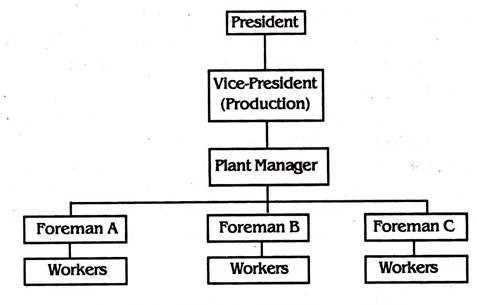
It represents a direct vertical relationship through which an activity flows from top to bottom throughout the organization and the quantum of authority is highest at the top and it reduces at each successive level down the hierarchy, every person in the organisation is in the direct chain of command. The line of authority not only becomes the avenue of command to operating personnel but also provides the channel of communication, coordination and accountability in the enterprise.

2. Line and Staff organization

Under the line and staff organization, the function of line is similar to its function under the line of organisation but some staff or experts are also appointed as advisors to the line officers. The functions of line officer are to take decisions, while the function of the staff officers is to advise them and these staff officers are experts in their respective fields and they offer their useful advice after analysing the problems presented by the line officers and in the way, the work of thinking and execution is done by different persons and this removes the chief defect of the line organisation and it can be adopted in case of large business enterprises. It is, however, important to make it clear that the line officers are not bound to accept the advice offered by the staff officers because the line officers alone are responsible for the outcome.