If not, it’s not uncommon. Until two years ago, I didn’t have a financial plan, whatsoever.
Even though I’ve been reading about money, finance, and investing ever since I made my first few bucks as a teenager, I never created a financial plan.
But now, I think every single working professional needs a financial strategy. How do you spend your money? How much do you save? What are your thoughts about debt? How do you invest your money? How much money do you need to retire?
This book was published in 1926 and as far as I can tell, it was the first popular book on personal finance.
Usually, I’m not into parables. But this is a great book. It’s the only parable that I’ve read that makes the message of the book even more powerful.
What it comes down to is this: Rich people are rich because they save their money, don’t get in debt, and don’t spend their money foolishly.
Clason recommends to save 10% of your income (I believe you should save 50% — more on that later). He calls saving “paying yourself first.” That’s an important mindset.
You only get rich by paying yourself. Don’t foolishly spend all your money on things you don’t need. When you do that, you pay others, not yourself.
Everyone should read The Richest Man In Babylon — the earlier the better.
What I enjoyed most about this book is that it teaches you to transform your relationship with money. This will change your life.
Money is something you trade your life energy for. Think about it. You work to earn money.
But you spend your time to work. That’s why Robin and Dominguez spend the first part of this book to make us aware that more is not better.
More money is especially not better if you have to put your own well-being on the line. It’s never worth it. Just ask the family of the bankers who committed suicide during any recession.
If you want to live a healthy and wealthy life, you must detach yourself from money. Instead of striving for more, get better at managing your money.
Save it. And don’t waste it on stuff you don’t need. Your Money Or Your Life starts out strategically and gets more practical towards the end.
One thing I don’t agree with is retiring early. I don’t want to retire and sit on a beach. That’s because my mentors, who are beyond the retirement age, still work and are very happy. I aspire to do the same.
But I also want to build enough wealth that I don’t “have” to work if I don’t want to. That’s one thing Robin and Dominguez also believe in.
I bought my first stocks when I was 20 years old. At the time, the finance sector was doing great, and I thought it would be good to invest in ING, the major Dutch bank.
Oh yeah, I should mention that this was in 2007, right before the financial crisis. I invested €1500 in ING and €500 in AEGON, a Dutch asset management firm.
It was about half of my savings at the time — a lot of money for a student. And a few months later, when Lehman Brothers collapsed, my stock portfolio was worth only a few hundred euros in total.
Man, I was so pissed off. I can’t even tell you how livid I was. But looking back, I understand that losing money is a part of investing.
And fortunately, I didn’t sell and waited until the stocks recovered. That took eight years, though.
I decided to not invest in individual stocks anymore. And The Intelligent Investor is one of the most important books that helped to realize investing in stocks is not for me.
If you already know that you don’t want to invest in individual stocks, you don’t have to read this book. However, if you are interested in finance, I highly recommend it. The commentary by Jason Zweig, a WSJ columnist, is also excellent.
P.S. I skipped the chapters about stock analysis because I’m not going to use it.
Productivity refers to the ratio between the volume of output and volume of inputs. Inputs here refer to factors of production like land, labor, capital etc. According to definitions, productivity is the residual output that is not explained by the direct contribution of input resources. It refers to goods and services produced in relation to resources used in their production. High productivity indicates that the resources are being used efficiently. If resources are economically the overall production will increase. This also decreases cost of production. It leads to higher production using minimal resources. It is an important critical indicator of economic performance. Residual output is called as Total Factor Productivity (TFP). Increase in productivity benefits the economy by making it possible to start new industrial units and generating more employment opportunities. Higher productivity is necessary for the growth of any nation.
Higher productivity helps in producing quality goods at lower cost. This will lead to lower prices increasing the standard of living. Profit maximization is possible because of higher productivity. This facilitates internal financing of expansion programmes. Factors of production can be used efficiently. This also increases income for workers. Higher productivity determines the standard of living. Lower productivity means low standard of living. GDP measures the total output. So, the total output is equal to the economy. This is the reason why American workers are richer than workers of any other developing nation. For example, let us consider Munro as an economy. He catches his own fish, grows his one vegetables, and makes his own clothes. His production and consumption can be considered as a simple economy. If he is bad at doing these things, he lives poorly. The standard of living of his economy depends on productivity. A country’s standard of living depends on its ability to produce goods and services.
The two variants of productivity are labor productivity and total factor productivity. Labour productivity measures the amount of output per worker. Total factor productivity measures the amount of output per unit of total input. Total factor productivity is total product output divided into index of all inputs like land, labor, capital etc. Output growing faster than inputs is higher productivity. Productivity increases as a result of advancement of technology, invention of new methods, newer processes etc. Increasing returns to scale, larger inputs and production will lead to higher productivity. Even with other factors remaining constant, economies of scale would contribute to productivity. If a product can be produced more efficiently when produced together than apart it creates a different kind of efficiency. It happens in the presence of economies of scope. For example, this happens in the software industry. When consumers buy software to prepare their federal income taxes the CD-ROM usually contains several other modules, including a link to a Web page, government documents, and a tax preparation manual. This shows economies of scope because the different modules can be more inexpensively produced, packaged, and used together than separately. Economics of scope are like the specialization and division of labor that increase productivity as economies become larger and more diversified. Economies of production and scope are also reasons for increasing productivity. Economies of scale and mass production have been important elements of productivity.
There are other factors that determine Robinson Crusoe’s standard of living other than productivity. From the example mentioned above we can call other determinants as physical capital, natural resources, and technological knowledge. These factors have a role in real economy.
Physical capital: physical capital per worker is important as workers will be more productive if they are provided with proper tools. Tools, equipment and structures used in the process of production of goods and services is called physical capital. The processes become easier and simpler with more tools and equipments. A worker with basic tools cannot produce more. Inputs to production are called factors of production. Physical capital is produced factor of production. Capital is an input into the production process that in the past was an output from the production process. Capital is a factor of production that is used to produce all kinds of goods.
Human capital: It includes the knowledge and skills that workers acquire through education, training and experience. The skills and experiences are a result of time spent in schools, programs, colleges, job trainings etc. It is an intangible capital. Like other determinants human capital also contributes to nation’s productivity. Human capital is a produced and completed determinant of productivity. Proper human capital which has effective and efficient workers requires proper educational facilities, teachers and institutions etc. Students are the future workers. They are the human capital that will be used in future production.
Natural Resources: Natural resource is another determinant of productivity. It includes rivers, land, minerals and other resources provided by nature. Natural resources are of two types: renewable sources and non renewable resources. Renewable resources are sources that can be created again or replaced easily. The supply is infinite. Examples include trees, fresh water, solar energy, biomass etc. Non renewable resources are sources that cannot be created again or replaced. The supply is limited. Examples include oil, gas, coal etc. Natural resource disparities are responsible for some of the differences in living standards around the globe. The historical success of USA was driven in the part by the large supply of land well suited for agriculture. Other examples are countries like Kuwait and Saudi Arabia. They are well off because of oil resources. Though natural resources are important, they are not solely responsible for higher productivity. Japan is a good example for this. Despite having low natural resources, it is one of the richest countries in the world. It imports many natural resources from other countries and exports manufactured goods to those countries.
Technological knowledge: Another important determinant of productivity is technological knowledge. It simply means using the best ways to produce goods. Technological advancements have made production process simpler. Once farming required a high input of labor to produce food for the entire population. Now, it has been made possible to produce for the entire population by employing a small proportion of the population. This has allowed labor to focus on other sectors. Technological knowledge has many forms. Common knowledge spreads to everyone after one uses it. For example, Henry Ford introduced production in assembly lines, other carmakers followed it. Rest is proprietary. Only the company that discovers or invents it knows it. Example: Coco Cola recipe. Some inventions are proprietary for short time. They become available to everyone after the patent expires. These forms of are important for the production of goods and services. Important difference between human capital and technology is technological knowledge refers to society’s understanding about how the world works. Human capital refers to the resources expended transmitting this understanding to the labor force.
Let us discuss about other determinants for better understanding of this. Other determinants of productivity are innovation, education, market efficiency and institutional infrastructure.
Innovation: Invention of new technology leads to development of high value added activities and improves the performance of existing economic activities. When we look back at the past we can know that only few countries have created new technology. They have invested heavily in research and development (R&D). Studies have revealed that creation of new technology is associated with higher TFP.
Education: There is a positive relationship between productivity and education. It is evident when we look at developing and developed countries. Studies show that the number of schooling years and completion rate of secondary and tertiary education is important in explaining the improvement of TFP for many countries.
Market efficiency: Studies have shown that market efficiency s related to variation in productivity across countries. Inefficiency in the allocation of human and physical capital is the main explanation for a low income among many countries. Estimates reveal that if capital and labor had been allocated at the same level as USA productivity in India and China could have been 1.6 times and 1.3 times higher than USA respectively.
Institutional infrastructure: Quality of governance that includes political stability, rule of law, the absence of corruption and so on is positively related to TFP and economic growth. Governance works as a channel for geographical endowments, such as temperate locations and proper growing environment for grains, to contribute to the growth of economy. Government size is also related to economic growth. It paves way for well executed government investment.
By studying productivity and its determinants we can understand the importance of productivity to an economy. Productivity ensures higher standard of living. It improves the income of labors and helps in developing the economy of a country. Determinants should be strengthened to increase productivity. Government should invest on infrastructure and education. Resources should be used properly. Higher productivity is essential for all nations.
Justice Aniruddha Bose said the issue will now be placed before CJI NV Ramana. Banerjee and Ghatak will submit information about their role in CBI’s arrest of four TMC leaders
New Delhi: Supreme Court judge Justice Aniruddha Bose on Tuesday recused himself from hearing appeals of West Bengal chief minister Mamata Banerjee and state law minister Moloy Ghatak about their role on the day of arrest of four TMC leaders by the CBI in the Narada sting tape case
As soon as a vacation bench of Justices Hemant Gupta and Bose assembled to commence the day’s proceedings, Justice Gupta said his brother judge is recusing himself from hearing these appeals.
Justice Gupta, presiding over the bench, said the issue would be now placed before Chief Justice of India NV Ramana who may take the decision and the pleas may be listed for hearing during the day itself.
The top court was scheduled to hear three appeals including that of the state government challenging the high court’s denial for filing of affidavits by her and the state Law Minister in their role on the day of arrest of four Trinamool Congress leaders on 17 May by the central agency in the case.
It has been alleged that the state ruling party leaders played a key role in stopping the CBI from performing its legal duty after arresting four leaders in the case.
We are almost over with the second wave, but we humans as a community have lost so much to the pandemic. It almost feels like the silence after the storm, when all the buildings, trees have collapsed but you are standing there helpless, staring at the damage and destruction that has been caused by this storm named pandemic. We still haven’t recovered from the scars of the 2 waves of covid and there is another wave lurking around the corner, and who knows the devastation it may bring about, although I hope it does not cause any more loss.
The second wave saw deaths at a larger rate than the previous wave, there was not a single night where there was no sound of an ambulance wheezing to save a single life.
The sad part is that many of the people who their lives might have been healthy if not for covid, they might not have had any health complications but still lost their life. Young people, too, have lost their lives in this pandemic.
We will eventually come out of this pandemic but at what cost? For many of us, it won’t even matter if the pandemic ends, after losing loved ones. But this where we should try to understand that now, after losing a life which was so dear to you might feel like “does it matter now that the cases are coming down, that deaths are occurring less and less day by day?” But still, we must realize that there are many more lives that need to be kept safe. The pain of losing a dear one will not pass away easily and when your kids will be reading about the pandemic, in the future, in their books, that memory will come alive again.
Many other things have also been lost, many people have lost their jobs, they have not been able to feed their family and themselves. Many students who were looking for employment lost their chances due to this pandemic. We have lost our normal routines, it feels like a lifetime when we went out for dinners and movies, we now miss even a regular day at schools and colleges.
But the bottom line is, life will go on no matter what, people will eventually forget that you had lost someone during the pandemic, they will move on. You will have to deal with this yourself, and we cannot blame them because everybody has to get on with their lives, so take time your time, sit back and reflect. Let the grief enter your mind and heart, feel it completely, cry, and when you let it sink in completely, then maybe you will be able to detach yourself from that feeling, although you can never forget it, it may help you. This detachment theory was something I read in the book “Tuesdays with Morrie”. We all must hope that the third wave does not bring with it any more destruction or better it does not come at all.
” I have no problem with starting from scratch” – Leif Garrett
The age 20-25 is quite confusing age of our lives. Everyone will have an inner voice which is constantly interrogating us a set of questions like , ” What are my interests?” , “Which is the field I can excel on?” , “How can I bring the best out of myself?”. Never be terrified by these questions. These are questions which will make you streamline your career path.
During the pre-final year and final times , we all will start to have a fear of future and will begin to recognize the practical aspects of life. The pressure could be due to college placements, peer discussions and expectations of our families. Never make any of these external factors influence your career choice.
The first step in order to identify the career path which best suits you is to know about your interests and skillsets. Write down three important interests of yours which may or may not relate to the stream of your study. Figure out what are the skill sets you have in those interests which could fetch you a job. In case if you have no skillsets in those fields refer to the career sites and find out what are the skill expectations for those roles.
The second step is to understand the industry. In the initial days of our college, we all would have had fun unaware of a world outside which is developing at a rapid phase . Start learning about what’s happening around you. Recognize the fields which are blooming and categorize those which attract you. List down the skills which are anticipated in those fields.
The third and most important step is to write down all the fields , interests and skillsets you have figured out in steps one and two. Write down your short term and long term goals which align with your interests. Narrow down to 2 fields which allure you and make you move forward towards your long term goals.
“We cannot become what we want to be , by remaining what we are” – Max DePree
Kick start your learning phase by acquiring skills and mastering them which attribute to revamp your profile. Make sure you update your profile regularly on career sites like LinkedIn which provides you the opportunity of networking. Never be petrified by the fear of perfection during the learning phases because,
“Continuous Improvement is better than Delayed Perfection” – Mark Twain.
The headline is the type of text indicates the nature of the article. the headline purpose is to quickly draw attention of a reader towards the story. It is written by a copy editor, but can also be written by the writer of the article, the page layout designer, or could be by other editors.
Headline is also known as soul of the content or hook of content. In other word we can say that headline line workout as compass.
Things to keep in mind while writing headline are as follows:
1. Understand the target audience: While writing a headline we have keep in mind whom we are writing for. we have to know exactly who we are talking to and trying to attract our reader with the help of our headline, so our headline should be effective. We should start headline writing process by keeping in mind who our audience is example for political news we should use diplomatic headline.
2. Show the Benefit of Reading: While writing headline, we should think about the reader, we should try to put ourselves into their shoes, and should begin writing headlines that could directly connect them with their wants and needs. Should Use our knowledge about the reader to write a headline that gives them a reason to read. Show them how they could benefit by this: • Solves their problem • Answers their question • Makes their life easier • Leads them to a positive outcome
3. Use the Simple but impressive Language: The language we choose should naturally impacts the worthiness of your headline. while using words that are bland, uninspiring, or unknown by most, your target readers may go to be turned off. Instead stick with language that is simple, but powerful. For example, address the reader as “you”, and use the words like “try” or “should”.
4. Headline must Appropriate to the Story: A humorous headline may work with a soft news, but it most definitely wouldn’t be appropriate for an article about someone being murdered or hard news. The tone of the headline must match the tone of the story. Example: a man brutally killed his wife for money.
5. Use of the Active Voice Use the subject-verb-object formula for news writing. That’s also the best model for headlines. Start with subject, write in the active voice, and your headline will convey more information using fewer words. Active voice tells who did what. Where as passive voice tells what happen which hides who.
6. Use of Present Tense It makes the reader fells more connected towards the story. Even if the news story is written in the past tense, headlines must almost always use the present tense. So that reader could get attracted towards the article. Example – Liverpool wins first premier league title Neymar injury hit PSG hopes
7. Must know where to Capitalize Always capitalize the first word of the headline as should all the proper nouns in the headline. Don’t capitalize every word in headline unless that is the style of your particular publication. Example: Blackpink’s Lisa showing love to fans
8. Be Direct Headlines aren’t the place to be obscure; a direct, straightforward headline gets your attention towards it more effectively than something overly creative. Example- Maggie – 30% off today only
9. Avoid names It is always better to avoid names while writing headline. But if in case it’s a popular well know name then name should be use because that particular name could attract the readers to read whole news. Example – if the news is about famous celebrity like Justin Bieber, Drake, BTS. people want to read about them, then it’s worth to use their name.
10. Using of articles in headline Avoid using of a, an, the in the headline. So that reader could get more connected with the article through headline. Example- Man releases rabid dog on street (A man released a rabid dog on a street) These were the few things we have to keep in mind while writing headline. A good headline catches reader attention first, then actual content on it. But then condition is headline should connect to content not any irrelevant information.
You do you. This is true, do not let the world tell you otherwise. Though all of us know how correct is this, often we find people who do not understand this. Those are the ones belittling you, judging you, and shaming you for your thoughts, preferences, way of life, and everything else too! Would you feel good if someone mocked you, talked about, or made negative opinions about you? The answer is pretty much a no. So if you as a person would be hurt if someone judged you, why would you want someone else to go through that pain? If you are someone who respects others for who they are and accepts them without any judgement, kudos to you. And for the others, it is never too late to be kind. You can start from today, in fact from now, and here are reasons why I think we all should stop judging others.
Judging others spreads negativity – We all know that positivity and kindness are the need of the hour. This means that we should stop doing things that are not bringing positivity to the environment. When you judge someone, that always brings down the other person, they even start associating negativity with you. That would never do any good to you, and the negativity might creep into you as well. It is difficult to stay happy and optimistic if you keep judging others. It like, always finding flaws in things, in situations, and with people. Try to find good in others, maybe appreciate how they smile, and how great it is to meet them. This would automatically infuse all the good vibes in and around your environment.
Judgement means a no to acceptability – Humans are diverse and very different from each other. From cultures to way of living, to life preferences and demands, everyone has their own choices. All of us want to be accepted in our own skin, isn’t it? Changing because someone else likes you better, is something that we all should say no to. Everyone has the right to be who they are and do what they want to do. All of this is negated when we start to judge others. A lot of people cannot stand the judgement and feel ashamed and embarrassed. This forces them to change in the way society wanted them to be, even when they did not want to. We should stop judging others to encourage acceptability and make people feel comfortable in their own skin.
You drive away happiness and contentment from your life – It is often said, judging someone does not define who they are, it defines who you are. There can be innumerable reasons why you are judging others, but a lot of times it is borne out of your own dissatisfactions and unhappiness. It sometimes might become difficult for you to see others happy when you are sad and discontent, and putting someone else down might provide a momentary satisfaction. But remember that it just makes you fall into a deeper pit of negative emotions, unhappiness, and guilt. You need to start being optimistic, accepting, and content with what comes your way. This will help you accept others as they are and spread positivity all around. Let us strive for a world wherein we all respect each other’s feelings, emotions, and thoughts so that our’s are accepted too and where all we diverse humans can live as one.
‘Save trees save life’ is a well known proverb for everyone. It is our responsibility to save forests because it would save our life. This types of forests are gets more rainfall and it helps to maintain ecosystem. It is important for the survival of life on the earth.
World Rainforest day is celebrated on June 22 every year. The name itself suggested the aim of the celebration. The day is to celebrate the existence of the rain forest and to create awareness or raise awareness among the people to preserve this type of natural resources. This day is celebrated on June 22 every year by millions of people round the world. It maintains the climatic balance and global warming.
History of World Rainforest Day
The first World Rainforest Day was observed on June 22 ,2017 which was introduced through the efforts and collaborations made by a groups called the Rainforest Partnership. The main aim of this initiative is to protect world’s Rainforests and to maintain ecosystem.
Theme of the World Rainforest Day 2021
The theme of this day has been finalized as “Protected together. Now. Forever”. On this special day people across the globe work together to preserve rainforests.
Significance of World Rainforest Day
This day is to promote methods or to preserve rainforests by many people across the globe. Due to this pandemic, no events were held in person but people are asking and willing to take part in the virtual events to highlight the importance of this day.
Two types of Rainforest:
There are two types of rain forests: tropical and temperate. Tropical forests are situated nearer to the equator where the land is hot whereas temperate forests are closer to the north or south pole where the land is cooler compared to tropical forests.
Rain forests gives us fresh water and it absorbs more carbondioxide and other harmful gases and emits oxygen which maintains the climatic balance. In these forests , we could find more valuable trees but all these trees are cutting down by people for money. There were more than 1 billion hectare from the tropical forests have been compressed due to deforestration.
Amazon rainforest alone provides 20% of oxygen and the pure water we drink. Daily there are 40 soccer lands are destroyed by the people. If this continues, 15% of carbondioxide emissions leads to climate change and global warming.
Top 3 Rainforestin the world
There are many rain forests out of which we are now looking at only the top 3 rainforests in the world
1. Amazon Rainforest
This is the world’s largest tropical rainforest located in South America with the land mass of 628 million hectares of tree covering area including 526 million hectares of primary forest and is the forest which has highest forest loss. 30 million hectares of primary forests have been deforestrated from 2002 to 2019.
2. The Congo Rainforest
It is the second largest tropican rainforest located in Congo Basin with the land mass of 288 million hectare of tree cover forest and 168 million hectares of primary forest. Due to deforestration, this forest losts over 6 million hectares of primary forest and 13.5 million hectares of tree cover forest between 2002 and 2019.
3. Australasian Realm Rainforest
This tropical rainforest is found on the island of New Guinea and also north eastern Australia with the land mass of 89 hectares of tree covering including 64 million hectares of primary forest in 2020. Due to deforestration, Indonesian part of New Guinea losts 605,000 hectares of primary forest area while PNG losts 732,000 hectares from 2002 .
This year marks 15th edition of SNDTWU’s Media Mantra. Education panel aims to gain perspective of edu-systems on how pandemic acted as catalyst in enhancing learning process with virtual shift. It reflects upon how lockdown fueled India’s EdTech platforms. The panel revolves around key game-changers like learning solutions, impact of technology, chance to upskill and institution’s crisis-response methods.
SNDTWU Extension & communication head of department Dr Mira K Desai spoke at length, upon asking how did students cope up with online education, she stated “It was challenging mainly in context of gender division of labor. Many of our students found it challenging to cope with new reality of studying with limited connectivity and manage studies while working from home.”
Media Mantra themed around ‘Unlocking Digital’, a flagship event organized by postgraduate students, since it is held virtually for the first time, Mira shared insights on her experience, “Media Mantra helps students explore their own potential and help them connect with industry. This is the first time that we have Online Media Mantra and it has gone National with panels and activities.”
Virtual event’s education panel will also comprise ‘National Survey’. On Challenges of online lectures, Mira K Desai commented,” You can join our panel to know what happened across the country.” A Voluntary Group of eleven media teachers from nine geographical locations across India got together in 2020 and decided to take up a study to understand impact of teaching-learning in online environment. Main objectives were understanding issues of reach and access of online technologies for online teaching/learning and examinations amongst students and teachers involved in media education.
Mira further added about supposed changes, “While all other processes remained unchanged, Media Mantra is an organically generated event for, of and by students. This year it’s different in terms of being online and also being ‘national’.”
She concluded what brand value Media Mantra holds, “We would like to believe that SNDTWU Media Mantra is a brand. It was launched in the year 2000 and is growing. This edition is 15th and we have 15 logos, taglines, guest lineup and reflection of Media of that time as perceived by our students.”
Influencer-based viral panel will give warm welcome to a string of millennial influencers who have carved a niche on social media platforms. Shradha Vyas, Fever FM RJ and host will overwhelm the audiences acting as moderator. List of content influencers include popular actor and digital creator Adil Feroz Khan, travel blogger Archana Singh, digital artist Diksha Rai, MTV’s former editor and video creator Nikhil Sidhwani. The edu-based panel will welcome guests such as Dr Akhil Shahani, MD of The Shahani Group and Rishabh Khanna, Cognitive Scientist and founder of the EdTech firm Suraasa which is a Teacher Education and lifestyle management portal. Dr Uma Shankar Pandey, IAMCR India Ambassador. Media mantra will be held on 26th June, courtesy of Nazrana Creation.
The very first Hindi word to be added in the English dictionary was “loot” which refers to the spoils of war pillaged from an enemy. This first addition was made when the British ruled India and filled their bags with Indian riches.
Before the British established their stronghold in India, our country was known all around the world as “Golden Bird” or “Sone ki Chidiya”.
The disintegration of the Mughal Empire in the 18th CE brought both political and economic fragmentation of the country. It was during this time that the British made their cunning move and eventually began to colonize the country. It was this colonial rule that not only devastated the political and social fabric but also drew out the riches.
A company’s official John Sullivan observed in 1840, ‘Englishmen flourishes, acts like a sponge, drawing up riches from the banks of Ganges and squeezing them down upon the banks of Thames’.
Before the British came, India’s share of the world’s GDP was very significant. Angus Maddison, a British economic historian observes that the contribution of India to world GDP declined from 24.4% to just 4.2% between 1700-1950. This is really a very dwindling figure.
SOURCE- PINTEREST
It was not that the Indians during the colonial times did not understand it. It was apparent to everyone. The greatest contribution in making the common people realize the economic exploitation goes to Dadabhai Naoroji. He put forward the “Drain of Wealth” theory. He described the drain of wealth as the major cause of Indian poverty. He said that the British were “bleeding India White”.
“By the end of the nineteenth century, India was Britain’s biggest source of revenue, the world’s biggest purchaser of British exports, and the source of highly paid employment for British civil servants and soldiers all at India’s own expense. Indians literally paid for their own oppression.” ― Shashi Tharoor, Inglorious Empire: What the British Did to India
And now the figures of how much the British drained our country would certainly blow everyone’s mind. Writing in 1859, George Wingate estimated the drain at £4 million per annum for 17 years between 1835-1851. V.I. Pavlov, professor of Economics at Moscow State University, estimated that in the 1930’s the British squeezed India of £130 million- £140 million in pure tribute. He remarks that -“With this amount, India could annually construct 3 plants of Bhilai type each of which would exceed in capacity the country’s iron and steel industry in British period”.
Thus, it can be concluded that the exploitation of Britishers is beyond reparation. The Englishmen understood that India was the bird that could lay golden eggs for them. So, they drained our country so excessively that when they left in 1947, they left behind an economically impoverished country, suffering for centuries from poverty and exploitation.
India is a diverse country, rich in age-old traditions and culture. Throughout its history, India has witnessed the emergence of many exotic art forms and craftsmanship. However, with the rise of cutting-edge technology of industrial textiles, many traditional craft forms have taken a massive hit. Rogan painting is a classic example of an enthralling yet sadly dying art.
What is Rogan Painting?
Rogan painting is a 400-year old inherited traditional textile craft of Gujarat. It is considered to be the oldest and most challenging printing art in the history of textile. The word Rogan means oil in Persia. With origins in Persia, it was brought to India around 300 years ago, even though there is not enough historical evidence to support the statement.
Preparation of the Ingredients
The chief ingredients required for Rogan painting are castor oil, wood, kerosene oil and dyes. The first step in the painting is the preparation of Rogan paste.
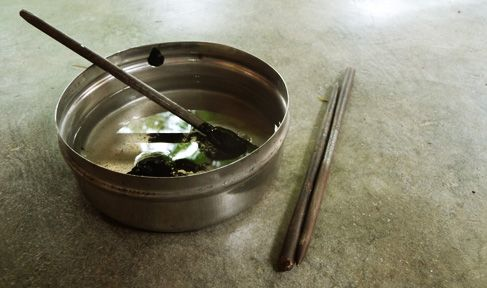
After preparing a furnace and selecting a suitable aluminium container, the local craftsmen boil a litre of castor oil for a minimum of four hours. The time required for boiling may vary depending upon the quantity of the oil taken. Then, they continuously stir the oil until it is time to remove the container from the furnace to let it cool down. While boiling, the castor oil may catch fire, after which it is immediately taken out and covered with a lid. During this, the impurities present in the oil gets thrown out in the form of fumes. This process is repeated several times until the oil forms a thick, gelatin-like consistency and turns yellowish.
Traditionally, the dyes used in Rogan painting were derived from organic, natural sources such as stones and plants. But today, synthetic dyes are used too. Red, yellow, blue, white, green, and brown are the primary colours used in the painting.
A manual stone grinder was used to mix naphthol dyes and white chalk powder and prepare the colour paste. With the gradual addition of water, the required consistency of the paste is reached. The Rogan paste is added to the colour paste and ground until it forms the desired soft, smooth, gelatinous dye paste.
Process of Rogan Painting
The process of painting is a very tedious and cumbersome task. Initially, the craftsmen lay the fabric to be painted on the floor. Next, they take a lump of the dye paste and put it on the palm of one hand. They hold a suya rod or a metal stylus in the other hand and mix the thick paste till it stretches into a thread-like structure.
They carefully twist the rod to create beautiful motifs and patterns across the fabric without the rod touching the cloth. After that, they fold the fabric and press it evenly to obtain an identical impression on the other half of the fabric. Lastly, the fabric is left out in the sunlight for about six to seven hours to let it dry.
The intricate motifs that embellish the fabric, such as geometric flowers, peacocks, the tree of life, etc., are inspired by the history and folk culture of the Kutch region of Gujarat.
Originally, the Rogan Art was used to adorn the trousseau of a bride. But due to the limited resources, meeting the market demand has become a challenge. From almost becoming a dying art to gaining worldwide recognition, Rogan Art sure has come a long way.
North Korean leader Kim Jong Un has asked his country to prepare for dialogue and confrontation with the United States. The Dictator has asked his countrymen to get ready to protect the dignity of the state but is North Korea even in the state to provoke the US. Pyongyang’s problems are on the rise, it is running out of food, it may be staring at a famine. Kim Jong Un may be unwell, there has been a lot of speculation after the North Korean dictator’s photos came out, they showed a seemingly thinner Kim.
The Hermit Kingdom is running out of food, in session at the plenary of North Korea’s ruling party all eyes are on North Korean dictator Kim Jong Un, as he walks up to the podium Kim wastes no time in addressing the food crisis, he calls it ‘tense’. Admissions like these are rare in a country that habitually rides behind a facade which also makes admissions like these very scary. Hunger and malnutrition have long coexisted with authoritarianism. The UN world food program claims that atleast 10 million North Koreans are malnourished, the country’s total population is 25 million. Most families can manage only two meals a day, many can afford just corn. As of june 2020, 40 percent of North Korea needed humanitarian aid, one year on the crisis has worsened. North Korea shut its borders with China in early 2020, China is North Korea’s primary economic partner and it accounts for 90 percent of North Korea’s trade when Pyongyang shut that door, the bilateral trade fell by 81 percent. Between june and september, North Korea was also hit by a severe flood. The result of the twin disaster looks horrible. North Korea’s GDP is 8.5 percent is estimated to have plummeted by in 2020 unlike the rest of the world, Pyongyang failed to rebound.
Earlier this year, Kim asked his countrymen to brace for an arduous march. The reference was to the famine of the mid 1990s where almost 3 million people died of starvation. This is clearly history repeating itself, North Korea has obviously run out of its imports from China. It has also refused international help and has advocated a stricter lockdown instead. North Korea has not publicly signed any vaccine deals, it has been questioning vaccine efficacy while clandestinely importing vaccine from China. Reports say vaccines are being loaded onto Chinese refrigerated vehicles and secretly moved to the North Korea city of Siniju who are they for reports say North Korean civilians have not been told about a global vaccine rollout. Vaccines from the Gavi Covax alliance are yet to land in Pyongyang. The situation in the hermit kingdom is dire to say the least. It becomes more desperate when you consider the dictator’s undisclosed health problems.
Kim has clearly lost a lot of weight, he is believed to be five foot and seven inches tall. South Korean intelligence claims Kim weighs around 140 kilos, he has been gaining six to seven kilograms in a year since ascending the throne. There is a clear BMI mismatch and his family’s health history isn’t flattering. Both Kim’s father and grandfather died of heart ailments. Kim Jong Un II disappeared for a brief while in 2020, only to return limping with a walking stick. Kim’s weight loss has triggered speculation, North Korean watchers have gone to extent of siting the difference in the length of watch strap.
Just because the paranormal is that the realm of the unexplained doesn’t mean there isn’t any explaining to try to do. Humans have always sought to define the planet around us, and even to the worlds which will be beyond us. As a result, throughout millennia, we’ve developed countless theories and told endless stories within the realm of paranormal popular culture, and there are tons of misconceptions that have taken root within the public’s consciousness. Believe it or not, even when handling the mysterious realm of ghosts, aliens, and creatures, there are some things we will fairly confidently label as false. So, to clear up some incorrect assumptions about the unexplained, let’s take a glance at 5 Paranormal Myths.
Paranormal Facts Exist – The term “paranormal” applies to anything currently beyond the range of scientific explanation. So anyone who claims they need access to the rulebook of the paranormal, which they know a foolproof way of creating a ghost go “boo!” is perhaps a charlatan … or close to be pretty famous. many researchers — including reputable scientists — have compelling theories about unexplained phenomena and are trying to use those utilizing the methodology, but thus far, paranormal facts don’t quite exist.
Ghosts Only begin in the dark – There are tons of reasons to ghost hunt at night: the planet quiets down because the day fades away; some locations only allow you to enter after the close of daytime business hours; it’s much creepier at night; and, most significantly, it’s the simplest time to play together with your sweet night-sight camera! But if you would like to chase ghosts, you’ll even as effectively roll in the hay during the day, consistent with most paranormal researchers. It’d even be a simpler time because that’s when the dead were probably most alive.
There’s No Physical Evidence of Bigfoot – While there haven’t been any bodies found, Bigfoot researchers claim there’s quite a little bit of physical evidence to suggest the creatures exists — including hair, blood, tissue, tracks, and, yes, poop. There is also a growing community of scientists who believe in Sasquatch, including famed primatologist Dr. Goodall and Dr. Jeffrey Meldrum of Idaho State University, among others. Eric Altman of the Pennsylvania Bigfoot Society stresses that, as far because the lack of physical remains (a dead Sasquatch), fossilization requires very specific conditions and Mother Nature has an efficient system of breaking down animal remains in about 10 days — so a freshly-dead specimen of the already-rare creature would be hard to seek out.
Only Old Buildings are Haunted – A decrepit, ancient Victorian mansion with broken windows, creaky floorboards and moldy furniture could also be the simplest haunted house in Hollywood, but it’s not where ghosts necessarily hang around. Beyond just old houses, researchers claim to possess found paranormal evidence in jails, asylums, hospitals, hotels, museums, battleships, cruise liners, cars, roads, and forests. New locations also can be haunted, as can the bottom where a replacement building is established. There doesn’t necessarily need to be a death on the property, either. it’s widely accepted within the paranormal community that objects and other people themselves are often the main targets of a haunting.
America’s Paranormal Fascination is New – Although the paranormal has become quite fashionable with the arrival of investigation-based reality shows, America’s fascination dates back to the origins of the state. The paranormal peaked within the US within the mid-19th and early 20th centuries with the introduction of Spiritualism, a spiritual philosophy that espoused that communication with the imaginary place is positive. Mary Todd Lincoln, Clemens, and Houdini were among the American celebrities who became a part of the paranormal conversation, and therefore the public gathered in homes and auditoriums to attach with the dead in séances. Beyond ghosts, future president Teddy Roosevelt wrote of a frontiersman’s encounter with a Bigfoot-like creature in 1893, and other Sasquatch stories would periodically make their way into the news. Long before the Battle of l. a. in 1942 or The Roswell Incident in 1947, “airships” were reported within the skies above America — and newspaperman S.E. Haydon wrote about the crash of such a ship in Aurora, Texas, in 1897, about 6 years before the Wright Brothers’ first flight.
Creating an app without coding language is easier and cheaper than you think. You just need to use an app builder like AppInstitute. With these tools you can have your app up and running in days or even hours.
The way of Simple steps:
1.Choose a template.
2.Brand your app.
3.Edit and add content.
4.Publish your app.
How to Create a Mobile App Without Writing a Code
To create a mobile app without coding, you need to use an app builder. These are tools that come with pre-programmed templates and features that you can edit and customize.
Because the features in app builders are pre-made, you don’t need to program them yourself. And because you can customize the look, content, and features, you can build mobile apps that are entirely your own.
AppInstitute is one of the most popular app builders. We have designed the mobile app development process to be as straightforward as possible. We believe you will be able to build an app that wows your customers, no matter your level of technical ability.
The device apps are perfect for small businesses and learning plotforms that want an app to improve their service and compete with bigger brands.
The every user currently include:
Restaurants that use their mobile apps to enable contactless ordering, takeaway, and delivery.
Coffee shops that use their app for loyalty schemes or order in advance.
Hair salons use the app to manage bookings and loyalty schemes.
Radio stations provide listeners with an easy-access radio stream.
And more.
You can quickly build both an iOS and an Android app with the app maker. This is essential, as releasing native apps on each platform ensures your entire customer base can use your product.
If you want to make an app while reading this guide, head over to this link to sign up and try out our app builder.
Step One: Choose Your Template
The first step in the app development process is choosing a template. We have templates available for a wide variety of business types, industries, and use cases.
Each of these templates contains the features that most benefit the people who run each type of business.
step one:App Builder
For example:
The beauty salon app template makes it easy for salons to accept bookings. It also has a gallery businesses can use to show off haircuts and styles.
The coffee shop app template contains a loyalty rewards program and the ability for customers to make orders ahead of time.
The radio station app template has features for a live stream and time schedules.
All the templates are customizable. That means if it doesn’t have all the features you want, you can easily add more in the following steps.
If your business doesn’t fit any of the existing templates, you can make an app from scratch and only add the pages and features you need. Just choose the relevant option when setting up.
Step Two: Branding
Next, select a color scheme for your template. We make this easy by letting you connect your website to the app builder. We then pull out the colors you already use and suggest a suitable palette for your app that matches your existing branding.
step two:theme
If you don’t have a website or you’d rather choose your colors, you can do so in the next step. Just click the “Skip this step” button.
At this stage, you can enter your mobile number so we can send you a preview link that lets you see how the app looks on a mobile device.
The colors you choose aren’t the only way you can brand your app. Our app builder makes it easy for you to customize your app with images that you can use on the splash screen or as a header bar image.
This makes your app instantly recognizable. Just upload the images via the relevant section.
The final step in the branding process is uploading your app icon. This is the logo that people see when they want to open your app or search for it on the App Store or Google Play. Make sure yours stands out and is instantly recognizable so people can quickly access your app.
Step Three: Content
Each app template comes with preloaded content, which you can easily edit to suit your own business. For example, you can change the text shown on the About page or add new images and descriptions to your menu.
The app builder also makes it easy to add new tabs to your mobile apps.
Whether it’s an about us page with details of your company’s contact and social information, a services page that outlines all you have to offer, loyalty programs, or simple to use forms. You can customize your content to build an app suitable for any business type.
It’s also easy to remove features you don’t think will benefit your audience. If you don’t want to offer a loyalty program, for example, just delete it from the app.
This customization ensures that novices can create mobile apps unique to their business without writing a single line of code.
Once you’ve added content, you can set navigation options. Choose from a tab bar or sidebar menu that enables customers to access features in your app easily.
Setting up the back-end of the features is easy. You can adjust the settings so that you receive a notification when someone makes an order or sends you a message. It’s also possible to restrict access to certain pages to only logged-in users.
Step Four: Publish
Now you’ve worked on the design and added your content to each area of your app, you just need to publish it. Users will then be able to easily download either the iOS or Android app to their phones.
We provide all our users with an easy-to-use wizard that simplifies the publication process. Just follow the steps to set your app live on the App Store, the Google Play Store, or both.
There are several sections you will have to complete before you go live. First, you need to confirm that you don’t breach any of the content warnings from either store. Then you can fill in the details that will show up in your app store listing, including:
App Title
Icon Name
Categories
Keywords
Description
Before publishing your app, you’ll need to sign up for a Google and Apple Developers account. This is required by everyone who wants to publish an app on one of these platforms.
Top App Builder Features for Your Business
The AppInstitute app maker has features that help many types of businesses: including coffee shops, nightclubs, hair salons, driving instructors, charities, and many more.
Here are some of the available features:
Mobile Coupons
Incentivize customers to download your new app by offering exclusive discounts with mobile coupons. These redeemable coupons can have set start and end dates to suit your offer and can help drive those all-important sales. Coupons are particularly effective at driving sales during quiet periods of the year or to promote special occasions!
Food Ordering
With the rise of food ordering apps like JustEat and Deliveroo, restaurant consumers are used to ordering food with just a few clicks. Create and customize your own food ordering app and benefit from great features like one-click ordering without the substantial commission fees charged by third parties. You can use this same system to provide a contactless ordering experience at your restaurant, coffee shop, or bar.
Gallery
Promote your business with gorgeous images in a photo gallery. Hair salons can easily upload the latest photos of their stunning cuts and colors. Or ecommerce stores can showcase images of all their latest products.
Loyalty Program
Our loyalty program tab lets you create a rewards scheme that gives user a stamp whenever they buy from your business.
When the customer hits a predefined number of stamps, you provide them with a gift. The scheme is entirely customizable, so you can make it work for your business and users. It’s perfect for any business that would benefit from repeat sales.
Booking System
Connect your online booking service to your app to accept bookings. It’s perfect for hotels, salons, restaurants, or any type of business that uses bookings. Or you can create events and then accept reservations from your customers. Bars and pubs will find this tab useful, too.
Ecommerce
Connect your ecommerce provider to your app to give people a new way to order directly from your business. We can integrate with platforms including Amazon, Etsy, Magneto, and Shopify.
Audio Stream
Give your customers direct access to an audio stream from their phone or tablet. It’s a great way for radio stations to ensure listeners always have access to their stream.
Push Notifications
Keep customers engaged by sending push notifications directly to their phone. A well-timed message could be the difference between someone ordering from your takeaway on a Friday afternoon and cooking at home.
You can tailor push notifications based on different user segments or the location of the user. For example, you can show families one offer and couples another.
Directions
Add a directions tab that shows users how to find your business. The tab uses Google Maps so it is easy for customers to use.
Contact
Make it easy for customers to contact your business by including a page with a form. We offer several preset forms that allow user to register, send feedback, or send images. Or you can create your own form with the form editor. Add various types of fields including checkboxes, email addresses, and images.
You can check out the complete list of features that we have available here.
Achieving Long-Term Success
App builders make it easy to create apps without programming knowledge. But building your app from scratch and then launching is only the start of the mobile app development process. And it is certainly just the start of the journey with us at AppInstitute.
We want to help you make the most of your new tool, so supply a 30-day success plan which covers all the things you need to do in the early stages to help achieve your long-term goals.
We’ll equip you with social sharing tools to promote your app on the likes of Twitter, Facebook, Instagram, and LinkedIn.
You’ll also be able to access your app’s analytics data to view downloads, app actions, and download sales reports across customized time frames to track the success of campaigns or learn how much revenue you are bringing in.
If you wanted even more in-depth analytical information, use Google Analytics to identify the most viewed pages, where your traffic is coming from, and many more insights and reports.
Once you’ve got a captive audience, communicating with them to keep them that way is the next crucial element. Push notifications are one of the best ways to connect with user almost instantly.
Use them to promote exclusive deals and discounts, send important updates, reminders, and much more. With the addition of geofencing technology, you can use push notifications to target user when they are near your business.
Building your first Apple or Android app doesn’t have to be a scary, daunting prospect.
AppInstitute makes the process easy, stress-free, and affordable. You don’t have to write a single line of code. You get complete control over how your app looks, functions, and feels.
The plunge and delve into the world of the mobile app to take advantage of features that will blow your user away and put you ahead of the competition.
When we talk about the law, it has been so important from the primitive time and its importance will never decrease as the world needs to run peacefully and smoothly. Law as a career is a wonderful profession that can give you a plethora of career Ventures. It is the best way to conquer and explore for the students who are good in communication and are also confident about logical reasoning and can easily imbibe into the legal sphere. This is the right and apt place to develop your skills moreover it is in great demand in today’s world.
Career as a lawyer
Lawyers have always been respected and we always need lawyers to interpret law properly. The students can specialize in various areas like a:
Litigation
Corporate Council
Judicial Clerkship
Judiciary and civil service
Media and Publication
Legal process outsourcing
Academia
Social work etc.
Looking into so many streams of specialization a student may get confused but just in case you are confused it is always good to take advice, and research a little bit to the various pros and cons of every stream.
In this topic, we will be analyzing and understanding the career of a lawyer who has taken the stream of litigation as his future career.
About a career as a litigation lawyer
Litigation is a very intellectual and challenging stream as the legal practitioners provide the services by presenting their clients in the Court. a litigation lawyer is also called an attorney. One has to research the legal issues and present his case in front of the judge. He has to draft his legal documents, and there would be a lot of courtroom appearances. Litigation lawyers should have the complete information of the courtroom with the in-depth knowledge of his case.
Litigation Lawyer
Eligibility for a career as a litigation lawyer
To be eligible and practice in the court as a litigation lawyer one has to:
Complete the LLB 5 years or LLB 3 year’s course
A student who has completed his LLM is also is eligible
One cannot practice if you have done a diploma or a certificate course.
Other basic requirements are:
The student has to be good with communication skills, logical reasoning, full research in legal concepts, detailed knowledge, patience, troubleshooting, critical thinking, confidence, etc.
Few years of experience through internships in law firms will give necessary skill sets to be a professional litigation lawyer.
Pay structure of a litigation lawyer
A lawyer who is practicing in the court his pay scale differs greatly from organization and experience. Sometimes due to the intellectual capability and skill set a litigation lawyer may become very expensive due to the accurate knowledge and Court deliverance. Reputation also is a Core factor that will differ from person to person. in general, a litigation lawyer on an entry-level will draw 1,80,000 per annum and an average litigation lawyer will earn somewhere around 4,99,000 whereas a senior lawyer’s salary will be somewhere around 7 to 8 lacs per annum.
Salary of an attorney
This job is highly rewarding and also has job satisfaction. It helps you to reach Heights which are unimaginable and you can also develop your skill sets and work experience within no time. The job of a litigation lawyer has new challenges daily and is exciting as law keeps changing, hence one has to always keep updating himself. This profession is a discovery of new knowledge and learning and also gets a lot of financial rewards and sometimes even gives a sense of happiness when a genuine client gets justice because of your effort.

















 Eduindex
You must be logged in to post a comment.