In order provide the gap between JEE mains 3 and JEE mains 4 , NTA has announced to postponed the JEE mains 4 ( may session) .Now Jee mains 4 will be conducted on August 26,27 ,31 , September 1 and 2 ,2021.
The Hon’ble education minister Pradhan says “In view of the persistent demand from the student community and to enable the candidates to maximize their performance, the NTA has been advised to provide a gap of four weeks between session 3 and session 4 of the JEE(Main) 2021 Exam.”
Now the application will be accepted till 20th july 2021.Students whose who have not applied at can do so before 20th july 2021.
The NTA releases official notice stating “With a view to remove hardships caused to candidates and to ensure larger participation of candidates, it has been decided to extend the last date further for: submission of online application form by new candidates and withdrawal/ correction by the existing/ interested candidates for the exam,”
In order provide the gap between JEE mains 3 and JEE mains 4 , NTA has announced to postponed the JEE mains 4 ( may session) .Now Jee mains 4 will be conducted on August 26,27 ,31 , September 1 and 2 ,2021.
The Hon’ble education minister Pradhan says “In view of the persistent demand from the student community and to enable the candidates to maximize their performance, the NTA has been advised to provide a gap of four weeks between session 3 and session 4 of the JEE(Main) 2021 Exam.”
Now the application will be accepted till 20th july 2021.Students whose who have not applied at can do so before 20th july 2021.
The NTA releases official notice stating “With a view to remove hardships caused to candidates and to ensure larger participation of candidates, it has been decided to extend the last date further for: submission of online application form by new candidates and withdrawal/ correction by the existing/ interested candidates for the exam,”
Mental illness can have a negative impact on daily life, relationships, and physical health.
This link, however, also works in the opposite direction. Mental health issues can be caused by a variety of causes, including personal circumstances, interpersonal relationships, and physical conditions. Stress, despair, and anxiety can all have an impact on a person’s mental health and disturb their daily routine.
Taking care of one’s mental health can help one’s ability to appreciate life. To do so, you must strike a balance between your daily activities, duties, and efforts to improve your psychological resilience.
Mental health, according to the WHO, is “more than merely the absence of mental diseases or disabilities.” Peak mental health entails not only avoiding active mental illnesses but also maintaining overall well-being and happiness.”
They also underline the need of protecting and repairing mental health on an individual level, as well as in many groups and societies around the world.
Mental health is essential to our ability to think, emote, interact with others, earn a living, and enjoy life on a collective and individual level. On this basis, mental health promotion, protection, and restoration might be considered a critical concern for individuals, communities, and societies all over the world.
What does mental health basically mean:
“Mental health is a condition of well-being in which a person recognizes his or her own potential, is able to cope with typical life challenges, is able to work efficiently, and is able to contribute to his or her community.“
There is no reliable physical test or scan that can determine whether or not someone has developed a mental disorder. However, the following are probable indications of a mental health condition that people should be aware of.
1)Avoiding activities that they would typically like withdrawing from friends, family, and coworkers sleeping too much or too little
2)Too much or too little food
3)Feeling despondent
4)Having low energy levels on a regular basis
5)Using mood-altering substances such as alcohol and nicotine on a more regular basis
6)Expressing negative feelings
7)Being perplexed
8)Having persistent thoughts or memories that resurface on a frequent basis being unable to execute daily duties, such as commuting to work or cooking a meal
9)Considering harming yourself or others physically
10)Recognising voices
11)Having hallucinations
SELF HELP IS IMPORTANT
A person dealing with mental health issues will almost always need to make lifestyle modifications in order to be well.
Reducing alcohol consumption, sleeping more, and eating a well-balanced, healthy diet are examples of such adjustments. People may need to take time from work or handle personal relationship issues that are negatively impacting their mental health.
Relaxation techniques such as deep breathing, meditation, and mindfulness may be beneficial to people suffering from anxiety or depression.
Having a support network, whether through self-help groups or close friends and family, is extremely important for mental illness rehabilitation.
Suicide prevention, the prevention and treatment of mental problems in children, the prevention and treatment of dementia, and the treatment of substance abuse disorders all have a number of successful interventions. The mental health Gap Action Programmed (MH GAP) has developed evidence-based guidelines for non-specialists to help them better identify and manage a variety of mental health conditions.
In the framework of national efforts to design and execute mental health policy, it is critical to not only safeguard and promote citizens’ mental well-being, but also to address the needs of people with specific mental diseases.
Mental illness can have a negative impact on daily life, relationships, and physical health.
This link, however, also works in the opposite direction. Mental health issues can be caused by a variety of causes, including personal circumstances, interpersonal relationships, and physical conditions. Stress, despair, and anxiety can all have an impact on a person’s mental health and disturb their daily routine.
Taking care of one’s mental health can help one’s ability to appreciate life. To do so, you must strike a balance between your daily activities, duties, and efforts to improve your psychological resilience.
Mental health, according to the WHO, is “more than merely the absence of mental diseases or disabilities.” Peak mental health entails not only avoiding active mental illnesses but also maintaining overall well-being and happiness.”
They also underline the need of protecting and repairing mental health on an individual level, as well as in many groups and societies around the world.
Mental health is essential to our ability to think, emote, interact with others, earn a living, and enjoy life on a collective and individual level. On this basis, mental health promotion, protection, and restoration might be considered a critical concern for individuals, communities, and societies all over the world.
What does mental health basically mean:
“Mental health is a condition of well-being in which a person recognizes his or her own potential, is able to cope with typical life challenges, is able to work efficiently, and is able to contribute to his or her community.“
There is no reliable physical test or scan that can determine whether or not someone has developed a mental disorder. However, the following are probable indications of a mental health condition that people should be aware of.
1)Avoiding activities that they would typically like withdrawing from friends, family, and coworkers sleeping too much or too little
2)Too much or too little food
3)Feeling despondent
4)Having low energy levels on a regular basis
5)Using mood-altering substances such as alcohol and nicotine on a more regular basis
6)Expressing negative feelings
7)Being perplexed
8)Having persistent thoughts or memories that resurface on a frequent basis being unable to execute daily duties, such as commuting to work or cooking a meal
9)Considering harming yourself or others physically
10)Recognising voices
11)Having hallucinations
SELF HELP IS IMPORTANT
A person dealing with mental health issues will almost always need to make lifestyle modifications in order to be well.
Reducing alcohol consumption, sleeping more, and eating a well-balanced, healthy diet are examples of such adjustments. People may need to take time from work or handle personal relationship issues that are negatively impacting their mental health.
Relaxation techniques such as deep breathing, meditation, and mindfulness may be beneficial to people suffering from anxiety or depression.
Having a support network, whether through self-help groups or close friends and family, is extremely important for mental illness rehabilitation.
Suicide prevention, the prevention and treatment of mental problems in children, the prevention and treatment of dementia, and the treatment of substance abuse disorders all have a number of successful interventions. The mental health Gap Action Programmed (MH GAP) has developed evidence-based guidelines for non-specialists to help them better identify and manage a variety of mental health conditions.
In the framework of national efforts to design and execute mental health policy, it is critical to not only safeguard and promote citizens’ mental well-being, but also to address the needs of people with specific mental diseases.
There is always a conflict between our heart and mind to explore or to cling on with the wise people’s saying before starting our track of life/career. In my opinion I require I both to be implemented in life as not everything can be known to everyone. But choose try your journey to write your novel and recite it to others. An unguided travel will always have various adventures and mysteries to be revealed, “Life is a journey explore your experience by unfolding mysteries”.
“Life is a stage where men and women are mere players
They come and play their part and leave the stage” – Words told by Shakespeare
So no one is permanent and don’t depend on others make yourself depended on you. As an infant you try to crawl then try to walk followed by jogging and finally running. Each and every step is taken by you is your effort to grasp things at every level and learn them after you mature every stage in life. Instead of getting guidance try to gain your guidance by making your way of what your mind says. You can do work your thinking tells you as it has never gone wrong. If you learn without training you will never forget your lesson that made you perfect out of the incidence. As you learn without training you improve your skills and your character to understand every aspect in life.
“Not everyone is perfect it is life shaping people in their own destiny”
Help yourself in understanding things without your rage or anger controlling you. You’re thinking and actions in life helps you decide who you are. Trespass your limits and create your path where there is a block. As you move forward you will face every aspect of life understanding factors like adjustments, emotions, sadness, sorrow. The more you explore, the deep you learn and face boldly to overcome your hinderances out of courage. Guidance helps you to travel safely but own path makes you to face the obstacle and how strong you are by heart. And it is an unavoidable fact that still 2 out of 4 children are handled and guided until their old days without they taking their own pavement. “Help children to find paths but don’t travel with their paths as the path will travel and teach them the value of them”.
There is always a conflict between our heart and mind to explore or to cling on with the wise people’s saying before starting our track of life/career. In my opinion I require I both to be implemented in life as not everything can be known to everyone. But choose try your journey to write your novel and recite it to others. An unguided travel will always have various adventures and mysteries to be revealed, “Life is a journey explore your experience by unfolding mysteries”.
“Life is a stage where men and women are mere players
They come and play their part and leave the stage” – Words told by Shakespeare
So no one is permanent and don’t depend on others make yourself depended on you. As an infant you try to crawl then try to walk followed by jogging and finally running. Each and every step is taken by you is your effort to grasp things at every level and learn them after you mature every stage in life. Instead of getting guidance try to gain your guidance by making your way of what your mind says. You can do work your thinking tells you as it has never gone wrong. If you learn without training you will never forget your lesson that made you perfect out of the incidence. As you learn without training you improve your skills and your character to understand every aspect in life.
“Not everyone is perfect it is life shaping people in their own destiny”
Help yourself in understanding things without your rage or anger controlling you. You’re thinking and actions in life helps you decide who you are. Trespass your limits and create your path where there is a block. As you move forward you will face every aspect of life understanding factors like adjustments, emotions, sadness, sorrow. The more you explore, the deep you learn and face boldly to overcome your hinderances out of courage. Guidance helps you to travel safely but own path makes you to face the obstacle and how strong you are by heart. And it is an unavoidable fact that still 2 out of 4 children are handled and guided until their old days without they taking their own pavement. “Help children to find paths but don’t travel with their paths as the path will travel and teach them the value of them”.
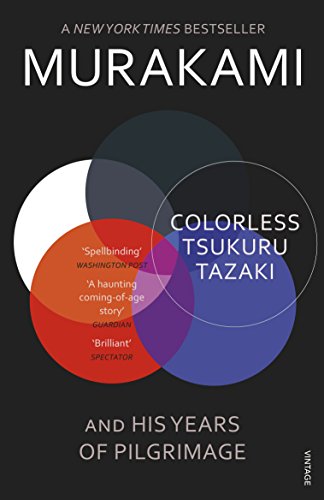
“One heart is not connected to another through harmony alone. They are, instead, linked deeply through their wounds. Pain linked to pain, fragility to fragility. There is no silence without a cry of grief, no forgiveness without bloodshed, no acceptance without a passage through acute loss. That is what lies at the root of true harmony.”
-Haruki Murakami, Colorless Tzukuru Tazaki and His Years of Pilgrimage
Haruki Murakami is a Japanese writer whose novels and short stories have been translated and admired all over the world. Murakami’s works are a true testament to the genre of Magic Realism wherein seemingly unnatural things and incidents happens in the natural world. His stories revolve around inner conflicts, the dilemmas of human existence and a spectrum of psychological topics that makes us question the working of the world. His most notable works include Norwegian Wood, Sputnik Sweetheart, Kafka on the Shore etc. Through this unique method of narration, Murakami explores the warped realities of the human world.
His Novel Colorless Tzukuru Tazaki and His Years of Pilgrimage was written and published in the year 2013. It sold over a million copies in just a month and is a bestseller. It is a realist bildungsroman that follows the life of a railroad engineer in Tokyo named Tsukuru Tazaki. Bildungsroman novels include the development of the protagonist’s mind and character in the passage from childhood through varied experiences- and often through spiritual crisis- into maturity; this process usually involves recognition of one’s identity and role in the world. During his school days, he becomes best friends with four people; two boys named Akamatsu (Red) and Oumi (Blue) and two girls called Shirane (White) and Kurono (Black). Tsukuru had always felt left out from his gang of friends for all of their names included a colour while he always remained colourless. Despite that, he considered them his good friends. But one day, he finds to his utter surprise that all his friends have suddenly cut ties with him without any explanations. Highly depressed and shocked, Tsukuru is traumatised by this turn of events.
“As we go through life we gradually discover who we are, but the more we discover, the more we lose ourselves.”
-Haruki Murakami, Colorless Tzukuru Tazaki and His Years of Pilgrimage
Later on in college, Tsukuru moves to another city and slowly recovers himself from the brink of suicide. He befriends a boy named Haida who narrates a peculiar story of a travelling man and his encounter with a particular kind of music. But before the start of the next semester, Haida leaves him as well. Now resigned to the conclusion that he was born to be lonely, Tsukuru is left with a fear of building close relationships.
Years later, Tsukuru nurtures his interests in trains and ends up being a railroad engineer. His girlfriend Sara advices him to embrace the past than run away from them, for she gives an ultimatum that unless he decides to confront his past, their relationship would never work out. Determined, he takes on a journey to find his lost friends and mend their relationships to work towards a healed future. Like all other Murakami books, this one retains a special place for music as well. In this novel, Lizst’s classical piano solo ‘Years of Pilgrimage’ serves as a recurring symbol that adds charm to the magic realist plotline.
“One heart is not connected to another through harmony alone. They are, instead, linked deeply through their wounds. Pain linked to pain, fragility to fragility. There is no silence without a cry of grief, no forgiveness without bloodshed, no acceptance without a passage through acute loss. That is what lies at the root of true harmony.”
-Haruki Murakami, Colorless Tzukuru Tazaki and His Years of Pilgrimage
Haruki Murakami is a Japanese writer whose novels and short stories have been translated and admired all over the world. Murakami’s works are a true testament to the genre of Magic Realism wherein seemingly unnatural things and incidents happens in the natural world. His stories revolve around inner conflicts, the dilemmas of human existence and a spectrum of psychological topics that makes us question the working of the world. His most notable works include Norwegian Wood, Sputnik Sweetheart, Kafka on the Shore etc. Through this unique method of narration, Murakami explores the warped realities of the human world.
His Novel Colorless Tzukuru Tazaki and His Years of Pilgrimage was written and published in the year 2013. It sold over a million copies in just a month and is a bestseller. It is a realist bildungsroman that follows the life of a railroad engineer in Tokyo named Tsukuru Tazaki. Bildungsroman novels include the development of the protagonist’s mind and character in the passage from childhood through varied experiences- and often through spiritual crisis- into maturity; this process usually involves recognition of one’s identity and role in the world. During his school days, he becomes best friends with four people; two boys named Akamatsu (Red) and Oumi (Blue) and two girls called Shirane (White) and Kurono (Black). Tsukuru had always felt left out from his gang of friends for all of their names included a colour while he always remained colourless. Despite that, he considered them his good friends. But one day, he finds to his utter surprise that all his friends have suddenly cut ties with him without any explanations. Highly depressed and shocked, Tsukuru is traumatised by this turn of events.
“As we go through life we gradually discover who we are, but the more we discover, the more we lose ourselves.”
-Haruki Murakami, Colorless Tzukuru Tazaki and His Years of Pilgrimage
Later on in college, Tsukuru moves to another city and slowly recovers himself from the brink of suicide. He befriends a boy named Haida who narrates a peculiar story of a travelling man and his encounter with a particular kind of music. But before the start of the next semester, Haida leaves him as well. Now resigned to the conclusion that he was born to be lonely, Tsukuru is left with a fear of building close relationships.
Years later, Tsukuru nurtures his interests in trains and ends up being a railroad engineer. His girlfriend Sara advices him to embrace the past than run away from them, for she gives an ultimatum that unless he decides to confront his past, their relationship would never work out. Determined, he takes on a journey to find his lost friends and mend their relationships to work towards a healed future. Like all other Murakami books, this one retains a special place for music as well. In this novel, Lizst’s classical piano solo ‘Years of Pilgrimage’ serves as a recurring symbol that adds charm to the magic realist plotline.
India is a country where people from different religions, customs, regions, etc. reside without any restriction. But it is often seen that people fight for their religion or castes either to establish supremacy over others’ or to protect theirs’. Isn’t it ironical to hear same people singing “Bharat Mata Ki Jai” during political rallies or on national days!
People celebrating the Gandhi Jayanti don’t even hesitate to spread violence when it comes to their so called self-respect. Is this what the slogan of “unity in diversity” strives ?
The loophole stands in the education system. The youth today is walking on the path enlightened by the corrupt and selfish people of the society. We are not empowered enough to take action since everyone is either scared or lack adequate resources. The world is revolving fast. It is peak time for action which should start by providing correct and necessary information and knowledge to the students.
It should be taught at school level to respect each person you meet, to be kind to every section of society, to learn from failures rather than taking revenge or hurting oneself. The secondary level begins from sixth standard in school which should be the time Life lessons should be started for the students where they would learn what the world offers to the people and how they can tackle their problems.
Personal mentorship should be provided to guide each one through the circumstances they may be facing. Only textbook knowledge cannot make a person successful. Education should be learning based. Some schools follow it by arranging sessions for their students but this is majorly the case of private schools. Now that the govt. is improving the facilities in public schools, such programmes should be arranged which will guide the students in their problems.
Health and sanitation is a must to be taught from beginning, not only through books but the students should be taught such basic things during interactions. Syllabus should not be the focus point of the teachers at schools. Shaping the students in a way that they become responsible citizens and more importantly good human being, should be a matter of concern for the teachers. Being formal and not interacting with students on a regular basis happens to be the reason why today, nobody cares for anybody. People don’t even talk without any self motive.
Teachers always stress on procuring good marks which brings competition to life at early stage. The time has come when the world needs to pace down and bring out moments of life. It seems like machines are working when people work hard to earn more comfort. They should bring out moments for themselves to improve as a human not as a worker.
The Education system is designed in a way that personality development gets compromised in front of theoretical knowledge, hindering the youth to step up for themselves. A good system supports well being of the society as a whole without discriminating on the basis of caste, religion, gender, etc.
India is a country where people from different religions, customs, regions, etc. reside without any restriction. But it is often seen that people fight for their religion or castes either to establish supremacy over others’ or to protect theirs’. Isn’t it ironical to hear same people singing “Bharat Mata Ki Jai” during political rallies or on national days!
People celebrating the Gandhi Jayanti don’t even hesitate to spread violence when it comes to their so called self-respect. Is this what the slogan of “unity in diversity” strives ?
The loophole stands in the education system. The youth today is walking on the path enlightened by the corrupt and selfish people of the society. We are not empowered enough to take action since everyone is either scared or lack adequate resources. The world is revolving fast. It is peak time for action which should start by providing correct and necessary information and knowledge to the students.
It should be taught at school level to respect each person you meet, to be kind to every section of society, to learn from failures rather than taking revenge or hurting oneself. The secondary level begins from sixth standard in school which should be the time Life lessons should be started for the students where they would learn what the world offers to the people and how they can tackle their problems.
Personal mentorship should be provided to guide each one through the circumstances they may be facing. Only textbook knowledge cannot make a person successful. Education should be learning based. Some schools follow it by arranging sessions for their students but this is majorly the case of private schools. Now that the govt. is improving the facilities in public schools, such programmes should be arranged which will guide the students in their problems.
Health and sanitation is a must to be taught from beginning, not only through books but the students should be taught such basic things during interactions. Syllabus should not be the focus point of the teachers at schools. Shaping the students in a way that they become responsible citizens and more importantly good human being, should be a matter of concern for the teachers. Being formal and not interacting with students on a regular basis happens to be the reason why today, nobody cares for anybody. People don’t even talk without any self motive.
Teachers always stress on procuring good marks which brings competition to life at early stage. The time has come when the world needs to pace down and bring out moments of life. It seems like machines are working when people work hard to earn more comfort. They should bring out moments for themselves to improve as a human not as a worker.
The Education system is designed in a way that personality development gets compromised in front of theoretical knowledge, hindering the youth to step up for themselves. A good system supports well being of the society as a whole without discriminating on the basis of caste, religion, gender, etc.
Korea was a part of the Japanese empire between 1910 to 1945. The dynastic kingdom- Joseon Korea had signed the Japan-Korean Treaty in 1876 and formed a coalition with the Meiji government of Japan. Through the treaty, Japan had indirect control of Korea as it also gave protection to it, followed by the annexation of Korea by Japan in 1910. This annexation was arbitrary and without the consent of the Korean emperor.
As with any other colonization in the world, it too was a brutal one. People were exploited by the Japanese army. Industrialization was accelerated in Korea to benefit Japan. Soon they also attacked Korean history and culture. The environment too was exploited. Soon, the need for a freedom movement became palpable. Many rallies took place throughout the nation after the death of the Korean emperor as there was widespread suspicion that he was poisoned. The Japanese violently responded to these protests and subsequently suppressed the movement. An estimated 2 million people participated in the country-wide protests and about 7000 people were killed by the Japanese forces during the 1 year. According to the Korean reports, almost 50,000 people were arrested and 16000 wounded.
March 1 movement
Following the dropping of atomic bombs on Hiroshima and Nagasaki, Japan surrendered to the Allied forces on 15 August 1945, ending 35 years of Japanese occupation. American forces under General John R. Hodge arrived at the southern part of the Korean Peninsula on 8 September 1945, while the Soviet Army and some Korean Communists had stationed themselves in the northern part of the Korean Peninsula. U.S. Colonel Dean Rusk proposed to Chischakov, the Soviet military administrator of northern Korea, that Korea should be split at the 38th parallel. This proposal was made at an emergency meeting to determine post-war spheres of influence, which led to the division of Korea. After the surrender of Japan on 15 August 1945, the United States and the Soviet Union divided Korea along the 38th parallel into two zones of occupation. The Soviets (Russia and allies) administered the northern zone and the Americans administered the southern zone. Post World War 2, the Cold war began. It was an ideological war between Communism of Russia & allies and The Capitalism of the USA.
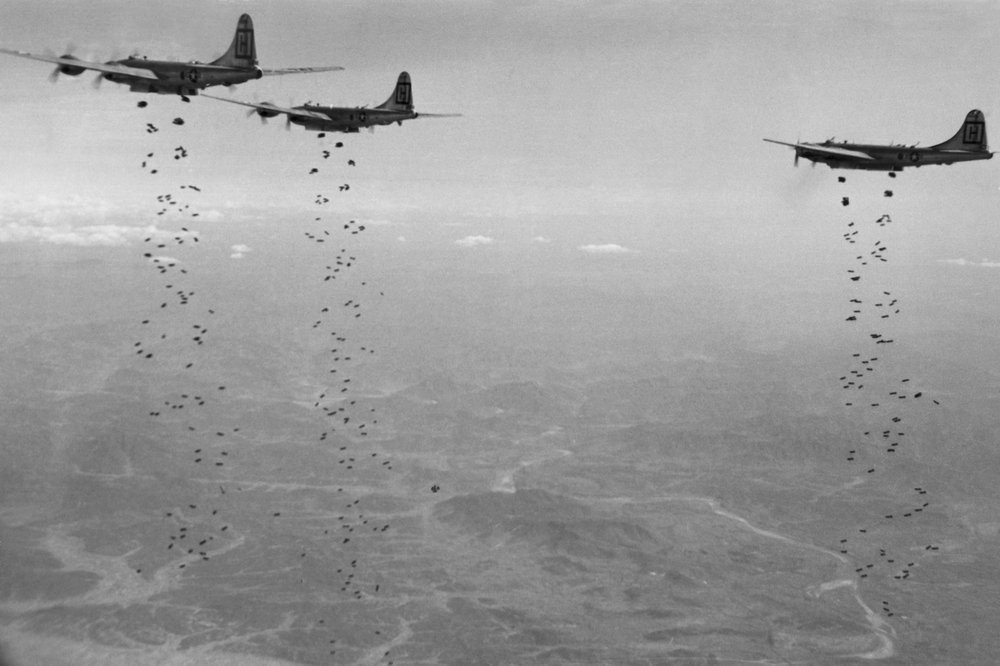
The US bombings.
The Soviet Army crossed the borders and attacked South Korea in June 1950. The UN denounced this as arbitrary and an invasion. Soon the UN sent their forces to help the South Korean army and counter the attack. Twenty-one countries of the United Nations eventually contributed to the UN force, with the United States providing around 90% of the military personnel. Russia, too, sent in more forces to help the North Korean attack. The South, backed by UN and US forces, was successful in defending and driving the invading forces out. Post this, they invaded the north. China too joined the war and backed its ideological ally- Russia and helped the North. The Chinese army invaded the South but was pushed back to positions around the 38th parallel from where it all started. The North had to face immense American bombing. Many civilians died. The backbone of the northern army was broken. This war which started in June 1950 ended in July 1953. Approximately 3 million people died in the Korean War, the majority of whom were civilians, making it perhaps the deadliest conflict of the Cold War era. Compounding this devastation for Korean civilians, virtually all of the major cities on the entire Korean Peninsula were destroyed as a result of the war. The May 1953 bombing of major North Korean dams threatened several million more North Koreans with starvation, although large-scale famine was averted with emergency aid provided by North Korea’s allies. North Korea was the country most devastated by the war, which resulted in the death of an estimated 12%–15% of the North Korean population (appox. 10 million), “a figure close to or surpassing the proportion of Soviet citizens killed in World War 2”, according to Charles K. Armstrong. Post-war, South Korea took comparatively less time to recover. As America was an ally, South Korea grew on the principles of Capitalism and Democracy while, North Korea, having the Soviet Union as an ally, moved ahead with Communism, and no sooner it turned into a dictatorship. People’s life there is miserable. No freedom of speech, expression. No press freedom. South Korea, on the other hand, is very democratic and is one of the fastest-growing economies. But South Korea is constantly at threat of war with the North. With the dictator of North Korea having now initiated many nuclear tests, even the US is under a threat of attack. North Korea was devastated to a great extent by the south and the US. The hatred of the North Koreans and the dictator himself towards these two is very evident.
Korea was a part of the Japanese empire between 1910 to 1945. The dynastic kingdom- Joseon Korea had signed the Japan-Korean Treaty in 1876 and formed a coalition with the Meiji government of Japan. Through the treaty, Japan had indirect control of Korea as it also gave protection to it, followed by the annexation of Korea by Japan in 1910. This annexation was arbitrary and without the consent of the Korean emperor.
As with any other colonization in the world, it too was a brutal one. People were exploited by the Japanese army. Industrialization was accelerated in Korea to benefit Japan. Soon they also attacked Korean history and culture. The environment too was exploited. Soon, the need for a freedom movement became palpable. Many rallies took place throughout the nation after the death of the Korean emperor as there was widespread suspicion that he was poisoned. The Japanese violently responded to these protests and subsequently suppressed the movement. An estimated 2 million people participated in the country-wide protests and about 7000 people were killed by the Japanese forces during the 1 year. According to the Korean reports, almost 50,000 people were arrested and 16000 wounded.
March 1 movement
Following the dropping of atomic bombs on Hiroshima and Nagasaki, Japan surrendered to the Allied forces on 15 August 1945, ending 35 years of Japanese occupation. American forces under General John R. Hodge arrived at the southern part of the Korean Peninsula on 8 September 1945, while the Soviet Army and some Korean Communists had stationed themselves in the northern part of the Korean Peninsula. U.S. Colonel Dean Rusk proposed to Chischakov, the Soviet military administrator of northern Korea, that Korea should be split at the 38th parallel. This proposal was made at an emergency meeting to determine post-war spheres of influence, which led to the division of Korea. After the surrender of Japan on 15 August 1945, the United States and the Soviet Union divided Korea along the 38th parallel into two zones of occupation. The Soviets (Russia and allies) administered the northern zone and the Americans administered the southern zone. Post World War 2, the Cold war began. It was an ideological war between Communism of Russia & allies and The Capitalism of the USA.
The US bombings.
The Soviet Army crossed the borders and attacked South Korea in June 1950. The UN denounced this as arbitrary and an invasion. Soon the UN sent their forces to help the South Korean army and counter the attack. Twenty-one countries of the United Nations eventually contributed to the UN force, with the United States providing around 90% of the military personnel. Russia, too, sent in more forces to help the North Korean attack. The South, backed by UN and US forces, was successful in defending and driving the invading forces out. Post this, they invaded the north. China too joined the war and backed its ideological ally- Russia and helped the North. The Chinese army invaded the South but was pushed back to positions around the 38th parallel from where it all started. The North had to face immense American bombing. Many civilians died. The backbone of the northern army was broken. This war which started in June 1950 ended in July 1953. Approximately 3 million people died in the Korean War, the majority of whom were civilians, making it perhaps the deadliest conflict of the Cold War era. Compounding this devastation for Korean civilians, virtually all of the major cities on the entire Korean Peninsula were destroyed as a result of the war. The May 1953 bombing of major North Korean dams threatened several million more North Koreans with starvation, although large-scale famine was averted with emergency aid provided by North Korea’s allies. North Korea was the country most devastated by the war, which resulted in the death of an estimated 12%–15% of the North Korean population (appox. 10 million), “a figure close to or surpassing the proportion of Soviet citizens killed in World War 2”, according to Charles K. Armstrong. Post-war, South Korea took comparatively less time to recover. As America was an ally, South Korea grew on the principles of Capitalism and Democracy while, North Korea, having the Soviet Union as an ally, moved ahead with Communism, and no sooner it turned into a dictatorship. People’s life there is miserable. No freedom of speech, expression. No press freedom. South Korea, on the other hand, is very democratic and is one of the fastest-growing economies. But South Korea is constantly at threat of war with the North. With the dictator of North Korea having now initiated many nuclear tests, even the US is under a threat of attack. North Korea was devastated to a great extent by the south and the US. The hatred of the North Koreans and the dictator himself towards these two is very evident.
One of the important part of your daily routine, which helps to do all other tasks of the day perfectly is a good sleep. Or we can say quality sleep. Every animals without any discrimination need sleep. It is as essential as food and water. Without sleep it becomes harder to concentrate on the tasks. It is basically essential to keep human being sane. Sleep is also important to functioning of brain. It also influences the communication of nerve cells. Many unwanted things your brain built during the day are removed while you are sleeping. Lack of sleep increases the chances of getting affected by different disorders.
how much a person sleep?
Need for sleep and pattern of sleep differ with age. A newborn sleeps almost 16-18 hours, while a grownup may sleep only for 8 hours. Even sleep pattern differs between individuals of same age group. But an average time is decided by surveys and studies. This not a prescription, but a result of a study. Average school student may need 9 hours sleep. Adults sleep for 7-8 hours. Older people normally sleep less. Children sleep very deep and their sleep will not get disturbed easily. But older people tend to get disturbed and awakened easily.
mechanism of sleep
Two things maintain your sleep mechanism. You may have heard of circadian rhythm. This directs different functions of the body like metabolism, body temperature, alertness, hormone release etc. This rhythm also controls sleep. This rhythm decides when you should be awake and when you should sleep. This rhythm makes you sleepy at night and makes you alert during the day time. This circadian rhythm gets synchronized with your surrounding environment. This may include your habits or weather around you like temperature or intensity of light. But they will work in the absence of these little information.
The other thing is the homeostasis. This keeps a track of your need of sleep. This works as a reminder telling your body to sleep at a certain time. This is the thing that maintains hoe intense your sleep is going to be. If you are deprived of sleep, this makes you sleep longer when you get to sleep.
There are many factors that influence your sleep mechanism. The medications if you are on any, your medical condition, The place where you sleep and your food habits. Exposure to light makes it difficult to sleep because some special cells in the eyes process the light and instructs the brain whether it is daytime or night. The Jet lag people face after a long flight is because of the disturbances in the circadian rhythm. people face problems when there is imbalance between the body clock and the actual clock.
some tips to sleep well
Try maximum to be in sync with the natural clock.
Try to sleep and getup everyday at same time.
Take care about your food habit and eat healthy.
Try to make your room completely dark while sleeping but be in bright light in the day time when you are fully awake.
Stay away from mobile or television at least 1 hour prior to your sleep.
Include exercise in your daily routine.
Avoid caffeine or nicotine as the sleep time is approaching near to you.
Be as much stress-less as you can.
Keep your room quiet.
a good sleep is everyone’s need and don’t allow your busy life to take a toll on your sleep. Sleep well and be healthy and be productive.
One of the important part of your daily routine, which helps to do all other tasks of the day perfectly is a good sleep. Or we can say quality sleep. Every animals without any discrimination need sleep. It is as essential as food and water. Without sleep it becomes harder to concentrate on the tasks. It is basically essential to keep human being sane. Sleep is also important to functioning of brain. It also influences the communication of nerve cells. Many unwanted things your brain built during the day are removed while you are sleeping. Lack of sleep increases the chances of getting affected by different disorders.
how much a person sleep?
Need for sleep and pattern of sleep differ with age. A newborn sleeps almost 16-18 hours, while a grownup may sleep only for 8 hours. Even sleep pattern differs between individuals of same age group. But an average time is decided by surveys and studies. This not a prescription, but a result of a study. Average school student may need 9 hours sleep. Adults sleep for 7-8 hours. Older people normally sleep less. Children sleep very deep and their sleep will not get disturbed easily. But older people tend to get disturbed and awakened easily.
mechanism of sleep
Two things maintain your sleep mechanism. You may have heard of circadian rhythm. This directs different functions of the body like metabolism, body temperature, alertness, hormone release etc. This rhythm also controls sleep. This rhythm decides when you should be awake and when you should sleep. This rhythm makes you sleepy at night and makes you alert during the day time. This circadian rhythm gets synchronized with your surrounding environment. This may include your habits or weather around you like temperature or intensity of light. But they will work in the absence of these little information.
The other thing is the homeostasis. This keeps a track of your need of sleep. This works as a reminder telling your body to sleep at a certain time. This is the thing that maintains hoe intense your sleep is going to be. If you are deprived of sleep, this makes you sleep longer when you get to sleep.
There are many factors that influence your sleep mechanism. The medications if you are on any, your medical condition, The place where you sleep and your food habits. Exposure to light makes it difficult to sleep because some special cells in the eyes process the light and instructs the brain whether it is daytime or night. The Jet lag people face after a long flight is because of the disturbances in the circadian rhythm. people face problems when there is imbalance between the body clock and the actual clock.
some tips to sleep well
Try maximum to be in sync with the natural clock.
Try to sleep and getup everyday at same time.
Take care about your food habit and eat healthy.
Try to make your room completely dark while sleeping but be in bright light in the day time when you are fully awake.
Stay away from mobile or television at least 1 hour prior to your sleep.
Include exercise in your daily routine.
Avoid caffeine or nicotine as the sleep time is approaching near to you.
Be as much stress-less as you can.
Keep your room quiet.
a good sleep is everyone’s need and don’t allow your busy life to take a toll on your sleep. Sleep well and be healthy and be productive.
We keep hearing the term ‘shares’ or ‘stock’ nowadays as it is a common topic of discussion. However, it is essential to know the different types of shares available in the market to be aware of our options as investors and also to determine which type suits the objectives of the investor better.
According to section 86 of the companies act, a company can issue only two types of shares: (a) Preference shares (b) Equity shares
PREFERENCE SHARES
As the name suggests, a preference share gives a preferential right to its shareholder, to get a fixed rate of dividend over other types of shares. This implies that preference shareholders are entitled to receive their dividends BEFORE any dividend is paid to equity shareholders from the profits.
Preference shareholders are also entitled to return of share capital before equity shareholders when the company is winding up. This implies, that after the company has paid off its debts to outsiders, the surplus and remaining assets are used to return the share capital to preference shareholders before equity shareholders. The remaining assets and surplus, if any, is distributed among the equity shareholders.
However, Preference shareholders don’t get to enjoy voting rights. They are only allowed to vote on
a) Any resolution affecting their rights
b) All resolutions when dividend has not been paid to them for the time period mentioned in the Act.
Types of Preference shares
Different kinds of shares have different rights associated with them.
Cumulative Preference Shares– Dividends not declared and paid in the current year (due to loss or inadequate profit), is accumulated and can be paid out of profits of subsequent years before dividend is paid to equity shareholders. Preference shares are always cumulative, unless the contrary is expressly stated in the Articles of Association.
Non-Cumulative Preference Shares- In the case of non-cumulative preference shares if dividend is not paid in any particular year, it lapses. It does not accumulate. Hence, it is not paid in the subsequent years.
Participating Preference Shares- In addition to the fixed rate of dividend, these shares carry a further right to participate with the equity shareholders in the surplus profits which remain after paying a certain rate of dividend to equity shareholders. Thus, they get two kinds of dividend, one fixed rate and the other changing every year depending on the level of excess profits. Similarly, such preference shares have a right to participate in the surplus assets of the company on its winding up after paying in full the preference and equity share capital.
Non-Participating Preference Shares– These shares are entitled to only a fixed rate of dividend. They do not participate either in the surplus or in the surplus assets on winding up after paying in full the preference and equity share capital. Preference shares are presumed to be non-participating unless specifically stated otherwise in the articles.
Convertible Preference Shares– These shares can be converted into equity shares within a specified time period.
Non-Convertible Preference Shares- These shares cannot be converted into equity shares. Preference shares are presumed to be non-convertible unless specifically stated otherwise in the articles.
Redeemable Preference Shares- Capital raised by means of these shares can be returned after a specified period or at any time at its options after giving notice as per terms of issue. These shares can be redeemed either out of profits or out of the proceeds of a fresh issue of shares.
Irredeemable Preference Shares- Any preference share that cannot be redeemed during the lifetime of the company is known as irredeemable preference Shares. Such shares are not offered anymore.
EQUITY SHARES
Equity shareholders are entitled to get dividend only after the fixed rate of dividend is paid to preference shareholders. Similarly, at the time of winding up of the company, only after returning preference share capital in full, and if there is any surplus, it will be paid to equity shareholders.
The rate of dividend is not fixed as it varies from year to year and depends on the profit earned every year. Higher the profits, higher the dividends of equity shareholders. However, in case of loss or inadequate profits, equity shareholders often do not get dividends for that year. Moreover, even in case of profits, the company can choose to retain the surplus in the business instead of paying dividends to equity shareholders. Hence, dividends for equity shareholders are not assured.
However, equity shareholders are considered as the owners of the company and hence, get voting rights on all resolutions.
To conclude, equity shares are quite risky since dividends and return of capital when the company is winding up is not assured. However, if the company is reputed and does well, equity shareholders dividends are usually more than fixed dividends of preference shareholders. Moreover, equity shareholders enjoy voting rights and are more involved in the management of the company as they are the owners.
On the other hand, for investors looking for fixed rate of return (dividends) and assured return of capital invested, preference shares should be a good investment.











 Eduindex
You must be logged in to post a comment.