NATIONAL EDUCATION POLICY 2021- SALIENT FEATURES

BY DAKSHITA NAITHANI

Who created NEP (National Education Policy)?

The challenges that would occur in the Indian education system – from school to college to work – were examined by a panel of experts chaired by former ISRO chairman K Kasturirangan. 

NEP- National Education Policy

The “New Education Policy 2020-2021” was recently adopted by the Central Government Cabinet Committee. 2 crore schoolchildren would be reintegrated into the mainstream under the NEP 2020. With 12 years of schooling and 3 years of Anganwadi/Preschool, a new 5 + 3 + 3 + 4 curriculum was launched.

Anganwadi will provide pre-school education to children for the first three years. The students will then be educated in first and second grades for the following two years. First five years of study will be completed by a new curriculum which will be developed. Activity-based learning will be the main focus. It will be available to youngsters aged three to eight. 

Preparatory stage – Classes three through five will be covered at this time. Children will be taught science, mathematics, the arts, and other subjects through experiments during this period. Children between the ages of 8 to 11 will be covered.

 Middle Stage – These subject-based workshops will include grades 6-8, as well as students aged 11-14. Courses in skill development will begin in sixth grade.

The secondary stage- From ninth through twelfth grade, students will be divided into two groups for intense study of the topics. There will also be the option of picking and choosing subjects. Previously, this system did not exist in government pre-schools. From first grade through tenth grade, there was a general education programme. 

With no clear distinction between academic streams, schools will focus a greater emphasis on extracurricular activities, professional development, reading, and numeracy. In accordance with the new policy 2020, vocational education will begin in the sixth grade. It will be mandatory to teach in the mother tongue / regional language till the fifth grade. Improvement of evaluation and tracking progress of students to accomplish learning goals, among other things, is covered with a full 360-degree progress card.

Other important changes in school education – Salient Features of #NEP2020

According to Dr. Kasturirangan, vocational education, led the committee created to approve the new education policy, and now the kid will get vocational education and skills beginning in the sixth grade. Internships will be available on a local level as well. Vocational education and skill development will be prioritised.

There will be no job losses as a result of the new education approach. The youngsters will receive the essential education in school for professional environment. The 10th and 12th grade Board examinations will be straightforward. The Board examinations for classes 10th and 12th will undergo modifications.

Exams conducted by the council will be undervalued. There are a lot of good ideas in this article. Exams, for example, should be given twice a year and divided into two portions, one objective and the other explanatory. When it comes to council examinations, students are always under pressure and rely on training to improve their grades. According to the education strategy, various councils will create a realistic model for board exams in the near future. Exams and units at the yearly and quarterly levels, for instance.

Changes will be made to children’s report cards, which will be used to evaluate their school achievement and performance. They will be graded on three different levels. The first will be a student, the second will be a classmate, and the third will be his teacher.

In 2019, the rough draft of NEP was introduced, and it received much praise as well as harsh criticism. The idea to declare Hindi one of the essential languages was quickly shot down. After that, the document was made public, and individuals and other stakeholders were asked to submit policy ideas for improvement.

Changes Made in Higher Education

50% Increase in GER

By 2035, the NEP intends to raise the existing GER (Gross Enrolment Ratio) from 26.3 – 50 percent. 3.5 Crore additional places in higher education would be added.

Interdisciplinary general education

The strategy aims to provide a complete, multidisciplinary, and broad-based college education with flexible plans, additional topic options, a greater emphasis on vocational education, and the ability to enrol and exit the programme with a recognised degree. For example, Certificate after 1 year, Advanced Diploma after 2 years, Degree after 3 years, License for research after 4 years.

India’s educational system is at a critical crossroads. On the one hand, it is expected to replace an out-of-date paradigm with the NEP 2020. New digital learning platforms and creative teaching approaches, on the other hand, are driving it to global standards and setting new milestones.

Any country’s education is judged by the quality of its human capital. A well-educated population with a high literacy rate is better prepared to take on social, economic, and political responsibilities responsibly while maintaining a broad understanding of global concerns. This is the goal embodied in the NEP 2020, which, if implemented well, would make education more comprehensive and enjoyable.

With the announcement to qualitatively improve 15,000 schools across India to adopt NEP in the Union Budget 2021-22 and these will act as role models for other schools to emulate. To maximise the benefits of the NEP, the education sector must harness the powers of technology in the future. This will result in a rising curve in the standard of education in India.

As we emerge from the coronavirus epidemic and begin a new academic year, it is critical to recognise the potential for change in Indian education as a consequence of these 3 forces: the National Education Policy (NEP) and the accompanying new platforms and teaching and learning methodologies.

.

CREATING A ROUTINE IN COVID: WHY IS IT SO IMPORTANT?

White Notebook With Black Pen

Owing the advent of Covid-19 pandemic last year, the entire world has turned upside—down. Almost everyone has been impacted by the pandemic after being forced to isolate and pursue their lives within the four walls of their house, till this trouble dies.

Unfortunately, not everyone has been able to deal with these times of crises in a healthy manner. With the entire foundation of everyone’s lives being shaken, the structure has collapsed; the routines have been destroyed. There is constant state of confusion that prevails in the minds of people as they have to constantly worry about what to do next, while trying to stay as productive as possible  and not waste away their days.

Here comes the role of routines; as humans thrive off of routines, forming an easy-to-follow routine can really help those feeling miserable in such confusing times.

Routines can be efficiently incorporated in our lives in pandemic in a number of ways:-

CREATE A LIST

As our lives have been frazzled with a constant need to answer the question: “what to do next?” , forming a list of goals that can be achieved smoothly in a day helps us feel more fulfilled and productive. This ensures that when we go to bed at night, we sleep with a feeling of accomplishment.

STAY HEALTHY

Whether it is to lose weight or a means of escapism from being cooped up within your house, exercising can provide us ease and peace as exercising produces endorphins or the ‘happy hormones’ in your body. Also, try to have meals 3 times a day in order to prevent binging on unhealthy snacks.

EXPAND YOUR HORIZONS

With a major portion of our commute time to work/school being cut down, we surprisingly have a lot of time on our hands. Instead of wasting away the precious time, try to learn something new. It can be anything; picking up your once favourite past time of playing piano or learning a new language that could really help develop your CV.

GET ADEQUATE SLEEP

A healthy sleep of 7 to 8 hours is necessary for our bodies to perform our best in our routinely tasks and stay on top of our game. However, with the beginning of the pandemic, people have really messed up their sleep schedules, which is quite unhealthy for them in the long run.

Hence, make sure to go to bed at the same time every night and get a good night’s rest to stay refreshed.

#5 TAKE BREAKS

 While we set targets that have to be achieved everyday in order to be as active as possible, it quite essential to take short breaks between work. Play with your dog or try to make a cup of coffee for yourself. These breaks ensure a higher productivity in the various tasks that we execute throughout the day and at the same time, really enjoy the things that we do so life does not appear monotonous to us.

So, make sure to stay active but at the same time, take care of yourself!  

Story of MBA Chaiwala

After reading the title you must be laughing at it but it the story of an entrepreneur or I could say a success entrepreneur who was struggling with himself and came up with this idea which proved a billion dollar deal to him. I know you would be interested to know the name and his journey but she journey is not always easy. Like there is a saying that life is not a bed of roses and that is applied here.

As I was going with my YouTube videos I saw a video of Prafull Billore yeah that’s the name and the thing which attracted me was the name MBA Chaiwala. It’s sound very funny but when I watched the video and the journey of him I was inspired. Like what a deal and what an inspiration one could get from him.

He was planning and decided to MBA like any other individual would go with giving the entrance exams and clearing it with good marks. But the idea was struck into his mind if starting his own business and then opened a roadside thela in Ahemdabad along with the utensils of chai that he bought in 45 days. He dropped from his college and started his business with his job also. He worked at a restaurant where he served burgers and that’s where he got the inspiration of his own food business.

The name was thought to be unique as in India customers come if the name is unique only. So it was named as Mr Billore A’bad Chaiwala. At chai point customers come ,have a cup of tea and forgets about their worries for sometime. Chai is a stress buster for us indeed.

Now he is well known name for the people and the network has become stronger . I’m sure that after reading the story of this startup you must also be thinking about it. Hope you will like reading it and I will try to bring more stories like this for my readers. Have a great day.

Thank you!!

World Sanskrit day

The day which revives the language Sanskrit. Today is World Sanskrit day which is also known as vishwa sanskrita dinam. Sanskrit is not only just a language but a tradition of India. It is the oldest languages in the world. The mother to all languages which lost its importance in this modern world. Sanskrit language is the soul of India and considered as one of the most sacred language.This year the event is celebrated on August 22, 2021.

Sanskrit is not only the language to be spoken but it has a religious importance too. The Vedas has Sanskrit shlok, epic books such as the Ramayan and the Mahabharata are written and scripted in Sanskrit. Most of the puranas of Hindu tradition are having detail written in Sanskrit language. Hinduism contains majority shlok in Sanskrit language only which have a perfect and divine meaning. It is celebrated on the shravani purnima in the month of shravan according to Hindu calendar. Sanskrit language is considered to be the language of gods and sages.

It is the official language of Uttrakhand and different programs are being organised to promote the language. It involves lectures which must be included in the normal lives to be connected with the nature. Sanskrit week is celebrated at national level to know and revive our mother language. Different types of competition like kavi sammelan, debates, poetry are performed in Sanskrit.

Not only at national but the day is celebrated internationally also and people are recognising the concept and tradition of Sanskrit in modern life. It also emproves the pronouncing ability of the individual. In yoga Sanskrit shloks are recited so as to understand the concept and connect with the power of it. Even Sanskrit teachers are hired at higher posts to teach Sanskrit as a language to their kids.

As an Indian we should try to know and promote it to our future generations too. The language can be tough yet beautiful.The language is spoken by not reading the words but by learning and understanding it by heart. I hope this information was useful for you.

Hope you will like it. Thank you!!

NEW TEHRI: UTTARAKHAND

NEW TEHRI
New Tehri is a modern town spread over an altitude from 1,550 mts. to 1,950 mts. above sea level, overlooking the gigantic lake and the Tehri Dam. The ruins of Old Tehri lie under water today. The newly established township is the district headquarters of Tehri Garhwal, a modern and well planned town, only 11 kms. from Chamba & 24 kms from Old Tehri.
SIGHTSEEING

TEHRI DAM
Tehri Dam is one of the world’s largest hydro electric projects harnessing waters of two important rivers of the Himalayas namely Bhagirathi and Bhilangana
DEVPRAYAG
Situated at the confluence of the Alaknanda and the Bhagirathi rivers, the town of Devprayag lies at an altitude of 472 ints, and about 64 kms away from New Tehri. Near the town there are two suspension bridges one over the Bhagirathi and the other over the Alaknanda. Devprayag is one of the five sacred Prayags (confluences) of the Alaknanda. Tradition has it that the town is named after Deosharma, a sage, which led a life of penance here and succeeded in having a glimpse of God.
CHAMBA
Chamba happens to be a focal point, being located at the junction of roads leading from Mussoorie, Rishikesh, Tehri and New Tehri, 60 kms. from Mussoorie and 48 kms. from Narendra Nagar on the road to Gangotri. Chamba is a township lying high at an altitude of 1676 mts., offering a splendid view of the snow capped Himalayas and the serene Bhagirathi valley. The Chamba-Mussoorie fruit belt is also famous for its delicious apples.
KANATAL
Kanatal is a hamlet built around numerous hills, a locale which personifies the romantic aura of Tehri district located on the Chamba-Mussoorie highway 35 kms from Tehri Garhwal. With a spectacular view of the snow-covered hills and green forests, Kanatal is situated nearly 300 kms. from Delhi at an altitude of over 8500 feet (2590 metres). The natural beauty of Kanatal allures many tourists every year.
SURKANDA DEVI
Surkanda Devi is a Hindu temple situated close to the small resort hamlet of Dhanaulti in Tehri District. It lies at an altitude of about 2,757 meters, or 9976 ft. and is close to nearby hill stations of Dhanaulti (8 kms) and Chamba (22 kms.) and walking distance of approx 3 kms. from Kaddukhal, the place where vehicles are parked. It is surrounded by dense forests and affords a scenic view of the surrounding region including the Himalayas to the North. The Ganga Dussehra festival is celebrated every year between May and June and attracts many tourists.
CHANDRABADNI
Chandrabadni is a mountain (2.277 ents. above sea level). On the border of Devprayag and Pratapnagar is the well known temple of Chandrabadni Devi, at the top of the mountain about 10 kms. north of Kandi Khal (on the Devprayag Kirti Nagar road). The legend says that the torso of Sati fell here and her weapons got scattered all around the place. Thus, even today a huge number of iron Trishuls (Tridents) and some old statues can be seen lying around the revered temple of Chandrabadni.
Chandrabadni commands a beautiful view of the Sirkanda, Kedarnath and Badrinath peaks. The temple is very small and contains a Shri-Yantra carved out on a flat stone instead of an idol. Traditionally, a cloth canopy is tied to the ceiling over this Shri-Yantra once a year by a Brahmin priest who is blindfolded. Road distance from Tehri Dam to Maa Chandrabadni Temple is 86 kms.

ALSO VISIT: Narender Nagar, Sem Mukhem, Budha Kedar and Kunjapuri.

DOLPHINS 🐬

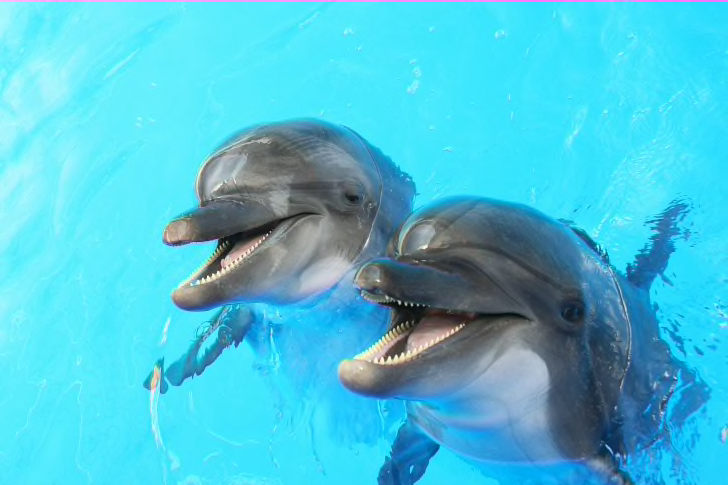
Dolphins are known for being smart, playful creatures that can learn to perform impressive tricks. But you might not know that dolphins are also champion nappers who have helped the U.S. Navy protect nuclear warheads.

DOLPHINS ARE EXCELLENT NAPPERS.

Since dolphins can’t breathe underwater, they need to swim up to the ocean’s surface to get air. So how do they sleep without drowning? Essentially, dolphins are champion power nappers. Rather than sleep for several hours at a time, they rest one hemisphere  of their brain for 15 to 20 minutes at a time, and they take these “naps” several times each day. By resting one hemisphere of their brain at a time, dolphins can continue swimming, breathing, and watching for predators 24/7.

DOLPHINS COMMUNICATE WITH CLICKS AND WHISTLES

Dolphins communicate with one another underwater by making a variety of vocalizations. To find prey and navigate the ocean, they make clicking sounds, and they “speak” to other dolphins by whistling. Dolphins also produce loud burst-pulse sounds when they feel excited or aggressive, such as when they need to scare off a nearby shark. Some female dolphins also produce a burst-pulse to reprimand their offspring, called calves, for bad behavior.

BUT DOLPHIN LANGUAGE REMAINS A MYSTERY.

Although marine scientists have studied and recorded dolphin vocalizations for decades, many aspects of the animals’ language and how they communicate are still unknown. Scientists have not yet broken down the individual units  of dolphin sounds, and they’re still searching for a Rosetta Stone that links the animals’ vocalizations to their behavior. By using new technologies—including algorithms and high-frequency recorders that work underwater—scientists hope to finally unlock the mystery of the dolphin language.

DOLPHINS USE ECHOLOCATION TO NAVIGATE.

To know where they are in relation to other objects and animals, dolphins use echolocation (a.k.a. biological sonar). After emitting a series of high-pitched clicks, they listen for the echoes to bounce off their surroundings. Based on these echoes, dolphins can judge where they are in space and determine the size and shape of nearby objects. Besides helping dolphins evade predators, echolocation allows them to trap, catch, and eat fish and squid.

DOLPHINS MAKE FRIENDS WITH OTHER DOLPHINS.

Dolphins are highly social, and scientists are still discovering fascinating details about how the aquatic mammals socialize with one another. In 2015, scientists at Florida Atlantic University’s Harbor Branch Oceanographic Institute published research in the Marine Mammal Science journal about the social networks of dolphins. After spending over six years tracking 200 bottlenose dolphins in Florida’s Indian River Lagoon, the scientists discovered that dolphins have friends. Instead of spending equal time with the dolphins around them, the animals actually segregate themselves into friend groups. Just like humans, dolphins seem to prefer the company of certain peers more than others.

EACH DOLPHIN RESPONDS TO ITS OWN NAME.

Dolphins aren’t swimming around with name tags, but every dolphin has its own unique whistle. Scientists believe that dolphins use these signature whistles  for life, and female dolphins may even teach their calves their whistles before they’re born. Dolphins use their signature whistles to call out to one another and may be able to remember other dolphins’ whistles after decades apart.

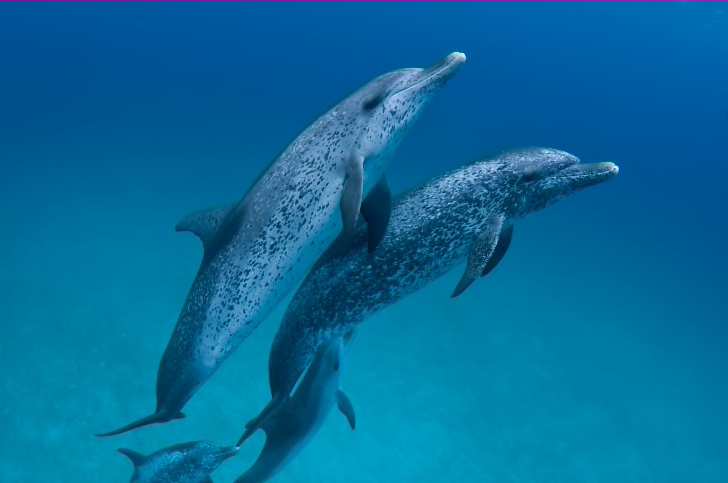
THERE ARE 44 DIFFERENT DOLPHIN SPECIES.

Although bottlenose dolphins are the most well-known and recognizable, there are 43 other  dolphin species. Most species live in temperate and tropical oceans, but a few live in colder oceans or rivers. Depending on their species, dolphins can vary considerably in their physical attributes and behavior. For example, the largest dolphin species, the Orca (also called Killer Whale), can be 30 feet long—10 times longer than the smallest dolphins.

DOLPHINS DON’T USE THEIR TEETH TO CHEW FOOD.

Dolphins have teeth, but they don’t use their chompers to chew food. Instead, dolphins use their teeth to catch prey (fish, crustaceans, and squid) and swallow it whole. Since they forgo-chewing , digestion occurs in their stomach—or, more precisely, in part of their stomach. Dolphins have multiple stomach chambers, one of which is devoted to digestion, while the other chambers store food before it’s digested.

DOLPHINS TYPICALLY GIVE BIRTH TO JUST ONE CALF.

Depending on their species, most female dolphins (called cows) carry their babies for nine to 17 months before giving birth to a calf. Interestingly, calves are born tail first, rather than head first, so they don’t drown during the birthing process. After nursing for one to two years, a calf typically stays with its mother for the next one to seven years, before mating and having its own calves.

 A DOLPHIN’S SKIN CAN BE REGENERATED EVERY TWO HOURS.

If you’ve ever swum with dolphins, you know their skin looks and feels super smooth and sleek. There’s a reason for that—a dolphin’s epidermis (outer layer of skin) can be sloughed off and replaced with new skin cells as often as every two hours. Because their skin regenerates so often, it stays smooth and, as most scientists believe, reduces drag as they swim.

DOLPHINS ARE NOT THE SAME AS PORPOISES.

To the untrained eye, dolphins and porpoises look nearly identical, and many people mistakenly think that porpoises are a type of dolphin. But the two species belong to completely different families and differ in their physical attributes. So how can you tell them apart? Dolphins, which are usually bigger than porpoises, typically have longer breaks  and curved dorsal fins. Porpoises, on the other hand, have more triangular dorsal fins as well as spade-shaped (rather than conical) teeth.

HUNTING, OVERFISHING, AND RISING OCEAN TEMPERATURES THREATEN DOLPHINS.

Some dolphin species are endangered or functionally extinct (like China’s baiji dolphin) due to hunting, overfishing, and pollution. Although dolphin meat is high in mercury, the animals are still hunted for their meat and eaten in parts of Japan and the Faroe Islands of Denmark. Overfishing means that dolphins’ food sources are shrinking, and some dolphins get caught up in fishing nets and die. Additionally, climate change and rising ocean temperatures are driving some fish and squid away from their natural habitats, putting dolphins’ main food source at risk.

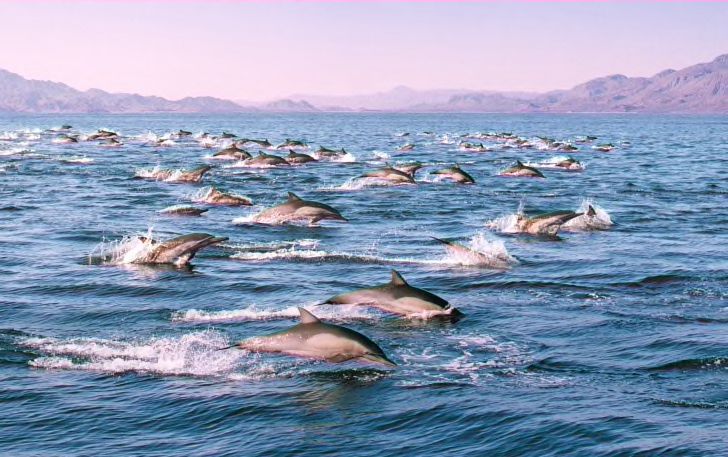
A SUPERPOD CAN CONSIST OF MORE THAN 1000 DOLPHINS.

Dolphins live in groups, called pods, that typically contain dozens or hundreds of dolphins. By swimming in a pod, dolphins work together to hunt prey, evade predators, and care for  sick or injured members. But different pods can also merge, forming a superpod of more than 1000 dolphins. Superpods are typically temporary and occur in parts of the ocean with plentiful food (and less competition for tasty squid).

THE OLDEST DOLPHIN IN CAPTIVITY LIVED TO THE AGE OF 61.

Dolphin lifespan varies greatly by species. Most dolphins in the wild live for a few decades, while those in captivity have a drastically reduced lifespan and may live for only a few years. So it’s all the more shocking that the oldest dolphin in captivity lived to be a sexagenarian. Nellie, a bottlenose dolphin who lived in a marine entertainment park  in Florida, was born in 1953. She appeared on TV shows and commercials and performed tricks for the park’s attendees before passing away in 2014.

DOCTORINE OF HOLDING OUT & DOCTRINE OF FEEDING THE GRANT BY ESTOPPLE

DOCTRINE OF HOLDING OUT
General rule regarding the transfer of property is that no one can transfer a better title than what he himself possesses. However, Section 41 of the Transfer of Property Act, 1882 makes an exception to this rule. Thus, transfer made by the ostensible owner of the property is valid subject to condition specified in Section 41. This Section is a statutory application of the law of estoppel. An ostensible owner is one who has all the indicia of ownership without being the real owner.
Transfer by ostensible owner [Section 41]: Where, with the consent, express or implied, of the persons interested in immovable property, a person is the ostensible owner of such property and transfers the same for consideration, the transfer shall not be voidable on the ground that the transferor was not authorized to make it, provided that the transferee, after taking reasonable care to ascertain that the transferor had power to make the transfer, has acted in good faith
In simple words, if sale is made by ostensible owner for a consideration, then such sale is valid if transferee has taken reasonable care to see that transferor has power to make such sale.
Essential Conditions:
(1) Transferor is the ostensible owner.
(2) He is so by the consent, express or implied, of the real owner. 
(3) Transfer is for consideration, and
(4) Transferee has acted in good faith taking reasonable care to ascertain that the transferor had power to transfer.
Examples:
(a) A made a gift of property to B but continued in possession of the gifted property. He purported to
exercise a power of revocation and then transferred the property to the defendant. The gift, however, was not revocable as it was an unconditional gift. B seeks to recover possession from the defendant. The defendant invoked protection under Section 41. In the given example, the donor is not an “ostensible owner” holding the property with the consent of the real owner. The defendant cannot, therefore, invoke the protection of Section 41.
(2) The manager of a point Hindu family consisting of some minor members alienated the ancestral house to P without any necessity and the alienee transferred it to the defendants. The minors challenged the alienation. The defendants sought protection under Section 41.
Here Section 41 has no application for “P was not the ostensible owner of the ancestral family house with the consent, express or implied, of the persons interested in the said ancestral house in as much as the plaintiff, had an interest in the said house, did not and could not by reason of the disability of infancy give their consent”.

DOCTRINE OF FEEDING THE GRANT BY ESTOPPLE
Transfer by unauthorized person who subsequently acquires (Section 43): Where, a person fraudulently or erroneously represents that he is authorized to transfer certain immovable property and professes to transfer such property for consideration, such transfer shall, at the option of the transferee, operate on any interest which the transferor may acquire in such property at any time during which the contract of transfer subsists.
In simple words. If a transferor transfer the property of other which is is not entitled, then subsequently when he acquires the property, he will have to transfer the property to the transferee
.
Example: A, a Hindu who has separated from his father B, sells to C three fields, X Y ,Z representing that A is authorized to transfer the same. Of these fields Z does not belong to A, it having been retained by B on the partition, but on B’s dying A as heir obtains Z. C, not having rescinded the contract of sale, may require A to deliver Z to him.

DOCTORINE OF HOLDING OUT & DOCTRINE OF FEEDING THE GRANT BY ESTOPPLE

DOCTRINE OF HOLDING OUT
General rule regarding the transfer of property is that no one can transfer a better title than what he himself possesses. However, Section 41 of the Transfer of Property Act, 1882 makes an exception to this rule. Thus, transfer made by the ostensible owner of the property is valid subject to condition specified in Section 41. This Section is a statutory application of the law of estoppel. An ostensible owner is one who has all the indicia of ownership without being the real owner.
Transfer by ostensible owner [Section 41]: Where, with the consent, express or implied, of the persons interested in immovable property, a person is the ostensible owner of such property and transfers the same for consideration, the transfer shall not be voidable on the ground that the transferor was not authorized to make it, provided that the transferee, after taking reasonable care to ascertain that the transferor had power to make the transfer, has acted in good faith
In simple words, if sale is made by ostensible owner for a consideration, then such sale is valid if transferee has taken reasonable care to see that transferor has power to make such sale.
Essential Conditions:
(1) Transferor is the ostensible owner.
(2) He is so by the consent, express or implied, of the real owner. 
(3) Transfer is for consideration, and
(4) Transferee has acted in good faith taking reasonable care to ascertain that the transferor had power to transfer.
Examples:
(a) A made a gift of property to B but continued in possession of the gifted property. He purported to
exercise a power of revocation and then transferred the property to the defendant. The gift, however, was not revocable as it was an unconditional gift. B seeks to recover possession from the defendant. The defendant invoked protection under Section 41. In the given example, the donor is not an “ostensible owner” holding the property with the consent of the real owner. The defendant cannot, therefore, invoke the protection of Section 41.
(2) The manager of a point Hindu family consisting of some minor members alienated the ancestral house to P without any necessity and the alienee transferred it to the defendants. The minors challenged the alienation. The defendants sought protection under Section 41.
Here Section 41 has no application for “P was not the ostensible owner of the ancestral family house with the consent, express or implied, of the persons interested in the said ancestral house in as much as the plaintiff, had an interest in the said house, did not and could not by reason of the disability of infancy give their consent”.

DOCTRINE OF FEEDING THE GRANT BY ESTOPPLE
Transfer by unauthorized person who subsequently acquires (Section 43): Where, a person fraudulently or erroneously represents that he is authorized to transfer certain immovable property and professes to transfer such property for consideration, such transfer shall, at the option of the transferee, operate on any interest which the transferor may acquire in such property at any time during which the contract of transfer subsists.
In simple words. If a transferor transfer the property of other which is is not entitled, then subsequently when he acquires the property, he will have to transfer the property to the transferee
.
Example: A, a Hindu who has separated from his father B, sells to C three fields, X Y ,Z representing that A is authorized to transfer the same. Of these fields Z does not belong to A, it having been retained by B on the partition, but on B’s dying A as heir obtains Z. C, not having rescinded the contract of sale, may require A to deliver Z to him.

WHAT IS GIFT UNDER TRANSFER OF PROPERTY ACT, 1882

“Gift” is the transfer of certain existing movable or immovable property made voluntarily and without consideration by one person called the donor, to another called the donee and accepted by or on
behalf of the donee. Such acceptance must be made during the life time of the donor and while he is still capable of giving. If the donee dies before acceptance, the gift is void.
Essentials:
(1) There must be a transfer of ownership.
(2) The subject matter of gift must be a certain existing movable or immovable property.
(3) The transfer must me made voluntarily.
(4) It must be done without consideration.
(5) There must be acceptance by or on behalf of the donee, and such acceptance must be made during the lifetime of the donor and while he is capable of giving.
The essence of a gift is that it is a gratuitous transfer.
According to Section 123, a gift of immovable property must be made by a registered instrument signed by or on behalf of the donor and attested by at least two witnesses. A gift of movable property may be made by a registered instrument or by delivery of property.
Revocation of gift: A revocable gift is one which may be revoked by the donor at any time. It is to be noted that a gift cannot be revoked at the will and pleasure of the grantor. If the revocation of gift depends upon the mere will or pleasure of the donor, then such a gift is void. But on the other hand, if the condition is one which does not depend on the will or pleasure of the donor, the gift can be revoked on the happening of such condition.
Example
(a) A gives a field to B, reserving to himself, with B ‘s assent, the rights to take back the field in case B and his descendents die before A, B dies without descendents during A’s lifetime. A may take back the field.
(b) A gives a lakh of rupees to B, reserving to himself with B’s assent the right to take  at leisure 10,000 rupees out of one lakh. The gift holds goods as to 90,000 rupees but is void as to 10,000 rupees which continues to belong to A.

Case Study
(1)It was held by the Privy Council, that while registration is a necessary solemnity for the enforcement of a gift of immovable property, it does not suspend the gift until registration actually takes place, when the instrument of gift has been handed over by the donor to the donee and accepted by him, the former has done everything in his power to complete the donation and to make it effective and if it is presented by a person having necessary interest within the prescribed period the Registrar must register it. Neither death nor the express revocation by the donor, is a ground for refusing registration, provided other conditions are complied with . (Kalyan Sundaram Pillai vs. Karuppa Mopanar AIR 1927 PC 421)
(2)Delay in registration of a gift does not postpone its operation Section 123, Transler of Property Act, 1882 merely requires that donor should have signed the deed of gift. Hence a gift deed can be registered even if the donor does not agree to its registration. (Kalyas Sandarum Pillai Karuppa Mopanar AIR 1927 PC 42); (Venkats Rana Reddy Pilian Raina Reddy AIR 1973 Mad. 282).

Difference between Private Company, Public Company and One Person Company

PRIVATE COMPANIES 

1.Private company requires minimum number of two members and maximum number of 200 members.
2.The liability of each member or shareholders is limited. It means individual assets of the shareholders are not at risk.
3.The company keeps on existing in the eyes of law even in the case of death, insolvency, the bankruptcy of any of its members.
4.The maintenance of index of members is not necessary in case the number of members of the company is less than fifty.
5.Private company needs minimum of two directors, to come into existence and start its operations.
6.There is no minimum capital requirement.
7.In private company there is no need to issue prospectus, as the prohibits any invitation to the public to subscribe for any securities of the company. 
8. It is mandatory for every private company to use the word “private limited” after its name.

PUBLIC COMPANY 
1.The board of the Public company comprises of a minimum number of three members and maximum of 15. The company may appoint more than 15 directors after passing special resolution.
2.Shareholder liability for the loses of the company is limited to their share contribution only. This is what makes it a separate legal entity from its shareholders.
3.A public company has a minimum of seven members and maximum has no limit.
4.The shares of listed public company are easily  transferable between its members and people trading in the stock exchange.
5.A public limited company is not affected by death of one of its shareholders, but the shares are transferred to the next kin of such deceased shareholder and the company continues to run its business as usual.
6.Public companies are strictly regulated and are required to publish their complete financial statements annually. 
7.Public limited companies enjoy an increased ability to raise capital since they can issue shares to the public through the stock market. They can also raise additional capital by issuing debentures and bonds through the same market from the public 
8.The public company should have word limited in its name. 

ONE PERSON COMPANY 
1.It is a company which has only one person as member.
2.It is type of a private company 
3.To incorporate one person company the natural person should be an Indian citizen and  resident in India.
4.Natural person who is an Indian citizen and  resident in India shall be a nominee for the sole member of a One Person Company.
5.A natural person shall not be a member of more than One person Company at any point of time and the said person shall not be a nominee of more than a One Person Company.
6.Where a natural person being  member in One person Company in accordance with this rule becomes a member in another such company by virtue of his being a nominee in that One Person Company, such person shall meet the eligibility criteria specified in sub rule (2) within a period of 180 days.
7.No minor shall become member or nominee of the One Person Company or can hold share with beneficial interest.
8.Such company cannot be incorporated or converted into a company under section 8 of the Act.
9.Such company cannot carry out Non-Banking Financial Investment activities including investment in securities of any body corporate.

WATER SCARCITY

The ways water is prioritized changed
dramatically over the years. Industries overrule farmers. Urban claims more
water than rural. The rich take from the poor. Lifestyles dominate livelihoods.
The scarcity of water is only strengthening these trends.

The country that pumps more groundwater
than any other has reached a water supply and food safety reckoning that
threatens to upend political and economic stability, and long-term public
health. In this special report, building on years of on-the-ground coverage,
Circle of Blue reveals how a nation of 1.3 billion people, by failing to
protect its water, is courting disease and economic hardship as well as social
upheaval. Hand in hand with the groundwater depletion and contamination, is a
food supply “toxic time bomb” of global implications. When irrigation wells go
dry, farmers turn to untreated wastewater that is laced with industrial
chemicals and human sewage.

Water Scarcity Essay: Water scarcity is a
fundamental issue faced by almost half of the population across the world. Like
global warming and climate change, water scarcity affects human lives in
different ways.

In some places, it disrupts smooth living.
In other parts of the world, it makes the existence of human life difficult. At
this point, it is beyond any argument that water is one of the essential
requirements for humankind to survive on Earth. But, as it seems these days,
probably humankind itself is responsible for its destruction. The scarcity of
water across the globe cannot be wholly attributed to the rise in population.
Irresponsible use of water is one of the significant reasons behind water
scarcity.

Water scarcity happens when people do not
save water or even lack the willingness to save it. In some countries of the
world, water is abundant. People in such countries do not reuse water. For
instance, water which is used for washing cars can be used for gardening too.
And the water which is used to clean floors can be put to use for other
domestic purposes. But in countries where water is abundant, people use fresh
water for each activity. This leads to indiscriminate use of water. In
countries where water is scarce, people save it in a lot of ways. Some
Governments make use of financial incentives to save water. The scarcity of
water affects people in a lot of ways. Some have to pay for water, while others
have to bear the hardships of bringing them from nearby ponds and lakes. Often,
there are cases of water poisoning. This happens mainly when people do not pay
for water and tend to use it without filtration.

Many of the water systems that keep
ecosystems thriving and feed a growing human population have become stressed.
Rivers, lakes and aquifers are drying up or becoming too polluted to use. More
than half the world’s wetlands have disappeared. Agriculture consumes more
water than any other source and wastes much of that through inefficiencies.
Climate change is altering patterns of weather and water around the world,
causing shortages and droughts in some areas and floods in others. At the
current consumption rate, this situation will only get worse. By 2025,
two-thirds of the world’s population may face water shortages. And ecosystems
around the world will suffer even more.

A Journal a year

Photo by Jess Bailey Designs on Pexels.com

Journal, a record of the official statement or the record of the personal activity of the day or the entry of business details for the transaction or the news sheet according to the 17th century.

Even though most of us think that keeping a record of something you do every day is a lot to do, many of us by adapting this method have found out the secret it holds.

Journaling is something quite creative and yet it is so basic of whatever you are thinking, you are doing or you want to do.

Writing a journal is all about finding the right motivation and the push so that whatever you are writing you are enjoying as the journal is not about the diary or not about the decoration though it may act as a plus, it is surely all about the thought and facts you are choosing to write down or the information you are mentioning about each passing day or yours or anything else.

Journaling is the habit that can make you just believe more in whatever you trust on it is the drive that can keep you up when you are down in the driving force of life.

But it is not that easy to keep writing or recording the day-to-day deed so to tip it off for you guys this article is here.

A few minutes a day

We think writing and organizing your though in a particular format and manner is going to take a lot of time from your busy schedule right?

But, no it won’t as even when you are riding in the bus or switching the train with few hour gaps in between or stuck in the subway you just have to scribble the keyword which can sum up that particular day’s activity and for that, you don’t even need to have the journal paper even your mobile’s note will do and yup you did it and when you will be looking back then you will understand what and why you wrote it that way which is a helpful tool in making and tracking some of your important decision of life.

Not a pressure 

Writing a journal seems like pressure to you? Then don’t as it’s not important to write it if you don’t find peace with it. 

Writing a journal is a way for some of us to cope with our thought storms resulting in way out of control Hollywood 2012’s conclusion.

So. yeah write it when you want it but again some of us dodge this writing down process just because we think we going to write everything correctly if we are recording it but whom do you need to show for it to be all perfect?

No one right? As journaling is for you to track every day of your life not for others to get more reasons to judge you based on your thought process.

Conclusion 

Concluding my article with saying that the importance of journaling is well explained by the Mystic Falls squad which is based on journaling only even though the entire thing has nothing to do with the reality it still is a fun way of getting inspired and bangs, writing everything out.

Positive Thinking And Your Creative Mind: 7 Steps To Success

You have a bright idea hidden somewhere in the back of your mind that you just can’t wait to test out. The question is, do you really want to bring it out into the light? What could motivate you to churn your creative, inspiring juices to their utmost flavor?

Did you know that it always helps to set a time limit to your personal goals? Set yourself up so you can accomplish the most tasks in record time. For example, mowing the lawn in an hour before the big game on TV. A correct and positive attitude in whatever you do will make things easier, and even enjoyable.

It’s simple. If you begin to allow yourself a bit of positive thinking then you will begin to realize things that you never thought possible. Thinking big is indeed the American Way and that what made our country prosperous. You can follow other great Americans who tapped into their creative mind and began to thing big..

Discover some tips to make it through your first week of possibility thinking even if you’re just sitting in your favorite couch. Your mind is constantly at work for you. Tap into it’s great resource while doing everyday activities.

1. Act. You must take passionate action towards living your life by design. Talk is cheap. Action = deposits in the bank of a passionately authentic future. My mother (probably quoting someone else) always said, “Action speaks louder than words”. Without action, passion is void.

Dreams become reality when you simply start by tinkering with your mind, then with your hands. And if the idea weakens or falters you can always go back to it later until you finish it. Thomas Edison and his Dream Team had to go back to the idea of a light bulb and recalculate it over 1,000 times before the first working light bulb begin to light the world.

2. Love. Commit to yourself. Then commit to those you love to powerfully create a life you can love. Instead of reacting, commit to creating from your heart and soul, out of love rather than fear. The American Dream will always be there, but a dream will still be a dream without motion. Be amazed as the transformation begins.

3. Live. Embrace moments and opportunities. Recognize and embrace the thought that each moment is perfect regardless of its outcome. Every time you hit on something that may appear too extreme why not give it a shot anyway. See if it will work. You may be surprised with the results. If you are not then decide to use that moment to learn from it and make the appropriate shift. Learning and growing from mistakes and failures is a part of living.

4. Be grateful. Dwell completely in a place of gratitude. Learn to utilize what you have in your hands and make use of it in the most constructive way. Necessity is the mother of invention. Have you ever been stuck without something you needed and had to make do with something else? (MacGyver,from the famous tv show, was famous for that!) How grateful were you that you had the means to solve your situation? Slipping into neediness will become less of a habit when you repeatedly shift towards gratitude and away from poverty consciousness.

5. Be Passionate. Use a Passion Formula of Recognize/Reevaluate/Restore in place of the Shoulda/Woulda/Coulda whirlwind. The former is based on increased knowledge and abundance while the latter focuses on scarcity and lack. As you face people or tasks that may seem harder than scaling the summit of the Himalayas, allow yourself to realize that the task is just as important as giving out orders to your subordinates. You would rather be richly passionate!

6. Laugh. Keep humor at the forefront of thought, laughing at and with yourself whenever possible. You may find yourself quite entertaining when you loosen up! I have yet to see a comedian ever go hungry even though his jokes are as ‘old as great-grandma’. Life has too much to offer to allow yourself to mope around in self pity. Humor is very attractive, very passionate: life-giving.

7. Discover Your Purpose. Believe that you are the architect of your destiny. Realizing how you wish to be remembered when you pass from this life is a truly driving force. Your purpose for being can be a seemingly simple as being a great parent to as elaborate as discovering miraculous cures.

When you have a strong purpose no one can take your passionate future from you except for you! Truly, as long as there’s still breath in your body, there is no end to how much you can accomplish in a lifetime. Discovering and following your purpose will enable you to enjoy your work. Celebrate in the discovery that acting on your creative mind’s thoughts is fulfilling your purpose. Watch everything flow into place with perfect, passionate precision.

Activate your positive thinking. Stretch your imagination. Think bigger than you feel comfortable. Act on your thoughts. The number one tip here is action. You want to start practicing these steps.

Think about this: It is unfortunate that so many people still do not use a computer because it appears too complicated to begin using. Or maybe they just keep putting it off till a more convenient time. These are just a couple of limitations one can set up for themselves. Limitations and failure to act on ideas and opportunities leave many as a dim bulb in a dark corner.

Alert! You are not doomed to darkness. You are interested in living a life of purpose and love. The wonderful, creative idea in you is about to be released. You are interested in doing this because you are reading this article. Fortunately if you truly desire something, the will to attain it will open your creative mind to find a way.

Now you need only to begin to act on your desire to create. Act now! Make your path to creativity and follow your purpose. Take your first step today with a positive attitude.

EFFECTIVE TIPS TO LOSE WEIGHT

How to Lose Weight in 7 Days: Tips & Exercises | Side Effects

Losing weight doesn’t mean that you should start starving yourself. This will only make you weak and inactive. Many people want to lose weight to impress someone, well you don’t need to change yourself for others. Lose weight to become fit not to impress others. Others don’t care if you lose or gain weight but still they will belittle about you.

Easy steps to lose weight are:

1.Do not skip breakfast

Breakfast is the most important meal of the day. You could miss out on essential nutrients and may end up feeling more hungry all day.

2.Eat regular meals

Eating at regular times during the day helps to burn calories at a faster rate. It likewise lessens the compulsion to nibble on food sources which are high in fat and sugar.

3.Get more active

Being active is important to getting in shape and keeping it off. Just as giving loads of medical advantages, exercise can burn more calories as compared to dieting.

4.Drink a lot of water

People sometimes confuse thirst with hunger. You can wind up burning-through additional calories when a glass of water is truly what you need.

At last don’t force yourself to lose weight if you’re not comfortable now. Do it when you’re prepared. Try not to be in a rush to shed pounds.

RESOURCE:

https://www.nhs.uk/live-well/healthy-weight/12-tips-to-help-you-lose-weight/

Book review: “War and peace” by Leo Tolstoy

This is the second time I’ve read this book. The first was a copy I borrowed a few years ago, and now I’ve purchased one for my own library. I try to collect good books I really loved reading, and “War an peace” easily falls into this category.

It is an epic novel in the truest sense of “epic”. Stretching over a period of several decades, it masterfully describes the history of Russia from the end of the 18th century and into the first third of the 1800s. At more than 1600 pages, it is definitely one of the longest novels out there, but unlike many much shorter books, its length is well justified. I can barely count on the fingers of one hand the amount of times I felt some section is too long. Although Tolstoy is very thorough, his writing is easily readable and the pages just fly.

The books focuses on two main topics. One is the Russian-French wars of 1805 and 1812. Tolstoy describes the wars, and in particular the battles of Austerlitz (1805) and Borodino (1812) in vivid detail and apparently very accurately from a historic point of view. The characters of Napoleon and Kutuzov (the Russian army leader) take active part in the narration, with the lesser leaders (Bagration, de Tolli, Davoux) also getting enough attention to build a complete and interesting story. Specific events of the war are highlighted with the participation of the book’s main characters, like Andrey Bolkonsky, Nikolay Rostov and Pierre Bezoukhov.

The other is the high Russian society of that time. The book provides a very interesting and in-depth glimpse into this unusual society by today’s standards, somewhat modeled after, and thus similar to, other European societies (French, British, etc.). Tolstoy also presents the life in rural Russia a little, and the interrelations between the rich and the serfs, although he doesn’t spend on this topic nearly as much as in Anna Karenina.

The characters in the book are various and present the different ideas Tolstoy tries to infuse into his narration. They are all, without exception, extremely believable and well developed. I can’t think of many authors who know how to present and develop their characters as well as Tolstoy.

Additionally, the book presents plenty of interesting philosophical and scientific (“science of history”) ideas. The chief one is undoubtedly the question “What causes and shapes historical events?”. Contrary to the popular dogma that historical events are the result of actions of single notable persons (such as Napoleon or king Alexander), Tolstoy believes that such persons don’t really cause events, but rather can only affect them in some ways once they are already in existence. He claims that what really changes history is the amalgam of human actions, built from thousands, nay, millions of small decisions, desires and ambitions of the people. A historical version of chaos theory.

Well, this review can be arbitrarily long, and I have to wrap up at some point. I just want to address one important issue – the book’s name. In Russian, the book’s name is “Voina i mir”, which may mean “War and peace” but may also mean “War and society”, since “peace” and “society” are homonyms in Russian. There are differences of opinion as to which Tolstoy actually meant when he authored the book, as you can read here or more at length here (Russian). Personally, I firmly believe that the “War and society” translation is more correct. It is very obvious that Tolstoy places a lot of emphasis on society in the book. Pierre compares his experiences in the society with his war adventures to form philosophical opinions. The same for Andrey. I can barely see any mention of peace in its “non-war” sense in the book.