MEDITATION – A GUIDE TO START


MEDITATION – GUIDE TO START

WHAT IS MEDITATION? THE REAL ACTION:

We are all reactors to nature i.e. Whenever we hear a sound or noise, we tend to hear it, see what it is, at first case we feel it. You may think what is the relation between the above and meditation. The intense ability to control us by imitating ourselves. When you see a gorgeous beautiful thing, our eyes seek attention to it and makes us to go glare at it, but it is dangerous behind; which eyes doesn’t realize. Mind instructs not to see, eyes obey, that is when control occurs.


ATTAINING WAYS:

There are a ‘n’ number of ways to do meditation based on one’s nature. But the common attribute is to hold the heart. The Heart is like a lake, each stone thrown on it raises waves and these waves doesn’t allow us realize the true nature of us. The Moon’s light falls on the river, as the river is with waves, we couldn’t see the reflection clearly. Likewise, many things affect us externally for a stationary time; escaping from the trap make us find who we are and understand what we are.

WHERE TO DO MEDITATION?

“Arrange a separate, isolated room if possible. Sleeping, eating and entering the room without bathing should be totally avoided; keep it orthodox” says Swami Vivekananda. But in an era as such, it goes hardly possible. As there is a will, there is a path; take any place which is distraction free especially from the digital world. Make sure that while starting meditation, anger, worry or any other emotion should be avoided. Mind and heart should be neutral.

THE FIRST THING TO DO:

First, leave heart to wander around in its own direction. Slowly monitor them, keenly observe as its the prior idea to start it. Without knowing what your soul is doing, controlling it is impossible. There may be vivid, evil thoughts too, which to encounter may be shocked in the beginning. As you continue with the process, you can feel its reducing potency. Things get into your control and you become only yours.The Mind gets unaffected by extrinsic factors. First believe that your body is rigid and with it you can realize all that is possible in the world.

Japan to Counter china

Japan is stressed that US plans to pour billions of dollars into chip fabricating to battle off China might wrap up off what’s cleared out of a Japanese semiconductor industry that once overwhelmed the world.

After “three misplaced decades”, concurring to Japan’s industry service, the country’s share of worldwide chip fabricating has fallen from a half to a tenth because it spilled clients to cheaper rivals and fizzled to preserve a lead in cutting edge production.

As China and the Joined together States, driven by a exchange war and security concerns, incline up back for the fabricating of chips that run everything from smartphones to rockets, authorities stress Japan will be pressed out altogether. “We can’t just continue what we have been doing, we have to be do something on a totally distinctive level,” previous Prime Serve Shinzo Abe told individual administering LDP party individuals in May at a to begin with party assembly to examine how the nation can be a driving advanced economy.

Authorities fear that by attracting Asian chip foundry monsters such as Taiwan’s Semiconductor Fabricating Co (TSMC) to its soil, the Joined together States might entice these firms to follow.

“It’s conceivable for companies to construct in Japan and send out, but the closer you’ll be as a provider the superior, it’s simpler to trade data,” said Kazumi Nishikawa, executive of the IT industry at METI. While the move may not come instantly, “it seem happen over the long term,” he said.

The companies Nishikawa stresses almost incorporate wafer producers Shin-Etsu Chemical and Sumco photoresist provider JSR Corp and generation apparatus builders Screen Property and Tokyo Electron. “We are continuously arranged to reply to arrangement changes in each nation,” said a representative for JSR, which makes light delicate photoresist coatings utilized for etching chips in Japan, Belgium and the Joined together States. When inquired by Reuters, none of the companies said they right now arrange to move generation to the Joined together States.

To hold them, Japan needs chip foundries that will purchase their wafers, apparatus, and chemicals, and will moreover guarantee steady supplies of semiconductors for the country’s car companies and electronic gadget makers.

TSMC, which is looking to extend abroad in the midst of concern around the potential powerlessness of its Taiwan operations to terrain China’s regional aspirations, has set up a investigate and improvement middle close Tokyo. It is additionally looking into a arrange to construct a manufacture plant in Japan.

However, its greatest foreign venture by distant could be a $12 billion (roughly Rs. 89,140 crores) plant it is developing in Arizona within the Joined together States. In a offered to keep up within the innovation race, Prime Serve Yoshihide Suga’s government in June endorsed a procedure concocted by Nishikawa’s group at METI to guarantee Japan has sufficient chips to compete in advances that will drive future financial development, counting fake insights, high-speed 5G network, and self driving vehicles. One init

FOOD AND MALNUTRITION


FOOD AND MALNUTRITION

FOOD SECURITY

Food is defined as a substance that we people eat, drink to live and maintain life and growth. Food security would denote a person’s ability to eat enough, stay active and lead a healthy life.

Food security exists when all people at all times, have physical, social and economic access to sufficient, safe and nutritious food which meets their dietary needs and food preferences for an active life. This concept is now-a-days used in few decades. Initially it referred to as overall supply of for a global, regional or national context.

The basic components of food and nutrition is the availability of food, accessibility and absorption. Availability of food in desired quantities which might change stocks and imports. Capabilities and opportunities in turn are related mainly to one’s access to his/her own assets and education. Absorption of food is the ability of biologically utilization.

NUTRITION AND HEALTH STATUS


India has largest number of malnourished children in the world and half of the stunned children. However, records reveals that the stunning prevalence has been declined since 2020 and nearly 45 million suffered from wasting. The malnutrition measures are used to track the world to move along in its sustainable development goals. However the crises remains same or increased when it comes with percentage. India losing up to nearly 4% of GDP and 9% of productivity is also a combined failure.

MALNUTRITION

The COVID 19 has however caused the biggest increase in the world by hunger and malnutrition. For Indian children older than fiver years of age this is the first time that the national values are published. The National Family Health survey says that nearly 29% of the Indian children suffer from malnutrition. Besides COVID Malnutrition is till running around many. Hunger is most crucial pain in the world. When we let to see children with such pain, we will try to give what we have.

Twitter Testing to Flag ‘Misleading’ Content

Twitter on Tuesday declared a modern highlight to permit clients to hail substance that may contain deception, a flay that has as it were developed amid the pandemic. “We’re testing a highlight for you to report Tweets that appear deluding – as you see them,” the social arrange said from its security and security account.

Starting Tuesday, a button would be obvious to a few clients from the Joined together States, South Korea, and Australia to select “it’s deluding” after clicking “report tweet.” Users can at that point be more particular, hailing the deceiving tweet as possibly containing deception around “wellbeing,” “legislative issues” and “other.”

“We’re surveying on the off chance that typically an viable approach so we’re beginning little,” the San Francisco-based company said. “We may not take activity on and cannot react to each report within the experiment, but your input will offer assistance us recognize patterns so that we will move forward the speed and scale of our broader deception work.” Twitter, like Facebook and YouTube, frequently comes.

But the stage does not have the assets of its Silicon Valley neighbors, and so regularly depends on exploratory strategies that are less costly than selecting armed forces of moderators. Such endeavors have inclined up as Twitter toughened its deception rules amid the COVID-19 widespread and amid the US presidential decision between Donald Trump and Joe Biden.

For case, Twitter started blocking clients in Walk who have been cautioned five times almost spreading wrong data almost vaccines. And the organize started hailing tweets from Trump with a pennant caution of their deluding substance amid his 2020 re-election campaign, some time recently the then-president was at long last prohibited from the site for posting actuations to viciousness and messages undermining the race results. Moderators are eventually dependable for deciding which substance really damages Twitter’s terms of utilize, but the arrange has said it trusts to inevitably utilize a framework that depends on both human and mechanized ana

Quantum internet

Numerous of us have transferred our lives to the web. Managing an account, work emails, social media, dating profiles, therapeutic records – all that imperative, touchy data. So it could be a small perturbing that the web features a lethal security imperfection.

Don’t freeze; our private data is safe for presently. But some time recently exceptionally long the encryption calculations that ensure us online are attending to crack. That is the pressing driving drive behind a modern, more secure kind of web that saddles the control of the quantum domain. Once up and running, the framework will be able to do a parcel more than ensure our data.

It could bring us unanticipated quantum apps, and possibly gotten to be the platform for a world-spanning quantum computer of extraordinary power. Building the quantum web could be a colossal and multi-faceted building challenge, but the establishments are as of now being laid. Systems of filaments are spreading. Researchers are chatting in mystery on neighborhood systems. There are indeed plans to utilize minor satellites to empower long-dist

COVID'S IMPACT ON ECONOMY


IMPACT OF COVID-19 IN INDIAN ECONOMY

COVID’s IMPACT

The outbreak of COVID-19 became a challenge for the Indian economy due to the potential drop in GDP. However, the second wave was much more severe when compared to the first which made a downside risk to the economic activity due to National level lockdown.  Several segments like manufacturing, small scale, Information technology, small unions are lost in the pandemic. The supply chain management with the global economy along with the procurement was drastically affected.

The immensity of the impact is directly proportional to the health crisis and duration of the lockdown. In this the analysis had been done on the affected segments and the Government concentrations of lockdown to increase the capital expenditure and to implement the structured reforms as well.

CHANGES

There are several sectors which are impacted by the COVID-19 and the chances of their revival are not in the near future. Their profitability is continuously decreasing and fixed cost is intact. Like media and entertainment industry; all multiplexes are closed and people do not want to visit the multiplexes in the near future. Many organizations have taken loans from commercial banks and other financial institutions. They have to pay interest on the loan despite of poor financial position.

Increase in the income provisions for the supportive measures of the rural and urban population The productive way is to increase recovery rate by emergency approval of the foreign vaccines when the demand for the vaccines increases in India. The Government and the RBI need to keep interest rate low despite borrowing on policy basis. The Success of the borrowing program depends on RBI support, by providing indirect liquidity which is really big as this is pandemic. However, liquidity expansions have their own limits.

FORECOMING CHALLENGES

The sectors like construction, trade and transport, hotel, mining, quarrying sectors and some other services are having a strong base effect on the challenging recovery part. These kind of hard situation are monitored clearly and the demand for those kind of sectors are faltering due to the crisis which would become more aggressive and would be the most unavoidable once for the upcoming years. The country’s long term goal is affected badly and the performance needed to withhold by hard efforts for the further improved output.

THE YOUTH OPPORTUNITY


THE YOUTH OPPORTUNITY

BETWEEN THE NECESSITY THERE LIES THE OPPORTUNITY

India is a country where we have nearly 28% of the youth population in contrast to 37 in China and 45 in Western Europe. This says about the enormous growth opportunity that India will have as the highest number of people in the workforce. In some other words, we could say that the India’s non working population would be out numbered by the working population leading to the demographic dividend which is to be in favor.

Climatic effects

The increased use of non-degradable plastics, bio-medical waste have created climatic deterioration. The pandemic had paved the way for the increased use of plastics and also we have no other go to end up without being safe. This effects leads to the increased landfilling which would cost fisheries, tourism and maritime transport and service industries with an additional billion dollars according to the report given by the UN Environmental Program.

The changes

Though the population of youth in India with the high level of unemployment is high, still there is chance of silver line beyond it. By concentrating on the demographic dividend, this leads to the increase in labour force, which in turn leads to the productive outcome. This accelerates the industrial growth. As the purchasing power of the population is high, there is no doubt in the increased domestic growth and increasing opportunities. By analyzing all these factors into the current situation, India will become the third largest country by 2030.

The younger the people the more conscious they are. They are much more of the climatic changes and impact of the land population which affects the sustainability of their growth. The natural disasters and less number of natural resources are even known to the children as it affects climate badly. The UN report also tells us that nearly half a million of the youth generation are taking action against the polluted lands through small initiatives they can make around their schools, colleges, surroundings and other communities.

The future

Sustainable future, socio-economic progress with the flourishing economies need a gradual vibrant to be empowered for the best future of the great version. India’s youth are interested in the green job as they have a great belief that healing the environment is the sustainable way to move forward. India is often in the forefront of bringing the change but there are issues like inequality which still goes in the Environment. Although the UN government has set up various employment programmes, the dominance of the informal economy still makes it difficult to reap profits.

The rising youth young population provides India with a great opportunity for growth. The labour intensive sectors needed to more skillful for the better job creation. Ensuring the components of the life skills along with the technical skills makes one to get the better satisfaction in the life.

Role of NGOs in rural Development

Role of NGOs in rural development

NGO (Non Governmental Organization) came into use in 1945 .According to the UN,all private bodies which are free from government control are known as NGO.Voluntary organizations with no profit making objective were active in health,disaster relief,cultural promotion as early as medieval era.they proliferated during british empire working to improve social welfare.Many organizations like Friend in need socity(1857), Arya samaj(1875), National council for women in india (1875) emerged during the second half of 19th century as self help emerged as primary objective of socio political movements.When mahatma gandhi returned he identified poverty as major issue and hence focused on developing with available local resources. Concept of voluntary organisations is not new to india.time to time many voluntary organisations emerged each focusing on important things of their time.

Role of NGOs :-

Voluntary organisations can prove themselves as a very helpful hand to the government in order to develop an area or a nation.voluntary organisation have deep roots among the people they know their issues and people love them as they seek no profit for them.NGOs and government working together can develop an area at an exponential rate as these organisations know the root problems that people are facing and have comparatively very low corruption unlikely the government.The only thing they lack is power however government has taken measure so that NGOs can work with government to achieve great results like there are scheme which provide these NGOs permission to use resources directly for rural development.

Some of the major objectives of NGOs in the present world are listed as follows
Objectives of NGO in rural areas :-

  1. To establish a proper communication between the people and government
  2. To motivate people through social media to help poor people in rural areas
    3.To help people in need with fund raising movements for different causes like health issues ,shelter etc.
  3. To establish camps in order to provide basic medicines
    5.to organise programs teaching rural people new skills for their livelihood

Looking at the work quality of these organisations new five year plan was given to these NGOs focusing on rural development by the government.with each tenure new opportunities emerge and these NGOs work amazingly because if their direct connection with people in developing areas.With time NGOs in rural india is growing,so now they are hiring experts to help in solving different issues.

Few famous NGOs in india:-

  1. Garima samajh vikas sansthan :-
    Woks primarily in the domain of Gender, education ,food etc.

2.Anahita foundation :-
Established in 2009 works with the single minded focus of empowering rural india

3.Batika :-
Works in the field of sustainable development of rural india

  1. Centre for education and social development :-
    Works in the area of advocacy and research, art and culture,nutrition,legal aid etc

5.Akruti :-
Provides special education,health and vocation training to people with disabilities

Conclusion :-
NGOs in rural areas works in many inaccessible areas to provide basic needs to people They not only work as gap fillers but also as a failure mechanism if anything wrong happens in any rural areas.they work among the people and with the government strengthening the society and developing the area .they provide training related to agriculture help people during adverse weather provides food if needed hence we can conclude that NGOs has worked efficiently in rural development and hence are very important for further development as they are the bridge between the rural people and government.

Greenhouse Effect.

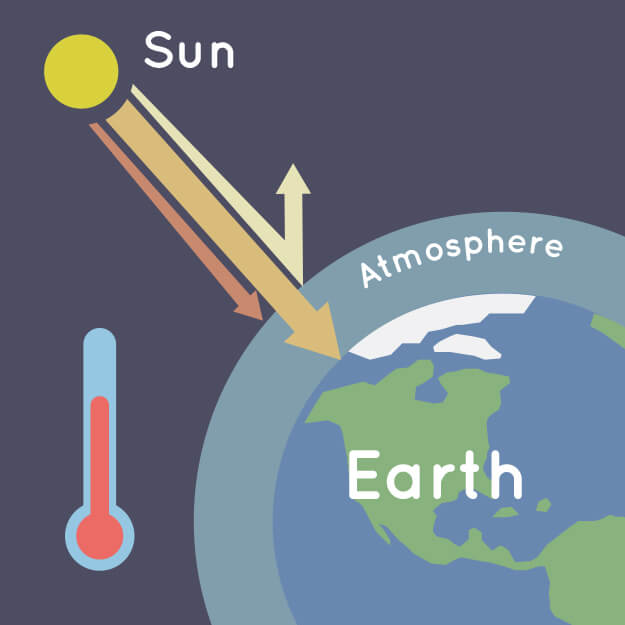
Greenhouse effect, a warming of Earth’s surface and troposphere i.e. the lowest layer of the atmosphere caused by the presence of water vapour, carbon dioxide, methane, and certain other gases in the air. Of those gases, known as greenhouse gases, water vapour has the largest effect.

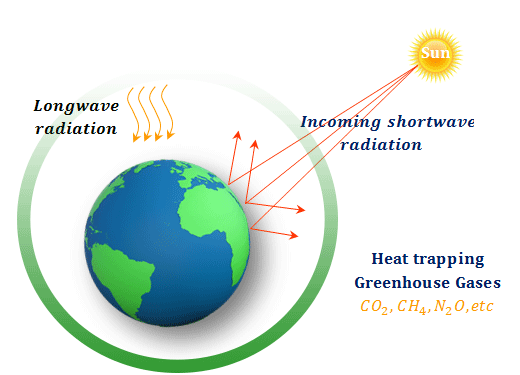
The atmosphere allows most of the visible light from the Sun to pass through and reach Earth’s surface. As Earth’s surface is heated by sunlight, it radiates part of this energy back toward space as infrared radiation. This radiation, unlike visible light, tends to be absorbed by the greenhouse gases in the atmosphere, raising its temperature. The heated atmosphere in turn radiates infrared radiation back toward Earth’s surface.

Some of the re-emitted energy remains within the atmosphere or returns to the surface and warms the lower atmosphere and surface. The rest of the re-emitted energy leaves the atmosphere and goes into space. The outcome of this absorption-emission process by the greenhouse gases is that less energy leaves the atmosphere than is emitted by the Earth below. Despite its name, the greenhouse effect is different from the warming in a greenhouse, where panes of glass transmit visible sunlight but hold heat inside the building by trapping warmed air.

The increased amounts of greenhouse gases human activities are adding to the atmosphere have upset the balance that has been in place since the end of the last ice age. Adding more greenhouse gases decreases the amount of infrared radiation energy leaving the atmosphere. To get the energy back in balance, the surface of the Earth has to warm up, so that it will emit more infrared energy, some of which will leave the atmosphere and compensate for the effect of the added greenhouse gases. Thus, the greenhouse effect, which is essential for creating the climate for life on Earth, is also responsible for the Earth getting warmer than it was before we started burning large amounts of fossil fuels.

Importance Of Financial Litracy for rural development.

Financial literacy and financial markets are rapidly changing,with developments in technology and new and more complex financial products.From different kind of loans to mortgages,the range of financial products people have to chose from has changes drastically from what it was in the past.the exponential hrwoth in fintech(financial technology) is revolutionizing the way people take financial decisions.Ability to effectively manage money and taking financial decisions in order to become financially self sustainable is known as financial literacy.

The OECD( organisation for economic cooperation and development)defines financial literacy not only as the knowledge of risks and management but also the skills.What does financial literacy involve:-From keeping tracks and understanding when to spend money how to spend money so that it does not have any negative impact on one’s life comes under financial literacy. Importance of financial literacy in a farmer’s life :- Financial literacy enables a farmer to develop a budgetary guide to distinguish what he owes,what he buys and what he spends.This can help them in becoming independent and self sufficient instead of debtors to banks or someone.

Understanding your money and knowing basic principles can prevent farmers from fraud as it will help them with foreseeing risks and argue with anyone learned and well informed.Hurdles in farmer’s way to achieve self sustainability :-Financial literacy can help farmers in many ways, but in india ,most of the farmers are illiterate who dont know how to read,never went to school hence they dont know basics things such as calculating interest adding amounts which plays a very big role in their lives.Because of lack of proper knowledge farmers usually become victims of fraud by money lenders.Money lenders charge a very hight amount of interest which is illegal but many farmers dont know that.Not only this there are many cases when a money lender charges money even though farmers have already paid it . There are many cases in india where farmers hang themselves to tree , burns themselves only because they get trapped in a debt trap and they dont know how to come out of it. There are cases like sanjeev bhatnagar vs union of india 2006, related to this matter but evern supreme court couldn’t do much then asking governments for reasons behind deaths and ordering them to take proper steps. So farmer have tk become self sustainable so that they can prevent themselves and their families from these.And to achieve this the only way is financial literacySolution :- Government should organise specialised programs at every panchayat where trained teachers can teach farmers about 1.Calculating interest to a given amount

2. Managing credit debit system

3. Different places from where they can get low interest loans

4.How to spend money and manage bills so that they dont have to face negative impacts.

5.Asset management. Risk managementThey can also teach them skills and how to apply them because there is no use of knowledge if you dont know how to apply it and where.With proper knowledge and understanding of credit debit system farmers can provide a major help in the growth of economy of india . No farmer will end up having a day with no food,no money or loss of thier land. This will be a concrete step towards the converting our developing nation into developed nation

Importance of education for rural India.

Importance of rural education in india
India is a country with a population of 135 crores.According to reports by world bank in 2020, 65 percent of indian population resides in rural areas.With such a huge population living in rural areas,rural education in india becomes important not only to eradicate poverty and illiteracy,but also for a variety of social ,economic as well as cultural and political reasons.
In 1947 when india became independent policy makers realized the importance of education.Education is considered as the most strong weapon to improve community development as well as initiate social alterations in the world.For a nation ,education in urban as well as rural areas plays a huge role in growth of country . Although education in urban areas of india has progressed rapidly , there are places where still education is not a priority.
It is mandatory for the government to teach people about the importance of education,about the benefits of education and why it should be enforced even in most remote places.

Benefits of education :-

  1. In political system of rural india,it is necessary for rural people to be educated so that they can understand the programs and principles in a much better way and hence elect worthy representatives.
  2. Villages in india plays major part in the economical growth of the country by producing agricultural, industrial as well as other goods.For this it is necessary to have an understanding of the global economy as it is the international price movement of goods which regulate their quantity and price.for that its important for rural masses to be educated.
  3. With time and introduction of modern gadgets culture is also advancing at a rapid rate. To handle and utilize the benefits of these advanced gadgets whether it is for agriculture or daily life education is a prequisite.For example,a rural farmer must be educated in order to learn how to use harvesters , fertilizers, threshers etc. Education can affect the intellectual life of people and make them contribute in the advancement of society.
  4. Indian constitution provides several rights and principles to citizen such as right to education,right to speak,right to information . To understand the significance and functioning of these right modern education becomes must.

Thus we can understand that rural education not only helps in the rural development but it helps in the overall progress and development of the nation.

Thus many steps were taken time to time in order to enhance level of education by the government.many programs were organised to enlighten the people,many schemes were launched in order to attract people of rural areas having low income .
Scheme launched by indian government :-

  1. Samagra shiksha is an scheme launched by indian government to ensure inclusive and equitable quality education
  2. Since the inception of erstwhile centrally sponsored scheme in 2001, 3.18 lakh school building,18.8 lakh additional classrooms,2.3 laks water facilities were constructed.
  3. Mid day meal was started to attract poor families and encourage them fo send their children to schools.
  4. Based on national achievement survey,2017 was conducted to identify and design strategies to reduce the gaps. 5.section of 23(2) of the RTE Act has been amended to extend the period of untrained in-service elementary teachers.

6.NIOS has been entrusted to organise trainings as well as D.El.Ed was started to ensure quality of teachers.

Child Labor Act 1978

What is Child labor?

The term child labor is used when a child is involved into doing a work which is mentally, physically , socially or morally harmful and dangerous to a child and also deprives them of a better childhood and schooling opportunities forcing them to leave the opportunities they have and mature earlier than they should.

The Child Labor Act 1986:

Government has enacted the Child Labor (Prohibition & Regulation) Amendment Act, 2016 which came into force. The Amendment Act completely prohibits the employment of children below 14 years. The amendment also prohibits the employment of adolescents in the age group of 14 to 18 years in hazardous occupations and processes and regulates their working conditions where they are not prohibited. The amendment also provides stricter punishment for employers for violation of the Act and making the offence of employing any child or adolescent in contravention of the Act by an employer as cognizable.

The main objective of this act was to ensure, no involvement of children who have not completed the age of 14 in certain occupations.

The Act also prohibits employment of child in about 13 occupations and 51 processes. The constitution of India in the article 24 under right against exploitation also mentions for prohibition for employment of children in factories and other unorganized sector.

A lot of efforts were put in by PN Bhagwati and V.R. Krishna Iyer to get this litigation into running and in action.

The Path-breaking and Landmark Case of MC Mehta V. State of Tamil Nadu:

The case started with a PIL which was filed by Mr. MC Mehta, alleging that many children were being employed in several hazardous industries more particularly in the firecracker and matchstick industry in Sivkasi in Tamil Nadu.

What held in the court:

A committee was appointed by the Supreme Court of India to visit the site and to prepare a report keeping all the different aspects in concern.

The committee after the submission of the report on November 11,1991 , gave suggestions that the state of Tamil Nadu should be directed that no child should be employed in hazardous and damaging industries of any kind. They also suggested another premise for them to not work more than 6 hours. Proper transport and education facilities should be provided in or around the factory.

It was also recommended to start a national commission on children’s welfare to prepare a scheme for the abolition of child labour.

The case is a landmark case and is so important because it introduces a lot of reforms and amendments in the child labor act 1986 and the case threw light on Child labor as a major issue.

Some of the provisions after the MC Mehta Case are:

The provisions introduced as an after effect of the case were:

Article 24 – Prohibition of employment of children in factories, etc. – No child below the age of fourteen years shall be employed to work in any factory or mine or engaged in any other hazardous employment. 39€. That the health and strength of workers, men and women, and the tender age of children are not abused and that citizens are not forced by economic necessity to enter avocations unsuited to their age or strength.

Article 39(f) -Children should be given opportunities and facilities to develop in a healthy manner, in conditions of freedom and dignity and childhood should be protected against exploitation and against moral and material abandonment.

Article 41 – Right to work, to education and to public assistance in certain cases.- The State shall, within the limits of its economic capacity and development, make effective provision for securing the right to work, to education and to public assistance in cases of unemployment, old age, sickness and disablement, and in other cases of undeserved want.

Article 45 – Provision for free and compulsory education for children.- The State shall endeavor to provide, within a period of ten years from the commencement of this Constitution, for free and compulsory education for all children until they complete the age of fourteen years.

And many other more reforms.

 Reference: lawtimejournal ( for the prvisions)

Gambling laws in India

Introduction

Gambling is defined as betting, gaming, or participating in an activity that is based on luck not on the skills to win a huge amount of money or any other prize by wagering some amount of money. To control gambling across the country legislation was passed in the year 1867, the Public Gaming Act of 1867, and is the most important legislation that regulates gambling in India.

Under the gambling legislation, the meaning of the act of wagering or betting for money or money worth is understood in the 2006 “jay video games and electrical v. State of Gujarat’’  case.

So here we discussed about the gambling, why it has become a more sensible topic in India and other countries, how it has come in scenario where their strict laws are must needed, why gaming skills are excluded from gambling or why Indian law classifies the games into two broad categories i.e. game of chance and game of skills. What are those games where gambling is not a big deal?

Legality

As per the status of the legality of Gambling in India, there is no unified law regarding any activities of gambling as it comes under the State list of the 7th schedule of the Constitution. So the gambling is a state subject, so the state has only the rights to regulate the law for the gambling activities in their respective territory. The state legislatures, under the Constitution of India, have been entrusted with significant regulatory flexibility to form state-specific gambling laws. 

The Gambling Act is the central enactment that has been adopted by certain states in India and other states have enacted their own legislation to regulate and govern gambling activities within their territory. So some states have allowed or some have banned gambling in their state. For example, casinos are banned in the other states except for Sikkim, Goa and Daman.

 As per Section 12 of the Public Gaming Act 1867, any game of mere skill will not be treated as gambling, but games of chances will be treated as gambling. 

The Public Gambling Act of 1867 is a central law that prohibits running or being in charge of a public gambling house. The penalty for breach of this law is a fine of Rs. 200 or imprisonment of up to 3 months. Additionally, this Act prohibits visiting gambling houses. A fine of Rs.100 or imprisonment of up to one month is the penalty. 

There is always a doubt regarding which games are covered under gambling because poker in India has very unclear significance in Indian law because it could never figure out whether it is a game of skills or a game of chance. It’s very interesting that games, such as wagering on cricket, are prohibited and while Rummy is permitted as observed by the court under  Mahalakshmi  Cultural Association v. The Director, Inspector General of Police, State of Tamil Nadu in 2012. Gone are the times of Matka betting and the preferences in India. These days, you can just wager on a couple of sports, that too in some states. As of now, betting on horse racing, online poker in states like Goa and Sikkim, online rummy, lottery, and a couple of gambling clubs are legal in India in accordance with the case of K .R Lakshmanan v. state of Tamil Nadu in 1996. 

Not only wagering on games is illegal, visiting or working in those places is also unlawful or illegal under section 4 of the  Public Gaming Act. It is likewise unlawful to visit such a place. The main problem is that the exact meaning of betting is not adequate in the legislation. As per the Act, it states Gaming as betting or wagering of money on a game which is a game of chance and not of skill except Horse Racing.

Laws on online-based betting

In the Public Gaming Act of,1867 there were no provisions related to online-based betting. There is in addition to this Act another act that could be considered to identify with web-based wagering and gaming i.e. The Information Technology Act of 2000. From this Act, it is very easy to identify the offences with online gambling and gives the government ability to check and search if required. However, this Act also does not mention online-based gambling like Public Gaming Act, 1867 does. 

The laws for online gambling are enacted by several states also like Sikkim. The state of Sikkim enacted the Sikkim Online Gambling (Regulation) Act,2008, which was passed on 28th  June 2008 by the Sikkim Legislative Assembly with the object of controlling and regulating through electronic and non-electronic ways in online gaming. And imposes Tax also on online gaming within its territory.

Game of chance or game of skills

Gambling is understood both under its traditional form as well as modern avatar. The traditional gambling is understood in the context of physical space, brick and mortar format, whereas modern gambling consists of computers connected offline or online, mobile phones, internet, etc. the Gambling legislations exclude the “game of skills” from the statute of gambling and hence doesn’t attract the penal provisions.

A game of chance is a game where the result is leveraged by a random number creator in which the participant may choose to bet money for that result. While in a game of skill, A person bet on the result which comes out of the skills of person or person requires them to have a degree of mental expertise to succeed, for example, Betting on Horse racing. However, in games like Poker and Rummy, many times the courts got confused about whether these are Game of Chance or Game of Skill. 

Penalties

Under the Public Gaming Act,1867 any person is found playing games for money, wager, stake or something else with cards, dice, counters, shall be liable to imprisonment for any term not exceeding one month and fine not exceeding one hundred rupees. As per the section 45 of the Indian Penal code 1860.  

Any person found in such gaming rooms during any gaming or playing there shall be presumed, until proven, to have been there for gaming purposes.  

Conclusion

Whereas there are various legislations in India, even every state has its own legislation for gambling as legal and regulated in the most appropriate ways. There is a need for a section or portion which would provide which type of gambling is legal and which is not. Apart from this, there is a need for central laws for online Gambling, we see that few States like Goa, Sikkim, and Nagaland are the only states that permit online gambling. Also, such a type of thing showed that there are no possible ways to stop or curb. At least something could be done to regulate this.

The Government, being a welfare State, acts in a manner to promote the economic and social well-being of its citizens, and therefore, it is necessary for the State to protect the sensitive sections of the society. About gambling, they can at least form a committee to survey the need for gambling and improvisation on the current legislation based on that survey. Thus, there is a need for aggressiveness to be taken from the side of the executives as well as the parliament to provide such norms which would codify the system of gambling in India. 

History of Python Programming Language

Python

In this article we’ll see about the most popular and commonly used programming language, Python. So, let’s begin and learn about the development of Python and gain insights about the current IT trends.

Introduction of Python

Python is very famous for its simple programming syntax. code readability and English-like commands that make coding and English-like commands that make coding a lot easier and efficient. Due to this, it is the most popular and preferred language. Python is an interpreted, high-level, general-purpose programming language developed by Guido van Rossum at National Research Institute for Mathematics and Computer Science, Netherlands.

In contrast to popular belief that Python was named after the snake, Python was actually named after the show “Monty Python’s flying circus”. Guido van Rossum formulated Python in the late 1980’s as a successor to the ABC language.

Versions of Python

In 1994, Python version 1.0 was released with features like exception handling, Lambda, Map, Filter and Reduce. Python 2.0, released in 2000, introduced features like list comprehensions and garbage collection system capable of collecting reference cycle. Python 3.0 was released on the 3rd of December 2008. Undoubtedly, Python 2.x and 3.x have proven to be the most used versions. As of today, Python 3.9.5 is the latest stable version released in the summer of May 2021.

Applications of Python

Python is popularly used for development, scripting, and software testing. Top IT companies like Google, Facebook, Instagram, Spotify and Netflix, among others, use Python. Some major applications of Python can be seen in the fields of Machine Learning, Artificial Intelligence, Data Science and IoT.

Python Also Offers Many Libraries like

👉 Numpy

👉Scipy

👉 Keras

👉Tensor Flow

👉Django 

👉 Flask

Pep-8 is the official style guide that defines the styling conventions for Python code. A few popular open source Python projects include PipENV, Chatistics, solving the travelling salesman problem using self-organizing maps and Python to BPF converter. Popular websites on the internet, like Reddit and Quora, are built using Python. 

Some Popular Games Developed Using Python

👉EVE Online Freedom Force

👉Pirates of the Caribbean Online

👉 Civilization IV, Battlefield 2

👉Sims 4

👉World of Tanks  

According to Indeed, the average salary of a Python developer in India is about Rs.5,00,000 per annum and that in the US is around $124,000.

Users and admirers of Python, especially those considered knowledgeable, are referred to as Pythonists, Pythonistas, and Pythoneers. Since its inception, Python has come a long way to become the most popular coding language and continues to revolutionize the IT industry. This is the best course for all beginners who want to learn the new course.

INSTAGRAM

Instagram usually abbreviated to IG, Insta or The gram is an American photo and video sharing social networking service created by Kevin Systrom and Mike Krieger. In April 2012, Facebook acquired the service for approximately US$1 billion in cash and stock. The app allows users to upload photos and videos that can be edited with filters and organized by hashtags and location tagging. Posts can be shared publicly or with your followers. Users can browse other users’ content by searching tags and locations and view trending content. Users can like and comment on other users’ photos and follow their knowns to add their content to a personal feed. It was released in October 6, 2010; 10 years ago. It is available in 32 languages and its website is https://www.instagram.com/. Later on, the service also added messaging features, the ability to include multiple images or videos in a single post, and a ‘stories’ feature which allows users to post their daily works and videos for 24 hours. The ‘Reels’ section is now also added which allows the users to post a video of them or anything within a limit of 15 to 30 seconds using any type of audio. The craze of making reels is so high among the people, they are enjoying and celebrating with Instagram Reels. Instagram became the 4th most downloaded mobile app of the 2010s.

Ongoing research continues to explore how media content on the platform affects user engagement. Past research has found that media which show peoples’ faces receive more likes and comments and that using filters that increase warmth, exposure, and contrast also boosts engagement. Users are more likely to engage with images that depict fewer individuals compared to groups and also are more likely to engage with content that has not been watermarked, as they view this content as less original. The motives for using Instagram among young people are mainly to look at posts, particularly for the sake of social interactions and recreation.

In popular culture:

  • Instagram is also used as a documentary film about three teenagers growing up on Instagram as social animals.
  • Instagram model is a term for models who gain their success as a result of the large number of followers they have on Instagram.
  • Instapoetry is defined as a style of poetry which formed by sharing images of short poems by poets on Instagram.
  • Instagram Pier is a cargo working area in Hong Kong that gained its nickname due to its popularity on Instagram.

https://www.npr.org/2017/06/07/493923357/instagram-kevin-systrom-mike-krieger

https://en.wikipedia.org/wiki/List_of_most-followed_Instagram_accounts

https://www.indiatimes.com/technology/news/instagram-rolls-out-new-anti-abuse-features-including-limits-details-inside-547034.html

PERKS OF USING INSTAGRAM-

  • Instagram gives you the opportunity to learn more about your audience and reach them very easily.
  • With more than 25 million businesses actively using Instagram to market to their target audience, it’s easy to see why so many people use the app to shop. In today’s instant access retail world, shoppers want visual content to help them make buying decisions.
  • It is a new method of sharing the pictures online via social media sites involving various creatives ideas like adding filters, making reels and many more to make the post or story look more attractive.
  • The positive effects of Instagram include self-expression, self-identity, community building and emotional support.
  • We can also make money by using Instagram like by creating sponsored posts for brands as an influencer. Become an affiliate and endorse different products. Be a virtual assistant to an influencer.
  • Your brand probably has a stable group of fans who follow your work, consume Instagram content, and like, share and comment on your posts.
  • It’s easy to share Instagram content across other channels.
  • Instagram is free advertising. With social media, including Instagram there are no costs involved unless you decide to pour money into it.

It’s not just about capturing the moment, Instagram is also a social network,” Eyal says. Instagram is so popular because it has the ability to anticipate users’ needs, prioritize their trust, keep abreast of competition, and leverage current trends. Instagram is more than just a way to get jealous about your friend’s vacation photos. Instagram is a way to express yourself and enhance your knowledge and various skills. It is a fun place to wander around in your phone anytime. You can post anything or can add to your story with beautiful filters never seen and used before. It is a very safe place for sure as it do not reveals your identity unless you follow another person. You can enjoy it by watching various types of reels, various funny reels are also there and. You can also make reels by choosing your choice of audio. So it’s not wrong to say that Instagram is very popular and it has become the way of living.