India’s friendship with Russia: Myth or reality

Russia and india Images, Stock Photos & Vectors | Shutterstock
Russia and India Images, Stock Photos & Vectors | Shutterstock

India and Russia is said to share cordial relations and let us check the reality of this friendship

International relations have gained immense significance since time immemorial. India also handles its external relations with due importance. This has made India a significant player in international relations by establishing close relations with biggest nations of the world. One of the most important relation among them are India’s close ties with Russia.

 Russia and its forefather USSR have always stood with India since independence. There were several instances when the socialist nation has offered support both ideologically as well as in person. Let us look into some such instances:

IRIGC

The Indo-Russian Inter-Governmental Commission (IRIGC) is a significant institution that manages the intergovernmental activities between both countries. It is considered as the steering committee of Indo-Russia relations. It has two wings, the first covering Trade, Economic, Scientific, Technological and Cultural Co-operation and is normally co-chaired by the deputy prime minister of Russia and the External affairs minister of India. The second wing of the commission deals with Military Technical Co-operation and is co-chaired by the respective Defense ministers of two countries. Both parts of IRIGC meet annually.

SPACE SECTOR

Historically, there has been a long history of cooperation between the Soviet Union and India in space. Examples include Aryabhata , India’s first satellite, was launched by the Soviet Union on 19 April 1975 from Kapustin Yar using a Kosmos 3M launch vehicle. Under Interkosmos space program, Rakesh Sharma was also launched by the Soviet Union. 

DEFENCE ASSISTANCE

The Soviet Union was an important supplier of defense equipment for several decades, and this role has been inherited by the Russian federation. Russia 68%, USA 14% and Israel 7.2% are the major arms suppliers to India (2012-2016), and India and Russia have deepened their make in India defense manufacturing cooperation by signing agreements for the construction of naval frigates, Twin engine utility helicopters, Brahmos Cruise missiles and such joint venture initiatives. The co-operation is not limited to a buyer-seller relationship but includes joint research and development, training, service to service contacts, including joint exercises.

TRADE PARTNERSHIP

Bilateral trade between both countries is concentrated in key value chain sectors. These sectors include highly diversified segments such as aerospace, machinery, electronics, fertilizers, precious stones, oil, etc. Both Governments have jointly developed an economic strategy that involves using a number of economic components to increase future bilateral trade. Also, a Joint study group has been appointed to study the prospects of free trade.

POLITICAL RELATIONS

Irrespective of the changing government policies both countries have supported each other in political matters. Non participation of India in UN meetings to condemn Russian invasion of Ukraine and USSR’s support during Bangladesh war of 1971 are few examples. The socialist idea of planning is also an example of India’s relation with Russia and USSR.

NUCLEAR DEALS AND ENERGY SECTOR

On 7 November 2009, India signed a new nuclear deal with Russia apart from the deals that were agreed upon by the two countries earlier. India and Russia are in discussion for construction of two more nuclear power units at Kudankulam. Two units of the Kudankulam nuclear power plant are already operational. Similarly, several initiatives have been taken up by these nations collectively to ensure energy efficiency.

RUPEE ROUBLE AGREEMENT

Recently Russia has signed an agreement by which imports from Russia could be paid in Rupees. This was in response to India’s support for Russia even during trade restrictions from nations around the world. For the rupee-rouble mechanism to be implemented, Indian importers would pay for goods to the accounts of Russian banks in India and they in turn would make the payment in roubles to the Russian exporters.

The countries have agreed to carry forward a special and privileged strategic relationship. Irrespective of the changing governments both nations have stood in support of each other during the hardest times.

Reference: Wikipedia

The Rashomon Effect

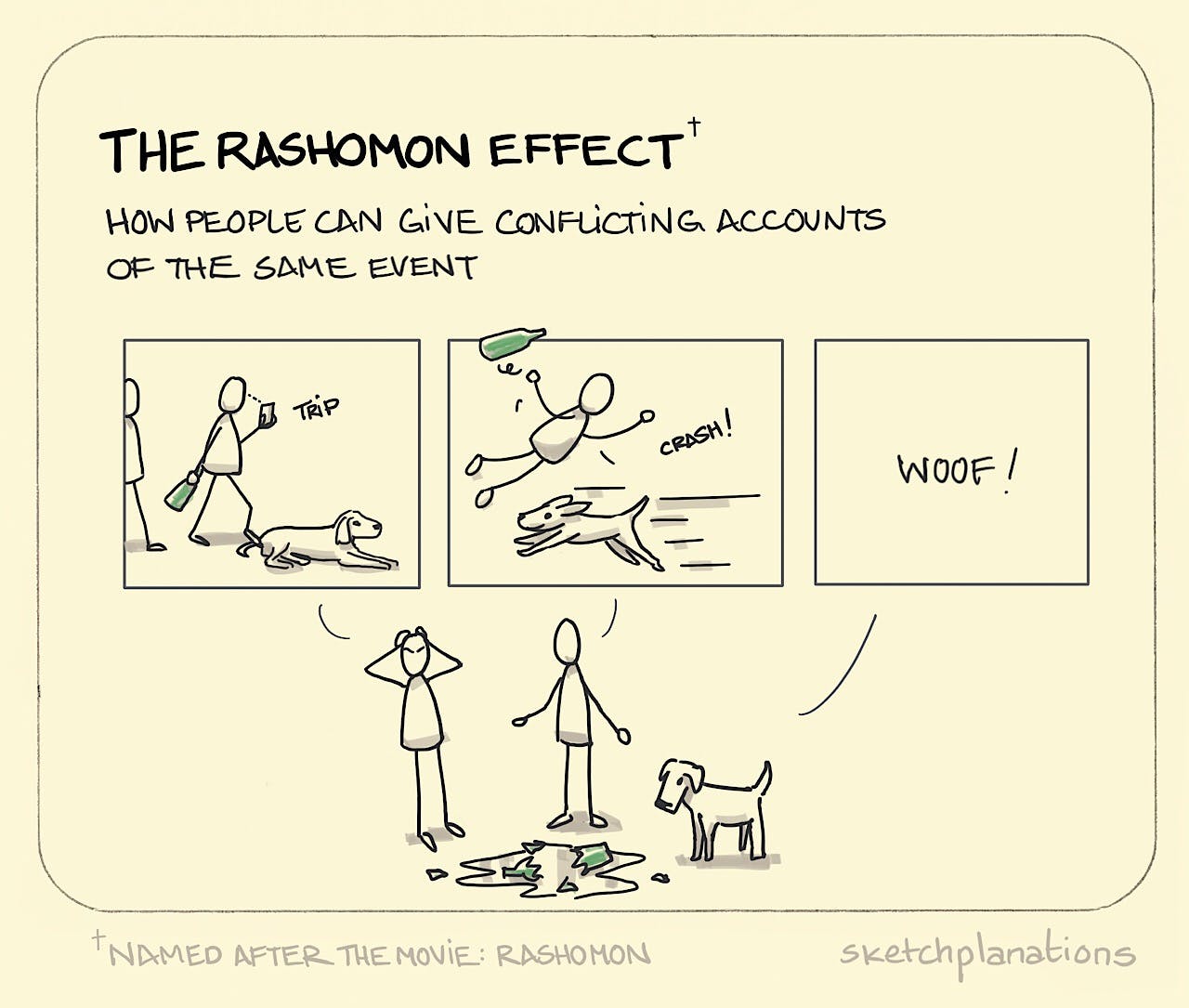
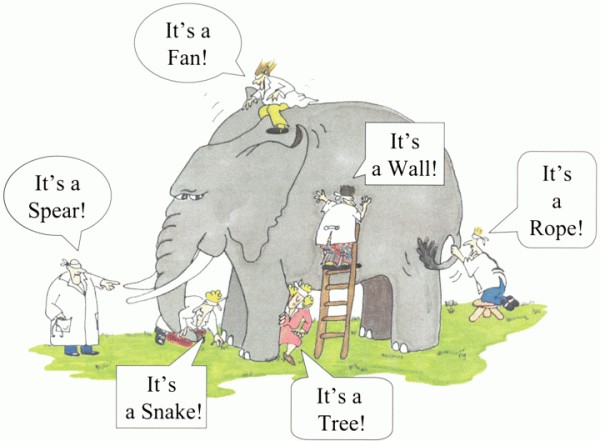
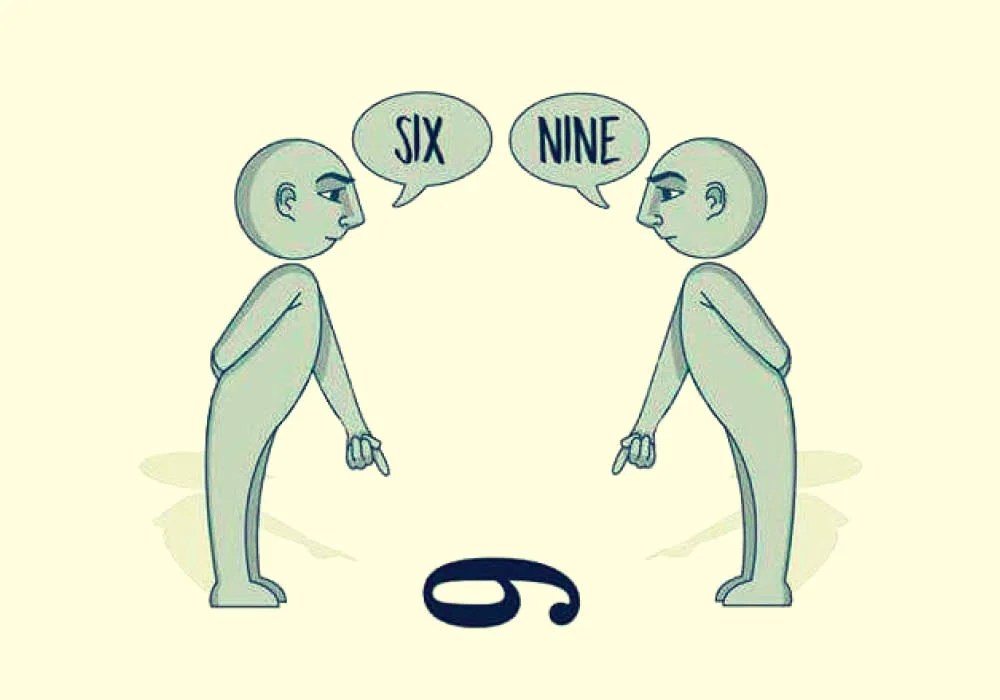
Ever heard multiple sides to a story from eye witnesses and had a tough time deciding which one is true or which to believe? Such a conundrum is brought about by subjective views, observer bias, perspective and memory of the observer. All these parameters can be summed into a single word known as The Rashomon. The Rashomon effect refers to an instance when the same event is described in significantly different (often contradictory) ways by different people who were involved.

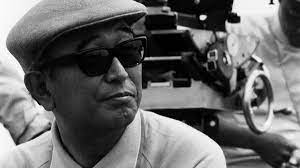
This phenomenon first came to be observed in a book called “in a grove “by Japanese author, Reyonosuke Akutagawa written in the early 1920’s. This was later adapted and made into a movie, by Japanese filmmaker Akira Kurosawa, who directed the 1950 film Rashomon, giving the effect its name. The plot revolves around which four different people provide contradictory accounts of a samurai’s murder, despite all having witnessed the crime. Each witness tale is varied from another, yet so very plausible, that a definite conclusion cannot be drawn, embroiling all of them.

The film explored the issues of the unreliability when depending on witness testimony explores a situation using a similar literary device, wherein the story is told through the viewpoints of different characters who supply conflicting stories. Whether the people’s competing explanations are different because of the fallacy of memory or because of self-serving interests varies. This film became revolutionary with how one understands the human mind, justice and the truth. It since then has become a cultural metaphor and is synonymous with happenings of everyday events as it’s not a sci-fi or an abnormal event, but a very natural course of nature that seems very striking .

Conditions and characteristics.

Not every story will have The Rashomon effect. It mostly occurs when there is no gripping and final evidence but a lot of eyewitnesses and when there is a pressure to achieve closure and coercion to find the truth. In both the movie and the book, no side of a person’s view is given more emphasis and all are shown in an equal scale, each testimony bearing its own truth and plausibility. The script and story writing does tell the audience how to feel or what to believe. The audience had to decide that for themselves making it engaging and deceiving at the same time. Such a premise has conflict as a driving. Conflict in a story drives a plot forward, reveals character, and engages an audience. The Rashomon Effect is based on contradicting reports of the same event and search for the truth through these reports can be a driving force of conflict for a story. The use of an unreliable narrator is another feature, opposed to the presentation from a more objective point of view. This allowed audiences to see the characters as they were and value neutral. To top it off, an ambiguous ending after such a mind boggling series of events, looks like the right justice to this type of storytelling. Our realization that none of the witnesses are reliable leaves us with more questions than answers. While most films at the time had a clear ending, the ending of Rashomon has no clear resolution. This unconventional decision left audiences baffled.  It can be frustrating to some as it subverts from its unorthodox counterparts but , it is not ambiguous for the sake of mystery or confusion, but rather to reiterate themes and larger concepts like the intricacy of the human brain.

Conclusion

Research studies have found that when people form a memory, a visual experience is often influenced by external cues, internal prejudice and past experiences. While a few are completely individualistic, most are universal. An example of this is egocentrism, i.e., having a positive view on their actions but disregard to the other person . it is a subconscious act , most of the times, and these psychological phenomenon means that the rashomon effect can  pop up anywhere.

The Rashomon effect finally boils down to the minutiae and can range from studies of anthropology and biology to the general public analyzing a historic world event. In conclusion this broke a psychobiological barrier of having the right answer to every crisis and rather shifted the focus to versions of the same event that can tell us about the time, place and people involved, how to go about different mind-sets, backgrounds and biases. It emphasized on the fact that sometimes, the objective truth cannot always be obtained and that it is normal to have an obscure, vague ending, which should be embraced and valued in certain circumstances.

The Rashomon Effect

Ever heard multiple sides to a story from eye witnesses and had a tough time deciding which one is true or which to believe? Such a conundrum is brought about by subjective views, observer bias, perspective and memory of the observer. All these parameters can be summed into a single word known as The Rashomon. The Rashomon effect refers to an instance when the same event is described in significantly different (often contradictory) ways by different people who were involved.

This phenomenon first came to be observed in a book called “in a grove “by Japanese author, Reyonosuke Akutagawa written in the early 1920’s. This was later adapted and made into a movie, by Japanese filmmaker Akira Kurosawa, who directed the 1950 film Rashomon, giving the effect its name. The plot revolves around which four different people provide contradictory accounts of a samurai’s murder, despite all having witnessed the crime. Each witness tale is varied from another, yet so very plausible, that a definite conclusion cannot be drawn, embroiling all of them.

The film explored the issues of the unreliability when depending on witness testimony explores a situation using a similar literary device, wherein the story is told through the viewpoints of different characters who supply conflicting stories. Whether the people’s competing explanations are different because of the fallacy of memory or because of self-serving interests varies. This film became revolutionary with how one understands the human mind, justice and the truth. It since then has become a cultural metaphor and is synonymous with happenings of everyday events as it’s not a sci-fi or an abnormal event, but a very natural course of nature that seems very striking .

Conditions and characteristics.

Not every story will have The Rashomon effect. It mostly occurs when there is no gripping and final evidence but a lot of eyewitnesses and when there is a pressure to achieve closure and coercion to find the truth. In both the movie and the book, no side of a person’s view is given more emphasis and all are shown in an equal scale, each testimony bearing its own truth and plausibility. The script and story writing does tell the audience how to feel or what to believe. The audience had to decide that for themselves making it engaging and deceiving at the same time. Such a premise has conflict as a driving. Conflict in a story drives a plot forward, reveals character, and engages an audience. The Rashomon Effect is based on contradicting reports of the same event and search for the truth through these reports can be a driving force of conflict for a story. The use of an unreliable narrator is another feature, opposed to the presentation from a more objective point of view. This allowed audiences to see the characters as they were and value neutral. To top it off, an ambiguous ending after such a mind boggling series of events, looks like the right justice to this type of storytelling. Our realization that none of the witnesses are reliable leaves us with more questions than answers. While most films at the time had a clear ending, the ending of Rashomon has no clear resolution. This unconventional decision left audiences baffled.  It can be frustrating to some as it subverts from its unorthodox counterparts but , it is not ambiguous for the sake of mystery or confusion, but rather to reiterate themes and larger concepts like the intricacy of the human brain.

Conclusion

Research studies have found that when people form a memory, a visual experience is often influenced by external cues, internal prejudice and past experiences. While a few are completely individualistic, most are universal. An example of this is egocentrism, i.e., having a positive view on their actions but disregard to the other person . it is a subconscious act , most of the times, and these psychological phenomenon means that the rashomon effect can  pop up anywhere.

The Rashomon effect finally boils down to the minutiae and can range from studies of anthropology and biology to the general public analyzing a historic world event. In conclusion this broke a psychobiological barrier of having the right answer to every crisis and rather shifted the focus to versions of the same event that can tell us about the time, place and people involved, how to go about different mind-sets, backgrounds and biases. It emphasized on the fact that sometimes, the objective truth cannot always be obtained and that it is normal to have an obscure, vague ending, which should be embraced and valued in certain circumstances.

EVOLUTION OF CONTENT DRIVEN CINEMA IN INDIA

Source: Mindscreen

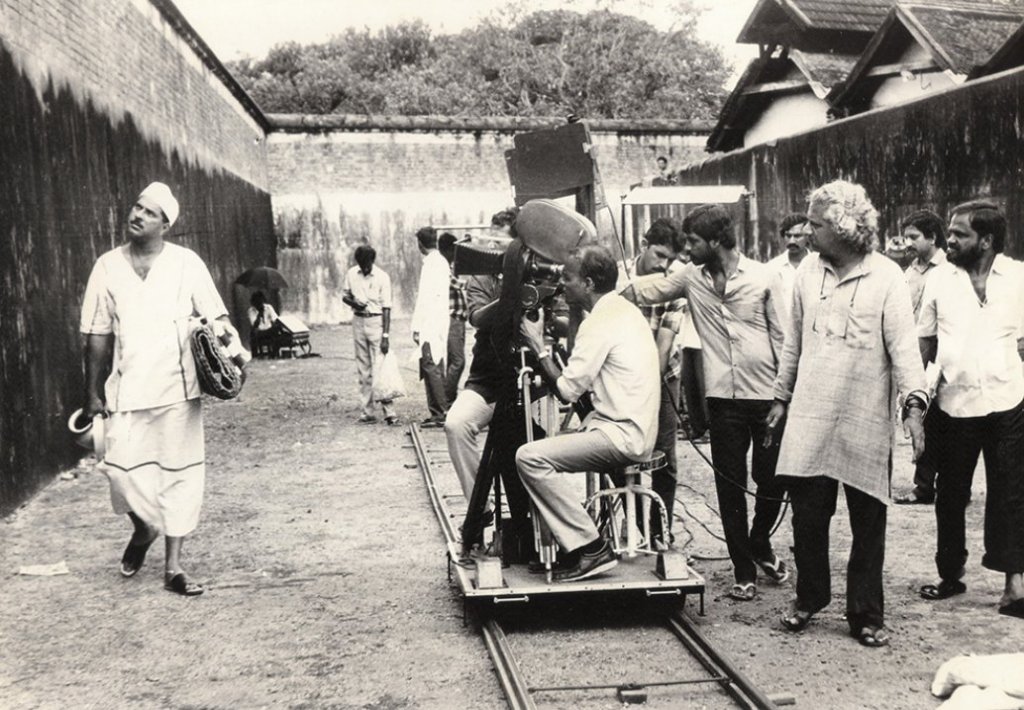
Good content driven movies are not new phenomena in indian cinema. We have already encountered since 60s but like change is part of any civilization or human life same occurred in Indian cinema which eventually turned out only in Bollywood. Firstly we need to understand Bollywood is not sole representer of Indian cinema infact it is just a entity of ocean. Why I am saying content had it’s own long back story with filmmakers like Bimal Roy, hrishikesh Mukherjee, shyam benegal, guru dutt.

We had tendency to watch good cinema but off course how human evolve too fast in peculiar manner as no other species able to do. That’s how ‘Art of filmmaking ‘ appeared to distorted in 80s and 90s.

What is content?
First, we need to track down the meaning of CONTENT that what do we mean by content ?

Information , experience of our surrounding ; expressing through the medium of writing , speech, poster and film. The main components are here – Information and experience. When any filmmaker portraying real life challenges , situations what happens people feel attach to those situations audience ready to believe what writers wants us to believe audience feels like he/she like me it okay not to be okay.

Content is something when filmmaker become successful to build that bond between script and audience which was result of real life experiences.

Golden age of Cinema

60s and 70s was the time when Indian cinema was on it’s peak of content driven script best part was audience love those movie. Let’s talk about few movies from that time – A kannada film Malaikkallu (1954) beautiful love story , Bedara kannapa. Bimal Roy was one of the finest filmmaker in india. He made movies on class struggle, casteism. For instance Do bigha zameen (1953) which was story of misuse of Power, Sujata( 1959), Bandini (1963). Each film has their own questions to the Society. These are not critical claim movies but real entertainment even in 21th century.

Hrishikesh Mukherjee who introduced new blend of entertainment and depicted the real life difficulties beautifully like in Anand (1971), Anari ,Abhimaan (1973) these films has its own substance to deal with filmmaking. If we talk about Abhimaan , Mukherjee was depicted as love, bliss, anger, ago, heartbreak and reunion of love again.

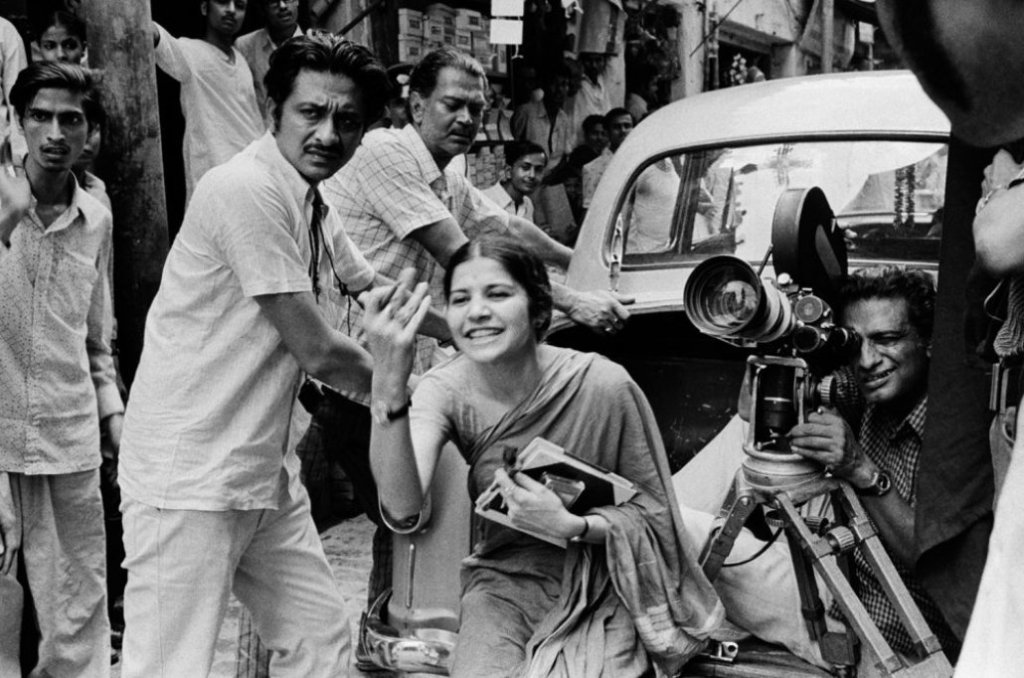
Now, the man who inspires and motivates young filmmakers to work on their ideas makes us all love his movies that is one and only satyajit Ray who changed the entire experience of filmmaking. The Apu trilogy (1955- 59) , The music room (1964) even though these films are in Bengali Language but language couldn’t switch off the impact.

Guru dutt another renowned filmmaker who made such incredible films – pyasa, kagaaz ke phool, chaudhvin ka Chand. Shyam benegal is one of understated filmmaker in modern time and for millennials. He gave Nishant , ankur, manthan( Indian’s first crowdfunded film by farmers who donated 2 rupees each) & terikal. Nishant was emphasize on during the time of feudalism in India, rural elite and sexual exploitation of women. This movie selected for Palme d’or 1976 Cannes film festival. The treatment of movie was so real that appeared very much real even in today’s time.

One element was common in 60s and 70s that filmmaker were not afraid to make good cinema, those makers knows how to write script that turned into great screenplay. Remember this is all happening in 60s where no use of excessive technology or no business Mongols of Bollywood.

Emphasis of Bollywood

From the time of 80s the style of filmmaking was changed or more likely to say distorted. Now, in 90s the explosion of star power corrupted the scripts , producers more inclined towards taking big stars in their movies without thinking about script and screenplay.

In 80s & 90s most common script pattern was “love story” and STARS like we don’t have mind to understand other kind of genres. Movies like – Tezaab, lamhe, raja hindustani , Dil toh pagal hai Chandni and kuch kuch hits hair, Hum aapke hair kon an d Hum sath sath hai etc. Now, we are not saying these were the only type of movies at that point of time exist ; there was also good movies like parinda, arth, sparsh, masoom, ek doctor ki maut, Drishti.

Reign of the good movies

After the gangs of wasseypur (2012) Bollywood discovered new and improved love for content driven cinema. After that Bollywood flooded with good filmmakers but old, rotten content still not vanished but level was decreased.

Queen, gangs of wasseypur, Hindi medium, The lunchbox , Vicky donor, udta Punjab , Shahid, talvar , piku are the movies which got tremendous account of love from audience as well as critical claimed movies. So now happened producers started to invest their money in fresh and fine scripts distributors had to turned their sides.

Let’s talk about web series if we talking about content web series culture changed the whole market for digital media. Where filmmakers are ready to play with screenplay, giving twist and turn. In this process , actors who are talented but put on backfoot now got their fair chance and basically employment.

When Content became Business

Movie business is unknown to commoners but insiders (families of Bollywood) knows really well how this business runs , have their production house. The whole idea is big production house grabs more screens on the basis of big stars only. Distributors are all set to do whatever these big house demands for example Thugs of Hindustan. In terms of box office collection masaan was flop but not literally. Ishqzaade, jab Tak hai jaan , rowdy rathore, ek tha tiger, agneepath, cocktail , Chennai express were all big blockbusters but as far as we see content was in dry and ancient well.

Regional Cinema of India

Regional Cinema has vast variety of exploration , big spectrum of ideas most importantly courage to implement their ideas in better screenplay. Veedu , sairat, chumbak, jogwa naal, aamas , visaranai, baaram all these movies has their different way to deal with society norms which wrapping in entrainment.

Conclusion

We should start praising good movies, audience (we) are everything in show business. If we find bad scripted film good because of stars then we are at the wrong side. We are investing our money at wrong recreation in terms of movies. Now we have to decide what we want in our entrainment list. Create a kind of environment for stars that if they produce and feature in trash films we not going to watch then stars will also take serious measures in the departments of script, writers and audience.

Remember we make them stars so, we are more responsible!!

EVOLUTION OF CONTENT DRIVEN CINEMA IN INDIA

Source: Mindscreen

Good content driven movies are not new phenomena in indian cinema. We have already encountered since 60s but like change is part of any civilization or human life same occurred in Indian cinema which eventually turned out only in Bollywood. Firstly we need to understand Bollywood is not sole representer of Indian cinema infact it is just a entity of ocean. Why I am saying content had it’s own long back story with filmmakers like Bimal Roy, hrishikesh Mukherjee, shyam benegal, guru dutt.

We had tendency to watch good cinema but off course how human evolve too fast in peculiar manner as no other species able to do. That’s how ‘Art of filmmaking ‘ appeared to distorted in 80s and 90s.

What is content?
First, we need to track down the meaning of CONTENT that what do we mean by content ?

Information , experience of our surrounding ; expressing through the medium of writing , speech, poster and film. The main components are here – Information and experience. When any filmmaker portraying real life challenges , situations what happens people feel attach to those situations audience ready to believe what writers wants us to believe audience feels like he/she like me it okay not to be okay.

Content is something when filmmaker become successful to build that bond between script and audience which was result of real life experiences.

Golden age of Cinema

60s and 70s was the time when Indian cinema was on it’s peak of content driven script best part was audience love those movie. Let’s talk about few movies from that time – A kannada film Malaikkallu (1954) beautiful love story , Bedara kannapa. Bimal Roy was one of the finest filmmaker in india. He made movies on class struggle, casteism. For instance Do bigha zameen (1953) which was story of misuse of Power, Sujata( 1959), Bandini (1963). Each film has their own questions to the Society. These are not critical claim movies but real entertainment even in 21th century.

Hrishikesh Mukherjee who introduced new blend of entertainment and depicted the real life difficulties beautifully like in Anand (1971), Anari ,Abhimaan (1973) these films has its own substance to deal with filmmaking. If we talk about Abhimaan , Mukherjee was depicted as love, bliss, anger, ago, heartbreak and reunion of love again.

Now, the man who inspires and motivates young filmmakers to work on their ideas makes us all love his movies that is one and only satyajit Ray who changed the entire experience of filmmaking. The Apu trilogy (1955- 59) , The music room (1964) even though these films are in Bengali Language but language couldn’t switch off the impact.

Guru dutt another renowned filmmaker who made such incredible films – pyasa, kagaaz ke phool, chaudhvin ka Chand. Shyam benegal is one of understated filmmaker in modern time and for millennials. He gave Nishant , ankur, manthan( Indian’s first crowdfunded film by farmers who donated 2 rupees each) & terikal. Nishant was emphasize on during the time of feudalism in India, rural elite and sexual exploitation of women. This movie selected for Palme d’or 1976 Cannes film festival. The treatment of movie was so real that appeared very much real even in today’s time.

One element was common in 60s and 70s that filmmaker were not afraid to make good cinema, those makers knows how to write script that turned into great screenplay. Remember this is all happening in 60s where no use of excessive technology or no business Mongols of Bollywood.

Emphasis of Bollywood

From the time of 80s the style of filmmaking was changed or more likely to say distorted. Now, in 90s the explosion of star power corrupted the scripts , producers more inclined towards taking big stars in their movies without thinking about script and screenplay.

In 80s & 90s most common script pattern was “love story” and STARS like we don’t have mind to understand other kind of genres. Movies like – Tezaab, lamhe, raja hindustani , Dil toh pagal hai Chandni and kuch kuch hits hair, Hum aapke hair kon an d Hum sath sath hai etc. Now, we are not saying these were the only type of movies at that point of time exist ; there was also good movies like parinda, arth, sparsh, masoom, ek doctor ki maut, Drishti.

Reign of the good movies

After the gangs of wasseypur (2012) Bollywood discovered new and improved love for content driven cinema. After that Bollywood flooded with good filmmakers but old, rotten content still not vanished but level was decreased.

Queen, gangs of wasseypur, Hindi medium, The lunchbox , Vicky donor, udta Punjab , Shahid, talvar , piku are the movies which got tremendous account of love from audience as well as critical claimed movies. So now happened producers started to invest their money in fresh and fine scripts distributors had to turned their sides.

Let’s talk about web series if we talking about content web series culture changed the whole market for digital media. Where filmmakers are ready to play with screenplay, giving twist and turn. In this process , actors who are talented but put on backfoot now got their fair chance and basically employment.

When Content became Business

Movie business is unknown to commoners but insiders (families of Bollywood) knows really well how this business runs , have their production house. The whole idea is big production house grabs more screens on the basis of big stars only. Distributors are all set to do whatever these big house demands for example Thugs of Hindustan. In terms of box office collection masaan was flop but not literally. Ishqzaade, jab Tak hai jaan , rowdy rathore, ek tha tiger, agneepath, cocktail , Chennai express were all big blockbusters but as far as we see content was in dry and ancient well.

Regional Cinema of India

Regional Cinema has vast variety of exploration , big spectrum of ideas most importantly courage to implement their ideas in better screenplay. Veedu , sairat, chumbak, jogwa naal, aamas , visaranai, baaram all these movies has their different way to deal with society norms which wrapping in entrainment.

Conclusion

We should start praising good movies, audience (we) are everything in show business. If we find bad scripted film good because of stars then we are at the wrong side. We are investing our money at wrong recreation in terms of movies. Now we have to decide what we want in our entrainment list. Create a kind of environment for stars that if they produce and feature in trash films we not going to watch then stars will also take serious measures in the departments of script, writers and audience.

Remember we make them stars so, we are more responsible!!

DO YOU WHAT IS ZOOLOGY?

Zoology, the branch of biology that studies animals, seeks to understand the sum total of all the properties of animals and animal populations. As a discipline, zoology is similar to others with major subdivisions that include anatomy, physiology, genetics, and interrelation.

JOB FOR AN ZOOLOGY STUDENT:

Photo by David Selbert on Pexels.com

Academic researcherAnimal nutritionistEcologistEnvironmental consultantEnvironmental education officerHigher education lecturerMarine scientistNature conservation officerScience writerZookeeperZoologist

Animal physiotherapist

Environmental managerField trials officerMarine biologistResearch scientist (life sciences)

Toxicologist

Veterinary nurse

Veterinary surgeon

•Not only by studying the subject of zoology make us a zoologist, we have work on that field study about animals and their behaviour, go for the internships Learn how to work gain advance knowledge make us a good zoologist.

Operant conditioning by B.F Skinner

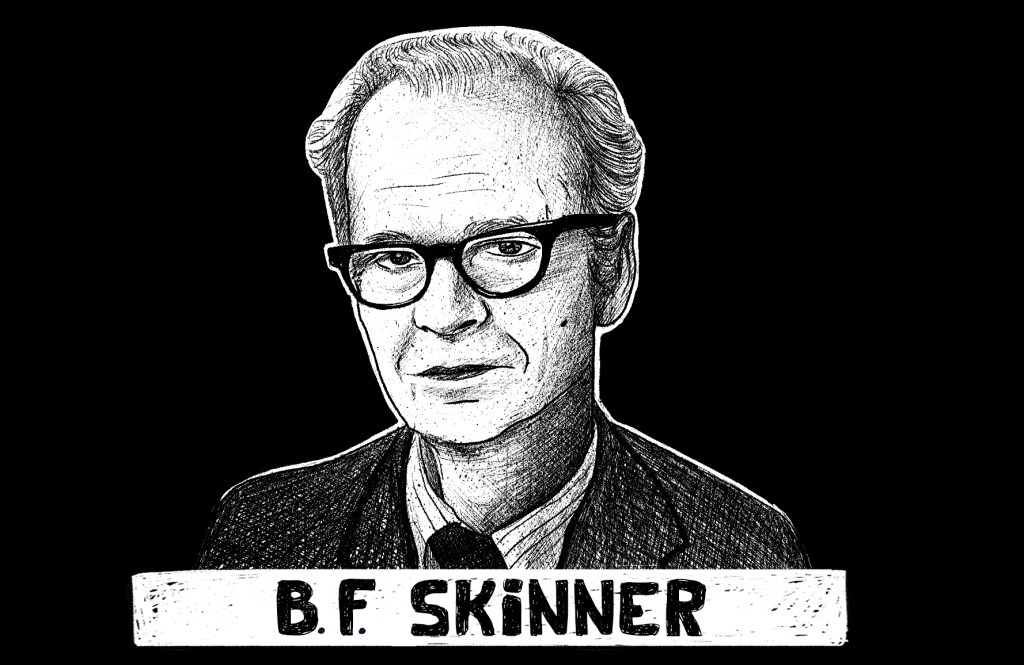
B.F Skinner is considered one of the most influential psychologist of this era. He studied human aspects and behaviourism of the day to day life that most of us fail to observe and put it into theory .His discovery are used till date to treat, diagnose and find solution to psychological problems. B. F. Skinner was an American psychologist best-known for his influence on behaviourism.

Early life

Burrhus Frederic Skinner was born and raised in the small town of Susquehanna, Pennsylvania. His father was a lawyer and his mother a homemaker. During high school, Skinner started to develop an interest in scientific reasoning from his extensive study of the works of Francis Bacon. After earning his undergraduate degree he decided to become a writer, a period of his life that he would later refer to as the “dark year. He wrote short newspaper articles and receiving some encouragement and mentorship from the famed poet Robert Frost. While working as a clerk at a bookstore, Skinner happened upon the works of Pavlov and Watson, which became a turning point in his life and career. Inspired by these works, Skinner decided to abandon his career as a novelist and entered the psychology graduate program at Harvard University.

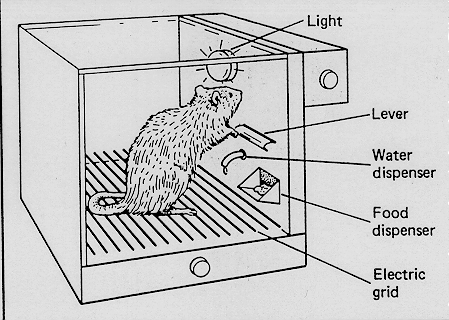
He Best Known for Operant conditioning, Schedules of Reinforcement, Skinner Box Cumulative Recorder, Radical Behaviourism. Among his many discoveries, inventions, and accomplishments were the creation of the operant conditioning chamber (aka the Skinner Box), his research on schedules of reinforcement, the introduction of response rates as a dependent variable in research, and the creation of the cumulative recorder to track these response rates. Skinner’s operant conditioning process, an operant referred to any behaviour that acts on the environment and leads to consequences. He contrasted operant behaviours (the actions under our control) with respondent behaviours, which he described as anything that occurs reflexively or automatically such as jerking your finger back when you accidentally touch a hot pan.

Operant conditioning and experiments

Skinner identified reinforcement as any event that strengthens the behaviour it follows. The two types of reinforcement he identified were positive reinforcement (favorable outcomes such as reward or praise) and negative reinforcement (the removal of unfavourable outcomes).Punishment can also play a role in the operant conditioning process.

Skinner distinguishes between two types of behaviour respondent and operant. Respondent behaviour is directly under the control of a stimulus. Operant behaviour appears to be spontaneous rather than a response to specific stimulus .Stimulus that may influence operant behaviour is called discriminative stimulus the word operant derived from the fact that operant behaviour of the rates and the environment to produce some effect. Thus, the telephone rings going to where it is and receiving our operant acts that lead to a telephonic conversation. To demonstrate operant conditioning in the laboratory, a rat is placed in a box called the skinner box that is deprived of food for some specified period and so was assumed to be motivated by hunger drive inside the Skinner box there is a protruding bar with the food dish beneath that small light bulb above the bar can be lit at the experimenters discretion. Left alone in the box, the rat move absolutely restlessly and by chance occasionally presses the bar. The rate at which it first pushes the bar defines the preconditioned of operant level of bar pressing after establishing the opponent level the experimental attaches the food dispenser so that every time the rat presses the bar, a palette of food falls into the dish. The rat eats and soon presses the bar again. The food reinforces by pressing and the rate of pressing increases dramatically. If the food dispenser is disconnected and pressing the bad no longer no longer delivers would the rate of bar pressing will diminish .Experimenter can set up a discrimination by presenting food if the bar is pressed while the light is on and not giving these reinforcement if the response is made in the dark. Selective reinforcement leads to the rats pressing the bar only in the presence of light operant conditioning refers to the increase in the probability of response in a particular stimulus environment by following the response with reinforcement. Usually reinforcement is something that can satisfy a basic drive like food to satisfy your hunger. Operant behaviour is consequences that lead to change in voluntary behaviour person.

Operant conditioning is not just something that takes place in experimental settings while training lab animals. It also plays a powerful role in everyday learning. Reinforcement and punishment take place in natural settings all the time, as well as in more structured settings such as classrooms or therapy sessions. Examples in real life include-     Homework Completion-A student tends to complete his/her homework daily; because he/she knows that he/she will be rewarded with a candy (action) or praise (behaviour). Incentives and Bonus-Workers are often offered with the incentives and bonus in return of completing their targets in time or for regular attendance. It makes the workers to perform better, so that, they can continuously get those incentives and bonus.

Operant conditioning by B.F Skinner

B.F Skinner is considered one of the most influential psychologist of this era. He studied human aspects and behaviourism of the day to day life that most of us fail to observe and put it into theory .His discovery are used till date to treat, diagnose and find solution to psychological problems. B. F. Skinner was an American psychologist best-known for his influence on behaviourism.

Early life

Burrhus Frederic Skinner was born and raised in the small town of Susquehanna, Pennsylvania. His father was a lawyer and his mother a homemaker. During high school, Skinner started to develop an interest in scientific reasoning from his extensive study of the works of Francis Bacon. After earning his undergraduate degree he decided to become a writer, a period of his life that he would later refer to as the “dark year. He wrote short newspaper articles and receiving some encouragement and mentorship from the famed poet Robert Frost. While working as a clerk at a bookstore, Skinner happened upon the works of Pavlov and Watson, which became a turning point in his life and career. Inspired by these works, Skinner decided to abandon his career as a novelist and entered the psychology graduate program at Harvard University.

He Best Known for Operant conditioning, Schedules of Reinforcement, Skinner Box Cumulative Recorder, Radical Behaviourism. Among his many discoveries, inventions, and accomplishments were the creation of the operant conditioning chamber (aka the Skinner Box), his research on schedules of reinforcement, the introduction of response rates as a dependent variable in research, and the creation of the cumulative recorder to track these response rates. Skinner’s operant conditioning process, an operant referred to any behaviour that acts on the environment and leads to consequences. He contrasted operant behaviours (the actions under our control) with respondent behaviours, which he described as anything that occurs reflexively or automatically such as jerking your finger back when you accidentally touch a hot pan.

Operant conditioning and experiments

Skinner identified reinforcement as any event that strengthens the behaviour it follows. The two types of reinforcement he identified were positive reinforcement (favorable outcomes such as reward or praise) and negative reinforcement (the removal of unfavourable outcomes).Punishment can also play a role in the operant conditioning process.

Skinner distinguishes between two types of behaviour respondent and operant. Respondent behaviour is directly under the control of a stimulus. Operant behaviour appears to be spontaneous rather than a response to specific stimulus .Stimulus that may influence operant behaviour is called discriminative stimulus the word operant derived from the fact that operant behaviour of the rates and the environment to produce some effect. Thus, the telephone rings going to where it is and receiving our operant acts that lead to a telephonic conversation. To demonstrate operant conditioning in the laboratory, a rat is placed in a box called the skinner box that is deprived of food for some specified period and so was assumed to be motivated by hunger drive inside the Skinner box there is a protruding bar with the food dish beneath that small light bulb above the bar can be lit at the experimenters discretion. Left alone in the box, the rat move absolutely restlessly and by chance occasionally presses the bar. The rate at which it first pushes the bar defines the preconditioned of operant level of bar pressing after establishing the opponent level the experimental attaches the food dispenser so that every time the rat presses the bar, a palette of food falls into the dish. The rat eats and soon presses the bar again. The food reinforces by pressing and the rate of pressing increases dramatically. If the food dispenser is disconnected and pressing the bad no longer no longer delivers would the rate of bar pressing will diminish .Experimenter can set up a discrimination by presenting food if the bar is pressed while the light is on and not giving these reinforcement if the response is made in the dark. Selective reinforcement leads to the rats pressing the bar only in the presence of light operant conditioning refers to the increase in the probability of response in a particular stimulus environment by following the response with reinforcement. Usually reinforcement is something that can satisfy a basic drive like food to satisfy your hunger. Operant behaviour is consequences that lead to change in voluntary behaviour person.

Operant conditioning is not just something that takes place in experimental settings while training lab animals. It also plays a powerful role in everyday learning. Reinforcement and punishment take place in natural settings all the time, as well as in more structured settings such as classrooms or therapy sessions. Examples in real life include-     Homework Completion-A student tends to complete his/her homework daily; because he/she knows that he/she will be rewarded with a candy (action) or praise (behaviour). Incentives and Bonus-Workers are often offered with the incentives and bonus in return of completing their targets in time or for regular attendance. It makes the workers to perform better, so that, they can continuously get those incentives and bonus.

Why is it so difficult to reach towards Humane level?

Today I will ask some questions to you and to myself because I was at that phase of life where I saw the time which was extremely uncomfortable and faced constant heavy stress.

Why we always wants to win why we cannot focus on process and learning something new?

Why we cannot stop judging others why we cannot believe anybody can inspire us whether it is a merchant or a homeless because one must learn from the unspoken or unheard experience of others?

Why we think only “successful” can motivate us?

Why we cannot help anybody just only because that person need help?

Why we think too much about success what is a meaning of success? Materialistic happiness or inner happiness?

Why we constantly avoid the real human interaction why we are not bother about the person & how this person is feeling?

Why judgements become prominent in our society why we love degrading and humiliating others?

Why we lost faith in love and humanity. Why we fake our love to others why we cannot love anybody genuinely?

Why we always trying to prove a point that we are worthy via social media?

Why validation is significant and criticism is insignificant?

Why we loosing Empathy why saying something good to others demands that we need to be close to that person?

Why we have several kinds of uncertain modes. I would call this modes because these expression of mouth and gestures cannot be emotions.

I will not give you any advice :

Be kind
Have compassion
Think before speak blah blah…
Because we already knows these traits but somehow forget to feel. I can understand we are living in really fast pace world where nobody doesn’t bother or interested to know anything about others unless we are not indulge in one incredible activity “Gossip”.

In the end, I just say this is a life we all fail and rise at some point of it. So stop judging. Make mistakes but never forget to learn and improve. Don’t be afraid to fail big to dream big , but remember dreams without goals just dreams and they ultimately fuel disappointment – Denzel Washington”

Don’t be afraid to fail big to dream big , but remember dreams without goals just dreams and they ultimately fuel disappointment – Denzel Washington”

Why is it so difficult to reach towards Humane level?

Today I will ask some questions to you and to myself because I was at that phase of life where I saw the time which was extremely uncomfortable and faced constant heavy stress.

Why we always wants to win why we cannot focus on process and learning something new?

Why we cannot stop judging others why we cannot believe anybody can inspire us whether it is a merchant or a homeless because one must learn from the unspoken or unheard experience of others?

Why we think only “successful” can motivate us?

Why we cannot help anybody just only because that person need help?

Why we think too much about success what is a meaning of success? Materialistic happiness or inner happiness?

Why we constantly avoid the real human interaction why we are not bother about the person & how this person is feeling?

Why judgements become prominent in our society why we love degrading and humiliating others?

Why we lost faith in love and humanity. Why we fake our love to others why we cannot love anybody genuinely?

Why we always trying to prove a point that we are worthy via social media?

Why validation is significant and criticism is insignificant?

Why we loosing Empathy why saying something good to others demands that we need to be close to that person?

Why we have several kinds of uncertain modes. I would call this modes because these expression of mouth and gestures cannot be emotions.

I will not give you any advice :

Be kind
Have compassion
Think before speak blah blah…
Because we already knows these traits but somehow forget to feel. I can understand we are living in really fast pace world where nobody doesn’t bother or interested to know anything about others unless we are not indulge in one incredible activity “Gossip”.

In the end, I just say this is a life we all fail and rise at some point of it. So stop judging. Make mistakes but never forget to learn and improve. Don’t be afraid to fail big to dream big , but remember dreams without goals just dreams and they ultimately fuel disappointment – Denzel Washington”

Don’t be afraid to fail big to dream big , but remember dreams without goals just dreams and they ultimately fuel disappointment – Denzel Washington”

Reasons for the failure of the Policy Implementation

Policy Implementation is the soul of Administration and Public Policy, one of the problem with Policy making in India is extreme fragmentation in the structure that fragmentation fails to acknowledge the action taken in one area have implications on another and may work at Cross purpose with policies of other sector. Implementation is not automatic that is more structured and scheduled. Implementation works as make or break the deal of Public Policy.

Effective implementation requires a chain of command, and the capacity to coordinate and control; often there are shortfalls in this exercise, more so in a developing country like India. Problem in the implementation of Policy are common in all countries, be they developed or developing. Even with relatively good administrative structure, Public Policy does not have it’s intended impact due to conceptual and political problem. Implementation deficit may be due to insufficiency of the requisite resources – of time, money or manpower.
Let’s discuss the implementation problem under the headings:

1) Conceptualization Issue of Policy Implementation

Conceptual Problem become the most crucial step in Policy Implementation that holds the high capacity to hinder the implementation. Understanding the nature of contextual problems, acknowledgement to those kind of policies and procedures which can address the inside problems. These conceptual problem majorly related to Policy design and anaylsis conflicts.

Policy Design Conflict

Hogwood and Gunn stressed if at the stage of Policy design, attention is given to potential problems of implementation; successful outcome will increased. In order to avoid major shortcomings in implementation take care of few preposition that prescribed by Hogwood and Gunn and Policy makers must ensure that:

A) Adequate time and sufficient resources are made available to the programme

B) No constraints in terms of overall resources, and even at each stage in the implementation process.

C) Policy must based on valid theory of cause and effect.

D) Single implementation agency that need not depend upon other agencies for success.

E) Good communication among co – ordination, various elements involved in the programme

The problem of Policy design in Poli design include ambiguous and ill – defined objective and inappropriate measure to achieve the stated goals. Lack of adequate political will, sufficient social support are other reason. For example, National Water Policy (NWP) adopted by Water Resource Council in 1987 was a wanted step in the direction of evolving national consensus. But, because of poor design remained unimplemented. NWP lacks the blue print

Policy Analysis Conflict

Implementation of Public Policy has also been hampered by conceptual weaknesses of Policy anaylsis. For instance, National health Policy (1983) was adopted without considering alternative Policy option. This inability to set priorities and evolve appropriate strategies for reduction in health problems by the state department

Policy Statement Conflict

Policy statement announced by the government contain ambiguous and contradictory terms, posing problems in implementation. The implementers at the field level often face a variety of issues because the policy statement lack clarity. Consequently, implementers use their own discretion while implementing them or they refer the statement back to the higher paths of Administration for clarification.

2) Political Pressure

Political Pressure in implementation always been evident and complex. This kind of pressure cannot let bureaucracy to work efficiently.

• Centralisation of Policy Process

Tassel between Central and state government relation has affected the policy implementation process adversely. Environment protection is heavily centralized. Although the central government has been enthusiastic in adopting innovative population, health, education and environmental policies and programmes as a result, health or environment quality has hardly improved in terms of availability of safe water, clean air, and provision of healthy living conditions.

• Unionisation of Bureaucracy

Another important of failure of Policy implementation is due to the Unionisation of civil services, at the lower level in particular. This has destroyed not only the work culture and discipline, but it also demoralized considerably the supervisory levels into withdrawal and promoting them to take least resistance. Higher and middle levels of bureaucracy are not so powerful and marginalized to give any relief to citizen in cases of corruption. Further, political interference by the political executive has compounded the marginalisation of higher bureaucracy thereby undermining it’s capacity to implement Public policies effectively.

• Politics of Interest Group

Many times, it is observed that the policies are not implemented because of to satisfy the interest groups. For example, several industries have little concern about environmental consequences of sitting decisions; industrialist influence the environmental Policy implementation process either directly or through business lobbies and representative of the business interests concerned. Pressure by industrial association during consideration of Environmental Protection Act in parliament resulted in a weakening of government and also forced the government to delay enforcement of enacted legislation. They are links with elites of ruling parties. It’s is, common for exertion of political influence in the environmental Policy process.

3) Bureaucratic Incompentency

Christopher Hood uses the term ‘Perfect administration’ in comparison to comparison to ‘Use of Perfect Competition’. He defines ‘ Perfect administration’ as a condition in which external elements of resources availability and political acceptability combine with administration to produce Perfect policy implementation.

• Lack of Adequate Institutional Capacity

The institutional structure and administrative capabilities for implementation of environmental laws and policies, for example, by no means Adequate in terms of political, social, and economic problem. Institutional structure includes the whole system of rules and regulations by which administrative tasks and responsibilities are clearly defined and juxtaposed with the capabilities of the administrators concerned. Let’s understand by example, when 30 industrial units, including few MNCs in West Bengal failed to comply with environment laws, the supreme Court had to play the role of the executive. In 1995 two judge bench of supreme Court expressed ” these multinational concerns have huge resources yet they are not bothered about protecting the environment”.

• Lack of Personnel and Financial Resources

Many policies will diffuse because of insufficient staff and lack of financial resources. Policies in developing nation have not been implemented in full scale owing to lack of trained staff. Well structured policies fail to attain the proper goals without competent Personnel. Implementation implies allocating personnel resources to the appropriate tasks and activities tasks and activities, motivating them to do well rewarding them for action. Regardless of their status, specialized knowledge, experience and qualifications, the programme personnel need to work as a cohesive team for the purpose of achieving policy results.

• Working under heavy pressure of Time

Pressure of time often creates the implementation gap. While fixing the time frame, the policy formulators do not take into consideration the prevailing conditions. The implementation agencies under pressure are unable to fulfill the targets allocated under the said Policy.

• No Administrative Will and Motivation

Without the conscious cooperation of implementers, nothing can be done. It is responsiblity of government to ensure the working conditions for implementers so that they will not lost their interest. Social policies have remained unimplemented largely for lack of administrative will and motivation. In current environment, officials are not likely to feel enthusiastic about implementing policies. Even when officials willing to implement environment laws, government undermined by manoeuvre of industrial bigwigs. Many of them fall to the dominance of economic interests and monetary temptations end up in formal enforcement of the regulation.

Cooperation and Coordination

Poor coordination and missing links among the administrative agencies have stood in the way of adequate and appropriate Policy actions. For example, at the administrative level, different department are concerned with implementing policies related to poverty alleviation programme. Gap in Policy implementation are found in population and family planning programme.

Lack of people’s participation

Public involvement in Policy Implementation such as education, population control, health, pollution control and forest conservation etc have tremendous pressure on administrative staff to cultivate results. By demonstration, protest and Public has tried to offset the power base of interest groups and lobbies that influence Policy Implementation in their favour.

The strength and endurance of the people’s movement for implementing and enforcing regulations have not been a link to that vests interest.

Conditions for proper implementation

W. William inakes an attempt to identify ways in which Policy failure can be prevented. He exhorst policy makers to pay more attention to implementation capacity like must underline few questions:

I) How capable are Policy makers in developing meaningful guidelines for and assistance to implementers?

II) How capable are implementers to do their work efficiently?

III) How well implementer articulated the Public Policy?

Mazmanian and Sabatier formulate a sufficient conditions of effective implementation;

I) The enabling legislation mandates Policy objective that are clear and consistent or at least provides substantive criteria for resolving goal conflicts.

II) The leaders of the implementing agency possess substantial managerial and Political skills. They are committed to statutory goals.

III) The programme is actively supported by organized constituency groups and key through out the implementation process, with the courts being neutral and supportive.

IV) The relative priority of statutory objective is not undermined overtime by emergence of conflicts of Public policies or by changes in relevant socio – economic conditions that weaken the statute’ s casual theory or political support.

Conclusion

Policy Implementation requires a wide variety of actions, including issuing Policy directives that are clear and consistent; creating organisational structure and assigning personnel with the information and authority necessary to administer the policies; coordinating personnel, resources and expenditure to ensure benefits for target groups and evaluating actions of personnel regarding implementation. Therefore, serious efforts are required for Policy Implementation at the level of Policy making itself, because it’s starts from beginning right from the policy making stage.

There’s tremendous gap between Public opinion and Public PolicyNoam Chomsky

Reasons for the failure of the Policy Implementation

Policy Implementation is the soul of Administration and Public Policy, one of the problem with Policy making in India is extreme fragmentation in the structure that fragmentation fails to acknowledge the action taken in one area have implications on another and may work at Cross purpose with policies of other sector. Implementation is not automatic that is more structured and scheduled. Implementation works as make or break the deal of Public Policy.

Effective implementation requires a chain of command, and the capacity to coordinate and control; often there are shortfalls in this exercise, more so in a developing country like India. Problem in the implementation of Policy are common in all countries, be they developed or developing. Even with relatively good administrative structure, Public Policy does not have it’s intended impact due to conceptual and political problem. Implementation deficit may be due to insufficiency of the requisite resources – of time, money or manpower.
Let’s discuss the implementation problem under the headings:

1) Conceptualization Issue of Policy Implementation

Conceptual Problem become the most crucial step in Policy Implementation that holds the high capacity to hinder the implementation. Understanding the nature of contextual problems, acknowledgement to those kind of policies and procedures which can address the inside problems. These conceptual problem majorly related to Policy design and anaylsis conflicts.

Policy Design Conflict

Hogwood and Gunn stressed if at the stage of Policy design, attention is given to potential problems of implementation; successful outcome will increased. In order to avoid major shortcomings in implementation take care of few preposition that prescribed by Hogwood and Gunn and Policy makers must ensure that:

A) Adequate time and sufficient resources are made available to the programme

B) No constraints in terms of overall resources, and even at each stage in the implementation process.

C) Policy must based on valid theory of cause and effect.

D) Single implementation agency that need not depend upon other agencies for success.

E) Good communication among co – ordination, various elements involved in the programme

The problem of Policy design in Poli design include ambiguous and ill – defined objective and inappropriate measure to achieve the stated goals. Lack of adequate political will, sufficient social support are other reason. For example, National Water Policy (NWP) adopted by Water Resource Council in 1987 was a wanted step in the direction of evolving national consensus. But, because of poor design remained unimplemented. NWP lacks the blue print

Policy Analysis Conflict

Implementation of Public Policy has also been hampered by conceptual weaknesses of Policy anaylsis. For instance, National health Policy (1983) was adopted without considering alternative Policy option. This inability to set priorities and evolve appropriate strategies for reduction in health problems by the state department

Policy Statement Conflict

Policy statement announced by the government contain ambiguous and contradictory terms, posing problems in implementation. The implementers at the field level often face a variety of issues because the policy statement lack clarity. Consequently, implementers use their own discretion while implementing them or they refer the statement back to the higher paths of Administration for clarification.

2) Political Pressure

Political Pressure in implementation always been evident and complex. This kind of pressure cannot let bureaucracy to work efficiently.

• Centralisation of Policy Process

Tassel between Central and state government relation has affected the policy implementation process adversely. Environment protection is heavily centralized. Although the central government has been enthusiastic in adopting innovative population, health, education and environmental policies and programmes as a result, health or environment quality has hardly improved in terms of availability of safe water, clean air, and provision of healthy living conditions.

• Unionisation of Bureaucracy

Another important of failure of Policy implementation is due to the Unionisation of civil services, at the lower level in particular. This has destroyed not only the work culture and discipline, but it also demoralized considerably the supervisory levels into withdrawal and promoting them to take least resistance. Higher and middle levels of bureaucracy are not so powerful and marginalized to give any relief to citizen in cases of corruption. Further, political interference by the political executive has compounded the marginalisation of higher bureaucracy thereby undermining it’s capacity to implement Public policies effectively.

• Politics of Interest Group

Many times, it is observed that the policies are not implemented because of to satisfy the interest groups. For example, several industries have little concern about environmental consequences of sitting decisions; industrialist influence the environmental Policy implementation process either directly or through business lobbies and representative of the business interests concerned. Pressure by industrial association during consideration of Environmental Protection Act in parliament resulted in a weakening of government and also forced the government to delay enforcement of enacted legislation. They are links with elites of ruling parties. It’s is, common for exertion of political influence in the environmental Policy process.

3) Bureaucratic Incompentency

Christopher Hood uses the term ‘Perfect administration’ in comparison to comparison to ‘Use of Perfect Competition’. He defines ‘ Perfect administration’ as a condition in which external elements of resources availability and political acceptability combine with administration to produce Perfect policy implementation.

• Lack of Adequate Institutional Capacity

The institutional structure and administrative capabilities for implementation of environmental laws and policies, for example, by no means Adequate in terms of political, social, and economic problem. Institutional structure includes the whole system of rules and regulations by which administrative tasks and responsibilities are clearly defined and juxtaposed with the capabilities of the administrators concerned. Let’s understand by example, when 30 industrial units, including few MNCs in West Bengal failed to comply with environment laws, the supreme Court had to play the role of the executive. In 1995 two judge bench of supreme Court expressed ” these multinational concerns have huge resources yet they are not bothered about protecting the environment”.

• Lack of Personnel and Financial Resources

Many policies will diffuse because of insufficient staff and lack of financial resources. Policies in developing nation have not been implemented in full scale owing to lack of trained staff. Well structured policies fail to attain the proper goals without competent Personnel. Implementation implies allocating personnel resources to the appropriate tasks and activities tasks and activities, motivating them to do well rewarding them for action. Regardless of their status, specialized knowledge, experience and qualifications, the programme personnel need to work as a cohesive team for the purpose of achieving policy results.

• Working under heavy pressure of Time

Pressure of time often creates the implementation gap. While fixing the time frame, the policy formulators do not take into consideration the prevailing conditions. The implementation agencies under pressure are unable to fulfill the targets allocated under the said Policy.

• No Administrative Will and Motivation

Without the conscious cooperation of implementers, nothing can be done. It is responsiblity of government to ensure the working conditions for implementers so that they will not lost their interest. Social policies have remained unimplemented largely for lack of administrative will and motivation. In current environment, officials are not likely to feel enthusiastic about implementing policies. Even when officials willing to implement environment laws, government undermined by manoeuvre of industrial bigwigs. Many of them fall to the dominance of economic interests and monetary temptations end up in formal enforcement of the regulation.

Cooperation and Coordination

Poor coordination and missing links among the administrative agencies have stood in the way of adequate and appropriate Policy actions. For example, at the administrative level, different department are concerned with implementing policies related to poverty alleviation programme. Gap in Policy implementation are found in population and family planning programme.

Lack of people’s participation

Public involvement in Policy Implementation such as education, population control, health, pollution control and forest conservation etc have tremendous pressure on administrative staff to cultivate results. By demonstration, protest and Public has tried to offset the power base of interest groups and lobbies that influence Policy Implementation in their favour.

The strength and endurance of the people’s movement for implementing and enforcing regulations have not been a link to that vests interest.

Conditions for proper implementation

W. William inakes an attempt to identify ways in which Policy failure can be prevented. He exhorst policy makers to pay more attention to implementation capacity like must underline few questions:

I) How capable are Policy makers in developing meaningful guidelines for and assistance to implementers?

II) How capable are implementers to do their work efficiently?

III) How well implementer articulated the Public Policy?

Mazmanian and Sabatier formulate a sufficient conditions of effective implementation;

I) The enabling legislation mandates Policy objective that are clear and consistent or at least provides substantive criteria for resolving goal conflicts.

II) The leaders of the implementing agency possess substantial managerial and Political skills. They are committed to statutory goals.

III) The programme is actively supported by organized constituency groups and key through out the implementation process, with the courts being neutral and supportive.

IV) The relative priority of statutory objective is not undermined overtime by emergence of conflicts of Public policies or by changes in relevant socio – economic conditions that weaken the statute’ s casual theory or political support.

Conclusion

Policy Implementation requires a wide variety of actions, including issuing Policy directives that are clear and consistent; creating organisational structure and assigning personnel with the information and authority necessary to administer the policies; coordinating personnel, resources and expenditure to ensure benefits for target groups and evaluating actions of personnel regarding implementation. Therefore, serious efforts are required for Policy Implementation at the level of Policy making itself, because it’s starts from beginning right from the policy making stage.

There’s tremendous gap between Public opinion and Public PolicyNoam Chomsky

Why should I choose an engineering stream?

<!–
/* Style Definitions */
p.MsoNormal, li.MsoNormal, div.MsoNormal
{mso-style-unhide:no;
mso-style-qformat:yes;
mso-style-parent:””;
margin-top:0cm;
margin-right:0cm;
margin-bottom:10.0pt;
margin-left:0cm;
line-height:115%;
mso-pagination:widow-orphan;
font-size:11.0pt;
font-family:”Calibri”,sans-serif;
mso-ascii-font-family:Calibri;
mso-ascii-theme-font:minor-latin;
mso-fareast-font-family:Calibri;
mso-fareast-theme-font:minor-latin;
mso-hansi-font-family:Calibri;
mso-hansi-theme-font:minor-latin;
mso-bidi-font-family:”Times New Roman”;
mso-bidi-theme-font:minor-bidi;
mso-ansi-language:EN-US;
mso-fareast-language:EN-US;}
p
{mso-style-priority:99;
mso-margin-top-alt:auto;
margin-right:0cm;
mso-margin-bottom-alt:auto;
margin-left:0cm;
mso-pagination:widow-orphan;
font-size:12.0pt;
font-family:”Times New Roman”,serif;
mso-fareast-font-family:”Times New Roman”;
mso-ansi-language:EN-US;
mso-fareast-language:EN-US;}
p.MsoListParagraph, li.MsoListParagraph, div.MsoListParagraph
{mso-style-priority:34;
mso-style-unhide:no;
mso-style-qformat:yes;
margin-top:0cm;
margin-right:0cm;
margin-bottom:10.0pt;
margin-left:36.0pt;
mso-add-space:auto;
line-height:115%;
mso-pagination:widow-orphan;
font-size:11.0pt;
font-family:”Calibri”,sans-serif;
mso-ascii-font-family:Calibri;
mso-ascii-theme-font:minor-latin;
mso-fareast-font-family:Calibri;
mso-fareast-theme-font:minor-latin;
mso-hansi-font-family:Calibri;
mso-hansi-theme-font:minor-latin;
mso-bidi-font-family:”Times New Roman”;
mso-bidi-theme-font:minor-bidi;
mso-ansi-language:EN-US;
mso-fareast-language:EN-US;}
p.MsoListParagraphCxSpFirst, li.MsoListParagraphCxSpFirst, div.MsoListParagraphCxSpFirst
{mso-style-priority:34;
mso-style-unhide:no;
mso-style-qformat:yes;
mso-style-type:export-only;
margin-top:0cm;
margin-right:0cm;
margin-bottom:0cm;
margin-left:36.0pt;
mso-add-space:auto;
line-height:115%;
mso-pagination:widow-orphan;
font-size:11.0pt;
font-family:”Calibri”,sans-serif;
mso-ascii-font-family:Calibri;
mso-ascii-theme-font:minor-latin;
mso-fareast-font-family:Calibri;
mso-fareast-theme-font:minor-latin;
mso-hansi-font-family:Calibri;
mso-hansi-theme-font:minor-latin;
mso-bidi-font-family:”Times New Roman”;
mso-bidi-theme-font:minor-bidi;
mso-ansi-language:EN-US;
mso-fareast-language:EN-US;}
p.MsoListParagraphCxSpMiddle, li.MsoListParagraphCxSpMiddle, div.MsoListParagraphCxSpMiddle
{mso-style-priority:34;
mso-style-unhide:no;
mso-style-qformat:yes;
mso-style-type:export-only;
margin-top:0cm;
margin-right:0cm;
margin-bottom:0cm;
margin-left:36.0pt;
mso-add-space:auto;
line-height:115%;
mso-pagination:widow-orphan;
font-size:11.0pt;
font-family:”Calibri”,sans-serif;
mso-ascii-font-family:Calibri;
mso-ascii-theme-font:minor-latin;
mso-fareast-font-family:Calibri;
mso-fareast-theme-font:minor-latin;
mso-hansi-font-family:Calibri;
mso-hansi-theme-font:minor-latin;
mso-bidi-font-family:”Times New Roman”;
mso-bidi-theme-font:minor-bidi;
mso-ansi-language:EN-US;
mso-fareast-language:EN-US;}
p.MsoListParagraphCxSpLast, li.MsoListParagraphCxSpLast, div.MsoListParagraphCxSpLast
{mso-style-priority:34;
mso-style-unhide:no;
mso-style-qformat:yes;
mso-style-type:export-only;
margin-top:0cm;
margin-right:0cm;
margin-bottom:10.0pt;
margin-left:36.0pt;
mso-add-space:auto;
line-height:115%;
mso-pagination:widow-orphan;
font-size:11.0pt;
font-family:”Calibri”,sans-serif;
mso-ascii-font-family:Calibri;
mso-ascii-theme-font:minor-latin;
mso-fareast-font-family:Calibri;
mso-fareast-theme-font:minor-latin;
mso-hansi-font-family:Calibri;
mso-hansi-theme-font:minor-latin;
mso-bidi-font-family:”Times New Roman”;
mso-bidi-theme-font:minor-bidi;
mso-ansi-language:EN-US;
mso-fareast-language:EN-US;}
.MsoChpDefault
{mso-style-type:export-only;
mso-default-props:yes;
font-size:11.0pt;
mso-ansi-font-size:11.0pt;
mso-bidi-font-size:11.0pt;
font-family:”Calibri”,sans-serif;
mso-ascii-font-family:Calibri;
mso-ascii-theme-font:minor-latin;
mso-fareast-font-family:Calibri;
mso-fareast-theme-font:minor-latin;
mso-hansi-font-family:Calibri;
mso-hansi-theme-font:minor-latin;
mso-bidi-font-family:”Times New Roman”;
mso-bidi-theme-font:minor-bidi;
mso-ansi-language:EN-US;
mso-fareast-language:EN-US;}
.MsoPapDefault
{mso-style-type:export-only;
margin-bottom:10.0pt;
line-height:115%;}
@page WordSection1
{size:612.0pt 792.0pt;
margin:72.0pt 72.0pt 72.0pt 72.0pt;
mso-header-margin:36.0pt;
mso-footer-margin:36.0pt;
mso-paper-source:0;}
div.WordSection1
{page:WordSection1;}
/* List Definitions */
@list l0
{mso-list-id:1025138763;
mso-list-type:hybrid;
mso-list-template-ids:-710637844 67698697 67698691 67698693 67698689 67698691 67698693 67698689 67698691 67698693;}
@list l0:level1
{mso-level-number-format:bullet;
mso-level-text:;
mso-level-tab-stop:none;
mso-level-number-position:left;
margin-left:39.75pt;
text-indent:-18.0pt;
font-family:Wingdings;}
@list l0:level2
{mso-level-number-format:bullet;
mso-level-text:o;
mso-level-tab-stop:none;
mso-level-number-position:left;
margin-left:75.75pt;
text-indent:-18.0pt;
font-family:”Courier New”;}
@list l0:level3
{mso-level-number-format:bullet;
mso-level-text:;
mso-level-tab-stop:none;
mso-level-number-position:left;
margin-left:111.75pt;
text-indent:-18.0pt;
font-family:Wingdings;}
@list l0:level4
{mso-level-number-format:bullet;
mso-level-text:;
mso-level-tab-stop:none;
mso-level-number-position:left;
margin-left:147.75pt;
text-indent:-18.0pt;
font-family:Symbol;}
@list l0:level5
{mso-level-number-format:bullet;
mso-level-text:o;
mso-level-tab-stop:none;
mso-level-number-position:left;
margin-left:183.75pt;
text-indent:-18.0pt;
font-family:”Courier New”;}
@list l0:level6
{mso-level-number-format:bullet;
mso-level-text:;
mso-level-tab-stop:none;
mso-level-number-position:left;
margin-left:219.75pt;
text-indent:-18.0pt;
font-family:Wingdings;}
@list l0:level7
{mso-level-number-format:bullet;
mso-level-text:;
mso-level-tab-stop:none;
mso-level-number-position:left;
margin-left:255.75pt;
text-indent:-18.0pt;
font-family:Symbol;}
@list l0:level8
{mso-level-number-format:bullet;
mso-level-text:o;
mso-level-tab-stop:none;
mso-level-number-position:left;
margin-left:291.75pt;
text-indent:-18.0pt;
font-family:”Courier New”;}
@list l0:level9
{mso-level-number-format:bullet;
mso-level-text:;
mso-level-tab-stop:none;
mso-level-number-position:left;
margin-left:327.75pt;
text-indent:-18.0pt;
font-family:Wingdings;}
@list l1
{mso-list-id:1418016799;
mso-list-type:hybrid;
mso-list-template-ids:-1155604928 67698699 67698691 67698693 67698689 67698691 67698693 67698689 67698691 67698693;}
@list l1:level1
{mso-level-number-format:bullet;
mso-level-text:;
mso-level-tab-stop:none;
mso-level-number-position:left;
margin-left:44.75pt;
text-indent:-18.0pt;
font-family:Wingdings;}
@list l1:level2
{mso-level-number-format:bullet;
mso-level-text:o;
mso-level-tab-stop:none;
mso-level-number-position:left;
margin-left:80.75pt;
text-indent:-18.0pt;
font-family:”Courier New”;}
@list l1:level3
{mso-level-number-format:bullet;
mso-level-text:;
mso-level-tab-stop:none;
mso-level-number-position:left;
margin-left:116.75pt;
text-indent:-18.0pt;
font-family:Wingdings;}
@list l1:level4
{mso-level-number-format:bullet;
mso-level-text:;
mso-level-tab-stop:none;
mso-level-number-position:left;
margin-left:152.75pt;
text-indent:-18.0pt;
font-family:Symbol;}
@list l1:level5
{mso-level-number-format:bullet;
mso-level-text:o;
mso-level-tab-stop:none;
mso-level-number-position:left;
margin-left:188.75pt;
text-indent:-18.0pt;
font-family:”Courier New”;}
@list l1:level6
{mso-level-number-format:bullet;
mso-level-text:;
mso-level-tab-stop:none;
mso-level-number-position:left;
margin-left:224.75pt;
text-indent:-18.0pt;
font-family:Wingdings;}
@list l1:level7
{mso-level-number-format:bullet;
mso-level-text:;
mso-level-tab-stop:none;
mso-level-number-position:left;
margin-left:260.75pt;
text-indent:-18.0pt;
font-family:Symbol;}
@list l1:level8
{mso-level-number-format:bullet;
mso-level-text:o;
mso-level-tab-stop:none;
mso-level-number-position:left;
margin-left:296.75pt;
text-indent:-18.0pt;
font-family:”Courier New”;}
@list l1:level9
{mso-level-number-format:bullet;
mso-level-text:;
mso-level-tab-stop:none;
mso-level-number-position:left;
margin-left:332.75pt;
text-indent:-18.0pt;
font-family:Wingdings;}

–>

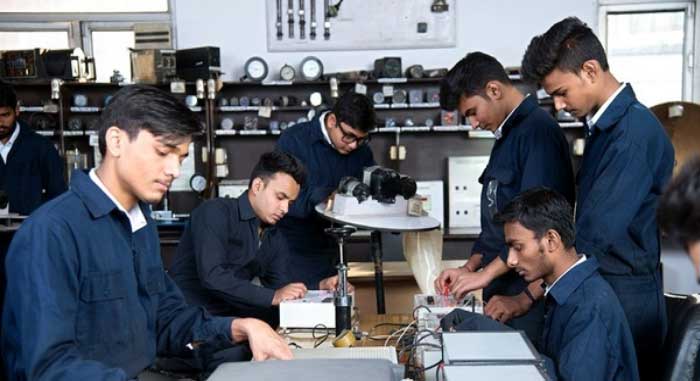
Engineering is a popular and one of the most sought after courses for students who have completed Class 12, especially for students from the Science stream


  The various streams of engineering can be broadly classified into 6 major branches, namely: Mechanical, Chemical, Civil, Electrical, Management, and Geotechnical.

What is the role of engineering in society?

                  Engineers are in every field. There is an engineer behind every beautiful and wonderful building. The technology we are using today, automobiles, machines, spaceships, communication system and many are built by an engineer. Engineers make human day to day life easier and efficient. An engineer is someone who solve problem and continue learning and help many people.

              Engineering gives skills you can apply everywhere. If you’re an engineer you can work for an MNC or an IT company or you can start a business, or to be consultant in a legal company. It gives an option to switch a career if you want to. 


vSome of the points to look in an engineering college before joining a engineering college             

Ø Infrastructure of the college: – check the basic need like classrooms, labs playground, etc.

Ø Choosing a right stream as per your interest: – There are different types of stream like Mechanical, civil, Chemical, etc.  Choose a right stream as your taste.

Ø Placements and Internships provided by college: – Before joining engineering colleges check whether college provides internships /placements.  It is important to start doing internships since the beginning of college. This gives practical learning along with theoretical learning.  

Ø Fee structure: the fee structure depends on the college whether its government, private or semi government. You should also look whether the college provides scholarships.

Ø Extra- curricular activities: – look whether the college has extra-curricular activities. Extra-curricular activities like indoor or outdoor game which are good for mental and physical health.

Ø Entrance exam:-Check whether the college conducts any entrance exam.

Also look minimum marks to join the college. 

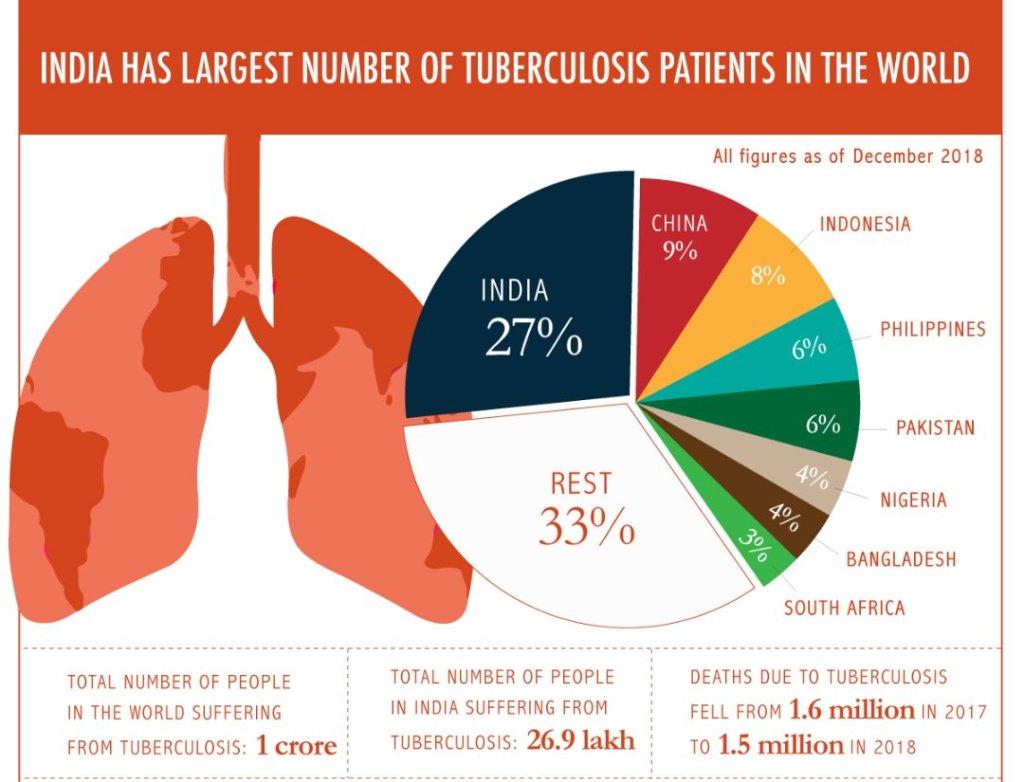
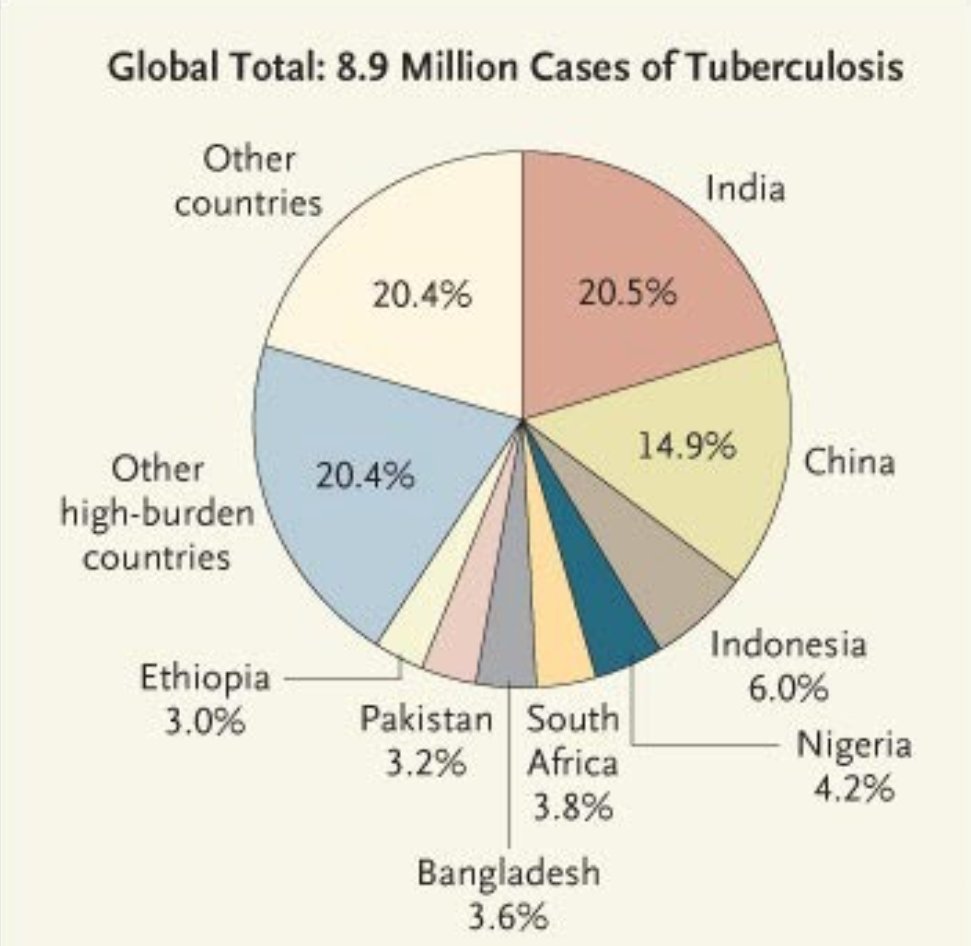
Tuberculosis in New self reliant India 2020

Source: World Health Organization

Tuberculosis is a pandemic globally become significant health threat in many countries. India top the list of having most tuberculosis patients. TB is airborne disease. Every year, India estimated TB patient is 28 lakhs, which is 27 per cent of the global total, almost 1200 TB patient die everyday, 10 every 3 minutes. In 2017, 204 TB cases per 1,00,000 encountered. India has the highest number of multi drug resistant TB (MDR-TB) cases in the world. Largest number of people living with multi resistance TB which normal dosage of Isoniziad and INH will not work on patient or first line drug of TB will not work on you.

Source: The New England Journal of Medicine NEJM

According to Health Ministry & Welfare data explain, only 63 per cent of the patients infected with airborne disease and currently under treatment. Further, 1,47,000 patients are resistant to first and second line TB medicines. World Health Organization (WHO) reported India had 2.7 million new cases and 440,000 deaths due to TB in 2018 – the highest in the world. Despite such conditions India has not implemented goal measures effectively to control the spread of TB. Imagine if we are not capable to control TB then can we measure Coronavirus? when we have paucity of hospital, less number of health workers and doctors.

HISTORY OF TUBERCULOSIS IN INDIA

Credit: Mint (Tuberculosis Patients at a Govt hospital)

For TB patients first open air isolation institution and treatment of TB patients was started in Ajmer & almore 1906. The anti TB movement in the country gained momentum with TB association of India which was established in 1939.

The Bhore committee report issued in 1946 estimated that about 2.5 million patients required treatment in the country with 6,000 beds available. National Tuberculosis Control programme (NTP) was formulated in 1962. NTP was not implemented properly then revised into National TB Control Programme (RNTCP) was developed. Sir Joseph Bhore recommended re – modelling the health services integrate curative & preventive medicine at all levels. Bhore committee was not able to reach the plan , recognizing the lack of access to basic healthcare in rural areas, National Health Policy 1993 emphasized on primary care, commitment to provide “Health to all” by the year 2000. By 2000 India still not achieved most of the goals of the national health policy.

National Health Policy by 2010 & to increase public investment from 0.9% to between 20% which is 3% of GDP. National Rural Health Mission 2005 – 2012 was launched to provide Healthcare to rural population. Special focus on 18 states who has weak Healthcare system.

MEASURES TAKEN BY GOVERNMENT
Indian government launched the TB free India campaign, Target of elimination of TB in the country by 2025. DOTS – Directory observed Treatment ,it is a strategy to diagnose the TB through sputum testing.
CBNAAT – Catridge based Nuclei acid amplification test, this test help two ways to detect TB that whether person diagnose with TB, if it is TB is it MDR or the other one first line drug. First time central TB Division (CTD) introduced a quarterly ranking of TB elimination efforts by all the states and UTs. TB preventive Therepy (TPT) give financial expenditure which include in the assessment. Saksham project provide psycho – social counseling to TB patients.

Nikshay poshan yojana (NPY) scheme made to give financial support to TB patients for their nutritional diet. The Nikshay Ecosystem is the National TB information System which is one – stop solution to collected information of patients and manage program activity & evaluate through out the country.TB Harega Desh Jeetega – This strategy launched in September 2019 for fight against TB.

ARE GOVERNMENT MEASURES GOING WELL ON GROUND LEVEL

After implementing most of the best policies are not capable to eliminate TB. India known for the fact that “poor quality of Healthcare”. There is shortage of testing centres, DOT centres, and other facilities to identify and treatment of new TB patients. GOI has set a target of zero – tuberculosis deaths by the 2025 rather should focus on zero – tuberculosis patients till 2030.

Despite all the notable measures taken by the government still needs to robust efforts to improve the early diagnose for the appropriate treatment which is significant for ending of TB. We need to expand both laboratory network as well as diagnostic facilities to cover the whole nation under the umbrella of one program National TB Elimination Programme. Private sector plays crucial role in terms of providing mandatory tuberculosis treatment quality care.

The UN sustainable development Goals (SDGs) include ending the TB epidemic by 2030 under the Goal 3. India set target to eliminate TB by 2025 ( which is five years ahead of SDGs) appears ‘unrealistic’ , ‘unattainable’ as seeing today’s condition of India which requires high quality of care to each person. We need to increase TB services for those who are not able to reach the TB centres , increase the engagement of private sector facilities and support system of universal access to drug susceptibility testing and second line TB drugs.

GOI said that new tools resulting from greater tuberculosis research & development (R&D) which is important to prevent Economic losses. 30 per cent of Indian population infected with tuberculosis. Consequently, we need accurate level of care which helps for detecting tuberculosis infection. India need close coordination between Ministry of Science & Technology , Ministry of Health and Research oriented pharmaceutical companies together to reach target to fight against the Tuberculosis. India strictly implement the strategy of finding the TB cases rather waiting for patient with TB to reach to the hospital.Under the make in India program, development of a first line anti – TB drug was proposed in public sector.

Awareness about TB and its prevention among masses is important. Media campaigns must planned under the program to promote TB preventive measures swasth E – gurukul is one such initiative of WHO.

Union Health Minister , Harsh Vardhan said:

“we as a nation, need to come together to fight against tuberculosis and the stigma surrounding it so that every TB patient seek care with dignity and without discrimination. The community must act as a well spring of support and comfort for a patient”.

Union Health Minister Harshvardhan in press conference talking about social stigma around TB;

We must talk about the social stigma attach with Tuberculosis. Association of HIV with TB estimated 9 per cent of all HIV – TB deaths in the world, the second highest number globally 92,000 HIV – TB patients were accounted on annual basis.

If GOI implement all policies wisely and evaluate them in every 6 months we can reach to attain our goal to eliminate Tuberculosis from India. In rural areas, officers must help to detect TB before it become MDR by making reports of how many people each month diagnose with TB. If we do not take serious measures now it will be difficult to achieve the set target of “elimination of TB in 2025”.

Tuberculosis in New self reliant India 2020

Source: World Health Organization

Tuberculosis is a pandemic globally become significant health threat in many countries. India top the list of having most tuberculosis patients. TB is airborne disease. Every year, India estimated TB patient is 28 lakhs, which is 27 per cent of the global total, almost 1200 TB patient die everyday, 10 every 3 minutes. In 2017, 204 TB cases per 1,00,000 encountered. India has the highest number of multi drug resistant TB (MDR-TB) cases in the world. Largest number of people living with multi resistance TB which normal dosage of Isoniziad and INH will not work on patient or first line drug of TB will not work on you.

Source: The New England Journal of Medicine NEJM

According to Health Ministry & Welfare data explain, only 63 per cent of the patients infected with airborne disease and currently under treatment. Further, 1,47,000 patients are resistant to first and second line TB medicines. World Health Organization (WHO) reported India had 2.7 million new cases and 440,000 deaths due to TB in 2018 – the highest in the world. Despite such conditions India has not implemented goal measures effectively to control the spread of TB. Imagine if we are not capable to control TB then can we measure Coronavirus? when we have paucity of hospital, less number of health workers and doctors.

HISTORY OF TUBERCULOSIS IN INDIA

Credit: Mint (Tuberculosis Patients at a Govt hospital)

For TB patients first open air isolation institution and treatment of TB patients was started in Ajmer & almore 1906. The anti TB movement in the country gained momentum with TB association of India which was established in 1939.

The Bhore committee report issued in 1946 estimated that about 2.5 million patients required treatment in the country with 6,000 beds available. National Tuberculosis Control programme (NTP) was formulated in 1962. NTP was not implemented properly then revised into National TB Control Programme (RNTCP) was developed. Sir Joseph Bhore recommended re – modelling the health services integrate curative & preventive medicine at all levels. Bhore committee was not able to reach the plan , recognizing the lack of access to basic healthcare in rural areas, National Health Policy 1993 emphasized on primary care, commitment to provide “Health to all” by the year 2000. By 2000 India still not achieved most of the goals of the national health policy.

National Health Policy by 2010 & to increase public investment from 0.9% to between 20% which is 3% of GDP. National Rural Health Mission 2005 – 2012 was launched to provide Healthcare to rural population. Special focus on 18 states who has weak Healthcare system.

MEASURES TAKEN BY GOVERNMENT
Indian government launched the TB free India campaign, Target of elimination of TB in the country by 2025. DOTS – Directory observed Treatment ,it is a strategy to diagnose the TB through sputum testing.
CBNAAT – Catridge based Nuclei acid amplification test, this test help two ways to detect TB that whether person diagnose with TB, if it is TB is it MDR or the other one first line drug. First time central TB Division (CTD) introduced a quarterly ranking of TB elimination efforts by all the states and UTs. TB preventive Therepy (TPT) give financial expenditure which include in the assessment. Saksham project provide psycho – social counseling to TB patients.

Nikshay poshan yojana (NPY) scheme made to give financial support to TB patients for their nutritional diet. The Nikshay Ecosystem is the National TB information System which is one – stop solution to collected information of patients and manage program activity & evaluate through out the country.TB Harega Desh Jeetega – This strategy launched in September 2019 for fight against TB.

ARE GOVERNMENT MEASURES GOING WELL ON GROUND LEVEL

After implementing most of the best policies are not capable to eliminate TB. India known for the fact that “poor quality of Healthcare”. There is shortage of testing centres, DOT centres, and other facilities to identify and treatment of new TB patients. GOI has set a target of zero – tuberculosis deaths by the 2025 rather should focus on zero – tuberculosis patients till 2030.

Despite all the notable measures taken by the government still needs to robust efforts to improve the early diagnose for the appropriate treatment which is significant for ending of TB. We need to expand both laboratory network as well as diagnostic facilities to cover the whole nation under the umbrella of one program National TB Elimination Programme. Private sector plays crucial role in terms of providing mandatory tuberculosis treatment quality care.

The UN sustainable development Goals (SDGs) include ending the TB epidemic by 2030 under the Goal 3. India set target to eliminate TB by 2025 ( which is five years ahead of SDGs) appears ‘unrealistic’ , ‘unattainable’ as seeing today’s condition of India which requires high quality of care to each person. We need to increase TB services for those who are not able to reach the TB centres , increase the engagement of private sector facilities and support system of universal access to drug susceptibility testing and second line TB drugs.

GOI said that new tools resulting from greater tuberculosis research & development (R&D) which is important to prevent Economic losses. 30 per cent of Indian population infected with tuberculosis. Consequently, we need accurate level of care which helps for detecting tuberculosis infection. India need close coordination between Ministry of Science & Technology , Ministry of Health and Research oriented pharmaceutical companies together to reach target to fight against the Tuberculosis. India strictly implement the strategy of finding the TB cases rather waiting for patient with TB to reach to the hospital.Under the make in India program, development of a first line anti – TB drug was proposed in public sector.

Awareness about TB and its prevention among masses is important. Media campaigns must planned under the program to promote TB preventive measures swasth E – gurukul is one such initiative of WHO.

Union Health Minister , Harsh Vardhan said:

“we as a nation, need to come together to fight against tuberculosis and the stigma surrounding it so that every TB patient seek care with dignity and without discrimination. The community must act as a well spring of support and comfort for a patient”.

Union Health Minister Harshvardhan in press conference talking about social stigma around TB;

We must talk about the social stigma attach with Tuberculosis. Association of HIV with TB estimated 9 per cent of all HIV – TB deaths in the world, the second highest number globally 92,000 HIV – TB patients were accounted on annual basis.

If GOI implement all policies wisely and evaluate them in every 6 months we can reach to attain our goal to eliminate Tuberculosis from India. In rural areas, officers must help to detect TB before it become MDR by making reports of how many people each month diagnose with TB. If we do not take serious measures now it will be difficult to achieve the set target of “elimination of TB in 2025”.