

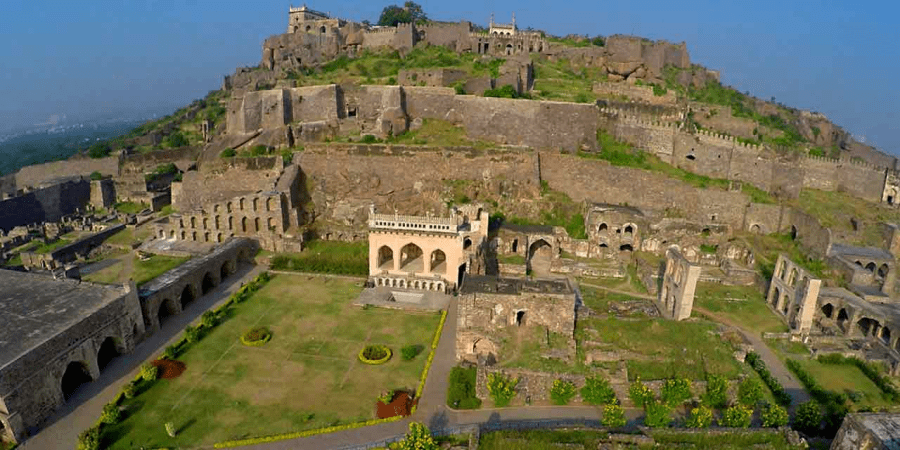
Golconda fort is located at 10 km away from the Hyderabad city. It was constructed during 13th century, on a hill which was once the territory of Kakatiya Kings of Warangal in 1143 A.D.
Among the ruins of Golconda Fort lies a history of half a millennium. It remains a thing of beauty despite the destruction it has gone through. It is 3 miles in circumference, and the granite hill that it is built on is 390 feet high. The glorious Golkonda fort in Hyderabad has cannons, gateways, majestic halls, drawbridges, and more. It was first built in 1143 by a Kakatiya king, but the Qutub Shahi Dynasty and Bahmani Sultans fortified it between the 14th and 17th centuries. The Qutub Shahi kings ruled the area in the 16th and 17th centuries. One of the most pivotal rulers in the Deccan Plateau, the Qutub Shahi Dynasty at its peak ruled Andhra Pradesh, Telangana, parts of Tamil Nadu and half of Karnataka. As the magnificent Golconda fort was built, it was the capital of the dynasty from 1518 to 1591. The Muslim sultanate was then overthrown by the Mughal emperor Aurangzeb in 1687. He destroyed the fort but the mosques and Qutub Shahi tombs remained safe enough to be visited as a tourist place.
History of Golconda fort:
As per legends, a shepherd found an idol in the area (now known as Golkonda Fort). Soon after, Kakatiyan king was informed about the same, and he gave the order to build a mud fort around the idol. The fort’s name is “GollaKonda” which meant Shepherd’s hill in Telugu. (Golla means shepered and Konda means Hill, thus Shepherd’s Hill)
The Golkonda fort was erected in the year 1143 under the Kakatiya Dynasty. However, it rose to importance when it came under the rule of Qutub Shahi Dynasty during the 16th century, i.e. when Quli Qutub Shah declared his independence from the Bahmani Sultanate in 1518. The striking fort since then expanded from a mud fortress to a structure to having a 10 km outer wall. After a failed attempt in the year 1686, the Mughal emperor Aurangzeb was finally able to opening the impregnable fort in 1687 after a long nine-month blockade.
Some Interesting Facts about Golconda fort:
1) The mud fort was rebuilt in iron and granite under Qutub Shahi kings.
2) The tombs of the Qutb Shahi rulers, mosques and the palaces are still standing tall.
3) The fort’s walls contain ventilators so that fresh air was available.
4) The fort consists of a secret underground path to one of the palaces that are located on the hill slope.
5) In the ancient times, the Golconda fort was a well-known trade centre for diamonds that were taken out from the rocks of the neighbouring hills. Moreover, the world-popular Kohinoor was found here.
6) This 800- year old fort is one of the architectural wonders of Hyderabad, the capital of Andhra Pradesh.
7) An interesting thing about the fort was that, if anyone clapped while standing at a certain point below the dome at the entrance, then its sound could be heard at the highest point of the hill-top, known as Bala Hissar. In the ancient times, people considered it a warning for the royals, if there was an attack. An amazing signalling device was in-built in the fort during the construction for important flow of information. The Golconda Fort is popular for its audio system.
8) The fort has 8 gates in the outer wall- the Fateh, Mecca, Bahmani, and Patancheru. In addition to Naya Qula Banjara, Moti, and Jamali.
9) The palaces, water supply system as well as the known ‘Rahban’ cannon, located within the fort are the prime attractions.












 Eduindex
You must be logged in to post a comment.