

The Kyung Hee University System officially announced the Bulletin of the Atomic Scientists as the recipient of the 2nd Miwon Peace Prize. Renowned globally for publishing the annual Doomsday Clock, the independent nonprofit was recognized for pioneering peace advocacy and addressing existential global risks through scientific analysis. The official award ceremony will take place on September 21 during the UN International Day of Peace.
The Kyung Hee University System officially announced that the Bulletin of the Atomic Scientists has been selected as the recipient of the 2nd Miwon Peace Prize. The recipient was officially disclosed during an announcement ceremony held at the Grand Peace Hall of Kyung Hee University in Seoul. Renowned globally for publishing the annual Doomsday Clock, the independent nonprofit organization was honored for pioneering new horizons of peace advocacy through scientific rigor and public engagement.
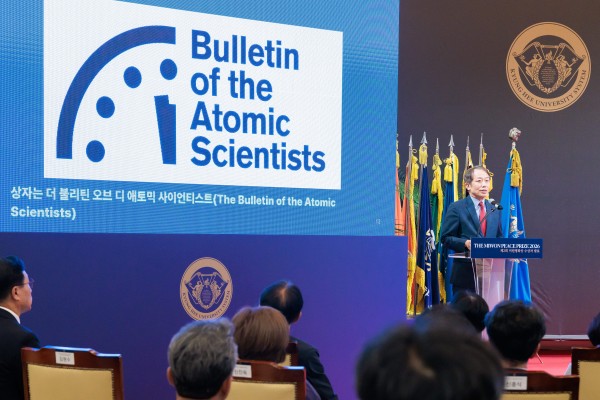
The Miwon Peace Prize Selection Committee identified the Bulletin as an exemplary institution bridging scientific knowledge and planetary peace. Irina Bokova, former Director-General of UNESCO and Selection Committee Chair, stated, “Over the last eight decades, the Bulletin of the Atomic Scientists, through the Doomsday Clock, has visualized how close humanity has brought itself to catastrophe and warned the world of the limitations of the modern civilization paradigm that threatens the existence of humanity. Through rigorous scientific analysis, the Bulletin has raised global awareness of existential risks, including nuclear weapons, climate change, and disruptive technologies, helping policymakers and the public pursue informed actions for peace and human security based on science.”
Established in 2024, the Miwon Peace Prize honors individuals or organizations that carry forward the peace philosophy and practice of Dr. Young Seek Choue, founder of the Kyung Hee University System. Laureates are selected through candidate evaluation by the Miwon Peace Prize Selection Committee and the deliberation and resolution of the Board of Trustees of the Kyung Hee University System. Awarded biennially, the prize includes a grant of USD 200,000 for world peace realization, funded by donations from the Miwon Peace Prize Foundation established by the Kyung Hee Alumni Association in North America. The official award ceremony is scheduled for September 21 during the 45th Peace BAR Festival, held in commemoration of the UN International Day of Peace.
Founded in 1945 by Manhattan Project scientists such as Eugene Rabinowitch and Hyman Goldsmith, the Bulletin was created to bring the ethical responsibilities of nuclear science into public discourse. Its flagship initiative, the Doomsday Clock launched in 1947, symbolizes humanity’s proximity to self-induced catastrophe in terms of minutes or seconds remaining before midnight. In January 2026, the Clock was set to 85 seconds to midnight, marking the most critical warning in its history due to compounding risks from nuclear escalation, climate crisis, and disruptive technologies. Through the Doomsday Clock and rigorous scientific analysis, the Bulletin has warned the public and policymakers for over eighty years about existential threats facing humanity.
Beyond issuing warnings, the Bulletin has made significant contributions by transcending academic disciplines, nations, and ideologies. Witnessing the destructive power of nuclear weapons, twentieth-century scientists expanded science into a public practice responsible for the fate of humanity and the Earth. Transcending Cold War ideological divisions and national borders, they viewed planetary society as a single shared destiny, making it clear that nuclear arms control, climate response, and technological risk management are shared global challenges. Grounded in this awareness, the Bulletin has linked scientists, diplomats, security specialists, and policymakers, serving as a bridge to translate scientific knowledge into global responsibility and collective policy action.
Furthermore, the Bulletin actively offers new vision and imagination for future generations. Through its Next Generation Initiative and Arts and Science Initiative, the organization cultivates the capacity of the next generation to understand existential crises of planetary society, imagine new solutions, and put them into action. Its governance structure consists of the Governing Board, the Science and Security Board, and the Board of Sponsors. The Board of Sponsors, an honorary advisory body that validates the scientific authority of the Bulletin’s work, was established by Albert Einstein in 1948 with J. Robert Oppenheimer serving as its inaugural chair, and has drawn on the participation of more than 40 Nobel laureates.
The selection announcement date holds special historical significance as it marks forty-five years since the founder of the Kyung Hee University System proposed the establishment of the UN International Day and Year of Peace on June 29, 1981, to transform an atmosphere of war into an atmosphere of peace. The UN International Day and Year of Peace were officially established at the 36th United Nations General Assembly in November 1981. By bestowing this honor upon the Bulletin of the Atomic Scientists, the Kyung Hee University System aims to re-establish peace as an urgent civilizational task in an era where global crises continue to deepen, seeking new horizons of peace for planetary society.
KyungHee University Website / URL: https://www.khu.ac.kr/eng/user/main/view.do


You must be logged in to post a comment.