

Financial literacy is often introduced through budgeting, saving, and basic money management. Yet for students who study economics, business, finance, or personal investing, one more topic deserves attention: risk. Before making any market-related decision, learners should understand how much capital is actually at risk. A practical tool such as https://iamforextrader.com/en/tools/position-size-calculator/ can help students see how position size, account balance, stop-loss distance, and risk percentage work together in a structured way.
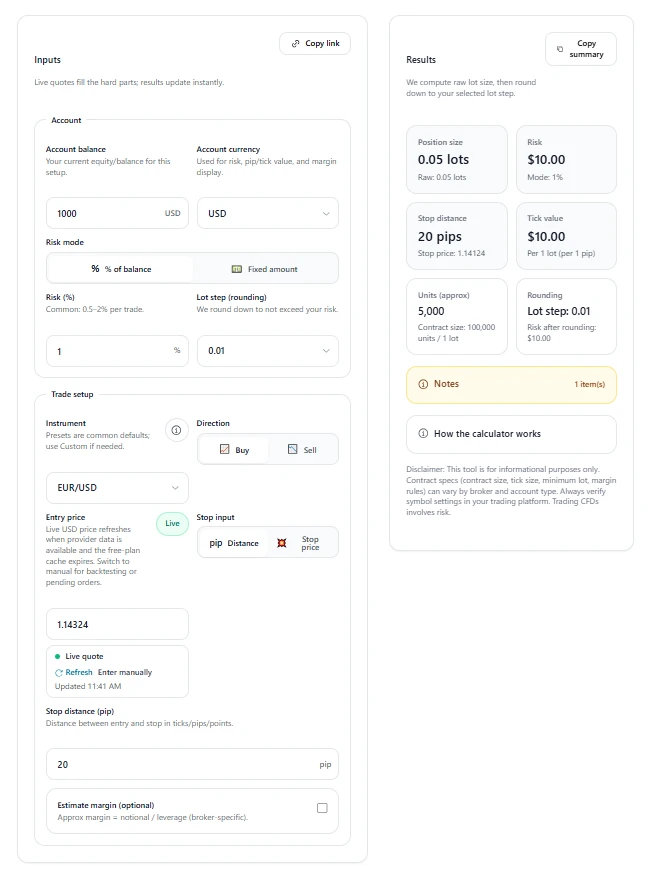
This article is educational in nature and does not provide investment advice. Its purpose is to explain how responsible risk calculation can become part of broader financial literacy.
Why Financial Literacy Should Include Risk Awareness
Financial literacy is not only about knowing financial terms. It is about making informed decisions under real-world constraints. Students may learn how interest rates work, how inflation affects purchasing power, or how budgets are created. However, when financial education reaches markets and investing, risk becomes central.
A financially literate student should be able to ask:
- How much money can I afford to risk?
- What happens if my assumption is wrong?
- Is this decision based on calculation or emotion?
- Do I understand the downside before thinking about the upside?
These questions are especially important in trading education, where decisions can be made quickly and emotional pressure can be high.
“Good financial education does not begin with profit expectations. It begins with understanding limits, consequences, and discipline.”
What Is Position Sizing?
Position sizing means deciding how large a trade or market position should be based on predefined risk. Instead of choosing a random amount, students learn to calculate position size using measurable inputs.
In simple terms, position sizing answers one question: How much should be placed in a position so that the possible loss stays within an acceptable limit?
For example, a learner may decide not to risk more than 1% of a practice account on a single trade. If the account size is $1,000, the maximum planned risk is $10. The position size then depends on the distance between the entry point and the stop-loss point.
This approach encourages discipline because the decision is based on a rule, not on excitement, fear, or guesswork.
Key Concepts Students Should Understand
| Concept | Simple Meaning | Why It Matters |
|---|---|---|
| Account balance | Total available capital | Helps define realistic risk limits |
| Risk percentage | The portion of capital risked on one idea | Prevents oversized decisions |
| Stop-loss distance | The gap between entry and exit if wrong | Affects how large the position can be |
| Position size | The calculated size of the trade | Connects risk plan with execution |
| Risk management | A system for limiting potential losses | Supports long-term learning discipline |
A Classroom-Friendly Example
Imagine a student is using a demo account for a financial markets course. The account balance is $2,000. The student decides to risk 1% on one market idea. That means the maximum planned loss is $20.
Now the student needs to know the distance between the entry price and the stop-loss level. If the stop-loss is far away, the position size should be smaller. If the stop-loss is closer, the position size may be larger, while still keeping the planned risk at $20.
This example teaches a valuable lesson: the size of a decision should be connected to the risk, not to confidence alone.
Why This Matters for Students
Many students first encounter financial markets through social media, online videos, or simplified success stories. These sources may focus on potential returns while ignoring risk structure. Academic and educational platforms can balance that by teaching a more responsible framework.
Position sizing helps students build several useful habits:
- Planning before acting
A calculated decision is usually more disciplined than an impulsive one. - Understanding downside risk
Students learn that every market decision can be wrong. - Avoiding emotional overexposure
Clear risk limits can reduce panic and overconfidence. - Connecting theory with practice
Risk formulas become easier to understand when applied to practical examples. - Building transferable skills
The same thinking can support budgeting, entrepreneurship, investing, and project planning.
Position Sizing as Part of Financial Education
Position sizing should not be taught as a shortcut to success. It should be taught as a risk-control method. In an educational setting, it fits naturally into topics such as:
- personal finance;
- behavioral finance;
- investment basics;
- business decision-making;
- probability and statistics;
- economics and capital allocation.
For example, a finance instructor can ask students to compare two scenarios: one where a person risks a fixed percentage per decision, and another where the person changes risk randomly. The discussion can reveal how inconsistent risk-taking may create unstable outcomes, even when some individual decisions are correct.
Common Mistakes Beginners Make
Students and beginners often make similar mistakes when learning about markets:
- risking too much on one idea;
- changing position size after a loss out of frustration;
- ignoring stop-loss distance;
- focusing only on potential profit;
- treating demo success as proof of future real-world results;
- copying others without understanding the calculation.
These mistakes are not only trading problems. They are financial literacy problems. They show why education should focus on process, not only outcomes.
A Simple Risk Checklist for Learners
Before studying or simulating any market position, students can use this checklist:
- Do I know my total account balance?
- Have I selected a fixed risk percentage?
- Do I understand where the idea becomes invalid?
- Have I calculated the position size before entering?
- Am I using this as an educational exercise rather than a guaranteed result?
- Can I explain the risk in one or two sentences?
If the answer to any of these questions is “no,” the decision may need more preparation.
Final Thoughts
Financial literacy for students should go beyond definitions and theory. It should help learners build decision-making habits that are careful, structured, and realistic. Position sizing is one practical way to teach those habits because it connects numbers, risk, behavior, and responsibility.
Students do not need to become traders to benefit from this concept. They need to understand that every financial decision has limits, trade-offs, and possible consequences. When risk is measured before action is taken, financial education becomes more practical, more honest, and more useful for real life.
Suggested image: A clean educational image showing students reviewing financial charts, calculators, and notebooks in a classroom or study environment. Recommended size: under 300 KB, JPG or WebP format.


 Eduindex
You must be logged in to post a comment.