

A serious health condition can affect far more than your medical expenses. Hospitalisation, specialised treatment, recovery time and a temporary loss of income can all place pressure on your finances. Regular health insurance can help manage eligible healthcare costs, but some situations may require additional financial support.
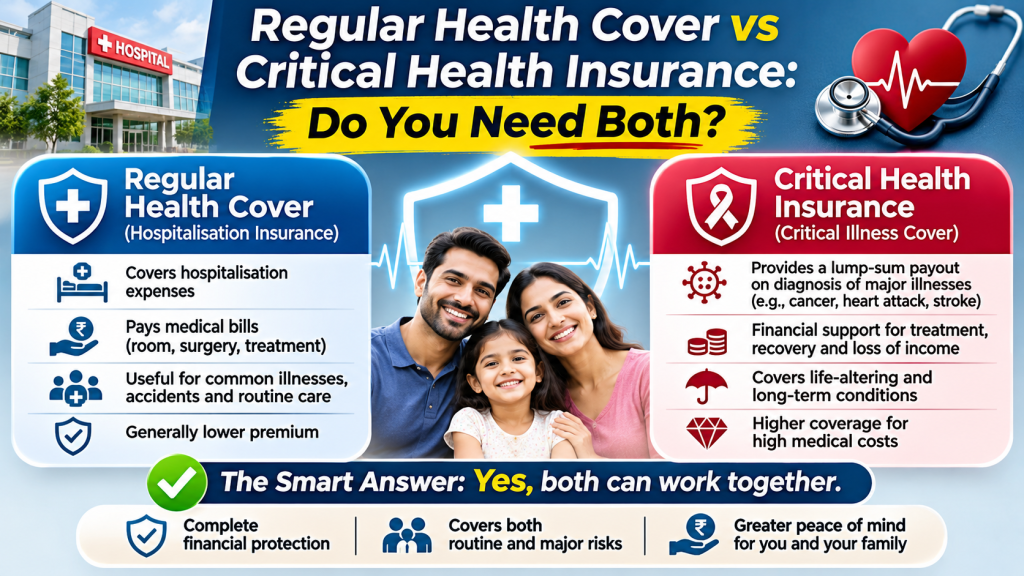
That is where critical health insurance can play a different role. It can provide a lump-sum benefit after the diagnosis of a covered critical illness, helping address financial needs that may extend beyond hospital bills. So, how do the two types of cover differ, and can having both provide more suitable protection?
How Do Regular Health Insurance and Critical Health Insurance Differ?
Regular health insurance generally provides indemnity-based coverage, meaning the insurer pays eligible medical expenses according to the policy terms and limits. Critical health insurance usually works as a defined-benefit cover, providing a predetermined lump sum when the insured is diagnosed with a listed critical illness and fulfils the applicable conditions.
| Feature | Regular Health Insurance | Critical Health Insurance |
| Benefit Type | Indemnity-based | Fixed-benefit |
| Main Purpose | Covers eligible healthcare and hospitalisation expenses | Provides a lump sum after diagnosis of a covered critical illness |
| Claim Basis | Based on admissible medical expenses | Based on the policy’s predefined sum insured |
| Coverage | Hospitalisation, day care procedures and eligible pre- and post-hospitalisation expenses | Specific critical illnesses listed in the policy |
| Use of Payout | Primarily towards covered medical expenses | Generally usable as per the policy terms and applicable conditions |
| Income Support | Mainly addresses healthcare expenses | Can help manage income disruption and other financial commitments |
| Claim Trigger | Covered treatment or hospitalisation | Diagnosis of a covered illness and fulfilment of claim conditions |
What Are the Benefits of Having Both Types of Health Cover?
Having regular health insurance alongside critical health insurance can provide two different forms of financial protection. One can address eligible treatment costs, while the other can provide a lump-sum amount following a qualifying diagnosis.
Benefits of Regular Health Insurance
- Hospitalisation Cover: Helps manage eligible expenses such as room charges, ICU costs, doctor fees, and nursing expenses during covered hospitalisation.
- Pre and Post-Hospitalisation Cover: Can cover eligible medical expenses incurred before admission and after discharge for the period specified in the policy.
- Daycare Treatment: Covers eligible procedures that may not require 24-hour hospitalisation because of advancements in medical technology.
- Broad Medical Protection: A regular policy can cover a wider range of illnesses and treatments, subject to exclusions, limits and other policy conditions.
Benefits of Critical Health Insurance
- Lump-sum Financial Support: A predefined amount can be paid when a covered critical illness is diagnosed, and the applicable claim conditions are met.
- Support During Recovery: The payout can help manage household expenses, loan commitments, or other financial requirements during a prolonged recovery period, subject to policy terms.
- Additional Financial Cushion: It can supplement the protection provided by regular health insurance when a serious diagnosis creates financial needs beyond medical bills.
- Greater Financial Flexibility: Since the benefit is generally fixed rather than linked directly to hospital bills, it can provide flexibility in managing eligible financial priorities.
How Can You Apply for Regular and Critical Health Insurance?
The application process can vary between insurers and policy types, but comparing coverage and reviewing policy conditions can help you make a more informed choice.
Applying for Regular Health Insurance
- Assess Your Requirements: Consider your age, medical needs, family size, and preferred sum insured.
- Compare Plans: Review premiums, coverage, waiting periods, exclusions, deductibles, and network hospitals.
- Provide Details: Enter the required personal, health, and nominee information.
- Disclose Medical Information: Share relevant health and medical history accurately as requested.
- Review the Policy: Check the terms, limits and exclusions before purchasing.
- Complete Payment: Pay the applicable premium and receive the policy documents.
Applying for Critical Health Insurance
- Identify Suitable Coverage: Review the illnesses covered, sum insured, waiting period, and survival period.
- Compare Available Plans: Evaluate policy definitions, exclusions, premium, and claim conditions.
- Submit Required Information: Provide the requested personal and health details.
- Complete Medical Requirements: Undergo medical tests if required by the insurer.
- Review Policy Terms: Understand the definitions of covered illnesses and conditions attached to the benefit.
- Pay the Premium: Complete the payment process to activate the policy.
Choose Health Protection That Fits Your Needs
Regular health insurance and critical health insurance can serve different financial needs, making it useful to assess them based on your healthcare requirements and financial responsibilities. Having suitable protection in place can provide greater confidence when unexpected health events arise.
Online insurance brokers like Jio Insurance Broking Ltd. can help you explore and compare available insurance options based on your requirements. Taking time to understand coverage, exclusions, waiting periods, and claim conditions can help you make a considered decision and build protection that remains relevant to your circumstances.
What’s a song that changed your life?
View all responses


