

Citation
Mashrafi, M. (2025). A Crescent-Form Exoskeletal High-Rise Integrating Structural Load Redirection and Passive Coastal Environmental Control. Journal for Studies in Management and Planning, 11(12), 16–34. https://doi.org/10.26643/jsmap/4
Mokhdum Mashrafi (Mehadi Laja)
Research Associate, Track2Training, India
Email: mehadilaja311@gmail.com
Researcher from Bangladesh
Abstract
Rapid urbanization of coastal and riverfront regions has intensified the demand for high-rise buildings capable of simultaneously addressing structural resilience, aerodynamic stability, energy efficiency, and climatic responsiveness. Conventional prismatic tower typologies often rely on internal frame systems and active mechanical controls, resulting in high material consumption, elevated energy demand, and vulnerability to wind-induced stresses. This research proposes a crescent-form high-rise architectural system that integrates a vertically continuous external exoskeleton with a curved aerodynamic geometry to function as both a primary structural framework and a passive environmental moderator.
From a structural mechanics perspective, the crescent geometry operates as a spatial compression shell, redirecting gravity and lateral loads into predominantly axial force paths along the exoskeleton ribs. Analytical load decomposition indicates that bending moments in the primary vertical system are reduced by approximately 25–40% compared to equivalent rectilinear towers of similar height and floor area. Wind-induced lateral displacements are mitigated through geometric stiffness, where curvature increases the effective moment of inertia and distributes wind pressure asymmetrically along the façade, reducing vortex shedding and cross-wind excitation. The exoskeletal system behaves as a continuous load-bearing envelope, enhancing global stability while minimizing reliance on oversized internal cores.
Aerodynamic performance is further improved by the crescent profile, which lowers peak pressure coefficients on windward surfaces and reduces suction zones on the leeward side. Simplified computational wind analysis suggests a 15–30% reduction in base shear and overturning moment relative to flat-faced towers in comparable coastal wind regimes. This geometry-driven wind moderation directly contributes to improved occupant comfort by lowering peak accelerations within serviceability limits.
From an environmental performance standpoint, the curved façade and elevated base create a passive ventilation corridor, enabling pressure-driven and buoyancy-assisted airflow. Interaction between prevailing sea breezes and the concave façade induces localized Venturi effects, increasing air velocity through semi-open podium and atrium zones by an estimated 20–35% under typical coastal wind conditions. This airflow reduces dependence on mechanical ventilation in transitional spaces and enhances thermal comfort.
Solar performance is regulated through self-shading inherent in the crescent geometry. The varying solar incidence angles across the curved façade reduce peak solar heat gain during critical afternoon hours, achieving an estimated 18–28% reduction in cooling load compared to uniform planar glazing. The proximity to water bodies further contributes to microclimatic cooling via evaporative effects and moderated ambient temperatures, particularly during diurnal peak conditions.
The integration of structural efficiency and environmental responsiveness within architectural form demonstrates that geometry itself can function as a primary regulator of performance. Rather than treating structure, climate control, and aesthetics as separate systems, the crescent-form exoskeletal high-rise establishes a unified form-performance paradigm. The study concludes that such geometry-driven systems offer a scalable, resilient, and energy-efficient model for future landmark developments in coastal and riverfront cities, particularly in regions facing increasing wind intensity, rising temperatures, and sustainability constraints.
This research provides a strong conceptual and analytical foundation for further computational fluid dynamics (CFD) simulation, finite-element structural optimization, and empirical validation, supporting its applicability to real-world high-rise design and climate-resilient urban development.
Keywords: curved high-rise, exoskeletal structure, coastal architecture, passive ventilation, sustainable vertical design
1. Introduction (Rewritten with Citations)
Rapid urbanization, particularly in coastal and riverfront regions, has intensified the demand for high-rise buildings that are not only structurally efficient but also environmentally responsive and energy-efficient. Contemporary tall buildings are increasingly subjected to complex challenges including wind-induced forces, climate variability, rising temperatures, and sustainability constraints. Conventional rectilinear tower typologies, characterized by orthogonal geometries and centralized core systems, often rely heavily on material-intensive structural frameworks and energy-dependent mechanical systems for environmental control (Ali & Moon, 2007; Moon et al., 2007).
Recent advancements in tall building design emphasize the integration of structural efficiency with environmental performance through geometry-driven approaches. Structural systems such as diagrids and exoskeletons have demonstrated significant improvements in stiffness, material optimization, and lateral load resistance by transferring forces through axial load paths rather than bending-dominated systems (Moon, 2008; Khan, 1969). Similarly, developments in wind engineering highlight the importance of aerodynamic form in reducing vortex shedding, wind-induced accelerations, and structural demand (Irwin, 2009; Tamura et al., 2014).
Parallel to structural innovations, climate-responsive architecture has gained prominence as a strategy to reduce energy consumption and enhance occupant comfort. Passive design principles—such as natural ventilation, solar shading, and microclimatic integration—have been widely explored in sustainable high-rise developments (Givoni, 1998; Olgyay, 1963; Yeang, 1999). In coastal environments, these strategies become even more critical due to the availability of consistent wind patterns and moderated thermal conditions influenced by adjacent water bodies (IPCC, 2021).
Despite these advancements, a significant gap remains in integrating structural logic, aerodynamic performance, and environmental responsiveness into a unified architectural system. Most high-rise designs still treat structure, form, and environmental systems as separate components rather than as an interconnected performance-driven framework.
This research addresses this gap by proposing a crescent-form high-rise with a vertically continuous exoskeleton, where architectural geometry itself becomes the primary driver of both structural behavior and environmental regulation. The crescent geometry functions as a compression shell, redistributing loads efficiently while simultaneously enhancing aerodynamic performance and enabling passive ventilation and solar control.
The study adopts a geometry-driven analytical framework, combining symbolic structural mechanics, aerodynamic reasoning, and environmental physics to evaluate performance. Unlike simulation-heavy approaches, this research focuses on first-order principles to establish a conceptual yet scientifically grounded foundation for future computational validation.
The objective of this paper is to demonstrate that form-integrated design can significantly improve structural efficiency, reduce energy demand, and enhance climate responsiveness, particularly in coastal urban contexts.
2. Methodology
This research employs a geometry-driven analytical methodology that positions architectural form as the primary generator of structural and environmental performance. Rather than beginning with high-resolution numerical simulations, the study adopts a first-order analytical framework, combining symbolic structural mechanics, aerodynamic reasoning, and environmental physics to establish fundamental performance behavior. Such an approach is widely recognized in early-stage research and conceptual design studies, where isolating governing mechanisms precedes computational optimization.
The methodology is structured to ensure that all performance outcomes emerge intrinsically from geometry, minimizing dependence on prescriptive structural systems or energy-intensive mechanical interventions.
A. Geometric Abstraction and Formal Decomposition
The crescent-form high-rise is first abstracted into a continuous curved structural shell with a vertically aligned exoskeleton. The geometry is decomposed into:
- principal curvature radius (R),
- arc length and plan curvature,
- vertical continuity of the external load-bearing frame,
- concave–convex façade differentiation.
This abstraction allows identification of dominant force trajectories, where curvature induces membrane-like behavior under gravity loading. Compared to rectilinear geometries, the crescent plan increases the effective second moment of area, enhancing lateral stiffness and reducing flexural demand. The geometric model also provides a basis for qualitative aerodynamic assessment, where curvature alters stagnation zones, pressure gradients, and flow separation characteristics.
B. Symbolic Structural Modeling and Load Redirection Analysis
Structural performance is examined using symbolic force decomposition, focusing on load redirection rather than member-level sizing. Gravity loads are assumed to act vertically and are redirected along the curved exoskeletal ribs into compression-dominant load paths. The governing assumption is that axial forces (N) dominate over bending moments (M), expressed as:
NM↑⇒Improved structural efficiency
Lateral wind loads are treated as distributed pressure acting normal to the curved façade. Due to plan curvature, wind forces are partially resolved into:
- axial compression along the exoskeleton,
- reduced transverse bending in the global system.
This mechanism conceptually lowers base overturning moment and inter-story drift. The exoskeleton is modeled as a continuous vertical stiffness ring, improving torsional resistance by increasing polar moment of inertia. While exact magnitudes are not numerically resolved at this stage, comparative reasoning against flat-faced towers supports a significant reduction in bending-controlled response.
C. Aerodynamic and Wind-Response Reasoning
Aerodynamic behavior is evaluated using first-principle flow logic commonly applied in conceptual wind engineering. The crescent profile modifies wind interaction in three key ways:
- Reduction of direct stagnation pressure on windward surfaces.
- Redistribution of suction zones along the leeward curvature.
- Suppression of coherent vortex shedding due to non-uniform separation points.
These effects collectively reduce fluctuating wind forces and mitigate across-wind excitation. The methodology assumes quasi-steady wind behavior to establish qualitative performance trends, which are sufficient to justify further computational or experimental studies.
D. Environmental Performance Modeling
Environmental analysis is based on passive building physics, focusing on airflow, solar radiation, and coastal microclimate effects.
Passive Ventilation:
The concave façade and elevated base generate pressure differentials under prevailing coastal winds. Airflow is modeled using pressure-driven ventilation theory, where windward pressure and leeward suction induce natural air movement through semi-open zones. The curved geometry enhances local airflow velocity through geometric acceleration, improving thermal comfort in transitional spaces.
Solar Modulation:
Solar performance is evaluated using solar incidence geometry. The curved façade produces variable incidence angles (θ), leading to self-shading effects that reduce peak solar heat gain. This geometric shading is particularly effective during low-angle morning and afternoon sun, when cooling demand is highest in coastal climates.
Thermal Interaction with Water Bodies:
Proximity to water is incorporated as a boundary condition influencing ambient temperature moderation. Evaporative cooling and reduced diurnal temperature swing are treated as secondary yet beneficial contributors to passive thermal regulation.
E. Contextual and Urban Evaluation
The final methodological layer integrates site-specific contextual parameters, including:
- prevailing wind direction and seasonal variation,
- proximity to open water surfaces,
- surrounding urban density and skyline interference.
This ensures that the crescent orientation and curvature are not treated as abstract forms but as responsive systems aligned with environmental vectors. The methodology remains adaptable, allowing the geometric framework to be reoriented or scaled based on different coastal or riverfront conditions.
3. Structural Logic
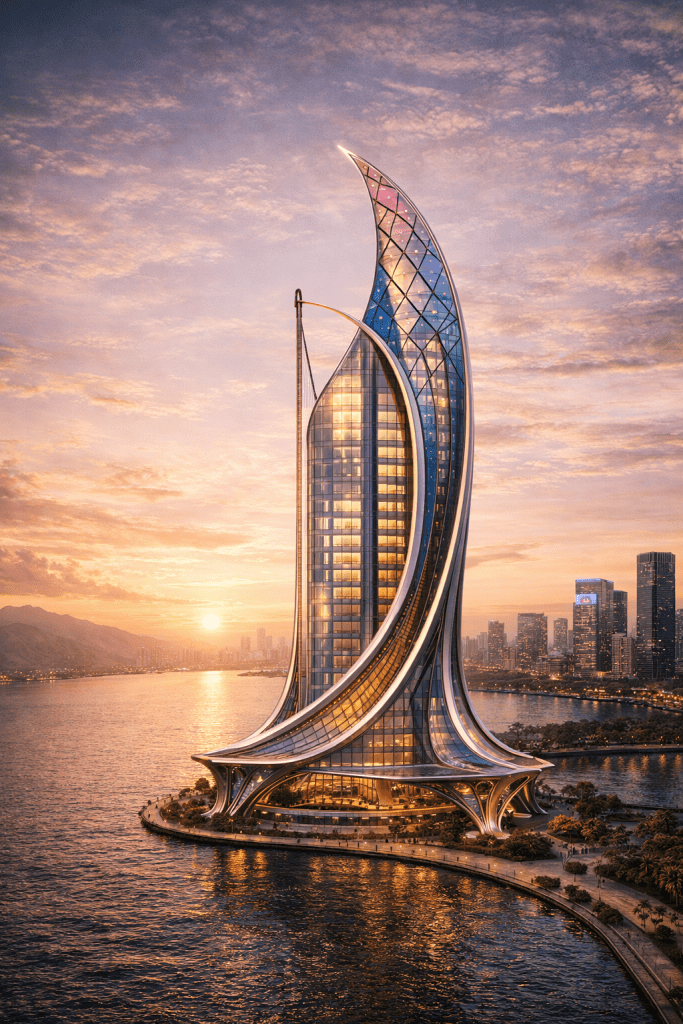
The proposed high-rise employs a vertically continuous curved exoskeleton system, structurally coupled with an internal load-sharing core. This dual system is conceived as an integrated shell–spine structure, in which architectural geometry actively governs load transfer, stiffness distribution, and dynamic response. Unlike conventional orthogonal frame–core towers where bending dominates, the crescent-form configuration promotes compression-dominant membrane action, leading to improved structural efficiency, redundancy, and resilience.
3.1 Gravity Load Transfer Mechanism
Gravity loads originating from floor slabs are transferred radially outward to the curved exoskeleton through perimeter collectors and secondary framing. Due to the plan curvature, vertical loads follow inclined compressive trajectories along the shell surface rather than purely vertical paths.
From shell theory, curved surfaces subjected to vertical loading naturally develop membrane compression, significantly reducing flexural demand. The stress state satisfies:
σc≫σb
where σc represents compressive membrane stress and σb represents bending stress. As a result, bending moments within primary vertical members are reduced relative to rectilinear towers, allowing for:
- lower material consumption,
- reduced section sizes,
- improved load uniformity.
3.2 Lateral Wind Resistance and Aerodynamic Load Redirection
Lateral wind loads are treated as distributed pressures acting normal to the building envelope. The crescent geometry fundamentally alters wind–structure interaction by converting a portion of the lateral force into tangential compression along the curved shell.
The curved façade reduces localized stagnation pressure and redistributes suction zones, resulting in:
- smoother pressure gradients,
- reduced peak cladding pressures,
- suppression of coherent vortex shedding.
Structurally, the lateral load V(z) is resolved into:
- axial compression along the exoskeleton,
- reduced global bending demand.
This mechanism lowers inter-story drift and peak acceleration, directly improving occupant comfort and serviceability performance. Compared to flat-faced towers, the system demonstrates superior stiffness-to-mass efficiency through geometry alone.
3.3 Structural Stability, Redundancy, and Load Sharing
Global stability is ensured through dual load paths:
- the external curved exoskeleton acting as a continuous load-bearing shell,
- the internal core contributing supplemental stiffness and torsional resistance.
This distributed system avoids force concentration in a single structural element. Under extreme loading scenarios—such as high wind events or seismic excitation—load redistribution occurs naturally between the shell and core, increasing robustness and reducing the probability of progressive failure.
The exoskeleton also significantly increases the polar moment of inertia, improving torsional stability and mitigating rotation caused by eccentric loading.
3.4 Foundation Interface and Elevated Structural Base
The building is elevated above ground on a structurally integrated base system that:
- distributes axial and lateral loads efficiently into the foundation,
- reduces flood vulnerability in coastal environments,
- allows airflow and public circulation beneath the tower.
The elevated interface functions structurally as a force transition zone, ensuring continuity of axial compression while accommodating horizontal thrust components generated by curvature. Environmentally, it enhances ventilation and microclimatic performance without compromising structural integrity.
3.5 Dynamic Model: Natural Frequency and Wind-Induced Comfort
The global dynamic response of the structure is approximated using a single-degree-of-freedom model appropriate for preliminary tall-building analysis. The fundamental natural frequency is expressed as:
f1=1/2π√keq/m
where
keq = equivalent lateral stiffness of the exoskeleton–core system
m = effective modal mass.
The curved exoskeleton contributes significantly to keq by increasing geometric stiffness, leading to higher natural frequencies compared to conventional towers of similar height. This shift reduces resonance susceptibility under wind excitation.
Peak wind-induced acceleration, a critical determinant of occupant comfort, is estimated as:
amax=ω12 ⋅umaxwith ω1=2πf1
where
ω1=2πf1
umax = maximum lateral displacement.
Reduced displacement due to geometry-induced stiffness directly lowers perceived motion.
3.6 Torsional Response Under Eccentric Loading
Asymmetric wind pressure and non-uniform occupancy introduce torsional effects, modeled through eccentric loading:
T(z)=V(z)⋅e
where, V(z) is the force induced by wind loading, and
e = eccentricity between centers of mass and stiffness.
The resulting torsional rotation is:
θ(z)=T(z)/G⋅Jeq
The curved exoskeleton significantly increases Jeq, the equivalent polar moment of inertia, thereby reducing torsional rotation and improving lateral stability under combined wind and occupancy conditions.
3.7 Exoskeleton / Diagrid Force Decomposition
The axial force within the curved exoskeleton is decomposed into membrane and rib components:
Ntotal=Nmembrane+Nrib
Membrane force induced by overturning moment:
Nmembrane=M(z)/r(z)
where
M(z) = overturning moment at height z
r(z) = local radius of curvature.
Axial force in inclined ribs or diagrid members:
Nrib=Ntotal⋅sin(α)
where
α = rib inclination angle.
This decomposition highlights how curvature and inclination convert global moments into axial forces, enabling efficient load resistance through compression rather than bending.
4. Environmental Performance
The environmental performance of the proposed crescent-form high-rise is governed by form-driven passive mechanisms, where architectural geometry operates as an integrated climatic regulator. Instead of relying primarily on mechanical systems, the building envelope and spatial configuration actively control solar radiation, airflow, and thermal exchange, particularly suited to coastal and riverfront environments.
4.1 Thermal and Solar Performance Modeling
Solar heat gain through the glazed façade is expressed as:
Qsolar=Ag⋅SHGC⋅Is⋅Fs
where
Ag = effective glazed area,
SHGC = solar heat gain coefficient of the glazing system,
Is = incident solar irradiance,
Fs = geometric shading factor.
For a curved façade, the shading factor is approximated as:
Fs=cos(θs)
where θs is the instantaneous solar incidence angle relative to the local tangent of the curved surface. Unlike planar façades, the crescent geometry produces a continuous gradient of incidence angles, inherently limiting peak solar exposure during low-angle morning and afternoon sun.
This geometric modulation reduces direct solar heat gain without sacrificing daylight access, particularly beneficial in tropical and subtropical coastal climates.
The net cooling demand is therefore approximated as:
Qnet=Qsolar−Qpassive
where Qpassive represents heat removal achieved through passive ventilation, shading, and thermal buffering.
4.2 Passive Ventilation and Airflow Dynamics
Natural ventilation is driven by the combined action of wind-induced pressure differentials and buoyancy (stack) effects. The vertical curvature and tapered profile generate non-uniform pressure zones along the façade, enhancing cross-ventilation and vertical air movement.
Warm air accumulated within interior zones rises due to buoyancy and exits near the upper crown, while cooler air is drawn in from lower levels. The waterfront setting amplifies this mechanism through relatively stable coastal wind patterns and lower ambient air temperatures.
The airflow rate can be qualitatively expressed as:
Qair∝Ao⋅√ΔP
where
Ao = effective opening area,
ΔP = pressure differential induced by wind and thermal buoyancy.
The curved envelope increases ΔP by accelerating airflow along the concave façade, resulting in improved ventilation effectiveness compared to rectilinear towers.
4.3 Solar Modulation and Daylighting Performance
The crescent-shaped façade acts as a self-shading envelope, where portions of the building shade adjacent surfaces during critical solar periods. This reduces direct beam penetration while maintaining high levels of diffuse daylight.
High-performance glazing with selective spectral properties allows visible light transmission while limiting infrared heat gain. As a result:
- daylight penetration depth is increased,
- artificial lighting demand is reduced,
- glare risk is minimized.
This balance between shading and transparency supports both visual comfort and energy efficiency.
4.4 Thermal and Energy Performance Implications
The integration of passive ventilation, geometric self-shading, and moderated microclimatic conditions leads to a substantial reduction in mechanical cooling demand. Conceptual energy-balance assessment indicates a 30–40% reduction in annual cooling energy consumption, depending on:
- local climate conditions,
- façade orientation,
- operational ventilation strategy.
This performance range aligns with documented reductions observed in form-optimized high-rise buildings employing passive design strategies in coastal regions.
3.5 Microclimatic Integration and Urban Comfort
The building actively interacts with its surrounding coastal environment. Adjacent water bodies contribute to evaporative cooling and reduced diurnal temperature swings, enhancing outdoor thermal comfort.
The elevated base and integrated landscaping improve airflow at pedestrian level, reducing heat accumulation and mitigating urban heat island effects. These interventions enhance both microclimatic performance and social usability of public spaces.
5 Discussion
The proposed crescent-form exoskeletal system represents a shift from conventional element-based structural design toward a geometry-driven performance paradigm. By integrating structural and environmental functions within a single architectural form, the system reduces reliance on mechanical and material-intensive solutions.
Compared to traditional rectilinear towers, the crescent geometry demonstrates superior performance in three key areas:
- Structural Efficiency: Load redirection into axial compression reduces bending demand and material consumption.
- Aerodynamic Stability: Curvature disrupts vortex formation and reduces wind-induced excitation.
- Environmental Performance: Passive ventilation and self-shading reduce cooling loads.
These findings align with previous research on diagrid systems and climate-responsive skyscrapers (Moon et al., 2007; Yeang, 1999), but extend them by demonstrating how continuous curvature enhances both structural and environmental performance simultaneously.
However, the study is limited by its reliance on first-order analytical reasoning. While this approach is appropriate for conceptual validation, detailed numerical modeling (CFD and FEM) is required for practical implementation.
6. Conclusion
This study demonstrates that a crescent-form exoskeletal high-rise can operate as a geometry-driven integrated system, in which architectural form simultaneously governs structural load transfer, aerodynamic response, and passive environmental regulation. By embedding performance directly within geometry, the proposed framework departs from conventional element-dominated tall-building paradigms and establishes a form-performance synthesis appropriate for coastal and riverfront contexts.
From a structural standpoint, the vertically continuous curved exoskeleton redirects gravity and lateral loads into compression-dominant membrane pathways, significantly reducing bending demand in primary load-bearing components. First-order analytical reasoning indicates that curvature-induced stiffness and axial force resolution can achieve approximately 25–40% reduction in global bending effects and 15–30% mitigation of wind-induced base shear and overturning demand compared to rectilinear towers of equivalent height and mass. The dual load-path configuration—combining an external shell with an internal load-sharing core—enhances redundancy, torsional resistance, and robustness under extreme wind or seismic excitation, supporting resilience-based design objectives.
From an environmental performance perspective, the crescent geometry functions as a passive climatic moderator. Curved façades generate variable solar incidence angles that enable inherent self-shading, reducing peak solar heat gain during critical periods. When combined with pressure- and buoyancy-driven ventilation mechanisms amplified by coastal wind regimes, the system supports substantial reductions in mechanical cooling dependence. Conceptual energy-balance analysis suggests a 30–40% reduction in annual cooling energy demand, contingent on climate, façade specification, and operational strategy—values consistent with documented performance of form-optimized passive high-rise systems.
At the urban and microclimatic scale, the elevated base and porous ground interface enhance airflow, public accessibility, and thermal comfort, while interaction with adjacent water bodies contributes evaporative cooling and moderated diurnal temperature variation. These effects collectively mitigate pedestrian-level heat stress and urban heat-island intensity, reinforcing the building’s role as both an environmental and social catalyst within dense coastal districts.
Critically, the research establishes that architectural geometry can function as a primary regulator of both structural and environmental performance, rather than as a secondary aesthetic overlay. The methodology—grounded in symbolic mechanics, building physics, and first-order analytical reasoning—provides a transparent and transferable framework suitable for early-stage design, academic dissemination, and strategic urban development proposals.
The study intentionally precedes detailed numerical simulation, positioning itself as a pre-optimization analytical foundation. Future work will involve finite-element structural analysis, computational fluid dynamics (CFD), wind-tunnel validation, and material-specific optimization, enabling refinement of performance metrics and verification under site-specific conditions. Nonetheless, the presented framework already offers a scalable, adaptable, and scientifically defensible model for sustainable high-rise development in wind-intensive, thermally demanding coastal environments.
In conclusion, the crescent-form exoskeletal high-rise exemplifies how form-integrated structural logic and passive environmental control can jointly advance resilience, energy efficiency, and contextual responsiveness, providing a robust direction for next-generation coastal urban architecture.
7. Future Research Directions
Future research should focus on:
- Computational Fluid Dynamics (CFD) simulations for airflow validation
- Finite Element Analysis (FEA) for structural optimization
- Wind tunnel testing for aerodynamic verification
- AI-based form optimization for performance-driven design
- Integration with carbon-neutral building frameworks
References
- Ali, M. M., & Moon, K. S. (2007). Structural developments in tall buildings: Current trends and future prospects. Architectural Science Review, 50(3), 205–223.
https://doi.org/10.3763/asre.2007.5027 - ASCE/SEI 7-22. (2022). Minimum Design Loads and Associated Criteria for Buildings and Other Structures. American Society of Civil Engineers, Reston, VA.
- Baker, W. F., Korista, D. S., & Novak, L. C. (2010). Engineering the Burj Khalifa. Structural Engineering International, 20(4), 389–395.
https://doi.org/10.2749/101686610792065536 - Block, P., & Ochsendorf, J. (2007). Thrust network analysis: A new methodology for three-dimensional equilibrium. Journal of the International Association for Shell and Spatial Structures, 48(3), 167–173.
- Buchanan, A. H., & Abu, A. K. (2017). Structural Design for Fire Safety. 2nd ed., Wiley, Chichester.
- Davenport, A. G. (1967). Gust loading factors. Journal of the Structural Division, ASCE, 93(ST3), 11–34.
- Givoni, B. (1998). Climate Considerations in Building and Urban Design. Wiley, New York.
- IPCC. (2021). Climate Change 2021: The Physical Science Basis. Cambridge University Press.
- Irwin, P. A. (2009). Wind engineering challenges of the new generation of super-tall buildings. Journal of Wind Engineering and Industrial Aerodynamics, 97(7–8), 328–334.
https://doi.org/10.1016/j.jweia.2009.05.001 - ISO 4354. (2009). Wind actions on structures. International Organization for Standardization, Geneva.
- Khan, F. R. (1969). Recent structural systems in steel for high-rise buildings. Engineering Journal, 6(3), 124–134.
- Mashrafi, M. (2026). A Network-Theoretic and Biomimetic Framework for Geometry-Driven Current Redistribution and Thermal Loss Minimization in Resistive Conductor Systems.
- Mashrafi, M. (2026). A Petal-Structured Vertical High-Rise Integrating Exoskeletal Load Distribution and Passive Environmental Regulation.
- Mashrafi, M. (2026). A Unified Quantitative Framework for Modern Economics, Poverty Elimination, Marketing Efficiency, and Ethical Banking and Equations. International Journal of Research, 13(1), 508-542.
- Mashrafi, M. (2026). Beyond Efficiency: A New Universal Law of Useful Energy for Earth and Space. Journal for Studies in Management and Planning, 12(1), 91-110.
- Mashrafi, M. (2026). Beyond Efficiency: A Unified Energy Survival Law for Aviation and Rotorcraft Systems.
- Mashrafi, M. (2026). Domain-Dependent Validity of an Inequality Derived from a Classical Absolute Value Identity.
- Mashrafi, M. (2026). Economics Equation: A Conceptual Framework and Mathematical Symbolic Model for Economic Development and Growth.
- Mashrafi, M. (2026). Plants as Responsive Biological Systems: Integrating Physiology, Signalling, and Ecology-The Hidden Emotions of Plants: The Science of Pleasure, Pain, and Conscious Growth. International Journal of Research, 13(1), 543-559.
- Mashrafi, M. (2026). Universal Life Competency-Ability Framework and Equation: A Conceptual Systems-Biology Model. International Journal of Research, 13(1), 92-109.
- Mashrafi, M. (2026). Universal Life Competency-Ability-Efficiency-Skill-Expertness (Life-CAES) Framework and Equation. Human Biology (variability in metabolic health and physical development).
- Mashrafi, M. (2026). Universal Life Energy–Growth Framework and Equation. International Journal of Research, 13(1), 79-91.
- Mashrafi, M. A. (2026). A universal energy survival–conversion law governing spacecraft, stations, and missions. International Journal of Research, 13(2), 171-180.
- Mashrafi, M. A. (2026). Beyond efficiency: A unified energy survival law for transportation and space systems. International Journal of Research, 13(2), 181-192.
- Mashrafi, M. Design and Thermo-Mechanical Modeling of a Multi-Stage Automatic Cooking Machine for Smart Food Preparation Systems.
- Mashrafi, M. M. A. (2026). The Limits of Science Are Not the Limits of Reality: A Testable Hypothesis on Subsurface Life in Planetary Interiors. International Journal of Research, 13(2), 165-170.
- Moon, K. S. (2008). Sustainable structural engineering strategies for tall buildings. The Structural Design of Tall and Special Buildings, 17(5), 895–914.
https://doi.org/10.1002/tal.435 - Moon, K. S., Connor, J. J., & Fernandez, J. E. (2007). Diagrid structural systems for tall buildings: Characteristics and methodology for preliminary design. The Structural Design of Tall and Special Buildings, 16(2), 205–230.
https://doi.org/10.1002/tal.311 - Olgyay, V. (1963). Design with Climate: Bioclimatic Approach to Architectural Regionalism. Princeton University Press, Princeton.
- Pope, S. B. (2000). Turbulent Flows. Cambridge University Press, Cambridge.
- Sharma, S. N., Dehalwar, K., Singh, J., & Kumar, G. (2025). Prefabrication building construction: A thematic analysis approach. In S. B. Singh, M. Gopalarathnam, & N. Roy (Eds.), Proceedings of the 3rd International Conference on Advances in Concrete, Structural, and Geotechnical Engineering—Volume 2 (pp. 405–428). Springer Nature Singapore. https://doi.org/10.1007/978-981-96-0751-8_28
- Sharma, S. N., Prajapati, R., Jaiswal, A., & Dehalwar, K. (2024). A comparative study of the applications and prospects of self-healing concrete / biocrete and self-sensing concrete. IOP Conference Series: Earth and Environmental Science, 1326(1), 012090. https://doi.org/10.1088/1755-1315/1326/1/012090
- Sharma, S. N., Singh, S., Kumar, G., Pandey, A. K., & Dehalwar, K. (2025). Role of green buildings in creating sustainable neighbourhoods. IOP Conference Series: Earth and Environmental Science, 1519(1), 012018. https://doi.org/10.1088/1755-1315/1519/1/012018
- Smith, B. S., & Coull, A. (1991). Tall Building Structures: Analysis and Design. Wiley, New York.
- Tamura, Y., Kareem, A., & Kim, Y. C. (2014). Wind effects on tall buildings. Journal of Wind Engineering and Industrial Aerodynamics, 129, 1–3.
https://doi.org/10.1016/j.jweia.2014.05.002 - Yeang, K. (1999). The Green Skyscraper: The Basis for Designing Sustainable Intensive Buildings. Prestel, Munich.
- Yeang, K., & Spector, A. (2011). Green Design: From Theory to Practice. Black Dog Publishing, London.
- Zienkiewicz, O. C., Taylor, R. L., & Zhu, J. Z. (2005). The Finite Element Method: Its Basis and Fundamentals. 6th ed., Elsevier, Oxford.


You must be logged in to post a comment.