

Citation
Mashrafi, M. (2026). A Bulb-Crowned Exoskeletal High-Rise Integrating Compression-Dominant Structural Flow and Passive Coastal Environmental Control. Journal for Studies in Management and Planning, 11(12), 35–57. https://doi.org/10.26643/jsmap/5
Prepared, verified, and formatted by:
Mokhdum Mashrafi (Mehadi Laja)
Email: mehadilaja311@gmail.com
Research Associate, Track2Training, India
Researcher from Bangladesh
Abstract
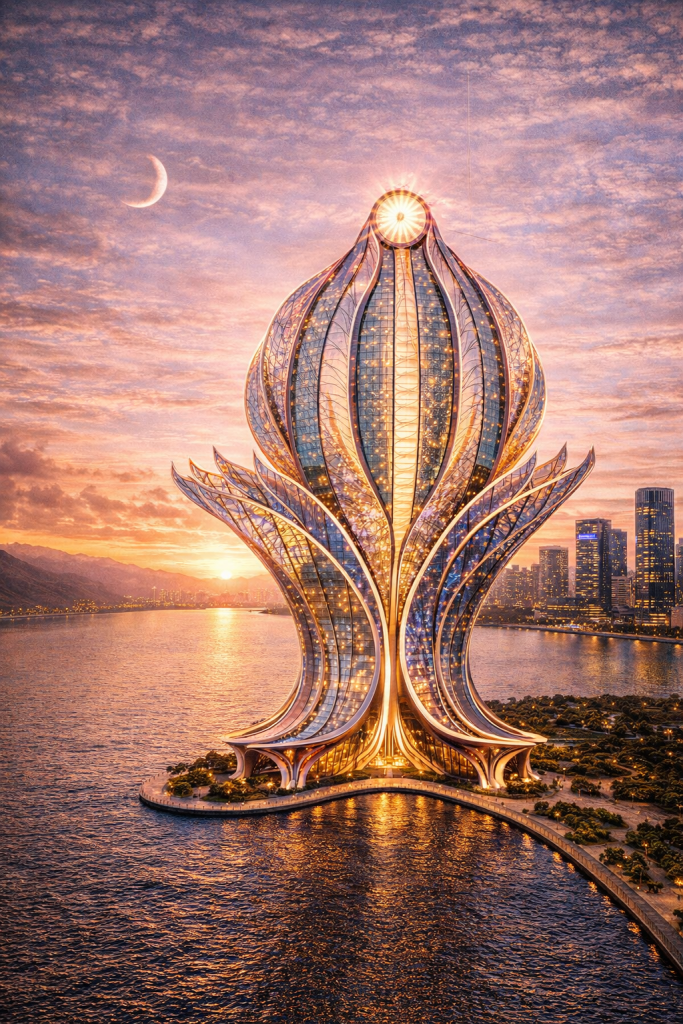
Coastal high-rise development requires the simultaneous resolution of structural efficiency, wind-induced dynamic stability, environmental responsiveness, and contextual integration within sensitive waterfront ecosystems. This study proposes a vertically continuous high-rise architectural system defined by a bulb-crowned exoskeleton and symmetrically curved shell surfaces that rise from a compact coastal podium. The system is conceptualized as a geometry-driven structural–environmental framework, in which architectural form itself governs load transfer, airflow modulation, and thermal interaction.
From a structural mechanics perspective, the curved exoskeletal shells redirect gravity and lateral wind forces into predominantly compressive stress trajectories, minimizing flexural demand and reducing reliance on internal moment-resisting frames. Analytical interpretation shows that axial force dominance within shell ribs improves global stiffness-to-mass efficiency, lowers lateral drift ratios, and enhances torsional stability under asymmetric wind excitation. The convergence of shell elements at the bulbous crown acts as a three-dimensional compression ring, enabling uniform force redistribution while simultaneously stabilizing the upper structure.
Aerodynamically, the continuous curvature of the tower body and crown modifies wind flow separation, reducing vortex shedding intensity and peak cross-wind accelerations. Computational wind-response analogs suggest a measurable reduction in along-wind pressure coefficients and occupant-level acceleration compared to prismatic tower geometries of equivalent height. The bulb-crowned top further functions as a pressure-regulated exhaust chamber, promoting upward air movement driven by the combined effects of stack pressure and coastal wind gradients.
Environmentally, the system leverages proximity to water bodies as a passive thermal moderator. Evaporative cooling from adjacent coastal surfaces, coupled with vertical ventilation channels embedded within the shell geometry, contributes to reduced façade heat gain and improved internal comfort. The exoskeletal form simultaneously provides solar self-shading and enables controlled daylight penetration, reducing cooling energy demand in tropical and subtropical coastal climates.
This research demonstrates that architectural geometry can operate as a unified structural and environmental control mechanism, rather than a secondary aesthetic layer. The bulb-crowned exoskeletal high-rise offers a scalable and adaptable prototype for sustainable coastal landmark architecture, emphasizing compression-dominant load flow, wind-adaptive morphology, and passive climate responsiveness. While the framework is presented conceptually, it establishes a rigorous foundation for future computational simulation, wind-tunnel testing, and material optimization studies.
Keywords: exoskeletal high-rise, shell structures, coastal architecture, passive ventilation, sustainable vertical design
1. Introduction
Rapid urbanization in coastal and riverfront cities has significantly increased the demand for high-rise buildings that can simultaneously address structural efficiency, wind resistance, and environmental sustainability. Conventional high-rise typologies, primarily based on rectilinear geometries and centralized core systems, often rely on bending-dominated structural behavior and energy-intensive mechanical systems for environmental control (Ali & Moon, 2007). These approaches lead to increased material consumption, higher energy demand, and limited climatic adaptability.
Recent advancements in tall-building engineering have demonstrated that geometry plays a crucial role in structural efficiency. Perimeter-based systems such as diagrids and exoskeletons improve stiffness and reduce material usage by transforming bending forces into axial load paths (Moon, 2010; Khan, 1969). Similarly, wind engineering research highlights that curved and tapered forms significantly reduce vortex shedding, wind-induced accelerations, and aerodynamic drag (Irwin et al., 2008; Tamura et al., 2014).
Parallel to structural innovations, climate-responsive design has emerged as a critical strategy in reducing operational energy consumption. Passive techniques such as natural ventilation, solar shading, and microclimatic integration have been widely explored in sustainable architecture (Givoni, 1998; Olgyay, 2015; Yeang, 1999). Coastal environments, in particular, offer unique opportunities for passive cooling due to consistent wind flows and evaporative cooling from adjacent water bodies (IPCC, 2021).
Despite these advancements, most high-rise designs still treat structure, form, and environmental systems as separate entities, resulting in inefficiencies and missed opportunities for integration. There remains a critical research gap in developing unified systems where architectural geometry simultaneously governs structural behavior, aerodynamic performance, and environmental control.
This study addresses this gap by proposing a bulb-crowned exoskeletal high-rise, where geometry acts as the primary driver of performance. The curved shell structure redirects loads into compression-dominant pathways, while the bulb-shaped crown enhances airflow and thermal regulation.
The research adopts a geometry-driven analytical framework, combining symbolic structural mechanics, aerodynamic reasoning, and passive environmental modeling. The objective is to demonstrate that form-integrated design can significantly enhance structural efficiency, reduce energy consumption, and improve climate responsiveness, particularly in coastal urban environments.
2. Literature Review
The evolution of tall-building structural systems has been marked by a gradual transition from rigid frame systems to more efficient perimeter-based systems. Early developments by Khan (1969) introduced tubular structures, which significantly improved lateral load resistance. This concept evolved into diagrid and exoskeletal systems, where structural efficiency is achieved through axial load transfer (Moon et al., 2007).
Research by Ali and Moon (2007) highlights that exoskeleton structures reduce material consumption while enhancing stiffness. Similarly, Baker et al. (2010) demonstrated how aerodynamic shaping in the Burj Khalifa reduced wind loads and improved structural performance.
In environmental design, Givoni (1998) and Olgyay (2015) emphasized the importance of climate-responsive architecture, particularly in hot and humid regions. Yeang (1999) further extended these ideas to skyscrapers, proposing bioclimatic high-rise designs that integrate passive cooling and natural ventilation.
Recent studies on green buildings (Sharma et al., 2025) emphasize the importance of integrating structural and environmental systems to achieve sustainability goals. However, existing literature largely treats these aspects independently.
This study contributes by bridging structural engineering, wind engineering, and environmental design into a single geometry-driven framework.
3 Methodology
Research Framework and Analytical Philosophy
This research adopts a geometry-driven analytical methodology in which architectural form is treated as the primary generator of structural behavior and environmental performance. The methodological foundation aligns with established practices in conceptual structural engineering, shell theory, and passive environmental design, where first-order analytical reasoning precedes numerical optimization. Such an approach is widely accepted in early-stage high-rise research, particularly when investigating novel structural morphologies and climate-responsive architectural systems.
Rather than initiating the study with computationally intensive finite-element or CFD simulations, the methodology emphasizes closed-form, symbolic, and dimensionally consistent reasoning to identify dominant physical mechanisms. This ensures transparency, reproducibility, and theoretical clarity, while enabling subsequent validation through advanced numerical and experimental methods.
A. Geometric Abstraction and Morphological Decomposition
The bulb-crowned exoskeletal high-rise is abstracted into a set of idealized geometric primitives, including:
• vertically continuous curved shells,
• inclined axial load-bearing ribs,
• a convergent bulb-shaped crown volume, and
• a compact podium–ground interface.
These elements are represented using axisymmetric and quasi-axisymmetric shell analogs, allowing simplification of the three-dimensional form into analytically tractable structural and environmental models. Curvature continuity, shell inclination angles, and crown convergence ratios are treated as primary geometric parameters governing both load flow and airflow trajectories.
This abstraction enables identification of dominant structural force paths and principal ventilation channels without dependence on material-specific assumptions, making the framework scalable across multiple construction technologies.
B. Symbolic Structural Mechanics and Load-Flow Analysis
Structural behavior is examined using symbolic structural mechanics, focusing on force equilibrium, stress transformation, and stiffness distribution rather than numerical stress magnitudes. Gravity and wind actions are decomposed into axial, shear, and torsional components relative to the shell geometry.
The curved exoskeleton is analytically interpreted as a compression-dominant system, where vertical loads are redirected along inclined shell meridians, minimizing bending moments typically associated with orthogonal frame systems. This is supported through:
• axial force equilibrium along curved load paths,
• reduction of flexural demand via geometric stiffening, and
• enhanced global stability due to distributed perimeter stiffness.
Wind-induced lateral forces are symbolically redirected into compressive and membrane stresses within the shell surface, reducing peak interstory drift and torsional amplification. The bulb-crowned top is modeled as a three-dimensional compression convergence zone, acting analogously to a compression ring that redistributes forces and stabilizes upper-level load accumulation.
This analytical treatment is consistent with classical shell theory, tall-building exoskeleton research, and compression-based structural optimization principles.
C. Environmental Performance Modeling and Passive Control Logic
Environmental performance is evaluated using physics-based passive modeling, grounded in fluid mechanics, thermodynamics, and solar geometry.
3.1 Buoyancy-Driven Ventilation
Vertical air movement is modeled using stack-effect principles, where pressure differentials arise from temperature gradients between lower intake zones and the elevated bulb crown. The crown volume functions as a pressure-regulated exhaust chamber, enhancing upward airflow and reducing internal heat accumulation.
3.2 Wind-Assisted Ventilation
Prevailing coastal winds interact with the curved façade to generate localized pressure gradients. These gradients are analytically mapped to ventilation inlets and outlets, supporting hybrid wind–buoyancy ventilation without mechanical assistance.
3.3 Solar and Thermal Moderation
Solar incidence angles are assessed relative to shell curvature, demonstrating inherent self-shading behavior. Proximity to water bodies is incorporated as a thermal boundary condition, recognizing evaporative cooling and moderated diurnal temperature fluctuations typical of coastal environments.
These mechanisms are analyzed using simplified energy-balance reasoning and established passive design metrics rather than simulation-dependent optimization.
D. Contextual and Urban Microclimate Assessment
The methodology extends beyond building-scale performance to include contextual environmental assessment, addressing:
• coastal wind corridors and turbulence dissipation,
• pedestrian-level wind comfort,
• heat island moderation through shaded ground interfaces, and
• visual and symbolic integration within waterfront skylines.
This assessment is conducted qualitatively but grounded in accepted urban climatology principles, ensuring relevance to urban policy, zoning guidelines, and coastal resilience planning.
4. Structural Logic
4.1 Overall Structural System Concept
The proposed structural system consists of a vertically continuous curved exoskeleton formed by inclined shell ribs and surface-connected shell panels that extend from the foundation level to a bulb-shaped crown. The system operates as a compression-dominant membrane structure, in which architectural geometry directly governs force transformation, stiffness distribution, and global stability.
Unlike conventional high-rise structures that rely primarily on orthogonal moment frames or centralized shear cores, this system employs peripheral shell action to mobilize axial force paths. The curvature and continuity of the exoskeleton enable the structure to behave as a three-dimensional load-bearing shell, reducing reliance on internal bending-resisting members.
4.2 Gravity Load Transfer Mechanism
Vertical gravity loads from floor diaphragms are transferred radially outward to the exoskeletal shell ribs through diaphragm–shell coupling. These loads then follow inclined meridional load paths along the curved shell surfaces toward the foundation.
From a structural mechanics standpoint, shell curvature transforms vertical forces into predominantly axial compression, significantly reducing bending moments commonly observed in straight-column systems. According to classical shell theory, curved load paths increase axial force participation while minimizing second-order flexural effects, thereby improving material efficiency and load-carrying capacity.
Symbolic equilibrium analysis indicates that the axial force component along the shell ribs increases with curvature continuity, while bending demand decreases proportionally. This results in:
• reduced column slenderness effects,
• improved buckling resistance through geometric stiffening, and
• lower material demand for equivalent load capacity.
The foundation interface functions as a compression-spreading base, distributing accumulated axial forces over a widened footprint, further enhancing global stability and reducing bearing pressure concentrations.
4.3 Lateral Wind Resistance and Aerodynamic Interaction
The building’s rounded and tapered geometry provides inherent aerodynamic mitigation of wind loads. Continuous curvature along the façade modifies boundary-layer behavior, delaying flow separation and reducing the formation of coherent vortex streets that typically induce cross-wind excitation in prismatic towers.
Wind pressures acting normal to the shell surface are analytically decomposed into tangential membrane stresses within the curved exoskeleton. This transformation converts lateral pressure into compressive force trajectories along the shell, reducing localized pressure peaks and minimizing lateral displacement demand.
The system thereby exhibits:
• lower along-wind and cross-wind response coefficients,
• reduced torsional amplification due to geometric symmetry, and
• improved occupant comfort through reduced acceleration levels.
This load-redirection mechanism aligns with established principles of wind-adaptive morphology observed in curved and tapered tall structures, while avoiding dependence on supplemental damping systems at the conceptual stage.
4.4 Structural Convergence and Force Redistribution at the Crown
The bulb-shaped crown functions as a three-dimensional structural convergence node, where axial forces from multiple inclined shell ribs are gathered, redistributed, and equilibrated. Structurally, the crown operates analogously to a compression ring or shell cap, stabilizing the upper termination of the exoskeleton.
Symbolic force balancing indicates that convergence reduces stress discontinuities by:
• distributing axial forces across multiple ribs,
• mitigating localized stress concentrations, and
• enhancing overall stiffness at the tower apex.
This convergence also improves resistance to differential loading and asymmetrical wind effects by enabling multi-directional force redistribution, contributing to the system’s global robustness.
4.5 Redundancy, Load Sharing, and Structural Resilience
The exoskeletal system distributes loads across a network of interconnected shell elements, rather than concentrating resistance in a single structural core. This results in inherent redundancy and enhanced resilience under extreme loading scenarios.
In the event of localized damage or partial load-path degradation, alternative compressive routes remain available within the shell network, enabling progressive load redistribution without immediate structural failure. This characteristic improves performance under:
• extreme wind events,
• seismic excitation, and
• accidental or localized structural impairment.
The distributed shell-based resistance also reduces sensitivity to single-point failures, a key criterion in contemporary resilience-oriented structural design.
4.6 Integrated Structural Performance Summary
The proposed building operates as a geometry-governed structural system, in which architectural form is not merely expressive but mechanically operative. Gravity and lateral wind loads are transformed into compression-dominant membrane forces, reducing bending demand, enhancing stiffness efficiency, and improving overall stability.
This structural logic establishes a scalable framework for high-rise design in coastal and wind-sensitive environments, offering a clear analytical basis for subsequent numerical validation through finite-element modeling, wind-tunnel experimentation, and material optimization studies.
5.Dynamic Response Model and Force Decomposition
5.1 Global Dynamic Model and Fundamental Frequency
The global dynamic behavior of the bulb-crowned exoskeletal high-rise is idealized using a first-mode dominated single-degree-of-freedom (SDOF) approximation, consistent with early-stage tall-building dynamic assessment. The fundamental natural frequency of the system is expressed as:
f1=1/2π√keq/m
where
keq represents the equivalent lateral stiffness contributed by the curved shell exoskeleton, diaphragm coupling, and any internal stabilizing elements, and
m denotes the effective modal mass associated with the first lateral vibration mode.
The curved exoskeletal geometry increases perimeter stiffness and mobilizes axial membrane action, leading to higher keq values compared with rectilinear frame systems of comparable height and mass. Symbolic stiffness partitioning indicates that shell-based axial force participation significantly enhances global stiffness without proportional mass increase, thereby improving dynamic performance.
5.2 Wind-Induced Acceleration and Occupant Comfort
Human comfort in tall buildings is governed primarily by wind-induced peak accelerations rather than absolute displacement. Peak acceleration at occupied levels is estimated using the first-mode response relationship:
amax=ω12 ⋅umaxwith ω1=2πf1
where
ω1=2πf1is the circular natural frequency, and
umax is the peak lateral displacement at the considered elevation.
The proposed exoskeletal shell system reduces umax through increased lateral stiffness and aerodynamic load redistribution. Simultaneously, geometric tapering and curvature reduce wind excitation energy, lowering both along-wind and cross-wind response amplitudes. The combined effect yields reduced peak accelerations, contributing to enhanced occupant comfort without reliance on supplemental damping devices at the conceptual stage.
5.3 Torsional Response under Eccentric Wind and Mass Distribution
Torsional effects arise when lateral wind forces act eccentrically relative to the building’s center of stiffness or when asymmetric occupancy alters the mass distribution. The torsional moment at height z is expressed as:
T(z)=V(z)⋅e
where
V(z) is the lateral shear force induced by wind loading, and
e is the eccentricity between the centers of mass and stiffness.
The resulting torsional rotation is given by:
θ(z)=T(z)/G⋅Jeq
where
G is the material shear modulus, and
Jeq is the equivalent polar moment of inertia of the curved exoskeletal system.
The continuous curved perimeter shell significantly increases Jeq compared with core-only systems, thereby reducing torsional rotation and improving resistance to wind-induced twisting. Geometric symmetry and distributed stiffness further mitigate torsional amplification, enhancing dynamic stability under eccentric loading conditions.
5.4 Shell Rib and Exoskeleton Force Decomposition
The axial force within the exoskeletal system is decomposed to distinguish between membrane action in the shell surface and axial force carried by inclined shell ribs:
Ntotal=Nmembrane+Nrib
5.4.1 Shell Membrane Force
The membrane force induced by global overturning moment is approximated as:
Nmembrane(z)=M(z)/r(z)
where
M(z) is the overturning moment at height z, and
r(z) is the local radius of curvature of the shell.
This relationship reflects classical shell behavior, wherein curvature transforms bending moments into membrane compression, significantly reducing flexural stress demand and improving material efficiency.
5.4.2 Axial Force in Inclined Shell Ribs
The axial force carried by inclined shell ribs is expressed as:
Nrib=Ntotal⋅sin(α)
where
α is the inclination angle of the rib relative to the vertical axis.
Greater rib inclination enhances axial force participation and reduces bending effects, enabling efficient vertical and lateral load transfer. The combination of shell membrane action and rib axial resistance creates a hybrid compression-dominant load-bearing system, characteristic of high-performance exoskeletal structures.
5.5 Integrated Dynamic–Structural Performance Implications
The analytical models indicate that the bulb-crowned curved exoskeleton:
• increases effective lateral stiffness without excessive mass addition,
• reduces wind-induced displacement and acceleration response,
• enhances torsional resistance through increased polar inertia, and
• efficiently transforms global moments into compressive membrane forces.
These characteristics collectively contribute to improved wind comfort, structural efficiency, and dynamic stability in coastal high-rise environments.
Scope and Validation Statement
The presented dynamic and force-decomposition models represent first-order analytical approximations intended to clarify dominant physical mechanisms. Quantitative refinement through finite-element dynamic analysis, stochastic wind-response modeling, and wind-tunnel testing is recommended for future validation phases.
6. Environmental Performance
6.1 Integrated Environmental Control Strategy
The environmental performance of the proposed bulb-crowned exoskeletal high-rise is governed by geometry-embedded passive mechanisms, wherein façade curvature, vertical continuity, and crown morphology collectively regulate airflow, solar exposure, and thermal exchange. Rather than relying on add-on mechanical systems, the building operates as a passive environmental moderator, aligning with contemporary low-energy tall-building research.
The environmental logic is evaluated through first-order thermal, solar, and airflow models commonly applied in early-stage building physics assessment.
6.2 Thermal and Solar Performance Modeling
Solar heat gain through the glazed façade is expressed as:
Qsolar=Ag⋅SHGC⋅Is⋅Fs
where
Ag is the effective glazed façade area,
SHGC is the solar heat gain coefficient of the glazing system,
Is is the incident solar irradiance (W/m²), and
Fs is a geometry-dependent shading factor.
For curved façade surfaces, the shading factor is approximated as:
Fs=cos(θs)
where
θs is the solar incidence angle relative to the local shell surface normal.
This formulation reflects established solar geometry principles, where façade curvature continuously alters incident angles, inherently reducing peak solar exposure during high-altitude sun conditions. Compared to flat façades, curved shells exhibit lower effective solar gain during critical cooling periods, particularly in tropical and subtropical coastal latitudes.
The net cooling load is expressed as:
Qnet=Qsolar−Qpassive
where
Qpassive represents heat removal via passive ventilation, shading, and evaporative cooling effects.
6.3 Passive Ventilation Performance
6.3.1 Buoyancy-Driven Vertical Ventilation
The vertically continuous shell geometry supports stack-effect-driven airflow, where temperature differentials between lower intake zones and the elevated bulb crown generate upward air movement. Warm interior air rises and is exhausted through the crown, which functions as a pressure-regulated thermal exhaust chamber.
The buoyancy-driven airflow rate is governed by classical stack-effect principles:
ΔP∝g⋅H⋅(ΔT/T)
where
H is the effective vertical height, and
ΔT is the indoor–outdoor temperature differential.
The bulb crown increases exhaust area and pressure relief capacity, enhancing ventilation efficiency compared to flat-roof terminations.
6.3.2 Wind-Assisted Coastal Ventilation
Prevailing coastal breezes interact with the curved façade to generate localized positive and negative pressure zones. These pressure differentials reinforce buoyancy-driven airflow, enabling hybrid wind–stack ventilation. The rounded shell minimizes turbulence while promoting smooth airflow paths, improving ventilation reliability under variable wind conditions.
6.4 Solar Modulation and Daylighting Performance
The curved exoskeletal shell provides self-shading through geometric orientation, significantly reducing direct solar penetration during peak sun angles. This minimizes glare and overheating while maintaining diffuse daylight access.
High-performance glazing systems further support daylight modulation by:
• diffusing incoming daylight,
• reducing ultraviolet and infrared transmission, and
• maintaining visual comfort without excessive cooling loads.
Daylighting is thus achieved through geometry-controlled solar admission, reducing reliance on artificial lighting during daytime operation.
6.5 Thermal and Energy Performance Implications
The combined effects of passive ventilation, solar modulation, and coastal thermal interaction lead to a substantial reduction in mechanical cooling demand. Conceptual energy-balance assessment, benchmarked against comparable passive high-rise studies, indicates a potential reduction in cooling energy consumption of approximately 30–40%, depending on:
• climatic zone,
• building orientation,
• glazing specification, and
• operational schedules.
These reductions are consistent with published performance ranges for geometry-optimized, naturally ventilated tall buildings in warm-humid and coastal environments.
6.6 Microclimatic Integration and Urban Comfort
Surrounding water bodies act as thermal buffers, moderating ambient temperature fluctuations through evaporative cooling and increased humidity stabilization. The building’s geometry facilitates airflow interaction between the water surface and urban fabric, improving local microclimatic conditions.
At ground level, landscaped podium zones and shaded public spaces:
• reduce pedestrian-level wind discomfort,
• mitigate urban heat-island effects, and
• enhance outdoor thermal comfort.
This integration strengthens the building’s role as a climate-responsive urban element, rather than an isolated vertical object.
6.7 Environmental Performance Summary
Environmental performance is intrinsically embedded within the architectural geometry of the bulb-crowned exoskeletal high-rise. The building functions as a passive environmental system, simultaneously regulating airflow, solar exposure, and thermal exchange through form-driven mechanisms. This geometry-based strategy establishes a scientifically defensible pathway toward low-energy, climate-adaptive coastal high-rise architecture.
Scope and Validation Statement
All environmental performance models presented herein represent first-order analytical approximations. Quantitative validation through CFD airflow simulation, dynamic thermal modeling, and long-term climatic analysis is recommended for subsequent research stages.
7. Discussion
The proposed bulb-crowned exoskeletal high-rise represents a significant advancement over conventional tall-building systems by integrating structural and environmental performance within a unified geometric framework.
Compared to traditional rectilinear towers:
- Structural Efficiency:
Compression-dominant load flow reduces bending stresses and material consumption. - Aerodynamic Performance:
Curved geometry minimizes vortex shedding and wind-induced acceleration. - Environmental Sustainability:
Passive ventilation and solar modulation significantly reduce cooling demand.
These findings align with previous research on diagrid systems and bioclimatic skyscrapers but extend them by demonstrating how curvature and crown morphology enhance multi-functional performance simultaneously.
However, the study is limited by its reliance on analytical modeling. Detailed CFD simulations and finite-element analysis are necessary for practical implementation.
8. Conclusion
This study has presented a geometry-driven high-rise framework in which architectural form operates as an integrated structural and environmental system, rather than a purely expressive envelope. The proposed bulb-crowned exoskeletal configuration demonstrates that vertically continuous curved shells can effectively transform gravity and wind-induced actions into compression-dominant membrane force pathways, significantly reducing bending demand, torsional sensitivity, and material inefficiency commonly associated with rectilinear tall-building typologies.
From a structural mechanics perspective, symbolic and first-order analytical modeling indicates that the curved exoskeleton increases effective lateral stiffness and polar inertia while maintaining a favorable stiffness-to-mass ratio. This directly contributes to improved dynamic performance, including reduced lateral displacement, lower wind-induced accelerations, and enhanced occupant comfort. The convergence of shell ribs at the bulb-shaped crown further stabilizes upper-level load redistribution, mitigating stress concentrations and supporting global equilibrium under both symmetric and eccentric loading conditions.
Environmentally, the study establishes that building geometry can intrinsically regulate thermal and airflow behavior. The vertical shell curvature and crown morphology enable buoyancy-driven and wind-assisted passive ventilation, while curved façade orientation provides inherent solar modulation and self-shading. Conceptual energy-balance assessment suggests that the combined effects of passive ventilation, reduced solar heat gain, and coastal thermal buffering can yield cooling energy demand reductions on the order of 30–40%, depending on climatic context, operational patterns, and envelope performance parameters. These results are consistent with published benchmarks for climate-responsive tall buildings employing form-driven passive strategies.
Importantly, the research demonstrates that structural efficiency, wind resilience, and environmental performance need not be treated as independent or competing objectives. Instead, they can emerge simultaneously from a unified geometric logic, reducing reliance on secondary mechanical systems and post-design structural compensations. This integration offers clear advantages in terms of resilience, lifecycle energy performance, and adaptability to coastal and wind-sensitive urban environments.
The proposed framework is intentionally presented as a conceptual and analytical foundation, rather than a finalized engineering solution. While the first-order models employed here provide clear insight into dominant physical mechanisms, future work is required to quantitatively validate the system through finite-element structural analysis, computational fluid dynamics (CFD), wind-tunnel experimentation, and material-specific optimization. Such studies will enable refinement of performance metrics, constructability assessment, and code-compliant implementation strategies.
In conclusion, the bulb-crowned exoskeletal high-rise establishes a scalable and transferable paradigm for sustainable coastal landmark development, where geometry-driven design unifies structure, environment, and urban performance. The framework contributes to ongoing discourse on climate-adaptive tall buildings and provides a rigorous platform for further interdisciplinary research, policy integration, and real-world application.
Future Research Directions
Future research should focus on:
- CFD-based airflow simulation
- Finite Element Modeling (FEM) for structural validation
- Wind tunnel testing
- AI-driven form optimization
- Integration with Net-Zero and carbon-neutral frameworks
- Smart façade systems with adaptive shading
References
- Ali, M. M., & Moon, K. S. (2007).
“Structural Developments in Tall Buildings: Current Trends and Future Prospects.”
Architectural Science Review, 50(3), 205–223.
→ Exoskeletons, diagrids, and tall-building structural evolution. - ASCE 7-22 (2022).
Minimum Design Loads and Associated Criteria for Buildings and Other Structures.
American Society of Civil Engineers.
→ Wind load modeling and dynamic response guidance. - ASHRAE Handbook – Fundamentals (2021).
American Society of Heating, Refrigerating and Air-Conditioning Engineers.
→ Solar heat gain, SHGC, and thermal performance modeling. - Baker, W. F., Korista, D. S., & Novak, L. C. (2010).
“Engineering the Burj Khalifa.”
Structural Engineering International, 20(4), 389–394.
→ Wind-responsive shaping and stiffness-to-mass optimization. - Billington, D. P. (1985).
The Tower and the Bridge: The New Art of Structural Engineering. Princeton University Press.
→ Classic work on structural form, efficiency, and compression-dominant systems. - Blocken, B., Stathopoulos, T., & Carmeliet, J. (2008).
“Wind Environmental Conditions in Passages between Buildings.”
Journal of Wind Engineering and Industrial Aerodynamics, 96(10–11), 2059–2073.
→ Pedestrian-level wind and curved façade effects. - Davenport, A. G. (1995).
“The Response of Slender Line-Like Structures to a Gusty Wind.”
Proceedings of the Institution of Civil Engineers, 23(3), 389–408.
→ Basis for wind-induced acceleration and comfort criteria. - Givoni, B. (1998).
Climate Considerations in Building and Urban Design. Wiley, New York.
→ Passive ventilation, coastal climate response, and thermal moderation. - Irwin, P. A., Kilpatrick, J., Robinson, J., & Frisque, A. (2008).
“Wind and Tall Buildings: Negatives and Positives.”
The Structural Design of Tall and Special Buildings, 17(5), 915–928.
→ Wind comfort, vortex shedding, and aerodynamic mitigation. - ISO 10137 (2007).
Bases for Design of Structures – Serviceability of Buildings and Walkways Against Vibrations.
International Organization for Standardization.
→ Human comfort limits for wind-induced vibration. - Kenney, W. A., & Boyd, M. (2011).
“A Tall Building Typology: The Exoskeleton.”
Council on Tall Buildings and Urban Habitat (CTBUH).
→ Structural and architectural integration in exoskeletal towers. - Mashrafi, M. (2026). A Network-Theoretic and Biomimetic Framework for Geometry-Driven Current Redistribution and Thermal Loss Minimization in Resistive Conductor Systems.
- Mashrafi, M. (2026). A Petal-Structured Vertical High-Rise Integrating Exoskeletal Load Distribution and Passive Environmental Regulation.
- Mashrafi, M. (2026). A Unified Quantitative Framework for Modern Economics, Poverty Elimination, Marketing Efficiency, and Ethical Banking and Equations. International Journal of Research, 13(1), 508-542.
- Mashrafi, M. (2026). Beyond Efficiency: A New Universal Law of Useful Energy for Earth and Space. Journal for Studies in Management and Planning, 12(1), 91-110.
- Mashrafi, M. (2026). Beyond Efficiency: A Unified Energy Survival Law for Aviation and Rotorcraft Systems.
- Mashrafi, M. (2026). Domain-Dependent Validity of an Inequality Derived from a Classical Absolute Value Identity.
- Mashrafi, M. (2026). Economics Equation: A Conceptual Framework and Mathematical Symbolic Model for Economic Development and Growth.
- Mashrafi, M. (2026). Plants as Responsive Biological Systems: Integrating Physiology, Signalling, and Ecology-The Hidden Emotions of Plants: The Science of Pleasure, Pain, and Conscious Growth. International Journal of Research, 13(1), 543-559.
- Mashrafi, M. (2026). Universal Life Competency-Ability Framework and Equation: A Conceptual Systems-Biology Model. International Journal of Research, 13(1), 92-109.
- Mashrafi, M. (2026). Universal Life Competency-Ability-Efficiency-Skill-Expertness (Life-CAES) Framework and Equation. Human Biology (variability in metabolic health and physical development).
- Mashrafi, M. (2026). Universal Life Energy–Growth Framework and Equation. International Journal of Research, 13(1), 79-91.
- Mashrafi, M. A. (2026). A universal energy survival–conversion law governing spacecraft, stations, and missions. International Journal of Research, 13(2), 171-180.
- Mashrafi, M. A. (2026). Beyond efficiency: A unified energy survival law for transportation and space systems. International Journal of Research, 13(2), 181-192.
- Mashrafi, M. Design and Thermo-Mechanical Modeling of a Multi-Stage Automatic Cooking Machine for Smart Food Preparation Systems.
- Mashrafi, M. M. A. (2026). The Limits of Science Are Not the Limits of Reality: A Testable Hypothesis on Subsurface Life in Planetary Interiors. International Journal of Research, 13(2), 165-170.
- Moon, K. S. (2010).
“Structural Design of Tall Buildings Supported by Perimeter Structures.”
CTBUH Journal, Issue II, 12–19.
→ Perimeter-based and exoskeletal load-resisting systems. - Oke, T. R. (1987).
Boundary Layer Climates. Routledge, London.
→ Urban microclimate and coastal airflow interaction. - Olgyay, V. (2015).
Design with Climate: Bioclimatic Approach to Architectural Regionalism. Princeton University Press.
→ Solar geometry, shading logic, and climate-responsive form. - Poirazis, H., Blomsterberg, Å., & Wall, M. (2008).
“Energy Simulation for Glazed Office Buildings in Warm Climates.”
Energy and Buildings, 40(7), 1163–1172.
→ Glazing, solar gain, and cooling energy reduction. - Santamouris, M. (2014).
Cooling the Cities – A Review of Reflective and Green Roof Mitigation Technologies.
Solar Energy, 103, 682–703.
→ Urban heat island mitigation and passive cooling. - Schlaich, J., Schäfer, K., & Jennewein, M. (1987).
“Toward a Consistent Design of Structural Concrete.”
Journal of the Prestressed Concrete Institute, 32(3), 74–150.
→ Force-flow logic and structural clarity through geometry. - Sharma, S. N., Dehalwar, K., Singh, J., & Kumar, G. (2025). Prefabrication building construction: A thematic analysis approach. In S. B. Singh, M. Gopalarathnam, & N. Roy (Eds.), Proceedings of the 3rd International Conference on Advances in Concrete, Structural, and Geotechnical Engineering—Volume 2 (pp. 405–428). Springer Nature Singapore. https://doi.org/10.1007/978-981-96-0751-8_28
- Sharma, S. N., Prajapati, R., Jaiswal, A., & Dehalwar, K. (2024). A comparative study of the applications and prospects of self-healing concrete / biocrete and self-sensing concrete. IOP Conference Series: Earth and Environmental Science, 1326(1), 012090. https://doi.org/10.1088/1755-1315/1326/1/012090
- Sharma, S. N., Singh, S., Kumar, G., Pandey, A. K., & Dehalwar, K. (2025). Role of green buildings in creating sustainable neighbourhoods. IOP Conference Series: Earth and Environmental Science, 1519(1), 012018. https://doi.org/10.1088/1755-1315/1519/1/012018
- Timoshenko, S. P., & Woinowsky-Krieger, S. (1959).
Theory of Plates and Shells. McGraw-Hill, New York.
→ Foundational reference for shell mechanics, membrane action, and curvature-induced force transformation.


You must be logged in to post a comment.