China\’s new lineup

Anybody who predicts what the next Standing Committee and the Politburo will be is almost certain to be wrong ! This is why most newspaper columnists are content with naming possible candidates and leaving it at that. This blogger does not care if he is proved wrong or even as a fool. There are no consequences to getting it dead wrong. So here\’s my prediction what\’s going to happen !
There are only two near certainties in this political game. One is that Xi Jinping will continue as Secretary of the Communist Party, Chairman of the Central Military Commission and as the President. The second is that Zhang Dejiang, Yu Zengsheng, Liu Yunshan and Zhang Gaoli will retire from the Standing Committee . Everything else is up for grabs.
Two of the key moves that is the subject of much speculation is what will happen to Li Keqiang the current Premier (most views are that he will stay on as Premier) and that of Wang Qishan (Xi\’s ally in the anti corruption drive, but who is crossing the informal retirement age of 68).
My guess is that Li Keqiang will be pushed out and Wang Qishan will replace him as the Premier. This is not considered likely today and if it happens, will be radical and  unexpected. If it indeed does happen, it will indicate that Xi has taken total control of the Party. My reasoning is that Li has been a disappointment as  Premier  with his management of the economy, his key job. He will also carry the can for the stock market troubles of 2015. Li belongs to the Youth League faction which has been systematically defanged. There is precedence in China of the Premier being replaced – Li Peng giving way to Zhu Rongji in 1998. Wang Qishan , as we have seen in earlier posts, is the de facto No 2 in China today.  He is an expert on the economy and if he were to be appointed Premier, he will be Xi\’s trusted lieutenant in the soft landing of the economy that is a big imperative for China. This will mean Xi is bending the retirement rule – something I am guessing he will do as a strawman for his own options 5 years from now when he will face this retirement rule himself.
I think Li Zhanshu is a shoo in for the Standing Committee. He is currently the Director of the General Office of the Party and is a right hand man of Xi.  Stacking the Standing Committee with his people will be a primary objective of Xi.
There is a good chance that Wang Yang, currently Vice Premier will be elevated to the Standing Committee. He is not a Xi loyalist  and was potentially a candidate for the Standing Committee  even the last time around. He is however efficient and strong and has quelled his reformer (read political) instincts. He has kept his head low over the last five years and for sheer ability is likely to rise.
Another likely name is Wang Huning. He is currently the head of the central policy research office. A  non controversial choice who doesn\’t belong to any faction. A theoretician whom Xi seems to rely on and is often seen on Xi\’s overseas trips as an important adviser.
If Xi is in total control of the Party and has not needed to cut any deals, then this is the likely Standing Committee – cut down to five members . Xi Jinping, Wang Qishan, Li Zhanshu, Wang Yang and Wang Huning.
If Xi however decides to stay with a seven member standing committee, then the two additional names, would be as my guess, Zhao Leji and Han Zheng. Both are \”senior\” but not powerful and therefore likely to simply make up the numbers and duly nod their heads to anything Xi says.
If my prediction is even 75% right, then it is clear that Xi is all powerful. None of these members can be a potential successor to Xi and it will also indicate that Xi is preparing to stay on after 2022 as he hasn\’t groomed a successor unlike what his predecessors Jiang Zemin and Hu Jintao did.
 Just as important as who gets in, is who doesn\’t get in. The disappointed persons would be
– Li Keqiang, the current Premier. He would be the biggest casualty if he were to fall. If he doesn\’t get dropped, Xi is just being cautious not to make too many changes. Li\’s power will continue to wane and he will, at best be a bureaucrat continuing to run the economy. Real decisions will  made by Xi.
– Hu Chunhua, the current party chief of Guangdong. He is of the next generation and had been touted as a potential successor to Xi even five years ago. He has recently been making noises pledging loyalty to Xi.  His elevation to the Standing Committee will mean he is the clear front runner next time around. His non inclusion will be a strong signal that Xi intends to stay on even after 2022.
– Chen Min\’er, current party chief of Chongqing. He was just brought in there to replace the disgraced Sun Zhengcai, a potential successor to Xi who fell in a power struggle. Chen is a staunch Xi loyalist. Its unlikely that he would be nominated, but if he were, it would be a clear signal that he would take over from Xi at least nominally in 2022, while Xi holds real power from the backroom.
A team like the one I have predicted will mean the following for China
– Xi Jinping is all powerful. He will start to acquire Mao like cult status. It is only hoped that he wouldn\’t unleash horrors on the country as Mao did.
– The Party will become even more ruthless in suppressing dissent. Personal freedoms will be even more curtailed and censorship will worsen.
– The economy will be managed efficiently. Economic troubles will come but they will be managed as best as could be.
– On foreign policy China will become increasingly belligerent and muscular.  They will be difficult to deal with diplomatically and might pick up fights with other countries. The current US administration will constantly lose on anything they pick up with China.
– The anti corruption drive and the defanging of political opponents will intensify. Xi might however face a challenge when Jiang Zemin dies. Major political activity tends to happen when somebody important dies.  The two major upheavals in China happened in 1976 after Zhou Enlai died and more famously in 1989 when Hu Yaobang died which led to the Tiananmen incidents. Jiang is nowhere near as liked as Zhou or Hu were, but it may be a trigger for old timers and those who had lost out in the Xi era to maybe flex their muscles.
– Xi will stay on post 2022 and will be the main power for at least another decade. He will install one of his men as the General Secretary, but will stay on as the Chairman of the CMC and wield real power. He may even be appointed Chairman of the Party, a post that was abolished after Mao.
How wrong I am would be revealed in the days after October 18th when the line of 5 or 7, which I alluded to in the first sentence of this series of posts will walk in and be introduced.  Even if I am 50% right, I will lay claim to being a \”Zhōng guó tōng\” (China expert) !
Enough of politics. This blog will go back to plodding on business and economic matters. It will return briefly to China and politics when the actual line up is announced in end October.

How would YOU implement the RTE?

If YOU were in charge of implementing RTE in a district / block, exactly WHAT would you do? Could I have step by step suggestions please. That\’s because all of us have by now said all that is wrong with RTE implementation, but this is not equal to knowing what to do. I come across many district and block functionaries who are seriously looking for suggestions (they also welcome critique, but find that it doesn\’t help them decide what to do – at best they only see they\’re doing something wrong).

It would be a great contribution. I promise I\’ll share the suggestions with at least 10 \’serious\’ functionaries who have asked for support and will try to impact 300 to 3000 schools each. As they start implementing, we\’ll create a facebook page where they can record their progress and impact. But could we have specific suggestions please, maybe even a framework or a detailed note?


One response I received was from Anjela Taneja:

Gave this some thought overnight. Basically, one immediate suggestion is to put this question onto a website (read you blog atleast) so you can get a larger pool of responses. Personally, I added the question onto the RTE India page I moderate as well. However, a more user friendly interface of responding would help instead of trying to type everything on FB. In response to the actual question, I see two sets of responses- universal recommendations (only a few), but a lot of questions related to specific geographies. The solutions need to emerge from the local problems, so it would help to know where the functionaries in question are actually stuck and atleast what states one is talking about.


In response, here are some details.

As for geographies… Specific ones include: the block of Fatehpur, near Kanpur; the training coordinator of Bareilly; an informal govt school teachers\’ collective (who want things to impove) in Varanasi; in terms of states, Bihar and Gujarat to start with.

A French soap opera is about to unfold

The world’s richest woman just died. If you didn’t know this, please stop focusing on the tweets and turn your attention to more weighty matters of the world.
Liliane Bettencourt passed away four days ago at the age of 94. She was the heiress to the founder of L’Oréal, the world’s largest cosmetic company; the only child of Eugène Schueller who founded L’Oréal in 1907. She herself worked in the company from the age of 15 and rose to become its deputy Chairperson.
The future of L’Oréal is now in play. And therein lies a story that could give a beating to any soap opera on television.
In 1974, fearing that France would nationalise the company, Bettencourt did a deal with Nestle wherein she offloaded about half her holding in exchange for shares in Nestle. Since then Nestle and Bettencourt have had one of the longest tangos in business history. Nestle, a food company, with no presence at all in cosmetics, had a 30% stake in the world’s largest cosmetics company (now down to 23%). But in an agreement with Bettencourt, Nestle remained a sleeping partner and promised not to acquire any more shares or to bid for Bettencourt’s own shares as long as she was alive. Presumably Nestle had thought that she would not live so long. But they kept their word and until now have not interfered at all in the business just pocketing the dividends and biding their time. So much so that very few outside the business world probably even know that Nestle is a major shareholder in L’Oréal.
In the meantime Bettencourt’s life over the last decade has been another soap opera all by itself. Sometime in 2007, at the  ripe age of 84, she took a fancy to her photographer and started to bestow gifts to him worth over €1 billion. Her daughter filed a complaint with the police that her photographer was taking advantage of her weakened psychological stake to amass a personal fortune. She and her daughter had an extremely public spat with each accusing the other of having gone mad. The courts finally made Bettencourt’s grandson as her overseer and the fortune was vested with her daughter and her two grandsons. But everything was in a state of limbo as long as she was alive.
Cue the events in Nestle. Nestle , for long, has waited patiently to consummate what was really a delayed acquisition. Both the last two Chairmen of Nestle sit on the L’Oréal Board. They were probably waiting for the death of Bettencourt to acquire L’Oréal . But alas they now have an activist shareholder in Dan Loeb who has a fair stake in Nestle and is pushing it to do the opposite – sell the stake in L’Oréal and return the money to shareholders. So there is no saying what Nestle will ultimately do – acquire L’Oréal or divest !
There are other big fish circling. Given how cheap debt is , there are enough and more funds of various stripes, including probably the notorious 3G Capital and their close friend Warren Buffet, who are getting all excited. Also interested would be two giants in the cosmetics field – Unilever and Procter & Gamble, who have long eyed Nestle’s stake with envy and made noises about what a Foods company is doing with a stake in a Cosmetics company.
Complicating this will be nationalism, for after all L’Oréal is (very) French. Would Macron be willing to let a French institution fall into the hands of the ugly Americans ? If he interfered, the tweeter in chief would surely have something to say !!
And what will Françoise Bettencourt Meyers, Liliane’s daughter and the two grandchildren to whom the 30% stake in L’Oréal passes, do ?  Would they act in concert. Or would they go their own ways ? Would they buy ? Or sell ?
Every investment banker is drooling and shivering with anticipation. It is fair to assume that no first class seats are available on all flights to and from Paris, London, New York and Lausanne !
Watch this space. The knives will be out on 18th March when the six months period after Bettencourt’s death ends and  all agreements expire.    Bettencourt’s life was colourful to say the least – marrying a Nazi sympathiser, losing money with Bernie Madoff,  a strange affair with her photographer, being declared mentally incompetent, accused of giving cash stuffed envelopes to Nicolas Sarkozy,  having numerous Swiss bank accounts …… But even by those standards, what will follow in the fight for L’Oréal will be, to put it mildly, interesting.

    What Do We Actually \’Celebrate\’ In Our Schools?

    \’So, you\’re \’celebrating\’ again.\’

    \’Yes, it\’s Independence Day tomorrow.\’
    \’Oh, so another round of ritualistic speeches?\’
    \’What do you mean, ritualistic speeches?\’
    \’You know what I mean. The same old \’important\’ people will be called. They will be welcomed, garlanded and they will walk around, feeling even more self-important.\’
    \’You\’re being very unkind, you know.\’
    \’But close to the truth, isn\’t it?\’
    \’I\’m not sure if this is really ritualistic…\’
    \’No, it is what follows afterwards…. The same formal atmosphere will be created. Children will sit in neat rows and told not to talk too much. The LIP (or your Local Important Person) will be praised, invited to give us the benefit of his wisdom, children will be asked to shush, and then the LIP will give the same speech as every year – you are the future of the country… freedom is very important.. our great leaders were so very great… you must work hard… you must try to like the great people of the past… And all this while instead of experiencing freedom on Independence Day of India, children will be sitting bored, stiff, not allowed tomove around or talk or express themselves….\’
    \’You\’re being really harsh!\’\’
    \’OK, tell me, didn\’t you hear the same speeches when you were a child?\’
    \’Ye-es.\’
    \’Did you really enjoy those celebrations? Were they a celebration for you?\’
    \’Actually, to be honest, no, not really.\’
    \’Aren\’t you surprised that the same speeches are being made even now?\’
    \’Yeah, now that you mention it…\’
    \’And shouldn\’t children be more like the leaders of tomorrow rather than the leaders of long past. After all, every kid is not going to experience walking 17 kilometres to school!\’
    \’Hmm… something to think about, there. And come to think of it, why was every great man\’s school 17 kilometres away?\’
    \’See, it\’s getting you too!  And when it comes to – no, no, better not to say that.\’
    \’Well you can tell me… I\’m not going to shout at you!\’
    \’I know you won\’t. But I don\’t want you to feel depressed either.\’
    \’Come on, I can handle it. Tell me what you were going to say.\’

    \’Well, if you insist. The thing is, children attend all these functions year after year, experience the same thing over and over again. And what do they learn? They learn that they don\’t matter. Their job is to listen. Their role is to be passive, not think for themselves. And look at you – you were a child who once found these functions boring but you are organizing exactly the same kind of function again! Independence Day isn\’t quite an experience in Independence, isn\’t it? My thesis is that these National Day type of \’celebrations\’ only teach us to be slaves, to accept that we have no freedom to be different or better, to allow ourselves to be defined by the limited vision of those limited adults who were similarly made limited by the experience they went through as children themselves…. Hey, you\’re suddenly very silent now. This is not look good… come on, say something.\’
    \’What do I say? I\’m feeling so…\’
    \’So… what?\’
    \’So depressed!\’
    ————————————————-
    What do you think about the other \’celebrations\’ we have in our schools? Is the birthday of a child celebrated \’more\’ or differently or better than that of other children whose families are considered to be less important or not influential?
    What are the festivals celebrated in schools? Whose festivals are left out? Many communities / religious groups never see their festivals even discussed in school? What do they feel about it? And what do they \’learn\’ from this?
    On Sports Day, do most children have the scope to participate and gain something? Or is only the \’victory\’ of a  few celebrated again and again? And what do the rest learn from this?
    And on Results Day, whose achievements stand out? And what does everyone learn from this? (Maybe CCE will make a difference here?)
    Perhaps all these celebrations, in the end, make us realise that their isn\’t much about us that is worth celebrating. When I was younger I would have said that this happens even though the intention is quite different. But now, a little more battered and older, I think the intention was always this – to make you realise that only a few can be \’important\’ persons worth celebrating, not you.
    ————————————————-
    So what should we celebrate in our schools?
    For starters, children and learning. Simply the presence of every child is worth celebrating (rather than \’Oh God, another one!\’). And how to celebrate? By smiling, by welcoming, by genuinely talking with the child, giving space to her questions, by looking for ways to ensure she is comfortable, involved and engaged in an actual learning.
    Children will ask unexpected questions, offer different points of view, find innovative ways of doing things, or help each other… celebrate this. Point out what they have done which is so good, and why it is so.
    There will be times when those who usually \’fall behind\’ will make an effort, come up with something of their own (of course, only if you ensure they have the opportunity to do so). Celebrate their efforts, point out their good parts, and indicate what else they can do that will earn them similar \’celebration\’.
    If you find a fellow teacher, a staff member, a parent, an SMC member who is doing something successfully and contributing to children and the school, that\’s worth celebrating.
    And on Independence Day? Start a few days before. Discuss with children what Independence Day means to us. Ask them how they think it should be celebrated. Come up with ideas that puts the children in the front, not adults or LIPs. Maybe they make drawings and posters related to freedom. Maybe they hold a debate on what freedom means and whether we really are a free people. Maybe they decide not to do a \’function\’ in the  school at all and instead spend time with children who are unable to be in school because they are not really free…And maybe they will learn something very different from such \’celebrations\’ than we did.

    What Do We Actually \’Celebrate\’ In Our Schools?

    \’So, you\’re \’celebrating\’ again.\’

    \’Yes, it\’s Independence Day tomorrow.\’
    \’Oh, so another round of ritualistic speeches?\’
    \’What do you mean, ritualistic speeches?\’
    \’You know what I mean. The same old \’important\’ people will be called. They will be welcomed, garlanded and they will walk around, feeling even more self-important.\’
    \’You\’re being very unkind, you know.\’
    \’But close to the truth, isn\’t it?\’
    \’I\’m not sure if this is really ritualistic…\’
    \’No, it is what follows afterwards…. The same formal atmosphere will be created. Children will sit in neat rows and told not to talk too much. The LIP (or your Local Important Person) will be praised, invited to give us the benefit of his wisdom, children will be asked to shush, and then the LIP will give the same speech as every year – you are the future of the country… freedom is very important.. our great leaders were so very great… you must work hard… you must try to like the great people of the past… And all this while instead of experiencing freedom on Independence Day of India, children will be sitting bored, stiff, not allowed tomove around or talk or express themselves….\’
    \’You\’re being really harsh!\’\’
    \’OK, tell me, didn\’t you hear the same speeches when you were a child?\’
    \’Ye-es.\’
    \’Did you really enjoy those celebrations? Were they a celebration for you?\’
    \’Actually, to be honest, no, not really.\’
    \’Aren\’t you surprised that the same speeches are being made even now?\’
    \’Yeah, now that you mention it…\’
    \’And shouldn\’t children be more like the leaders of tomorrow rather than the leaders of long past. After all, every kid is not going to experience walking 17 kilometres to school!\’
    \’Hmm… something to think about, there. And come to think of it, why was every great man\’s school 17 kilometres away?\’
    \’See, it\’s getting you too!  And when it comes to – no, no, better not to say that.\’
    \’Well you can tell me… I\’m not going to shout at you!\’
    \’I know you won\’t. But I don\’t want you to feel depressed either.\’
    \’Come on, I can handle it. Tell me what you were going to say.\’

    \’Well, if you insist. The thing is, children attend all these functions year after year, experience the same thing over and over again. And what do they learn? They learn that they don\’t matter. Their job is to listen. Their role is to be passive, not think for themselves. And look at you – you were a child who once found these functions boring but you are organizing exactly the same kind of function again! Independence Day isn\’t quite an experience in Independence, isn\’t it? My thesis is that these National Day type of \’celebrations\’ only teach us to be slaves, to accept that we have no freedom to be different or better, to allow ourselves to be defined by the limited vision of those limited adults who were similarly made limited by the experience they went through as children themselves…. Hey, you\’re suddenly very silent now. This is not look good… come on, say something.\’
    \’What do I say? I\’m feeling so…\’
    \’So… what?\’
    \’So depressed!\’
    ————————————————-
    What do you think about the other \’celebrations\’ we have in our schools? Is the birthday of a child celebrated \’more\’ or differently or better than that of other children whose families are considered to be less important or not influential?
    What are the festivals celebrated in schools? Whose festivals are left out? Many communities / religious groups never see their festivals even discussed in school? What do they feel about it? And what do they \’learn\’ from this?
    On Sports Day, do most children have the scope to participate and gain something? Or is only the \’victory\’ of a  few celebrated again and again? And what do the rest learn from this?
    And on Results Day, whose achievements stand out? And what does everyone learn from this? (Maybe CCE will make a difference here?)
    Perhaps all these celebrations, in the end, make us realise that their isn\’t much about us that is worth celebrating. When I was younger I would have said that this happens even though the intention is quite different. But now, a little more battered and older, I think the intention was always this – to make you realise that only a few can be \’important\’ persons worth celebrating, not you.
    ————————————————-
    So what should we celebrate in our schools?
    For starters, children and learning. Simply the presence of every child is worth celebrating (rather than \’Oh God, another one!\’). And how to celebrate? By smiling, by welcoming, by genuinely talking with the child, giving space to her questions, by looking for ways to ensure she is comfortable, involved and engaged in an actual learning.
    Children will ask unexpected questions, offer different points of view, find innovative ways of doing things, or help each other… celebrate this. Point out what they have done which is so good, and why it is so.
    There will be times when those who usually \’fall behind\’ will make an effort, come up with something of their own (of course, only if you ensure they have the opportunity to do so). Celebrate their efforts, point out their good parts, and indicate what else they can do that will earn them similar \’celebration\’.
    If you find a fellow teacher, a staff member, a parent, an SMC member who is doing something successfully and contributing to children and the school, that\’s worth celebrating.
    And on Independence Day? Start a few days before. Discuss with children what Independence Day means to us. Ask them how they think it should be celebrated. Come up with ideas that puts the children in the front, not adults or LIPs. Maybe they make drawings and posters related to freedom. Maybe they hold a debate on what freedom means and whether we really are a free people. Maybe they decide not to do a \’function\’ in the  school at all and instead spend time with children who are unable to be in school because they are not really free…And maybe they will learn something very different from such \’celebrations\’ than we did.

    What Do We Actually \’Celebrate\’ In Our Schools?

    \’So, you\’re \’celebrating\’ again.\’

    \’Yes, it\’s Independence Day tomorrow.\’
    \’Oh, so another round of ritualistic speeches?\’
    \’What do you mean, ritualistic speeches?\’
    \’You know what I mean. The same old \’important\’ people will be called. They will be welcomed, garlanded and they will walk around, feeling even more self-important.\’
    \’You\’re being very unkind, you know.\’
    \’But close to the truth, isn\’t it?\’
    \’I\’m not sure if this is really ritualistic…\’
    \’No, it is what follows afterwards…. The same formal atmosphere will be created. Children will sit in neat rows and told not to talk too much. The LIP (or your Local Important Person) will be praised, invited to give us the benefit of his wisdom, children will be asked to shush, and then the LIP will give the same speech as every year – you are the future of the country… freedom is very important.. our great leaders were so very great… you must work hard… you must try to like the great people of the past… And all this while instead of experiencing freedom on Independence Day of India, children will be sitting bored, stiff, not allowed tomove around or talk or express themselves….\’
    \’You\’re being really harsh!\’\’
    \’OK, tell me, didn\’t you hear the same speeches when you were a child?\’
    \’Ye-es.\’
    \’Did you really enjoy those celebrations? Were they a celebration for you?\’
    \’Actually, to be honest, no, not really.\’
    \’Aren\’t you surprised that the same speeches are being made even now?\’
    \’Yeah, now that you mention it…\’
    \’And shouldn\’t children be more like the leaders of tomorrow rather than the leaders of long past. After all, every kid is not going to experience walking 17 kilometres to school!\’
    \’Hmm… something to think about, there. And come to think of it, why was every great man\’s school 17 kilometres away?\’
    \’See, it\’s getting you too!  And when it comes to – no, no, better not to say that.\’
    \’Well you can tell me… I\’m not going to shout at you!\’
    \’I know you won\’t. But I don\’t want you to feel depressed either.\’
    \’Come on, I can handle it. Tell me what you were going to say.\’

    \’Well, if you insist. The thing is, children attend all these functions year after year, experience the same thing over and over again. And what do they learn? They learn that they don\’t matter. Their job is to listen. Their role is to be passive, not think for themselves. And look at you – you were a child who once found these functions boring but you are organizing exactly the same kind of function again! Independence Day isn\’t quite an experience in Independence, isn\’t it? My thesis is that these National Day type of \’celebrations\’ only teach us to be slaves, to accept that we have no freedom to be different or better, to allow ourselves to be defined by the limited vision of those limited adults who were similarly made limited by the experience they went through as children themselves…. Hey, you\’re suddenly very silent now. This is not look good… come on, say something.\’
    \’What do I say? I\’m feeling so…\’
    \’So… what?\’
    \’So depressed!\’
    ————————————————-
    What do you think about the other \’celebrations\’ we have in our schools? Is the birthday of a child celebrated \’more\’ or differently or better than that of other children whose families are considered to be less important or not influential?
    What are the festivals celebrated in schools? Whose festivals are left out? Many communities / religious groups never see their festivals even discussed in school? What do they feel about it? And what do they \’learn\’ from this?
    On Sports Day, do most children have the scope to participate and gain something? Or is only the \’victory\’ of a  few celebrated again and again? And what do the rest learn from this?
    And on Results Day, whose achievements stand out? And what does everyone learn from this? (Maybe CCE will make a difference here?)
    Perhaps all these celebrations, in the end, make us realise that their isn\’t much about us that is worth celebrating. When I was younger I would have said that this happens even though the intention is quite different. But now, a little more battered and older, I think the intention was always this – to make you realise that only a few can be \’important\’ persons worth celebrating, not you.
    ————————————————-
    So what should we celebrate in our schools?
    For starters, children and learning. Simply the presence of every child is worth celebrating (rather than \’Oh God, another one!\’). And how to celebrate? By smiling, by welcoming, by genuinely talking with the child, giving space to her questions, by looking for ways to ensure she is comfortable, involved and engaged in an actual learning.
    Children will ask unexpected questions, offer different points of view, find innovative ways of doing things, or help each other… celebrate this. Point out what they have done which is so good, and why it is so.
    There will be times when those who usually \’fall behind\’ will make an effort, come up with something of their own (of course, only if you ensure they have the opportunity to do so). Celebrate their efforts, point out their good parts, and indicate what else they can do that will earn them similar \’celebration\’.
    If you find a fellow teacher, a staff member, a parent, an SMC member who is doing something successfully and contributing to children and the school, that\’s worth celebrating.
    And on Independence Day? Start a few days before. Discuss with children what Independence Day means to us. Ask them how they think it should be celebrated. Come up with ideas that puts the children in the front, not adults or LIPs. Maybe they make drawings and posters related to freedom. Maybe they hold a debate on what freedom means and whether we really are a free people. Maybe they decide not to do a \’function\’ in the  school at all and instead spend time with children who are unable to be in school because they are not really free…And maybe they will learn something very different from such \’celebrations\’ than we did.

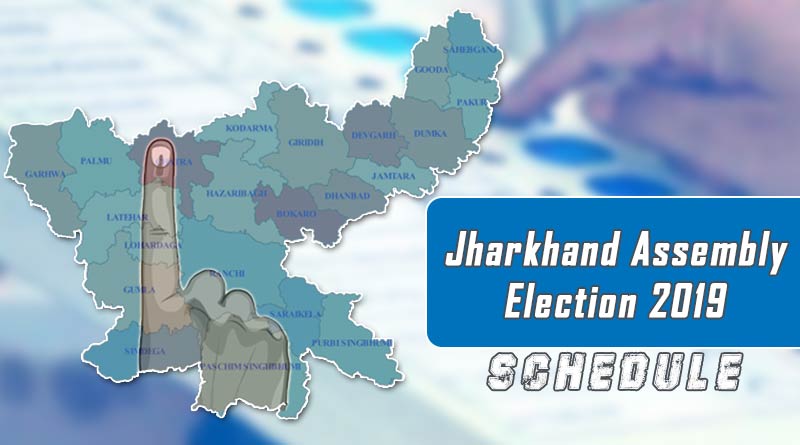
    Fact Sheet on Jharkhand Legislative Assembly Election (Phase -2)

     JHARKHAND (Phase-2), Date of  Poll 7th December, 2019


    Number of Recognized State parties: Four(04)

    (a) AJSU Party

    (b) Jharkhand Mukti Morcha

       (c) Jharkhand Vikas Morcha (Prajatantrik)

       (d) Rashtriya Janata Dal

    1. Assembly Constituencies: Twenty (20), Districts: Seven (07)


    List of 20 (Twenty)  Assembly Constituencies of Jharkhand  going to poll in Phase-II

    PHASE-II


    Sl.NO. Name of District No. and Name of Assembly Constituency
    1.  


    East Singhbhum

    44-Baharagora
    45-Ghatsila (ST)
    46-Potka (ST)
    47-Jugsalai (SC)
    48-Jamshedpur East
    49-Jamshedpur West
    2.  

    Seraikella-Kharsawan

    51-Seraikella (ST)
    57-Kharsawan (ST)
    3.  


    West Singhbhum

    52-Chaibasa (ST)
    53-Majhgaon (ST)
    54-Jaganathpur (ST)
    55-Manoharpur (ST)
    56-Chakradharpur (ST)
    4.  

    Ranchi

    58-Tamar (ST)
    66-Mandar (ST)
    5.  

    Khunti

    59-Torpa (ST)
    60-Khunti (ST)
    6. Gumla 67-Sisai (ST)
    7.  

    Simdega

    70-Simdega (ST)
    71-Kolebira (ST)


    2.1.1 Smallest and largest Constituencies:-By Area

    By Area Name of Constituency   Area( in square kilometers)
               
    Smallest 48-Jamshedpur East 34.52  
    Largest   55-Manoharpur (ST) 2028.21

    2.1.2 Smallest and largest Constituencies:-By Size of Electorate.
             
    By Size of Electorate Name of Constituency   Size of Electorate
               
    Smallest   54-Jagannathpur (ST)   1,74,337  
    Largest 49-Jamshedpur West   3,56,965  

    2.1.3 Electorate size-wise composition.        
       
    Size of Electorate No.& Name of Assembly Constituencies
    Less than 1 Lakh   ——-
    1 Lakh-1.50 Lakh   ——-      
    1.50 Lakhs  2 Lakh   53-Majhganon (ST)

    54-Jaganathpur (ST)

    55-Manoharpur (ST)

    56-Chakradharpur (ST)

    59-Torpa (ST)

    71-Kolebira (ST)

         
    More than 2 Lakh   44-Baharagora

    45-Ghatsila (ST)

    46-Potka (ST)

    47-Jugsalai (SC)

    48-Jamshedpur East

    49-Jamshedpur West

    51-Saraikella (ST)

    57-Kharsawan (ST)

    52-Chaibasa (ST)

    58-Tamar (ST)

    66-Mandar (ST)

    60-Khunti (ST)

    67-Sisai (ST)

    70-Simdega (ST)


    1. Electors:

    3.1.1 By Sex

      Male Female Others Total
    Population (Projected 2019) 38,47,006 38,20,865 —— 76,67,871
    Size of Electorate 24,31,511 23,93,437 90 48,25,038
    EPIC Issued To 24,31,511 23,93,437 90 48,25,038

    3.1.2 NRI & Service Voters.

    Number of NRI Voters     5  
    Number of Service Voters     10492  
    3.2 Age and Sex-wise Composition of Electorate    
             
      Male Female Others Total
    18-25 years 412571 401319   32 813922
    25-40 964443 969845   41 1934329
    40-60 776757 745336   15 1522108
    >60 277740 276937   02 554679

    1. No. of EVMs& VVPATs to be used in the elections:

    BU required for poll and Reserve @ 125% of PS (Including 5%Training and Awareness) CU required for poll and Reserve @ 125% of PS (Including 5%Training and Awareness) VVPAT required for poll and Reserve @ 135% of PS (Including 5%Training and Awareness)
    9788 7583 7886

    1. Total no. of Polling Stations:           6,066


             State-Jharkhand

             Phase wise (I-V)Phase-II

    1.1 Total No of candidates (Male, Female& Others):

    Candidates Total Number of Candidates
    Male 231
    Female 29
    Others ———
    Total 260

    1.2 No. and Name of AC with Maximum and Minimum Number of Candidates:

    1 No & Name of Assembly Constituency with Maximum number of candidates 48- Jamshedpur East

    49- Jamshedpur West

    20
    2 No & Name of Assembly Constituency with Minimum number of candidates 51- Saraikella (ST) 7


    1.3  Party wise list of Candidates:

        Party Name M F


    10


    Party-wise list of candidates:

    BJP 18 2
    BSP 14 0
    CPI 2 0
    CPIM 1 0
    INC 6 0
    NCP 1 0
    AITC 5 1
    AJSU 10 2
    JVM(P) 16 4
    JMM 13 1
    Registered Political Parties (other then recognized National and State) 78 13
    Independents 67 6
    Total 231 29

    Pseudo Solutions for Real Educational Problems

    Ask an intelligent question and get a ________ reply!
    Here\’s an experiment. It seems to work well with functionaries from educational systems in India, Bangladesh and several other countries in South Asia and beyond.
    Bring together a group of educational personnel such as academic supervisors, district and state / provincial educational officials. Pose a critical educational problem before them. Of the kind that they probably deal with on a daily basis, such as:
    • How to improve learning among children? Or
    • What action to take so that classroom processes become more interactive than they are at present? Or
    • How to enable children to enjoy learning mathematics (rather than being afraid of it)? Or
    • How to ensure and increase teacher attendance?

     Now, monitor the responses you get. They will usually include answers such as:
    Teachers must be dedicated / devoted to the profession.
    • We must ensure that the system functions well.
    • We must increase monitoring and do it properly.
    • Teachers must be made aware of their responsibilities.

    That didn\’t surprise you, did it? These are the typical answers one hears (you can probably increase the list greatly). But why should these answers worry us?
    Because these answers are positively dangerous!
    Either they reveal that our education system is in the hands of people who don\’t know what to do. Or, what is worse, it is in the hands of those who know what to do but are trying to hide behind these kinds of answers.
    You can decide for yourself – after taking a look at the explanation below.
    THE RICH VARIETY OF PSEUDO SOLUTIONS
    The key issue is that instead of actions and concrete steps, those responsible come up with other things instead. From an educational planning point of view, a step or an action is something that you have to do, that you can set in a clear time-frame, that can be budgeted, broken down into clear parts to be implemented. It is not a vague statement of good intent.
    And by coming up with statements that are not actions or steps, those making these statements are actually preventing solutions from really coming about. Here\’s how.
    Give a quality instead of an action
    A commonly offered \’solution\’ – \’teacher must be dedicated to his profession\’ – is not an action but a quality, the outcome of many other steps that we would have to take. Since those talking are often even responsible for recruiting teachers (and they did not take into account whether the potential teacher had a sense of \’dedication\’ or not), they need to discuss exactly how this dedication will now be ensured. E.g. by conveying to teacher that they matter, are valued, by visiting them, developing and disseminating performance standards (and using them to identify good performance, in an objective manner), or by setting role models in the form of the seniors themselves following a code of conduct, or a thousand other activities…. But instead of concrete action, we are presented sermons. Basically, offering a quality instead of a step merely looks like a ploy to avoid the necessary!
    Defer the solution through \’action\’ that keeps on requiring further action
    Do you remember those little \’Russian\’ dolls we used to get long ago – you lifted one and found another doll inside it, and another one inside, and so on. This variety of \’pseudo-solution\’ is just like those dolls. Here, the proposed solution is nothing but a guise to postpone committing oneself to actual action. For instance, you commonly hear suggestions such as \’Teachers must be trained properly\’, which begs the question: \’What should we do to ensure that teachers are trained properly?\’ Answer: \’We must have proper trainers.\’ But: \’How will we get proper trainers?\’ Answer: \’By recruiting them properly.\’ And so on. The solution is never really in your grasp; it keeps on evading you because it contains in itself yet another question, the answer to which contains another one…. Even Socrates with his Socratic Method would have had a tough time pinning down the actual action required. Lesser mortals like us just go mad and give up!
    Show resolve, not necessarily solve!
    Here, the answer to the critical problem is in the form of some very resolute-sounding statement. It gives the feeling that people are \’very serious\’ about doing something (never mind if scratching the surface shows that it can\’t really be converted into action). Pseudo-solutions of this category sound like this: \’We must ensure discipline.\’ Or \’We have to cover every single school.\’ Or \’The inputs must be made regularly.\’
    Nothing wrong with these statements, except that they are only resolutions and not clear steps or concrete action. They don\’t take into account that the present action, which is so strongly being proposed to be improved, may itself not be the right action to start with. Or may not even have anything wrong to begin with. For instance, before concluding that inputs must be made regularly, we need to take into account that perhaps the inputs may be inappropriate, and making them regular will not help. Also, the feeling is that having said that they will be regular, what are the steps to make them regular? (E.g. use of scheduling software and training everyone it its use, or interactions to discuss the needs of the different components of our programme in terms of regularity as well as the nature of inputs needed, and exploring whether more than just regularity it is how well they are implemented that needs to be improved…)
    Once again, the feeling is that having declared something solemnly, it will now happen. Unfortunately, it doesn\’t.
    Everyone except us!
    This is encapsulated in statements that exhort everyone to pull up their socks (or equivalent), except the people making these statements. Hence in a discussion on the kind of improvements required to increase the effectiveness of an educational system or a programme, it will be said that teachers must be devoted / dedicated, that supervisory staff must be capable, that managers must be professional and administrators sensitive and flexible apart from being committed. Such statements will be made about categories other than that of the solution givers, of course! And of course it is still not clear as to how the suggested change will be brought about.
    The monitoring myth
    For some reason as yet not very clear, a lot of proposed solutions have to do with monitoring – it is pointed out that monitoring is very poor, ineffective, irregular, and several other words that I\’m sure you can reel off. Well, excuse me, but monitoring is extremely limited as a solution. A commonly used example: I\’m monitoring the weight of a child regularly and it keeps on decreasing – all this regular monitoring does not help me if I don’t know what to do – the kind of nutrition to ensure, how to obtain / procure and prepare the required nutrients and enable the child to ingest these in an appropriate manner over the required period… I can keep monitoring without necessarily bringing about any improvement.
    The dangerous part is the feeling that programmes and systems work only if they are monitored. Not necessarily – in order to work well, those involved need to feel that they are doing something worthwhile, that someone cares that they are there, that the task is challenging yet doable and enjoyable, that they are equipped to do it, enjoy doing it and are supported in their actions. Under these circumstances monitoring can indeed play a role to enhance effectiveness, but it is no substitute for the basics that need to be in place. It\’s a little bit like a car that has a very good speedometer and odometer (monitoring devices), but no engine (implementation requirement)! Good monitoring is not necessarily equal to good implementation.
    An accompanying myth is that better planning is the solution. In fact, if you look at the kind of technical professionals brought in by donor agencies, multilaterals, development partners and even governments, there seems to a far greater concentration on the planning and the monitoring/evaluation parts, but very little on the stuff that comes in between the two – i.e., implementation! And that is why, when educational functionaries are asked to come up with solutions or steps that will lead to specific outcomes, they tend to suggest action related to better planning and monitoring, rather than improved implementation.
    The thesis, and a question
    So that\’s the thesis – that when asked to identify actions / steps / solutions to address critical educational issues, those responsible come up with things that might look like them but are not the real thing. And it is this that has kept us back, preventing the huge amounts of money and effort being invested from translating into reality.
    But if this is actually the case, is it due to sheer incompetence, or is it a deliberate ploy to ensure that real change does not happen (because behind it all, people are very uncomfortable with an education system that actually works). If you\’re a conspiracy theorist too, let me know!

    In defence of TPP

    The Trans-Pacific Partnership (TPP) is a trade deal that 12 countries bordering the Pacific Ocean are negotiating. The countries include the USA, Japan, Australia and Canada, but exclude China. The TPP is being vigorously opposed by a collection of groups – Democrats in the US, environmental groups, labour unions  and even Medicines Sans Frontiers. There is much fear mongering and shrill yelling, especially from US politicians, and this blogger believes a reasoned debate on the real issues would be useful. This series is also in response to this post from my good friend.
    Firstly, we must clarify what TPP is. It is an attempt at a trade deal between 12 countries. The WTO was (is ?) an attempt to do a trade deal across most of the countries in the world. The TPP is far less ambitious – it attempts to cover only 12 countries, most of whom see eye to eye on many issues. And yet, this is proving to be very difficult to achieve, with much of the noise in opposition emanating from the US.
    Why do we need any trade deals at all ? It is necessary simply to make imports and exports between countries possible. It can be as simple as a Double Taxation Agreement – two countries agree that the same income will not be taxed by both countries. It can be an agreement between both countries not to raise huge tariff barriers that make trade impossible. It can be to respect intellectual property rights in both countries, etc etc. It can be an agreement on a single issue (piecemeal and suboptimal) or a more comprehensive multi issue pact (preferred and in which case it becomes a full blown trade deal) .
    In the past countries did bilateral trade deals with one another. This led to a complex plethora of agreements which came in the way of trade, as the world started to become more and more globalised. Therefore countries tried to form groups and do a single trade deal amongst themselves in order to create level playing fields and facilitate trade and commerce between all of them. The European Economic Community is perhaps the earliest and deepest bloc. NAFTA tried to create a far less ambitious trade deal in the Americas. Trade zealots tried to achieve a global deal amongst all countries – first called GATT and then WTO, but this is proving impossible to achieve and perhaps a pipe dream. The TPP is a far more modest attempt by 12 countries, but even this is proving so tough to do.
    I hope you would agree that some sort of trade deals are necessary for the globalised world of today. If you are in the camp that says all globalisation is wrong and no trade deals should ever be done at all, then I will not debate the matter with you as our positions are on different ends of the universe. If you accept that trade deals are good in principle, then let us turn our attention to the TPP and the issues which are most objected to by the opponents of the deal.
     * The setting up of arbitration panels to decide disputes, including where a government is a party to the dispute, instead of taking the matter to national courts (This has what got my friend\’s goat in his post referred to earlier and is also the point on which a certain Elizabeth Warren is making the maximum noise)

     * The fear of loss of jobs in the US , which is the chief complaint of the trade unions

    * The fear of increased economic activity creating more pollution and climate change, which is the chief objection of the environmentalists

    * The enforcement of intellectual property rights, which is the chief objection of Medicines Sans Frontiers

    There is also the added objection in the US that the negotiations are being done in secret by the US government- another issue that has aroused my friend\’s ire.
    I will cover each of these issues in detail in subsequent posts.

    A French soap opera is about to unfold

    The world\’s richest woman just died. If you didn\’t know this, please stop focusing on the tweets and turn your attention to more weighty matters of the world.
    Liliane Bettencourt passed away four days ago at the age of 94. She was the heiress to the founder of L\’Oréal, the world\’s largest cosmetic company; the only child of Eugène Schueller who founded L\’Oréal in 1907. She herself worked in the company from the age of 15 and rose to become its deputy Chairperson.
    The future of L\’Oréal is now in play. And therein lies a story that could give a beating to any soap opera on television.
    In 1974, fearing that France would nationalise the company, Bettencourt did a deal with Nestle wherein she offloaded about half her holding in exchange for shares in Nestle. Since then Nestle and Bettencourt have had one of the longest tangos in business history. Nestle, a food company, with no presence at all in cosmetics, had a 30% stake in the world\’s largest cosmetics company (now down to 23%). But in an agreement with Bettencourt, Nestle remained a sleeping partner and promised not to acquire any more shares or to bid for Bettencourt\’s own shares as long as she was alive. Presumably Nestle had thought that she would not live so long. But they kept their word and until now have not interfered at all in the business just pocketing the dividends and biding their time. So much so that very few outside the business world probably even know that Nestle is a major shareholder in L\’Oréal.
    In the meantime Bettencourt\’s life over the last decade has been another soap opera all by itself. Sometime in 2007, at the  ripe age of 84, she took a fancy to her photographer and started to bestow gifts to him worth over €1 billion. Her daughter filed a complaint with the police that her photographer was taking advantage of her weakened psychological stake to amass a personal fortune. She and her daughter had an extremely public spat with each accusing the other of having gone mad. The courts finally made Bettencourt\’s grandson as her overseer and the fortune was vested with her daughter and her two grandsons. But everything was in a state of limbo as long as she was alive.
    Cue the events in Nestle. Nestle , for long, has waited patiently to consummate what was really a delayed acquisition. Both the last two Chairmen of Nestle sit on the L\’Oréal Board. They were probably waiting for the death of Bettencourt to acquire L\’Oréal . But alas they now have an activist shareholder in Dan Loeb who has a fair stake in Nestle and is pushing it to do the opposite – sell the stake in L\’Oréal and return the money to shareholders. So there is no saying what Nestle will ultimately do – acquire L\’Oréal or divest !
    There are other big fish circling. Given how cheap debt is , there are enough and more funds of various stripes, including probably the notorious 3G Capital and their close friend Warren Buffet, who are getting all excited. Also interested would be two giants in the cosmetics field – Unilever and Procter & Gamble, who have long eyed Nestle\’s stake with envy and made noises about what a Foods company is doing with a stake in a Cosmetics company.
    Complicating this will be nationalism, for after all L\’Oréal is (very) French. Would Macron be willing to let a French institution fall into the hands of the ugly Americans ? If he interfered, the tweeter in chief would surely have something to say !!
    And what will Françoise Bettencourt Meyers, Liliane\’s daughter and the two grandchildren to whom the 30% stake in L\’Oréal passes, do ?  Would they act in concert. Or would they go their own ways ? Would they buy ? Or sell ?
    Every investment banker is drooling and shivering with anticipation. It is fair to assume that no first class seats are available on all flights to and from Paris, London, New York and Lausanne !
    Watch this space. The knives will be out on 18th March when the six months period after Bettencourt\’s death ends and  all agreements expire.    Bettencourt\’s life was colourful to say the least – marrying a Nazi sympathiser, losing money with Bernie Madoff,  a strange affair with her photographer, being declared mentally incompetent, accused of giving cash stuffed envelopes to Nicolas Sarkozy,  having numerous Swiss bank accounts …… But even by those standards, what will follow in the fight for L\’Oréal will be, to put it mildly, interesting.

      What does \’taking pride in being an Indian\’ mean?

      Anyone working on curriculum or materials or education in general, ends up wanting children to take pride in being an Indian. But what does \’taking pride in being an Indian\’ mean? Though the idea of \’taking pride\’ can be questioned, here are some things a person \’proud of being an Indian\’ would do / not do (not in any particular order):

      • celebrate the uniqueness and successes of those who are \’different\’ from us – whether belonging to different religion, ethnicity, language, region, profession…
      • not spit out in the open anywhere (surprised? well, this is a leading cause of diseases like TB still being active and killing people)
      • stop complaining about what is wrong (hoping someone else will do something about it) and start taking small steps to make things better, and also urging others to do the same (there\’s power in numbers!)
      • not restrict their sense of identity to a state or a region or a sub-set of India…
      • taking the responsibility of being at one\’s best (whether in health, or talent or work or socializing) so that one can ADD to what is already good in India 
      • taking responsibility of keeping one\’s immediate surroundings at the best we can (in terms of things being well-organized and clean/hygienic as well as in an \’ecological\’ sense) 
      • not simply keep harping on the \’golden days\’ of India\’s past but be aware of what we are at present… and hence 
      • not be afraid to face what is really wrong, accept it and work to changing it (e.g. recognize the \’ugly Indian\’ who jumps lines, is rude and selfish, flouts rules and grins when he gets away with it. Or, of course, the bigger issues of poverty, security, discrimination…)

      What does \’taking pride in being an Indian\’ mean?

      Anyone working on curriculum or materials or education in general, ends up wanting children to take pride in being an Indian. But what does \’taking pride in being an Indian\’ mean? Though the idea of \’taking pride\’ can be questioned, here are some things a person \’proud of being an Indian\’ would do / not do (not in any particular order):

      • celebrate the uniqueness and successes of those who are \’different\’ from us – whether belonging to different religion, ethnicity, language, region, profession…
      • not spit out in the open anywhere (surprised? well, this is a leading cause of diseases like TB still being active and killing people)
      • stop complaining about what is wrong (hoping someone else will do something about it) and start taking small steps to make things better, and also urging others to do the same (there\’s power in numbers!)
      • not restrict their sense of identity to a state or a region or a sub-set of India…
      • taking the responsibility of being at one\’s best (whether in health, or talent or work or socializing) so that one can ADD to what is already good in India 
      • taking responsibility of keeping one\’s immediate surroundings at the best we can (in terms of things being well-organized and clean/hygienic as well as in an \’ecological\’ sense) 
      • not simply keep harping on the \’golden days\’ of India\’s past but be aware of what we are at present… and hence 
      • not be afraid to face what is really wrong, accept it and work to changing it (e.g. recognize the \’ugly Indian\’ who jumps lines, is rude and selfish, flouts rules and grins when he gets away with it. Or, of course, the bigger issues of poverty, security, discrimination…)

      What does \’taking pride in being an Indian\’ mean?

      Anyone working on curriculum or materials or education in general, ends up wanting children to take pride in being an Indian. But what does \’taking pride in being an Indian\’ mean? Though the idea of \’taking pride\’ can be questioned, here are some things a person \’proud of being an Indian\’ would do / not do (not in any particular order):

      • celebrate the uniqueness and successes of those who are \’different\’ from us – whether belonging to different religion, ethnicity, language, region, profession…
      • not spit out in the open anywhere (surprised? well, this is a leading cause of diseases like TB still being active and killing people)
      • stop complaining about what is wrong (hoping someone else will do something about it) and start taking small steps to make things better, and also urging others to do the same (there\’s power in numbers!)
      • not restrict their sense of identity to a state or a region or a sub-set of India…
      • taking the responsibility of being at one\’s best (whether in health, or talent or work or socializing) so that one can ADD to what is already good in India 
      • taking responsibility of keeping one\’s immediate surroundings at the best we can (in terms of things being well-organized and clean/hygienic as well as in an \’ecological\’ sense) 
      • not simply keep harping on the \’golden days\’ of India\’s past but be aware of what we are at present… and hence 
      • not be afraid to face what is really wrong, accept it and work to changing it (e.g. recognize the \’ugly Indian\’ who jumps lines, is rude and selfish, flouts rules and grins when he gets away with it. Or, of course, the bigger issues of poverty, security, discrimination…)

      Ramamritham falls in love

      Who is the person I hate the most ? No; not that one, whom I frankly don’t care about . He is half the planet away and troubling other folks; not me. My visceral hate is reserved for somebody much closer home. The “dotard” called Ramamritham. Allow me an unhinged rant please; I badly need it !
      You see, the problem is that Ramamritham has fallen head over heels in insane love. We all know how crazy he is even when supposedly normal. Now that his brain circuits have been singed with love, he has become a monster. The delectable damsel who has swept this idiot off his rockers is called Aadhaar.
      For the benefit of the one American reader who claims to be ignorant about India (no; not the lady – she is an expert !), Aadhaar is the national ID that every resident of India is supposed to get.
      The government introduced Aadhaar some 5 years ago ostensibly as a way to identify individuals to whom subsidies could be paid directly and thereby minimise leakages.  The government gave pious assurances (including to the Supreme Court) that Aadhaar was not compulsory or mandatory and it would never make it so.
      I think the government framed this with good intentions, but had not factored that the old toothless fart, Ramamritham, would fall in love with this.  They say love makes you irrational, and if anybody needed any further proof of this, look at what this apology to the human race is doing.
      He first made Aadhaar mandatory for buying gas cylinders. Then he made it mandatory to operate any bank account. Then he made it mandatory to file a  tax return.  But where he has gone completely bonkers is that he has now made it mandatory for a mobile connection !! And where it truly descends into madness is that its not just an Aadhaar number that this clown wants. He wants a fingerprint match for every mobile owner !! No; I am not joking. He wants to fingerprint you before you have a mobile phone.
      Consider the logistics. There are 1.2 billion people in India. Perhaps some 800 million own a mobile phone. And we being the argumentative Indians we are,  don’t possess just one connection . Almost everybody has two SIM cards. And this is what Ramamritham wants us to do.
      1. Go physically to a store of the mobile company (they usually have one store for a million users)
      2. Stand in a queue ; you can imagine the length of the queue yourself
      3. Give your mobile number and Aadhaar number to whoever is behind the counter
      4. You will get a one time password on your phone
      5. Give this number to the flunkey
      6. He will enter some 10 fields into a computer system that has been ordained by Ramamritham.
      7. You then place your thumb on a fingerprint reader
      8. If it goes through (and that’s a big IF – see below), then the flunkey does some more fiddling with the system
      9. You then place your thumb a second time (Ramamritham wants to make absolutely sure)
      10. If it again goes through, then say four different prayers and then go home
      11. You’ll get a SMS saying that your request has been registered and that you will get a confirmation in 24/48 hours
      12. If you get a SMS after 24/48 hours, you should follow the instructions there and type Y or N or don’t do anything
      13. If you fail in any of these steps, go to Step 1
      Note : The big IF arises because , this being India, any sensible store has bought a cheap Chinese fingerprint reader and it is impregnated with the smudges of the half a million people who have tried to bestow their affections on it.  Therefore your fingerprint is rarely read on the first attempt. If you fail in three attempts, your Aadhaar gets locked and if you want to unlock it then you have to undergo some contortions not dissimilar to what a certain Mr Scaramucci suggested a Mr Bannon was in the habit of doing.
      800 million Indians have to do this twice ( not just once, for you see everyone has two SIM cards). If you are stretcher bound, you still have to do this. Nobody else can do it for you because you have to press your damn thumb on that damn machine in the store. If you don’t do this by February, be prepared to just not have a mobile phone. Cost estimates for the whole nation to cater to Ramamritham’s love affair have been pegged at Rs 1000 crores.
      I have lived in the most obsessed country in the world which wants to control every single bit of information you have access to – China. This is the country that has blocked Twitter, Facebook, YouTube, WhatsApp, ………… This is the country that employs a million people to read every tweet and delete those that it doesn’t like. Even in that country, buying a SIM card was as simple as going to a corner shop and just buying it. No paper, no forms, no crap. It takes all of 2 minutes. And I am now supposed to be living in a liberal democracy called India. And I have to do all of what I have outlined in this post, simply to have the privilege of talking to a friend.
      Unfortunately this is not the worst of it. The other day, I had to receive a payment from some company. They demanded my Aadhaar. Very soon, if I have to pee, I am sure I will have to validate my Aadhaar.
      Readers are invited to design the most creative torture that can be inflicted on Ramamritham. And to the good American referred to earlier in the post. Let’s do an exchange. I’ll gladly take your dear leader in exchange for Ramamritham !!

      Three Reasons Why The Use Of I.T. In Schools Is NOT Leading to Improved Learning

      Recent reports from different parts of the world show that computer / IT supported learning programmes are not yielding the learning improvements expected. 
      So why is this happening?
      After looking at a fair number of IT-based programmes, software, and reports from different sources, this appears to be because something critical is being ignored: that improved learning requires both improved relationships and processes, and a clearer focus on outcomes considered worthwhile. Let me explain this a little. 
      1. IT Use Doesn\’t Seek to Impact Relationships 
      Relationships among the key stakeholders – teachers, students, parents / community, school heads, supervisors and administrators, and academic support personnel – cannot be bypassed; without improving them, it is difficult to see learning outcomes improve. Living in the hope that IT usage will make a difference here, is to be unrealistic. For relationships to flourish, apart from changing the teacher\’s role (and several other aspects), activities that require real group thinking would make a difference. At present the IT material has not paid sufficient attention here, though it is uniquely placed to do so, especially in gaming software. 
      In addition, of course, several governance changes are required (e.g. in how school \’inspection\’ takes place) as well as in management of learning (through better preparation for teaching, classroom organization and use of assessment). Again, a misplaced emphasis on IT will not see changes here.
      2. IT Use Could – But Doesn\’t – Sufficiently Impact Processes:
      Some parts of the curriculum require face time between teachers and students, and among students themselves. Some parts are better handled through IT – I believe such an analysis of curriculum has not been done, resulting in everything being dumped on to IT, much of which it is not really in a position to support. (Khan Academy does try to increase the face time by \’reversing\’ the class, but it still does not do this analysis sufficiently and could benefit from it).
      3. IT Use Doesn\’t Always Focus On The Outcomes It Should
      The tendency is to focus mainly on a limited number of scholastic outcomes. In fact, even within the subjects themselves, higher order learning objectives are often ignored, or under-represented. Believe it or not, this affects the learning of other aspects as well! E.g. children who have the opportunity to make creative use of language end up being better in grammar and spelling than children who get an overdose of grammar and spelling. A great deal of IT material is geared to towards getting children to answer tests / exams rather than help in real, long-term learning.
      But other than the subjects, larger curricular goals – such as cooperation, respect for diversity, development of a scientific outlook and an ecological perspective, developing a questioning mind, democratic values – hardly figure in much of the IT based material / activities. Implying that it is, at best, supporting some parts of subject-oriented learning rather than  education as such.
      So is all this emphasis on \’modern technology\’ wrong and misguided? No, not necessarily wrong, but our expectations are certainly misplaced. In our desire to find the one single magic solution we have ignored the many other actions that need to be taken before learning improves. Perhaps focusing on IT seems easier and more exciting than than the hard work that the other stuff requires.
      At any rate, IT is clearly not the silver bullet that many desperately believe it to be. It needs to be treated as just one more tool to be used, rather than as a solution for problems that it can\’t solve. And even as a tool, it needs to be used much better than is the case at present.