Education must inspire a thirst to innovate in our students: Vice President

The Vice President, Shri M. Venkaiah Naidu today said that education must not only foster scientific spirit and entrepreneurial endeavour in students but also create in them a thirst to innovate.

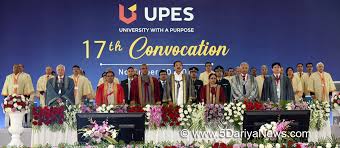
Addressing the 17th Convocation of University of Petroleum and Energy Studies (UPES) in Dehradun today, Shri Naidu called for imparting Entrepreneurial Education in our technical institutions so that a larger number of our graduates do not end up as mere job seekers but possess the confidence and the skills to create businesses, jobs and wealth.

The Vice President said that the world is increasingly turning its attention to India today because of its steady pace of growth which is much faster than most major economies of the world. He added that India also has the advantage of an enormous youth population, with 50% of its population below 25 years of age.

He opined that if this demographic dividend is to be realized and leveraged for inclusive and sustainable growth and development, our youth must be equipped with domain focused education, skills and expertise.

Expressing concerns about the employability of our young graduates, Shri Naidu urged universities and the industry to join hands to groom students to be future-ready professionals.

Observing that routine jobs are now being replaced by Artificial Intelligence and Automation, the Vice President asked educational institutions to be quick on their feet to adapt and evolve. He emphasized that universities must train students to perform tasks that machines simply cannot.

He advised educational institutions to abandon the rote learning methodology and focus more on assimilation of diverse information, problem solving, decision making and analysis. “Design thinking principles should be introduced in schools along with digital skills”, he added.

Observing that the 4th Industrial Revolution is on the horizon and he urged educational institutions to prepare for it by acquiring knowledge and skills to make the big leap forward.

Stressing that India needs to India needs to rethink the entire education system, Shri Naidu cautioned that if we don’t innovate, we stand the risk of falling behind.

Referring to the exalted status of ‘Vishwaguru’ that India enjoyed in the past, he called on Indian universities to strive hard to make India a hub for global learning, once again. He asked Indian universities to aim be among the top 100 institutions in the world.

Highlighting the plethora of initiatives of the government such as NISHTA, ARPIT and DHRUV, the Vice President cautioned that government working in isolation will not succeed in creating a world-class education system. “Each one of our institutions, both public and private, must work in tandem with the government”, he said

Opining that it is not sufficient that we produce graduates who are academically proficient, Shri Naidu said that students must develop not only cognitive skills, but also social and emotional ‘soft’ skills, including cultural awareness and empathy, perseverance and grit, teamwork and leadership, among others.

The Vice President said that culturally, India has been, and continues to be, a cradle of great diversity in all walks of life and added that these rich legacies to world heritage must not only be nurtured and preserved but also enriched.

He urged Universities to strive to bridge the gap between theory and practice and promote research in a big way by networking with industries, R&D labs within India and abroad.

Stressing that India’s strength is in its young people who will play a key role in transforming India into a major economic and technological power, he asked them to remember their social responsibility and to give back to the people of India the fruits of technological advancements.

The Governor of Uttarakhand, Smt. Baby Rani Maurya, Chief Minister, Uttarkahand, Shri Trivendra Singh Rawat, Minister of Education, Govt. of Uttarakhand, Shri Dhan Singh Rawat, Chancellor of UPES, Dr. S.J. Chopra and Vice Chancellor of the university, Dr. Deependra Kumar Jha were among the dignitaries who graced the occasion.

Following is full text of speech –

“My dear students,

I am delighted to be here with all of you this afternoon to share your moment of pride and glory as you graduate from the portals of this great institution.

I extend my heartiest congratulations to each and every one of you on earning these coveted degrees, after several years of toil and hard work. You are truly worthy of the honors and accolades that are being bestowed upon you today.

I also congratulate the proud parents whose children are graduating today. Congratulations are also due to the teaching fraternity for carefully and devotedly nurturing the future of our country in its schools, colleges and universities.

I must also take this opportunity to complement the founders of this University for their vision and pioneering initiative that took the form of this institution, 16 years ago, in 2003. I understand that 15000 plus alumni of UPES are already working in more than 700 national and international companies.

I am happy to know that UPES has two campuses of its own that houses 06 schools. It is truly noteworthy that over 11,000 regular students are pursuing their undergraduate and postgraduate studies in 90 specialized programs that are being run across these schools.

I commend the University for providing industry focused education in high growth sectors of Oil and Gas, Power, Infrastructure, Information Technology, Aviation, Shipping, Automotive, Electronics and International Business.

I am also told that several companies visit the campus annually to recruit students and I am quite pleased to learn that right from the first graduating batch, campus placements of eligible students have witnessed a rising trend.

I was also pleased to learn that in UPES students from all the disciplines go for Industry or Corporate Internships.

It is truly heartening that UPES runs an “Industry Attachment” module for the faculty, named “ABHIGYAAT”. The contemporary industry perspectives are thus brought into the classrooms.

I also commend the institution for having footprints in the 05 continents through MOU’s with nearly 60+ Universities and Institutions.

I am particularly enthused to note that UPES is closely working with “NITI AAYOG” on several projects and is also focusing on Incubation / Entrepreneurship and Start-Ups.

Let me once again congratulate each and every one of you on this momentous occasion.

My dear sisters and brothers,

Today, the world is increasingly turning its attention to India. It is growing at a steady pace, much faster than most major economies of the world. It has an enormous youth population, with 50% of its population below 25 years of age.

We have a potential demographic dividend that is waiting to be realized.

But if this demographic dividend is to be realized and leveraged for inclusive and sustainable growth and development, our youth must be equipped with domain focused education, skills and expertise.

A number of employment reports point out that in the recent times, there has been a fall in employability among young people. We must not fail to comprehend that we live in a world that is evolving and undergoing transformation at an unprecedented rate.

Technological advancement has been the defining factor for determining the pace of progress.

No institution can insulate itself from the unpredictability of technological progression and disruption. The success of institutions is not about what we do in the next few years, but it is our ability to create future-ready professionals.

India needs to rethink the entire education system. We must innovate or stand the risk of falling behind.

Our educational institutions must be quick on their feet to anticipate future trends as well as adapt, evolve and respond to disruptions.

We must abandon rote learning and focus more on assimilation of diverse information, problem solving, decision making and analysis.

Design thinking principles should be introduced in schools along with digital skills.

Students need to be made aware of what is expected in the real life environment and should be guided and mentored.

The 4th Industrial Revolution is on the horizon and I urge our educational institutions to prepare for it by acquiring knowledge and skills to make the big leap forward.

Today we have more than 900 universities across the length and breadth of the country. But none figure in the top 200 universities in the world. Merely adding more and more universities is not enough. Numbers are important, but quality is more important.

To start with, our universities must aim to be among the top 100 institutions in the world, making India a sought-after hub for global learning.

The Government of India is implementing a number of initiatives to improve the quality of education in India, including teacher training programs like NISHTA and ARPIT, the Pradhan Mantri Innovative Learning Scheme, DHRUV and the declaration of 20 institutions as Institutions of Eminence (IoE).

But the government working in isolation will not succeed in creating a world-class education system.

Each one of our institutions, both public and private, must work in tandem with the government.

They need to adopt a systematic approach by comprehensively reorienting the teaching methods, research strategies and setting high academic standards on par with global institutions.

It is not sufficient that we produce graduates who are academically proficient.

Students must develop not only cognitive skills, but also social and emotional skills, also referred to as ‘soft skills’, including cultural awareness and empathy, perseverance and grit, teamwork and leadership, among others.

Education is the foundation for the progress of humanity. Education is not merely for employment, but education is meant to empower, impart wisdom and knowledge, and develop a holistic individual with qualities of head and heart.

India has had a long and illustrious history of holistic education. The aim of education in ancient India was not just the acquisition of knowledge but also of wisdom.

India was the renowned ‘Vishwaguru’, home to illustrious universities of Nalanda, Vikramshila and Takshashila. The ancient Indian education system had produced brilliant    scholars like Charaka and Susruta, Aryabhatta, Bhaskaracharya, Chanakya, Patanjali and numerous others. They made seminal contributions to the collective knowledge of the world in diverse fields.

Swami Vivekananda once said that “Education is not the amount of information that we put into your brain and runs riot there, undigested, all your life. We must have life-building, man-making, character-making assimilation of ideas.”

Culturally, India has been, and continues to be, a cradle of great diversity in all walks of life, with its myriad languages and dialects, classical dance and music forms, many well-developed traditions of folk arts, exquisite architecture, incredible cuisines, fabulous textiles of all kinds and much more.

These rich contributions to world heritage must not only be nurtured and preserved for posterity, but also enriched.

We should integrate this rich tradition with modern education to help develop creativity and originality of students, and to encourage them to innovate.

My dear sisters and brothers,

Apart from promoting entrepreneurial spirit, education must instill and nurture scientific spirit and the thirst to innovate, among youngsters.

Our universities must strive to bridge the gap between theory and practice and promote research in a big way.

Our universities and institutions must network with  industries, R&D labs within India and abroad.

We must also impart Entrepreneurial Education in our technical institutions so that a larger number of our graduates do not end up as mere job seekers but possess the confidence and the skills to create businesses, jobs and wealth.

My dear students,

India’s strength is in its young people and you hold the key in transforming India into a major economic and technological power.

I sincerely hope that each one of you will remember your social responsibility – a commitment to give back to the people of India the fruits of technological advancements.

I once again extend my hearty congratulations to all the students who are receiving their degrees today. Good Luck to each one of you in your exciting journey in building a more prosperous, equitable, safer and cleaner India and the world.

My best wishes would be with all of you as you embark on this exciting world of almost unlimited possibilities.

Thank You!

Jai Hind!”

****
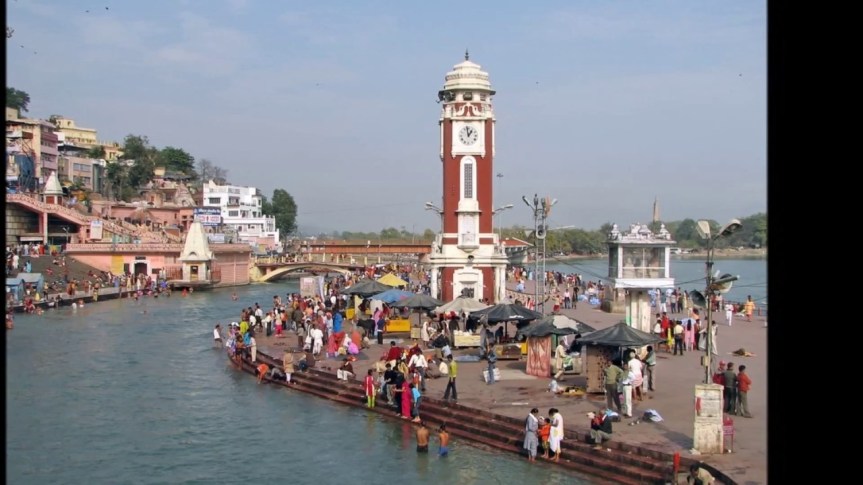
President of India in Kanpur; Inaugurates the Conference on Recent Advancements in Computer, Communication and Information Technology and Addresses the First Alumni Meet of Chhatrapati Shahu Ji Maharaj University

The President of India, Shri Ram Nath Kovind, inaugurated the conference on recent advancements in computer, communication and information technology at PSIT College of Higher Education, Kanpur today (November 30, 2019).

Speaking on the occasion, the President said that technology has been a prime mover of social change. India’s journey from a poor nation at the time of independence to one of the fastest and biggest economies in the world has come about in part thanks to technology. As we aim to become a 5 trillion dollar economy by 2024-25, we again look forward to technology playing its role. Apart from giving us the economic might, new forms of knowledge have bettered the lives of people on the margins of society. Moreover, advances in information and communication technology have been a great equaliser in all walks of life.

The President said that technology, however, is just an instrument. Be it fire or electricity, it is a great servant but a bad master. When we deliberate on the latest technological advancements, we should keep foremost in mind the implications for the humanity. Kanpur has an excellent example of using technology for humanity. Over the decades, Artificial Limbs Manufacturing Corporation of India (ALIMCO) has helped countless persons with disabilities by manufacturing rehabilitation aids, with focus on continuous technology upgradation.

Later in the day, the President graced and addressed the first alumni meet of Chhatrapati Shahu Ji Maharaj University, Kanpur.

Addressing the gathering, the President said that last month he had launched the Endowment Fund of IIT Delhi, created in collaboration with the alumni of the institute. While launching the Fund, the President said, he was thinking that all educational institutions should establish such Funds. These Funds can be used to provide scholarships to poor and meritorious students, develop the infrastructure of the institution and to raise advanced technology and resources for the institution. The President urged alumni of the Chhatrapati Shahu Ji Maharaj University to take this initiative forward in this university as well. The President contributed rupees 1,11,000 to the Fund and requested others to cooperate in this work.

Later in the evening, the President will attend a felicitation programme being organised by the Kanpur Nagar Nigam.


*******

Address by the Hon’ble President of India Shri Ram Nath Kovind on the Occasion of Inauguration of International Conference ‘ICRACCIT 2019’ on Recent Advancements in Computer, Communication and Information Technology

  1. I love to be in Kanpur, not merely because it is my city. I love it because this city is a true confluence of tradition and modernity. It is in this context that I feel proud to be here for the inauguration of the International Conference on Recent Advancement in Computer Science, Communication and Information Technology, which is being organized at PSIT, Kanpur. It is my privilege to address some of the brightest young minds in the country.
  2. Technology is very much woven in the genes of this great city. Down the ages, Kanpur always has had a unique relation with advancement of technology. One or another kind of technology took this city to great heights in the twentieth century. Its excellence in the textile industry earned it the name as “Manchester of the East” when its mills competed with the best in the world. The textile boom led to the setting up of a number of industries here, making the city an industrial hub. It also graduated to becoming a major trading centre and came to be called the “commercial capital” of Uttar Pradesh. After the textile boom, it has been the leather technology that is remaking this city. It is now called the “Leather City of the World”.
  3. Given this connection with technology and industry, it is no wonder that the city has been home to some of the best names in engineering education. What is particularly unique about the city is that its pursuit for material wealth is always accompanied by a determined effort to keep pace with the advanced education. Who in the world does not know the eminence of the IIT, Kanpur? Along with this great institute exists an equally important centre of learning, Harcourt Butler Technical Institute (HBTI), which has now become a full-fledged university. There are a host of other institutes which have produced excellent engineers and scientists.
  4. PSIT too enriches this heritage of the city. I congratulate the institute for organising this conference. I am sure it will prove to be an excellent platform for researchers and professionals from India and abroad to discuss latest developments in various domains.

Ladies and gentlemen,

  1. I find the world of technology fascinating, because technology has been a prime mover of social change. India’s journey from a poor nation at the time of independence to one of the fastest and biggest economies in the world has come about in part thanks to technology. As we aim to become a 5 trillion dollar economy by 2024-25, we again look forward to technology playing its role. Apart from giving us the economic might, new forms of knowledge have bettered the lives of people on the margins of society. Moreover, advances in information and communication technology have been a great equaliser in all walks of life.
  1. Technology, however, is just an instrument. Be it fire or electricity, it is a great servant but a bad master. This city has been witness to the powers of technology to make as well as break. When you deliberate on the latest technological advancements, I would urge you to keep foremost in mind the implications for the humanity. Kanpur has an excellent example of using technology for humanity. Over the decades, Artificial Limbs Manufacturing Corporation of India (ALIMCO) has helped countless persons with disabilities by manufacturing rehabilitation aids, with focus on continuous technology upgradation.
  2. We are told that we are entering the age of the Fourth Industrial Revolution. Futurologists envision a fundamental change in our day-to-day living as the digital and infotech revolution gives way to a convergence of cyber, physical and biological domains. Internet of Things and 3D Printing are already delivering what was till yesterday in the pages of science fiction. We can harbour great hopes that this will lead to all-round improvement in the human life. However, there are also fears of technology. For decades, Artificial Intelligence (AI) technology was a matter of academics, but now it has become real. Instead of all the long-cherished fruits of AI, the initial impact is in terms of job losses as machines take over human roles.
  3. All technological revolutions so far have given us great tools for improvement, but at a great price. Air pollution in Kanpur is a visible proof. But I am an optimist. I take heart in the fact that the great visionaries working at the cutting edge of technology have always been sensitive to the human concerns.
  4. I am sure you all are eagerly looking forward to exciting and fruitful brainstorming over the two days. Students too will have a great opportunity to learn from veterans. I once again congratulate the organisers of the conference and wish you all success.


Thank you,

Jai Hind!

****

Soma Roy Burman takes charge as new Controller General of Accounts

Smt. Soma Roy Burman, a 1986-batch Indian Civil Accounts Service (ICAS) Officer, took charge as the new Controller General of Accounts here today.

Smt. Burman is the 24th Controller General of Accounts (CGA) and is the seventh woman to hold this coveted position.

The Government of India appointed Smt. Burman, as the Controller General of Accounts (CGA), Ministry of Finance, Department of Expenditure with effect from December 1, 2019.

Smt. Burman holds the degree of M.Phil in Mathematical Statistics from the University of Delhi.

During her 33-year long career, she has held cadre positions at different levels in Ministries such as Home Affairs, Information & Broadcasting, Industry, Finance, Human Resource Development and Shipping, Road Transport & Highways. She has headed the Central Pension Accounting Office (CPAO) as the Chief Controller (Pension) and the Institute of Government Accounts and Finance (INGAF), New Delhi, as Director.

She has also handled important portfolios while on Central deputation to the Government of India, where she served as Deputy Secretary/Director in the Department of Economic Affairs (Budget Division) and as Joint Secretary and Financial Adviser, NATGRID, Ministry of Home Affairs. She has also held charge as Director in the office of Comptroller and Auditor General (CAG) of India on deputation.

Prior to assuming the charge of CGA, Smt. Burman served as Additional Controller General of Accounts in the office of CGA handling the critical areas of Accounting Rules, Policy and reforms, Financial Reporting, Data Analytics, Cash and Budget Management.  Smt. Burman has been actively involved in the formulation of wide ranging reforms in these areas for strengthening Public Financial Management in the Union Government.

****

PM greets BSF personnel on BSF’s Raising Day

The Prime Minister Narendra Modi has greeted BSF personnel and their families on BSF’s Raising Day.

Prime Minister said, “Greetings to all BSF personnel and their families on BSF’s Raising Day. This force has been diligently protecting our borders. During natural disasters and crisis situations, BSF personnel have always worked hard to serve our citizens. Best wishes to the BSF family!”

PM wishes people of Nagaland on Statehood Day

The Prime Minister Narendra Modi has wished the people of Nagaland on their Statehood day.

Prime Minister said, “Best wishes to my sisters and brothers of Nagaland on their Statehood Day. This state is known for its great culture. The people of Nagaland are compassionate and courageous. May Nagaland scale new heights of progress in the coming years.”

Companies don\’t make investment decisions based on tax rates

If you cut tax rates, will companies invest more ? This is almost a religious belief in a certain party in a certain country in the world. Is it justified  ?
The answer, in my opinion, is mostly No.
Companies make investment decisions based on markets, sales projections, competitive advantage, margin potential, scalability and the like.  These are extremely complex business variables and occupy 90% of the time and effort that goes into a business decision.
The tax line is one of the last lines in the cash flows of an investment proposal. It is certainly important, but hardly a determiner of whether the investment goes ahead or not.
There are a few instances when the tax rate indeed becomes a determining variable in the decision. For example, in India, there have been many instances where the government, in an effort to stimulate an underdeveloped part of the country has allowed zero income tax rates for operations located in those areas. In such a case, the tax rate becomes a determiner of the location of the investment; not the investment per se. Nobody puts up a factory just because the tax rate is zero. They put up a factory because the business opportunity is compelling. Having decided to invest, they may choose to locate it in a low tax zone.
The other instance when a tax rate becomes a determiner of investment is if the tax rate is ridiculously high.  For example if the marginal tax rate is 90%, nobody will invest even if the business opportunity is compelling (M. Melenchon\’s supporters, are you listening ?). But if you cut the tax rate from 35% to 15% , it\’s a nice bonus, but it will not add one dollar of investment which otherwise would not have been made.
Further, companies make investments based on a 7 or 9 year time horizon. If one President cuts tax rates this year, what stops the next President from increasing it 3 years from now. So its almost inconceivable that a company which would otherwise have not made the investment, will rush to now make it because of the tax cut.
The argument that a major tax cut on companies, will spur investment growth is mostly flawed. It will however have the following consequences
It will improve corporate profits (for after all tax is a cost) and therefore both the investible surplus and/or dividends in the hands of shareholders. It will increase the wealth in the hands of those who are shareholders. They may spend it which will have a beneficial impact on the economy.
It will correspondingly increase the deficit that the government runs, and therefore the nation\’s borrowings. That will push the cost of borrowing and inflation.
But will it also increase tax revenues and therefore make the measure revenue neutral. Mostly No. But there is one big exception in the US, which will be the subject matter of the next post.

Companies don\’t make investment decisions based on tax rates

If you cut tax rates, will companies invest more ? This is almost a religious belief in a certain party in a certain country in the world. Is it justified  ?
The answer, in my opinion, is mostly No.
Companies make investment decisions based on markets, sales projections, competitive advantage, margin potential, scalability and the like.  These are extremely complex business variables and occupy 90% of the time and effort that goes into a business decision.
The tax line is one of the last lines in the cash flows of an investment proposal. It is certainly important, but hardly a determiner of whether the investment goes ahead or not.
There are a few instances when the tax rate indeed becomes a determining variable in the decision. For example, in India, there have been many instances where the government, in an effort to stimulate an underdeveloped part of the country has allowed zero income tax rates for operations located in those areas. In such a case, the tax rate becomes a determiner of the location of the investment; not the investment per se. Nobody puts up a factory just because the tax rate is zero. They put up a factory because the business opportunity is compelling. Having decided to invest, they may choose to locate it in a low tax zone.
The other instance when a tax rate becomes a determiner of investment is if the tax rate is ridiculously high.  For example if the marginal tax rate is 90%, nobody will invest even if the business opportunity is compelling (M. Melenchon\’s supporters, are you listening ?). But if you cut the tax rate from 35% to 15% , it\’s a nice bonus, but it will not add one dollar of investment which otherwise would not have been made.
Further, companies make investments based on a 7 or 9 year time horizon. If one President cuts tax rates this year, what stops the next President from increasing it 3 years from now. So its almost inconceivable that a company which would otherwise have not made the investment, will rush to now make it because of the tax cut.
The argument that a major tax cut on companies, will spur investment growth is mostly flawed. It will however have the following consequences
It will improve corporate profits (for after all tax is a cost) and therefore both the investible surplus and/or dividends in the hands of shareholders. It will increase the wealth in the hands of those who are shareholders. They may spend it which will have a beneficial impact on the economy.
It will correspondingly increase the deficit that the government runs, and therefore the nation\’s borrowings. That will push the cost of borrowing and inflation.
But will it also increase tax revenues and therefore make the measure revenue neutral. Mostly No. But there is one big exception in the US, which will be the subject matter of the next post.

Turn the world vegetarian

Humans love eating meat. Vegetarians and vegans (this blogger is a vegetarian) don\’t stand a chance. In quite a few countries in the world, you simply have to starve if you are a vegetarian.  In many others, your only ordering choice in a restaurant is likely to be an apology of a salad, that could more appropriately be fed to a cow !
Any chance that you can turn the human race into vegetarians ? Well, at least one company thinks so. The aptly named Impossible Foods based in California (where else)  would like to try. An interesting Q&A with the founder that I read in the Guardian, prompted this post.
The logic for turning the human race vegan is impeccable. The largest environmental impact that humans have created is from rearing animals for food – cows being the primary culprit. The resources utilised – water, land, etc – per pound of meat is also the largest. The absolutely atrocious conditions in which we rear and kill farm animals has to be a permanent blot on the human species (pig farmers in Iowa – are you listening ?) And if the population of farm animals decreases, there is a better chance of wildlife prospering,  as one of the chief causes of habitat loss is grazing. 
Of course, this is not going to happen. Go back to the first sentence of this post. 
I however have this feeling, totally unsubstantiated by data, that this might be a long term trend. Technology in food production is on the cusp of a revolution. After all humans don\’t eat meat because they like to kill animals. They eat it because they love the taste. If, and when, plant based foods are engineered to taste like meat, there is every chance that people will start to switch. Especially if it is cheaper.  And then, slowly, the ethical side of it will start to play a part. If you can satisfy your nutrition and the craving for taste without killing, why wouldn\’t you do it. After all, if many of the meat eaters actually saw how their meat was being produced, a good proportion will turn vegetarians immediately !
But this is not going to happen in a hurry. Impossible Foods is just a fad and, this being California, fads are always welcome. But good luck to them. I might even come out of retirement and open the India branch – at least it will get me into the good books of the awful gau rakshaks !
But one day, in the distant future, maybe 100 generations later, our descendants will look upon with horror at \”prehistoric man\” for killing and eating animals. And maybe somebody will read my post from the archeological archives and pronounce me as a prescient wise man !

Companies don\’t make investment decisions based on tax rates

If you cut tax rates, will companies invest more ? This is almost a religious belief in a certain party in a certain country in the world. Is it justified  ?
The answer, in my opinion, is mostly No.
Companies make investment decisions based on markets, sales projections, competitive advantage, margin potential, scalability and the like.  These are extremely complex business variables and occupy 90% of the time and effort that goes into a business decision.
The tax line is one of the last lines in the cash flows of an investment proposal. It is certainly important, but hardly a determiner of whether the investment goes ahead or not.
There are a few instances when the tax rate indeed becomes a determining variable in the decision. For example, in India, there have been many instances where the government, in an effort to stimulate an underdeveloped part of the country has allowed zero income tax rates for operations located in those areas. In such a case, the tax rate becomes a determiner of the location of the investment; not the investment per se. Nobody puts up a factory just because the tax rate is zero. They put up a factory because the business opportunity is compelling. Having decided to invest, they may choose to locate it in a low tax zone.
The other instance when a tax rate becomes a determiner of investment is if the tax rate is ridiculously high.  For example if the marginal tax rate is 90%, nobody will invest even if the business opportunity is compelling (M. Melenchon\’s supporters, are you listening ?). But if you cut the tax rate from 35% to 15% , it\’s a nice bonus, but it will not add one dollar of investment which otherwise would not have been made.
Further, companies make investments based on a 7 or 9 year time horizon. If one President cuts tax rates this year, what stops the next President from increasing it 3 years from now. So its almost inconceivable that a company which would otherwise have not made the investment, will rush to now make it because of the tax cut.
The argument that a major tax cut on companies, will spur investment growth is mostly flawed. It will however have the following consequences
It will improve corporate profits (for after all tax is a cost) and therefore both the investible surplus and/or dividends in the hands of shareholders. It will increase the wealth in the hands of those who are shareholders. They may spend it which will have a beneficial impact on the economy.
It will correspondingly increase the deficit that the government runs, and therefore the nation\’s borrowings. That will push the cost of borrowing and inflation.
But will it also increase tax revenues and therefore make the measure revenue neutral. Mostly No. But there is one big exception in the US, which will be the subject matter of the next post.

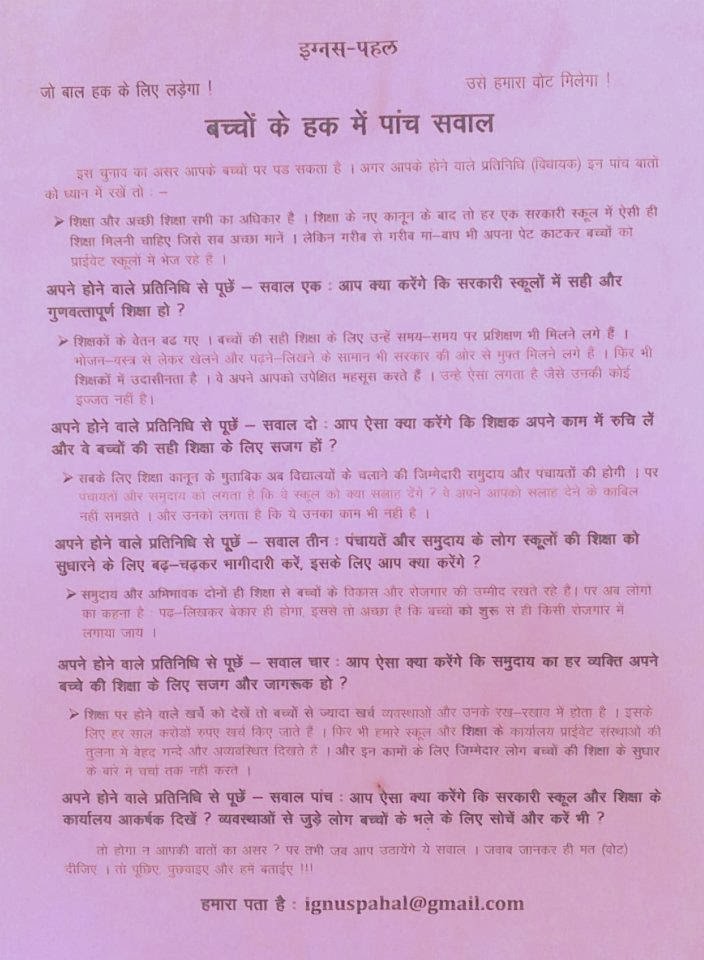
Five Questions To Ask Your Election Candidate!

With elections not so far away, here are five questions you can encourage people to ask of their prospective representatives. We used these in the last general elections, and had encouraging results. They were re-printed by others and spread over a fairly wide area in Varanasi and Lucknow regions. Many candidates and their party heads had to touch upon these issues. Unfortunately, we got the idea fairly late during the campaign season. This time though we need not be so late!
Inviting everyone to take a look and use what they find fit. Right now, these are in Hindi (and not a good reproduction of the original flyer) – will put up an English version as well.

Learn from history – Steel tariffs don’t help

The US has been there before many times. And yet they do it again and again. Granted that logic and thoughtful action is not a feature of the current US administration. But still, you would have thought they would have read up what happened when they tried it last time.
I am referring to the announcement today that the US plans to impose a tariff of 25% on steel imports.
George W Bush tried the same tactics in 2002, with an eye on the same political prize – voters in Pennsylvania and West Virginia.  He imposed 8-30% tariffs on imported steel . At that time the target was European steel. Europe promptly took the US to the WTO and won sanctions of  some $2 billion. More tellingly, the politically astute European Union threatened retaliatory tariffs on oranges (goodbye Florida votes) and cars (ta ta Michigan votes).  Meanwhile steel prices in the US surged, screwing industries that buy steel. A later study concluded that 200,000 jobs were lost in the US as a result.  Bush retreated and called off the tariffs in 2003.
His father George HW Bush , and his predecessor Ronald Reagan tried various forms of it too. Reagan famously tried quotas on cars (at that time the target was Japan). The end result of that was that car prices went up by $1000 between 1982 and 1984 and the auto industry actually lost 60,000 jobs as a result of the quotas.
Obama indulged in steel tariffs too. His target was China. But that administration did it selectively – huge tariffs, selectively on products and against companies from China that were dumping.
It is not clear what the current administration is trying to achieve. Presumably their target is China , the current bogeyman and indisputably the cause of depressed world steel prices because of overcapacity. But China exports not much steel to the US possibly as a result of the Obama era actions. It is the 11th largest exporter to the US occupying a small portion of US imports – even India is above it in the rankings. The biggest exporter of steel to the US is Canada, followed by Brazil. Is the US trying to screw Canada ?
Why pick a trade war with Canada of all the countries. The US has a  deficit of $ 12 bn in goods and a surplus of $24 bn in services on a $ 700 bn two way trade. Overall the US has a surplus with Canada. And you want to provoke a war with them ? Yes, the current administration has launched a war on NAFTA, but even by that perverted logic, the target must be Mexico and not Canada.  Canadians are not fools . Selected tariffs from Canada  on Vehicles (bye Michigan) and Agricultural Produce ( adieu Ohio) and we are back to reliving the George Bush experience.
Albert Einstein is famously quoted to have said ” The definition of insanity is doing the same thing over and over again, but expecting different results.” But to avoid that, you have to read history to determine what has been done before. Well, in the current administration, reading history is too much to ask. They would make a “yuuge” improvement if they could just begin with reading !

The economics of Classical Music in India

 (carnaticdurbar.com)
This blogger is  a recently turned fan of Indian classical music. Being the weirdo he is, it is only to be expected that he would turn his attention to the economic side of this . Yes, I know it’s weird with a capital W that instead of humming a tune, a blog post on economics is what comes out.
Classical music in India is economically a basket case. Every piece in the carnatic music supply chain is in doldrums moneywise.
Take the fan. A listener will only go to a concert if it is free. Will not buy a ticket even if it is just Rs 50. It is perfectly acceptable behaviour to go to a concert, find that there is a ticket and return back without going in ! The fan is a complete hypocrite. Music must be free. Musicians don’t deserve money. But their own salaries (pensions) must be doubled.
Artistes, unless they are at the top of the profession earn an absolute pittance. I am  certain that what most upcoming musicians earn will not even be up to the minimum wage levels in India for casual labour. It is not unknown for lesser musicians to pay to perform rather than the other way around.
The musicians at the very top do earn for their concerts and the popular perception amongst the fans is that they demand too much money. This is nonsense. They may earn Rs 100,000 for a concert; something they have to share with the accompanying artistes. They can probably do 4 or 5 concerts a month on an average. That level of earnings is equivalent to what a middle manager in a company doing an irrelevant pedestrian job will make. And these are the top musicians in the land.
The organisations that hold these concerts are called sabhas – they are the equivalent of music clubs. Given the facts above, every one of them makes a loss and are barely solvent. How they survive is a mystery.
With these economics, it is hardly surprising that there are zero facilities for concerts. None of the cities have anything like the equivalent of an opera house. There is just one good concert hall in the cities of Chennai, Mumbai and Bangalore and they were all built at least 25 years ago. Not a single new concert hall of any size or quality has come up in decades – and just witness the number of malls, cinema multiplexes, resturants and the like that have sprung up. Concerts are held in ramshackle places where the word acoustics is foreign and as for facilities, what are they ?
There are two lifelines that has so far kept this genre going.
One is sponsorship from businesses. Sabha organisers harry, beg, plead, grovel for grants for businesses. You can always find a music fan in a company and they sometimes contribute for a concert. This can hardly be justified in any company for business reasons – this must just be written off as a handout with no benefit for the business.
For the artistes themselves, their main source of income is teaching music to Indian Americans on Skype. You see, the Indian parents in the US feel very guilty for disassociating their children from Indian culture. They are partial to therefore teaching them Indian classical music. Skype offers a perfect medium. Its a nice ego boost to be taught by the finest musician in the genre. This is how artistes put food on the table. The dollar goes a long way as you know.
Another option for artistes is to perform in  the US.  The huge Indian American community in the US wants to “keep in touch” with Indian music, even if they are pretty ignorant about it. For some strange reason Cleveland (of the “bum state” fame) is the headquarters of carnatic music.
All this makes for depressing reading. Musicians world over, in most genres, are millionaires. Classical music in  India is however economically gasping for breath. It is in decent health in terms of listener interest. But it can only thrive if a sensible economic model starts to emerge. For a start, listeners should start paying for a concert instead of demanding it for free. I’ll buy a ticket for every concert I go to , or if its a free concert, at least drop the notional ticket price into the donation box.

Send them back

This blogger knows a thing or two about procuring visas , having had to endure this torture hundreds of times for nearly 30 years now. Indians, as is generally well known, are not welcome anywhere. The visa regimes of every country is designed to make it as difficult as possible for an Indian to visit. Note – the word is “visit” and not “stay”.
You sign all sorts of declarations and produce all sorts of proofs before you will even be considered for a visa. You have to produce a ton of documents (my favourite is the Australian visa for which I once had to produce 723 pages). You have to make all sorts of declarations (my favourite is a US declaration that says you have not kidnapped somebody below 18 years of age – there is no requirement to declare that you have not kidnapped somebody above 18 years of age). You solemnly swear to everything under the sun in the fine print.  My favourite is the UK requirement in the past (thankfully no longer there)  that if you are a lady going to get married to somebody in the UK, you swear that you are a virgin, which will subsequently be tested by somebody inserting her hand in to test whether your hymen is intact (I am not kidding). After all this you are subjected to the ignominy of a visa interview where you stand in a long and winding queue outside the embassy starting from 4.00 AM in the morning, then wind your way inside a virtual jail till you come into a prison like counter where you face a visa officer. He or she can , and does, reject your visa application simply because he/she/it does not like the look of your face . Period. That’s it. No chance of even appealing.
All this is a long and elaborate preamble to illustrate how the very same countries completely flip 180 degrees if you are an economic offender who has fled your country.  You are now welcomed with open arms. Suddenly human rights of the alleged offender take precedence over everything else.  The very same United Kingdom of Great Britain and Northern Ireland (of the virginity test fame) will shield the alleged economic offender until its very last breath and allow him to stay indefinitely in the country. 
There is a long and illustrious list of alleged crooks who have fled India – Lalit Modi, Vijay Mallya, Jatin Mehta, Nirav Modi, Mehul Choksi et al. If you are interested, the exact number of such luminaries is 184. The modus operandi is usually the same. As soon as the heat starts to be felt and you feel that you are likely to get caught, flee the country. And then claim that you are being harassed , fear for your life, etc etc and stay put. Uncle Sam, Old Blighty and all the rest will freely protect you.
Sure, this lot has obtained permanent residency in these countries sometime in the past. So ? You  sign all the honest to god statements that you have to do for a mere visa to visit. Probably you swear to a few more things before you get permanent residency. This is not citizenship; just permanent residency. You still remain an Indian citizen , bound by the laws of India. If you have then violated them, why isn’t permanent residency revoked ?
I can understand protecting those undergoing political persecution, those who are fleeing from war, and those who might be killed if returned. But these are economic offenders. If they are returned to India, they will be put through due legal process in a court of law. The Indian justice system may not be perfect, but it isn’t arbitrary and without merit. Even with the greatest of ingenuity, the argument cannot be made that India is a lawless country. So what is the logic in not sending them straight back.
The long list of luminaries referred to earlier are Indian citizens. They are subject to the laws of India. The government of India has revoked their passports. Any foreign government, in whose jurisdiction they are staying,  are hypocrites in not returning them to India forthwith. 
I am not welcome to even transit through Heathrow, let alone visit the UK (the same visa process applies even if you are transiting and not entering the country). Mr Vijay Mallya is free to stay for as long as he wishes to and will be protected by Her Majesty. Shame on you, and every other country harbouring these 184 worthies.

Singapore is a threat to the national security of the US

Prime Minister Lee Hsien Loong should go on TV and broadcast to his countrymen that Singapore has “arrived”. The mighty US is scared of little Singapore. Perhaps a national holiday in Singapore will be declared to mark the event !
I am referring to the US government blocking the bid by Broadcom for the takeover of Qualcomm, on the grounds of national security. Broadcom is a Singaporean company (never mind that Broadcom had offered to move its headquarters to San Jose if the deal went through). Qualcomm is an American company. So Singapore is a threat to the national security of the US. Great !
The US government is giving a specious argument to justify national security. According to the government, Broadcom would cut R&D spending after it took Qualcomm over.  This would affect the development of 5G technology. Instead Huawei would become the leader in 5G. Huawei is a Chinese company. Therefore the US would be dependent on China for its mobile networks. That is the threat to national security.
That is an even more laughable argument. Qualcomm is an important player, but not the leader in the development of 5G in the first place. Have you forgotten Cisco ? Intel ? AT&T ? Samsung ? Ericsson ? And innovation is not the monopoly of anybody – even a rudimentary understanding of business should tell you that. Innovation comes from the strangest of places. If Qualcomm slashes R&D, does anybody seriously think other US companies will not succeed in 5G. If the US was solely dependant on Qualcomm, it was screwed long ago.
And why is 5G technology a matter for national security ? If this is truly the case with wireless technology, China’s national security has long been compromised  because of US leadership thus far. Why is ownership of 5G technology and standards so  worrying ? Is the argument that Huawei will get a monopoly of technology and therefore all US companies will have to buy telecommunication equipment only from them and therefore China will have a backdoor entry and control over the entire US telecommunications infrastructure ? That stretches incredulity to the limit.
There’s an interesting subplot to this. In the midst of the drama with Broadcom, Qualcomm  itself  is currently trying to take over NXP – another semiconductor company. That deal is awaiting clearance from Chinese regulators. Fat chance of that happening now. The people really screwed by these developments are Qualcomm shareholders – they don’t get NXP and they don’t get to be bought out by Broadcom at a stiff premium. And before you say you don’t care about shareholders, let’s just note for the record that US institutional investors , including mutual funds and pension funds, hold nearly 80% of Qualcomm stock.
No, this is not about national security at all. These days it appears you can claim national security for anything – even steel and aluminium tariffs. This is pure and simple economic nationalism. We don’t want an American company to be taken over by “Chinese looking people”. That’s it.
The current US administration is supposed to be a Republican one.  Standing for free trade and non interference of government into business. Has ideology, beliefs and policy ceased to matter at all ?