EPFO adds 17.21 lakh net members during the month of September 2023

 EPFO’s provisional payroll data released today highlights that EPFO has added 17.21 lakh net members in the month of September, 2023. Month-on-month comparison of payroll data shows an increase of 21,475 net members over the previous month of August 2023. Year-on-year comparison of payroll data reflects an increase of 38,262 net members over the previous year of September, 2022.

The data indicates that around 8.92 lakh new members have enrolled during September, 2023. Among these newly joined members, the age-group of 18-25 years constitutes 58.92% of total new members added during the month. This demonstrates that majority of the members joining organised sector workforce of the country are youth, who are mostly first-time job seekers.

Payroll data shows that approximately 11.93 lakh members exited but rejoined EPFO. These members switched their jobs and re-joined the establishments covered under the ambit of EPFO and opted to transfer their accumulations instead of applying for final settlement thus, extending their social security protection. As compared to the previous month, number of exits have decreased by 12.17% with 3.64 lakh exits in the month of September, 2023. The data also highlights that the number of members exiting EPFO has been declining since June, 2023.

Gender-wise analysis of payroll data represents that out of the total 8.92 lakh new members added during the month, around 2.26 lakh are new female members, joining EPFO for the first time. Also, the net female member addition during the month stood at around 3.30 lakh.

State-wise analysis of payroll data denotes that net member addition is highest in the 5 states of Maharashtra, Tamil Nadu, Karnataka, Gujarat and Haryana. These states constitute around 57.42% of net member addition, adding a total of 9.88 lakh members during the month. Of all the states, Maharashtra is leading by adding 20.42% of net members during the month.

Month-on-month comparison of industry-wise data displays significant growth in the members working in establishments engaged in the Sugar industry, courier services, iron and steel, hospitals, travel agencies etc. Of the total net membership, around 41.46% addition is from expert services (consisting of manpower suppliers, normal contractors, security services, miscellaneous activities etc.). 

The above payroll data is provisional since the data generation is a continuous exercise, as updating employee record is a continuous process. The previous data hence gets updated every month. From the month of April-2018, EPFO has been releasing payroll data covering the period September, 2017 onwards. In monthly payroll data, the count of members joining EPFO for the first time through Aadhaar validated Universal Account Number (UAN), existing members exiting from coverage of EPFO and those who exited but re-joining as members, is taken to arrive at net monthly payroll. 

****

All-India Consumer Price Index Numbers for Agricultural and Rural Labourers

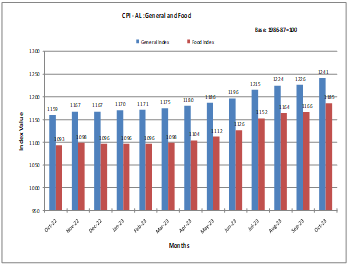
 The All India Consumer Price Index Number for Agricultural Labourers (CPI-AL) and Rural Labourers (CPI-RL) (Base: 1986-87=100) for the month of October, 2023 increased by 15 points and 14 points respectively to stand at 1241 (one thousand two hundred and forty-one) and 1251 (one thousand two hundred and fifty-one) points respectively. The major contribution towards the rise in general index of Agricultural Labourers and Rural Labourers came from food group to the extent of 13.20 and 12.48 points respectively mainly due to increase in prices of rice, wheat atta, pulses, vegetables, milk, onion, chillies (green), mixed spices etc,.

There has been an upward trend in the index across all the states. In the case of Agricultural Labourers, it recorded an increase of 1 to 10 points in 5 States, 11 to 20 points in 13 states and an increase of more than 20 points in 2 states. Tamil Nadu with 1427 points topped the index table whereas Himachal Pradesh with 960 points stood at the bottom.

In the case of Rural Labourers, it recorded an increase of 1 to 10 points in 5 states, 11 to 20 points in 13 states and an increase of more than 20 points in 2 states. Andhra Pradesh and Tamil Nadu with 1415 points each topped the index table whereas Himachal Pradesh with 1011 points stood at the bottom.

Amongst states, the maximum increase was experienced by Jammu & Kashmir for both CPI-AL and CPI-RL (32 and 29 points respectively) mainly due to rise in the prices of rice, wheat atta, onion, kadam saag/spinach, etc. The minimum increase in both the indexes was experienced by Kerala (1 point each).

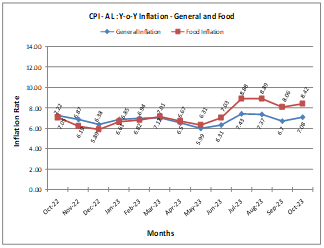
Point to point rate of inflation based on the CPI-AL and CPI-RL stood at 7.08% and 6.92% in October, 2023 compared to 6.70% and 6.55% respectively in September, 2023 and 7.22% and 7.34% respectively during the corresponding month of the previous year. Similarly, food inflation stood at 8.42% and 8.18% in October, 2023 compared to 8.06% and 7.73% respectively in September, 2023 and 7.05% & 7.00% respectively during the corresponding month of the previous year.

All-India Consumer Price Index Number (General & Group-wise):

Group

Agricultural Labourers

Rural  Labourers


September, 2023

October, 2023

September, 2023

October, 2023

General Index

1226

1241

1237

1251

Food

1166

1185

1171

1190

Pan, Supari,  etc.

2004

2009

2014

2019

Fuel & Light

1307

1308

1299

1299

Clothing, Bedding  &Footwear

1261

1266

1307

1315

Miscellaneous

1274

1277

1278

1278


The CPI – AL and RL for the month of November, 2023 will be released on 20th December, 2023. 

***

Annual PhD Workshop at Indian Institute for Human Settlements (IIHS) New Delhi

 The Indian Institute for Human Settlements (IIHS) will host the tenth edition of the Annual PhD Workshop in a hybrid format (virtually and in-person) from 8 to 10 January 2024.


With a strong interdisciplinary focus, as well as an emphasis on the relationship between research and practice, IIHS nurtures research and innovation focused on the challenges and opportunities of India’s urban transition. IIHS has built a substantive on-ground presence of direct policy and programmatic engagement across India, across middle and senior administrative levels, and in multiple urban contexts in the Global South. This makes for a globally unique opportunity for scholars intending to research the Urban where it matters – at the intersection of theory and practice. IIHS’ Post-Doctoral programme and the proposed doctoral programme emphasise the institute’s wider connections into domestic and international policy, and to overlapping communities of practice. IIHS is also building an integrated programme of quality campus-based education and research, training and lifelong learning for working professionals, distance and blended learning, as well as an array of practice and advisory services.


About the PhD Workshop

The PhD Workshop is a unique educational intervention on interdisciplinary urban research designed to provide a dedicated space for PhD candidates to expand on their work. They do this by interacting with eminent urban scholars and practitioners from IIHS and leading universities, and research institutions across the world including Yale, MIT, IIT-Madras, TISS, among others.


Initiated in 2013, the PhD Workshop has had close to 200 participants from leading global and domestic institutions including University of Oxford, MIT, University of Pennsylvania, Cornell University, NUS, JNU, TISS, IIT-Bombay etc., across a wide range of disciplines such as Architecture, Planning, Sociology, Urban Health, Economics, Public Policy, Climate Change, Anthropology, Engineering, Governance and Law. The Workshop provides participants with an opportunity to explore emerging areas of urban research especially in India and other parts of the global South and give them the opportunity to theorise from both research and practice.


The Workshop aims to shape the trajectory of a doctoral career and enable participants to engage with the imperatives of the changing form of disciplines, and meet the substantive academic demands of the doctoral process. The foundational ethos of the Workshop is an interdisciplinary approach to the Urban, guided by theories of and from the Global South with an emphasis on grounded understandings. The Workshop provides scholars with a space to critically examine urban related issues of their interest, and their own position within it. This self-reflexive criticality allows participants to approach their field of inquiry as actors within, rather than as mere viewers of urban phenomena. In addition to guiding students through their work, the Workshop deals with specific processes of earning a doctoral degree. The aim is to create a space of convivial co-learning that opens conversations not only on fields of inquiry, but also on experiences of students navigating the path to a doctoral degree.


Structure of the Workshop

This iteration of the PhD Workshop is open to participants from across a wide range of disciplines, with a common thread being an interest in urban research and practice. The Workshop is designed to provide a platform for in-depth exploration and for early and mid-to-late stage PhD students and fine-tune their work. The structure of the Workshop and the modules within it are designed to be relevant to students from different disciplines and at different stages of their doctoral career. The structure also allows for specific attention to the needs of individual scholars and enables peer to peer learning.


In addition to thematic relevant to particular disciplines, the Workshop will also have a Commons track, and two specialised tracks. The Commons track will primarily involve engagement with eminent urban scholars and practitioners as they explore the possibilities of new methods and pedagogies in and around the Urban. This track provides an opportunity to learn about and understand a range of methods and data sources that are unique to urban India, ethical practices in research as well as the nuances of publishing in academia. Two specialised tracks will focus on early career students who are in the process of finalising their questions (Track 1) and late career students working on finalising their dissertation (Track 2).


The PhD Workshop will be in a hybrid format this year from 8 to 10 January 2024. Interested candidates should send in their submissions by 27 November 2023.


For queries on the Workshop, write to us at research@iihs.ac.in.

Vacancy for Faculty Positions at National Institute of Technology (NIT) | Calicut, Kerala | Architecture, Planning


Vacancy for Faculty Positions at National Institute of Technology (NIT) Calicut

The National Institute of Technology Calicut (NIT Calicut or NITC) is a premier technical institution in India located in Calicut, Kerala. It is one of the 31 National Institutes of Technology in the country and was established in 1961 as the Regional Engineering College Calicut. It was later granted Institute of National Importance status and renamed as the National Institute of Technology Calicut in 2002.

Here are some key points about NIT Calicut:

  1. Academic Programs: NIT Calicut offers undergraduate, postgraduate, and doctoral programs in various engineering, technology, and science disciplines. These programs include B.Tech, M.Tech, M.Sc, MBA, and Ph.D. degrees.

  2. Campus: The campus is spread over a vast area and provides facilities like hostels, sports complexes, academic buildings, laboratories, and a library.

  3. Research and Development: NIT Calicut is involved in cutting-edge research and development activities. The institute encourages faculty and students to engage in research projects and publish their findings in reputed journals.

  4. Departments: The institute has various departments, including departments of Engineering, Sciences, and Humanities. Each department offers specialized courses and conducts research in its respective field.

  5. Placements: NIT Calicut has a strong placement record, and its graduates are sought after by leading companies in the industry. The institute’s placement cell facilitates interactions between students and potential employers.

  6. National Importance: Being an Institute of National Importance, NIT Calicut receives funding and support from the Government of India, allowing it to maintain high academic standards and infrastructure.

  7. Cultural and Technical Festivals: The institute hosts various cultural and technical festivals, providing students with opportunities to showcase their talents and interact with peers from other institutions.

  8. Notable Alumni: NIT Calicut has produced many successful professionals and entrepreneurs who have made significant contributions in various fields.

It’s important to note that specific details about academic programs, admission procedures, and other relevant information may change, so it is recommended to check the official website of NIT Calicut for the latest and most accurate details.

Positions: Assistant Professor (Grade II)
Institution: National Institute of Technology (NIT)
Department: Architecture and Planning/Civil Engineering
Qualification: ✔️ Detailed educational qualifications, experience, and other criteria for selection shall be according to the recruitment rules for Faculty in NITs as per Schedule E of the first statutes of the NITs (amendment statutes 2017) issued vide Gazette of India dated 24th July 2017, and clarification issued by Ministry of Education dated 16th April 2019.
Experience: ✔️ Details Provided Below.
Job Description: ✔️ Details Provided Below.
Type: Full Time
Location: Calicut, Kerala
Salary: ✔️ Pay level: 10 (AGP 6000)
Apply at: ✔️ Apply Link
Last Date: 30 November 2023

Vacancy for Assistant Architect at Himachal Pradesh Public Service Commission (HPPSC) | Himachal Pradesh


Vacancy for Assistant Architect at Himachal Pradesh Public Service Commission (HPPSC)

The Himachal Pradesh Public Service Commission (HPPSC) is a constitutional body that conducts recruitment examinations and interviews for various posts in the state of Himachal Pradesh, India. The commission is responsible for advising the state government on matters related to the recruitment, promotion, and transfers of civil servants. Its main objective is to ensure the fair and transparent selection of candidates for various government positions.

Key functions and responsibilities of the Himachal Pradesh Public Service Commission include:

  1. Recruitment: Conducting examinations and interviews to select candidates for various posts in the state government.

  2. Advisory Role: Advising the state government on matters related to recruitment, promotions, and disciplinary actions.

  3. Conducting Examinations: Designing and conducting competitive examinations for various services and posts.

  4. Promotions and Transfers: Recommending candidates for promotions and transfers based on their performance and eligibility.

  5. Disciplinary Matters: Advising the state government on disciplinary matters related to civil servants.

  6. Rule-Making: Recommending rules and regulations related to recruitment and other personnel matters.

The commission is headed by a chairman and consists of members appointed by the Governor of Himachal Pradesh. The members hold office for a fixed term as specified by the state government.

Positions: Assistant Architect (Grade I)
Institution: Himachal Pradesh Public Service Commission (HPPSC)
Department: DEPARTMENT OF HOUSING (HIMUDA)
Qualification: i) Degree in Architecture from a recognized University or an Institute duly recognized by the Central /State Government.
ii) Atleast two years experience in the field of Architecture after qualifying for the Degree in Architecture.
iii) Preference will be given to those Architects who get Registration under the Architect Act, 1972.
Experience: ✔️ Min. 02 Years.
Job Description: ✔️ Details Provided Below.
Type: Full Time
Location: Himachal Pradesh
Salary: ✔️ Pay Band Level – 18 (Rs. 56100 – 177500)
Apply at: ✔️ Apply Link
Last Date: 01 December 2023

What is Anxiety

 Anxiety is body’s natural response to stress. It’s a feeling of fear or apprehension about what’s to come. For example, going to a job interview or giving a speech on the first day of school may cause some people to feel fearful and nervous.

But if the feelings of anxiety are extreme, last for at least 6 months, and are interfering with your life, then it may be anxiety disorder.

What are anxiety disorders?

It’s normal to feel anxious about moving to a new place, starting a new job, or taking a test. This type of anxiety is unpleasant, but it may motivate us to work harder and do a better job. Ordinary anxiety is a feeling that comes and goes but doesn’t interfere with our everyday life.

In the case of an anxiety disorder, the feeling of fear may be with us all the time. It’s intense and sometimes debilitating.

This type of anxiety may cause us to stop doing things we enjoy. For example, it may prevent us from entering an elevator, crossing the street, or even stepping out of home in extreme cases.

If left untreated, the anxiety will keep getting worse.

Anxiety disorders are the most common form of emotional disorder and can affect anyone. But, according to the American Psychiatric Association, women are more likely than men to receive a diagnosis of an anxiety disorder.

What are the types of anxiety disorders?

Anxiety is a vital part of several different disorders. These include:

1. panic disorder. This means you experience recurring panic attacks at unexpected times.

2. Phobia. This is an excessive fear of a specific object, situation, or activity.

3.Social anxiety disorder. This is an extreme fear of being judged by others in social situations.

4.obsessive-compulsive disorder. This means you have recurring irrational thoughts that lead you to perform specific, repeated behaviours.

5. Separation anxiety disorder. This means you have a fear of being away from home or your loved ones.

6.  anxiety disorder. This is anxiety about your health (formerly called hypochondria).

In addition, a number of mental health and medical conditions may feature anxiety as a symptom. These include:

a. post-traumatic stress disorder (PTSD). This is anxiety following a traumatic event.

b. Major depressive disorders. A strong relationship exists between depression and anxiety.

c. Chronic disease. Managing conditions such as chronic obstructive pulmonary disease (COPD) and diabetes may result in anxiety symptoms.

d. Inflammatory conditions. Anxiety can lead to chronic inflammation and diseases such as arthritis

e. substance use disorders: many people with anxiety may try to self-medicate to help manage their symptoms.

f. Chronic pain. Anxiety is often found in those with chronic pain disorders.

What are the symptoms of anxiety?

Anxiety feels different depending on the person experiencing it. Feelings can range from butterflies in your stomach to a racing heart. You might feel out of control like there’s a disconnect between your mind and body.

You may have a general feeling of fear and worry, or you may fear a specific place or event. In some cases, you may experience a panic attack.

Symptoms of anxiety can include:

1.    anxious thoughts or beliefs that are difficult to control

2.    restlessness

3.    trouble concentrating 

4.    difficulty falling asleep

5.    fatigue

6.    irritability

7.    unexplained aches and pains

Your anxiety symptoms might be different from someone else’s. That’s why it’s essential to know how anxiety can present itself.

What is a panic attack?

A panic attack is a feeling of intense fear that comes on suddenly and peaks within 10 to 20 minutes. The initial trigger of the fear can be known or unknown.

The physical symptoms can mimic a heart attack. Once you’re experiencing a panic attack, the symptoms may get worse if you believe you may be having a heart attack or having a mental health emergency. Another common fear that may exacerbate a panic attack is the fear that you might be judged negatively if you’re having an attack in public.

Panic attacks can vary greatly, and symptoms may differ among individuals. In addition, the many symptoms of anxiety don’t happen to everyone, and they can change over time.

Common symptoms of a panic attack include:

chest pain

feeling of choking

fear of losing control

feeling of impending doom

sweating, chills, and hot flashes

shaking

numbness and tingling of hands, feet, or face

nausea or upset stomach

shortness of breath

fear of dying

When you experience repeated panic or anxiety attacks, you may have a panic disorder.

What causes anxiety?

1.stress

2.other medical issues such as depression or diabetes

3.first degree relatives with generalized anxiety disorder

4.environmental concerns, such as child abuse

substance use

5.situations such as surgery or occupational hazard

In addition, researchers believe that it stems from the areas of the brain responsible for controlling fear and the storing and retrieval of emotional and fear-related memories.

Who is at risk of anxiety disorders?

With each type of anxiety, there are different risk factors. But there are some general influences including:

1.    Personality traits. This includes shyness and nervousness in childhood.

2.    Life history. This includes being exposed to negative or stressful life events.

3.    Genetics. Of those who have a diagnosis of anxiety, 25 percent  have a first degree relative who also has a diagnosis of anxiety.

4.    Other health conditions. Thyroid problems and other health conditions can make you prone to anxiety.

5.    Stimulants. Consuming caffeine, specific substances, and medications can worsen your symptoms.

Are there tests that diagnose anxiety?

A single test can’t diagnose anxiety. Instead, an anxiety diagnosis requires a lengthy process of physical examinations, mental health tests, and psychological questionnaires.

Some doctors or healthcare professionals may conduct a physical exam, including blood or urine tests to rule out underlying medical conditions that could contribute to the symptoms one is experiencing.

Several anxiety tests and scales are also used to help a doctor assess the level of anxiety.

What are treatments for anxiety?

Treatment for anxiety falls into three categories:

Psychotherapy. Therapy can include cognitive behavioural therapy and exposure response prevention.

Complemental health techniques. Mindfulness, yoga, and self-management strategies such as stress management are ways to treat your anxiety using alternative methods.

Medication. Doctors prescribe antianxiety and antidepressant drugs.

Meeting with a therapist or psychologist can help you learn tools to use and strategies to cope with stress when it occurs.

What natural remedies are used for anxiety?

Lifestyle changes can effectively relieve some of the stress and anxiety you may cope with every day. Most natural “remedies” consist of caring for your body and participating in healthy activities while eliminating unhealthy ones.

These include:

a. getting enough sleep

b.  meditating

c. staying active and exercising

d. eating a healthy diet

e.  avoiding alcohol

f. avoiding caffeine

g. quitting smoking cigarettes 

h.  Anxiety and depression

if you have an anxiety disorder, you may also be experiencing depression. While anxiety and depression can occur separately, it’s not unusual for mental health disorders to happen together.

Anxiety can be a symptom of clinical or major depression. Likewise, worsening symptoms of depression can become triggered by an anxiety disorder.

You can manage symptoms of both conditions with many of the same treatments: psychotherapy (counselling), medications, and lifestyle changes.

Why it’s important to address your mental health

It’s important for people to address their mental health to live lives that are fulfilling. Acknowledging and treating your mental health helps create resilience. It also teaches you to better cope. Then when a similar situation occurs, you are equipped to handle it.

Stressful situations are going to happen. How you react can determine how these situations will affect you. Many resources are available regarding anxiety, depression and stress.

What is Empathy

 Empathy is the capacity to understand or feel what another person is experiencing from within their frame of reference, that is, the capacity to place oneself in another’s position. 

Empathy is, at its simplest, awareness of the feelings and emotions of other people. It is a key element of Emotional Intelligence, the link between self and others, because it is how we as individuals understand what others are experiencing as if we were feeling it ourselves.

Empathy goes far beyond sympathy, which might be considered ‘feeling for’ someone. Empathy, instead, is ‘feeling with’ that person, through the use of imagination.


On the other hand, sympathy involves understanding from your own perspective. Empathy involves putting yourself in the other person’s shoes and understanding why they may have these particular feelings. In becoming aware of the root cause of why a person feels the way they do; we can better understand and provide healthier options.

“Unsympathetic” is a word that may be used to describe a person who lacks empathy. Someone may also use the terms “insensitive or “uncompassionate” to describe people who lack empathy.


Signs of a Lack of Empathy

  • Being extremely critical of other people.
  • Blaming the victim.
  • Not forgiving people for making mistakes.
  • Feeling like other people are too sensitive.
  • Not listening to other people’s perspectives or opinions.
  • An inability to cope with emotional situations.


What causes lack of empathy?


Low emotional intelligence, burnout, and stress
Being under prolonged stress may also lead someone to be less tolerant of other people’s behavior and have lower cognitive empathy. In some cases, emotional avoidance may also be a reason why someone may not develop or practice empathy.


Elements of Empathy


Understanding Others

Developing Others

Having a Service Orientation

Leveraging Diversity

Political Awareness

1.Understanding Others: This is perhaps what most people understand by ‘empathy’ “sensing others’ feelings and perspectives, and taking an active interest in their concerns”. Those who do this:

·         Tune into emotional cues. They listen well, and also pay attention to non-verbal communication, picking up subtle cues almost subconsciously. For more, see our pages on Listening Skills and Non-Verbal Communication.

·         Show sensitivity, and understand others’ perspectives.

All these are skills which can be developed, but only if you wish to do so. Some people may switch off their emotional antennae to avoid being swamped by the feelings of others.

2. Developing Others: means acting on their needs and concerns, and helping them to develop to their full potential. People with skills in this area usually:

  • Reward and praise people for their strengths and accomplishments, and provide constructive feedback designed to focus on how to improve. See our page on Giving and Receiving Feedback for more.
  • Provide mentoring and coaching to help others to develop to their full potential. See our pages on Mentoring and Coaching Skills for more.
  • Provide stretching assignments that will help their teams to develop. See our page on Delegation Skills.

3. Having a Service Orientation: Primarily aimed at work situations, having a service orientation means putting the needs of customers first and looking for ways to improve their satisfaction and loyalty.

People who have this approach will ‘go the extra mile’ for customers. They will genuinely understand customers’ needs, and go out of their way to help meet them.

In this way, they can become a ‘trusted advisor’ to customers, developing a long-term relationship between customer and organisation. This can happen in any industry, and any situation.

4. Leveraging diversity: means being able to create and develop opportunities through different kinds of people, recognising and celebrating that we all bring something different to the table.

Leveraging diversity does not mean that you treat everyone in exactly the same way, but that you tailor the way you interact with others to fit with their needs and feelings.

5. Political Awareness: Many people view ‘political’ skills as manipulative, but in its best sense, ‘political’ means sensing and responding to a group’s emotional undercurrents and power relationships.

Political awareness can help individuals to navigate organisational relationships effectively, allowing them to achieve where others may previously have failed


Empathy, Sympathy and Compassion

There is an important distinction between empathy, sympathy and compassion.

Both compassion and sympathy are about feeling for someone: seeing their distress and realising that they are suffering. Compassion has taken on an element of action that is lacking in sympathy, but the root of the words is the same.

Empathy, by contrast, is about experiencing those feelings for yourself, as if you were that person, through the power of imagination.

Three Types of Empathy

Psychologists have identified three types of empathy: cognitive empathy, emotional empathy and compassionate empathy.

  • Cognitive empathy is understanding someone’s thoughts and emotions, in a very rational, rather than emotional sense.
  • Emotional empathy is also known as emotional contagion, and is ‘catching’ someone else’s feelings, so that you literally feel them too.
  • Compassionate empathy is understanding someone’s feelings, and taking appropriate action to help.


How Do We Empathize?

Experts in the field of social neuroscience have developed two theories in an attempt to gain a better understanding of empathy. The first, Simulation Theory, “proposes that empathy is possible because when we see another person experiencing an emotion, we ‘simulate’ or represent that same emotion in ourselves so we can know first-hand what it feels like,” according to Psychology Today.

There is a biological component to this theory as well. Scientists have discovered preliminary evidence of “mirror neurons” that fire when humans observe and experience emotion. There are also “parts of the brain in the medial prefrontal cortex (responsible for higher-level kinds of thought) that show overlap of activation for both self-focused and other-focused thoughts and judgments,” the same article explains.

Some experts believe the other scientific explanation of empathy is in complete opposition to Simulation Theory. It’s Theory of Mind, the ability to “understand what another person is thinking and feeling based on rules for how one should think or feel,” Psychology Today says. This theory suggests that humans can use cognitive thought processes to explain the mental state of others. By developing theories about human behaviour, individuals can predict or explain others’ actions, according to this theory.

While there is no clear consensus, it’s likely that empathy involves multiple processes that incorporate both automatic, emotional responses and learned conceptual reasoning. Depending on context and situation, one or both empathetic responses may be triggered.

Cultivating Empathy: Empathy seems to arise over time as part of human development, and it also has roots in evolution. In fact, “Elementary forms of empathy have been observed in our primate relatives, in dogs, and even in rats,” the Greater Good Science Centre says. From a developmental perspective, humans begin exhibiting signs of empathy in social interactions during the second and third years of life. 

This suggests we have a natural predisposition to developing empathy. However, social and cultural factors strongly influence where, how, and to whom it is expressed. Empathy is something we develop over time and in relationship to our social environment, finally becoming “such a complex response that it is hard to recognize its origin in simpler responses, such as body mimicry and emotional contagion,” the same source says.

Psychology and Empathy: In the field of psychology, empathy is a central concept. From a mental health perspective, those who have high levels of empathy are more likely to function well in society, reporting “larger social circles and more satisfying relationships,” according to Good Therapy, an online association of mental health professionals. Empathy is vital in building successful interpersonal relationships of all types, in the family unit, workplace, and beyond. Lack of empathy, therefore, is one indication of conditions like antisocial personality disorder and narcissistic personality disorder. In addition, for mental health professionals such as therapists, having empathy for clients is an important part of successful treatment. 

Empathy plays a crucial role in human, social, and psychological interaction during all stages of life. Consequently, the study of empathy is an ongoing area of major interest for psychologists and neuroscientists in many fields, with new research appearing regularly. 


How to Develop Empathy at Work

1.Give Your Full Attention: Listen carefully to what someone is trying to tell you. Use your ears, eyes and “gut instincts” to understand the entire message that they’re communicating.

Start with listening out for the key words and phrases that they use, particularly if they use them repeatedly. Then think about how as well as what they’re saying. What’s their tone or body language  telling you? Are they angry, ashamed or scared, for example?

Take this a stage further by listening empathically . Avoid asking direct questions, arguing with what is being said, or disputing facts at this stage. And be flexible – prepare for the conversation to change direction as the other person’s thoughts and feelings also change.


2.Consider Other People’s Perspective: You’re likely familiar with the saying, “Before you criticize someone, walk a mile in their shoes.” Examine your own attitude, and keep an open mind. Placing too much emphasis on your own assumptions and beliefs doesn’t leave much space for empathy!

Once you “see” why others believe what they believe, you can acknowledge it. This doesn’t mean you have to agree with it, but this is not the time for a debate. Instead, be sure to show respect and to keep listening.

When in doubt, invite the person to describe their position some more, and ask how they think they might resolve the issue. Asking the right questions  is probably the simplest and most direct way to understand the other person.

3.Take Action: There’s no one “right way” to demonstrate your compassionate empathy. It will depend on the situation, the individual, and their dominant emotion at the time. Remember, empathy is not about what you want, but what the other person wants and needs, so any action you take or suggest must benefit them.

And remember that empathy is not just for crises! Seeing the world from a variety of perspectives is a great talent – and it’s one that you can use all of the time, in any situation. And random acts of kindness brighten anyone’s day.


two-day International Conference-cum-Exhibition on ‘Aerospace & Aviation in 2047’ in New Delhi

 The Aeronautical Society of India (AeSI) is organising an International Conference-cum-Exhibition on ‘Aerospace & Aviation in 2047’ at Yashobhoomi Convention Centre in New Delhi on November 18 & 19, 2023. President Smt Droupadi Murmu, the Chief Guest of the event, will inaugurate the Conference-cum-Exhibition. The Guests of Honour will include Minister of State (Independent Charge) for Science & Technology and MoS, Prime Minister’s Office Dr Jitendra Singh; Minister of State for Civil Aviation and Road Transport & Highways General (Dr) VK Singh (Retd) and Raksha Rajya Mantri Shri Ajay Bhatt.

This conference-cum-exhibition is being organised to commemorate 75 years of excellence of the AeSI. The inaugural session of the event will include the release of Compendium on 75 years of aerospace & aviation journey in India as well as Vision Document 2047. The event will focus on India’s journey in the field over the last 75 years, showcasing the achievements, technological advancements and the role of great visionaries.

The event will be attended by 1,500 delegates including dignitaries, international experts, scientists, industrialists, academia, start-ups and students. About 200 industries and MSMEs, including more than 75 start-ups, will showcase indigenous capabilities at the exhibition. Many heads of organisations/departments will deliver visionary talks during the conference.

The conference will consist of technical sessions with speakers from Safran, Rolls Royes, Lockheed Martin, MIT USA, Cranefield UK along with prominent Scientist/Technologist/Service officers from the Indian side. The event will also feature a start-up challenge that spans the length and breadth of the country. The finalists will present their innovative ideas and products, along with their vision for India’s aerospace growth by 2047. Many other events are also planned to engage with the youth.

The AeSI was established in 1948 with the Prime Minister as Patron-in-chief to promote aerospace and aviation in the country. The objective of the society is to promote the advancement and nationwide diffusion of the knowledge of aeronautical sciences and aircraft engineering among various streams including industry, academia and research laboratories.

The AeSI has provided significant leadership in the domain of aerospace and aviation with outstanding luminaries as its members and Presidents that include Dr APJ Abdul Kalam, Dr Satish Dhawan, Dr VS Arunachalam, Dr VK Saraswat etc. It has been a catalyst for the growth of India’s aerospace industry and fostered collaborations between the government, private sector and academia to nurture a robust aerospace ecosystem.

The society is represented by distinguished aerospace professionals from research organisations, aerospace industries and academia. Former Secretary, Department of Defence R&D & Chairman DRDO Dr G Satheesh Reddy is its present President and Chairman, ISRO Shri S Somanath is the President-Elect.

****

Making Human Resources Future Ready

 Union Minister for Education and Skill Development & Entrepreneurship, Shri Dharmendra Pradhan, chaired the Education Ministers’ Session at 2nd Voice of Global South Summit held today in New Delhi. The summit, operating under the theme ‘Together for everyone’s growth, with everyone’s trust,’ addressed critical issues, particularly in the field of education. The Education Ministers deliberated on the theme of ‘Making human resources future-ready’.

Ministers/ Dignitaries of 14 countries from the Global South – Botswana, Brunei Darussalam, Georgia, Tunisia, Iran, Lao PDR, Malawi, Myanmar, Republic of Palau, Democratic Republic of São Tomé and Príncipe, Albania, Malaysia, Zimbabwe, Cameroon – participated virtually in the session and shared their insights.

 Shri Dharmendra Pradhan, in his opening remarks, welcomed the participating Ministers and reaffirmed India’s commitment to champion the voice of the Global South under leadership of Prime Minister Shri Narendra Modi.

Highlighted India’s pivotal role in leading discussions on these issues at the G20 Education Minister’s Meeting, Shri Pradhan emphasised on the significance of collaborative efforts in developing a resilient, equitable, inclusive, and sustainable education and skilling ecosystem. The G20 New Delhi Leaders’ Declaration acknowledged the importance of investing in human capital development.

Shri Pradhan informed the participating Ministers on how India’s National Education Policy (NEP) 2020, being implemented under the leadership of the PM Shri Narendra Modi, is bringing holistic transformation to India’s learning and skilling landscape. He also remarked that NEP as a philosophical document can act as a template for emerging economies towards developing comprehensive strategies and agile policies. Stressing on the importance of shared aspirations, Shri Pradhan, called for common strategies, leveraging the twin pillars of education and skill development.

Other Ministers in their address, shared success stories, challenges faced and strategies to address them. They unequivocally commended India’s effort to strengthen cooperation in the fields of education and skilling among the countries of the Global South.

The Education Ministers from the participating countries agreed on the need to work together for an accessible, equitable, inclusive, and sustainable future through quality education. Underlining the importance of investing in human capital development and to address the global skill divide, the Ministers agreed on the need to provide skilling, reskilling and upskilling opportunities to create a future-ready workforce aligned to the demands of the industry.

The Education Ministers also reiterated shared commitment to overcome the digital divide for all learners by addressing the barriers to technological infrastructure and work collectively to develop technology ecosystems and learning resources, including in local languages that are affordable and easily accessible. They underlined the central role of all teachers and education staff all over the world in promoting education and the need to foster an environment including through capacity building and exchange programmes that will enable teachers and staff to thrive in their profession.

The Ministers agreed to encourage collaborative solutions, innovations, sharing of best practices to promote quality teaching, learning and skilling as well as foster academic collaborations among educational institutions as well as encouraging student and faculty exchange programs.

Appreciating the fellow Ministers for their valuable ideas, Shri Pradhan expressed his confidence that with collective efforts, the South-South cooperation will grow from strength to strength. India will work ‘Together for Everyone’s Growth, With Everyone’s Trust’ for global well-being, an equitable world order and for a brighter global future, he added.

The summit builds upon the foundation laid during the Inaugural Voice of Global South Summit in January 2023, which focused on uniting voices and purposes from 125 countries of the Global South, reflecting India’s commitment to addressing key priorities of the developing world, particularly in education and skill development.

The 2nd Voice of Global South Summit aims to serve as a platform to share the outcomes of various G20 meetings, sustain momentum generated from the previous summit, and discuss ways to achieve shared aspirations for inclusive and equitable international development. Deliberations will also focus on harnessing digital technologies to bridge the digital divide and strengthening cooperation in developing life, technical, and vocational skills. The outcomes of the summit are expected to inform the deliberations at the upcoming G20 Virtual Summit hosted by India on 22nd November 2023.

There are 8 Ministerial sessions during the Summit. The Summit, with the theme ‘Together, for Everyone’s Growth, with Everyone’s Trust’ would focus on sharing with countries of the Global South the key outcomes achieved in various G20 meetings over the course of India’s Presidency. Key ideas and suggestions emerging from the members of the Global South at the 2nd VOGSS will also be informed during the next G-20 Virtual Summit, to be hosted by India on 22 November 2023.

*****

India Art, Architecture & Design Biennale” at Red Fort

 The Ministry of Culture is organizing India Art, Architecture and Design Biennale 2023 at Red Fort, to be inaugurated on 8th December 2023. Following the Inaugural & VIP preview, the exhibitions along with panel discussions, workshops and the art bazaar will be held from 9th to 15th December and will be open to public. The keynote addresses by international artists, architects, and designers, public art installations, art bazaar and cultural programs are the major attractions of the Biennale. The pavilions set up as part of the Biennale will be on display till the 31st of March 2024.

Building on the success of past events like the International Museum Expo & Festival of Libraries, the Biennale seeks to create a prominent global cultural event, comparable to those in Venice, Sao Paulo, and Dubai. Inspired by the Prime Minister’s directive to establish five cultural spaces in India, including one at the Red Fort, IAADB’23 is an innovative initiative to highlights India’s diverse art, architecture and design.

Addressing a curtain raiser press conference at National Museum, here today, Minister of State for Culture and External Affairs Smt. Meenakashi Lekhi said that the biennale showcases a diverse range, including traditional artisans, contemporary designers, curators, and thought leaders. The Biennale is an innovative initiative to celebrate the rich tapestry of our country’s artistic heritage, spanning ancient, modern, contemporary and tech-driven art, architecture and design, said the Minister.

The week-long event is organised around daily themes, each aimed at showcasing different aspects of India’s rich cultural heritage. Seven esteemed curators are involved in IAADB’23, ensuring a captivating experience that combines physical and digital exhibitions, interactive installations, sessions and panel discussions. Expertly curated catalogues will accompany each exhibition along with a comprehensive coffee table book for the entire event.

The curated pavilions at the event offer a fascinating journey through diverse aspects of India’s cultural heritage. Mr. Aditya Arya guides visitors through “Pravesh“ exploring the symbolism of doors and gateways. Ms. Anjchita B Nair curates “Bagh-e-Bahar,” a pavilion delving into the concept of gardens as universes. Mr. Amit Pasricha takes on “Sthaypatya” exploring the timeless design and architectural resilience of temples. “Sampravah” is curated by Mr. Ratish Nanda and Mr. Vikramjit Rooprai, focusing on Baolis in India. Ms. Shikha Jain and Ms. Adriana A. Garreta present “Vismaya” a pavilion celebrating India’s post-independence architectural splendour. Mr. Anubhav Nath brings forth “Deshaj”: exploring folk art and design traditions. Finally, Ms. Swati Janu curates “Samatva” an exploration of women’s contribution to architecture.

In addition to the above, the Ministry also invited artists and curators to submit their work for IAADB’23 through an open call on social media. The Ministry received 560 queries and 260 submissions of which 150 entries were selected and will be on display at the venue. In conjunction with the IAADB’s mandate for inclusivity, a Student Biennale is also being organised from the 9th of December at the Lalit Kala Akademi and will serve as a platform for emerging talent to showcase creativity and imagination.

The India Art, Architecture & Design Biennale is set to be a unique event that aims to mobilise the community of artists and designers by providing a platform for both established and emerging artists. Its goal is to energize cultural and creative industries by fostering dialogue among practitioners in art, architecture, and design.

****

Indo-Pacific Economic Framework for Prosperity (IPEF)

 The third Indo-Pacific Economic Framework for Prosperity (IPEF) Ministerial Meeting was held in San Francisco, California on 14 November 2023 hosted by the US. Union Minister for Commerce and Industry, Consumer Affairs, Food and Public Distribution, and Textiles, Shri Piyush Goyal participated in the Ministerial meeting.

IPEF was launched jointly by the USA and other partner countries of the Indo-Pacific region on May 23, 2022 at Tokyo. IPEF has 14 partner countries including Australia, Brunei, Fiji, India, Indonesia, Japan, Republic of Korea, Malaysia, New Zealand, Philippines, Singapore, Thailand, Vietnam & USA. It seeks to strengthen economic engagement among partner countries with the goal of advancing growth, peace and prosperity in the region.

The framework is structured around four pillars relating to Trade (Pillar I); Supply Chains (Pillar II); Clean Economy (Pillar III); and Fair Economy (Pillar IV). India had joined Pillars II to IV of IPEF while it has an observer status in Pillar-I.

At this Ministerial Meeting, negotiations under the IPEF Pillar-III (Clean Economy), Pillar IV (Fair Economy) and the Agreement on the Indo-Pacific Economic Framework for Prosperity (which seeks to establish a ministerial-level council and a commission) were substantially concluded. Moreover, following the substantial conclusion of the negotiations on the IPEF Supply Chain Agreement in May 2023, the IPEF Ministers signed the IPEF Supply Chain Agreement during the Ministerial Meeting. Pillar-wise Press Statement was issued at the end of the San Francisco Ministerial meeting highlighting the contours and the efforts planned under each of the substantially concluded Pillars (link below).

Under the Clean Economy (Pillar-III), IPEF partners are aiming to advance cooperation on research, development, commercialization, availability, accessibility, and deployment of clean energy and climate friendly technologies, and facilitate investment towards climate-related projects in the region. During his intervention under this Pillar, Shri Goyal emphasized the need for increased collaboration among partners on research and development of innovative and affordable climate friendly technologies. Further, Shri Goyal stressed the need to prioritize implementation of Cooperative work programmes envisaged under this pillar, including hydrogen supply chain initiative and other proposals in the pipeline such as India’s proposal for biofuels and e-waste recycling.

Under the Fair Economy (Pillar-IV), IPEF partners aim to strengthen implementation of effective anti-corruption and tax measures to boost commerce, trade, and investment among IPEF economies. During his intervention under this Pillar, Shri Goyal highlighted enhancing information sharing among partners, facilitating asset recovery and strengthening cross-border investigations and prosecutions as the key benefits to emerge from the Agreement. Further, he highlighted that this will strengthen the joint resolve to fight against corruption, money laundering and terror financing.

* Link to Pillar II-IV San Francisco IPEF Statement

***

Global Infrastructure and Investment (PGII) & Indo-Pacific Economic Framework for Prosperity (IPEF) Investors Forum

 Union Minister for Commerce and Industry, Consumer Affairs, Food and Public Distribution and Textiles, Shri Piyush Goyal, participated in the Investor Forum of the Partnership for Global Infrastructure and Investment (PGII) & Indo-Pacific Economic Framework for Prosperity (IPEF). The Forum, a moderated discussion, was co-hosted by U.S. Secretary of Commerce Ms. Gina Raimondo and Senior Advisor to the President Mr. Amos Hochstein with the discussion centred on collaborative actions and shared priorities to increase private investment in the Indo-Pacific.

The Forum was also attended by Ministers and senior officials from IPEF partner countries including the Prime Minister of Fiji, His Excellency Mr. Sitiveni Rabuka, and Minister of Trade of Korea His Excellency Mr. Dukgeun Ahn; and corporate leaders including Co-CEO of KKR Joseph Bae; Chairman and CEO of BlackRock Larry Fink; CEO of Citi Jane Fraser; Founder and Chairman of Fortescue Andrew Forrest; Founding Partner of Global Infrastructure Partners Matthew Harris; Founding Partner, Chairman and CEO of Global Infrastructure Partners Adebayo Ogunlesi; President, CIO and CFO of Alphabet and Google Ruth Porat; Founder and CEO of RockCreek Afsaneh Beschloss; and Founding Partner and Executive Chair of TPG Jim Coulter.

U.S. Secretary of Commerce Gina Raimondo in her address to the forum highlighted the continuing partnership between India and USA through the Green Transition Fund co-created by U.S. International Development Finance Corporation (DFC) and National Investment and Infrastructure Fund (NIIF) aimed at providing climate impact benefits and accelerating the development of clean-energy transition projects in India through investments in solar, energy storage, and e-mobility.

The Minister in his address extended his appreciation to IPEF partners on the conclusion of negotiations on Pillar-III (Clean Economy) and Pillar-IV (Fair Economy) and emphasised on India’s commitment to enhancing ease of doing business, ushering in transparency in business regulatory ecosystem, delivering sustainable growth and development.

Thereafter, the Minister participated at the APEC Informal Leader’s Dialogue where he highlighted India’s environmental leadership in successfully meeting the renewable energy target of 175 gigawatt nine years ahead of its target. Additionally, he also called upon the world leaders to join hands as a global community to construct a future where sustainability is not a distant aspiration but a way of life and where climate action is not a burden but an opportunity for innovation and growth.

As part of day’s engagements, the Minister joined the world leaders at IPEF Leader’s Meeting. The engagement was attended by several world leaders including His Excellency Mr. Joe Biden, President of the United States of America. Several IPEF initiatives such as Critical Minerals dialogue, Investment Accelerator, Catalytic Fund, Investor Forum, IPEF Networks etc were announced during the meeting.

Besides participating at the PGII Investor Forum, APEC engagements, including the dinner reception for APEC Leaders, and IPEF Leaders’ meetings, the Minister during the day held several bilateral and one-to-one meetings with world leaders and corporate giants. He met H.E. Mr. Juan Carlos Mathews, Minister of Foreign Trade and Tourism of Peru, and discussed ways to enhance bilateral trade and investment linkages, reviewed progress of bilateral FTA negotiations and suggested expedited conclusion. The Minister also met Mr. Alex Rogers, President, Qualcomm Technology Licensing & Global Affairs and discussed the vast opportunities for collaboration that India’s rapidly evolving semiconductor ecosystem & robust innovation landscape offers to companies like Qualcomm.

****

Sectoral Plan for Efficient Logistics (SPEL)

 The 60thNetwork Planning Group (NPG) meeting was held on 16th November 2023, under the chairpersonship of Special Secretary (Logistics), Department for Promotion of Industry and Internal Trade (DPIIT), Smt. Sumita Dawra in New Delhi.

The meeting focused ondiscussions on Sectoral Plan for Efficient Logistics (SPEL)by individual line Ministries/Departments. This initiative, among the various initiatives proposed under the Comprehensive Logistics Action Plan (CLAP) of National Logistics Policy (NLP), was proposed to ensure that a focused approach is taken in addressing logistics-related requirements at the individual sector level.

Today, the Ministry of Steel and the Ministry of Coal presented their plans to address logistics issues pertaining to infrastructure, processes, digital improvements, policies and regulatory reforms, and capacity building for a better workforce.

Ministry of Steel outlined their SPEL approach, encompassing in-depth Supply & Demand Analysis for Iron Ore and steel, Forecasted Requirements up to 2030-31 and beyond, Strategic Planning for Future Readiness in Logistics, etc. The preliminary SPEL draft is expected to be finalized shortly by the Ministry of Steel.

Ministry of Coal presented itskey findings on the Integrated Coal Evacuation Plan prepared under the aegis of Coal Logistics Policy 2023. Infrastructural gaps project requirements were presented that shall improve logistics and cost efficiency, and achieve optimum multimodal mix. Ministry envisages a 14% reduction in Rail logistics cost through railway network optimization for coal logistics. Further, there is potential to lower Co2 emissions by 100,000 Tonnes Co2 per Annum by FY30 due to a reduction in railway leads and the replacement of Road Transportation by Rail.

The chair acknowledged that the Coal Logistics Policy is a significant step toward the development of sector-specific plans to foster the efficient growth of the logistics industry within specified timelines. The Special Secretary emphasized prioritizing cross-sectoral cooperation and focus on the optimization of modal mix for holistic planning.

So far, the following actions have been taken by other Ministries addressing logistics-related requirements:

  • Comprehensive Port Connectivity Plan by Ministry of Ports, Shipping and Waterways was developed and notified.
  • Development of Cement Sectoral Plan underway
  • Department of Food and Public Distribution undertaking a study to identify optimized routes for movement of foodgrains, with aim to reducing logistic cost & transit time.
  • Department of Agriculture and Farmers Welfare has developed an Agriculture Infrastructure Fund to developing logistics-related infrastructure as a part of post-harvest management infrastructure.

*****

Fully Funded PhD Programs at University of Cambridge, England

Are you holding Master’s degree and looking for fully funded PhD positions? University of Cambridge, England invites online application for multiple funded PhD Programs / fully funded PhD positions in various research areas. 

Candidates interested in fully funded PhD positions can check the details and may apply as soon as possible. Interested and eligible applicants may submit their online application for PhD programs via the University’s Online Application Portal. 

1. Fully Funded PhD Position

Summary of PhD Program:

The Oliver Gatty PhD Studentship for full-time study and research training in the fields of Biophysical and Colloid Science is open to graduates in the broad area of biophysics. The Studentship is tenable for up to four years, commencing on the 1st October 2024. Candidates should identify a supervisor and agree on a proposed course of research before making an application.

Application Deadline: 7 January 2024

Apply now

2. Fully Funded PhD Position in Cancer Biology

Summary of PhD Program:

The CRUK Cambridge Centre is a dynamic collaboration of academic researchers, clinicians, and the pharmaceutical and biotech industries based in the Cambridge area. By being part of the Centre, students will have the opportunity to attend a number of lecture series, workshops and meetings aimed at facilitating and strengthening collaborations between complimentary disciplines and across different departments and institutes.

Application Deadline: 15 November 2023

Apply now

3. Fully Funded PhD Position in Veterinary Anaesthesia

Summary of PhD Program:

Applications are invited from recently qualified veterinarians for this twelve month post-graduate training programme offering high-quality, post-graduate training in Veterinary Anaesthesia. The emphasis will be on gaining practical clinical experience in Veterinary Anaesthesia under the supervision of board-certified diplomates, and will further prepare the candidate to embark on a 3-year Residency Training Programme in veterinary anaesthesia.

Application Deadline: 19 November 2023

Apply now


4. Fully Funded PhD Position in Genetics

Summary of PhD Program:

The Drosophila adult midgut is a homeostatic tissue, in which cells constantly turn over and are replaced by the progeny of intestinal stem cells divisions. These progeny, called enteroblasts, are initially quiescent, lack an apical domain and lie on the basal side of the epithelium. In response to dying cells or signals that expand the gut, the enteroblasts integrate into the epithelium, polarise and form a new apical domain with a typical brush border. Two features of this process are very different from other epithelia in Drosophila. Firstly, enteroblast polarisation does not require any of the canonical epithelial polarity factors that have been identified in other tissues, and it depends instead on adhesion to the basement membrane, as is the case in mammalian epithelia (1).

Application Deadline: 26 November 2023

Apply now


5. Fully Funded PhD Position

Summary of PhD Program:

Applications are invited for an Ernest Oppenheimer Studentship to be held at Cambridge University in Colloid Science, as broadly interpreted within the fields of biology, chemistry, physics, materials science and engineering. The Studentship is to support research projects directly leading to a PhD. The application should be made by the designated research supervisor, on behalf of the named candidate. Normally, only one application per supervisor will be considered.

Application Deadline: 9 January 2024

Apply now


6. Fully Funded PhD Position in Cancer 

Summary of PhD Program:

The Early Cancer Institute at the University of Cambridge is the UK’s only Institute dedicated to the early detection of cancer. This world-leading centre is based on the Cambridge Biomedical Campus and houses a highly multidisciplinary, collaborative range of experts working to take early detection innovations from bench to bedside and move the world beyond the fear of cancer.

Application Deadline: 22 November 2023

Apply now


7. Fully Funded PhD Position in Trophoblast

Summary of PhD Program:

Our PIs are recognized international experts in their fields based across Cambridge in the Departments of Physiology, Development, and Neuroscience, Obstetrics and Gynaecology, Pathology, Genetics, and allied institutes, including the Institute of Metabolic Science, Cambridge Stem Cell Institute, Cambridge Institute of Therapeutic Immunology and Infectious Disease, the LMB, Babraham, and Wellcome Sanger Institute. A CTR Studentship is held within the relevant Department or Institute, where an internal Departmental Postgraduate Educational Committee is responsible for administering your degree.

Application Deadline: 16 November 2023

Apply now

10 Best AI Cover Letter Builders

8. Fully Funded PhD Position in Cancer 

Summary of PhD Program:

The CRUK Cambridge Centre is a dynamic collaboration of academic researchers, clinicians, and the pharmaceutical and biotech industries based in the Cambridge area. By being part of the Centre, students will have the opportunity to attend a number of lecture series, workshops and meetings aimed at facilitating and strengthening collaborations between complimentary disciplines and across different departments and institutes.

Application Deadline: 15 November 2023

Apply now


9. Fully Funded PhD Position in cancer

Summary of PhD Program:

Cancer-associated fibroblast (CAF) are cells embedded in the tumour microenvironment (TME) along with immune and cancer cells. Recently, some CAF subsets have been associated with poor response to immunotherapy. This has led to the emergence of CAF as potential therapeutic targets, although limited understanding of CAF heterogeneity and lack of CAF-rich mouse models mimicking the human immune-suppressive TME has hampered the efforts to effectively target these cells. The aim of this project is to develop novel models that mimic the immunosuppressed microenvironment of solid tumours and to explore the impact of CAF heterogeneity in immunotherapy resistance.

Application Deadline: 19 November 2023

Apply now


10. 
Fully Funded PhD Position in Multimodal AI-guided tools for early prediction of disease progression in neurodegenerative disorders

Summary of PhD Program:

Applications are invited for 4-year PhD studentship based in the Department of Psychology, University of Cambridge and the new AstraZeneca Discovery Centre at Cambridge. The student will be working on a collaborative project jointly supervised by Professor Zoe Kourtzi at Department of Psychology Cambridge in collaboration with AstraZeneca’s Neuroscience (Dr Keith Tan, Dr Andrew Lowe) and Data Science & AI (Dr Philip Teare, Dr Gayathri Mohankumar) teams and will have the opportunity to work across the two sites. The project, entitled ‘Multimodal AI-guided tools for early prediction of disease progression in neurodegenerative disorders’ is in the field of AI for Neuroscience that has generated much excitement in both academia and industry.

Application Deadline: 20 November 2023

Apply now

11. Fully Funded PhD Position in Reading and Writing in Medieval Womens Religious Communities

Summary of PhD Program:

This PhD studentship offers an opportunity to investigate the culture of female religious communities in the Middle Ages, through a study of their surviving manuscripts. We are inviting applicants to propose a project that explores any aspect of women’s conventual life, with the specific aim of bringing together kinds of sources that have rarely been discussed in combination. The themes and structure of the project are entirely open, provided the proposal is interdisciplinary and combines different types of manuscripts in novel, creative, and productive ways.

Application Deadline: 4 January 2024

Apply now

12. Fully Funded PhD Position in Philosophy of Wellbeing Policy

Summary of PhD Program:

The PhD studentship aims at making explicit the knowledge that exists among practitioners and in the less visible space of implementation of well-being policies and exploring its relevance for evidence-based policy. Using review of a variety of literatures as well as interviews with the staff of What Works Centre Wellbeing and cognate practitioners, this project seeks to reconstruct the methodology behind generation and deployment of wellbeing evidence as it travels between the academy and the practitioners. In addition to being a contribution to wellbeing practice, such a project trials an innovative approach to philosophy of science and applied epistemology more generally. How is localized knowledge relevant to specific practical contexts generated, preserved, and passed on? Does it have a philosophy of its own? Can recovering this knowledge help address deficits in evidence-based practices? In this way this project encourages and supports practice-based research at doctoral level.

Application Deadline: 5 December 2023

Apply now


13. Fully Funded PhD Position in Non-Normative Identities in 20th-21st Century Catalan Cultures

Summary of PhD Program:

The PhD student will carry out original research that addresses the presence of minoritarian/non-normative identities within Catalan cultures. The project will need to address the complexities of subaltern expressions of gender, sexuality, race, ethnicity, ability, migration, and/or class situated in the framework of Catalan cultures, perhaps exploring the nuanced intertwining of identities and nationhood. Applicants will be asked to propose their own PhD research project, based on their qualifications and interests that fits within the general parameters specified.

Application Deadline: 5 December 2023

Apply now


14. Fully Funded PhD Position in Multilingual teaching, learning and assessment of English in India’s primary schools

Summary of PhD Program:

The PhD student will carry out original research addressing an important gap in recognizing and destigmatizing the use of multiple languages in the classrooms of linguistically diverse societies of the Global South. While multilingualism is the norm in these contexts, there is a need to develop and test the effectiveness of multilingual educational materials for language learning, use and assessment.

Application Deadline: 5 December 2023

Apply now


15. Fully Funded PhD Position in Physiology, Development & Neuroscience

Summary of PhD Program:

Applicants are invited for two 4-year PhD studentships in the Department of Physiology, Development & Neuroscience (PDN) from October 2024. These students will join the Cambridge Biosciences Doctoral Training Programme, participate in training and cohort-building events, and undertake a Professional Internship for PhD Students (PIPS) of 3 months.

Application Deadline: 4 January 2024

Apply now


16. Fully Funded PhD Position in Molecular technologies in human health

Summary of PhD Program:

Applications are invited for three studentships to be held at the Yusuf Hamied Department of Chemistry in the group of Professor Tuomas Knowles. The studentships are part of an active collaboration with the leading pharma company Novo Nordisk with the aim of developing and applying cutting-edge molecular technologies to key problems in human health. The research areas cover both biological chemistry and physical chemistry. The projects are highly interdisciplinary and an interest in working on major biomedical problems through approaches that bring together biological and physical chemistry is required. The projects are suitable both for biological chemists or students with a biology background wishing to apply their expertise to biophysical technologies, and for students with a background in physical chemistry or physics, wishing to apply physical approaches to important problems in the biomedical sciences.

Application Deadline: 30 November 2023

Apply now


17. Fully Funded PhD Position in The Leverhulme Centre for Life in the Universe 

Summary of PhD Program:

The Leverhulme Centre for Life in the Universe and the University of Cambridge are committed to Widening Participation in postgraduate students at the University of Cambridge. Research within the Centre aims to develop a deeper understanding of life, its emergence, and its distribution in the Universe by addressing four questions:
What are the chemical pathways which led to the origins of life that are compatible with benign conditions for life in different planetary environments
How do we characterise the environments on Earth and other planets that could act as the cradle of prebiotic chemistry and life

Application Deadline: 14 November 2023

Apply now


18. Fully Funded PhD Position in History of Colombo

Summary of PhD Program:

Applications are invited for a three year fully funded, full-time international studentship, commencing 1st October 2024. The student will be based at the Faculty of History as part of a UKRI-funded project titled ‘Colombo: Layered Histories in the Global South City’, which was selected for funding by the European Research Council under its ‘HORIZON’ programme. The prospective doctoral student will focus their attention within the broad field of the Political and/or social history of Colombo, ideally in the era after 1800. Given the project’s aim to generate dialogue between Sri Lanka and Europe, candidates applying from Sri Lanka are especially encouraged.

Application Deadline: 18 December 2023

Apply now


19. Fully Funded PhD Position in Catalysis, Energy, Sustainability

Summary of PhD Program:

Three 4-year PhD studentships are available at the University of Cambridge, starting in October 2024 under the supervision of Professor Erwin Reisner in the Department of Chemistry within the broad theme of catalysis, energy and sustainability. The projects will develop new fundamental approaches and application strategies focused on the capture and utilisation of the greenhouse gas carbon dioxide or valorisation of biomass and plastic waste streams, using solar-powered technologies to convert carbon dioxide or biomass/plastic waste into renewable fuels and commodity chemicals. More specifically, photon-to-chemical conversion systems and devices will be assembled by integrating bespoke catalysts into state-of-the-art semiconductor or integrated photovoltaic photoabsorbers.

Application Deadline: 24 November 2023

Apply now

20. Fully Funded PhD Position

Summary of PhD Program:

Modern compute platforms involve a high degree of centralisation, both in how computational resources are provided and how they are used. For example, a small number of large platform providers enable content delivery to the vast majority of readers, and state of the art scientific modelling uses large centralised high-performance computing facilities. These PhDs will study how to place intelligence in the network as one means to help support greater accountability by, e.g., enabling information accuracy to be validated and dissemination understood, and to improve the sustainability of such platforms by, e.g., moving compute nearer to data sources.

Application Deadline: 4 December 2023

Apply now


21. Fully Funded PhD Position

Summary of PhD Program:

The programme is structured as 0.5 + 3.5, and in the first 6 months students will undertake two 3 month rotations projects in different laboratories. These projects will be in different disciplinary areas related to your field of research, and will allow refinement of your PhD project in line with your emerging research interests as the programme progresses. Potential projects will be advertised on the DTP-MR website, and applicants can choose up to 3 projects of interest.

Application Deadline: 5 December 2023

Apply now

22. Fully Funded PhD Position in Synthetic Organic Chemistry and Chemical Biology

Summary of PhD Program:

We are looking for a highly motivated and enthusiastic individual capable of thinking and working independently. Applicants should have or shortly expect to obtain a first or upper second-class degree from a UK university, or an equivalent standard from an overseas university, in a relevant subject such as chemistry. Ideally, the candidate will have a strong background in organic chemistry. Practical experience of synthetic organic chemistry and peptide chemistry in a research environment would be beneficial.

Application Deadline: 1 December 2023

Apply now


23. Fully Funded PhD Position in Interactions of non-covalent biologics at the single-molecule level

Summary of PhD Program:

Protein-protein interactions at high concentrations exhibit complex manifestations of molecular interactions, often forming heterogeneous and dynamic cross-reactions both at formulation and after injection. Identifying and quantifying these interactions with ensemble-based biophysical and bioanalytical methods is challenging due to poor sensitivity. These limitations lead to measurement challenges in assessing and predicting high-concentration formulation challenges such as aggregation, viscosity, and solubility in solution and dose delivery.

Application Deadline: 30 November 2023

Apply now


24. Fully Funded PhD Position in Synthetic Organic Chemistry

Summary of PhD Program:

We are looking for a highly motivated and enthusiastic individual capable of thinking and working independently. Applicants must have (or expect to obtain) at least the equivalent of a UK upper second-class Masters degree in a relevant subject such as chemistry. Ideally, the candidate will have a strong background in organic chemistry. Practical experience of synthetic organic chemistry in a research environment would be beneficial.

Application Deadline: 5 December 2023

Apply now


25. Fully Funded PhD Position in Role of Metabolic Disease in Alzheimers Disease

Summary of PhD Program:

The proposed project will clarify how metabolic disease mechanistically contributes to neurodegenerative disease by revealing: (a) how diet alters protein aggregation and the development of Alzheimer’s Disease (AD), (b) which tissues are most susceptible, and, (c) which proteins show the most aggregation. The project fits into the theme of multimorbidity and organ-organ interactions. The associated technologies may help enable early diagnosis, giving at-risk individuals more time to make lifestyle changes to potentially reduce their risk and adjust to living with dementia.

Application Deadline: 30 November 2023

Apply now


26. Fully Funded PhD Position in Electrochemical Carbon Dioxide Capture

Summary of PhD Program:

Research in the Forse group centres around the development of new materials for climate change mitigation. Electrochemical carbon dioxide capture is an emerging strategy for capturing carbon dioxide at source, and offers an energy-efficient means to prevent carbon dioxide emissions. The overarching aims of this PhD project are to understand the mechanisms of electrochemical carbon dioxide capture, and to design improved devices. Specifically, the project will involve electrode synthesis/fabrication, electrochemical gas adsorption experiments, data analysis and interpretation, with opportunities to carry out in situ NMR spectroscopy measurements.

Application Deadline: 5 December 2023

Apply now

27. Fully Funded PhD Position in Hearable Systems

Summary of PhD Program:

The project will focus on understanding the potential and applications of devices worn around the ear for the purpose of fitness and health tracking. The specific aim of the studentship can range from systems contribution to efficient devices (given the form factor) to the novel exploration of the sensing capabilities of devices as well as the algorithmic innovation related to improving healthcare and fitness tracking through such devices.

Application Deadline: 4 December 2023

Apply now


28. Fully Funded PhD Position

Summary of PhD Program:

Embark on a journey of cutting-edge research and innovation with our MRC Industry Partner (iCASE) PhD studentships! We are offering a number of fully funded opportunities to combine academic research and training with industrial experience.

Application Deadline: 5 December 2023

Apply now


29. Fully Funded PhD Position in Natural Language Processing

Summary of PhD Program:

Applications are invited for a three-year PhD studentship on the project EQUATE – a new project that investigates how Natural Language Processing (NLP) could be made globally more equitable. This UKRI Frontier project was selected for funding by the European Research Council (ERC) and is led by Prof. Anna Korhonen. The goal is to investigate the challenges in the development of globally equitable language technologies and to design transformative approaches to overcome them.

Application Deadline: 5 December 2023

Apply now


30. Fully Funded PhD Position in Haematological Malignancies

Summary of PhD Program:

Cambridge is one of the best places in the world to study haematological malignancies. We have the largest concentration of researchers working on haematological malignancies in Europe, with seventeen research groups based around the city making us a globally significant centre for research in leukaemia, lymphoma and pre-leukaemic conditions. World leading PIs based in Cambridge include Peter Campbell, Bertie Göttgens, Tony Green, Brian Huntly, Nicole Soranzo, George Vassiliou and Alan Warren. The Department of Haematology has an exceptional record in training young researchers. Over thirty students who studied for their PhDs in the Department have become PIs, either in Cambridge or elsewhere.

Application Deadline: 19 November 2023

Apply now


31. Fully Funded PhD Position

Summary of PhD Program:

Applications are invited for two 3-year PhD studentships in the National Institute for Health and Care Research Blood and Transplant Research Unit in Organ Donation and Transplantation (NIHR BTRU in ODT, https://odt.btru.nihr.ac.uk/). The posts will be based in the University of Cambridge Department of Surgery on the Cambridge Biomedical Campus. The proposed start date is 17th April 2024. The NIHR BTRU in ODT provides a centre of excellence dedicated to research into organ donation and transplantation. The overarching aims are to increase the number of organs available, improve long-term outcomes and improve quality of life after transplant.

Application Deadline: 15 January 2024

Apply now

32. Fully Funded PhD Position in Road Digital Twin Design Automation

Summary of PhD Program:

This aim of this studentship is to answer these questions for the case of roads. Understanding & digitally representing road DTs includes deriving (a) local and national stakeholders’ user and information requirements, and DT scoring metrics; and (b) creating a framework for automatically generating a pareto-optimal of trustworthy information models, libraries, and cloud architectures consistent with CDBB’s Information Management Framework (i) at micro, meso and macro scales (material-level; asset-level; network-level) and resolutions (mm-level; cm-level; m-level);

Application Deadline: 1 December 2023

Apply now

Help Us By Sharing This Article 

Vacancy for Assistant Manager at National Capital Region Transport Corporation (NCRTC)

 National Capital Region Transport Corporation (NCRTC) is a government agency in India responsible for implementing the Regional Rapid Transit System (RRTS) in the National Capital Region (NCR). The NCR includes Delhi and its surrounding areas.

The primary objective of NCRTC is to develop a high-speed, high-capacity rail-based transport system to connect various satellite towns around Delhi and ease the commuting challenges in the NCR. The RRTS is envisioned to be a fast, reliable, and comfortable mode of transportation to reduce congestion on roads and enhance connectivity in the region.

Key features and goals of the NCRTC and the RRTS project include:

High-Speed Connectivity: The RRTS aims to provide high-speed rail connectivity between different cities in the NCR, making it possible for people to travel quickly between key locations.

Integration with Other Modes of Transport: NCRTC is working towards integrating the RRTS with other modes of public transportation, such as metro rail, buses, and suburban railways, to create a seamless and efficient transportation network.

Environmental Sustainability: The project focuses on environmentally sustainable practices, and the use of public transportation is expected to contribute to reducing air pollution and traffic congestion in the NCR.

Smart Infrastructure: The RRTS is designed to incorporate modern technologies for efficient operations, safety, and passenger convenience.

Economic Development: The improved connectivity is expected to spur economic development in the NCR by facilitating easier movement of people and goods.

Positions: Assistant Manager / TOD
No. of Vacancy: 01(UR)
Institution: National Capital Region Transport Corporation (NCRTC)
Qualification: ✔️ Essential Qualification – B.E./ B. Tech./ B. Arch. or its equivalent
✔️ Preferable Qualification – MBA/Master/ PG Diploma in Management/ Urban Planning/ Urban Design or its equivalent.
Experience: – Minimum 05 years post qualification experience
– Experience in handling infrastructure assignments related to extensive research.
– Benchmarking studies of Infrastructure assignments.
– Proficiency in presentation documents,
– Preparation of Financial Models is preferable.
– Prior experience in the areas of TOD/ Real Estate for Transit Projects is preferable.
Job Description: ✔️ Details Provided Below.
Type: Full Time / Contractual
Location: New Delhi
Salary: ✔️ Consolidated Remuneration – Rs. 16 LPA.
Apply at: ✔️ Apply Link
Last Date: 30 November 2023