STAFFING

Staffing may be defined as the managerial function of employing and developing human resources for carrying out the various managerial and non-managerial activities in an organization. The function is concerned with attracting, acquiring and activating the human resources for achieving organizational goals and staffing also involves upgrading the quality and usefulness of members of the organization with a view to getting higher performance from them and in other words the policy of selecting ‘right man for the right job’ should be adopted. The staffing function includes such activities as manpower or human resource planning, recruitment, selection, placement, training and development, remuneration, performance appraisal, promotion, transfers, and so on. Staffing is a continuous function of managers and this is because the organization’s need to retain and maintain its personnel is a need ending process and managers have to keep a regular watch on the size and composition of personnel needed by the organization. As said by Weihrich and Koontz “The managerial function of staffing involves the filling and keeping filled, positions in the organizational structure”.

NATURE OF STAFFING

Staffing is related to people not with goods and it is a human factor related to people and staffing is also influenced by the social, economical, political, and educational environment of the country. Speaking, staffing is a function of far-reaching consequences and the reason is that managers are not shown as an asset in the balance-sheet of the organization whatsoever money we may have to spend on their selection, education, training and development and hence, we may conclude that staffing is a function of a for reaching consequences. According to Theo Haimann “Staffing is also a liability of the management like its other functions which is to be done by a manager continuously”. Recruitment, selection, training, and development of employees is a continuous process and with the increase in the size of the organization, continuity in staffing also increases. Staffing is influenced by the internal and external environment of the organization and the internal environment includes policies regarding promotion, retirement, etc., while the external environment includes the social, economic, political, and educational environment of the country and speaking both internal and external effect the staffing function.

In management selection, training, development, and evaluation of manpower are interlinked and hence convert staffing into a system and it is treated as a sub-system of management system because it is linked with organizational structure. Staffing is done not only to fulfill the present vacancies but also to fulfill the future vacancies and here we have to forecast the number and type of vacancies in near future and the level of the educated and trained people required for fulfilling these vacancies and arrange for the fulfillment, education, and training for these vacancies in advance. Staffing is not a phase of organizing but a separate managerial function and staffing is the responsibility of the managers. Staffing helps in determining and securing qualified and capable personnel for various jobs and it places round pegs in round holes and square pegs in square holes and it aims at economical and better employee performance.

Meetings in India to topple my govt., says Nepal PM K.P. Oli

 Prime Minister K.P. Sharma Oli of Nepal on Sunday said meetings are being organised in India to topple his government.

Addressing a gathering at his official residence to mark the 69th birth anniversary of the late communist leader Madan Bhandari, Mr. Oli said his government enjoys parliamentary majority and the ouster plans will fail.

“There is news coming from Delhi about this. Look at the meetings being organised in India against Nepal’s decision to amend the Constitution to place the revised map of the country in the national emblem,” said Prime Minister Oli, pointing at the alleged plot to overthrow his government.

The lower house of Nepal’s parliament unanimously passed the Second Constitution Amendment on June 13, which gave constitutional status to the new map of the country including the disputed Limpiyadhura-Kalapani-Lipulekh region that is in the Indian state of Uttarakhand. The bill was signed by President Bidhya Devi Bhandari on June 18.

Mr. Oli said India was upset by Nepal’s territorial assertion.

“Nepal’s nationalism is not so weak. We have changed our map and if the prime minister of the country is deposed, then that will be unthinkable to Nepal,” he said. Hinting at India, he said some people consider the new map of Nepal a “crime”. He also indicated at an external plot against his government in 2016 and recollected that the government fell at that time because he had reached out to China and signed transit agreements which reduced dependence on land connectivity through India “I clearly remember that I was toppled when I signed transit agreement with China,” he remarked during the meeting.

“You must have heard that the Prime Minister will be changed in 15 days. If I am removed at this time, no one will dare to speak in favour of Nepal because that person will be dismissed immediately. I am not speaking for myself. I speak for the country. Our party, our parliamentary party will not fall into such traps. Those who are trying, let them try,” said Mr. Oli.

Despite the popular and emotive move on the new map, Mr. Oli has been criticised by colleagues from the faction of Pushpa Kamal Dahal ‘Prachanda’ in the ongoing meeting of the powerful Standing Committee of the ruling Nepal Communist Party. The hostility between the two factions was evident on Friday when Mr Oli did not attend the Standing Committee’s meeting.

The members of the Committee have been critical of the Prime Minister’s handling of the COVID-19 pandemic in Nepal. It is understood that of the 44 members in the Standing Committee, around 30 are with co-chair Prachanda, considered a challenger to Mr. Oli.

The political parties of Nepal put up a joint front during the debates on the new map in parliament but soon thereafter fissures appeared in the Nepal Communist Party over the issue of leadership as Prime Minister Oli is holding both the post of the prime minister as well as chairman of the ruling party. It is being speculated that Mr. Prachanda, though not as popular as Mr. Oli, has support from the opposition and the Madhesi members of the parliament.

Himachal Pradesh Has Been Killing Monkeys for Four Years. Will It End in 2020?

For the fourth straight year, the Himachal Pradesh government has received approval from the Union environment ministry to declare rhesus macaque monkeys ‘vermin’, opening them up to be hunted and killed.

Rhesus macaques are classified as being of ‘least concern’ in the IUCN Red List.

Principal chief conservator of forests wildlife and chief wildlife warden Savita told The Wire Science, “In our latest monkey population estimation, [we recorded] 1.36 lakh monkeys – a decrease of 33.5% since the last count five years ago.”

This survey was conducted by researchers from the Salim Ali Center for Ornithology and Natural History, Coimbatore, on December 4 and 5 last year. The results were published in March 2020.

“Around 5,000 forest staff and officials were engaged in this survey. The monkey-infested areas were divided in line transit patterns. The monkeys in each transit were counted thrice,” Savita said.

Since 2007, around 1.62 lakh monkeys have been sterilised in Himachal Pradesh’s seven sterilisation centres, according to her, preventing the birth of around four lakh rhesus macaques.

“With further reduction of monkey population achieved this year, we may not [have to] declare them vermin next year.”

But even without culling, Savita said the state would continue with its plan to sterilise 20,000 monkeys next year.

Sumanth Madhav, a campaign manager at the Humane Society International, isn’t a fan of Himachal Pradesh’s approach, however. He doesn’t think monkeys turn to human localities because forests have run out of food. “The degradation and fragmentation of habitat in forests is factual. But there is no evidence to support the assertion that there is not enough food for monkeys in the forest.”

Instead, Madhav said, monkeys enter human-settled areas for the easy access to food.

However, Savita and Madhav agree that the more food the monkeys find, the more their population increases, and have called for municipal corporation officials, local bodies and gram panchayats to coordinate and ensure proper disposal of garbage.

Under Section 62 of the Wildlife Protection Act 1972, animals designated ‘vermin’ – because they damage crops – can be killed without inviting punishment. However, animals that move in groups, including rhesus macaques, often have a hierarchy among themselves. When this ordering is suddenly disrupted, there could be unforeseen consequences.

“If an alpha male in a troupe, who manages the entire group, is killed, the younger ones are left headless,” Madhav said. “These babies or sub-adults don’t know how to behave and they create a ruckus. So one troupe becomes fragmented into smaller chunks, with rowdy youngsters.”

So in the absence of a policy on the right way to cull rhesus macaques, many are doing it wrong and potentially making a bad problem worse.

Some farmers, for example, have taken to poisoning the monkeys. Last year, officials spotted the carcasses of a hundred monkeys around Shimla.

Kuldip Tanwar, president of Kisan Sabha Himachal, said, “The Himachal Pradesh government prohibited arms and ammunition use in 1983. Those guns have become obsolete, and their users have lost practice.”

Nine-tenths of the people of Himachal Pradesh live in rural areas. Only a few rich farmers among them can afford guns, pistols and cartridges; the rest use poison. “The farmers are accustomed to using pesticide for their crops, so using another form of poison for monkeys comes easy,” Tanwar said.

In the case of the hundred that had died last year, Tanwar said some people had mixed corn paste with the poison, smeared it on slices of bread and laid them out in places the monkeys visit often. Once a monkey consumed the slice, it would wander off in search of water. If there was a water body nearby, the poisoned monkeys’ carcasses would collect there.

Tanwar used to work with the Indian Forest Service until about a decade ago.

Savita said a carcass that hadn’t been properly disposed could subsequently threaten any animals or birds that may come in contact with it or the water.

And at least one sign points to farmers not disposing of the carcasses: Savita said the wildlife department has declared a cash prize of Rs 500 for every monkey killed – but a single farmer hasn’t come forward to claim it.

She thinks it could be because of the stigma attached to killing monkeys, given the importance of the monkey-god Hanuman in Hinduism. But this reverence is part of why farmers have such a tough time with monkeys in the first place: people often feed monkeys because they’re thought to be venerable in some way.

And this is why, Savita continued, no other state in India might have declared monkeys ‘vermin’.

“Though no method of culling has been prescribed by the wildlife department, the farmers have been directed to hand over the monkeys’ carcasses after they have been killed for a proper disposal,” Savita said. “However, we haven’t received any complaints about farmers resorting to poison.”

Need for a multifaceted strategy

In the past, farmers used to protect their crops with community-watch programmes. Tanwar suggested the government could deploy people through the MGNREGA scheme as ‘community watchers’.

In keeping with that, Madhav said culling must be more humane. “It is a debatable subject, though there is no evidence culling can help in a conflict. It is more politically motivated and psychologically comforting for the people.”

He also said the people as well as state officials could be confusing “population management as a tool for conflict management” when really they ought to be guided by different strategies.

“Population management may help but it is not the only solution.” Monkeys that are “sterilised may live for another ten or more years, so conflicts will continue.” As a result, “unscientific population control and sterilisation in isolation will never give optimum results.”

Instead, he stressed the need for a multi-pronged approach that works with other important factors to ease human-monkey conflicts, including an “awareness programme” to have farmers shift to “crop rotation or [to growing] unpalatable crops for monkeys”. He also said, “The government should introduce a crop insurance scheme and make timely ex gratia payments [for] crop loss to farmers.”

“These measures over a period of long time will help people live alongside animals.”

Decimation of primary herbivores

Such peaceful coexistence pertains not just to the rhesus macaques but also to wild boars, porcupines, rabbits and peacocks, all of which have been blamed for crop depredation in the state.

While Himachal Pradesh is alone in designating monkeys ‘vermin’, Uttarakhand has accorded the wild boar this status (as has Kerala) and Bihar, the nilgai.

Savita said all of these animals – and bird – have been forced to wander towards human settlements because human settlements have encroached on their habitats.

Suresh Bhai, an environmentalist, said however that wild boars and nilgai are primary herbivores. So manipulating their population could in turn affect the survival of tigers, leopards and other carnivores in the same ecosystem.

Seema Sharma is a Chandigarh-based independent journalist. She previously worked at The Tribune and The Times of India. She writes on forest, wildlife, environment, social and rural issues.


 

Hyderabad’s high COVID-19 positivity rate worries experts

Telangana State Disaster Response and Fire Services Department workers sanitise the area surrounding Charminar in Hyderabad, to prevent the spreading of COVID-19

Report points to abysmally low testing rates in the State of Telangana Amidst apprehension that COVID-19 community transmission may be under way in large urban cities, Hyderabad’s high COVID-19 positivity rate (32.1% on June 23), the highest among major infected cities in India, coupled with low tests per 10 lakh population compared to other cities has been repeatedly red-flagged by worried Central government experts.

Pointing to the abysmally low testing rates in Telangana, the report ‘Testing Status: Hyderabad and Telangana’ accessed by The Hindu notes, “Only 1 out of 19 private labs in Telangana is conducting more than 500 tests per week and testing in Telangana is heavily focussed on Hyderabad. Tests per 10 lakh population in other highly infected districts (Ranga Reddy, Sangareddy, Warangal Urban and Jagaon) is extremely low.”

The document adds that Telangana has the highest positivity rate (June 10-23) in India (27.7%) and consistently ranges from 20 – 40% daily with the lowest tests per 10 lakh population (June 10-23) in India.

“All COVID-red States are being closely monitored and have been instructed to hike testing. Testing is vital to map out the growth and concentration of the virus in the general population. Several States have been instructed on this multiple times,” said a senior government official with ICMR who added that letters were issued to all States recently asking them to ramp-up COVID-19 testing.

The ICMR also has noted that COVID-19 escalation is sharpest in urban cities with Delhi, Gurugram, Mumbai and Chennai, also witnessing significant rise in the spread of the virus and added that Telangana has been repeated told to improve its testing scope and reach.

Bringing in the contrast, a senior health official added that neighbouring Andhra Pradesh is testing over 12,000 persons/day and also ramping-up testing to maintain a low mortality rate. “Andhra Pradesh has 336 TruNat machines and 42 labs for COVID-19 testing while Telangana has 21 machines and one lab,” the official added.

According to the Health Ministry, a Central team led by Lav Agarwal, Joint Secretary, in the Ministry is now in Gujarat, Maharashtra and Telangana to interact with the State officials and coordinate with them to strengthen ongoing efforts for management of COVID-19 there.

The Ministry added that they are expanding the COVID-19 testing labs network across the country, ICMR has inducted 11 new labs in the last 24 hours and the country now has 1,016 diagnostic labs dedicated to COVID-19 which includes — 737 in the government sector and 279 private labs.

“At present, India has Real-Time RT PCR based testing labs — 560 (Govt: 359 + Private: 201), TrueNat based testing labs : 369 (Govt: 346 + Private: 23) and CBNAAT based testing labs : 87 (Govt: 32 + Private: 55),” said ICMR.

‘Bring all helathcare facilities under one umbrella’

Meanwhile, in a statement issued by 26 national and Karnataka-based civil society organisations including Naavu Bharathiyaru Karnataka, All India Drug Action Network, All India Central Council of Trade Unions (AICCTU), Karnataka and Campaign for Dignified and Affordable Healthcare (CDAH), the group has noted that in order to successfully curtail the pandemic, a whole health systems approach is sorely required. This is missing in the current approach where provision of healthcare is seen in a segmented manner. There is a dire need to bring public, private, charitable, medical colleges, corporation facilities under a single umbrella with transparent and well-functioning referral and reporting mechanisms, said the group.

It added that the government could use the COVID-19 situation as a good opportunity to improve the reporting and assisted referral mechanisms from the various public as well private facilities so that the patients are not distressed going from one hospital to another and the treatment given to COVID-19 patients must be in strict adherence to Standard Treatment Guidelines, which should be issued by an appropriate government agency.


Jaipur Hospital Served Notice Over Trials in Patanjali COVID Drug

The Rajasthan Health Department has served a notice to the National Institute of Medical Sciences in Jaipur seeking an explanation on the trials of the Patanjali drug that claims it can cure COVID-19. Reports suggest that trials for the controversial ‘Coronil’ drug by Patanjali were conducted at NIMS, Jaipur before it was launched.

Chief Medical and Health Officer, Jaipur, Dr Narottam Sharma told PTI, “We served notice to the hospital on Wednesday evening seeking explanation in three days. The hospital did not inform the state government nor sought permission.”

NIMS has now however, reportedly distanced itself from the drug stating that no clinical trials for the drug were conducted at the hospital. NIMS Chairman, Dr. B.S. Tomar told The New Indian Express that there was no serious case in the patients admitted at the hospital.

“Only 100 asymptomatic patients were given few Ayurvedic medicines under the sponsorship of Patanjali. But we did not prepare any medicine nor did we know its name,” he reportedly said.

Dr. B.S Tomar reportedly claims that he had the ICMR’s trial wing, the Clinical Trials Registry – India’s permission for five ayurvedic medicines to be tested on coronavirus patients.

Earlier, the AYUSH ministry had sought information on the trial of the drug and banned Patanjali from advertising it as a medicine to cure COVID-19.

While the Uttarakhand government has served a notice to Patanjali for its claims about the drug, the states of Rajasthan and Maharashtra have reportedly refused to allow the Patanjali product to be used in their respective states till it received clearance from the AYUSH ministry.

We’ll get through this!

Digital Marketing has changed Today’s Business World : Big Exclusive >>>>>>>>>>>…

Credit : Third Party Reference

Digital marketing as you heard this word, you will certainly focus on online marketing or the non traditional marketing technique which can boost the market of important goods and things digitally. Basically digital marketing is the type of marketing which is delivered over the digital channels especially on the internet, smartphones and other digital mediums are technically included. Digital marketing can create a hyphen market space which can be utilized by both suppliers and customers.

Without facts and principles, data is useless.” –Bob Hoffman, Writer, Speaker and Type A Group Partner

Anyone who is using digital media or mediums can take advantage of exclusive offers and deals which have been provided by suppliers. Digital marketing can boost the business turnover of the companies. Digital marketing offers a huge return on small investment. Nowaday Companies are hiring digital marketing experts for better promotion of their products.

“We need to stop interrupting what people are interested in and be what people are interested in.” –Craig Davis, former Chief Creative Officer at J. Walter Thompson

“Content is not king, but a president elected by the votes of those whom it aims to rule.” –Raheel Farooq, Teacher, Writer and Voiceover Artist

Credit : Third Party Reference

Digital marketing can be divided into several types which is given as follows-

  1. Search Engine Marketing (SEM).
  2. Social Media Marketing (SMM).
  3. Email Marketing (EM).
  4. Content Marketing (CM).
  5. Pay-Per-Click (PPC).
  6. Television Marketing (TM).
  7. Affiliate Marketing (AM).
  8. Radio Marketing (RM).

“Does your content lead readers on a journey, or does it merely stuff them as leads into a pipeline?” –Ann Handley, Chief Content Officer of MarketingProfs

Digital marketing has consist several marketing benefits which is given as below-

  1. Low Cost: Marketing digitally offers more affordable alternatives than traditional methods. They create much impact yet cost less.
  2. Easy to Measure: Success of the digital campaign can be easily traced like email marketing software.
  3.  Easy to Adjust: Digital marketing can be easily adjusted accordingly or stopped all through with ease over traditional marketing.
  4. Brand Development: A well developed website that is highly interactive in some of the ways by which business can build its brand,
  5. Ease to Share: Digital marketing channels, feature sharing capabilities which allows campaigns to be shared with various followers.

“The consumer is not a moron; she is your wife.” –David Ogilvy, the Father of Advertising, Founder of Ogilvy & Mather

“Authenticity, honesty, and personal voice underlie much of what’s successful on the Web.” –Rick Levine, Author of The Cluetrain Manifesto

Hence, Digital marketing is the revolutionary step to increase the business capability and goals, promotes the goods and makes the business companies a big brand.

Apple catches TikTok reading user clipboards; won’t do now, says Chinese app

Chinese short-video-making app TikTok has announced it will no longer automatically access user clipboards on Apple iPhones after iOS 14 in Beta exposed the app’s constant reading of user clipboards.

TikTok told The Telegraph that it would stop “snooping on users’ clipboards after iPhone update showed app constantly reads copied text”.

“A security patch from Apple has suddenly exposed just how many smartphone apps are reading users’ clipboards every time they are on screen,” said the report.

In iOS 14 Beta, one of these features is a new banner alert that lets users know if an app is pasting from the clipboard.

This has exposed the behaviour of some popular apps like TikTok as annoyed users who upgraded to iOS 14 Beta went on social media with such complaints.

“For TikTok, this was triggered by a feature designed to identify repetitive, spammy behaviour. We have already submitted an updated version of the app to the App Store removing the anti-spam feature to eliminate any potential confusion,” the Chinese company said in a statement.

According to the report, other apps that read the iOS clipboard include AccuWeather, Call of Duty Mobile and even Google News.

iOS 14 is limited to developers now and the company plans to release a public beta version next month ahead of the launch later this year.

In iOS 14, all apps will now be required to obtain user permission before tracking.

Later this year, App Store product pages will feature summaries of developers’ self-reported privacy practices, displayed in a simple, easy-to-understand format.


DECENTRALIZATION AND CENTRALISATION

DECENTRALIZATION

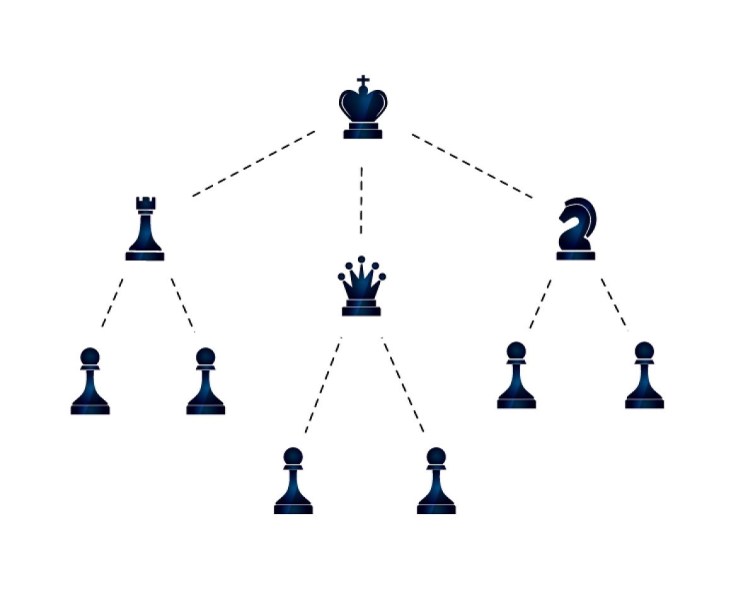
Decentralization is a systematic effort to delegate to the lowest levels of the authority except that which can be expected that can be exercised at central points. It is the pushing down of authority and power of the decision-making to the lower levels of the organization and the essence of decision making is dispersed throughout the organization. The essence of decentralization is the transference of authority from a higher level to a lower level. It is a fundamental principle of democratic management where each individual is respected for his inherent worth and constitution as Newman and Summer rightly said “Decentralization is simply a matter of dividing up the managerial work and assigning specific duties to the various executive skills”.

FEATURES OF DECENTALISATION

The following are the chief characteristics of decentralization:

  1. It is an extended form of delegation.
  2. It gives importance to the role of subordinates.
  3. It reduces the work-load of the managers in the top hierarchy.
  4. It is a process applied to the entire organization.
  5. Under it its decisions are taken by those employees who implement them; and
  6. Under it along with authority, responsibility is also transferred.

CENTRALIZATION

Centralization is the reservation or withholding of authority by individual managers within the organization and according to Henry Floyd “Everything that goes to increase the importance of the subordinate’s role in decentralization, everything which goes to reduce it is centralization”.

In centralization a little delegation of authority is the rule; power and discretion are concentrated in a few executives. Control and decision-making are in the hands of top-level management, however, absolute centralization is untenable because it would mean that the subordinates have no duties, power, or authority.

Centralization may be essential in a small organization to survive in a highly competitive world, but as an organization becomes more complex in terms of increasing size, the interdependence of work-flow, complexity of tasks and spatial physical barriers within and among groups, a requisite for efficiency is to move decision-making centres to the operating level. Thus, the larger the size of an organization, the more urgent is the need for decentralization and this does not mean that denaturalization is good and centralization is bad. According to Allen “ Centralization is the systematic and consistent reservation of authority at central points in the organization” and according to Fayol “Centralization is that organization where the role of subordinates is reduced”.


FEATURES OF CENTRALIZATION

          On the basis of the properties, the following are the characteristics of centralization:

  1. Right of decision is centralized and withhold with the top level of the management.
  2. The lower level of management executives only follows the decisions and necessary actions taken by top-level management.
  3. There is the least use of the process of delegating rights as it brings down the taken for making a decision and reduces the number of people involved as there is the direct involvement of the top-level management.
  4. There is reduction in the role of subordinates.
  5. There are a great distance work site and the decision-making place.

The Power of ATTITUDE💪 – Lion & Eagle

There are only two animals on the planet that the creator identified himself with the first one is the eagle and the second animal is the lion and when we study these two animals because if he is the leader of the universe and we want to be a leader on earth we need to better find out the nature of these animals and also the up attitude of those animals.

If we discover that both of them are the kings of their domain the Eagle is the king of the bird Kingdom and the lion is the king of the animal kingdom but let’s talk a little bit about the lion, the lion has the spirit of leadership and this word spirit here is referring to attitude everybody’s attitude a leader has attitude that makes him or her different from followers now the lion is the king of the jungle but the lion to is a great source of encouragement to all of us. I want you to write down this down remember this as long as you reside favorite the lion isn’t the tallest animal within the jungle number two the lion is not the largest animal in the jungle number three the lion is not the heaviest animal in the jungle number four the alliant is not the smartest animal or the foremost intelligent animal within the jungle and yet when he shows up all of them run away.

Your attitude matters in your life – Journey of life Continues
It really brings home the purpose a military of sheep led by a lion will always defeat a military of lions led by a sheep and therefore the answers thereto dilemma is that this because leadership can transform cowards into violent warriors the proper quite leadership can transform a timid into bold people that are fellows leadership is that powerful leadership can walk into a camp of depressed people on in 20 minutes. They are turned on into unbelievable powerful armies because leadership determines everything the lion is that the king of the jungle due to one-word attitude.

Attitude is Everything (@attitudetweets) | Twitter
Lion features a different attitude that creates every animal scared of him now we do not want to steer by fear but it does take respect for you to become a leader once I use the word fear within the jungle we’re talking about respect the elephant respects the lion the hyenas respect the lion they the giraffes they respect the life what makes these massive animals respect such a small cap the attitude is the difference for example, a lion will see an elephant and the thing that counts with mine one word lunch I could eat this thing and he acts the way he thinks now here’s another amazing mystery the elephant is larger, bigger, stronger, more powerful, heavier and more intelligent and yet when the elephant sees the lion one word involves mind eater attitude may be a product of belief you can’t have an attitude beyond your belief so your attitude comes from your belief system the lion is that the king due to what he believes about himself.

DELEGATION OF AUTHORITY

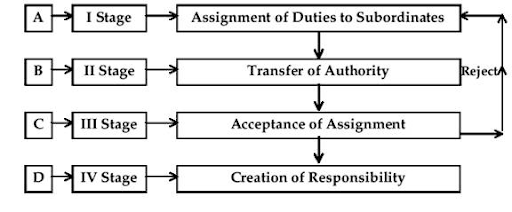
Just as no person alone in an enterprise can do all the tasks necessary for the accomplishment of goals, so also it is impossible, for one person to exercise all the authority for making decisions. There is a limit to the number of person managers can effectively supervise and for whom they can make decisions and once this limit is crossed, the authority must be delegated to the subordinates, who will make decisions within the area of their assigned duties. Then the question is how authority is delegated when decision-making power is vested in a subordinate by his superior and superiors cannot delegate all their authority without, in effect, transferring their position to their subordinates. The entire process of delegation involves four steps. They are:

  1. The determination of results expected from persons in a position;
  2. The assignment of tasks to persons;
  3. The delegation of authority for accomplishing these tasks; and
  4. The holding of people responsible for the accomplishment of these tasks.

Thus, delegation is the process that a manager follows in diving the work assigned to him so that he performs that part, which because of his position, can perform effectively. According to F.G.Moore “ Delegation means assigning work to others and giving them authority to do it”.

FEATURES OF DELEGATION OF AUTHORITY

The salient features of the delegation of authority that can be derived are:

  1. Delegation essentially means passing on authority.
  2. Only a part of the authority is delegated by a superior.
  3. Authority is delegated to a subordinate.
  4. A superior can delegate authority only when the superior possesses that.
  5. The limits within which a subordinate is expected to exercise delegated authority, have to be fixed.
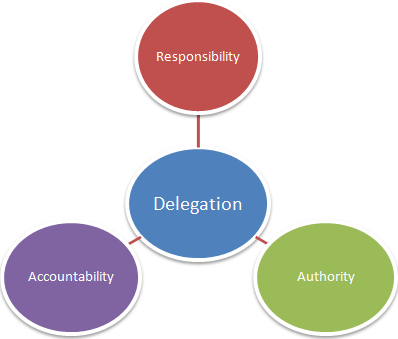
  6. Delegation of authority does not imply the abdication of responsibility on the part of the superior.
  7. Delegation of authority is for the discharge of some responsibility or duty assigned.
  8. It creates accountability or obligation on the part of the person who has been delegated authority, for proper use of authority and accomplishment of the task assigned.

A manager cannot delegate all his authority and for the purpose of the delegation, all authority of a manager can be divided into three broad categories:

  1. The authority which must be delegated as authority to take routine decisions for the accomplishment of tasks;
  2. The authority which can be delegated as the administration of policies; and
  3. The authority cannot be delegated at all as the authority to make policy decisions.

A successful manager is one who can delegate his authority successfully and he must delegate the authority to do work of routine and subsidiary nature. For instance, the marketing manager of a business enterprise is responsible for many operations like conducting marketing research, development of means of sales promotion, management of advertising, employment and training of sales forces, etc. The marketing manager cannot look after all these operations and he can entrust the responsibility of the performance of some of these operations to his subordinates.  

HACCP

“Hazard Analysis and Critical Control Points”.
It is basically a preventive approach to food safety which is used to find and then eliminate the biological, chemical and physical hazards which may or may not be there in production processes and can cause the final products to be unsafe and unhealthy for human consumption. These are certain principles which have been designed by the government to ensure the food quality and safety. It is a various step process that is followed in any food industry.
The HACCP system is followed at each and every level of food chain i.e. in food production and preparation processes which also includes packaging, distribution and even consumption by the consumer. It is therefore known as FARM-TO-TABLE process.
This technique was originated by NASA in the 1960s and US food and drug administration gave a particular definition to this. The main objectives of the HACCP system are –
• Prevention of food-borne diseases so that no one is affected after the consumption of food.
• This system mainly focuses on quality assurance unit i.e. maintains the quality of the food.
• HACCP system tends to reduce the cost of analysis of food.
• It also reduces the losses which occur due to product recall.
• And finally it helps in protecting the reputation of government.

HOW TO CONDUCT A HACCP PLAN??????
Conducting a HACCP plan is a 5 step process as mentioned below –

  1. Collection of HACCP resources and assembling of HACCP team which will look into the all steps.
  2. Description of the product by the team and deciding its method of distribution.
  3. Developing a complete list of ingredients and raw materials which are to be used in the production of the final product.
  4. Developing a flow diagram of the process i.e. how the product will be manufactured, its complete process.
  5. Meeting the requirements for the product to be manufactured safely.

PRINCIPLES OF HACCP
There are 7 main principles of conducting successfully a HACCP plan.

  1. To conduct a hazard analysis is the first step in which all the potential physical, chemical as well as biological hazards in the production of the product are identified.
  2. To determine all the critical control points (CCPs). At this step, all the control measures are thought to be applied. Basically at this step, those points are identified where control measures can be applied for the safety. This step is very essential to eliminate hazards completely from the product.
  3. To establish critical limits is the next step i.e. in this step the control measures are actually applied and also the maximum and minimum limits are set for the preventive measures. To each point found in the last step, a critical limit is applied. These limits assure the food safety.
  4. To establish monitoring procedures is the next step in which all the planning which was done yet is monitored and it should be done on a regular basis. This step assures that there is no mishandling of any procedure of the complete plan.
  5. To establish corrective actions is the next step in which appropriate correct actions are taken if after monitoring it is observed that the critical limits are not met. The corrective actions for each point and limit are already pre-decided.
  6. To establish verification procedures is the next and most important step in which the complete HACCP plan is validated. The complete verification of the plan is required to assure that the precautions and preventions are taken carefully.
  7. To maintain record keeping and documentation procedures is the final step in which the record is maintained and established which must be done regularly. It is necessary for validation procedures.

HRD Minister Calls Exams Mandatory for Final Year Students

DU Exams 2020 : HRD Minister Calls Exams Mandatory for Final Year Students

The Union Minister of HRD, in an interview with the Zee News last night, addressed the speculations concerning the fate of the examinations in the universities and the colleges across the country.

The minister highlighted the formation of a UGC taskforce to receive recommendations in order to orchestrate the examinations of the graduation and the post-graduation courses. He mentioned that the students in their first semester/year of study will be entirely evaluated on the basis of their Internal Assessments. The students in their intermediate semester/year will be awarded a composite grade on the basis of their marks in the previous semester/year and the Internal Assessment marks of the present semester/year. These were the provisions for the promotion of the students to the next academic year.

The minister, however, clarified the stance on the examinations of the final year students and emphasized on the necessity of their examinations to be conducted. He said that though the examinations cannot be conducted in the month of July because of the health crisis across the country, the students will have to appear for their final examinations when the situation improves. The new academic session, he declared, will begin only after the final examinations are conducted.

Swarm Of Locusts Reaches Gurugram, But Will They Enter Delhi?

Houses and trees were covered by locusts in some parts of Gurugram as the swarm continues to advance from west to east with steady wind.

A swarm of locusts, about 3 km in length, has hit Gurugram and it is flying across the city in the NCR region from west to east, according to officials.

The Gurugram administration is sounding sirens and blowing horns to make noises so that the locusts don’t settle on green vegetation and destroy them.

Besides, we have been spraying chemicals through vehicle-mounted pump sets in rural areas,” said Amit Khatri, Gurugram Deputy Commissioner (DC).

There is disagreement amid different administrations over whether the swarm will enter Delhi.

“They are flying across the city West to East due to the steady wind. They will most likely enter Delhi,” said Khatri.

Delhi Air Traffic Control (ATC) on Saturday directed pilots of all airlines to take necessary precautions during landing and take-off of aircraft in view of locust swarms seen near the airport in areas along Gurugram-Dwarka Expressway, news agency ANI reported. A team has been set up to monitor the situation.

However, KL Gujjar, deputy director, Plant Protection, Quarantine and Storage (PPQS), Faridabad, says that it is unlikely that they will reach Delhi because they are moving in East direction. PPQS comes under the Ministry of Agriculture and Farmers Welfare and it is a nodal body to take locust control measures with its various sub-offices across the country.

“They have entered India from Pakistan through Jaisalmer and Barmer border area and reached Jhujhuna. From there, they travelled to Rewari. From Rewari, they came to Jhjhar and from there they have reached Gurugram. Now from here, they will fly to Faridabad and then considering the current wind direction they will move towards Palwal side. I don’t see that they will enter Delhi,” he said.

Meanwhile, Delhi Environment Minister Gopal Rai called an emergency meeting to discuss the situation following a locust attack in Gurugram. The minister also directed the administration to be alert, an official said.

“After the emergency meeting, an advisory will be issued on steps to be taken to deal with the situation,” Rai told PTI.

He asked the officials of the Agriculture department to make field visits to areas close to Gurugram.

On Friday, Gurugram administration reportedly warned its residents about the attack, urging them to keep their windows shut as a precautionary measure. The administration also asked them to make clanging noise by beating utensils to repel the crop-eating insects.

The locust attack has ravaged parts of Uttar Pradesh, Rajasthan, Punjab and few other states for over a month.

Experts say that the present locust crisis that many Indian states are faced with is intense due to the younger population of the insect, swarms of which have entered the country from the north-west areas bordering Pakistan.

A young locust is far more dangerous for crops than a mature and older one. While the mature locusts cover shorter distances and focus more on breeding, the younger ones can fly 150 km in a day and devour more green vegetation.

Experts believe that the current locust invasion was part of the residue population that survived after February 17, 2020, in the deserts of Pakistan and Iran. After 1993, for the first time on May 22, 2019, large swarms of locusts invaded areas bordering Pakistan. Locust controlling units thought that they could finish them by the end of October 2019 but the invasion continued till early February 2020.

“On February 17, 2020, we either killed all the locusts or forced them to go across the border in Pakistan and Iran. We stopped our locust control measures and expected that Pakistan and Iran would take similar measures to eliminate them. But somehow, the residue population continued breeding and in April they attacked,” said Dr Rajesh Kumar, Plant Protection Officer, Jaisalmer.

Is Wearing a Face Mask All Summer Bad for Your Skin?

Look, no one wants to wear a face mask. But even as states open back up and the urge to forget COVID-19 ever happened becomes almost irresistible, it’s good to remember that wearing a mask in public places is not about you, it’s about keeping other people safe from a disease that has killed more than 115,000 people in the U.S. alone.

That said, if wearing a face mask has proved problematic in late winter and spring, it’s going to get much worse when the sweat, sunscreen and sweltering temperatures of summer come into play. You may have already dealt with an unfortunate bout of maskne (that’s mask acne, for people who aren’t keeping up on the new COVID lingo), but when you’re essentially creating a hot box around half your face, strange skin issues will follow.

To help you save face this summer, literally, we got in touch with Dr. Jaime Davis, Board Certified Dermatologist and Medical Director and CEO of Minnesota’s Uptown Dermatology and SkinSpa, who has already been dealing with these conditions among patients.

What sunscreen pairs best with a face mask? What materials should you avoid when buying one? And what issues should men, a generally dermatologically naive bunch, be aware of? Dr. Davis answered all these questions and more.

What kind of face mask should I wear in summer?

Before even talking about the type of mask, Dr. Davis pointed out that many issues are cropping up due to overuse. “Wear the mask when necessary, but remove it as soon as it is not necessary,” she said. “Try to avoid prolonged stretches of mask wearing.” This falls in line with current CDC guidelines that recommend “wearing cloth face coverings in public settings where other social distancing measures are difficult to maintain.” Also, if you have severe breathing issues, it’s important to note that the CDC exempts you from that recommendation.

In terms of materials, Dr. Davis recommends masks with moisture-venting features, which it should be said does not mean cutting a hole in it. While she says that medical-grade options are the most protective, they’re also the most occlusive (in other words, they provide the tightest seal, which is good for stopping virus transmission but potentially bad for your skin); instead, she recommends homemade alternatives “made from tightly woven soft cotton fabric that has been washed in unscented soap, rinsed well of any residual detergent, and dried without fabric softener.”

I’ve developed a rash from my mask. What is it?

While you shouldn’t self-diagnose a rash or other skin irritation, one issue Dr. Davis has dealt with at her practice that people should be aware of is allergic reactions to face-mask materials. She points specifically to “the metal nose bridge (if nickel is in the alloy) or elastic (rubber allergy) or any textile-specific coatings on the fabric.” The nickel issue will be familiar to people who wear earrings or other jewelry, and may be more of a concern for people wearing medical or medical-style coverings.

If you think you’re experiencing an allergic skin reaction, be sure to seek out professional help from a dermatologist. Even if you’re nervous about venturing out to a doctor’s office, Dr. Davis notes that her Minneapolis practice has been offering e-visits which have been, in her words, “freaking fantastic!” She notes that insurance is covering the online sessions, care can be delivered quickly and there’s always the potential for an in-person follow-up, so check with your local dermatologist.

How do I avoid and treat maskne?

Not all acne is the same and it should not be treated the same; the same goes for maskne. Dr. Davis says she’s dealt with both acne rosacea (“inflammatory acne exacerbated by heat and humidity of occlusive masks”) and acne vulgaris (“pimples and plugs from excess oil”) in the current mask-wearing age, but notes people should seek a professional opinion if their acne doesn’t go away. If face wash isn’t part of your regular grooming arsenal, she says to use a mild cleanser like Cetaphil twice a day, which may solve your problem.

What sunscreens go well with masks?

The biggest conversation around sunscreen in recent years has been mineral versus chemical. Basically, chemical sunscreens are the most popular products you’ll find on shelves, available from companies like Banana Boat and Coppertone, but some of them are being banned because they’re unsafe for marine life. Mineral sunscreens are generally considered to be friendlier to oceans and the environment, but in terms of protecting you from skin cancer while wearing a mask, Dr. Davis says you’ll be better off with chemical versions.

“Mineral-based sunscreens sit on top of the skin and could be rubbed off by the mask. Chemical-based sunscreens absorb into the skin and generally provide longer-lasting protection,” she says. “Brands that are generally well tolerated by sensitive skin include Vanicream and Cetaphil.” If you have a favorite brand already, she suggests using SPF 30 or higher for normal daily use. And yes, you should be applying sunscreen on your face every day. However, Dr. Davis also notes that if you’re wearing a snug-fitting or tightly sealed mask, you could develop a sensitivity to the sunscreen.

If you do end up with an unfortunate mask-shaped sunburn, the dermatologist-recommended salve is a cool, moist compress on the burn over a thin layer of 1% Hydrocortisone cream, which is available over the counter at local drugstores.

What other skin issues should I be aware of?

If you’ve got facial hair, you may be having problems with beard folliculitis, which is basically inflammation or infection in the hair follicles, similar to razor bumps. Dr. Davis says men have been experiencing this issue when short whiskers get caught in masks as their facial hair grows out. To avoid it, she advocates for beard commitment: either let it grow out or keep a close shave. “It’s that five o’clock shadow or weekend of not shaving that is the stuff which gets caught and causes folliculitis,” she says.

In a similar vein, the last issue she’s noticed is seborrheic dermatitis, which is a condition that generally leads to dandruff on the scalp but can also manifest in dandruff of the face (yes, 2020 is only getting worse). Thankfully, the solution is generally simple. “People are skipping showers during the pandemic and we’re seeing a lot more dandruff,” Dr. Davis says. So to keep face dandruff at bay just do what she already recommended and wash your face at least once a day.

Copyright © 2020 InsideHook. All rights reserved.

How USA plans to help India, corner China and the real story of Tibet`s repression

In order to counter Chinas Peoples Liberation Army (PLA), the US is reviewing its global deployment of forces in Asia by reducing them from Europe. 

New Delhi: Amid India-China border standoff along the Line of Actual Control in Ladakh, a threat of the Third World War appears to be looming large. The global community seems to have realised this but the United States is the first country to openly criticise China’s aggressive policies.

The US has officially stated that it is reviewing its global deployment of forces to counter the growing Chinese military threat to countries like India, Malaysia, Indonesia, and the Philippines. US Secretary of State Mike Pompeo said this in response to a question during the virtual Brussels Forum 2020 of the German Marshall Fund on Thursday.

In order to counter China’s People’s Liberation Army (PLA), the US is reviewing its global deployment of forces in Asia by reducing them from Europe. American military bases in many European countries were established to deal with the threat of Russia for years. Now, China and its Communist Party have emerged as the biggest threat to the world. Under the force posture review, the US is reducing the number of its troops in Germany from about 52,000 to 25,000.

China has been fast expanding military and economic influence in the strategic Indo-Pacific region, triggering concern in various countries of the region and beyond. China is currently engaged in hotly contested territorial disputes in both the South China Sea and the East China Sea. It has built up and militarised many of the islands and reefs under its controls in the region.

Pompeo also said that China’s PLA was indulging in provocative military actions, while referring to the ongoing military standoff in eastern Ladakh where the PLA killed 20 Indian soldiers on June 15 during a violent face-off, and also cited China’s continued aggression in the South China Sea.

If there arises a situation of the Sino-India war, America may come out in support of India, but it would lead to the third world war. Then the countries like Pakistan and North Korea may side with China, while America, Japan, Australia along with India would oppose China’s aggression. Countries like Russia, however, may face the dilemma of choosing an old friend India or China.

The question arises why should such a situation come. Rather, the world should unite to question China against its expansionist policies and military activities, which if not stopped now, would create a crisis for the world.

US Secretary of State Mike Pompeo’s statement indicates at American strategy to encircle China, but the real siege of the Communist nation will be from Southeast Asia. America has taken the name of countries of this region, especially Vietnam, Indonesia, Malaysia, and the Philippines, which are facing the military wrath of China in the South China Sea.

The US entered into an agreement with the Philippines since 1988, while Vietnam has also come closer to the US amid threats from China and is getting the US Navy’s support in safeguarding its coastline. American defence cooperation with Indonesia and Malaysia has gradually increased, while in Singapore, the US has an agreement to use the latter’s Air and Naval bases.

If America’s military presence in these countries increases further, China is likely to be encircled from all the directions in case of any major confrontation. China is very aggressive in this region as well as in the ​​East China Sea. It had openly issued a military threat to Taiwan by sending its fighter jets, but Taiwan repulsed that move.

The US military does not have a permanent base in Taiwan, but it often comes here for training and patrolling. Currently, three US aircraft carriers are stationed near Taiwan. In the Asia-Pacific region, the US military bases are in South Korea and in Japan to deal with China and its friend North Korea.

In South Korea, over 28,000 troops of the US Army, Air Force, and Navy are already stationed. This region has about 15 small and large US military bases. In Japan, the US has about 23 small and large military bases with over 54,000 troops. The 7th largest fleet of the US Navy, with about 50 warships and 20,000 naval soldiers always remain ready in Japan.

Along with South Korea and Japan, about 5,000 US troops are permanently stationed in Guam, a small island, where the US Air Force has it base.

Meanwhile, China’s real expansionist face can be witnessed in the nations where it has established its authority. Tibet is one such nation that testifies the atrocities committed by the Communist Party of China and its ruthless army. People who ran away from the erstwhile Buddhist nation still remember those atrocities.

In Ladakh, Zee News visited one such village where the refugees, who fled from Tibet, now live there for years. They recall as to how China first enticed Tibetan people with ration and money and then grabbed their land, and destroyed their culture as well as places of worship.

President Lobsang Sangay of Tibet’s government in exile told Zee News how China and its army persecuted Tibetans even today, adding that 10 lakh Tibetans have so far been massacred and 98 percent of their monasteries have been ruined.

After the Chinese occupation of Tibet in 1959, 560 Tibetan citizens reached Ladakh. Currently, there are 7500 Tibetan refugees all over Ladakh. They lived in tents and camps until 1975 but were later settled in Angling, Choklamsar and Jangthang villages of Ladakh.

Although Tibetan refugees are grateful to India, they still aspire for the liberation of Tibet from China’s occupation.