

The developing utilization of online applications has opened diverse vocation roads for youth across the globe. Regardless of an applicant is a fresher or an accomplished one, these new position profiles help one in better proficient future and furthermore great motivations.
One of such occupation profile is of Search Engine Optimization (SEO) proficient. As a large portion of individuals across the world use web crawlers like Google to determine their questions. Website design enhancement is one of the advanced showcasing methods that assistance in better streamlining of a site and rank it top in web search tools for applicable questions.
There are many type of improvement, for example, on location content and site page enhancement or site backlink streamlining. Web optimization not just plans to rank better sites or drive quality traffic yet in addition assist with building brand perceivability in the online world.
Different ongoing investigations recommend that SEO will be a significant showcasing device for creating leads and procuring new clients. It has constrained pretty much every organization to put more in SEO prompting expanded interest of SEO experts in India. The developing interest of SEO experts has constrained alumni and website specialists to learn SEO for a superior profession ahead.
Category: Courses
History of Unix
Origins of Unix
UNIX development was started in 1969 at Bell Laboratories in New Jersey. Bell Laboratories was (1964–1968) involved on the development of a multi-user, time-sharing operating system called Multics (Multiplexed Information and Computing System). Multics was a failure. In early 1969, Bell Labs withdrew from the Multics project.
Bell Labs researchers who had worked on Multics (Ken Thompson, Dennis Ritchie, Douglas McIlroy, Joseph Ossanna, and others) still wanted to develop an operating system for their own and Bell Labs’ programming, job control, and resource usage needs. When Multics was withdrawn Ken Thompson and Dennis Ritchie needed to rewrite an operating system in order to play space travel on another smaller machine (a DEC PDP7 [Programmed Data Processor 4K memory for user programs). The result was a system called UNICS (UNiplexed Information and Computing Service) which was an
’emasculated Multics’.
Unix Development
The first version of Unix was written in the low-level PDP-7 assembler language. Later, a language called TMG was developed for the PDP-7 by R. M. McClure. Using TMG to develop a FORTRAN compiler, Ken Thompson instead ended up developing a compiler for a new high-level language he called B, based on the earlier BCPL language developed by Martin Richard. When the PDP-11 computer arrived at Bell Labs, Dennis Ritchie built on B to create a new language called C. Unix components were later rewritten in C, and finally with the kernel itself in 1973.
Since it began to escape from AT&T’s Bell Laboratories in the early 1970’s, the success of the UNIX operating system has led to many different versions: recipients of the (at that time free) UNIX system code all began developing their own different versions in their own, different, ways for use and sale. Universities, research institutes, government bodies
and computer companies all began using the powerful UNIX system to develop many of the technologies which today are part of a UNIX system. By the late 1970’s, a ripple effect had come into play.
Key Factors
1969 The Beginning
The history of UNIX starts back in 1969, when Ken Thompson, Dennis Ritchie and others started working on the “little-used PDP-7 in a corner” at Bell Labs and what was to become UNIX.
1980 Xenix
Microsoft introduces Xenix. 32V and 4BSD introduced.
1983 System V
Computer Research Group (CRG), UNIX System Group (USG) and a third group merge to become UNIX System Development Lab.
AT&T announces UNIX System V, the first supported release. Installed base 45,000.
1991
UNIX System Laboratories (USL) becomes a company – majority owned by AT&T. Linus Torvalds commences Linux development.
Solaris 1.0 debuts.
1998 UNIX 98
The Open Group introduces the UNIX 98 family of brands, including Base, Workstation and Server. First UNIX 98 registered products shipped by Sun, IBM and NCR. The Open Source movement starts to take off with announcements from Netscape and IBM. UnixWare 7 and IRIX 6.5 ship.
2007
Apple Mac OS X certified to UNIX 03.
|Ways of acquiring Mate|
How does one gets married? Normally people get married by publishing matrimonial ads in newspapers, online sites, or with the help of relatives who acts as mediators. This was about the modern industrial society, but the tribal society is unique, so their ways of getting married are also unique. Tribes have nine different ways of acquiring a mate.
In this article, I will show the different ways of acquiring a mate prevalent in tribal society.
Marriage by capture– When a man snatches away a woman from her village and marries her, it is called marriage by capture. This form of marriage is most popular among the Naga who invade villages and capture girls.
Marriage by exchange- Under this marriage, two households exchange women with each other and thus avoid paying the bride price. Bride price is the payment made by the groom’s side to the bride’s side to marry her. This form of marriage is found all over India and is also found among the non-tribals.
Marriage by purchase- In this form of marriage bride price is the central theme. Among the Munda, Ho, Santhal it is the most prevalent. The high bride price has the worst consequences as is seen in the case of the Ho tribe of Chotanagpur where to escape the bride price many youth resorts to marriage by capture or remain unmarried.
Marriage by elopement- It is a peculiar feature of tribal India. Anthropologists believe this kind of marriage has emerged as a result of boys and girls shedding their traditional submissiveness. If the parents’ consent is not forthcoming, they resort to elopement and get married.
Marriage by service- In this form of marriage the groom serves in the house of the bride as suitor-servant and marries her after a lapse of few years. they have to work in the bride’s household for three years and have to fulfill all the responsibilities of a son. This form of marriage is a way to avoid payment of bride price completely or minimizing it through service rendered by the prospective groom at the bride’s residence. For example, marriage by service is found among the Gond Baiga, Birhor.
Marriage by intrusion- Here a girl desirous of marrying an unwilling young man thrust herself on the groom and his parents. She tries to serve her prospective in-laws and can be tortured in return. If she persists in her intentions and her endurance lasts for a considerable period she is finally accepted as a daughter-in-law.
Marriage by trial- In this form of marriage, the prospective groom has to prove his prowess before he can claim the desired girl. Thus he is required to undergo a trial.It is most popular among Bhils. During Holi festival, young men and women perform a folk dance known as ‘gol gadhedo’ around a pole or a tree to the top of which there is a coconut and jaggery tied. The girls make a ring around the tree and the boy to marry the girl has to break the ring and eat the coconut and jaggery after climbing the tree. In all this, he is beaten up, and inspite of all this if he succeeds he gets the right to demand any girl from the group as his wife.
Marriage by mutual consent- In this formalities of marriage are arranged by parties concerned through the process of mutual consent and consultation. This practice is result of tribal contacts with Hindus, Christians, etc.
Marriage by probation- Under this the prospective husband and wife are expected to live together for some time for marriage in the bride’s house. If they like each other and willing to marry, elders arrange their marriage.Otherwise, the man has to pay compensation to the girl’s parents. This form of marriage can be called a primitive version of the modern practice of courtship. It is prevalent among Kuki tribes of Andhra Pradesh.
Hence this was the nine different ways of acquiring mate found among the tribals. These kind of marriages is in contrast to the marriages in mainstream society. These interesting ways of getting married make the tribes even more unique.
What is Firewall and its types

A firewall forms a barrier through which the traffic going in each direction must pass. A firewall security policy dictates which traffic is authorized to pass in each direction. A firewall may be designed to operate as a filter at the level of IP packets, or may operate at a higher protocol layer. Firewalls can be an effective means of protecting a local system or network of systems from network-based security threats while at the same time affording access to the outside world via wide area networks and the Internet.

TYPES OF FIREWALLS
- Packet Filtering Firewall
It is simplest, fastest firewall component. It is Foundation of any firewall system. Examine each IP packet (no context) and permit or deny according to rules. Hence restrict access to services (ports). A packet filtering firewall applies a set of rules to each incoming and outgoing IP packet and then forwards or discards the packet. The firewall is typically configured to filter packets going in both directions (from and to the internal network).
2. Stateful Packet Filters
A traditional packet filter makes filtering decisions on an individual packet basis and does not take into consideration
any higher layer context. To understand what is meant by context and why a traditional packet filter is limited with regard to context, a little background is needed. Most standardized applications that run on top of TCP follow a client/server model. A stateful packet inspection firewall reviews the same packet information as a packet filtering firewall, but also records information about TCP connections.
3. Application Level Gateway (or Proxy)
An application-level gateway, also called an application proxy, acts as a relay of application-level traffic. Application-level gateways tend to be more secure than packet filters. Rather than trying to deal with the numerous possible
combinations that are to be allowed and forbidden at the TCP and IP level, the application-level gateway need only scrutinize a few allowable applications. In addition, it is easy to log and audit all incoming traffic at the application level. A prime disadvantage of this type of gateway is the additional processing overhead on each connection.
4. Circuit Level Gateway
This can be a stand-alone system or it can be a specialized function performed by an application-level gateway for certain. A circuit-level gateway does not permit an end-to-end TCP connection; rather, the gateway sets up two TCP connections,
Between itself and a TCP user on an inner host.
Between itself and a TCP user on an outside host.
News and Current affairs


What is news
News is information about current events. This may be provided through many different media: word of mouth, printing, postal systems, broadcasting, electronic communication, or through the testimony of observers and witnesses to events. … The genre of news as we know it today is closely associated with the newspaper.
What is current affairs
Technically Current Affairs is defined as a genre of broadcast journalism where the emphasis is on detailed analysis and discussion of news stories that have recently occurred or are ongoing at the time of broadcast.
Difference
Current affairs is a genre of broadcast journalism. This differs from regular news broadcasts that place emphasis on news reports presented for simple presentation as soon as possible, often with a minimum of analysis.
Day to Day life many things happened that information will pass to us in the form of news and current affairs
The Basics Of Database Management System
Data processing has undergone evolutionary changes in the past 30 years. Processing with a database management system offers a number of advantages. Presents the basics of today′s dynamic database management systems. Reviews the relevant professional magazines and concludes that systems now are more user‐friendly.
A collection of interrelated data together with a set of programs to access the data, also called database system, or simply database. The primary goal of such a system is to provide an environment that is both convenient and efficient to use in retrieving and storing information.
A database management system (DBMS) is designed to manage a large body of information. Data management involves both defining structures for storing information and providing mechanisms for manipulating the information. In addition, the database system must provide for the safety of the stored information, despite system crashes or attempts at unauthorized access. If data are to be shared among several users, the system must avoid possible anomalous results due to multiple users concurrently accessing the same data.
Examples of the use of database systems include airline reservation systems, company payroll and employee information systems, banking systems, credit card processing systems, and sales and order tracking systems.
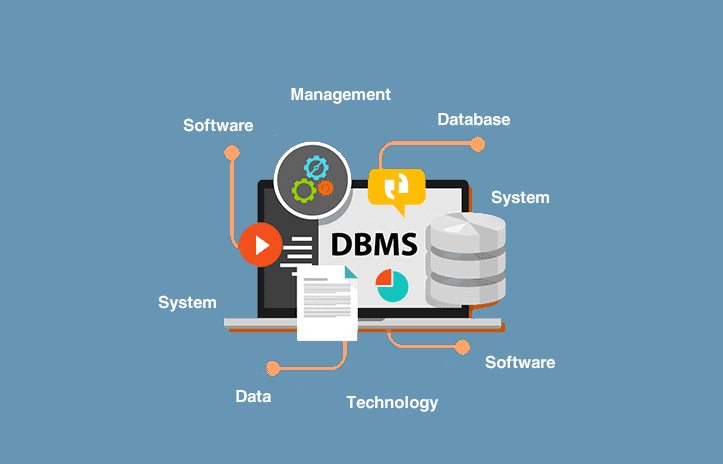
A major purpose of a database system is to provide users with an abstract view of the data. That is, the system hides certain details of how the data are stored and maintained. Thereby, data can be stored in complex data structures that permit efficient retrieval, yet users see a simplified and easy-to-use view of the data. The lowest level of abstraction, the physical level, describes how the data are actually stored and details the data structures. The next-higher level of abstraction, the logical level, describes what data are stored, and what relationships exist among those data. The highest level of abstraction, the view level, describes parts of the database that are relevant to each user; application programs used to access a database form part of the view level.
The overall structure of the database is called the database schema. The schema specifies data, data relationships, data semantics, and consistency constraints on the data.
Underlying the structure of a database is the logical data model: a collection of conceptual tools for describing the schema.
The entity-relationship data model is based on a collection of basic objects, called entities, and of relationships among these objects. An entity is a “thing” or “object” in the real world that is distinguishable from other objects. For example, each person is an entity, and bank accounts can be considered entities. Entities are described in a database by a set of attributes. For example, the attributes account-number and balance describe one particular account in a bank. A relationship is an association among several entities. For example, a depositor relationship associates a customer with each of her accounts. The set of all entities of the same type and the set of all relationships of the same type are termed an entity set and a relationship set, respectively .
The information in a database is stored on a nonvolatile medium that can accommodate large amounts of data; the most commonly used such media are magnetic disks. Magnetic disks can store significantly larger amounts of data than main memory, at much lower costs per unit of data.
To improve reliability in mission-critical systems, disks can be organized into structures generically called redundant arrays of independent disks (RAID). In a RAID system, data are organized with some amount of redundancy (such as replication) across several disks. Even if one of the disks in the RAID system were to be damaged and lose data, the lost data can be reconstructed from the other disks in the RAID system.
Data manipulation is the retrieval, insertion, deletion, and modification of information stored in the database. A data-manipulation language enables users to access or manipulate data as organized by the appropriate data model. There are basically two types of data-manipulation languages: Procedural data-manipulation languages require a user to specify what data are needed and how to get those data; nonprocedural data-manipulation languages require a user to specify what data are needed without specifying how to get those data.
A query is a statement requesting the retrieval of information. The portion of a data-manipulation language that involves information retrieval is called a query language. Although technically incorrect, it is common practice to use the terms query language and data-manipulation language synonymously.
Database languages support both data-definition and data-manipulation functions. Although many database languages have been proposed and implemented, SQL has become a standard language supported by most relational database systems. Databases based on the object-oriented model also support declarative query languages that are similar to SQL.
SQL provides a complete data-definition language, including the ability to create relations with specified attribute types, and the ability to define integrity constraints on the data.
Data Security:
The DBMS can prevent unauthorized users from viewing or updating the database. Using passwords, users are allowed access to the entire database or a subset of it known as a “subschema.” For example, in an employee database, some users may be able to view salaries while others may view only work history and medical data. See database security.
Data Integrity:
The DBMS can ensure that no more than one user can update the same record at the same time. It can keep duplicate records out of the database; for example, no two customers with the same customer number can be entered.
Intelligent Databases:
All DBMSs provide some data validation; for example, they can reject invalid dates or alphabetic data entered into money fields. But most validation is left up to the application programs.
Intelligent databases provide more validation; for example, table lookups can reject bad spelling or coding of items. Common algorithms can also be used such as one that computes sales tax for an order based on zip code.
When validation is left up to each application program, one program could allow an item to be entered while another program rejects it. Data integrity is better served when data validation is done in only one place. Mainframe DBMSs were the first to become intelligent, and all the others followed suit.
The Road Not Taken
When every choice involves the loss of opportunity, which path will you choose? When your choices come with incomplete information, how can you be certain? How long will you stand still before making your choice? How confident are you when you realize you can’t save the first road for another day when the road you chose tends to lead onward to another? Whichever road you choose will make all the difference. In order to be different and do something great, you have to think different and implement things with a different approach. You have to take a different lane; the road not taken.
Remember the poem “The Road Not Taken” penned by Robert Frost?
Two roads diverged in a yellow wood,
And sorry I could not travel both
And be one traveler, long I stood
And looked down one as far as I could
To where it bent in the undergrowth…
The poem describes someone standing at a fork, or turning point, in a road in the woods, trying to decide which path he is going to take. He looks down one road as far as he can see, and after thinking for another minute, decides to take one because it looks like nobody’s been that way yet, and he is curious about where it leads. He thinks maybe he might come back another day and try out the other path but he has a feeling that the road he has chosen will lead him to new places and discoveries, and he probably won’t be back. He thinks wistfully about that road, which he did not take, and where he might have wound up if he’d gone that way instead. Part of him regrets his decision, but he also realizes that the things he’s seen and the places he’s gone because of the direction he chose has made him who he is.

This poem tells a lot about life in general. Life is all about making choices, whether it’s about choosing to change your daily diet or choosing the right partner. Every choice has its significance in some way or the other.
It makes me remember that past is always dynamic because it shapes my present and therefore, I should be careful about my present as it will take care of my future. Most importantly, this poem makes me think wisely about my choices. It reminds me that I should not make such a choice which I would regret one day and say ‘if I would have taken the other road, it would have been better’. Rather I should be proud of my decision and say ‘Yes! Since I chose the right path, it has led to all this difference’. The difference is what makes it different. Just as Frost ended the poem: “I took the road less travelled, and that’s all that matters”. There are no bad roads, there are only different battles that births different results.
In my opinion, the poet encourages the readers to create opportunities that may be overlooked by us because we all are in search of solutions for our problems rather than trying to sort out the things in the less conventional way.
Python: An Introduction
Python was created by Guido Van Rossum in late 1980s at National Research Institute for Mathematics and Computer Science in the Netherlands. It is derived from many other languages like Modula-3, C, C++, Algol-68 and Unix Shell.It is object oriented , open source, cross platform, high-level dynamic and interpreted language . Python programming is very powerful, expressive and easiest language to learn and use.
Features of Python
- easy to learn and use
- comprises of board library
- free and open source
- object-oriented concepts
- extensible
Interactive Mode :- A command line which gives immediate result for each statements.
Script Mode :- It is used to write set of statements/instruction in python. Set of statements store in file with .py extension.
IDLE :- It refers to “Integrated Development Environment” in python. It comprises Python shell program which lets user to type instruction into system.
If you decide to design your own language there are thousand of sort amateur language designer pitfalls.~ Guido Van Rossum
Top 5 online courses every student must do.
Here is the list of 5 courses that every student must do in there life. The courses are from various platforms such coursera and edx.
- PROGRAMMING FOR EVERYBODY(GETTING STARTED WITH PYTHON)
This course is offered by University of Michigan. This course aims to teach everyone the basis of programming using python. Everyone can do this course, whether you are medical student , engineering student , working professional or a school student. The duration of the course is seven weeks and it is available on coursera and edx platforms.The best part of the course is the concept is well-explained by the instructor. Also, the assignments will also helps you to understand the concept well. You can enroll in the course for free. I recommend this course for anyone who wants to learn python from basics.
2. CS50 INTRODUCTION TO COMPUTER SCIENCE
This course is offered by Harvard university. It will teach student how to think algorithmically and how to solve problems efficiently. It is a 10 week course and includes the topics like web programming,data structures,security, software programming,artificial intelligence. Also, it will includes the programming languages like C,SQL,Python,HTML ,CSS,JavaScript. It is taught by David J Malan(professor of computer science ) at Harvard University, he is brilliant teacher and teaches very well. This course contains problem sets and one final project, all this will help you to understand the concepts. Check out this course at edx which is very popular. You can enroll for free.
3. THE SCIENCE OF WELL BEING
This course is offered by Yale University. It teaches you how to increase your happiness, how to build productive habits and misconceptions about happiness, annoying features of mind that lead to think the way we do. Itis a ten weeks course and this course is taught by Laurie Santos and she is the professor of psychology at Yale University. Check out this course at coursera. It is one of the popular course at coursera. You can enroll in the course for free.
4. HOW TO LEARN ONLINE: POWERFUL MENTAL TOOLS TO HELP YOU MASTER TOUGH SUBJECTS
This course is offered by University of California San Diego and McMaster University. It teaches you test preparation, learning to learn, it teaches learning techniques like pomodoro technique, meta learning etc. Everyone whether you or me will have a subject that we will feel as hard, which is difficult to master and you don’t know how to master it. In this course the instructors will share some techniques, tips and share the secret how to master tough subjects. The duration of the course is 4 weeks and it is taught by Barbara Oakley and Dr. Terrence Sejnowski. Check out this course at cousera. You can enroll this course for free in coursera.
5. SPEAK ENGLISH PROFESSIONALLY: IN PERSON, ONLINE AND ON THE PHONE
This course is offered by Georgia Institute Of Technology. This is a well structured course. It teaches you improve pronunciation and fluency of English, word stress, English vocabulary. The duration of this course is 5 weeks and the instructor of the course is Amalia B. Stephens. This course is those for who want improve there English pronunciation and fluency. Check out this course on coursera. You can enroll the course for free.
Trainings and Internships In Technical Fields
In the early days of our university, we will all live in a fantasy world, where we will feel that we have everything we want. The future is bleak If we start the internship after the first year of study, whether it is a remote internship or a full-time internship, this situation can be easily resolved. Choose according to your convenience and university practice.
“Your greatest opportunity may be by your side”-Napoleon Hill
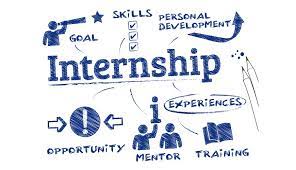
Your interns can choose from several trusted websites such as:
- Internshala
- Letsintern
In the college, we will have a group of friends and we will be happy to play with them. In the workplace, this may or may not happen, but you have to adapt to the environment as soon as possible to deal with different types of people. I’m sure some companies offer internship extensions and full-time performance based on the attitude of interns, depending on their Attitude Pages An easy process If this is a paid internship, you will understand the value of the funds you have used in the past, which will help you make better use of the economy. During the internship, you will need you to manage your studies, study and test results. Although once you have mastered the multitasking and time management skills that can be solved in real-time with World Problems , the process may seem daunting at first, but if your internship skills are not too passionate for Asmara, then your internship skills are also something Good things signal that they ignored the option very early. Work hard, study, and then forget to make the most of it. Don’t hesitate, don’t be afraid to start again. Because experts say you don’t start from scratch, but from experience.
You can learn how to apply the knowledge you have acquired during an internship to your future workplaces. In addition to this, it is an excellent learning curve for young graduates and students while meeting new people and making connections in the professional world
ANDROID APP DEVELOPMENT
The Android device market is growing day by day, and companies are taking advantage of it by developing Android applications and selling them on the market. Google Mobile Operating System. It is designed to be open source so that Android application developers can take advantage of the operating system and create innovative new applications. The app makes everything easier. But anyone can simply download and use the application; developing an application is not easy. It takes months or even years of brainstorming and deciding on technical details to finally develop an application that can prove itself in the market. To cope with fierce competition in the market, it is important to ensure that everything is done under the latest trends and technological updates in the development industry. Mobile application development is the process of creating software applications that run on mobile devices, and a typical mobile application Use network connections to handle remote computing resources.

Basics of Android development
Android application development consists of one or more of the following four categories:
Operation-an application that provides visible user operations. On the start screen or application Start the operation in the launcher.
Service-You can use service for any application that needs to run for a long time, such as a B. Network monitor or application to check for updates.
Content provider. The easiest way to think about content providers is to think of them as database servers. The job of the content provider is to manage access to persistent data, such as contacts on mobile phones. If your application is very simple, you don’t need to create a content provider. However, if you are building a larger application or application that makes the data available for multiple operations and/or applications, the content provider is a medium that prohibits access to your data.
Streaming media receiver. You can launch Android applications to process data about specific items or respond to events, for example to Receive SMS.
In the past 10 years, Android has become the most popular operating system in many ways. This is a very flexible and user-friendly system that can change anything unrecognizable. It can be done at any stage of the Android application development process, which is impossible to build an application from scratch on a traditional linear platform
MACHINE LEARNING – THE MIRACLE
In the real world, we are learning new things every day and improving our decision-making skills on the basis of successful decisions in the past. Isn’t this human learning? If we now use computers to fully automate this process, what will it be? This will be machine learning.

Everyday applications
We use it a dozen times a day without even realizing it. Every time you perform a Google search, your machine learning software will figure out how to categorize the pages you want to visit. Also learn that if you read emails from your inbox, the smart spam filter can save you from browsing a lot of spam.
THE TECHNICAL UNDERSTANDING
Recently, Tom Mitchell described machine learning as a computer program. It is said that the program learns from experience E related to task T and performance metric P because its performance in T is improved by the P metric. Experience E Let us give an example of an online chess game, in which each game is a task T, and the process of the game is the experience E. Each game has a final result, which is a performance indicator P. This performance indicator is to win. Probability of a game against a new opponent. Now that the computer has the patience to play tens of thousands of games alone, it can further improve your chances of winning consecutively. Machine learning technology: a brief overview We all know how computers work, we all know How the computer works, we have simplified many operations. Now we are trying to get computers to examine all the macro and micro levels of human thought processes that lead to multiple decision-making skills. By developing truly intelligent machines, we can do almost anything you and I can do. This work consists of complex algorithms and functions of artificial intelligence applications running in expert systems. With every action you take, the computer will learn self-learning and self-esteem through progressive, keen, and precise decision-making skills. The computer learns to remember a past experience and process them according to the archived tasks and the resulting performance level. Development of actions/results in a specific context or situation.
FUTURE ASPECTS AND THE SCOPE OF IMPROVEMENT
Machine learning is not limited to Google search or Amazon prediction. It is widely used in medical diagnosis, where tiny patterns are revealed to predict disease. Machine learning can have a positive impact on treatment and subsequent procedure decisions. Financial transactions, data mining, fraud detection, speech recognition, spam prevention, and language translation are some other areas where machine learning is used. The company uses the technology to predict the relevance of products based on the collected data. Let us see what machine learning can bring to the future. A fully functional self-driving car is expected to be available at the end of 2018. Natural language processing has developed a subset of machine learning so that students can improve search results and translations based on the search context. It will also help digital assistants like Siri interact with Humans On Cyber Security Front, a machine learning model that can analyze the structure of inbound or outbound traffic to detect and stop suspicious before continuing damage occurs. activity. Decisions and code changes can be made without explicit programming, which makes machine learning an inevitable trend now and in the future.
How to use the phone as a webcam for your PC


In these pandemic situation there no offline meetings and interviews. Video conference is daily habited in these time , we are using lot of application for video conference like Google meet, zoom meet, Microsoft teams , Skype and jio meet
Most of people facing problems while hosting and interviews times ,our laptops and PC doesn’t have good quality of video
Then , is there any way to optimise for good quality of video . yes there is a way for that problem
In these day every one have mobile phones , by those mobile phone we can as a webcam
Are you thinking I am joking , then just follow my instruction you will be find my word are no joke..
I have research many application but ,I recommended an application Droidcam that can be download by our favourite app stores
Now you connect your PC or a Laptop over the same Wi-Fi network or with the help of a USB cable. If you downloaded the DroidCam app on your phone from the app store, then download the DroidCam Client on your Windows laptop or PC
There are two ways :
- Using wi-fi
- Using cable
- using Browser
Using Wi-Fi
Open the DroidCam app on your phone and click on the ‘Wireless’ option.
Then next screen should display the ‘WiFi IP’ and ‘DroidCam Port’ . If your ‘WiFi IP’ appears 0.0.0.0, then you are not connected to the Wi-Fi.
Open the DroidCam Client on your PC or laptop and enter the ‘WiFi IP’ and ‘DroidCam Port’ as displayed on your mobile phone. Click on the ‘Start’ button.
Now start the video conferencing app and check the webcam by clicking on the ‘Webcam’ or ‘Video’ settings.
Using cable
Connect your mobile phone to your PC or Laptop with USB cable.
We have remember to note is that you need iTunes downloaded on your PC to connect using USB cable. If you do not have iTunes, you can download it . Once you login to iTunes, it will automatically detect your mobile Phone.
Start the DroidCam Client, select the ‘USB’ option and tap on ‘Start’.
using Browser
DroidCam mobile phone application also connect to the camera using a web browser.
Then you have to connect your phone to a Wi-Fi and open DroidCam application.
Lunch Chrome on your Laptop or PC and enter the ‘Browser IP Cam Access’ data then ‘http://192.168……./video’ and click on enter.
If you have wish to specify the resolution of the video in the URL by using the path including ‘force’. example – http://192.168…./video.force?1280×720.
The application DroidCam Wireless Webcam we used was the free ver . You canl also find the paid ver of this app, called the DroidCamX Wireless Webcam Pro in the Google Play Store. The paid version application supports HD video streaming with out ads
there is one more application I recommends i.e Xsplit connect
Socialisation ( Meaning , Definitions , Types , Agents , Stages )
It is said , Little of man’s behaviour is instinctive , rather his behaviour is ‘ learnt ‘.
At birth the human child possesses the potentialities of becoming human .
The human child comes into the world as a biological organism and becomes a social being by learning social ways of acting .
The child becomes a man or a person
( Purush) through various experiences .
Socialist referred it as “socialised person “
Every society has its own way of making a biological organism into a socialised being .
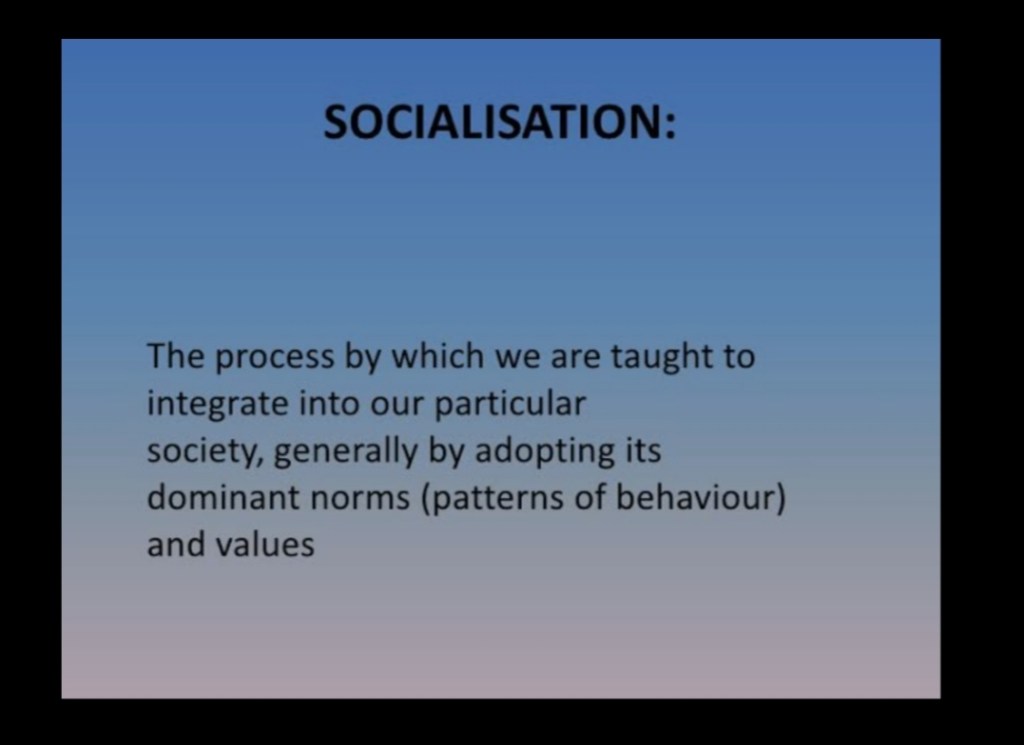
This social training is called “Socialisation “
Hence , the process of moulding and shaping the personality of a human infant is called “Socialisation “.
Sociologists have often referred to socialisation as “transmission of culture “.
A man is not only social but also a cultural being .
Cultural learning is the process by which the individual learns the fundamental culture pattern of the society in which he lives or will live . Culture includes not only its living members but also members of past generations and those yet unborn . Culture defines social conditions for us like what we eat , drink , wear , God we worship , our beliefs etc.
Still cultural learning does not completely define socialisation .
Socialisation is an aspect of all activities within human societies and are socialised in the course of the activities.
Socialisation is the process of adjustment of an individual to conditions of his social environment . There are some relevant internal forces that direct or limit socialisation like instinct , urges , capabilities , education , reflexes , etc .In the process of socialisation an individual learns culturally approved habits , ideas ,. beliefs . He is taught his rights and duties ,his position and responsibilities. The culture rules are so completely internalised that they become part of individual personality .
Definitions :-
Lundberg says that socialisation consists of the ” complex processes of interaction through which the individual learns the habits , beliefs ,skills and standards of judgement that are necessary for his effective participation in social groups and communities . “
Peter Worsley explains socialisation as the process of “transmitted culture, the process whereby men learn the rules and practice of social groups “.
Socialisation is the process of working together ,of developing group responsibility or being guided by the welfare needs of others ”
– Bogardus
W.F. Ogburn defines Socialisation as “, the process by which the individual learns to conform to the norms of the group “.
Hence , Socialisation is a process of transforming the human animal into human being ,of converting the biological being into social being .
Characteristics of Socialisation :-
• It is a continuous process .
• Socialisation is also referred to as ” transmission of culture “.
• Socialisation is social learning .
• Socialisation can be informally or formally conducted
• Socialisation means internalisation of norms .
• The process of Socialisation emerges from the development of “self “.
• Timing is an important concept of Socialisation .
Types of Socialisation

Ian Robertson in his book “Sociology “( 1977) described four types of Socialisation . According to him , an individual undergoes four types of socialisation in his lifetime .
1:
Primary Socialisation :-
Many Sociologists like Sigmund Freud, George Herbert Mead, Charles Cooley, Jean Piaget and Talcott Parsons , have contributed to the theory of primary socialization.
Primary Socialisation is the most essential and fundamental type of socialisation. Period early in a person’s life during which they initially learn and build themselves through experiences and interactions around them is the period of primary socialisation.
It takes place in the early years of life of a newborn individual .It includes teaching of language and cognitive skills , internalisation of culture and norms , developing a perspective , emotional ties etc.
Primary socialization starts with the family teaching children how to bond, create relationships, and understand important concepts including love, trust, and togetherness.
“Internalisation of norms ” is the most important aspect of primary socialisation . It is a process where the norms of the society become a part of an individual .
Several agents reinforce an individual’s learning of norms , the right and wrong behaviour .
2:
Secondary Socialisation:
Secondary socialisation generally refers to the social training received by the child in institutional or formal settings and continues throughout the rest of his life.The process can be seen at work outside the immediate family, in the ‘peer group’. The growing child learns very important lessons in social conduct from his peers. He also learns lessons in school. Hence, socialisation continues beyond and outside the family environment.
3:
Anticipatory Socialisation :-
According to Merton , the process whereby men socialise themselves into the culture of groups with the anticipation of joining that group .
Men learn not only the culture of the group which they belong to but also about the group they don’t. An individual may socialise into groups of which they are already members or into groups to which they wish to become attached.
For instance , a person starts doing his physical exercises and learns to become tough mentally and physically if he intends to join the military.
Socialisation is not a process that takes place merely in early childhood but also at different times and places throughout life .
4:
Developmental Socialisation and Resocialisation :-
According to Ian Robertson ,
“It builds on already acquired skills and knowledge as the adult progresses through new situations such as marriage or new jobs . These require new expectations , obligations and roles . New learning is added to and blended with old in a relatively smooth and continuous process of development “.
Developmental Socialisation is based on learning on the achievements of primary socialisation. A person learns more developed beliefs, values and norms through which he learns how to act in his new role.
Re- Socialisation fundamentally means ” stripping away of the learned patterns and substitution you f new ones “
Re- Socialisation takes place mostly when a social role is radically changed during periods of rapid mobility .
Agents of Socialisation
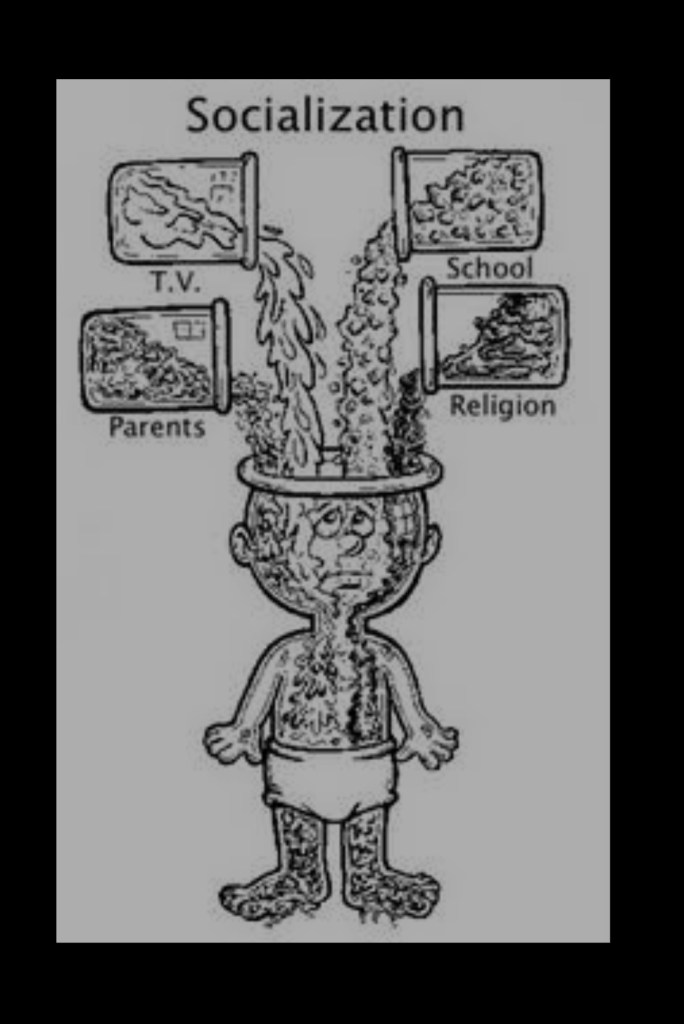
Socialisation includes moulding and shaping the personality of an individual . The continuous process of socialisation includes some agents who help an individual human being to become a social being .
• Family and Parents :-
The first stage of socialisation starts from the foetal form , where the mother plays an important role . The process of socialisation begins with parental , particularly maternal influence on an individual.
Parents are the first to introduce the child to the society system and culture of his group.
The family acts as the fundamental agent in internalisation of roles for an individual.
• Peers :-
As the child grows he starts associating with other individuals outside his family . He learns from these individuals in school or in the playground or on the street .
The peers group forms perspective on several important topics .
In modern society the peer group has surpassed the importance of the parental group. An individual has more communication understanding with his peers than his own family.
The child maintains an egalitarian relationship with those who are of the same age or gender .
It’s with the peers group that an individual learn more information regarding culture , manners , fashion , styles , gender etc.
• Teachers :-
School is the most influencing place where an individual learns how to behave and form an independent personality . Teachers are major agents of socialisation. School is a formal conduct in the process of socialisation . Teachers help an individual to be responsible and mature .
• Literature and Mass of Communication :-
Entertainment media , mass.media , literature , plays an important Agent I’m socialising . The different opinions or perspectives on several important topics like political , economical , social , etc are highly influenced by these agents.
The attitudes and ideologies ,the words written by someone impact a person in guiding and forming a perspective in a new light .
Stages of Socialisation
Socialisation is a continuous process of learning. AC children are taught about social life in various stages . The form of socialisation begins with ‘ simplicity to complexity’ as the social world gets wider and wider and the child is confronted with several things to learn and adjust .
At each stage of socialisation the child internalises a ‘ system ‘ of roles .
Socialisation consists of four stages from infancy to adulthood .
The first stage –
The Oral Stage :- Oral Stage begins with the birth of the child . It lasts till the child completes his one year .In the foetal form the child feels the comfort of his mother’s womb .
In this stage the child establishes his oral dependency by whimpering or bawling for everything .
Sigmund Freud ,an Australian Psychiatrist ,called this stage as primary identification as a child tries to internalise his and his mother’s role .
2:
The Second stage
The Anal Stage :- The next stage in socialisation is the Anal Stage which begins just after the completion of the oral stage . In this stage the child is taught to do some fundamental tasks such as eating , Cleaning , toileting , etc .
In the first stage the oral dependency starts to fade and the child learns that he cannot depend completely on his mother .
In this stage the child’s mother is the socialising agent .The child in this stage separates his and his mother’s role and understands the social system to a larger extent than in the first stage .
3:
The Third stage
The Oedipal Stage :-
The thirst stage starts from the fourth year of the child and lasts till puberty i.e 12-13 years .
The third stage the child establishes his role on the basis of his sex .
The boys and girls learn about their roles in the society and identify themselves as part of the social system and starts internalising according to their sex , the role of others and their identities on the basis of their gender .
4
The Fourth Stage :-
The Stage of Adolescence :- The fourth is the stage where the child becomes free from their parental control and establishes independence . Parents play an important role in a child’s life at all stages . Despite the freedom from parental control ,they help the child to make some very important decisions in his life . They encourage and help them to take new roles during this period of Adolescence . They expect the child to learn new responsibilities and new roles that are assigned to them .
In modern society ,the parents intend to give more freedom than traditional societies where parents take mostly all the important life decisions of the child .
This stage is the most important stage in socialisation as the child’s behaviour and personality depends on the kind of learning he / she learns and the decision he/ she takes that affects the society . During adolescence the child goes through several physiology and psychological changes ,which affects mentally and emotionally and hence establishes more new experiences than any other stages .
Socialisation makes an individual a social being who transmits cultural ideas , beliefs , languages , skills etc from generation to generation, learns rules and practices of social groups and contributes to forming a society .
Courses for students in Science stream


If you are pass out (higher secondary) from science stream aka biology stream. This is article to tell you which course you can choose for higher education.
- MBBS
- BAMS
- BHMS
- BNYS
- BPT
- BUMS
- BDS
- Bvs ah
- Bsc nursing
- Bsc diary technology
- ry technology
- Bsc biotechnology
- bsc home science
- BOT
- BMLT
- Bcom
- Bba
- Bsc nutrition and dietician
- Bsc forensic science
- Bsc bioinformatics
- Bsc clinical psychology
- B pharmacy
Mbbs is acronym for Bachelor of Medicine, Bachelor of Surgery is a 5 year-long undergraduate program which is undertaken by students aspiring to be doctors in the near future. It can be done through NEET.
BDS is a dental course through neet.
BAMS is a ayurvdic course through neet.
Bhms and bnys , bums all have admissions through neet.
Veterinary also had same criteria .
If you are looking for course apart from the medical or science stream. You can apply for bachelor in business administration or bachelor in commerce. You can also opt for integrated courses here.
If you have interest in medicine join B pharamcy. After wards you can go for M. Pharmacy too.
Apart from it there are some bsc courses. You can look at those. Like bsc in radiology,botony, zoology.
Some paramedical courses like :
- Bachelor of Radiation Technology
- Bachelor of Physiotherapy
- Bachelor of Occupational Therapy
- B.Sc. Nursing
- B.Sc. in Dialysis Therapy
- B.Sc. Medical Lab Technology
- B.Sc. in Optometry
- B.Sc. in X-Ray Technology
- B.Sc. in Nuclear Medicine Technology
- B.Sc. in Operation Theatre Technology
- B.Sc. in Medical Record Technology
- B.Sc. in Medical Imaging Technology
- B.Sc. in Anesthesia Technology
You can also opt for bba in hospital management.
 Eduindex
You must be logged in to post a comment.