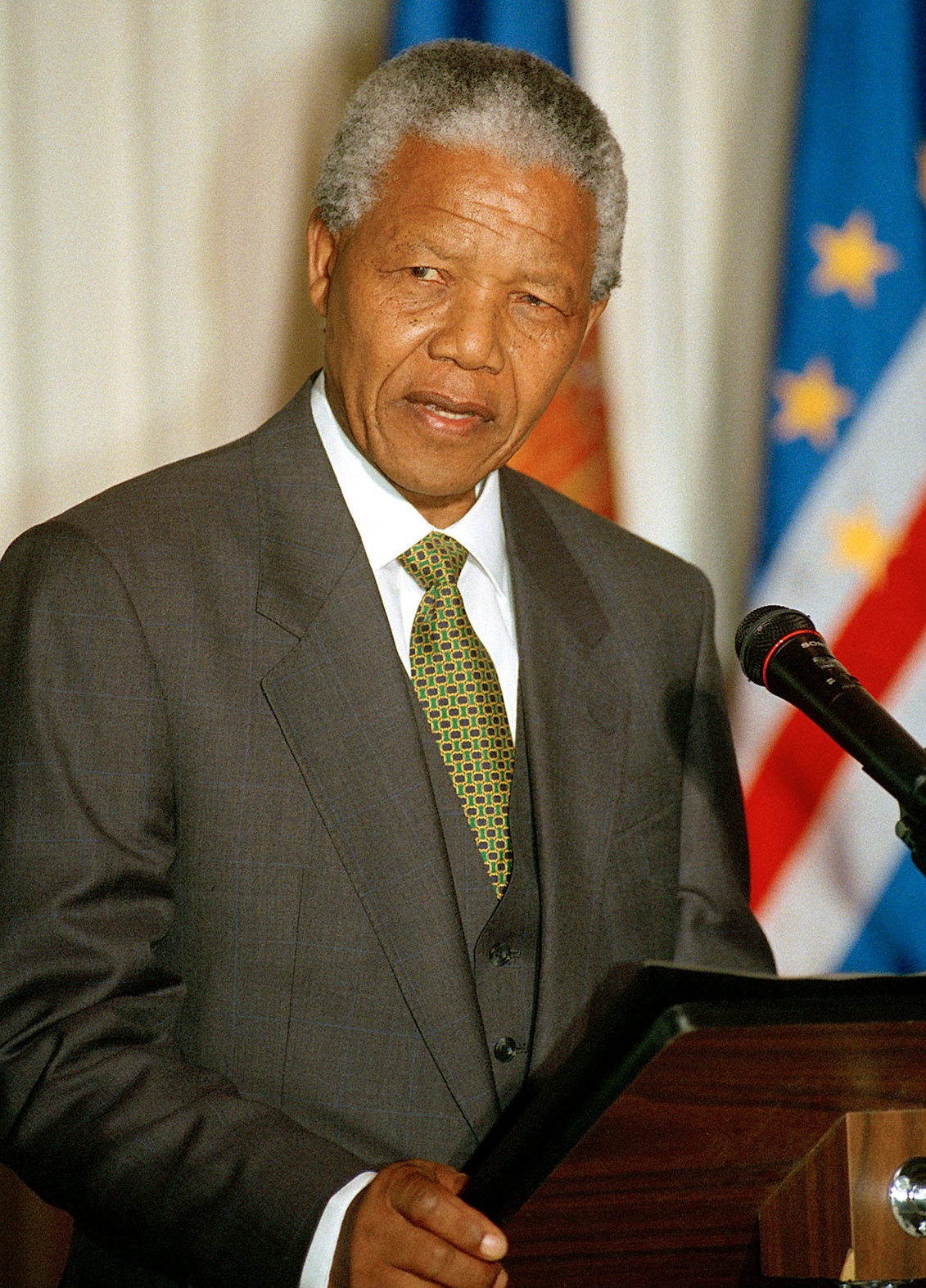
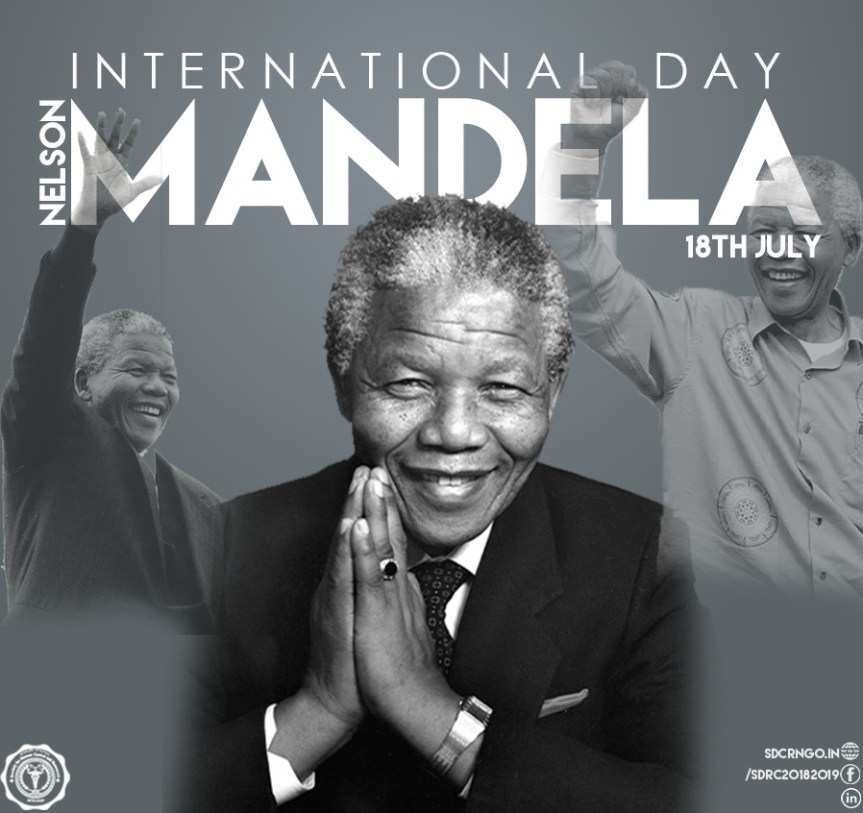
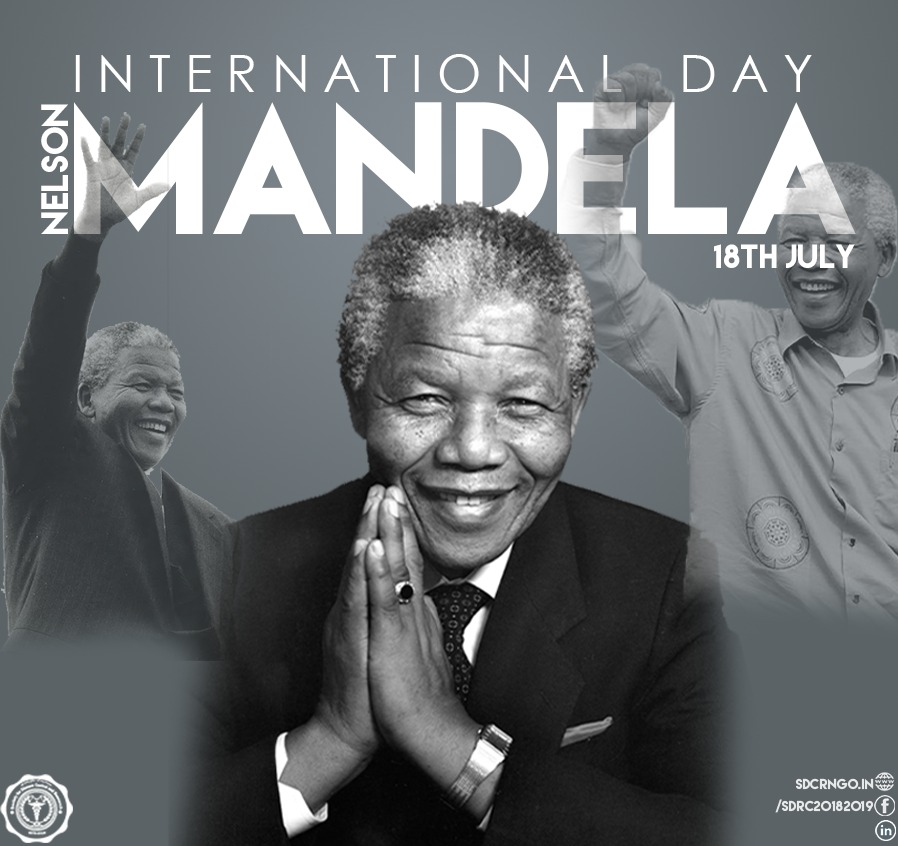
18th July marks the birth of an iconic figure who vanquished South Africa’s apartheid system. The great personality who fought for human rights and was an international peacemaker. This person who played a very vital role in shaping the society and conserving the human rights was Nelson Rolihlahla Mandela.
“It is easy to break down and destroy. The heroes are those who make peace and build.”
– Nelson Mandela
ABOUT NELSON MANDELA
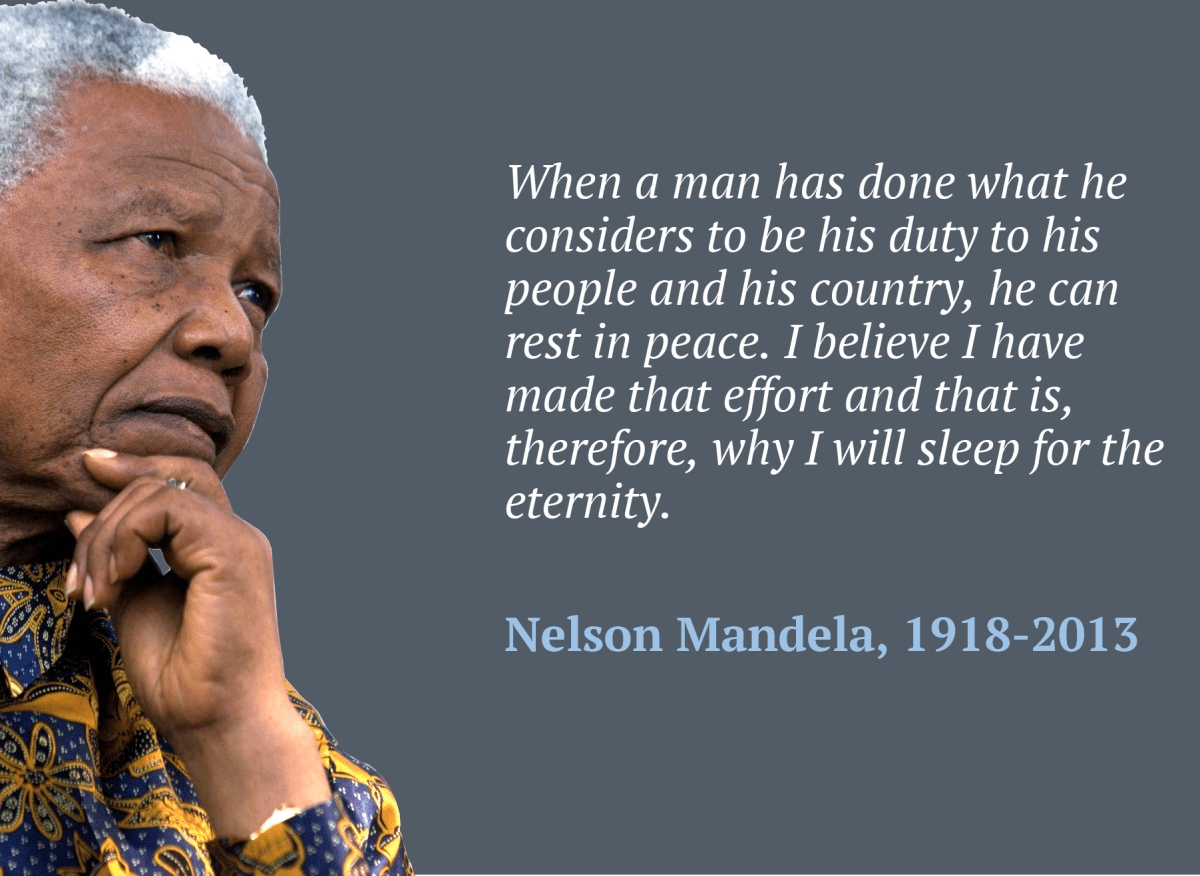
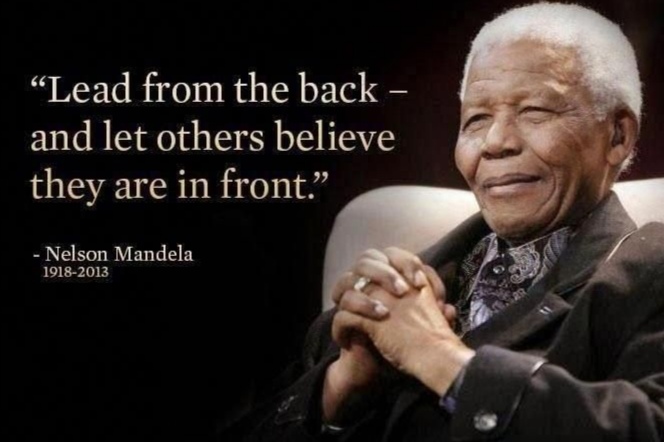
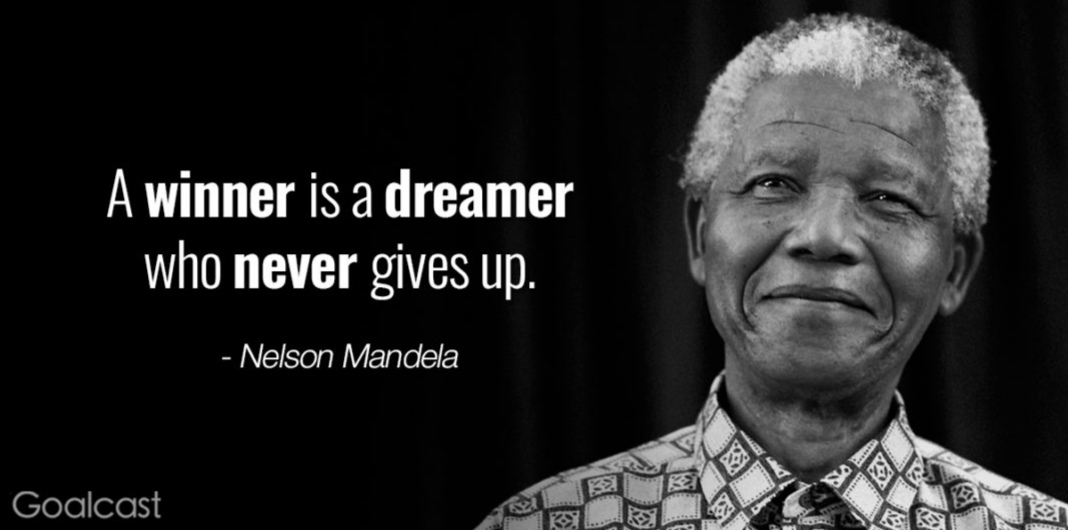
Nelson Rolihlahla Mandela (18 July 1918 – 5 December 2013) was a South African anti-apartheid revolutionary, who served as President of South Africa from 1994 to 1999. The main focus of his government was on knocking down the apartheid regime by fostering racial reconciliation and tackling institutionalized racism. Nelson Mandela is an iconic figure who was an human rights lawyer, a prisoner of conscience and an international peacemaker. He is that great personality who vanquished South Africa’s apartheid system and was the first democratically elected president of free South Africa. Nelson Mandela was born Nelson Rolihlahla Mandela in Transkei, South Africa on 18 July, 1918. His strategy was to bring change through Legal Revolution but not through actual violence. He began his journey towards by following the path of non-violence, later embracing violence, and then adopting a non-violent approach for negotiation and reconciliation.
ABOUT NELSON MANDELA INTERNATIONAL DAY
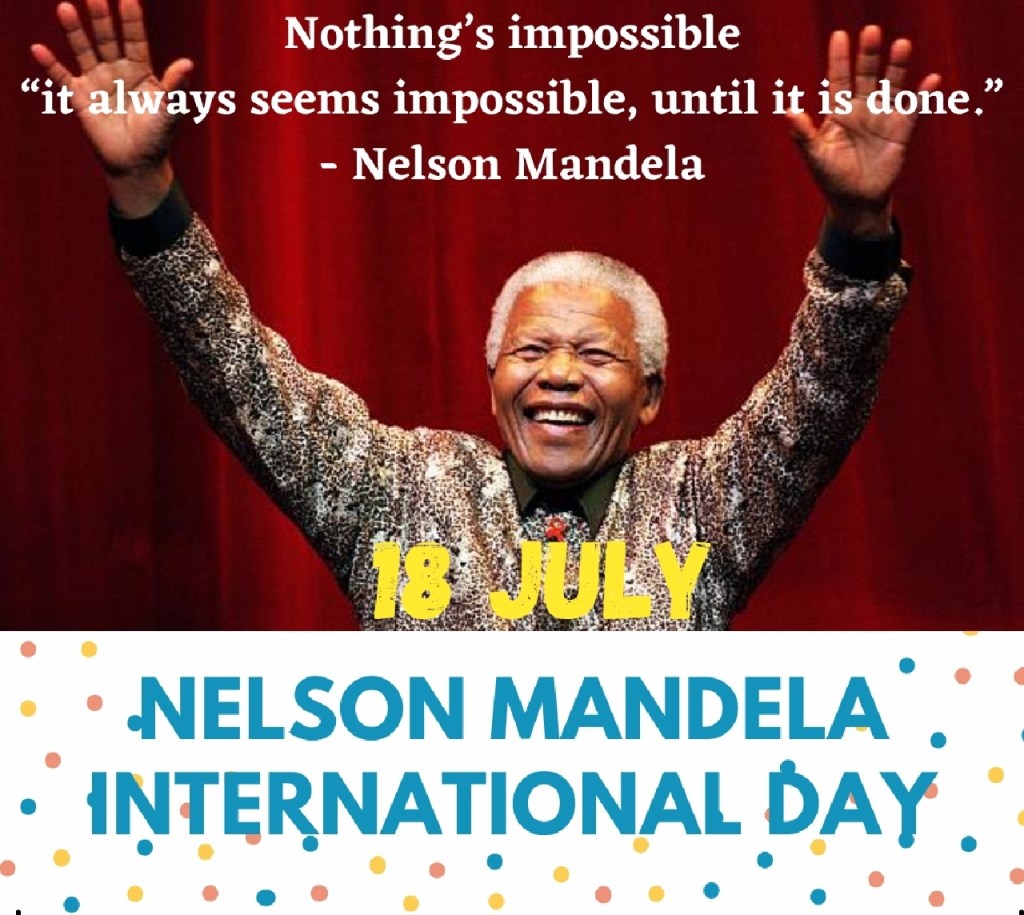
Nelson Mandela International Day (or Mandela Day) is celebrated in honor of Nelson Mandela, the former South African President, on his birthday, that is on 18 July. This day was declared officially by the United Nations in November 2009 and the first Mandela Day was thus held on 18 July 2010. There are many other groups who celebrated this day before 2010 also, that is from 18 July 2009.
The UN General Assembly (UNGA) declared 18th July as “Nelson Mandela International Day” for paying tribute and for recognizing his contributions for achieving and promoting peace and freedom. Mandela Day reminds us that “Each individual has the potential and power to bring a positive change, transform and ability to make an impact.”
MESSAGE OF MANDELA DAY CAMPAIGN
Nelson Mandela fought for peace and harmony. He fought for bringing social justice for over 67 years. This day urges the people of Mother Earth to fight poverty and promote peace, reconciliation and cultural diversity.
While establishing this international day, UNGA recognized the values and dedication of Nelson Mandela for serving the humanity. He constantly fought for democracy and for promoting cultural peace throughout the world. Some other values for which he fought are:
Conflict Resolution
Race Relations
Promotion and Protection of Human Rights
Reconciliation
Gender Equality
Rights of Children and other vulnerable groups
Fight against Poverty
Promotion of Social Justice
The contribution of Nelson Mandela to the society can never be measured and his works remind us that “Everyone has the ability and the responsibility to change the world for the better!” Mandela Day is one such occasion which urges all to take action and inspire change.
WHY DO WE CELEBRATE NELSON MANDELA DAY ?
Nelson Mandela International Day is celebrated every year to remember the legacy of a man who shaped the present with his fight for 67 years and provided a better world and society for the future generation. Nelson Mandela changed the 20th century and helped shape the 21st century and future of the world. This day exhorts us to renew the values and principles of Nelson Mandela and to take actions for building a better society.
Nelson Mandela was a South African anti apartheid Revolutionary Statesman.
Nelson Mandela
He served as president of South Africa from 1994 to 1999.
Nelson Mandela was first black head of state and the first elected in a fully representative democratic election.
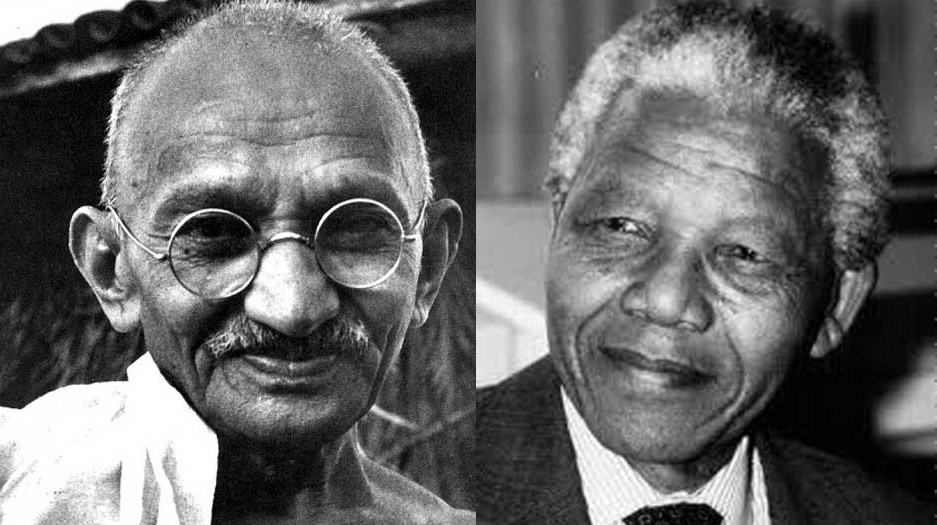
Nelson Mandela is known as Gandhi of South Africa.
Nelson Mandela was born on 18 July 1918.
We died on 5th December 2013.
Nelson Mandela International Day is celebrated on 18 July every year.
Today is 103rd birth anniversary of Nelson Mandela.
Nelson Mandela opposes the racist system of Apartheid in South Africa and dedicated his life to establishing social equality for all.
Nelson Mandela was awarded the prestigious Nobel Peace Prize in 1993.
He involved in anti colonial and African Nationalist politics, joining the AMC in 1943 and co-founding its youth league in 1944.
In 1962, He was arrested, imprisoned and subsequently sentenced to life imprisonment for conspiring to overthrow the state following the Rivonia trial.
He served 27 years in prison.
Nelson Mandela was also known as Madiba.
Nelson Mandela was birth name Rolihlahla Mandela.
Nelson name was given by his Primary school teacher.
In 1931, he begin his College degree at University College of Fort hare.
Nelson Mandela was expelled for participating in a protest against the universities policies.
Nelson Mandela received his law degree from University of South Africa in 1989.
The king of his village threatened him and his cousin with arrange marriages but they both ran away.
Nelson Mandela along with his fellow AMC member established South Africa’s first black law practice in 1952.
Nelson Mandela was banned from leaving the country
In order to leave the country he used the name David Motsamayi to get out of country in secret.
In prison, he was mentor to to other prisoner and taught them about nonviolent resistance.
Nelson Mandela believed that sports has the power to change the world, it has the power to inspire,. It has the power to unite people in a way that letter else does. It speaks to youth in a language they understand. Sport can create hope where one there was only dispair. It is more powerful than government in Breaking Down racial barriers.
He was released from prison in 1990 by president Frederick William De klerk.
Nelson Mandela was 76 year old when he was elected as president of South Africa.
Theme of national Mandela International Day 2021
The theme of this year is One Hand Can Feed Another.
Last year’s theme was Take Action, Inspire change.
The theme highlighted the importance of Government and citizen working together to build a peaceful equitable and sustainable world for all.
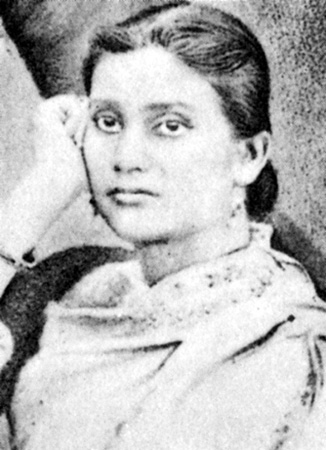
160 years ago, on this day, July 18, Kadambini Ganguly was born in a Bengali family in Bhagalpur, Bihar. As a child, she was rebellious with regard to sexism and patriarchy and was very hard-working as a student.
Picture of Dr. Kadambini Ganguly.
During her childhood, she had witnessed that in her area many women used to die without treatment as women could not get proper treatment because all doctors were males and Indian social culture didn’t approve a male doctor treating a female patient. From here, she dreamt of becoming a doctor during her childhood.
However, things didn’t happen according to her. She was married off at young age and thus she thought her dreams would go down the gutter. But it was then her husband who supported her in every walk of her life. She did her schooling partly at Banga Mahila Vidyalaya and partly at Bethune School. In 1878, she became the first female to pass the University of Calcutta entrance examination.
Within few years, she became one of the first few female graduates in the country alongside Chandramukhi Basu. When she wanted to study medicine, she was denied admission by University of Calcutta as the university wasn’t allowing female students back then. Dwarkanath Ganguly, Kadambini Ganguly’s husband challenged this patriarchal rule and in 1883 Kadambini Ganguly was the first female to take admission in Calcutta Medical College.
Kadambini Ganguly received a scholarship of two years and in 1886 she was awarded the GBMC award and thus making her the first female to have a degree in Western Medicine in the whole of South Asia.
It is also important to note that during that time people didn’t approve a female getting education and as a result she received strong opposition regarding her academical choices from conservatives even from her neighbourhood and relatives.
Bangabashi, a magazine of that time that was run by the then conservatives also called her a “whore” and this obviously didn’t go well with the Ganguly couple. Dwarkanath Ganguly legally filed a court case against the magazine and this resulted in 6 months jail term for the editor of the magazine.
Kadambini Ganguly also went abroad for her studies and got her further education in Edinburgh College of Medicines for Women. She quickly earned three different diploma degrees. Soon, she became popular in entire South Asia and Europe. Her name became so popular that the then King of Nepal invited her to treat his ailing mother.
Kadambini Ganguly had even advocated for social change in India and especially for women. It was due to her efforts that Bethune College in Kolkata added the Fine Arts course in their college. She was also one of the six female delegates to fifth session in Indian National Congress and even organised Women’s Conference in 1906 in Calcutta.
Authors of that time described Kadambini Ganguly as one of the “greatest” and the “most accomplished woman” of her time. And truly, all of us agree to it. Because of courageous women like her, so many women in the world must have got inspired to achieve their dreams. Kadambini Ganguly will always remain immortal in all her hearts.
Nelson Mandela was born on 18 July 1918, at Umtata, Cape of Good Hope in South Africa. He is an iconic figure in today’s world when it comes to fighting for one’s rights as a human being. The son of a Xhosa Chief, Mandela studied law at the University of Witwatersrand, and in 1944 joined the African National Congress (ANC), After the Sharpeville massacre (1960), he was disillusioned to the extent that he gave up his non-violent stance and became one of those who helped found the Spear of the Nation, the ANC’s military wing. Arrested in 1962, he was sentenced to life imprisonment. The South African Court convicted him on charges of sabotage as well as other crimes committed while he led the movement against apartheid.
How is Nelson Mandela International Day celebrated?
Mandela provides service to others and always wants to create a better world for everyone. So, on this day if people find injustice in the neighbourhood, city, or state they do everything to alleviate the problem. Work in soup kitchens, marched with protesters, volunteer in local organisations, and work to help bring about civil liberties for everyone. Inspire change, and make every day a celebration of Mandela Day. People work for others and want to improve the lives of people around them. They will do this by volunteering or taking part in protests.
“After climbing a great hill, one only finds that there are many more hills to climb.”
This day provides a global call for people to recognise their ability and have a positive effect on others around them. People also inspire others about the values that Mandela shared like democracy, freedom, diversity, reconciliation, and respect. To promote Nelson Mandela Day, many people and organisations around the world take part in several activities. These activities are volunteering, sport, art, education, music, and culture. This day also celebrates a campaign known as “46664”, in reference to Nelson Mandela’s Robben Island prison number. The campaign was originally launched to raise awareness about HIV/AIDS. In 1995 and 1999 Children’s Fund and the Nelson Mandela Foundation were established.
“I learned that courage was not the absence of fear, but the triumph over it. The brave man is not he who does not feel afraid, but he who conquers that fear.”
His Movements And Struggles:
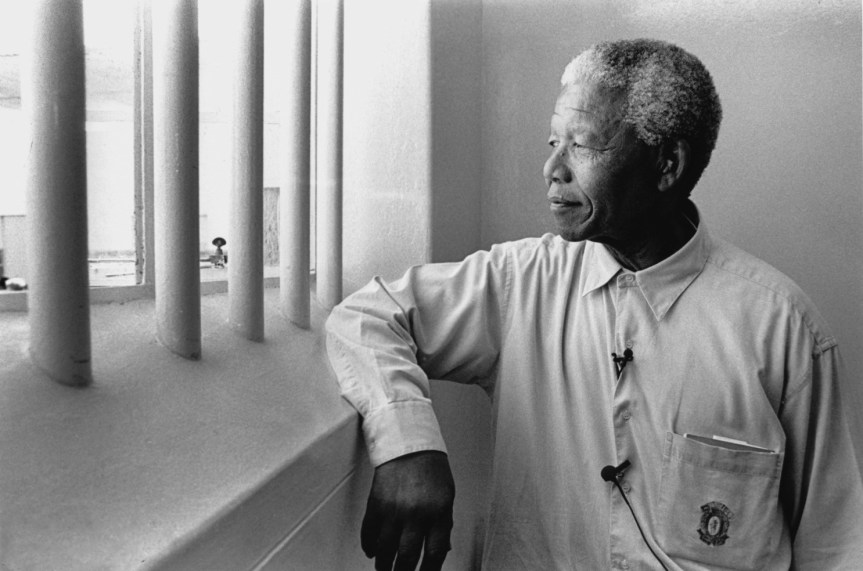
In accordance with the conviction, Mandela served twenty-seven years in prison. While in jail, Mandela’s reputation grew and he became widely known as the most significant black leader in South Africa. The conditions that he had to go through as a prisoner were appalling. He performed hard labour in a lime quarry. Prisoners were segregated on the basis of race, and the black prisoners received the fewest rations. Political prisoners were kept separate from ordinary criminals and received fewer privileges. Mandela himself describes how as a D-group prisoner, the lowest classification, he was allowed one visitor and one letter every six months. Letters, when they came, were often delayed for long periods and made unreadable by the prison censors. It calls for nerves of steel for a man imprisoned for life to get a degree of Bachelor in Law from the University of London through correspondence.
In February 1985, President PW Botha offered Mandela conditional release in return for renouncing armed struggle. Mandela spurned the offer, releasing a statement through his daughter Zindzi saying, ‘What freedom am I being offered while the organisation of people remains banned? Only free men can negotiate. A prisoner cannot enter into contracts.’
Throughout Mandela’s imprisonment, local and international pressure mounted on the South African Government to release him. In 1989, South Africa reached a crossroads when Botha suffered a stroke and was replaced as President by Frederik Willem de Klerk. De Klerk announced Mandela’s release in February 1990. His release from jail was broadcast live all over the world.
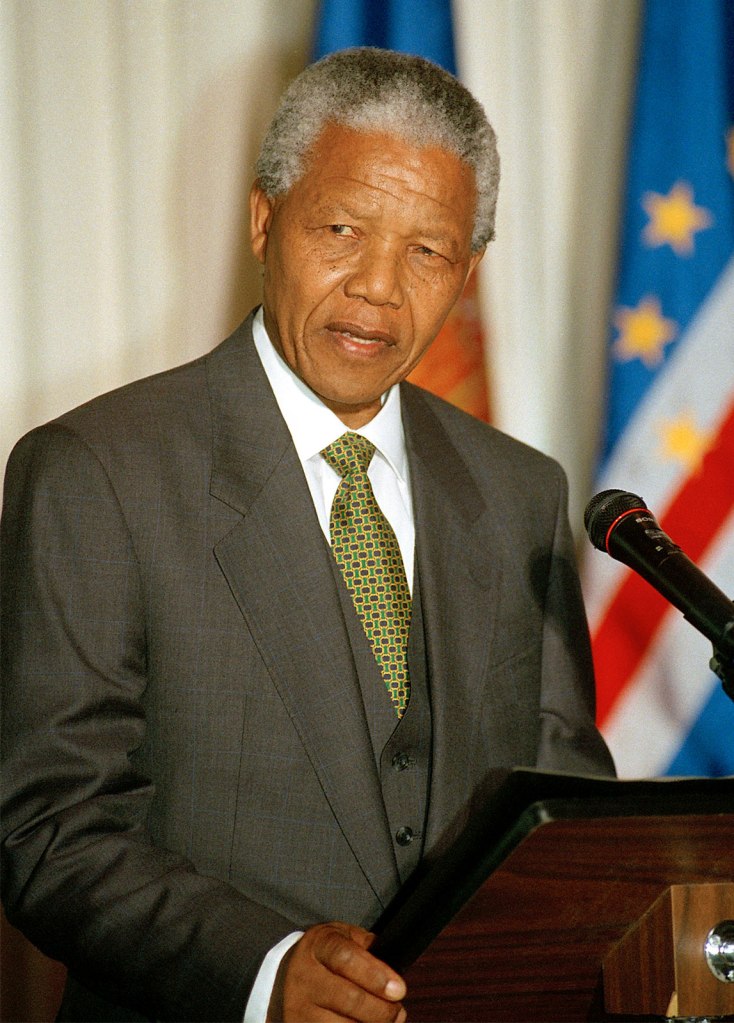
South Africa’s first multi-racial elections, in which full enfranchisement was granted, were held in April 1994. The ANC won 62 per cent of the votes in the election. Mandela became the first black President. As President from May 1994 to June 1999, Mandela presided over the transition from minority rule and apartheid, winning international respect for his advocacy of national and international reconciliation.
It is not surprising that Mahatma Gandhi should have inspired Mandela in his war against apartheid. The most universally respected figure of post-colonial Africa, Mandela was awarded the Nobel Peace Prize in 1993 along with De Klerk for their efforts to end apartheid and bring about the transition to non-racial democracy. Mandela remains an inspiring figure for any man in any corner of the world who becomes conscious of his rights and is willing to fight for the same.
Nelson Mandela came into this world on July 18th, 1918. He hailed from a small village in Umtata, South Africa. His entire life story symbolizes a struggle against institutionalized racism in South Africa. It wasn’t easy for him to fight against the prevailing situations, as he was also one of those who were burdened by the impartial system.
Before getting actively involved in protesting against anti-apartheid fight, Nelson Mandela survived several years of his life being a subject of colonization. As an African child, Mandela suffered being a prey of the European expatriate project that involved ‘civilizing’ native communities. In 1960’s, Nelson Mandela was put behind the bars for standing against the racist regulations of the government. He spent around three decades of his life in prison but did not compromise his demand for seeking equality and justice for the common people.
Being an uncompromising and courageous leader, Nelson Mandela was characterized as a man of strength, integrity and principles. In the year 1994, he alone led the nation to put an end to racial discrimination. He was the 1st black president ever to get nominated in South Africa. He served as the South African President for five years ranging from 1994 to 1999.
After Nelson Mandela retired from his public life, he continued to symbolize the dreams and hopes of an equal and free world. In December 2013, he left this world forever. He was of 95 years at that time. Nelson Mandela had to his credit more than two hundred and fifty awards and honors that included the “1993 Nobel Peace” Prize, the Medal of Freedom, and the Bharat Ratna.
Life of Nelson MandelaHe has conducted comprehensive traveling since his release from prison when he spoke. Nelson Mandela claims: “The biography of Pandit Nehru helped me prepare for my discharge. Who wrote about what’s going on when you leave prison.My daughter Zinzi claims she grew up without a dad who became the nation’s dad when he came back. This has put on my shoulders a huge burden.And wherever I travel, I instantly start missing the familiar–the mine dumps, the uniquely South African color and smell, and especially the individuals. I don’t like being away for a long moment. There’s no place like home for me.Mandela accepted the Nobel Peace Prize as a tribute to all those who worked for peace and opposed racism. This individual has been awarded as much as it has been to the ANC and all the individuals of South Africa.
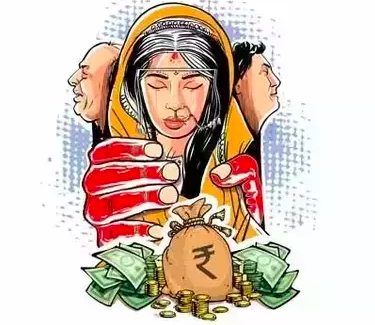
Dowry is basically the transfer of parental property, gifts, money or anything else of monetary value, usually by the wife’s family to the husband and his family upon marriage. Hence, dowry serves as a gift from the bride’s family to the groom’s family in consideration of their marriage and accepting the bride into the groom’s home. This practice of dowry is an old, obsolete and discriminatory practice. It has its roots in ancient Indian culture that placed women at an inferior position to men, such that women had to pay a price through dowry just to be with them. In older times, women had no individual identity and their identity was tied to their husbands through marriage. Dowry is a practice which took advantage of this convention and exploited women due to their inferior social position. With the change in times and beliefs, the payment of dowry has been prohibited under specific Indian laws such as the Dowry Prohibition Act, 1961 and subsequently by Sections 304B and 498A of the Indian Penal Code. However, the practice is still prevalent to a high degree in India today despite its prohibition, leading to things like harassment, domestic violence and even dowry deaths. There are many reasons for this.
Reasons for Dowry till existing
Firstly, dowry still exists in India because it is perceived as a source of easy income by the groom’s family. This is why we see the practice of dowry today predominantly in the rural areas and among the households of the poor. Without any of their own effort or hard work, and by simply relying on this social convention, the groom’s family can ask for dowry and gain wealth for free. Yet, research suggests that dowry is highly prevalent even among urban households and households of the rich and educated. This is unusual and it raises the question as to why someone who is educated and aware of laws indulge in the practice of dowry. Even recently in 2019, there was CCTV footage released of a retired Madras High Court judge Nooty Rama Mohana Rao harassing and beating his daughter in law for the payment of dowry. Hence, there are other factors that cause the practice of dowry to continue.
In most cases, due to patriarchy and preference of a boy child over a girl, the sex ratio in many states of India is disparate. This leads to a greater number of men compared to women. It could be argued that due to a greater number of men, dowry might hardly exist. However, this isn’t practically true, because the men having characteristics desired by the bride and her family are few. These characteristics include physical features, income, family status, etc. Thus, the bid for these highly demanded men leads to the existence of dowry. This is a typical market approach focusing on the demand and supply of desired partners which still exists in India today. Dowry is essentially the price to be paid to gain a husband or son-in-law, called the ‘groom price’.
Another reason for the prevalence of dowry is the notion of security. Research suggests that in-laws show more preference towards the daughter-in-law that brings a large dowry, giving her more autonomy and say in households matters and giving her fewer chores to do. In some cases, the bride herself encourages the payment of dowry as she sees it as a transfer of wealth from her paternal side to her husband’s side, leading to a rise in the financial position and status of her new family. Hence, the play of power and autonomy has led dowry to still exist.
Conclusion
Hence, we can see that despite its abolishment, dowry is still practiced to a large extent in India. This is because of the reasons stated above, and also generally because we are in a modern era with new requirements. We have an open economy which fosters free trade and globalization, which in turn has nurtured a consumerist attitude in us. The growing consumerism has affected the way dowry is perceived in India, and it is now being encouraged as it helps satisfy the consumerist needs of people. Furthermore, any attempt by a woman to file a complaint or report a case of domestic violence/harassment with regard to dowry is often silenced by the husband or his family by threat or coercion. Therefore, India must try its best to create some sort of support system for women and work to abolish the practice of dowry at all levels so as to remove this discriminatory practice from Indian society.
“May your choices reflect your hopes, not your fears.”
Nelson Mandela
Introduction
July 18th every year is observed as the Nelson Mandela International day ever since 2009. Nelson Mandela’s full name was Nelson Rolihlahla Mandela and he was also known as Madiba. He was born on July 18, 1918, in South Africa and died on December 5, 2013. He was a Black Nationalist and is popularly known as the first Black president of South Africa. He is also known for his negotiations in the 1990s with the then South African President F.W. de Klerk which helped in ending the apartheid system in the country. Later in 1993, both, Mandela and de Klerk received the Nobel Peace Prize for their efforts.
Life
Nelson Mandela studied law at the University of Witwatersrand. He joined the African National Congress (ANC) in 1944 and became the leader of its Youth League. He established the first black law practice in 1952 in Johannesburg, his focal cases were of racial segregation. He was a part of drafting the Freedom Charter, a document demanding nonracial social democracy, in 1955. Because of actions against the apartheid legislation, he became a target and was banned and arrested on charges of treason in the year 1956 but was acquitted in 1961.
He was trained in guerrilla warfare and sabotage in 1962 but the same year he was arrested again and was sentenced to five years in prison. After the trial where he made his famous speech “I Am Prepared to Die”, he was sentenced to life imprisonment only narrowly evading the death penalty. During this sentence, he was held at the Robben Island Prison off Cape Town. He was released under the government of President de Klerk on February 11, 1990, soon after which he was made the deputy president of the ANC, he then became president of the party in 1991.
Mandela won the first elections by universal suffrage and also was sworn as the president of the first multiethnic government. In 1995, he established the Truth and Reconciliation Commission (TRC) which’s work was to investigate human rights violations that took place during the apartheid. He then resigned from ANC in December 1997. He didn’t seek a second term and transferred the presidency to his successor in 1999. He established the Nelson Mandela Foundation in 1999 through which he kept working as an advocate of peace, reconciliations, and social justice.
Mandela and Gandhi
Mandela had said that Gandhiji was his role model and that he inspired him to lead South Africa on its journey of independence. He was also sometimes referred to as the “Gandhi of South Africa”. Although both of them did not meet each other, yet some similarities can be noticed such as, both emphasized moral power being a force to reckon with. Both of them were lawyers and spent time in Johannesburg’s old fort prison although it was during different years, Gandhiji in 1906 and Mandela in 1962. It is also said that during Mandela’s 27 years at the Robben Island prison, he was in the room full of books of Gandhiji, where he spent time meditating and reflecting to rid his soul of the bitterness. It was a big coincidence that two of the most inspiring world leaders had a connection to South Africa.
Conclusion
The theme of Nelson Mandela International Day 2021 is One Hand Can Feed Another. Everyone should take some time out to read about Nelson Mandela’s journey and then read about issues of violence and security around the world to understand better and play our part in the fight to make the world more peaceful.
General knowledge is very important in everyone’s life. The person without the knowledge is like the bird without the wings. It is very important to know what is happening across the world. So, it is very important to attain the general knowledge. To grab general knowlede, an individual must follow some of the techniques like reading books, articles, magazines, newspapers etc.
The newspaper consists of all the important things like the business purposes, sports, entertainment, some interesting puzzles, Hindi habits, food recipes, Current affairs etc.
Reading newspaper is an important thing because whenever an individual comes across a motivational thing, he or she will be motivated and focuses on the particular aspect. The individual will get to know the current affairs. The person will get a good grip on the general knowledge. solving puzzles improves the skills of the person. Reading about the healthy habits in the newspaper makes the individual to go for good and healthier meals.
Reading newspaper is very important because gives the chance to know what is happening around us. Early in the morning or evening whatever the time maybe, sparing at least 10 to 15 minutes of time on newspaper is a very good habit that an individual can develop.
The newspaper consists of all the important things like the business purposes, sports, entertainment, some interesting puzzles, Hindi habits, food recipes, Current affairs etc.
In one of the other way the individual develops good habits and focuses more on what they are trying to do.
Individual Differences :
Intelligence :
High scores on tests of general knowledge tend to also score highly on intelligence tests. IQ has been found to robustly predict general knowledge scores even after accounting for difference in age, and five factor model personality tarits. However, many general knowledge tests are designed to create a normal distribution of answers, creating a bell shaped curve.
General knowledge is also moderately associated with verbal ability, though only weakly or not at all with numerical and spatial ability. As with crystallized intelligence, general knowledge has been found to increase with age.
Long term semantic memory :
General knowledge is stored as semantic memory. Most semantic memory is preserved through old age, though there are deficts in retrieval of certain specific words correlated with aging. In addition, stress or various emotional levels can negatively affect semantic nemory retrieval.
Personality :
People high in general knowledge tend to highly open to new experiences and in typical intellectual engagement. The relationship between openness to experieñce and general knowledge remains robust even when IQ is taken into account. People high in openness may be more motivated to engage in intellectual pursuits that increase their knowledge. Relationships between general knowledge and other five factor model traits tend to be weak and inconsistent. Though one study found that extraversion and neutroticism were negatively correlated with general knowledge, others found that they were unrelated.
Predictor of achievement :
A number of studies have assesses whether performance on a general knowledge test can predict achievement in particular areas, namely in academics, proofreading and creativity.
Academic achievement :
General knowledge has been found to predict exam results in a study of Britush schoolchildren. The study examined congnitive ability and personality predictors of exam performance and found that general knowledge was positively correlated with GCSE english, mathematics, and overall exam results. General knowledge test scores presicted exam results, even after controlling for IQ, five factor model personality traits, and learning styles.
Proofreading :
General knowledge has been found to robustly predict proofreading skills in univeristy students. A study found that proofreading had a larger correlation with general knowledge than with general intelligence, verbal reasoning, or openness to experience. In a multiple regression analysis using general knowledge, general intelligence, verbal reasoning, five factor personality traits, amd learning styles as predictors, only general knowledge was a significant predictor.
Creativity
General knowledge has been found to have weak associations with measures of creativity. In a study examining contributions of personality and intelligence to creativity, general knowledge was positively correlated with tests of divergent thinking, but was unrelated to a bigraphical measure of creative achievemnet, self- rated creativity, or a composite measure of creativity. The realtionship between general knowledge and divergent thinking became non- significant when controlling for fluid intelleigence.
Game shows and Quizzes :
Many game shows use general knowledge questions for entertainment purpose. Game shows such as who wants to be a Millionarie? and fiteen to one centre their questions on general knowledge, while other shows focus questions more on specific subjects. Some show ask questions both on specific subjects and on general knowledge .
In a time before our known history, there was a class of powerful and valorous warriors called kshatriyas. The best among them would typically fight on chariots. These were the ancient equivalents of a tank, moving swiftly in the battlefield, shooting powerful arrows with remarkable accuracy. To put things in perspective, the modern armor- piercing rounds are basically high-velocity arrows. Among these powerful warriors some would achieve perfection in their military skills. They would become so expert in the usage of weapons, that they would be able to fight thousands of other warriors, even if surrounded. They were called “Maharatis” or “great rathis”. Arjuna, Bhisma, Karna, Drona, Bhima are examples of famous Maharatis that performed heroic deeds during the battle of Kurukshetra as described in Mahabharata. However, there is another Maharathi that is less known- Abhimanyu.
Abhimanyu was the son of Arjuna, the great hero of the Mahabharata, and Subhadra, Krishna’s sister. He was personally trained by Krishna and Balrama since a very early age in the military arts and proved to be extraordinarily talented. Even being just 16 years old, he already knew tricks that even his father could not master, like the art of wearing his armor in a loose fashion, so he could close the gaps between the plates in the event of incoming arrows just by subtle movements of his body, making thus his armor impenetrable. In the 13th day of the battle of Kurukshetra, the Kauravas organized their army in a Chakravyuha formation with the goal of capturing King Yudisthira and thus defeating the Pandavas. Part of the plot was to use Susharma to challenge Arjuna and thus lure him to a distant part of the battlefield, neutralizing thus the biggest threat to the plan. In the Chakravyuha, an army is organized as a gigantic moving circle that acts like a Chakra(a sharp circular weapon), penetrating the opposing force with the goal of capturing an specific individual. When properly organized, the movement of the Chakravyuha is considered unstoppable. Using this formation, the Kaurava army was gradually penetrating the Pandavas formation and was about to capture King Yudhisthira who didn’t have the knowledge of how to stop it. If the Kauravas could capture King Yudhisthira, it would mean the end of the war in their favor, just like in a game of chess that ends with the capture of the king.
Abhimanyu volunteered to attack the formation and break it open, opening a path so others could also enter and destroy it from inside. The plan was that Abhimanyu would be followed by Bhima and the other Pandava generals, who would exploit the gap created by him. How to enter the formation was a secret that very few knew. It involved using specific types of weapons at a very complicated timing to exploit the weaknesses of the formation. It was extremely dangerous mission, if the others could not exploit the gap the formation would close and Abhimanyu would be trapped inside.
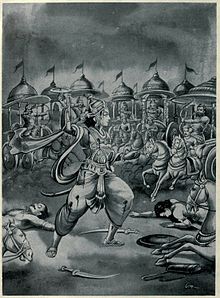
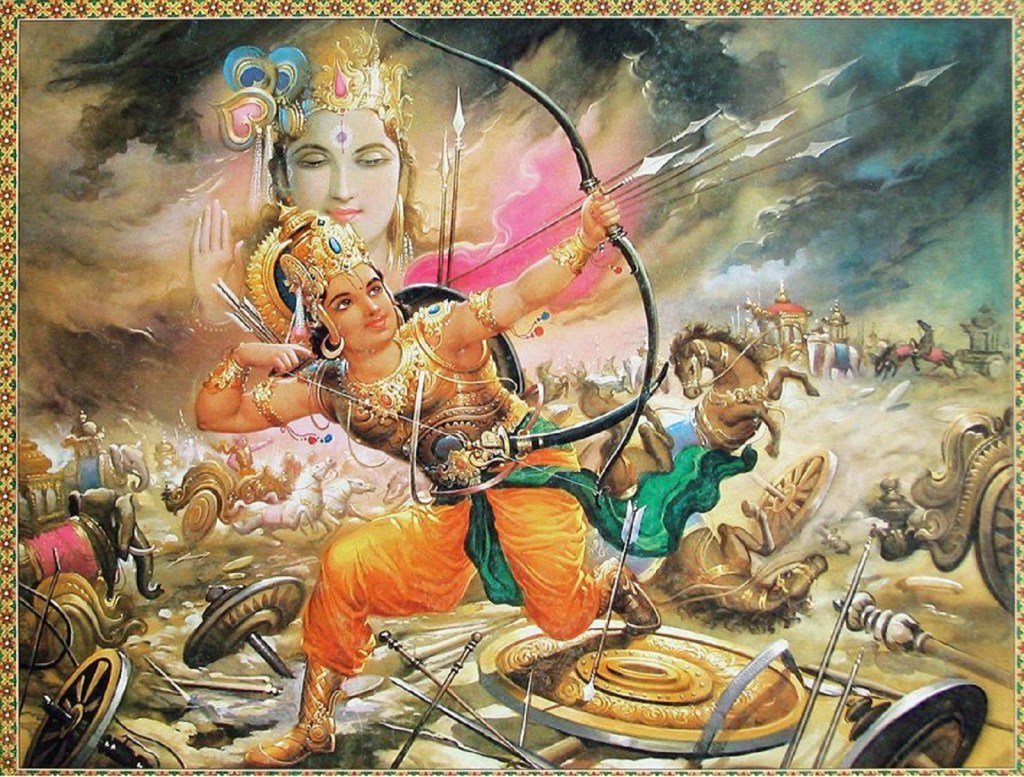
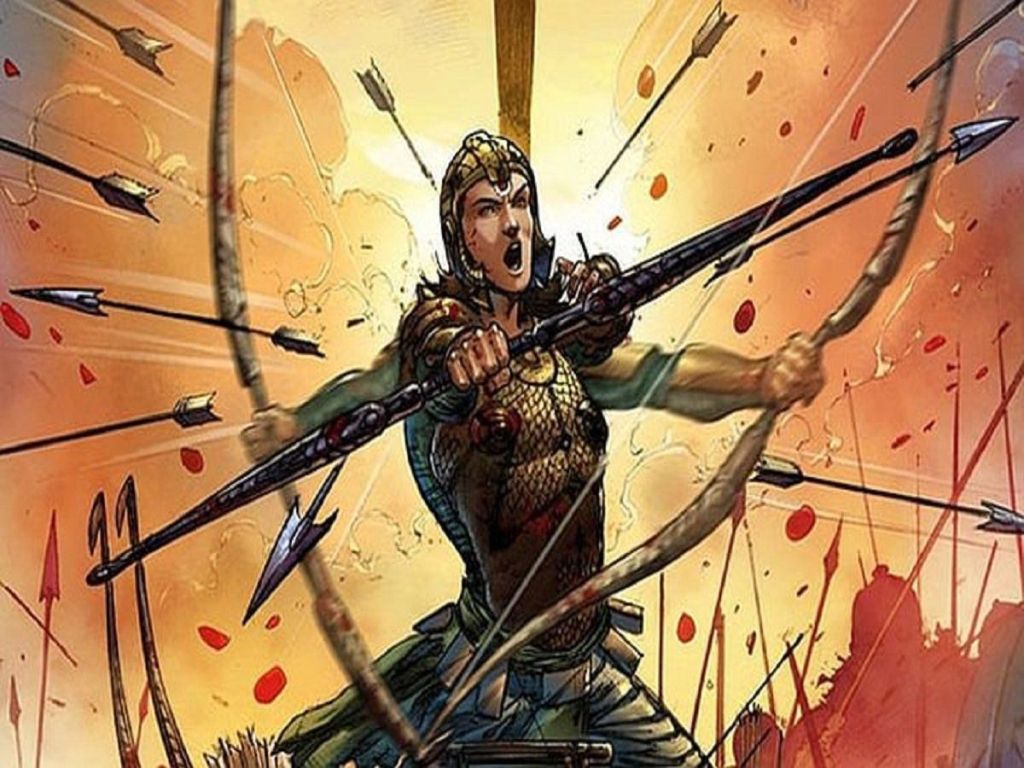
Abhimanyu advanced, firing different types of arrows, volley after volley. He was firing his arrows at such speed that the Kauravas had the impression of fighting hundreds of Abhimanyus. Using celestial weapons, he was slaying the Kauravas by the thousands, including many powerful generals. In fact, the attack of Abhimanyu was so fierce that he turned the tables, injuring Karna and threatening the life of Duryodhana, forcing the Kaurava warriors to go on the defensive and protect their king.
During vedic period women were enjoying fair and equal opportunities as the men. Women have the essence of freedom and use their power and status in society.
introduction
Vedic period was that time when vedic was the centre of every action, reaction and activities. People follow the rule and regulation of vedas. They read them and work according to them. There are four vedas
Rig veda : earliest veda
Yajur veda : veda for prayer
Sama veda : veda for singing
Atharva veda: veda for medicine.
. Everyone had the right to live with dignity irrespective of their caste and gender. The vedic period was the period when women had the rights to do anything according to their needs and interests. In this article we are going to highlight some sectors to discuss the status of women during the vedic period.
The sectors are
Education
Marital rights
Social status
Economics rights
Political status
Education
During the vedic period women had the right of education. In vedic period education is considered a source which helps an individual to attain self-knowledge, self reliant and self confidence. For a better society it was really important that every individual should be educated and attain spirituality. Women were also given a chance to get education. In vedic period there was no existence of child marriage. And education was the must for the women too. Samaveda, atharva veda, house management,cooking, running horses and using swords- that all were the subjects in teaching. Women can continue their studies without getting married. Gargi, vak apala Ghosa, Kakhivati Surya Savitri, Indrani, Shradha Kamayani, Yami Shachi, Poulomi, Urvashi etc. many more were the female educators.
Marital right
During vedic period child marriage does not exist. Women were getting married when they were physically mentally and emotionally ready. Women had the right to choose their husband. They can have inter caste marriages too. Women can marry anyone with her choices. Partichary was still there but women have their own status. If a woman did not want to marry and spend her life alone it would be ok with society. There Were no sati pratha during the vedic period. Widow remarriage was acceptable.
Social status
In vedic period women had freedom to express their views. Women can speak in public and give suggestions and opinions in society. Women can participate in any social function and competitions. Women enjoy a high status in society during the vedic period. Women also advise men on social matters.
Economic rights
There was no gender inequality between men and women during the vedic period. Unmarried daughter had equal shares in properties as the son. Married women have financial support from her husband. But the rights were limited.
Political status.
Women had the right to participate in sabha and can pass the order in absence of higher authorities. Women could rule the throne if there were no sons. Women had the right to make decisions on political issues. They have the right to express their thoughts in the sabha and can put the question to the higher authorities. Women have a prestigious and fair position in politics during the vedic period. Manu the father of political theory considers the women as reliable and subordinates.
Conclusion
During the vedic period women have the right to education, martial rights and have a prestigious position in society. There was no oppression against the women. They had equal rights. In vedic period a man was considered half without his wife. The women were ardhangi and gerhswamni, which means half body part and the owner of the house. Women have limited economic rights. Marriage was a choice for women in vedic period.
Vedic period was a golden and feminine era for women.
‘BRIYANI‘! The word just tickles the tongue and its buds with sweet pain. The phrase “Briyani is not just a word, it’s an emotion“, denotes that it has become a part of our life. Each merriment is decored with this signature dish. This particular food doesn’t really need any introduction, as it could present itself with the blend of shades, dance of spices, satisfying aroma, texture of meat and prominent raisins. For centuries, this significant dish serves the tongue and satisfies our crave for unique flavour and our appetite. Let’s go deeper into the search of; where does it come from. The journey of briyani would also be an interesting one as itself.
It’s quite exclamatory to acknowledge that Persia is the throne of its arrival. The etymology of this Indo-Aryan word ‘Briyani’ is from the Persian word ‘Biryan‘ which means ‘fried before cooking’. It served as the food for those soldiers who confronted at the battlefield in Persia. During those times, the people at the war field had prepared their food of this kind. They had coated their meat with the spicy powders that they got from their home and parched it for a night. Then they cook it with rice in earthenware vessel with the charcoal. That was termed as ‘Brinji‘ in those times. So Briyani was the food meant for the people in warfare.
Briyani stepped into India with the arrival of Mughal dynasty in 13th century and King Timur had a huge role in it. But then the food was meant for the people who fight for our country. Then the recipe came to the ears of cooks in kingdoms and it was maintained as the food for the kings which was a mystery for the normal people, including the soldiers. 16th century again played a role, when Mumtaz Mahal, the iconic reason behind the existence of Tajmahal, also played a key role for this iconic dish to reach to the citizens. Mumtaz is the most beautiful and intelligent wife of Shajahan and she used to accompany him, wherever he goes. When she found the soldiers in a weary condition without any nutrients, she prepared this recipe with nutrient sources such as meat and nuts. As the cyclic process, this briyani came back to normal people.
When the British had entered India during the later half of 19th century, the practice of adding ghee to the dish came in, as they were not exposed to the spicy taste. When India got independence, this dish got popularized all over India and each state had adopted their own creative way of preparation. For instance, Hyderabadi briyani got its flavour from the Nizam of Hyderabad and he taught this to Nawab of Arcot.
It would be really intresting to ponder about the history behind each types of Briyani. Now this particular dish got adopted to its own style in accordance to different cultures. Earlier in 2nd century it was mentioned as ‘Oon Soru‘ in Sangam literature. This is one such traditional dish which is revered all throughout the world in recent times. As Virginia Woolf said “One cannot think well, love well, sleep well, If one has not dined well“, food is a kind of elixir for life and it would be intresting to know about their history.
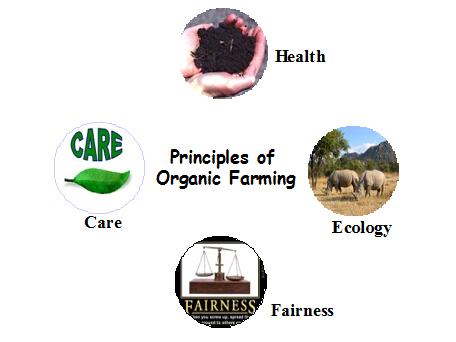
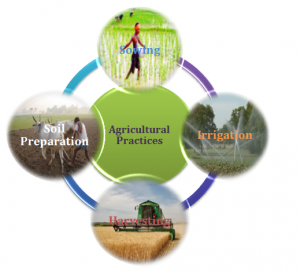
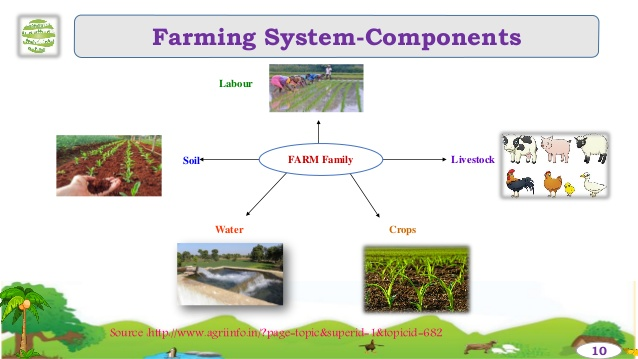
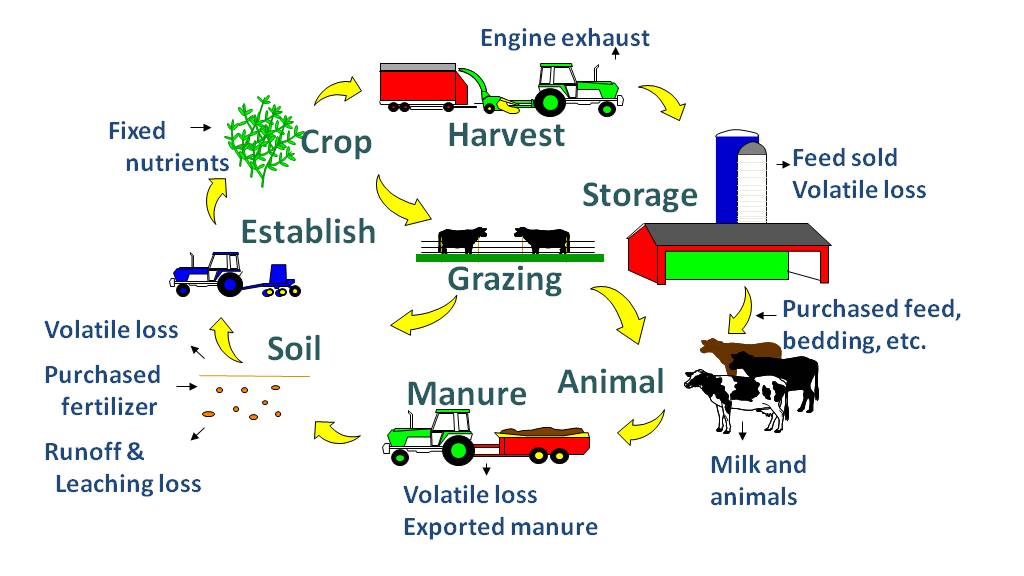
Farming plays a major role to the life of any human being. Without food, life on earth is not possible as hunger will consume every human and living being on this earth. Each and every modern food like pizza, burger, sandwich and nuggets and many more have atleast one primary content of cereal in it.
This sector is the primary factor for any economical balance and system of a country. Agriculture is commonly called as the backbone of any nation as it supports the important necessity factor of any country. Provides employment for various industries and population in an enormous rate that can be guaranteed for sure.
“If the farmer is poor then so is the whole country”. – Polish Proverb
Agriculture is the only platform that proves to provide self-employment and opportunities for others also. A smart way of farming can help you earn more than a lakh a month with organic based products alone. It’s stream also associates with rearing of farm animals, and sea creatures along with livelihood of many families. In rural sides, the basic establishment is agriculture to run their family.
There maybe sophisticated industries uprising and converting the society into a digital world, but a farmer can never be replaced or compared with anyone as they are preferred as gods to fulfill our stomach on time.
“The farmer is the only man in our economy who buys everything at retail, sells everything at wholesale, and pays the freight both ways”. – John F. Kennedy
There are critical situations where farmers lose hope on their passion and life resulting in suicides. These corporates also play a role in controlling vast area of these fields and demolishing but these issues became outdated inspite of protesting it.
“An agricultural life is one eminently calculated for human happiness and human virtue”. – Josiah Quincy
It can be considered as the India is the ancient and first nation to spread the cultivation process all over countries by exporting them also encouraging friendly nations to produce their paddy or farming.
An independent, stress-free job only with your hardwork and knowledge about effective production for each variety of seed, you succeed with your outcome.
Certain kind of insults and discriminations are made in every step of their life denoting their passion as if some kind wrong act to stabilize certain dignity of higher caste forgetting about the reality as farmers are rulers of any nation.
To understand the present let me take you to an incident, “Imagine a situation where you have to just drink water and tolerate your hunger, you can adjust for a day or even one week but your health will gradually decrease since as a defect to fulfil hunger”.
Our health is balanced and nutrition is maintained because of the benefits of various pulses and grains that supports life force of every species. So, try to support and cultivate the habit of encouraging it to younger generations as they need to respect and know the importance played by this sector in a nation’s economy.
“If farmers fail to keep hands on land, we can’t keep hands on food/rice”
Try creating awareness and modify of vision towards farmers to appreciate them at right work which is forgotten by us mostly. Helping a farmer is like feeding a thousand children while they are hungry. Do support agriculture and respect as mere humans to maintain humanity.
The things must be told to every single child to know the value of farming to be recognized and adopt this as their passion in upcoming future.
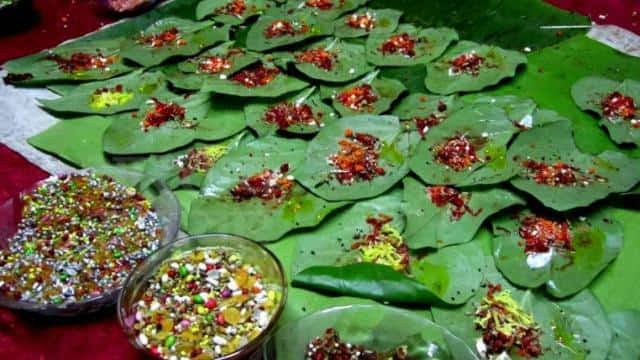
Magahi betel leaf (Paan) is an variety of betel grown in south Bihar region and mostly in Aurangabad, Gaya and Nalanda districts. This paan, is about 3.5 to 9.5 inches in size. It’s non-fibrous, sweeter, tastier and the soft.it got GI tagged in 2018 alongwith Jardalu mango and katarni rice
Magahi paan was popular even during ancient times. It is claimed that prince Vijai Mal was fond of Magahi paan and it is mentioned in the 1884 book of GA Grierson, an Irish administrator and linguist in British India. Several other references had been cited in the journal to establish Magahi paan being an exclusive produce of Magadh region
Magahi paan is sown during March-May each year, with leaves plucked during January-March. Each plant can give 40-60 leaves, yielding 500 dholis per year per katha .Every year, farmers have to sow new plants. When everything goes well, farmers can earn Rs 70,000-1,00,000 from one katha of land.
Problems encountered by betel leaf (paan) farmers
Betel leaf (paan) plants damaged due to cold
There is lack of insurance or MSP facility to the farmers. it is highly susceptible to bad weather conditions and is classified as horticulture, not agriculture product. Money is paid in installments by the buyer and Sometimes money is paid after one and a half years to the farmers.
Number of paan farmers is on the decline because of lack of any state help to ease their high cost of production, as the plant requires an artificial conservatory to grow.
Future ahead
A tie up between Agricultural and Processed Food Products Export Development Authority (APEDA) and Bihar Agricultural University (sabaur) is currently under process. Plan is to export GI tagged products Makhana, Jardalu Mango, Shear Rice, Litchi and Magahi Pan.
Let’s hope the things gets better and government policies should be made and implemented in a way keeping the problems faced by farmers and their needs at centre. Then, only these betel growing farmers will get benefitted from those government benefits.
“The greatest patriotism is to tell your country when it is behaving dishonorably, foolishly, viciously.” ― Julian Barnes, Flaubert’s Parrot
Patriotism means love of one’s motherland. The attachment to one’s motherland is as innate as one’s affection for one’s parents. Man’s first loyalty is to himself, then to his family and then to his own country. India is a land of many cultures, traditions, and languages. But Indians stand as one whenever there is a threat to the integrity of India. They stood up unitedly at the time of the Chinese aggression. Recently it has been proved during the Kargil war in Kashmir. Thus, patriotism brings out the qualities of unity, service and sacrifice. Patriotism encourages the noble quality of self- sacrifice for the cause of one’s country.
Gitanjali 35
Where the mind is without fear and the head is held high; Where knowledge is free; Where the world has not been broken up into fragments by narrow domestic walls; Where words come out from the depth of truth; Where tireless striving stretches its arms towards perfection; Where the clear stream of reason has not lost its way into the dreary desert sand of dead habit; Where the mind is led forward by thee into ever-widening thought and action Into that heaven of freedom, my Father, let my country awake…………BY RABINDRANATH TAGORE
Patriotism, however, sometimes develops a false national pride. The people of a particular geographical area have intolerance for the people of other areas. They even nurse evil feelings and enmity and go to war. This is not real patriotism. We know the horrors of war due to aggressive patriotism.
We have to shed mutual bickering, shed the difference of being high or low and develop the sense of equality and banish untouchability. We have to restore the conditions of Swaraj prevalent prior to British rule. We have to live like the children of the same father.- Sardar Vallabhbhai Patel
Patriotism is a noble virtue when love of one’s country does not lead to the hatred against other nations. One’s love of one’s country should expand itself into a love for all world. Narrow patriotism reeds passions and prejudices and so it is despicable. It brings hatred and wars. True patriotism must seek peace and prosperity of e world. It must be free from narrowness and meanness. It is Possible to combine patriotism with love for the people of the world. Thus, patriotism may least to international brotherhood.
Men, money and material cannot by themselves bring victory or freedom. We must have the motive-power that will inspire us to brave deeds and heroic exploits. -Netaji Subhash Chandra Bose
When a query performed on Google implies local results should be shown, the search engine populates a map pack of 3 local results. The map pack has many other names, including “local pack,” or the “Google 3-pack.”
If you own or operate a business that caters to your local community, chances are you qualify to get a Google My Business listing. A quality Google My Business listing can get you one step closer to being added to a local pack.
In this guide, we’ll explore the best way to add your business on Google My Business and offer some tips to increase your local rankings.
Back in March 2021, Google noted that there are more than 2 billion visits to local websites each month. That’s a lot of website traffic.
If you’re a small business owner, your #1 driver of new business is likely going to be referrals.
Referrals are great!
But, even with a referral, most people will still Google your business name to learn more about your business, read reviews, etc — before even contacting you.
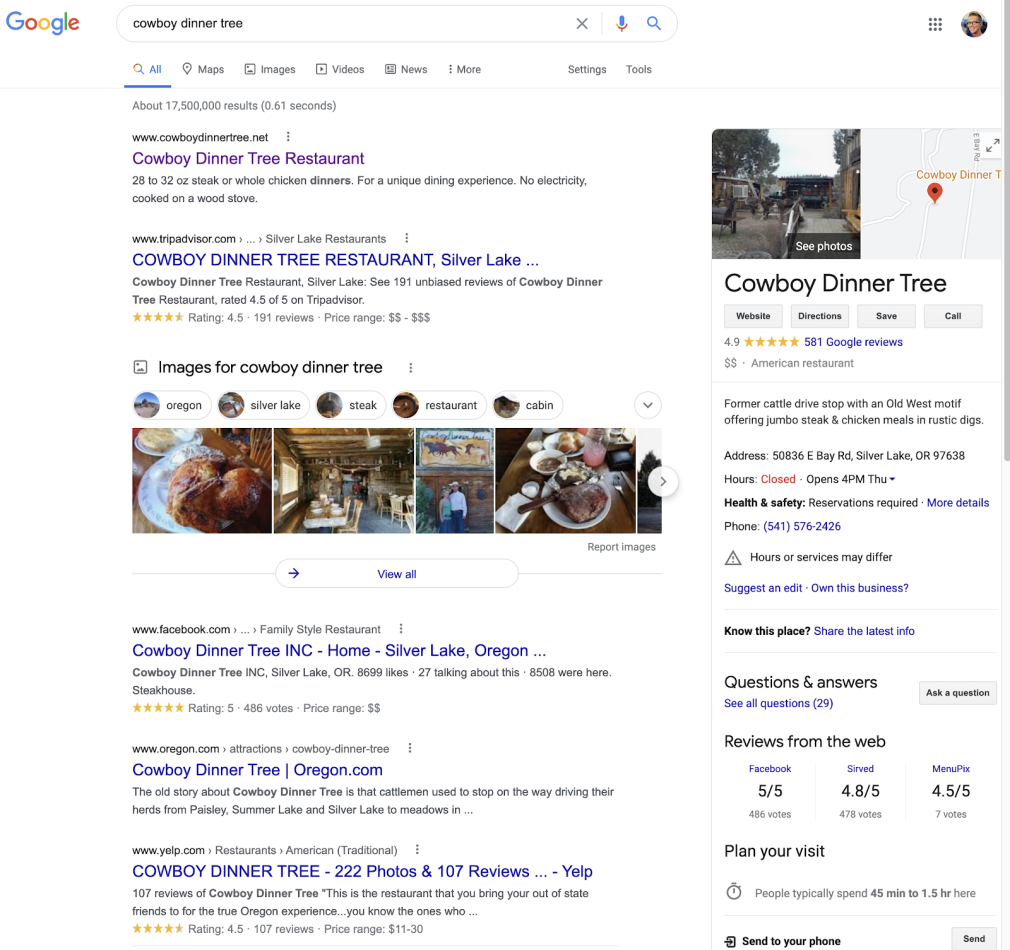
What happens when I perform a search on Google for “Cowboy Dinner Tree?”
The right-panel is generated by Google’s Knowledge Graph, but most of the data being populated here is sourced from Google My Business.
Now, what’s interesting about Cowboy Dinner Tree’s GMB listening is they don’t even have ownership of it. It isn’t owned by anyone.
Same with their Yelp, Facebook, etc. Even their website is very web 1.0.
How do they have a Google My Business listing if it isn’t claimed?
Google will automatically create one based on data they collect about businesses (entities). Keep this in mind as we get into the process of creating your own Google My Business listing.
Back to the benefits of owning your Google My Business listing.
You, the owner of your business, can provide the most accurate information about your business and have it displayed when someone does a search for your business on Google.
One of the other major benefits to claiming your Google My Business listing is that some simple optimizations and ongoing activities can help your chances of getting new business from organic search for free.Increase Your Visibilitywith the Listing Management ToolTry for Free →
How to add your business to Google My Business
You’ll have about 3 different scenarios to choose from:
Brand new business: Select Scenario 1 if your business is less than 6 months old.
Listing exists, unclaimed: If your business has been around longer than 6 months, start with Scenario 2 (but you may end up back at Scenario 1).
Listing exists, claimed: If you claimed your listing some time ago but don’t remember the login, the email is no longer active, or another person owns your listing, go with Scenario 3.
Scenario 1: Brand new business
Congratulations! Let’s get you on the path to getting you a Google My Business listing.
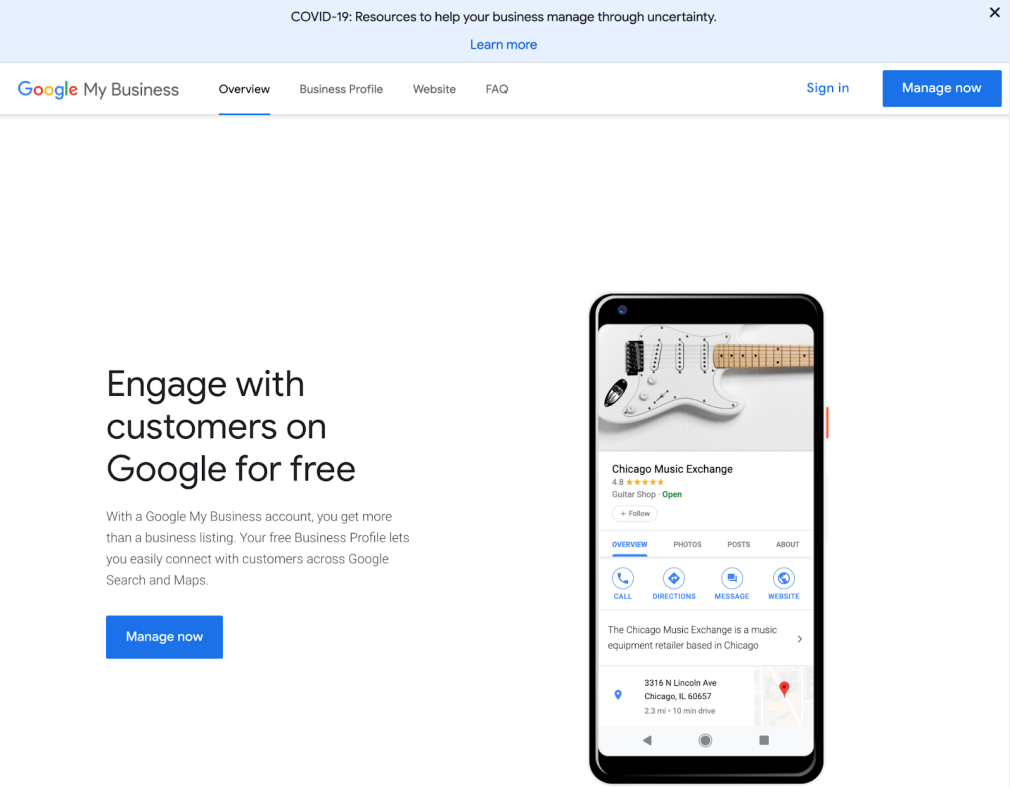
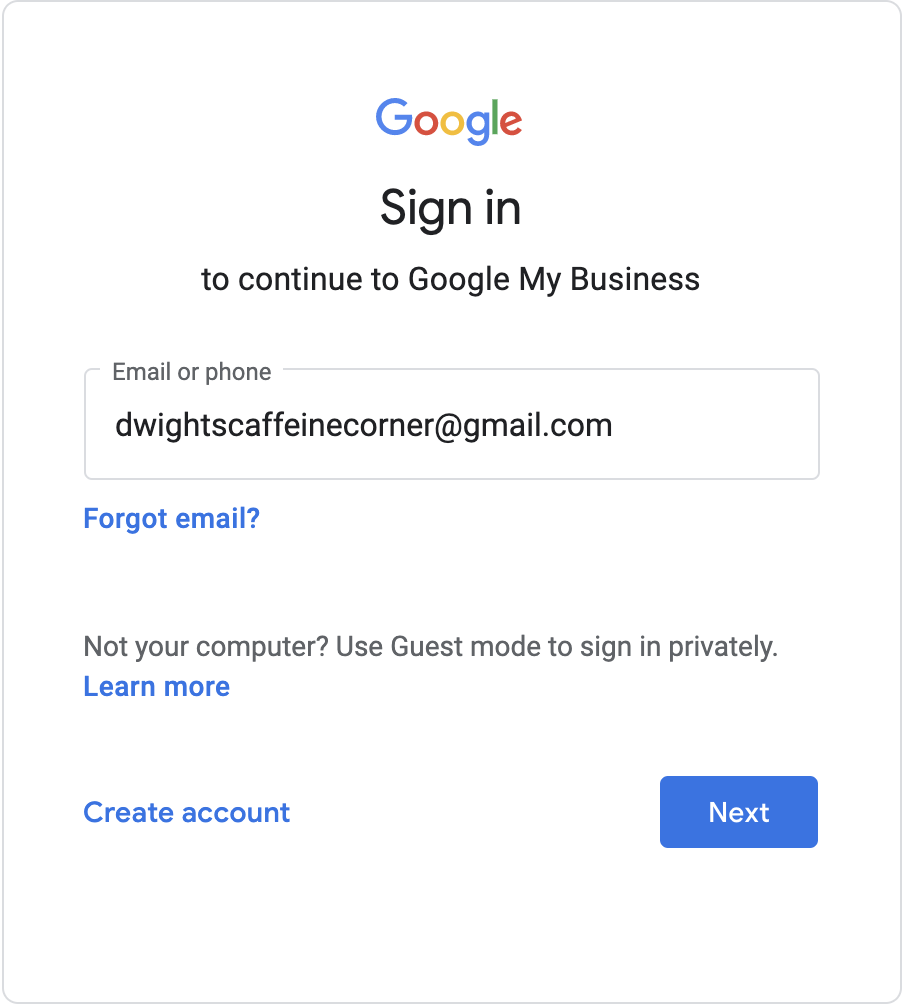
Step 2: Sign in to a gmail account that you own. This is important: remember what email address you are using here. This gmail account will be the Primary owner of the listing. Write it down on a post-it or take a screenshot if you need to.
Step 3: Once you have signed in, you’ll get taken to a page like the one below. Click on the Get Started button.
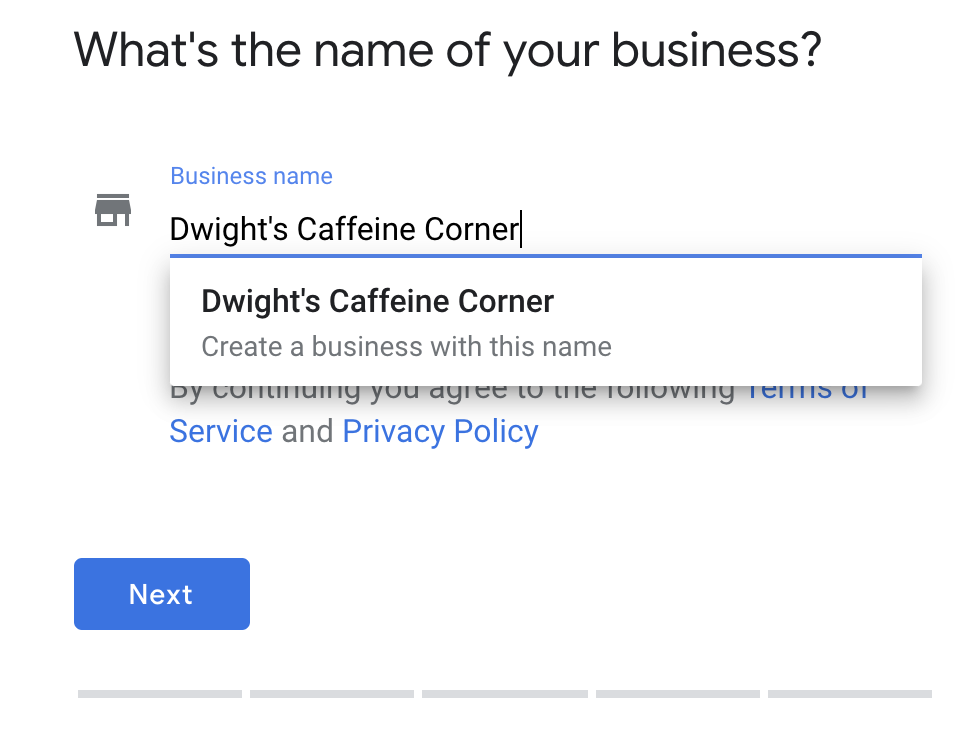
Step 4: Start typing in the name of your business. Google My Business will attempt to locate a listing but since your business is new, you likely don’t have one yet. When you spot the option to “create a business with this name,” click it, then click on Next.
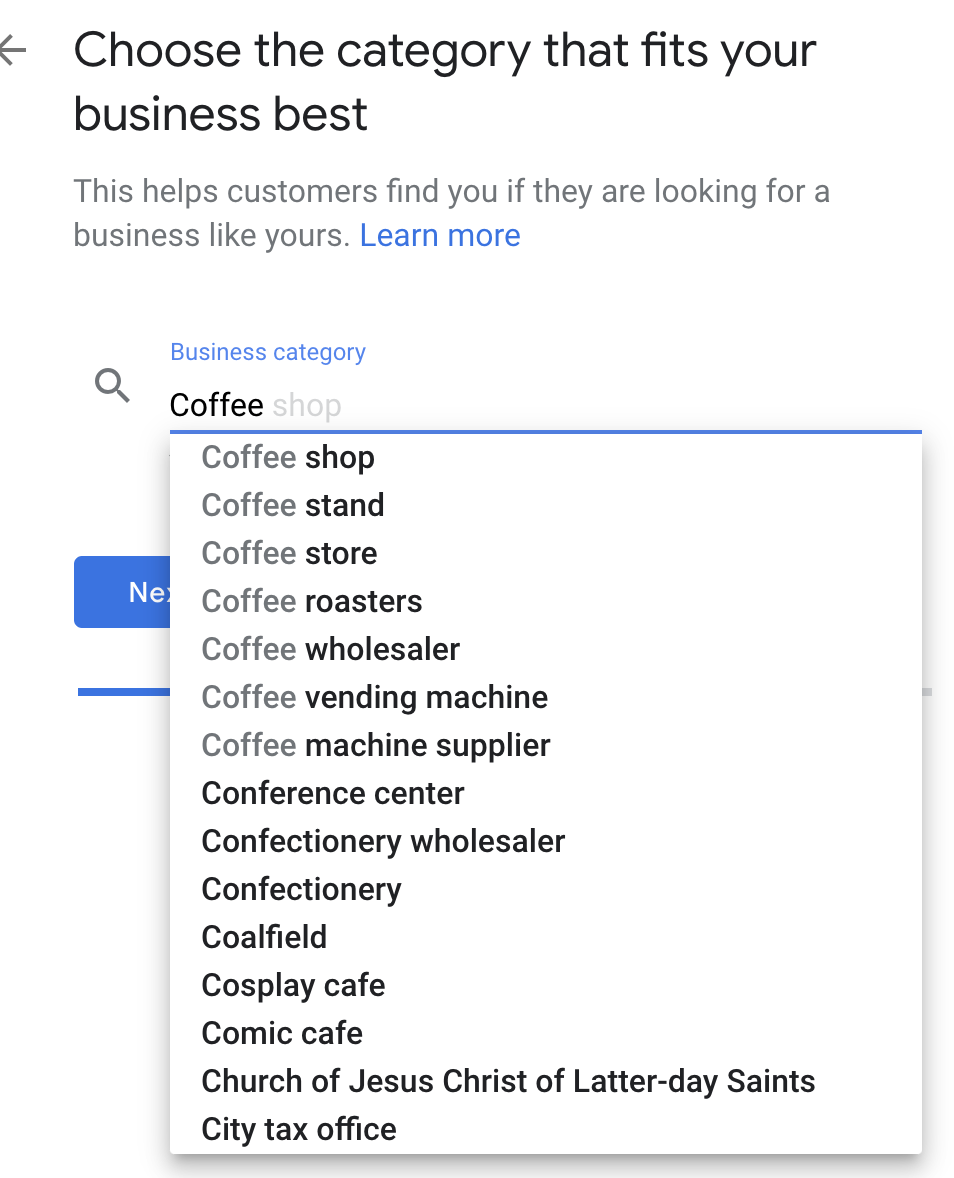
Step 5: Now we need to choose a Business category that best matches your business. For our example, coffee shops are the best matching category. If there are multiple categories that match your business, you’ll be able to add additional categories after your listing has been verified. Once you’ve chosen your category, click Next.
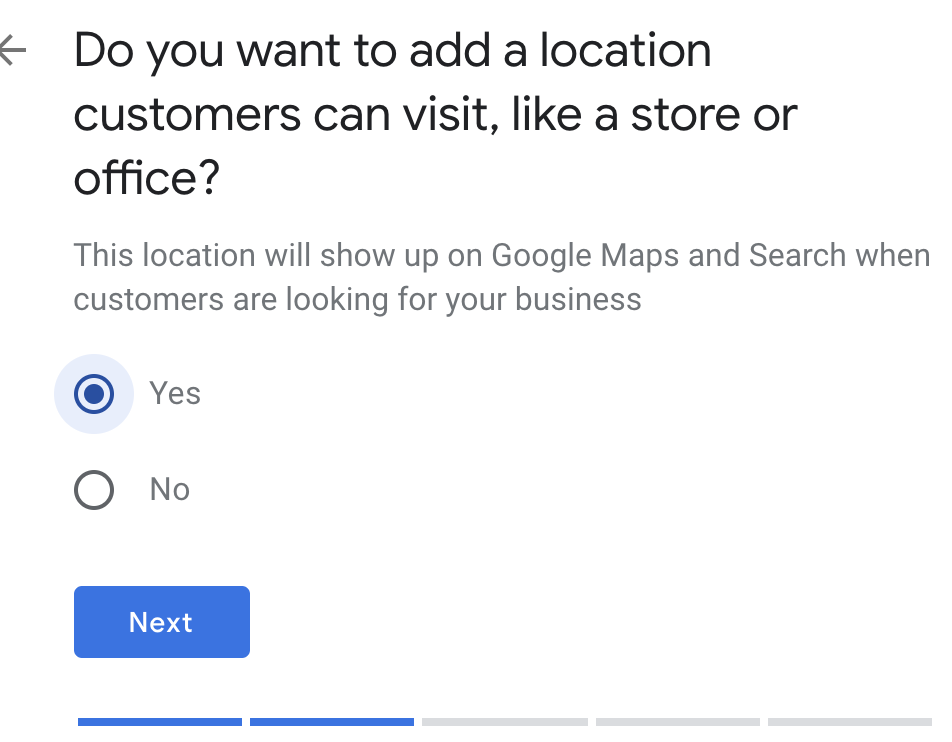
Step 6: Your next move depends on what type of business you operate. If your business is a brick and mortar, then the answer is yes. If you are a service provider (you go to your customers) and don’t have a physical storefront with signage then you will select no. If you are a service provider AND have a physical storefront with signage, then choose yes. Once you’ve made your choice, click Next.
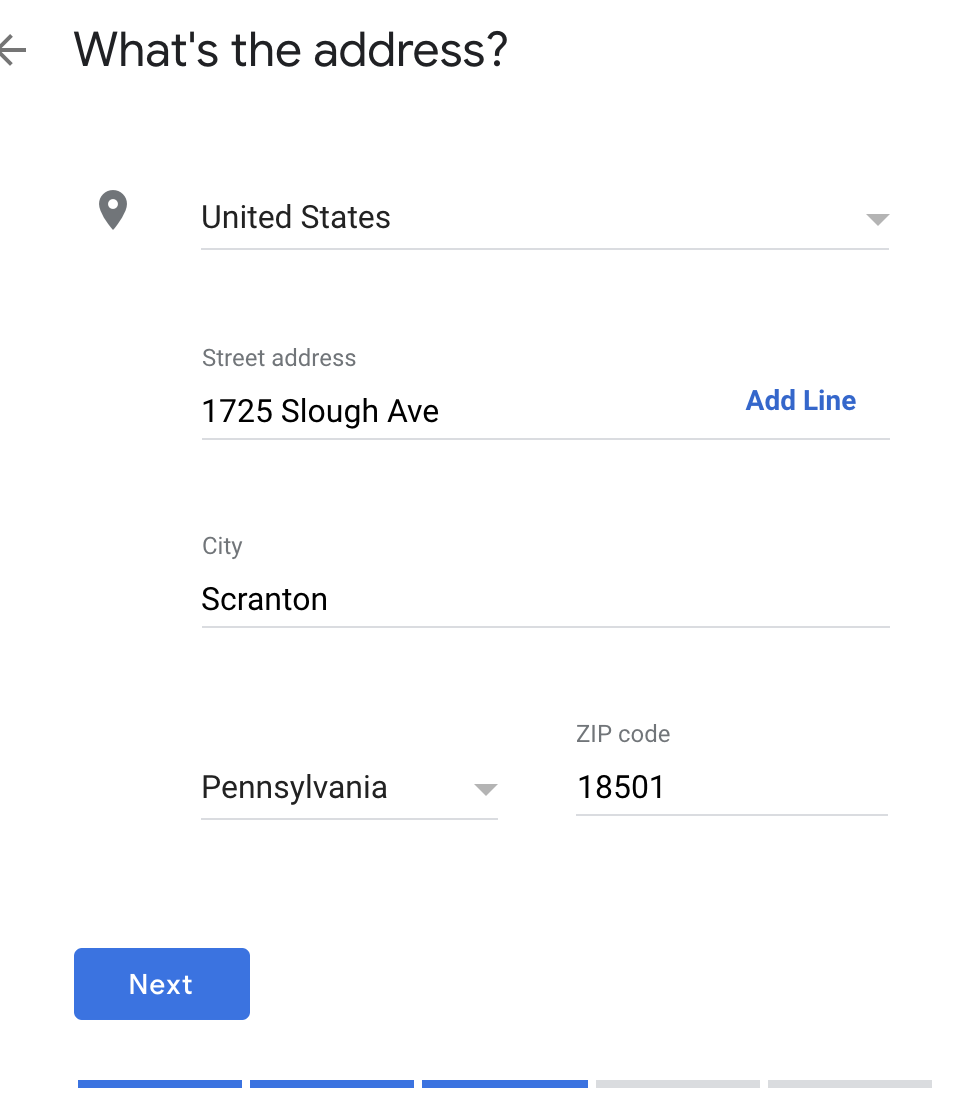
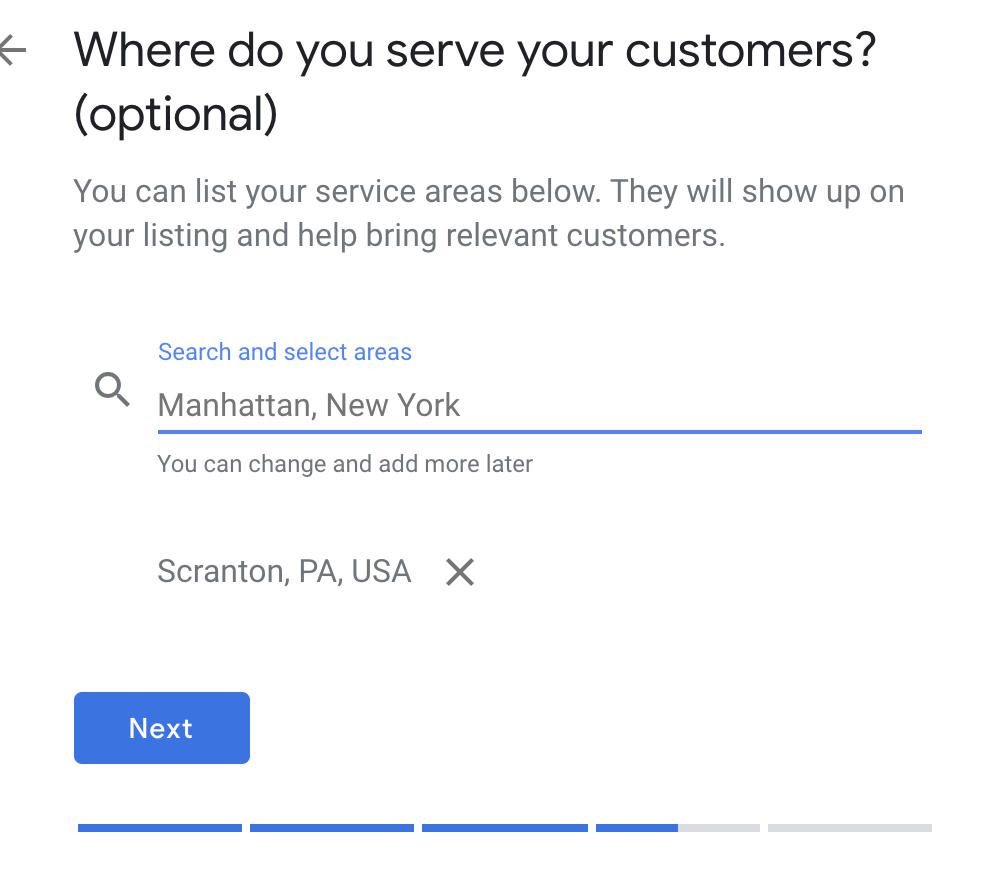
Step 7: Enter your address, then click Next if you answered yes in the previous step. If you chose no in the previous step, you will be asked to enter your service area. Once finished, click Next.
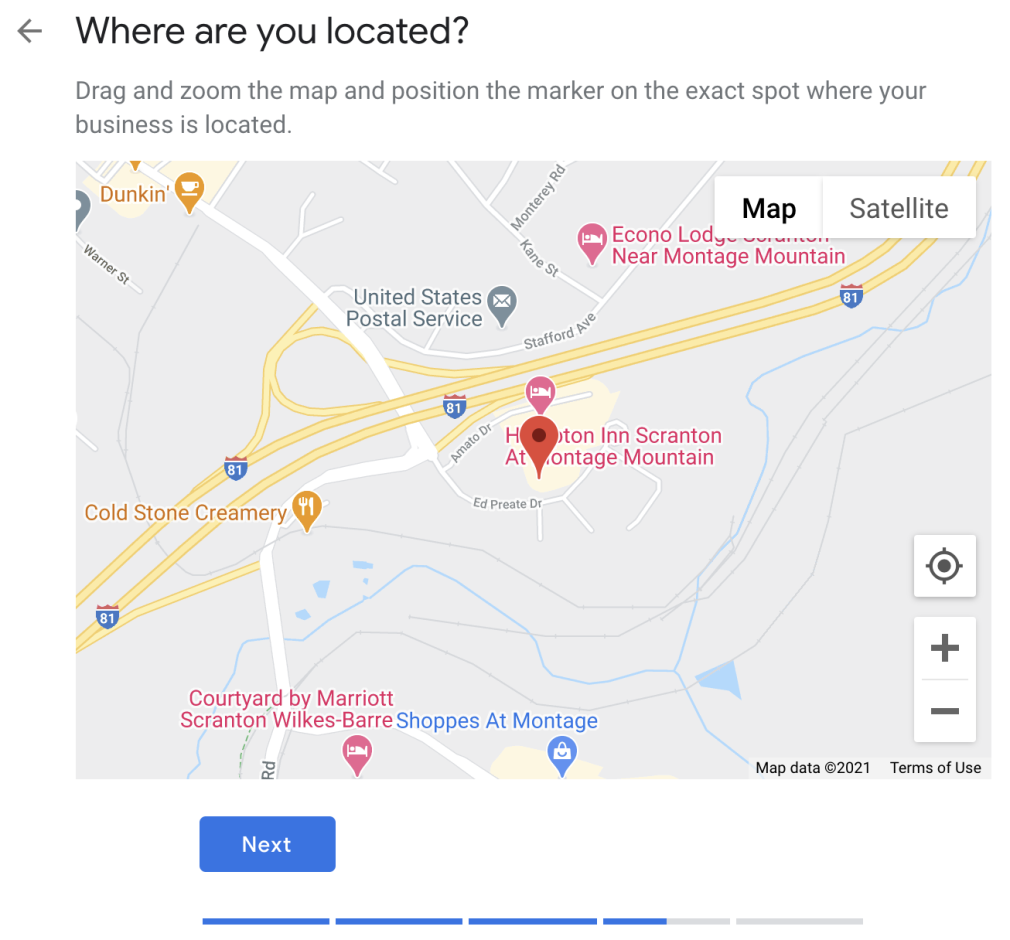
Step 8: If you are displaying your address, you might be asked to point to the exact spot where your business is located. Once finished, click Next. If you are not showing your address, you will be asked to provide your business phone number and website.
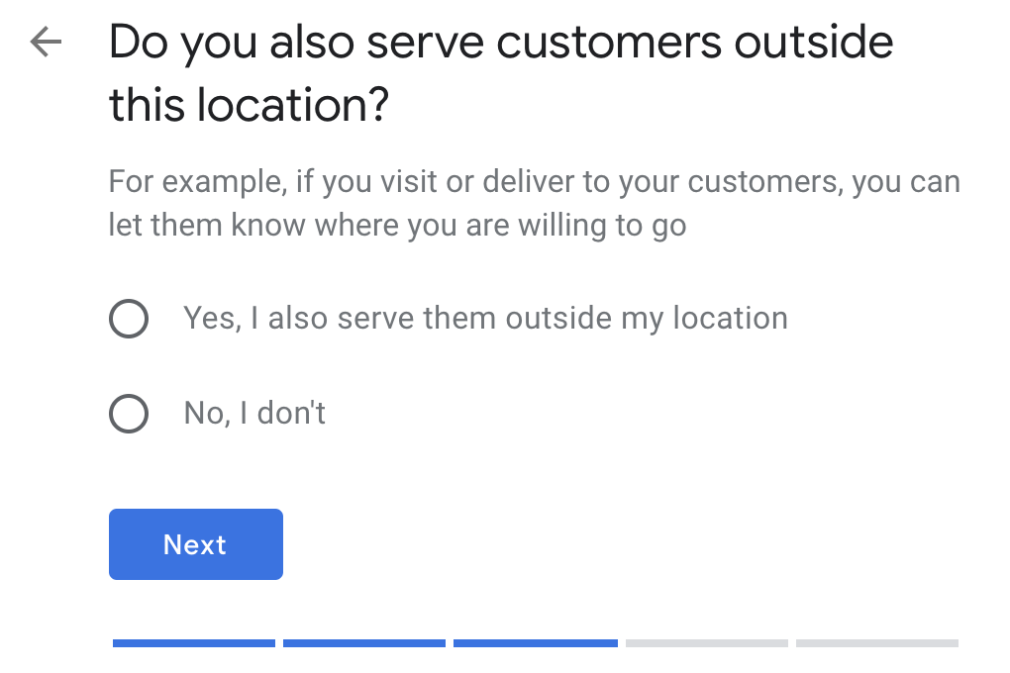
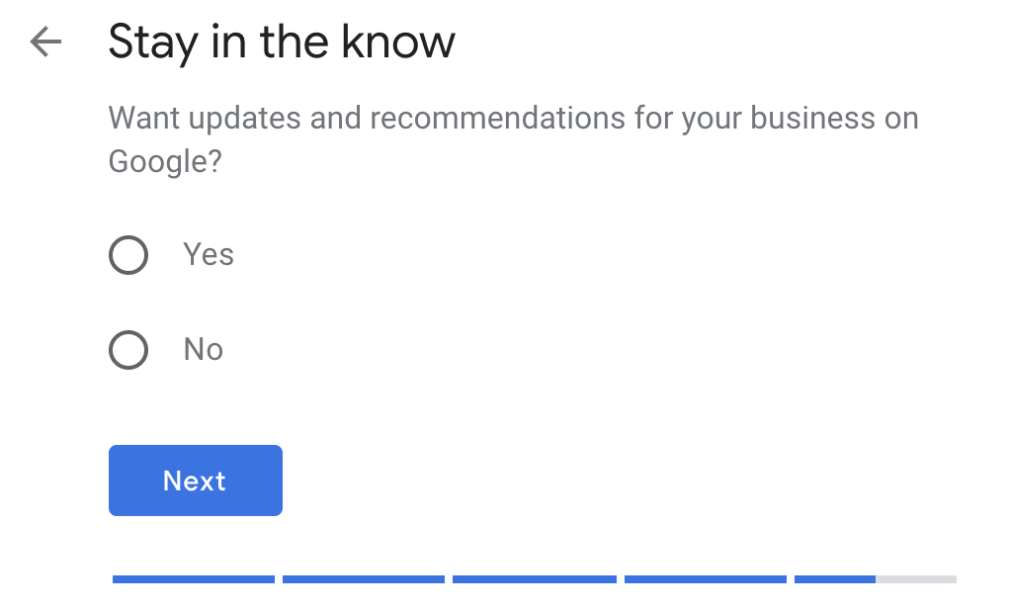
Step 9: If you’re showing your address, you’ll be asked if you also serve customers outside of your location. If you are not showing your address, you’ll be asked if you want to get updates and recommendations from Google. Choose your answer, then click Next.
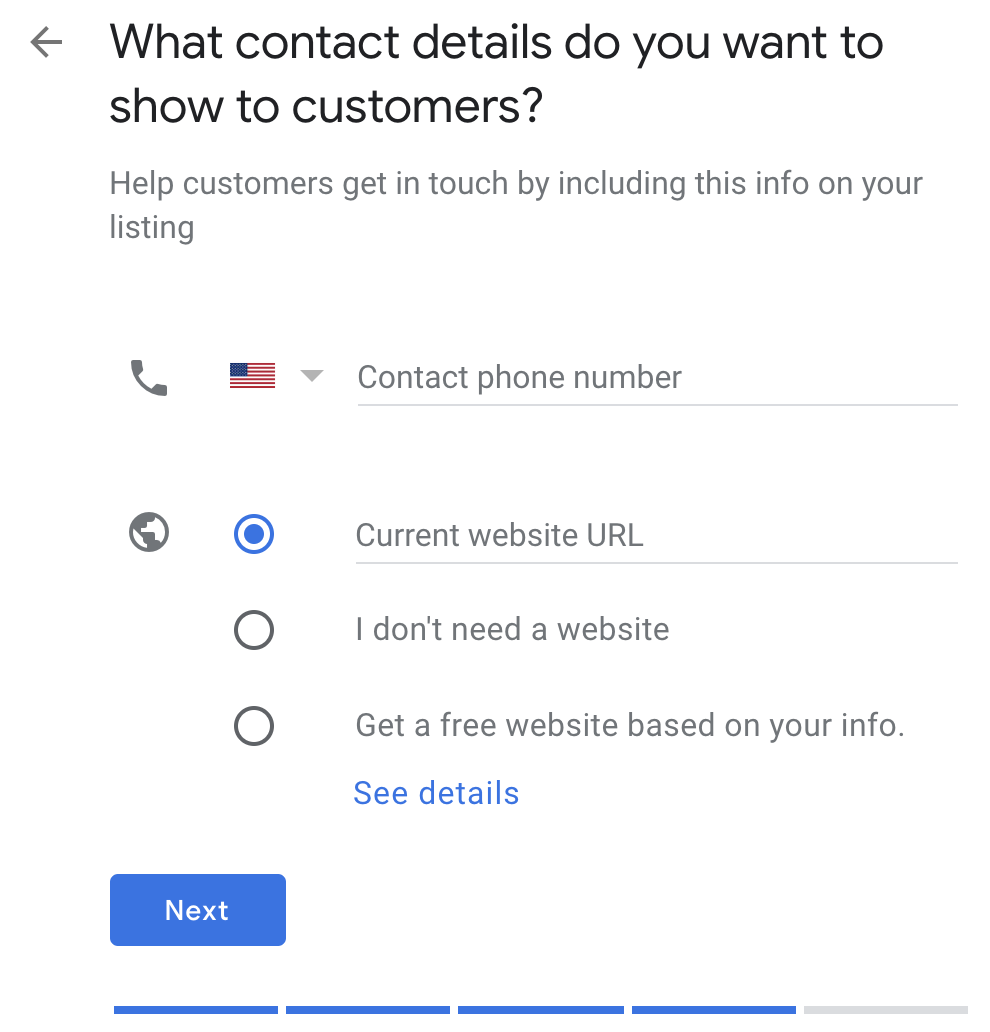
Step 10: If you’re showing your address, you’ll be asked to add your phone number and website. If you are not showing your address, skip to Step 10. Once you’ve added your website address and phone number, click Next.
Step 11: Time to finish and start the verification process! Select “Finish.”
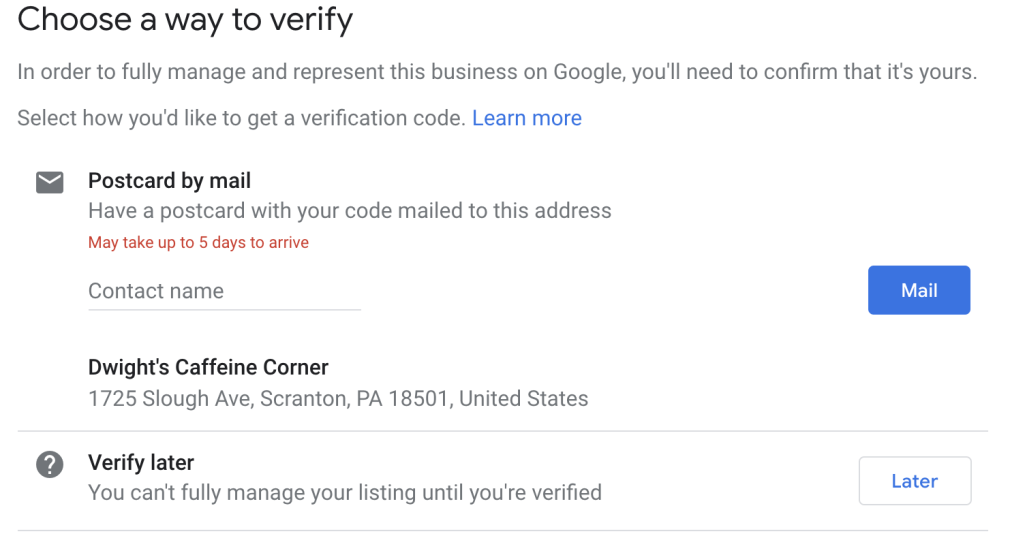
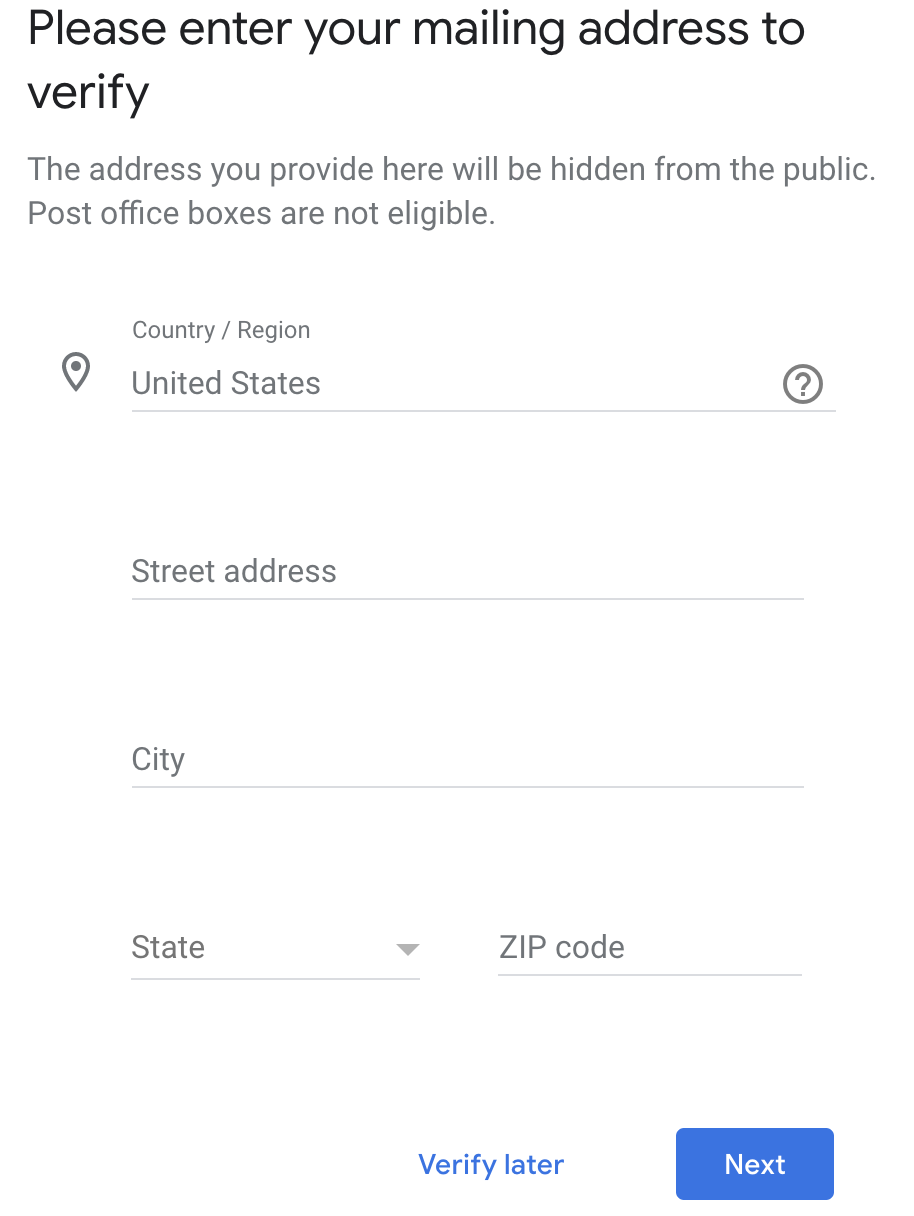
Step 12: If you are showing your address, you’ll be prompted to verify by postcard with an option to add a contact name. If you are hiding your address, you’ll be prompted to add an address for verification purposes. Your address will not be shown but is needed to verify your business.
Step 13: Once you receive the postcard (usually within 5 business days), log back into your listing to verify your listing.
Scenario 2: Listing exists, unclaimed
If your business has been around for at least 6 months, you might already have a Google My Business listing that was automatically created.
Go to Google Maps and perform a search for your business name. If a listing shows up and you see “Claim this business,” then claim it! If you see your listing and there’s a label that says ‘Manage this listing,” then head to Scenario 3.
If you have the option to claim the listing, you’re going to be asked to make sure the information is up to date, then you’ll go through the verification process.
Scenario 3: Listing exists, claimed
Maybe a former employee, an email address you don’t have access to anymore, or a former agency that claimed the listing on your behalf. Whatever the reason is, you don’t have access to your Google My Business listing.
Go to Google and perform a search for your business. Within the panel, you’ll see ‘Suggest an edit • Own this business?’ Select “own this business.”
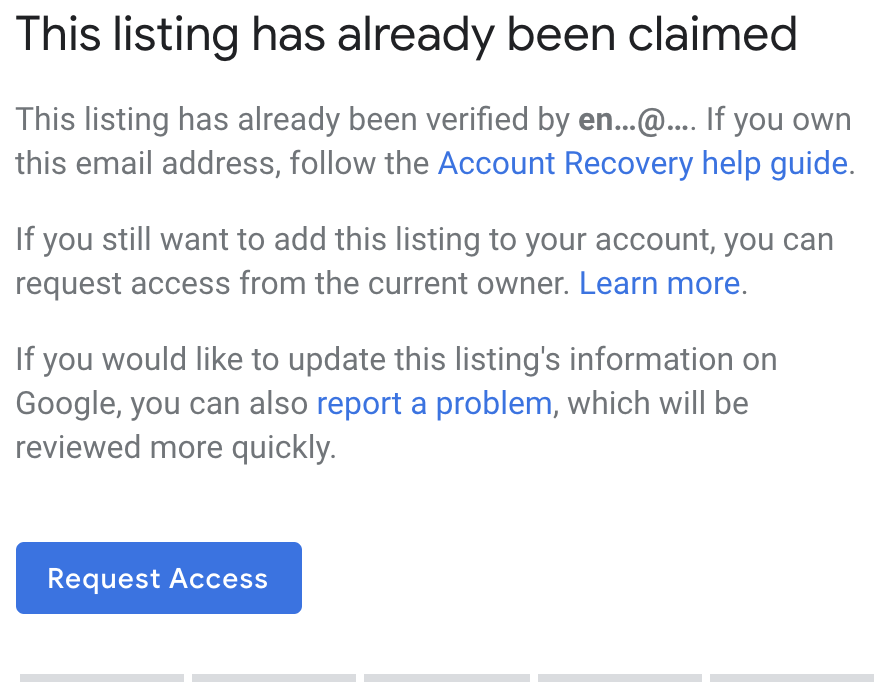
Google will show the first 2 characters of the email address that owns the listing. Sometimes, this may spark your memory with the email address that you used years ago to claim the listing.
If you don’t know the email address, click on the Request Access button.
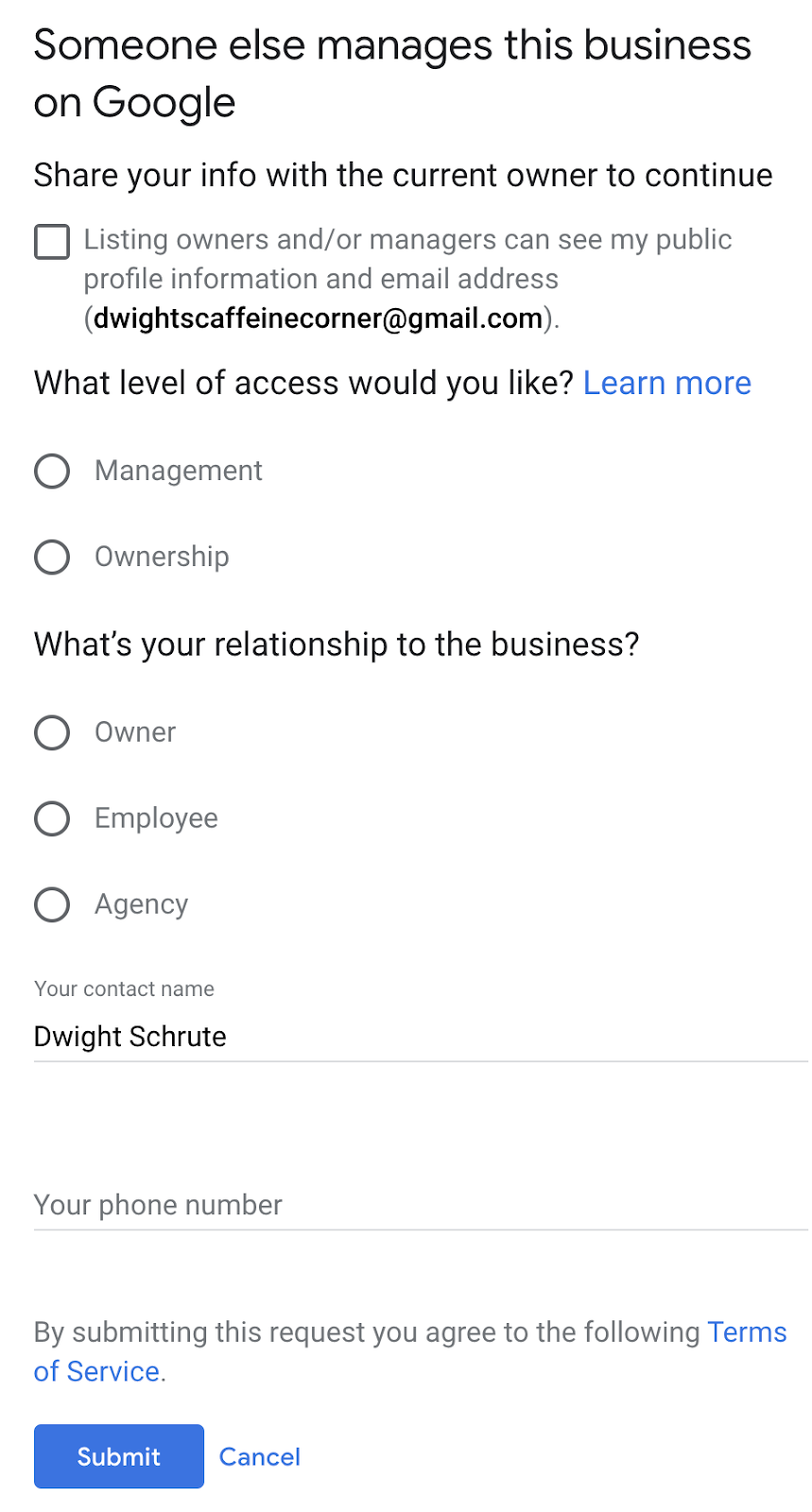
More often than not, you’re going to check the box to share your info with the current owners and managers of the listing.
For level of access, choose Ownership.
Your relationship to the business is likely going to be owner since you’re requesting ownership of the listing.
Provide your name and phone number, then submit.
After you submit the form, the current owner of the listing will get an email that asks them if the request is valid. You’ll also receive a confirmation email. Keep the confirmation email.
The current owner of the listing has 3 days to respond to your request. You can check the status of your request by clicking on the link within the confirmation email.
If your request is approved, you’ll get an email confirmation and can then start managing the profile.
If your request is denied, you’re going to need to contact Google My Business support via the Help Center.
Alternatively, you can get in touch with GMB Support on Twitter. It might take them a few days to respond, but they’ve been helpful in the past.
If the current listing owner does not respond within 3 days, you’ll get the option to claim the listing. Sign into g oogle.com/business and you should see an option to verify the listing.
Once you get access to the listing, the first thing you will want to do is make sure that anyone who should have access to the listing does. Since you are now the primary owner of the listing, you can add or remove users from having access.
Next Steps
Once you’ve created or updated your listing, be sure to stay on top of it! Listing management is an important part of ensuring the information around your business is useful and accurate.
Set a predetermined time to check in on your listing, try a few marketing strategies to connect with your audience, and keep an eye out for any user interactions with your listing. You can also use listing management tools to take the guesswork out of managing your listing.

























 Eduindex
You must be logged in to post a comment.