10 Best Places to visit in Manali

Manali is a resort and tourism town in the Himachal Pradesh highlands of India. It is located in the Kullu Valley, which is created by the Beas River.

Some places you must visit if you are visiting Manali are –

Hadimba Temple

This historic temple, also known as Hidimba Devi Temple and Dhungari Temple, was built by Maharaja Bahadur Singh in 1553. The temple is devoted to Hidimba Devi, Bheema’s wife, as the name suggests. On the grounds, there is another temple dedicated to Hidimba Devi’s son Ghatotkacha.

Solong Valley

Manali is only a short drive away from Solang Nala. It’s a sanctuary for adventure and sports enthusiasts, and you can test your abilities on a pair of skis or go on a snowmobile adventure while you’re here. People come here to do zorbing and paragliding when the weather warms up. You may also take a cable car ride to see breathtaking views of the Himalayas. Winter is the greatest season to visit if you want to participate in snow-based activities and sports, while summer is excellent for other adventure sports.

Hampta Pass

The Hampta Pass walk offers spectacular views of the Kullu Valley and the Lahaul Valley. The trek’s main feature is Chandratal Lake, which is located along the way. The pass is located at an elevation of nearly 4000 meters in the Pir Panjal Range, and the path includes spectacular river crossings.

Arjun Gufa (Arjun Cave)

The Arjun Cave, which lies adjacent to the Beas River’s rushing currents, is linked to a legend from the Hindu epic Mahabharata. Arjun, one of the Pandava brothers, is said to have meditated here. Arjun Cave, one of the greatest spots around Manali for a basket picnic, offers breathtaking views of the surrounding hills and valleys.

Himalayan Nyingmapa Buddhist Temple

The serene stillness of Manali’s Nyingmapa Buddhist Temple can soothe even the most frayed nerves. This Shangri-La-style sanctuary is in the heart of the bustling city, with pagoda-style buildings and vivid colours adding a magical charm to the scene.

Vashisht Hot Water Springs and Temple

Vashisht village is home to a magnificent temple nestled within the spectacular Himalayan landscape, making it a spiritually significant location. The shrine’s interiors include wooden carvings, ancient figures, and paintings, and the temple is thought to have a history of over 4000 years. The existence of hot springs, which are thought to have therapeutic powers, adds to the uniqueness of this place.

Beas River

The Beas River is a natural icon in the area that will accompany you on your Manali vacation for the most of the time. Vashisht village is known for having some of the greatest views of the river valley, while a journey to Kothi will get you up close to its beautiful blue waters. Water sports such as kayaking and rafting are popular in the Beas.

Great Himalayan National Park

Many unique species, including over 1000 plants, 209 bird species, and 31 animal species, may be found in the park. The secretive snow leopard reigns supreme, with populations of Himalayan tahr and brown bears also present. Photographers will be fascinated by the variety of wildflowers and glacial valleys that dot the landscape.

Gulaba

A vacation to Manali should involve trips to surrounding villages to learn about the local culture as well as take in the breathtaking scenery. The village features some of Himachal Pradesh’s most fascinating trekking paths, making it a popular winter destination for those seeking snowy scenery.

Rohtang Pass

This high mountain pass in the Pir Panjal Range, at an elevation of 4000 meters above sea level, will take your breath away. Rohtang Pass is a haven for adventurous sports like mountain biking and skiing, in addition to being a favorite hub of nature enthusiasts, painters, and photographers for decades.
The Jagannath Rath Yatra

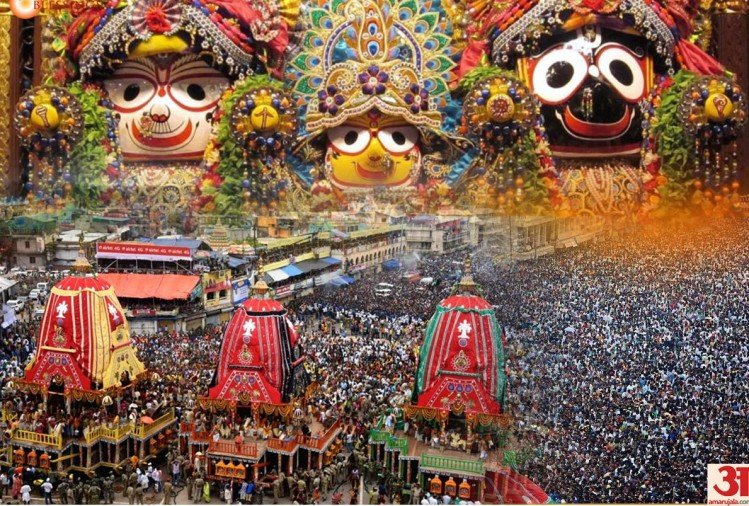
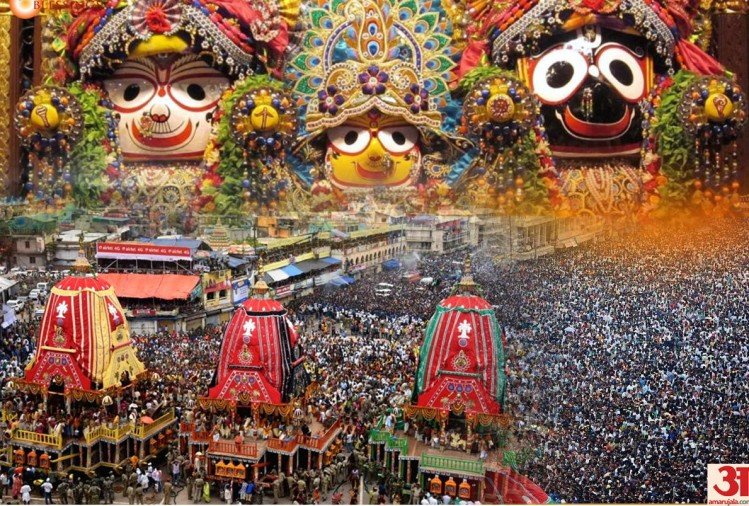
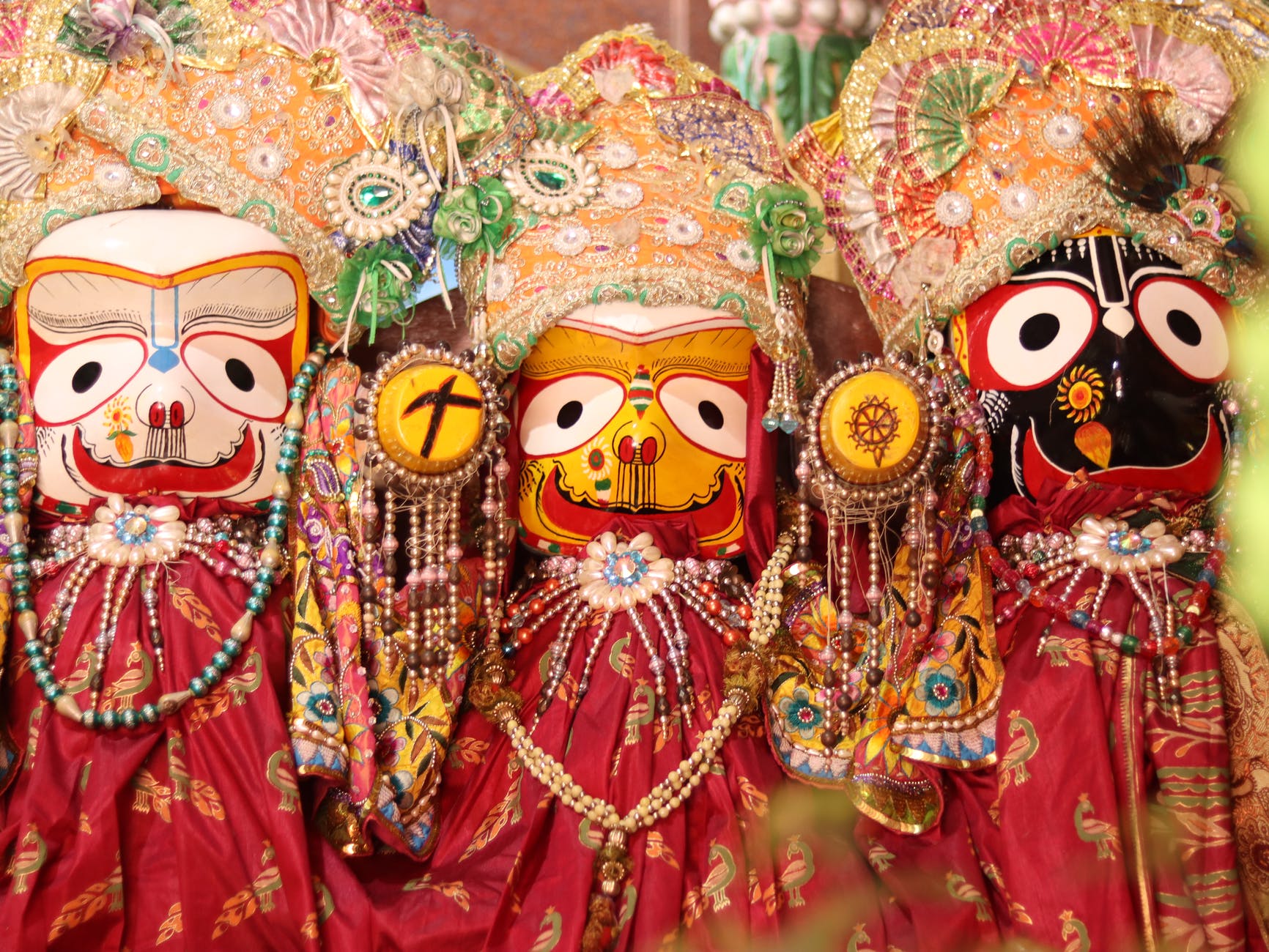
The Jagannath Rath Yatra is an annual Hindu festival associated with Lord Jagannath celebrated in Puri at the state of Odisha. It is celebrated on the Ashadha Shukla Paksha Dwitiya which is the third month according to the traditional Oriya calendar. A 9-day long event, it is celebrated as the return journey of Lord Krishna- who is known as Lord Jagannath, his brother Balabhadra- also known as Balaram and his sister Devi Subhadra to Vrindavana . On their way back from the Shri Gundicha Temple, the three stop near Mausi Maa’s Temple (their aunt’s abode) where Poda Pitha is offered to them.

The rath yatra begins at the Jagannaath Temple in Puri. The Jagannath Temple is believed to have been constructed by the king of Ganga Dynasty- Ananta Varman Chodaganga Deva in the 12th century(source-wikipedia). The image of Sri Krishna (Lord Jagannath) in the temple of Puri is made of wood and is replaced every 12 or 19 years by an exact replica. This temple is part of the Char Dham( that comprises of the temples of Badrinath, Dwaraka, Puri and Rameswaram).

Every year, the rath of all three deities is newly constructed by a specialized team of carpenters from the wood of a particular type of neem tree and takes about 2 months to construct. They are given hereditary rights for the very same. A week prior to the Rath Yatra, the Jagannath temple’s doors are shut as the lord is believed to have caught a high fever during his annual bath. After the end of the 7-day rest period, the doors are opened and the 3 km Rath Yatra begins, where thousands of devotees from all over the world participate in pulling the raths of the 3 deities to Shri Gundicha Temple. It is a popular belief that anyone who participates in the Rath Yatra is blessed with a good fortune. During the festival, the king dressed as a sweeper, sweeps the area around all the 3 chariots with a golden broom and sprinkles sandalwood water and powder as a part of the Chera Paahara ritual held on two separate days that marks the beginning as well as the end of the Rath Yatra. This day of the beginning of Rath Yatra also marks the beginning of agricultural season and farmers start ploughing their fields. It also marks the beginning of a three weeks long Chandan Yatra.

This year, however, in response to the covid-19 pandemic that is spread across the country, the government said that the Rath Yatra will take place with only 5 vehicles including 3 chariots and no devotees. The Supreme Court also said that the Rath Yatra will take place in limited areas of Puri. It began on the 12th of July,2021.

The Real Santa Claus

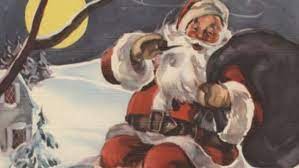
Santa Claus—otherwise known as Saint Nicholas or Kris Kringle—has a long history steeped in Christmas traditions. Today, he is thought of mainly as the jolly man in red who brings toys to good girls and boys on Christmas Eve, but his story stretches all the way back to the 3rd century, when Saint Nicholas walked the earth and became the patron saint of children. Find out more about the history of Santa Claus from his earliest origins to the shopping mall Santas of today, and discover how two New Yorkers—Clement Clark Moore and Thomas Nast—were major influences on the Santa Claus millions of children wait for each Christmas Eve.


The Legend of St. Nicholas: The Real Santa Claus

The legend of Santa Claus can be traced back hundreds of years to a monk named St. Nicholas. It is believed that Nicholas was born sometime around 280 A.D. in Patara, near Myra in modern-day Turkey. Much admired for his piety and kindness, St. Nicholas became the subject of many legends. It is said that he gave away all of his inherited wealth and traveled the countryside helping the poor and sick. One of the best-known St. Nicholas stories is the time he saved three poor sisters from being sold into slavery or prostitution by their father by providing them with a dowry so that they could be married. 

Over the course of many years, Nicholas’s popularity spread and he became known as the protector of children and sailors. His feast day is celebrated on the anniversary of his death, December 6. This was traditionally considered a lucky day to make large purchases or to saasget married. By the Renaissance, St. Nicholas was the most popular saint in Europe. Even after the Protestant Reformation, when the veneration of saints began to be discouraged, St. Nicholas maintained a positive reputation, especially in Holland.

Sinter Klaas Comes to New York

St. Nicholas made his first inroads into American popular culture towards the end of the 18th century. In December 1773, and again in 1774, a New York newspaper reported that groups of Dutch families had gathered to honor the anniversary of his death.

The name Santa Claus evolved from Nick’s Dutch nickname, Sinter Klaas, a shortened form of Sint Nikolaas (Dutch for Saint Nicholas). In 1804, John Pintard, a member of the New York Historical Society, distributed woodcuts of St. Nicholas at the society’s annual meeting. The background of the engraving contains now-familiar Santa images including stockings filled with toys and fruit hung over a fireplace. In 1809, Washington Irving helped to popularize the Sinter Klaas stories when he referred to St. Nicholas as the patron saint of New York in his book, The History of New York. As his prominence grew, Sinter Klaas was described as everything from a “rascal” with a blue three-cornered hat, red waistcoat, and yellow stockings to a man wearing a broad-brimmed hat and a “huge pair of Flemish trunk hose.”

‘Twas the Night Before Christmas

In 1822, Clement Clarke Moore, an Episcopal minister, wrote a long Christmas poem for his three daughters entitled “An Account of a Visit from St. Nicholas,” more popularly known as “‘Twas The Night Before Christmas.” Moore’s poem, which he was initially hesitant to publish due to the frivolous nature of its subject, is largely responsible for our modern image of Santa Claus as a “right jolly old elf” with a portly figure and the supernatural ability to ascend a chimney with a mere nod of his head! Although some of Moore’s imagery was probably borrowed from other sources, his poem helped popularize the now-familiar image of a Santa Claus who flew from house to house on Christmas Eve in “a miniature sleigh” led by eight flying reindeer to leave presents for deserving children. “An Account of a Visit from St. Nicholas” created a new and immediately popular American icon.

In 1881, political cartoonist Thomas Nast drew on Moore’s poem to create the first likeness that matches our modern image of Santa Claus. His cartoon, which appeared in Harper’s Weekly, depicted Santa as a rotund, cheerful man with a full, white beard, holding a sack laden with toys for lucky children. It is Nast who gave Santa his bright red suit trimmed with white fur, North Pole workshop, elves and his wife, Mrs. Claus

Santa Claus Around The World 

18th-century America’s Santa Claus was not the only St. Nicholas-inspired gift-giver to make an appearance at Christmastime. There are similar figures and Christmas traditions around the world. Christkind or Kris Kringle was believed to deliver presents to well-behaved Swiss and German children. Meaning “Christ child,” Christkind is an angel-like figure often accompanied by St. Nicholas on his holiday missions. In Scandinavia, a jolly elf named Jultomten was thought to deliver gifts in a sleigh drawn by goats. English legend explains that Father Christmas visits each home on Christmas Eve to fill children’s stockings with holiday treats. Père Noël is responsible for filling the shoes of French children. In Italy, there is a story of a woman called La Befana, a kindly witch who rides a broomstick down the chimneys of Italian homes to deliver toys into the stockings of lucky children.

ALL ABOUT CHESS

History of Chess

The origin of chess is something that is debated and there is not really a consensus on its origin or even the history of chess, from the old to the present.

Some say that versions of chess and its board date back from Ancient Egypt or Dynastic China, but its most supported origin is that it first appeared in India around the 6th century, at that time it would have the name of Chaturanga.

Over time, it eventually reached Persia and its name eventually changed, being now called Xatranje, probably having other rules as well.

It eventually spread throughout Europe slowly and it took about 500 years for Xatranje to begin to look more like the chess we know today.

In the yoer of 1475 began to be consolidated with the current rules and its name also eventually changed to chess but it still took a few hundred years for Europe to play with the most modern pieces and rules as well.

In the middle of the nineteenth century began to appear tournaments and chess competitions, thus giving rise to a sport, which was always dominated by the same players and had World champions who maintained their reign for long periods, 20 / 30 years for example.

Chess game

The game of Chess aims to give the “mate” in the king of the opponent player. This happens in the following situations:

  • The king can not move to any house (they are all in the attack line of the opponent’s pieces);
  • No part can stand in front and protect the King;
  • The piece you are attacking cannot be captured;

If any of these conditions arise, then the “mate” or “checkmate” will occur and the game ends, winning the player who applied the “mate”.

Board and Chess Pieces

The chessboard is composed of squares of white and black color (8 squares of length on each side), being these always alternating.

The pieces also have the same colors and each color corresponds to the pieces of a player.

The board should be positioned so the last house on the right side of the row closest to each player is a white square.

The game of chess consists of the following pieces:

  • Pawn
  • Tower
  • Horse
  • Queen
  • Bishop
  • Rei

The pieces have their own order to be placed on the board (Follow the positions that are represented in the image);

Please note: The position of the King and Queen changes depending on the player, following the rule:

White King – Black House
Black King – White House
White Queen – White House
Black Queen – Black House

Who starts playing is always the player who owns the white pieces.

Chess Moves / Plays

Each piece has its unique way of moving around on the board, which enables a very large number of patterns and strategies, making chess a strategy sport and more interesting.

The possible plays per house piece are:

Pawn
This can only just move forward (no more part has this rule), being that it can only advance 1 home in front, or 2 if it has never been tweaked. It is also the only one that moves differently when it is to take the opponent’s piece, and he can only take the piece that is diagonally forward.

Tower
The tower has a fairly simple movement. It can move forward, backward, left or right in a straight line across the entire board as long as it has the path without any part.

Horse
The horse is the one that has the most unique movement. It can only move in L. format. This means that you can only walk two houses forward and one to the side at each move. This piece can already make your move jumping over other pieces (it’s the only one with this rule).

Bishop
The bishop has a movement similar to that of the Tower, only the latter, instead of moving in a straight line, moves diagonally, and can not pass over any part either.

Queen
This is considered the most powerful piece of Chess, this due to its versatility of movements since it can make the same movements of the Tower and the Bishop.

Rei
The King can move 1 each in all directions. The only restriction that this has is not being able to go to a house that is “check” (in the line of attack) by some part of the opponent.

Special moves

There are certain moves that can be made under special circumstances that make this magnificent game even more interesting and competitive. The special plays that exist are:

Pedestrian Promotion

When you can get one of your pawns to reach the end of the board (on the first line of the opponent), the pawn must be replaced by another piece (being a bishop, tower, queen, or horse), and is usually chosen the queen since it is the most powerful piece of the game.

Roque

It consists of a movement between the king and the queen, who change positions at the same time, in an attempt to defend the king by taking it from the center of the board and move the tower to a better position of attack.

In this movement, the king moves toward the tower two houses and the tower moves to the king’s side passing over him. There are two rocks: the small and the large, the only difference being its designation. The big rock is when the rock is made with the tower farthest from the king and the small is the opposite.

To make this move, certain conditions must be met:

  • The king could not have moved;
  • The tower can not have been moved;
  • The way between the tower and the king must be clean;
  • The king can not stand in a position that is in the line of attack of the enemy;

Passing

This is a special way for the pawn to move and can take the opponent’s pawn that passed next to him when he is in the 5 row counting from his field. Observe the images to better understand the move.

For this move there are also special conditions, which are:

  • Your pawn should be in the 5 row
  • The pawn of the opponent has advanced two houses and thus have stayed next to his;
  • The bid must be made immediately to the movement of your opponent;

Some Chess Rules

Chess also has some rules. Let’s just highlight the main rules that are usually addressed.

  • When a player lifts a piece, it may place it anywhere that is valid for the movement of that piece. After landing the piece cannot be removed, only if it has made an invalid movement.
  • When promoting a pawn, the player can touch a piece that is outside the board and change for his pawn, thus finishing the move;
  • During the Roque the player must first take the King and then in the Tower thus making their exchange of positions. If you touch both at the same time you can do it. If this one raises the King with the intention to make the Roque but this is impossible, then it must move the King to a valid house.
  • Players must not speak during the game, only when asking for a tie or advising the referee of any infraction. In games between amateurs it is common to announce the “check” but among professionals, the same should not be announced.

4 best places to visit in Delhi

Delhi is not only the capital of India but also lies in the heart of the country. It is filled with joyful and hard working people who always merry on hangouts around the city. Each place is special and offers something one of a kind in Delhi. People from various regions visit here to gain sale of their innovative and beautiful products. This has also led to emergence of various known markets in the place. Here are some of the favourite hangout places of ‘Delhiites’.

Photo by Rabi Debbarma on Pexels.com
  1. Chandni Chowk

It is a very famous market in old Delhi for spices, sarees, religious places and many more. What is more famous is the Paranthe wali Gali. The variety and deliciousness of their Paranthas are unmatched since 19th century, the period of their start-up. There’s always a crowd at the place. The Chandni Chowk market is also famous for variety in clothing and tasty food. There are over hundreds of delicacies to wet your tongue ranging from sweet to spicy, the street food in Chandni chowk always attracts visitors. There are religious places- temples, church, Gurudwara and masjid set up in the same row where people come from distant places to worship. Nearby is the Red Fort, the historical monument established by the Mughal emperor-Shahjahan. The crowded streets never end here. The market has a lot to offer to general public as well as tourists. There are popular shops of sweets and local food vendors, you can also find shops selling trophies, and other items such as bells and wooden statues, handicrafts, etc. Chandni chowk has also witnessed shooting of many Bollywood movies. Fair are also organised close to the place during festivals, bringing larger crowd to the market.

2. Connaught Place (Rajiv Chowk)

Photo by Rachel Claire on Pexels.com

It is a go-to place especially when it comes to youngsters. It covers a wide area built with many commercial buildings and hangout spots for people to enjoy food and luxury. The Hanuman temple is also a reason behind the crowd at the place. Connaught place of Delhi also holds many cultural events at its central park. The Georgian style architecture of the place brings the difference out from other places. The market is built with big showrooms offering branded products and good services.

3. Lodhi Garden I Khan Market

The Lodhi Garden is a beautiful city park spread out in a vast area and is one of the old green places in Delhi holding historical significance. Located in Lodhi estate, it is a prime area to calm down and relax in between the nature, just aligned to the main roads. The architectural heritage here is an attraction to tourists as well as the locals. The serenity provided by sweet chirpings of the birds and clean water of the lake is magical and relaxing. The garden has tombs and other architecture.

Nearby is the Khan Market to shop luxurious items from foods to branded clothing. It is a tourist place situated on the main road of the Lodhi estate, well-fenced with structured walls. It is not much crowded and quite close to the metro station.

Photo by Elena Saharova on Pexels.com

4. Karol Bagh

It is a commercial as well as residential place located in Central Delhi. It has busy shopping streets and tasty street food serving the crowd around. This place has also served as shooting site in pop culture. There is direct metro connectivity to Karol Bagh. Branded as well as non branded and inexpensive items are available in the market adjoining the metro station with less crowded streets to offer a mindful shopping experience.

Why isn’t everyone a feminist?

It has come to my surprise that most people do not identify themselves as feminists. I have no idea what some people think feminism is. So, here is the dictionary meaning of the word feminism. 

Feminism is defined as the belief in social, political, and economic equality of sexes. 

I would like to emphasise the word equality. Feminism does not support sexism.Feminists do not put men down, nor do we support the women who put them down. Feminism is the belief in equality and not female superiority.

I was surprised to see some of the women not identifying themselves as feminists. I have come across women saying things like: 

I don’t face gender discrimination, so why should I support feminism. 

To all the women who have similar beliefs, it is the FEMINISTS that got you to a place where you can say sentences like these. 

Do you really think that without voices being raised, you got to a place where you are?

Women did not even have the right to vote, study, or work. Back in the old days, men did not even consider women. So, we have come a long way from women-only staying in the households to now becoming presidents.

 Secondly, there are still so many issues happening against women, and we must raise voices. If you have the privilege to face no gender discrimination, that is good for you. But do you not want that for every single girl out there?

To all the people who think that feminism is unnecessary, I would like to show some of the achievements done by feminists.

  • Right to vote
  • Gain access to birth control
  • Bought women out of household
  • Calling out on rape culture
  • Fought for legal discrimination
  • Making the workplace a little more equal

These were just a few of the things done because of feminists. So, the next time you think feminism is not needed and that we are already in an equal world.

Well, open your eyes. There is still a long way to go.

  • Saudi Arabia gave women the right to drive in 2018.
  • Each minute 28 girls are married before they are ready
  • One in three women have experienced physical or sexual violence
  • 62 million girls are denied an education all over the world
  • 4 out of 5 victims of human trafficking are girls

These were just a few facts out of 100 more issues that women face today. This data is for people who think we already have achieved gender equality. We have not and, we still need feminism.

If you are one of those people who does not like being labeled but believes in equality of both sexes. What are you afraid of? It is just a label for the betterment of our society. If you think people are going to judge you for it. Those are the people who did not do their research on what feminism is.

I am a proud feminist and, I am here to fight against the injustice that women go through. If you are with me, I hope you all identify yourself as a feminist.

If you are not convinced and, women with strong opinions on achieving equality bother you. Well, you can contribute to the world of misogyny. 

NASA girl trolled for her faith- peak of Hinduphobia

Humanity hit a new low when an Indian origin American girl was heavily trolled by netizens just because of her faith. NASA, in order to invite new interns tweeted an application showcasing the diverse nature of the organization. An Indian girl also featured in the tweet with Hindu idols in the background of her picture.

An innumerable number of trolls targeted the girl criticizing NASA for including such a “stereotypical” image of Indians according them. But is it okay to bash someone merely because they follow a particular faith or religion? The girl undoubtedly secured a place through her efforts and a futile, good for nothing crowd directly mocked her as a fake science-lover only because she believes in her Gods. If atheism was a criterion to get selected in any scientific organization then people should also nullify the work and contributions of Einstein, Newton and Darwin.

It is so shameful to read the tweets and realize how much hatred and Hinduphobia is prevalent in society. Some of the tweets read ‘She missed Lord Ganesha and 33 million other Gods’, ‘NASA and gods don’t mix. The Indian kid seems to have some kind of obsession with Gods’. Other tweets are too vile to read.

Another user very accurately pointed out “All those mocking her: Hijab, polygamy, child marriages, Niqab, prayers on road, etc. are supposed to be respected under the concept of ‘choice’ and ‘pluralism’ but a Hindu lady practicing her faith has to be ridiculed. Carry on! Your bigotry will make her faith stronger.”

It is indeed true that the case would have been very contrasting only if the girl was wearing either hijab or had a Christ portrait in the background. However, irrespective of any religion or faith, no one should be criticked or targeted just because they are proud of their roots.

HISTORY OF LAKSHADWEEP.

Lakshadweep is one of India 8th union territory. Local traditional attribute the the settlement on this islands to the period of Cheraman Perumal, The last king of Kerala. The principal islands in the territory are minical and those in the amindivi group. Lakshadweep means one lakh islands in Malayalam the official as well as the the widely spoken native language in the territory. The region forms a single Indian district with 10 subdivisions the island are the The northernmost of the Lakshadweep Maldives chagos group of islands which are the top of a watched under sea bridge mountain range the chagos Lakshadweep.

There are reference to the control of the islands by the Charas in the Sangam patirrupattur local traditional and legends attribute the first settlement on these islands the oldest inhabited Islands in the group are Amini, lalpeni, Andetto, Kavararti and Agatti. Most people of Lakshadweep are descendants of migrants from the Malabar coast of Southwest India and the islands are ethically e similar to coastal Kerala Malayali people the South most and second largest Islands of minicoy has and ethically e e population that are native to the Maldives it is believed that after is conversion to Islam at the behest of sono Arab merchants the present day kodungallor old as our town Kochi. It is believed that one of this sailing boats of Raja of cannanore was stuck by a fierce strong and they were shipwrecked on the island now known as bangaarama. The advent of Islam dates back to the seventh century around the year 41 hijra even after the convention of the entire Islands to Islam sovereignty remained in the ends of The Hindu rajah of chirakkal for some years later the administration of ireland’s passed onto the Muslim house of arakkal of cannanore around the middle of the 16 century.

Its traditional system of administration was treated by the English as something of miss government but they were more interested in their own political and economic interest that was the good government of the island. The soils of Lakshadweep agentry Sandy derived from the coral. The economic of Lakshadweep is agriculture and fishing coconut plums are the agriculture mainstay of Lakshadweep copra is produced and exported to the mainland and the cultivation of bananas vegetable fruit edible root crops and millet. The fishing is a continuous and ancient tradition of Skilled navigation among the territory. Other manufacturing activities coir coconut nosiery production fibre production weaving and boat building. The tourism promotes the industry which is closely monitored to guard against negative moment. The Government sponsored tour package available. The transportation to Lakshadweep is connected to the Indian mainland by sea and air there is and airport on the island of Agatti which has regular plane service to and from Kochi there are only a few miles of roads in Lakshadweep.

most of the Lakshadweep Islands speak Malayalam which is skin to old Sinhalese to safeguard indias vital shipping lanes to the middle East and Indian Navy base INS Dweeprakshak was commissioned on Kavararti Island.

Bioterrorism

From the past two decades , it is stated that the threat of biological warfare is not a myth but a harsh reality of the world . Due to the outbreak , we can recognise the high risk and consequences of bioterrorism.

This editorial provides you the overview of bioterrorism , it’s symptoms , causes , measures and impact on humans in present scenario .

Introduction

A bioterrorism attack is the deliberate release of viruses, bacteria, or other germs to cause illness or death. These germs are often found in nature. But they can sometimes be made more harmful by increasing their ability to cause disease, spread, or resist medical treatment.

Biological agents spread through the air, water, or in food. Some can also spread from person to person. They can be very hard to detect. They don’t cause illness for several hours or days. Scientists worry that anthrax, botulism, Ebola and other hemorrhagic fever viruses, plague, or smallpox could be used as biological agents.

Despite patchy intelligence, France started its own biological weapons programme in the early 1920s. It was headed by Auguste Trillat, an inventive German-educated chemist who envisioned and tested the sustained virulence of airborne pathogens.

The goal of bioterrorism is usually to create fear and/or intimidate governments or societies for the purpose of gaining political, religious, or ideological goals. Bioterrorism may have a different effect on societies than would weapons such as explosives.

Symptoms

The symptoms of exposure to a biological agent might include sore throat, fever, double or blurred vision, rash or skin blisters, exhaustion, difficulty talking, confusion, descending muscle weakness, nausea, abdominal pain, vomiting, diarrhea, and coughing.

History

Historically, biological weapons have been a threat to humans for many centuries. At those times, very crude methods such as fecal matter, animal carcasses, etc. were used to contaminate water sources, but now the concentrated forms of biological agents such as dried spores and genetically modified organisms are available, which are fatal even in minute quantity.

During the Indo-Pakistan war of 1965, a scrub typhus outbreak in north-eastern India came under suspicion. India’s defense and intelligence outfits were alert to the outbreak of pneumonic plague – well known in biological warfare – in Surat and Bubonic plague in Beed in 1994, which caused several deaths and sizeable economic loss.

Prevention

There are some points that you need to consider during the outbreak :

  • If you become aware of a suspicious substance, quickly get away.
  • Cover your mouth and nose with layers of fabric that can filter the air but still allow breathing. Examples include two to three layers of cotton such as a t-shirt, handkerchief or towel.
  • Depending on the situation, wear a face mask to reduce inhaling or spreading germs.
  • If you have been exposed to a biological agent, remove and bag your clothes and personal items.
  • Follow official instructions for disposal of contaminated items.
  • Wash yourself with soap and water and put on clean clothes.
  • Contact authorities and seek medical assistance. You may be advised to stay away from others or even to quarantine.
  • If your symptoms match those described and you are in the group considered at risk, immediately seek emergency medical attention.
  • Follow the instructions of doctors and other public health officials.
    Avoid crowds.
  • Wash your hands with soap and water frequently.
  • Do not share food or utensils.

Link

5 Must Read Books on Ancient Egyptian History :

Once a French novelist , Gustave Flaubert said , “ (Egypt) is a great place of contrast ; splendid things gleams in the dust “. Egypt is one of the great civilizations with its flourishing & mysterious historical significances. Their history make you wonder ,mysteries will make you interested & their story will make you addict .If you are a history lover then you must be a curious knowledge gainer about various aspects of ancient Egypt .Here are some recommended books for you to read & help you to know the Egypt in a new light .These book will take you to their time & experience you the glory of ancient Egypt at that time .

1.The Complete Gods and Goddesses of Ancient Egypt –– This book is written by famous archaeologist Richard H. Wilkinson , which is published in 2003 . This is one of the great book on Egyptology . This books talks about the mythology of ancient Egypt in great view . Worshiped gods & goddesses , their  myth , beliefs of ancient Egyptians all of those are recorded in this book very prominent way . It is a very detailed book . This book is available on Amazon .

2.The Cultural Atlas of Ancient Egypt This book is written by two renowned Egyptologist of United Kingdom , John Baines  & Jaromir Malek which is published on 31st October in 2000. This the most favoured book of ancient history for almost last 23 years in the whole world , As it’s name it has indeed lots of geographical photographic pictures , maps, table presentations , charts about ancient history . This book talks about the civilization of Egypt in ancient time. It includes architectural works ,social daily life , artistic sides of Egyptian people in detailed & analyzing manner. This is a very favourite book for history lover specially for Egyptology fans .

3.The Pharaohs of Ancient Egypt —  This book is written by Elizabeth Payne which was published in 1964 & an still now it has it’s glory in the field of Egyptian history . It is a type of landmark book which obviously gives a geographical presentation on ancient Egypt’s great architectures with times . This book has a detailed information about every individual Pharaohs ,lifestyle at the time of their ruling period , their grat works which is engraved in history . It also give away an idea about the works a of archaeologists behind these discoveries.

4.Pyramid — This renowned book is written by an British-American writer & illustrator Davis Macaulay which was published on 26th April, 1982 .This is a highly recommended book for interested readers . This book focuses on the pyramids of Egypt .The black & white illustrations give a detailed knowledge about how pyramids built , what is the ingredients used ,their engineering & archeological signification , the land chosen for pyramid , what is founded inside them , The reason to built & Egyptian myth related to it . If you want to know abot pyramids of Egypt then it is a must read book .

5.Ancient Egypt & Her Neighbor — This book is written by Lorene Lambert , which is published in 2013 . It is a one of the great book great book on ancient history lovers . This book depicts a clear picture on Egyptian culture , their civilization of that time through some story-telling .This books also focuses on the relation between ancient Egypt & their neighboring countries , historical facts of those country & connect the big historical events with ancient Egyptian historical time & geography of ancient Egypt . This book is understandable & knowledgeable for kids also.

There are only 5 books are mentioned above but apart from them there are so many fundamental books about Egyptian history –‘The Rise & Fall of Ancient Egypt’  written By Toby Wilkinson ,’The Oxford History of Ancient Egypt written by Ian Shaw’ ,’The Complete Gods and Goddesses of Ancient Egypt’ written by Richard H. Wilkinson , ‘Tutankhamun’s Armies’ written by John Coleman Darnell and Colleen Manassa ,Egyptian Art in the Age of the Pyramids (Metropolitan Museum of Art Publications)’ written by Dorothea Arnold etc. There are hundrades & millions of books on this interesting subject just you have to browse it .

Rath Yatra: The world famous Cart Festival

Puri Jagannath Rath Yatra, 12 July, 2021

Rath Yatra, also known as “Car Festival” or “Chariot Festival” is an annual festival which takes place in Puri, Odisha, a state in India. It is famous for being a crowd puller. Every year millions of people arrive in the city to take part in the festival.

This Hindu festival is associated with Lord Jagannath, a form of Lord Vishnu (not to be confused with avatar).

Every year Lord Jagannath visits his birthplace- Gundicha temple, via Mausi Maa temple (maternal aunt’s temple).

The festival is about Lord Jagannath, his brother Lord Balaram, sister Goddess Subhadra along with the eternal wheel Sudarshan Chakra journey and visits to his birthplace. It is a seven days’ visit and on the last day when he returns home, he stops for a short while at his maternal aunt’s home, the Mausi Maa temple.

Each of the deities has a chariot of its own.

Lord Jagannath

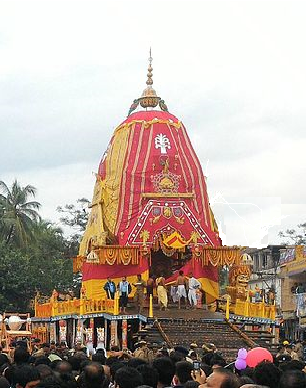
Lord Jagannath’s Chariot is the largest of all with 16 wheels and 4 white horses.  The name of the chariot is Nandighosha, also known as Garudadhwaja and Kapiladhwaja. The Chariot is also recognised by its red and yellow colour which are most commonly associated with Lord Vishnu among the Hindus. The guardian of the chariot is Garuda and the name of the charioteer is Daruka. The gatekeepers are Jaya and Vijaya. The Lord is accompanied by the deity Madanmohan. Among all the chariots Lord Jagannath’s chariot is the tallest since he’s the most powerful one even if he’s the middle one. The emblem of his flag is the Sudarshana Chakra.

Nandigosha Rath

Lord Balabhadra

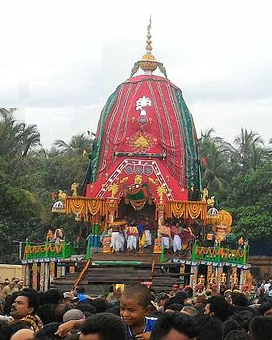
Lord Balabhadra is the second most powerful among the three siblings, hence the second-largest chariot. His chariot has 14 wheels and 4 horses. His chariot is recognised by the red and bluish-green colour combination and black horses. The emblem of the flag on His chariot is a palm tree. The guardian of his chariot is Vasudev and the charioteer is Matali. The gatekeepers are Nanda and Sunanda. His chariot is called Taladhwaja, also known as Langaladhwaja. He is accompanied by Ramakrishna.

Taladhwaja Rath

Goddess Subhadra

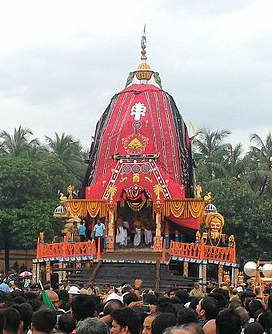
Goddess Subhadra is the sister. Along with her brothers, she too travels to Lord Jagannath’s birthplace in her red and black chariot, black being associated with the Goddess. Her chariot, Darpadalana, also known as Devadalana or Padmadhwaja has 12 wheels and 4 red horses. Her guardian is Jayadurga and charioteer is Arjun. She is accompanied by the eternal wheel, Sudarshana. The eternal wheel travels with Her, on Her chariot for Her safety. Her gatekeepers are Ganga and Jamuna.

Darpadalana Rath

The Yatra (The Journey)

The Rath Yatra takes place starts from a specific place and follows a fixed path. The procession progresses down the Bada Danda, a 3km long road. The chariots are drawn by the many devotees who assemble on this holy day at the Bada Danda. The deities reach their destination, the Gundicha temple, before nightfall. They stay in their respective chariots for the entire night and enter the temple the next day. For the following 7 days, they stay there after which they come back. On the day the deities return many rituals like Suna Besha take place.  

Once they return to their abode in Puri the Rath Yatra ends.  

Note: All images have been taken from https://en.wikipedia.org/wiki/Ratha_Yatra_(Puri)

The Flash Theory: Iris Brings Back The Arrowverse Multiverse Post-Crisis

Warning! Spoilers ahead for The Flash season 7 episode 16, “P.O.W.”

The Flash season 7 is barreling towards its two-part finale and Iris West-Allen’s latest storyline could bring back the Arrowverse’s multiverse following its collapse in Crisis on Infinite Earths. Time and interdimensional travel have been heavily utilized in the shared universe ever since The Flash unlocked the titular character’s abilities to move backwards and forwards in time. The team’s trip to Earth-2 opened up yet another gateway to traversing the multiverse. While Crisis on Infinite Earths changed that for good, Iris’ situation could unlock the multiverse once again. 

Iris has been noticeably absent from two episodes of The Flash. In season 7’s episode 15, Barry revealed she wasn’t feeling well and was recovering from a bout of illness at home. In the following episode, however, Iris confirmed what she was experiencing was far more than a regular cold; when she sneezed, her eyes briefly and startlingly flashed green before returning to their normal color afterward. Why the illness is affecting Iris in this way remains unclear, but her symptoms have led her molecules to become unstable, inducing headaches and time displacement.   

At the end of the episode, Nora West-Allen confirms that Iris will be okay, but there’s no telling when her symptoms will clear up or what will happen before they do. That said, it’s possible Iris moving in and out of the timeline could play a crucial role in the future of the multiverse and the reason for her predicament may be hiding in plain sight.

Iris Is Phasing In & Out Of The Timeline

Iris’ absence from The Flash season 7’s episode 15 was suspicious, especially since it involved a possible pregnancy storyline that was happening without her. In the following episode, however, fans learned why Iris has been absent. As it turns out, her cold wasn’t a normal one and it was somehow causing her to phase in and out of the timeline. It got so bad apparently that Deon, the Still Force, swooped in to protect Iris by using his abilities to stabilize her from phasing through various temporal planes, moving her to “pure temporal strains” to keep her alive. If it wasn’t for Deon, Iris would have fractured through time itself, which doesn’t sound very pleasant and could have unprecedented repercussions.

This subplot creates an interesting twist considering everything happening on The Flash right now. Between what’s going on with Iris, the Godspeed clones, August Heart — who originated as Godspeed in 2049 pre-Crisis on Infinite Earths — coming into the picture, and Barry dreaming about Nora telling him there seems to be something wrong in the future, Iris’ timeline instability may be the one thing connecting each of these separate storylines. That said, the reason why she’s suddenly phasing in and out of the timeline has yet to be confirmed on the show, but all roads seem to be leading back to one cause.  

Iris Being Pregnant Is Causing Her To Be Unstuck From Time

Barry and Iris have been trying to conceive for a few episodes now. After Barry dreamed about Nora the first time, he assumed Iris was pregnant only for the results of the test to come back negative. However, this could have been a false negative. Considering that Iris’ presence in the timeline has been unstable, it’s possible that she is already pregnant and doesn’t realize it. What’s more, being pregnant with speedster babies won’t follow the same patterns of a normal pregnancy and it’s possible that Iris carrying metahumans is causing her to be unstuck from time. Her phasing in and out of the timeline could be The Flash’s equivalent to morning sickness. 

This could also explain why she will be able to regain her speedster powers in the season 7 finale. In the comics, Iris phases back and forth in time because it’s revealed she is actually from the future and was sent back to the 20th century by her birth parents. The Flash showrunner Eric Wallace has teased this storyline coming into play, but like with all things that make their way onto the show, it will probably be a loose adaptation from the comics storyline it’s based on. Traveling between timelines because of a pregnancy might be the closest the series gets to this particular comics arc in this instance.

Jay Garrick’s The Flash Return Hints At Alternate Earths Connection

Jay Garrick (aka, The Flash of Earth-3) was last seen prior to Crisis on Infinite Earths, warning Barry of the impending doom facing the multiverse. However, the speedster didn’t participate in the crossover, nor was he confirmed to be alive in the aftermath that saw the multiverse rebooted and Earth-1 merge with others (including Supergirl’s Earth-38) to become Earth-Prime. Jay will be appearing in The Flash’s two-part season 7 finale to aid in the Godspeed clone war. How his reappearance will be explained remains to be seen, but it’s possible he will show up courtesy of Iris’ temporal phasing. Jay originally hails from Earth-3 and his return to The Flash coinciding with Iris being able to phase through time (and maybe dimensions) could be connected. Iris may be acting as the bridge between Earth-Prime and Jay’s world without even realizing, and the superhero series might confirm that he is now from Stargirl’s Earth-2 instead.

Theory: Iris’ Temporal Phasing Brings Back The Multiverse

In The Flash season 6, Nash Wells detected particles of Eternium, an interdimensional (and multiversal) element, on Iris prior to the events of Crisis on Infinite Earths. At the time, nothing much came of it, just another tease that seemed to lead nowhere. However, this could come back into play now that Iris is phasing through temporal planes in season 7. It’s possible the combination of Eternium and her moving in and out of time now allows her to connect to not only different time periods on Earth-Prime, but alternate universes as well. Perhaps before she is finally stabilized, Iris will indeed fracture through time and that’s what breaks the barrier separating Earth-Prime from the rest of the multiverse, which has remained a secret post-Crisis.

Namely, Iris’ temporal instability could alert her and The Flash to the fact there are still other worlds out there despite the collapse of the multiverse during Crisis. After all, Stargirl exists on the rebooted Earth-2 and it’s been confirmed that Jay Garrick will make an appearance on the series in its sophomore season. And so Iris’ temporal imbalance could open the gateway to interdimensional travel once more, reestablishing the connection between Earth-Prime and other earths. There has to be a reason for why Nash detected Eternium on her. All of this could also be setting up The Flash’s five-episode crossover event in the fall. Whatever the reasons behind Iris’ phasing in and out of time, the introduction of this storyline for her could finally tie together so many loose plot threads for The Flash and the Arrowverse at large. 

Do We Live in a Multiverse?

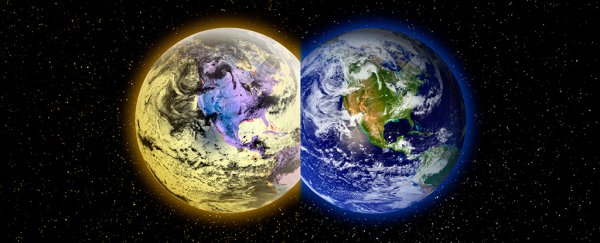
As far as we currently know, there is a single expanding blob of spacetime speckled with trillions of galaxies – that’s our Universe. If there are others, we have no compelling evidence for their existence.

Amazing book about Multiverse

That said, theories of cosmology, quantum physics, and the very philosophy of science have a few problems that could be solved if our blob of ‘everything’ wasn’t, well, everything.

That doesn’t mean other universes must exist. But what if they do?

What is a universe?

It should be a simple question to answer. But different areas of science will have subtly different takes on what a universe even is.

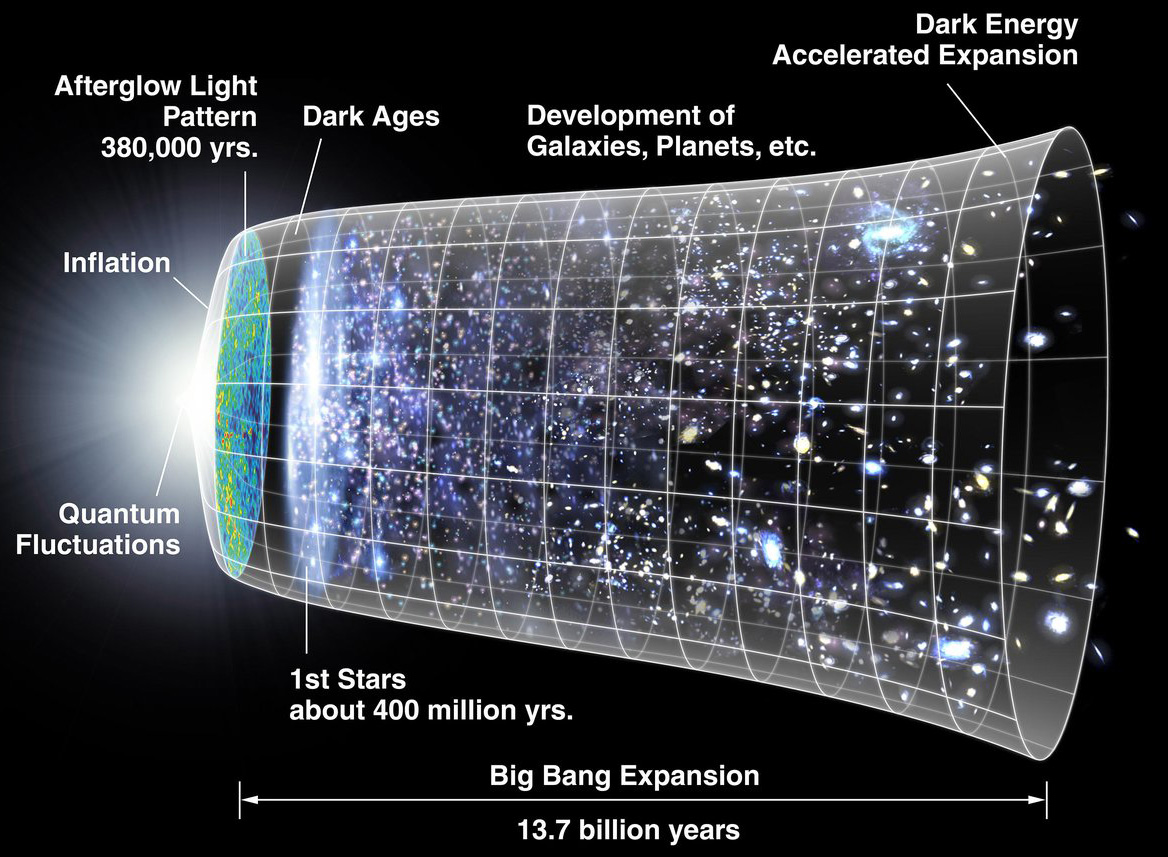
Cosmologists might say it describes the total mass of stuff (and the space in between) that has been slowly expanding from a highly concentrated volume over the past 13.77 billion years, becoming increasingly disordered with age. 

It now stretches 93 billion light years from edge to edge, at least based on all of the visible (and invisible) stuff we can detect in some way. Beyond that limit, there are either things we can’t see, an infinite expanse of nothingness, or – in the unlikely scenario that all of space bends back around on itself – a round-trip back to the start across a hyperspherical universe. 

If we’re talking quantum physics, though, a universe might refer to all fields and their particles, and their combined influences over one another. As a general rule, a universe (like ours, at least) is a closed system, meaning it can’t suddenly lose or gain a significant sum of energy. 

Telescope under 100

Philosophically speaking, a universe might be a discrete set of fundamental laws that governs the behavior of everything we observe. A universe would be defined by its own rules that set its unique speed for light, tell particles how to push or pull, or space how it should expand. 

What is a multiverse in cosmology?

A century of astronomical observations has told us a lot about the age, size, and evolution of galaxies, stars, matter and the four dimensions we sum up as spacetime. 

One thing we know with great confidence is that everything we see now is expanding at an accelerating rate. This logically implies the Universe, at least the one we live in, used to be a lot smaller

big bang nasa infographic expansion(NASA/JPL)

We can theoretically squeeze all of the matter of the Universe down to a point where the concentration of energy reduces atoms to a soup of simpler particles and forces combine until we can’t tell them apart. Any smaller than that? Big shrugs.

If we go with what’s known as a cyclic model of cosmology, the parent universe preceded ours in some way. It might even be a lot like this one, only running in reverse compared with ours, shrinking over time into a concentrated point only to bounce back out for some reason. Played out for eternity, we might imagine the respective universes bounce back and forth in an endless yo-yo effect of growing and collapsing.

Or, if we go with what’s known as a conformal cyclic model, universes expand over trillions upon trillions of years until their cold, point-like particles are so spread out, for all mathematical purposes everything looks and acts like a brand new universe.

If you don’t like those, there’s a chance our Universe is a white hole – the hypothetical back end of a black hole from another universe. Which, logically, just might mean the black holes in our Universe could all be parents, pinching off new universes like cosmic amoebae.

What is a multiverse in quantum physics?

Early last century, physicists found theories that described matter as tiny objects only told half of the story. The other half was that matter behaved as if it also had characteristics of a wave.

Exactly what this dual nature of reality means is still a matter of debate, but from a mathematical perspective, that wave describes the rise and fall of a game of chance. Probability, you see, is built into the very machinery that makes up the gears of a universe like ours.

Of course, this isn’t our daily experience as vast collections of atoms. When we send a bucket of molecules called a rocket to the Moon as it zooms past 300,000 kilometres away, we’re not rolling dice. Classical old physics is as reliable as tomorrow’s sunrise.

But the closer we zoom in on a region of space or time, the more we need to take into account the possible range of measurements we might find. 

This randomness isn’t the result of things we don’t know – it’s because the Universe itself is yet to make up its mind. There’s nothing in quantum mechanics explaining this transition either, leaving us to imagine what it all means. https://www.youtube.com/embed/dzKWfw68M5U?ab_channel=PBSSpaceTime

In his 1957 doctoral dissertation, American physicist Hugh Everett suggested the range of possibilities are all as real as one another, representing actual realities – separate universes, if you like – just like the one we’re all familiar with.

What makes any one universe in this many worlds interpretation distinct is how each wave correlates with a specific measurement taken of other waves, a phenomenon we call entanglement.

What ‘we’ means, and why ‘we’ experience one entangled set over waves over another, isn’t clear, and in some ways presents an even bigger problem to solve. 

What is a multiverse in philosophy?

One of science’s most fundamental starting assumptions is that in spite of what your mother tells you, you’re not special. Nor is any other human, or our planet, or – by extension – our Universe.

While rare events occur from time to time, we don’t answer The Big Questions with ‘it just happened that way’. 

So why does our Universe seem to have just the right tug-of-war of forces that allow not just particles to appear, but to congeal for long enough periods into atoms that can undergo complex chemistry to produce thinking minds like ours?

Philosophically speaking, the anthropic principle (or principles, since there are many different ways to spin the idea) suggests we might have it backwards. Without these conditions, no minds would have arisen to consider the amazing turn of events. 

If just a single universe ‘just happened that way’ early one spring morning, it’d be one big coincidence. Too big really. 

But if there were infinite universes, with infinite combinations of forces pushing and pulling, some would inevitably give rise to minds that just might ask ‘are we part of a multiverse?’ 

Will we ever discover other universes?

Given the very definition of a universe relies on some kind of physical fence keeping influencing factors apart, it’s hard to imagine ways we might ever observe the existence of a sibling for our universe. If we did, we might as well see it as an extension of our own Universe anyway.

That said, there could be some cheats that could give us a glimpse.

Any experiment to find one would have to rely on that ‘fence’ having some holes in it that allow particles or energy to leak across, either into ours, or away from it. Or, in the case of universes existing in our past, monumental events that left enough of a scar that not even a rebirth could erase.

For now, we still have no good reason to think our blob of everything is anything but unique. Given we’re still learning how our own Universe works, the current gaps in physics could yet be plugged without any need to imagine a reality other than ours.

In countless other versions of this article scattered throughout the multiverse, however, the question of whether we are alone just might have a different answer.

Modern Trends in Indian Art

Modern art refers to the artistic work produced during the period of 1860s to the 1970s and represents the styles and philosophies of the art produced during that era. The term is usually pertains to the art in which the traditions of the past have been thrown aside in a spirit of experimentation. In India, the modern art movement began in the early 1900s. During 1900-1925, Bengal School dominated the Indian art.
Bengal school of painting represented the first art movement in the country. Artists like Abindranath Tagore, Nandal Bose, Raja Ravi Verma, Jamini Roy were some of the pioneers of Bengal school. It was the rebirth of Indian art. Bengal school witnessed the departure of traditional painting methods like tempera. Chinese cloth painting and Japanese wash technique were used. The Japanese water colour technique called wash became the hallmark of Bengal school. This technique diluted the impact of the colours used giving the paintings a mystic sense of space and atmosphere. The these of the paintings included religious, social and historical events. Paintings of landscapes, birds and animals were also done.
After 1925, artists refused to imitate the mannerisms of the art of the past. They argued that such imitation bounds the imagination and creativity of the artists. The contemporary artists stressed on liberating the imagination from the shackles of past. The art after 1925, was therefore very different from the previous Indian arts. There was variety in the techniques used and artworks were different from each other having more or less similarity.
Technique like cubism was used by the artist Gaganendranath. Cubism is a European style of art which aims to show all of the possible viewpoints of a person or an object all at once. Cubistic artworks look like they are made out of cubes and other geometrical shapes. Chiaroscuro, which is a characteristic of the European Renaissance was used in his famous painting ‘Magician’. Chiaroscuro is the use of strong contrasts between light and dark, usually bold contrasts affecting a whole composition.
The soft wash technique was discarded and oil painting started getting more recognition. These paintings had bold and contrasting colour scheme in comparison to the light wash technique of the Bengal school. The credit for popularising oil painting in India goes to Amrita Sher Gil.
Graphic Prints stated getting popular as well. Artist Krishna Reddy used techniques like intaglio and kaleidoscopic effects in his graphic prints. Intaglio is a printmaking technique in which the image is incised into a surface and the incised line or sunken area holds the ink. It is a process of print on engraved design. In his painting ‘Whirlpool’ which is a intaglio on paper, Krishna Reddy has also used the method of viscosity printing. Viscosity printing is a multi-colour printmaking technique which is uses the viscosity of the paint or ink.
Etching and aquatint was also used in contemporary print making. Etching is an intaglio printmaking process in which lines or areas are incised using acid into a metal plate in order to hold the ink. Aquatint is also an intaglio printmaking technique, a variant of etching that produces areas of tone rather than lines. Both of these techniques were used together to create contemporary prints. ‘The Children’ by Somnath Hore, ‘TheDevi’ by Jyoti Bhatt and ‘ Man, Women and Tree’ by K. Laxman Goud are some of the famous prints which have been made using these techniques.

https://www.jagranjosh.com/general-knowledge/bengal-school-of-art-1345270637-1

https://www.flexiprep.com/NIOS-Notes/Secondary/Painting/NIOS-Class-10-Painting-Chapter-9-Contemporary-Indian-Art-Part-1.html

The Bishnois of Rajasthan

Formation of the Bishnoi sect— India’s original environmentalists

Bishnoism originated in the 1485AD by Saint Guru Jambheshwar in theThar Desert of Rajasthan, India. Long before the world came to know about the environmental crises, Bishnois have been cognizant of man’s relationship with nature and the importance to maintain its delicate balance. It is remarkable that these issues were considered, half a century ago by Bishnoi visionaries. No other secthas given this level of importance to environment value, protection and care.


Not many of us know that the concept of Tree Huggers and Tree-Hugging, have roots within the Bishnoi community. The famous ‘Chipko Movement’ was inspired by a true story of a brave lady called Amrita Devi Bishnoi who refused to let the kingsmen cut the trees and sacrificed her life to save the trees.

Sundarlal Bahuguna

This sacrifice not only inspired the “Chipco Andoloan” by Sunder Lal Bahuguna but also the Indian government. The “Amrita Devi Bishnoi Smrithi Paryavaran Award” for contributing to environment conservation is given to those who have significantly contributed for environment conservation.  

The Bishnois are one of the first organized communities that have collectively sought for eco-conservation, wildlife protection, and green living. The ideals and tenets of the bishnois and bishnoism mentioned in the 29 religious tenets are very crucial and relevant to our ever evolving world.

The social concern, in medieval Rajasthan, manifested itself in various forms. To unite the people for a common cause, Guru Jambheswar Ji advised 29 principles to become a Bishnoi. The word ‘Bishnoi’ stands for ‘bish’ which means 20 and ‘noi’ which means 9; derived from these 29 principles out of which 6 principles are dedicated to environmental protection and compassion for all living beings.

 Of the 6 tenets that focus on protecting nature, the two most profound ones are:

Jeev Daya Palani – Be compassionate to all living beings.

Runkh Lila Nahi Ghave – Do not cut green trees.

Though these rules date back centuries, they still hold the morals and the beliefs for which the bishnois stand and are more than relevant to the environmental problems faced in today’s world.

Conservation as a practical necessity

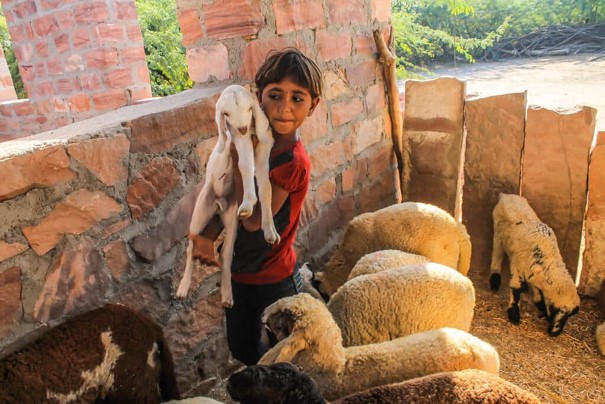
In the arid and semi-arid regions of western Rajasthan, Bishnoism as a sect has over the ages has not only proposed, but also internalised their practices in an effort to usher in new practices of conservation ethics in Rajasthan. A majority of the Bishnoi rules suggested maintenance of harmony with the environment, like the prohibition on cutting green trees and animal slaughter. One plausible explanation is that the economy was primarily sustained by animal rearing. Hence, any slaughter, even during droughts, would have affected their means of livelihood.

Similarly, the cutting of green trees was prohibited, as it would scale back the availability of green fodder for the cattle, especially in the dry region where natural vegetation was very thin and sparse. Jambhoji’s teachings, which were in line with the interests of the folk, became immensely popular primarily in the arid regions of Bikaner and Jodhpur. The number of his followers increased manifold in these regions. His principles became so influential that the rulers of these states were forced to respect his teachings and sermons. The Bishnois have since long proposed for placing restrictions and punishments for cutting trees.

Rajasthan’s landscape demands dependence on agricultural and cattle-rearing practices. The conservation of natural vegetation of the region helped sustain superior breeds of cattle for export to other regions, exports such as sheep for wool, and camels for transport proved beneficial. Trade and commerce were also an important component of these economies as is evident in the nature of taxation where non-agricultural production was also taxed extensively (Kumar 2005).

Protection of wildlife and animals

The Bishnois consider the blackbucks as pavitra, or sacred. They follow what is perhaps the only environment-friendly religion in the world and recognise the rights of all kinds of birds, animals and trees and believe in living with peace and harmony with them. Reports show that in 2016, over 1,700 people who were involved in wildlife crimes in Rajasthan were arrested owing to the tireless efforts of the bishnoi community.

Some of their commandments mention to “provide shelters for abandoned animals to avoid them from being slaughtered in abattoirs,” making clear the Bishnoi’s reverence of all life on the planet.

The Khejarli massacre

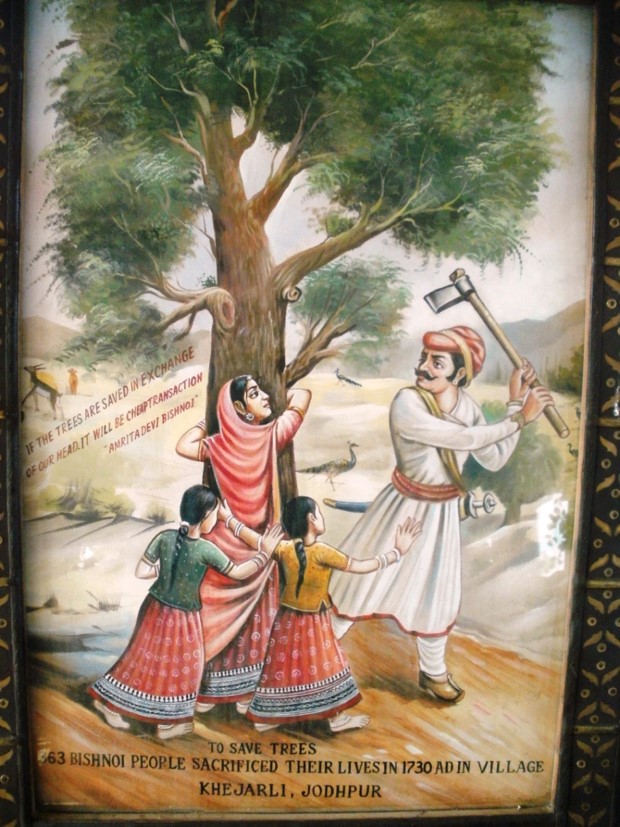
Khejarli or Khejadli is a village situated in Jodhpur district of Rajasthan, just 26 km southeast of the main city of Jodhpur. The name of the town is derived from khejri trees, which were in abundance in the village. In the year 1730 AD (Vardhan 2014), the king of Jodhpur sent-out his army to cut trees in order to build his palace. When his army started to cut down and log a Bishnoi forest, the bishnois organised a non-violent protest, offering their bodies as shields for the trees. The soldiers had warned that anyone intending to stand in their way would share the fate of Amrita (or Imarta/Imarti as she is often also referred to by the locals) and her three daughters who had taken the bold step of hugging trees following their mother’s action, and had been killed by the soldiers. Men, women and children from 83 different villages stepped forward, embraced the trees and sacrificed themselves one after the other.

The army’s axes had already slain 363 people, when the king, Maharaja Abhay Singh, hearing the whole incident and their perseverance and courage, halted the logging and declared the Khejarli region a preserve, issued a royal decree engraved on a tambra patra (a letter engraved on a copper plate), prohibiting the felling of trees and hunting in the Bishnoi areas. The Bishnois as well as non-Bishnois consider the tambra-patra declaration as a victory of the communities efforts at conservation.

Till date, the Bishnoi community commemorates and celebrates this collective sacrifice as a symbolic victory in Khejarli by maintaining the place as a heritage site. An annual fair is organised at the village near Jodhpur, which also maintains a functional temple. In 1988, the Government of India commemorated the massacre formally, by naming the Khejarli village as the first National Environmental Memorial (Clarke 1991). A cenotaph now stands at the site as a memorial to the Bishnoi lives lost at the massacre site, which is collectively maintained through community funding as well as by private donations.

Incidentally, Imarta Devi, the first woman who died in defence of the khejri trees during the 1730 Khejarli massacre, uttered her last words as follows: Sar sāntey rūkh rahe to bhī sasto jān (even if one were to get their head severed to save a tree, still it is a cheap bargain).