It has been over a year, the world is still battling the devastating coronavirus pandemic. While rich countries more or less have managed to mitigate, to an extent the adverse effects of the pandemic thanks to their higher and faster vaccination coverage, low and middle-income countries are still desperately seeking vaccines to cover their vulnerable population groups.
US economy is slowly showing a positive uptick so is the case with other rich countries and China.US retail sales increased in June as demand for goods remained strong. Israel is considering the option of booster shots to its already largely vaccinated population after few instances of breakthrough infections. while Israel’s actions are truly justified given the severe nature of the virus, it sometimes feels a little unjust when we consider the cases of many low-income countries where healthcare workers are not even administered with a single shot. Vaccines nationalism as a result of the pandemic is not surprising and given the already deep wide divide between rich and poor countries the pandemic has further exacerbated this divide. Also within the poor and middle-income countries, the gap between the rich and poor has drastically increased.
According to Pew Research analysis, the number of poor in India is estimated to have increased by 75 million because of the pandemic recession. Many economists attribute India’s sluggish recovery post to the deadly second wave to dampened demand. While this may be true as the majority of the population in India fall under the low or middle-class category who’s the ability to spend has been severely compromised(affecting demand). But this is one side of the story. Recently Santosh Iyer vice president of sales and marketing, Mercedes Benz India, told that the company is seeing strong demand for its product, and supply-side constraints have made their customers wait longer. He further adds that sales and demand are back to pre-pandemic levels. This indicates that these upper classes especially in economic terms were not affected as Mercedes Benz’s target market usually comprises the upper class who prioritize luxury.
Hence the rich grew richer and the poor given their already vulnerable state further slipped into pathetic poverty.
General knowledge is very important in everyone’s life. The person without the knowledge is like the bird without the wings. It is very important to know what is happening across the world. So, it is very important to attain the general knowledge. To grab general knowlede, an individual must follow some of the techniques like reading books, articles, magazines, newspapers etc.
The newspaper consists of all the important things like the business purposes, sports, entertainment, some interesting puzzles, Hindi habits, food recipes, Current affairs etc.
Reading newspaper is an important thing because whenever an individual comes across a motivational thing, he or she will be motivated and focuses on the particular aspect. The individual will get to know the current affairs. The person will get a good grip on the general knowledge. solving puzzles improves the skills of the person. Reading about the healthy habits in the newspaper makes the individual to go for good and healthier meals.
Reading newspaper is very important because gives the chance to know what is happening around us. Early in the morning or evening whatever the time maybe, sparing at least 10 to 15 minutes of time on newspaper is a very good habit that an individual can develop.
The newspaper consists of all the important things like the business purposes, sports, entertainment, some interesting puzzles, Hindi habits, food recipes, Current affairs etc.
In one of the other way the individual develops good habits and focuses more on what they are trying to do.
Individual Differences :
Intelligence :
High scores on tests of general knowledge tend to also score highly on intelligence tests. IQ has been found to robustly predict general knowledge scores even after accounting for difference in age, and five factor model personality tarits. However, many general knowledge tests are designed to create a normal distribution of answers, creating a bell shaped curve.
General knowledge is also moderately associated with verbal ability, though only weakly or not at all with numerical and spatial ability. As with crystallized intelligence, general knowledge has been found to increase with age.
Long term semantic memory :
General knowledge is stored as semantic memory. Most semantic memory is preserved through old age, though there are deficts in retrieval of certain specific words correlated with aging. In addition, stress or various emotional levels can negatively affect semantic nemory retrieval.
Personality :
People high in general knowledge tend to highly open to new experiences and in typical intellectual engagement. The relationship between openness to experieñce and general knowledge remains robust even when IQ is taken into account. People high in openness may be more motivated to engage in intellectual pursuits that increase their knowledge. Relationships between general knowledge and other five factor model traits tend to be weak and inconsistent. Though one study found that extraversion and neutroticism were negatively correlated with general knowledge, others found that they were unrelated.
Predictor of achievement :
A number of studies have assesses whether performance on a general knowledge test can predict achievement in particular areas, namely in academics, proofreading and creativity.
Academic achievement :
General knowledge has been found to predict exam results in a study of Britush schoolchildren. The study examined congnitive ability and personality predictors of exam performance and found that general knowledge was positively correlated with GCSE english, mathematics, and overall exam results. General knowledge test scores presicted exam results, even after controlling for IQ, five factor model personality traits, and learning styles.
Proofreading :
General knowledge has been found to robustly predict proofreading skills in univeristy students. A study found that proofreading had a larger correlation with general knowledge than with general intelligence, verbal reasoning, or openness to experience. In a multiple regression analysis using general knowledge, general intelligence, verbal reasoning, five factor personality traits, amd learning styles as predictors, only general knowledge was a significant predictor.
Creativity
General knowledge has been found to have weak associations with measures of creativity. In a study examining contributions of personality and intelligence to creativity, general knowledge was positively correlated with tests of divergent thinking, but was unrelated to a bigraphical measure of creative achievemnet, self- rated creativity, or a composite measure of creativity. The realtionship between general knowledge and divergent thinking became non- significant when controlling for fluid intelleigence.
Game shows and Quizzes :
Many game shows use general knowledge questions for entertainment purpose. Game shows such as who wants to be a Millionarie? and fiteen to one centre their questions on general knowledge, while other shows focus questions more on specific subjects. Some show ask questions both on specific subjects and on general knowledge .
McLaren F1 was the fastest production car for 12 straight years from 1993 to 2005. At the time of its unveiling, McLaren F1 was an engineering marvel with numerous pioneering technological innovations. It was designed by the legendary designer and engineer Gordon Murray.
McLaren F1 Rear
It was the first road production car to be fully built carbon fiber. The entire Carbon fiber monocoque weighs just fewer than 220 pounds and 5000 pieces of carbon fiber pieces were used to mold the final frame. This gives it double the strength of steel but it makes it five times lighter than traditional frames.
The car has a central seating position which is unique to this car. While developing McLaren F1, Gordon Murray drove and tested all the contemporary supercars of that time and he realized that their three-pedal boxes were somewhat offset. So He wanted to eliminate that. To solve this problem he placed the seat in the central driving position similar to a traditional F1 racing car. The central position also helps in increasing the visibility of the driver.
It has a naturally aspirated 6.1-liter V12 engine, but initially, McLaren has asked Honda to supply an engine for them as they were also the supplier for their F1 racing team at that time. But Honda didn’t follow the specification stated by Gordon Murray. Later they asked BMW to supply them with the engine of their car. BMW had to make a new engine as per the specification and the final results were incredible. The Engine is called BMW Motorsport S70/2
The engine possesses extremely efficient heads. It also has continuous variable inlet valve timing and an emission-control system and four catalytic converters with ‘Lambda’ exhaust gas analysis control. Even with a 6064 CC displacement and a power output excess of 550bhp, the engine is quite efficient. The engine created so much heat that it had to be covered with a good heat deflecting material and to solve that problem the engine bay was covered with 16 grams of gold foil.
On 31 March 1998, Andy Wallace drove the McLaren F1 XP5 prototype at Volkswagen’s test track in Ehra-Lessen, Germany, and broke the record created by McLaren F1 itself in 1993. The car reached the top speed of 391 kilometers per hour or 243 Miles per hour. As of today, the F1 remains the fastest naturally aspirated production car in the world.
The car had a limited production of 106. Of those only 64 of them were road-going cars and 28 of them were racecars and the remaining of them were prototypes and special editions like the LM and longtail version. Rowan Atkinson (Mr. Bean) was for one period the owner of McLaren F1 as well.
Back in 1993, a brand-new McLaren F1 cost £540,000. In today’s money it would be approximately 1.1 million pounds but due to the rarity and the special status and engineering feat of the car. McLaren F1 has steadily climbed in value since then. As of today a McLaren F1 costs around £16 million and special versions can fetch even more. This car has also stood the test of time in its design, engineering, and craftsmanship.
Magahi betel leaf (Paan) is an variety of betel grown in south Bihar region and mostly in Aurangabad, Gaya and Nalanda districts. This paan, is about 3.5 to 9.5 inches in size. It’s non-fibrous, sweeter, tastier and the soft.it got GI tagged in 2018 alongwith Jardalu mango and katarni rice
Magahi paan was popular even during ancient times. It is claimed that prince Vijai Mal was fond of Magahi paan and it is mentioned in the 1884 book of GA Grierson, an Irish administrator and linguist in British India. Several other references had been cited in the journal to establish Magahi paan being an exclusive produce of Magadh region
Magahi paan is sown during March-May each year, with leaves plucked during January-March. Each plant can give 40-60 leaves, yielding 500 dholis per year per katha .Every year, farmers have to sow new plants. When everything goes well, farmers can earn Rs 70,000-1,00,000 from one katha of land.
Problems encountered by betel leaf (paan) farmers
Betel leaf (paan) plants damaged due to cold
There is lack of insurance or MSP facility to the farmers. it is highly susceptible to bad weather conditions and is classified as horticulture, not agriculture product. Money is paid in installments by the buyer and Sometimes money is paid after one and a half years to the farmers.
Number of paan farmers is on the decline because of lack of any state help to ease their high cost of production, as the plant requires an artificial conservatory to grow.
Future ahead
A tie up between Agricultural and Processed Food Products Export Development Authority (APEDA) and Bihar Agricultural University (sabaur) is currently under process. Plan is to export GI tagged products Makhana, Jardalu Mango, Shear Rice, Litchi and Magahi Pan.
Let’s hope the things gets better and government policies should be made and implemented in a way keeping the problems faced by farmers and their needs at centre. Then, only these betel growing farmers will get benefitted from those government benefits.
When a query performed on Google implies local results should be shown, the search engine populates a map pack of 3 local results. The map pack has many other names, including “local pack,” or the “Google 3-pack.”
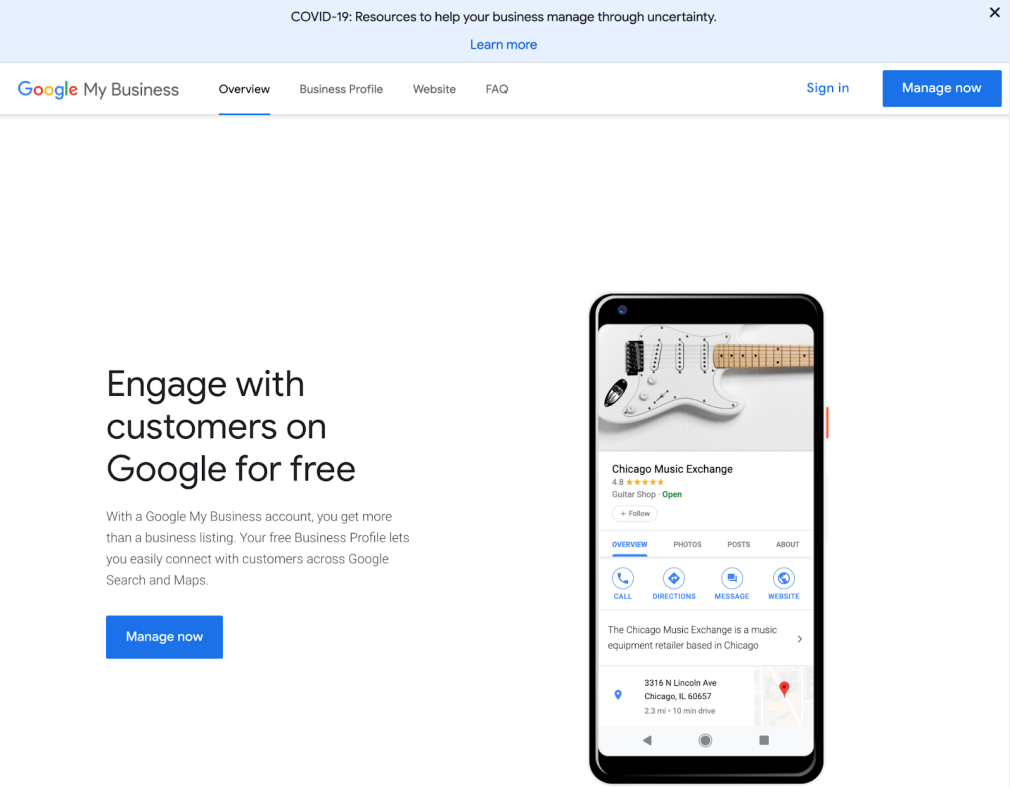
If you own or operate a business that caters to your local community, chances are you qualify to get a Google My Business listing. A quality Google My Business listing can get you one step closer to being added to a local pack.
In this guide, we’ll explore the best way to add your business on Google My Business and offer some tips to increase your local rankings.
Back in March 2021, Google noted that there are more than 2 billion visits to local websites each month. That’s a lot of website traffic.
If you’re a small business owner, your #1 driver of new business is likely going to be referrals.
Referrals are great!
But, even with a referral, most people will still Google your business name to learn more about your business, read reviews, etc — before even contacting you.
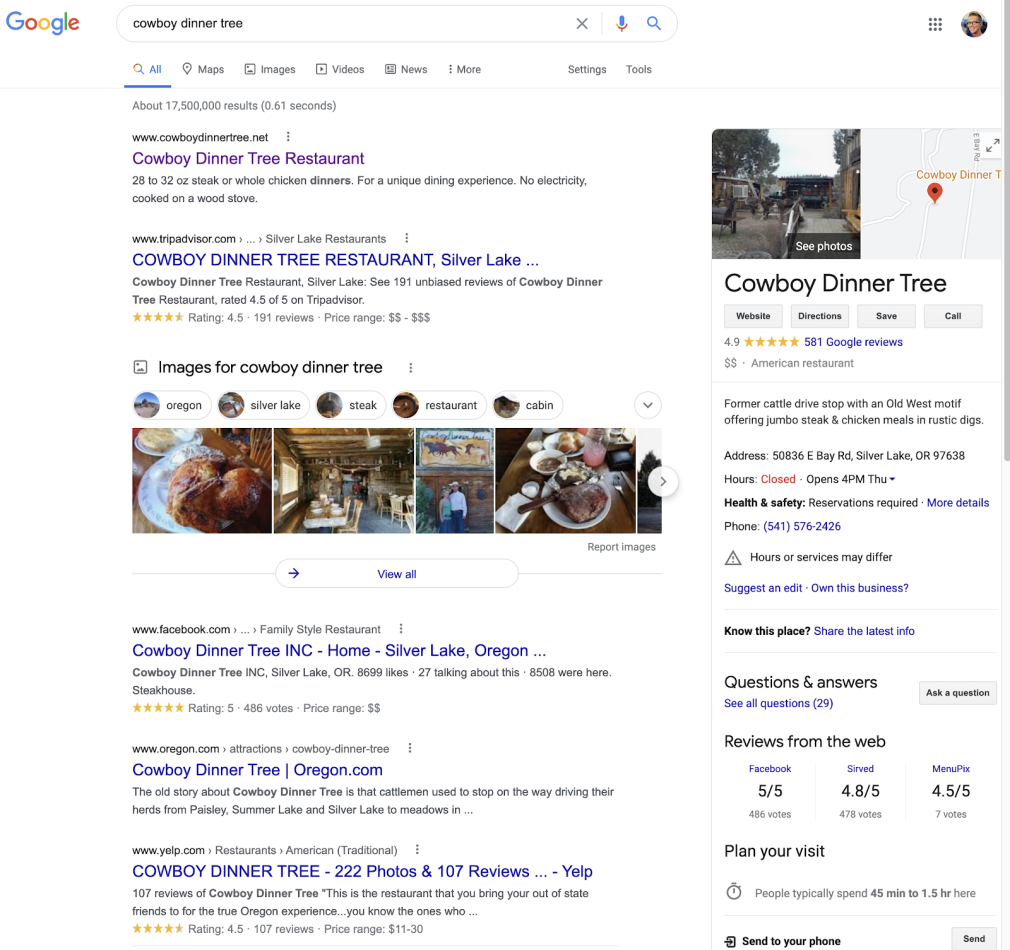
What happens when I perform a search on Google for “Cowboy Dinner Tree?”
The right-panel is generated by Google’s Knowledge Graph, but most of the data being populated here is sourced from Google My Business.
Now, what’s interesting about Cowboy Dinner Tree’s GMB listening is they don’t even have ownership of it. It isn’t owned by anyone.
Same with their Yelp, Facebook, etc. Even their website is very web 1.0.
How do they have a Google My Business listing if it isn’t claimed?
Google will automatically create one based on data they collect about businesses (entities). Keep this in mind as we get into the process of creating your own Google My Business listing.
Back to the benefits of owning your Google My Business listing.
You, the owner of your business, can provide the most accurate information about your business and have it displayed when someone does a search for your business on Google.
One of the other major benefits to claiming your Google My Business listing is that some simple optimizations and ongoing activities can help your chances of getting new business from organic search for free.Increase Your Visibilitywith the Listing Management ToolTry for Free →
How to add your business to Google My Business
You’ll have about 3 different scenarios to choose from:
Brand new business: Select Scenario 1 if your business is less than 6 months old.
Listing exists, unclaimed: If your business has been around longer than 6 months, start with Scenario 2 (but you may end up back at Scenario 1).
Listing exists, claimed: If you claimed your listing some time ago but don’t remember the login, the email is no longer active, or another person owns your listing, go with Scenario 3.
Scenario 1: Brand new business
Congratulations! Let’s get you on the path to getting you a Google My Business listing.
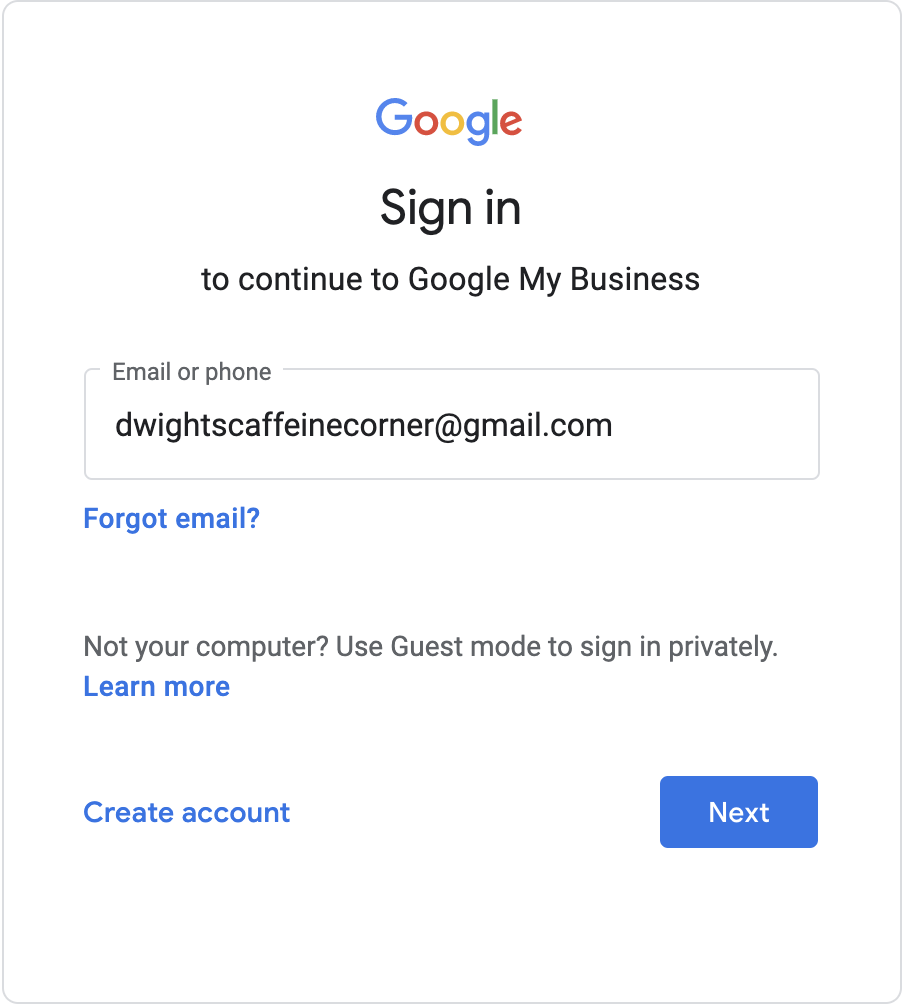
Step 2: Sign in to a gmail account that you own. This is important: remember what email address you are using here. This gmail account will be the Primary owner of the listing. Write it down on a post-it or take a screenshot if you need to.
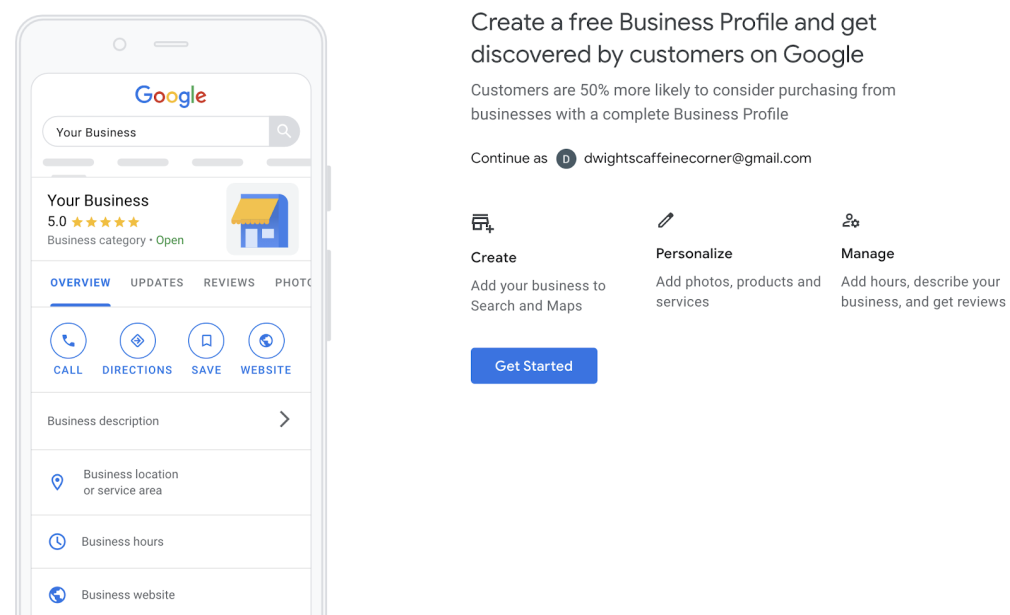
Step 3: Once you have signed in, you’ll get taken to a page like the one below. Click on the Get Started button.
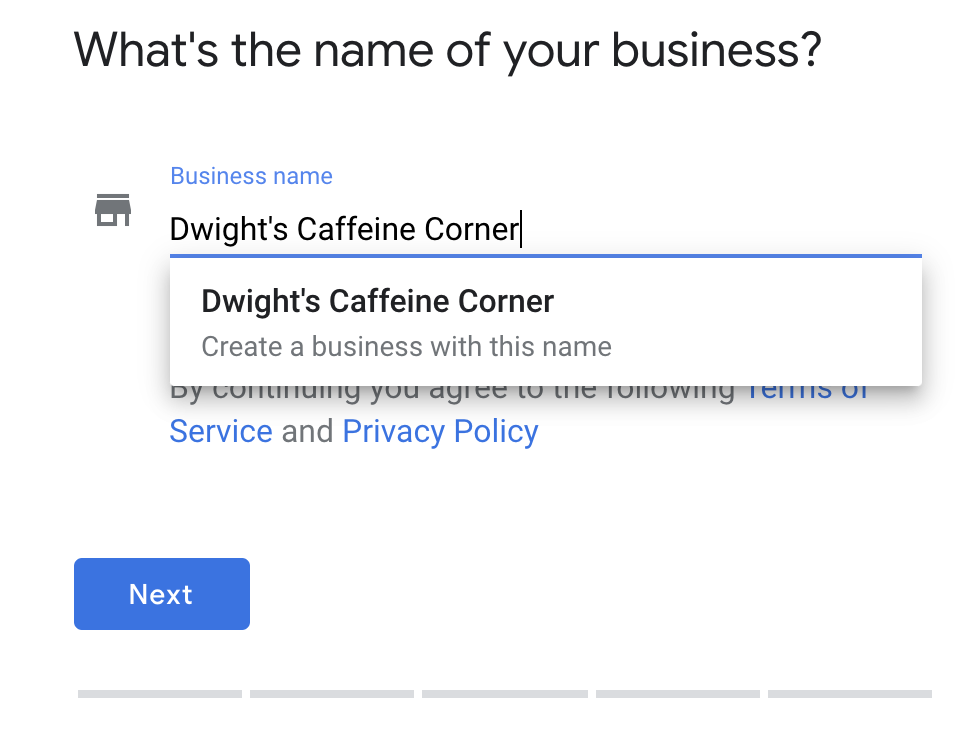
Step 4: Start typing in the name of your business. Google My Business will attempt to locate a listing but since your business is new, you likely don’t have one yet. When you spot the option to “create a business with this name,” click it, then click on Next.
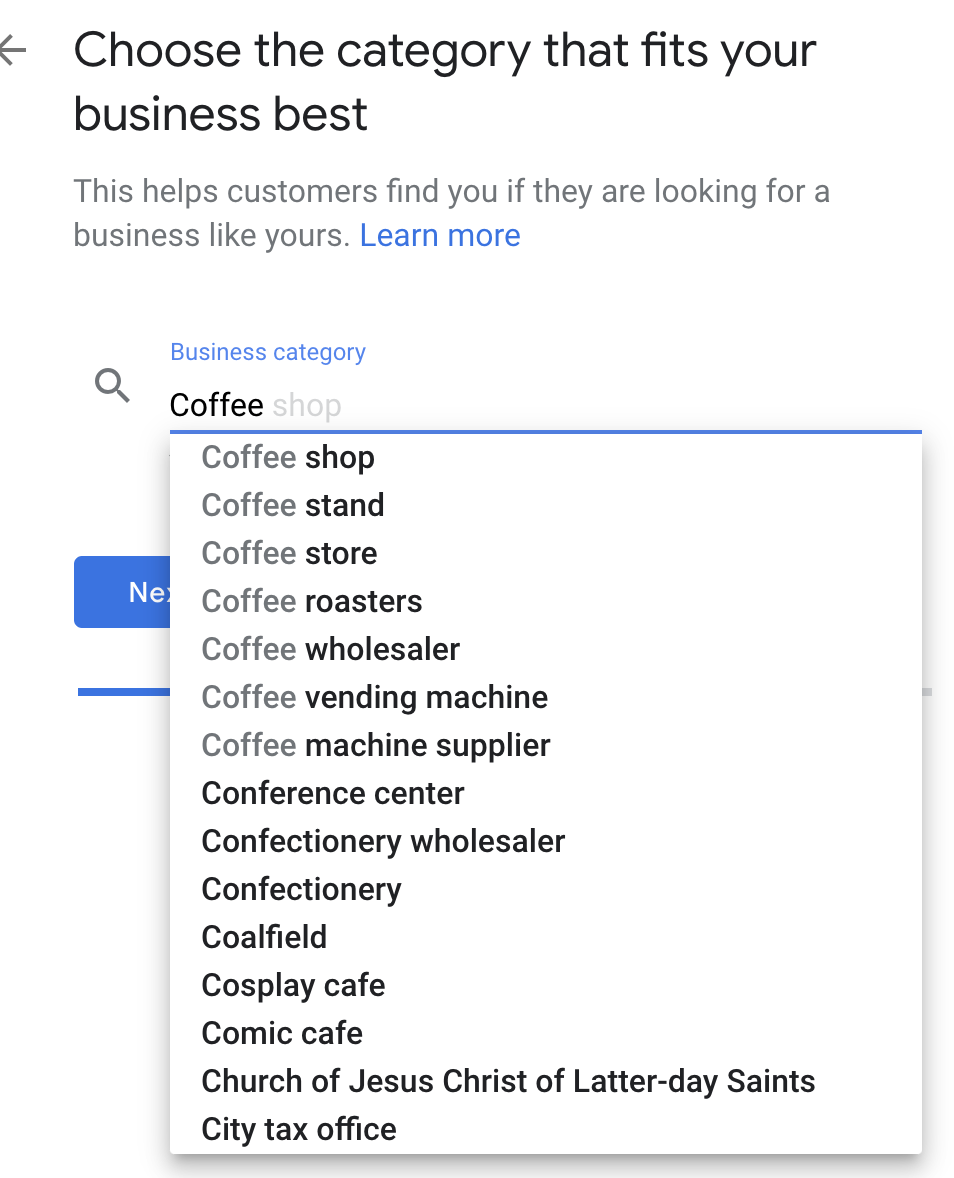
Step 5: Now we need to choose a Business category that best matches your business. For our example, coffee shops are the best matching category. If there are multiple categories that match your business, you’ll be able to add additional categories after your listing has been verified. Once you’ve chosen your category, click Next.
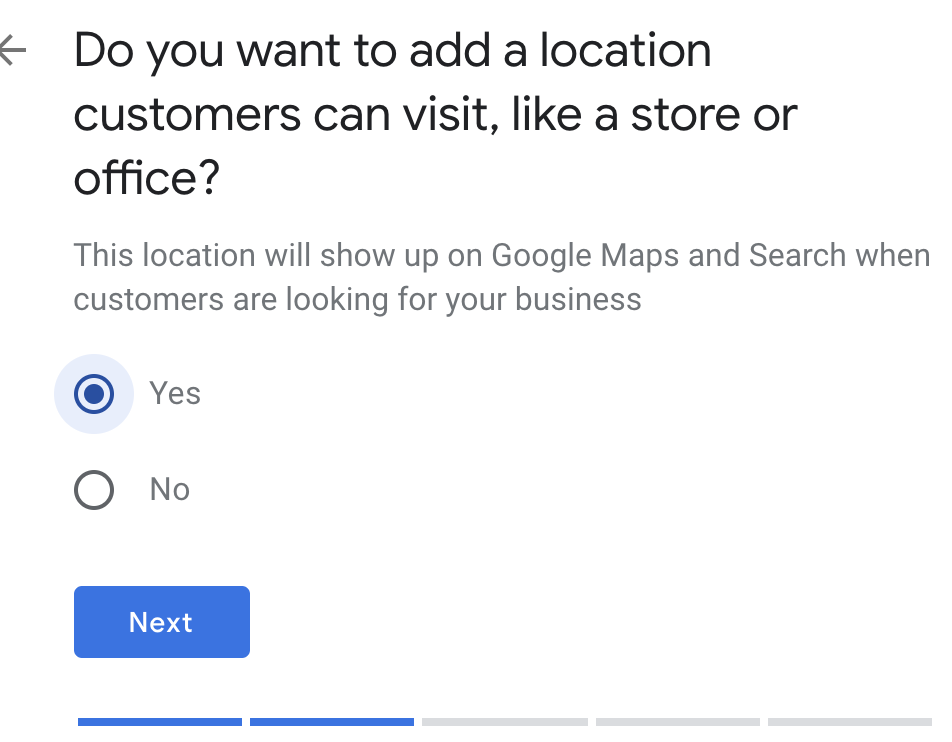
Step 6: Your next move depends on what type of business you operate. If your business is a brick and mortar, then the answer is yes. If you are a service provider (you go to your customers) and don’t have a physical storefront with signage then you will select no. If you are a service provider AND have a physical storefront with signage, then choose yes. Once you’ve made your choice, click Next.
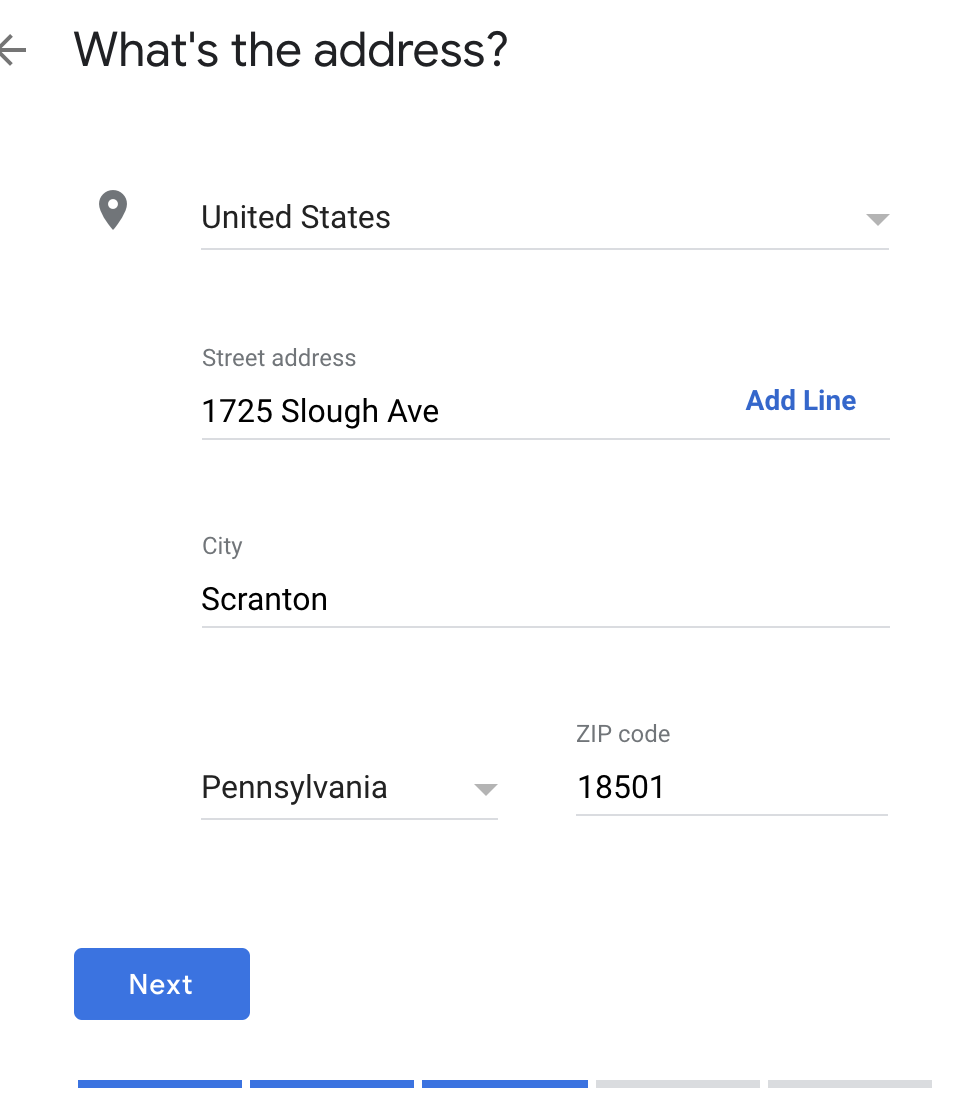
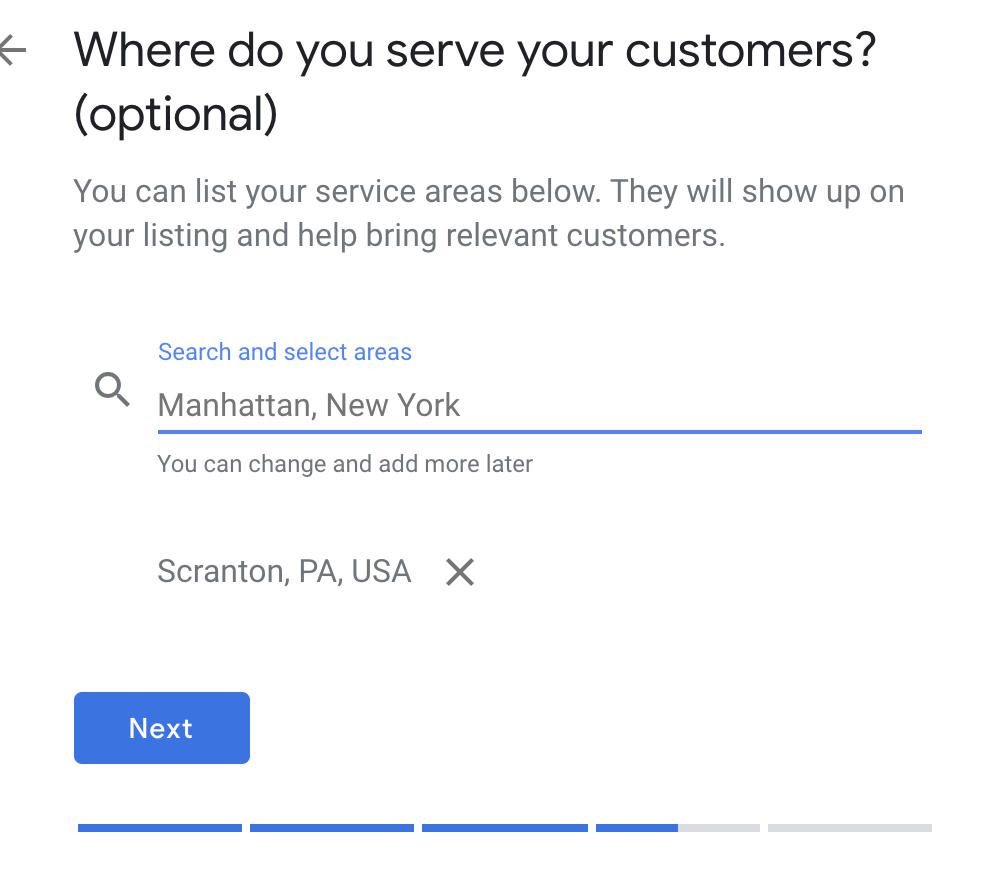
Step 7: Enter your address, then click Next if you answered yes in the previous step. If you chose no in the previous step, you will be asked to enter your service area. Once finished, click Next.
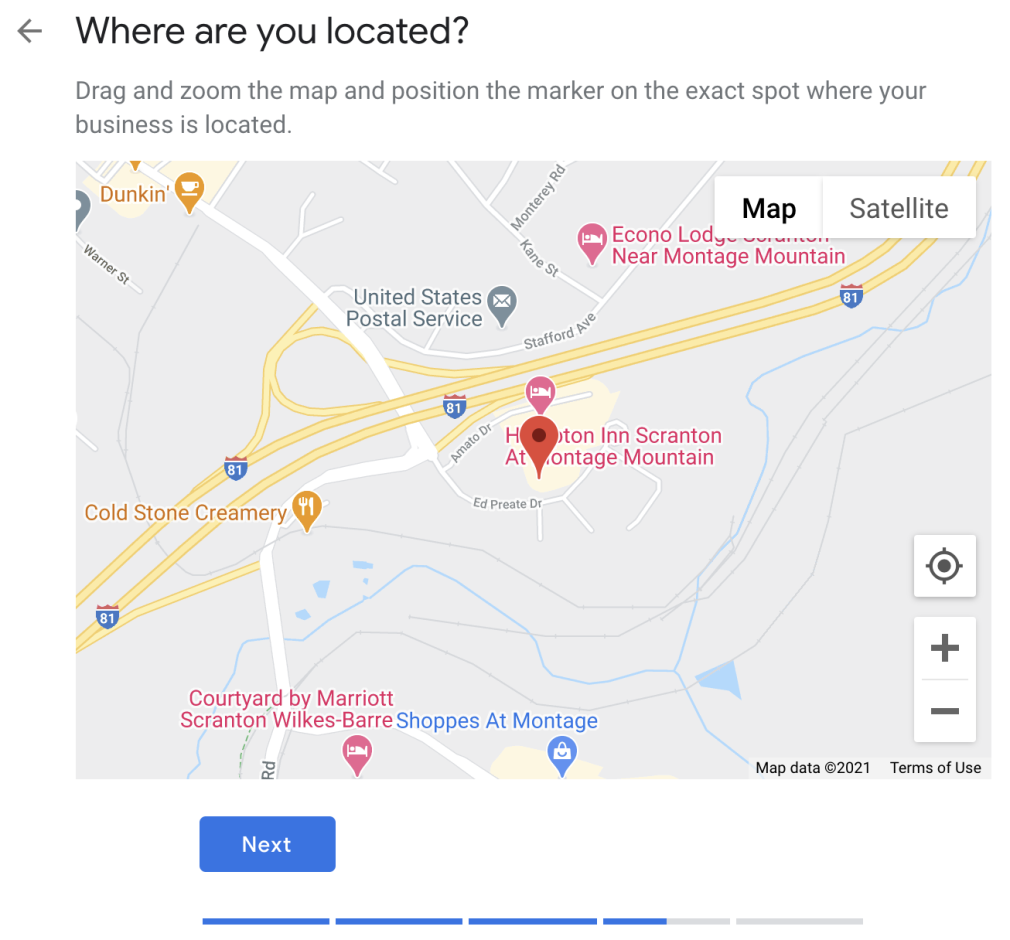
Step 8: If you are displaying your address, you might be asked to point to the exact spot where your business is located. Once finished, click Next. If you are not showing your address, you will be asked to provide your business phone number and website.
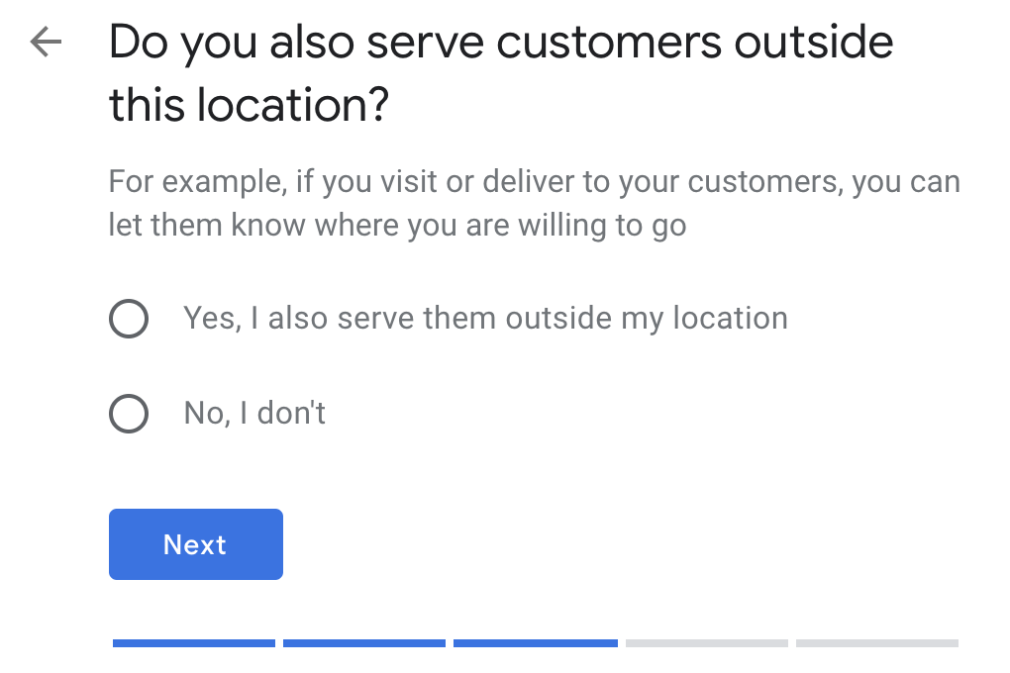
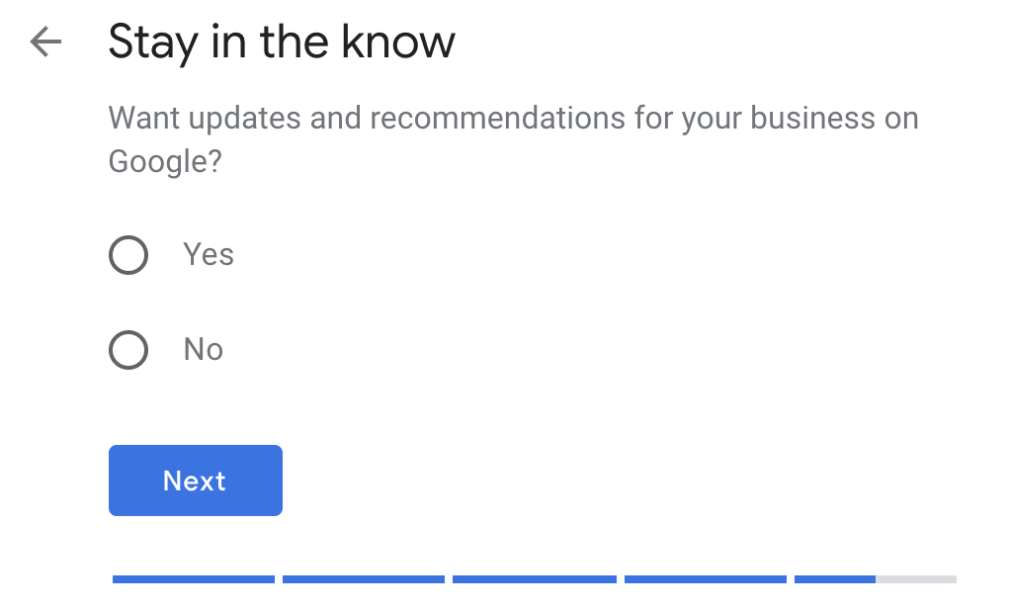
Step 9: If you’re showing your address, you’ll be asked if you also serve customers outside of your location. If you are not showing your address, you’ll be asked if you want to get updates and recommendations from Google. Choose your answer, then click Next.
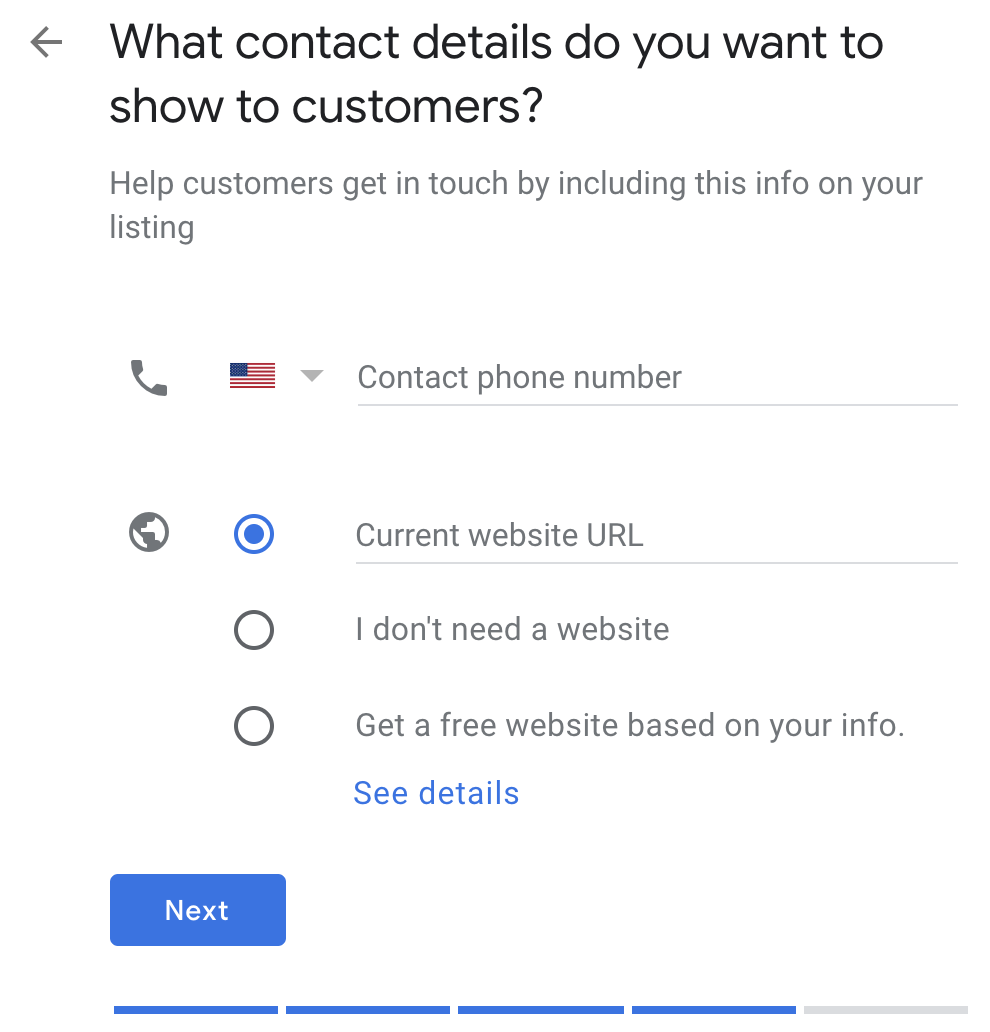
Step 10: If you’re showing your address, you’ll be asked to add your phone number and website. If you are not showing your address, skip to Step 10. Once you’ve added your website address and phone number, click Next.
Step 11: Time to finish and start the verification process! Select “Finish.”
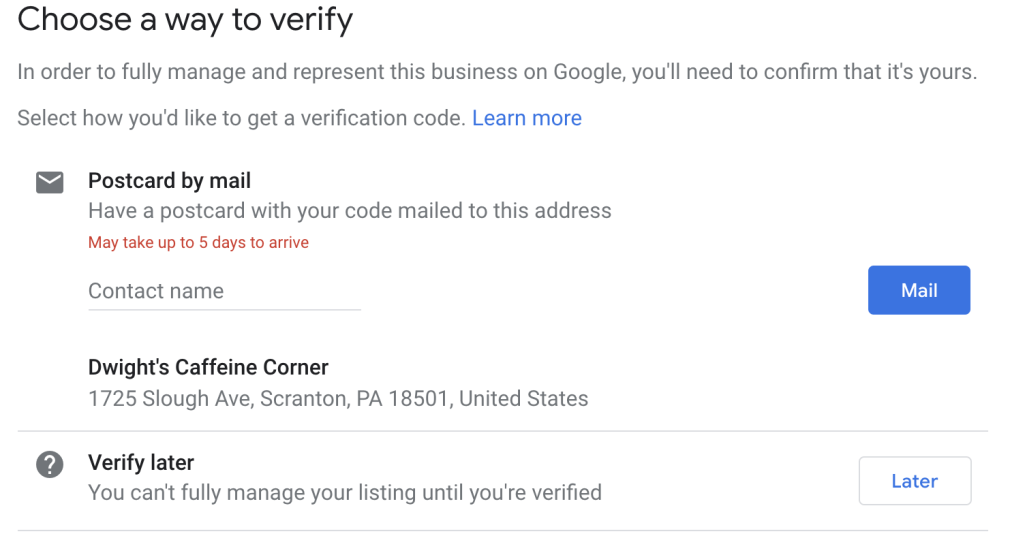
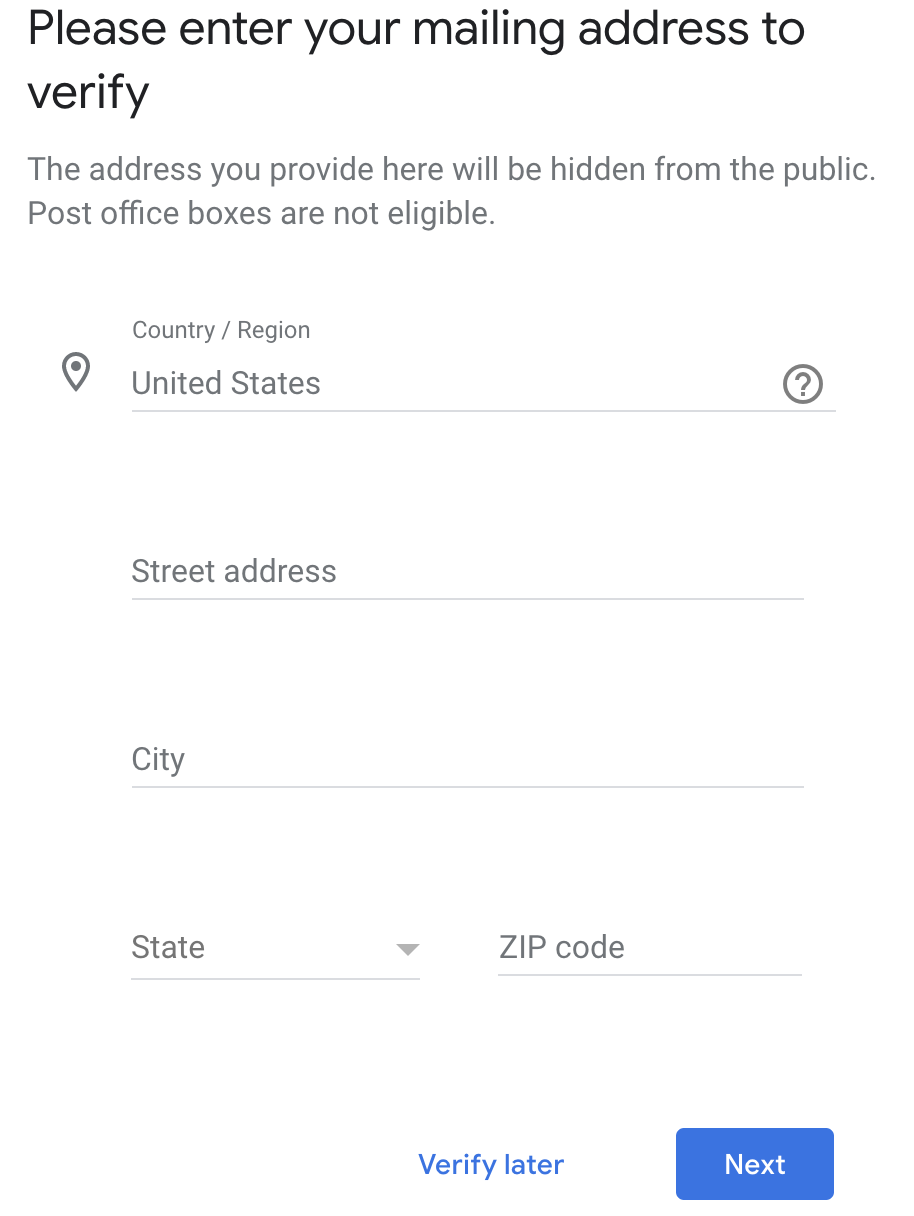
Step 12: If you are showing your address, you’ll be prompted to verify by postcard with an option to add a contact name. If you are hiding your address, you’ll be prompted to add an address for verification purposes. Your address will not be shown but is needed to verify your business.
Step 13: Once you receive the postcard (usually within 5 business days), log back into your listing to verify your listing.
Scenario 2: Listing exists, unclaimed
If your business has been around for at least 6 months, you might already have a Google My Business listing that was automatically created.
Go to Google Maps and perform a search for your business name. If a listing shows up and you see “Claim this business,” then claim it! If you see your listing and there’s a label that says ‘Manage this listing,” then head to Scenario 3.
If you have the option to claim the listing, you’re going to be asked to make sure the information is up to date, then you’ll go through the verification process.
Scenario 3: Listing exists, claimed
Maybe a former employee, an email address you don’t have access to anymore, or a former agency that claimed the listing on your behalf. Whatever the reason is, you don’t have access to your Google My Business listing.
Go to Google and perform a search for your business. Within the panel, you’ll see ‘Suggest an edit • Own this business?’ Select “own this business.”
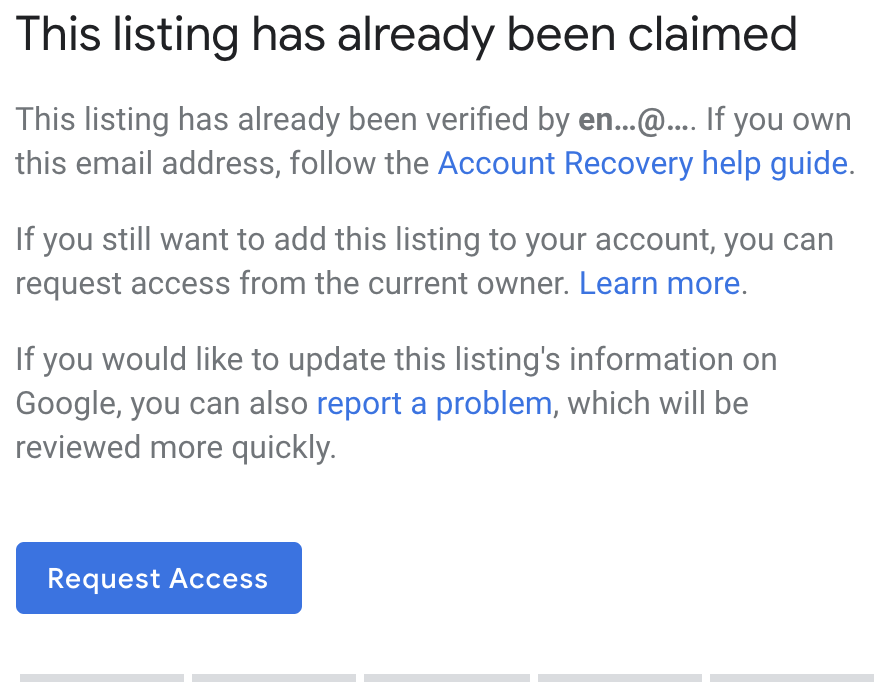
Google will show the first 2 characters of the email address that owns the listing. Sometimes, this may spark your memory with the email address that you used years ago to claim the listing.
If you don’t know the email address, click on the Request Access button.
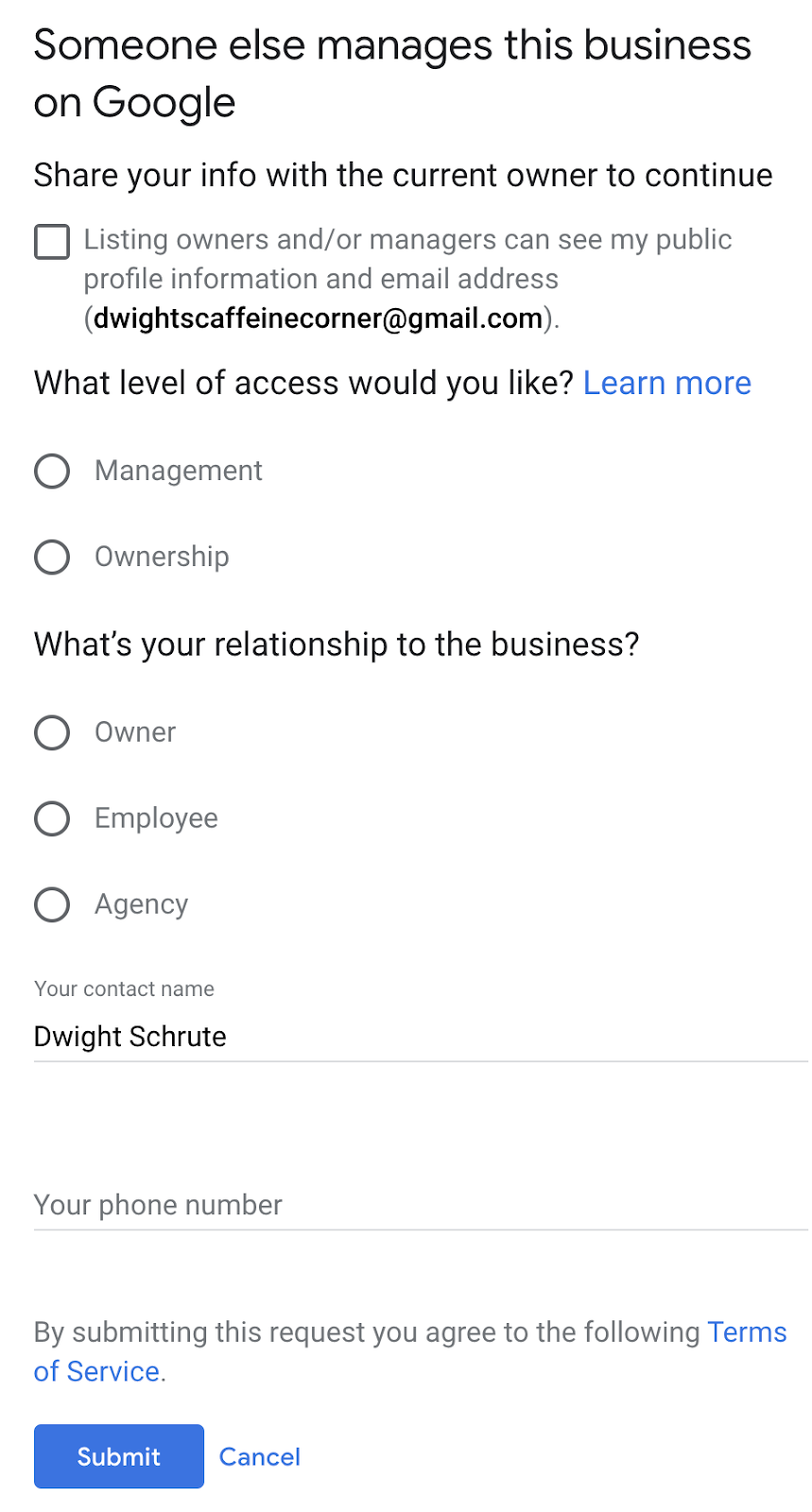
More often than not, you’re going to check the box to share your info with the current owners and managers of the listing.
For level of access, choose Ownership.
Your relationship to the business is likely going to be owner since you’re requesting ownership of the listing.
Provide your name and phone number, then submit.
After you submit the form, the current owner of the listing will get an email that asks them if the request is valid. You’ll also receive a confirmation email. Keep the confirmation email.
The current owner of the listing has 3 days to respond to your request. You can check the status of your request by clicking on the link within the confirmation email.
If your request is approved, you’ll get an email confirmation and can then start managing the profile.
If your request is denied, you’re going to need to contact Google My Business support via the Help Center.
Alternatively, you can get in touch with GMB Support on Twitter. It might take them a few days to respond, but they’ve been helpful in the past.
If the current listing owner does not respond within 3 days, you’ll get the option to claim the listing. Sign into g oogle.com/business and you should see an option to verify the listing.
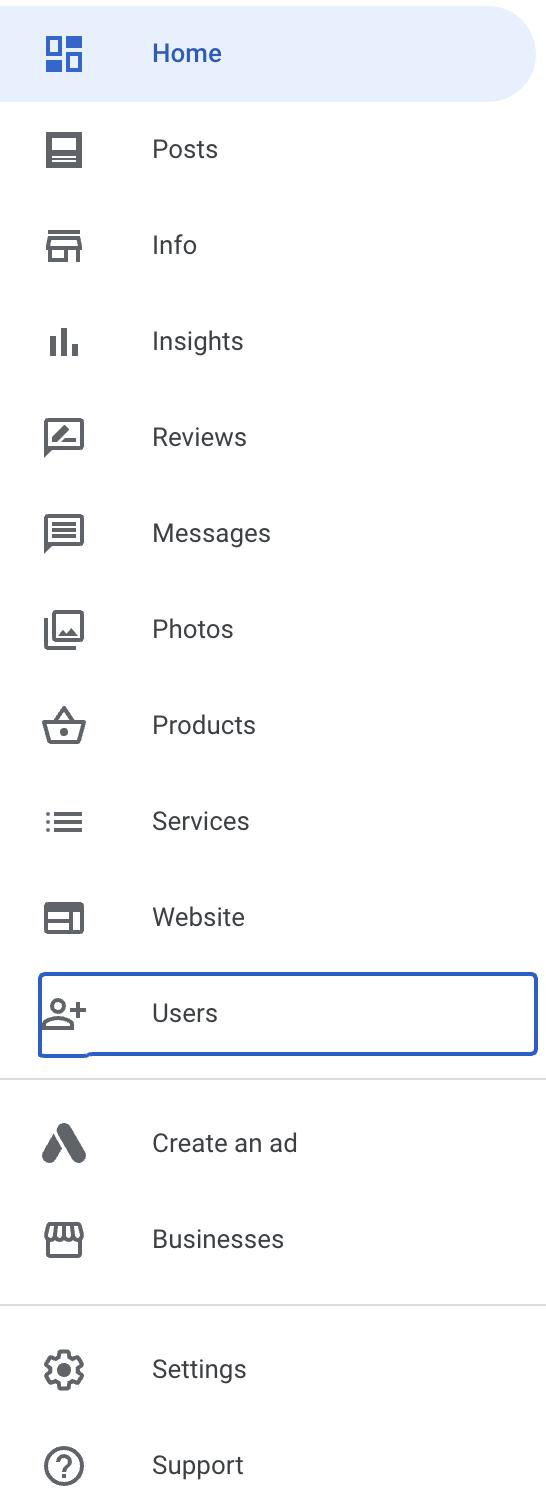
Once you get access to the listing, the first thing you will want to do is make sure that anyone who should have access to the listing does. Since you are now the primary owner of the listing, you can add or remove users from having access.
Next Steps
Once you’ve created or updated your listing, be sure to stay on top of it! Listing management is an important part of ensuring the information around your business is useful and accurate.
Set a predetermined time to check in on your listing, try a few marketing strategies to connect with your audience, and keep an eye out for any user interactions with your listing. You can also use listing management tools to take the guesswork out of managing your listing.
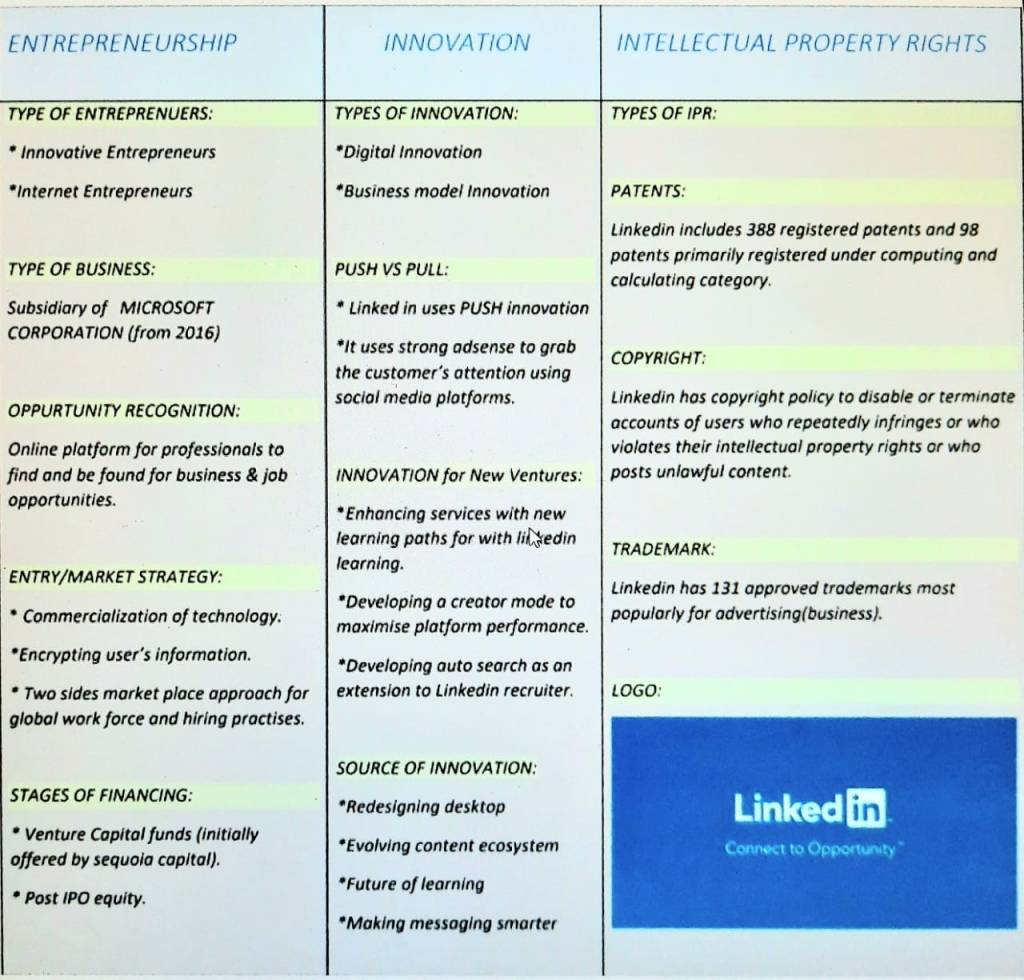
As we all know that ” Linked in ” corporation is one of the leading networking website which functions on describing user created profiles with their work experience, education and training, skills, and a personal photo so that users can find jobs, people and business opportunities recommended by someone in one’s contact network. Users can save jobs that they would like to apply for. Users also have the ability to follow different companies.
In the above para we discussed about the working of linked in corporation with user provided data but we can understand it’s business marketing strategies and it’s growth from initial stage in a clear manner when we see linked in as a business model.
Linked in was found on may 5, 2003 at mountain view, California, US by Reid Hoffman. Initially the company started getting it’s financing through the help of venture capitalist company and later it struggled to get investors in IPO but at the year of 2011 LinkedIn priced its IPO at $45 per share giving the company valuation of $4.5 billion but at the year of 2016 Microsoft announced the valuation of LinkedIn for $196 per share which in all cash transaction valued as $26.2 billion and acquired the company.
CHALLENGES THAT ARE ACCEPTED BY LINKEDIN :
As a networking site the first and foremost challenge faced by LinkedIn is data encryption of user along with the data encryption LinkedIn should also concentrate on following terms:
PRIORITISING LINKEDIN GROUPS: LinkedIn contains many community groups with managers to share/discuss ideas for improving their work/business. So, they have to arrange the groups with out arising any type of ambiguity.
CONSTANTLY CHANGING THE WAY OF ADVERTISING : We get too many irrelevant ads when we use LinkedIn. Sometimes, getting non-sink advertisements also creates a negative impact on the site. So, that it should constantly change the patterns of presenting adds with new algorithms to avoid negative footprints on site.
ARTICULATING THE DORMANT PROFILES: LinkedIn says it’s growing, but there are many inactive accounts that should be removed after a reasonable period of time by keeping the active users accounts effectively and let inactive users go by the wayside.
MAKING LINKEDIN FROM “HAVE TO” TO “WANT TO” FOR BUSINESS PROFESSIONALS: Many people are on LinkedIn because they feel that they “have to” be there for expanding their network but very few professionals LOVE logging in to their LinkedIn. So, to attract more people on internet then LinkedIn must use competitive content on it’s pulse.
MARKETING STRATEGIES APPLIED BY LINKEDIN:
LinkedIn used Traditional marketing strategy at its initial stage of growth. LinkedIn approached it’s users through branding it’s company with chocolates. Similarly, LinkedIn adopted several marketing strategies on internet for improving it’s sustainability.
Most of the business organisations put a great deal of effort into creating the perfect website, and invest a significant portion of the marketing budget on curating the ultimate customer experience. So for that purpose LinkedIn has created virtual circle of influence by combining LinkedIn marketing and remarketing on your website. In order to attract efficient business professionals LinkedIn promoted paid marketing system which can afford a wide variety of ad formats and business targeting opportunities.
LinkedIn provides sponsored content, sponsored messaging, Text adds and Dynamic adds which are considered as native ads that will appear in the viewer’s LinkedIn feed and it tends to be customer centric with helping it’s customers on getting control over their business marketing.
Overview of the company
One of the main reason for it’s sustainable marketing growth is, LinkedIn seamlessly fills in the fields and provides you with information it already knows about your prospect. The up side of this capability is that it reduces the user’s submission time, and also diminishes their friction to signing up for whatever you are offering to the opposite person .It also target the customised accounts for the profile that is provided by user and also allows you to run account based marketing campaigns, powered by LinkedIn data.
Finally, LinkedIn is particularly well-suited for personal branding and which actively manages one’s image and unique value to position oneself for career opportunities. LinkedIn has evolved from being a mere platform for job searchers into a social network which allows users a chance to create a personal brand. LinkedIn’s constant adoption and application of new technologies and new strategies in market has improved it’s standards and sustainability in the competitive corporate field.
Being a part of a mixed economy , where politics tend to exploit the peace between different religions and so on …….. .
“India was the motherland of our race, and Sanskrit the mother of Europe’s languages: she was the mother of our philosophy; mother, through the Arabs, of much of our mathematics; mother, through the Buddha, of the ideals embodied in Christianity; mother, through the village community, of self-government and democracy. Mother India is in many ways the mother of us all.”
Will Durant, American historian
And now you want to know why I am being so dramatic over such things . Well , if you want to know than start reading the editorial .
Introduction
Indians say it is important to respect all religions, but major religious groups see little in common and want to live separately
More than 70 years after India became free from colonial rule, Indians generally feel their country has lived up to one of its post-independence ideals: a society where followers of many religions can live and practice freely.
Religion has historically influenced Indian society on a political, cultural and economic level. There is a sense of pride associated with the country’s rich religious history as the traditions of Hinduism, Buddhism, Sikhism and Jainism all emerged out of India. Moreover, while a majority of people in India identify as Hindu (79.8%), the medley of religions that exist within the country continually impact contemporary society.
Census
The 2011 Indian census indicated that 79.8% of Indians identified as Hindu, 14.2% identified as Muslim and 2.3% identified as Christian. A further 1.7% of the population identified as Sikh, 0.7% identified as Buddhist and 0.37% identified as Jain. Due to the massive population size of India, religious minorities still represent a significant number of people. For example, although only 0.37% of India may identify with Jainism, that still equates to over 4 million people. While not all religions in India can be discussed in detail, the following provides an overview of the major religions in the country as well as sizable religions that originated in India.
Social beliefs
“India has two million gods and worships them all. In religion all other countries are paupers; India is the only millionaire.”
Mark Twain
Karma, Acceptance and Personal Choice . Many Indians tend to have a sense of acceptance towards one’s life position or a belief that, due to actions in one’s past life, good or bad personal circumstances are deserved. This attitude partly stems from religious ideas such as ‘karma’ (the idea that one’s actions will affect their current or future life) and ‘samsara’ (the cycle of rebirth).
The interplay of these social, cultural and religious factors allows people to be accepting of life events and trajectories. However, this is not to be interpreted as Indians being unwilling to take responsibility for life circumstances. Many often contemplate how their actions may impact their future and make decisions accordingly. Some of India’s youth are challenging a fatalistic perspective by asserting their free will to choose their vocation, spouse and other life factors. Indeed, as social mobility becomes more common, there is a growing belief that one can change their circumstances.
It’s Role
Religion plays a major role in the Indian way of life. Rituals, worship, and other religious activities are very prominent in an individual’s daily life; it is also a principal organizer of social life. The degree of religiosity varies amongst individuals; in recent decades, religious orthodoxy and observances have become less common in Indian society, particularly amongst young urban-dwellers. As of the politics , they play with religion , people’s belief and with their trust .
Online classes are here to stay . Online learning has gain popularity , thanks to this pandemic . Not only colleges & universities but all schools have also introduced this system . In this pandemic , where the whole world is in lockdown it was very difficult to continue studies as all schools , universities , organizations were shut , & here these online class came into force .Online classes have whole different environment as compare to our traditional form of classroom , & students are enjoying this environment.
Some advantages of online classes which you also will relate to are :
Taking classes usually means showing up on class at a particular time, sitting through a somewhat lengthy lecture and then going directly to your next class. Or, if you’ve spaced your classes out, you may be able to take a break in between, but you still have to stay on campus. It can make for really long, really intense, really exhausting days. Then you have to come home, do homework, sleep and do it all again the next day. It can easily become a grind. But with online classes you can sit comfortable & take the lecture by sitting in the position you want to .
Online classes teaches you self discipline , because their is no teacher that will ask you to sit in discipline . You learn the most important thing of your line that is self discipline .
Comfort of you very own home is what students like the most . You can take class from any where & every where .
4 Online classes will force you outside of your comfort zone (in a good way). You will have to learn to navigate the course lectures, download materials, interact with others online and communicate well digitally. Yes, this may be scary for some people! However, in the information age, these are essential skills and will allow you to keep pace with others.
At the same time online classes have disadvantages also which all of us know , they are :
Online learning creates a sense of isolation , students starts feeling that they are in a cage & somebody is forcing you to sit in front of a device .
It require self discipline , students don’t have this skill , as this skill require experience.
Online classes are prone to technical issues, it require proper network connection & needs a proper device for taking classes on .
Online classes need more time to be spend on screen & people don’t have this much time & patience to sit at one place .
Conclusion drawn from this is , we all know that this pandemic will stay for long & online classes are the only remedy for this , to avoid contact with one & other , & for students safety & security , online classes are here to stay
Peter Lynch is one of the most successful and top value investor of all time. He was a legendary fund manager who gave 29% returns to their investors for 13 years in a row. He wrote books on value investing , where he shared his investment lessons which he learned and used during his journey as an investor. He is one of the greatest value investor of all time. He is a firm believer that an average investor can also pick winning stocks as Wall Street professional with right research, patience , steady discipline and common sense.
Some of his investment principles are –
1. Invest in what you already know – “The worst thing you can do is invest in companies you know nothing about. Unfortunately buying stocks on ignorance is still a popular American pastime.” -Peter Lynch
People can perform well by investing in what they already know. For instance if a doctor wants to invest in banking sector (about which he know nothing) , he will not have that great return as compared to if he will invest in pharmaceutical companies ( as he already knew about drugs, healthcare sector and their companies)
“Invest in what you know. It leaves out the role of serious fundamental stock research. People buy a stock and they know nothing about it. That’s gambling and it’s not good.” -Peter Lynch
So, it’s better to choose the company whose products/services are either used by you or you are familier of the products/services of that company in some way or other. These knowledge will lead you to invest in better stocks .
2. Invest in companies not in stocks – “Look for small companies that are already profitable and have proven that their concept can be replicated. • Be suspicious of companies with growth rates of 50 to 100 percent a year”-Peter Lynch
Behind every stock there is a company. If companies will perform well, the stocks automatically will perform well. So, it’s important to know about the company, it’s business model. Choose a company whose fundamentals are strong. A company whose business model is so easy to understand that anyone can understand and run that company.
“Go for a business that any idiot can run – because sooner or later any idiot probably is going to be running it” -Peter Lynch
Know a companies management, it’s fundamentals and then ask yourself , “are you able to understand the mission and vision of the company? “ or “If you’ll be given the responsibility to run this company, will you be able to run the company? “
If the answers to the above questions are a YES then it’ll be great to invest in that company.
So always remember that you have to invest in a company and not in a single stock.
“Behind every stock is a company. Find out what it’s doing.” -Peter Lynch
“Never invest in a company without understanding its finances. The biggest losses in stocks come from companies with poor balance sheets.”
3. Don’t take unnecessary risks. Take calculated risks – You don’t have to take risks which you can’t bear. Only take calculated risks.
Let’s say, you have $10 dollar, maybe if you will lost this, you won’t regret. But what if you lost $100 or $1000! Always buy stocks of the amount if you lose won’t regret. You are not required to put all your money in market and risk all that money. Instead put only that amount which if you lose won’t make you regret of investing.
Also, invest only the amount you will not need ever back in your life
4. Peter Lynch said that the most important thing that keep in mind while investing is : know why you own it.
“ You have to know what you own ,and why are you own it .” -Petrr Lynch
It sounds simple but it is not . He said when I asked most people they just don’t know why they own a stock . 80% of investors have no answer to this question .
They maybe hear some tip from anywhere and put their money at risk and when they lose it they blame institutions .
First you have to know the reason . Why you should invest in this company ,research about that company . Check their balance sheets . Without proper research you are not investing you are just gambling . Read and know as much as you can about the company. And remember to buy the company and not just a stock.
“If you’re prepared to invest in a company, then you ought to be able to explain why in simple language that a fifth grader could understand, and quickly enough so the fifth grader won’t get bored.” – Peter Lynch
5. Invest for long time- Lynch used to hold stocks for long period of time. He used to sell the stocks when the fundamentals of any company gets changed. This is his advice for all investors out there to not go behind short term profits but invest for a long period of time.
He even conducted many studies to understand the power of compounding.
“People who succeed in the stock market also accept periodic losses, setbacks, and unexpected occurrences. Calamitous drops do not scare them out of the game.”
Some more investment lessons by Peter Lynch :
• “Never invest in any idea you can’t illustrate with a crayon .”
• “The trick is not to learn to trust your gut feelings, but rather to discipline yourself to ignore them. Stand by your stocks as long as the fundamental story of the company hasn’t changed”
• “Whenever you invest in any company, you’re looking for its market cap to rise. This can’t happen unless buyers are paying higher prices for the shares, making your investment more valuable.”
• “There’s no shame in losing money on a stock. Everybody does it. What is shameful is to hold on to a stock, or worse, to buy more of it when the fundamentals are deteriorating.”
• “Never invest in any company before you’ve done the homework on the company’s earnings prospects, financial condition, competitive position, etc”
• “Big companies have small moves, small companies have big moves.”
• “Good management, a strong balance sheet, and a sensible plan of action will overcome many obstacles, but when you’ve got weak management, a weak balance sheet, and a misguided plan of action, the greatest industry in the world won’t bail you out.”
• “In the long run, a portfolio of well chosen stocks and/or equity mutual funds will always outperform a portfolio of bonds or a money-market account. In the long run, a portfolio of poorly chosen stocks won’t outperform the money left under the mattress.”
This is how he succeed in the world of investment. You can learn from him and help yourself to reach the level you want in investment.
When we think about how we should prevent and punish criminals on the question of whether criminals are born or made. We first should understand the behaviour traits of criminals because personality is the major factor in many kinds of behaviour, one of which is criminal behaviour. To determine what makes a criminal to become as “a criminal,” we must understand his/her personality.
Are criminals born or made? This question has been crushed the brains of psychologists, sociologists, and criminologists for many years at several incidents and efforts have been made to establish the nature of criminality. The born or made argument, known as the “nature versus nurture” debate, arises the question, whether criminality is due to genetic factors, and therefore unavoidable, or whether it is the product of social, situational, environmental surroundings, and other external factors.
Criminal behaviour has been increasing virtually throughout the every part of the world because such behaviour may be passed on from father to son and the genetically deprived criminal under class is breeding faster than the rest of society, he argues. Majorly, the psychological factors which inhibit criminal behaviour are fear and conscience.
Psychologists after many experiments they came up with an opinion that criminal behaviour lie in genetics and as well as environmental situations but it doesn’t mean that every criminal will posses with same type of behavioural traits. According to the population census of India the children who were born to thug is used to be recorded as a thug, this was registered under the criminal tribe act(1870). This act resembles that there is a chance of getting criminal behaviour if the child was born to a thug.
In these days we are observing that even some of the common people are also becoming criminals with out having any past crime background. So, this is the point where we have to think about the impact of society or the environment on the criminal. Guys, a criminal is also a human who posses all the common things as we all have but the only difference is that the perspective and the surrounding where a criminal has risen.
Most of the teenagers and children has a high tendencies to learn from their surroundings. Petty crimes committed by children may appear to be a tale to friends who may also be involved the same for pleasurable. Over duration of time, this behaviour may prove to become a permanent thing. Peer pressure is mainly clear in the slums where houses close to one another. Among other factors, this explains why crime rate is on the higher on average in poor vicinity.
According to study, families in inner cities are facing many challenges. There is extremely huge number of single parent families where mostly the father is missing. This impacts the children in those families a lot especially boys need a father figure in the family to help them grow and learn how to control their manhood. Surroundings around a person influences a person a lot as like an old proverb says that wicked group damage decent principles. There are several reasons behind a person to become as a criminal that may be because of his financial standards or because of family issues or sometimes because of being as victim also.
Now a days we see many people who are at higher positions in their career are also becoming as a criminals. This type of scenarios clearly show us that having lots of degrees in hand can’t stop the people in turning them as a criminals. The main reason behind these scenarios are lack of essential values and ethics which are missing in todays education system and this effect is adversely creating a negative roots on society.
1. Gold/Money clingeth to the protection of the cautious owner who invest it under the advice of men wise in its handling. Therefore while investing your money take the advice of a wise man.
2. Gold/Money sleeps away from the man who invest it in business or which are not approved by those skilled in its keeping simply don’t invest things unknown to you or first learn about them and then invest.
3. Gold/Money goes away from the man who would force it to impossible earning or who follows the alluring advice of tricksters and schemers or who trusts it to his own inexperience and romantic desires in investment
4. Gold/Money will come gladly and in increasing quantity to any man who will put by not less than one tenth of his earnings to create an estate for his future and that of his family.
If you work in local SEO, you know that dealing with spam on Google My Business is going to be a constant battle. This is especially true if you work in industries like:
Legal
Health
Home services
We need to understand why Google My Business spam is so rampant.
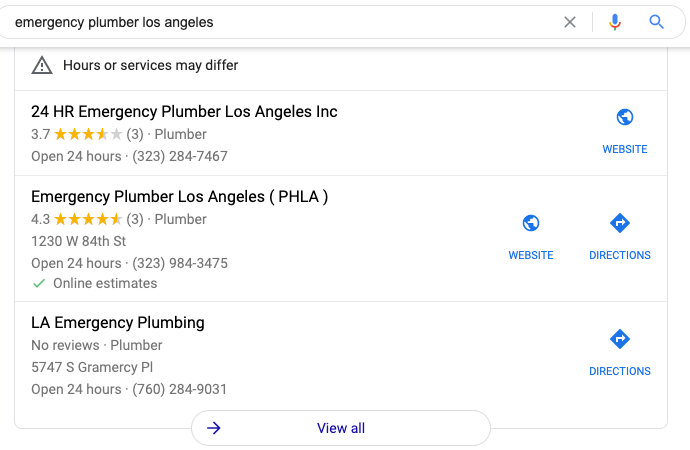
Unfortunately, having keywords in your business name is a massive ranking factor. As an example, I performed a search for “emergency plumber Los Angeles” and here are the top three Google My Business listings ranking in the map pack:
The first result (24 HR Emergency Plumber Los Angeles Inc) is a lead generation website, which is against Google My Business Guidelines. The second result appears to be a lead generation website, too. The third result? You guessed it, it’s another lead generation listing, they don’t even list a website!
These companies sell leads to real plumbers at a hefty price. Clicking through View all to see all listings, you don’t find a real plumber until the 10th result! Outside of completely fake listings that need to be removed, sometimes competitors will keyword stuff their Google My Business name.
Our Google My Business Spam Checklists
There are two checklists: one for identifying potential listings violating Google My Business guidelines and the other is a reporting checklist.
The first checklist doesn’t need to be done frequently, but it would be beneficial to do it at least once. If your rank tracking is set up correctly for Google Maps, you will likely just need to pay attention to your map rankings. If you drop a position on a major keyword, what listing is outranking you now? If it’s a new listing, head to checklist no.2.
Checklist No.1:
On google.com/maps, make sure you’re in the area you want to find spammers
Use the search operator intitle:”keyword” to surface listings with the keyword in the business title
Any listing that has the primary keyword is a Yellow flag
Any listing that is ONLY named the keyword is a Yellow flag
Any listing that has a modifier (-) is a Yellow flag
Any listing that has no website is a Yellow flag
On a Google Sheet, add the business name, address, phone number, website, and link to Google My Business listing for each Yellow flag listing
Repeat this process for each major keyword (topic) that you/your client covers
For good measure, perform a few raw searches in Maps as if you were a customer looking for the particular service, including the city name
This checklist enables you to find potential listings relatively quickly. These listings may be fake or could be completely legit. The second checklist will help us go through each listing, one-by-one, to build a case for the listing to be corrected or completely removed.
Checklist No.2:
Tip: (A “no” response on any checklist item will require documentation)
Use the state’s business name lookup. Is there a business registered at the address?
From the listing, click on photos and then go to Street View and 360º.
Is there signage for the business?
Is it a personal residence?
In a new tab, do a search of the exact address/is the listing the only one at that address?
Visit the website. Is the branding/logo the same as the business name?
Does the site have an about page with real people or company history?
Is the content heavily ‘SEO’d’ and generic?
Is the content focused on connecting users to someone else (lead gen)?
For industries that require a license, is one listed? If yes, is it a valid license?
This checklist should be used on each listing that has a Yellow flag.
Documenting Your Evidence
As you’re going through the checklist, you need to document all of your findings, this will be used when we submit the Business Redressal Form.
Open a Google Doc, name it appropriately, and let your documentation live there. Each listing should have it’s own Google Doc. The more detail you can provide in the document, the better. Some suggestions for added detail could include adding screenshots, external links with descriptions, etc.
Suggest an Edit or the Redressal Form?
If you are reporting a competitor that is just keyword stuffing their business name and the location is legitimate, you may want to consider simply suggesting an edit first.
Pro tip: Do not use an email address that is associated with Google My Business listings. This can cause your other listings to be suspended. (h/t to my friend, Jason Brown).
If and/or when your suggested edit does not stick, then submit the redressal form. If the listing is fake, go straight to the Business Redressal Form.
Filling Out the Redressal Form
Follow the Business Redressal Form instructions and fill out the sections. When you get to the last section that allows you to explain why you’re requesting a redress, this is where your Google Doc is going to come in handy.
In this field, you can’t add photos, but you are able to include a link to your Google Doc. When grabbing the Google Doc link, make sure it is viewable by anyone with the link. If it’s not, Google Support will not be able to see the contents. Don’t just drop the link and submit, provide some context, and then place the Google Doc link. Submit.
Repeat the process for each and every listing that you believe needs to be removed. Google recommends:
“If you have many URLs to report, we recommend submitting 10-100 at a time for a faster processing time. You can submit multiple URLs by clicking the ‘Add additional’ link or by uploading a spreadsheet with all the URLs.”
Now the hardest part begins, waiting.
In your original spreadsheet, add a date column and add the date that the redressal form was submitted. Timelines can vary depending on multiple factors but if nothing has happened after 10 weeks, then you’ll need to reassess the redressal and look for further evidence.
Having to deal with spam on Google My Business is frustrating and can be time-consuming, but if done correctly, can help protect users from spammers and help real small businesses. For more tips, check out SEMrush’s post about their Google My Business checklist.
A former NASA scientist Parag Narvekar has created sensors to enhance farm produce for farmers in Nashik, Maharashtra. He claims that new sensors will assist farmers to understand the weather and adjust their use of irrigation and fertilisers. According to Narvekar, the new sensors are more cost-effective than the already existing ones and have made sensors of Rs 10,000 that earlier use to cost Rs 1.5 lakh.
Cost-effective Sensors to Improve Farm Produce
A resident of Nashik, Narvekar owns a company Sensartics that makes weather sensors and offers cost-effective solutions to farmers. Narvekar’s company has also collaborated in the past with more organisations to provide solutions to local farmers’ problems. In February this year, Sensartics collaborated with Sahyadri Farmers Producers Company (FPC) to establish sensors in Nashik’s grape farms to safeguard the farmers from losing their harvest because of odd weather. The team installs sensors at the root zone levels of the plants. These sensors calculated temperature, soil moisture and soil electrical conductivity. Sensors placed in the canopies measured humidity and leaf wetness other than temperature.
Narvekar, with his team at Sensartics, has also established village level local weather stations that can provide precise weather forecasts beneficial for the local farmers, the efforts of Narvekar and his company have brought state-of-the-art meteorological stations within the reach of farmers.
With this they Gained greater clarity around the potential of sensors to improve agriculture and food security.
Belarus is an overlooked country that is located east of Poland and south of Lithuania and Latvia. It is bordered by Russia in the East and also bordered by Ukraine in the South. The landlocked country has an area of 207,600 square kilometers (80,200 square mi) and a population of little over 9 million people. Belarus was one of the newest countries that were formed after the disintegration of the USSR in 1991.
Alexander Lukashenko was elected Belarus’s first president of Belarus in 1994. Since then he has held the position and has been governing the country for more than 25 years. Lukashenko’s style of governance has been deemed as authoritative as there have been no free elections since he got elected. He has maintained many of the Pre-Soviet policies and Belarus’s Democracy Index rating is the lowest in Europe. In the 2020 Belarusian elections, Lukashenko was declared the winner against the opposition leader Sviatlana Tsikhanouskaya. The election was marred by allegations of widespread electoral fraud. Many western countries had demanded a re-run but that never happened. This also triggered mass protests across the major cities in Belarus. But to control the critics and protesters, the government reacted with brute force, arresting demonstrators and sending numerous protestors behind the bars.
In May 2021 the kidnapping of opposition journalist Roman Protasevich and his girlfriend, Sofia Sapega was another sign of the Belarusian government’s woes against any kind of critics. This was basically a state-sponsored hijacking of air piracy. This incident occurred on Ryanair Flight 4978 en route to Vilnius on May 23 when the plane was diverted to Minsk with a fake bomb threat from Belarusian air traffic control. After this violation of international aviation rules, both were arrested on questionable charges of organizing mass unrest.
Belarus has always swayed between Russia and the EU but recently European Union has imposed one of the toughest restrictions against Belarus. EU has blocked the sale or supply of major technology to Belarus, as well as restricted access to capital markets and trade in oil and potash. EU has also imposed airspace restrictions against Belarus. But any sanctions against Belarus must not target ordinary people. Because the land borders are already sealed off with Poland and Lithuania. The only viable option for Belarusian people was air travel. So this restriction will also affect the citizens of the country. To counter the problem of Potash sanctions, Lukashenko has struck a deal with his Russian business friend to create a new Potash mining and processing plant. But this will come at a cost of increased taxes for the individual citizens of Belarus amid the Covid-19 crisis and economic downturn. The United States has also imposed visa bans and other sanctions on 62 individuals who were identified as contributing to the Belarus crackdown.
The citizens of Belarus deserve free Elections and a leader who can think about the citizens of the country instead of holding onto the power. With a progressive leader, Belarus could have been on par with the Baltic countries. The recent sanction might or might not work but in the end, the common citizens of the country suffer the most.
Developing and Managing a business is called Entrepreneurship. The goal of the business is to gain profit. The entrepreneur should be innovative enough to make his/her business become a success. He/She should be having qualities of a good leader to execute the team work efficiently. This journey also comes with many risks.
Entrepreneurship includes start-ups and small business. Entrepreneurship creates jobs and helps in developing economy. Entrepreneurship does not have a specific path to follow. The path differs to for every aspiring entrepreneur according to their goals and their present conditions.
India has seen many of such successful entrepreneurs from a very long period. Here are some of the entrepreneurs of the recent times who managed to swim through the ocean and grab the trophy of success:
RITESH AGARWAL (OYO ROOMS) : Ritesh Agarwal, founder of OYO Rooms was born in Odisha. He qualified the Thiel fellowship which was for entrepreneurs of age below 20. Ritesh founded OYO-On your own hotels and homes in 2013 and at the age of 22 he became a millionaire. The concept of OYO was inspired by Airbnb, a US based company. OYO headquarters is in Gurugram and the company has expanded to Malaysia and USA and 80 other countries.
SHRADHA SHARMA ( YOUR STORY) : Your story was started in 2008 by Shradha Sharma. She Used to work at CNBC TV18 as a journalist before she decided to take this venture of start-up. Your story publishes stories of success of different people through their blog. The blog is published in 12 Indian languages. Now the net worth of the company is estimated to be $678K. More than 40,000 success stories have been published in the blog and has more than 10 million readers per month.
BHAVISH AGARWAL ( OLA CABS) : Bhavish Agarwal was born in Punjab. He was a student of IIT Bombay and started his career by working in Microsoft. A Bad experience during one of his rented drive, gave him Idea of starting the car renting company. Ola cabs stared partnering with taxi drivers. They gave the comfort of booking the cars through mobile phones through the app to the customer. They also started partnering with auto drivers as well. Now the Net worth of the company is estimated to be $6.5 billion. Now Ola is renting e-bikes which aims bring revolution.
KUNAL SHAH ( CRED) : CRED was started in 2018 by Kunal shah, Who is also known for starting the company freecharge. CRED is a app mostly for mobiles which helps the members to manage their credit cards in one place. Kunal Shah is a founder of tech company without engineering background . The company got funding before its execution. And it has a huge market as now.
The opportunities for an entrepreneur in India is very high and still growing. India is considered as a good investment destination. A report from pricwwaterhouseCoppers says that 2219 multinational companies emerge from India till 2024. A favorable environment for the business persons is developing in India. Along with government programs, private funds are also increasing in India and hopes to see much more successful entrepreneurs in future.







































 Eduindex
You must be logged in to post a comment.