Critical analysis of films considering Laura Mulvey’s Essay

Introduction:

Laura Mulvey was born on 15 August 1941 and is a British feminist film theorist. She is best known for her essay on visual pleasure and narrative cinema.

I’m going to write about 4 films which clearly validates all the aspects or ideologies of the film industry which Laura Mulvey opposes and tries to teach us what is wrong with it and why.


In this part, Laura Mulvey tells us “how the fascination of film is reinforced by pre-existing patterns of fascination already at work” which basically tells us how we already have existing ideas and thoughts and also our thinking and cinema is what validates it. We also have a set of ideologies which movies reveal and we feel like we can put that into practice.


There is also a gender assymetry which is revealed to the common people and the movies validate them which makes people think that there is nothing wrong with it and it is what it is. From the beginning of time we see how women are being suppressed and not given their own voice and therefore even now, there are many films following the same pattern of filmmaking which is not justified as it gives the wrong idea to society.


We see how Laura Mulvey appropriately portrays psychoanalytic theory by demonstrating patriarchy has a structured film form.


Laura Mulvey in her essay also describes phallocentricism which is the idea of having a penis and how it is the central element of the world and how everything revolves around men. She also mentions “castrated woman” which talks about the lack of penis and because our society is a patriarch society, we do not give much importance to the ones which lack a penis. She tells this is a paradox as in order to enhance these male characters, a female is always necessary and how they are only used as a plot to forward the film. This shows us the concept of active male and passive female.


In every movie there is a concept of an active male and a passive female.
An active male is when the main character has a very important role and given all the attention or importance and is also the central reason the film is being made. The male protagonist is given all the dominant roles or is portrayed in a way that makes the audience believe that he is the most important aspect of the movie. The filmmakers try to show that the movie would not have been possible if the male character was not present.
A passive female is where in a movie, the female part is not given that much importance and is just used for the sole purpose of entertainment. It’s also how women are not given the lead roles or is just used to elevate the film, they are mostly used as foil characters, mostly to enhance the role of men. She is used as a plot and does not have any real importance in the film. It also shows how she needs a man to be protected and cannot be independent as that would hurt the ego of the man or make him feel less powerful.


An example for this would be the movie “Hero” release in 2015. The entire movie depicts how without the main protagonist which is Sooraj Pancholi, Athiya shetty would be in danger even though she is the daughter of a very well known police commissioner. It depicts how a woman would be in danger without a man, how she is dependent on him and how she “needs” him to protect her. The whole movie shows the man’s power and how he’s the only one who can save her from any problem or any situation. It shows how weak females are and how it is necessary for them to have a male by their side to be safe in this society.

Laura Mulvey talks about 2 things. The first one is how In a female’s life if there is an absence of a penis then there is a threat to her and secondly to overcome this threat she needs to raise a male child.


She tells how “woman’s desire is subjected to her image as bearer of the bleeding wound, she can only exist in relation to castration and cannot transcend it”. This tells us about how woman due to an absence of phallus is dependent on men or how she is identified as someone’s daughter or someone’s wife or a mother but she never has her own identity. They are also just displayed as objects and their appearance is in such a way that it cannot be anything apart from being erotic.


She tells how women are used to signify the men and how they are a bearer of meaning and not maker of meaning. This shows how women are always related to a male and how they lack individuality.


This essay reminds us of how we are being oppressed and how even though we are independent females, some people think that it is important to depend on men as it is a patriarchal society and that’s how it’s always been.
This essay also talks about women as a “non- mother” where according to the society, in order to be complete, she needs to have a child or motherly instincts or she is not considered as a woman.


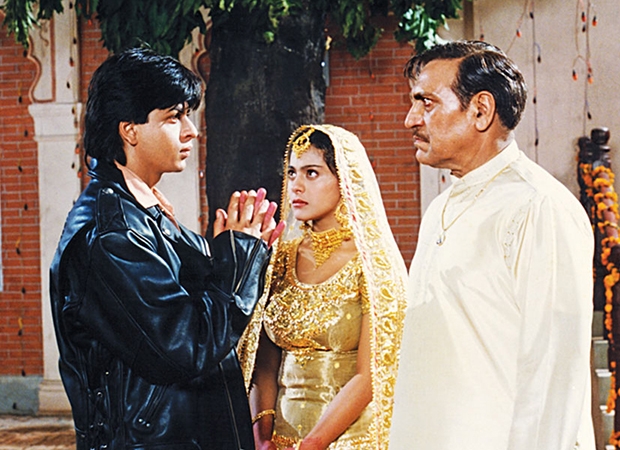
An example for this would be the movie “dilwaale dulhaniya le jaaenge”
This movie shows the patriarchy of society where the female character ie Kajol is subjucated by her father, not allowed to listen to music,not allowed to go out with friends and is forced to marry a guy of his choice even though she was in love with Shah Rukh Khan. Futhermore, this concept is amplified when the male lead is the one who must save her from getting married.
Laura Mulvey talks about how cinema can offer a number of possible pleasure but she specifically talks about scopophilia. It is the pleasure of looking at another person in an active controlling sense or by objectifying others.
In this, looking at something itself is a form of pleasure. She also mentions voyeurism which is the practice of obtaining sexual gratification from objectifying or observing others. When someone is looking at someone they are trying to find erotic basis by objectifying them.when we watch a movie, we tend to detach from the outside world or our surroundings and start to relate to the character and try to associate ourselves with them. She explains how we relate to the characters. She tells it is because we repress our emotions or thoughts and when we see the protagonist do the same, we feel like our thoughts are validated.
An example for scopophilia is the song “Chikni Chameli”from the movie Agneepath. In this song we see how all the men take pleasure from watching a single woman dance for them which makes them feel dominant or powerful as they do it to make the woman feel like a object but she is told that she is “glorified” which is definitely problematic.

Male gaze is the term used to describe or objectify females and what their thought about an “ideal woman” is. This term was coined by Laura Mulvey. It is characterized by a tendency to sexualize women. Male gaze is problematic as women in our society are expected to be seen in a certain way and they fear of not being accepted if they don’t fulfill that criteria. The thought of “not being enough” is always at the back of their heads. This is shown from a male’s perspective keeping in mind the male audience and therefore everything is over sexualized.
Female gaze is also quite similar to male gaze. This also talks about how we the women view men as an object but we don’t fully objectify them. Female gaze also talks about how we view things from our perspective and therefore even of it’s something which is sexualized, it still seems to be normal.


An example is the movie “Babadook” Directed by Jennifer Kent.
In this movie, the main character Amelia who is in denial of being depressed was seen to pleasure herself in the bedroom and because this movie was directed by a female, this act of masturbation was completely normalises and it was not sexualized at all. This is also because it was seen from a female’s perspective. If the same scene was directed by a male director then it would be overly sexualized as it would be seen from a man’s perspective. This is the best example for male and female gaze.

Conclusion:

Laura Mulvey tries to tell us about how cinema is all about visual pleasure and how every movie is made just to satisfy the audience and how it is always filmed from a male perspective and how females lack major role in our society.


Greed vs Generosity: Which Gives a Better Competitive Advantage?

Many people think that in the professional world, selfishness and greed are the characteristics that pay dividends. But the truth is, excepting win-lose situations, that the most successful people in the medium and long term are those who are the most generous in their business and personal lives.

Ambition is a desire to take on more than you can realistically accomplish, to constantly strive for improvement, to grow both personally and professionally, and, of course, the desire to generate more income. However there comes a time when ambition crosses a line, and when that happens it becomes greed. Greed is the desire to chew more than you can eat, a desire that distracts you from realistically possible goals. Greed is wanting to get more than what you have actually earned, obtaining maximum profit at minimum cost, or as an old adage has it: “Grasp all, lose all.”

Today there is an abundance of courses and books on finance, limitless knowledge on hand with a simple click. But to know what is right, to subdue the pirates of greed and to follow your trading plan- this is another story. People who look for easy money invariably find that there is no such thing, paying a heavy price for this lesson. Ego, vanity, and revenge play a part, causing people to fail on their trading accounts. This is one of the factors that explains why people might not fall into the exclusive 10% that ‘win’, and find themselves one of the 90% that lose.

Literature and film are full of greedy and stingy characters, and the moral of films like ‘A Christmas Carol’ or ‘The Wolf of Wall Street’ is always the same: the fate of the greedy is heartbreaking. Their addiction to work means that they live a lonely life, and their search for wealth means that at the end of their lives, they have only the sober memory of their friends from the Stock Exchange.

GIVE AND TAKE

People do not realize that giving without expecting something in return could be a competitive advantage, as well as making ones outlook more positive. Studies have shown that the most successful people are generous. At least this is the affirmation of Adam Grant, a psychologist and professor at Wharton and author of “Give and Take”.

A generous person builds bigger and stronger networks, improves communication with their existing contacts, and also finds it easier to interact with people outside of their core network- this gives them access to new contacts and valuable sources of information. Generous people inspire in others a predisposition, or positive receptivity, to reconnect with them, as well as a greater willingness to collaborate.

Moreover, being a giver encourages persistence because givers are able to enthusiastically motivate people, inspiring confidence, because they are liberal with praise. They create a generally positive environment. Talent is important, but the most important factor in success is persistence. And what’s even more interesting is that being a giver has an energizing effect that increases levels of happiness.

According to Bill Williams, famous trader and writer of “Trading Chaos”, people with a ‘giving’ mindset enjoy more happiness and success. For example, later in his career Bill always traded two accounts, one for himself and one for his charities. The charity account always made more money, even though he traded using the same method with both accounts. In the charity account he never veered from his strategy, while in his own account he would sometimes take a trade based on a “feel”, or get in a trade before the actual signal. This shows us the importance of sticking to a plan, but also the importance of being a ‘giver’.

Giving distracts us from our problems, adds meaning to our lives and helps us feel valued by others. This explains why avidity and egoism are the trader’s worst enemy. Having a benevolent mindset while trading helps the trader to increase performance. Happy people earn more money on average, score higher yields, make better decisions and contribute more to their organizations. Furthermore, traders who are givers are at the top of the most successful trading operations.

THE GREED EFFECT

Focusing only on money results in the ‘greedy effect’, something that all professional traders know. In fact, one of the most common pieces of (rarely followed) advice that newbies receive is to shift their focus from trade results to the trading process, analyzing and following the rules of their trading system. Another suggestion is to start reasoning in pips and ticks instead of dollars. This reduces the greedy mindset and develops a more reliable attitude.

However we can make a further effort to improve our performance by shifting our focus to be more generous. One example is trading for charitable purposes like the aforementioned Bill Williams, another could be simply committing a small part of your monthly or annual profit to microcredits, which promote a world of stability and self-sufficiency, key to overcoming poverty.

Material things can be recovered, but feelings of guilt, helplessness and loneliness cannot be solved with money. If humans would be more understanding of and generous to others, the world would be a very different place. And that is why those who practice generosity, making it part of their daily lives, experience an uplifting of their mental and emotional state, and are generally filled with more satisfaction in their professional and personal lives.

In conclusion, we see that generous people are the most successful in their daily trading performance for the reasons described above. Having a giving mindset helps professionals become part of that exclusive group, the 10% of winners.

Anger

Anger is one of the basic human emotions, as elemental as happiness, sadness, anxiety or disgust. These emotions are tied to basic survival and were honed over the course of human history. Anger is related to the “fight, flight, or freeze” response of the sympathetic nervous system, it prepares humans to fight. But fighting doesn’t necessarily mean throwing punches. It might motivate communities to combat injustice by changing laws or enforcing new norms.

Of course, anger too easily or frequently mobilized can undermine relationships or damage physical health in the long term. Prolonged release of the stress hormones that accompany anger can destroy neurons in areas of the brain associated with judgment and short term memory and weaken the immune system. For those who struggle with chronic anger, or for those who only experience occasional outbursts, learning skills to identify and navigate this powerful emotion can lead to growth and change.

What causes anger?

The question of why some shrug off annoyances while others explode in rage is a fascinating one. One model of anger, put forth by psychologist Jerry Deffenbacher, posits that anger results from a combination of the trigger event, the qualities of the individual, and the individual’s appraisal of the situation.

The trigger is the event that provokes anger, such as being cut off in traffic or yelled at by a parent. The qualities of the individual include personality traits, such as narcissism, competitiveness, and low tolerance for frustration, and the pre-anger state, like levels of anxiety or exhaustion. Perhaps most importantly is cognitive appraisal—appraising a situation as blameworthy, unjustified, punishable, etc. The combination of these components determines why and if people get mad.

How can I manage my anger?

If you are often carried away by anger, it can be helpful to understand the patterns that trigger you. It’s possible to intervene at different points along the way to deal with anger effectively.

1. Sleep: Sleep deprivation makes it harder to control angry impulses, so regular, healthy sleep can prevent you from being provoked.

2. Consider alternative interpretations: And ask yourself what evidence you have to support your angering interpretation. Consider different perspectives.

3. Take deep breaths: Take long, slow, deep breaths, using the diaphragm rather than the chest.

4. Avoid the “catharsis myth”: Venting anger, acting with aggression, and viewing aggressive content does not tend to release anger effectively.

5. Know that it’s ok to get mad: If you have been wronged, treated unfairly, or provoked, you should get angry, but express it assertively instead of aggressively.

How can I manage anger that’s warranted?

In cases of warranted anger, such as a coworker who never contributes to collaborative projects, you may want to use a different set of anger management tips. In those situations:

1. Distance yourself from the angering situation. This will help you stop ruminating and develop a clear path forward.

2. Dedicate time to thinking about how to solve the root problem so it doesn’t occur again.

3. Express your anger assertively, with a solutions-oriented approach, rather than aggressively.

East Timor: Brief analysis of its history & independence.

East Timor or Timor-Leste is a tiny island country in Southeast Asia nestled between Australia and Indonesia.

For more than 300 years the territory of East Timor was ruled by Colonial Portugal (Portuguese Timor). They set up both commercial outposts and catholic missions. On 28 November 1975, Portugal withdrew from the island territory when the Revolutionary Front for an Independent East Timor had declared the territory’s independence. But this exit from East Timor was not at all smooth and this enraged bitter rivalry between various local groups. Just nine days later in December 1975 East Timor was invaded and occupied by the Indonesian military. Suharto, the Indonesian president at that time didn’t receive much resistance from the western countries due to the left-leaning stance of East Timor at that time (Cold war).  The Indonesian occupation was a brutal and violent period in East Timor’s history with various suppression tactics many people lost their lives during that period.

The following decades were highly violent with many conflicts between the separatist groups known as Fretilin and the Indonesian military. The military fought a continuous guerilla war with the rebels in the island’s interior mountains. There were numerous rights violations and over 100,000 people died under the occupations of Indonesia.

One of the most defining instances happened on November 12, 1991, when the Indonesian military shot and killed over 250 people who had come for the memorial procession in honor of Sebastio Gomez, a pro-independence supporter killed by the Indonesian military. The events occurred in the Santa Cruz Cemetery in Dili, East Timor’s capital. This tragedy is known as the Santa Cruz Massacre. The event gained international media attention. Although the Indonesian occupation did not cede until eight years later in 1999, the Santa Cruz massacre was a defining moment in the island nation’s quest for independence.

In 1998 president Suharto resigned from his position after more than 30 years in power due to growing pressure and protests against him from within the country. His replacement was open towards more open towards the autonomy of East Timor. International pressure for East Timor grew in 1998. During the downfall of the New Order government, as part of Reformasi, a referendum was held in East Timor to ask whether they wished to remain in Indonesia with increased autonomy or become independent. On August 30, 1999, about 78% of the population of East Timorese chose to remain independent.

Following the referendum, violence again erupted in East Timor as Indonesian-backed militias increased their activities across the country. In September UN peacekeeping let by Australia force took control of the situation but a lot of damage was already done. In 2002 Xanana Gusmão was elected as the first president after three years of transitional governance by the UN.

As of today, the country has been relatively stable but the economic conditions have not been improved. Indonesia’s Timor has fared comparatively better than East Timor. It was also discovered that Australia, a country that East Timor considered as their ally had spied on East Timor to gain leverage over negotiations on the exploitation of natural resources in the Timor Sea. On a positive note, the country has comparatively good relations with Indonesia now.

References:

Sanskrit.

Sanskrit is a standardized dialect of Old Indo-Aryan, originating as Vedic Sanskrit as early as 1700-1200 BCE. One of the oldest Indo-European languages for which substantial documentation exists, Sanskrit is believed to have been the general language of the greater Indian Subcontinent in ancient times.

Sanskrit ; attributively संस्कृत-, saṃskṛta-; nominaly संस्कृतम्, saṃskṛtam, is a classical language of South Asia belonging to the Indo-Aryan branch of the Indo-European languages. It arose in South Asia after its predecessor languages had diffused there from the northwest in the late Bronze Age. Sanskrit is the sacred language of Hinduism, the language of classical Hindu philosophy, and of historical texts of Buddhism and Jainism. It was a link language in ancient and medieval South Asia, and upon transmission of Hindu and Buddhist culture to Southeast Asia, East Asia and Central Asia in the early medieval era, it became a language of religion and high culture, and of the political elites in some of these regions. As a result, Sanskrit had a lasting impact on the languages of South Asia, Southeast Asia and East Asia, especially in their formal and learned vocabularies.

Sanskrit generally connotes several Old Indo-Aryan varieties. The most archaic of these is Vedic Sanskrit found in the Rig Veda, a collection of 1,028 hymns composed between 1500 BCE and 1200 BCE by Indo-Aryan tribes migrating east from what today is Afghanistan across northern Pakistan and into northern India. Vedic Sanskrit interacted with the preexisting ancient languages of the subcontinent, absorbing names of newly encountered plants and animals; in addition, the ancient Dravidian languages influenced Sanskrit’s phonology and syntax. “Sanskrit” can also more narrowly refer to Classical Sanskrit, a refined and standardized grammatical form that emerged in the mid-1st millennium BCE and was codified in the most comprehensive of ancient grammars, the Aṣṭādhyāyī (“Eight chapters”) of Pāṇini.The greatest dramatist in Sanskrit, Kālidāsa, wrote in classical Sanskrit, and the foundations of modern arithmetic were first described in classical Sanskrit. The two major Sanskrit epics, the Mahābhārata and the Rāmāyaṇa, however, were composed in a range of oral storytelling registers called Epic Sanskrit which was used in northern India between 400 BCE and 300 CE, and roughly contemporary with classical Sanskrit. In the following centuries, Sanskrit became tradition-bound, stopped being learned as a first language, and ultimately stopped developing as a living language.

Interior designing

Gone are the days where people don’t pay attention to visual things .Now people are quite serious about visuality of things.The designing industry is growing at the rate 23-25% annually.India currently need more than 1 lakh interior designers .In coming future , interior designing is one of the most popular designing profession in india.The interior designing market said to be increased by 8.3% by the end of the year 2025.With increase in standard of living in both urban and rural areas ,a good living styles became the inseparable part people.

With the rapid growth of commercialation ,the living standard of people changed .To live in the most beautiful house is been a dream of both urban and rural people. The experts says there is surely the positive growth in interior designing sector in india.It is surely the best career for creative people.

LEARN FROM FAULTS-STORY OF A TEENAGER

” I know that changes in me are due to activation of hormones in teenage. The cuddle hormone is responsible for that. I’m the one who likes to enjoy my life to the fullest and I could not control the thoughts that are running at high speed with new energy. I’m curious about to join in a college where I can find many new friends to enjoy the college life along with my academics. I can still remember the first day in my college where I met an unforgettable person in my life.

At initial days I felt delighted to go college and enjoyed my studies along with my friend whom I met on the first day. With in few weeks we both became best friends and we used to bunk the classes when we feel bore. After some days my attendance report was sent to my parents, by seeing my attendance report my parents scolded me a lot. I felt very bad on that day and next day when I went to college I discussed every thing that was happened in my home with my bestie. After listening to my words he cooled down me and made me to feel better from my guilt. At that day I felt happy to have such a friend.

His presence made me to do crazy things with a pretty smile on my face but I have never recognized that I’m neglecting my studies. Slowly my mind got turned to bad things, I started smoking along with my friend with out knowing the consequences. At that time I don’t know that those cigars contain drugs in them. I have addicted to those cigars a lot and my studies got damaged totally. One day, my parents got to know about me through my principle because of a robbery that was made by me and my friend.

When my principle asked me and my friend about the robbery, he simply throwed that mistake on me and escaped from their. I never expected that from him and I regretted a lot for having such a worst person as a friend in my life. I said every thing that happened to me with my parents on that day but they didn’t spill a word on me and immediately next day they took me for counselling. Slowly I started understanding my parents and their love and care on me but I bagged a bad name in front my lecturers and my cousins insulted my parents a lot because of me.

After a lot of counselling sessions I realized about the importance of career in my life and started my new journey with focused mind and today I owned a job in an MNC with an outstanding salary. Guys, I just want to convey you one thing that, be conscious while choosing your friends and don’t neglect the words of your parents especially when your are in teenage. Never forget to learn from your previous mistakes. ”

From the above story, I can definitely say that most of the teenagers have confronted with various situations where they can distract from their studies. The teenager life is too complicated in every persons life and we have to understand that it is a phase where everyone want freedom and wishes to fly heights. So my dear teenagers, beware of your root point where you have to come back though you fly at heights and always remember that time is the precious gift that can’t bring back once if you wasted it. So please use your time wisely to reach your motives with out any distractions.

Drug Addiction

Drug Addiction has now become one of the major problem of our society, particularly in the urban areas. Sometimes frustration and sometimes temptation are the cause of this addiction. Many youngsters are falling victim’s of this deadly curse. As a result, possibilities of these young men and women society are being nipped in the bud. The dishonest traders operate underground, and the deadly narcotics and drug are smuggled into country. It is really surprising to note that these traders manage to thrive at the cost of precious lives and rosy possibilities to our young generation. Many of these drug addict crazy young men are tempted to continue these drugs. Once they take it, they are caught in a death trap. Slowly but surely they are led to death.

One thing that many of these dangers have in common is that they affect not only the user but also have a negative impact on those around them.

Physical dangers to the user include:

• Developing a tolerance to the drug.

• Withdrawal symptoms when trying to cut back or quit.

• Health problems, like irregular heart rate, high blood pressure, lung damage, and seizures.

• Injury, both accidental and self-inflicted.

• Overdose.

• Death.

Dangers can also have social, professional, or interpersonal consequences. These can include:

Becoming pregnant while using drugs and harming the fetus and newborn baby.

Jeopardizing relationships with friends and family.

Neglecting work and school responsibilities.

Involvement in criminal activity and a greater risk of being victimized by crime.

The exact cause of drug addiction is unknown; however, there are factors that may contribute to drug addiction:

An underlying mental disorder, like schizophrenia, post-traumatic stress syndrome (PTSD), depression or anxiety.

  • A low sense of self-worth.
  • Emotional distress due to personal, professional, or financial difficulties.
  • Exposure to an environment where drug use is accepted and drugs are readily available.
  • Peer pressure.
  • Genetics.

But we have a duty to fight against this dangerous enemy of our social life. The alarming nature of the problem must be highlighted and people must be made aware of this evil with the help of the mass media. Seminars should be organized in schools and colleges. In west Bengal an anti narcotic cell has been established in Lal bazar, Kolkata. Drug business is punishable and the highest punishment is death sentence in Bangladesh. But no government action can be fruitful unless it is backed by a strong public opinion, especially of the young generation.

Section 66A Of IT Act,still relevant ?

How does this act came into existence ?

Section 66A of the Information Technology Act (“IT Act”), 2000, came into existence through an amendment in 2008. This  section penalised sending “offensive messages” via online communication. provision was often misused by enforcement authorities and caused problems over freedom of speech on  internet.

Case of shreya singhal vs Union of India

Two girls were arrested in Mumbai over criticising the bandh in maharashtra over demise of shiv sena chief Bala sahib Thackeray in November 2012. One of them posted illegal content while another one simply liked it, both of them were booked under section 66A of IT ACT and section 295A of IPC.

Although,both of girls were released and charges were dropped but this act invited criticism from all over the country.
Shocked by misuse of law by the authorities, Shreya singhal filed an PIL in 2012 to declare section 66A of IT ACT 2000 as unconstitutional.

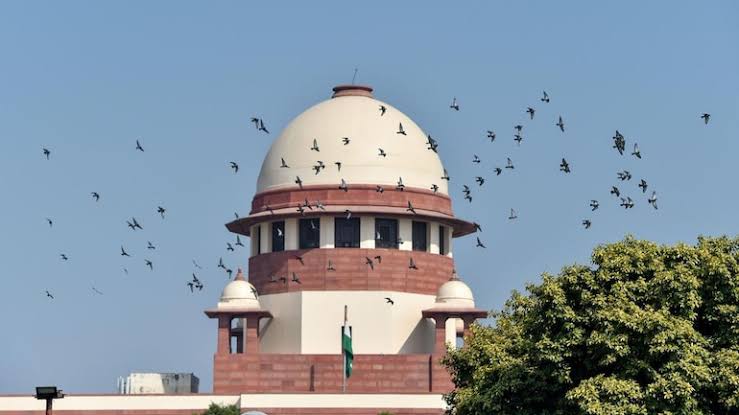
On March 24, 2015 the Hon’ble Supreme Court of India passed a landmark judgement in this matter. The Hon’ble Supreme Court  came out with judgement that Section 66A of the IT Act is arbitrarily and disproportionately affects the right to freedom of speech. Also, all the pending cases were directed to be dismissed and no fresh cases were to be registered under this scrapped section 66A of IT ACT.

Why is section 66A of IT Act in news in 2021 ?

Even,after this section was scrapped,many fresh cases were registered under this section of IT act. A plea was filed by PUCL ,it came into light that even after 7 years of the law being scrapped. total of 745 cases are still pending and active before the district courts in 11 states, under Section 66A of the IT Act. Supreme court have sent a notice to centre, demanding why this scrapped section is still in use and why not proper measures are taken till now.

Bhimbetka

Bhimbetka is a beautiful archaeological site with nature enveloping its caves. It is derived from ‘Bhimbetka’ which means siting place of prince Bhima from the great mythology ‘Mahabharata’.  It also manifests for earlier traces of human life on earth and stone age. It is a UNESCO world heritage site; very limited people visit Bhimbetka which maintains its peace and silence. It was founded by Vishnu Walankar in 1957-58 during a visit to Ratapani Sanctuary.

LOCATION

It is situated in the foothills of Vindhya range near Raisen district of Madhya Pradesh, inside Ratapani wildlife sanctuary, the south of these shelters are successive range of Satpura hills. There are over760 rock shelters and 500 are bedecked by rock paintings.

MYTHOLOGY INTEREST

As the name signifies this place is where Bheema use to reside, it is known that pandavs were sent to vanvasa for 12 years and 1-year agyatvasa which means that pandavs were told to live away from Duryodhana’s shadow in agyatvasa. When vanvasa was over Lord Krishna sent pandavs here for some period. Bhima use to reside in these caves. Also, a temple is situated near Bhimbetka in Bhojpur with one of the largest shivling in India where pandavs use to offer prayers.

ARCHITECTURE

Its architectural significance span over upper palaeolithic, Mesolithic, chalcolithic, early history and medieval. There are over 750 archaeological caves spread over 10 km but only 12 to 15 caves are open for tourist to visit, these caves and their rock painting are assumed to be around 10,000 years old.

Auditorium cave 

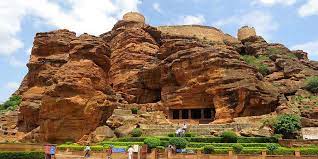
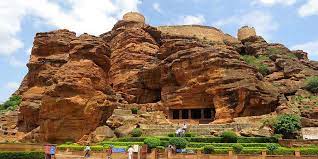
It is one of the largest caves in Bhimbetka and is visible from a distance, it is built up of 25-metre-long tunnel and also quartzite towers which are visible from several kilometres distance. Robert Bednarik describes the Auditorium cave as one with a cathedral atmosphere, with “its Gothic arches and soaring spaces”.

Extinct Dickinsonia

Dickinsonia is an extinct genus basal animal. Dickinsonia fossils are known only in the form of imprints. The specimens range from a few millimetres to about 1.4 metres in length and is found in Bhimbetka it is similar to Ediacara Member of Ediacara Hills in South Australia. These fossils are found within sandstone of Bhander Group of Vindhyan Supergroup mixed with sand deposits and intertidal facies

ROCK ART AND PAINTING

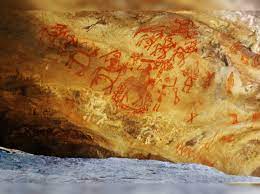
Tribals have always amused the current society with there culture, attires, jewellery, lifestyle and of course their beautiful paintings. One such example is also illustrated by Bhimbetka where paintings from stone age, medieval etc. can be found. The aesthetic art depicts basic story life of people living there and daily struggles in the form of Warli art. As the time flies many things get faded away but these paintings are still headstrong. Tribals used natural red, white, green and yellow colours are also used. The colours are a combination of manganese, hematite, wooden coal, soft red stone, plant leaves and animal fats.

These paintings can be classified according to seven periods-

Period I Upper Palaeolithic: These are linear representations, in green and dark red, of huge figures of animals such as bison, tigers and rhinoceroses.

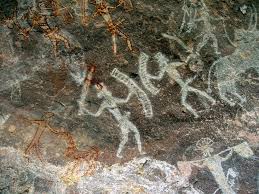
Period II Mesolithic: these show small linear decorations on the body, animals, human figures and hunting scenes and weapons they used- barbed spears, pointed sticks, bows etc. Some scenes are interpreted as depicting tribal war between three tribes. The depiction of communal dances, birds, musical instruments, mothers and children, pregnant women, men carrying dead animals, drinking and burials appear in rhythmic movement.

Period III Chalcolithic: these drawings tell us about the increasing communication and beginning of initial stage of barter system in the form of exchange, the cave dwellers of this area were in contact with the agricultural communities of the Malwa plains, exchanging goods with them.

Period IV & V Early historic: The figures of this group have a schematic and decorative style and are painted mainly in red, white and yellow. The association is of riders, depiction of religious symbols, tunic-like dresses and the existence of scripts of different periods. The religious beliefs are represented by figures of yakshas, tree gods and magical sky chariots.

Period VI & VII Medieval: These paintings are geometric linear and more schematic, but they show degeneration and crudeness in their artistic style. The colours used by the cave dwellers were prepared by combining black manganese oxides, red hematite and charcoal. They depict war scenes between kings.

Zoo Rock

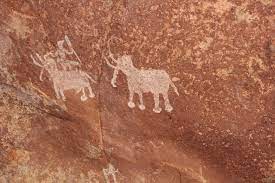
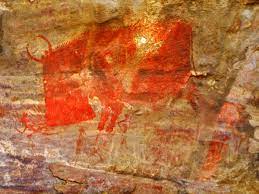
It depicts elephants, barasingha, bison and deer, peacock, a snake, a deer and the sun. On another rock, two elephants with tusks are painted. Hunting scenes with hunters carrying bows, arrows, swords, and shields also find their place in the community of these pre-historic paintings. In one of the caves, a bison is shown in pursuit of a hunter while his two companions appear to stand helplessly nearby; in another, some horsemen are seen, along with archers. In one painting, a large wild bovine (possibly a gaur or bison) is seen where people are trying to save their lives from bison. Also, there are some paintings when sun is a particular point

REFERENCES

Singh, H. (2016, July 28). Rock Shelters of Bhimbetka: Facts at a Glance. Jagranjosh.Com. https://www.jagranjosh.com/general-knowledge/rock-shelters-of-bhimbetka-facts-at-a-glance-1462443813-1

Goyal, A. (2020, October 12). Bhimbetka Rock Shelters and Pre-Historic Cave Paintings. Inditales. https://www.inditales.com/rock-paintings-of-bhimbetka/

Wikipedia contributors. (2021, July 10). Bhimbetka rock shelters. Wikipedia. https://en.wikipedia.org/wiki/Bhimbetka_rock_shelters#Auditorium_cave

Does India has low divorce rate because of happy marriages?

Divorce refers to the legal cancellation of marriage declaring that marriage as null and void. Marriage which is said to be a union of two individuals is generally expected to last till the death of the couple but in some cases when the couple feels that they are not compatible with each other or are hindering each other’s growth or any other reason , they decide to legally cancel their marriage . The reasons for divorce are many not just the two reason which are mentioned above raging from domestic violence, to the cases where one partner commits infidelity to cruelty, insanity, desertion etc. It is not good to continue in a relation which is turning toxic as it will affect the mental as well as physical well being of an individual.

India , the second most populated country in the world has less than 1% of divorce rate while Maldives which is 11,031 times less populated in India has the highest divorce rate in the world with 10.67% of divorces happening per 1000 inhabitants. The reason for such a high rate is that being a Muslim country, Maldives prevents any kind of premarital physical relations and as soon as the children turn 18 , they marry . Also the marriages there are not at all a costly affair with $10 being the fee for the judge and 10 relatives being invited to the wedding. The decisions taken in such tender age of 18 are often proves to be wrong , as the partners mature with time they realise that their aims are very different from others. Also, there are no social obligation restricting them in a unhappy marriage.

Why is there such a huge discrepancy between both the countries? Is it because people in India are quite happy with their partners? Or is it because they are married with their choice of life partner? Read the blog completely to know the reasons.

Why does India has such low divorce rate?

The main reason for divorce rate being the lowest in the second most populated country in the world is that people consider divorce to be a taboo. Marriages in India are a big affair with every acquaintance being invited and treated to the best lavish dishes and luxurious gifts that the family can provide which often leads to the expenditure of the entire savings of the family and heft loan amounts. According to a common belief, here marriages are made in Heaven and even if you are suffering terribly you should not break the bond which is said to be pious tying to people in a matrimony for their next seven human lives. This belief is very contrary to what the VEDAS(the oldest religious scriptures in the world which is a theoretical source for all the laws written in the SMRITIS which used to govern the laws in ancient times) say.

Also, there is a social stigma attached to the divorces which questions the character of mainly the woman stating her to be incapable of “fulfilling her husband’s demands”. Women since centuries now, are a piece of toy who despite all her qualification fails to be called a successful woman if she is not married and has not produced the kids. It is a woman who is supposed to adjust, putting even her self respect at stake. This is the reason where a woman even after becoming a victim to domestic violence never dares to file for separation as victim blaming and shaming starts soon after and she eventually accepts domestic violence as a part of her life. A woman is supposed to have no voice of hers as she is considered incapable of taking correct decisions for herself. What an irony it is that staying in a venomous marriage is considered to be good for a woman! This is the reason that the states of Bihar, Haryana, Rajasthan and UP where patriarchy still has a strong hold have the lowest divorce rates while the liberal North East has the high rates. It is the state of Mizoram in India that has the highest divorce rate of 6.34%

The time period of divorce also stretches infinitely long sometimes taking years when the divorce is not mutual which drains the involved parties emotionally, mentally and financially due to the amount of alimony involved.

What does the VEDAS say about the marriage and divorce

According to Kirron Krishnan a Vedic spiritual theist, Rigveda (which contains information about religious, social and economic life of the people) or any of the other three Vedas do not contain any mention of the term called divorce. In those times the term was not needed because according to Rigveda , the husband takes the hand of the bride to live with her till their old age playing with their grandchildren respecting her , loving her and supporting her all along. Meanwhile the wife was the queen of her husband’s household who would over the same support , respect and love back. It was a mutual show of respect by both the parties which did not leave any scope for any domestic violence case. Further, unlike in today’s time where a daughter is considered to be a liability who is born just to be married off, in the days when India was a golden bird the women were trained and skilled by her family and was married to the groom of her choice and the same was prevalent with men.

However there is the mention of remarriage if one partner dies , rennounces the world , disappears , is involved in criminal activity or is impotent. The laws in the ancient times were far more suitable for both the genders than they are today.

Is it good to have such a low divorce rate in the country

By stating that the low divorce rates are not good it doesn’t implies that the divorces are good and more people should have it. If the couple in the marriage is happy then there are no issues, but if the couple in the marriage is not happy with each other and is only together “because they have no other way” then it is completely wrong as it will generate negative vibes harming the couple as well as their innocent children . It is seen in more than one cases that the children from unhappy marriages results in being a frustration box to their parents’ outbursts which hampers the growth of the child.

AMBITION

The starting point of all achievement is desire.” —Napoleon Hill

One needs to aim for the sky, to achieve as much as a mountain in the bargain Success in life comes only to those who are ready to work hard for the same. The key to success is to have an aim in life and the earlier you attain this aim, the better.

In spite of all the new options in today’s times, there are those age-old professions that are a favourite with most of the youngsters all the time. These include, the profession of a doctor, an engineer and that of a teacher or an advocate. I too, wanted to be part of one of these noble professions. If my memory proves me right, I always wanted to be a teacher. What is exciting about teaching is that this is one of the few professions where you are actually dealing with living beings. To make a difference to a child’s life or to positively influence a child in such a way as to bring about good change, is a great achievement in itself. Somewhere, along the path, we are also the product of the reinforcements made by our parents and teachers, one way or the other.

However, even our Puranas reinstate that the teacher or the guru’ comes above God. The reason being that teacher is the person who shows you the way to God, or teaches you, what God is all about. So, if the enlightenment of God and the things around you comes from one particular force, then that is the person to be revered, first.

The responsibility being immense, it’s not an easy job either. If the young minds have to look forward to you as a source of knowledge, then you need to be one. With the quantum of knowledge increasing day by day, it’s a difficult task to keep abreast of the upcoming information. Apart from all this, what is more important in this profession is whole hearted dedication and willingness to work beyond the restrictions of time and assigned duties.

With all this view in mind, I would like to pursue my ambition to be a teacher. It’s anyhow of least importance to assert which subject I would specialize in because subject is not as important, as to know, how to effectively teach it. Be it Maths. English or Science, to develop a flair and love for the subject is a teacher’ s greatest challenge. A bad teacher can always generate an aversion towards the subject in the minds of the children, just by not giving the subject a proper treatment. My ultimate aim would be to be such a teacher who would make a difference in the lives of young minds and bring about their overall development.

HUMAN EVOLUTION

The story of human origins is complicated since our ancestors swapped genes (and probably skills).

The first humans emerged in Africa around two million years ago, long before the modern humans known as Homo sapiens appeared on the same continent.

There’s a lot anthropologists still don’t know about how different groups of humans interacted and mated with each other over this long stretch of prehistory. Thanks to new archaeological and genealogical research, they’re starting to fill in some of the blanks.

The First Humans

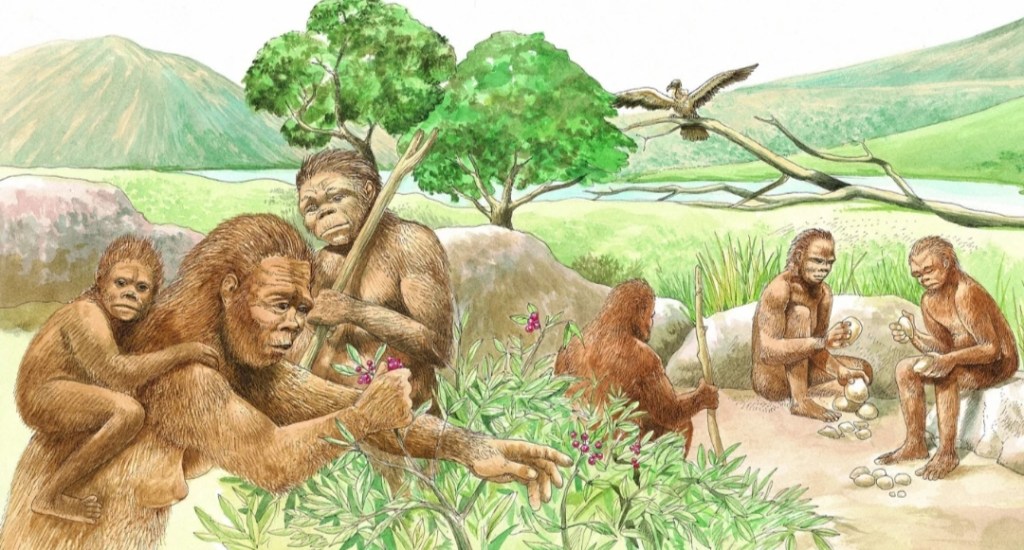
Homo habilis individuals chip away at rocks, sharpening them for cutting up game or scraping hides while a woman, with her child, gathers wild berries to eat and branches to make shelters.

First things first: A “human” is anyone who belongs to the genus Homo (Latin for “man”). Scientists still don’t know exactly when or how the first humans evolved, but they’ve identified a few of the oldest ones.

One of the earliest known humans is Homo habilis, or “handy man,” who lived about 2.4 million to 1.4 million years ago in Eastern and Southern Africa. Others include Homo rudolfensis, who lived in Eastern Africa about 1.9 million to 1.8 million years ago (its name comes from its discovery in East Rudolph, Kenya); and Homo erectus, the “upright man” who ranged from Southern Africa all the way to modern-day China and Indonesia from about 1.89 million to 110,000 years ago.

In addition to these early humans, researchers have found evidence of an unknown “superarchaic” group that separated from other humans in Africa around two million years ago. These superarchaic humans mated with the ancestors of Neanderthals and Denisovans, according to a paper published in Science Advances in February 2020. This marks the earliest known instance of human groups mating with each other—something we know happened a lot more later on.

After the superarchaic humans came the archaic ones: Neanderthals, Denisovans and other human groups that no longer exist.

Archaeologists have known about Neanderthals, or Homo neanderthalensis, since the 19th century, but only discovered Denisovans in 2008 (the group is so new it doesn’t have a scientific name yet). Since then, researchers have discovered Neanderthals and Denisovans not only mated with each other, they also mated with modern humans.

“When the Max Plank Institute [for Evolutionary Anthropology] began getting nuclear DNA sequenced data from Neanderthals, then it became very clear very quickly that modern humans carried some Neanderthal DNA,” says Alan R. Rogers, a professor of anthropology and biology at the University of Utah and lead author of the Science Advances paper. “That was a real turning point… It became widely accepted very quickly after that.”

As a more recently-discovered group, we have far less information on Denisovans than Neanderthals. But archaeologists have found evidence that they lived and mated with Neanderthals in Siberia for around 100,000 years. The most direct evidence of this is the recent discovery of a 13-year-old girl who lived in that cave about 90,000 years ago. DNA analysis revealed that her mother was a Neanderthal and her father was a Denisovan.

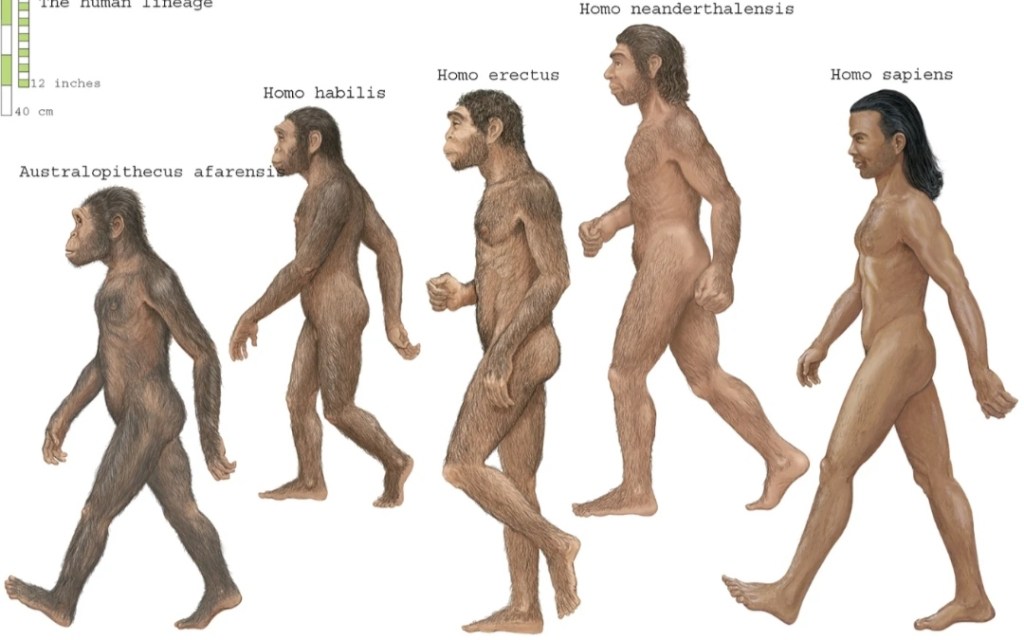
The human lineage of Australopithecus afarensis, Homo habilis, Homo erectus, Neanderthals and Homo sapiens.

Scientists are still figuring out when all this inter-group mating took place. Modern humans may have mated with Neanderthals after migrating out of Africa and into Europe and Asia around 70,000 years ago. Apparently, this was no one-night standresearch suggests there were multiple encounters between Neanderthals and modern humans.

Less is known about the Denisovans and their movements, but research suggests modern humans mated with them in Asia and Australia between 50,000 and 15,000 years ago.

Until recently, some researchers assumed people of African descent didn’t have Neanderthal ancestry because their predecessors didn’t leave Africa to meet the Neanderthals in Europe and Asia. But in January 2020, a paper in Cell upended that narrative by reporting that modern populations across Africa also carry a significant amount of Neanderthal DNA. Researchers suggest this could be the result of modern humans migrating back into Africa over the past 20,000 years after mating with Neanderthals in Europe and Asia.

Given these types of discoveries, it may be better to think about human evolution as a “braided stream,” rather than a “classical tree of evolution,” says Andrew C. Sorensen, a postdoctoral researcher in archaeology at Leiden University in the Netherlands. Although the majority of modern humans’ DNA still comes from a group that developed in Africa (Neanderthal and Deniosovan DNA accounts for only a small percentage of our genes), new discoveries about inter-group mating have complicated our view of human evolution.

“It seems like the more DNA evidence that we get—every question that gets answered, five more pop up,” he says. “So it’s a bit of an evolutionary wack-a-mole.”

Early Human Ancestors Shared Skills

Human groups that encountered each other probably swapped more than just genes, too. Neanderthals living in modern-day France roughly 50,000 years ago knew how to start a fire, according to a 2018 Nature paper on which Sorensen was the lead author. Fire-starting is a key skill that different human groups could have passed along to each other—possibly even one that Neanderthals taught to some modern humans.

“These early human groups, they really got around,” Sorensen says. “These people just move around so much that it’s very difficult to tease out these relationships.” 

Science you tube channels that are worth subscribing.

You tube! One of the biggest social media platform, whose content is in the form of Vedio. This was first launched in February 2005. Now It hosts biggest content creators of on variety of content from arts to science. You tube has become one of the income sources option or we can say a career option now. There are many educators who found career in you tube. In this situation of pandemic, You tube educators have saved many students education.

You tube has now become a source of information for everything. It is the biggest search engine after google. being a science enthusiast i always watch Scientific you tube channels. There are many YouTube channels doing a great job in giving perfect information with beautiful illustrations and examples. But here are the some I think which are worth subscribing.

Vsause

One of the best you tube channel hosted by Michel David Stevens. He is an American educator The channel has scientific, psychological, Mathematical, philosophical Vedios. Channel is currently on 1.7 crore subscribers and 380 Vedios on the channel. The best thing about the channel is detailed research that is done on the topics presented. And also the host Michel Stevens steals your attention by his method of explanation. He makes the Vedio interesting by scratching your brain and increasing the curiosity. The series called “Mind field” which has 3 seasons is one of the best Vedio series I have watched. They have mind blowing experiments and explorations done by the host himself.

This channel is worth subscribing.

veritasium

Another you tube channel which has the best science Vedios. This channel is hosted by Derek Muller, who is Australian-Canadian science communicator, filmmaker. The channel now has 94.8 lakh subscribers and 313 Vedios. Derek, In his Vedios answers very simple questions in a way that you would never thought of having it. He conducts many street interviews about the topics or you may call it surveys to get the public mindset and information. In may of his Vedios he breaks many Myths around science and psychology.

The best things about the Veritasium channel are the experiments and the execution. The animations used to explain things are very cool to watch. And obviously the perfect information is what you always get.

The royal institution

This is the official you tube channel of the Royal institution situated in great Britain. It is the organization for scientific education and research founded very long back in 1799. The institution holds lectures on various science topics. Many famous scientists gave their lectures here. The you tube channel has the recorded Vedios of this lectures. The channel has 10.4 lakh subscribers and 925 Vedios.

What’s the best thing? The Vedios are genuine lectures from the scientists you admire! You get the whole lecture recorded and what’s better than that. You get to know about the new discoveries and advancements in detail. Vedios make you think more deeply about science. I think that’s more than enough to make you subscribe if you are a science geek.

lectures by walter lewin They will make you love physics

Who doesn’t know Walter Lewin and his love for physics. He is the former professor of physics at Massachusetts institute of technology. He has written a book called “For the love of Physics”. He is one of the best teachers you would ever get. His fun demonstrations of theories, and facts are loved by students around the world. The channel has 10.8 lakh subscribers. His lectures make you really fall in love with physics.

there are many more YouTube channels that provide quality science Vedios. PBS spacetime, Parth G, Periodic Vedios are some other to mention. But the above four channels are my personal favorite and I think are worth giving a try.