Data Science – Learning Sources

When it comes to learning data science, there are many, many resources around the internet. Many articles, many online courses, many Youtube channels, and so on…

You have to choose carefully, especially when it comes to free things. There are a lot of low-quality or simply wrong data science tutorials out there. And even if they are free, you’ll still have to pay for them with your time.

So, Here are the top YouTube channels that you can refer to :

1. StatQuest With John Starmer

Joshua Starmer started this channel on May 23, 2011 with the objective to explain statistics to his former colleagues. In order to show the simplicity behind all the confusing terminology, he stripped away the terminologies involved and illustrated the concepts using pictures.

He explains the concept by breaking down every technique into small, simple steps. Thus, making major methodologies easier to understand. This is one of the best channels for learning data science as he really stresses the theoretical aspects of statistics and machine learning along with practical applications.

2. Corey Schafer

The channel is named after his founder, Corey Schafer, who started this YouTube channel on May 31, 2006. The tutorials on his channel cover topics such as Python, SQL, Development Environments, Terminal Commands, Programming Terms, JavaScript, Computer Science Fundamentals, and several other tips and tricks and that too for different skill levels. Whether you are a beginner or have several years of experience, it will have something for you.

3. Sentdex

Sentdex, owned by Harrison Kinsley, was started on December 16, 2012. Harrison is also a founder of multiple other businesses, all of which are over the Python programming language. This channel has around 1000 videos and text-based tutorials offering some of the best programming language content for Python. The tutorials covers topics such as machine learning, deep analysis, facial recognition, and improving education for aspiring data scientists. 

4. FreeCodeCamp

FreeCodeCamp is a non-profit organization that helps you learn to code by building projects. It was found by Quincy Larson, a software developer who took up programming after graduate school and created freeCodeCamp to help students progress from beginners to job-ready professionals. This is an open-source community of hectic learners. The channel has thousands of engaging coding tutorials and videos. They have videos related to Basic Python programming, Data Science Machine Learning, and Deep Learning.

5. Krish Naik

Krish Naik works as a Lead Data Scientist at Panasonic IIC, pioneering in machine learning, deep learning, and computer vision, an educator, and a mentor. This channel was started on February 11, 2012. The channel covers various topics related to AI, ML, and deep learning.

The channel extensively covers everything essential for a data scientist. The content includes machine learning, deep learning, natural language processing, computer vision, etc. He has also covered Tableau and Microsoft Power BI. Some topics related to model deployment are also covered.

6. 365 Data Science

365 Data Science is an e-learning platform that provides courses in the data science discipline. They share quality content and use a learner-friendly method of explanation. But one of the best parts is that they make use of real-life examples to relate better to. 365 Data Science joined YouTube on 07 August 2017 and now has 115K subscribers. Further, they have more than 100 videos on their channel.

They offer tutorials on Python, Data Science, Machine Learning, Deep Learning, and many more topics. Their videos also include information about the trends and educational requirements for various job roles in the data science industry.

7. Brandon Foltz

Brandon Foltz  started his channel on August 11, 2011. Since then he has been sharing his knowledge. He specializes in teaching, curriculum design, and course design and has experience of almost 16 years in this field.

His tutorials focus on introductory statistics, finite mathematics along with management science, operations management, and basic accounting. It is amongst the few YouTube channels focussing on the theoretical understanding of statistics and mathematics used in data science in depth.


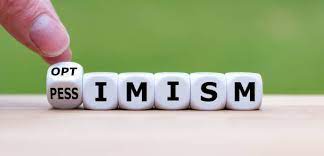
Want to be a optimist?! That’s Easy!!

Are you a person lacking confidence and hope in everything? Trying hard to be an optimistic person? It’s very easy. Let’s see how to be optimistic in everything through this article.

WHO IS A PESSIMIST?

A pessimist is a person who thinks the worst side of anything or they have a thought that they can’t do it. These pessimistic thoughts came from fear to do something. They often focus on the negative side or an unfavorable situation rather than thinking about what is going right. A pessimistic person is more likely to notice problems or it may cause anxiety to them. These types of people may have depression because of this. If we want to know clearly, it is a personality trait. These pessimistic persons wouldn’t believe anyone because they don’t know whether those persons have good intentions. To put it simply, they don’t believe anyone firmly.

According to research, pessimism is associated with the right hemisphere of the brain and the lower self-esteem was also associated with the right side of the brain. Though pessimism is a perspective that affects the general worldview, it is not an unchangeable trait that can’t be changed throughout the lifetime. A pessimistic person can also be optimistic like others.

” A pessimist is an optimist in full possession of the facts “.

– Arthur Schopenhauer

COME ON; LET US BE OPTIMISTIC!

Till now, we saw about pessimism; Being optimistic is a wonderful thought that make us feel self-confident and self- aware. As we saw, pessimism is connected to the right side of the brain and optimism is connected to the left side of the brain. But we should know that both the right and left brains are necessary to maintain a healthy state. Yes, both optimism and pessimism are related to each other and necessary to maintain a healthy life. But sometimes, the pessimistic thoughts may come upon the optimistic thoughts. The only thing is we should control our pessimistic thoughts.

Why You Should Choose A Positive Response For Every Situation -  WhateverItTakesMotivation

Just follow few tips and automatically be an optimistic person. Yeah, that’s for sure.

  • First, learn to be grateful. Being grateful makes you both optimistic and have a great personality. Even if it is a small thing, be grateful to the one who helped you. For example, if one helped you during your difficult times, don’t forget their help when you reached some peaks in your career or life. So, grateful and optimistic feel makes you feel better than anything.
  • Always believe that you can do it even when no one can! In this case, being optimistic helps you to achieve it. Just believe and move towards your goal. Let me say myself as an example, I love photography and I participate in many inter-collegiate competitions. Till now, I didn’t win any prizes, but I continue to pursue my dream. And I hope one day I will be able to win the prize. Just trim yourself to be a better and confident individual.
  • Don’t think that it is impossible. When the word impossible reaches your mind or heart you can’t do anything, don’t allow it. Anything is possible if you are very optimistic and confident. Think about it, if anyone can do your work, why are you here? Just ask this yourself and find yourself in yourself.
  • If there is some problem, just look into a solution rather than blowing it into a big volcano. Be calm and shuttle, think optimistically, and seek solutions. It will be good for you and your loved ones.
  •  Then, focus on the things which are under your control. Don’t look into things that are out of your control. Because those things can disturb you and make you a pessimist sometimes.
  • Lastly, love fearlessly and no one can stop you in this. Yes, pursue your love optimistically. Your love can either be your career or dream or anything just pursue it optimistically. And learn to see beauty in small things. For example, none of us would say,’ I don’t like a child ‘ because we forget ourselves when we are with them. This is an optimistic feel. If there is a smile on that child’s face without any doubt we will be happy, Right? That’s it. This tells you how optimistic you are!!

Both optimism and pessimism are needed in our life but they should be kept at an equal level to maintain a healthy and a happy life.

The pessimist complains about the wind..." William A. Ward [800x598]:  QuotesPorn

Some reference links;

https://www.goodtherapy.org/blog/psychpedia/pessimism

https://www.123helpme.com/essay/The-Importance-Of-Optimism-774469

School Inovation ambassador training program

The program, School innovation ambassador training program (SATP) launched on16 July is a joint effort of ministry of the union education ministry and tribal affair ministry. Education minister Dharmendra Pradhan and Tribal minister Arjun Munda together announced the scheme for training 50,000 school teacher. “The teachers are the biggest influence in our lives. We aim to make our teachers, change agents, and ambassadors of innovation to make our students future-ready,” said education minister Dharmendra Pradhan on the launch of program. Further Tribal Affair minister Ashok Munda highlighted how it will be helping students in tribal area and broaden their perspective with will enhance the creativity.

The scheme will be implemented from 20 July. the ultimate aim of the program is to bring innovative changes for the benefit of both student and teachers. The program will benefit CBSE affiliated school including government schools like – kendriya Vidyalaya, Eklavya Residential model school and other school. The training will be divided into 5 subjective parts which include:
• Entrepreneurship
• Innovation
• Intellectual property rights
• Product development
• Design thinking
• Idea generation
The training will be of a duration of 2 months and it will be conducted online. The implementation of such schemes is effective in overall development of education system not only for students but, teachers who are considered an important pillar of education system.
Above all The Indian education system which is continuously trying to evolve and implement new changes can succeed by such programs.

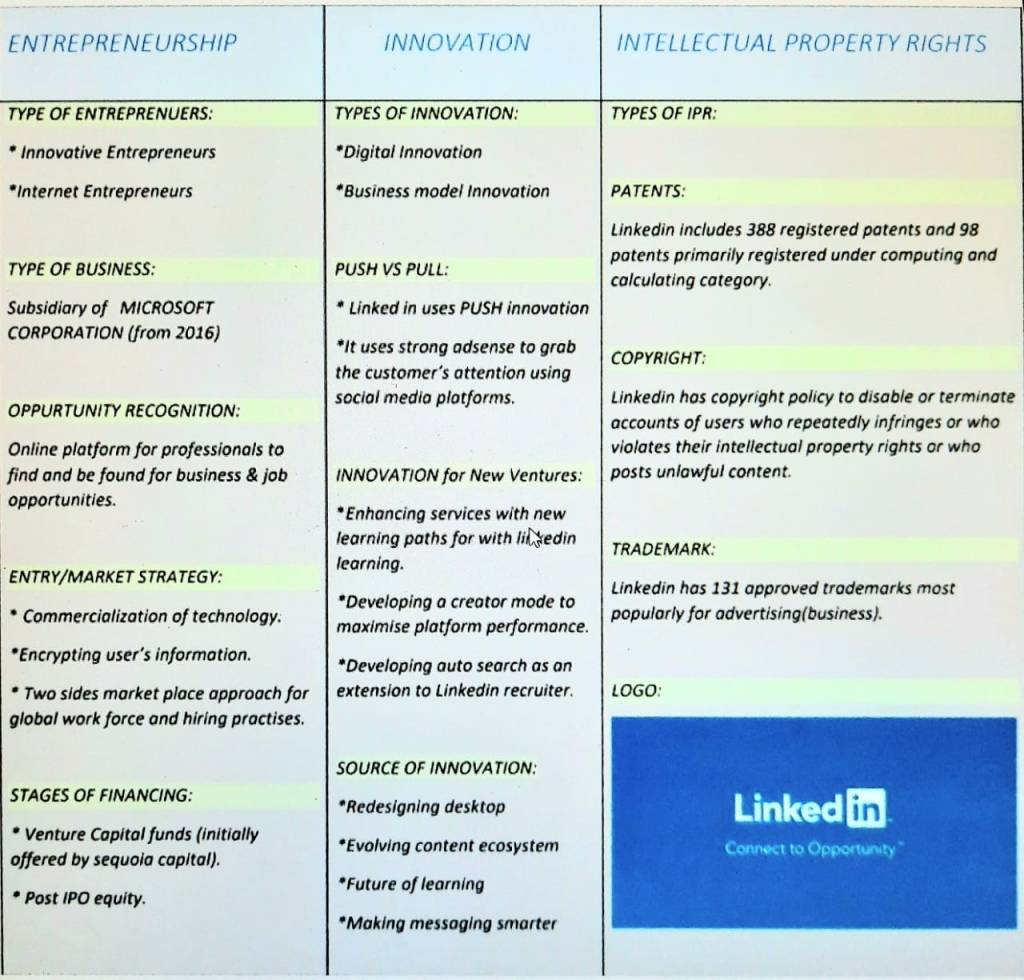
UNDERSTANDING LINKEDIN AS A BUSINESS MODEL

As we all know that ” Linked in ” corporation is one of the leading networking website which functions on describing user created profiles with their work experience, education and training, skills, and a personal photo so that users can find jobs, people and business opportunities recommended by someone in one’s contact network. Users can save jobs that they would like to apply for. Users also have the ability to follow different companies.

In the above para we discussed about the working of linked in corporation with user provided data but we can understand it’s business marketing strategies and it’s growth from initial stage in a clear manner when we see linked in as a business model.

Linked in was found on may 5, 2003 at mountain view, California, US by Reid Hoffman. Initially the company started getting it’s financing through the help of venture capitalist company and later it struggled to get investors in IPO but at the year of 2011 LinkedIn priced its IPO at $45 per share giving the company valuation of $4.5 billion but at the year of 2016 Microsoft announced the valuation of LinkedIn for $196 per share which in all cash transaction valued as $26.2 billion and acquired the company.

CHALLENGES THAT ARE ACCEPTED BY LINKEDIN :

As a networking site the first and foremost challenge faced by LinkedIn is data encryption of user along with the data encryption LinkedIn should also concentrate on following terms:

PRIORITISING LINKEDIN GROUPS: LinkedIn contains many community groups with managers to share/discuss ideas for improving their work/business. So, they have to arrange the groups with out arising any type of ambiguity.

CONSTANTLY CHANGING THE WAY OF ADVERTISING : We get too many irrelevant ads when we use LinkedIn. Sometimes, getting non-sink advertisements also creates a negative impact on the site. So, that it should constantly change the patterns of presenting adds with new algorithms to avoid negative footprints on site.

ARTICULATING THE DORMANT PROFILES: LinkedIn says it’s growing, but there are many inactive accounts that should be removed after a reasonable period of time by keeping the active users accounts effectively and let inactive users go by the wayside.

MAKING LINKEDIN FROM “HAVE TO” TO “WANT TO” FOR BUSINESS PROFESSIONALS: Many people are on LinkedIn because they feel that they “have to” be there for expanding their network but very few professionals LOVE logging in to their LinkedIn. So, to attract more people on internet then LinkedIn must use competitive content on it’s pulse.

MARKETING STRATEGIES APPLIED BY LINKEDIN:

LinkedIn used Traditional marketing strategy at its initial stage of growth. LinkedIn approached it’s users through branding it’s company with chocolates. Similarly, LinkedIn adopted several marketing strategies on internet for improving it’s sustainability.

Most of the business organisations put a great deal of effort into creating the perfect website, and invest a significant portion of the marketing budget on curating the ultimate customer experience. So for that purpose LinkedIn has created virtual circle of influence by combining LinkedIn marketing and remarketing on your website. In order to attract efficient business professionals LinkedIn promoted paid marketing system which can afford a wide variety of ad formats and business targeting opportunities.

LinkedIn provides sponsored content, sponsored messaging, Text adds and Dynamic adds which are considered as native ads that will appear in the viewer’s LinkedIn feed and it tends to be customer centric with helping it’s customers on getting control over their business marketing.

Overview of the company

One of the main reason for it’s sustainable marketing growth is, LinkedIn seamlessly fills in the fields and provides you with information it already knows about your prospect. The up side of this capability is that it reduces the user’s submission time, and also diminishes their friction to signing up for whatever you are offering to the opposite person .It also target the customised accounts for the profile that is provided by user and also allows you to run account based marketing campaigns, powered by LinkedIn data.

Finally, LinkedIn is particularly well-suited for personal branding and which actively manages one’s image and unique value to position oneself for career opportunities. LinkedIn has evolved from being a mere platform for job searchers into a social network which allows users a chance to create a personal brand. LinkedIn’s constant adoption and application of new technologies and new strategies in market has improved it’s standards and sustainability in the competitive corporate field.

Service Marketing

Must have heard this term often right? But do you really know what is service marketing all about? Keep reading to understand properly.

The term can be easily understood separately as the service refers to an act of performing something for someone in exchange for adequate consideration on the other hand marketing is a broader term but in simple word it means promotion. Collectively we can say that when a person or entity promotes services it offers to the various clients it can be known as service marketing which aims at providing the solutions to the problems faced by the clients. Both the B2B (business-to-business) and B2C ( business-to-consumer) marketing is included in it.

Service Marketing have occupied a significant role in the market because service is something which can’t be seen or touched it can only be availed and experienced. The decision of the buyers in case of products is highly influenced by its quality but it is something different in case of services because the quality of service can be determined after it is availed by the customers. So it is required by the marketers to adopt those strategies that are highly attractive for the customers to induce them for availing a particular service.

Also these services can’t be resold or returned that means they are one time action and the manner it is availed at that time affects its future sale because if the goodwill of a particular service is not maintained then it will not be able to attract another more customers.

Examples: marketing of medical services, beauty parlours and spa, coaching centres , telecommunication etc

Service marketing is often confused with the term product marketing but it is important to know that both of them are different product marketing is the marketing of a tangible item that can be seen and touched whereas services are intangible.

If the proper service marketing strategies are adopted then it can leads to huge profit potential for a business and promote it to get more customers also.

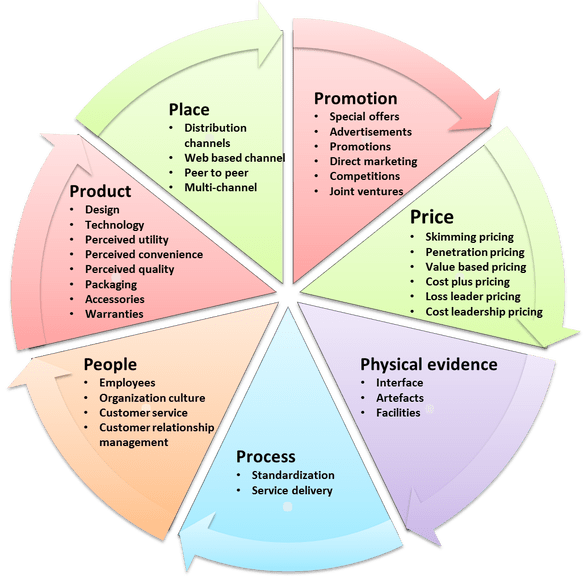
Services marketing are dominated by the 7 Ps of marketing namely Product, Price, Place, Promotion, People, Process and Physical evidence. All these are the factors or elements that are mixed by the marketer in order to deal with the customers much better.

Explanation of service marketing elements.

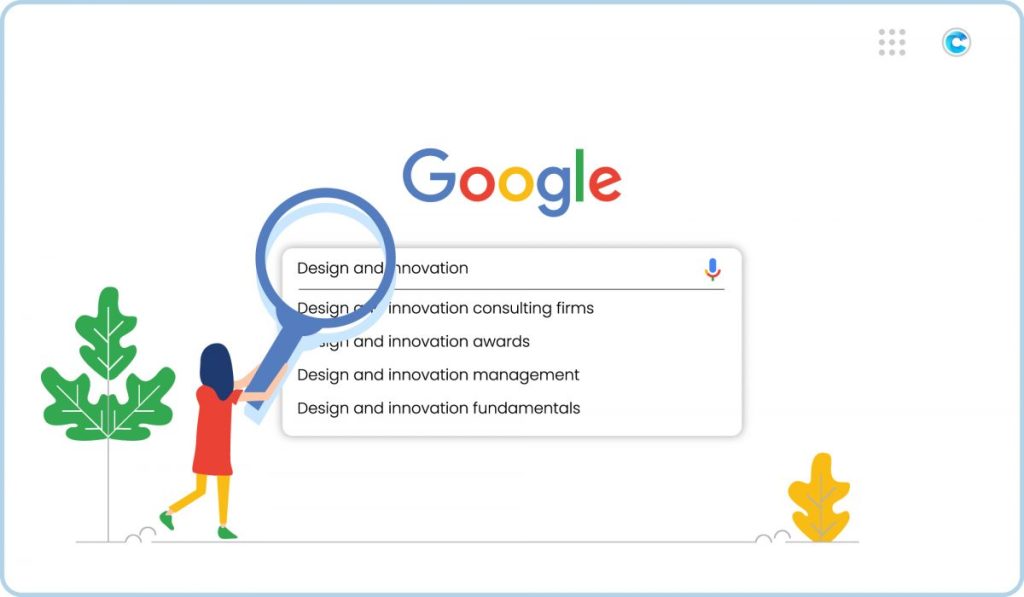
HOW DOES SEARCH ENGINE GOOGLE WORKS?

Almost everyone of use google chrome for searching information today but do we ever think about how the google functions in order to give the accurate results. Today we are going to know about the functionality of search engine google.

INTRODUCTION ABOUT SEARCH ENGINE:

Search engine came into our world in the year of 1990 in the form of “archie”, which was an ftp indexing tool that allowed people to obtain certain files. A “ search engine “ is several interlinked mechanisms that work together to identify pieces of web content like images, videos , website pages, etc… based on the words you type in the search bar. The search engines always looks for the best solution, the right product, the most relevant video & the most accurate answers to better up the search experience of user.  

Search engine look simple from outside but that deceptively easy interchange requires a lot of computation and heavy lifting backstage. The too complicate matters in search engines are the algorithms used for searching. Most of the search algorithms are not only kept secret but are also constantly being changed and revised.  The hard work of search engine start it’s way before you make a search .Search engine work round-the-clock by gathering and organising information. 

FUNCTIONALITY OF A GOOGLE SEARCH ENGINE:

Understanding how a search engine works is vital to know about rank of a website. As the rank of a website is higher, the traffic that the website gets is also higher which leads to more income. The functioning of every search engine begins with the three-step process which is clearly explained in following steps:

CRAWLING:

Search engines rely on crawlers to scour the web information. Crawlers start out with a list of websites. The algorithms dictate crawlers about how many pages to crawl and how frequently.    A crawler is an internet bot that systematically browses the world wide web. Typically used by search engines . These crawlers are also called as spider.   Crawlers visit each site on the list systematically, following through tags like HREF & SRC to     jump to internal or external pages . Over time crawlers build an ever expanding map of interlinking pages

INDEXING & PAGE RANKING:

Once the content from web pages has been crawled, the web pages should be indexed based on the occurrence of multiple keywords.  When the web page content is indexing, the common elements are avoided and indexed information is stored in an organized manner. The organisation of indexed pages is called as page ranking. Search engines use algorithms for determining the rank of a web page.

PageRank is the first algorithm used by Google to evaluate web pages. It uses a simplistic model of web surfing to estimate the probability of browsing to each site on the internet. It uses the concept of random walks in a Directed Acyclic Graph.

The factors include in page ranking are Backlink quality, Mobile friendliness and how recently content was updated or Freshness. Engagement and Page speed. So, These three process steps play a vital role in “Search Engine” for query processing. The following video picturizes about the functionality of google search engine in a clear way.

CONCLUSION:

As billions of search queries per day are being performed in google, The quality of search results is closely monitored by google search quality team. The caffeine index of google takes up around 1,00,000,000 gigabytes and fills “server farms” , thousands of computers of google never get turned off around the globe. Google’s synonym system allows the search engine to recognize when groups of words mean the same thing.  For example: when you type “ dark coloured dresses”, search engine’s will results for black dresses as well as dark tones. That is the engine understands that dark as often synonymous with black

Finally, Google search engine is provided by Google LLC which is handling 40 billion indexed pages containing results along with advertisements in it. The three main reasons why internet user’s love google beside other search engines are because of it’s high quality results and regular updation of search algorithms. This is the reason why google has become most popular search engine even today in the world though it was developed at 1997 and it has almost 92% share of the global search engine market. 

Microplastic-A new global concern

Pollution from plastics have always ranked in the top for being a global problem. Now microplastic pollution is joining the club. Microplastics, as the name suggests are the minute particles of plastic. The size of a particle is less than 5mm. They occur from the larger plastics which degrades into small pieces as expected, they are also added as exfoliants to beauty and health products. Microbeads which are intentionally designed to be small can be added to this list of sources. Microplastic fragments are also found in single use plastic bottles and everyday usage plastic products like containers also one of the sources. As the macroplastic waste is omnipresent but prominent in marine bodies, microplastic also is a major pollutant of the oceans and large lakes. They get accumulated in soil as well.

Microplastics is a quite new to the pollutants list. But they are a serious threat as they can not be removed by water filtration systems. Aquatic life and birds will feed this microplastics mistaking them as food. There is no complete information available about the pollution because of less research in the area. But slowly the research is increasing in the field.

hazards of microplastics

Microplastics are made of polypropylene, polystyrene and polyethylene. UV light fragments large plastic litter into micro and nanoparticles of plastic. As mentioned above, the capacity of the to microplastics escape the filtration process poses a serious threat. We all know plastic can not be digested. If these microparticles enter the body they may get accumulated. Because of their small size they might posses the capacity to pass through cells and tissues. Their segregation in aquatic animals will be a threat indirectly to humans because we feed on them. It is estimated that humans consume 11,000 microplastic particles per annum.

If these microplastics enter cells, they may cause irritation as they are foreign bodies. They are chemically toxic to the body as well. But it is the biggest threat to marine animals. They affect the reproducing capacity of the marine animals. The number of larvae were less and size of the offspring was small. They got physical inabilities, problems in swimming. They block gastrointestinal tracts of the animals.

some solutions to reduce microplastic pollution

The main solution is the 3R, reuse reduce and recycle. Any pollution related to plastic can be reduced if we reduce the usage of the plastic. Mainly the single usage plastics should be reduced. Products containing microbeads should be avoided. people should be aware about the problems and should support bans on plastic. Conducting beach cleanups will reduce the amount of plastic that reaches the ocean. Ocean cleanup projects will also do maximum help. Finding the major sources of the problem and starting to solve the problem at its origin. People should try to have zero waste life, at least mini waste life so that there will be less contributions towards pollution. Taking the help of technologies to check the pollution and developing perfect filter systems which will filter off 100% microplastics.

Glycolysis and Krebs cycle

Glycolysis is the process in which glucose is broken down to produce energy. It produces two molecules of pyruvate, ATP, NADH and water. The process takes place in the cytosol of the cell cytoplasm, in the presence or absence of oxygen. Glycolysis is the primary step of cellular respiration. In the absence of oxygen, the cells take small amounts of ATP through the process of fermentation. This metabolic pathway was discovered by three German biochemists- Gustav Embden, Otto Meyerhof, and Jakub Karol Parnas in the early 19th century and are known as the EMP pathway (Embden–Meyerhof–Parnas).

Glycolysis stages:

Step 1: 

A phosphate group is added to glucose in the cell cytoplasm, by the action of enzyme hexokinase.

In this, a phosphate group is transferred from ATP to glucose forming glucose,6-phosphate.

Step 2: Glucose-6-phosphate is isomerized into fructose,6-phosphate by the enzyme phosphoglucomutase.

Step 3: The other ATP molecule transfers a phosphate group to fructose 6-phosphate and converts it into fructose 1,6-bisphosphate by the action of enzyme phosphofructokinase.

Step 4: The enzyme aldolase converts fructose 1,6-bisphosphate into glyceraldehyde 3-phosphate and dihydroxyacetone phosphate, which are isomers of each other.

Step 5: Triose-phosphate isomerase converts dihydroxyacetone phosphate into glyceraldehyde 3-phosphate which is the substrate in the successive step of glycolysis.

Step 6: This step undergoes two reactions:

The enzyme glyceraldehyde 3-phosphate dehydrogenase transfers 1 hydrogen molecule from glyceraldehyde phosphate to nicotinamide adenine dinucleotide to form NADH + H+.

Glyceraldehyde 3-phosphate dehydrogenase adds a phosphate to the oxidized glyceraldehyde phosphate to form 1,3-bisphosphoglycerate.

Step 7: Phosphate is transferred from 1,3-bisphosphoglycerate to ADP to form ATP with the help of phosphoglycerokinase. Thus two molecules of phosphoglycerate and ATP are obtained at the end of this reaction.

Step8: The phosphate of both the phosphoglycerate molecules is relocated from the third to the second carbon to yield two molecules of 2-phosphoglycerate by the enzyme phosphoglyceromutase.

Step 9: The enzyme enolase removes a water molecule from 2-phosphoglycerate to form phosphoenolpyruvate.

Step 10: A phosphate from phosphoenolpyruvate is transferred to ADP to form pyruvate and ATP by the action of pyruvate kinase. Two molecules of pyruvate and ATP are obtained as the end products.

The Krebs cycle or Citric acid cycle is a series of enzyme catalysed reactions occurring in the mitochondrial matrix, where acetyl-CoA is oxidised to form carbon dioxide and coenzymes are reduced, which generate ATP in the electron transport chain.

Krebs cycle was named after Hans Krebs, who postulated the detailed cycle. He was awarded the Nobel prize in 1953 for his contribution.

It is a series of eight-step processes, where the acetyl group of acetyl-CoA is oxidised to form two molecules of CO2 and in the process, one ATP is produced. Reduced high energy compounds, NADH and FADH2 are also produced.

Two molecules of acetyl-CoA are produced from each glucose molecule so two turns of the Krebs cycle are required which yields four CO2, six NADH, two FADH2 and two ATPs.

Krebs cycle steps:

It is an eight-step process. The Krebs cycle takes place in the matrix of mitochondria under aerobic conditions.

Step 1: The first step is the condensation of acetyl CoA with 4-carbon compound oxaloacetate to form 6C citrate, coenzyme A is released. The reaction is catalysed by citrate synthase.

Step 2: Citrate is converted to its isomer, isocitrate. The enzyme aconitase catalyses this reaction.

Step 3: Isocitrate undergoes dehydrogenation and decarboxylation to form 5C 𝝰-ketoglutarate. A molecular form of CO2 is released. Isocitrate dehydrogenase catalyses the reaction. It is an NAD+ dependent enzyme. NAD+ is converted to NADH.

Step 4: 𝝰-ketoglutarate undergoes oxidative decarboxylation to form succinyl CoA, a 4C compound. The reaction is catalyzed by 𝝰-ketoglutarate dehydrogenase enzyme complex. One molecule of CO2 is released and NAD+ is converted to NADH.

Step 5: Succinyl CoA forms succinate. The enzyme succinyl CoA synthetase catalyses the reaction. This is coupled with substrate-level phosphorylation of GDP to get GTP. GTP transfers its phosphate to ADP forming ATP.

Step 6: Succinate is oxidised by the enzyme succinate dehydrogenase to fumarate. In the process, FAD is converted to FADH2.

Step 7: Fumarate gets converted to malate by the addition of one H2O. The enzyme catalysing this reaction is fumarase.

Step 8: Malate is dehydrogenated to form oxaloacetate, which combines with another molecule of acetyl CoA and starts the new cycle. Hydrogens removed, get transferred to NAD+ forming NADH. Malate dehydrogenase catalyses the reaction.

Bond linking in the monomers

Polymers such as proteins, polysaccharides and nucleic acids are formed when monomers link in long chains. The different types of bonds provide structure and stability to biomolecules and make them functional. Proteins are formed from amino acids when the carboxyl group of an amino acid reacts with the amino group of the next amino acid and form a peptide bond. This bond is formed due to dehydration. Polysaccharides are formed when several monosaccharides linked together by a glycosidic bond. This bond is also formed due to dehydration. The glycosidic bond connects carbohydrate molecules or a carbohydrate and a non-carbohydrate molecule. Nucleic acids are formed when a nitrogenous base, a phosphate group and a pentose sugar are linked to form a polynucleotide chain. Here, the three prime carbon atoms of one sugar of a nucleotide are linked to the five prime carbon atoms of the sugar of the succeeding nucleotide by a phosphate moiety. The phosphate and hydroxyl groups of sugar join to form an ester bond. The ester bonds formed by the phosphate group, between the third and fifth carbon atoms of adjacent pentose sugar rings, are called phosphodiester bonds. This bond links three prime carbon atoms of one sugar molecule with the five prime carbon atoms of an adjacent sugar molecule. The phosphodiester bond forms the backbone of the DNA strands.
The B-form of the DNA exists as a double helix, where two strands of polynucleotides are anti-parallel, that is, one strand runs in three prime to five prime and the other strand runs in five prime to three prime directions. The backbone of the DNA is formed by a sugar-phosphate-sugar chain. The four bases found in the DNA are adenine, cytosine, guanine and thymine. Adenine on one strand base pairs with thymine on the other strand by a double bond. Similarly, cytosine on one strand base pairs with guanine on the other strand by a triple bond. One full 360o turn of the helical strand would involve ten base pairs. The distance along one turn is known as a pitch, which is thirty-four angstroms. The distance between two base pairs is three-point four angstroms.

Software Development through – RAD Model

What is RAD Model ?

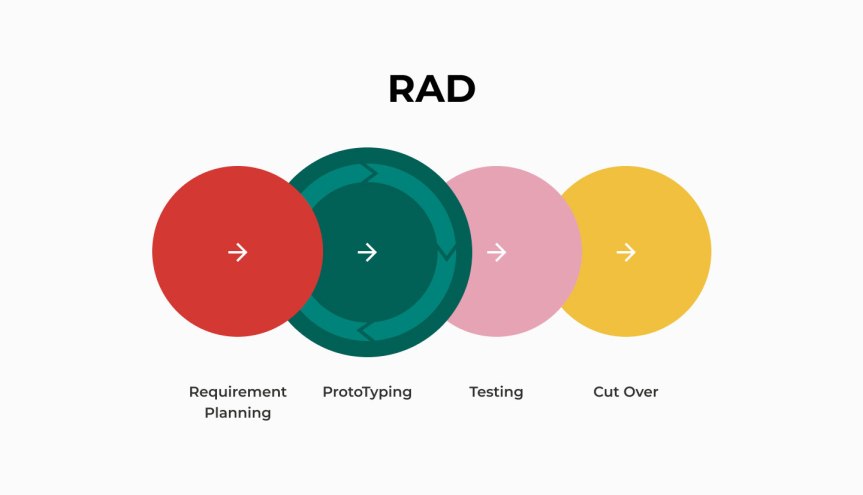
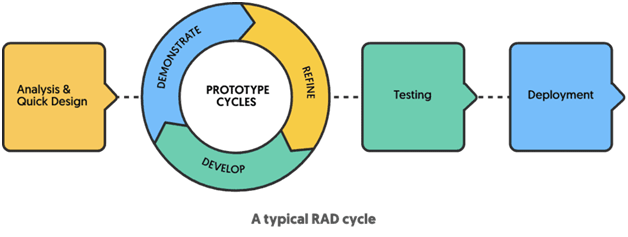
Rapid application development (RAD) is an incremental software development process model that emphasizes an extremely short development cycle.
The RAD model is a ―high-speed adaptation of the linear sequential model in which rapid development is achieved by using component-based construction.

Situation When RAD Model is Useful:

RAD should be used when there is a need to create a system that can be required in 2-3 months of time.
It should be used if there‟s high availability of designers for modeling and the budget is high enough to afford their cost
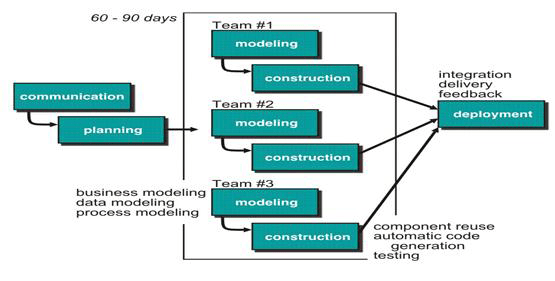
enables a development team to create a ―fully functional system within very short time periods (e.g., 60 to 90 days).

Phases

1. Communication:

Communication phase is used to understand the requirements of the project.

2. Planning:

Planning is very essential because multiple project teams are working parallel in RAD model

3. Modeling:

a) Business modeling:

The information flow among business functions is represented.

b) Data modeling:

The information flow defined as part of the business modeling phase is refined into a set of data objects that are needed to support the business.

c) Process modeling:

The data objects defined in the data modeling phase are transformed to achieve the information flow necessary to implement a business function.

4. Construction:

RAD process model reuses the existing program components (when possible) or create reusable components (when necessary).

5. Deployment:

Modules developed by different RAD teams are integrated to develop final complete product.

Advantages


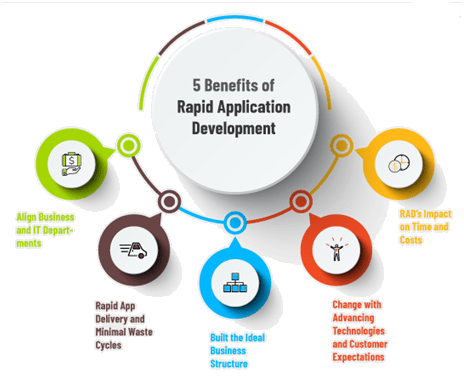
Faster implementation of Project
Parallel implementation
Increases re usability of components
Encourages customer feedback
Projects divided into small teams results into better implementation

Disadvantage


•Limited Time for system implementation results into inadequate analysis of project.
•Less time for testing.
•If user is unclear with the system project may fail.
•If developers and customers are not committed to the rapid model, the RAD project fails.
•Time is the major constraint in RAD.
•RAD has to be modularized in a proper way otherwise creates a lots of confusions and problems.
•In case of high performance requirement, RAD cannot be ideal model.

Conclusion

RAD Model is fast and is also based on Component Based Construction so, there is faster implementation of the project and increases re usability of the components. But also, if the user is unclear with the system the project may fail, this may lead to loss of time and cost.

TEA CONNOISSEUR – ”HERBAL TEA” (1)

Unlike the major broad varieties of tea, Herbal teas are not true teas. They are not brewed from the leaves of the Camellia sinensis plant. They are infused from dried fruits, flowers, spices or herbs. Hence, they are also called “tisanes”.

Herbal tea however is often considered a much better option due it the absence of caffeine. The polyphenols in herbal teas load them up with antioxidants that benefit our body in several ways. Antioxidants nurture a healthy lifestyle and gives us the boost of energy we need to get through a busy day.

Diving right into the types of herbal teas:

Chamomile tea is infused from dried Chamomile flowers. It contains Chamazulene, an aromatic chemical compound that possesses anti-inflammatory, analgesic and antispasmodic properties. Camomile tea is often known for its calming properties as it smoothens the nervous system and promotes muscle relaxation. Soothes . It relaxes the uterus and decreases the production of prostaglandins. Chamomile tea helps eliminate and prevent dandruff, soothe scalp irritation and promote healthy hair.

Peppermint tea is infused from dried or fresh peppermint leaves. The menthol in peppermint provides the cooling properties and the minty scent. This tea provides a cooling sensation that possibly eases pain. Peppermint has various antibacterial, antiviral and anti-inflammatory properties that helps them fight cold, allergies and infections caused by a clogged sinus. It aids in digestion and soothes the stomach.

Rosehips tea is infused from the pseudo fruit of the rose plant, which gives it a delicate, floral flavour and a distinct tart aftertaste. The high levels of polyphenols, carotenoids, vitamin C and E, provides powerful antioxidant properties. The presence of tiloroside promotes fat-burning and weight-loss. The antioxidants in rosehip helps to protect the brain and boosts the formation of collagen that prevents skin from aging.

Ginger tea is infused from dried or fresh ginger. It has been used for medical purposes since the old times. Ginger contains nutrients like vitamin B3 and B6, iron, potassium, vitamin C, magnesium, phosphorus, zinc. It has volatile oils, which have anti-inflammatory properties similar to that of non-steroidal anti-inflammatory drugs. It is known to prevent the nausea and vomiting associated with motion sickness. The vitamins, minerals and amino acids in ginger tea can help restore and improve blood circulation, which may help decrease the chance of cardiovascular problems. Ginger may prevent fat from depositing in the arteries, thus preventing heart attacks and stroke.

Lemongrass tea is infused from dried or fresh Lemongrass stem. Compounds like chlorogenic acid, isoorientin, and swertiajaponin promotes to its anti-inflammatory properties. According to the Memorial Sloan Kettering Cancer Centre, smelling lemongrass may help people with anxiety. It increase haemoglobin concentration, packed cell volume, and red blood cell count in the body. It soothens the symptom of premenstrual syndrome (PMS) by preventing water retention in body that leads to bloating.

Do not forget to read more from the series 🙂

TEA CONNOISSEUR

TEA CONNOISSEUR – “HERBAL TEA”(2)

ARE ONLINE CLASSES HERE TO STAY ?

ONLINE CLASSES ARE HERE TO STAY ?

Online classes are here to stay . Online learning has gain popularity , thanks to this pandemic . Not only colleges & universities but all schools have also introduced this system . In this pandemic , where the whole world is in lockdown it was very difficult to continue studies as all schools , universities , organizations were shut , & here these online class came into force .Online classes have whole different environment as compare to our traditional form of classroom , & students are enjoying this environment.

Some advantages of online classes which you also will relate to are :

  1. Taking classes usually means showing up on class at a particular time, sitting through a somewhat lengthy lecture and then going directly to your next class. Or, if you’ve spaced your classes out, you may be able to take a break in between, but you still have to stay on campus. It can make for really long, really intense, really exhausting days. Then you have to come home, do homework, sleep and do it all again the next day. It can easily become a grind. But with online classes you can sit comfortable & take the lecture by sitting in the position you want to .
  2. Online classes teaches you self discipline , because their is no teacher that will ask you to sit in discipline . You learn the most important thing of your line that is self discipline .
  3. Comfort of you very own home is what students like the most . You can take class from any where & every where .

4 Online classes will force you outside of your comfort zone (in a good way). You will have to learn to navigate the course lectures, download materials, interact with others online and communicate well digitally. Yes, this may be scary for some people! However, in the information age, these are essential skills and will allow you to keep pace with others.

At the same time online classes have disadvantages also which all of us know , they are :

  1. Online learning creates a sense of isolation , students starts feeling that they are in a cage & somebody is forcing you to sit in front of a device .
  2. It require self discipline , students don’t have this skill , as this skill require experience.
  3. Online classes are prone to technical issues, it require proper network connection & needs a proper device for taking classes on .
  4. Online classes need more time to be spend on screen & people don’t have this much time & patience to sit at one place .

Conclusion drawn from this is , we all know that this pandemic will stay for long & online classes are the only remedy for this , to avoid contact with one & other , & for students safety & security , online classes are here to stay

International Nelson Mandela Day 2021!

Why do we celebrate this day and its significance, his life and theme for 2021.

‘This day is also known as 67 Minutes Mandela Day, as for 67 years he fought for social justice.

The theme for 2021 Nelson Mandela International Day is “One Hand Can Feed Another.”

To further this recognition of his legacy, the month of July is also unofficially recognized as “Mandela Month” in South Africa.

About Nelson Mandela:

Nelson Rolihlahla Mandela was a South African anti-apartheid revolutionary, who served as President of South Africa from 1994 to 1999. He was also a statesman and philanthropist. Influenced by Marxism, he secretly joined the banned South African Communist Party (SACP). Although initially committed to non-violent protest, in association with the SACP he co-founded the militant Umkhonto we Sizwe in 1961 and led a sabotage campaign against the government. He was arrested and imprisoned in 1962, and subsequently sentenced to life imprisonment for conspiring to overthrow the state following the Rivonia Trial. Mandela served 27 years in prison

He was the country’s first black head of state and the first elected in a fully representative democratic election.

Over the course of his life, Mandela was given over 250 awards, accolades, prizes, honorary degrees, and citizenship in recognition of his political achievements. Among his awards were the Nobel Peace Prize, Bharat Ratna, the Soviet Union’s Lenin Peace Prize, and many more. Within South Africa, he was widely considered “The Father of the Nation” and “The Founding Father of Democracy.” Worldwide, he was regarded as a “Global Icon” and was described as “One of the most revered figures of our time” by Rita Barnard.

In the 1950s, he was elected as the leader of the youth wing of the African National Congress (ANC) liberation movement. He first resorted to peaceful protests. But he was met with violence by the government, he went on to support an armed movement. Mandela was an important symbol for the oppressed in South Africa who were fighting for their rights. He was extremely instrumental in tearing down the oppressive government and laid the foundation of democracy.

He started the Nelson Mandela Foundation to combat HIV or AIDS, support educational and rural development. In 2009, the United Nations proclaimed July 18th to be International Nelson Mandela Day. On this day, people are asked to spend 67 minutes doing something good for others, which represents all the 67 years he spent working towards change.

The 1st UN Mandela Day was held on 18th July 2010.

WHY ?

We celebrate this day to remember his struggle and contribution to the world which helped to pave a path for growth from the 20th – 21st century. It is a movement for all of us to renew and imbibe the values that inspired Nelson Mandela.

 "It is easy
 to breakdown and destroy.
  The heroes are those
 who make peace and build."
                                                              - Nelson Mandela

Things to do:

  • Learn about human rights!
  • Get acquainted with what you can do to fight alongside communities you most connect with.
  • Read about what inspired Nelson Mandela and the steps to took to fight injustice.
  • Talk with NGOs nearby you and find out how can you help the cause they are working on.
  • Talk to the friend you miss!
  • Find shelters, volunteer, or contribute food, amenities to help our beloved furbabies!!
  • Take a minute and appreciate everything that made you who you are.
  • Look into your strengths and use them to give back to the world.
  • Never underestimate the words, actions that you put out in the world! You matter!

Refences:

https://en.wikipedia.org/wiki/Nelson_Mandela

https://www.dosomething.org/us/facts/11-facts-about-nelson-mandela

RACISM

Racism, also known as racialism, is the belief that humans can be divided into distinct biological entities known as “races,” that there is a causal link between inherited physical traits and personality, intellect, morality, and other cultural and behavioral characteristics, and that some races are innately superior to others.

While contemporary social science considers race and ethnicity to be distinct categories, the two terms have a long history of equivalency in public usage and earlier social science literature.

“Ethnicity” is frequently used in a sense similar to that of “race”: the classification of human groups based on attributes thought to be inherent or necessary to the group.

The term “racial discrimination” refers to any distinction, exclusion, restriction, or preference based on race, color, descent, national or ethnic origin that has the purpose or effect of nullifying or impairing the recognition, enjoyment, or exercise of human rights and fundamental freedoms on an equal footing in the political, economic, social, cultural, or other fields of public life.

The phrase also refers to political, economic, or legal institutions and systems that participate in or perpetuate racial discrimination or otherwise exacerbate racial disparities in wealth and income, education, health care, civil rights, and other sectors.

With the rise of critical race theory, an extension of the critical legal studies movement, such institutional, structural, or systemic racism became a special focus of scholarly research in the 1980s.

Since the late twentieth century, biological race has been recognized as a cultural construct with no scientific foundation.

Racism dictated that different races (primarily blacks and whites) be separated from one another, that they should have their own distinct communities and develop their own institutions such as churches, schools, and hospitals, and that it was unnatural for members of different races to marry in North America and apartheid-era South Africa.

BLACK LIVES MATTER

On June 6, half a million people showed out in approximately 550 locations around the United States for the recent Black Lives Matter rallies, which peaked on June 6. That was just one day in a month of protests that are still going on today.

Photo by Life Matters on Pexels.com

Four recent polls, including one released this week by Civics Analytics, a data science firm that works with businesses and Democratic campaigns, estimate that between 15 million and 26 million people in the United States have participated in protests in recent weeks in response to the death of George Floyd and others.

These figures would make the recent protests the largest movement in the country’s history, according to interviews with scholars and crowd-counting experts.

While it’s likely that more people stated they protested than actually did, even if only half of them were telling the truth, the surveys indicate that over seven million people took part in recent protests.

There have been protests in more than 40% of counties in the United States (at least 1,360).

Unlike previous Black Lives Matter events, approximately 95 percent of counties with recent protests are majority white, with nearly three-quarters of counties having a white population of more than 75 percent.

Half of those who claimed they demonstrated indicated it was their first time participating in some type of activism or protest.

Within the recent year, the majority of people claimed they had seen a video of police violence against protestors or the Black community. And half of those polled thought it strengthened their support for the Black Lives Matter movement.

According to the Crowd Counting Consortium, the number of protests has decreased significantly over the last two weeks, notwithstanding a rise on Juneteenth.

“Our ability to reach unity in diversity will be the beauty and the test of our civilization.”

– Mahatma Gandhi, 1925

Professor McAdam stated, “It appears, for all the world, that these protests are accomplishing what very few do: putting in motion a period of profound, persistent, and broad social, political change.” “We look to be on the verge of a social transformation tipping point, which is both rare and possibly significant in society.”

Investing lesson of Peter Lynch


Peter Lynch is one of the most successful and top value investor of all time. He was a legendary fund manager who gave 29% returns to their investors for 13 years in a row. He wrote books on value investing , where he shared his investment lessons which he learned and used during his journey as an investor. He is one of the greatest value investor of all time. He is a firm believer that an average investor can also pick winning stocks as Wall Street professional with right research, patience , steady discipline and common sense.


Some of his investment principles are –

1. Invest in what you already know – “The worst thing you can do is invest in companies you know nothing about. Unfortunately buying stocks on ignorance is still a popular American pastime.” -Peter Lynch
People can perform well by investing in what they already know. For instance if a doctor wants to invest in banking sector (about which he know nothing) , he will not have that great return as compared to if he will invest in pharmaceutical companies ( as he already knew about drugs, healthcare sector and their companies)
“Invest in what you know. It leaves out the role of serious fundamental stock research. People buy a stock and they know nothing about it. That’s gambling and it’s not good.” -Peter Lynch
So, it’s better to choose the company whose products/services are either used by you or you are familier of the products/services of that company in some way or other. These knowledge will lead you to invest in better stocks .
2. Invest in companies not in stocks – “Look for small companies that are already profitable and have proven that their concept can be replicated. • Be suspicious of companies with growth rates of 50 to 100 percent a year”-Peter Lynch

Behind every stock there is a company. If companies will perform well, the stocks automatically will perform well. So, it’s important to know about the company, it’s business model. Choose a company whose fundamentals are strong. A company whose business model is so easy to understand that anyone can understand and run that company.

“Go for a business that any idiot can run – because sooner or later any idiot probably is going to be running it” -Peter Lynch

Know a companies management, it’s fundamentals and then ask yourself , “are you able to understand the mission and vision of the company? “ or “If you’ll be given the responsibility to run this company, will you be able to run the company? “
If the answers to the above questions are a YES then it’ll be great to invest in that company.
So always remember that you have to invest in a company and not in a single stock.


“Behind every stock is a company. Find out what it’s doing.” -Peter Lynch

“Never invest in a company without understanding its finances. The biggest losses in stocks come from companies with poor balance sheets.”

3. Don’t take unnecessary risks. Take calculated risks – You don’t have to take risks which you can’t bear. Only take calculated risks.
Let’s say, you have $10 dollar, maybe if you will lost this, you won’t regret. But what if you lost $100 or $1000! Always buy stocks of the amount if you lose won’t regret. You are not required to put all your money in market and risk all that money. Instead put only that amount which if you lose won’t make you regret of investing.
Also, invest only the amount you will not need ever back in your life
4. Peter Lynch said that the most important thing that keep in mind while investing is : know why you own it.

“ You have to know what you own ,and why are you own it .” -Petrr Lynch

It sounds simple but it is not . He said when I asked most people they just don’t know why they own a stock . 80% of investors have no answer to this question .

They maybe hear some tip from anywhere and put their money at risk and when they lose it they blame institutions .
First you have to know the reason . Why you should invest in this company ,research about that company . Check their balance sheets . Without proper research you are not investing you are just gambling . Read and know as much as you can about the company. And remember to buy the company and not just a stock.

“If you’re prepared to invest in a company, then you ought to be able to explain why in simple language that a fifth grader could understand, and quickly enough so the fifth grader won’t get bored.” – Peter Lynch

5. Invest for long time- Lynch used to hold stocks for long period of time. He used to sell the stocks when the fundamentals of any company gets changed. This is his advice for all investors out there to not go behind short term profits but invest for a long period of time.
He even conducted many studies to understand the power of compounding.

“People who succeed in the stock market also accept periodic losses, setbacks, and unexpected occurrences. Calamitous drops do not scare them out of the game.”


Some more investment lessons by Peter Lynch :

• “Never invest in any idea you can’t illustrate with a crayon .”

• “The trick is not to learn to trust your gut feelings, but rather to discipline yourself to ignore them. Stand by your stocks as long as the fundamental story of the company hasn’t changed”

• “Whenever you invest in any company, you’re looking for its market cap to rise. This can’t happen unless buyers are paying higher prices for the shares, making your investment more valuable.”


• “There’s no shame in losing money on a stock. Everybody does it. What is shameful is to hold on to a stock, or worse, to buy more of it when the fundamentals are deteriorating.”

• “Never invest in any company before you’ve done the homework on the company’s earnings prospects, financial condition, competitive position, etc”

• “Big companies have small moves, small companies have big moves.”

• “Good management, a strong balance sheet, and a sensible plan of action will overcome many obstacles, but when you’ve got weak management, a weak balance sheet, and a misguided plan of action, the greatest industry in the world won’t bail you out.”

• “In the long run, a portfolio of well chosen stocks and/or equity mutual funds will always outperform a portfolio of bonds or a money-market account. In the long run, a portfolio of poorly chosen stocks won’t outperform the money left under the mattress.”


This is how he succeed in the world of investment. You can learn from him and help yourself to reach the level you want in investment.


Thank you.