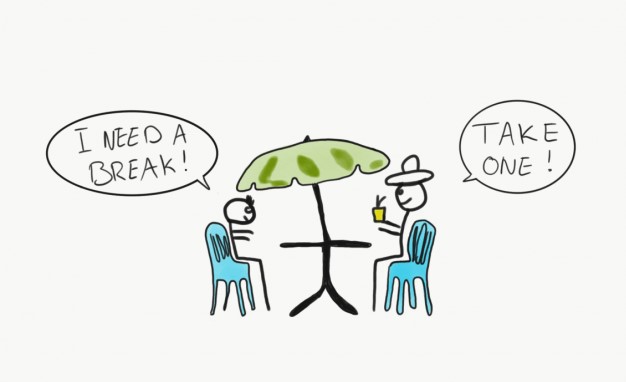
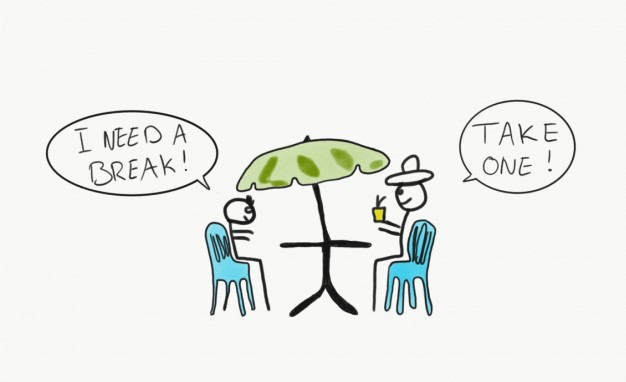
If You Feel Like You Need A Break, Take One

HAVE A BREAK!

You recharge your phone when it runs out of juice. You refill your gas tank when you’re running on empty. But sometimes, you forget to take a break and recharge your most precious possession: Your body (and the brain that’s inside of it).

Whether you love what you do, are in between jobs, or have a job you hate: You’re working. Living is also a job. A pretty tough one, actually. Just the act of getting up in the morning can be a daunting task. And I’m not even talking about all the responsibilities we have.

So why do you make your life even more challenging by not taking a vacation to recharge? I’m not talking about your weekends that are packed with activities, or holidays where you do more work than relax.

No, that type of “free time” only costs energy. I’m talking about resting with a very specific reason: To recharge your battery so you can get back to living a productive life.

A break reduces stress and improves productivity.

Scientific research shows that a vacation decreases perceived job stress and burnout. Now, that’s a pretty solid benefit of taking a few days off. But there’s more.

As you may know, I’m always interested in productivity. In the case of resting or a vacation, my question is:

Will I get more things done when I get back?

The answer is yes, but there’s one major thing to keep in mind. But let’s back up a bit: What does it mean to get more done? Getting things done has nothing to do with time—if you work more hours, you don’t necessarily get more done.

In fact, research shows that working more hours general means less productivity.

Why? Well, we often waste time if we have a lot of it. It’s simple: If I say to you, you have a year to write an article. What would you do? Put it off until tomorrow, right?

But what if I tell you that you only have 2 hours? You’ll probably get started right away. So in a way, having more days off, and fewer days to work, forces you to be more effective with your time.

Research shows that a vacation in itself won’t make you more productive, but when you have more days off, you have a strong desire to get more things done in less time.

And that’s a win-win situation for everybody: You, your business, or your job. You take off a few days, recharge, spend time with your family or friends, and when you come back, you’re more productive.

Sounds great. But wait, there’s a caveat.

When your vacation is stressful, the positive benefits go away. So keep the stress at a minimum on your holiday. Otherwise, you’ve wasted a perfect opportunity to relax and boost your overall productivity.

I recently felt I needed a break for several reasons. I had a few injuries that didn’t seem to go away and had less energy. I could have powered through, but instead, I decided to go on a vacation with my family. For a week, I did absolutely no work. And when I came back, I was full of energy.

Here are a few tips that might help you to take a break that fully recharges you.

1. Do What You Want

There are no rules for taking vacations and everybody relaxes in a different way. If you like to plan your holiday, just do it. If you want to go with the flow, then do that.

Want to wake up early? Do it. Don’t like waking up early? Sleep in. Even if you go on a vacation with your partner, friends, or family, you don’t have to be together 24/7. You can also sometimes do things that you enjoy.

The key is to not have expectations on your vacation. Let go of everything. I also don’t like to post vacation pictures on social media. Otherwise, I’m constantly thinking about taking a cool picture so I can impress others.

You’ll probably even do things you wouldn’t do just to take a picture. “I really need to rent a jet ski so I can take a picture with it.” No, you don’t.

Who cares? Focus on enjoying the moments you experience. Whatever those moments may be.

2. Read

Bill Gates is famous for his voracious reading habit. He is also known for his ‘Think Week’ where does nothing else but read and think.

You don’t have to be Bill Gates to think about your life and career. We all have our daily, weekly, and monthly routines. Usually, routines and habits work very well. However, you can also get stuck inside a loop.

That’s why I recommend you to step back from your daily life and career. If you do that, two things can happen: When you step away, you miss your daily life and can’t wait to pick up where you left off.

Or, the opposite will happen. You don’t want to go back. See that as a sign that you need to make a change. Either way, a break always serves a purpose. It doesn’t only help you to recharge, it will also make you think.

That’s why I like to read for hours on my vacation.

3. Get Bored

One of my favorite strategies for finding new ideas is to get bored out of my mind. It sounds easier than it is because of distractions.

In the past, I would do everything to NOT get bored: Watch TV, go out, browse Facebook, etc. But did you know that you can use boredom to your advantage?

Instead of giving into distractions, just give into the boredom and see it leads your mind to. In fact, one of my favorite artists of all time, Andy Warhol, embraced boredom. You can tell by the boring films he made or the references he made in The Philosophy Of Andy Warhol about getting bored.

Whenever I hit a creative wall, I just do nothing. Literally, nothing. Try it sometime. It’s a great strategy; maybe you come up with the next best thing in your industry.

It’s never a good time to take a break.

  • “I just need to finish this project.”
  • “My boss will never accept it.”
  • “People will think I’m lazy.”
  • “I don’t have time.”
  • “My family needs me.”

Yeah, yeah, I’ve been there too. But what would you rather: Continue to work without resting and burn out? Or take some rest before you’re tired?

So before you use all those valid reasons to not take a break, think about what all the people in your life have to do if you’re not here anymore. Yes, you’re important. So take care of yourself. Take a break and come back with more energy.
Why do we hate our bosses?

Cognitive revolution played a huge part in how we interact as groups today. Legends, myths, gods and religions appeared for the first time during the cognitive revolution. So we basically started creating fiction and as a result of that we could  weave common myths such as the concept of a country and things like human rights. Such myths give us the ability to cooperate flexibly in large numbers and this is how leaders emerged.

So how are we doing now as leaders? Today the top google search results for ‘my boss…’is very unpleasent. 90% of the people agree their leaders are incompetent. And it is true. Most leaders have very negative effects on their followers and subordinates,causing low levels of productivity,and high levels of burnout and stress.

An organizational psychologist says one of the reasons might be because when we elect our leaders we can’t discern between these two words: confidence and competence. A lot of people right now in leadership are people who have fooled others that they are better than they actually are. And this is not because they are very manipulative but mostly because they fooled themselves too.  I’m pretty sure you have worked with people who think they are really good at something, when they’re actually not. Also, statistically,they are more likely to be male than female.Men are typically more deceived about their talents than women are. So there’s a sexism converstion here which I won’t be discussing since we don’t have time but the catch is that they are also  more likely to succeed in their careers. So being unaware of your limitations increases your probability of being a boss.

But why did our society start functioning like this ? It’s us.

When we comes to leaders, we tend to gravitate towards leaders who are charismatic and charming We prefer our leaders to be  charismatic and  fascinating.But in reality, the best leaders are humble rather than charismatic,to the point of even being rather boring.This is why they rarely feature in the media or blockbuster movies.If we want to improve the performance of our leaders,we should start by focusing on the right traits.Instead of falling for people who are confident, narcissistic .We should promote people into leadership because of their competence, humility and integrity. Leaderships should be judged on traits like accountability, empathy. Are they able to convey their message to their team, can they keep a team motivated?

Yes,if they are very charming, give groundbreaking speeches and sweep you off your feet,  good. But that alone should not be the criteria of choosing a leader. Look at Elon Musk, that guy can’t speak four sentences without stammering yet he has been successfully leading one of the biggest companies. And anyway we don’t have a good history with  people having over the top speaking skills!

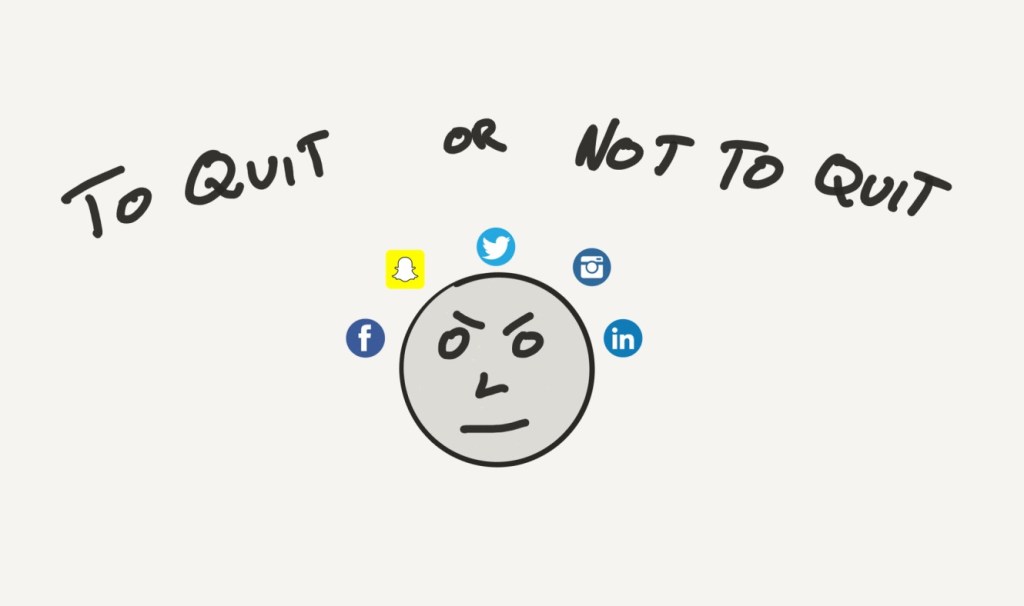
If Social Media Makes You Feel Bad, Quit Using It

YOU ARE YOUR BOSS!

Just admit it, you’ve thought about it before. Social media is great and all. But you and I both know that it also sucks.

Does this scenario sound familiar?

  • It’s late at night, you’re in bed, you dread waking up early tomorrow because you have to go to work, so you grab your smartphone, you open up Instagram (or whatever app you’re addicted to).
  • And you start browsing, you go from one picture to the next, you watch some videos, you start feeling bad about your life, because all the other people have fun, and you have to go to work in the morning.

Alright, we’re at a very bad place right now in that scenario. Because now the existentialism creeps in slowly. And finally, you think:

“My life is shitty compared to these other people. They look amazing, have money, travel the world, and they are important too. Who am I? I’m nothing. What have I done? Nothing! FML.”

And what do you do besides feeling like shit? Nothing. You just go on with your life and repeat that whole process the next day. And some days you counter the posts from other people by ‘crafting’ your own cool posts.

Just admit it, this whole thing is not cool. Of course, I’m exaggerating, and social media is not the source of all our problems. Don’t expect that your life will be awesome when you get rid of social media. I don’t believe in fairy tales.

But you get my point. Social media has a negative impact on many of us. Some people love it. If that’s you, there’s no need to read this article. But if you ever thought about quitting social media, keep reading.

Actually, just stop reading, and go on and delete the apps that make you unhappy.

Just follow the example of Louis C.K. When asked about why he quit Twitter in an interview, he said:

“It didn’t make me feel good. It made me feel bad instead. So I stopped doing it.”

That makes it very simple. If something makes you feel bad, stop using it.

It’s the opposite of the scientific approach to quitting social media that Cal Newport took. He makes some good points about why social media is bad for you.

But to me, that’s way too rational. And we’re not rational beings. We’re emotional. That’s why I like the approach of Louis C.K.

Here’s why I got rid of my social media.

I only used it for self-promotion. And I don’t like that. I don’t think that’s fair to people who follow you. So I got rid of my Instagram, Facebook, and Snapchat. I only have Twitter and LinkedIn (for now). But if I don’t use them, I’ll get rid of them too.

This article is not about convincing you to do the same. Or about getting rid of all your social media profiles. All I’m saying is this: If you ever thought about quitting social media, just do it already.

You’re limiting yourself by not pulling the trigger. Now, you might say: “It’s just social media. Who cares?”

But you’re not getting off that easily. If you want to live a happy and stress-free life, you have to be decisive. When things linger in your head, it’s all dead weight. And you don’t want that.

What’s it going to be? Do you use social media or not? Does it make you happy? Does it improve your life or business?

I know what you’re thinking. “What if I ever need it?”

You don’t need anything for business or your career.

People who have stakes in social media will never tell you to stop using it. Why? Because their career depends on it.

But what did you think people did before social media? It’s all a matter of perspective. Many successful entrepreneurs I know have never used social media.

Is that why they’re doing well? There’s no way to tell. One thing is sure: You can do well in life with and without social media.

It’s up to you to decide. And it comes down to self-awareness. It’s also about simplifying life. Because it’s already complicated enough. Get rid of shit that doesn’t contribute anything to your life.

So what’s your perspective? Have you ever thought about quitting social media? Why did you never pull the trigger? Let me know in the comments.

3 Common Mistakes Smart People Make

OOPS!

If you believe that only stupid people make these common mistakes, you’re as wrong as I was. The truth is that everyone makes mistakes. Smart people admit that. Stupid people do not.

What’s more, the smartest and most successful people in history have made the most mistakes. Are those two things connected? I think so. This Albert Einstein quote says it all:

“Anyone who has never made a mistake has never tried anything new.”

I used to blame myself for making mistakes in life. I think that’s how our society is. As a kid, you’re punished for making mistakes in school and life. And because of that, we think it’s normal to punish each other as adults.

But why would you punish yourself or another person for making silly mistakes? Most things in life are reversible and small (I’m not talking about committing crimes or adultery here). What matters is that we learn from our mistakes.

One of the best traits one can have in life is to be forgiving. You must go easy on yourself when you screw up. The same is true for the people in our lives. Alexander Pope put it best:

“To err is human, to forgive, divine.”

And when people really cross the line—just move on. No need to make things complicated.

In life, there are lines one should not cross. If you keep yourself to a high moral standard, you’re doing the right thing. And if you make mistakes? So what? No one is perfect.

Here are 5 of those mistakes that smart people make. Remember that you don’t have to make these mistakes yourself. It’s better to learn from other people’s mistakes. They have made them, so we don’t have to.

1. Chasing money

I recently read How To Get Rich by Felix Dennis, who owned one of the biggest magazine publishers in the UK. Contrary to the title, the book actually tries to discourage you to chase money.

Many rich people will tell you the same. The funny thing is that we all know there is more to life than money. And yet, we make it our sole purpose. Dennis writes:

“People who get trapped in the tunnel vision of making money think that is all there is to life.”

There’s nothing wrong with wanting to get rich. We just have to remind ourselves that making money beyond a certain amount has little impact on our happiness. But somehow, we get tunnel vision. Again, trying to get rich is not a mistake. However, it is a mistake if you expect that it’s the answer to all your problems.

2. Ignoring sleep

When you get excited about something, you want to spend all your time on it. That’s a great feeling.

But when your excitement prevents you from having quality sleep, you want to change that. It’s one of my biggest pitfalls. I can read and work all day long—well into the night.

But even when I go to bed at 2 AM and wake up 8 hours later, I still feel tired. Somehow, it’s different when I hit the sack at 11 and wake up at 7. I feel much more energized.

For the past year, I’ve been taking my sleep more seriously. I wake up at the same time every morning. And I turn off my devices exactly one hour before I want to sleep. That means no work or heavy mental activity before bedtime. Just some light reading or journaling.

3. Being connected too much

The past decade has been great for technology. Almost everyone has a smartphone with access to the internet. Within a few years, the whole world will be connected. Even the less developed countries.

Modern technology has changed the world. These developments are great. But remember that too much of a good thing becomes bad.

That also applies to your smartphone, tablet, and laptop. Recent research shows that Generation Z (born after 1995) is distressed and anxious. The American Psychological Association even says they have “the worst mental health of any generation.”

One of the biggest reasons for their mental state? All the signs point towards their smartphones and connectedness. For years, I’ve been limiting my smartphone usage.

And inspired by Cal Newport’s new book, Digital Minimalism, I’m only getting more strict with this.

LIFE CYCLE OF INNOVATION

INNOVATION

Innovation is the action or process involved in improving an existing product/service. It involves new techniques and ideas to create better products that add up value to the customers. Innovation enhances the brand value and is the key to the successful running of the organizations.

Example: Power banks – They are innovative reusable devices that replace conventional chargers in the absence of electricity. Power banks store the battery and give power through USB ports to the devices in need of charging.

LIFE CYCLE OF INNOVATION

The phases of innovation in an innovation life cycle can be the following

  • Ideation – Ideation starts with the necessity of a solution for a problem or to satisfy the customer’s requirements. The problem statement is identified first and the feasible idea to solve it, is generated. Curiosity, Creativity, Involvement gives impetus for a new idea to spark. This may either increment an old one or open a new market. Innovation potentials are generally identified through
    • Targeted search – This involves finding potentials through creativity workshops, idea contests, or LEAD user workshops.
    • Random findings – This involves discovering the new idea randomly while coming across some new products, suggestions, and customer feedback.
  • Research – This is one of the important steps as it involves identifying risks. After the idea is generated, research should be done to conceptualize and bring an idea into a form. Proof of Concept (POC) must be provided and it should prove that neither a similar product is available in the market nor POC is available and patented. This phase should ensure that the idea is possible by analyzing
    • Customer’s requirements – Customer’s unheard problems and needs.
    • Market potential – Market size and attractiveness for the generated idea.
    • Growth potential – Expected opportunities, growth, and scalability.
    • Risks and feasibility – Potential risks, technical barriers and laws, standards, and patterns.
  • Offering – This phase involves offering the product as a complete one to the market. Before it is offered, the availability of resources and scope of the product in the market must be analysed. The feedback from the potential customers must be obtained and incorporated. Use these customers as an anchor to obtain new customers. 
  • Commercialization – This involves launching the product as a commercial one to gain profit from it. The following points should be considered for commercialization
    • Sales plan and marketing strategy – How the product is delivered to the customers and attracting, convincing, and making the customers realize the need for the product.
    • Contracts and license management – Regarding the terms and conditions for using the product
    • Product management and engineering – Involves packaging, delivery, and installation. Striving continuously for future enhancements and updating the versions on a timely basis.
    • Customer support – Customer helpdesks, feedback management, etc.
  • Growth – This phase is to ensure leading the market. Continuous study on the competitors, new arrivals, and customer needs could help retain the market position. The product should be able to sustain the competitive market. Customer acceptance and support should be increased through the performance of the product. Eventually, revenue generation increases. The availability of the product must be expanded.
  • Retirement – A product goes through this phase when there is a replacement of the product by an advanced one. The product tends to lose the market position thereby failing to generate expected revenue. This may happen due to a decrease in demand, the substitution of technology or the product may no longer provide a relevant solution to the customers.

These phases of innovation are considered indispensable in the product’s lifecycle. So, it becomes mandatory to take care of every detail in the life cycle to achieve success and sustain in the market.

INDUSTRIAL SICKNESS

Industrial sickness refers to the situation wherein an industrial firm performs poorly, incurs losses for several years and often defaults in its debt repayment obligations. The problem of industrial sickness has grown significantly over the years in India and a large number of industrial units were affected by it.

There are various causes of industrial sickness. Firstly, an internal cause can be faults at the planning and construction stage. Faulty decisions like setting up the firm in the wrong location i.e. a location which lacks infrastructure facilities or lacks market availability cause problems in the long run. Unplanned production, unbalanced capital structure etc. are all faulty decision which makes a firm sick.

Defective plant and machinery is another reason for industrial sickness. It has been observed that small scale sector do not seek professional technical guidance in choosing machinery. At times technology adopted is outdated and inappropriate. Production with this sort of technology is bound to be inferior and likely to suffer cost and price disadvantage.
An external cause of industrial sickness is demand and credit restrain. During the times of recession, there is a steep decline of demand in the market. This causes losses to individual units especially the products with high prices like automobiles. If such situation persists for long durations, then industrial units are prone to turn sick.
The most important internal cause of industrial sickness is management problems. Management can make or break a firm. Incorrect managerial decisions pertaining to the fields of finance, production, marketing etc. can ruin a business. Absence of quality control systems, lack of inventory, inadequate maintenance are some examples of mismanagement.
Entrepreneurial incompetence is yet another reason for industrial sickness. Many entrepreneurs in the small scale sector do not have basic knowledge of business, manufacturing, costing, accounts etc. Units set up by them often turn sick.
Industrial sickness can have serious consequences. It is a set back for employment opportunities. When a firm turns sick, it can actually go out of business. Closure of an industrial firm renders its workers unemployment. This situation can be more serious if a big firm with a large number of employees gets shut down. Unemployment brings a lot of complications with itself. This can cause industrial unrest. Closure of a big firm also causes labour unrest which can result in industrial strikes which threatens the peace of industrial environment.
Industrial sickness also leads to wastage of resources. When a sick firm is shut down, resources invested in that unit are wasted. In case of large firms this problem is more serious as a lot of investment is made in its plants and machinery. In fact other industries which are linked to a sick firm through backward or forward linkages, also incur some losses.
Closure of large sick units also effects investors and entrepreneurs and creates a psychology of despair. The prices of share fall down and affect the entire stock market. Even banks and financial institutions which have granted loans to these units suffer losses. Locking up funds in the sick units negatively affects the future lending programmes of banks and financial institutions. Industrial sickness also results in loss of revenue of government. Since industrial sickness has such a wide range of impact, it is considered as a social problem in India.

Competitive Programming

“I think everybody in this country should learn how to program a computer, should learn a computer language, because it teaches you how to think.”Steve Jobs

If you are a programmer, you may understand the deep meaning of these words quoted by Steve Jobs, and you may also have this experience even if you turn off the computer, you continue to think about the programming or code you use in it. The project has been written. In programming, you just don’t learn programming, you also learn the “art of thinking“, the method is to break the code into smaller parts, and then use creative, logic-based thinking to solve problems from different angles. Programming is very interesting and it is like brain training. Programming is an intellectual sport. When this sport is practiced by sports programmers on the Internet, it is called competitive programming.

Coding contests or competitions usually require the host to have a series of logical or mathematical questions for the contestants, also called puzzles (ranging from ten to one thousand) problems. Scoring is mainly based on the count of problems solved and the time required to write a successful solution, but other factors (quality of results obtained, execution time, program size, etc.) also do count.

The goal of competitive programming is to write source code for computer programs that can solve specific problems. Most of the problems encountered in the programming Olympics are essentially mathematical or logical problems. Typical problems fall into one of the following categories: combinatorics, number theory, graph theory, algorithm game theory, computational geometry, string analysis, and data structure. Challenges related to deadlines and artificial intelligence are also popular in certain competitions.

These coding contests provides young and talented coders with the opportunity to measure their skills and compare them with other programmers around the world. Some of them are listed as-

1) The ACM-ICPC International Collegiate Programming Contest

2) Google’s Coding Competitions

3) The ICFP Programming Contest

4) BME International 24-hours Programming Contest

5) Microsoft Imagine Cup

6) Facebook Hacker Cup

Tillage Practices and Their Potential to Impact the Soil Carbon Dynamics

Abstract
In dry regions, it is customary for farmers to use soil water conservation and/or water harvesting techniques. These practices have now become applicable to agriculturalists combating the adverse effects of drought on food production. In the semiarid areas of Zalingei in western Sudan, we quantified the soil erosion using traditional conservation measures and conducted experiments in two consecutive rainy seasons (2013 and 2014). A split-split plot design was used to quantify the respective influences of each variable on reducing soil erosion: A) three gentle gradients (Slope1 (0.98%), Slope2 (1.81%), and Slope3 (3.1%)); B) two cropping systems (mono-crop and mixed-crops); and C) five indigenous conservation tillage practices—chisel ploughing (CHP), cross slope tied bonding (CSTB), contour ridge with stone bonds (CRSB), cross slope bonding (CSB), and zero tillage (ZT). Our results showed that there were significant differences between the slopes in season 2 (2014); the soil eroded at Slope3 was more than that of Slope1 and Slope2 by 71% and 27%, respectively. Over two seasons, there were no significant differences between the cropping systems. Conversely, the erosion level observed with CHP was higher than with the other practices. However, the CSTB and CSB erosion levels were only higher in season 2 when compared with those of CRSB and ZT. The study concluded that under the above conditions, the rate of soil erosion was severe and exceeded the erosion tolerance. Based on these results, in western Sudan, CRSB and ZT may be the more effective indigenous conservation practices for the protection of agricultural soils and productivity.

INTRODUCTION
The level of soil degradation is increasing globally and is linked to an increased risk of drought . The growing human population faces increased pressure on its food supply, which is compounded by the limited availability of agricultural lands. To address these issues, the productivity of existing arable lands must be increased via better water use efficiency and soil conservation practices. . Moreover, climate change is also predicted to increase the incidence and severity of droughts in semiarid regions
The erosion of agricultural soils has long been a global environmental concern . Also, soil erosion is considered as one of the significant environmental problems worldwide due to its effects on water quality, soil productivity, and ecosystems. Rain flood erosion in agricultural lands strips the fertile topsoil on-site in arid and semiarid regions. Soil loss is often triggered and accelerated by poor or non-existing soil conservation practices promoting the transport of sediments and potentially hazardous pollutants via runoff to rivers and streams . In rainfed areas, the on-farm management of soil and water plays a critical role in achieving the full potential of soil conservation and water use . It is important to design conservation measures and strategies that are effective in controlling such soil losses on the Earth . Reasonable cultivation patterns combined with rainwater harvesting techniques can improve the management of degraded lands, which eventually leads to the sustainability of production, greater certainty, and lower marginal inputs. One type of soil conservation practices that are commonly used are conservation tillage practices (CTPs), which aim at no-tillage, little tillage, and cover crops . Other traditional or modern agricultural operations are used in conjunction with CTPs to reduce farmland degradation and to increase land productivity . In developing countries, the land is commonly fragile and degradable with poor vegetation as a result of the influence of frequent fires, tree logging, and free grazing. On top of these challenges, the area may suffer from climatic changes , rainfall fluctuations and the rapid advancement of the Sahara Desert. As a climatic adaptation strategy, rainfed, smallholder cultivation of grain crops is the predominant agricultural system in the hilly areas, where the terrace system is an interesting practice among indigenous water harvesting systems . However, the most effective method in conserving the soil surface is not well studied and reported so far in this area. Knowledge about the reduction in water and soil losses due to the practice of the terrace system is very limited in developing areas. Whether this traditional irrigation system helps in improving soil characteristics, crop production, and biodiversity richness in the area is also insufficiently quantified. Arid and semiarid areas account for about 60% of the national land in Sudan and account for approximately 8% of the world’s semiarid tropical regions . They are usually characterized by an unprotected soil surface, especially in clay areas, through which high-intensity rainfall cannot be infiltrated and thereby discharged dominantly by the surface runoff process . From these perspectives, this study aims to:
(A) evaluate the effect of the cultivation practices on the soil erosion;
(B) understand whether the cropping system affects water erosion, and
(C) recommend suitable field operations.
2. Method and Materials
2.1. Study Site
The field experiments were carried out during two consecutive seasons (2013 and 2014) at the experimental field of the University of Zalingei, western Sudan (between latitudes 12◦300–13◦300 N and 23◦300–23◦450 E) in the semiarid zone of North Africa. This is a mountainous area, where there are different types of waterways due to the land undulation, and large water streams (valley/wadi), streaming through from the Jebel Marra massif (approximately 100 km east of Zalingei) carrying fertile alluvial and volcanic soils [21]. The agriculture consists exclusively of small-scale family farms. Miehe [17] classified the soils of the area as Andosols with a bulk density of 1.32 g/cm3 . The climate is hot and rainy in the summer and harsh and dry during the winter. The average annual rainfall in Zalingei is approximately 600 mm/yr.; however, approximately two-thirds of it falls during July and August and about 90% from June to September, and there is very little or no rain from October to March [22,23]. The major crops for food are mostly grown during the rainy seasons (June to October) and include sorghum (Sorghum bicolor), millet (Pennisetum glaucum), and groundnuts (Arachis hypogaea), with vegetables mostly cultivated alongside the wadis’ lowland and flood plains during the winter. Water 2020, 12, 1554 3 of 11 Water 2020, 12, x FOR PEER REVIEW 3 of 12 Figure 1. The study area, located in the semiarid zone of North Africa. In the first rainy season (May–September 2013), the accumulation of rainfall was 542 mm, and it was 675 mm in the second season (June–October 2014); thus, the rainfall in the second season was 24.5% greater than in the first (Figure 2). The rain distributions were also varied, particularly during July and August of the second season, as a higher amount of rain precipitated, compared to that of the same period in the first season. To be exact, it was higher by 116.2% and 46% in July and August, respectively. Figure 2. The distribution of the rainwater per month (mm/m) and the accumulation of rainfall in each of the growing seasons, Season 1 (2013) and Season 2 (2014).
2.2. Experimental Design:
In three-factor field trials, split-split plots, each with 3 replicates, were used to quantify the influence of the following factors on soil erosion control: slope, cropping systems, and indigenous Water 2020, 12, 1554 4 of 11 conservation tillage practices. Thus, the field trial layout consisted of 90 plots, i.e., 3 whole plots × 2 subplots × 5 sub-subplots × 3 replicates. Three whole plots (each 35 m × 10 m), each with a different slope (S): S1 = 0.98%, S2 = 1.81%, and S3 = 3.1% (gradient measured by manual clinometer), were subdivided into 3 subplots (each 11 m × 10 m), each with a different cropping system (CS): mono-crop; sorghum and mixed crop; sorghum + groundnut. Each cropping type subplot was further subdivided into 5 sub-subplots (each 2 m × 5 m), each cultivated with a different conservation tillage practice (CTP): chisel ploughing (CHP), cross slope tied bonding (CSTB), contour ridge with stone bonds (CRSB), cross slope bonding (CSB), and zero tillage (ZT) (Figures 3A and 4). Water 2020, 12, x FOR PEER REVIEW 4 of 12 conservation tillage practices. Thus, the field trial layout consisted of 90 plots, i.e., 3 whole plots × 2 subplots × 5 sub-subplots × 3 replicates. Three whole plots (each 35 m × 10 m), each with a different slope (S): S1 = 0.98%, S2 = 1.81%, and S3 = 3.1% (gradient measured by manual clinometer), were subdivided into 3 subplots (each 11 m × 10 m), each with a different cropping system (CS): monocrop; sorghum and mixed crop; sorghum + groundnut. Each cropping type subplot was further subdivided into 5 sub-subplots (each 2 m × 5 m), each cultivated with a different conservation tillage practice (CTP): chisel ploughing (CHP), cross slope tied bonding (CSTB), contour ridge with stone bonds (CRSB), cross slope bonding (CSB), and zero tillage (ZT) (Figures 3A and 4). Figure 3. View of the prepared land of the experiment: (A) conservation tillage techniques; (B) collectors of soil particle deposits. Figure 4. The field layout of the simple methodology to determine the effect of conservation tillage on soil erosion. Chisel ploughing, CHP; cross slope tied bonding, CSTB; contour ridge with stone bonds, CRSB; cross slope bonding, CSB; and zero tillage, ZT. Arrows are in the flow direction.
2.3. Measurement of Soil Losses:
A small ditch (40 cm wide and 20 cm deep) was prepared, covered with a plastic sheet at the bottom end of each plot to receive the deposit of soil eroded, and transported by rain force out of the plot (Figures 3B and 4). After at least one day of rain events, the soil deposit was carefully taken from the field to the lab, where the samples were dried in an oven at 70 ◦C until a constant weight was obtained. At the rainy season’s end, the samples were weighed and the eroded soil mass per plot area was estimated.
2.4. Data Analysis
The procedure in Gomez and Gomez [24] was used for the analysis of variance (ANOVA) and all statistical analyses were performed using the SAS 9.4 software package (SAS Institute Inc., Cary, NC, USA). A least significant difference (LSD) of 5% probability was used in comparing the means of soil erosion for different treatment: (S), (CS), (CTP) (S × CS), (S × CTP), (CS × CTP) and (S × CS × CTP).
3. Results
3.1. Soil Erosion
There were significant differences in the mass of eroded soils among treatments with different land slopes in the second season (Figure 5A). However, the slope levels did not significantly affect the soil erosion in the first season. The cropping system factor also did not exhibit any significant variances among the treatment means over the two consecutive seasons (Figure 5B). The results showed differences as a result of the interaction between the land slope and the cropping system only in the first season (Figure 6A). The conservation tillage also significantly (p ≤ 5%) affected the soil erosion. There were no significant differences among treatments due to factor interactions over the two seasons: slope (S) × cropping system (CS) × conservation tillage practices (CTPs).
3.2. Effect of the Land Slopes and Cropping System
The slope factor clearly affected the magnitude of soil erosion, as we expected (Figure 5A). Only in the second season, S3 (3.1%) had significantly more eroded soil than S2 (1.81%); moreover, the masses of the eroded soil at the slopes were in the following order: S3 > S2 (by 27%), S2 > S1 (by 35%), and S3 > S1 (by 71%). However, there were no significant differences between S1 (0.98%) and S2 or S3 in the first season. The first season was unlike the second; the slope factor did not show any significant differences. The results did not show any significant differences between the mono- and mixed-crop systems (Figure 5B). Therefore, the two systems had no effects on soil erosion.
3.3. Effect of the Conservation Tillage Practices
The results in Figure 5C showed that the conservation tillage techniques in both seasons affected the soil water erosion significantly: in the first season, the CHP treatment differed significantly from CSTB and CRSB/CSB/ZT, whereas CRSB, CSB, and ZT were not markedly dissimilar from each other. In season 2, the soil loss measured in CRSB and ZT was significantly smaller than in the other three techniques. At the same time, the soil loss measured in CHP did not significantly differ from that in ZT; moreover, CSTB did not significantly differ from CSB. However, CHP and Z were not different from CRSB, but smaller than CSTB and CSB.

4. Discussion
Soil erosion occurs due to soil particle detachment, transportation, and sedimentation by erosion, such as water or wind. The problems caused by soil erosion can be both onsite and offsite, including nutrient lessening and limiting of crop production. As the topography affects these processes, the practices of CTP and CS also affect the soil erosion and crop production as a result. Not only is the quantity of annual rainfall essential to removing the soil particles from the original place, but the number of events, rain intensity in each event, and raindrop characteristics are also crucial factors. The mass of heavy rain with larger drops is more powerful for detaching and transporting the soil.


5. Conclusions
Our experiment provides a clear picture of how the conservation tillage practices (CTPs) affect the soil erosion of three slopes (S), and two cropping systems (CSs) in the hilly semiarid areas of the study area. According to the results of the experiment, we concluded that the conservation tillage practices (CTPs) strongly affected the soil erosion, such as the contour ridge with stone bonds and zero tillage. We found that the cropping systems (CSs) did not have significant effects; therefore, farmers need to apply more practices (i.e., CRSB) beside the CSs to conserve their land from soil erosion. We confirmed that the steeper the land, the more erodible the soil surface. The soil erosion due to cultivation practices in the study area is severe; therefore, the cultivation of cropland requires extensive 5. Conclusions Our experiment provides a clear picture of how the conservation tillage practices (CTPs) affect the soil erosion of three slopes (S), and two cropping systems (CSs) in the hilly semiarid areas of the study area. According to the results of the experiment, we concluded that the conservation tillage practices (CTPs) strongly affected the soil erosion, such as the contour ridge with stone bonds and zero tillage. We found that the cropping systems (CSs) did not have significant effects; therefore, farmers need to apply more practices (i.e., CRSB) beside the CSs to conserve their land from soil erosion. We confirmed that the steeper the land, the more erodible the soil surface. The soil erosion due to cultivation practices in the study area is severe; therefore, the cultivation of cropland requires extensive.

youtube

YouTube

YouTube the way of leaning

What Are the Main Functions of YouTube?

  • Users can search for and watch videos.
  • Create a personal YouTube channel.
  • Upload videos to your channel.
  • Like/Comment/share other YouTube videos.
  • Users can subscribe/follow other YouTube channels and users.
  • Create playlists to organize videos and group videos together.

What is the main purpose of YouTube?

YouTube provides a simple way for people to store videos online and share them with others. YouTube videos cover any topic anyone cares to upload a video about. These videos are easy to share via other forms of social media, email and websites and can also be embedded in other websites

What are the benefits of being a YouTuber?

Benefits of Having a YouTube Channel

Give the Audience More Content. One really good reason to add video and a YouTube channel to your site is to give the audience more content. …

Extra Source of Traffic. …

Closer Personal Connection. …

Another Source Of Revenue. …

Modernizing. …

Creative Outlet. …

Get Outside Your Comfort Zone.

Teens Like YouTube because?

YouTube is a free to use service and a can be a great space for teens to discover things they like. For many young people, YouTube is used to watch music videos, comedy shows, how to guides, recipes, hacks and more. Teens also use the video-sharing service to follow their favourite vloggers (video blogger), subscribe to other YouTubers and celebrities they are interested in.

By YouTube what the people wish to like ?

The way the their mind sets and Intrest videos

there are different kind of people

Wish to learn new things

spend time on their mind sets

giving live news and events

Advantages and Disadvantages

1.       In education YouTube help in term of provide the video of teaching and learning for the students to get the knowledge from the professors in another part of the world.

2.       The students are able to access to the sources of learning anytime anywhere they want without any payment.

3.       Provide the chance for all the learner to study with the high professional teacher especially for those who have no chance to go university.

4.       There are many skill people who upload their video and we can learn from their skill.

5.       YouTube is the very wide classroom for teaching and learning which we can save our time and budget.

6.        It is a biggest source of study which easy to understand by the video such as video on how to make up, video on how to cook, video on how …etc.

Influencer Marketing in 2020: Trends and Strategies of Your Company.


In the era of digital marketing, the rise of influencer marketing in recent years is undoubtedly eye-catching. Influencer marketing trends dominate today’s marketing world.
To understand influencer marketing, let’s look at this example. You have just started to learn about sportswear. The company also wants to advertise their products. You want to target the right audience, and you want people to trust your brand.

How should people trust your product when no one knows your brand?
If someone you trust has a coupon for your product, that person may be a celebrity on various social networks.Someone may be an athlete trusted by your target audience. When these trustworthy people recognize and support your brand, people will notice your brand and show genuine interest in buying. This is an example of influencer marketing. People you know very well. When your friends or family tell you that a place is suitable for making burgers or buying clothes, do you trust these people? Do you want to make a difference? You know this person and their social media activities very well. The most important factor is your trust in these influencers. In the past, celebrities were considered effective influencers. Today, you don’t have to be a celebrity to be an influencer.

How do you organize an influential promotion strategy?
Before doing anything, the main theme you want to try is to develop a methodology for your influencer marketing activities. This will help you get things done at the right time. With the right strategy, you will not be able to track the performance of influencer marketing activities. First, you need to decide to choose the type of platform that suits your niche or brand. Then choose the right influencers and analyze their demographic data. After all, please double check your budget. The platform is the main problem you face. Analyze the network or platform that suits your brand.This is usually necessary because you want to understand that the type of product you sell is currently popular and you plan to make a difference on this social network. For example, fitness products such as serums, vibrators and sportswear are very popular on Instagram. In this way, you can find the right social network that suits your image or product, and locate the right people who are interested in your product. Now that you have found the right platform, it’s time to look for influencers. The challenge for the right influencer in the future is to use the right influencer, check their demographic data, and figure out how they will help you. You need to analyze the influencers associated with your niche, and you need to know that their age and quality differ on open social media platforms. You need to visualize your demographic data and the types of followers. The last thing you should check is that they want followers to be interested in buying your product.You must organize how Internet celebrities can help you promote and sell your clothing and products, on which platforms or networks they promote your brand or in what way, such as through videos or pictures. In the end, the must and challenge is to find everything that fits your budget. For example, if you have a reasonable budget, you will rent out to anyone with a large number of fans. However, with a tight budget, you need to find the right person with good fans. For example, the number of followers of this influencer can be between 10 and 20,000.
The most important thing is the influence of the people you hire on the people you want to position. What is the latest trend of influencer marketing?

AGRICULTURE IS AN PROFESSION

AGRICULTURE IS AN PROFESSION
Introduction : Hello! hear I’m Keerthana Balraj from Tirupur writing an article on, Is Agriculture is a Profession? Every one know that agriculture is very important to each and every human in the world but no one have awareness on agriculture now a days. First of all agriculture is the science or practice of farming , including cultivation of soil for the growing of crops and the rearing of animals to provide food, wool, and other products . Yeah! I hope every have got an idea on what is agriculture. Now let’s see an importance , how can bring up agriculture and lot’s of information on agriculture.Own story of a Farmer : As I’m writing an article about agriculture I have contacted an farmer who well experienced in agriculture and his name is Mr.Alagapaswamy. I asked him about his experience as a farmer , he replied that he has 35 years of farming and knows when would the climate changes and he is the only farmer who plans for his whole village when to sow and when to harvest etc… he said that he learned this from his grandfather who have 65 years of experienced in farming . He also shared his few tips for farming and he also called as the harvesting king in his village . He also motivates his village youngsters to do farming and teaching them the correct way of farming . IMPORTANCE OF AGRICULTURE: Importance , the word importance says how the agriculture is very necessary to every human . Without food no one in the world even plants and animals also can’t live· It agriculture increases national income of an country also increases.· It also gives employment opportunity to youngsters .· It helps to be healthy ,when we work in field and to eat healthy food .I have no words really to explain the necessity of agriculture in each and every living organism . For example , ants also save foods for future ,but as a human we have no awareness on agriculture . Now a days farmers children are going to study outside their village , then who will feed us ? can any on answer for this question? From now owards every human need to take care of our agriculture because it is the god’s gift for human as well as to every organism in this earth . Lets join us now to save farmers ,save nature and save world.FATHER OF AGRICULTURE : Do any one know who is father of agriculture ? He is Mr. Norman Ernest Borlaug (25 March 1914 – 12 September 2009) was an American agricultural scientist, and humanitarian. He is considered by some to be the “father of modern agriculture” and the father of the green revolution. He won the 1970 Nobel Peace Prize for his life works.I have gone through his many quotes that I loved the most is “You can’t build a peaceful world on empty stomachs and human miserys “I loved it because he have understand about human can’t be alive without food so, agriculture is very important .PROBLEMS OF AGRICULTURE:· UNPREDICTABLE CLIMATE· LACK OF AWARENESS· LACK OF SUPPORTMEASURES TO IMPROVE AGRICULTURE :· GIVING SUPPORT FINANCIALLY· MUST ON ALLOW MIDDLEMEN WHILE SELLING AGRICULTURAL PRODUCT .AUTHORS AND THEIR QUOTES ON AGRICULTURE :· “The ultimate goal of farming is not the growing of crops, but the cultivation and perfection of human beings.”― Masanobu Fukuoka, The One-Straw Revolution· “The real cause of hunger is the powerlessness of the poor to gain access to the resources they need to feed themselves.”― Frances Moore Lappe· “A farmer is a magician who produces money from the mud.”― Amit Kalantri, Wealth of WordsMY OPINION ON AGRICULTURE : My opinion is each and every youngsters must learn agriculture . If an farmer is financially strong , he will be a richest man than any type of business man. Agriculture is a precious gift given by god and also by nature , now a day’s no one is willing to do agriculture I don’t know why? I have started an instagram account which supports farmer (@support_farmers_06) . In that I seeks support for farmers and helping them directly like buying them seeds , natural fertilizers etc… and also posting about governmental and private organisations which is freely helping farmers . It is not necessary that one should need field to do agriculture . We can to organic gardening in our home and use it for our personal use and also we can share it with our neighbour.CONCLUTION: I going to conclude this topic , I hope everyone who reads this article have understand about importance and necessity of agriculture to once life . When hungry is the best demand and agriculture is the best occupation . Everyone in the world are working hard to remove our family’s hunger why don’t everyone become a farmer and feed your family and sell this to poor at lowest price . I hope my point is correct for this generation because increase in technology can’t satisfy hunger only farmers can do it . Support farmers and support lives of human. Thus, I conclude that , AGRICULTURE IS A PROFESSION AS A MOTHER WHO FEEDS HER CHILD

Race: today’s generation!

As I’m going to start this blog I would love to say everyone is perfect in their own personality, in their own perspective, in their own decisions. So it’s been a long time I had passed my school and now persuing my passion (not a course) ‘my passion’ so let me tell what is the main topic I’m talking about but firstly I’ll tell you a story which is real, so I was studying in 10th and one of my closest friend I can’t revel his name but his intrest was in painting and then he was confused that ‘bro what should I take as a stream in 11th’ so I told him what you love or in which you have your interest, but he said my father is telling me to take PCM (science, math) and he wants to take humanity but he was confused because his dad said if you’ll took humanity then there’s no future! And his dad told him take science-maths and then you cout prepare for IIT and he took science-math and just because he want to become a engineer and want to earn money! And he wasn’t happy as he wasn’t able to paint because of his studies and he wasn’t that good in studies so he was trying very hard but I said why I mean if you love to paint and you wanted to take humanity as your stream then did you took science and math just for the sake of money and even you don’t have intrest in science maths then why and he said because of my father. And this is my experience ladies and gentlemen he took science and maths he studied very hard and gave the exam for jee and he failed because he wasn’t having that intrest in PCM. And on the other hand he haven’t painted for more than a year and when he gave his exam and came back home he took his brush and painted and I’ll that art was one of the best of my friend as he hasn’t painted for a while which is more than a year but,

As i said ‘IF YOU HAVE INTREST IN A PARTICULAR FIELD, YOU’LL DEFINITELY WIN’ but if you don’t have intrest in that particular field you’ll definitely lose doesn’t matter who much you work upon it ‘HAVING INTREST IS THE TOP FACTOR’

For example, if you don’t love to cook and your mom said son just cook tonight’s dinner and you know how to cook but you hate it than Tonight’s dinner would be for the dustbin. I’m damn sure! I don’t love to paint and if you’ll say please make my sketch. Then I don’t know what I’ll make but after making that Sketch you’ll disown me I know.

But why you guys just want yurselves to put yur souls, your hard-work, your precious time and obviously money, in those things where you don’t have any Intrest in. My today’s generation just want to become a engineer, doctor, or a IAS.

Okay so, let’s take an assumption, if my friend was passed in that jee exam and he was selected in a college and becomes an engineer and was doing his job properly but what do you think he used to be happy and prosperous okay if you was at his place were you used to feel good and happy. Guys invest yourselves in those materials where you’re good at and where you’ll love your thing. Its not about that we should not listen to our parents but sometimes we should listen to ourselves too.

How a grassroots organization in India got a six-sigma certification

Prince Charles once wanted to meet the Mumbai dabbawalas,so he did–on a footpath.
The dabbawalas are a tiffin delivery service.They collect homemade food from houses and deliver it to the offices at lunchtime.But here’s a catch,they do not use any kind of fuel or modern technology.An organisation where average literacy standards of workers is grade 8 and probably only 15 % might have attended senior secondary school,the story of mumbai dabbawalas started more than 130 years ago.

Mumbai,then known as Bombay, took shape in the 19th century. During the latter half of this century, Bombay was a centre of cotton trade especially during the American Civil War and that created a pool of wealth among Indians. Much of this money was channelled into rebuilding the core of this city.
An increasing number of migrants had started to move to Bombay from different parts of the country. They belonged to different communities, and had different tastes that could only be satisfied by their own home-cooked meals. So, in 1890, Mahadeo Havaji Bachche started a lunch delivery service in Bombay with about a hundred men,and The dabbawalas were born.Unlike most other companies in the same field , dabbawalas have a very straight forward mission–To provide healthy homemade food to people.

Everyone in the organisation earns the same salary regardless of his job role i.e. approximately INR 12,000 per month.Currently, a minimum of 5,000 dabbawalas are involved in the business.Most of the dabbawalas come from the Varkari community of Maharashtra. They worship lord vitthal and therefore find their jobs of feeding people very spiritually fulfilling. They live simple lives,most of them reside in the slums of mumbai.

The Dabbawala got Six Sigma Certified, which means, error ratio is 1 in 16 million i.e. 1 mistake in 1,60,00,000 tiffin. In 1998, Forbes Global magazine conducted a quality assurance study on operation of dabbawala and gave a six sigma efficiency rating of 99.999999.

Here is how they operate:
The food dabbas that they carry have a shelf life of 4 -5 hours. The total delivery time is 6 hours – 3 hours from house to office and 3 hours from office to house.Each box shifts hands in transit 6 times and same in return as an empty tiffin. On a daily basis one worker covers a distance of 60 – 70 km. Since most of the dabbawalas are not educated,they use a simple code system.The dabbas are first collected from the homes of the costumes mostly on bicycles.The dabbawala then takes them to a sorting place, where he and other collecting dabbawalas sort the lunch boxes into groups. The gathered boxes are put within the coaches of trains, with markings to recognize the destination of the box . The markings incorporate the railroad station to empty the boxes and the destination building delivery address. At each station, boxes are given over to a neighborhood dabbawala, who delivers them. The purge boxes are collected after lunch or the another day and sent back to the individual houses. Speed and accuracy taking care of the boxes, timely conveyance to the correct proprietor makes a difference them keep up their benefit quality

The dabbawalas even deliver in the pouring rain or during political strikes.They have become the symbol of discipline in mumbai.However the pandemic has proved damaging for them. With no one needing their services anymore ,the dabbawalas have returned to their village.

I hope to see the annadaatas of mumbai again soon, laughing and chattering by the footpath before getting into a hurried segregation and loading of tiffins onto the bicycles.

How to make money on Instagram | Instagram strategies to earn

How to make money on Instagram

I am delighted if I caught your sight through the headline buy hey that is true you can earn so much via Instagram and I am here to guide you through the Instagram algorithm and strategies.

Instagram strategies to earn

There are 2 types of business you may be deciding to land on.

  • To market your products to sell your product
  • To be a blogger and recommend products that the organization has asked you to sell.

These are the two probabilities of how you can make money Below are the essentials that will help you to get started. Read all the instructions wisely and start implementing them to your Instagram account.

Instagram


  1. Selling your products:

If you have to get sales done by selling your product online the procedure is as follows.

  • Make your Instagram account giving it the user name that defines your company/store and set your logo as a former step to get started,
  • Reach out and ask your friends, family, and people you know to follow you.
  • Post your updated products mentioning their description in the caption area while not forgetting to keep your clients updated on new upcoming products on your story.
  • Ask your clients to dm(direct message) you or directly comment on the product they need to buy and from here you can start.

This was all about selling products online through Instagram which is all free to use, your task is just to engage more people by following you. Just the only thing to keep in mind is asking people to provide feedback to your site which you can surely provide in the description and always try to better take their feedback seriously.

  1. Blogging:

You can start being a fashion, food, or travel blogger. Set up your profile and start posting daily about what you do all day, what you eat, how you work,  this is all to generate more followers. The more real followers you gain, the more the brands would reach you. If you write some blogs on your website so don’t forget to put that in your bio and ask people to read that as well. While you keep blogging you can also sell your own products and mention the link that people can access and buy the product.

Reach out to more number people:

This always remains a major issue, I have some points that you must follow while continuing to manage your profile:

  • Use hashtags(#) that belong to your field.

Example: If you are a food blogger, you can use , #deliciousm #yummy #indianfood #chinesefood #desifood #mumbaifood #chocolates, etc… and you can simply search these hashtags on Google and use them in your caption for better reach of your particular field.

  • Tag people in your post, it may be influencers or the organization you are targeting to reach you for the brand promotion.

Tips for Instagram followers:

  • Do not use fake techniques available on the internet or on youtube to gain fake followers because doing so will probably make you unhappy in the end.
  • Be genuine with your content and people will slowly reach out to you.
  • Add Instagram with your other social accounts so that maximum people can join you and can follow you easily.
  • Share your Instagram link to all the WhatsApp groups available and ask your friends too to share them as well.

Keep creating your content and share updates on your Instagram stories and don’t forget to share about your background stories, trust me people will get connected to you soon.

Soon brands will reach you out and will ask you to add for their brand and will pay you the desired amount what is your responsibility to have the same spirit till last and manage to get engagements to your account.

Hope it helps!