Organic Farming in India: The Future of Sustainable Agriculture

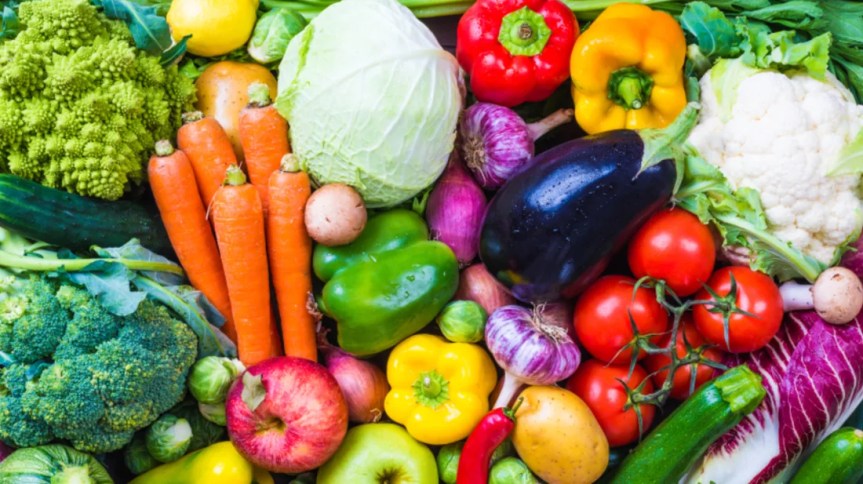
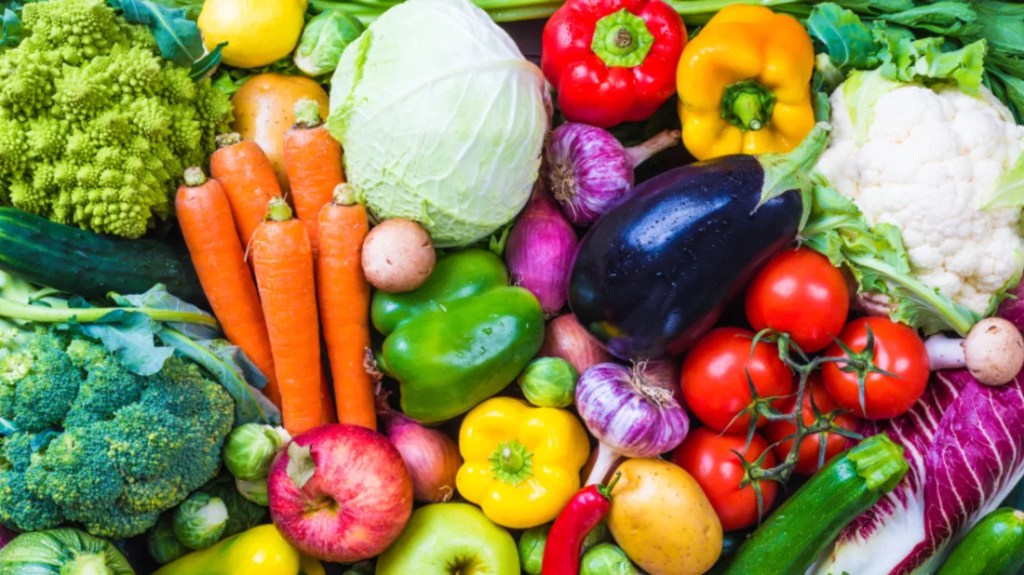
Organic Farming Produce

Introduction

The term ‘organic’ was first coined by Northbourne, in 1940, in his book entitled ‘Look to the Land’. In recent years, organic farming as a cultivation process is gaining increasing popularity . Organically grown foods have become one of the best choices for both consumers and farmers. Organically grown foods are part of go green lifestyle.
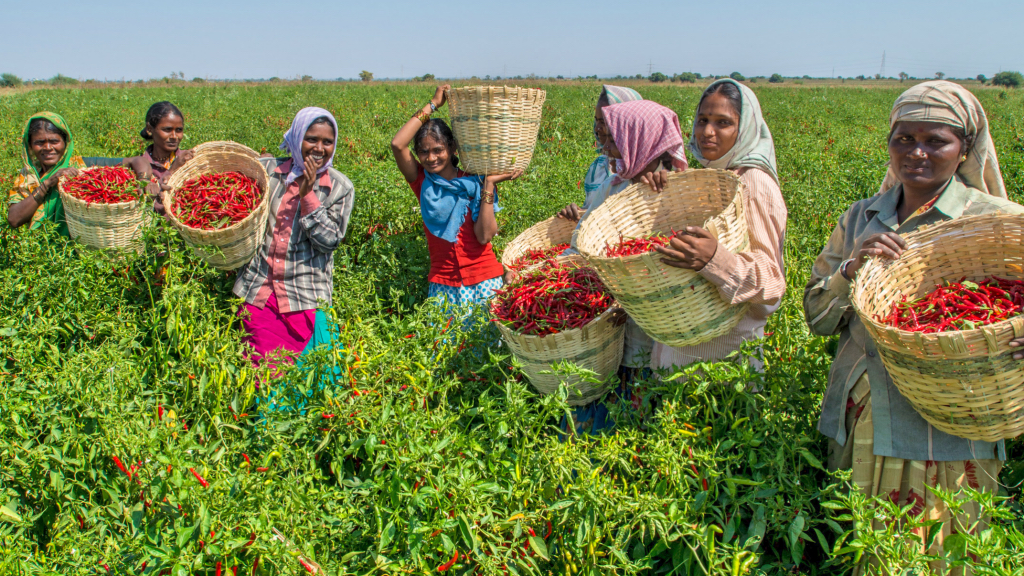
Farmers showing their Organic Harvest

Why Being Preferred These Days: The Importance of Organic Farming

Food quality and safety are two vital factors that have attained constant attention in common people. Growing environmental awareness and several food hazards (e.g. dioxins, bovine spongiform encephalopathy, and bacterial contamination) have substantially decreased the consumer’s trust towards food quality in the last decades. Intensive conventional farming can add contamination to the food chain. For these reasons, consumers are quested for safer and better foods that are produced through more ecologically and authentically by local systems. Organically grown food and food products are believed to meet these demands.
Organic Farming Processes

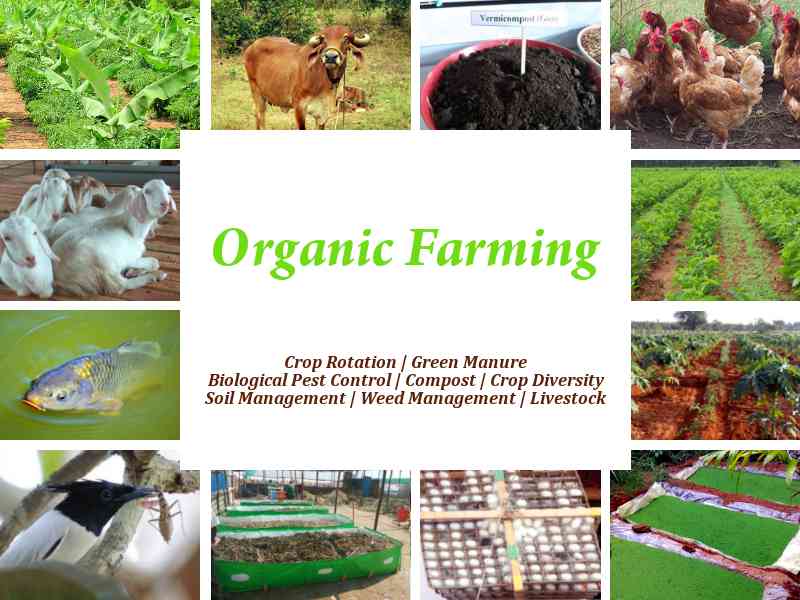
Organic Farming Process

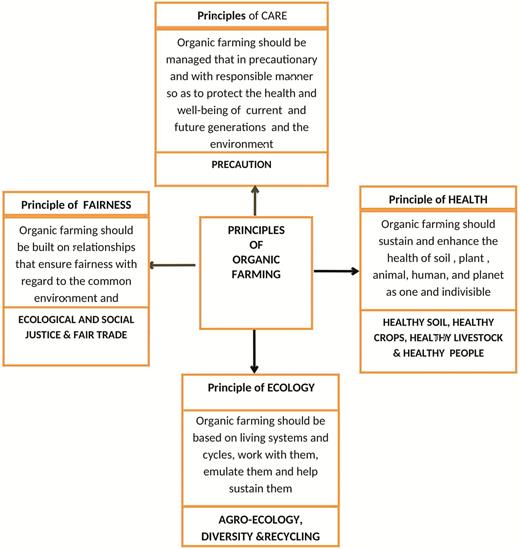
Organic farming and food processing practices are wide-ranging and necessitate the development of socially, ecologically, and economically sustainable food production system. The International Federation of Organic Agriculture Movements (IFOAM) has suggested the basic four principles of organic farming, i.e. the principle of health, ecology, fairness, and care . The main principles and practices of organic food production are to inspire and enhance biological cycles in the farming system, keep and enhance deep-rooted soil fertility, reduce all types of pollution, evade the application of pesticides and synthetic fertilizers, conserve genetic diversity in food, consider the vast socio-ecological impact of food production, and produce high-quality food in sufficient quantity.

Principles of Organic Farming  

According to the National Organic Programme implemented by USDA Organic Food Production Act (OFPA, 1990), agriculture needs specific prerequisites for both crop cultivation and animal husbandry. To be acceptable as organic, crops should be cultivated in lands without any synthetic pesticides, chemical fertilizers, and herbicides for 3 years before harvesting with enough buffer zone to lower contamination from the adjacent farms. Genetically engineered products, sewage sludge, and ionizing radiation are strictly prohibited. Fertility and nutrient content of soil are managed primarily by farming practices, with crop rotation, and using cover crops that are boosted with animal and plant waste manures. Pests, diseases, and weeds are mainly controlled with the adaptation of physical and biological control systems without using herbicides and synthetic pesticides. Organic livestock should be reared devoid of scheduled application of growth hormones or antibiotics and they should be provided with enough access to the outdoor. Preventive health practices such as routine vaccination, vitamins and minerals supplementation are also needed.
Principles of Organic Farming

Types of Organic Farming

Organic Farming are of two types. Here are the two types of Organic Farming being performed in India.

(a) Pure Organic Farming – pure organic farming, there is avoiding every unnatural chemical. In the process of pure farming, fertilizer and pesticides obtain from natural sources. It is called a pure form of organic farming. Pure organic farming is the best for high productivity. 

(b) Integrated Organic Farming – Integrated organic farming consists of integrated nutrients management and integrated pest management.

Organic Farming in India

Organic farming is in a nascent stage in India. About 2.78 million hectare of farmland was under organic cultivation as of March 2020, according to the Union Ministry of Agriculture and Farmers’ Welfare. This is two per cent of the 140.1 million net sown area in the country. A few states have taken the lead in improving organic farming coverage, as a major part of this area is concentrated only in a handful of states. Madhya Pradesh tops the list with 0.76 million of area under organic cultivation — that is over 27 per cent of India’s total organic cultivation area. The top three states — Madhya Pradesh, Rajasthan and Maharashtra — account for about half the area under organic cultivation. The top 10 states account for about 80 per cent of the total area under organic cultivation. Sikkim is the only Indian state to have become fully organic so far. Even though India has very small organic area under cultivation, in terms of number of organic farmers it is being ranked first. India has over 1.9 million farmers as of March 2020, which is 1.3 per cent of 146 million agricultural landholders.

Advantages and Disadvantages of Organic Farming

Advantages of Organic Farming

Organic farming in India is very economical, it uses no expensive fertilizers, pesticides, HYV seeds for the plantation of crops. It has no expenses. 

With the use of cheaper and local inputs, a farmer can earn a good return on investment. This is one of the most important benefits of organic farming in India. 

There is a huge demand for organic products in India and worldwide and can earn more income through export.

Organic products are more nutritional, tasty, and good for health to chemical and fertilizer utilized products. 

Organic farming in India is very environment friendly, it does not use fertilizers and chemicals. 

Disadvantages of Organic Farming

Organic farming in India has fewer choices, and off-season crops are limited.

Organic agricultural products are low in the early years. Farmers find it difficult to accommodate mass production.

The main disadvantage of organic farming is the lack of marketing of the products and Inadequate infrastructure.
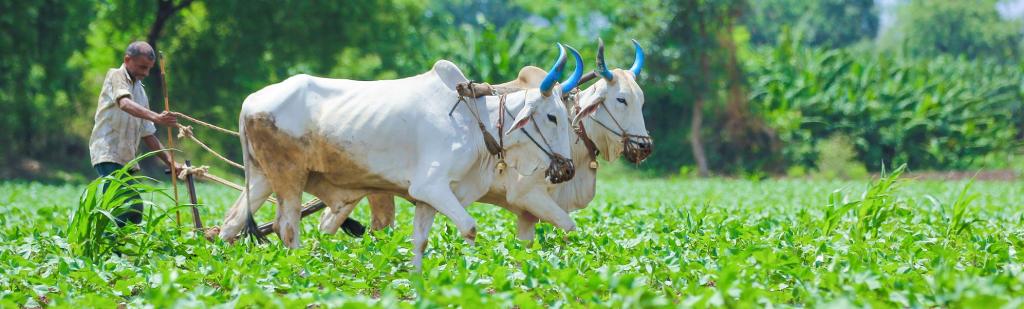
Organic Farming in India

Future of Organic Farming in India

India is an agriculture-based country with 67% of its population and 55% of manpower depending on farming and related activities. Agriculture fulfils the basic needs of India’s fastest-growing population accounted for 30% of total income. Organic farming has been found to be an indigenous practice of India that practised in countless rural and farming communities over the millennium. The arrival of modern techniques and increased burden of population led to a propensity towards conventional farming that involves the use of synthetic fertilizer, chemical pesticides, application of genetic modification techniques, etc.
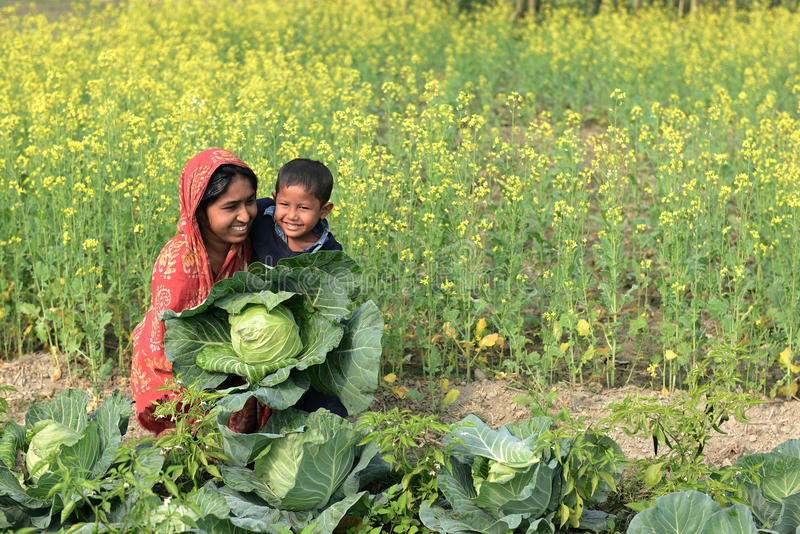
Organic Farming leads to Sustainability and Holistic Growth

Even in developing countries like India, the demand for organically grown produce is more as people are more aware now about the safety and quality of food, and the organic process has a massive influence on soil health, which devoid of chemical pesticides. Organic cultivation has an immense prospect of income generation too. The soil in India is bestowed with various types of naturally available organic nutrient resources that aid in organic farming.
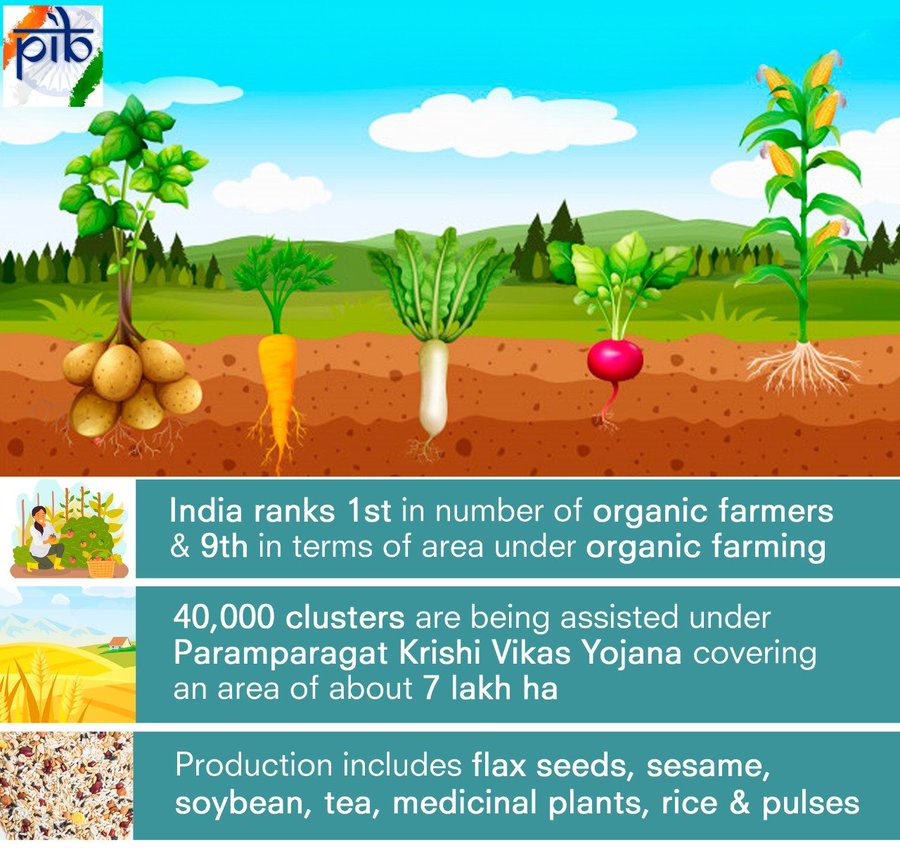
As per data collected from Government of India

Conclusion

India is a country with a concrete traditional farming system, ingenious farmers, extensive drylands, and nominal use of chemical fertilizers and pesticides. Moreover, adequate rainfall in north-east hilly regions of the country where few negligible chemicals are employed for a long period of time, come to fruition as naturally organic lands. Organic farming yields more nutritious and safe food. The popularity of organic food is growing dramatically as consumer seeks the organic foods that are thought to be healthier and safer. Thus, organic food perhaps ensures food safety from farm to plate. The organic farming process is more eco-friendly than conventional farming. Organic farming keeps soil healthy and maintains environment integrity thereby, promoting the health of consumers. Moreover, the organic produce market is now the fastest growing market all over the world including India. Organic agriculture promotes the health of consumers of a nation, the ecological health of a nation, and the economic growth of a nation by income generation holistically. India, at present, is the world’s largest organic producers and with this vision, we can conclude that encouraging organic farming in India can build a nutritionally, ecologically, and economically healthy nation in near future.
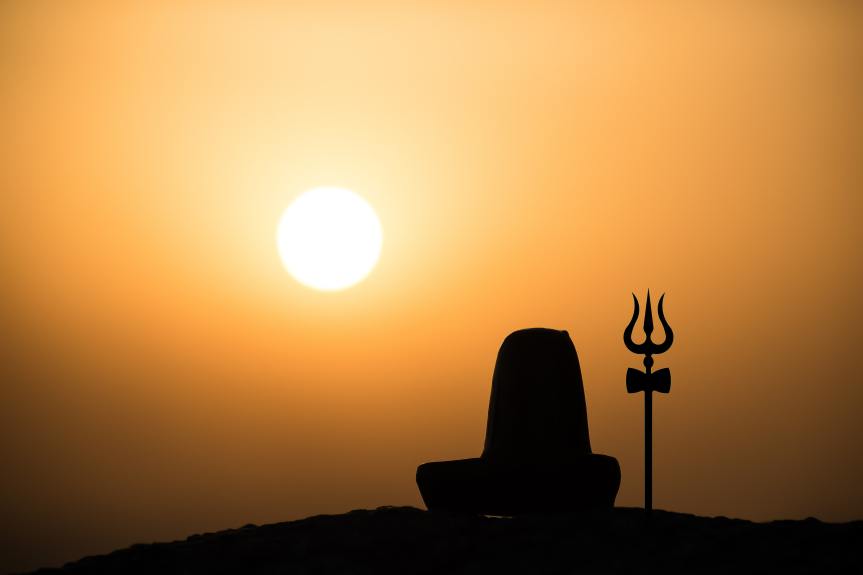
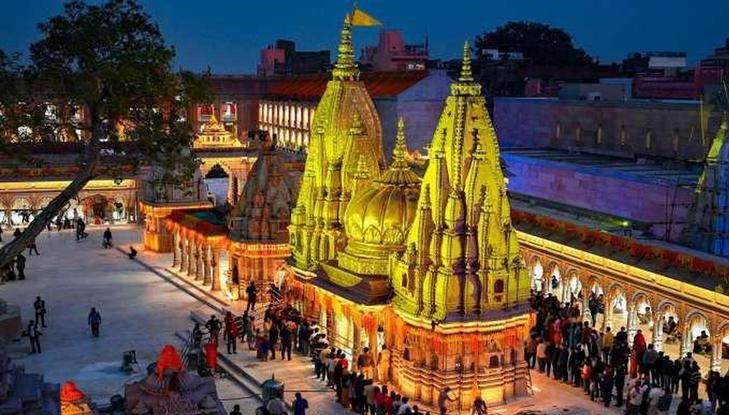
Maha Shivratri and the Legacy of Ahilyabai Holkar

Hindus all around the world observe the night of Maha Shivratri today on the 1st of March 2022. Maha Shivratri (“The Great Night of Shiva”) is celebrated every year on Chaturdashi Tithi during Krishna Paksha in the month of Magha according to the South Indian calendar, or on 13/14 night of Krishna Paksha in Phalguna of the North Indian Hindu calendar. It is said to be the day Lord Shiva performs his heavenly dance (“Tandav“) of creation, preservation, and destruction. According to other legends, it is also the night Lord Shiva married Mata Parvati. So it is considered to be the night of union of Shiva and Shakti – the embodiment of love, power, and oneness. Devotees worship and pray to Lord Shiva, perform all-day fasting, and maintain an all-night vigil on this day. Some visit Shiva temples or go on pilgrimage to Jyotirlingams, the holiest of Shiva temples.

The Kashi Vishwanath temple in Varanasi, Uttar Pradesh is one of the sites of the 12 Jyotirlingams across India. This holy temple is one of the most important places of worship in the Hindu religion, with Vishveshvara or Vishvanath, the Jyotirlinga of Shiva residing inside the temple. The history of this sacred place of worship, however, is one of a cycle of destruction and plunder and re-construction. The original temple was destructed at the hands of Qutb al-Din Aibak in 1194 CE, re-constructed in 1230, and then again destroyed by the Mughal Emperor Aurangzeb in 1669 CE, building the Gyanvapi mosque in its place. It was a great and virtuous queen by the name of Ahilyabai Holkar who re-built the present-day Kashi Vishwanath temple beside the mosque. The story of this little-known noble queen is truly magnificent.

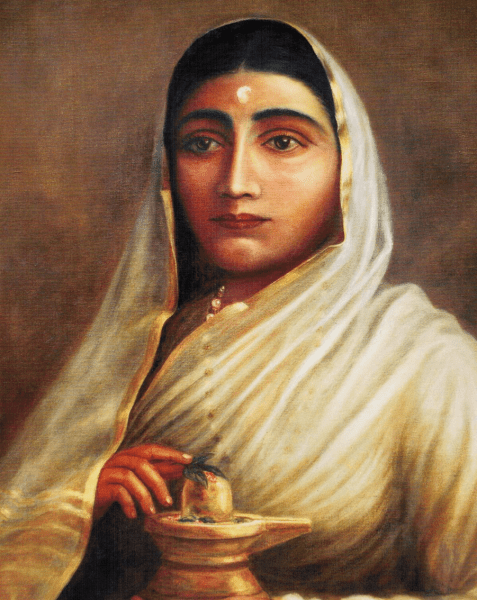
Ahilyabai was born on 31 May 1725 to Mankoji Rao Shinde, the Patil or Chief of Chondi village, Ahmednagar in present-day Maharashtra. Ahilyabai was not born into royal lineage but was married to Khanderao Holkar, after the Lord of the Malwa territory, Malhar Rao Holkar, became impressed by the young girl’s reverence and strong character. She became a widow at 29 when her husband died in the battle of Kumbher in 1754. It was her father-in-law, Malhar Rao Holkar, who prevented Ahilyabai from committing Sati after her husband’s death. Tragedy struck Ahilyabai again when her father-in-law, who was her greatest pillar of support passed away in 1766. This led to Ahilyabai’s only son Male Rao Holkar ascending the throne under her regency. He also died a few months later in 1767 which resulted in Ahilyabai becoming the ruler of Indore on 11 December 1767, despite some objections from the kingdom. She proved all those who opposed her wrong when she protected her kingdom from invaders who wanted to plunder Malwa, barely a year into her rule. She was a learned politician, cautioning the Maratha Peshawa against the British in a letter in 1772, comparing the British embrace to a bear-hug.

Maharani Ahilyabai Holkar Source: thebetterindia.com

During her 30-year rule, she transformed Indore from a tiny village to a prosperous city. She constructed numerous forts and roads in Malwa, sponsored festivals, and donated to many Hindu temples. She built dozens of temples, ghats, wells, tanks, and rest-houses stretching from the Himalayas in the north to the pilgrimage centers in the south. It was in 1780 that Ahilyabai re-constructed the present-day Kashi Vishwanath Temple adjacent to the mosque. The noble queen also beautified various holy sites including Gaya, Somnath, Ayodhya, Mathura, Haridwar, Kanchi, Avanti, Dwarka, Badrinarayan, Rameshwar, and Jaganathpuri as recorded by the Bharatiya Sanskritikosh.

Maheshwar, her capital was a center of literary, artistic, musical, and industrial achievement. She established a textile industry in the city and gained supporters like the Marathi poet Moropant, Shahir Anantaphandi, and Sanskrit scholar, Khushali Ram. Historians write of her kind rule, encouraging all within her realm and her kingdom to do their best.

She was 70 when she died in 1795 and was succeeded by her commander-in-chief and nephew, Tukoji Rao Holkar. As a tribute to her, Indore international airport has been named Devi Ahilyabai Holkar Airport. Similarly, Indore university has been renamed Devi Ahilya Vishwavidyalaya. A commemorative stamp was also issued in her honor in 1996. On 13 December 2021, India’s Prime Minister Narendra Modi inaugurated the Kashi Vishwanath Corridor Project in Varanasi, restoring an array of temples to their past glory. On this day, let us remember the great queen of Malwa and her invaluable contribution to our nation. The legacy of the great queen of Malwa lives on.

Looking Back to Past: Vintage Kolkata in Photos

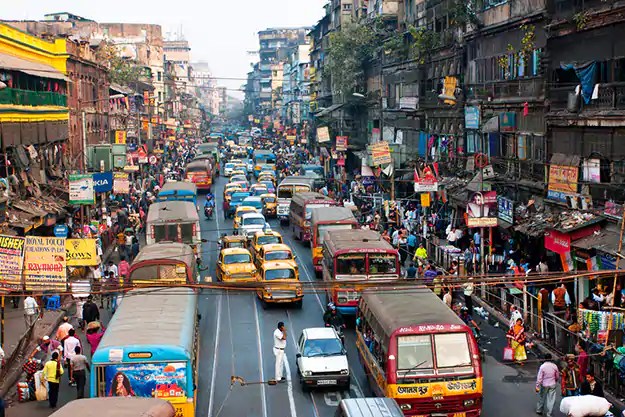
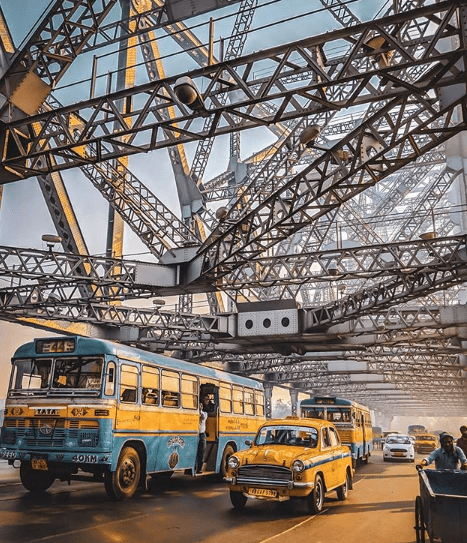
A busy street of Today’s Kolkata

Introduction

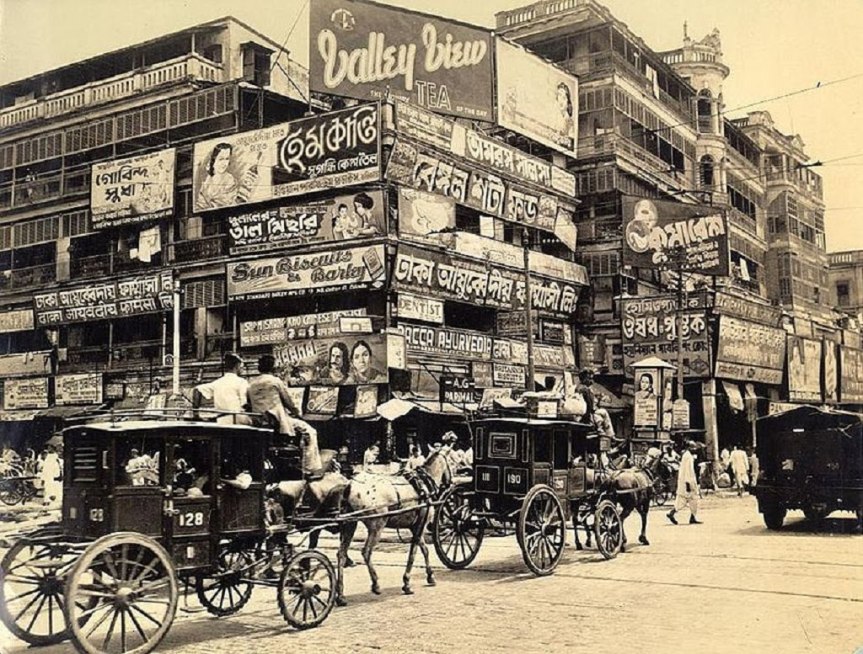
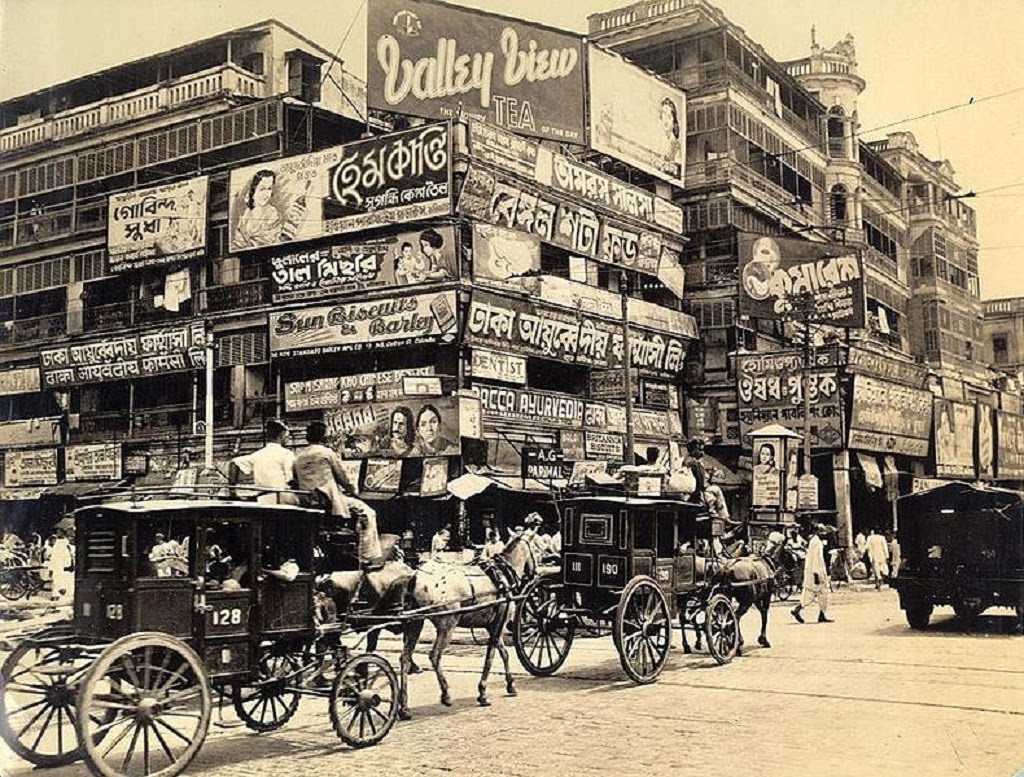
Kolkata, also fondly know as “The City of Joy”, never ceases to amaze generations with its breathtaking beauty, not only with its metro city status of today’s India, but also in the days of past. In today’s editorial, we’re going to take glance at glimpses of Vintage Kolkata from the past.

Brief History and Importance

Kolkata’s recorded history began in 1690 with the arrival of the English East India Company, which was consolidating its trade business in Bengal. Job Charnock, an administrator who worked for the company, was formerly credited as the founder of the city; In response to a public petition, the Calcutta High Court  ruled in 2003 that the city does not have a founder. The area occupied by the present-day city encompassed three villagesKalikataGobindapur  and Sutanuti

Kolkata , also known as Calcutta (official name until 2001) is the capital of the Indian state of West Bengal. Located on the eastern bank of the Hooghly river, the city is approximately 80 kilometres (50 mi) west of the border with Bangladesh. It is the primary business, commercial, and financial hub of Eastern India  and the main port of communication for North-East India .According to the 2011 Indian census, Kolkata is the 7th most populous  city in India, with a population of 45 lakh (4.5 million) residents within the city limits, and a population of over 1.41 crore  (14.1 million) residents in the Kolkata Metropolitan Area. The Port of Kolkata  is India’s oldest operating port and its sole major riverine port. Kolkata is regarded as the Cultural Capital of India.

Vintage Kolkata Album

Here we take a look at the vintage snaps of Kolkata’s most iconic places

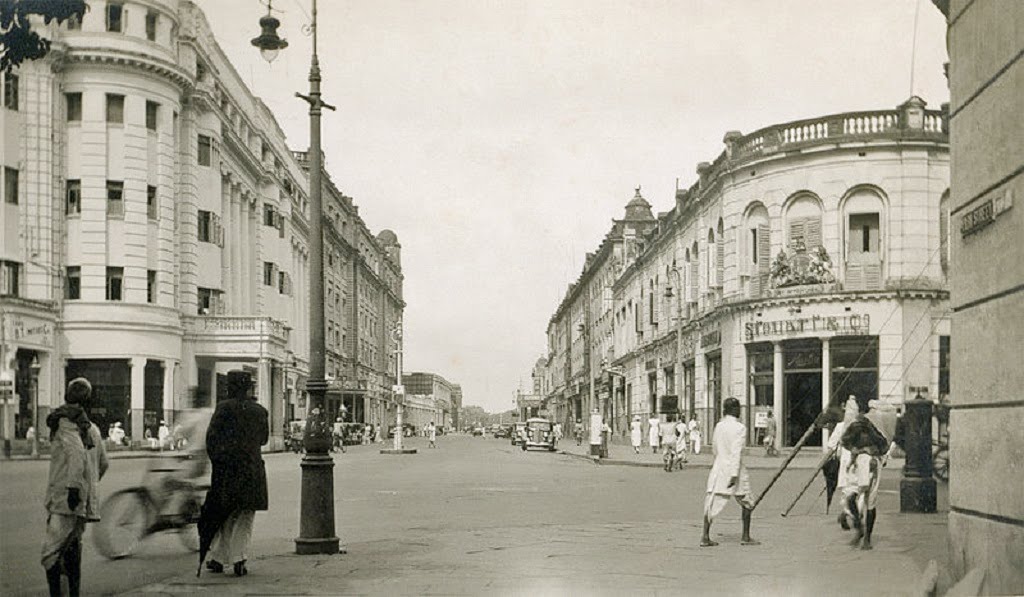
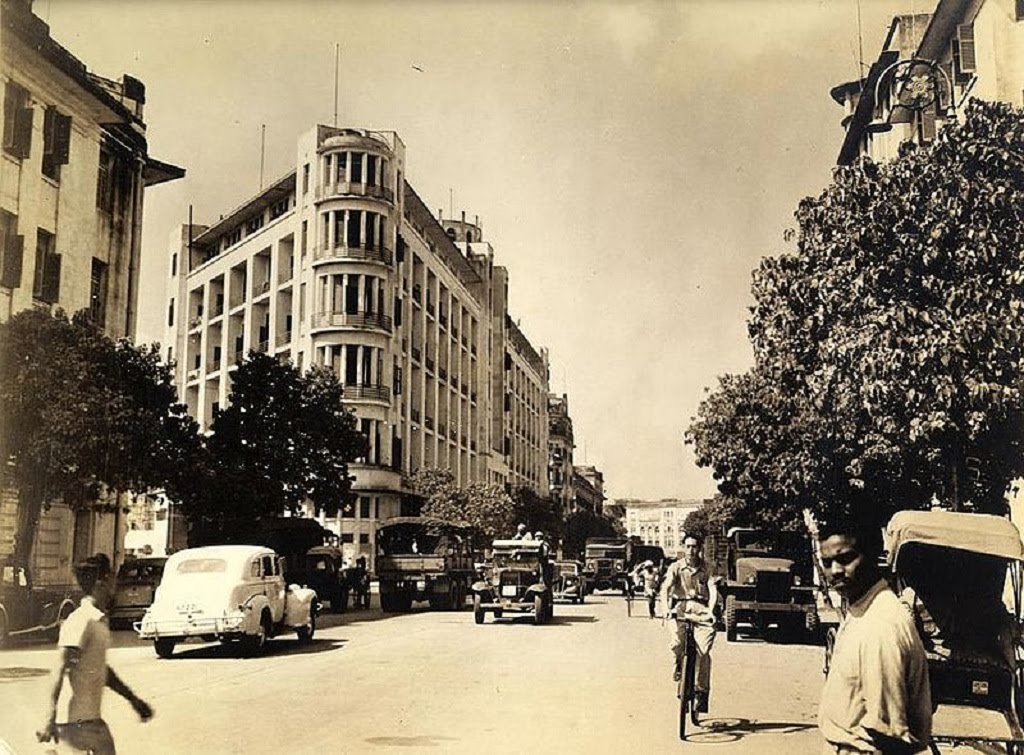
Crossing of Harrison Street, Strand Road and Burra Bazaar Area
Park Street
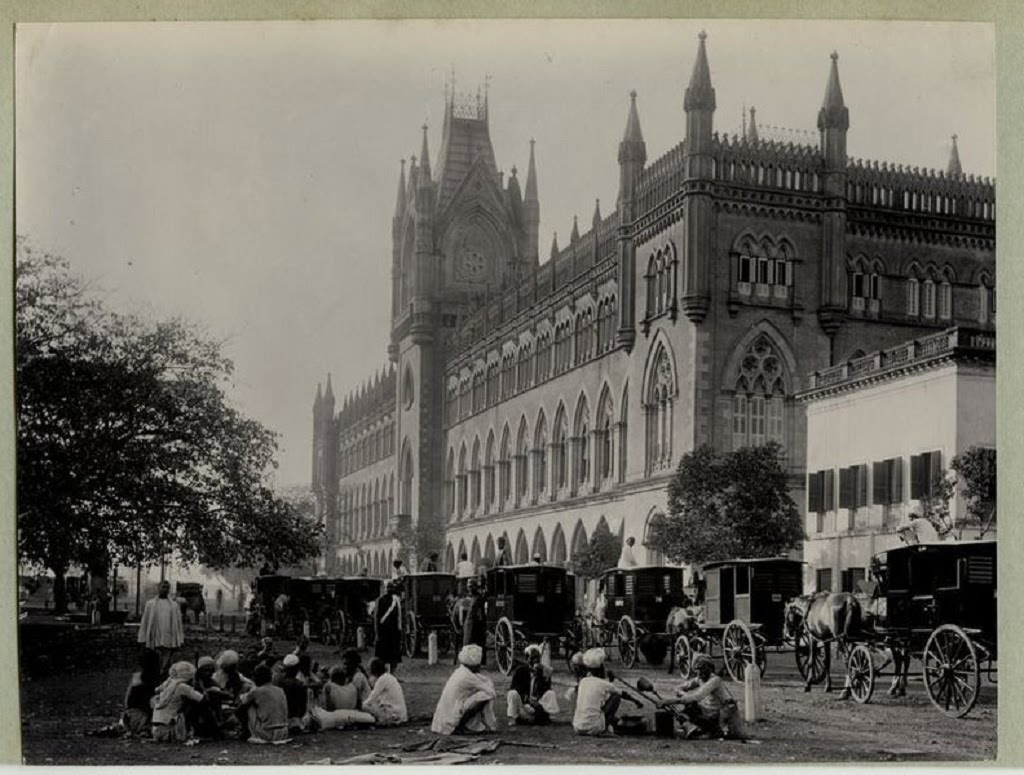
Calcutta High Court
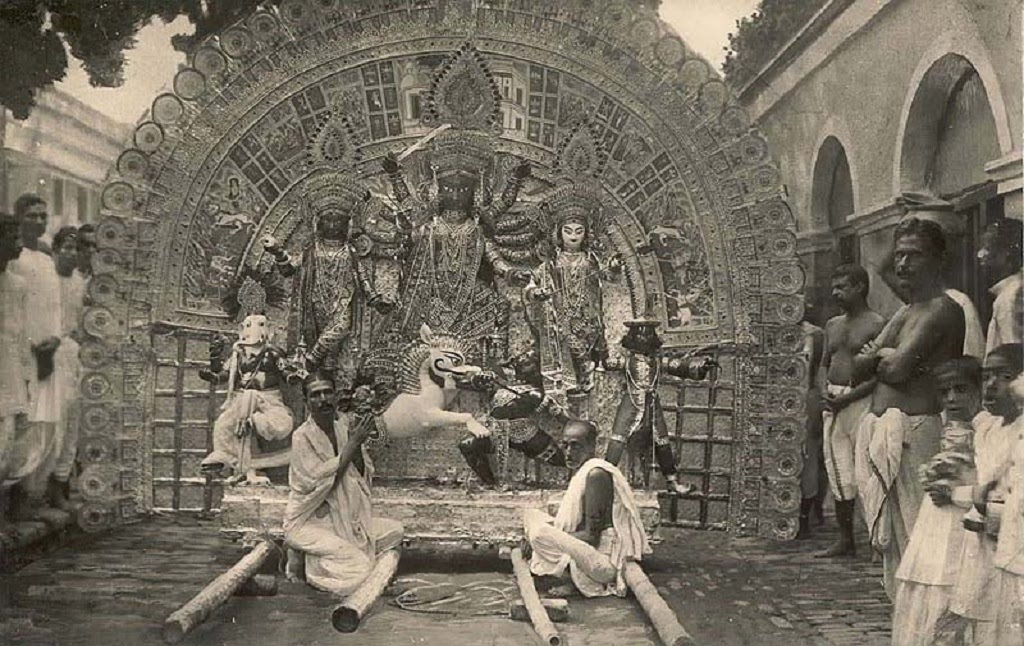
Traditional Goddess Durga Idol
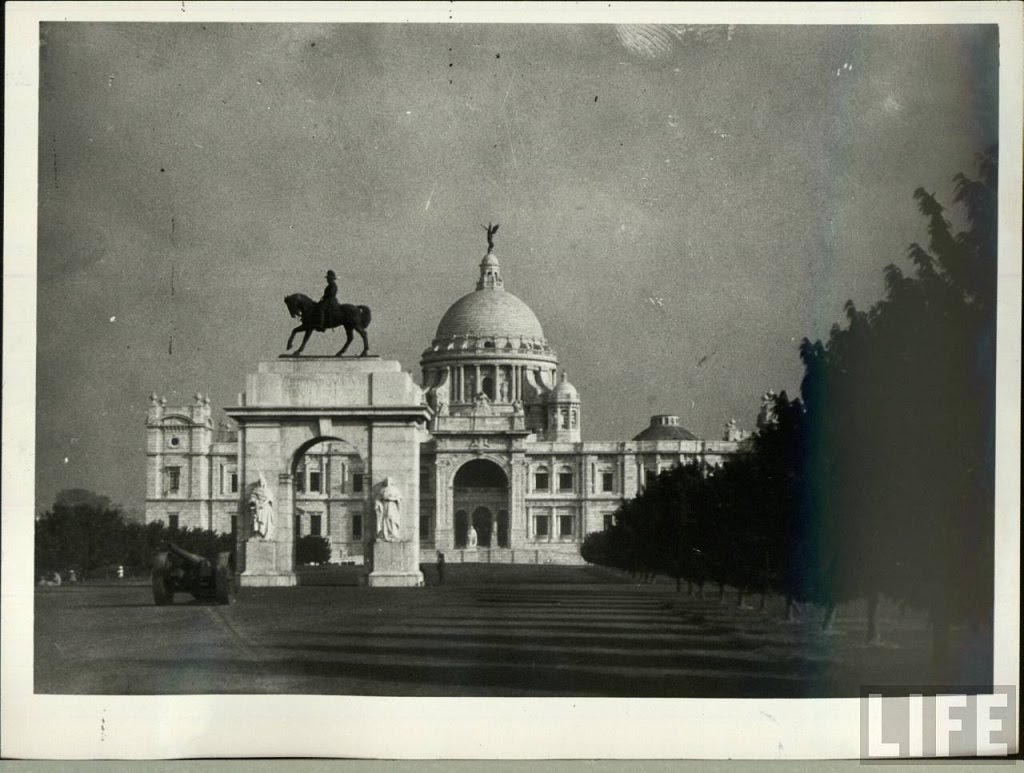
Victoria Memorial Hall
The Hindustan Building on Central Avenue once served as the office of US Army
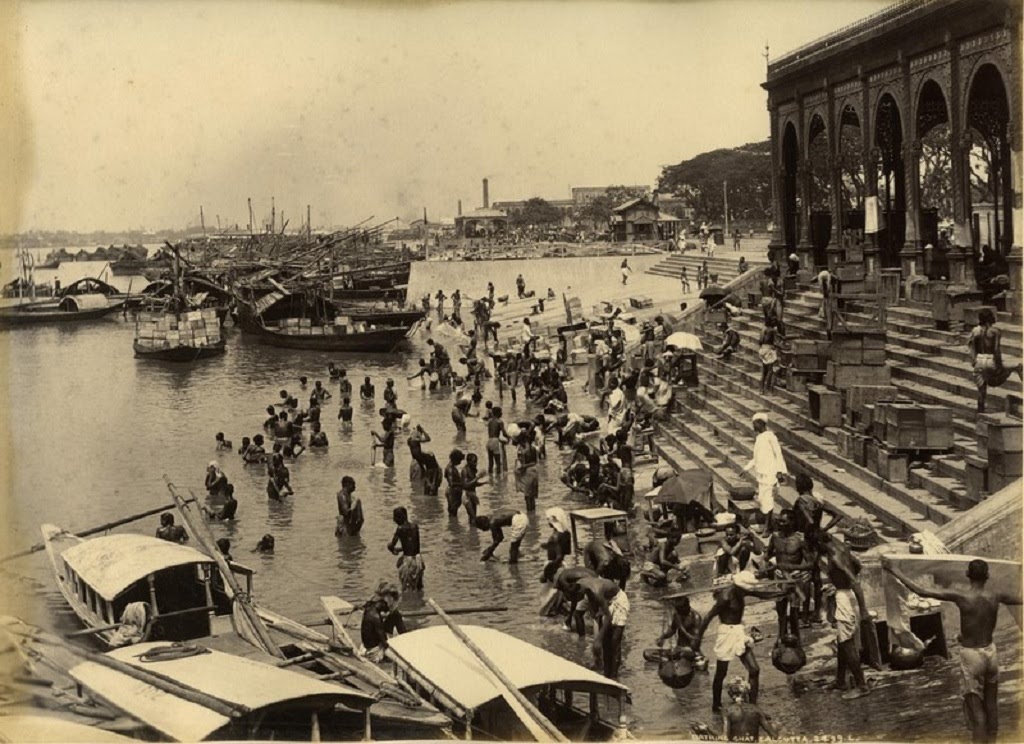
The Bathing Ghat of Hooghly River
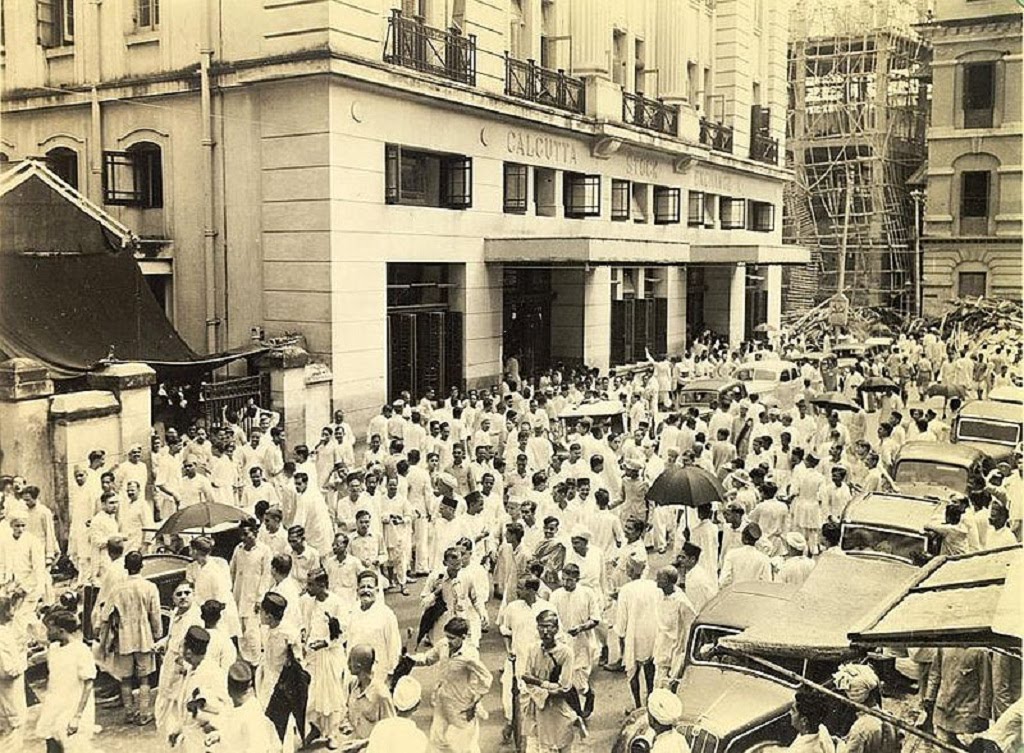
Hustle in front of Calcutta Stock Exchange
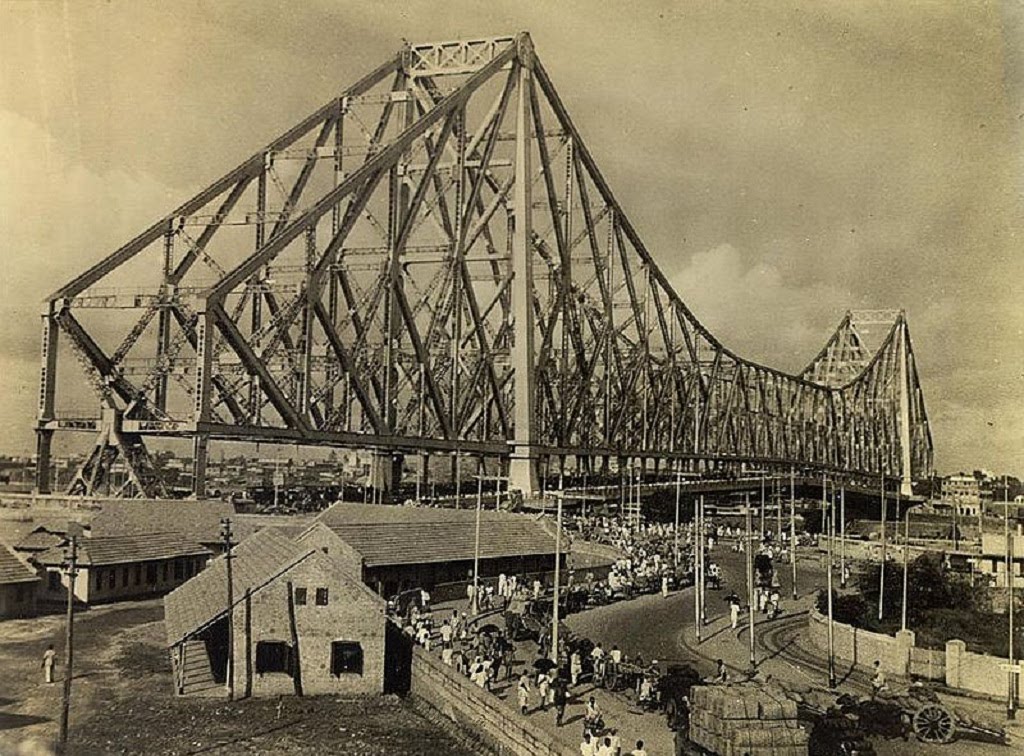
Early days of Howrah Bridge
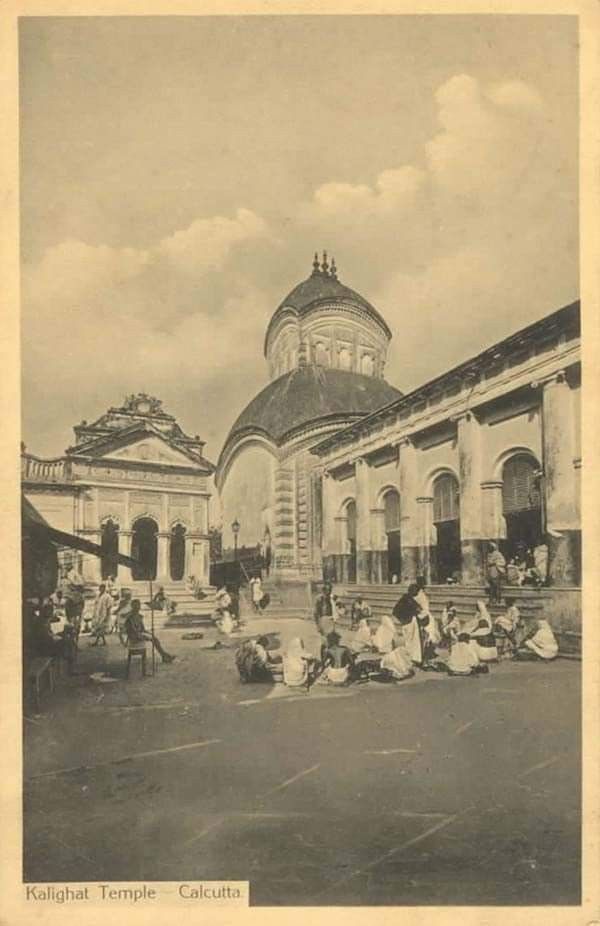
The auspicious Kalighat Temple of Goddess Kali
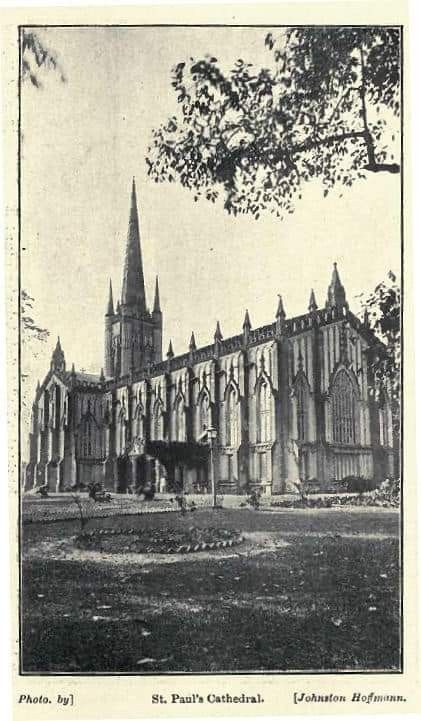
St. Paul’s Cathedral Church
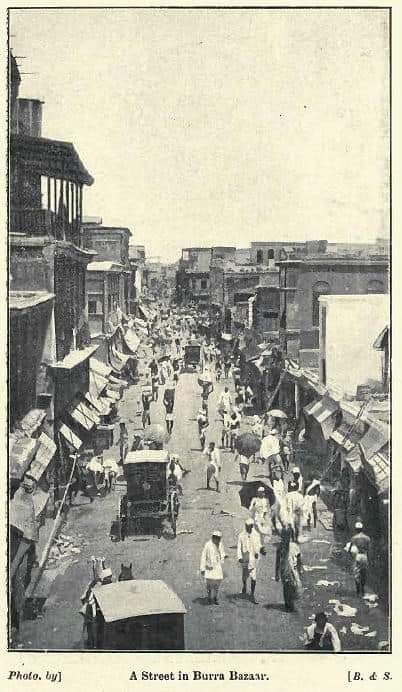
Burra Bazaar Area
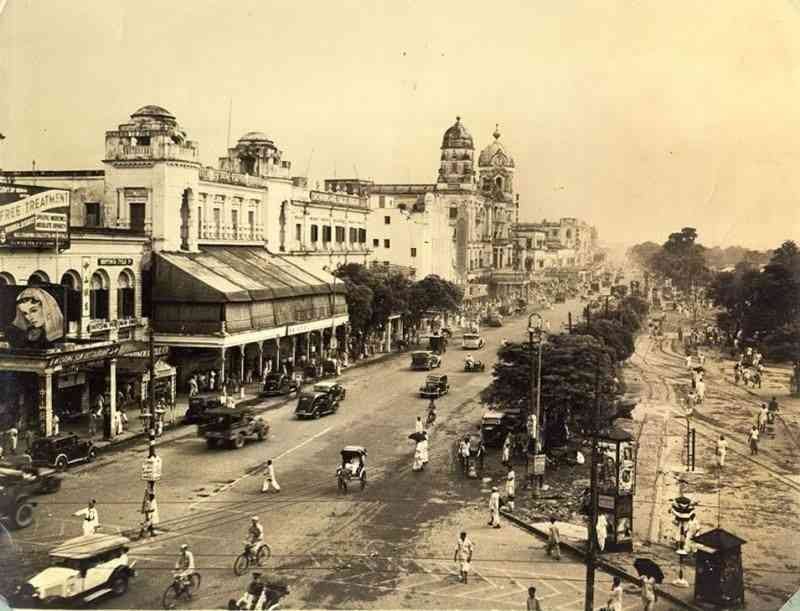
Esplanade Area
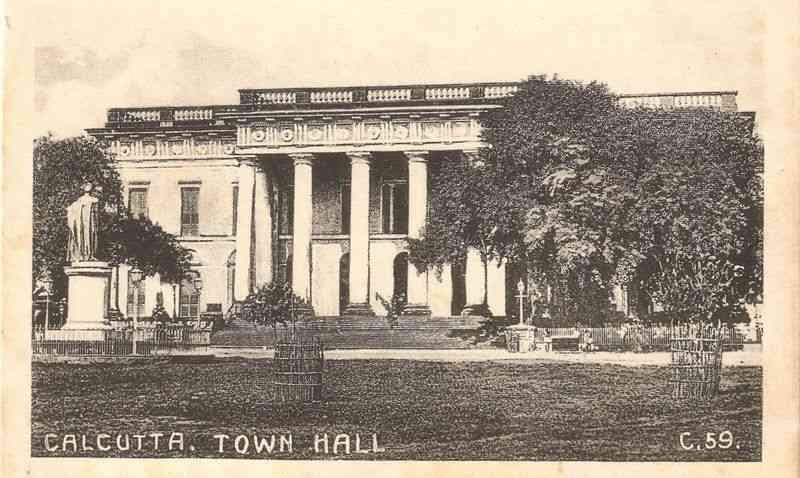
Calcutta Town Hall

Conclusion

Though the time has changed, and history has taken many turns but the essence of Kolkata, has remained the same over ages. The Government has come forward to preserve the heritages of Kolkata, that have made the Bengal and Bengalis proud through decades. People are hopeful that this tradition follows down with the upcoming generations by passing love and the celebration of the beauty of Kolkata.

Great Women Who Fought For Our Freedom

The road to freedom was a lengthy and messy affair for India. The number of people who fought for our country’s independence from the British Raj is countless. We celebrate the efforts and sacrifices made by the most prominent of them. Here are 7 of some of the great women who stood their ground against the British and fought for india’s independence:

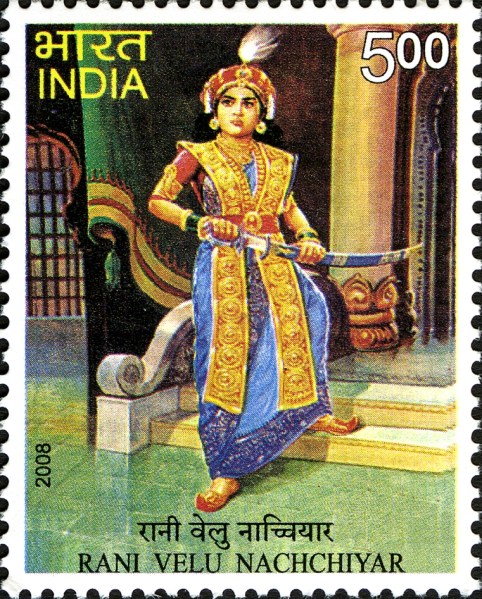
Rani Velu Nachiyar

Rani Velu Nachiyar was the first queen in India to fight against the East India Company. She was the queen of the Sivaganga estate. Her husband was killed by British forces on 25 June 1772 which forced her to become a fugitive. After 8 years of planning and help from many feudal lords, she fought against the British and reclaimed her husband’s kingdom, and proceeded to rule it for 10 more years. The people of Tamil Nadu call her  Veeramangai (brave woman) in respect. The Indian Government released a commemorative postage stamp in her name in 2008.

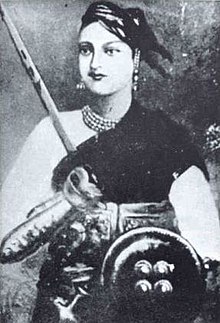
Rani Lakshmibai

Rani Lakshmibai is well-known among the young and old in India for her brave fight against the British who sieged her kingdom. She was named Manikarnika and took up the name Lakshmibai after her marriage to the Maharaja of Jhansi, Gangadhar Rao Newalker in May 1842. Rani of Jhansi was a leading figure in the Rebellion against British Raj in 1857. A proficient horse-rider and fencer, she fought in the battle on horseback, with her adopted son tied to her back. She fought valiantly, resisting the British for 7 days with her small army and until her last breath.

Begum Hazrat Mahal

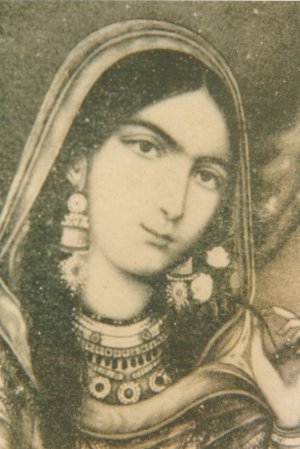
Begum Hazrat Mahal was another important character in the Indian Rebellion of 1857. After her husband, Nawab of Awadh Wajid Ali Shah was exiled to Calcutta by the British and the Indian Rebellion began, her army of supporters rebelled against the British Forces under the leadership of Raja Jalal Singh and seized control of Lucknow. She became the regent of Awadh from 1857-1858, taking power as the guardian of her minor son, whom she had declared as the ruler of Awadh. Later, she was forced to retreat and found asylum in Nepal, where she died in 1979.

Madam Bhikaji Cama

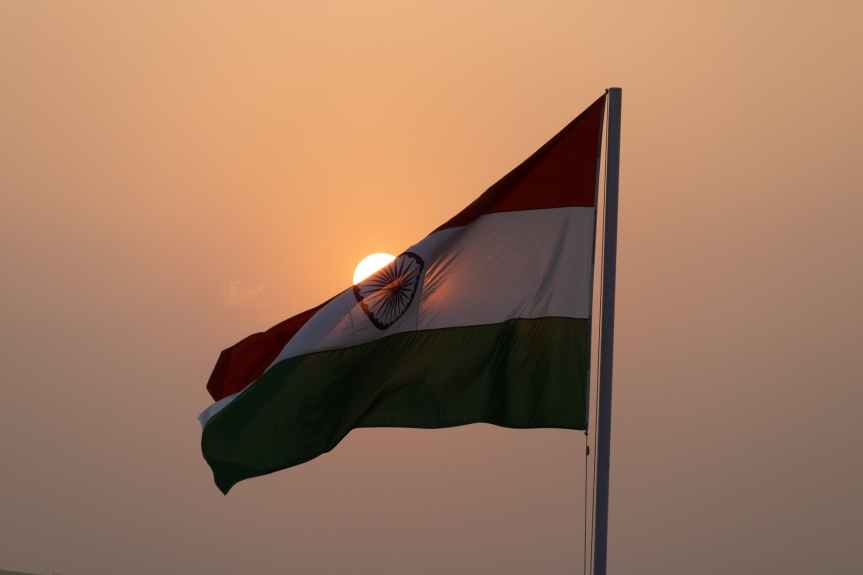
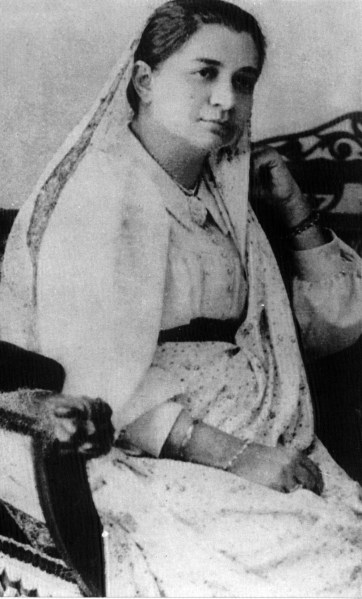
Born in a Parsi Zoroastrian family, Madam Bhikaji Cama was an important figure in the Indian freedom struggle. Living in Paris, she co-founded the Paris Indian Society in 1905. She wrote, published, and distributed revolutionary literature for the Indian Independence movement in Netherlands and Switzerland. She presented the “Indian Flag of Independence” at the second Socialist Congress at Stuttgart, Germany on 22 August 1907, in her appeal for human rights, equality, and autonomy from Great Britain. This flag which was co-designed by Cama and Vinayak Damodar Savarkar would serve as the template from which the current national flag was designed.

Umabai Kundapur

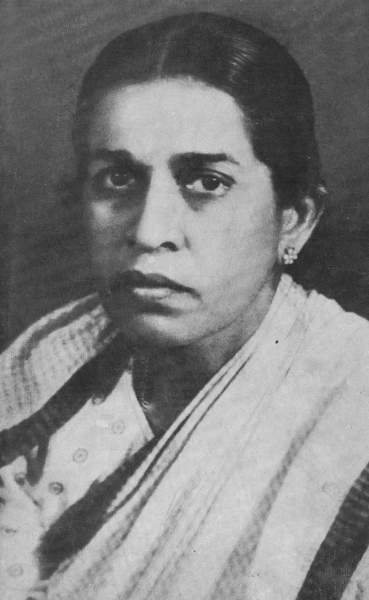
Umabai Kundapur was a teacher and fearless political activist from Karnataka. She led the “Tilak Kanya Shala”, a school for girls started by her father-in-law Ananda Rao. She took part in protests and campaigns against the British and founded “Bhagini Samaj”, an NGO for women. She also led the women’s wing of the Hindustani Seva Dal and encouraged girls and women across the country to join the freedom movement. She provided a safe house for freedom fighters from the British. A selfless personality, she rejected several honors and awards given to her, living her life silently after independence.

Kamaladevi Chattopadhyay

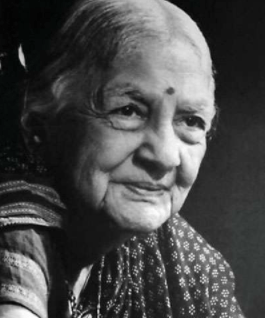
Kamaladevi Chattopadhyay was a freedom activist who was a part of the seven-member lead team in the Salt Satyagraha. She was a social reformer who is most known for her efforts in encouraging the growth of Indian handicrafts, handlooms, and theatre in independent India. She was the first woman in India to contest in elections in the Madras constituency, even though she lost the elections. Post-independence, she set up the National School of Drama and also headed the Sangeet Nataka Akademi. She has been awarded both the Padma Bhushan (1955) and the Padma Vibhushan (1987) as well as the Ramon Magsaysay Award (1966).

Sarojini Naidu

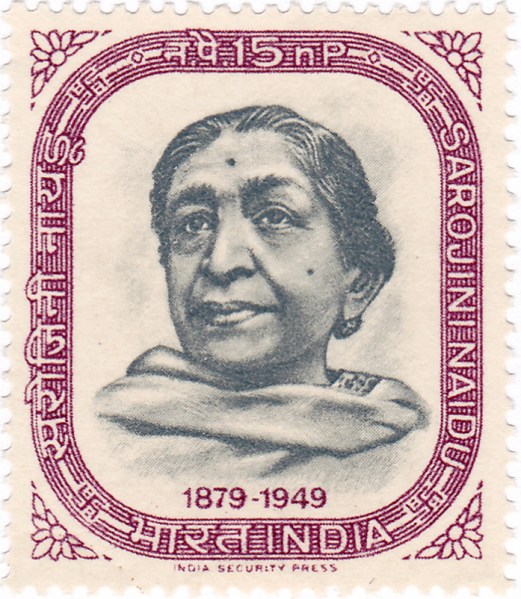
Sarojini Naidu was known as “the nightingale of India”, a nickname coined by Mahatma Gandhi for her work in poetry. She was an important political activist who took part in the Indian Nationalist Movement. Having close ties with personalities like Rabindranath Tagore, Mahatma Gandhi, and Gopal Krishna Gokhale, she participated in both the satyagraha movement and the Non-cooperation movement. She was appointed the President of the Indian National Congress in 1925 and later became the first woman to hold the office of Governor in the Union of India, as the Governor of the United Provinces in 1947.

Water Crisis in India: The Present and The Future

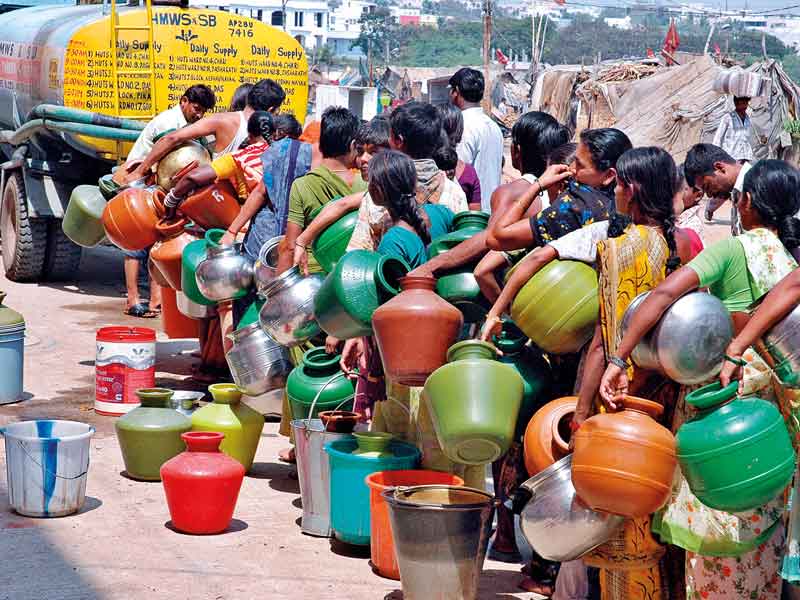
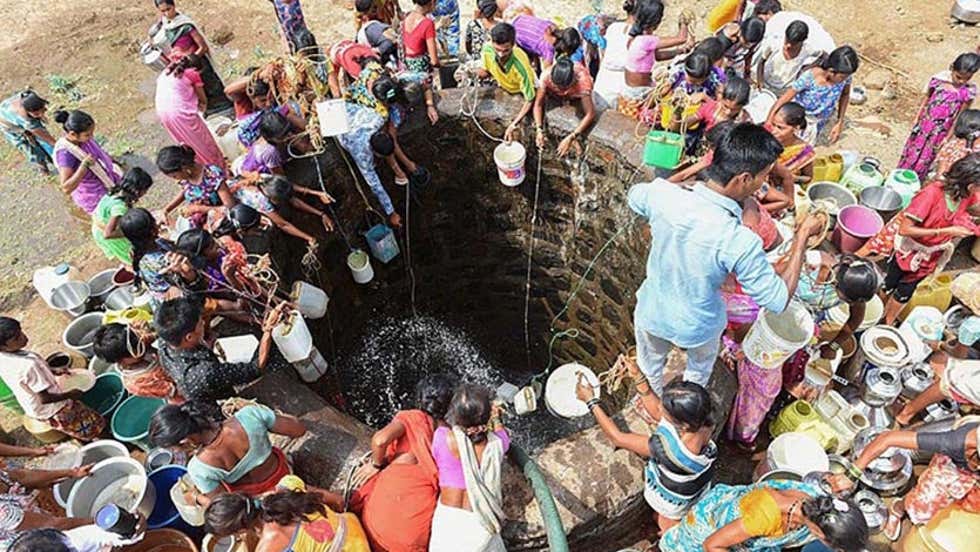
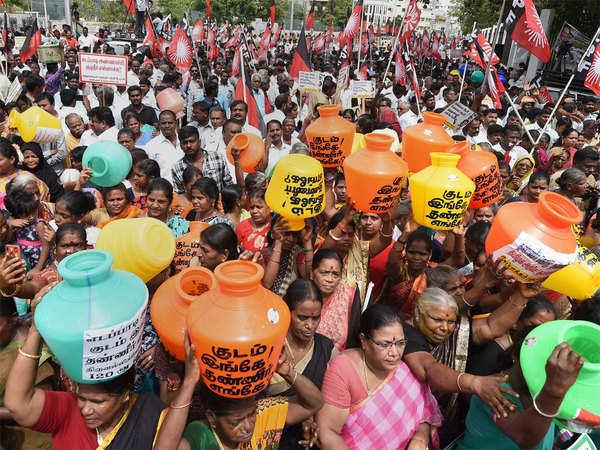
Queue for daily water collection

Introduction

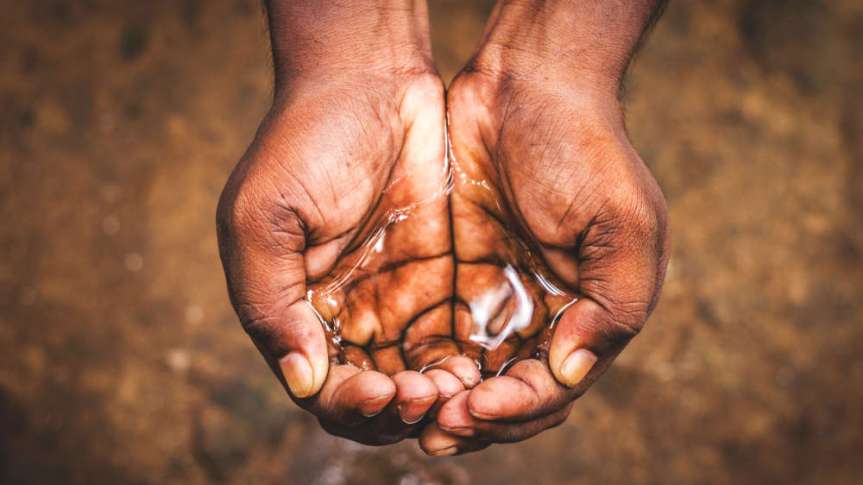
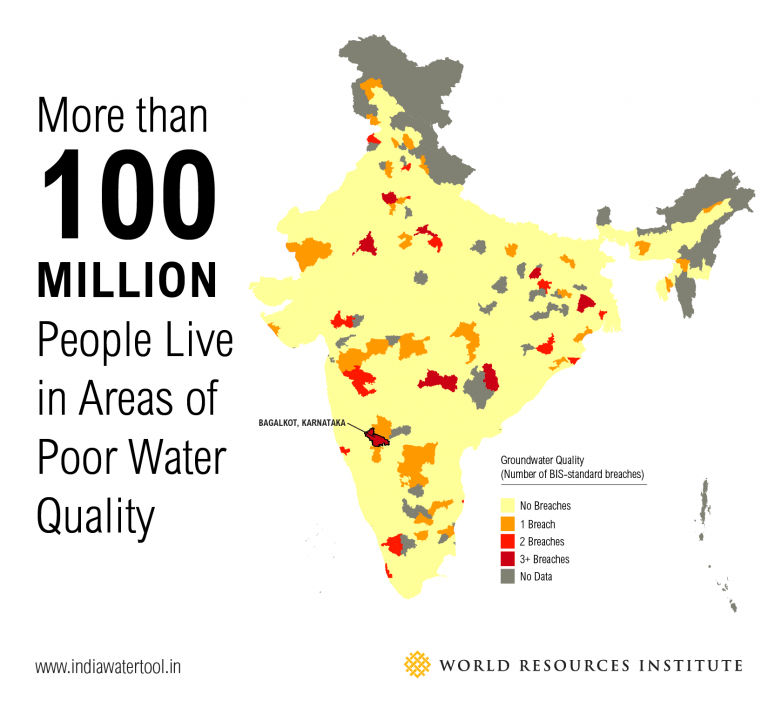
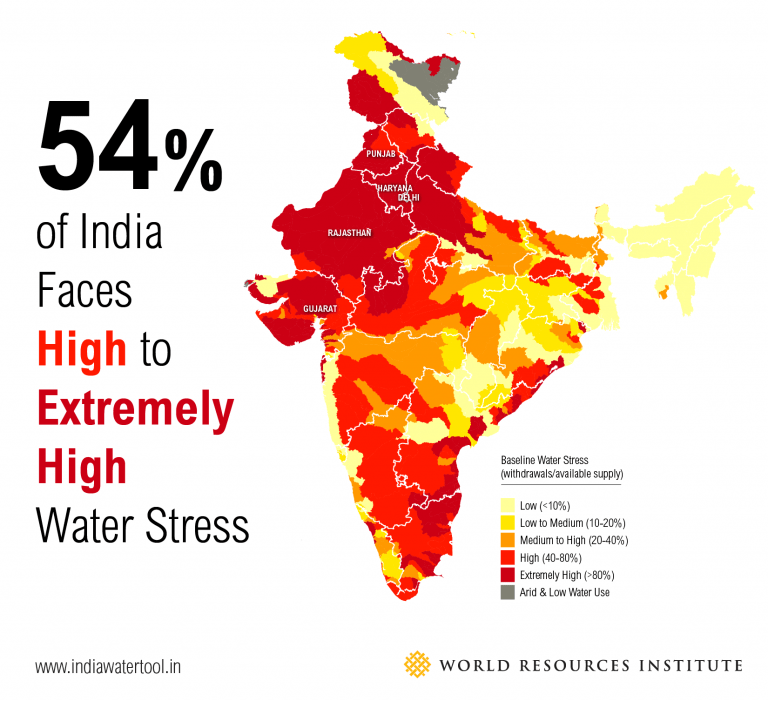
Water is the most essential element of life and livelihood. And India is having a hard time, coping up with the severe crisis of water. India constitutes 16 per cent of the world’s population, but the country has only four per cent of the world’s freshwater resources. With the changing weather patterns and recurring droughts, India is now declared as “water stressed”.

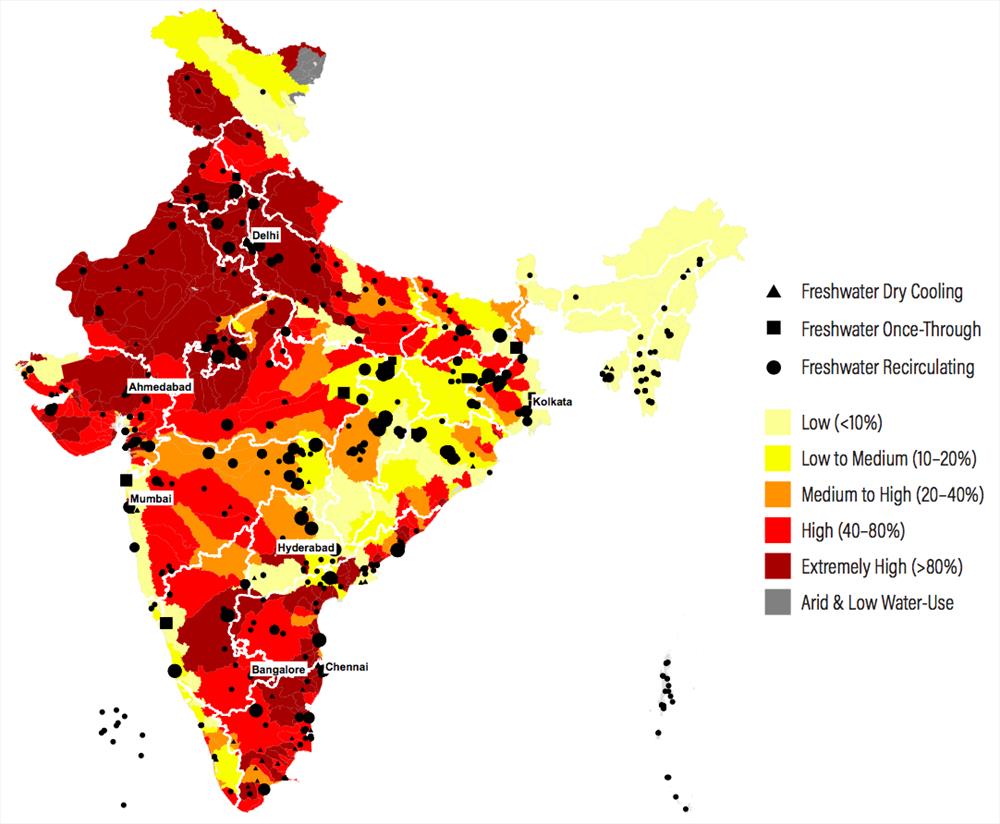
Statistical representation of India‘s Water Crisis

Background

Archaeological researchers had assumed the fall of Great Indus Civilisation was due to a catastrophic water scarcity caused either by shifting rivers or by drastic climate change that forced people to abandon city settlements. And history seems to repeat for present day India again. According to a NITI Aayog report in 2018, about 600 million people, or nearly half of India’s population, are facing extreme scarcity of water. The three-fourths of India’s rural households do not have stable running water supply and rely on sources that can cause serious health risks. The report also stated that India has become the world’s largest extractor of groundwater, accounting for 25% of the total. Moreover, 70% of the water sources were labelled as contaminated .And the conclusion of the report was ‘India is suffering from its worst water crisis in its history.’ It also pointed out 21 Indian cities to be run out of groundwater by 2020.

Reasons behind Water Crisis in India

1. Climate Change : The North-East monsoon is responsible for 10%-20% rainfall of the total rainfall in India, while the South-West monsoon provides approximately 80% of rainfall. In 2018, the North-East monsoon decreased by 44% and the South-West monsoon was deficient by 10%, causing the total rainfall in the area to decrease by 36 percent in comparison to the 50-year average. Because of the lower rainfall, water levels in reservoirs across the country decreased and led to extreme shortages of water in many major cities of India

. 2. Ground Water Extraction: Groundwater meets more than half of the country’s need of water supply and nearly 89% of the groundwater extracted in India is used for irrigation purposes. The traditional techniques of irrigation are also to blame for the water crisis as they result in a majority of water loss and evaporation during the irrigation process.

3. Pollutions in Our Rivers: Due to the lack of long term water management plans, most of the country’s rivers either run dry or have remained polluted over decades. The national river of Ganges is also the one that is most severely polluted, which is mainly resulted from untreated sewage of densely populated cities, industrial waste as well as due to religious ceremonies in and around the river.

4. Wastage of Unmanaged Water : According to the Central Water Commission, even though climate change has resulted in a reduction in rainfall and lack in underground water reservoirs, the country still receives enough rainfall to meet the needs of over 1 billion people. However, India only catches only 8 percent of its annual rainfall due to poor rainwater harvesting. Also for lacking the treatment of wastewater reuse, approximately 80% of domestic wastewater is drained out as waste and ends up flowing into salt water bodies.

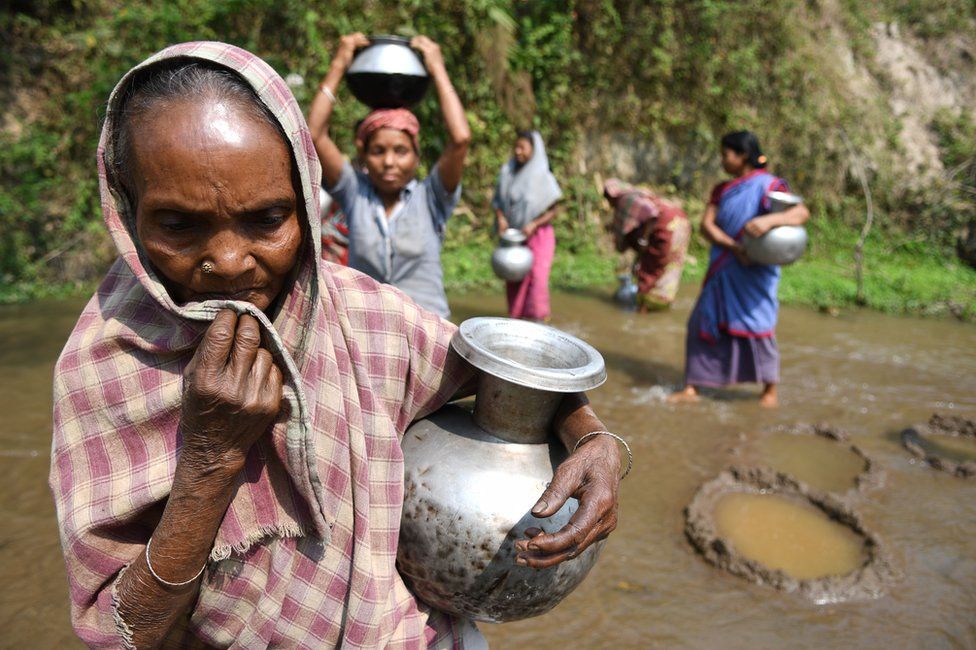
Struggle for daily water collection in water-stressed areas of India

Effects of Water Crisis in India: Where We Stand Today

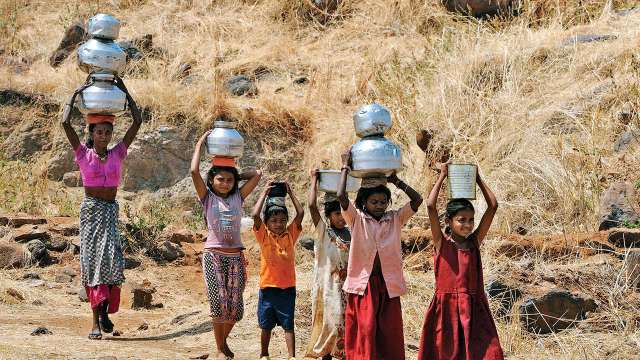
As many as 256 of 700 districts have reported ‘critical’ or ‘over exploited’ groundwater levels, according to a data from the Central Ground Water Board (2017). Fetching water in India has been perceived as a women’s job for centuries, especially in the rural areas. As groundwater resources come under increasing pressure due to over-reliance and unsustainable consumption, wells, ponds drying out fast, escalating the water crisis and placing even greater burden of accessing water on women. A rural woman in Rajasthan walks over 2.5 kilometres to reach a water source, according to a report by the National Commission for Women. Moreover, according to a non-profit named Water, women around the world spend a collective 200 million hours fetching water for their family. In addition to the time spent collecting water, millions may also spend significant amounts of time finding a place to go to relieve themselves. This makes up an additional 266 million hours lost each day. The acute crisis has even led to polygamy in one drought-prone village of Maharashtra. This involves having more than one spouse to collect water. The arrangement is termed as ‘water wives’.

The struggle for women

The Solution to the Crisis: Future Stands

Children also becoming victims of Water Crisis

The Government has taken up the most important role to eradicate the crisis by forming the Ministry of Jal Shakti and launching “Jal Jeevan mission”- Rural in 2019 to promote “Har Ghar Jal” by 2024. Goa and Telengana have achieved the first two Indian states to reach “Har Ghar Jal“, while Andaman & Nicobar Islands and Puducherry became first Indian Union Territories to reach the milestone. In 2021, “Jal Jeevan mission”-Urban was launched to complement the project. “Jal Shakti Abhiyan-Catch the rain” is also introduced to capture and reuse of rain water at the grassroot level as a Jan Andolan. Along with this, for the cleaning and filtration of Ganges river “Namami Gange” had been rolled out as a national flagship mission. Coastal Reservoirs, Desalination of sea water and improved irrigation techniques are now been adopted to address the crisis.

Conclusion

Along with time, active participation from every layer of society in solving the water crisis of India is being witnessed. The youth has come forward with an appealing message to properly addresses the crisis and solve the drawbacks together. Now, the emerging awareness spreading among masses India can hope for a better future to handle the crisis more effectively.

Women in the Field of Science

When we talk about women’s empowerment, gaining formal education, a career or some form of a stable means of livelihood forms an important part. From not allowing girls entry into schools and colleges to witnessing women make pioneering discoveries in the fields of science, technology, medicine, and space, the world has come a long way.

However, let us also not forget the fact that only 33% of researchers globally are women (UN Women 2022). They are also provided fewer funds than men and promoted less. According to a study conducted by The Times of India in 2018, women made up only about 25% of the scientific faculty of universities and institutions. While they form a significant fraction of science teachers in both government and private schools and colleges, the number of women sitting in top positions and with successful careers in these fields is quite small. This is mostly because women more often than not face the pressure of balancing their careers with their families. There remains an inherent belief among many that maintaining the family is primarily the women’s responsibility and cannot be compromised because of their job. A portion of female students enrolled in PG courses and female Ph.D. researchers end up unable to complete their courses due to family pressure regarding marriage. More than 50% of female graduates end up choosing a teaching career, rather than working as professionals in physics, mathematics, and engineering.

Then there are also the numerous complaints of harassment and biased and discriminatory behavior reported in such institutions. The representation of women in the overall field of science is small because people generally see science as a profession for men.

Despite all this, there have been many women visionaries in India who have made significant contributions in the field of science. Here are some of the well-known females in India’s scientific field:

  • Kamala Sohonie {1912-1998} was the first female student of C.V. Raman and was the first woman to obtain a Ph.D. degree in a scientific discipline. She discovered that every cell in a plant tissue contained the ‘cytochrome c’ enzyme which was involved in the oxidation of all plant cells.
  • Anandibai Gopalrao Joshi (1865-1887) was the first Indian woman to have graduated with a degree in western medicine in the U.S and went on to become the first woman physician in India.
  • Janaki Ammal (1897-1984) was a talented botanist who worked on developing different varieties of homegrown sugarcane and eggplant. She received the Padma Shri award in 1977 and was also appointed the Director-General of the Botanical Survey of India.
  • Asima Chatterjee (1917-2006) was a chemist well-known for her contribution in the fields of organic chemistry and phytochemistry.
  • Tessy Thomas (1963-) is the Director-General of Aeronautical Systems of DRDO. She is also the first woman scientist to head a missile project in India. 
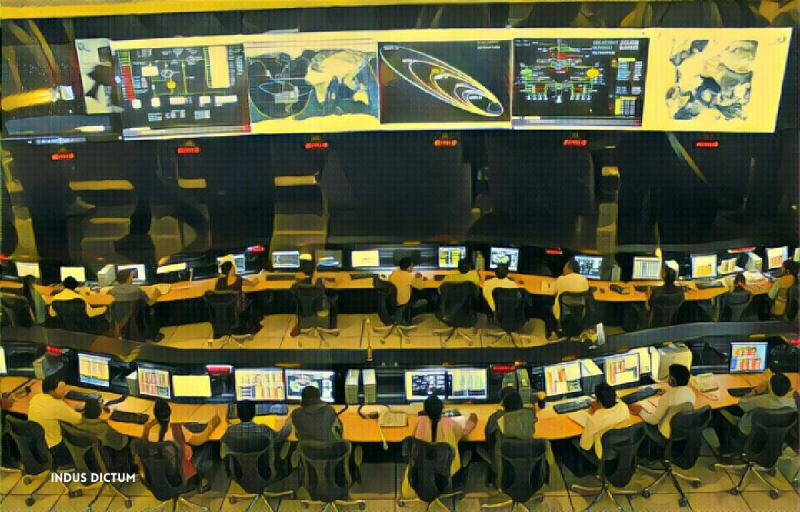
  • Major women scientists of ISRO, like Ritu Karidhal, T.K. Anuradha, Nandini Harinath, and V.R. Lalithambika among many others have received widespread praise and recognition for their work on various successful space missions like Mangalyaan, Chandrayaan, etc.

All of this goes to show us that science is not just a men’s field of play. It is as much a woman’s subject as it is a man’s and this is definitely not the last we will see of women in the field of science.

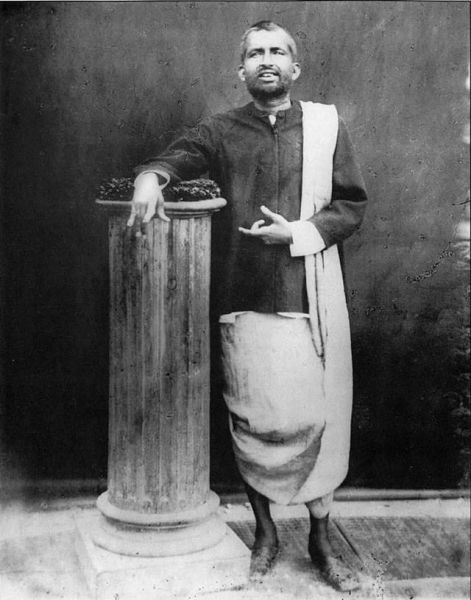
The Incredible Life of Sri Ramakrishna Paramahamsa

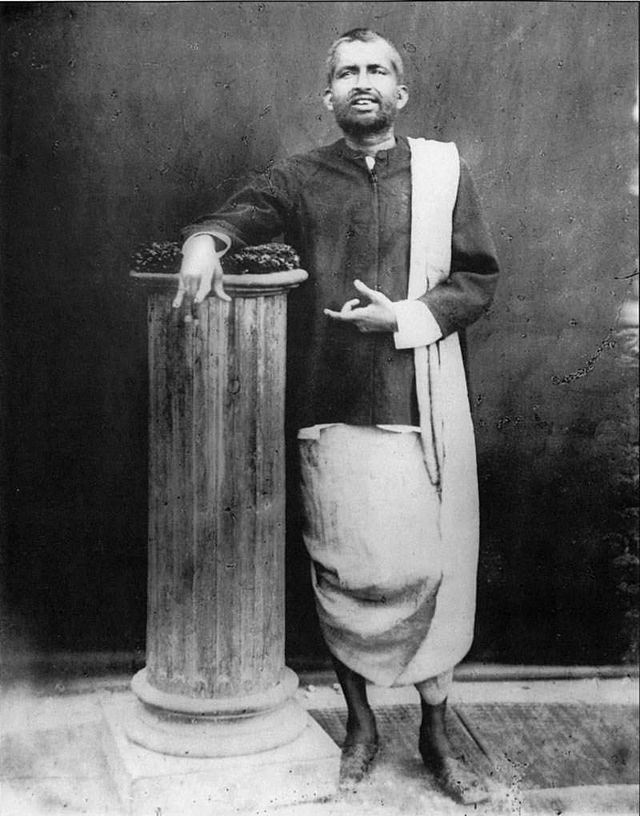
Sri Ramakrishna was an Indian Hindu religious leader and saint of 19th century Bengal who is known for his enlightening teachings on God and religion. On his 186th birth anniversary, let us take a look into his compelling life and ideals which has influenced and still remains influencing a great number of minds.

Sri Ramakrishna Paramahamsa

Sri Ramakrishna was born on 18 February 1836 to Kshudiram Chattopadhyaya and Chandramani Devi, in the village of Kamarpukur, West Bengal, in India. Born in a very poor, yet pious and orthodox household, he did not show much interest towards formal education, saying that he was not interested in “bread-winning education”.

Spirituality, Priesthood and Marriage

It was at the age of six that he went through his first experience of spiritual trance, when he came across the sight of a flock of white cranes flying against a background of black rain clouds and continued to have similar experiences throughout his childhood. He was also interested in spiritual discourses from an early age. The death of his father when he was just seven years old added to his introspective nature.

At sixteen, Ramakrishna travelled to Kolkata to help his brother Ramkumar who was the chief priest at the Dakshineshwar Kali Temple. When his brother died after a few months, Ramakrishna was made the priest. He now became completely absorbed in the worship of Goddess Kali. He spent days and nights in prayer, singing devotional songs and meditating, forgetting his priestly duties, longing for the divine vision of Mother Kali. Finally, on an occasion when he was in utmost despair yearning for Mother Kali, he was blessed with her vision, later describing it as an infinite sea of radiation and light which enveloped him and everything around him.

Rumors of Sri Ramakrishna’s unstable life resulted in his concerned family getting him married to Sarada, a five-year old from the neighboring village of Jayarambati. She later joined him in Dakshineshwar at the age of eighteen. Sri Ramakrishna had by this time been ordained a Sannyasin and thus observed the basic vows of monastic life. Thus, their marital life remained truly spiritual. He even worshipped Sarada as the Divine Mother while performing the Shodashi Puja in his room at Dakshineshwar.

After his marriage, Sri Ramakrishna returned to Dakshineshwar, where he proceeded to learn and experience different aspects of God he followed, with the help of various Gurus, and realized God through each path. Bhairavi Brahmani, an ascetic well-versed in scriptures, was the first Guru to arrive at Dakshineshwar in 1861 and teach Sri Ramakrishna various disciplines of the Tantric path. A Vedanta monk named Tota Puri arrived in 1865 and guided him to Nirvikalpa Samadhi, which is the highest spiritual experience according to Hindu scriptures. Sri Ramakrishna also went on to practice Islam and Christianity, wanting to experience God in all forms. He was able to attain the highest realization through each of them in a short span of time. He spent 12 years practicing various forms of religion and spirituality, finally expressing his spiritual realization as “So many religions, so many paths to reach one and the same goal”.

Disciples and Final Years

As his name and spiritual messages spread all over the country, it attracted people from different backgrounds. Disciples arrived from all over, wanting to learn from him. He divided his disciples into householders, who were taught to realize God while performing their family duties, and young, educated monks, who were tasked with spreading the universal message of Vedanta. One of his most influential disciples was Swami Vivekananda, who re-invigorated Hinduism and remains one of the most celebrated spiritual leaders in India.

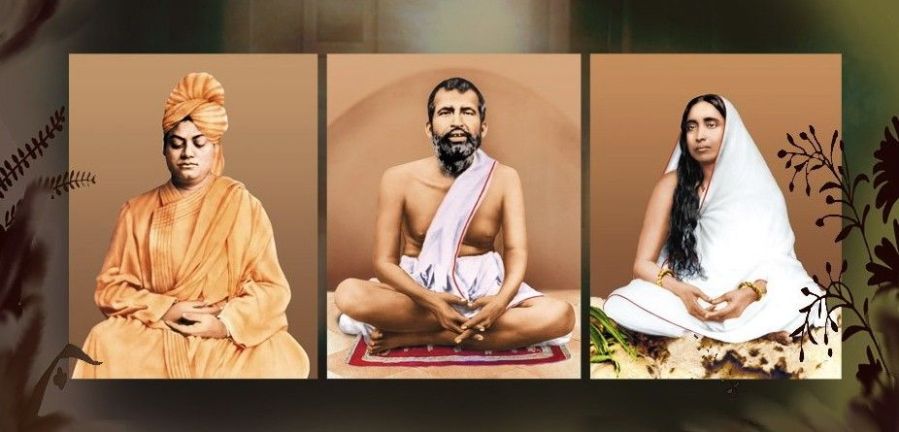
Swami Vivekananda, Sri Ramakrishna Paramahamsa and Sarada Devi

In 1885, Sri Ramakrishna was diagnosed with throat cancer after which he was shifted to a suburban villa where he was nursed by his disciples and Sarada Devi. He gave up his physical body on 16 August 1886, uttering “Ma” before passing away. Sri Ramakrishna’s disciples, led by Swami Vivekananda founded the Ramakrishna Math and Ramakrishna Mission. His illuminating conversations with visitors and disciples have been noted down by his disciple Mahendranath Guptha and published as a book “The Gospel of Sri Ramakrishna“, released in 1942.

Hand-Rickshaw Pullers of Kolkata: The Legacies Left Behind

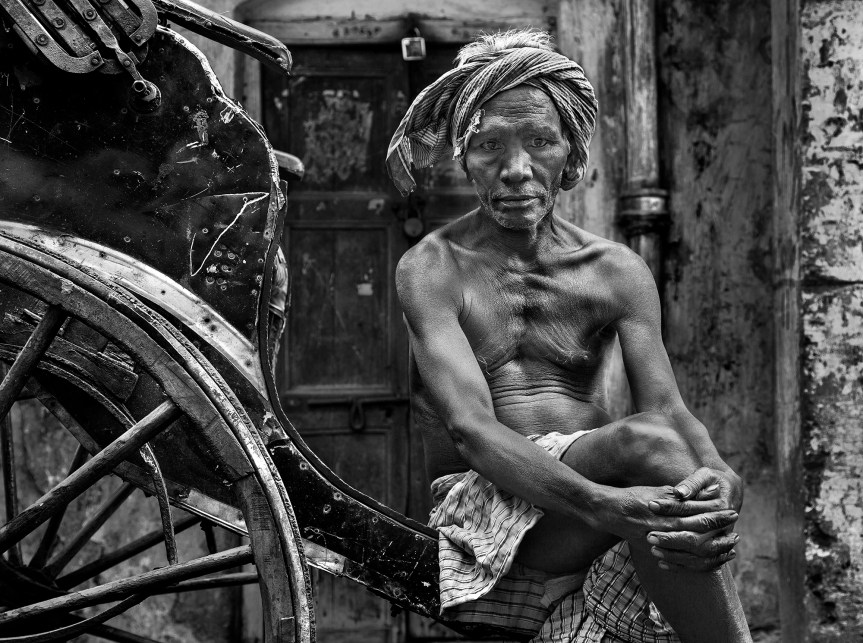
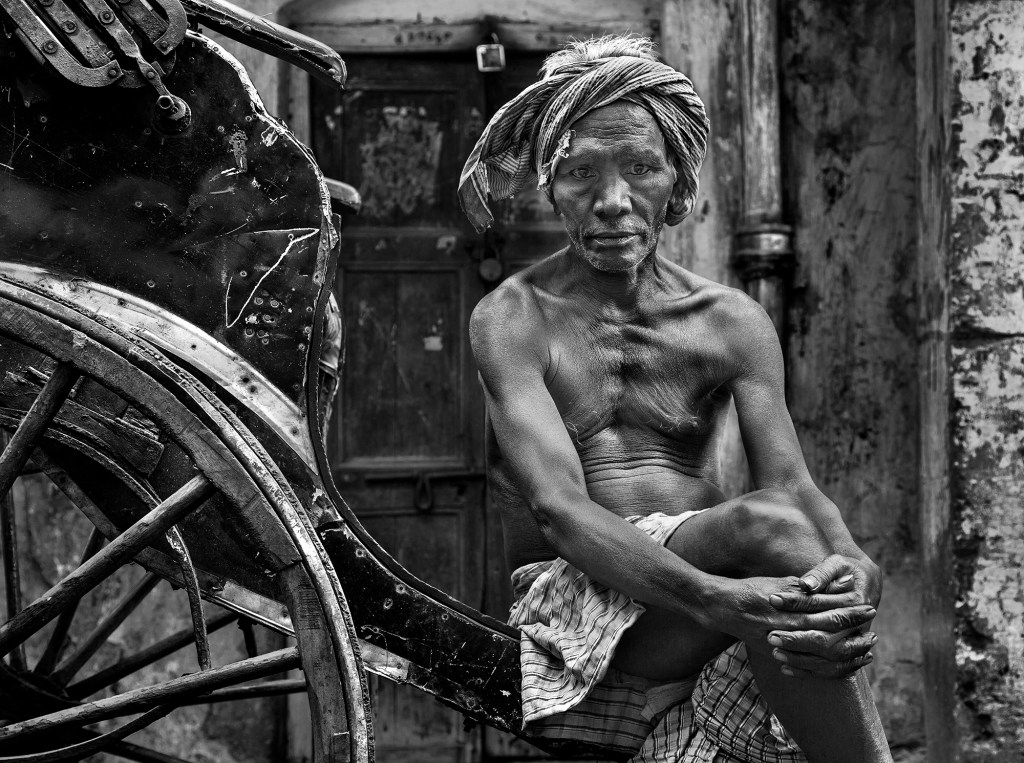
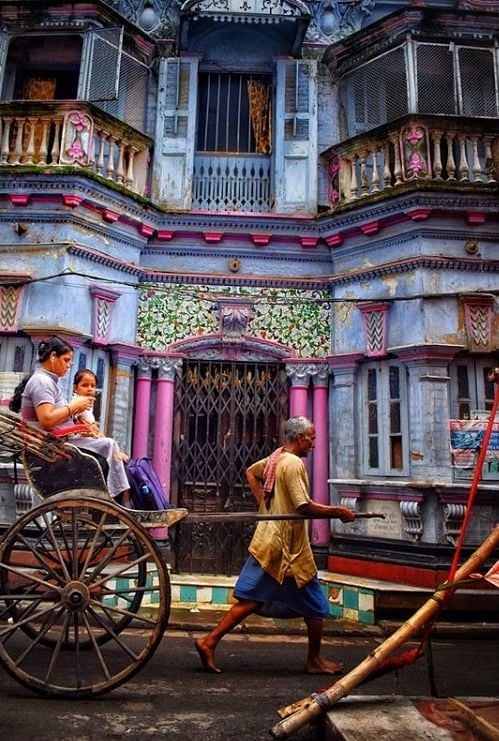
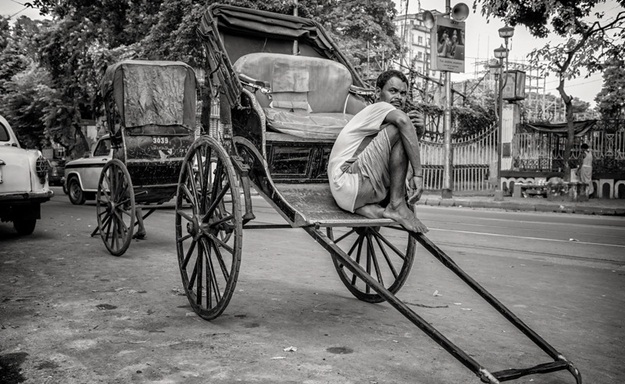
Hand-Rickshaw puller of Kolkata

Introduction

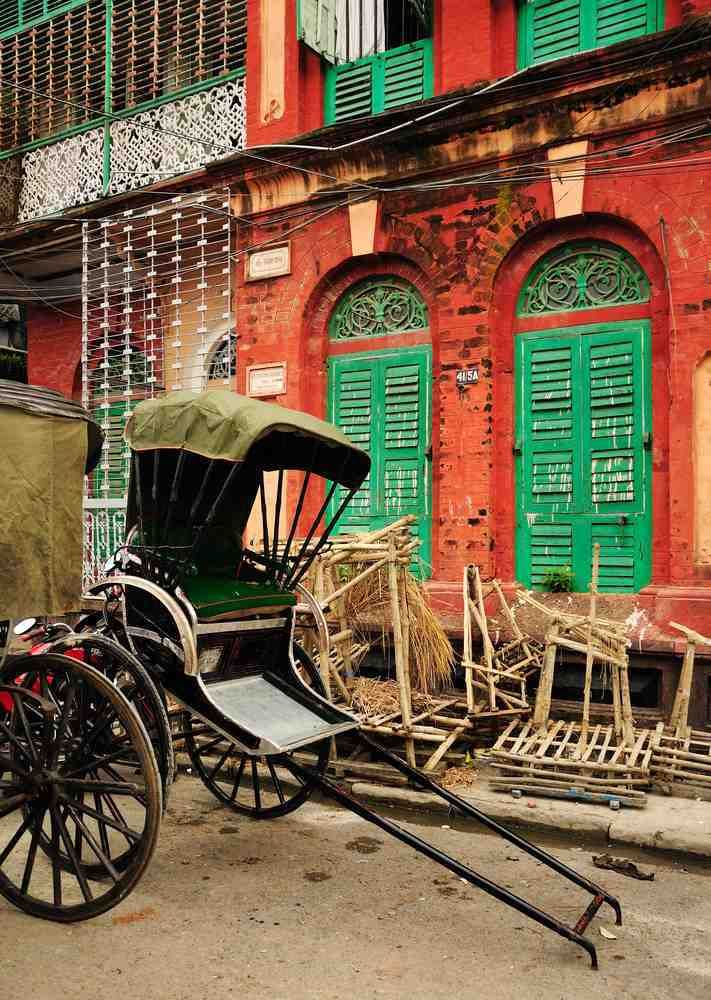
Kolkata is a city that is an amalgamation of the old and new. A city that is being modernised everyday but still manages to hold on to the old charm vibe. It is the only city in India to have various modes of transportation, dating back to the British era. The first city in India to construct a metro rail, it is now the only city in the world that continues to operate licensed hand-pulled rickshaws (called tana rickshawin Bengali) as a mode of public transport. One can still see the tram cars and hand-pulled rickshaws plying on the narrow bylanes of Kolkata.

Hand Rickshaw in Kolkata

Histrionic Background

The word ‘rickshaw’ originates from the Japanese word ‘Jin-riki-sha’ (jin meaning human, riki meaning power, and sha meaning vehicle; which translates to human-powered vehicle). The hand-pulled rickshaw was invented in Japan in 1869 and was introduced in China by 1874. Unlike previous modes of transport, like kago, sedan chairs, etc. which needed two persons to carry, the rickshaw had the significant advantage of being driven by a single person. The following decades witnessed a boom of hand-pulled rickshaws in Japan, China, Singapore, India, Indonesia and Malaysia. They served as cheap means of transportation and provided employment to millions of poor working-class families living in cities. 

The British were the dominant colonial power in Asia and the usage of a human to pull another human definitely served in reinforcing the master-slave power hierarchy. Post World War II, colonialism declined in Asia and the hand-pulled rickshaw faded out of use from erstwhile British colonies. Strangely, the legacy of rickshaws continued in Calcutta long after the British Empire was gone (1947), and long after the communist government in China banned (1949) the use of rickshaws. Not only did it survive in Calcutta but the tenacious hand-pulled rickshaw has become an icon of the metropolis

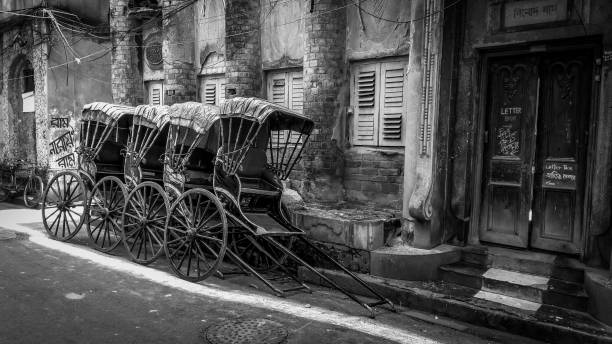
A Hand-Rickshaw in an alley of Kolkata City

A Staple to Kolkata’s Culture

Kolkata’s hand-pulled rickshaws are mentioned in many literary books and featured in films of different languages. It plays the protagonist in Rudyard Kipling’s ‘The Phantom Rickshaw’. The story is set in Shimla of the 1980s. Greg Vore, an international travel photographer, researched on the life, role and history of hand-pulled rickshaws in Kolkata and Bangladesh. Bimal Roy’s classic Do Bigha Zamin (released in 1953) tells the story of a farmer who becomes a rickshaw wallah in the then Calcutta.

Present Situation of Rickshaw: How They Are Doing

The hand-pulled rickshaw survives due to a number of socio-economic reasons peculiar to Kolkata. Firstly, pulling a rickshaw does not require skill; it requires hard physical labour. Unemployed and unskilled labourers find employment as rickshaw pullers in Kolkata. They do not undergo any training or require a driver’s license to operate. Most rickshaw pullers do not even know the names of the roads they ply their trade on, nor do they understand the various traffic symbols. This is because they are mostly illiterate and speak Hindi instead of the local Bengali. Many rickshaw pullers do not even own the vehicles themselves, but rent them from sardars (rickshaw owners) who own khatals (rickshaw garages). This arrangement evolved because many rickshaw pullers are either too poor or seasonal migrants, plying the rickshaws only for a few months when their fields back home lie fallow. 

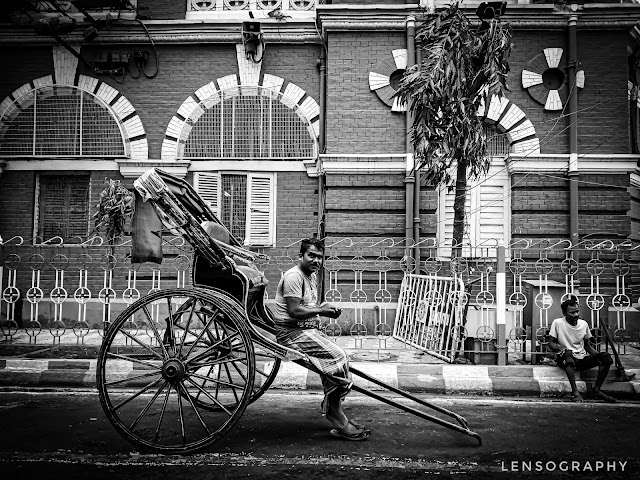
Leisure between the fare trips

Today, due to declining popularity and availability of other modes of transport, rickshaw pullers earn a meagre amount and mostly live on the streets, saving every rupee to send to their families. Added to this are costs for food and rent paid to sardars, after which they are left with very little money for themselves. Many turn to alcohol and suffer from various diseases and medical problems associated with old age and the physical stress of the job.

Kolkata does currently have 18,000 rickshaw pullers and 6000 rickshaws, though not all of them are licensed by the municipality

Queued up for passengers

The “Ban” for Rickshaws: The Efforts to Demolish The Rickshaw Transportation

Kolkata has faced much flak due to the existence of this colonial relic. In 2006, the state government tried permanently banning these rickshaws by the passing of the Calcutta Hackney-Carriage (Amendment) Bill, but it was never implemented. Nothing has changed after the change of government in 2011, though promises were made about replacing the licensed hand-pulled rickshaws with electric or cycle rickshaws. If these rickshaws need to be permanently removed from the streets, a justifiable solution needs to be worked out to ensure proper rehabilitation for all the people directly and indirectly attached to the trade.

On the streets of Kolkata

The Positive Side: Why Hand-pulled Rickshaws Are Relevant To Kolkata

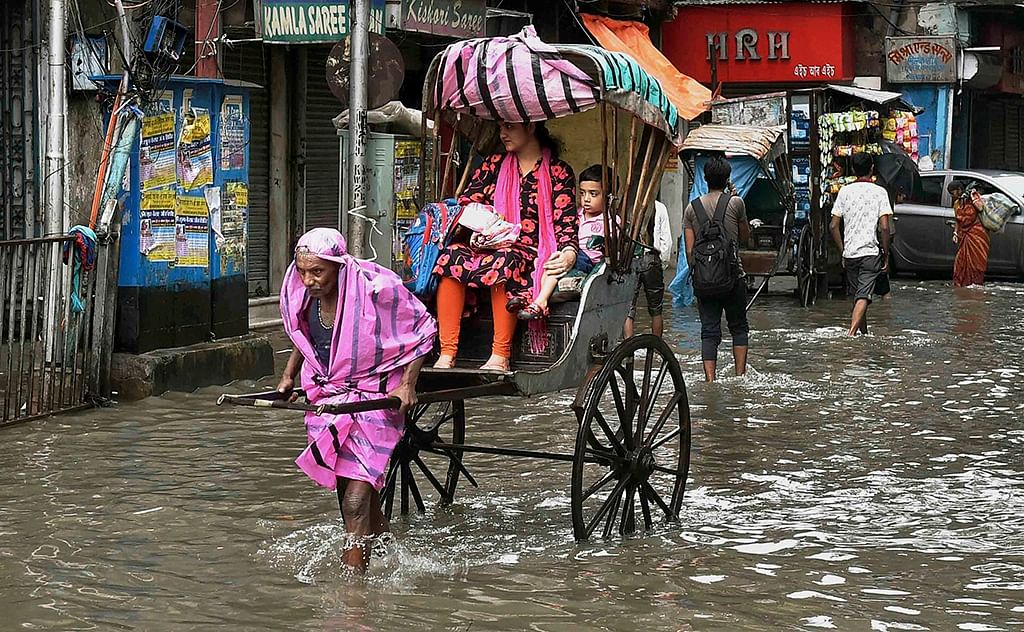
The narrowed urban planning of Kolkata has also played a part in the continuance of this mode of transportation. Due to poor drainage, streets in low-lying areas get flooded frequently. During heavy monsoons, the hand-pulled rickshaw is the only form of transport which can navigate flooded streets. Its non-reliance on fossil fuels makes it less expensive and non-polluting, and its compact size allows easy navigation through the narrow lanes of Kolkata

Carrying passengers in flooded road

Conclusion

Hand-pulled Rickshaws are the legacies of Kolkata’s British colonial past. The demolition of these mannual carts and their replacement with electric mode of carrier carts, would slightly dim the spirit the of the old city. But with time’s stand, it is on the behalf of saving the human labour in a more cost-effective and eco-friendlier way. Although, Kolkata will always cherish its beautiful past garnered with these wooden carts, that served the city and its citizens for ages.

Khadi: The Sustainable Fashion of India

Khadi, India‘s own versatile clothing material for ages

Introduction

Khadi, also known as Khaddar ,which started as a symbol of the Swadeshi Movement led by Mahatma Gandhi 100 years ago, is now a fashion statement in India and is gradually getting popular across the globe. Not only as an affordable and comfortable fabric for daily-wears, but also Khadi is now being considered as a Style Statement for its sustainability and eco-friendliness.

Khadi production

Nature of The Khadi Material

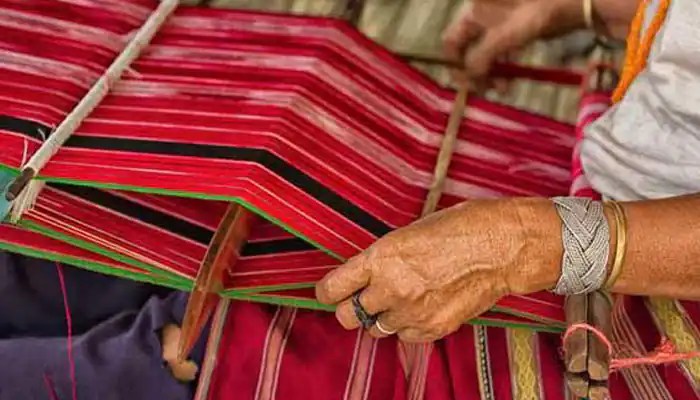
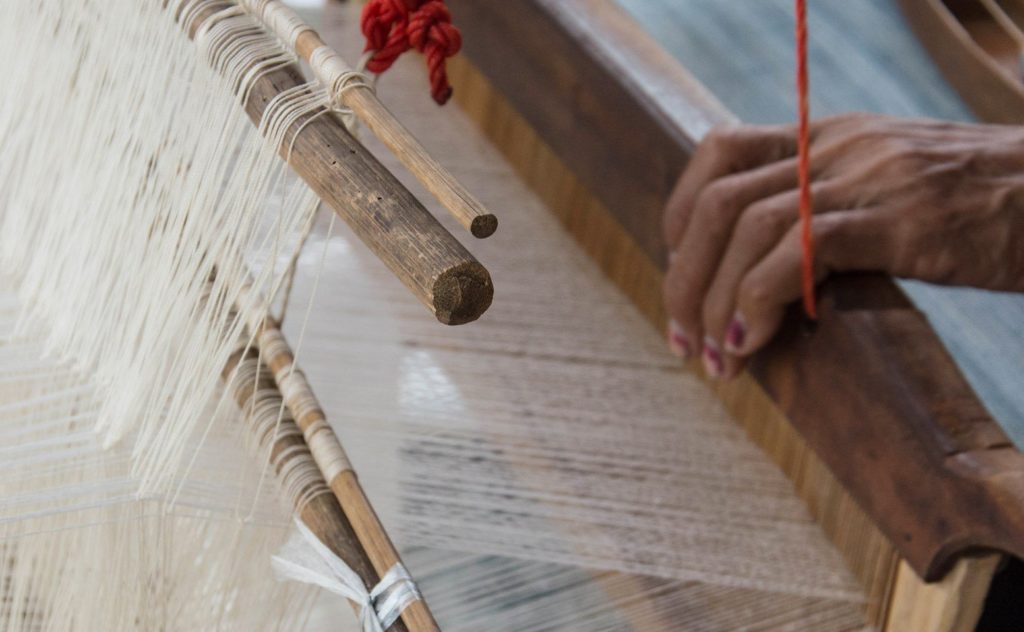
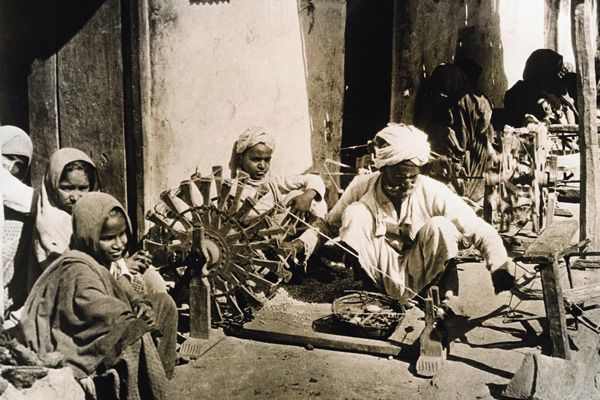
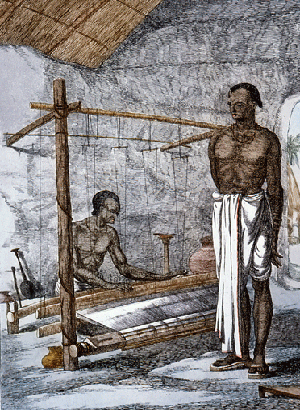
Khadi is a textile fabric made by hand-spun and hand-woven cotton, silk, wool or a mixture of these fibres. It is a traditional way of textile manufacturing and is generally produced by rural artisans. The method of manual spinning and weaving makes the fabric structure somewhat rugged and imparts a unique appearance and makes it soft and comfortable to wear. The spinning is carried out on a traditional wooden frame called charkha, while the weaving is done on a handloom. The specific fabric construction helps in circulation of air within the threads and imparts unique property of keeping the wearer warm in winter as well as cool in summer.

Weaving of Khadi

History of Khadi : Role in India’s Freedom Movement

India has an ancient heritage of cloth making based on the availability of natural fibrous raw material such as -agricultural cotton owing to the clement climatic conditions and fertile land, varieties of silk from different sericulture and wool from domestically reared sheep. The textile coloration was carried out using abundantly available natural dyes, derived from various plant and animal extracts. Such flourishing textile base was one of the major attractions for the Western world. After mechanised industrialisation, the situation changed and the basic raw material was exported from India, converted into mill-processed finished cloth and the imported fabric was brought back. This led to the demolition of traditional textile manufacturing in India and eventually the art and craft of fabric making diminished.

During the initial phase of the freedom movement, national leaders like Dadabhai Naoroji and Lokmanya Tilak initiated the Swadeshi Movement to promote Indian-made products. However, it was Mahatma Gandhi who in 1918 brought the focus of India’s freedom struggle to khadi by promoting that as a Swadeshi symbol.

Under the leadership of Mahatma Gandhi, khadi-making regained momentum and became a symbol of revolution and resistance. It also provided employment to the vast rural population of India and achieved distinct identity as a common man’s cloth. As everybody could wear the same form of clothing without any distinctions of class, creed or religion, they could demonstrate solidarity in freedom struggle. Wearing khadi became a matter of national pride and united the population of India by surpassing the divisive system of the region, language, religion, caste, age and gender. It reflected our country’s legacy of sustainable living and self-reliance. The Indian national flag is also made from khadi material.

Khadi making with Charkha, during India‘s Freedom Movement

Government Initiatives After India’s Independence

The Khadi and Village Industries Commission (KVIC) is the Indian government body that promotes khadi, whose production and sale comes under the small scale industry sector. KVIC was created by a parliament act after which many KVIC outlets were opened across the country. These shops sell khadi fabrics and apparel. Every year between October to January, all Khadi Gramodyog Bhavans offer discounts on their products. KVIC also organises exhibitions and trade fairs in the country and abroad to promote khadi.

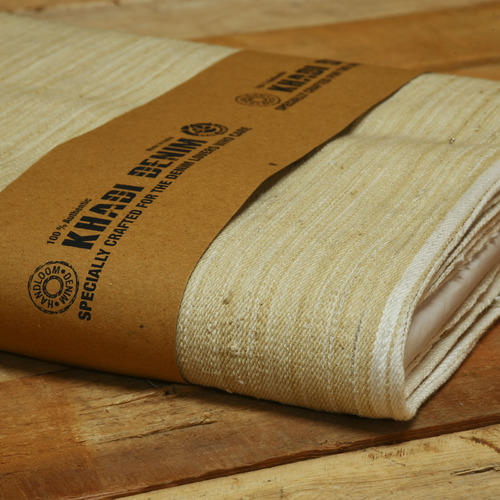
An estimated 15 lakh people are now engaged in producing over 12 crore metres of khadi. KVIC is taking further steps to enhance its production as the market demand for such products is much more than the supply. A new programme is expected to establish the ‘Khadi Mark’ and a logo to indicate the genuineness of the product. The financial support provided and the political will exerted by the present government and the special emphasis from Prime Minister Narendra Modi has helped boost employment in the manufacturing and promotion of khadi products. Leading film artists, sports personalities and fashion designers have come forward to promote this unique ‘Made in India’ fabric in the global arena.

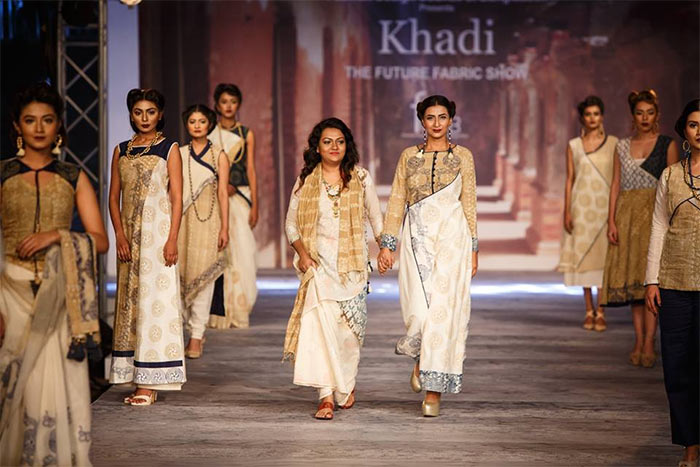
Khadi used in sustainable fashion

Contribution of Khadi in World Fashion

Considering khadi‘s eco-friendly and natural origin, it has become a focal point of global fashion owing to growing consumer awareness and the consistent demand for sustainability. Fashion designers have acknowledged the aesthetic appeal and comfort attributes of khadi and experimented it in blending with many other stuff to synergistically enhance the fashion appeal and outlook of products. Khadi is now used in denims, jackets, shirts, dress material, stoles, home furnishings and apparel accessories like handbags. Khadi, once considered as the fabric for political leaders and the rural folk, has entered the wardrobe of the fashion-conscious urban population. Wearing khadi now symbolises affluence as it offers a distinguished look. The ecological aspect and ethnic looks of khadi have caught the fancy of global brands and leading fashion designers have started including khadi material in their collections.

Global acceptance of the Khadi in fashion

Conclusion

Incorporating Khadi in our daily life may also pave the way for a simple spiritual living exuded by our clothing and home décor items. Khadi being such a versatile fabric can be easily incorporated, by changing the warp and weft, in a home decor and clothing lines. This will make us come closer to nature and add a touch of earthiness in our lifestyle.

Howrah Bridge: The Living Heritage of Kolkata

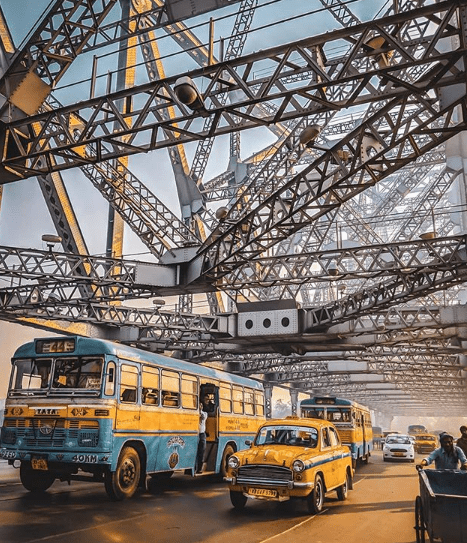
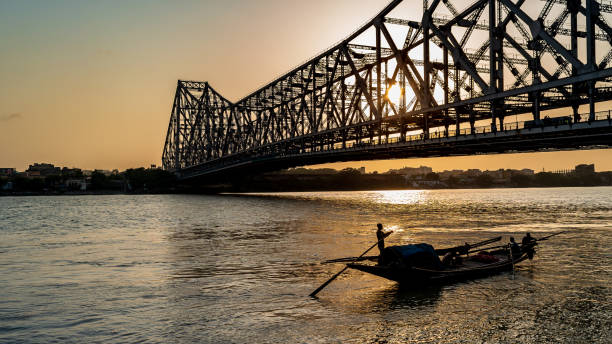
An everyday view of Howrah Bridge

Introduction

Howrah Bridge is an architectural marvel and a well-known Kolkata landmark. It has served as a backdrop for numerous movies since the 1950s, including a 1958 film named after the bridge. One can walk across the bridge and admire its unique construction or glide underneath while on a boat ride along the Hooghly River. With a central span of 1,500 feet (457 meters) between its two towers, this enormous steel structure is one of the longest cantilever bridges of its type in the world. Howrah Bridge extends across the Hooghly River, connecting the city of Howrah to Kolkata.

Historic Background

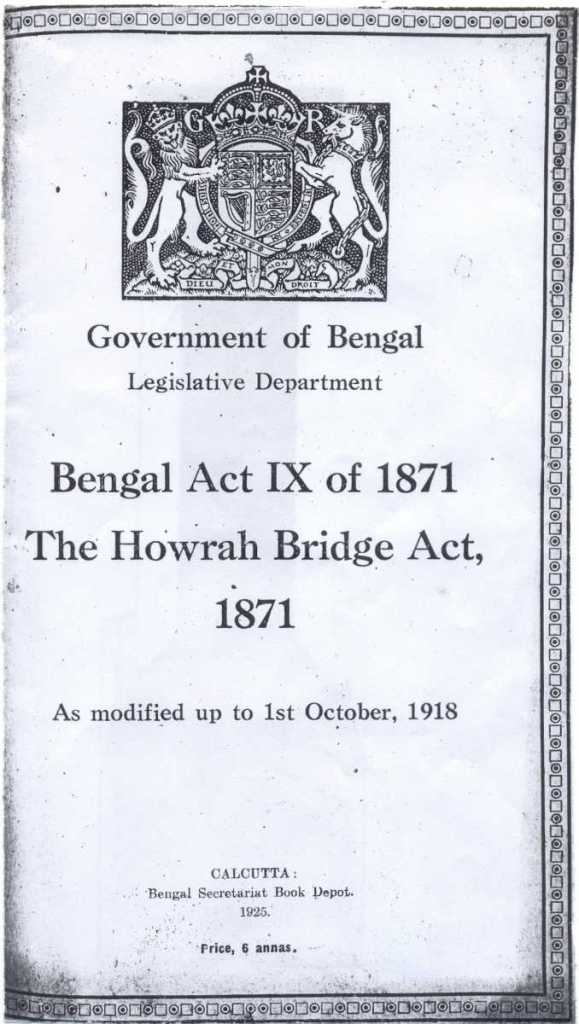
The construction of the Howrah Bridge  was first proposed in 1862. The Government of Bengal wanted to build a bridge over the Hooghly River. They asked the Chief Engineer of the East India Railway Company to study the feasibility of the idea and come up with a proposal. But for several reasons, his proposal never materialised.

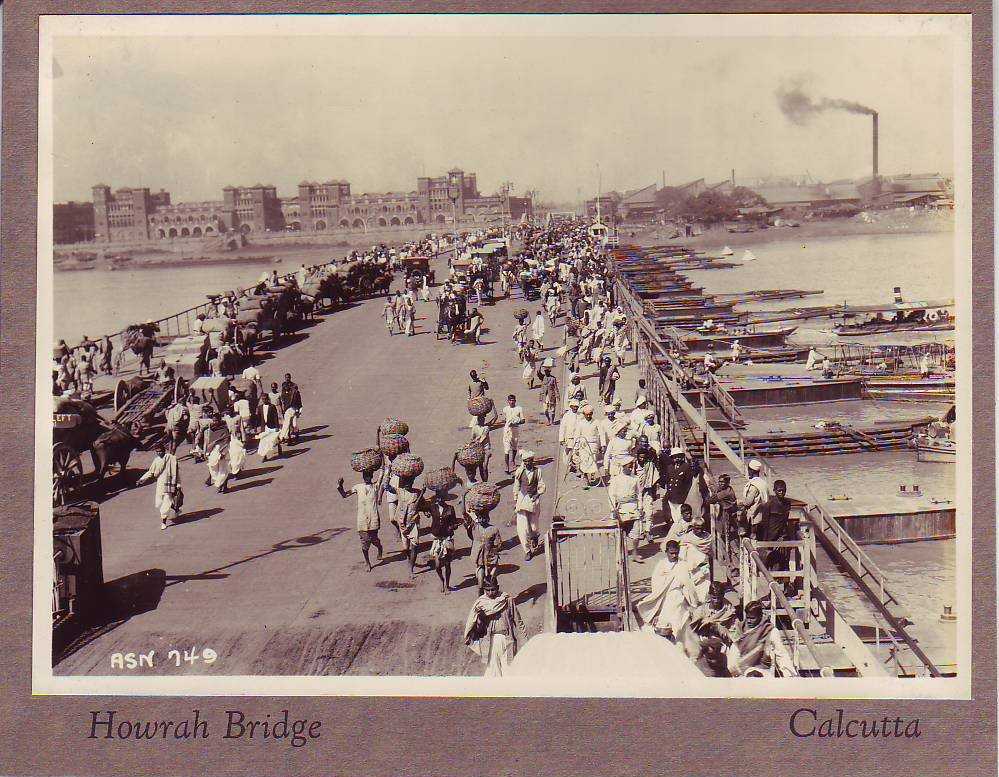
Later in the 1800s, a pontoon bridge or floating bridge was built between Howrah and Kolkata. But it wasn’t strong enough to handle the huge traffic between the two cities or to weather the frequent storms in the area. So the Bengal government continued to look for alternatives and, several decades later, the new bridge was finally commissioned. The contract to build it was awarded to a company called The Braithwaite Burn and Jessop Construction Company.The design of the Howrah bridge was made by Rendel, Palmer and Tritton and the bridge was constructed by Cleveland Bridge & Engineering Company. The construction of bridge was started on 1936 and ended in 1942. It was opened for the public transport on 3 Feb 1943. It was renamed as Rabindra Setu in June 1965 after the first Indian Nobel laureate Rabindranath Tagore.

The Act for the construction of Howrah Bridge

Key Structure of The Bridge

The Howrah Bridge is a suspension-type balanced Cantilever Bridge. It has a central span of 1500ft between the main towers. The anchor and cantilever arms are 325ft and 468ft long, respectively.The suspended span has a length of 564ft. The main towers are 280ft-high above the monoliths and 76ft apart at the top. The bridge deck measures 71ft in width and features two footpaths of 15ft on either side.The super-structure is built up with riveted sections made of a combination of high tensile and mild steel. The bridge deck descends from panel points placed in the middle of the towers, which are located in the lower chord of the main trusses through hungers.The bridge deck consists of a 71ft carriageway and a 15ft pathway projected on both sides of the trusses and supported by a fascia girder.The carriageway outside the tower is backed on the ground by an anchor arm. The deck system includes cross girders suspended between pairs of hungers by a pinned connection. Six rows of longitudinal stringer girders are arranged between cross girders and floor beams support transversally on top of the stringers.These joints support a continuous pressed steel troughing system surfaced with concrete. Two main expansion joints are placed at the interfaces in the middle of the suspended span and the cantilever arms.Eight articulation joints exist at the cantilever arms and suspended portions and separate the bridge into segments by a vertical pin connection to allow the deck’s rotational movements. The bridge deck features a longitudinal ruling gradient at each end.The main tower is based on single monoliths with 21 chambers. The minimum vertical clearance for the carriageway is 5.8m and 8.8m for the river traffic.

The early days of Howrah Bridge

Specialities of The Bridge: What Made It A Heritage

Constructed without nuts and bolts, the Howrah Bridge was formed by riveting the entire steel structure. The bridge officially opened in 1943 when it was the world’s third longest cantilever bridge. Today, it is the sixth longest bridge of its type in the world. The Howrah Bridge is also thought to be the world’s busiest cantilever bridge.

In 1946, in a census carried out, it said that the bridge saw a daily traffic of 27400 vehicles and 12100 pedestrians. In fact ages ago the bridge had also carried trams that left from Howrah station terminus. However, it seemed like the bridge could not take the weight of the heavy weight and hence running trams on the bridge was discontinued. Currently, the bridge can bear the weight of 60,000 vehicles only but it still carried almost 90000 vehicles daily. The bridge also has a separate foot path for pedestrians to walk.While the bridge remains one of the key attractions in the city, the Howrah Railway Station at its Howrah end is another site of much historical significance as the country’s oldest railway station. At the Kolkata end, the bridge ends right by the stunning and colourful Mallick Ghat flower market, one of the city’s most vibrant markets.

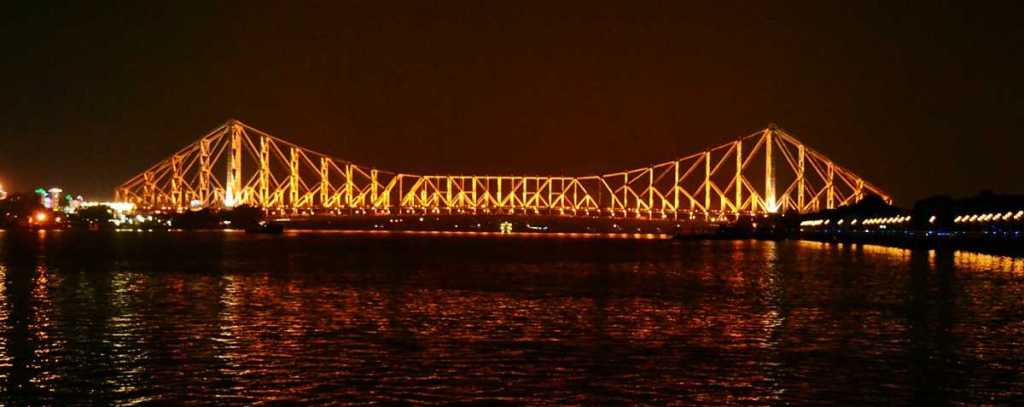
Night View of Howrah Bridge

Cultural Significance of The Bridge

Since the beginning of its journey, the bridge has been featured in numerous Bengali Hindi even International films, such as Do Bigha Zamin (1953), Bari Theke Paliye(1958), Parash Pathar(1958), Howrah Bridge(1958), Neel Akasher Neechey (1959), China Town(1962 ) and Amar Prem  (1971), Teen Devian(1965), Calcutta 71 1972), Padatik (1973), Richard Attenborough’s 1982 Academy Award winning film Gandhi, Paar(1984), Ram Teri Ganga Maili (1985) , Nicolas Klotz’s The Bengali Night(1988), Rolland Joffé’s  City of Joy  (1992), Florian Gallenberger’s  Shadows of Time (2004), Yuva(2004),  Parineeta (2005) and the list goes on.

Recent Renovations of The Bridge

The articulation joints at deck level were renovated in 2008, and the bridge was illuminated in colours of gold and magenta in November 2006.Bridge operator Kolkata Port Trust (KPT) invested Rs35M in the project for laying 13km of cable, 700 lights, a new control tower and a sub-station. Around Rs27.3m was spent on the maintenance of the bridge in 2005.The pylons, the steel-lattice inner structure, the under-deck and the pathway were fixed with white and the upper structure with blue LEDs. Painted in June 2005, the bridge required more than 26,500l of aluminium paint to cover 23,500t of steel, occupying a surface area of 2.2mm².Prime Minister Shri Narendra Modi launched the interactive light and sound show of the bridge in January 2020. The new Rabindra Setu decorative lighting features 650 power-efficient LEDs and spotlight fittings for programmable multi-colour lighting, including a music-syncing show.

Silhouette of Howrah Bridge at the time of Sunrise. Howrah Bridge is a bridge with a suspended span over the Hooghly River in West Bengal.

Conclusion

The surprising fact about this bridge is that, despite being such a heritage, it has suffered a lot of damage. And the damage is not only because of trams plying heavy load, but it is also because of human spit and bird excreta.The corrosion on the bridge is because of prolonged chemical reaction that has occurred because of continuous bird droppings. Calcutta Port Trust is currently in charge for the maintenance of the bridge. Along with the authority, the citizens should also be responsible for protecting the living heritage of our country.

Dhakai Muslin: The Exclusive Bengal Silk from The Past

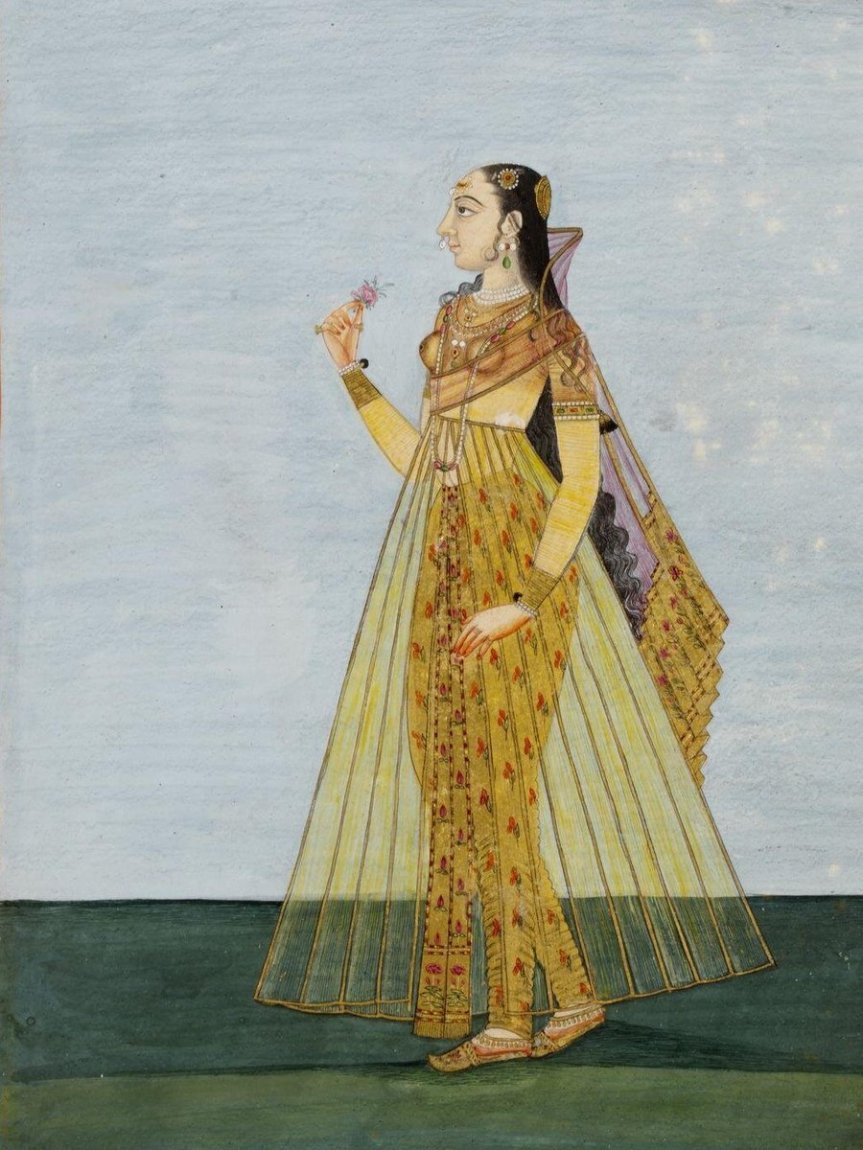
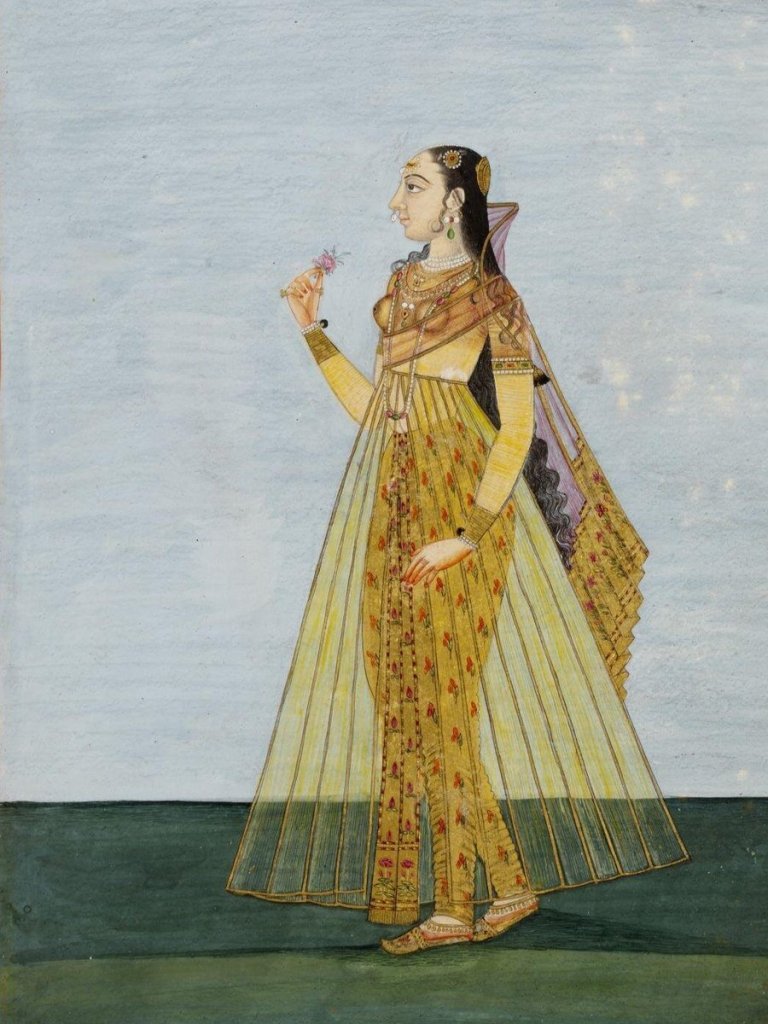
A portrait illustrating how Transparent Muslins were

Introduction

Muslin today has come to mean almost any lightweight, gauzy, mostly inexpensive, machine-milled cotton cloth. The word has lost all connection to the handwoven fabric that once came exclusively from Bengal. Cotton, stated the historian Fernand Braudel, was first used by the ancient civilizations on the Indus, while the art of weaving itself has been traced back to much earlier times. This head start perhaps was why ancient India became proficient in making cotton textiles. They became a staple export commodity to the Roman Empire, and they expanded in volume in the Middle Ages with the growth of the “maritime Silk Road” in the Indian Ocean.

Historic Background

Muslin a brand name of pre-colonial Bengal textile, especially of Dhaka origins. Muslin was manufactured in the city of Dhaka and in some surrounding stations, by local skill with locally produced cotton and attained world-wide fame as the Dhaka Muslin. The origin of the word Muslin is obscure; some say that the word was derived from Mosul, an old trade centre in Iraq, while others think that Muslin was connected with Musulipattam, sometime headquarters of European trading companies in southern India. Muslin is not a Persian word, nor Sanskrit, nor Bengali, so it is very likely that the name Muslin was given by the Europeans to cotton cloth imported by them from Mosul, and through Mosul from other eastern countries, and when they saw the fine cotton goods of Dhaka, they gave the same name to Dhaka fabrics. That the name Muslin was given by the Europeans admits of little doubt, because not only Dhaka cotton textiles, but cotton goods imported by the Europeans from other parts of India like Gujrat, Golconda, etc were also called Muslin.

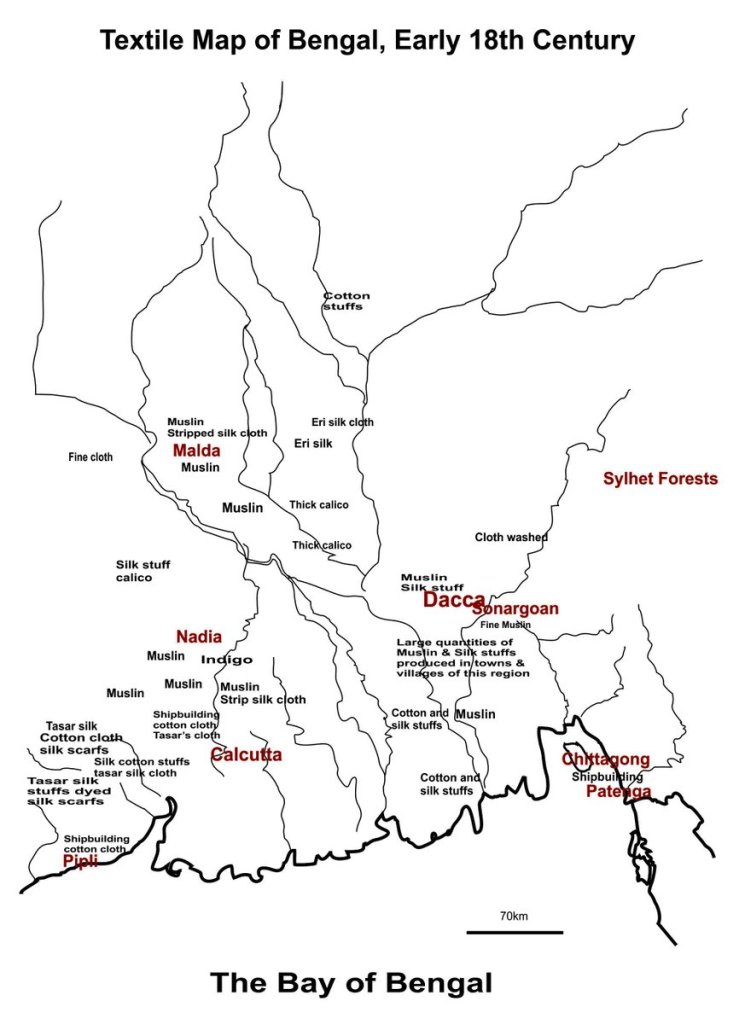
The route connecting the Hubs of Muslin Industry in Bengal

How Muslins Were Made

The textile industry of Bengal is very old. Bengal cotton fabrics were exported to the Roman and the Chinese empires and they are mentioned in Ptolemy’s Geography and the Periplus of the Erythraean Sea, and by the ancient Chinese travellers. But Dhaka Muslin became famous and attracted foreign and transmarine buyers after the establishment of the Mughal capital at Dhaka. The Muslin industry of Dhaka received patronage from the Mughal emperors and the Mughal nobility. A huge quantity of the finest sort of Muslin was procured for the use of the Mughal emperors, provincial governors and high officers and nobles. In the great 1851 Exhibition of London, Dhaka Muslin occupied a prominent place, attracted a large number of visitors and the British Press spoke very highly of the marvelous Muslin fabrics of Dhaka. Weavers in Dhaka, Bangladesh, used to make this incredibly fine cloth using a method called the discontinuous weft technique. This technique required the weaver to work two layers of weft – one as fine as spider’s silk to hold the cloth together and the other forming the pattern. Each pattern motif was worked individually, using fine bamboo sticks to interlace the pattern threads with the warp threads.

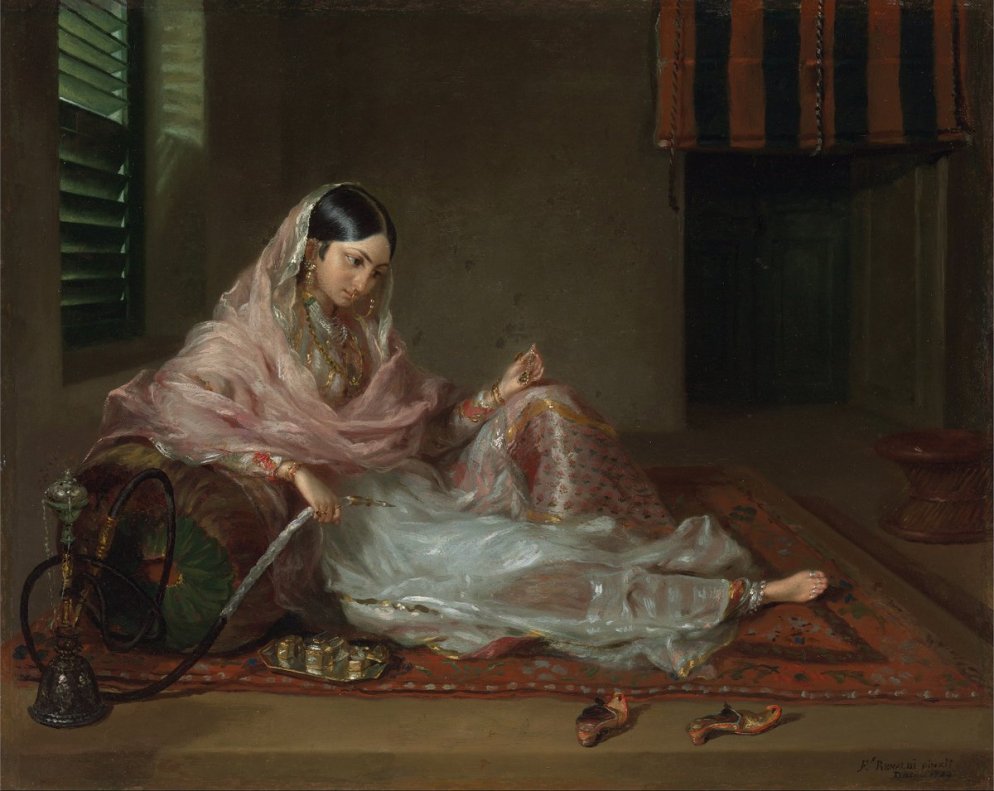
Weaving of Muslins under the supervision of royal official( Painting, in 1800s)

Types And Variations

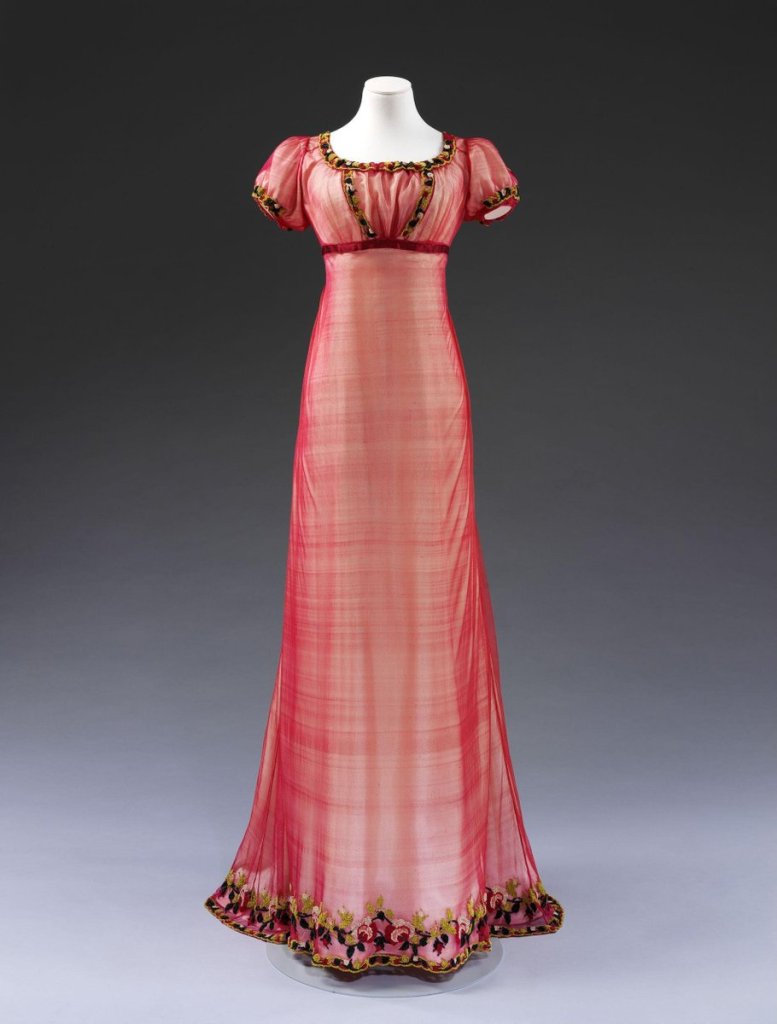
The finest sort of Muslin was made of phuti cotton, which was grown in certain localities on the banks of the Brahmaputra and his branches. The other kinds of cotton called bairait and desee were inferior and were produced in different parts of Dhaka and neighbouring areas; they were used for manufacturing slightly inferior and coarse clothes.The productions of Dhaka weavers consisted of fabrics of varying quality, ranging from the finest texture used by the highly aristocratic people, the emperor, viziers, nawabs and so on, down to the coarse thick wrapper used by the poor people. Muslins were designated by names denoting either fineness or transparency of texture, or the place of manufacture or the uses to which they were applied as articles of dress. Names thus derived were Malmal (the finest sort), Jhuna (used by native dancers), Rang (of transparent and net-like texture), Abirawan (fancifully compared with running water), Khasa (special quality, fine or elegant), Shabnam (morning dew) Alaballee (very fine), Tanzib (adorning the body), Nayansukh (pleasing to the eye), Buddankhas (a special sort of cloth), Seerbund (used for turbans), Kumees (used for making shirts), Doorea (striped), Charkona (chequered cloth), Jamdanee (figured cloth). The finest sort of Muslin was called Malmal, sometimes mentioned as Malmal Shahi or Malmal Khas by foreign travellers. It was costly, and the weavers spent a long time, sometimes six months, to make a piece of this sort. It was used by emperors, nawabs etc. Muslins procured for emperors were called Malbus Khas and those procured for nawabs were called Sarkar-i-Ala. The Mughal government appointed an officer, Darogah or Darogah-i-Malbus Khas to supervise the manufacture of Muslins meant for the emperor or a nawab.

A real Muslin dress exported to England from colonized India

Areas of Production

Weaving was prevalent in the Dhaka district in almost every village, but some places became famous for manufacturing superior quality of Muslins. These places were Dhaka, Sonargaon , Dhamrai, Teetbady, Junglebary and Bajitpur.

Why It Was So Exclusive

The finest of Muslins were honoured with evocative names conjured up by imperial poets, such as “baft-hawa”, literally “woven air”. These high-end muslins were said to be as light and soft as the wind. According to one traveller, they were so fluid you could pull a bolt – a length of 300ft, or 91m, through the centre of a ring. Another wrote that you could fit a piece of 60ft, or 18m, into a pocket match-box. Dhaka muslin was also more than a little transparent.

Muslins were adored by the elites

How The Industry Was Lost

Unfortunately, during the period of the East India Company, European manufacturers all but destroyed the industry by flooding the market with factory produced muslin equivalents. Through a combination of punitive taxes on locally produced textiles and the dissolution of local and influential patrons, Jamdani muslin became uneconomical to produce and the skills were almost lost.

Conclusion

Thankfully, there are organisations in Bangladesh today that are encouraging local weavers to continue to practice their craft. Coupled with the UNESCO listing of Jamdani muslin on its Representative List of the Intangible Cultural Heritage of Humanity, there is more impetus to continuing production, albeit on a very small scale. With the proliferation of mass produced and synthetic fabrics on the market today, it is important that these historical techniques aren’t lost forever. No factory can ever emulate the quality arising out of a skilled artisan. Their skills are part of our textile heritage and it’s wonderful they are being recognised and preserved.

Dhakis of West Bengal: Where They Come From and Where They Go

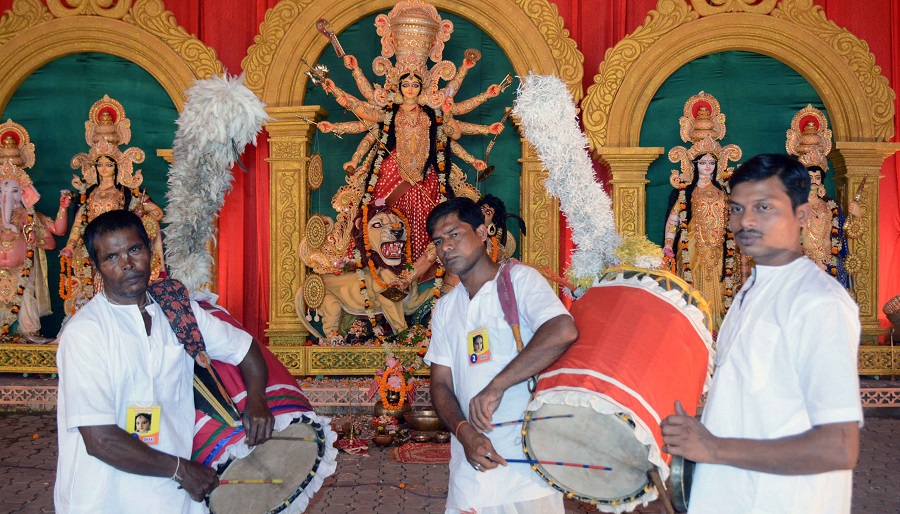
Dhakis playing dhaks in a Durga Puja pandal

Introduction

India is a country of rich cultural diversity and the essence of festivity for each Indian state is unique on its own. The main festival of the Indian state of West Bengal is Durga Puja, which is held during the auspicious Aashwin Durga Navtras in the months of September-October. During the festival the Mother Goddess is welcomed to her home on Earth with 9 long days of celebrations and joy. As a ritual of the festivity both her arrival and departure are rung by hundreds of thousands of “Dhaks” played by the professional drummers, locally called as “Dhakis”.

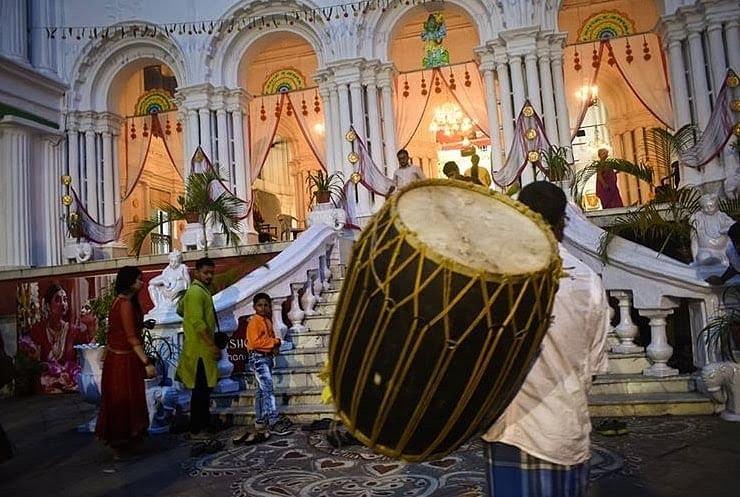
Dhak at a Puja Bari

What “Dhaks” Are: How They Are Made

The word “Dhak” comes from the Austric word “Dhaka” included in the Sanskrit language. The word later became a part of the Bengali script. The dhak is a big membranophone instrument that originally belongs to South Asia. The dhak has become an integral aspect of the widely loved Bengali festival of Durga Puja, other Bengali rituals and festivities. It would have no festive aura if not for the maddening rhythm of the dhak. The dhak is beaten with two sticks loudly to infuse the frenzied beats into the listeners. These beats are enough to raise the spirits and conjure up the feel of the Durga Puja. Without the instrument, the heavily celebrated festival would have felt sombre.

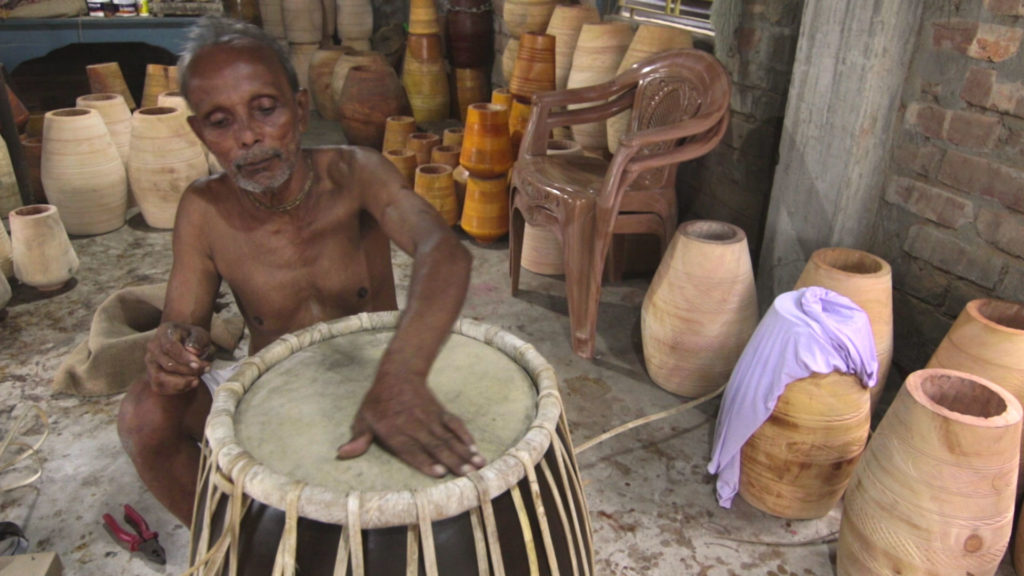
The sound of the dhak depends on a lot of factors like the shape. The shape varies from almost cylindrical to barrel-like. On one hand, the outer portion of the wood is shaved off and carved to create the barrel shaped instrument. On the other hand, the inner side of it is made to be absolutely hollow.The two ends of the dhak are wrapped up with goat skin on the top and calf skin at the bottom. It is said that using these two types of hides bring out the perfect sound texture of the dhak. The manner of stretching the skin over the mouth of the dhak and lacing it is also an important factor in the kind of sound that will be produced. The more the strings on the side of the dhak are pulled the higher the pitch of the dhak gets. The two sticks that are used to beat the dhak are carefully chiseled and formed out of thin cane or bamboo. Because of the drying session of the wooden structure and the intricate handwork and decoration, it takes around one month to reach the perfection in making the instrument.

Making of Dhaks

Who “Dhakis” Are: The Heritage follows

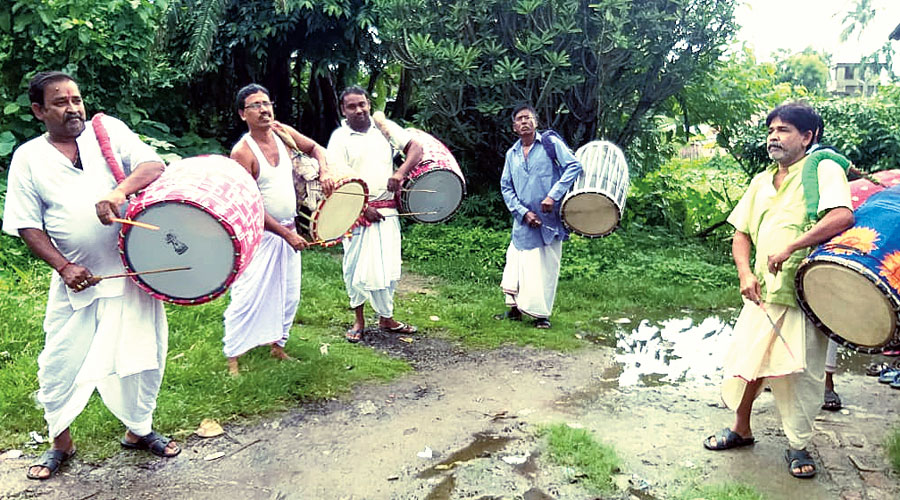
‘‘Dhakis’’ are integral to almost all festivities in Bengal but the art of playing the huge barrel-shaped membranophone instrument is considered as a staple of Bengal’s most celebrated Durga Puja. Most of the ‘dhakis’ or men who play the ‘dhak’ hail from humble rural backgrounds of Murshidabad, Hooghly, Malda, Bankura and Purulia districts of the state. Just like playing any other instrument that is highly associated with a centuries-old cultural heritage, the art of playing dhak, or the business of dhakis are often found to be ancestral and moving in the families since ages. The art of playing such instrument is considered as a living witness, bearing the tradition of the state of West Bengal. The art of playing dhak is passed on from one generation to the next though this art is gradually dying out and losing its focus. One of the reasons for this is the uncertain informal nature of this profession. They still teach the children to play the dhak is to preserve the culture and heritage.

Each part of Durga Puja rituals has a different and unique tune and beat of the dhak right from the arrival of the idols till their immersion. It is played when the idol enters the pandal and even when it exits the pandal on the last day of puja, Dashami. In fact, it is the deafening sound of the dhak that fills the air of immense celebration during the ‘Sandhya Arati’ on Ashtami. This ceremony is absolutely incomplete without the beats of the dhak. Along with that, the ‘Dhunuchi Nach’ is also an essential part where the dhak provides the musical rhythm to which people dance with the ‘dhunuchi’. Another popular tradition is the ‘Dhaker Lorai’ or ‘Fight between Dhaks’ where the grandeur is revealed the best when dhakis play in groups. It is usually a fascinating experience for the audience to see the feathered drums being played by the dhakis dancing to the music produced. Finally, on Dashami, the majestic beats of the dhak helps lift the air of sadness and gloom during the vermilion ritual and ultimately, the immersion.

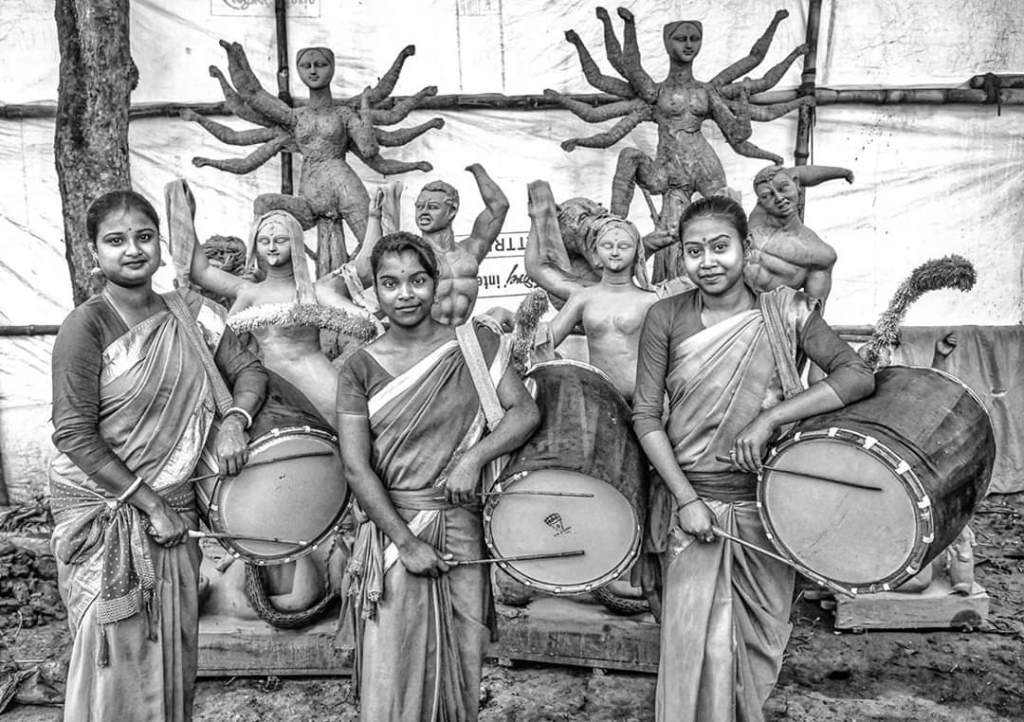
Female artists too have now taken up the responsibility to revive the age old art of playing the dhak. In such a male-dominated profession where carrying the dhak is a major issue, women have proved themselves to be no less than their male counterparts. Teams of women dhakis are finding fame and getting established slowly in their fields.

Dhakis of Bengal

COVID-19 and The Livelihood of Dhakis

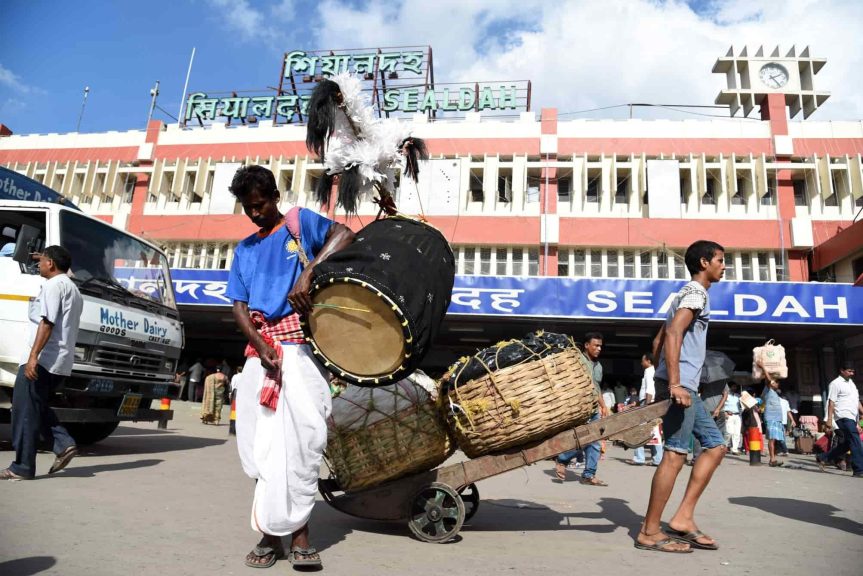
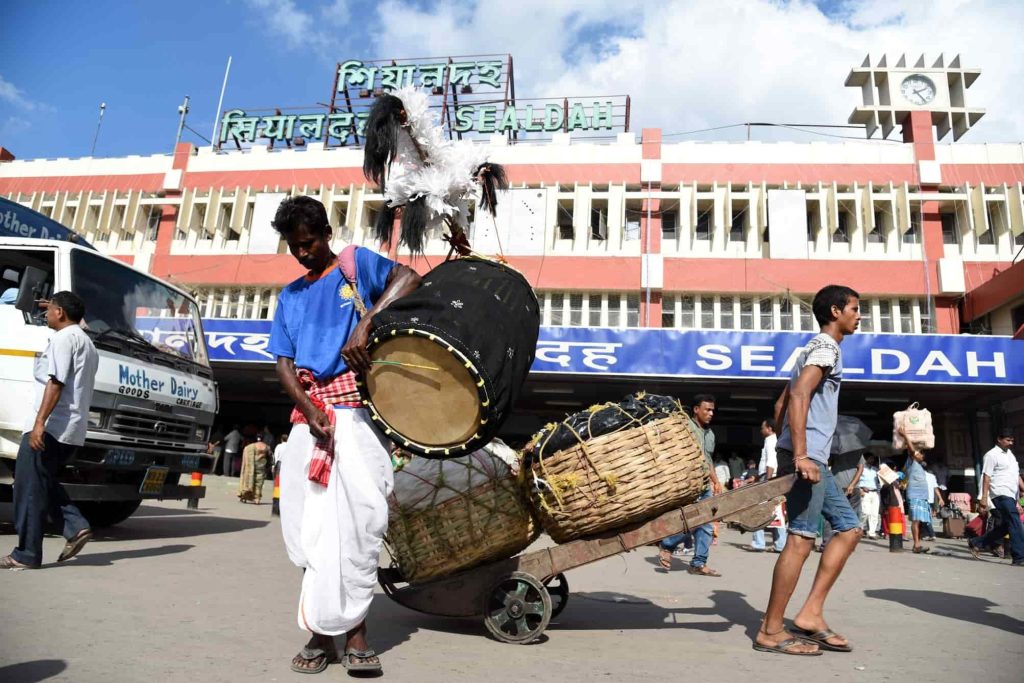
The Impact The drop in the number of Durga Pujas in and outside Bengal amid the novel coronavirus outbreak has taken the rhythm out of the lives of many dhakis (traditional drummers) who look forward to this festive season as their main source of earnings in the year. Every year, the dhakis from different districts and villages of Bengal use to appear at Sealdah station premises before Durga puja. The dhakis used to play the drums in front of Sealdah station every year before puja. From there, various puja committees used to take them in the puja pandals to play the ‘dhak’. But for the past two years the situation is very different, as Puja Committees and Organizers are tight in budget and have to follow a lot of restrictions . Moreover, thousands of dhakis from Bengal districts like East Burdwan, Birbhum, Purulia, Bankura and Hooghly would in other years travel to states such as Assam, Maharashtra, Delhi, Uttar Pradesh to perform at Durga Puja pandals and get higher pay than what they would have got in their home state. But, COVID-19 has restricted that option too for these drummers in past years.

Dhakis at Sealdah station, Kolkata

Where Are They At Now: How We Can Help

Acknowledging the fact that, playing dhak couldn’t be considered as a stable profession and is more inclined to be an occasional source of performing art and earning money, most of the dhakis are often associated with other rural jobs like farming, weaving, fishing to support their livelihood. During Pandemic, the dhakis hope that though they could not travel outside Bengal, they were still lucky if they got calls from Bengal puja organisers. When budgets are low, organisers play recorded beats of the dhaki in pandals. However, several organisers in Bengal have decided to go ahead with dhakis to add the traditional fervour to festivities with the state government offering a dole of Rs 50,000 to each puja committee.

A group of Women Dhakis in front of Goddess Durga idols

Conclusion

Just like of everyday’s, MachhBhaat, Bengal ’s essence of festivity is incomplete without the rhythmic beats of Dhaks. Along with everyone one of us, they are also looking forward for a better situation in the upcoming years, while we can celebrate together the joys of life without fearing for the safety of our health . With the constant effort of the Government and the citizens together , hope we are going to reach that phase very soon.

Child Marriage in India: The Problem and The Cure

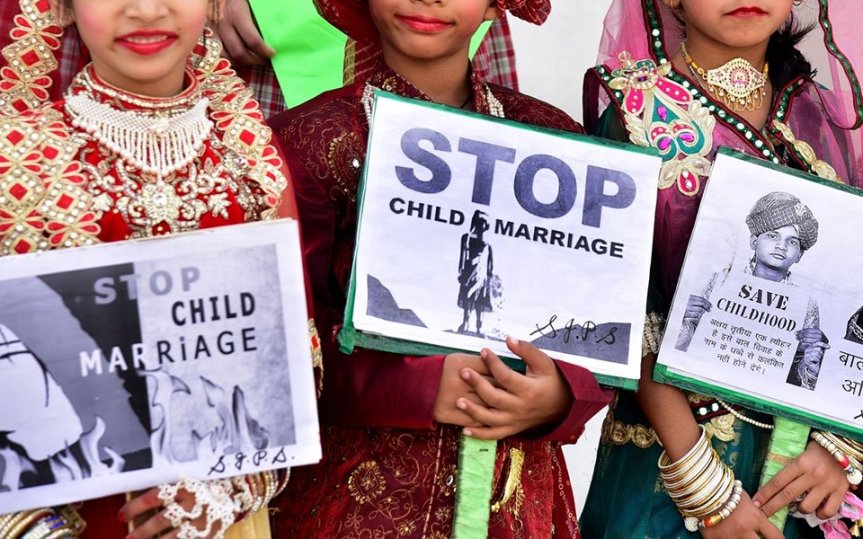
Child Marriage in India

Introduction

Our country India has always been known to the world for its diverse cultural enrichments. But, the legacies from our past beliefs also bore with it some evil practices to the society that we are still dealing with. And one of those practices is the child marriage. The seeds of the problem are still buried so deep in the society and the mind of its people, that it stands alone as a huge socio-cultural challenge till today.

Historic Background

The Vedic history of India dated back to from 200 BC to 700 AD, scribes the marriage as a freedom of choosing desired partner for both men and women. But, with the formation of Government and political modification due to multiple invasions in Medieval India, the women lost their rights to education and choosing their partner and rather were subjected to obey rules and the code of behaviour. Though, age at which the girl was to be married differed and it was rare for girls younger than 12 to be married in antiquity however it became increasingly common for girls as young as six or eight to be married as young brides or “Valika Vadhu”. The parents decided on the marriages of their children at a very early age although the daughter stayed with her parents until she attained the age of puberty. Reaching to which she was bid off to her in-laws through ‘Gehna’ ceremony, in Rajasthan. While in Bengal, this practice was known as ‘Koulinya Pratha’ where a girl child was often married off to an old ‘Kulin Brahmin’ which later on led her to be ‘Sati’ after his husband’s death.

Laws against Child Marriage

The Child Marriage problem in India was first addressed during the British Era. The Child Marriage Restraint act was established in 1929 and come to force in 1930, which defined the minimum ages of marriage for men and women as 18 and 14 years respectively. However, after India’s independence, the minimum age of marriage for women was increased to 15 years. In 1978, the ages of both men and women were revised again to 21 and 18 years. In 2006, the Prohibition of Child Marriage Act came in force, though it was Inapplicable to the Muslim community. Recently in December 2021, Union Cabinet approved to raise the minimum age of marriage for women to 21 years.

The plea is getting stronger.

The Situation in Current Times and the Consequences

Though there are active laws against Child Marriage, but this practice is still ghostly being performed in various parts of India. According to a survey by UNICEF in 1998, the Child Marriage rate in India is 47%, while by UN reports it to be 30% in 2005. Jharkhand has been found to hold the highest rate while Kerala possess the lowest rate in India. Rural Child Marriage cases were found 3 times higher than Urban ares in India in 2009. The consequences of the evil practice, leave many young women shattered for their entire life. Child Marriages have reported a large number of non-consensual marital rapes, physical abuse and domestic violence, low rates of women literary, deaths during childbirth and post natal problems of both underage mothers and newborns.

Our Take: Fighting for a Social Cause

In this modern Era, India is emerging fast as an United country, with largely powered new age youths. And the present generation can give a tremendous change from the society. The situation is already getting better with more to children and giving equal opportunity to both in order to eradicate the practice completely citizens showing their responsibility male and female children. Bachao,Beti Padhao” movement The Government’s “Beti has stirred up the thoughts of young Indian people With many small initiatives, in every state, for a better future. the idea of going along with everyone with equal opportunities are being accepted by Indian parents for marrying their sons and daughters age. The priorities are being given to qualify for a good education and career build up at a matured before getting married.
The youths’ take is most important.

Conclusion

The citizens are the pillars of society and the future lies on the hand responsibility to work together to effort gets counted when we should try our best to improve of every citizen. It is our make our society even better and free from any evil practices. Every work together for a larger cause. more for a better India. The progress so far is appreciable and we

If I Ran The World

Now go to Daisy at Home to get the If Kids Ran the World themed menu. We invite you to share your dinner photos with us any time of the month on our Family Dinner Book Club Facebook page. If Kids Ruled the World Leo and Diane Dillon is a story about kids helping make our world a better place. .If it’s so inspiring that kids rule the world, read it aloud and it will impact your student community.

This book is a true celebration of childhood, play and imagination. This is the pinnacle of Dr. Seuss, celebrating the young imagination and creating a fantasy world that will delight and captivate readers of all ages. Description Leo and Diane Dillon, two-time Caldecott Medalists, show children how to create a more generous and peaceful world through play where everyone can share with each other. Two-time Caldecott Medalists Leo and Diane Dillon show how children can use play to create a more generous and peaceful world for all.

Diane Dillon lives in Brooklyn, New York. Leo and Diane Dillon are two of the most famous illustrators of our time. Leo and Diane created award-winning picture books, book covers, magazines and other works of art until Leo’s death in 2012. This is their last collaboration. Their long list of awards includes two Caldecott Medals, a NAACP Image Award, five Coretta Scott King Awards and Honors, four Boston Globe-Horn Book Awards, and induction into the Society of Illustrators Hall of Fame. They also won Coretta Scott King awards in 2003 for Rap a Tap Tap Heres Bojangles – Think of That and in 2005 for Virginia Hamilton’s People Could Fly – Picture Book.

The Dillons’ contributions to art and illustration, and their lifelong dedication to the diversity of children’s books, makes it uncomfortable to criticize If Kids Ruled the World. Criticism is further tempered by the fact that the book was the last edition the couple created together: Leo died before the book was finished.

Particularly helpful is the emphasis on sharing all the good things that come alive in the world the child has created. The story presents idealistic opportunities for global camaraderie and justice for all people – if only children ruled the world. In the colorful tree house, the children’s rainbow identifies the most important needs in our complex world, while the following branches feature boys and girls who happily help others.

If kids rule the world, even adults are better off. I like that the author points out that if children rule the world, then there will be more kindness and harmony. They say that if children rule the world, young people will make sure everyone has enough to eat and everyone can wear whatever they want without being ridiculed.

The book enlightens the reader about what would happen if children were in charge of the world. This book has so little to do with the world in which real children live, and it seems that this is a gesture, not a call to action. Leo Dillon’s latest book with Diane Dillon imagines what the world would be like if kids were in charge.

The Dillons, in their latest collaboration (Leo died in 2012), are turning the creation of this ideal world into a game; no holiness, no sense of tiresome duty. Perhaps Dillon’s intent was to show diversity, but a scene like this suggests that the past is irrelevant to the present.

They do not think about the poor and do not think about the proper development of the nation and the world as a whole, which shows how self-centered and selfish the rulers of the world are. In the current world scenario, every person who wants to be the president or prime minister of a country has only one goal – to rule the country or the world for the sake of money and power. The world cannot depend only on the rich; the poor also play a very important role in the whole environment.
I would just like to be a guiding light for the world and not impose thoughts on people that are not suitable for me as a ruler or even the people of the world as citizens. Seriously, if I really ruled this world, I would make sure that every person is happy in everything they do, and also respect each other or even the life of the other. That when you leave, you will be a better person than when you started.

It makes us doubt everything and in some cases robs us of the will to live. Our idea of ​​what looks good in the context of work no longer matches.
This means that in a world where we work more independently of others, there will be less feedback. Many agencies will move to campus or shared workspaces instead of a store front. Sarah and I take turns showing the children table decoration crafts.

On the 15th of each month, we share the title of the featured book. Satisfy your voracious literary appetite with a lifetime supply of free books in all formats and genres, as well as books, videos, and audiobooks that don’t wait. Pair it with ever-expanding shelf space so you never have room for your collection.

All people, regardless of gender or socioeconomic status, have the opportunity to learn to read and write. At birth, new mothers will be encouraged to attend parenting courses to learn how to care for their baby, including feeding and accompanying the baby through the various stages of his or her young life. If the child is out of wedlock, the mother will receive additional advice on how to cope emotionally and financially if she does not have family support.

Organize a conversation for the company’s senior management (both men and women) so that you can also share it with your boss, team, or HR. Women leaders can create ROI in their organizations, industries and the world right now. And putting the world in the hands of women would be too simplistic.

If you have a solid idea of ​​how to make a difference and are brave enough to lead the way, then I believe the world needs you right now. Because I’m willing to bet that your ideas, talents and drive can make the world a better place, and I love being a woman who supports you.

But I can’t do all this work alone, so I’m going to select a few key senators, representatives, and governors to serve as my advisory committee. But I suspect that after experiencing all the upgrades and upgrades to our core services, I will garner the most votes.

Finally, to say that I would do all this if I had to manage this world is easier than to actually implement them. I also understand that you may be the type of woman who wants to better understand what they’re getting into before jumping into a conversation. do not worry.

Impact Of Increasing Oil Prices On Indian Economy

The latter will come true as more than half of India’s remittances will go through the Gulf countries, which are likely to see better economic conditions with higher oil prices. In terms of numbers, a $10-a-barrel rise in crude oil prices would increase spending on commodity imports by about $20 billion, offset in part by a $6-billion increase in oil exports and dollars in workers’ remittances. The cost of imports will be halved if the price of crude oil continues to hover around $30 a barrel. In addition, every $10 increase in crude oil prices has a direct impact on a country’s current account (CAD) deficit.

Thus, when crude oil reaches $85 per barrel, the oil deficit will rise to $106.4 billion, or 3.61% of India’s GDP. According to a report by the Reserve Bank of India (RBI), every $10/barrel rise in crude oil prices would lead to an additional deficit of $12.5 billion, equivalent to 43 basis points of India’s GDP. According to an analysis by the Reserve Bank of India, every $10-a-barrel rise in crude oil prices would result in an additional $12.5 billion deficit. Higher prices affect the current account deficit, which means that the value of imported goods and services exceeds the value of exports.

Changes in commodity prices can affect the economic ecosystem at all levels, from family budgets to corporate income and national GDP. Rising oil prices have a negative impact on several factors such as the stock market, currency, inflation, transportation and manufacturing sectors, and government spending. Rising oil prices will drive up the cost of energy, which, combined with the oncoming winter and increased commercial activity as the pandemic eases, will have a major impact on the economies of most countries of the world. India, which relies on imports for more than 80% of its fuel consumption and already has fuel prices above Rs 100 for both petrol and diesel in most cities, will be no exception.

Rising crude oil prices have helped lift the price of gasoline and diesel in India to record highs. High crude oil prices are the result of less drilling by shale gas producers in the United States, disruptions to crude oil supplies due to hurricanes in the Gulf of Mexico, and runaway fuel demand as the global economy stabilizes. -19 pandemic, which significantly reduced economic activity. With the global economic recovery following COVID-19, global demand for crude oil increased in 2021, driving prices up sharply. Crude oil prices have risen steadily since early 2021, when Brent crude traded at around $52 a barrel, fueled both by hopes of improved demand thanks to regional economic recovery and reduced supply from major oil producing countries.

Crude oil prices hit a two-year high, with Brent oil rising above $71 a barrel on Wednesday, reaching its highest level since May 2019, when major oil-producing countries announced they were joining plans to gradually increase crude oil production. World crude oil prices rose to their highest level in 13 months, driven by strong demand prospects amid a global economic recovery and supply disruptions in the Middle East. In February and March 2020, crude oil prices accelerated their decline in response to the coronavirus pandemic and the expected sharp decline in oil demand. The fall in prices is associated with an increase in supply due to hydraulic fracturing.

This was followed by price increases again since 2004, and this upward trend in the cost of oil continues to this day. In addition, since 1996 there have been high fluctuations in oil prices. If we look at the evolution of crude oil prices since the 1950s (see attached chart), price spikes have mostly been accompanied by geopolitical tensions or other factors. leading to a supply shortage.

Due to the pandemic, these oil-producing countries continue to slowly increase production, which leads to higher oil and gas prices. According to the IEA, oil production in non-OPEC Plus countries will increase by 710,000 bpd in 2021. 5.4 million bpd in 2021 and another 3.1 million bpd in 2022.

Since none of the largest oil-producing countries in the world is likely to increase oil supplies, experts predict that by 2019 the price could even reach $100 per barrel. Despite a 430% jump in Brent oil prices since March 2020, oil seems cheap. long term vision. Goldman Sachs expects Brent oil prices to exceed $80 on average in the third quarter of this calendar year, with peaks above that price; JP Morgan expects crude oil to top $80 in the last quarter of 2021, and Bank of America expects Brent oil prices to hit $100 by next summer.

Any rise in global crude oil prices directly affects India as the country imports over 80% of its oil. India paid over $110 billion for oil imports in 2017. Thus, if oil prices double within a year, a country’s import spending will also double over the same period.

Since India imports most of its fuel, it needs more dollars to buy crude oil, which results in liquidity being squeezed. This is bad news for India, which depends on imports for 85% of its crude oil needs and is the third largest importer of fossil fuels in the world.

Given India’s dependence on oil imports and the current pressure on the country, New Delhi is pushing OPEC to increase oil production to contain prices. Analysts say a rise in production by major oil producers is probably India’s biggest hope for a short-term solution, as some economists warn of the risk that crude oil prices could approach $100 a barrel by the end of this year. At the same time, oil-producing countries will be careful enough to maintain a balance in production so that prices do not collapse.

There will also be a significant impact on the Consumer Price Index (CPI) and the CPI inflation rate could be 5% in FY23 due to higher oil prices. The report predicts that rising oil prices could also lead to WPI-based inflation rates of 12% and 6% in FY22 and FY23 respectively. % of crude oil will lead to an increase in India’s Wholesale Price Index (WPI). by almost 0.9%.

An increase in oil prices by 15-25% within one year will affect the Indian economy in different ways. As a general rule, a $10 per barrel increase in crude oil prices would have a negative impact on the current account deficit of $10-11 billion (or 0.4% of GDP). Therefore, rising crude oil prices could increase India’s spending, thereby negatively impacting India’s budget deficit, the difference between total government revenue and total spending.