With the rise in the online world of work, digital marketing is emerging as a crucial field of marketing. In 2019, digital marketing surpassed traditional marketing for the first time. This is due to the fact that, consumers are increasingly getting involved with the online channels. Due to the pandemic, nearly all utilities and services are shifting towards the online mode. In such scenario, digital marketing is increasingly getting popular and necessary to sustain businesses. Digital marketing refers to the marketing that is done using internet or online based technologies like laptops, mobiles, or other digital devices. It is basically advertisements done through digital platforms such as search engines, websites, social media, email, and mobile apps. By implementing an a sound digital marketing strategy, marketers can collect valuable insights into target audience behaviours while opening the door to new methods of customer engagement. Additionally, companies can expect to see an increase in profits. Digital marketing revolves around 5Ds: digital devices, digital platforms, digital media, digital data, and digital technology. The first of the 5Ds mainly focuses on digital devices such as smartphones, tablets, desktop computers, TVs, and gaming devices. It mainly deals with the target audience’s interaction and engagement on websites and mobile applications. Digital platforms like Facebook, Twitter, LinkedIn, YouTube, Instagram etc. Are the preferred platforms to capture the attention of target audience. Digital media revolves around paid, owned, and earned communications channels utilized to build engagement with the target market through several ways such as advertising e-mails, messaging, search engines, and social networks. Digital data refers audience profiles and engagement patterns with businesses. Digital technology on the other hand focuses on building interactive experiences across a wide range of platforms, from your websites and mobile apps. To gain an upper hand in the sphere of digital marketing, it is important to understand and creatively utilize the 5Ds for the benefit of the company or business. There are many platforms that assist in digital marketing. Social media is a great way to promote products or resources organically to brand followers, and engage with consumers. A vast majority of individuals have more than single social media accounts. Platforms like Facebook, Instagram etc. Are very popular and helpful in reaching out to a large audience. Social media platforms allow marketers to reach their prospects in a variety of ways. Marketing teams can use these channels to distribute paid ads and sponsored content. Each platform is different so one can choose accordingly but most have capabilities that allow marketing teams to place ads based on location, job title, interests, age, etc. E mail marketing is also very useful. It allows organizations to stay connected with prospects and customers, sending them customized newsletters or offers based on past shopping history or brand engagements. Even consumers agree that email plays a role in their purchase decisions. Furthermore, transactional emails are more likely to be opened by subscribers. Digital marketing platforms span several functions in one solution – allowing marketing teams to get a more integrated / holistic view of their campaigns.
After it’s first launch , thousands of programmers and users got attracted towards LINUX . Today we can say that Linux is the first choice of millions of people all over the globe . It is different from other operating systems as it comes with a host of positive developments . This is because of what LINUX offers to users and programmers , such as scalability , security , consistency , user friendliness , freedom and non pirated enterprise software . Many of the advantages of Linux are an aftermath of its origins , deeply rooted in UNIX .
Linux is Free : Linux is a freely distributable operating system . The first thought that comes to mind is what does free means . When we say Linux is free that does not mean it is always free of cost . Here , free implies the freedom to work . You can download the Linux for free from Internet , without registration and without going into per user per year kind of licensing . You are free to use , free to customize , free to modify , free to distribute and also free to brand your modified variant . Modification is possible because its source code is freely available . This makes the Linux free . It has already been explained that no licensing is required for Linux . Again , this does not mean that there is no license . Like any other software Linux also has a license . Linux comes with GNU Public License (GPL) . The license states that anybody who may want to use and apply Linux can do so . Anybody has the right to change Linux and eventually redistribute a changed version , on the condition that he makes available the code after redistribution . In other words we can say that you are always free to grab a kernel image , for any of your functionality as long as your client can still have a copy of that code .
Linux is Hardware Independent : Linux is compatible with nearly all available hardware . As mentioned in the previous section , its source code is freely downloadable and that also comes with the GPL license , you are free to follow the documentation available and customize so as to work with your unsupported hardware . This makes the Linux hardware independent .
Linux is Secure : Linux has proven , beyond doubt , the sound security level it offers . This security aspect is the key feature of Linux and its security model is entirely based on UNIX , which we all know is very robust and of proven quality . In Linux , security is not only restricted to the security from internet threats but it is also very much secure from other system related breaches or malpractices . Linux offers security at all levels , such as User level , Application level , System level , Device level , Inner threats , External threats .
Linux is Scalable : When Linux was in the gestation process , its creators wanted to make an operating system that was extensively suitable for any application , any hardware , and any process . They wanted it to work with computers with high power and capacities like of super computers , mainframes , and with computer for personal use like PCs , laptops and even with computers of limited resources like Palmtop , PDAs , etc., so that Linux fits everywhere .
The Journalism and mass media is the graduates work nationwide and worldwide at newspapers and magazines and in advertising, branding, broadcast news, social media, marketing, media research, photojournalism, publication design, public relations, radio, and other areas.
The Journalism is the activity of gathering, assessing, creating, and presenting news and information. It is also the product of these activities. Journalism can be distinguished from other activities and products by certain identifiable characteristics and practices.
There are five types,
investigative,
news,
reviews,
columns,
feature-writing.
The Rules Of Journalism
#1: Ask questions.
The journalist’s greatest assets is their natural curiosity. Start with the famed five W’s (and one H), then ask some more. Asking “why?” is what gets you the good stuff.
#2: Dig for the story.
If you think you’ve got the whole story, dig around some more. The most fascinating parts of the story are often just under the surface.
#3: Master the language.
As a journalist, language is your main tool. Read as much as you can and as often as you can, research odd words and archaic sayings, look at what’s behind etymology. Learn the patterns behind language and how to use them.
#4: Spelling matters.
Double-check if you aren’t sure about spelling or style (especially in the case of names), and read through messages and articles thoroughly before sending either.
#5: Know thy publication.
Before you pitch, know a publication’s style, editorial staff and content. Publications are usually more than happy to provide back-issues. If you can’t find writer’s guidelines, send a short introductory email requesting them.
#6: Contacts are your career.
Contacts (and your reputation with said contacts) are your entire career. Editors, sources and interviewees are all vital parts of the journalistic process. Without them, you’d be screwed.
#7: Once it’s off the record, keep it that way.
Trusted sources will tell you all sorts of juicy, fascinating, scandalous and personal things in your career as a journalist, often off the record. Shut up about it.
#8: Three is a golden number.
Mind the rule of threes: Have at least three reliable, corroborating sources for every fact; three interviewees for every article; and read through a piece at least three times before you sit down to change a comma – that’s at least.
#9: Rejection is opportunity.
Getting a story rejected means you’ve just opened up a line of communication with a new editor – congratulations. Pitch again. Rejection also gives you a chance to sell the story elsewhere: Sometimes rejection just means it’s not right for them
#10: Editors are teachers.
You can learn a hell of a lot from the experience of your editors, and when given the chance you should. They braved the journalistic battlefield before you, so you can trust their edits and advice. Usually, they’re right.
#11: Mind the word count.
Yes, you can do that in the assigned word count, and the editor will either make you add or cut if you don’t. Here, they always know better. (Remember this piece of key-advice from The Elements of Style and repeat it as your daily editing mantra: Omit unnecessary words.)
#12: Deadlines are holy.
Deadlines exist for a reason: Never skip out on a deadline unless you are incapacitated or dead. If you have to, let your editor know beforehand and have a damn good reason. Then, don’t do it again. Compare deadlines to menstrual cycles: If you skip one, you might just be stressed. If you skip several, you’re in trouble.
#13: Know the law.
Journalism can take you to some strange places. Make sure you know the law and what side of it you’re standing on at all times.
#14: Always do your research.
Make sure that your research is flawless and that you can always match which source gave which fact. Cross-reference, find first-hand information and do your background research before requesting, planning or conducting an interview.
#15: Have it outlined.
Have the skeleton of your idea outlined and ready by the time you pitch the idea. That way you have all the information ready, and it makes your job – and theirs – easier. Your outline should include the article’s proposed headline, the article’s sub-headers and sections (you can write down facts as key-words here) and who you will interview.
#16: Keep and file everything.
Keep prior notes, interviews, sources, tapes, the lot: You never know when you’ll need it, and you probably will.
#17: Guard your vices.
Many great journalists have been crippled or completely destroyed by their vices – and it can be almost anything: Overworking, coffee, manic exercising, painkillers or heavier drugs. Whatever yours is, keep it in check or risk your job.
#18: Burnout is a rabid, fanged monkey.
Burnout is a myth, until you’re there. It’s a mental and physical size of your writing engine, and if you don’t find your way to unwind you’ll get there a lot quicker.
The Mass media refers to a diverse array of media technologies that reach a large audience via mass communication. … Broadcast media transmit information electronically via media such as films, radio, recorded music, or television.
The types of mass media include Newspapers, Radio, Television, Internet, Magazines and more,
…
What is Mass Media?
Journalism.
Social Media.
Films.
Television.
Radio.
Advertising.
Public Relations.
Books, Magazines, Newspapers and Journals.
RULES OF MASS MEDIA
The Privacy Act works to guarantee privacy to individuals and controls how personal information is used. Defamation in the written form (libel) or the spoken form (slander) is illegal in the United States.
Section 315 (Equal Time Rule) ensures that broadcast media cannot favor any one candidate over another by granting one more time than another. The Fairness Doctrine ensured that radio stations offered equal time to opposing viewpoints.
The Freedom of Information Act grants the public, including the news media, access to many government documents. The Digital Millennium Copyright Act, established in 1998, extended existing copyright laws to encompass and protect information online.
One of the most reputed and highly competitive and difficult to crack, a BBA graduate possessing a spirit to bring a effective and efficient change, one possessing a spirit of serving the nation should apply to be a Civil Servant.
Examination and Selection Procedure
Examination Name:-Civil Service Examination
Conducting Body:-Union Public Service Commission
The Exam can be sub-divided into three groups namely Preliminary Exam, Main Exam and the interview. Candidates will have to perform well in all the three rounds to get selected.
Advantage for BBA Graduate
Since BBA graduates have studied administration during the three years of their degree, they are ideal candidates for these posts.
Banking Sector
A BBA Graduate interested in banking can join a bank. Graduates can apply for the post of Provisional Officers (PO) and clerks
Examination and Selection Procedure
Examination Name:- IBPS Clerk (For Clerk post) and IBPS PO (For PO post)
Conducting Body:- Institute of Banking Personnel Selection (IBPS)
The Exam can be sub-divided into three groups namely Preliminary Exam, Main Exam and the interview. Candidates will have to perform well in all the three rounds to get selected. There will not be any personal interview for Clerical cadre recruitment
SBI has been conducting online exams and papers for selection of Clerical Cadre and Officer Cadre separately.
Police Sub-Inspector
Candidates who are fit enough can also apply for the post of police sub-inspector after completing their graduation in BBA.
Every student wants to join a dream college or university.
After schooling, we desire to join a top college or university for the security of our feature
Is a college the same thing as a university? What does “liberal arts” mean? Why are some colleges called public and others private? Here are the basics of the types of colleges.
Let me know about NIT AGARTALA
Institute is committed to developing highly competent young Engineers, Scientists, and Management Professionals to cater to the ever-increasing techno-managerial needs of national and international standards fulfilling professional ethics and societal commitment.
MISSIONS
• To produce techno-managerial human resources in line with global needs, offering a state-of-the-art facility, research, and engineering and allied disciplines.
• To enhance the effectiveness of technical education with innovative systems and devising a mechanism to facilitate the application of research findings to solve real problems of industries/academics.
• To nurture and sustain an academic ambience conducive to the development of intellectually capable and committed professionals so that effective growth is obtained for the region’s economic development and the nation as a whole.
• To establish as the corridor of higher education for the South East Asian countries.
EDUCATION SYSTEM
Presently the Institute offers eight UG courses and PG courses in several fields along with Post Doctoral Fellowships. This Institute is autonomous under NIT being act passed by the parliament.
The Institute recently introduced a new curriculum in IITs where more elective subjects are being offered to make the system flexible. Previously, the Institute used to follow the mark based system of evaluation, but have been switching over to a credit-based system to keep track of the global evaluation methods. Industrial training, Undertaking projects are parts of the education system and students are also encouraged to take various activities for social development through NSS and NCC.
Initiatives
The Institute recently has been converted from State Engineering College to National Institute of Technology. The total seats have been increased from 250 to 420 for the academic session 2007-2008. Recently three Under Graduate courses has been introduced in Electrical & Electronics Engineering, Transportation Engineering and Production Engineering. The Civil Engineering Department will start a PG programme in Structural Engineering to fulfil the requirement of the State. The nonresidential campus is to be made residential with the reopening of two boys hostels and one girl’s hostel for the students admitted for the session 2007-2008. A master plan is under preparation for 335 acres of land where a new campus will be built with modern facilities for the overall requirement of the Institute. The Institute is getting a 33 VK dedicated power supply through Tripura State Electricity Corporation Limited for uninterrupted power supply in the campus. The R. D. Department of Govt. of Tripura took total renovation work of the existing buildings after conversion to NIT. The Institute has also obtained a grant of 12 crore rupees from DoNER for the development of infrastructures like the extension of the Library Building, an extension of the Academic Building, the Centralized Computer Centre, a new water treatment plant and boys and girls common room. The campus is now totally connected through Wi-Fi with WiMAX wireless backbone and all e-journal facilities are available in the digital library of NIT Agartala.
Human intelligence is the intellectual capability of humans, which is marked by complex cognitive feats and high levels of motivation and self-awareness.Through intelligence, humans possess the cognitive abilities to learn, form concepts, understand, apply logic, and reason, including the capacities to recognize patterns, plan, innovate, solve problems, make decisions, retain information, and use language to communicate. There are conflicting ideas about how intelligence is measured, ranging from the idea that intelligence is fixed upon birth, or that it is malleable and can change depending on an individual’s mindset and efforts.Several subcategories of intelligence, such as emotional intelligence or social intelligence, are heavily debated as to whether they are traditional forms of intelligence.They are generally thought to be distinct processes that occur, though there is speculation that they tie into traditional intelligence more than previously suspected.
Various definitions of intelligence tend to converge around similar notions designed to capture the essence of this psychological factor. Jensennotes Carl Bereiter’s definition of intelligence: “what you use when you don’t know what to do” (p 111). After their extensive survey, Snyderman and Rothmanunderscored reasoning, problem solving, and learning as crucial for intelligence. The “mainstream science on intelligence” report coordinated by Gottfredsonhighlights reasoning, planning, solving problems, thinking abstractly, comprehending complex ideas, learning quickly, and learning from experience. The American Psychological Association (APA) report on intelligence acknowledges that “individuals differ from one another in their ability to understand complex ideas, to adapt effectively to the environment, to learn from experience, to engage in various forms of reasoning, to overcome obstacles by taking thought.
For more than a century, psychologists have developed hundreds of tests for the standardized measurement of intelligence with varying degrees of reliability and validityThe resulting measures allowed for the organization of taxonomies identifying minor and major cognitive abilities. J. B. Carroll,for example, proposed a threestratum theory of intelligence after the extensive reanalysis of more than 400 datasets with thousands of subjects from almost 20 different countries around the world.shows a simplified depiction of the taxonomy of cognitive abilities.
This survey of factor analytic studies supports the view that intelligence has a hierarchical structure (ie, like a pyramid). There is strong evidence for a factor representing general intelligence (g) located at the apex of the hierarchy (stratum III). This g factor provides an index of the level of difficulty that an individual can handle in performing induction, reasoning, visualization, or language comprehension tests. At a lower order in the hierarchy (stratum II), several broad ability factors are distinguished: fluid intelligence, crystallized intelligence, general memory, visual perception, auditory perception, retrieval, or cognitive speed. Lastly, stratum I is based on specific abilities, such as induction, lexical knowledge, associative memory, spatial relations, general sound discrimination, or ideational fluency.
Artificial Intelligence:-
INTRODUCTION:-
Artificial intelligence (AI), the ability of a digital computer or computer-controlled robot to perform tasks commonly associated with intelligent beings. The term is frequently applied to the project of developing systems endowed with the intellectual processes characteristic of humans, such as the ability to reason, discover meaning, generalize, or learn from past experience. Since the development of the digital computer in the 1940s, it has been demonstrated that computers can be programmed to carry out very complex tasks—as, for example, discovering proofs for mathematical theorems or playing chess—with great proficiency. Still, despite continuing advances in computer processing speed and memory capacity, there are as yet no programs that can match human flexibility over wider domains or in tasks requiring much everyday knowledge. On the other hand, some programs have attained the performance levels of human experts and professionals in performing certain specific tasks, so that artificial intelligence in this limited sense is found in applications as diverse as medical diagnosis, computer search engines, and voice or handwriting recognition.
Today, Artificial Intelligence is a very popular subject that is widely discussed in the technology and business circles. Many experts and industry analysts argue that AI or machine learning is the future – but if we look around, we are convinced that it’s not the future – it is the present.With the advancement in technology, we are already connected to AI in one way or the other – whether it is Siri, Watson or Alexa. Yes, the technology is in its initial phase and more and more companies are investing resources in machine learning, indicating a robust growth in AI products and apps in the near future.
The following statistics will give you an idea of growth!
– In 2014, more than $300 million was invested in AI startups, showing an increase of 300%, compared to the previous year (Bloomberg)
– By 2018, 6 billion connected devices will proactively ask for support. (Gartner)
– By the end of 2018, “customer digital assistants” will recognize customers by face and voice across channels and partners (Gartner)
– Artificial intelligence will replace 16% of American jobs by the end of the decade (Forrester)
– 15% of Apple phone owners’ users use Siri’s voice recognition capabilities. (BGR)
Unlike general perception, artificial intelligence is not limited to just IT or technology industry; instead, it is being extensively used in other areas such as medical, business, education, law, and manufacturing.
In the following, we are listing down 9 very intelligent AI solutions that we are using today, marketing machine learning as a present thing – not the future.
Siri
Tesla
Cogito
Netflix
Pandora
Nest (Google)
Boxever
Flying Drones
Echo
1. Siri
Siri is one of the most popular personal assistant offered by Apple in iPhone and iPad. The friendly female voice-activated assistant interacts with the user on a daily routine. She assists us to find information, get directions, send messages, make voice calls, open applications and add events to the calendar.Siri uses machine-learning technology in order to get smarter and capable-to-understand natural language questions and requests. It is surely one of the most iconic examples of machine learning abilities of gadgets.
2. Tesla
Not only smartphones but automobiles are also shifting towards Artificial Intelligence. Tesla is something you are missing if you are a car geek. This is one of the best automobiles available until now. The car has not only been able to achieve many accolades but also features like self-driving, predictive capabilities, and absolute technological innovation.If you are a technology geek and dreamt of owning a car like shown in Hollywood movies, Tesla is one you need in your garage. The car is getting smarter day by day through over the air updates.
3. Cogito
Cogito originally co-founded by Dr. Sandy and Joshua is one of the best examples of the behavioral version to improve the intelligence of customer support representatives, currently on the market. The company is a synthesis of machine learning and behavioral science to enhance customer collaboration for phone professionals.Cogito is applicable on millions of voice calls that take place on a daily basis. The AI solution analyzes the human voice and provides real-time guidance to enhance behavior.
5. Pandora
Pandora is one of the most popular and highly demanded tech solutions that exist. It is also called the DNA of music. Depending on 400 musical characteristics, the team of expert musicians individually analyzes the song. The system is also good at recommending the track record for recommending songs that would never get noticed, despite people’s liking.
6. Nest (Google)
Nest was one of the most famous and successful artificial intelligence startups and it was acquired by Google in 2014 for $3.2 billion. The Nest Learning Thermostat uses behavioral algorithms to save energy based on your behavior and schedule.It employs a very intelligent machine learning process that learns the temperature you like and programs itself in about a week. Moreover, it will automatically turn off to save energy, if nobody is at home.In fact, it is a combination of both – artificial intelligence as well as Bluetooth low-energy because some components of this solution will use BLE services and solutions.
7. Boxever
Boxever is a company that heavily relies on machine learning to enhance the customer experience in the travel industry and conveys micro-moments or experiences that can please the customers.Boxover significantly improves customer engagement through machine learning and Artificial Intelligence to rule the playing field, helping customers to find new ways and make memorable journeys.
8. Flying Drones
The flying drones are already shipping products to customers home – though on a test mode. They indicate a powerful machine learning system that can translate the environment into a 3D model through sensors and video cameras.The sensors and cameras are able to notice the position of the drones in the room by attaching them to the ceiling. Trajectory generation algorithm guides the drone on how and where to move. Using a Wi-Fi system, we can control the drones and use them for specific purposes – product delivery, video-making, or news reporting.
9. Echo
Echo was launched by Amazon, which is getting smarter and adding new features. It is a revolutionary product that can help you to search the web for information, schedule appointments, shop, control lights, switches, thermostats, answers questions, reads audiobooks, reports traffic and weather, gives info on local businesses, provides sports scores and schedules, and more using the Alexa Voice Service
Conclusion
Artificial Intelligence is gaining popularity at a quicker pace; influencing the way we live, interact, and improve customer experience. There is much more to come in the coming years with more improvements, development, and governance.
Difference Between Artificial Intelligence and Human Intelligence
Artificial Intelligence: Artificial Intelligence is based on the human insights that can be decided in a way that can machine can effortlessly actualize the tasks, from the basic to those that are indeed more complex. The reason for manufactured insights is learning, problem-solving, reasoning, and perception. This term may be connected to any machines which show related to a human intellect such as examination and decision-making and increments the efficiency. AI covers assignments like robotics, control systems, face recognition, scheduling, data mining, and numerous others.
Human Intelligence: Human intelligence or the behaviour of the human being has come to past experiences and the doings based upon situation, environment. And it is completely based upon the ability to change his/her own surroundings through knowledge which we gained. It gives diverse sorts of information. It can provide data on things related to the particular aptitude and knowledge, which can be another human subject, or, within the case of locators and spies, diplomatic data to which they had to get to. So, after concluding all it can give data on interpersonal connections and arrange of interest.
Below is a table of differences between Artificial intelligence and Human intelligence:
Feature
Artificial Intelligence
Human Intelligence
Emergence
AI is an advancement made by human insights; its early improvement is credited to Norbert Weiner who theorized on criticism mechanisms.
On the other hand, human creatures are made with the intrinsic capacity to think, reason, review, etc.
Pace/Rate of AI and human
As compared to people, computers can handle more data at a speedier rate. For occurrence, in the event that the human intellect can solve a math problem in 5 minutes, AI can solve 10 problems in a minute.
In terms of speed human cannot beat the speed of AI, or, machines.
Decision Making
AI is profoundly objective in choice making because it analyzes based on absolutely accumulated data.
Human’s choices may be affected by subjective components which are not based on figures alone.
Perfection
AI frequently produces precise comes about because it capacities based on a set of modified rules.
For human insights, there’s more often than not a room for “human error” as certain subtle elements may be missed at one point or the other.
Energy Consumption
Modern computer generally uses 2 watts energy.
On the other hand, human brains uses about 25 watts
Modification of AI and Human
AI takes much more time to adjust to unused changes.
Human insights can be adaptable in reaction to the changes to its environment. This makes individuals able to memorize and ace different skills.
Versatility
AI can as it were perform less assignments at the same time as a framework can as it were learn duties one at a time.
The human judgment skills underpins multitasking as prove by differing and concurrent roles.
Social Networking
AI has not aced the capacity to choose up on related social and enthusiastic cues.
On the other hand, as social creatures, people are much way better at social interaction since they can prepare theoretical data, have self-awareness, and are delicate to others’ feelings.
Astrophysics is a branch of space science that applies the laws of physics and chemistry to explain the birth, life and death of stars, planets, galaxies, nebulae and other objects in the universe. It has two sibling sciences, astronomy and cosmology, and the lines between them blur.
In the most rigid sense: Astronomy measures positions, luminosities, motions and other characteristics Astrophysics creates physical theories of small to medium-size structures in the universe Cosmology does this for the largest structures, and the universe as a whole.
In practice, the three professions form a tight-knit family. Ask for the position of a nebula or what kind of light it emits, and the astronomer might answer first. Ask what the nebula is made of and how it formed and the astrophysicist will pipe up. Ask how the data fit with the formation of the universe, and the cosmologist would probably jump in. But watch out — for any of these questions, two or three may start talking at once! Goals of astrophysics Astrophysicists seek to understand the universe and our place in it. At NASA, the goals of astrophysics are “to discover how the universe works, explore how it began and evolved, and search for life on planets around other stars,” according NASA’s website.
NASA states that those goals produce three broad questions:
How does the universe work?
How did we get here?
Are we alone?
It began with Newton
While astronomy is one of the oldest sciences, theoretical astrophysics began with Isaac Newton. Prior to Newton, astronomers described the motions of heavenly bodies using complex mathematical models without a physical basis. Newton showed that a single theory simultaneously explains the orbits of moons and planets in space and the trajectory of a cannonball on Earth. This added to the body of evidence for the (then) startling conclusion that the heavens and Earth are subject to the same physical laws.
Perhaps what most completely separated Newton’s model from previous ones is that it is predictive as well as descriptive. Based on aberrations in the orbit of Uranus, astronomers predicted the position of a new planet, which was then observed and named Neptune. Being predictive as well as descriptive is the sign of a mature science, and astrophysics is in this category.
Milestones in astrophysics
Because the only way we interact with distant objects is by observing the radiation they emit, much of astrophysics has to do with deducing theories that explain the mechanisms that produce this radiation, and provide ideas for how to extract the most information from it. The first ideas about the nature of stars emerged in the mid-19th century from the blossoming science of spectral analysis, which means observing the specific frequencies of light that particular substances absorb and emit when heated. Spectral analysis remains essential to the triumvirate of space sciences, both guiding and testing new theories.
Early spectroscopy provided the first evidence that stars contain substances also present on Earth. Spectroscopy revealed that some nebulae are purely gaseous, while some contain stars. This later helped cement the idea that some nebulae were not nebulae at all — they were other galaxies!
In the early 1920s, Cecilia Payne discovered, using spectroscopy, that stars are predominantly hydrogen (at least until their old age). The spectra of stars also allowed astrophysicists to determine the speed at which they move toward or away from Earth. Just like the sound a vehicle emits is different moving toward us or away from us, because of the Doppler shift, the spectra of stars will change in the same way. In the 1930s, by combining the Doppler shift and Einstein’s theory of general relativity, Edwin Hubble provided solid evidence that the universe is expanding. This is also predicted by Einstein’s theory, and together form the basis of the Big Bang Theory.
Also in the mid-19th century, the physicists Lord Kelvin (William Thomson) and Gustav Von Helmholtz speculated that gravitational collapse could power the sun, but eventually realized that energy produced this way would only last 100,000 years. Fifty years later, Einstein’s famous E=mc2 equation gave astrophysicists the first clue to what the true source of energy might be (although it turns out that gravitational collapse does play an important role). As nuclear physics, quantum mechanics and particle physics grew in the first half of the 20th century, it became possible to formulate theories for how nuclear fusion could power stars. These theories describe how stars form, live and die, and successfully explain the observed distribution of types of stars, their spectra, luminosities, ages and other features.
Astrophysics is the physics of stars and other distant bodies in the universe, but it also hits close to home. According to the Big Bang Theory, the first stars were almost entirely hydrogen. The nuclear fusion process that energizes them smashes together hydrogen atoms to form the heavier element helium. In 1957, the husband-and-wife astronomer team of Geoffrey and Margaret Burbidge, along with physicists William Alfred Fowler and Fred Hoyle, showed how, as stars age, they produce heavier and heavier elements, which they pass on to later generations of stars in ever-greater quantities. It is only in the final stages of the lives of more recent stars that the elements making up the Earth, such as iron (32.1 percent), oxygen (30.1 percent), silicon (15.1 percent), are produced. Another of these elements is carbon, which together with oxygen, make up the bulk of the mass of all living things, including us. Thus, astrophysics tells us that, while we are not all stars, we are all stardust.
Astrophysics as a career
Advertisement
Becoming an astrophysicist requires years of observation, training and work. But you can start becoming involved in a small way even in elementary and high school, by joining astronomy clubs, attending local astronomy events, taking free online courses in astronomy and astrophysics, and keeping up with news in the field on a website such as Space.com.
In college, students should aim to (eventually) complete a doctorate in astrophysics, and then take on a post-doctoral position in astrophysics. Astrophysicists can work for the government, university labs and, occasionally, private organizations.
Take math and science classes all through high school. Make sure to take a wide variety of science classes. Astronomy and astrophysics often blend elements of biology, chemistry and other sciences to better understand phenomena in the universe. Also keep an eye out for any summer jobs or internships in math or science. Even volunteer work can help bolster your resume.
Pursue a math- or science-related bachelor’s degree. While a bachelor in astrophysics is the ideal, there are many other paths to that field. You can do undergraduate study in computer science, for example, which is important to help you analyze data. It’s best to speak to your high school guidance counselor or local university to find out what degree programs will help you.
Take on research opportunities. Many universities have labs in which students participate in discoveries — and sometimes even get published. Agencies such as NASA also offer internships from time to time.
Finish a doctorate in astrophysics. A Ph.D. is a long haul, but the U.S. Bureau of Labor Statistics points out that most astrophysicists do have a doctoral degree. Make sure to include courses in astronomy, computer science, mathematics, physics and statistics to have a wide base of knowledge.
Natalie Hinkel, a planetary astrophysicist who was then at Arizona State University, gave a lengthy interview with Lifehacker in 2015 that provided a glimpse into the rewards and challenges of being a junior astrophysics researcher. She described the long number of years she has put into doing her research, the frequent job switches, her work hours and what it’s like to be a woman in a competitive field. She also had an interesting insight about what she actually did day to day. Very little of her time is spent at the telescope.
“I spend the vast majority of my time programming. Most people assume that astronomers spend all of their time at telescopes, but that’s only a very small fraction of the job, if at all. I do some observations, but in the past few years I’ve only been observing twice for a total of about two weeks,” Hinkel told Lifehacker.
“Once you get the data, you have to reduce it (i.e. take out the bad parts and process it for real information), usually combine it with other data in order to see the whole picture, and then write a paper about your findings. Since each observation run typically yields data from multiple stars, you don’t need to spend all of your time at the telescope to have enough work.”
How can you describe a great leader? Great leaders aren’t always found with title CEO or manager on their business card.
Anyone can demonstrate leadership qualities.
It’s not about winning a popularity contest. You don’t have to be liked to be respected. It’s about serving and influencing others regardless of their job title in the effort to achieve a certain goal. More than anything, it’s about creating harmony in an environment where people want to work together.
In one study, leadership qualities such as assertiveness, adaptability, intelligence, and conscientiousness were cited as the most important. Transformational leaders are positive, empowering, and inspiring. They value followers and inspire them to perform better. So what can you do to embrace these valued leadership qualities and become a stronger and more effective leader?
Transformational leadership are usually described as enthusiastic, passionate, genuine and energetic. These leaders are not just concerned about helping the group achieve its goals; they also care about helping each member of the group reach his or her full potential.
Leadership can be a struggle to develop, as there are intrinsic qualities that are tough to cultivate.
But if you’re willing to face the challenge, and follow these guidelines, then you’ll be on the right path to becoming the leader your business needs to succeed.
Encourage Creativity
Intellectual stimulation is one of the leadership qualities that define transformational leadership. Followers need to be encouraged to express their creativity. Effective leaders should offer new challenges with ample support to achieve these goals.
Serve as a Role Model
Idealized influence is another of the four key components of transformational leadership. Transformational leaders exemplify the behaviors and characteristics that they encourage in their followers. They walk the walk and talk the talk. As a result, group members admire these leaders and work to emulate these behaviors.
Be Passionate
You can develop this leadership quality by thinking of different ways that you can express your zeal. Let people know that you care about their progress. When one person shares something with the rest of the group, be sure to tell them how much you appreciate such contributions.
Listen and Communicate Effectively
By keeping the lines of communication open, these leaders can ensure that group members feel able to make contributions and receive recognition for their achievements.
Have a Positive Attitude
Even when things look bleak and your followers start to feel disheartened, try to stay positive. This does not mean viewing things through rose-colored glasses. It simply means maintaining a sense of optimism and hope in the face of challenges.
ELON MUSK, the famous and most successful person in the tech world, who played many roles and faced many struggles to become what he is today. Elon Musk was born and raised in South Africa.
We all know him as an entrepreneur, businessman, CEO of Tesla and spacex, but he is also a skilled investor, software developer, designer, inventor, rocket scientist, actor, film producer, one of the richest man in the world.
During his school days, he was a victim of severe bullying. At the age of 12, he created a video game(blaster) and sold it to a computer magazine. Elon Musk is the founder of X.com (later it became paypal), spacex, Tesla motors.
Recently Elon Musk turned 50, over the past decades Musk managed to become CEO of Tesla and spacex, founder of the boring company, co-founder of OpenAI, Neuralink. He also played a vital role in space rockets, electric cars, solar batteries.
“”Failure is a option here, if things are not failing then you are not innovative enough.””. – Elon Musk
“” I think it’s possible for ordinary people to choose to be extraordinary.”” –Elon Musk
Digital marketing the world become digitalizing day to day.
Every things we can do with digital, we are become digital life’s.
Marketing is main source for improve companies, on before digital life’s there was we have person to person and posters to expose their products and services
Now , we are in surviving digital life’s . every things will get on internet so the bases of internet ,we have recognised by Digital marketing .
The digital marketing it is high level, digital marketing refers to advertising delivered through digital channels such as search engines, websites, social media, email, and mobile apps.
by help of these online media channels, digital marketing is the method by which companies endorse goods, brands and services.
On these digital marketing we have a wide range of digital marketing jobs out there meaning there are a huge variety of career options.
Video/audio production.
Interactive technology (such as AI)
Mobile marketing.
Search engine optimization (SEO)
Search engine marketing (SEM)
Social media.
E-commerce.
Email marketing.
Scopes for digital marketing
The scope of digital marketing is quite good. Anyone who is looking to learning digital marketing would surely get a good benefit from it. There are also huge of job opportunities available in the field .
How can you start
There we have many web sites and blogs, start learning digital marketing help of reading books or blogs, enrolling in courses, watching videos on YouTube, listening to podcasts, watching webinars, and more.
There many programming languages in this world written in many languages. Different companies uses different programming languages. What is actually a programming language ? A programming language is a set of commands, instructions and other syntaxes to computer to perform a specific task. In this blog, I am going to tell you the most popular and top programming languages in this world.
PYTHON
There is no doubt that python is the number one programming language. Python is powerful and easy language to learn. It is very easy to read and understand. Python is the trending programming language in the world. It is the favorite language for many beginners. Python is used in many trending subjects like Artificial Intelligence, Data Science and Machine Learning. It has great libraries like Numpy, PyTorch, Pandas which makes machine learning very easy. In python, you can easily find bug or error in your code. It is used for scientific and computational applications like FreeCad and Abacus. The popular websites like Google, MicrosoftYouTube, Pinterest, and Instagram use it. The average salary of python developer is $100,000.
2. JAVASCRIPT
JavaScript is thought to be the most consistentprogramming language, because it demand never goes off. You can use JavaScript to build web applications, desktop apps, mobile apps and many more. Millions of the websites in the internet depend on JavaScript. Giant tech companies like Google, Facebook, Microsoft and Uber use JavaScript. JavaScript is best option for you along with HTML and CSS. The average salary of JavaScript developer is $84,000.
3. JAVA
Java is a popular programming language since 2000’s. Java is a independent platform runs on a virtual machine(JVM). Just like python, java is also easy to learn. Java is fundamentally object-oriented. Those who want to learn android development, then java is right option for you. Java language is continuing creating new jobs in tech field. Giant companies like Google, Amazon and YouTube use java. Around 40 percent of developers use java. The average salary of java developer is $80,000.
4. C / C++
C language is considered to be the mother of all other programming languages. C is a perfect language for a beginner to learn. Comparing to the other languages c just have 32 keywords. Being one of the oldest programming language it demand hasn’t down yet. Around 23 percent of the developers use C language. Giant tech companies like Google, Apple, intel use C / C++. The average salary of a C / C++ developer is $78,000.
5. KOTLIN
Kotlin is a open source and general purpose language. Within short period of time it gained full popularity. According to a survey Kotlin is one of the fivemostpopularlanguage. Kotlin is best language for android development. Kotlin is designed to interoperate fully with java and JVM version of Kotlin library. Around 60 percent of the android developersare using Kotlin. Some of the most popular apps that are built using Kotlin are Tinder, Square, Evernote. Giant tech companies that use Kotlin are Google, Amazon, Netflix and many more. The average salary of a Kotlin developer is $77,000.
All these are the most popular and top programming languages. If you like my work, please like it and rate it. Thank you.
UNIX is a multi-user and multitasking operating system. in a multi-user environment. the computer can receive the commands from a number of end users programs, access files, and print documents simultaneously.
The host computer, which has a UNIX operating system, provides services to the terminal, such as file access services. four terminals are connected to one host computer and all the terminals are sharing resources from the host computer.
Features of UNIX
The general and additional features of UNIX operating system are :
File and Processes : file and process are two entities that are supported by UNIX. A file contains information, such as text, code or directory structure that you need to save in the computer, The file is stored in the hard disk of the computer at a particular location, which can be easily remember whereas a process is the name given to a file or a programs that is currently running . UNIX provides various tools that enable you to control a process, change the sequence of the process, and kill the process.
Multi-user system: UNIX supports multitasking system as the kernel is designed to handle multiple processes. A single user can run multiple process simultaneously. For example, an end user can print a file and edit another file simultaneously. The kernel handles the multiple processes as foreground and background process. The current process runs in the foreground and the other processes run in the background. This multitasking feature is an advantage for the programmers, as they do not have to close the editor and run the program; this can done simultaneously.
UNIX toolkit: The UNIX toolkit provides various tools that are enable you to perform different tasks in UNIX as kernel alone cannot perform every task. The tools that are included in the UNIX toolkit are:
1:- General purpose tools , such as vi editor
2:- Text manipulation utilizes filters that are used to retrieve the output from two or more commands simultaneously .
3:- Compiler and Interpreter .
4:- Network administration and system tools , such as mailx and pine.
Pattern Matching :- UNIX supports pattern matching feature that enables you to retrieve the output according to the required pattern . Pattern matching in UNIX can be implemented using a special characters , such as * known as metacharacter .
Programming Facility :- UNIX provides a programming facility known as shell that is developed specifically for programmers and not for the users .
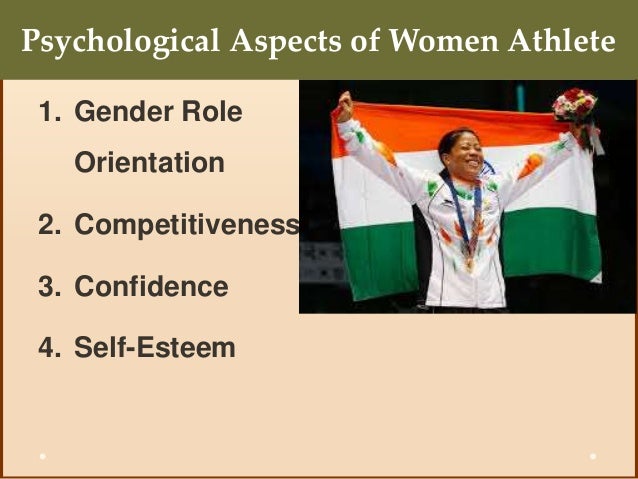
Over the past several decades , the role of women has changed drastically .However , gender beliefs and stereotypes still do exist across the world especially in sports . Most of the people in our society consider that sports are not meant for females but only for males .Social tradition , customs and cultures have great influence upon the psychology of women . In a male dominating society , males are expected to be aggressive , independent , dominating , robust and confident , whereas females are expected as well as considered to be emotional , sensitive , cooperative , sympathetic , loyal , etc. It is a well – known fact that participation of women in sports is increasing year after year .With this enhancement in female participation in sports , there is also renewed interest in the psychological characteristics of the female athletes and the effects of athletics on women . The various psychological traits of women athletes are stated below .
Gender Role Orientation : It is an established fact that there has been an increase in the level of women’s participation in the types of sports that have been traditionally limited to only males , e.g., wrestling , weightlifting , kick boxing , body building , etc . However , many sports have been still considered inappropriate for women . For a long time it was considered that women should not take part in athletics because of the potentially harmful masculinising effects of sports .
Competitiveness : It is evident that in the field of sports , both men and women are competitive in their own fields . In fact , women are more goal oriented and perform magnificently in artistic activities such as gymnastics . However , a number of research studies indicate that females who take part in sports are more competitive in comparison to the females who do not participate in sports .
Confidence : As mentioned earlier , due to social pressures , women tend to have less confidence than men . Participation in sports , competitive environment , awards and recognitions increase confidence levels of sportspersons . However , a significant difference may exist between sportswomen and non- sportswomen .
Self-esteem : Most of the research studies indicate that training plays a vital role in performance . Self -esteem improves with good performance . In the field of sports , intensive training helps in enhancing self-esteem . Research studies also show that those people who engage in sports have high self-esteem in comparison to non-participants .
Aggression : Aggression is a forceful , goal- directed action that maybe verbal or physical . Participation in sports has many positive aspects which usually involve aggressive behavior . Various studies of aggression show that athletes who participate in contact sports , i.e., football players , judos or wrestlers are more aggressive than the athletes who participate in less contact sports . However , females who participate in contact sports show more aggression in comparison to females who do not participate in sports at all.
WHO is bringing the world’s scientists and global health professionals together to accelerate the research and development process, and develop new norms and standards to contain the spread of the coronavirus pandemic and help care for those affected.
The R&D Blueprint has been activated to accelerate diagnostics, vaccines and therapeutics for this novel coronavirus.
The solidarity of all countries will be essential to ensure equitable access to COVID-19 health products.
Global research database
WHO is gathering the latest international multilingual scientific findings and knowledge on COVID-19. The global literature cited in the WHO COVID-19 database is updated daily (Monday through Friday) from searches of bibliographic databases, hand searching, and the addition of other expert-referred scientific articles. This database represents a comprehensive multilingual source of current literature on the topic. While it may not be exhaustive, new research is added regularly.
The WHO evidence retrieval sub-group has begun collaboration with key partners to enrich the citations and build a more comprehensive database with inclusion of other content. The database is built by BIREME, the Specialized Center of PAHO/AMRO and part of the Regional Office’s Department of Evidence and Intelligence for Action in Health.
For further information or questions, please contact the WHO Library via email.
Disclaimer: the designations employed and the presentation of the material in publications listed in this database does not imply the expression of any opinion whatsoever on the part of WHO concerning the legal status of any country, territory, city or area or of its authorities, or concerning the delimitation of its frontiers or boundaries. Dotted and dashed lines on maps represent approximate border lines for which there may not yet be full agreement.
The mention of specific companies or of certain manufacturers’ products in publications listed in the database does not imply that they are endorsed or recommended by WHO in preference to others of a similar nature that are not mentioned. Errors and omissions excepted, the names of proprietary products are distinguished by initial capital letters.
By listing publications in this database and providing links to external sites does not mean that WHO endorses or recommends those publications or sites, or has verified the content contained within them. The database has been compiled without warranty of any kind, either expressed or implied. The responsibility for the interpretation and use of publications included in this database lies with the reader. In no event shall WHO be liable for damages arising from its use.
Unemployment refers to those who are competent and actively seeking employment but are unable to find one. Those in the workforce who are working but are not in a suitable position are included in this category.
In India, because of its rising population and need for jobs, the country’s unemployment difficulties are significant. There are hundreds of thousands of individuals out there that are unemployed.
As per, center for monitoring Indian economy (CMIE) report India’s unemployment rate is 12.81 percent as of June 8th, 2021, despite the lockdown and limitations on movement. Previously, India’s unemployment rate increased from 6.5 percent in March 2021 to 8% in April 2021, rising to 14.7 percent by the end of May, while employment decreased from 37.6 percent in March to 36.8 percent in April. Many companies have been forced to close because of the lockdown to contain the coronavirus epidemic, resulting in increased unemployment across the country. So, if we ignore this problem, it will become the nation’s undoing.
The administration has taken the situation seriously and is taking steps to reduce unemployment gradually. Following are the initiatives taken by Indian government to tackle the problem of unemployment: –
TRYSEM (Training of Rural Youth for Self-Employment) was established by the government in 1979. The goal of this program was to assist jobless youngsters in rural regions aged 18 to 35 years old in learning self-employment skills. Women and youth from the SC/ST group were given priority.
In the following year, 1980, the government established the Integrated Rural Development Program (IRDP) with the goal of creating full-time jobs in rural regions.
In 1982, Sri Dharmasthala Manjunatheshwara Educational Trust, Canara Bank, and Syndicate Bank collaborated on a new project called RSETI/RUDSETI. The goal of RUDSETI, which stands for Rural Development and Self Employment Training Institute, was to reduce young unemployment. RSETIs (Rural Self-Employment Training Institutes) are currently handled by banks with active participation.
The Jawahar Rozgar Yojana (JRY) began in April 1989 by combining two existing wage employment programs, the RLEGP (Rural Landless Employment Guarantee Program) and the NREP (National Rural Employment Program), on an 80:20 cost-sharing basis between the state and the center.
The Mahatma Gandhi National Rural Employment Guarantee Act (MNREGA) was passed in 2005, giving individuals the right to work in rural areas. MGNREGA’s employment plan aims to offer social security by guaranteeing all families with adult members who choose unskilled labor-intensive jobs a least of 100 days of paid work per year.
In November 2014, the National Skill Development Mission was established to pursue the ‘Skill India’ goal in ‘Mission Mode,’ bringing together current skill training programs and combining scale and quality of skilling efforts with speed.
In 2015, the Pradhan Mantri Kaushal Vikas Yojana (PMKVY) was introduced. The goal of PMKVY was to enable the country’s young to enroll in industry-relevant skill training to earn a better living
In 2016, the government announced the Start-Up India Scheme. The goal of the Startup India programs was to create an environment that nurtured and promoted entrepreneurship throughout the country.
In the same year, the Stand Up India Scheme was also introduced to help women and SC/ST borrowers get bank loans between Rs 10 lakh and Rs 1 crore to start a greenfield business.
Furthermore, the government makes some restrictions flexible under these programs so that jobs might be produced in the private sector as well. To sum up, we may say that India’s unemployment crisis has reached a tipping point. However, the government and local governments have finally recognized the problem and are striving to address it to minimize unemployment. Also, this problem should be addressed correctly by determining its causes so that it doesn’t create a major social and economic problem that has far-reaching consequences across the board if left neglected.



























 Eduindex
You must be logged in to post a comment.