Stock Exchange Market ( Meaning, Definitions , Functions , Members , Stock Exchange Market in India , Trading procedure , Members)

Stock exchange Market

What is a stock exchange market?

A market is said to be an arrangement between buyers and sellers to exchange goods or services for money.
A stock exchange is a highly organised market ,where listed securities are bought and sold under a code of rules and regulations.

A stock exchange Market is also known as a ‘security exchange or ‘, ‘security market ‘ or ‘share bazar ‘.

It is an organised market for the purchases and sale of industrial and financial securities or where financial instruments like stocks, bonds and commodities are traded.

It is a platform where buyers and sellers come together to trade financial tools or securities , adhering to SEBI’s well-defined guidelines. SEBI’s responsibility is to ensure that the securities market in India functions in an orderly manner.

( About SEBI )


Definitions

” A stock exchange is an association of persons engaged in buying and selling of shares , stocks , debentures and bonds for public on commission and are guided by certain Rules and usages “
…….. Dr. K.L Garg

” A stock exchange is an organised auction market where buyers and sellers come together through their brokers ,to effect transactions in securities admitted to listing on the exchange and unlisted securities for which a market is maintained “
……… Charles W. Gerstenberg .


” A stock exchange is a marketplace where securities that have been listed thereon ,may be bought and sold for either investment or speculation “
…….. W.Pyle .

” Stock exchange means a body of individuals ,whether incorporated or not , constituted for the purpose of assisting ,regulating and controlling the business of buying , selling and dealing in securities .”
…….. Securities Contracts ( Regulation ) Act , 1956


The stock market is a market where exchange of regular activities of buying, selling, and issuance of shares of publicly-held companies take place.


Key meaning :-

• it is an organised market where securities are purchased and sold
• transaction takes place between the members or their authorized agents on behalf of the investors.
• securities refer to shares , stocks , debentures and Government bonds .
• Securities are traded in a stock exchange in a systematic manner for investment .
• only listed securities are traded in a stock market.
• functions on the basis of rules and regulations.
•It is managed by the Board Of Directors elected by the shareholders .
• brings a huge amount of capital necessary for the economic progress of a country .


Names and locations of stock exchanges in India :-

At present there are 24 recognised stock exchanges in India .



The major stock exchanges in India :-


1: Bombay ( Mumbai ) Stock Exchange :-
This stock exchange was formed on 13th December , 1887 in the name of Native Share and Stock Brokers Association .
It is a non – profit making voluntary association . It is organised and controlled by Bombay Securities Control Act . The rules and regulations of this exchange are its own and approved by the Government of Maharashtra.



2: Calcutta ( Kolkata ) Stock Exchange :-
This stock exchange was set up in the year 1908 at Royal Exchange place , Calcutta . In 1923 , it was registered in the name of Calcutta Stock Exchange Association Ltd. with 300 members . It is a public company limited by shares .


3: National Stock Exchange ( Greater Mumbai ):- This stock exchange was recognised by the Central Government on 26th April , 1993 . The object of its establishment was to convert the exchange market into a professional market . It provides security (i.e , shares , debentures , bonds , etc.) trading facilities at the national level through satellite communications systems .


4: Over the Counter Exchange (OTCE) :-

(About OTCE )

This stock exchange was established in 1992 . It has been promoted jointly by ICICI , UTI , IFCI , IDBI , SBI , GIC ,LIC , Capital Market Ltd. and Canara Bank Financial Services Ltd. These institutions are the sponsor members of this exchange. Its head office is in Mumbai . It has four regional offices at Kolkata , Delhi , Chennai and Mumbai . It helps smaller companies to raise funds at low cost .


There are two types of stock exchange market investment :-


Primary market – Primary market creates opportunities for the issuer to issue shares and bonds , and acts as a market where companies meet their investment requirements . The companies enlist their shares for the first time in the market and sell their shares through an Initial Public Offering or IPO.

(About IPO )


Secondary market – The secondary market is a trading market platform for investors or issuers , and is also known as the stock market. It is a market where shares of a company are traded after being initially offered to the public in the primary market by the help of brokers or agents . It is a market where buyers and sellers meet directly.

Functions and Services of a Stock Exchange:-
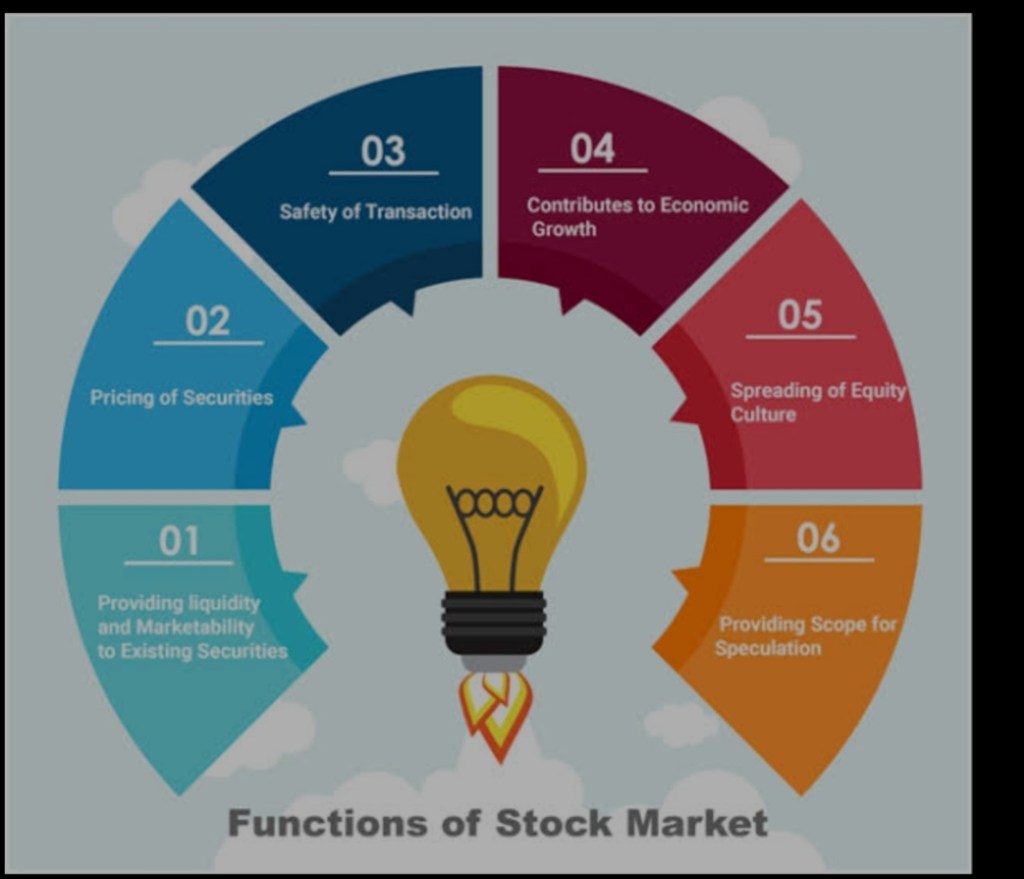


Stock exchange renders the following services :-

1:
Services to the Investors :-

• Investment guide :- Stock Exchange periodically publishes the quotations of listed securities. Investment can decide about purchase and sale of securities on the basis of stock exchange and quotations . Thus , the investors can get the maximum benefit from their investment.

• Liquidity of Investment :- Stock Exchanges are ready and continuous markets for purchase and sale of securities .The securities can easily be converted into cash as the needs of the investors arise .

• High Collateral Value of Listed Securities :- Listed securities in any stock high collateral value . These securities are preferred by rational investors . The securities of such companies can be sold easily . The investors have no fear of risk while trading in listed securities.

• Better use of Capital :-
The prices of shares reflect the profitability and efficiency of the company concerned . A stock exchange helps the investors in choosing good companies for their investment .

• Protection from Bad deliveries :- Securities in the stock exchanges are listed after the proper scrutiny . It prevents the trading of false and duplicate securities .

2:
Services to corporate sector

• Wide market for new securities :-
A stock exchange serves as a sales counter for new securities . Once a company gets listed in a stock exchange, it’s shares are traded freely in that exchange . Therefore , a company can raise a huge amount of capital from different types of investors.

• Increasing Goodwill of the company:-
The shares of only those companies are listed in the stock exchange which are financially sound . Therefore , listing of shares adds to the goodwill and credit standing of a company.

• Transfer of Securities at suitable prices :-
In the event of a merger or amalgamation ,the company whose securities are listed ,is in a better position than the company whose securities are not listed.

• Assist development of companies :-
A stock exchange is an essential adjunct of companies for quick capital formation . It provides a wider and a ready market for the secur of companies . It ensures higher bargaining power to companies in the event of further expansion and merger.

• Knowledge about future investment :-
Companies can get relevant information regarding trends of investment , investors choices and priorities etc., From the stock exchange on a regular basis .The companies can plan their future issue of capital on the basis of such information.

3: Services to Society :-

• Capital formation :- A stock exchange provides good investment opportunities to investors .It promotes the habit of savings and investment.

• Industrial Development :-
A stock exchange helps to mobilize public savings for the economical development of the country.This leads to industrial and commercial development .

• Utilizing scarce capital for productive purposes :- Idle lying funds can be invested in securities on account of stock exchange .

• Useful to Government :- The government plays a vital role as an entrepreneur in the promotion and management of commercial and industrial enterprises . A stock exchange helps the Government in raising sufficient funds for rapid industrial growth .


Operators In A Stock Exchange

Stock market operators are market participants who form a organise stock securities purchases and sales .

Generally found operators:-

Broker :-
A broker acts as a link between the investors and the jobber . He is a commission agent of buyer or seller of securities . A broker charges commissions from both the buyers and the sellers.
He does not specialize in any particular security .He assists in buying and selling all types of securities .

Jobber :-
Jobber can sell and purchase securities in his own name . He is a professional operator . He gets no commission for his service. His income is the profit in purchase and sale of his securities. The service of a jobber is both useful for both the investors and the stock exchange.


Speculators in Stock Exchange

On the basis of Zoological characters , speculators are of four types :-

Bull

In India , bull speculator is known as
Tejiwala “.
The stock market is called a ” bullish market ” when there are large numbers of bulls speculators .
A ‘bull’ is an optimistic speculator who buys securities with the exception of a rise in their prices . He makes purchases of Securities to be sold in future at a higher price to make profit .

Bear

In India , a ‘ bear ‘ speculator is known as a
Mandiwala “. When a stock market has large number of bears ,it is known as ” bearish market “.
A bear speculator expects a fall in the prices of securities . He sells securities with the hope of buying the same at a lower price before the date of delivery.

Stag

A ‘stag ‘ is a ” premium hunter “. He never holds securities as a permanent investment. He issues shares by the new company on the basis of their issued prospectus .He sells these shares at a premium soon after the allotment is made . The premium earned became his profit.

Lame & duck :-
A ‘lame-duck’ is a bear speculator struggling against the difficulties involved in meeting his commitments. He struggles like a duck to purchase shares so that he may deliver the same to another party . He is a bear speculator who is in no position to find shares .


Trading procedure in a Stock Exchange.

Trading in stock markets means the transfer (in exchange for money) of a stock or security from a seller to a buyer. This requires these two parties to agree on a price.


Procedure :-

• Selection of a broker
• Placing the order
• Executing the order
• Preparing the contract note
• Final settlement.

My year reading a book from every country in the world | Ann Morgan |

Something which kept me quite on to the edge was the reading journey taken up by Ann Morgan. It was quite wonderful of her to take up such a wonderful opportunity. As someone who loved to read I felt myself more closer to her perspective. I was able to identify myself with her and the way she spoke and carried herself, the more I noticed, the more I realized her idea of the world. 

The fact that we can understand a person by looking at their book shelf was a quite a point, Because we are what we read upon. What we encounter and read enhance us. They make us who we are. The socialization and books make us realize our potential. A good book is worth a good friend because it moulds you into a better version of yourself.

Reading about various things under the sun and not just sticking to one genre is very important for a reader. He/she must be ready to break the barriers and go beyond their comfort zone because it is only when we explore, we learn about the unknown and hidden and the voiceless. These are very important, because what the world need is a good reader because a good reader knows the world better than anyone else. The person will be objective and not subjective. A good reader knows the bias and learns to be impartial and be more open to the world. They know the  difference between empathy and sympathy. 

What Ann Morgan stresses again is that fact that if we need something so badly, then the whole world will be with us. Just like how Paulo Coelho said in Alchemist that if we really want something then the whole world will conspire. She brings in and stress some long forgotten words and values. 

I hope that more people realize the value of reading in their lives and learn to be better people and change the nation and break away from the stereotypes.

SOCIAL MEDIA

One in three-person have heard this word before and may had used it too frequently. But what social media stands for? Social media is a collective term for websites and applications which focus on communication, community-based input, interaction, content-sharing, and collaboration.  There are plethora of social media platforms present out there, which not only allow you to share your thoughts and ideas with the world but also provide a stage to do online business.

Types of platforms-

  1. Facebook and Instagram: they are a popular free social networking website that allows registered users to create profiles, upload photos, and videos, send messages and keep in touch with friends, family, and colleagues.
  2. Twitter: it is a free microblogging service that allows registered members to broadcast short posts called tweets. Twitter members can broadcast tweets and follow other users’ tweets by using multiple platforms and devices.
  3. Linkedln: it is a social networking site designed specifically for the business community. The goal of the site is to allow registered members to establish and document networks of people they know and trust professionally.

And much more others.

Social media networks help a person to expand his clients and work with larger networks easily.  You need to answer the question-  how much social media help my business to grow? And you are all set to join a large community of people needing your goods.

social media monitoring- analytics: what is happening at websites, who visited there and are interested in your business help you find a target audience you can put efforts to make a sale.

Social media is a large field where you can do diverse actions, make friends, learn new things, see what is trending in the world, stay updated with current happenings, and much more.

But you need to use it wisely due to ongoing cyber threats and lots of misshaping. to every coin, there are two sides you need to know both before flipping the same!

THE BEAUTY OF MOVIE POSTERS

When I was in primary school, I would always look outside my school bus through the window to look up at the billboards that had the movie posters. And I was so captivated by it that I started to read and study different kinds of posters.

Movie posters is something that most of us don’t pay much attention to, but it is far more important than just a piece of design or art. Movie posters fall somewhere between the realm of design and art. To make the poster feel cinematic, it requires a certain kind of aesthetic, sensibility and should also share a glimpse of the story. A movie poster can work wonders for the film, it can make it or break it. That’s why there are multiple poster designing agencies that only work in making the poster for the film.

In Hollywood, there are awards for remarkable poster art. The bar for posters is much lower in our country (mainly Bollywood). Before the trailer or the teaser of the film, the first thing that the audience sees is the poster. Without a poster, we are solely relying on words which can get dull very quickly.

As people who are not into filmmaking, we do not break down these posters and find the true meaning, so I will be breaking down 3 movie posters and show how I analyse a poster and discover the beauty that it holds.

Poster #1 : PSYCHO (1960) By Alfred Hitchcock

Psycho is a 1960 psychological thriller-horror movie directed by Alfred Hitchcock. The poster was designed by legendary graphic designer, & academy award winning film maker Saul bass. The poster contains 3 major things- the lead character of the movie, the title and the names of the cast, director, producer etc. the colours that are mainly used here are yellow, blue, red, white and black.

In the poster, the girl is looking away from the man in the back on the left side of the poster. She is also in her undergarments which indicates that she’s either a model or she is a victim to an assault. The picture of this character and the title are both in yellow, which indicates that there might be a connection between the two. The two men in red are smaller compared to the women in yellow, which indicates that their role is smaller compared to that of the woman’s. The fact that they are in red might symbolise that one could either be the love interest or a murderer. It also highlights the genre of the movie- which is thriller- horror. The colour black in the background sets the mysterious tone of the film.

So, what message does this poster send? The artist is trying to send the genre across to the viewers as the message. The genre is psychological thriller-horror. (Although it would have been easier had there been a weapon to give more clarity to the viewers)

Poster #2: JAWS (1975) by Steven Spielberg

Jaws is a 1975 horror-adventure film whose poster was designed by Roger Kastel.  This is a well know and an iconic film. It is still well known throughout the different age generations.

When we first look at the poster two things capture our attention. The first thing is the title “jaws” which is written in red bold letters. The red colour could be seen as representing blood and violence which is a hint to the films content. This allows the audience to know what they are getting into and what they can expect out of this film. The second thing that captures our attention is the shark attack and the victim who is unaware of her fate. The teeth of the shark are also visible which suggests that what was about to happen to the woman. The colour of the shark and the colour of the water are pretty similar, which tells us that the shark is camouflaged in water and also gives the element of surprise which makes it eviller. All these elements make the audience want to buy a ticket to the film and find out what happens next. 

Poster #3: LITTLE MISS SUNSHINE (2006) by Valerie Faris & Jonathan Dayton

Little Miss Sunshine is a comedy-drama film and its poster was designed by BLT Communications.

The first few things that we notice about this poster is the bright yellow colour, the Volkswagen van, and the characters running towards it. The image used on the poster is a still from the film. The yellow van signifies freedom and the word Volkswagen means ‘people’s car’ in German. These vans are notorious for breaking down and the films has used this to comic effect in their poster portraying a family running to keep up with a vehicle which has trouble breaking. The image of the car denotes travel which also has connotations of adventure and freedom, all key themes in the film. The image gives a clear visual representation of the plot and reflects the light-hearted tone of the film. The colour yellow ties in with the name of the film. This poster gives a clear visual representation of the story, cast, crew and genre. Together the image, colours and tag-lines create a representation of the film’s genre. From the poster, it is clear that audiences can expect a comedy, adventure drama.

Hence, posters are more important than you think. The saying “a picture is worth 1000 words” is true. One picture can tell a story in more detail than 1000 words ever could.

4 MAJOR LEARNING LESSONS FROM THE BOOK ‘THE ALCHEMIST’

1. NEVER GIVE UP

While pursuing your dream, you will come along many obstacles in your path, and they may make your moral down and you will think that you are not capable of achieving that thing, but don’t give up because god is testing you so give your best shot every time.

2. OVERCOME THE FEAR OF FAILURE

Fear of failure is worse than the failure itself and this the only thing that will hold you back from attaining your dream. So, the best way is to embrace this failures as learning and move ahead in your quest of finding your destiny.

3.TAKE ACTION

You will never learn how to do things unless you implement them , by taking actions because actions are the only ways of learning how to correctly do the things, and if you don’t take actions you will never learn.

4. ENJOY THE JOURNEY

Enjoy this journey of reaching towards your destiny, because this is the moment where you will learn many things ,you will meet many people, there will be ups and downs but these things only makes your journey memorable. So, enjoy every bit of these journey.

The Alchemist by Paulo Coelho

Complaints Never End!

What is the most important goal of you as a person? Having a perfect life, Or a happy one? Do we even have proper definitions to these terms available. Why is it so that we all are always just complaining, being sad about something or other going wrong in our lives. Why do we only wish to count the things we are lacking and not the ones which are present for us everyday. Well, may be because we are too busy in proving ourselves superior these days that we just couldn’t accept if anyone around possess anything better than us. And the fun fact is the other person is trying to do the same thing, and thus they try to hide their shortcomings and outshine themselves while actually they are into the same thought as yours. Moreover, in today’s scenarios people not only tend to show their superiority by their possessions but also in the problems of their life. Say, if you go to someone to vent about your problems they will try to demean the depth of your problem and describe their’s as a major issue.

WHAT IS THE ISSUE WITH US?

!ACCEPTANCE! The most important thing to have in life. And the thing most lacked by us, humans. It is the one thing which can solve 50% of our stress because as they say ” It’s all in the mind”. Accepting doesn’t mean to learn to settle for less, or to stop working to improve or to grow. Having a simple meaning, still a very crucial term to understand. As when interpreted wrong it could even make you resistant to your own growth. Acceptance is the the gratitude for good things and priviledges we have even if it’s those basic things like food to eat which thousands of people in the world are still deprived of, shelter to live while there are so many who still have no roof on their heads and still keep lurking here and there, clothes to wear that still is very hard to even afford for some and books to learn, as education being the strongest weapon to survive in this World has to be considered a basic necessity for all. However, many of them doesn’t even understand the meaning of this term. Acceptance is the sense of Belongingness we get from our beloved family and friends around us, the ones who care for us and deserve to be loved back. The true value of such relations is understood by the individuals who have no friends, by the kids who lost their families/ parents at an early age, those old age people whose children separated from them. Thus, instead of trying to make them feel inferior or boasting about oneself we should be celebrating ans supporting each other with love and care as we humas are here for each other, by each other. Acceptance is the fact that life doesn’t need to be perfect and happiness doesn’t come from luxuries. Rather, it solely depends on your state of mind in every situation.

Life is made up of both, JOYS and SORROWS..

Problems and situations has to be present each day! Or else what else you could be doing with the time regularly. Being stressed regularly is a burden, likewise enjoying regularly will bore you with it someday soon too. Imbalance works nowhere, and that is why you get both joys and sorrows equally or based on the decisions you make in life. This is what our lives are all about, as days of relaxation and entertainment are there to make us realise the beauty of our life. The troublesome days are here to provide you with lessons of life, to build your knowledge of how you solve and create, to let you grow. Solving problematic situations gets you acknowledged with the opportunities you can use to create the methodologies and ethics to be followed by you for the entire lifetime. With every step you climb, you learn from the bygones and take precautions from making similar mistakes and realise the value of certain things or people you should have been happy about. This is how the life cycle works, right.

Realise before it goes away.

As the times passes, individuals and possessions come and go, it depends upon you which ones you hold or let go. Complaining or being jealous doesn’t helps you get something but, acceptance surely would strength you to move on and find happiness and peace in the hardest situations too. Learn to value what belongs to you, and not always what you desire. Materials doesn’t die along with you,those are feelings and satisfaction that survive until the end and provide you the smile at the end of the day.

In such cases, Often The best motivations are when you look up to some real life stories and the protagonist of these stories growing through. Because, then you could believe the actual importance to a specific lesson. So here are a few links for you to hear actual people and learn ;

It took me 20 years to accept myself

You don’t find happiness, you create it!

Book Reviews

The Books are of  knowledge oceans, from every book we learn some thing new and to improve our knowledge and build our personality

BOOK Defination  

we all know that a lot of English words come from ancient Latin – that’s because the Romans occupied England for almost five hundred years from 54BC to 410 AD. … The word book comes from Old English “boc” which in its turn comes from a Germanic root “*bok-“, which means “beech” – as in the beech tree

Types of Book Reviews

Endorsements: Hand-picking Relevant Reviewers Before Your Book is Published. …

Trade Reviews: Publishing Professionals May Advocate Your Book To The Industry. …

Reader Reviews: Individuals Recommending Your Book To Each Other. …

Editorial Reviews: Third Parties Publishing Reviews About Your Book.

Why write book reviews

Book reviews give books greater visibility and a greater chance of getting found by more readers. On some websites, books that have more book reviews are more likely to be shown to prospective readers and buyers as compared to books with few or no book reviews.

How to write a book review

  • Start with a couple of sentences describing what the book is about. …
  • Discuss what you particularly liked about the book. …
  • Mention anything you disliked about the book. …
  • Round up your review. …
  • You can give the book a rating, for example a mark out of five or ten, if you like!

In this days most of people like to read blogs because they have simple and clear to understand content

Some of people read books by help of Book review, its give simple summary to understand that book

PHOBIA


                     “Nothing in life is to be feared. It is only to be understood.’
                    
                                         –Marie Curie

A phobia is a persistent, excessive, unrealistic fear of an object, person, animal, activity or situation. It is a type of anxiety disorder. A person with a phobia either tries to avoid the thing that triggers the fear, or endures it with great anxiety and distress. Some phobias are very specific and limited

There are three types of phobia: social phobia, agoraphobia, and specific phobia. Symptoms, or phobic reactions, may be psychological, such as an intense feeling of unease or foreboding; physical, such as crying or gastrointestinal distress; or behavioral, which includes a wide variety of avoidance tactics

Some of humanity’s most common fears are well known, like fear of heights or the dark. Others, however, are less talked-about, like the fear of speaking to strangers due to thoughts of what they might think of you. To free yourself of these fears, it’s not enough to change the channel or end the conversation.

Fear is a natural emotion that protects people from harm when they face real and imminent danger. A phobia is an excessive fear or anxiety related to specific objects or situations that are out of proportion to the actual danger they present.

                                  “The brave man is not he who does not feel afraid, but he who conquers that fear.”

                                –Nelson Mandela

Animals rights awareness week

Animal Rights Awareness is observed this June 14 – June 20. Animal Rights Awareness Week(ARAW) is created to honour the animals who have been exploited and killed by humans around the world. It is our duty to spread the awareness among humans as animals can be our friends, companions, protectors, benefactors and comforters. Research studies indicate that people has own pets and have close bond with them and have higher self esteem. They are also generally happier and healthier.

The aim of this week is to create an opportunity to direct the public’s attention to the needs and wants of animals.

History of Animal Rights Awareness Week

In 1991 Animal Rights awareness week founded to promote education about animals welfare and bring further protection to animals.

Several ways to participate in spreading awareness concerning the human treatment of animals are:

  1. Adopt shelter for pets.
  2. Do programs in your area and spread the importance of animals.
  3. Buy cruelty-free products.
  4. Know where your products come from and determine whether they are obtained humanely.
  5. Consider adopting pets from shelter.
  6. If you do decide to buy from a breeder make sure to do your research and find reputed one.

Many zoos function as an extension to conservation and preservation efforts, others do not. The conditions in puppy mills, for example, do not provide proper shelter or care. Most of the dogs are used solely for breeding purposes and rarely leave their kennels or receive proper veterinary care.

Book Reviews

Pin on libros

TOPICS OF BOOK REVIEWS:-

* Goodreads

* LibraryThing

* Reedsy Discovery

* LoveReading

* The Millions

* A Promised Land

* Alice’s Adventures in Wonderland

* Luster

* The Tenant of Wildfell Hall

* Uncanny Valley

1. Goodreads:-

Goodreads
Review Styles: star rating, community reviews
It’s impossible not to mention Goodreads when discussing book communities: it’s the Facebook of book reviews — the ultimate social media platform for bibliophiles. If you’ve somehow managed to go this long without stumbling upon this omnipresent site, here’s the run-down: you can use Goodreads to organize, display, and discuss your virtual bookshelf with other users.
Goodreads recommendations are based on your listed interests. You can follow authors and book influencers ranging from Celeste Ng to Bill Gates. This allows you to see all their reviews, which vary from compact one-liners to critical analysis, and watch the new reviews roll in. For a quick verdict, just take a look at the star rating that they give the book.
Also if you like to browse lists, Goodreads compiles the best and most popular books for every genre. There’s also the annual Goodreads’ Choice Awards to celebrate each year’s new releases, where you can cast your vote or peruse the list of contenders to find a new book to read. It’s a site for every kind of reader, with abundant ways to comment and interact

2. LibraryThing:-

LibraryThing
Review Styles: star rating, recommendation, community reviews
This is the OG of all online book catalogues and discussion boards — take a look and you’ll see that it’s an oldie but a goodie. Of course, the basic functions of LibraryThing are rather similar to Goodreads: there are millions of books that readers can add to their lists, as well as review with star ratings.
While the interface harks back to the earlier days of the world wide web, LibraryThing has a secret weapon that’ll appeal to all readers, especially modern ones: their Zeitgeist. This page displays the crème de la crème of the whole site, from the most popular books to the hottest reviews, which is updated constantly. Just a glance shows that the readers here know how to read between the lines and wield their words!
So if you’re hoping to read or share some in-depth literary thoughts with fellow sharp-minded users , LibraryThing is the site to browse. (You can even access it without creating an account!)

3. Reedsy Discovery:-

Reedsy Discovery
Review Styles: star rating, recommendation, editorial reviews, community reviews (video option available)
Now, if you’re searching for some hidden gems to peruse, Reedsy Discovery’s got your back. While our blog features everything from classics to contemporary hits, Discovery’s specialty is indie publications, many of which are accompanied with succinct comments from experienced reviewers. There’s no better way to broaden your horizon!
Moreover, if casual and creative reviews are more your cup of tea, then rejoice: the burgeoning community of readers on Discovery can leave comments, one-line reviews, and video reviews (calling all Booktubers!) on just about any book. It’s a fun and interactive way to geek out over your favorite reads and discover all the coolest new titles you won’t find anywhere else.

4. LoveReading:-

LoveReading
Review styles: staff and guest contributor reviews
Though it’s UK-based, this prolific site caters to audiences around the world. LoveReading is strictly a reviewing site, with a base of staff writers and carefully selected contributors, so you know the reviews are top-notch. The staff often give quite personal reading experiences in their reviews, which make their recommendations very endearing, like they’re from a close friend. They even offer you presents — well, if you think of giveaways as presents!
LoveReading covers books from every genre you can think of. They also have weekly, monthly, and yearly list features to keep you up to date with the latest stellar releases, so you’ll never be in want of something to pore over.

5. The Millions:-

Review styles: professional and guest contributor reviews
In search of reviews that really dive into the themes, metaphors, and overall executions of interesting and highbrow books? The Millions has got you covered.
Written by a collection of seasoned critics, these reviews are speckled with memorable quotes, elegant analysis, and plentiful comparisons to other works — which means extra reading recommendations for you! If contemporary and literary fictions are your go-tos, then The Millions is the site for all your lit nerd needs.

6. A Promised Land:-

A Promised Land_Barack Obama
Nate Marshall on Barack Obama’s A Promised Land (Chicago Tribune)
A book review rarely leads to a segment on The 11th Hour with Brian Williams, but that’s what happened to Nate Marshall last month. I love how he combines a traditional review with a personal essay—a hybrid form that has become my favorite subgenre of criticism.
“The presidential memoir so often falls flat because it works against the strengths of the memoir form. Rather than take a slice of one’s life to lay bare and come to a revelation about the self or the world, the presidential memoir seeks to take the sum of a life to defend one’s actions. These sorts of memoirs are an attempt maybe not to rewrite history, but to situate history in the most rosy frame. It is by nature defensive and in this book, we see Obama’s primary defensive tool, his prodigious mind and proclivity toward over-considering every detail.”

7. Alice’s Adventures in Wonderland:-

Alice’s Adventures in Wonderland
Merve Emre on Lewis Carroll’s Alice’s Adventures in Wonderland (The Point)
I’m a huge fan of writing about books that weren’t just published in the last 10 seconds. And speaking of that hybrid form above, Merve Emre is one of its finest practitioners. This piece made me laugh out loud and changed the way I think about Lewis Carroll.
“I lie awake at night and concentrate on Alice, on why my children have fixated on this book at this particular moment. Part of it must be that I have told them it ‘takes place’ in Oxford, and now Oxford—or more specifically, the college whose grounds grow into our garden—marks the physical limits of their world. Now that we can no longer move about freely, no longer go to new places to see new things, we are trying to find ways to estrange the places and objects that are already familiar to us.”

8. Luster:-

Luster_Raven Leilani
Parul Sehgal on Raven Leilani’s Luster (The New York Times Book Review)
Once again, Sehgal remains the best lede writer in the business. I challenge you to read the opening of any Sehgal review and stop there.
“You may know of the hemline theory—the idea that skirt lengths fluctuate with the stock market, rising in boom times and growing longer in recessions. Perhaps publishing has a parallel; call it the blurb theory. The more strained our circumstances, the more manic the publicity machine, the more breathless and orotund the advance praise. Blurbers (and critics) speak with a reverent quiver of this moment, anointing every other book its guide, every second writer its essential voice.”

9. The Tenant of Wildfell Hall:-

The Tenant of Wildfell Hall
Constance Grady on Anne Brontë’s The Tenant of Wildfell Hall (Vox)

Restoring the legacies of ill-forgotten books is one of our duties as critics. Grady’s take on “the least famous sister in a family of celebrated geniuses” makes a good case for Wildfell Hall’s place alongside Wuthering Heights and Jane Eyre in the Romantic canon.

“[T]he heart of this book is a portrait of a woman surviving and flourishing after abuse, and in that, The Tenant of Wildfell Hall feels unnervingly modern. It is fresh, shocking, and wholly new today, 200 years after the birth of its author.”

10. Uncanny Valley:-

Uncanny Valley_Anna Wiener
Ismail Muhammad on Anna Wiener’s Uncanny Valley (The Atlantic)
Muhammad is a philosophical critic, so it’s always fun to see him tackle a book with big ideas. Here, he makes an enlightened connection between Wiener’s Silicon Valley memoir and Michael Lewis’s 1989 Wall Street exposé, Liar’s Poker.
“Like Lewis, Wiener found ‘a way out of unhappiness’ by writing her own gimlet-eyed generational portrait that doubles as a cautionary tale of systemic dysfunction. But if her chronicle acquires anything like the must-read status that Lewis’s antic tale of a Princeton art-history major’s stint at Salomon Brothers did, it will be for a different reason. For all her caustic insight and droll portraiture, Wiener is on an earnest quest likely to resonate with a public that has been sleepwalking through tech’s gradual reshaping of society.”
Referance Link:
https://reedsy.com/discovery/blog/book-review-sites
https://lithub.com/the-10-best-book-reviews-of-2020/

INDIA AND INDUSTRIAL REVOLUTION 4.0 Part-1

The industrial revolution is the advancement in manufacturing processes. The industrial revolution began in Europe in the 17th century. It was the first Industrial Revolution.  With the advancements in machines and manufacturing processes, Industrial revolution 2, 3 and 4 came into existence.

Industrial Revolution 2.0 started just after the first industrial revolution. It was also coined as Technological Revolution. The area of influence of the Industrial Revolution 2.0 was mainly Britain, America and parts of Germany.

The third industrial revolution began with the era of computers. With the widespread use of computers, and the capability to do superhuman things, Industrial revolution 3.0 started. Industrial revolution 3.0 stated the use of programming logic controllers. It also laid foundations for Industrial revolution 4.0.

The industrial revolution, also coined as “smart factory”, is the dependency of machines and smart reality at the more ease and comfort with more increase in production. In essence, industry 4.0 is the trend towards automation and data exchange in manufacturing technologies and processes which include cyber-physical systems (CPS), the internet of things (IoT), industrial internet of things, cloud computing, cognitive computing and artificial intelligence.

Industrial Revolution 4.0 consists of different aspects viz.

1.Internet of Things

2.Smart Sensors

3.Advanced robotics

4.Big Data Analytics

5.3D Printing

6.Augmented reality

7.Cloud computing

8.Location Detection

1.Internet of Things

The ability to transfer data over a network without requiring human-to-human or human-to-computer interaction is known as the Internet of Things.

In simple language, when things communicate with each other over a common network, it is known as the Internet of things. In the consumer market, IoT is synonymous with home automation, home security and systems that can be controlled with devices related to that ecosystem like smartphones.

2. Smart sensors

Smart sensors are a major part of the Internet of Things. They are equipped with a digital interface, and they perform self-diagnosis by monitoring internal defects for evidence of faults.

The most important feature of a smart sensor is the ability to communicate, which can be done by displaying the data directly to the user and transfer it over a wired interface wirelessly.

3.Advanced robotics

Advanced robotics is the use of sensors that allow a robot to interact with the real world. The concept of creating machines that can operate autonomously dates back to classical times, but research into the functionality and potential uses of robots did not grow substantially until the 20th century. Throughout history, it has been frequently assumed by various scholars, inventors, engineers, and technicians that robots will one day be able to mimic human behaviour and manage tasks in a human-like fashion. Today, robotics is a rapidly growing field, as technological advances continue; researching, designing, and building new robots serve various practical purposes, whether domestically, commercially, or militarily.

4. Big Data Analytics

Big Data analytics is the process of collecting, organizing and analyzing large sets of data (called Big Data) to discover patterns and other useful information. Big Data analytics can help organizations to better understand the information contained within the data and will also help identify the data that is most important to the business and future business decisions.

5. 3D Printing

3D printing covers a variety of processes in which material is joined or solidified under computer control to create a three-dimensional object, with the material being added together (such as liquid molecules or powder grains being fused), typically layer by layer.

6.Augmented reality

Augmented reality (AR) is one of the biggest technology trends right now, and it’s only going to get bigger as AR ready smartphones and other devices become more accessible around the world. AR let us see the real-life environment right in front of us. Perhaps the most famous example of AR technology is the mobile app Pokemon Go, which was released in 2016 and quickly became an inescapable sensation.

7.Cloud computing

In its most simple description, cloud computing is taking services (“cloud services”) and moving them outside an organization’s firewall. Applications, storage and other services are accessed via the Web. The services are delivered and used over the Internet and are paid for by the cloud customer on an as-needed or pay-per-use business model.

8.Location Detection

Several technologies can provide real-time information about the location of devices, and hence the location of users of the devices. The types of devices that can be located include mobile telephones, laptop computers, personal digital assistants and gaming consoles. There are many location detection technologies, such as the global positioning system (GPS)

Read more about India and Industrial Revolution in next part, INDIA AND INDUSTRIAL REVOLUTION 4.0 Part-2.

“The Funny boy” – A Homosexual Novel of searching identity

“For me, growing up, I felt like there was something fatally and tragically flawed in my nature and that it was my duty to try to avoid falling for that vice”.

– Shyam Selvadurai

Certainly, we all as a human, face some sort of battle within ourselves, might be towards our identity or maybe our existence. The worst crisis any human can face is the crisis within him/herself. It is one of the dangerous crises any person goes through, and this is what the author Shyam Selvadurai had gone in his own life which he portrayed in the novel “Funny Boy” through the main protagonist “Arjun” aka “Arjie”.

The Funny Boy – A Background :

The novel evidently sets in the early 1980’s at the consequent of Sri Lankan civil war, which showcase us the disputes and riots of Tamil – Sinhalese Historical enmity towards each other. The novel is divided into 6 chapters, in which every chapter has its own uniqueness which makes the novel more explicit.

The 1st chapter, “Pigs can’t fly”, begins with the Naïve life of the main character Arjie and his reminiscence of his childhood days, where he presents his own baffled thoughts of his own existence of, he being “Different” from other boys of his age. He was anxious and felt that his interests in playing with dolls and girls is a taboo for society whereas playing cricket will make him an ideal boy in the society.

“Life is full of stupid things and sometimes we just have to do them”, Arjie’s Amma says this to him when he refused to play with boys and instead, he likes to wear saree and play, “bride- bride” with his female cousins.

 This shows us how this chapter portray us that our society is prejudice towards the gender norms in which all of us are distributed. In one of the incidents when the relatives of Arjie saw him wearing a saree , made him a center of laughter and mocked him by saying him “ Funny”, through which the author tried to showcase us that the third Gender in our society is considered as unethical or as a clown which is irrelevant to the society, namely the title of the chapter “Pigs can’t fly’’, presents us how people in our society don’t accept the people who belongs to the third gender as according to them, pigs represents the people who are transgenders or gay like Arjie are breaking the norms of the culture.

Any war, riots or a sense of violence happens within the human minds, and politically, language and cultures drift us apart sometimes to establish a war”, this quote is well explained in the second chapter “Radha Aunty”, where this chapter explains us how casteism becomes a hurdle, when people fall in love.

They say that “If two people love each other, the rest is unimportant.”

“No, it isn’t. Ultimately, you must live in the real world.

And without your family you are nothing.”

The Funny Boy

By this quote, the author explains us the tragic love story of Radha Aunty and Anil Uncle who wanted to get marry, but the enmity and disbelief in both the communities of Tamil and Sinhalese made them apart! Indeed, this tragedy is obvious to show us the situation of the Sri Lankan civil war and the rules in which people were abused to be in. Incidents of Radha Aunty where she was brutally attacked by 2 Sinhalese people show us how threatening Humans were demons for each other.

“See no evil, hear no evil”, is the chapter 3 where show us one more Tragic incident happened with “Daryl Uncle”, we can say that the novel has a theme of failed love relationships, casteism, hatred, war, and disputes, as this chapter encloses about the incident of how Daryl uncle died or rather got murdered. It portrays us how violent was the time in columbo when the Journalist like Daryl uncle was abused and murdered.

In chapter 4, “Small Choices”, we get to know about Arjie’s feelings for the male character Jegan, who came to work in Appa’s hotel. This is the chapter where Arjie started to know about his identity but hide from the outer world as it was against the norms, which Arjie felt his feelings for men is Immorality. This chapter also counts about Anti- Tamilians and how these community was making a life miserable for the innocent people of Columbo.

Often, we know who we are, what is our identity, but because of the taboo inflicted in the society, we escape from our originality and behave as how the society wants to picture us. This is what Arjie was doing to be a normal ideal boy, but somewhere he was an abnormal boy (according to him) because of his gay feelings for the character Shehan in chapter 5, “The Best School of All “show us. When Arjie fell in love with Shehan, his perception for life and his ideology of his identity changed when he met shehan and shehan removed all the perplexed thoughts floating in the minds of Arjie. Shehan made Arjie realized that “We should ultimately know who we are! We should not hide identity from ourselves”. This is what made Arjie realize that he should respect himself and his identity. This was the chapter where he was not afraid of who he was and his sexual desires for Shehan was totally legit. In this chapter, Arjie was proud to be himself as a gay and his love for Shehan was compatible.

In “Riot Journal: An Epilogue’’ is the last chapter where Arjie wrote a journal on the effects and incidents of riots and its impact how ruined his life and lost his parents. The books end in a dismal and with a sense of alienation of Arjie and the tragic feelings inculcated and made him hollow.

Funny Boy – A Novel to explore one’s own identity !

Still unending war a human faces within himself/ Herself when it is about recognizing one’s own identity. We Humans have a psychology of hiding our real personality infront of other humans which is basically due to the age old cliché ideology of “Acceptance in the society”, due to which people hide there real self.

As Humans, we live in society and communities in which we have an urge of desire that we need love, cherishment, respect and acceptance in return, thus when we don’t get it we realize we are different from others, which ultimately makes us feel that we are an outcast from our society. so, as a part of community we behave as the world wants us to behave.

Whereas, “The Funny Boy” is the best novel of all which provides you that particular kind of Catharsis if you not aware of yourself!

So, a personal recommendation to the Bibliophile out there , Go check this Book which is not only a homosexual novel, but a novel which is Heartening and will open your insights to understand your real self.

How To Be More Assertive

I learned to be assertive from my mother. She always expresses her feelings, is comfortable with saying no, acts in her family’s best interest, and also thinks about the common good.

She’s the most assertive person I know. No one can take advantage of her. If you try, she will let you know about it. And you won’t like it. 

What is assertiveness actually? Robert E. Alberti and Michael L. Emmons are considered the lead experts in this field. Their book Your Perfect Right, first published in 1970, is considered a classic on the topic. They define assertive behavior as follows:

“Behavior which enables a person to act in his own best interests, to stand up for himself without undue anxiety, to express his honest feeling comfortably, or to exercise his own rights without denying the rights of others.”

In general, there are three types of behavior:

  1. Passive: Indirect, dishonest, does not take control, is nice at all cost, focuses on others.
  2. Assertive: Direct, honest, self-worth, to the point, focuses on the self, respects others.
  3. Aggressive: Harmful, egocentric, will to win at any cost, justifies the means, wants to control others.

If you watch our society, most behavior happens at the extremes. How often do you experience dishonesty at home, with your friends, and at work? It’s not always because people have evil intentions. Too often, it’s because most people are passive. They are afraid of the confrontation, and instead, they prefer to lie. 

But there are also a lot of aggressive people. People say that aggression is becoming more common in the world. I don’t know about that, but I do know that no one wants to be around aggressive people. 

The middle is where you want to be. You want to be respectful, firm, and not aggressive. That’s what assertiveness is all about.

An Assertiveness Technique 

But how do you become more assertive? Like anything in life you want to improve, you must practice. And the best way to practice is on aggressive people and in confrontational situations. 

Next time you experience a stressful situation or when you must deal with an aggressive person, do the following: Detach from the person and situation. Tell yourself you’re observing the situation. 

You never want to get emotionally involved. That’s the most important thing if you want to be more assertive. And once you’re detached, you simply get to the point. I know this sounds vague, so let me give you an example.

The other day I called a construction company that’s supposed to fix a leakage problem I had at my apartment. The guy tried to brush me off and wasn’t too subtle about it: “We don’t have anyone right now.”

I paused, detached from the situation, realized it wasn’t personal, and said: “What am I supposed to do? Let everything go to waste when it rains? What would you do?” 

It went on like that for a while until he finally said, “Alright, fine, I’ll come by myself.” Two hours later, he came to my apartment and fixed the leakage. Problem solved. 

Often, we escalate situations that are not necessarily bad. That’s because we allow them to become personal. But we must realize that other people have their own issues. It’s never personal. Or, we do the opposite: We do everything to avoid escalation. But that only works against us.

In the past, if something like this happened, I would say, “Okay. When can you send someone over?” And then I had to wait. That’s classic passivity.

In this world, you have to be assertive to get what you want. You don’t have to act like a bully, but you have to be a little demanding. I see it as honesty. I was simply honest with that guy. I had a problem that needed to be fixed.

It’s All About Practicing

When we become more assertive, we need to be careful not to overdo it. Otherwise, we risk becoming aggressive or overly dominant. Recent research showed that informal leaders were more liked and respected when they had “a moderate amount of assertiveness and warmth.”

That’s very accurate. When we are too nice, we risk that people take advantage of us. When we are too aggressive, we push people away. But if we’re direct and are respectful to people at the same time, we can get much more done together.

Unfortunately, you only become more assertive by being more assertive. You must practice. What helps is to see every social situation as a negotiation.

I highly recommend reading Never Split The Difference by Chris Voss. In fact, I learned the “How am I supposed to do that?” technique from that book. When people give you a proposal you don’t like, ask them that question. In my case, I changed it to “What am I supposed to do?” 

You put the ball in the other person’s court. That’s a good way to deal with difficult situations. Let others come up with a solution. But sometimes, people need a little push to make that happen. And that’s exactly what assertiveness is: A little push in the right direction.

THE GOLDEN childhood DAYS

The golden days of childhood will never comeback.

The irony is when we are children we want to grow up fast but when we are an adult and we have to make choices, take decisions and bear responsibilities we want to return to our golden childhood days

I say it golden because it so precious and valuable to us when we talk about childhood days we always remember it as our best time in our life.

Do you guys remember how we used to bunk school when it rains ,and how happy we used to feel when the school used to declare holiday on weekdays unexpectedly

I know most of you also tried to fool your mother by saying you have stomachache or fever, so that you can stay at home but in vain they easily catch our tricks. we are the fools to think we can fool our parents.

we used to love when teachers give us free sports period so that we can play, we used to play so many games, playing rock paper scissors ,hand cricket, ice or water, hide and seek.

when we used to win prizes in events conducted by school and we used to do projects, we used to go to trips to museums, zoo and parks.

Especially sharing food in break time and trying different varieties was also memorable.

We feel so elated by thinking that we made a masterpiece by drawing whatever we used to feel and as you guys already for making a masterpiece the paint should be everywhere else except on the paper.

Photo by Sharon McCutcheon on Pexels.com

I used to love playing with bubbles, especially playing with balloons, and flying kites on the occasion of sankranthi.

I used to love the time we used to spend playing word games, singing songs in bus while coming home ,and not to forget the card games and board games .Racing with bicycles and skating also used to be my favourite leisure time.

How can we forget all the kinds of snacks like pichu mithai(sugar candy), coconut toffee, biscuits, so many varieties and also the figurines we used to win

Waking up early mornings to watch your favorite cartoon was always so fun, but we used to be always late for school. I know we have got our own priorities first ,hehe

Do you guys still remember how we use to use glitter pens ,sketch pens ,stickers and various types of things to decorate our projects, and the pride we used feel when our drawing or project are displayed on the notice board ,participating in quiz competitions, debates were also fun

Every time we used to think of new stories to write in the exam and end up writing film stories > <

Photo by Helena Lopes on Pexels.com

Those days where running even a small errand for mother and bringing back the exact amount was a matter of pride and was always excited to run errands for them unlike. The things which we used to do happily are a hassle now.

I know we are grown ups and we should understand and be more matured about the situations

But its ok to miss those days and bring out our memories into our present. Its ok to enjoy the things that we like and enjoy, age doesn’t matter.

People can still spend some time on themselves, on their own happiness and don’t care about this whole” you are an adult you cant like these thing at your age, you can’t do this at your age”.

Child hood is a phase that everyone goes through and that golden time will never comeback, but we should never forget lessons learnt in our childhood.

The main thing, the essence of our childhood that is the pure happiness we feel from encountering smallest things is our golden time although short but definitely sweet

Thankyou^^ and keep smiling.

ONLINE VS OFFLINE CLASS – WHICH MAKES BETTER SENSE?

We all live in a society where education is taught in schools and colleges in the classroom environment. We have been following this method of teaching from a very old time. Suddenly we were forced to face a situation like a pandemic and were told to make ourselves ready for whatever is going to happen next. As a result of the lockdown schools, colleges and all other educational institutions were shut. The government advised the institutions to take up classes through online mode. When all the students and teachers heard this, it created a mere shock. But we had no other option to choose. So, we started to adapt ourselves to the situation. It has been almost more than a year by now since schools and colleges started to function online. Having a year of experience taking up classes online, I would like to describe the pros and cons of both online and offline classes that I have understood.

ONLINE CLASS 

Starting with the advantages we gained through online classes, all of us would have felt that we got more time for relaxing and engaging ourselves in doing our hobbies. When we had offline classes, we would spend time dressing up and traveling to school or college. But online, we don’t have to spend our time on all that and we could use it effectively. Also, the training or lectures can be conducted from anywhere in the world. Participants are just needed to log on to their internet from anywhere. Online learning is more flexible as it is offered through many platforms. Another advantage that I felt personally is that people who were reluctant to open up and speak in the classroom gained some confidence and interacted in the online mode. This would help introverts to come out of their cages. It would also help them to build their interpersonal skills and come out of their comfort zone. In online teaching, the lectures are taken through videos, presentations, or activities which is more interactive than the conservative classroom environment and encourages students to engage with interest. 

OFFLINE CLASS

Although we have considerable advantages in online learning, we always prefer offline classes as we are conditioned to listen to lectures in that way from our childhood. Maybe online classes would be comfortable for kids even after when they grow since they are practiced to that way of learning. If we ask ourselves a question, whether we are comfortable with online class, we would say no but yes, we got used to it by now. Not only this we have many advantages in offline learning. The concepts related to mathematics and algorithms were clearer when it was taught in the board-chalk method and it would be easier for us as students to clarify our doubts. The student-teacher relationship is developed better in offline classes than on virtual platforms. The subjects that needed laboratory training would be possible only through offline mode. In offline classes, we would be made to sit in one place to listen to the lessons and we are not allowed to move from there. This would make something go into our heads as we have to look at the teacher’s face and make eye contact frequently. So even if we are not in the mood to listen, we would end up listening in one way or the other. But in the online way of teaching, there is no one to monitor us and our activities. We can do whatever we wanted to whenever it’s a boring session. This would affect only us as the students during their exams and skill test. Another one is that we couldn’t spend time with our friends virtually as we do in our schools and colleges. Those moments that we share in between the classes and breaks are heavenly and nothing can replace the joy that we get through chitchatting and roaming around with our gang.

So, both offline and virtual learning have their advantages but the online mode cannot provide as much pleasure and enjoyment as the real meetings. Let us hope and pray to get things better and come back to our normal lives with a bang.