17 dangerous apps removed from Google Play Store, delete them instantly from phone

Priya Yadav,

During the second week of July and September, Google removed 17 apps from the Play Store. These apps were malware-infected. In July, the tech giant has banned 11 while 6 apps from the Play Store a few days ago. Now, these 17 apps are not available on Google and they cannot be downloaded.

The 17 apps that were removed from the Play Store were all affected by a new variant of malware called Joker. Researchers at Check Point detected these malware apps in July. According to reports, Google has been tracking these apps since 2017.
After these 11 apps were removed from the Play Store, Joker malware came in the form of 6 other apps on the Google Play Store in a new form. Now, these 6 apps are also removed. According to cybersecurity firm Pradeo, these 6 apps have been downloaded nearly 2 million times before they were removed from the Play Store.
The apps which are removed are:-
com.imagecompress.android, com.contact.withme.texts, com.hmvoice.friendsms,
com.relax.relaxation.androidsms, com.cheery.message.sendsms,
com.peason.lovinglovemessage,
com.file.recovefiles,
com.LPlocker.lockapps,
com.remindme.alram,
com.training.memorygame,
Safety AppLock,
Convenient Scanner 2,
Push Message- Texting & SMS,
Emoji Wallpaper,
Separate Doc Scanner,
Fingertip GameBox,
These 17 apps are no longer available on the Play Store. And if any of these apps is present in your smartphone, then delete it immediately.

The Joker malware that infects these apps is a malicious bot that has been categorized as fleeceware. The main function of this malware is to collect clicks and intercept SMS so that users can be subscribed to paid premium services without their knowledge. The Joker uses little code and it leaves no mark, making it difficult to detect.

Serological Testing at CSIR-CDRI, Lucknow for antibodies against Corona Virus (SARS-CoV-2)

CSIR-CDRI (Central Drug Research Institute) is carrying out a research study that involves testing of people for antibodies against SARS-CoV-2. The serological testing is conducted from 9th-11th September. For the past 7 months we are in the midst of a pandemic of coronavirus (COVID-19) infection with more than 45 lakh individuals being infected with the virus which has resulted in more than 76,270 deaths in India.

Dr. Susanta Kar and Dr. Amit Lahiri, the nodal scientists from CSIR-CDRI, said that the diagnostic tests performed in India have been largely limited to people showing symptoms and those who have come in close contact with these individuals. Most importantly, community testing has not been initiated yet. From the reports available from various countries it can be perceived that there are many more asymptomatic cases who have not been tested. Thus, the burden of the disease could be larger.

Dr. Kar and Dr. Lahiri also stated that, a person infected with the disease will generate antibodies which is expected to protect them for further infection. However, since this is a novel virus, the duration of protection from antibodies is not known. It is therefore important to perform a long-term pan-India surveillance using serology-based assays to not only estimate the burden of the infection, but also assess thetitres of the antibodies by collecting samples at fixed intervals. This will also help us to identify people who can also donate their plasma to the terminally ill COVID patients.

Prof. Tapas K Kundu, The Director CSIR-CDRI, said that the establishment of such a cohort with longitudinal biological sampling will also align with the framework of the National Health Mission and will facilitate the development of national reference standards to aid clinical decision making as well as national healthcare policy decisions. It will also help address several unanswered questions on the infection caused by novel Corona virus.

The test is VOLUNTARY and free of cost and is open to all CSIR staff and students. Blood samples will be collected from those who are willing to participate in the CDRI dispensary under the supervision of resident doctors Dr. Shalini Gupta and Dr. Vivek Bhosale. The presence or absence of anti-SARS-CoV2 antibody titers in CSIR staff and students will then be assessed using ELISA based assay at CSIR-IGIB, New Delhi. Other biochemical parameters also will be measured to ascertain correlation between Cardio-metabolic risk factors and the possibility of recurrent infection. This project will align well with the CSIR’s Indigenous program “Phenome India – A long-term longitudinal observational cohort study of health outcomes”

Quick Estimates of Index of Industrial Production and Use-Based Index

The Quick Estimates of Index of Industrial Production (IIP) are released on 12th of every month (or previous working day if 12th is a holiday) with a six weeks lag and compiled with data received from source agencies, who in turn receive the data from the producing factories/ establishments.

Photo by dinesh boaz on Pexels.com

2.        In view of the preventive measures and announcement of nation-wide lockdown by the Government to contain spread of COVID-19 pandemic, a large number of the industrial sector establishments were not operating from the end of March, 2020 onwards. This has had an impact on the items being produced by the establishments during the period of lockdown. With the lifting of restrictions in the subsequent periods, industrial activity is resuming. The Index for the month of July 2020 stands at 118.1 as compared to 54.0, 89.5 and 108.9 for April 2020, May 2020 and June 2020.

3.        For the month of July 2020, the Quick Estimates of Index of Industrial Production (IIP)with base 2011-12 stands at 118.1. The Indices of Industrial Production for the Mining, Manufacturing and Electricity sectors for the month of July 2020 stand at 87.2, 118.8 and 166.3 respectively (Statement I).The Quick Estimates will undergo revision in subsequent releases as per the revision policy of IIP.

5.        As per Use-based classification, the indices stand at 114.1 for Primary Goods, 70.9 for Capital Goods, 122.9 for Intermediate Goods and 125.2 for Infrastructure/ Construction Goods (Statement III) for the month of July 2020.  Further, the indices for Consumer durables and Consumer non-durables stand at 99.5 and 156.4 respectively for the month of July 2020.

6.        Statements giving Quick Estimates of the Index of Industrial Production for the month of July 2020 at Sectoral, 2-digit level of National Industrial Classification (NIC-2008) and byUse-based classification are given at Statements I, II and III respectively. A Statement IV giving month-wise indices since April 2020, by industry groups (as per 2-digit level of National Industrial Classification-2008) and sectors, is also given for users to appreciate the changes in the industrial sector.

7.        Along with the Quick Estimates of IIP for the month of July 2020, the indices for June 2020 have undergone the first revision and those for April 2020 have undergone the final revision in the light of the updated data received from the source agencies. The Quick Estimates for July 2020 have been compiled at a weighted response rate of 87 percent, the first revision for June 2020 at a weighted response rate of 93 percent and the final revision for April 2020 at a weighted response rate of 94 percent.

Declaration of Results of Ranking of States: 2019, on support to Startup Ecosystems

The Results of the second edition of Ranking of States on Support to Startup Ecosystems were released by Minister of Commerce & Industry and Railways Shri Piyush Goyal today, through a virtual felicitation ceremonyin the presence ofMinister of State for Commerce & Industry & Minister of State (Independent Charge) for Civil Aviation, Housing and Urban Affairs Shri Hardeep Singh Puri and Minister of State for Commerce & Industry Shri Som Parkash.

The Department for Promotion of Industry and Internal Trade (DPIIT) conducted the second edition of the States’ Startup Ranking Exercise, with the key objective to foster competitiveness and propel States and Union Territories to work proactively towards uplifting the startup ecosystem.  It has been implemented as a capacity development exercise to encourage mutual learning among all states and to provide support in policy formulation and implementation.

The States’ Startup Ranking Framework 2019 has 7 broad reform area, consisting of 30 action points ranging from Institutional Support, Easing Compliances, Relaxation in Public Procurement norms, Incubation support, Seed Funding Support, Venture Funding Support, and Awareness & Outreach. To establish uniformity and ensure standardization in the ranking process, States and UTs have been divided into two groups.While UTs except Delhi and all States in North East India except Assam are placed in Category ‘Y’. All other States and UT of Delhi are in Category ‘X’.

A total of 22 States and 3 Union Territories participated in the exercise. Evaluation Committees comprising independent experts carried out a detailed assessment of responses across various parameters. Many parameters involved getting feedback from beneficiaries which was gathered through more than 60,000 calls made in 11 different languages to empathetically connect with beneficiaries to ascertain the real situation at the implementation levels.

For the purposes of Ranking, States are classified into 5 Categories: Best Performers, Top Performers, Leaders, Aspiring Leaders and Emerging Startup Ecosystems. Within each category, entities are placed alphabetically. States are also recognised as Leaders in 7 reform areas of support to startups. Results are attached at Annexure.

The felicitation ceremony was accompanied by the release of a National Report which highlights the vision, trajectory, methodology and the future roadmap of the States Ranking Exercise. A State Specific Report for each of the 25 participating entities has also been released, containing a comprehensive analysis of respective ecosystem, which highlights strengths and priority areas for future.

A ‘Compendium of Good Practices’ adopted by various States in supporting startups has also been released. It identifies 166 good practices, which may be directly used by States to identify and implement newer initiatives.

The National Report and Specific Reports for all participating States and Union Territories launched during the session can be downloaded from the Startup India Portal.

Speaking on the occasion, Shri Piyush Goyal said that Startups have Out-of-the-box thinking, and are solution oriented, who look at new and new ideas. He said that the Prime Minister has been fully appreciative and supportive of promoting entrepreneurs who are important from the point of job creation, expanding economic activity and for the prosperity of people.

The Minister said that centre and states, coming together in the spirit of cooperation, collaboration and competition to promote startups, is really an important development. Describing the startups as the store-house of talent, knowledge and ideas, Shri Goyal said that the ranking will not help the states and UTs, but also the entrepreneurs, and will help in expansion of the startups and launching of new ventures. He also highlighted the fact that women entrepreneurs are actively into the startups, and this breaking of stereo-typing is an encouraging sign.

Shri Goyal expressed happiness on the fact that like the centre’s fund of funds for startups, states are also working on the similar lines. He called upon the High networth individuals, venture capitalists and other funds to also come forward for financing the startup ventures. The Minister recommended that startups should come up with imaginative, relevant and innovative products, undertake reengineering and reform of processes, and orient their ideas to be people-centric. He said that Covid pandemic should not be seen as a problem or challenge but as an opportunity to reimagine and reinvigorate India. During COVID period, our Startups have come up with brilliant ideas & solutions to the many problems that the country & the world face.

Shri H.S.Puri said that societies that have developed across the globe, have developed ecosystems for encouraging entrepreneurships, and collaborative solution development. He said that strong ecosystem for startup is necessary for the country to reach the levels of $5tn economy by 2024. He expressed happiness that the mindset of our people is changing from the job seekers to job providers.

Shri Som Parkash said that the ranking will encourage our young entrepreneurs who have skills and ideas to start their businesses. He said that the country has become 3rd largest ecosystem in the world.

Secretary, DPIIT Dr Guruprasad Mahapatra said that the startup ecosystem in the country has led to creation of over 4 lakh jobs. He said that the ranking is an example of cooperative federalism, which will help in capacity building in the states.


Union Minister Dr.Jitendra Singh calls for Public Awareness campaigns on RTI

Union Minister of State (Independent Charge), Development of North Eastern Region (DoNER), MoS PMO, Personnel, Public Grievances, Pensions, Atomic Energy and Space, Dr Jitendra Singh said that RTI is fully functional in Jammu and Kashmir and there is a pressing need to create public awareness about the functioning of the RTI Act. After a meeting with senior most Information Commissioner Shri D.P.Sinha, who is officiating as CIC, the Union Minister has urged the Civil Society to come forward in a big way in this noble mission, so that the Central Information Commission is not overloaded with frivolous and non-essential queries.He suggested that the Information Authorities should ponder not to entertain the avoidable RTIs and stressed that almost all information is available in public domain today.

Dr.Jitendra Singh said that it goes to the credit of the Commission and its functionaries that inthe midst of the pandemic on 15th May this year, the Central Information Commission started entertaining, hearing and disposing of RTIs from the newly created Union Territory of Jammu & Kashmir, through virtual means.The Minister also informed that any citizen of India can now file RTI pertaining to matters related to J&K and Ladakh, which was reserved to only Citizens of erstwhile State of Jammu and Kashmir, before the Reorganisation Act of 2019.It is pertinent to mention here that consequent to the passing of J&K Reorganisation Act 2019, the J&K Right to Information Act 2009 and the Rules there under were repealed and Right to Information Act 2005 and the Rules there under were enforced from 31.10.2019. This measure was widely hailed by people of Jammu and Kashmir and the Administration of the UT.

Dr.Jitendra Singh said that ever since Modi Government came into power in 2014, Transparency and Citizen-Centricity became the hallmark of the Governance Model. He said that in the last six years, every conscious decision was taken to strengthen the Independence and Resources of the Information Commissions and all vacancies were filled as fast as possible.

Shri Sinha pointed out that various steps taken to facilitate the CIC hearing during the lockdown and partial lockdown included video conferencing, audio conferencing, facilitation of return submission, uploading of the contact details of Deputy Registrars on the website, issue of notices by e-post wherever required, online registration and scrutiny of fresh cases etc. He also informed the Minister that the Commission had effectively continued its interactive and outreach activities including video conference with civil society representatives and with members of National Federation of Information Commissions in India.

Live Storage Status of 123 Reservoirs in the Country

Central Water Commission is monitoring the live storage status of 123 reservoirs of the country on a weekly basis. Out of these reservoirs, 43 reservoirs have hydropower benefit with installed capacity of more than 60 MW. The total live storage capacity of these 123 reservoirs is 171.091 BCM which is about 66.36% of the live storage capacityof 257.812 BCM which is estimated to have been created in the country. As per reservoir live storage available in these reservoirs is 142.234 BCM, which is 83% of total live storage capacity of these reservoirs. However, last year the live storage available in these reservoirs for the corresponding period was 139.647 BCM and the average of last 10 years live storage was 120.667 BCM. Thus, the live storage available in 123 reservoirs is102% of the live storage of corresponding period of last year and 118% of storage on average of last ten years.

The northern region includes States of Himachal Pradesh, Punjab and Rajasthan. There are 8 reservoirs under CWC monitoring having total live storage capacity of 19.17 BCM. As per the total live storage available in these reservoirs is 15.04 BCM which is 78% of total live storage capacity of these reservoirs. The storage during the corresponding period of last year was 91% and average storage of last ten years during corresponding period was 83% of live storage capacity of these reservoirs. Thus, storage during current year is less than the corresponding period of last year and is also less than the average storage of last ten years during the corresponding period.

The Eastern region includes States of Jharkhand, Odisha, West Bengal, Tripura and Nagaland. There are 18 reservoirs under CWC monitoring having total live storage capacity of 19.43 BCM. As per the total live storage available in these reservoirs is 14.34 BCM which is 74% of total live storage capacity of these reservoirs. The storage during corresponding period of last year was 75% and average storage of last ten years during corresponding period was 65% of live storage capacity of these reservoirs. Thus, storage during current year is less than the corresponding period of last year and is better than the average storage of last ten years during the corresponding period.

The Western region includes States of Gujarat and Maharashtra. There are 42 reservoirs under CWC monitoring having total live storage capacity of 35.24 BCM. As per the total live storage available in these reservoirs is 31.95 BCM which is 91% of total live storage capacity of these reservoirs. The storage during the corresponding period of last year was 83% and average storage of last ten years during corresponding period was 68% of live storage capacity of these reservoirs. Thus, storage during current year is better than the storage of last year and is also better than the average storage of last ten years during the corresponding period.

The Central region includes the States of Uttar Pradesh, Uttarakhand, Madhya Pradesh and Chhattisgarh. There are 19 reservoirs under CWC monitoring having total live storage capacity of 44.45BCM. As per the total live storage available in these reservoirs is 38.60 BCM which is 87% of total live storage capacity of these reservoirs. The storage during the corresponding period of last year was 82% and average storage of last ten years during the corresponding period was 75% of live storage capacity of these reservoirs. Thus, storage during the current year is better than the storage of last year and is also better than the average storage of the last ten years during the corresponding period.

The Southern region includes the States of Andhra Pradesh, Telangana, AP&TG (2combined projects in both states), Karnataka, Kerala and Tamil Nadu. There are 36reservoirs under CWC monitoring having total live storage capacity of 52.81 BCM. As per the total live storage available in these reservoirs is 42.31 BCM which is 80% of total live storage capacity of these reservoirs. The storage during corresponding period of last year was 79% and average storage of last ten years during corresponding period was 66% of live storage capacity of these reservoirs. Thus, storage during current year is better than the corresponding period of last year and is also better than the average storage of last ten years during the corresponding period.

Corporatisation of Ordnance Factory Board: Government constitutes Empowered Group of Ministers headed by Raksha Mantri;

Consequent to the decision of the Government to convert Ordnance Factory Board (OFB), a subordinate office of Ministry of Defence (MoD) into one or more than one 100 per cent Government owned corporate entities, the Government has constituted an Empowered Group of Ministers (EGoM), under the Chairmanship of Raksha Mantri Shri Rajnath Singh, to oversee and guide the entire process, including transition support and redeployment plan of employees while safeguarding their wages and retirement benefits. Other ministers in the EGoM are Home Minister Shri Amit Shah, Finance Minister Smt Nirmala Sitharaman, Minister for Law & justice Shri Ravi Shankar Prasad, Minister of State for Labour & Employment Shri Santosh Kumar Gangwar and Minister of State for Personnel, Public Grievance & Pension Dr Jitendra Singh.

The Terms of Reference (ToR) of the EGoM inter alia include:

(1) Decision on conversion of OFB into a single Defence Public Sector Undertaking (DPSU) or as multiple DPSUs;

(2) Matters related to various categories of employees including protection of their salary and pension of existing employees;

(3) Financial support that may be provided to the entity/entities to make them economically viable and self-reliant;

(4) Grandfathering of orders already being executed by OFB or for which facilities created in OFB;

(5) Treatment for land assets of OFB.

The composition of EGoM along with ToRs have been communicated to the OFB and various Federations, Unions and Associations at Board/ Factory/Unit level and they have been requested to place all their suggestions, issues and concerns relating to corporatisation of OFB before the EGoM.

The Department has also selected M/s KPMG Advisory Services Pvt. Ltd. (Lead Consortium Member) with M/s Khaitan& Co. Ltd. as another Consortium Member, as the Consultancy Agency for providing strategic and implementation management consulting services to assist the Department of Defence Production in the process of corporatisation of the OFB.

Timelines for Publicity of Criminal Antecedents

In continuation of the detailed instructions dated 10.10.2018 and 6.3.2020  issued by ECI in the matter of publicity of criminal antecedents by the contesting candidates as well as by the political parties nominating such candidates, it was discussed at length in the Commission’s meeting today. Commission decided to further streamline the instructions concerning publicity of criminal antecedents by candidates concerned and by the political parties, who nominate them for elections. Commission has always emphasised on this moral yardstick for overall betterment of electoral democracy.

 Highlights of the modified instructions are as follows:

A.   Revised Timeline for Publicity

As per the revised guideline, the candidates as well as the political parties, regarding candidates nominated by them, will publish the details of criminal antecedents, if any, in newspapers and television in following manner:

  1. First publicity:       Within first 4 days of last date of withdrawal.
  2. Second publicity:   Within 5th to 8th day of last date of withdrawal
  3. Third publicity:       From 9th day till the last day of campaign, i.e. two days prior to date of poll)

This timeline will help the voters in exercising their choices in more informed manner.

B.   Regarding the publicity by uncontested winning candidates as well as the political parties who nominate them, it is clarified that uncontested winner candidates as well as the political parties who nominate them shall also publicise the criminal antecedents, if any, as prescribed for other contesting candidates and political parties.

As decided by Commission, a Compendium of all instructions and formats issued so far, in this matter, is being published for the benefit of stakeholders. This will help in creating more awareness amongst the voters and other stakeholders.  All instructions, in this regard, must be complied by the  contesting candidates with criminal antecedents and the political parties regarding their nominated candidates. These modified instructions shall apply with immediate effect.      

Labour and Employment Minister inaugurates ‘Shram Bureau Bhawan’ in Chandigarh

Minister of State (Independent Charge) for Labour & Employment, Shri Santosh Kumar Gangwar inaugurated the newly constructed building of Labour Bureau i.e. Shram Bureau Bhawan in Chandigarh today marking the Centenary year of Labour Bureau. 

Union Minister Shri Gangwar lauded the efforts of officials of Labour Bureau, for their steadfastness and exemplary role which have finally culminated in the creation of ‘Shram Bureau Bhawan’. 

While lauding the efforts, Union Minister mentioned that data on all aspects of labour is crucial to serve as inputs in policy making and this justifies the existence of an organization like Labour Bureau dedicated to labour statistics. With the ever increasing importance of data in the times to come coupled with the fact that India is a labour abundant nation, a dedicated organization for labour statistics like the Bureau merits strengthening.

Labour Bureau has been mandated the task of collection of data on recently proposed four labour codes. Both Minister & Secretary (L&E) have assured to lend all possible support to Labour Bureau in future endeavours. A committee was set up in 1940 to recommend a statistical body for measuring change in prices following the Second World War. Accordingly, the Directorate of Cost of Living was established in Shimla 1941 and in 1946 the directorate was rechristened as Labour Bureau.

Shri Gangwar, inaugurates newly constructed building of Labour Bureau

Minister of State (I/C) for Labour and Employment Shri Santosh Kumar Gangwar, inaugurated the newly constructed building of Labour Bureau, Shram Bureau Bhawan in Chandigarh today. Shri Heeralal Samarya, Secretary,  Labour and Employment and DG Labour Bureau DPS Negi were also present on the occasion.

Shri Santosh Kumar Gangwar said on the occasion that data on all aspects of labour is crucial to serve as inputs in policy making and this justifies the existence of an organization like Labour Bureau dedicated to labour statistics. With the ever increasing importance of data in the times to come coupled with the fact that India is a labour abundant nation, a dedicated organization for labour statistics like the Bureau merits strengthening.

PM to dedicate to the nation three key projects related to the Petroleum sector in Bihar on 13th September

Prime Minister Shri Narendra Modi will dedicate to the nation three key projects related to the Petroleum sector in Bihar on 13th September, via video conferencing. The projects include the Durgapur-Banka section of the Paradip-Haldia-Durgapur Pipeline Augmentation Project and two LPG Bottling Plants. They have been commissioned by IndianOil and HPCL, PSUs under the aegis of the Ministry of Petroleum and Natural Gas.

Chief Minister of Bihar will also be present on the occasion.

Durgapur-Banka section of the Pipeline Project

The 193 km long Durgapur-Banka pipeline section, built by IndianOil, is a part of the Paradip-Haldia-Durgapur Pipeline Augmentation Project, for which the foundation stone was laid by the Prime Minister on 17th February 2019. Durgapur-Banka section is the extension of the existing 679 Km long Paradip-Haldia-Durgapur LPG pipeline to the new LPG bottling plant at Banka in Bihar. The pipeline of 14” diameter passes through three states viz. West Bengal (60 km), Jharkhand (98 km), and Bihar (35 km). Presently, LPG injection can be made in the pipeline system from Paradip Refinery, Haldia Refinery, and IPPL Haldia. On completion of the whole project, the LPG injection facility will also be available from the Paradip Import terminal and Barauni refinery.

Laying of the pipeline under Durgapur-Banka Section required crossing several natural and manmade hurdles. A total of 154 crossings were bridged including 13 rivers (one of them being the Ajay river of 1077 m length), 5 national highways, and 3 railway crossings. The pipeline was laid under the riverbeds through state-of-the-art Horizontal Directional Drilling technique without disturbing the water flow.

LPG Bottling Plant at Banka, Bihar

IndianOil’s LPG Bottling Plant at Banka will increase the ‘AtmaNirbharta’ of Bihar by meeting the rising demand for LPG in the state. This Bottling Plant has been built at an investment of around Rs 131.75 crore to serve the districts of Bhagalpur, Banka, Jamui, Araria, Kishanganj & Katihar in Bihar, along with the districts of Godda, Deoghar, Dumka, Sahibganj, and Pakur in Jharkhand. With the LPG storage capacity of 1800 MTs and bottling capacity of 40,000 cylinders per day, this plant would generate direct and indirect employment opportunities in the state of Bihar.

LPG Plant at Champaran(Harsidhi), Bihar

HPCL’s 120 TMTPA LPG Bottling Plant has been constructed at Harsidhi in East Champaran district for Rs. 136.4 crores. This plant has been constructed on 29 acres of land and its Foundation stone was laid by the Prime Minister on 10th April 2018. The bottling plant will cater to the LPG requirement of East Champaran, West Champaran, Muzaffarpur, Siwan, Gopalganj & Sitamarhi districts in Bihar.

The event will be telecast Live on DD News.

JEE Main 2020 Results: 24 applicants scores 100 percentile

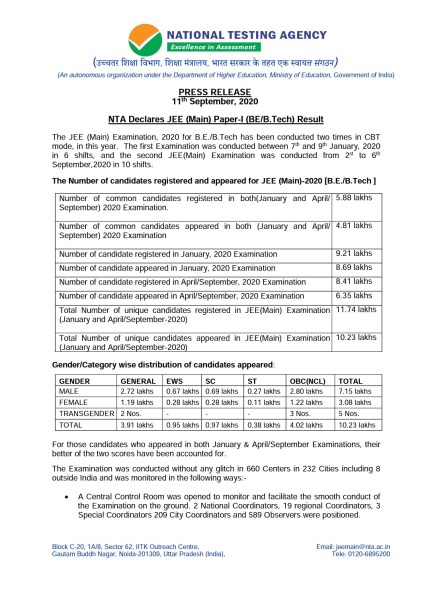
National Testing Agency (NTA) has declared the NTA JEE Main result 2020 at jeemain.nta.nic.in. The JEE Main 2020 result latest news shows 24 candidates have scored 100 percentile in JEE Main 2020 result.

The website may have gone down due to heavy traffic, students may wait for a while and then check their JEE Main 2020 results.

The Union Education minister Ramesh Pokhriyal on Wednesday said that out of the 8.58 lakh candidates who had registered for the JEE (Main) exam, 6.35 lakh candidates appeared in the examination. Over 8 lakh students had appeared in the JEE Main 2020 examination amid the COVID-19 pandemic.

 Students, parents and Opposition leaders had protested strongly demanding the postponement of the exam. But the government did not pay heed to their requests. Instead it issued strict guidelines for the appearing students and invigilators at the exam centre and conducted the entrance tests.

At the time of going to print, the National Testing Agency, which conducts the examination, had not yet released the full all-India rank list or the cut-off score for eligibility to attempt the JEE Advanced to be held on September 27. Students can check their scores and the final answer keys at jeemain.nta.nic.in.

For September, the number of students who have scored 100 is 15. State wise break up for the numbers is Telangana with 8 followed by Delhi with 5 students. 2 students from Haryana and 1 student each from Gujarat and Maharashtra scored 100 percentile. Rajasthan has 4 toppers and Andhra Pradesh has 3 students who scored 100 percentile. Along with the 100 percentilers, NTA would also be releasing the state wise list of toppers.

 The complete list of toppers would be provided shortly along with the JEE Main 2020 Rank list on the official site as well. In January, 9 students had scored 100 percentile. The complete list of toppers would be provided shortly along with the JEE Main 2020 Rank list on the official site as well. The score card of the candidates would be released online on jeemain.nta.nic.in. As many as 2.5 lakh students would qualify to appear for JEE Advanced 2020 or IIT JEE examination, scheduled for September 27. 

1. Landa Jitendra – Andhra Pradesh

2. Thadavarthi Vishnu Sri Sai Sankar – Andhra Pradesh

3. Y S S Narasimha Naidu – Andhra Pradesh

4. Chirag Falor- Delhi

5. Gurkirat Singh -Delhi

6. Laksh Gupta -Delhi

7. Nishant Agarwal- Delhi

8. Tushar Sethi – Delhi

9. Nisarg Chadha – Gujarat

10. Divyanshu Agarwal - Haryana

11. Harshvardhan Agarwal – Haryana

12. Swayam Shashank Chube- Maharashtra

13. Akhil Agrawal- Rajasthan

14. Akhil Jain — Rajasthan

15. Parth Dwivedi — Rajasthan

16. R Muhender Raj- Rajasthan

17. Chagari Koushal Kumar Reddy – Telangana

18. Deeti Yeshash Chandra – Telangana

19. Chukka Tanuja — Telangana

20. Morreddigari Likhith Reddy — Telangana

21. Rachapalle Shashank Anirudh – Telangana

22. Rongala Arun Siddardha – Telangana

23. Shiva Krishna Sagi — Telangana

24. Vadapalli Arvind Narasimha — Telangana

Steps to check Results

  • Visit the official website at jeemain.nta.nic.in
  • click on the link that reads, “JEE Mains 2020 results”
  • A new window page will display in screen
  • Login by entering your details
  • The JEE Mains 2020 will be displayed on the screen
  • And now you can download the results and take its print out too.

India – China to “Disengage” mutually on Border issues

India and China have agreed to “quickly disengage” from a standoff that has seen gunfire at a disputed border and accusations of kidnapping. Their foreign ministers met on Thursday and said they would ease tensions.

In a joint statement, the neighbours said the “current situation is not in the interest of either side”.

“They agreed, therefore, that the border troops of both sides should continue their dialogue, quickly disengage, maintain proper distance and ease tensions,” said the statement, released by Indian Foreign Minister S Jaishankar and his Chinese counterpart Wang Yi.

Both sides have accused each other of straying into their territory, and the clashes have sometimes turned deadly. Soldiers from both countries have periodically skirmished along the poorly demarcated border, called the Line of Actual Control. It is understood that the military commanders’ meeting in the next few days will chalk out steps of disengagement more clearly, which the Foreign Ministers will review before deciding on the course ahead. 

The five points agreed to are a template for the “principles of disengagement”, said a senior official privy to the meeting, but large divergences still remain in the positions taken by both sides. Both Ministers had a frank and constructive discussion on the developments in the India-China border areas as well as on India-China relations and agreed as follows:

1. The two Ministers agreed that both sides should take guidance from the series of consensus of the leaders on developing India-China relations, including not allowing differences to become disputes.

2. The two Foreign Ministers agreed that the current situation in the border areas is not in the interest of either side. They agreed therefore that the border troops of both sides should continue their dialogue, quickly disengage, maintain proper distance and ease tensions.

3. The two Ministers agreed that both sides shall abide by all the existing agreements and protocol on China-India boundary affairs, maintain peace and tranquillity in the border areas and avoid any action that could escalate matters.

4. The two sides also agreed to continue to have dialogue and communication through the Special Representative mechanism on the India-China boundary question. They also agreed in this context that the Working Mechanism for Consultation and Coordination on India-China border affairs (WMCC), should also continue its meetings.


5. The Ministers agreed that as the situation eases, the two sides should expedite work to conclude new Confidence Building Measures to maintain and enhance peace and tranquillity in the border areas

According to the Chinese press release, state councillor Wang said that bilateral relations between the two Asian neighbours “have once again come to a crossroads”. “But (he added) as long as the two sides keep moving the relationship in the right direction, there will be no difficulty or challenge that can’t be overcome.”
Jaishankar told his Chinese counterpart that India remained concerned at the massing of Chinese troops at the LAC, which was not in accordance with the 1993 and 1996 agreements. There has been “no credible explanation for this deployment”, which the minister said has created flash points along the LAC.

The Indian side said that the Chinese front line troops’ “provocative behaviour” at the various stand-off points showed disregard for border pacts and protocols.

10th September- World Suicide Prevention Day!

\

How difficult it is for a family who loses a loved one to bear the loss ? How painful it is for a friend to lose another? How devastating it is for a parent to cry over a child loss? UNIMAGINABLE. You can never know how much it aches to lose a piece of life and that to when you know that it was a “suicide”. When you come to know that someone close to you was tired of his life and you could just not predict that. You would crave to go back to them and ask them WHY did they do so . WHY this step? BUT,it would be too LATE till then. You would have to live with a regret then, that had you questioned this before you could save A LIFE.

Every day and evry year we come across news of suicides happening. From a CEO to a farmer, we had heard it all. Because when the mind is upset,no status matters. The pain and the frustration one feels is identical. But,since the topic suggests “PREVENTION” how can we contribute in the same ? How can we stop ourselves from regrets? How can we stop somebody from commiting a suicide ? Or how can we make someone feel lively again?

There are a lot of things we can do. We just need to get serious and committed about it. We need to stop taking things and people as a joke. Especially,what they speak. Because nobody speaks anything without a reason.If you are talking to somebody and they talk to you seriously about them getting tired of their life or how they can not just handle what is happening to them. STOP THERE,AND LISTEN. Listen to what one is saying maybe you can help them cope maybe you can help them heal . DO NOT JOKE AND IGNORE THE SAME. Maybe you will never be able to forgive yourself later.

There has to be an awareness about the serious effects one can have on their mental health.Aware people around you.Aware people who do not know about the seriousness about the matter.

Never discourage or talk pessimistic to a person who is already talking sad things. Always encourage them and tell them everything will be fine. Tell them about positives of life. Distract them from taking wrong decisions.

Do every part you can. Spread smiles everywhere you can 🙂