Lockdown in India……

Lockdown News: List of Cities Under Complete Shutdown This Week to Break Chain of Coronavirus.

Lockdown News: To contain the spread of coronavirus, a number of states have imposed complete shutdown in certain cities. Starting from Odisha and Tamil Nadu to Karnataka and Uttar Pradesh, these states have taken strict measures in these cities to break the chain of the virus. However, they have allowed the essential services to function during this time.
Cuttack (Odisha)
Amid rising cases of coronvirus, the Odisha government on Saturday declared a complete shutdown in Cuttack till July 8. During this time, all non-essential shops will be closed and non- essential travel will be prohibited.

Municipal Corporation (CMC) said grocery, vegetable and milk shops can remain open from 5 AM to 6 PM while strictly adhering to COVID-19 safety protocols. The development comes as Cuttack’s COVID-19 tally surged to 116, including 92 active cases.

Sambalpur (Odisha)

Apart from Cuttack, the Sambalpur district administration has also announced a one-day shutdown on Sunday to contain the spread of the virus. As per notification from the district administration, the restrictions will be imposed on vehicular movement and non-essential services.

Madurai (Tamil Nadu)

Looking at the rising cases of coronavirus, the Tamil Nadu government on Saturday has extended complete lockdown in Madurai till July 12. Prior to this, the state government had announced complete lockdown in areas within Madurai Corporation limits, Paravai Town Panchayat and rural blocks of Madurai East, Madurai West and Thirupparankundram from June 24 to July 5.

Issuing a notification, Chief Minister K Palaniswami said essential services will continue during the lockdown and no kind of activities shall be permitted in containment zones.

Just a few days ago, the state government announced that there will be a complete shutdown on all the four Sundays in July throughout Tamil Nadu.

Ballia (Uttar Pradesh)

After 40 new cases were reported, the Ballia district administration in Uttar Pradesh has imposed complete lockdown in Ballia city and surrounding areas from July 3 to 10.

The development comes as the city in the past 10 days has reported 42 cases with 30 of them without travel history.

Issuing an order, District Magistrate Hari Pratap Shahi said all localities in the city and surrounding areas have been declared containment zones and said there will be restriction on people’s movement. However, only people involved in providing essential services will be exempted.

Itanagar and Naharlagun (Arunachal Pradesh)

Taking preventive measures, the Arunachal Pradesh government has also on Saturday announced a week-long complete lockdown in Itanagar and Naharlagun from July 6.

As per announcement from the state government, the complete lockdown will be imposed at 5 AM on July 6 and till 5 PM on July 12.

Issuing the order, Chief Secretary Naresh Kumar said that there will be certain exemptions which would be announced on July 5, Kumar said.

The twin towns of Itanagar and Naharlagun, which are also known as Capital Complex region, have seen a rapid rise in the number of COVID-19 cases of 89 so far. Of the 89 cases, 81 are active while eight people have recovered.

With 20 fresh COVID-19 cases were reported in the state on Saturday, the ttal tally in the state stands at 252.

Bengaluru

The Karnataka government has on Saturday enforced strict lockdown in all containment zones in the state, especially Bengaluru, to check the further spread of coronavirus.

The move was taken as 1,839 new corona cases were reported during the last 24 hours. The total tally in the state has gone up to 21,549, including 11,966 active cases and 9,244 cured patients. The state’s death toll increased to 335 with 42 more casualties since Friday.

On the other hand, Bengaluru alone accounted for 1,172 new cases, taking its tally of positive cases to 8,345 and active cases to 7,250 with 965 discharged patients till date.

Smart phones got cheaper….

These smartphones got expensive and cheaper in India recently.

The Goods and Services Tax (GST) Council earlier this year announced a hike in the rate of tax on mobile phones. The revision was supposed to come in effect from April 1, after which 18 per cent GST would be levied on mobile phones instead of 12 per cent. Due to this many brands including Xiaomi, Apple, Samsung and OnePlus were seen increasing the price of their phones.

Amidst the price increase, a country-wide lockdown was implemented due to the COVID-19 pandemic, during which many brands were seen dropping the prices of their devices. Here we will be taking a look at all of the phones that have either seen a price increase or decrease in recent times.

The iPhone 11 now starts at Rs 68,300 (up from Rs 64,900) for the base 64GB variant. The iPhone 11 Pro now starts at Rs 1,06,600 (up from Rs 1,01,200) for the base 64GB variant. And the iPhone 11 Pro Max now starts at Rs 1,17,100 (up from Rs 1,11,200) for the base 64GB model.

Samsung Galaxy S20 Ultra is now priced at Rs 97,900, up from Rs 92,999. The Galaxy S20+ and Galaxy S20 now start at Rs 77,900 (up from Rs 73,999) and Rs 70,500 (up from Rs 66,999). The Galaxy S10 Lite and Galaxy Note 10 Lite, now start at Rs 42,142 (up from Rs 39,999) and Rs 41,000 (up from Rs 38,999), respectively.

All variants of Poco X2 have received a price bump of Rs 1,000 on all variants of smartphones. Realme 6 now starts at Rs 13,999, whereas, the Realme 6 Pro now costs Rs 17,999 for the base variant. The Realme 5i is priced at Rs 999 and the Realme X2 starts at Rs 17,999.

The Oppo Reno2 is now available at Rs 38,990, up from Rs 36,990. The Reno2Z is available for Rs 27,490 instead of Rs 25,990 and the Reno2F is available for Rs 23,490 instead of Rs 21,990. Oppo F15 is priced at Rs21,990, up from Rs 19,990.

Vivo V17 now starts at Rs 24,990, Vivo S1 Pro at Rs 20,990, Vivo S1 at Rs 16,990 and Vivo U20 at Rs 19,990. Redmi Note 9 Pro Max starts at Rs 16,499, Redmi Note 9 Pro now starts at Rs 13,999.

OnePlus 7T Pro has gotten a Rs 6,000 price cut for the 8GB RAM/256GB storage variant. It is now available at Rs 47,999 at Amazon and the company’s own official website.

iQOO 3, when launched, was priced at Rs 38,990 for the 8GB RAM/128GB storage variant, at Rs 41,900 for the 8GB RAM/256GB storage variant, and at Rs 46,990 for the 12GB RAM/256GB storage variant. Now, these variants are available at Rs 34,990, Rs 37,990 and Rs 44,990, respectively.

Samsung Galaxy M21 is now available at Rs 12,699 for the 4GB RAM variant and at Rs 14,999 for the 6GB RAM variant. Whereas, the Galaxy A50s is now available at Rs 18,599 for the 4GB RAM variant and at Rs 20,561 for the 6GB RAM variant.

Anupama

I have seen this movie a hundred times, every time I learn something new from this movie. A beautiful movie which depicts a string of emotions different people go through. What is fascinating about this movie is that in this movie no one is perfect ( as defined by the Indian cinema), everyone has their own traits which makes them look different but all these people with different traits live together and do not try to change each other rather they respect individuality ,Which I think this generation does not do. We are always in a race to become like someone, want a hair style like her,  hey I want a bike like him, You should do an MBA as she did and etc. There are many factors which tends us to change our identity, our belief systems to make us someone we are not. What is required is not to make ourselves like others rather to learn things constantly, and bring out a better human from inside.

This movie revolves around Uma played by Sharmila Tagore who is a very shy and a quiet girl. Who never speaks up ,does not have aspirations or desires rather thinks that she is the reason her mother died. Her mother died at the time of her birth, since then her father went into an emotional trauma and distances himself from his daughter. The father daughter share the same roof but never do they talk to each other. This movie is directed by Hrishikesh Mukherjee and his movies always depicts complex relationships in a very simple yet elegant way.

Ashok played by Dharmendra is a struggling writer, he is poor but is determined not to ask the rich for favors. He has some principles in life reading this you might think he would be a very strict person, that’s not true. He is fun, he translates his misery into a joke every time he  talks to people.

Such meaningful and heartfelt movies with songs having references to the storyline is not made nowadays. It does not mean that all the movies in this era are bad,  it is just that they do not have any relevance, every movie you see today will have a catchy party song, a very heartfelt romantic song, a sad song that is it just to grab public attention. In Anupama the director used songs only to convey some feelings which cannot be said by a speech. Like the song  kuch dil ne kaha portrays that Uma is a person who is shy of talking to people but opens up her feelings to flowers and leaves as she thinks they are her friends.

This movie does not have dramatic screenplay but it sure has many emotions, beliefs and trusts being broken or overflowed. Ashok when meets Uma and comes to know of her feelings , he gives her some advice about how grateful she should be that she has many things that many people don’t have and about the emotional chakravyuh she is in, he says “it is you who can get yourself out of this, some problems that we have created have to be solved by ourselves that is the best way”.

The movie was an eye-opener for me and I guess it would for you too.


Chinese phone Banned…..

Will Chinese Phones Be Banned In India? List Of Top 11 Chinese Smartphones….

The Indian Home Ministry announced a ban on 59 Chinese apps on Monday i.e. June 29, 2020, stating that the move is to protect India’s security and cyberspace. The MHA also said that the apps posed a threat to the safety of user data and privacy, and they are unfavourable to the country’s sovereignty and integrity. Before the Indian government’s bold move of banning the China-based applications, many users had already started boycotting Chinese apps, software and hardware to show support to the Indian army after the incident at the Line of Actual Control where 20 soldiers were martyred by Chinese soldiers.

However, many Chinese smartphone users are wondering, “will Chinese phones be banned in India?” “When will Chinese phones be banned in India?” and more. If you are wondering the same, here is all you need to know.

Will Chinese phones be banned in India?

Amid the movement to ban Chinese products, many people who have already bought several goods are worried if these phones will get banned too. Chinese smartphones are generally cheaper than most of the smartphones made in other countries such as Samsung, Nokia, iPhone and more. This is the reason why Indians preferred buying these smartphones because they are high on features with reasonable prices. However, no such ban has been reported until now and there is no such official statement released by the government of India for a ban on Chinese smartphones. So, until any further official statement by the government, it can be safely considered that a ban is not going to happen anytime soon. However, the ban on Chinese apps has shaken the Chinese app development companies and smartphone selling organisations. Nonetheless, according to reports, the Chinese smartphone sellers are going to present an update that will deactivate all the in-built banned Chinese apps from their phones.

List of Top 11 Chinese Smartphone brands in India

  • OnePlus Mobiles
  • Xiaomi / Mi
  • Lenovo
  • Oppo smartphones
  • Vivo
  • Realme
  • Huawei
  • Coolpad
  • Gionee smartphones
  • Zopo
  • ZTE

INTERNATIONAL KISSING DAY

Do you need a reason to kiss someone? Or is it just a spur of the moment to let some know that I care about you? Whatever be it, today is the perfect day to let go of all the boundaries and kiss the person who matters to you. It does not mean that you can kiss only your partner, it is a perfect excuse and a great opportunity to show your love to your parents, your children and to everyone whom you love. This day is marked as an awareness to remind people about the pleasure and the subtle intimacy that can emanate from a simple kiss, be it among the friends, family, loved ones to the extent of pets.

The history of kissing dates back to the Romans who practically invented three widespread forms of kissing. The first is savium which denotes the most passionate form of kiss and it is usually exchanged among the partners and couples. Second is the basium which is of lesser degree as compared to savium, it is basically a loving kiss on the lips and it can be exchanged among the friends and it is the preferable kiss in the public. The last one is the osculum, which is just a friendly peck on the cheek and it is usually exchanged among everyone, depending on the occasion.

Gently stroking babies can reduce pain

Now there is an interesting trivia about the forms of kissing. We all are aware of the term “French Kiss“. So if somebody asks you about the origin of this term, you might, well absentmindedly, say “it’s from France“. But surprisingly, it is not. The term “French Kiss” originated among the British and the American servicemen in France at the time of WWI, where the Galic women were more interested in a passionate kind of kiss as compared its American and British counterparts. So even though the French were not directly involved in such a type of kiss, but the event of passionate kiss being more prevalent in France gave birth to the name “French Kiss”. And the yet more surprising part is that, French were not even aware of the “mouth-on-mouth” kissing. In fact, the famous term “Galocher” which means “kissing with tongue” was added to the French dictionary, Le Petit Robert, recently in 2014. So what we initially thought that French kiss was started among the French, it in fact started among the Galic women in France.

Now enough about the history of the origin of the International Kiss Day, let’s turn our attention towards some interesting facts and traditions followed worldwide.

  1. In Vietnam, kissing is prevalent only among the spouses in private. The same is being followed in China and Japan.
  2. In Netherlands, the norm is to exchange 3 kisses as a form of greeting.
  3. In France, the customary way of greeting is one air kiss.
  4. In Italy and France, the prevalent way of greeting is to exchange kiss on the lips among both men and women.
  5. Modern anthropologists strongly believe that kissing was developed among the Eskimos, who used rub their noses against each other to take each other’s breath and to prevent getting cold. Such a cute form of kissing was known as “Eskimo Kissing“. This method of kissing is also quite prevalent among the Pacific Islanders and it is very surprising, yet a fact, that taking each other’s breath is a measure of compatibility.

International Kissing Day is a way of reminding how times are fleeting and why we should take a moment to appreciate what we have. It is not necessary to be grandeur about it, but how about a sudden subtle kiss on the cheek? Trust me, it will make someone feel valued. Tomorrow is 6th July, 2020. My personal advice would be to wake up in the morning, plant a kiss on your husband, parents and your children. Take some time out of your busy Monday mornings to greet your friends with virtual kisses either via Zoom/Whatsapp/Skype/Google Meet and so on and so forth. There are millions of way how can you show your love and you do not need to a romantic to do so.

All said, let’s take out a moment to send our kisses to our health-workers, doctors and the families who have lost their near ones during the COVID-19 pandemic. It might sound a bit illogical, but then again it’s International Kissing Day and there is a great opportunity to show our love and respect for them too.

Just a peck or may be Hershey’s Kisses will do!

Source:

https://www.awarenessdays.com/awareness-days-calendar/international-kissing-day-2020/

https://nationaltoday.com/international-kissing-day/

COVID19 vaccine’Made in India’……

Scientists strike note of caution as ‘Made in India’ vaccine programme gains momentum.

NEW DELHI: India’s COVID-19 vaccine programme has gained sudden traction but it is imperative to strike a balance between giving it high priority and rushing into a process that takes months, even years, several scientists said on Saturday, a day after the ICMR announced it envisaged a preventive by next month.
There was hope but caution too as the Indian Council of Medical Research on Friday said it aims to launch the world’s first COVID-19 vaccine by August 15.
The same day, Ahmedabad-based Zydus Cadila announced it has got the Drugs Controller General of India’s (DCGI) nod for human clinical trials for a potential vaccine.

“Fast tracking a vaccine trial in four weeks for safety, immunogenicity and efficacy is just not possible if things are to be done correctly,” Shahid Jameel, virologist and CEO of the Wellcome Trust/DBT India Alliance, a public charity that invests in building biomedical sciences and health research framework, told PTI.

Immunogenicity is the ability of a foreign substance, such as an antigen, to provoke an immune response in the body of a human or other animal, he explained.

Virologist Upasana Ray added that an accelerated launch or promise for launch of a vaccine against the novel coronavirus deserves applause but it is important to ask whether “we are rushing too much”.

“We must rush albeit carefully. Giving this project high priority is absolutely important. However, excess pressure might not necessarily lead to a positive product for public use,” the senior scientist at CSIR-IICB, Kolkata, told PTI.

India’s premier medical body ICMR has said 12 clinical trial sites for the indigenous Covaxin , being developed in collaboration with the Hyderabad-based Bharat Biotechand the National Institute of Virology (NIV), have been identified.

It asked medical institutions and principal investigators to ensure that the subject enrolment is initiated no later than July 7.

“It is envisaged to launch the vaccine for public health use latest by August 15 after completion of all clinical trials,” ICMR Director General Balram Bhargava said in his letter to the principal investigators of the 12 sites.

The tone of the letter and the haste it indicated had some scientists worried.

They questioned the timeline of the announcement mentioned in the letter, and advised against subverting the due vaccine development process.

“The ICMR ‘letter’ is, to say the least, a deeply inappropriate letter, in tone and content, both in terms of the integrity of due processes of product development, and in terms of technically realistic estimates,” immunologist Satyajit Rath told PTI.

Vaccine development is a multi-phase process.

Phase 1 trials are small-scale, usually involving few participants, to assess whether the vaccine is safe for humans.

Phase 2 trials often involve several hundred subjects, and mainly evaluate the efficacy.

The final phase involves thousands of people to further assess the efficacy of the vaccine over a defined period of time, and can last several months.

Ray added that a vaccine normally takes at least 12-18 months to pass all necessary clinical trial phases.

“From now till August 15, the company has just over a months’ time to wrap up everything that normally a vaccine development process requires for releasing a vaccine for clinical use,” she said.

“How can such a sharp timeline be even decided? Where does the evidence come from that by such a short time all the essential steps will be completed? What about the safety and efficacy, the fundamental steps of any drug development? Have even the pre-clinical studies been completed? Too much rush comes with possible risks,” she said.

Ray noted that there are some broad mandatory steps for developing a vaccine.

Preclinical tests in small animals and mammals, she stressed, are essential to assess neutralising antibody titers and that itself can take at least a month or two.

A titer is a laboratory test that measures the presence and amount of antibodies in blood.

“Next, we check for safety. Then is the human trial. Even if we are in a deep rush we have to wait for some time for immunised individuals to start generating antibodies.

“After that a population needs to be monitored over time to investigate if people are still being infected,” she explained.

Skipping steps could either be dangerous or lead to poor product, Ray said.

“We must not compromise with the standard, the quality. We don’t need to be the first to launch a drug but what we need is a Made in India vaccine that the entire world can rely on,” she added.

The vaccine landscape in India has been also bolstered after the approval for Zydus Cadila’s vaccine candidate.

It was fast-tracked following a recommendation by the subject expert committee on COVID-19, considering the emergency and unmet medical need during the pandemic.

“DCGI Dr V G Somani has given approval for the phase I and II clinical trials (on humans) of the potential novel coronavirus vaccine developed by Zydus Cadila Healthcare Ltd on Thursday after its animal studies were found to be successful,” an official source said.

Jameel, winner of the 2000 Shanti Swarup Bhatnagar Prize for Science and Technology, one of the highest Indian science awards, noted that it is a vaccine funded by Biotechnology Industry Research Assistance Council (BIRAC) and the Department of Biotechnology.

“Congratulations to Cadilla, BIRAC and DBT. We would look forward to properly conducted trials and good news in due course,” he told PTI.

“I am glad that a locally made vaccine candidate is making the same progress that others elsewhere in the world are making, not just with SARS-CoV-2 vaccine candidates but with DNA-based SARS-CoV-2 vaccine candidates, and I will look forward to the results,” added Rath from Delhi’s National Institute of Immunology (NII).

Gautam I. Menon, professor from the Departments of Physics and Biology at Ashoka University, said Zydus Cadila’s vaccine appears to have shown safety and efficacy in animal trials and so they have been allowed to go to the next step, to human trials.

“This is the standard procedure. It is the human trials that are time-consuming and it is important to get this right,” Menon told PTI.

In another development, Serum Institute of India (SII) CEO Adar Poonawalla told The Tribune newspaper that the Covid-19 vaccine being developed at the University of Oxford will hit the market by the year-end.

ChAdOx1 nCoV-19 is made from a virus (ChAdOx1), which is a weakened version of a common cold virus (adenovirus) that causes infections in chimpanzees, and has been genetically changed so that it is impossible for it to reproduce in humans.

“I think it is likely that the ChAdOx1-S vaccine candidate which has entered a phase 3 clinical trial in Brazil, will give at least somewhat promising results by late this calendar year,” Rath said.

“Whether this will lead to the ‘vaccine’ becoming available in the market, and in the public health system, more importantly, by the end of this calendar year in India is much more uncertain, Mr Poonawala’s welcome optimism notwithstanding,” he added.

ARCHITECTURE OF INDIA

Among a number of architectural styles and traditions, the contrasting “Hindu temple architecture” and “indo-islamic architecture” are the best known historical styles. The architecture of India has rooted in its history,culture and religion. An early example of town planning was the Harappan architecture of the Indus valley civilisation.

Hindu temple architecture is mainly divided into dravidian and nagara styles. Dravidian architecture flourished during the rule of the Hoysala, Chola, Chera and pandiyan empires as well as Vjayanagara Empire.

During the British colonical period, European styles including neoclasses, gothic revival and baroque became prevalent across India. After independence, modernist ideas spread among Indian architects as a way of progressing from the colonial culture.

Most of the gupta period represented a hiatus in Indian rock-cut architecture, with the first wave of construction finishing before the empire assembled and the second wave beginning in the late 5th century, after it ended. This is the case, for example, at the Ajanta caves with an early group made by 220 CE at the latest and a later one probably all after about 460. Most of the famous monuments in a broadly gupta style, the caves at Ajanta, Elephanta and Ellora were in fact produced under other dynasties in Central India.

The Ajanta caves
This image has an empty alt attribute; its file name is shutterstock_694433434_20191213110339_20191213110412.jpg
The Elephanta caves
The Ellora caves

The Jain temple architecture is generally close to Hindu temple architecure and in ancient times Buddhist religious architecture. The basic layout of a Hindu and most Jain temples has consisted of a small garbhagriha or sanctuary for the main murti or cult images over which the high superstructure rise, then one or more larger mandapa halls. The earliest survivals of Jain architecture are part of the Indian rock-cut architecture tadition, initially shared with buddhism and by the end of the classical period with Hinduism. Jain temples and monasteries share a site with those of the other religions, as at Udayagiri, Bava Pyara, badami and Kalugumalai. There is considerable similarity between the styles of the different religions, but often the Jains placed large figures of one or more of the 24 tirthankaras in the open air rather than inside the shrine.

Udayagiri caves
Bava Pyara
Kalugumalai

The Mughal architecture and painting influenced indigenous Rajput styles of art and architecture. Rajput architecture represents different types of bulidings which may broadly be classed as either secular or religious. The secular buildings are of various scales. It also continued well into the 20th and 21th centuries as the rulers of the princely states of British India commissioned vast palaces and other buildings like Umaid Bhawan palace.

Umaid Bhawan Palace

Similarly, The Maratha rule from 17th to 19th centuries, emerged during decline of Mughal empire, Prominent buildings such as Shaniwar wada, Lal Mahal in pune are few examples.

The Lal Mahal

Sri Lanka Batsman Arrested…..

Sri Lanka Batsman Kusal Mendis Arrested for Causing Fatal Road Accident

Sri Lanka batsman Kusal Mendis has landed himself in deep trouble after a fatal accident in Pandura. He has been arrested by the North Police, after his vehicle collided with a 64-year-old cyclist, killing the latter.

The accident, according to reports in Sri Lankan media, occurred near the 13th KM post in the Horethuduwa area in Panadura at 5.30 a.m. on Sunday. The cricketer has been produced before a doctor for an examination and will be produced before court.

Day After Police Drop Probe, SL Sports Minister Offers ICC Evidence 2011 World Cup Was Fixed

Police Spokesperson SSP Jaliya Senaratne confirmed the news of Mendis’ arrest.

Also it has been learnt that the victim was a resident of Gorakapola area in Panadura.

The 25-year-old wicket-keeper batsman has represented Sri Lanka in 44 Tests and 76 ODIs. Mendis was part of the national squad which had resumed training after the Covid-19 lockdown. He has scored 2,995 runs at an average of 37 in Tests and 2,167 runs at an average of 30 in the ODIs. Mendis has also played 26 T20Is in which he has scored 484 runs at an average of 18.6.

For now Sri Lanka’s international assignments are on hold, that included a series against India, due to coronavirus.

To add to that, Lankan cricket is going through a big mess, be it individual players, or the government alleging that 2011 World Cup final was fixed. Legendary cricketers like Kumar Sangakkara, Mahela Jayawardene and Aravinda de Silva were questioned by the police on the same issue.

But the investigation was closed after widespread protests in the nation.

America loves India…

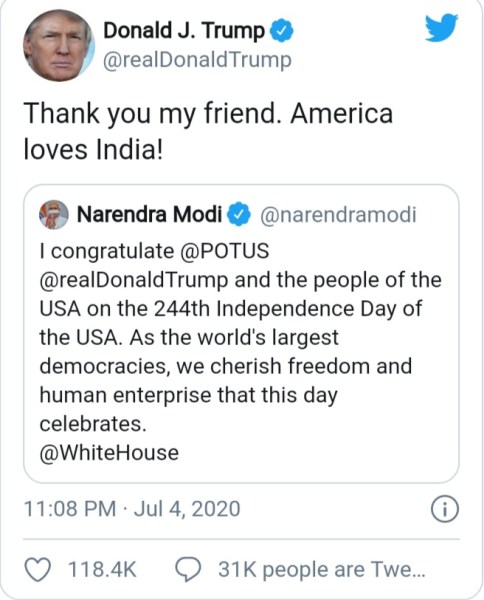
Trump thanks ‘friend’ PM Modi for Independence Day greetings, says ‘America loves India’.

Trump thanks ‘friend’ PM Modi for Independence Day greetings, says ‘America loves India’

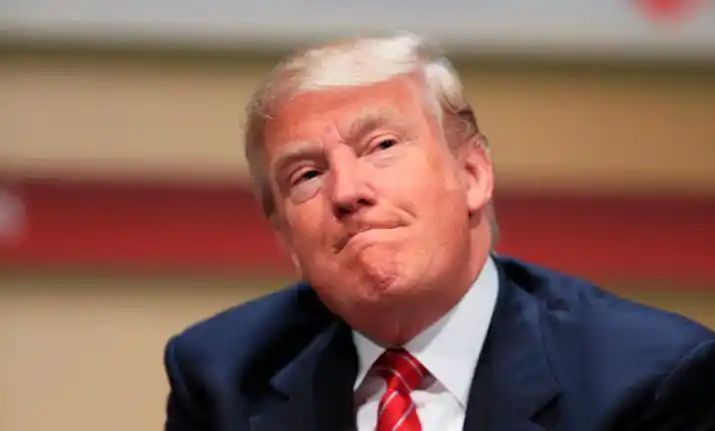
US President Donald Trump on Saturday responded to Prime Minister Narendra Modi’s tweet greeting him and the people of the United States on the country’s 244th Independence Day. Thanking PM Modi, Trump said, “America loves India.”

The two leaders are known to share an easy and increasingly close relationship, and often refer to each other as ‘friends’.

Google removes the app….

Google removes apps that stole your Facebook credentials: Here’s the list

Google has reportedly removed 25 applications from its Play Store after French cyber-security firm Evina claimed that they stole Facebook credentials of users. The firm even mentioned that by the time they were taken down, these 25 apps were downloaded some 2.34 million times in total. mentioned was that these apps were created by the same group.

And while all of them seemed different in offerings and features, they served the same purpose under the hood. These apps were from different genres, as reported by ZDnet. While some were step counters, image editors, video editor apps, others were wallpaper apps, flashlight applications, file managers, and mobile games.

Here is the list of apps that have now been removed from the Google Play Store:

Super Wallpapers Flashlight

Padenatef

Wallpaper Level

Contour level wallpaper

Iplayer & iwallpaper

Video maker

Color Wallpapers

Pedometer

Powerful Flashlight

Super Bright Flashlight

Super Flashlight

Solitaire

Accurate scanning of QR code

Classic card game

Junk file cleaning

Synthetic Z

File Manager

Composite Z

Screenshot capture

Daily Horoscope Wallpapers

Wuxia Reader

Plus Weather

Anime Live Wallpaper

iHealth step counter

Com.tyapp.fiction

Out of these, Super Wallpapers Flashlight and Padenatef were the only apps that were downloaded 500,000 times. Most were downloaded 100,000 times while the last three were downloaded roughly 100 times.

These apps included malicious code that detected which app is opened in the background and foreground. If it was Facebook, the malicious app will show an overlaid web browser window on top of the Facebook app and load the fake login page. The user then gives his/her credentials thinking of it as a legit page.

All these apps were reported to Google in May and the company removed these apps earlier this month. Although the Play Store is now slightly more secure with these apps gone, what however still remains a question is that despite Google’s stringent processes of approving apps, how are such app still making their way to the Play Store.

Unemployment

For the unemployed person,it is often a damaging affront to human dignity and sometimes a catastrophic blow to family life. It falls most heavily on the young,the semiskilled and unskilled,the black person,the older worker and the underemployed person in a low income rural area who is denied the option of securing more rewarding urban employment.

The concentrated incidence of unemployment among specific groups in the population means far greater costs to society than can be measured simply in hours of involuntary idleness or dollars of income lost. Thus hope in coming years employment should be in peak and human beings can be out of depression.

POOR vs RICH

We live in a society comprised of two classes called the rich and the poor with a lot of differences between them. These are also referred to as the dos and don’ts of the society. The rich make up barely 40% of the population and have control over 60% of the resources while 60% of the population makes use of the remaining 40% of the resources. However, the divide between rich and poor, despite all ‘isms’ such as communism, capitalism, and socialism keeps growing all the time making the condition of the poor worse than it has all along been. However, the financial condition is not the only difference between the rich and the poor.

• Control of Life:

• Rich believe they are in control of their lives.

• Poor feel they are subject to various of life and life controls events taking place in their lives.

• Money:

• Investing in schemes to make more money is like a game for rich.

• The poor are all the time terrified of investing in the stock market with the result that more often than not, they lose money.

• It is apparent to all that the poor are playing not to lose money while the rich are playing to win more.

• Opportunities and Obstacles:

• Rich people see the opportunities while poor see the obstacles first.

• Poor keep thinking how they will overcome these obstacles whereas rich keep their focus on opportunities as they have the resources to overcome obstacles easily.

• Dreaming:

• Rich dream big and, therefore, strike rich.

• Poor dream small with the result that they have to remain content with whatever they get.

• Doers and Dreamers:

• Rich are doers; they take concrete steps to fulfill their dreams.

• Poor just dream about their dreams.

• Company:

• The company of rich people includes rich and successful.

• Poor people have the company of unsuccessful and daydreamers.

• This difference in company proves vital in deciding the future of the rich and the poor.

History of pudukkottai samasthanm….

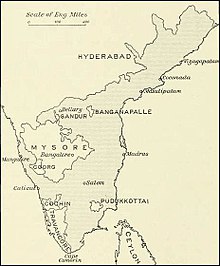
Pudukkottai was a kingdom and later a princely state in British India, which existed from 1680 until 1948.1913 map of the Madras Presidency showing location of Pudukkottai State.

1913 map of the Madras Presidencyshowing location of Pudukkottai State


The Kingdom of Pudukkottai was founded in about 1680 as a feudatory of Ramnad and grew with subsequent additions from Tanjore, Sivaganga and Ramnad. One of the staunch allies of the British East India Company in the Carnatic, Anglo-Mysore and Polygar wars, the kingdom was brought under the Company’s protection in 1800 as per the system of Subsidiary Alliance. The state was placed under the control of the Madras Presidency from 1800 until 1 October 1923, when the Madras States Agency was abolished, and until 1948 it was under the political control of the Government of India.

Pudukkottai State covered a total area of 1,178 square miles (3,050 km2) and had a population of 438,648 in 1941. It extended over the whole of the present-day Pudukkottai district of Tamil Nadu (with the exception of Aranthangi taluk which was then a part of Tanjore district). The town of Pudukkottai was its capital. The ruler of Pudukkottai was entitled to a 17-gun salute.

Geography.

The state of Pudukkottai extended from 10 degrees 7′ to 10 degrees 44’N latitudes and 78 degrees 25′ and 79 degrees 12′ E longitudes.and covered a total area of 1,178 square miles (3,050 km2). It extended for 52 miles (84 km) from east to west and 41 miles (66 km) from north to south.The state was bounded by Trichinopoly district to the west, Tanjore district to the east and south-east and Sivaganga estate of Madura district to the south.

The kingdom did not have fixed boundaries originally and was called “Tondaiman country” or “Tondaiman’s woods” until the end of 18th century. The kingdom started to have fixed boundaries since early 19th century. The easternmost point of Pudukkottai state was located 12 miles (19 km) from the sea. When the Pudukkottai district was formed in 1974 long after its incorporation into the Republic of India, the coastal Aranthangi taluk was detached from Tanjore district and merged with the new district.

For administrative purposes, the state was divided into three taluks: Alangudi, Kulathurand Thirumayam, each under the authority of a Tahsildar who was responsible for land revenue. There was also a few semi-autonomous zamindaris : Karambakadu, Nagaram, Palayavanam, Senthankudi and Seriyalur.

Demography..


As of 1931, the princely state of Pudukkottai had a total population of 400,694 with a population density of 340 people per square mile. Ponnamaravathi firka was the most densely populated with 498 people per square mile while Nirpalani was the most sparsely populated with 213 people per square mile.There were 435 towns and villages – 426 of them with a population less than 5,000 and nine – Pudukkottai, Ponnamaravathi, Varpet, Ramachandrapuram, Arimalam, Thirumayam, Alangudi, Kiranur and Pillamangalam-Alagapuri with population greater than 5,000.The male literacy rate was 21.62 percent and the female literacy rate, 1.87 percent.Between 1925 and 1929, the population of the state dropped by over 65 percent as more than 53,000 people left Pudukkottai for neighbouring districts due to widespread plague and famine.

Religion:


The kingdom was predominantly Hindu. However, there were significant Muslim and Christian populations. The affairs of Hindu temples was administered by a Devasthanams Department established in 1897.

According to the 1901 census, there were 353,723 Hindus who formed 93% of the state’s population. Muslims who numbered 12,268 formed 3.2% of the population while the Christians numbering 14,449 formed 3.8% of the population.In 1931, there were 367,348 Hindus (91.7 percent), 15,194 Muslims (3.8 percent) and 17,960 Christians (4.5 percent).

Languages :


The majority of the population spoke Tamil as their mother tongue. According to the 1931 census, Tamil was spoken by 378,741 people or 94.52 percent of the population as their mother tongue.Other languages spoken as mother-tongue included Telugu (12,250 speakers, 3.05%), Kanarese (5,118, 1.27%), Hindustani or Urdu (1,993, 0.49%), Saurashtri (1,172, 0.29%), Marathi (660, 0.16%), Malayalam (522, 0.13%), Hindi (187, 0.04%), Arabic (23, 0.005%), English (22, 0.005%), Danish (2, 0.0005%), Malay (1, 0.0003%), Sinhalese (1, 0.0003%), Konkani (1, 0.0003%) and Spanish (1, 0.0003%). The natives of Pudukkottai spoke Tamil which was also an official language of the state alongside English. Telugu-speakers were descendants of military chieftains who had migrated during the rule of the Vijayanagar Empire and the Madurai Nayak kingdom. Kanarese or Kannada was spoken largely by the Kuruba shepherds who had migrated from the Mysore kingdom.However, the Kurubars spoke a Kanarese dialect of their own with a heavy admixture of Tamil words.Hindusthani or Urdu was used by Pathani Muslims while Saurasthri and Marathi were spoken by the Saurashtra and Thanjavur Marathi migrants.

Tourist Places

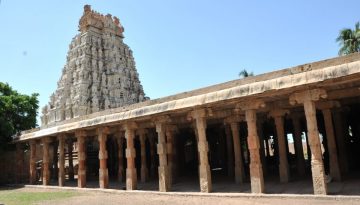
                      Thirugokarnam Temple

A rock cut cave temple situated in the heart of the city built by Mahendravarma pallava is Known as Kokaraneeswarer… 

DirectionMuseum

A museum has been initiated by the state Government on 1910 AD with the antiquity of History, Geology, Zoology, Archaeology,Anthorapalogy…

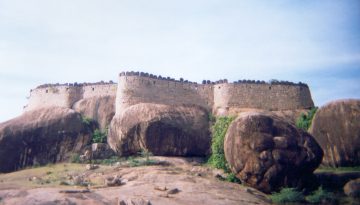
 DirectionThirumayam Fort

Olden days kings construct Fort and palaces, so as to protect the subjects from enemy country and a residential area… 

Kudimiyanmalai

It is located at a distance of 20 km from pudukkottai . The cave temples situated here are the testimony… 

Avudaiyarkoil

The temple dedicated Athmanatha samy situated in Avudayar koil at a distance of 60 km from pudukkottai, contain life-size sculptures….

Chithannavasal

Chithannavasal is a Prominent Tourist Centre of Pudukottai District. It is located on the Annavasal – Pudukottai Road at a… 

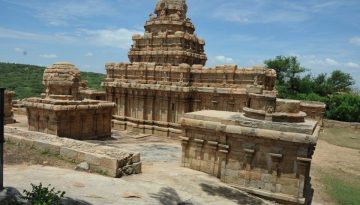
Narthamalai

It is located at a distance of 17 km from Pudukkottai. Narthamalai is head Quarters for the Cheiftain of Mutharaiyar….

Malaiyadipatty

Pdukkottai District ,at Keezhayur panchayat a siva temple together with vishu temple have been situated with a distance of 33…

Kunnandar Koil

The name Kunnandar Koil is called as Thirukundrakudi in the inscriptions available in this Temple. It is located 40 km…

Kodumbaloor

The name Kodumbaloor has been mentioned in the Tamil epic Silapathigaram. It is located at a distance of 35km from…

PM Modi reviews progress of Indian Council of Agricultural Research

Prime Minister Narendra Modi has exhorted that traditional knowledge of Indian communities should be coupled with technology and skill sets of youth and Agriculture graduates to translate the full potential of Indian Agriculture in transforming rural areas. Reviewing the progress of agriculture research, extension and education in India through videoconference today, Mr Modi highlighted the need to orient Agricultural Education and research systems based on agro climatic requirements to meet the demands of the Farmers.
 
  He said, the systems are to be geared towards enhancing farmer’s incomes while meeting International standards. The Prime Minister directed that ease of access to farm equipment and transport facility from field to markets shall be ensured.  In this regard, the Department of Agriculture, Cooperatives and Farmers Welfare  has launched an app – Kisanrath.
 
   In order to enhance water use efficiency, he desired that awareness and outreach programs be conducted. Mr Modi highlighted the need to adopt organic and natural farming practices on a cluster based approach. ICAR has developed geo-referenced  Organic Carbon Map of India , identified 88 bio control agents and 22 Bio pesticides which can promote organic agriculture.
 
  The Prime Minister directed that start-ups and agri-enterprenues need to be promoted to ensure innovation and use of technology in Agriculture and allied sectors. He highlighted the need to leverage information technology to provide information on demand  to the farmers.
 
  Mr Modi directed that Hackathons may be organized twice a year to solve identified problems and meet  design needs for tools and equipement that can reduce drudgery if farming activity, given that a large number of farm workers are women. He also exhorted the need to create awareness regarding inclusion of  millets like Jowar, bajra, ragi and several other minor millets in diet to ensure healthy diet.
 
  In an effort to bolster ‘Kuposhan Mukt Bharat’ (India free from Malnutrition) 70 bio fortified varieties with enhanced Iron, Zinc and Protein content have been developed.
 
Poshan Thali and Nutria-gardens are being promoted through Krishi Vigyan Kendras. Pilots were conducted in Madhya Pradesh and Chhattisgarh involving 76 Krishi Vigyan Kendras and 450 model farms. Anganwadi Workers and women from rural areas are being trained in raisingnutria-gardens to ensure balanced diet. Poshan Thali comprises of rice, local dal, seasonal fruit, leafy green vegetable, tubers, other vegetables, milk and other components like sugar, jiggery and oils. 100 Nutri Smart villages are to be created by 2022.
 
  To meet the requirement for commercial processing varieties with processing traits like ArkVises, ArkAlesha and ArkYoji have been developed. Mr Modi appreciated the efforts towards developing varieties focusing on specific requirements of agro-climatic zones and exhorted the need for developing forward and backward linkages to assure better returns to farmers.
 
  Karan -4, a sugarcane variety has enhanced sugar recovery and has replaced traditionally grown varieties in Uttar Pradesh. The Prime Minister highlighted that avenues for enhancing bio ethanol from sugarcane and other crops needs to explored.
 
  While reviewing the contributions of ICAR in developing new breeds of cattle, sheep and goats, the Prime Minister highlighted the need for research on indigenous breeds of dogs and horses. He directed that a focused mission mode approach be adopted for vaccination drives for Foot and Mouth disease.
 
Mr Modi exhorted that study of grasses and local fodder crops should be undertaken to understand their nutritive value. He highlighted the need to study use of sea weeds  for their impact on soil health apart from  exploring commercial applications in  nutraceuticals.
 
 
Minister of Agriculture, Rural Development & Panchayat Raj, both the Ministers for State for Agriculture joined the review meeting.  In addition to the Senior officials from PMO, Secretaries from Departments of Agriculture, Animal Husbandry and Dairy and Fisheries were present.

Nitin Gadkari calls for expeditious clearances for Chambal Expressway Project

Road Transport and Highways Minister Nitin Gadkari today reviewed the proposed Chambal Express Project with Madhya Pradesh Chief Minister Shivraj Singh Chauhan through a Video Conference.  The project offers huge employment potential in the districts and adjoining areas. 

Chief Minister Shivraj Singh Chauhan described this project as ‘Chambal Progress-Way’. Madhya Pradesh government is providing 100 percent land of 421 crore free of cost for this dream project.

Apart from this, the state government will also provide assistance of 781 crore. The ‘Expressway’ will be 309 km long in the state. It will connect the boundaries of Rajasthan and Uttar Pradesh via Sheopur, Morena and Bhind. 

This route will be connected to the Golden Quarterletal (Agra-Kanpur) route in Bhind, North-South Corridor in Morena and Delhi Mumbai Corridor in Rajasthan. Union Minister Narendra Singh Tomar said that the construction of this expressway will help a lot in the development of this backward region.

In the video conference, Rajya Sabha MP Jyotiraditya Scindia suggested to build the Chambal Expressway along with the Bhind-Kota railway line.