T and I have just been brought on to the flexible learning committee and although there was good discussion about flexible learning issues most did not seem to have a clear idea of where the committee was heading re the information gathering for developing the strategy. Probably cos most people were relatively inexperienced with flex learning per se and were coming to terms with the whole concept. Now of course T and I have the job of coming up with the ideas/survey etc. to gather info on which to base the strategy…such is life and the challenge…and swallowing the \”I told you so\” feeling. It would have been a lot easier if we had been there from the start.
M of course is being roped in to our working group. Plus I will be involving L who is bringing us in to the 21st century although he isn\’t on the committee – yet. Good to have K as an ally on the same wave length and speaking the lingo.
Our Career Development team has some tips to help MBA grads land the right job.
It’s a good time to be entering the workforce with your MBA. Today, employers are looking for candidates who not only have experience but the transformative leadership, management and problem-solving skills they need to become future leaders and executives.
The Graduate Management Admission Council found that more companies are hiring MBA grads than in previous years. In fact, 86 percent of employers sought to hire MBA graduates in 2017, including nearly all Fortune 100 and Fortune 500 companies.
So, now that you have that extra degree, it’s time to find the right job. We asked our Career Development team for some tips to help MBA grads land the right role. Here’s what they had to say:
1. Make your resume pop
You’ve worked hard to advance your education, so make sure that you’re also putting in the extra effort to differentiate yourself from other candidates who may be applying for the same role. Don’t expect the “MBA” in your title to do all the hard work for you. Your resume should demonstrate the added value you can bring to a particular company or role, not just reiterate your accomplishments.
2. Know how to sell yourself
The job description is your best friend. Make sure your experience aligns with everything that is being sought after. Too often we get hung up on how awesome we feel our accomplishments are, forgetting that sometimes our experience doesn’t translate well outside of our industry or employer.
If you’ve found a position that’s a good fit, make sure to align each of your skills and accomplishments with the employer’s values and needs. Break down the skills you learned in your MBA program to showcase your talents and the depth of your experience. Go through your courses or the program outline to think about what you learned there and how you can represent it well in an interview or on your resume. Write in a voice that is quantitative, specific and concise.
3. Network your network
Let your network know you are talented, educated and ready to make a move. Been a while since you updated your LinkedIn? Get connected with your previous and current managers, as well as your professors and instructors. Upload your new resume and start to populate your profile.
You should also consider publishing content, sharing updates and engaging with your connections regularly. For added visibility, you can customize your LinkedIn URL with your name and/or degree title, which makes it easier for your professional peers to find you online. For more LinkedIn tips, check out this blog.
4. Label your resume
This one sounds simple, but even the smallest details can make a big difference in your job search success: Label your resume with your full name, your title and the position you are applying for.
For example: Sharon Rosin MBA Human Resources Resume.doc
Why is this important? Because having your name – and your new credentials—in the title of your resume document is one of the ways recruiters and sourcing specialists find qualified candidates. Don’t run the risk of letting your resume get buried in someone’s inbox. Make yourself easy to find.
5. Take advantage of your resources
It’s important to be continually working on your post-graduate career options. Whether you’re looking to advance your career at your current company or make a change, you should be networking and contemplating your options before you really need to. If you plan ahead, you could be in a new role before you graduate with your new degree.
Working with the career development team at your university can help you learn about opportunities you might not have found otherwise. Get involved with your alumni network from your undergrad institution, attend career events and work with your career advisors. With so many resources at your disposal, it’s easier than ever to find out about and position yourself for the roles you really want.
One of the great things about mobile devices such as tablets, iPads and phones is that most modern devices have good quality cameras and microphones built in. This opens up a really wide range of potential for communication and speaking practice that used to be such a struggle to organise on older laptops and desktop computers.
App developers have also been quick to exploit the potential of this powerful tool and in this post I\’d like to look at some of the tools that have been created and how they can be used for language development.
Mailvu for asynchronous messages
Mailvu has been a long time favourite of mine, mainly because the web based version is so easy to use and doesn\’t require any downloads. You just point your browser at: http://mailvu.com/ and as long as you have the Flash plugin installed on your computer you can start recording immediately. Mailvu also provides mobile apps for iOS, Android an Blackberry. These are easy to use and it allows you to send short spoken messages which don\’t require the viewer to have any specific software or to download large video files. They just click a link and watch your message. This kind of cross platform compatibility is really important if you are working in a BYOD environment where students could be coming to class with a wide range of devices.
EyeReport for picture in picture
EyeReport puts an interesting twist on the video communication genre by adding the ability to record video on video. By this I mean that students can upload or record a video on their mobile device and then add a video commentary over the top explaining or commenting on what they see in the original video. This opens up a whole range of potential activities that we can get students doing. They could add commentary to sporting clips, give guided tours of places they have visited, explain processes or even make their own documentaries. Once students have completed their recording these can be shared to YouTube, Facebook, Twitter or emailed directly from within the app.
CoachesEye for video annotation
CoachesEye is a similar app to EyeReport (though this one is no longer free) but is much more feature rich. Like EyeReport you can record video commentary over video, but with CoachesEye you can also add annotations and you can stop and control where you insert your comments into the video. This app was designed for coaches to give detailed feedback to athletes on their physical movements, but it\’s a great app to get students creating and talking about their own videos, and also a useful tool to use when observing teachers for training purposes.
Storytime for bedtime stories
Storytime is another app which puts a new Twist on the video communication genre. It combines video conferencing with reading stories out loud. The app was designed to enable parents to read to their children from a distance and it contains a number of books you can choose to read and while you read you can discuss the books, ask questions and point to things on the page whilst chatting with the video window at the top. This is great for doing online tutoring with younger learners. There is quite a range of books from very basic and up and they are nicely illustrated.
Teleprompter for controlled speaking practice
Teleprompter is an app that I wrote about a while back when it was still free (iPhone for Speaking Homework ). The app is what it says, it allows you to import text and then it scrolls through the text while creating a video of you reading it. This is great to get students doing controlled speaking practice and then watching and improving their speaking. You can set texts which include a range of sounds which they find difficult and then watch them together and help them to understand what elements of their pronunciation are causing problems.
Keek for video journals
Keek mixes web with mobile in the form of video journals. Users can post short messages of up to 35 seconds from their mobile or computer and these are published to the web or can be browsed through the app. This would be a great tool to use as a daily learning journal, but it\’s probably best used by adults or more responsible teens. It seems to be a very popular tool with teens in the USA and there is a wide range of content that students can browse through, some of which is not best suited to educational purposes, but as a concept this is quite a good app. If you prefer your students to be sheltered from this kind of popular culture app, then you can still take up the idea of the video learning journal and just get them to use their built in video camera app and post the messages to a Dropbox site.
Six3 for video messaging
Six3 is similar to MailVu and also compatible with most platforms, but it gives you the choice of recording private or public message and has an additional filter feature which can help to improve your appearance on the video. It\’s called Six3 because you have 63 seconds of recording time in each message. Like Mailvu, the messages are also sent via links through your email, but they can also be posted directly to Twitter or Facebook from within the app.
Skype for synchronous online tutoring
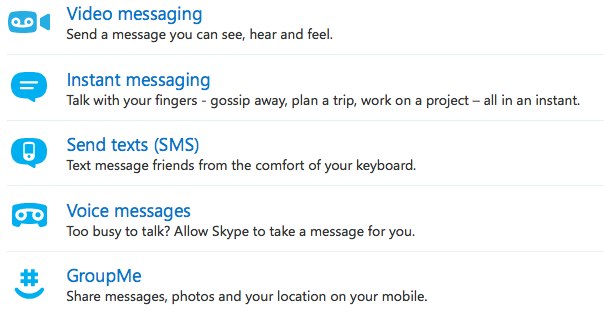
Skype has been around for a good while and was one of the first video based communication tools to break into the mainstream. It\’s being used by many online schools to deliver live online lesson from teachers to all parts of the globe. One of the great things about Skype, apart from the reliability, is that it keeps developing and adding new features. The recent addition of video messages that enable it to be used as an asynchronous tool will really help to widen its scope for use as a language development tool.
Built in camera app With all these apps and the possibilities they offer, it can be easy to overlook the obvious. Most modern mobile device come with a built in video camera application and you can always use this to record and send video message. This has the advantage that messages are very safe from third party app providers and any possible security breaches, but sending the video clips to someone else often involves sending the whole clip via email which can be slow and require good connectivity.
Well one of the best reasons to use these kinds of apps is to get students speaking. Speaking homework has always been particularly difficult for students, but now you can ask students to produce spoken homework which you can watch and assess.
Video as a communication genre is likely to become increasingly important as a 21st century digital literacy, so it\’s important that our students have practice and are able to use this communication genre, just as they do with speaking on the telephone or writing emails.
Video can draw students\’ attention to many of the paralinguistic features of communication that are hard to highlight in a crowded classroom.
Enabling students to record themselves speaking and then to watch themselves can be very enlightening for students as they can then start to self assess their own performance and look for ways they can improve. It can also encourage some students to try harder, because they know that someone else might see the video.
Video can be very engaging and can be played repeatedly so it gives students the chance to listen again and in more depth.
Video communication can help teachers to build a stronger sense of connection with their students, especially with online course when you might never physically meet your students. Conveying some sense of your personality, sense of humour and character can be very difficult in written communications, so video has some really big advantages.
Giving students 1 to 1 time and having the time to just sit down and spend a few moments listening to a single student without the noise of others around can be really difficult in the classroom, but having a short recorded video clip of our students can really enable us to focus on their specific strengths and weaknesses and enable us to give them some really personalised feedback.
Potential problems
As with any kind of online communication, make sure your students know how to protect their privacy and also themselves from harassment. Be sure to have a transparent and open policy on any kind of harassment so students know what is likely to happen to anyone harassing and how to report harassment.
If you are using video communications with younger students also make sure their parents know what you are doing and why you are doing it and get their approval (in writing if possible) and if possible get them involved too.
Make students aware of the difference between poor quality speaking and poor quality audio. You don\’t want them to think they sound bad if the real problem is the recording quality and interference from background noise etc. Help your students to understand how to get he best quality results from whatever recording tools they have, by finding somewhere quiet to record and experimenting with the best distance from the microphone.
Helping students to look their best on video will also help to boost their confidence. Getting the camera angle right and having the light coming from the right direction can also have a big impact on how students look, so helping with this can be part of the learning experience. There is a useful article here which may help: http://www.makeuseof.com/tag/look-good-on-webcam/
Always remember and remind students that anything they do or say on video can potentially be seen by other people for years and even centuries to come, so whenever one of these apps is used, encourage them to think about what they are doing and saying and keep in mind that it could be seen by people they know and people they might yet meet as well as strangers who they might never meet. It\’s important to remind students of how they want to be perceived.
I hope you enjoy these apps and that they help to get your students speaking. Please leave a comment if you have any favourite video communication apps that you use to get your students speaking.
Interested in pursuing a career a fast-growing industry? Follow these five steps to become a software engineer in the technology field.
Software engineers, often referred to as software developers, design innovative software for businesses and clients. From a personal banking app to a company’s project management workflow system, software engineers are behind many of the essential apps and programs that make business and daily life more efficient.
Companies rely on software engineers to create better online experiences for their employees and customers. The Bureau of Labor Statistics predicts that employment for software engineers will grow by 24 percent between 2016 and 2026, adding as many as 302,500 new jobs.
Due to its reputation as one of the fastest-growing technology jobs today, software development was ranked as the #1 Best Technology Job in America for 2018 by U.S. News & World Report. Discover how much software developers make on average across the U.S. and what it takes to succeed in this high-demand field.
Interested in pursuing a career in this fast-growing field? Follow these five steps to become a software engineer:
1. Enroll in a software development program
The first step to becoming a software engineer is to enroll in a software development degree program. You don’t need to have a background in technology to pursue this degree path – most software development programs begin with foundational courses to help you learn common coding languages and basic programming skills, followed by more advanced courses to prepare you for entry-level roles in software development.
A bachelor’s degree is a requirement for most full-time software engineer positions. However, some students may choose to start out with an associate degree in software development. This path allows you to pursue entry-level information technology roles and gain experience as you work towards your bachelor’s degree.
2. Gain internship experience
Internships allow you to get hands-on experience in your field and put your skills and knowledge from class into practice. They are also great resume-builders and can be instrumental in helping you land your first job after college. Many aspiring software developers will complete an internship to position themselves for competitive entry-level software development jobs.
Working at a few different internships throughout your college career can also help you discover the types of companies you would like to work for after graduation. Software engineers can work in a variety of industries and business settings – such as healthcare, banking and marketing – so it’s important to explore which environment best suits your personal career interests.
3. Choose your specialty
Software engineers will typically specialize in computer applications software or computer systems software. Applications software includes word processors, games and other computer applications that allow users to perform a specific task. Computer systems software includes the computer operating systems, such as file management tools, system utilities and debuggers. The user does not typically interact with computer systems software.
A bachelor’s degree software development program will prepare you for roles in either specialty and your internship experiences can help you determine which path you are most interested in pursuing. Both specialties require creativity, as well as advanced problem-solving and critical thinking skills.
4. Pursue industry certifications
A software development degree program will also prepare you to sit for industry certifications, such as the Oracle Certified Java Programmer or the Microsoft Certified Solutions Developer, which are valuable differentiators for entry-level candidates. Pursuing these certifications can help you advance your software development career and allow you to pursue roles with additional responsibility and specialization.
5. Continue your education
With experience, software engineers can advance to information technology project managers who oversee the software development process. A master’s degree may be required for advanced roles. Software engineers can pursue an MBA in Technology Management to develop the leadership and management skills necessary to advance their careers.
Below is a movie to show you how to enrol yourself or others in a Blackboard course. Give the video time to stream in – press pause and let it load before playing.
If you can’t see the movie, please right click this link and download it to your computer.
Programmers write code for computer programs and mobile applications. They also are involved in maintaining, debugging and troubleshooting systems.
The job of a computer programmer is vitally important in today’s digital-focused economy, which is why the number of openings in this field continues to grow.
Programmers write code for computer programs and mobile applications. They also are involved in maintaining, debugging and troubleshooting systems and software to ensure that everything is running smoothly.
Programming skills are essential for many technology disciplines, but are in especially high demand for software and web development roles. According to the US Bureau of Labor Statistics (BLS), web development jobs are projected to grow by as much as 15% over the 2016-2026 period, adding another 24,400 new jobs.
If you’re looking for an entry-level technology job with ample opportunities for career advancement and specialization, computer programming could be the right path for you.
What do computer programmers do?
On a typical day, a computer programmer can be involved in many different coding projects. Daily duties might include:
Writing and testing code for new programs. Computer programmers work closely with web and software developers to write code for new mobile applications or computer programs. In some cases, programmers might have a similar role to web designers, creating the look, feel and functionality of a new software program. Writing new code often involves a lot of trial and error. Computer programmers have strong critical thinking and problem-solving skills, and enjoy using logic to solve complex problems.
Updating existing programs. Programmers also create and install updates for existing software programs. An update might include a bug fix, or enhanced functionality to improve the user experience. Depending on the complexity of the update, these projects can take anywhere from a few days to several months.
Identifying and correcting coding errors. On a daily basis, computer programmers might assist in troubleshooting parts of a website or computer program that are not functioning correctly. Often, problems are a result of an error in the code, and a programmer can help identify and correct the mistake quickly.
Rewriting programs for different operating systems. Often, programmers have to rewrite code in a different languages, so that programs and applications can be compatible with different operating systems. For example, Windows and OS X programs are coded differently. Some programmers are trained to write new applications in SaaS code, which works across both operating systems.
Secure programs against cybersecurity threats. Many computer programmers work in the cybersecurity field, helping to identify malicious software and fix software that could be vulnerable to potential hacks. Additionally, programmers can write code that prevents security breaches and data leaks. As the number and severity of cyber-attacks increases, demand for information security experts continues to rise. In fact, the Bureau of Labor Statistics (BLS) predicts that employment for information security analysts will increase by 28% through 2026, adding 28,500 new jobs.
How much do computer programmers make?
The median salary for computer programmers in 2018 was $84,280, with the highest-paid 10% earning more than $134,630, according to the BLS data. Keep in mind this is not an entry-level wage and you will need to work towards this level of pay after graduating with a degree and earning your first job. Discover the average computer programmer salary by state to determine a closer estimate in your region.
An entry-level career in computer programming offers upward mobility into more advanced and higher-paying roles. In fact, programming skills are the foundation for almost any top-ranked technology job today, such as:
Computer Systems Analyst
Database Administrator
Security Analyst
Hardware Engineer
Software Developer
Web Designer
What are the benefits of a programming career?
Programming is a valuable skill set that may allow you to pursue opportunities in a variety of fields, including finance, healthcare, graphic design or digital marketing. Programming jobs are growing 12% faster than the average for all occupations, according to recent findings by job market research firm BurningGlass.
Many programmers also enjoy perks such as flexible hours and the option to work remotely, according to the BLS.
How do I become a computer programmer?
A bachelor’s degree in computer programming can prepare you for a broad range of entry-level programming positions. Herzing University’s computer programming bachelor degree program can be completed online in as little as 36 months and provides students with practical training in essential technology skills, such as:
Advanced web development
Object-oriented programming
Software development and testing
Mobile applications development
Data warehousing
Continued learning is important for programmers because coding languages are constantly changing and evolving. Many programming professionals will pursue additional certification in specific coding languages, such as C++ or JavaScript. Some technology companies might even have their own vendor-specific coding languages, and require their employees to become certified in those additional languages as well.
What are my opportunities for advancement?
Achieving a masters-level education in a specialized area such as technology management can help programmers advance into management and leadership roles, like IT manager or computer systems analyst. Herzing’s computer programming degree program offers a dual credit option, allowing students to earn up to 12 credits toward an MBA as an undergraduate, saving time and money on both degrees.
Learn more about our technology degree paths and find out how you can get started on your computer programming career today.
Writing a research paper can be challenging if you aren’t a strong writer. Here are some tips on how to start writing a college paper.
Writing is an important skill for many professions, and long-form writing assignments are just one way your classes can help prepare you for your career. In addition to testing your writing ability, writing assignments allow you to showcase your critical thinking, research and analysis skills, which are also important for your career development.
However, writing a research paper can be challenging if you aren’t a strong writer and don’t really enjoy it. Getting started can be the most difficult part, but it’s important not to procrastinate if you want to get the best grade possible.
Here are some tips for tackling college writing assignments:
1. Do your research
The foundation of any good college essay is research. Fortunately, we live in the information age where all the resources you need are just a few clicks away. In addition to using your course materials and conducting your own online research, you should also take advantage of your school library to find academic research on your topic. All Herzing students have free online access to dozens of databases where you can find scholarly journals, magazine and newspaper archives, books, transcripts, multimedia and more to help with your research.
Don’t be afraid to ask a librarian for help if you’re not sure where to start. Professors often work with librarians to curate resources for specific assignments and research projects, so there might already be a selection of texts set aside for you to look at. Librarians are also available via phone, email and chat for online students who need help navigating the databases.
As you conduct your research, it is very important to document all the resources that you use. If you are taking notes, be sure to write down the name of the source and the page number, as you will need to cite these in your paper later. Copying someone else’s words without citing them is considered plagiarism, which is definitely something you want to avoid!
2. Craft your argument
Most college essays will require you to develop an argument relating to your topic. As you conduct your research, start thinking about what approach you would like to take with your essay. Ask yourself:
What do I want my readers to learn from my paper?
What do I want them to understand about my topic?
If you are really stuck, it might help to read other academic essays on the topic. NEVER copy these examples, but you can take notes on how the writer formed their argument, the tone they used, and the examples they cited to support their points. You can use this for inspiration on how to form your own paper without copying anything they have written. For example, maybe you disagree with a prominent author’s point of view on your subject. This can be the basis for your own argument, provided you have the examples you need to support your point.
3. Make a tentative outline
Staring at a blank word document is one of the universal banes of writing. It can be hard to get started if you don’t have a clear direction for your paper in mind. That’s why you should create an outline. Outlines help you develop a logical, coherent structure for your paper, making it easier to translate your ideas into words and sentences. Here’s an example of an outline you might write if your essay is about self-driving vehicles:
Reasons why self-driving cars are a good idea
Reasons why some people may be against self-driving cars
Technological challenges to overcome before widespread use
Advances that have already been made
Why this is an important part of the future of transportation
You’ll notice that this outline is simple. You can make your outline as detailed as you want, but it helps to define the general framework for your argument first. For more tips on writing the perfect outline, check out this blog post.
4. Just write!
Once you type out your outline, it’s time to start writing. Fill in information in the form of paragraphs for each of your bullet points. You might find that you still need to do some research, or you might decide that you don’t need one of your points after all. That’s fine, and you should free to change your outline as you go.
Even with an outline, it can be very difficult to begin actually writing. You might be asking yourself:
How should I write this?
What tone should I use?
Is this language okay?
However, hovering over these questions too long can hamper your creative process. The best thing to do is just start writing. Don’t worry about how good or bad it is, as you can always revise later. Getting the basic flow of your argument down is most important.
5. Write an introduction and conclusion
Some people like to start by writing the introduction, but others prefer to save it for the end, especially because your argument can evolve as you write. Introductions are a vital part of an essay, and they should do more than give a brief overview of the paper. You want to create a strong hook for your reader so they want to keep going.
Example Hook: “Even though there are still some major manufacturing challenges to overcome, self-driving cars will become a vital source of transportation in the next 20 years.”
This introduction makes it clear that we will discuss some of the issues with self-driving cars and the arguments against them, but also provide solid reasoning for why they are part of the future of transportation. In the conclusion, you can reiterate those points to explain the reasoning for your argument, as well as why it is important to discuss this topic. Check out this blog post for more tips on writing a strong introduction.
6. Revise
No matter how good of a writer you are, you need to edit and proof your work. Make sure you leave yourself enough time for revisions, too. It’s a good idea to try to have your first draft done at least a week in advance so that you can make any necessary edits before the paper is due.
If writing is not one of your strengths, consider setting up an appointment with a Writing Center tutor to revise your first draft. Your tutor can help you identify and fix any logical or structural problems, as well as common spelling and grammar mistakes that could affect your grade.
Once all of this is done, congrats! You’ve officially written a college paper. Be sure to review your teacher’s critiques when you receive your grade, as they will help you perform better on future assignments. If you need additional help or want to focus on developing your writing skills over time, reach out to the Writing Center to set up a regular appointment.
Union Minister of Finance and Corporate Affairs Smt Nirmala Sitharaman has stressed that the Government trusts industry fully and comprehensively. She urged industry to plan for engaging labour with a more professional approach and engage in skilling. “Mindsets in industry need to set examples in handling workers in a way that is acceptable to all,” stated the Finance Minister.
Cold Chain Infrastructure
The Finance Minister was speaking at an interaction through video conferencing with Confederation of Indian Industry (CII) which is marking 125 years of its existence in 2020. Felicitating CII on this milestone, Smt Sitharaman said that CII has played a critical role in the country and its members have played strong roles in their own sectors. She exhorted CII to stand out as an exemplar in the policymaking process.
The interaction had the participation of Shri Ajay Bhushan Pandey, Finance Secretary, Ministry of Finance; Shri Injeti Srinivas, Secretary, MCA, Shri Debasish Panda, Secretary, Department of Financial Service, Dr. T. V. Somanathan, Secretary, Department of Expenditure, Shri Tuhin Kanta Pandey, Secretary, Department of Investment and Public Asset Management, Shri Tarun Bajaj, Secretary, Department of Economic Affairs and Dr. Krishnamurthy Subramanian, Chief Economic Adviser.
Industry needs to reset its relations with workers and plan for labour including unskilled labour, said the Finance Minister. She requested industry to consider a professional manner in the terms for engaging unskilled workers and work towards the skilling of employees at all levels.
On a question regarding the MSME sector, Smt Sitharaman stated that before Covid19 as well, clear handholding was announced for MSME and NBFCs to help enterprises in rural areas. She stated that credit availability for additional term loan and working capital loan was intended to reach all MSME, and hence the Government has provided a guarantee to banks to overcome hesitation in lending. “When Government provides full and partial guarantees with a special purpose vehicle post-lockdown, the banks
hesitation has been addressed,” she said.
Responding to a question on agriculture, the Finance Minister mentioned that comprehensive reforms have been announced. Three model Acts have been shared with State governments. She stated that many states have commenced on land reforms.
The National Infrastructure Pipeline will be given a big push in order to create demand with a multiplier effect, stressed the Finance Minister on a question related to infrastructure. “Large projects will be frontloaded and this will bring in positive energy and sentiments,” said Smt Sitharaman.
The Finance Minister noted that there has been a fair and open interaction on GST which has come to the bottom quarter in inflows. Discussions are underway on this.
She agreed that infusion of liquidity in the power sector of Rs 90,000 crore would be fast-tracked.
Concerns that large industry too is facing a lot of stress, particularly in certain sectors such as tourism, automotives and aviation were also discussed. Discussions need to be undertaken to protect jobs, increase demand, and ensure survival of large businesses, industry requested.
Mr Chandrajit Banerjee, Director General, CII noted that the new definition of MSME has been well received by them as brought out in a CII survey.
Department of Personnel & Training (DoPT) has exempted pregnant women officials and staff members from attending office. This was disclosed here today by Union Minister of State (Independent Charge) Development of North Eastern Region (DoNER), MoS PMO, Personnel, Public Grievances & Pensions, Atomic Energy and Space, Dr Jitendra Singh. He said, a circular to this effect has been issued and is expected to be followed by different Ministries/Departments as well as State/Union Territory governments.
Yojana
Dr Jitendra Singh said, pregnant women employees who are not already on maternity leave will also be exempted from attending office. Persons with disabilities are also to be given similar exemption from attending office.
The latest circular issued by the DoPT also states that Government servants who have underlying Co-morbidities and were undergoing treatment for these ailments before the lockdown, may, as far as possible, be exempted upon production of medical prescription from treating physician as per the CGHS/CS (MA) Rules, as applicable.
What is important, is to strictly observe staggered timings for the arrival and departure of the officers and the staff. In order to avoid unnecessary crowding, all the Heads of Departments have been advised to ensure three sets of timings. These would be 9 AM to 5 PM, 9:30 AM to 6 PM and 10 AM to 6:30 PM respectively.
While officers of the level of Deputy Secretary and above are expected to attend office on all working days, the officers and staff below the level of Deputy Secretary will attend office with 50% attendance every alternative day and those not attending the office should work from home and remain available on telephone and electronically.
Dr.Jitendra Singh appreciated the staff in the Ministry of Personnel for having continued to work with full commitment during the entire phase of lockdown. In fact, he said, some of the staff members were working from home even during the weekends which normally does not happen when the offices are closed.
Every care has been taken to ensure that while offices continue to function, at the same time, the welfare and safety of officials is not overlooked, said Dr Jitendra Singh.
Ministry of Railways (MoR) in consultation with Ministry of Health & Family welfare (MoHFW) and Ministry of Home Affairs(MHA) has decided that train services on Indian Railways shall be further partially restored w.e.f. from 01st June 2020.
Indian Railways will start operations of 200 passenger services as listed in the annexure (attached below). These trains shall run from 1/6/2020 and booking of all these trains will commence from 10 am on 21/05/20.
These special services shall be in addition to the existing Shramik special trains being run since 01st May and Special AC trains (30 trains) being run since 12th May 2020.
Other regular Passenger services including all mail/express, passenger and suburban services shall remain cancelled until further advice.
Train Type: Special trains on the pattern of Regular Trains
These will be fully reserved trains having both AC & Non AC classes. General (GS) coaches shall also have reserved seat for sitting. There will be no unreserved coach in the train.
Fare shall be as normal and for General (GS) coaches, being reserved, second seating(2S) fare shall be charged and seat will be provided to all the passengers.
Booking of Tickets & Charting:
i. Only online E-Ticketing will be done through IRCTC website or through Mobile App. No tickets will be booked across the reservation counter on any Railway Station. Booking of tickets through ‘agents’, (both IRCTC Agents and Railway Agents) shall not be permitted.
ii. The ARP (advance reservation period) shall be maximum 30 days.
iii. RAC and Wait list will be generated as per extant rules however waiting list ticket holders shall not be permitted to board the train.
iv. No unreserved (UTS) tickets will be issued and no tickets will be issued onboard to any passenger during the journey.
v. No tatkal and premium tatkal booking shall be permitted in these trains.
vi. First chart shall be prepared at least 4 hours before scheduled departure and second chart shall be prepared at least 2 hours((unlike present practice of 30 minutes) before scheduled departure. Only online current booking shall be permitted in between first and second chart preparation.
vii. All passengers shall be compulsorily screened and only asymptomatic passengers are allowed to enter /board the train.
viii. Passengers travelling by these special services will observe the following precautions :
1. Only passengers with Confirmed tickets shall be allowed to enter the Railway station.
2. All passengers must wear face covers/masks at the entry and during travel.
3. The passengers shall reach the station at-least 90 minutes in advance to facilitate thermal screening at the station. Only passengers who are found asymptomatic will be permitted to travel.
4. Passengers shall observe social distancing both at the station and on trains.
5. On arrival at their destination, the travelling passengers will have to adhere to such health protocols as are prescribed by the destination state/UT
Quota Permitted:
All quotas shall be permitted in these special trains as has been permitted in Regular trains. Limited number of reservation (PRS) counters shall be operated for this purpose. However, normal ticket booking cannot be done through these counters.
Concessions: Only four categories of Divyangjan concession and 11 categories of patient concessions are permitted in these special trains..
Cancellation and Refund rule: Railway Passengers (Cancellation of Ticket and Refund of Fare) Rules, 2015 shall be applicable.
In addition following instructions already issued regarding Refund of fare in case passenger is not found fit for travelling due to symptoms of Corona shall remain applicable.
As per MHA guidelines all passengers shall be compulsorily screened and only asymptomatic passengers shall be allowed to enter/board the train.
If during screening a passenger has very high temperature/symptoms of Covid-19 etc., he shall not be allowed to travel despite having confirmed tickets. In such case full refund shall be provided to passenger as under:-
(i) On PNR having single passenger.
(ii) On a party ticket if one passenger is found unfit to travel and also all other passengers on the same PNR do not want to travel in that case full refund shall be granted for all passengers.
(iii) On a party ticket if one passenger is found unfit to travel however other passengers on the PNR want to travel in that case full refund of fare shall be granted to passenger who was not allowed to travel.
For all the above cases, TTE certificates as per extant practice shall be issued to the passenger at the entry/checking/screening point itself mentioning “Number of passengers not travelled due to symptoms of Covid 19 in one or more passengers”
After getting TTE certificates, online TDR shall be filed for refund of not travelled passengers, within 10 days from the date of journey and the original
TTE certificate issued shall be sent by the passenger to IRCTC as per extant provision and full fare for the part passenger/full who have not travelled shall be refunded by IRCTC in the customer’s account.
For the above purpose, CRIS and IRCTC shall make necessary changes for filing of TDR for non-travelling passengers due to covid-19 symptoms. One option ‘part/full passenger not allowed to travel by Railways due to very high temperature/covid-19 symptoms’ will be available.
Catering:
No catering charges shall be included in the fare. Provision for pre paid meal booking, e-catering shall be disabled. However, IRCTC shall make provision for limited eatables and packaged drinking water on payment basis only in limited trains, having Pantry car attached. Information to this effect shall be made available to passengers during time of booking ticket.
Passengers are encouraged to carry their own food and drinking water.
All static catering and vending units (Multi Purpose stalls, Bookstalls, Misc./Chemist stalls etc) at Railway stations will remain open. In case of Food Plaza and Refreshments rooms etc, cooked items may be served as take away only with no sit-down eating arrangements in place.
Linen and Blanket:
No Linen, blankets and curtains shall be provided inside the train. Passengers are advised to carry their own linen for the travel. The temperature inside AC coaches shall be suitably regulated for this purpose.
Zonal Railways have been instructed to ensure that there are separate entry and exit gates at Railway stations to the extent feasible so that there is no face to face movement of passengers. Zonal railways will be guided by standard social distancing guidelines on stations and trains and observe the safety, security and hygiene protocols.
All passengers must download and use the Aarogya Setu application. Passengers are advised to travel light.
As per MHA guidelines the movement of the passenger(s) as well as the driver of the vehicle transporting the passenger(s) to and fro the Railway Station shall be allowed on the basis of the confirmed e-ticket.
Below is a movie to show you how to enrol yourself or others in a Blackboard course. Give the video time to stream in – press pause and let it load before playing.
If you can\’t see the movie, please right click this link and download it to your computer.
Here are five steps for securing a job as an IT manager (computer and information systems manager) and what you need to know for your career.
As companies have become more reliant on technology for everything from financial analytics to sales lead development, the role of computer and information systems managers have increased as well.
IT managers play a vital role in the future of every organization because they not only lead the teams that manage the expansion of their information systems and oversee cybersecurity initiatives, they also provide the strategic direction for long-term IT needs.
What do computer and information systems managers do?
A computer and information systems manager, or IT manager, leads an organization’s IT department, overseeing all computer-related activities and working with important leaders within the company to assess and constantly improve upon current IT practices. They often provide oversight and direction on technology upgrades and consult with top executives on how to use technology to improve business operations.
The number of information and computer-related managerial positions is increasing every year. In fact, the U.S. Bureau of Labor Statistics predicts that employment for information systems managers will increase by 12 percent from 2016 through 2026, adding more than 44,000 new jobs.
How much can I make?
Pursuing a position in IT management can be a lucrative career choice. According to 2018 data from the Bureau of Labor Statistics (BLS), IT managers earn an average annual salary of $152,860 per year ($73.49 per hour).
Recent graduates just entering the field in an entry level position will need to work their way towards earning a salary in this range. How much you can make depends largely on where in the US you are employed and the responsibilities of the specific management position. Find the average salary for an IT manager by state.
How do I become an IT manager?
Becoming a computer and information systems managers requires a background in technology as well as a passion for solving problems, strong project management skills and the ability to lead and motivate others.
Here are five steps for securing a job as a computer and information systems manager:
Step 1: Enroll in a technology bachelor’s degree program
Competition for IT jobs is tough, which is why an internship – which gives you real-world experience with CIS managers – is so important. You’ll have hands-on insight regarding network administration, software engineering and more before you even begin your official job search.
Step 3: Gain work experience
Like every profession, securing a managerial position requires some experience. For example, many individuals start out in an IT support or IT help desk role, learning the ins and outs of the organization as they pursue a higher-tier position.
From their experience, they are able to achieve a well-rounded perspective of an organization’s IT needs, and build up their arsenal of strong technical skills in order to become a top-notch information technology manager one day.
Step 4: Continue your education
Many employers require a master’s degree in computer and information systems management. Consider an MBA program that focuses on technical, strategic, and managerial concepts. An MBA in Technology Management is a good option for those who want to advance their IT career. Additionally, look into post-master’s certificate options that explore project management and technology management.
Step 5: Get the job
With the right experience and education, you can become a skilled computer and information systems manager, helping organizations prepare for and respond to the IT needs of the future. Often, computer and information systems managers that start out in mid-level management positions can eventually advance to executive or C-suite roles, such as IT director or CTO.
If you find that a career in IT management isn’t the right fit for you, there are a variety of similar professions that you can explore. Consider opportunities in computer programming, cybersecurity or computer networking – all of which are valuable, high-growth careers that are becoming increasingly important in today’s technologically advanced world.
As the traditional lecture has come increasingly under fire for being completely out of touch with modern teaching and learning methods, there has been a move by many teachers, conference presenters and lecturers to make their teaching techniques more modern and interactive. One of the key technologies for enabling this has been a range of audience response systems that provide real time responses to polls, questions and surveys while the speakers is actually presenting.
It’s great that many teachers are taking this step, but some of these response systems like mQlicker can deliver much more than a simple audience response, in fact you can use them to initiate debates, brainstorm ideas or even develop complete units of elearning which can help you to ‘flip’ your classroom and create motivating blended learning materials which encourage and keep track of student engagement.
Be sure to tab through the different questions types, enter data and use the settings tab to change the way the data displays. I particularly like the word cloud type data display for text and numerical entries.
To set up your mQlicker interactions you need to register and log in on the mQlicker site. This is free to do.
Once you have done this you see the admin user interface. This is much simpler to use than it looks at first glance and the initial field shows you the 6 step instructions for how to create your poll or questionnaire.
Once you have created your questionnaire and launched it, participants just need to go to: https://respond.cc/ enter a numerical code and then input their response.
Here are 3 short video tutorial which show you how to do that.
How to create an mQlicker questionnaire 1
How to create an mQlicker questionnaire 2
How to create an mQlicker questionnaire 3
Why I like mQlicker
For a start mQlicker is cross platform compatible so as well as working an app on all the major mobile platforms it will also run in the browser on both mobile and desktop.
It has a range of ways of displaying participants responses which you can choose from. I particularly like the one which shows responses to text input as a word cloud.
I really like that you only need to set up one fixed URL https://respond.cc/ for responses and that respondents just enter a short digital code. This makes it pretty simple to get people to the right place at an event and they don’t have complex URLs to copy down or registration codes to handle.
mQlicker is pretty simple and straight forward just to get started with, but it also comes with a complete manual http://resources.mqlicker.com/doc/manual.pdf that you can download to start digging into the more complex capabilities.
You can embed mQlicker chart results into a presentation (PPT) and make it dynamic so that your presentation slide updates automatically when people vote.
It’s easy to reuse questions or questionnaires with multiple classes as it collects questions together in a question bank.
There are premium services if you want something that looks customized for your company or event.
Some tips for getting the best from audience response
Don’t limit participation to the room. Why not send out surveys and polls for response through social networking sites like Twitter and Facebook or through a back channel chatroom, then you can get a much wider variety of opinion and get the people in the room to respond to that.
You can use the tool to brainstorm, especially with the word cloud data display. This would be great for brainstorming vocabulary based around topics, or words which collocate with … etc.
You can set up before and after votes for in class discussions, to see how many people can be persuaded to change their minds.
You can create complete flipped interactive learning, by creating questionnaires with a video embedded into a slide at the beginning and then a variety of questions to get students exploring the video content. Then when you come to class students are prepared and you have some response data to get them working with and thinking and talking about in class. Using videos for flipped learning in this way when you are tracking the responses, puts more pressure on students to actually do the work and watch the video as they know their responses are being tracked by the teacher.
You can create questions based around images, so be sure to take advantage of this feature to help stimulate response from the students.
You can allow students / participants to be anonymous, so this is a great tool for doing action research and to collect genuinely honest feedback on your teaching methods or content.
You can use it to make your classroom more democratic, by setting up votes to find out which parts of the book or course students most want to study or what kinds of activities they want to do next.
It’s great that mQlicker can enable open text input, so make the most of this feature. Participants are often frustrated wit questionnaires or polls that don’t really provide the answers that they want to give. Creating open text questions gives the respondent much more ability to express what they feel. This can though be more difficult for you to analyze statistically
And last but not least you can use it for assessment and set micro tests as you class progresses. This can assure you that participants are following and understanding your message.
mQlicker is a great free tool for making your classroom, lecture or conference presentation more interactive. It would be great to see more tools like this being used at conferences and in classrooms, but of course you do need to make sure that your venue or classroom has good connectivity and get people into the habit of coming along ready with devices to participate, but as mobile and tablet penetration grows in the education sector and educational authorities realize that we have to stop banning these devices from classrooms and start exploiting them more fully.
One common note-taking mistake is to try to transcribe every detail from a class lecture. This strategy actually makes it difficult for students to absorb information because they’re writing everything down, no matter what.
There are strategies you can use to improve your note-taking skills. The Cornell method, for example, promotes active listening and has been shown to be more effective in helping students retain information. Mastering the Cornell method can also help you develop more effective study habits and improve your performance on exams as a result.
Why should I use the Cornell method?
The Cornell method forces you to think critically about the key concepts from each lesson and to explain those items in detail, making it more likely that you will remember them later. Additionally, because you are not trying to capture your professor’s every word, you have more time to be part of class discussions, which can also hold important lessons and takeaways.
One advantage of the Cornell method is that your notes are already organized in a logical, easy-to-read layout. This makes it easy to find your notes from specific lectures, as well as remember the key points discussed in each class.
Cornell University suggests covering the right column, which will contain definitions and detailed notes, with a piece of paper. Then, see if you can define or explain the keywords and ideas in the right column without peeking at the left. This strategy will help you quickly identify which topics or concepts you need to spend time reviewing.
The Cornell method can be useful for students who are new to handwriting their notes, or for students who want to improve their note-taking skills. Using the Cornell method will not only help you practice your active listening skills and absorb more information, but it can also help you prepare more effectively for your exams.
Here’s how the Cornell method works:
Step 1: Set up your worksheet
The Cornell note-taking method follows a specific layout. You will divide your page into four different sections: two columns, a space at the bottom of the page and a smaller space at the top of the page. The right column should have significantly more space than the left column.
Step 2: Create a header for your notes
Your header will go in the space at the top of your page. Include the date, the course name and the title of the lesson in your header. Labeling your notes this way will make it easier for you to find specific information later when you are studying for the exam.
Step 3: Taking notes
You will use the two columns in the middle of your page to organize your notes during class. The left column is where you’ll jot down keywords and main ideas. The right column – or the “note-taking column” – is where you’ll define or explain the words and ideas in the left column.
For example, if you’re in a nursing class and you are learning about the cardiovascular system, you might write down each of the key parts (arteries, veins, capillaries, heart) in the left column and their specific functions in the right column.
Step 4: Summary
After class, use the space at the bottom of the page to write down key concepts or “big ideas” from the lesson. This step requires you to reflect on the information you received and to identify what is most important. These are the concepts that are most likely to reappear on quizzes and exams in the future. You can also list any questions you still have about the lesson so that you can remember to bring them up in the next class.
Various measures have been announced from time to time to provide relief to the employers and employees of the establishments covered under the EPF & MP Act, 1952 distressed by Lockdown to prevent spread of COVID-19 and other disruptions due to Pandemic.
The reduction in statutory rate of contributions from 12% to 10% for wage months May, 2020, June, 2020 and July, 2020 for all class of establishments covered under the EPF & MP Act, 1952 announced on 13.05.2020 by the Central Govt. as part of Atma-Nirbhar Bharat package has been notified vide SO 1513 (E) dated 18.05.2020 published in the Gazette of India. The notification is available under the TAB- COVID-19 on the home page of EPFO website
The above reduction of rate of contribution is not applicable to establishments like Central and State Public Sector enterprises or any other establishment owned or controlled by or under control of the Central Govt. or State Govt. These establishments shall continue to contribute 12% of basic wages and dearness allowances.
The reduced rate is also not applicable for PMGKY beneficiaries, since the entire employees EPF contributions (12% of wages) and employers’ EPF & EPS contribution (12% of wages), totaling 24% of the monthly wages is being contributed by the Central Govt.
Reduction in rate of EPF contributions from 12% to 10% of basic wages and Dearness allowances is intended to benefit both 4.3 Crore employees/members and employers of 6.5 lakhs establishments to tide over the immediate liquidity crisis to some extent.
As a result of reduction in statutory rate of contributions from 12% to 10%, the employee shall have a higher take home pay due to reduction in deduction from his pay on account of EPF contributions and employer shall also have his liability reduced by 2% of wages of his employees. If Rs.10000/- is monthly EPF wages, only Rs.1000/- instead of Rs.1200/- is deducted from employee’s wages and employer pays Rs.1000/- instead of Rs.1200/- towards EPF contributions.
In Cost to Company (CTC) model, if Rs.10000/- is monthly EPF wages, in CTC Model the employee gets Rs.200/- more directly from employer as employer’s EPF/EPS contribution is reduced and Rs.200/- less is deducted from his/her wages.
Under the EPF Scheme, 1952 any member has the option to contribute at a rate higher than statutory rate (10%) and employer can restrict his contributions 10% (statutory rate) in respect of such employee.















You must be logged in to post a comment.