- staff development – workshops, awareness
- operations = wellness, energy saving, transport – hybrid, biofuel, electric, bicycles for staff and students – what to get for staff transport.
- curriculum – graduate profile working party – EDC support (18 May & 1 June) – email chrise@tekotago.ac.nz (chris ebert) for link to wiki for grad profile.
- outreach – (sustainable Otago), design EXPOs – criteria to keep a high standard, sustainable business workshops – want to use own staff – advocacy.
- students – forums, working party, OPSA, wellness, Gyro article – after checking what students want
- communications – wait until get funding to promote more of this.
- funding – contestable funds – business cases, need to see savings and how they are going back to the plan, incentives to bike to work.
Category: News
Comprehensive, up-to-date news coverage, aggregated from sources all over the world by EduindexNews.
What Can You Do With A Paralegal Degree In Atlanta?
Paralegals complete a lot of work behind the scenes to help lawyers on a variety of legal matters, such as researching and preparing important legal documents
Ranked as the #7 Best Social Services Job of 2018 by U.S. News & World Report, paralegals, or legal assistants, play an integral role in supporting lawyers and other members of a legal team.
Atlanta is among the top 10 metropolitan areas with the highest employment in this occupation, and the number of paralegal jobs in Georgia is projected to grow throughout the next 10 years at a rate of almost 20%, according to the Bureau of Labor Statistics (BLS).
Nationally, the BLS predicts employment for paralegals to grow 12% from 2018 to 2028, which is faster than the average for all occupations.
What do paralegals do?
Paralegals complete a lot of work behind the scenes to help lawyers on a variety of legal matters, such as researching and preparing important legal documents (i.e. separation agreements, mortgages, contracts, etc.). Paralegals do not practice law or advise clients. Their responsibilities, which vary depending on their experience level and their employers’ needs, could include:
- Researching regulations, laws and legal articles
- Maintaining filing systems (both paper and electronic)
- Summarizing reports to prepare lawyers for trial
- Taking notes during trials
- Reviewing trial transcripts
- Arranging evidence and other legal documents needed for attorney review
- Scheduling calls, meetings and interviews with clients, witnesses, outside vendors, etc.
- Filing briefs, appeals and other legal documents with the court
Seven out of 10 paralegals work for law firms, but paralegals might also be employed at a government agency or corporation. They can work in various areas of law, including personal injury, litigation, copyrighting and bankruptcy.
How much do paralegals make?
According to the Bureau of Labor Statistics (BLS), the average annual salary of paralegals in 2018 was $54,500, or $26.20 per hour. Paralegals with additional experience have the chance to earn more. The highest 10 percent of paralegals earned more than $82,050, while the lowest 10 percent earned less than $31,400.
In the Atlanta metropolitan area, the annual mean wage in May 2018 for paralegals and legal assistants was $55,870. Discover how much paralegals/legal assistants make by state and get an idea of what you may be able to earn by becoming an experienced paralegal.
What are the opportunities for advancement?
There are ample opportunities for advancement as a paralegal or legal assistant. Those with strong computer and database management skills are likely to have the best job prospects, due to the amount of documents and data that’s often collected over the course of a case.
Experience is your greatest asset in advancing in this field – the more experienced you are, the more you can earn. Advancement could mean becoming a senior paralegal, continuing your education to become an attorney, or working your way up in a specific sector – private or public.
How do you earn a paralegal degree?
Law firms require a certificate in legal studies or an associate degree to work as a paralegal or legal assistant. Herzing University’s paralegal/legal assisting associate degree program in Atlanta is approved by the American Bar Association and can help arm you with the skills and knowledge you’ll need to succeed in the field.
Additionally, students who wish to advance their career in legal assistance or legal administration roles can pursue a bachelor’s degree in legal studies. This degree is also ideal for those who want to go to law school.
Herzing-Atlanta students also have the opportunity to learn from the best, which includes Associate Professor Lucinda Jones – a practicing attorney who was sworn in to practice with the United States Supreme Court.
11 Essentials for Keeping Up with Work and School
Start this semester off on the right foot with these 11 work and school essentials.
The start of a new semester is a great time to take stock of your school supplies and make sure that you have what you need to be successful. Making the extra effort to prepare for your first few weeks of school will help set the tone for a productive year and put you on the right track toward achieving your goals.
To help, we’ve compiled a list of essentials that can play a vital role in helping you prepare for and stay organized throughout the semester. All of these items may not apply to everyone’s lifestyle, but they’re a good place to begin. Start this semester off on the right foot with these 11 work and school must-haves:
- Backpack or bag: Consider investing in a backpack or bag that can hold your computer, your textbooks and other necessities. Choose a spacious bag that is also durable to help store everything you need for work, class, and in-between.
- Planner: A planner is essential to staying organized both in and out of school. It allows you to keep track of your assignments and personal commitments all in one place. Make a habit of taking out your planner at the beginning and end of each day to make any modifications to your schedule or add assignments to your to-do list.
- Headphones: A pair of earbuds or headphones can help block out external distractions so you can focus on your studies. If you find it difficult to listen to music while studying, consider investing in a pair of noise-canceling headphones to give yourself the gift of a completely silent work environment, no matter where you are.
- Laptop or tablet: A personal device — whether it’s a laptop or a tablet — gives you the ability to complete online assignments from wherever you are. Take it to work to study on your lunch break, or put your tablet in your bag to check classwork when you’re out and about.
- Reusable water bottle: Staying hydrated offers a variety of benefits, including increased energy and mental clarity. Plus, drinking water is especially beneficial during the winter months to ward off sickness. Instead of drinking your H2O from a plastic water bottle, consider a reusable water bottle, which is better for the environment. You can fill it up multiple times throughout the day and reap all the benefits of staying hydrated.
- Notecards: Keeping a pack of notecards on hand is a smart idea, especially if you’re taking a course that requires a lot of memorization. Notecards make it easy to organize course material and can be a great study tool before exam time. They’re easy to take with you when you’re on the go, so you can study whenever you have some extra downtime.
- Snacks/gum: Having snacks or gum with you can help alleviate those late-morning or late-afternoon hunger pangs. Granola bars or dried fruit are a healthy snack choice to hold you over until your next meal.
- Colored pens: Some students like to color-code their planners, or use highlighters to distinguish important terms or information. Highlighters and pens are helpful tools to have on hand if you like to keep your notes organized.
- Emergency kit: Build yourself a small emergency kit so you are prepared for any sort of inconvenience you might encounter throughout the day. Fill a small zipper bag with any of the below travel-sized items:
- Band-aids
- Hair ties/scrunchies/bobby pins
- Tissues
- Cough drops
- Nail clippers/file
- Over-the-counter medicines (for headaches, stomach issues, etc.)
- Plus anything else you think you may need!
- Membership with Amazon.com: Amazon is a great place to rent textbooks and order supplies at discounted rates. The site makes it easy to search for books by their ISBN number and offers rental rates that are cheaper than buying books new. A membership with Amazon Prime Student also offers college students free shipping and access to special sales.
- Reliable study space: A dedicated study space is essential for any college student. This could be a room at the local library or your desk at home — wherever you’re the most productive. If you don’t have a dedicated study space, look for a spot that has good lighting and a low noise level so you can focus without interruptions.
These are just a few of the items that I’ve found to be most helpful in my student life. Having these essentials will help you stay organized and on track for a successful semester!
Speedy Capital Punishment For Rapists Must Be Ensured
“The deteriorating situation of women safety in the entire country, especially in Uttar Pradesh, is a cause of grave concern. It is shocking that just within six months of the reporting of the case, the accused was allowed to come out on bail. The girl has suffered tremendously for raising her voice against a brutal crime inflicted on her. The root cause for crimes against women is the complete absence of fear of certain and swift punishment in the minds of the criminals.”
– Delhi Commission for Women Chief Swati Maliwal who is on indefinite hunger strike demanding speedy capital punishment for rapists.
Maliwal very rightly demands capital punishment for rapists within six months of their conviction. I will certainly not term capital punishment for rapists as “revenge” but will rather term it as “justice” for which the victim and her family runs from pillar to post and faces all sorts of inconveniences, threats and what not! But it must be uniformly imposed on all rapists and it is not once in 15 years that a poor rapist is hanged on circumstantial evidence alone as he was so poor that his petition was drafted by prisoners of Tihar jail as was pointed out by senior Supreme Court advocate Colin Gonsalves while in similar other cases the accused are not hanged just because they are affluent and are able to hire a battery of “eminent and experienced lawyers” who can argue most forcefully on their behalf! This injustice must stop! Why can’t thousands and thousands of rapists be hanged just like Dhananjoy Chatterjee was hanged in 2004? Why this selective hanging of rapists? Before Dhananjoy, it was Ranga and Birla who were hanged in 1982 as there was definite proof against them and there can be no sympathy for such rapists cum murderers but what about the other rapists? Why are they spared? Is this justice? Is this equality? What sort of equality is this?
It is being written in newspapers that the Union Home Ministry has recommended rejection of mercy plea of one of the convicts in the December 2012 Nirbhaya gangrape case to President Ram Nath Kovind. The President’s Secretariat is likely to decide on the mercy petition before December 16, said people aware of the matter. Vinay Sharma who is one of the convicts facing death sentence for the rape and murder of a 23-year-old paramedic student, had filed the mercy petition before the President. As per the law, the death penalty of other co-accused cannot be executed unless the government takes a decision on Sharma’s plea. Three others – Pawan Gupta, Akshay Thakur and Mukesh Singh – did not file any mercy plea while the fifth accused Ram Singh had allegedly committed suicide in Tihar jail in March 2013. Officials said Sharma’s mercy plea has been pending for more than four months.
The moot question is: Why does it take so long to decide on mercy petition? Why can’t mercy petition be decided in just few hours or few days or few weeks? Why does it take decades as we saw in case of killers of former PM Rajiv Gandhi in which case even in decades it was not decided due to which the killers get the benefit?
Bluntly put: Why so much of inordinate and unacceptable delay in deciding mercy petition? Why can’t a time frame be fixed in this regard? Why should the parents and relatives of victim keep waiting indefinitely for mercy petition to be decided?
Does it not make a complete mockery of our entire criminal justice system? Why no attention is paid to this all-important issue by our law makers? Should we be proud of it?
Why is it that in Nirbhaya’s case it was only after the case of gangrape and murder of a 26-year-old veterinary doctor in Hyderabad that the Delhi government expedited his appeal? Why earlier the Delhi government was just sitting over the appeal? Why Delhi government did not took the all-important decision of deciding mercy petition swiftly?
Whose interest was this inordinate delay serving? Could it not have been decided in time? It merits no description as we all know the ostensible answer.
Why it took so long for Delhi’s Lieutenant Governor Anil Baijal to send the file rejecting the mercy plea to the Home Ministry just recently? Why only interest of accused is safeguarded while deciding mercy petition and that of victim is blatantly, brutely and brazenly disregarded? Should we be proud of it? Why for decades the mercy petition of killers of former PM late Rajiv Gandhi was not decided? What image does this project of India in front of the world? That India does not have the courage to punish the killers of its own former PM late Rajiv Gandhi!
Why can’t even President decide on mercy petition as in case of Nirbhaya within few days? Why Delhi Lt Governor took an agonizingly long time of many months to decide on mercy petition? Why does it take so long to be decided?
Why the mental agony suffered by parents and victims families due to this inordinate delay in deciding mercy petition not taken into account? Why is mercy petition not abolished for heinous crimes like rape and terror cases? Why at least some time frame not fixed?
It cannot be denied that the President himself just recently while voicing sharply his serious concern on alarming rise in cases of crime against women had minced just no words in saying plainly that, “Women’s safety is a very serious issue. Incidents of demonic attacks on girls shake the conscience of the country. It is the responsibility of every parent to instill among boys the feeling of respect for women.”
I have the highest respect for President and I fully agree with what he said about women’s safety being a serious issue and also on instilling in boys the feeling of respect for women. But I humbly beg to differ with him on just one aspect. Just recently while speaking on cases where minor girls are raped, President Ram Nath Kovind had said that, “In this context, several things are coming up. Such convicts have been given the right of mercy petition by the Constitution. I have said that there should be reconsideration on this…In cases under Pocso (Protection of Children from Sexual Offences) Act, they be deprived of the right of mercy petition. They do not need any such right.”
With great pain I have to ask: Why only minor girls? Why those who rape even major women not be deprived of the right to mercy petition? Why should there be any discrimination of any kind between minor and major?
It cannot be overstated that a rape is a rape which under no circumstances can be ever justified! Those who indulge in it certainly deserve no mercy! Whether the victim is minor or major should just no matter at all! With full humility I must say that the President must reconsider his stand on this!
The Vice President of India M Venkaiah Naidu very rightly said that those minors who know how to rape should be punished just like others. They should not be allowed to escape easily which sets a very wrong precedent as we see most unfortunately in our country! Why should the minor not be at least sentenced to life who plays with the life of the women in the most brutal manner as we saw in Nirbhaya’s case that it was the minor boy who perpetrated the maximum brutality on Nirbhaya? Why should they be allowed to come out of reform home within two or three years as we see most unfortunately right now?
V Narayansamy who is Puducherry Chief Minister while hailing the killing of all 4 accused of gang rape and murder of Hyderabad’s 26-year-old veterinary doctor said, “This punishment (encounter killing) must be accepted as punishment by the Lord. Criminals must learn a lesson from this incident.” He is not alone in feeling so. There is a national rejoice over the killing of these 4 rape accused which is something unprecedented and it is for first time in my life that I have seen so even though some have sounded caution and restraint on this as this would only encourage “extrajudicial killings”!
Former Police Commissioner of Mumbai MN Singh wondered where the rule of law was. He minced no words in saying that, “This incident and the subsequent encounter deaths of the accused is a sad commentary on the criminal justice delivery system in India. People seem to have lost faith in the system because it doesn’t seem to be delivering justice and people want those involved in such heinous crimes to be punished expeditiously and sternly, which is not happening.”
On the 2012 Nirbhaya gangrape case, MN Singh said that, “The case is seven years old and has been lost in procedures. It is frustrating that people are celebrating when the accused are killed in encounters. They feel it brings justice to the system and deters criminals. People are losing faith because the system is so procedure-oriented and so prone to delay it doesn’t seem to be functional.”
How can the Supreme Court and our lawmakers take all this lying down? Why should a definite time frame not be fixed for deciding rape cases, gangrape cases and terror cases not just in trial court but also in High Court and Supreme Court too? Similarly why should a definite time frame not be fixed for deciding review petition and mercy petition till they are not abolished altogether?
Former Director General of Police Prakash Singh while lamenting at the Hyderabad encounter said that, “It just goes to show people’s eroding faith in the country’s criminal justice system. Look at the Nirbhaya case, it’s been seven years and despite the fast track court and media hype, the system has not hanged them (the accused) because the mercy petition is pending.”
To put it simple and straight: Does this not make a complete mockery of our criminal justice system and severely erodes the faith of people even in Supreme Court? Why is mercy petition not decided at the earliest? If mercy petition can’t be abolished as many human rights lawyers would argue then why can’t a definite time frame be fixed for deciding it? Certainly no one will object to this! Only adequate political will is needed as was pointed out by the Vice President Venkaiah Naidu!
We just cannot overlook what Julio Ribeiro who is former Mumbai Police Commissioner and Punjab DGP said while condemning the encounter that, “The judicial process system is not working. That is why these short-cuts are adopted under pressure from the public and politicians.” Ribeiro is a man of vast experience in police service and so what he says not only deserves a food for thought but the Supreme Court must also seriously introspect on this and try to complete such serious criminal cases of rape and gangrape well in time!
It must also be pointed out here that SS Virk who served as DGP of Maharashtra and Punjab said quite bluntly and most rightly that, “In the Nirbhaya case, strong legal action was taken against the accused. They were all sentenced to death but have not been hanged so far. The legal system loses its impact in such cases. When our criminal justice system becomes weak and ineffective, the public expects strong action. Then even if the action is not strictly legal, people welcome it. We have to fast-track our system, make it more effective.”
Senior Congress leader Sanjay Nirupam said, “Encounter killing of all 4 accused of # Hydrabad Rape-Case may seem like unlawful but it was the need of the hour. I congratulate # hydrabad police to instill sense of security in the women of our country. # Human Rights activists may not agree but a strong message had to be put out.” However, I personally very strongly feel that if they had been made to face trial in court of law and then sent to gallows, the happiness would have been much more. But the excruciatingly glacial pace with which our judicial system functions is certainly a matter of deepest concern for all of us!
It cannot be overlooked that just recently even the Union Law Minister Ravi Shankar Prasad on the solemn occasion of inauguration of a new building of the Rajasthan High Court in Jodhpur made a fervent appeal saying that, “I would urge the CJI and other senior judge that now there must be a mechanism to monitor the disposal of these cases so that India’s stature as a proud country governed by rule of law must be restored at the earliest.” Prasad also assured government funding for it which must be appreciated!
No doubt, Ravi Shankar Prasad has a point when he says that, “In the law relating to violence against women, we have already laid down capital punishment and other severe punishment including completion of trial in two months’ time.” But it also cannot be denied that capital punishment has not been made mandatory in our rape laws even for repeated offenders nor for gang rape on women under twelve years of age. All the discretion bombs” in the form of “may” and providing alternative of “life” in our rape laws need to be defused promptly if we really want to send a strong and stern message to all rapists that any misadventure by them would culminate in their being lined up for being hanged! Just cosmetic steps meant for public consumption won’t do! The fear of “swift and strict” punishment need to be ingrained in rapists which can be possible only if our rape laws are amended drastically so as to close all escape routes for rapists and gang rapists!
No doubt, Ravi Shankar has a point when he says there were 704 fast track courts for such offences and others. But it also cannot be denied that 15 states and Union Territories have failed to set up fast-track special courts (FTSC) for speedy rape trials, ignoring repeated reminders from the Centre. These states have not responded to the Centre’s proposal to start FTSCs to fast-track the trial of sexual assault cases, including those registered under the Protection of Children from Sexual Offences (Pocso) Act. It is quite glaring to note that both Telangana and Uttar Pradesh where rape incidents have sparked huge public outrage did not take adequate steps to designate special courts. Telangana constituted its first FTC on December 4 after the rape and murder of the 26-year-old veterinary doctor in Hyderabad. Earlier reminders were sent to the states on five occasions – September 5, October 15, October 22, November 5 and November 20. This is what is most shocking and reflects the callous attitude of the states on such an important issue. This alone explains why senior Supreme Court advocate VV Giri, who assisted the top court in the case resulting in the November order relating to fast track courts for Pocso cases, said the states had abdicated their duty by not setting up FTSCs in a time-bound manner. Giri further added that, “One needs a political will to set up FTSCs and not drag the matter. Besides, the state must also appoint a special prosecutor to conduct the trial on behalf of the prosecuting agency. The more the case gets prolonged, chances of tampering by the accused are also high.”
Smriti Irani who is Union Minister for Women and Children Development says that, “There are talks for enacting a provision of stricter punishment for rapists. The government has already come out with the provision of death penalty. Nothing can be more severe than handing capital punishment (for rapists).” She must read the rape laws enacted in IPC even after the 2018 amendments carefully. “Escape routes” in the form of “discretion bombs” are there not just for child rapists but even for repeated offenders. All these “escape routes’ must be fully closed and “discretion bombs” must be promptly defused by making death penalty mandatory with no option of life term! Only then will rapists think thousand times before even attempting to commit rape!
However, it is good to learn from Smriti Irani that funds are being utilized for setting up 1023 fast track courts in the country for speedy disposal of rape cases. It is also good to learn from her that a national database of more than 7 lakh offenders found guilty of rape is readied to keep an eye on them. I would rather say that, “Why should all these 7 lakh offenders found guilty of rape not be hanged? Why hang just one poor Dhanajoy Chatterjee in 15 years?
It cannot be denied that Smriti Rani rightly said that society should come forward to provide legal aid to rape survivors. She also rightly said that respect for women should begin from families as they are the centres for “nurturing moral values”. Strict laws alone even though imperative are not enough to check crimes against women! It merits no reiteration that the whole attitude of society must change hugely towards women and girl child and only then can we hope that crime against women will subside to a great extent in coming years!
Sanjeev Sirohi, Advocate,
s/o Col BPS Sirohi,
A 82, Defence Enclave,
Sardhana Road, Kankerkhera,
Meerut – 250001, Uttar Pradesh

sustainable futures in the organisation
- staff development – workshops, awareness
- operations = wellness, energy saving, transport – hybrid, biofuel, electric, bicycles for staff and students – what to get for staff transport.
- curriculum – graduate profile working party – EDC support (18 May & 1 June) – email chrise@tekotago.ac.nz (chris ebert) for link to wiki for grad profile.
- outreach – (sustainable Otago), design EXPOs – criteria to keep a high standard, sustainable business workshops – want to use own staff – advocacy.
- students – forums, working party, OPSA, wellness, Gyro article – after checking what students want
- communications – wait until get funding to promote more of this.
- funding – contestable funds – business cases, need to see savings and how they are going back to the plan, incentives to bike to work.
Brainstorming and polling with AnswerGarden
AnswerGarden is a very simple tool for creating short answer polls and displaying the answers as word clouds. It’s really simple and quick to use and can be used in the classroom or embedded into webpages, blogs or in online courses.
To create an AnswerGarden poll just go to http://answergarden.ch and click on the + sign at the top. Then you can either type in a topic to brainstorm or a question.
AnswerGarden poll responses are limited to either 20 or 40 characters so be sure that the type of question you use doesn’t require a long complex answer. AnswerGarden works best when only a single word answer is required.
Once you have added your topic or question you can just click enter and your poll will be ready. Then just share the URL with the recipients.
You can refine your poll and add some security to it if you wish.
- There are a number of modes you can choose for your poll.
- You can allow different users to repeat the same answer, in which case the repeated word will appear larger depending on the number of people who enter the word, or you can allow each word to be entered only one time.
- You can set the poll to be moderated so that words only appear once you approve them.
- You can add a password for the poll and add your email address to get an admin link for the poll.
- You can lock the poll so that nobody can add to it, but this would usually be done once the poll is complete.
Once the poll has been launched there are a number of other nice features including an automatically generated QR code to make the poll easy to access for students on mobile phones.
You can also share the poll quite easily through a range of social media or get an embed code to add it to a webpage or blog. You can even geo broadcast the poll through your local network so that anyone can discover it on their mobile phone or laptop.
Once your students have completed the poll there are a number of export options including export to Wordle, Tagxedo which allow you to customise the word cloud and save or edit the results. You can also send it to Twitter or save it as a PNG.
AnswerGarden in the classroom
- You can set a topic and get students to brainstorm vocabulary connected with that topic. Once all the words have been added you can ask students to peer teach any they don’t know in pairs or small groups or research the words in an online dictionary.
- Example: http://answergarden.ch/view/216363
- As a warmer you could get students to enter all the verbs, nouns or adjectives they know that start with a particular letter. You could even create two or three AnswerGardens with the same task and give them to different groups and see which group produces the most examples.
- Example: http://answergarden.ch/view/216365
- You could do a variation of the above game by getting students to brainstorm nouns that have specific qualities. For example, students could add anything they can think of that has feet, or anything that can fly, or anything that is green.
- Example: http://answergarden.ch/view/216364
- You could start with a route word and ask your students to enter or collect words that collocate with it. This doesn’t have to be done in one lesson but students could use a number of these AnswerGardens to collect collocations. They could do a similar thing with phrasal verbs using either a verb or a preposition in the question.
- Example: http://answergarden.ch/view/216366
- You could use AnswerGarden to get your students to create anagrams from a route word. Again you could have a different poll for each grup and make this competitive.
- Example: http://answergarden.ch/view/216367
- You could use an AnswerGarden to find out more about your students by getting them to enter things or people that they like or don’t like, such as favourite sports or actors.
- You could find out how students feel about something by getting them to enter adjectives to express their feelings about anything from politics to action research on specific classroom techniques you use. Or they could just enter adjectives to describe how they are feeling. This is a good way to take the temperature of the room.
- Example: http://answergarden.ch/view/216362
- You could use AnswerGarden to get students to decide between two or three options. They just type in the one they want and the most popular one will appear as the biggest word.
- Example: http://answergarden.ch/view/216369
Because AnswerGarden is so simple and quick to use and doesn’t require registration it would be great to get students using it to create their own small research questionnaires. They could then share these within the class or through their social media networks and then present the responses in class.
I hope you enjoy using AnswerGarden with your students. Please post any additional ideas or links to examples you have created in the comments.
Related links:
- Digital Video – A manual for language teachers
- Managing the digital classroom – Using a backchannel
- Managing the digital classroom – Getting students\’ attention
- 20 + Things you can do with QR codes in your school
- Crowdsourcing Knowledge with Students
Best
11 Healthcare Degrees You Can Earn in 2 Years or Less
You can earn these 11 healthcare degrees in 2 years or less. Discover the types of jobs you can get and how much you could make in short order.
Healthcare is the fastest-growing career field today, with more than 2.4 million new jobs expected by 2026, according to the Bureau of Labor Statistics (BLS).
Many healthcare occupations offer stable and secure employment, ample opportunities for advancement and other employer benefits, such as a 401k plan – and you don’t necessarily need a four-year degree to get started in your healthcare career.
Here are 11 healthcare degrees you can earn in two years or less:
1. Diploma in Practical Nursing (DPN)
Program length: as few as 12 months
- Job title: Licensed Practical Nurse (LPN)
- Job demand: Proj. 11% increase from 2018-2028 (BLS)
- Average salary: $47,050 per year, $22.62 per hour (BLS)*
- Online? On-campus schooling required, some online classes incorporated.
- Campus availability: Akron, OH; Birmingham, AL; Kenosha, WI; Brookfield, WI; Orlando, FL
Nurses at every level are in high demand, and earning your diploma in practical nursing is the fastest way to jumpstart your nursing career as a licensed practical nurse (LPN). LPNs provide basic nursing care and work closely with registered nurses (RNs) and physicians in a wide variety of healthcare settings, including hospitals, doctor’s offices, nursing homes, hospice and urgent care clinics.
There are several pathways to nursing career advancement through higher education. Many nurses start out as an LPN before choosing to advance their education and nursing career through an associate, bachelor’s or master’s degree program.
Further reading: How to become an LPN; Are LPNs in demand?; Average LPN salary
2. Associate of Science in Nursing (ASN)
Program length: as few as 20 months
- Job title: Registered Nurse (RN)
- Job demand: Proj. 12% increase from 2018-2028 (BLS)
- Average salary: $75,510 per year, $36.30 per hour (BLS)*
- Online? On-campus schooling required, some online classes incorporated.
- Campus availability: Akron, OH; Birmingham, AL; Orlando, FL
You can become a registered nurse (RN) in just two years with your associate degree in nursing (ASN). RNs are the first line of care in many healthcare settings, and they are in increasingly high demand as healthcare organizations strive to accommodate a growing patient population.
Further reading: How to become an RN
3. Physical Therapist Assistant (Associate)
Program length: as few as 20 months
- Job title: Physical Therapist Assistant (PTA)
- Job demand: Proj. 27% increase from 2018-2028 (BLS)
- Average salary: $57,750 per year, $27.77 per hour (BLS)*
- Online? On-campus schooling required, some online classes incorporated.
- Campus availability: Brookfield, WI; Minneapolis, MN; Orlando, FL
Physical therapist assistant was ranked #3 on U.S. News’ list of Best Healthcare Support Jobs for 2019. PTAs help patients of all ages – from newborns to the elderly – improve strength and mobility through a range of therapeutic exercises and training. To become a PTA, you’ll need to earn your associate degree.
Further reading: How to become a PTA; Average PTA salary; OTA vs. PTA difference; What does a PTA do?
4. Occupational Therapy Assistant (Associate)
Program length: 24 months
- Job title: Occupational Therapy Assistant (OTA)
- Job demand: Proj. 33% increase from 2018-2028 (BLS)
- Average salary: $60,410 per year, $29.04 per hour (BLS)*
- Online? On-campus schooling required, some online classes incorporated.
- Campus availability: Minneapolis, MN
Occupational therapy assistants (OTAs) work under the supervision of an occupational therapist to help people of all ages regain, develop, or master the strength to perform everyday skills so that they can live independent, productive and satisfying lives. As the baby boomer population ages, demand for OTAs will continue to grow.
To become an OTA, you will need to earn an associate degree from an accredited OTA program, which typically takes about two years to complete. With experience, OTAs can advance to administrative and management positions in hospitals and private practices.
Further reading: Average OTA salary in Minnesota; OTA vs. PTA
5. Dental Assisting Services
Program length: 16-24 months
- Job title: Dental Assistant
- Job demand: Proj. 11% increase from 2018-2028 (BLS)
- Average salary: $39,770 per year, $19.12 per hour (BLS)*
- Online? On-campus schooling required, some online classes incorporated.
- Campus availability: Minneapolis, MN
Dental assistants work closely with and under the supervision of dentists, and many are taking on a greater role in patient care as the demand for dental services expands.
Most dental assistants have an associate degree or a diploma in dental assisting, which can take between 16 and 24 months to complete. For many, this entry-level occupation provides basic dental assisting training and experience and serves as a steppingstone to more highly-skilled and higher paying jobs, such as a dental hygienist.
Further reading: How to become a dental assistant; Skills of a dental assistant
6. Medical Assisting Services
Program length: 10-20 months, depending on degree level
- Job title: Medical Assistant
- Job demand: Proj. 23% increase from 2018-2028 (BLS)
- Average salary: $34,540 per year, $16.61 per hour (BLS)*
- Online? Yes! Also available on-campus in Akron, OH.
Medical assistants are an important part of the healthcare team, providing support for physicians and assisting with administrative and clerical duties as needed. You can start your career as a medical assistant in as little as 10 months by earning your diploma in medical assisting services, or earn your associate degree in as little as 16-20 months to pursue roles with greater responsibility.
Further reading: How to become a medical assistant; Average medical assistant salary; Medical assistant skills; What does a medical assistant do?; Medical assistant career path
7. Radiology Technology
Program length: 24 months
- Job title: Radiologic Technologist
- Job demand: Proj. 9% increase from 2018-2028 (BLS)
- Average salary: $61,540 per year, $29.59 per hour (BLS)*
- Online? On-campus schooling required, some online classes incorporated.
- Campus availability: Orlando, FL
Radiology technologists are a critical part of the medical imaging team. They work alongside doctors and nurses and help to perform X-ray exams and other diagnostic imaging procedures. With experience, radiology technologists can pursue careers in MRI and CT imaging, mammography, nuclear medicine and more.
You need to have at least an associate degree in radiologic technology to work in entry-level radiology positions at hospitals and physician offices. A bachelor’s degree in radiology is often required in order to advance to supervisory or specialized positions.
Further reading: Become a radiologic technologist; Radiologic Technologist vs. Radiologist; What does a radiologic technologist do?
8. Associate in Surgical Technology
Program length: as few as 20 months
- Job title: Surgical Technologist
- Job demand: Proj. 9% increase from 2018-2028 (BLS)
- Average salary: $49,040 per year, $23.58 per hour (BLS)*
- Online? On-campus schooling required, some online classes incorporated.
- Campus availability: New Orleans, LA
Surgical technologists (STs) are members of the operating team who handle the instruments, supplies and equipment necessary during a surgical procedure. Nurses, surgeons and patients rely on STs to ensure that the operation runs smoothly. With an associate degree in surgical technology, you can prepare to work as an ST in a hospital, outpatient care center or ambulatory surgical facility.
Further reading: What is a surgical technologist?; How much surgical technologists make
9. Associate in Healthcare Administration
Program length: as few as 16 months
- Job title(s): Medical Secretary, Administrative Coordinator, Patient Service Rep
- Job demand: Proj. 16% increase from 2018-2028 (BLS – Medical Secretaries)
- Average salary: $37,090 per year, $17.83 per hour (BLS – Medical Secretaries)*
- Online? Yes!
There are also plenty of in-demand jobs on the administrative side of healthcare. With an associate degree in healthcare administration, you can pursue opportunities as an administrative support specialist, administrative coordinator, medical secretary or patient service representative. You’ll be responsible for ensuring the day-to-day operations of an organization, which could include staffing, patient relations, scheduling or inventory control.
This degree also provides you with a foundation to continue your education if you want to enroll in an online healthcare management bachelor’s degree program later in your career.
Further reading: Healthcare Administration vs. Management
10. Health Information Management (Associate)
Program length: 20 months
- Job title(s): Medical Records / Health Information Technician
- Job demand: Proj. 11% increase from 2018-2028 (BLS – Health Information Technician)
- Average salary: $44,010 per year, $21.16 per hour (BLS – Health Information Technician)*
- Online? Yes!
Healthcare providers are charged with keeping secure electronic patient records. It’s up to specialists who can code and digitize patient records and manage the process. A career in health information management offers may unique paths in science, business and information technology. This is a versatile, growing field with many opportunities for advancement.
You can earn your associate degree in health information management in less than 2 years.
Further reading: Health information management salary; Careers in health information management; Skills of a health information manager; Health information management certifications
11. Medical Coding
Program length: as few as 20 months
- Job title(s): Medical Coder, Health Information Technician
- Job demand: Proj. 11% increase from 2018-2028 (BLS – Medical Records Technician)
- Average salary: $44,010 per year, $21.16 per hour (BLS – Medical Records Technician)*
- Online? Yes!
As the healthcare system moves towards electronic patient records, there is a growing demand for specialists who can code and digitize patient records, as well as health information professionals to manage the entire process and check for accuracy. These individuals are known as medical coders or health information technicians.
Medical coding professionals work in a variety of settings including hospitals, clinics, long-term care settings, consulting firms, government agencies, health insurance companies and more. An associate degree in medical coding often serves as a stepping stone to a bachelor’s degree in health information management, which allows for career advancement.
Ready to get started in your healthcare career? With a healthcare degree from Herzing University, you’ll graduate with the right skills and credentials for lifelong career opportunities.
* – In the case of all estimates from the Bureau of Labor Statistics, figures are not entry-level wages. You will need to work towards reaching these average levels of pay.
Words, Pictures, Numbers, WOW! – 2nd Grade Infographics Attract Attention
![]() |
| Source: ASIDE, 2014 |
For the past four years, we’ve been using infographics with our students at different grade levels. This year, our second graders were studying New York City to make comparisons between its historical past at the turn of the last century with today. Instead of the typical presentation poster, they made infographics using the Easelly app.
![]() |
| Source: ASIDE, 2014 |
We worked with our colleagues Stefani Rosenthal (@StefRosenthal) and Jessica Raffaele (@miss_raffaele) to help the students gather the data facts they needed. With an array of examples from other students displayed in and around the library, these young learners easily picked up the basic elements and principles of design to create the examples in this post.
The synchronicity of words, pictures, and numbers found in infographics enables students to visualize what they have learned and share it with an audience of their peers and others. Moving the content from writing journals or note-taking apps, where no one else sees it, to a place for others to interact with it changes the engagement with the information. A teacher alone does not make an audience.
![]() |
| Source: ASIDE, 2014 |
Students worked out the details of learning the simple principles of contrast, and color for the best arrangement of their facts and figures. Knowing that their work would be on view during a presentation and printed for the infographics wall in the library provided that extra incentive to make it their best.
While we digitally show our students work, there is something different about having it on view around the building. Kids notice and love to see their creations exhibited live. The content reach also expands through the visual presentation on display. We constantly see others looking and discovering. As in advertising, the visual design of information solicits the viewer’s attention.
The participation by an audience provides learners with an opportunity to demonstrate their understanding collectively to groups of spectators, whether peers, parents, or teachers. For kids, that encounter makes a difference.
![]() |
| Source: ASIDE, 2014 |
This collective consumption of content broadens the learning environment far beyond a simple grade level or subject area. The power of audience changes the dynamic from static, self-contained learning to one of organic assimilation of knowledge.
For more information, please see:
Why am I interested in sustainable living?
I presently work as an Educational Developer in the Educational Development Centre. I have been interested in environmental issues since the 70s when I lived in London for five years and Switzerland for six months – they were recycling everywhere, in the community and in the hospital I nursed in. You could pick up free furniture every month off the street when it was put out for collection. The reason for the activity – their country is too small to fill it up with junk. There is more about how I got to this space on my blog and I would feel privileged if you took the time to read about my background in sustainability.
While in London i rode a bicycle constantly, and used public transport because it wasn’t practical to use a car even on long journeys. There was too much traffic; it was exhilarating to weave in and out of the cars and buses, and the fastest way to get around. I ate organic food which was very easy to get. Every time I washed my hair the water was black with soot. It was a very polluted city, and the water we were expected to drink had been recycled eight times by the municipal council.
Living there made me very aware of the issues facing the planet. I recall asking a chemistry lecturer about global warming, and the idea was poohooed as pollycock. I also recall asking questions about the safety of nuclear energy in a meeting with nuclear energy official representatives. They were adamant that alternative energy sources would never see the light of day and that nuclear power plants were 100% safe. The most fascinating trip I ever made was to Macynlleth in mid Wales where alternative energy centre was being set up – Centre for Alternative Technology – they had created a fully sustainable house and community from a bare quarry. Today it is a thriving magnet for all sorts of people wanting to learn about alternative energies and sustainable ways of living.
I joined a group of protesters one time and our efforts to get to to Greenham Common via train and bicycle were blocked by the authorities. we were protesting the nuclear weapons held there by the US. I was also closely involved with an urban regeneration group and we replanted wastelands and areas near abandoned railway tracks. My interest in the environment and sustainable ways of living has always been from a scientific angle as well as from a sociological stance. I just want to see people and the earth treated justly.
I would like to see Otago Polytechnic modelling sustainabiity in everything we do. Not just the everyday practical things which relate to energy use and recycling but also that we ensure we purchase good only from reputable sustainable companies, and that we provide sustainable educational choices for the community.
You may be interested in the following local organisations:
1. Sustainable Dunedin Network at: http://www.dect.org.nz/
2. Sustainable Dunedin City Society at: http://www.sustainabledunedincity.org.nz/
Here is a video clip on the Channel 9 website of an interview about the Dunedin City Council Annual Plan with members of Sustainable Dunedin City Society
“The newly-formed Sustainable Dunedin City Society are arguing that the DCC’s annual plan shows no sign of dealing with issues concerning climate change.They’re concerned if the council doesn’t rethink their current plan, Dunedin can kiss goodbye to a sustainable city and environment.“
First of all we need to communicate openly and discuss the ideas around the Key Performance Indicators for the Sustainability plan. We would also benefit from having information added to a Wiki so it can be dynamic and readily updated by all interested staff at OP. That way people will feel involved and will be more likely to contribute and collaborate as well as cooperate. otherwise we may get into the same ole ways of working where we are being told what we have to do, rather than taking responsibility for doing what is right because we feel passionate about being a sustainable organisation.
How to Earn Your BSN Degree: 5 Steps to Get Started
A BSN is increasingly becoming the educational standard for registered nurses. If you’re ready to pursue your BSN, here are five steps to get you started.
Pursuing a career as a registered nurse (RN) means you’ll not only have the opportunity to care for others, but you’ll be a part of one of the fastest-growing career fields. According to the Bureau of Labor Statistics (BLS), employment of registered nurses is projected to grow faster than the average for all occupations, increasing 12% from 2018 to 2028 and adding more than 370,000 new jobs.
This anticipated growth is partly due to aging baby boomers, who require care for a variety of health conditions. As the demand for their healthcare increases, so will the need for qualified nurses. Also, many nurses from that generation are retiring in the coming years.
A BSN is increasingly becoming the educational standard for registered nurses. Whether you’re looking to begin or advance your nursing career, enrolling in a BSN program is a great place to start.
Do I Really Need a BSN?
RNs who have a bachelor’s degree in nursing, or a BSN, have the opportunity to earn a higher salary than nurses with an associate degree. The average annual salary for an RN was $71,730 in May 2018, according to the BLS, but the highest 10% earned more than $106,530.
Earning a BSN can also provide a competitive advantage in the workforce, as RNs with a BSN tend to have better job prospects than those without one. This is due in part due to a 2010 report by the Institute of Medicine (IOM), which recommended that 80 percent of the nursing workforce obtain their BSN by 2022. Hospitals aspiring to Magnet Status – which requires the 80-percent standard – are more likely to hire BSN-prepared nurses and they strongly encourage their current nurses to advance their education with a BSN.
Additionally, a BSN allows RNs to advance their careers, offering a stepping stone to a master’s degree program. They could also move into specialized roles ranging from a pediatric nurse to an oncology nurse.
5 Steps to Earning a BSN
If you’re ready to pursue your BSN, here are five steps to get you started:
1. Do your research
Find a school that’s going to support you throughout your journey to becoming a BSN. If you’re transferring from another university or re-enrolling after taking some time off, look for a school that values your prior education and experience and will work with you to maximize your transfer credit. It’s also important to consider whether or not the school offers flexible learning options – especially if you plan to work full-time while enrolled. At Herzing University, nursing students have the opportunity to learn at their own pace. Coursework can be completed online, and there are also night classes available to make it easy to reach your career goals without disrupting your life.
2. Choose your path
There are a few ways you can go about earning your BSN. You can opt for a traditional BSN path, allowing you to earn your degree in three years or less. If you already have an active RN license, however, you may prefer the RN to BSN pathway. This option allows RNs to earn their BSN online in one year or less. There’s also the accelerated BSN pathway for students who already hold a non-nursing bachelor’s degree from a regionally accredited college or university. Students on the accelerated pathway can earn their BSN in as little as 16 months.
3. Consider a dual-credit option
At Herzing, qualifying students have the option to complete up to four graduate-level (MSN) courses as part of their BSN or RN-BSN program, saving time and money on their education. Students who opt for dual credit will be working toward their nursing careers while also setting themselves up for advancement in the future.
4. Make the most of your clinical experience
Clinical experience is an integral part of your nursing education and can give you the opportunity to practice what you’ve learned in the classroom and apply it to real-life scenarios. Clinicals also allow you to discover what you like and don’t like, which can help you determine which nursing positions you might want to apply for when you earn your degree. During your clinical experience, don’t be afraid to ask questions or request clarification – this is how you learn.
5. Apply for RN licensure and take the NCLEX-RN exam
All RNs are expected to pass the NCLEX – a nationwide cumulative exam required for nursing licensure. Just like any exam, it requires plenty of study time, and one of the best ways to prep is with an ATI NCLEX Review or Kaplan NCLEX Test Prep. Schools typically offer these resources to help set students up for success.
Ready to get started? Learn more about Herzing University’s nursing degree pathways and begin growing your nursing career today!
Creating the Perfect Morning Routine
Even if you don’t consider yourself a “morning person,” it’s important to start your day on the right foot. Here are eight simple steps.
Even if you don’t consider yourself a “morning person,” it’s important to start your day on the right foot. Having a structured morning routine can make it easier to manage a busy schedule and set the tone for a productive day.
Here are eight simple steps for creating the perfect morning routine:
- Start your day early – The key to a productive morning routine is waking up early. Rather than getting ready and rushing out the door in 20 minutes, give yourself some extra time in the morning to wake up, eat a good breakfast, and plan your day. Try setting your alarm for 30 minutes to an hour before you would usually wake up.
- Avoid your phone – As difficult as it may be, avoid checking your phone until you’re out of bed. Turning off your alarm and immediately unlocking your phone can lead to an additional hour in bed scrolling through social media, which isn’t a healthy habit. Plus, without that extra hour in the morning, you might end up feeling stressed and overwhelmed.
- Play music – Playing your favorite tunes while getting ready can boost your mood and help you start your day on a positive note. Turning on something upbeat and energizing can take you from sleepy to alert.
- Hydrate before coffee – It’s tempting to pour yourself a cup of coffee first thing in the morning to energize yourself. However, it’s better to hold off on the cup of Joe until you can drink a glass of water. We tend to become dehydrated while sleeping, and putting coffee in our systems right away can increase dehydration. Start your day with water instead to help with digestion and allow your body to recover from the night before.
- Eat a hearty breakfast – Never skip breakfast because of a busy schedule, as it truly is the most important meal of the day! Making time to eat a hearty breakfast (one filled with protein, fruits and whole grains) can improve concentration, increase energy and reduce your urge to snack throughout the day. Avoid ingesting a heaping amount of carbs, like a large muffin or a donut, as these will fill you up initially, but can cause you to crash later. Do yourself a favor and grab something healthy to fuel your day, such as yogurt and a banana.
- Review your day – Take 10 minutes to plan out your day or review what you already have planned. If you need to reprioritize some items on your schedule, this is the time to do it. Taking the time to plan out your day can help reduce feelings of stress and make it easier to hold yourself accountable for important tasks. You’ll be more aware of what you have going on and you can prepare accordingly.
- Exercise – Dedicate some time to exercise before you start your day. This can be something as simple as taking a short walk or doing some stretching. Running several miles isn’t necessary, but if you have the opportunity and the desire to do so, go for it!
- Make time for yourself – Treat yourself to some free time before your day starts by getting out the door a little earlier than normal. Just five to 10 minutes can make a big difference in your day, allowing extra time for a trip to the local coffee shop or that new podcast episode you’ve been waiting to listen to.
While your morning routine can shape how the rest of your day will go, there are a few additional steps you can take the night before to ensure your morning goes smoothly. A good night’s sleep can be the difference between feeling alert or sluggish when your alarm goes off the next day. Experts recommend getting between seven and nine hours of sleep each night. While this may not always be feasible, do your best to maintain a consistent sleep schedule, as this will make it easier for you to stick to your morning routine.
By implementing a morning routine, you have the opportunity to make every day a productive one. Everyone has a different definition of what a successful morning looks like for them, and that’s okay! These tips are a starting point to help you find what works best for you.
Why am I interested in sustainable living?
I presently work as an Educational Developer in the Educational Development Centre. I have been interested in environmental issues since the 70s when I lived in London for five years and Switzerland for six months – they were recycling everywhere, in the community and in the hospital I nursed in. You could pick up free furniture every month off the street when it was put out for collection. The reason for the activity – their country is too small to fill it up with junk. There is more about how I got to this space on my blog and I would feel privileged if you took the time to read about my background in sustainability.
While in London i rode a bicycle constantly, and used public transport because it wasn\’t practical to use a car even on long journeys. There was too much traffic; it was exhilarating to weave in and out of the cars and buses, and the fastest way to get around. I ate organic food which was very easy to get. Every time I washed my hair the water was black with soot. It was a very polluted city, and the water we were expected to drink had been recycled eight times by the municipal council.
Living there made me very aware of the issues facing the planet. I recall asking a chemistry lecturer about global warming, and the idea was poohooed as pollycock. I also recall asking questions about the safety of nuclear energy in a meeting with nuclear energy official representatives. They were adamant that alternative energy sources would never see the light of day and that nuclear power plants were 100% safe. The most fascinating trip I ever made was to Macynlleth in mid Wales where alternative energy centre was being set up – Centre for Alternative Technology – they had created a fully sustainable house and community from a bare quarry. Today it is a thriving magnet for all sorts of people wanting to learn about alternative energies and sustainable ways of living.
I joined a group of protesters one time and our efforts to get to to Greenham Common via train and bicycle were blocked by the authorities. we were protesting the nuclear weapons held there by the US. I was also closely involved with an urban regeneration group and we replanted wastelands and areas near abandoned railway tracks. My interest in the environment and sustainable ways of living has always been from a scientific angle as well as from a sociological stance. I just want to see people and the earth treated justly.
I would like to see Otago Polytechnic modelling sustainabiity in everything we do. Not just the everyday practical things which relate to energy use and recycling but also that we ensure we purchase good only from reputable sustainable companies, and that we provide sustainable educational choices for the community.
You may be interested in the following local organisations:
1. Sustainable Dunedin Network at: http://www.dect.org.nz/
2. Sustainable Dunedin City Society at: http://www.sustainabledunedincity.org.nz/
Here is a video clip on the Channel 9 website of an interview about the Dunedin City Council Annual Plan with members of Sustainable Dunedin City Society
\”The newly-formed Sustainable Dunedin City Society are arguing that the DCC\’s annual plan shows no sign of dealing with issues concerning climate change.They\’re concerned if the council doesn\’t rethink their current plan, Dunedin can kiss goodbye to a sustainable city and environment.\”
First of all we need to communicate openly and discuss the ideas around the Key Performance Indicators for the Sustainability plan. We would also benefit from having information added to a Wiki so it can be dynamic and readily updated by all interested staff at OP. That way people will feel involved and will be more likely to contribute and collaborate as well as cooperate. otherwise we may get into the same ole ways of working where we are being told what we have to do, rather than taking responsibility for doing what is right because we feel passionate about being a sustainable organisation.
Creating illustrations and infographics for ELT tasks
Draw.io is one of my favourite tools and the one I use most for creating graphics and infographics. As someone who doesn’t draw very well and has only limited design abilities it has really helped me out a number of times and enabled me to produce professional looking illustrations, product mockups and teaching materials.
How it works
When you go to the Draw.io site you can either open an existing diagram or create a new one.
Click on Create New Diagram and you will have the option to either choose from a number of templates that you can edit or use a blank template.
Once you open a blank template you see the canvas in the centre and on the left of the screen there are a number of shapes and a search engine. If you scroll down the categories on the left and click on them you’ll see a vast range of shapes images and icons any of which you can use by simply dragging them onto the canvas.
The canvas appears to be A4, but to can drop images and shapes anywhere around it and it will expand in any direction to accommodate your graphic.
If you want something specific you can type a key word into the search engine and you’ll see images related to the word.
All shapes and images can be resized, dragged around and have text and colour added once they are on the canvas.
Going to the insert menu also enables you to add images from URLs or search Google for images to add to your graphic.
Once you have finished creating your graphic you can export it as an image or save it in a number of different format types including PDF, PNG, SVG and HTML. You can also save an XML file of the graphic and then open it at a later date or share it with someone else to edit it. This is a really useful if you spot an error or typo at a later date.
The files can be saved on the device you are working on or on Google Drive or DropBox, so they are easy to share with other people.
How to use it
Create time lines
Time lines are great for helping students to understand the concepts and time relationships in various statements. You can use the timeline to map out the events in the sentence and illustrate the order in which they happened. draw.io can help you to quickly produce visually appealing timelines with images to help illustrate the sentences.
Flashcards
Creating flashcards can be time consuming, especially if you can’t draw. You can very quickly create your own flashcards using the images from draw.io and add text or phonemic script (You can copy paste the phonemic text from: http://www.photransedit.com/Online/Text2Phonetics.aspx ) or you can find and add the images on Google Images.
Create infographics
Infographics are a great way to convey dense statistical information in an accessible way for the computer screen. draw.io is a great way to create your own infographics for students or you can get students to create the infographics themselves. draw.io makes it easy to add images and colour to the graphics.
You can find lots more tasks and suggestions for exploiting infographics in my ebook.
Process maps
draw.io is great for creating process maps students can create these to demonstrate their understanding of the processes described in a text or you could create them to show students different process, such as visually explaining a the writing process.
Mindmaps
Mindmaps are a great way to support memory and show connections between different topics. They are also great for helping students to remember and review vocabulary. draw.io makes these very easy to create and you can also add images to illustrate them. If you save the xml file created by draw.io you can also share it so that others can edit it and create their own version.
Grammar summaries
You can use draw.io to create illustrated grammar summaries or get students to create them. You can have a section for meaning, form, pronunciation and appropriacy and use icons or illustrations to help clarify and make the summaries more attractive and memorable.
Conversation/ dialogue maps
Many transactional conversations follow very similar patterns. You can use draw.io to create dialogue maps to illustrate this for students or get them to map out a conversation themselves. They can use the dialogue map to show the purpose of each part of the conversation.
Visual story summaries
You or your students can use draw.io to create visual summaries of stories. These can show the characters and the main events in the plot. For longer stories, students can build the visual as they read each section or paragraph. This is a great way to get students to demonstrate their understanding of the text.
Lifeline maps
Students can create lifeline maps of themselves showing the main events in their lives. These can be really useful as prompts for speaking activities and to help students get to know each other better. They can also create lifelines for famous people or historical figures or events.
Illustrations for materials
If you create your own texts or worksheets you can use draw.io to add illustrations graphs and images to them to make them look a bit more attractive and professional.
What I like about it
- It’s free and runs in the web-browser so no need to download anything.
- Great selection of images and icons to add to illustrations
- Great to be able to save to Google Drive and share with others
- Great range of formats for download
- Love the unlimited canvas space
- Doesn’t require any login or registration
- Quick to learn so usable with students
- Great that photographic images can be imported in too
As a tool for creating graphics, infographics and illustrations there isn’t much that can be improved. I guess some people might prefer a freehand creation tool but I’ve personally never had much success with these. For me draw.io is great the way it is. I hope you and your students find it useful too.
Related links
- My infographic lesson plans
- Exploiting Infographics for ELT
- Digital Video – A manual for language teachers
- Managing the digital classroom – Using a backchannel
- Managing the digital classroom – Getting students\’ attention
- 20 + Things you can do with QR codes in your school
- Brainstorming and polling with AnswerGarden
Retailers and Practicing Engineers, Architects and Town planners
Union Minister for MSME and Road Transport and Highways, Shri Nitin Gadkari today assured the Retailers Association of India and Practicing Engineers, Architects and Town Planners Association (India) that their request for registering as MSMEs will be examined expeditiously. He felt that this need to be explored from the point of these bodies being employment creators and whether various benefits such as insurance, medical, pension, etc can be provided to workers.
He also called upon the retailers to start exploring option of home delivery and maintaining social distancing, availability of sanitizers for customers/employees and use of masks at all retail outlets.
The Minister was addressing meetings today via video conferencing with the representatives of Retailers Association of India and representatives of Practicing Engineers, Architects and Town Planners Association (India) on impact of COVID-19 on their respective sectors. During this interaction, the representatives expressed concerns regarding various challenges being faced by them amid COVID-19 pandemic along with few suggestions and requested support from the government to keep the sector afloat.
He also called upon the Engineers, Architects and Town planners to explore decongesting over crowded cities and participate in the development of rural, tribal and backward regions especially along the Green Expressways like the new Delhi -Mumbai Exoressway which is passing through such areas. He said various clusters and logistics parks will come up up on this ambitious project offering huge opportunities.
Some of the major issues highlighted and the suggestions given included: registering retailers/restaurants/architectural firms as MSMEs, starting Malls with conditions of safety measures related to COVID-19, starting operations of e- Commerce companies for non-essential items, relief in rentals for retailers, extension of moratorium to 9 months, reduction in bank interest rate from 10% to 4-5%, adherence to RBI guidelines by private banks, applying GST on receivables only, registration of builders as MSME who are already registered under RERA Act, etc.
Shri Gadkari called upon the industry that it is needed to be ensured by industries that necessary preventive measures are taken to prevent the spread of COVID-19. He emphasized on usage of PPE (masks, sanitizer etc.) and advised to maintain social distancing norms during business operations.
He mentioned that all the stakeholders must adopt an integrated approach to come over the crisis while ensuring the lives and livelihood of the people. Shri Gadkari also urged the industry to have a positive attitude during this time to tide over this crisis.
The Union Minister emphasized that special focus towards export enhancement is the need of the hour and necessary practices shall be adopted to reduce power cost, logistics cost and production cost to become competitive in the global market. Further, he mentioned that there is also need to focus on import substitution to replace foreign imports with domestic production.
He further mentioned that work on Green Express Highway has already started, and this is an opportunity for industry to make future investments in industrial clusters, logistics parks equipped with state-of-art technology. He opined that there is a need to expand the horizon of industrial cluster in areas other than metro cities and urged industries for participation.
The Minister recalled that Government of Japan has offered special package to its industries for taking out Japanese investments from China and move elsewhere. He opined that it is an opportunity for India which should be grabbed.
Shri Gadkari responded to the questions from representatives and assured all possible help from the government. He informed that he would take up the issues with related departments. He emphasized that industry should take a positive approach and tap the opportunities that will be created when the COVID-19 crisis gets over.
Creating Infographics With Young Learners
![]() |
| Source: ASIDE, 2015 |
In our previous post, we wrote about the infographics that second grade students created for their social studies unit. We’ve created infographics this year with a number of our elementary grades, and through trial and error, we’ve perfected the process to help them gather their data facts for the topics they researched.
![]() |
| Source, ASIDE, 2015 |
For younger learners, a clearly defined way of collecting the information is key. To do this, we designed the simple graphic organizer in this post to help them. The purpose of separating the number from the description is twofold. It not only clearly delineates the data from the facts, but it also aids in designing the actual infographic.
In order for the number to stand apart, it needs to be in its own textbox. This allows the data to be sized differently from the text in the infographic. The data piece is important. It should be more pronounced, in order to highlight each key fact in the overall design. We found that using this method with younger students also helped guide them through the editing process in writing the descriptions without repeating the number within the text.
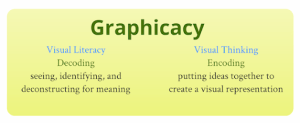
Empowering kids to be their own content creators helps them visually look at ways to encode the design of information. We firmly believe that building the skills of design literacy develops a keen sense of how to manipulate content for maximum impact. It develops visual literacy and visual thinking, the key components of graphicacy. The process of shifting from linear to visual information aids the learning process by providing context for content individually and by educating others about their topics.
![]() |
| Source: ASIDE, 2012 |
The earlier students learn to do this, the savvier they become at scrutinizing other information they see on a daily basis in the media. Understanding that design and media play a huge role in content creation can only help them as they go through the continual bombardment of advertising by infographics in the future.
![]() |
| Source: ASIDE, 2015 |


You must be logged in to post a comment.