How and why covid-19 hampered the mass production of automobiles?

The novel Corona Virus epidemic has had an instant and serious impact on the globally integrated automotive industry. Prodromes include a disruption in Chinese parts exports, large-scale manufacturing interruption across the world.

Due to an upset in supplying chains, a shortage of chips was created, which enforced automobile makers to drop production. A Shortage of a very critical part known as semiconductor chips has been brought up as a key reason. Both global and Indian manufacturers had announced production circulation linked to the obtainability of chips and been feigned to apply brakes on mass production.

What are the circumstances?

A conventional component across automobiles, electronic goods, medical devices, and smart appliances is the integrated circuits (IC) chips. IC’s are the foundation of all modern electronic equipment and the chip is their brain and nerve center. The circuit is a conglomeration of all electronic components — resistors, transistors, capacitors — compressed into a small silicon chip and connected all together, to perform individual or numerous tasks.

Earlier to the covid-19 pandemic, about trillions of chips were being produced on average globally every year. That is about 120 chips per person, which would appear to a great extent. All in all only a small percentage of the global population uses high-end connected equipment holding many chips. Nevertheless, the chip shortage today has a lot to do with the epidemic and how it changes customer’s actions.

After countries by countries went under lockdown people started purchasing more and more electronic equipment such as computers, mobile phones, gaming devices as they have to stay home. As a result of the lockdown in which factories were shut down, automobiles cut down on chip purchases. This affected the supply and demand throughout the world. Now as demands for automobiles appear to be on stream, chip companies are scrambling to adjust the production and distribution of the sectors such as automobiles.

Carmaking uses chips in most of the parts of the automobile, in everything from the power steering wheel, and fuel injector sensors to the navigation system, and parking cameras. As cars are also getting additional technologies and smarter and more affiliated electronic devices and equipment today, account for 40% of the cost of a new internal combustion engine car, up from less than 20% from last two decades, chips account for a scale of this escalate.

why may not carmakers hoard up?

At the last moment, the carmakers usually kept economical account holding and depended on an electronic industry contributing chain to nurture the production lines as per the opportunity. There can be two objectives behind that:-

(1) Firstly, constant reduction in the cost of production.

(2) Secondly, advancement in the processing powers of chips.

The counts of transistors going on an increase in the IC chips have doubled every year. This fact is widely known as Moore’s Law signifies the smaller device with substantial processing speeds.

Nevertheless, plenty of the evolution in chips design exists on the non-auto edge. The auto industry undergoes and large stuck to basic chips that have the same function for years.

So, what happens nowadays?

Countries’ evidence in semiconductor production is functioning to safeguard the dispense of their chips. The Indian government also started again to make an old effort for having companies build semiconductor fabrication set-up in India or get hands-on semiconductor fabs outside India. The Center’s primary effort on making India self-made for semiconductor fabs has overall been imposed severely by the company’s request to protect inevitable expenditures with different sops.


Time and tide wait for none

Time, is the only factor which is limited in life. Everything else you might stretch, elongate, increase since your birth but time is the only constraining factor which is extremely limited. There are only 24 hours in a day but how you spend the best part of those 24 hours is what shall determine your success or failure in life.

Have you ever stopped at a sea-shore and watched the ebb and flow of the tides of the sea? No matter, how much you want to hold it in the cusp of your hand, it shall flow back and the next tide shall return. Similarly, it is with time. The passage of time shall go on at its own pace, no matter how sad, miserable or happy and delighted you be. It is another matter altogether that moment of grief seems so prolonged and moments of ecstasy seem so transient.The essence of the proverb is then to make best use of the allotted time in creative and positive pursuits rather than in negative and time-wasting pursuits. Time once lost can never be regained. So if in the age- appropriate situation, you do not make favorable use of time, you shall have to remain in regret for the rest of your lifetime. A student who shields away his school years in idle pursuits shall always feel the pinch of lack of education, no matter how high he reaches or how far he travels. If you do not spend hours of warmth and comfort in the company of loved ones, you will always feel the pinch of it once you lose your parents or your children grow up or the love of your life walks away.

Remember that all great people who have registered their names in history or made life-changing contribution to the annals of human history also had access to same 24 hours in a day. It is the manner in which they utilised their 24 hours which made each hour of the day count. We can either while our time in idle, mindless pursuits or browsing through inane social networking sites, or indulging in gossip and back-biting or spend hours complaining or bribing about the state of our life, society, country or world or step up our game, rise up to the occasion and do something positive about it to wield constructive changes.

Whether be it learning new things, paying more attention to our physical fitness, connecting with our friends and family, putting in more productive hours at work, let us make each and every moment count in our life so that at the end of the day, we can go to sleep at peace knowing that the day has been well-spent.

Grab every opportunity that comes in your way, lead every day as the last day of your life and wake up every day as if it is the first day of your life. There can be no greater mantra for success.

Alpha Centauri, Star System Closest To Our Sun

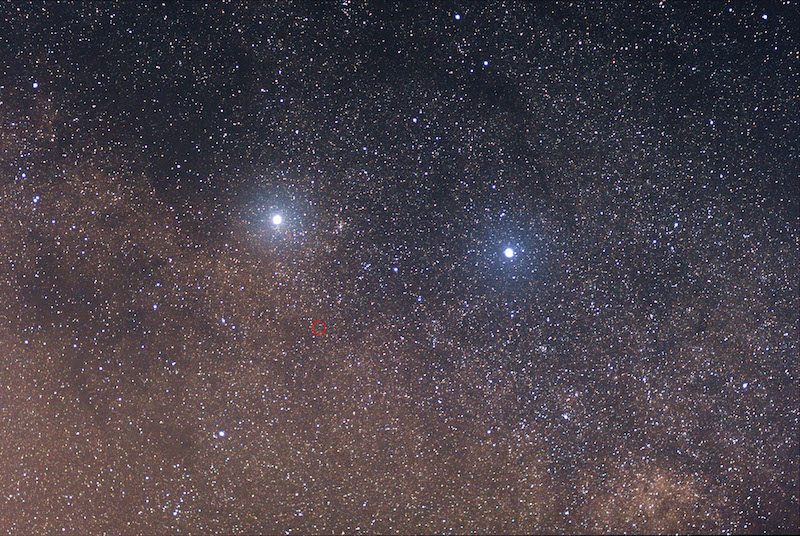
Star Alpha Centauri very bright against a backdrop of extremely dense field of fainter stars and dust clouds.
Alpha Centauri is the third-brightest star in our night sky – a famous southern star – and the nearest star system to our sun. Through a small telescope, the single star we see as Alpha Centauri resolves into a double star. This pair is just 4.37 light-years away from us. In orbit around them is Proxima Centauri, too faint to be visible to the unaided eye. At a distance of 4.25 light years, Proxima is the closest-known star to our solar system.
Science of the Alpha Centauri system. The two stars that make up Alpha Centauri, Rigil Kentaurus and Toliman, are quite similar to our sun. Rigil Kentaurus, also known as Alpha Centauri A, is a yellowish star, slightly more massive than the sun and about 1.5 times brighter. Toliman, or Alpha Centauri B, has an orangish hue; it’s a bit less massive and half as bright as the sun. Studies of their mass and spectroscopic features indicate that both these stars are about 5 to 6 billion years old, slightly older than our sun.

Alpha Centauri A and B are gravitationally bound together, orbiting about a common center of mass every 79.9 years at a relatively close proximity, between 40 to 47 astronomical units (that is, 40 to 47 times the distance between the Earth and our sun).Must Watch Sky Events in 2021

In comparison, Proxima Centauri is a bit of an outlier. This dim reddish star, weighing in at just 12 percent of the sun’s mass, is currently about 13,000 astronomical units from Alpha Centauri A and B. Recent analysis of ground- and space-based data, published in 2017, has shown that Proxima is gravitationally bound to its bright companions, with a 550,000-year-long orbital period.

Proxima Centauri belongs to a class of low mass stars with cooler surface temperatures, known as red dwarfs. It’s also what’s know as a flare star, where it randomly displays sudden bursts of brightness due to strong magnetic activity.

In the past decade, astronomers have been searching for planets around the Alpha Centauri stars; they are, after all, the closest stars to us so the odds of detecting planets, if any existed, would be higher. So far, two planets have been found orbiting Proxima Centauri, one in 2016 and another in 2019. A paper published in February 2021 reported tantalizing evidence of a Neptune-sized planet around Alpha Centauri A, but so far, it has not been definitively confirmed.

Large-appearing bright star with 4 lens-effect bright spikes coming out from it.
Extremely dense star field with 2 brights stars and a small red circle around a much smaller one.

How to see Alpha Centauri. Unluckily for many of us in the Northern Hemisphere, Alpha Centauri is located too far to the south on the sky’s dome. Most North Americans never see it; the cut-off latitude is about 29° north, and anyone north of that is out of luck. In the U.S. that latitudinal line passes near Houston and Orlando, but even from the Florida Keys, the star never rises more than a few degrees above the southern horizon. Things are a little better in Hawaii and Puerto Rico, where it can get 10° or 11° high.

But for observers located far enough south in the Northern Hemisphere, Alpha Centauri may be visible at roughly 1 a.m. (local daylight saving time) in early May. That is when the star is highest above the southern horizon. By early July, it reaches its highest point to the south at nightfall. Even so, from these vantage points, there are no good pointer stars to Alpha Centauri. For those south of 29° N. latitude, when the bright star Arcturus is high overhead, look to the extreme south for a glimpse of Alpha Centauri.

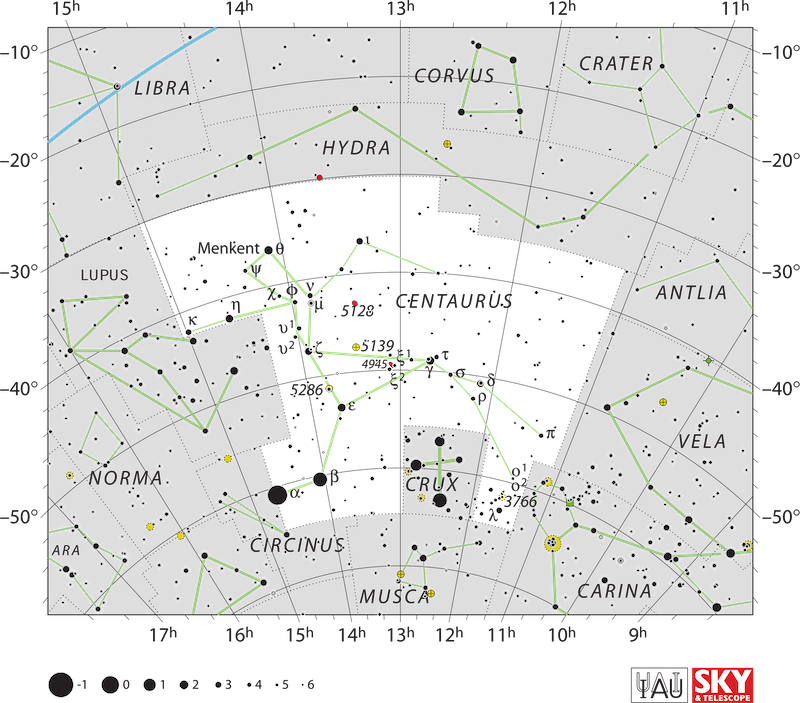
Star chart with stars in black on white, of Centaurus with Southern Cross constellation.
The southern constellation Centaurus. Image via Wikimedia/ International Astronomical Union/ SkyandTelescope.com.

Observers in the tropical and subtropical regions of the Northern Hemisphere can find Alpha Centauri by first identifying the distinctive Southern Cross. A short line drawn through the crossbar (Delta and Beta Crucis) eastward first comes to Hadar (Beta Centauri), then Alpha Centauri. Meanwhile, in Australia and much of the Southern Hemisphere, Alpha Centauri is circumpolar, meaning that it never sets.

A telescope dome at in the foreground with Milky Way and bright stars in the sky.
In this image taken at the European Southern Observatory’s La Silla Observatory in Chile, the Southern Cross is clearly visible, with the yellowish star, closest to the dome, marking the top of the cross. Drawing a line downward through the crossbar stars takes you to the bluish star, Beta Centauri, and then to the yellowish Alpha Centauri. Image via ESO / Wikimedia Commons.

Alpha Centauri in mythology. Alpha Centauri has played a prominent role in the mythology of cultures across the Southern Hemisphere. For the Ngarrindjeri indigenous people of South Australia, Alpha and Beta Centauri were two sharks pursuing a sting ray represented by stars of the Southern Cross. Some Australian aboriginal cultures also associated stars with family relationships and marriage traditions; for instance, two stars of the Southern Cross were through to be the parents of Alpha Centauri.

Astronomy and navigation were deeply intertwined in the lives of ancient seafaring Polynesians as they sailed between islands in the vast expanse of the South Pacific. These ancient mariners navigated using the stars, with cues from nature such as bird movements, waves, and wind direction. Alpha Centauri and nearby Beta Centauri, known as Kamailehope and Kamailemua, respectively, were important signposts used for orientation in the open ocean.

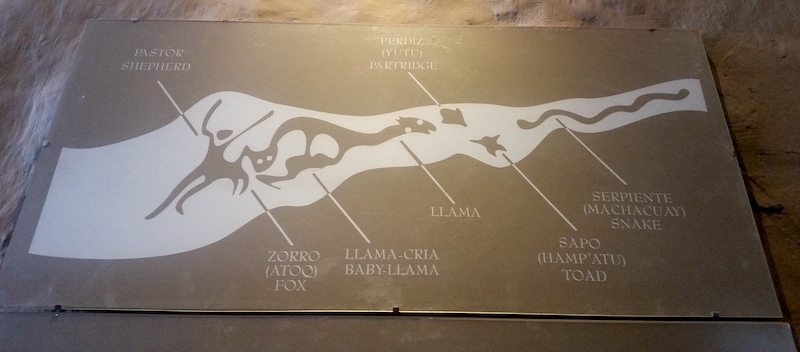
For ancient Incas, a llama graced the sky, traced out by stars and dark dust lanes in the Milky Way from Scorpius to the Southern Cross, with Alpha Centauri and Beta Centauri representing its eyes.

Dark-on-light shepherd, mother llama with baby, partridge, toad, and snake.
A plaque at the Coricancha museum showing Inca constellations. Coricancha, located in Cusco, Peru, was perhaps the most important temple of the Inca empire. Image via Pi3.124 / Wikimedia Commons.

Ancient Egyptians revered Alpha Centauri, and may have built temples aligned to its rising point. In southern China, it was part of a star group known as the South Gate.

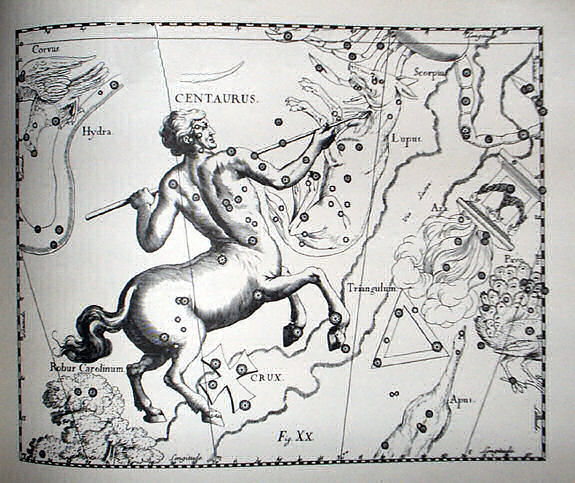
Alpha Centauri is the brightest star in the constellation Centaurus, named after the mythical half human, half horse creature. It was thought to represent an uncharacteristically wise centaur that figured in the mythology of Heracles and Jason. The centaur was accidentally wounded by Heracles, and placed into the sky after death by Zeus. Alpha Centauri marked the right front hoof of the centaur, although little is known of its mythological significance, if any.

Antique etching of half-man-half-horse in field of stars in black on white.
A depiction of the Centaur by Polish astronomer Johannes Hevelius in his atlas of constellations, Firmamentum Sobiescianum, sive Uranographia. Image via Wikimedia Commons.

Alpha Centauri’s position is RA: 14h 39m 36s, Dec: -60° 50′ 02″

Bottom line: Alpha Centauri is actually two binary stars that are quite similar to our sun. A third star that’s gravitationally bound to them is Proxima Centauri, the closest star to our sun.

Html

HTML is the language in which most websites are written. HTML is used to create pages and make them functional.

The code used to make them visually appealing is known as CSS and we shall focus on this in a later tutorial. For now, we will focus on teaching you how to build rather than design.

What are Tags and Attributes?
Tags and attributes are the basis of HTML.

They work together but perform different functions – it is worth investing 2 minutes in differentiating the two.

What Are HTML Tags?
Tags are used to mark up the start of an HTML element and they are usually enclosed in angle brackets. An example of a tag is:

. Most tags must be opened

and closed

in order to function.

What are HTML Attributes?
Attributes contain additional pieces of information. Attributes take the form of an opening tag and additional info is placed inside.

An example of an attribute is:

A photo of my dog.

Golden Rules To Remember
The vast majority of tags must be opened () and closed () with the element information such as a title or text resting between the tags.
When using multiple tags, the tags must be closed in the order in which they were opened. For example:

This is really important!
HTML Editors
Now that we’ve gotten the basic theory out of the way. It’s time to learn how to build our first website.

First off, we must ensure that we have the right tools. Most important, we need an HTML editor.

There are many choices on the market. Here are a handful of the most popular:

Sublime Text 3
However, for this tutorial, we will use the Sublime Text 3 as it is free and also offers cross-platform support for Windows, Mac, and Linux users.

Sublime Text 3
Sublime Text 3 has a mini-preview window on the right.
Pros
Easily customizable
Beginner-friendly
Pleasant color schemes to choose from.
Cons
Can’t print documents or code
No toolbar or dashboard available.
Notepad ++
Another common choice for HTML and other language coders is Notepad ++. It is a tiny program to download and perform the functions you need for writing clean code.

HTML Notepad ++
This is Notepad ++. Far from glamorous but does the job.
Pros
Distraction-free interface
Auto-completion feature
Plugin options for extended functionalities.
Cons
Can be difficult to get used to for beginners
No support for Mac.

Read more: https://html.com/#ixzz70EBqcvpq

Basic Construction of an HTML Page
These tags should be placed underneath each other at the top of every HTML page that you create.

— This tag specifies the language you will write on the page. In this case, the language is HTML 5.

— This tag signals that from here on we are going to write in HTML code.

— This is where all the metadata for the page goes — stuff mostly meant for search engines and other computer programs.

— This is where the content of the page goes.

HTML Structure
This is how your average HTML page is structured visually.
Further Tags
Inside the tag, there is one tag that is always included: , but there are others that are just as important:</p> <p><title><br /> This is where we insert the page name as it will appear at the top of the browser window or tab.<br /> <meta><br /> This is where information about the document is stored: character encoding, name (page context), description.<br /> Let’s try out a basic <head> section:</p> <p><head><br /> <title>My First Webpage

.


Adding Content
Next, we will make tag.

The HTML is where we add the content which is designed for viewing by human eyes.

This includes text, images, tables, forms and everything else that we see on the internet each day.

How to Add HTML Headings To Your Web Page
In HTML, headings are written in the following elements:

Read more: https://html.com/#ixzz70EC2YJuH

SELF DIAGNOSIS : MENTAL HEALTH EDITION

WHAT IS SELF DIAGNOSIS?

Self-diagnosis is the process of diagnosing or identifying, medical conditions in oneself.

OTHER WAYS TO GET IT DONE

It can be done by using study materials such as medical dictionaries, books, and resources on the internet. Not only that but if you have had a past mental health experience then you can figure out if you need a diagnosis or not. Due to your past experience you might be able to help yourself the next time. Another way could be that if someone around you had issues with mental health before you, then you can work on yourself after noticing the symptoms and measures they had and how they dealt with it.

CHALLENGES

One of the main challenges will be Misdiagnosis. It is defines as an incorrect diagnosis of an illness or other problem.

REASONS AND CONSEQUENCES OF MISDIAGNOSIS

  • What might seem “normal” to you, might actually be something not normal.
  • And conversely, what might seem “not normal” to you, might actually be something normal.
  • You don’t know all the disorders that exist and the minute differences between them.
  • The symptoms might actually be that of a physical illness.
  • You may miss something entirely.
  • You might harm yourself if you start medications (allopathic or homeopathic) based on self-diagnosis.

WHY DO PEOPLE DO IT?

  • If there cant find proper resources.
  • If they are not able to access the resources, that could be because of un-supportive family, money issues, cultural beliefs, etc.
  • The research on psychiatric disorders is way too narrow.
  • The resources available and accessible can sometimes be dysfunctional too.
  • They might be in urgent need and want of help that they wouldn’t think of seeking help from someone else but end up doing it on their own.

WHAT DO WE LEARN AFTER THE SELF-DIAGNOSIS

After the self diagnosis we will be able to help ourselves in the future if we ever happened to face something similar. We can come up with support groups or even join one, that will help us maintain our mental health and help us in dealing with post mental health mindset. It is also learnt that after learning thoroughly about self-diagnosis we will be able to understand ourselves and even others who are going through something similar. You will see those changes in yourself and act accordingly to the situations around you.

If you are consider Self-Diagnosis, make sure you are thoroughly educated about it and work efficiently.

Article by : Haniah Mirza

NASA’s Kepler Mission Discovers Bigger, Older Cousin to Earth

Kepler-452b and Earth

NASA’s Kepler mission has confirmed the first near-Earth-size planet in the “habitable zone” around a sun-like star. This discovery and the introduction of 11 other new small habitable zone candidate planets mark another milestone in the journey to finding another “Earth.” 

The newly discovered Kepler-452b is the smallest planet to date discovered orbiting in the habitable zone — the area around a star where liquid water could pool on the surface of an orbiting planet — of a G2-type star, like our sun. The confirmation of Kepler-452b brings the total number of confirmed planets to 1,030.

“On the 20th anniversary year of the discovery that proved other suns host planets, the Kepler exoplanet explorer has discovered a planet and star which most closely resemble the Earth and our Sun,” said John Grunsfeld, associate administrator of NASA’s Science Mission Directorate at the agency’s headquarters in Washington. “This exciting result brings us one step closer to finding an Earth 2.0.”

Kepler-452b is 60 percent larger in diameter than Earth and is considered a super-Earth-size planet. While its mass and composition are not yet determined, previous research suggests that planets the size of Kepler-452b have a good chance of being rocky.

Twelve New Kepler HZ Candidates

Highlighted are 12 new planet candidates from the seventh Kepler planet candidate catalog that are less than twice the size of Earth and orbit in the stars’ habitable zoneCredits: NASA Ames/W. StenzelTwelve New Small Kepler Habitable Zone Candidates

Kepler Planet Candidates July 2015

There are 4,696 planet candidates now known with the release of the seventh Kepler planet candidate catalog – an increase of 521 since the release of the previous catalog in January 2015.Credits: NASA/W. StenzelRead more…

While Kepler-452b is larger than Earth, its 385-day orbit is only 5 percent longer. The planet is 5 percent farther from its parent star Kepler-452 than Earth is from the Sun. Kepler-452 is 6 billion years old, 1.5 billion years older than our sun, has the same temperature, and is 20 percent brighter and has a diameter 10 percent larger.

“We can think of Kepler-452b as an older, bigger cousin to Earth, providing an opportunity to understand and reflect upon Earth’s evolving environment,” said Jon Jenkins, Kepler data analysis lead at NASA’s Ames Research Center in Moffett Field, California, who led the team that discovered Kepler-452b. “It’s awe-inspiring to consider that this planet has spent 6 billion years in the habitable zone of its star; longer than Earth. That’s substantial opportunity for life to arise, should all the necessary ingredients and conditions for life exist on this planet.”

To help confirm the finding and better determine the properties of the Kepler-452 system, the team conducted ground-based observations at the University of Texas at Austin’s McDonald Observatory, the Fred Lawrence Whipple Observatory on Mt. Hopkins, Arizona, and the W. M. Keck Observatory atop Mauna Kea in Hawaii. These measurements were key for the researchers to confirm the planetary nature of Kepler-452b, to refine the size and brightness of its host star and to better pin down the size of the planet and its orbit.

The Kepler-452 system is located 1,400 light-years away in the constellation Cygnus. The research paper reporting this finding has been accepted for publication in The Astronomical Journal.

In addition to confirming Kepler-452b, the Kepler team has increased the number of new exoplanet candidates by 521 from their analysis of observations conducted from May 2009 to May 2013, raising the number of planet candidates detected by the Kepler mission to 4,696. Candidates require follow-up observations and analysis to verify they are actual planets.

Twelve of the new planet candidates have diameters between one to two times that of Earth, and orbit in their star’s habitable zone. Of these, nine orbit stars that are similar to our sun in size and temperature.

“We’ve been able to fully automate our process of identifying planet candidates, which means we can finally assess every transit signal in the entire Kepler dataset quickly and uniformly,” said Jeff Coughlin, Kepler scientist at the SETI Institute in Mountain View, California, who led the analysis of a new candidate catalog. “This gives astronomers a statistically sound population of planet candidates to accurately determine the number of small, possibly rocky planets like Earth in our Milky Way galaxy.”

These findings, presented in the seventh Kepler Candidate Catalog, will be submitted for publication in the Astrophysical Journal. These findings are derived from data publicly available on the NASA Exoplanet Archive.

Scientists now are producing the last catalog based on the original Kepler mission’s four-year data set. The final analysis will be conducted using sophisticated software that is increasingly sensitive to the tiny telltale signatures of Earth-size planets.

Ames manages the Kepler and K2 missions for NASA’s Science Mission Directorate. NASA’s Jet Propulsion Laboratory in Pasadena, California, managed Kepler mission development. Ball Aerospace & Technologies Corporation operates the flight system with support from the Laboratory for Atmospheric and Space Physics at the University of Colorado in Boulder.

For more information about the Kepler mission, visit:

http://www.nasa.gov/kepler

Gregor Johann Mendel

Gregor Johann Mendel was an Austrian monk,who was the first to explain the mechanism of transmission of characters from the parents to the offsprings.He maintained that there were particles called factors,which carried the traits to the subsequent generation.This holds good even today and since he is the pioneer of modern genetics,he is called The father of genetics.

Gregor Johann Mendel was born in 1822 to a family of poor farmers in Silisian,a village in Heizendorf which is now a part of Czechoslovakia.After finishing his high school,at the age of 18,he entered augustinian monastery at Brunn as a priest.From here he went to the University of Vienna for training in physics, mathematics and natural sciences.He himself became interested in hybridisation experiments.

Mendel returned to the monastery in 1854,and continued to work as a priest and teacher in the high school.In his spare time,he started his famous experiments on garden pea plant which assumes great historic importance.He conducted his experiments in the monastery garden for about nine years from 1856 to 1865.

The findings of Mendel and his laws were published in the journal annual proceedings of the natural history society of Brunn,in 1865.The paper was entitled experiments in plant hybridisation.Bit his work was not accepted or lauded by the scientific world at that time because

⭐The journal was obscure

⭐His concept was far ahead of his time

⭐The scientist were busy with the controversy over Darwin’s theory of origin of species and

⭐Mendel not being very sure of his findings lacked an aggressive approach.

Later in the year 1900,three scientists Carl Correns of Germany,Hugo de Vries of Holland and tshermak of Austria independently rediscovered Mendel’s findings and brought to light the ingenuity of father Mendel.To recognize his work,it was named as Mendel’s laws and Mendelism.

Physical role and deficiency symptoms of mineral elements taking place in plants

Macro Nutrients

⭐ Carbon, hydrogen and oxygen

These are not mineral elements in the true sense but have been included because these elements form the composition of all organic compounds present in plants.They are a part of carbohydrates, proteins,and days.Thus these elements have a role to play in the general metabolism of plants.

Deficiency symptoms

Deficiency of these elements is very rare because the plants have a steady supply of these through water and gaseous exchange.Deficiency affects the normal growth and development of plants.

⭐ Nitrogen

Nitrogen is an essential constituent of proteins, nucleic acids,vitamins and many other organic molecules such as chlorophyll.Nitrogen also forms a constituent of various hormones, coenzymes and ATP.

Deficiency symptoms

Stunted growth,chlorosis, reduction in flowering, excessive colouring in apple and peach and reduction in fruit size,decrease in protein contents,change in the pigmentation pattern.

⭐ Phosphorus

It is present in plasma membrane, nucleic acids,nucleotides,many co-enzymes and organic molecules.It plays an important role in energy metabolism.Phosphorus promotes healthy root growth and fruit ripening.

Deficiency symptoms

Loss of older leaves, reduction in growth,increase in phosphatase enzyme activity, causes accumulation of carbohydrates in soyabean.

⭐ Potassium

Potassium is required in the meristematic regions and regions of cell differentiation.It accumulates in older leaves.Though it does not have a structural role,it is involved in stomatal opening and closing.It is an activator of many enzymes and has a role in protein and carbohydrate metabolism.

Deficiency symptoms

Leaf tips curve downward,causes mottled chlorosis, development of chlorosis at tips and margins of leaves, shortening of internodes and stunted growth.

⭐ Sulphur

Sulphur is the constituent of certain vitamins such as thiamine and biotin.It is constituent of coenzyme-A playing an important role in respiration.It forms the sulphydryl group in many enzymes and is a constituent of sulphur containing aminoacids such as cystine,cysteine and methionine.

Deficiency symptoms

Causes inhibition of protein synthesis,younger leaves show chlorosis first,chloroplasts of mesophyll show a decrease in stroma lamellae but grana increase.

⭐ Magnesium

Magnesium is a constituent of chlorophyll molecule which cannot be formed without magnesium.It has a vital role in carbohydrate metabolism and the binding of ribosomal subunits.Magnesium is the activator of many enzymes involved in DNA and RNA synthesis.It acts as a Phosphorus carrier and activates enzymes such as PEP carboxylase and RuBP carboxylase.

Deficiency symptoms

Interveinal chlorosis takes place,anthocyanin pigment deposition takes place after chlorosis,necroctic spots appear in acute cases.

⭐ Calcium

Calcium forms an important constituent of the cell wall occuring in the middle lamella as calcium pectate.It has an important role in the formation of plasma membrane.Calcium plays a role in mitotic cell division and is a constituent of enzymes like phospholipase and adenyl kinase where it acts as an activator.

Deficiency symptoms

Affects the carbohydrate metabolism,the process of respiration is badly affected as number of mitochondria are decreased, meristematic tissues are affected and leaf and root tips die,cell wall may become brittle or rigid.

Micro Nutrients

⭐Iron

Soil is generally not deficient in iron.Iron is a constituent of various flavoproteins and forms a part of enzymes such as catalases,peroxidases and cytochromes.It plays an important role in the electron transport system of photosynthesis being part of cytochrome and derredoxin.

Deficiency symptoms

Causes interveinal chlorosis and the leaves become yellow or white,impairs aerobic respiration and related processes, fruit trees particularly show sensitivity to iron deficiency.

⭐Boron

Leaves and seeds require boron.It is necessary for uptake and utilisation of Ca++ions,pollen germination,cell differentiation and translocation of carbohydrates.It plays a role in nitrogen metabolism,hormone and fat metabolism.

Deficiency symptoms

It causes brown heart rot disease in beetroot,in apple internal tissues become corky,causes leaf to curl and become brittle, premature fall of fruits and flowers.

⭐ Manganese

Manganese is required by leaves and seeds,It is an activator of enzymes like carboxylases,oxidases,dehydrogenases and kinases.

Deficiency symptoms

Causes grey spot disease in oat,poor development of root system,interveinal chlorosis occurs.

⭐ Copper

This is required in all plant parts.Copper forms a component of enzymes such as phenolases and tyrosinase.Copper being a constituent of plastocyanin plays a role in photophosphorylation.Copper maintains the carbohydrate-nitrogen balance.

Deficiency symptoms

Causes die back of shoots especially in citrus,a disease called exanthema causes yield of gums on the bark.

⭐Zinc

Zinc is involved in the synthesis of indole acetic acid by activating the enzyme tryptophan synthetase.It plays a role in protein synthesis.

Deficiency symptoms

Causes distortion of growth,leaves become very small and resettled called as little leaf disease.

⭐ Molybdenum

Molybdenum has an important role to play in the metabolism of Nitrogen.It activates the enzymes involved in nitrogen metabolism.

Deficiency symptoms

It leads to mottling and witling of leaves at the margins causing “yellow spot”disease of citrus.

Small Scale Industries: helping in a BIG way

Small Scale Industries (SSI) are those industries in which manufacturing, providing services, productions are done on a micro scale. Small scale industries play an important role in the social and economic development of India. These industries do a one-time investment in machinery, plants, and industries which could be on an ownership basis, hire purchase or lease basis.

The SSI sector produces a wide range of industrial products such as food products, beverage, tobacco and tobacco products, cotton textiles, wool, silk, synthetic products, jute, hemp & jute products, wood & wood products, furniture and fixtures, paper & paper products, printing publishing and allied industries, machinery, machines, appliances and electrical machinery. The SSI sector also has a large number of service industries.  The small-scale sector in India embracing of a diverse range of units from traditional crafts to high- tech industries.  The number of SSI working units (registered & unregistered) in India totalled 11.4 million in 2003-04-80.5 percent of which are proprietary concerns and 16.8 percent are partnership firms and private limited companies. They have always played an important role in the economies of all major industrial countries. The Report of the Working Group on Micro, Small and Medium Enterprises (MSMEs) growth for 12th 5-year Plan (2012–17), unveils that the sector accounts for 45% of the manufacturing output and 40% of the total exports of the country. Further the Ministry of MSME’s (2017) highlights that the MSMEs accounted for 30.74% of GDP in the year 2014–15. Current economic forecast or survey interprets that with the Indian Economy growing at an average of 7% per annum, it is likely to become a $5 trillion economy by the year 2025. Hence, the development of the MSME sector is essential and it is considered to be the backbone of the Indian economy. Small-scale industry is playing a paramount role in the industrial landscape of our country.

The growth in employment in this sector over years has been noteworthy. The small-scale industries have shown splendid progression in their quantity, production, employment and exports. The cumulative number of units has increased from 105.21 lakhs in 2001-02 to 115.22 Lakhs in 2003-04 to 630 lakhs as of 2020. The number of individuals employed in small scale units too, has gone up from 249.09 lakhs in 2001- 02 to 273.97 lakhs in 2003-04 to 11 crores in 2020. Exports from small scale sector account for nearly 35 percent of the gross value of exports from our country. Total value of exports of this sector has increased from Rs. 71,244 crores in 2001-02 to Rs. 86,013 crores in 2002-03 to a value of $14740 crore and by 2022 it is expected that MSMEs will contribute 60% to India’s total exports. The total value of production of small-scale units comes to nearly 40 percent of the total value of industrial output of the country. Over the years an inspiring trend in exports has been observed in the dimension of increase in exports of unconventional products from this sector.

The SSI has emerged as an ever-changing phenomenon of the Indian economy. At the national level, this sector has performed extremely well and enabled our country to attain industrial diversification. SSIs have made a portentous endeavour to increase in employment fortunes and productivity prospects. If its potential is properly harnessed, it can help in accentuating the pace of balanced regional progress apart from creating employment opportunities.

Best Suspense Thriller webseries

If you are a fan of thriller then these are the perfect pick for you to indulge in binge watching.

Typewriter.The series is set in Goa, and revolves around a haunted house. This series focuses on a story about three kids who form a ghost club and are in search of ghosts as they have read in the book written by one of their grandfather when one of the family travel down to haunted house. This house is filled with mystery as it is haunted. It was a very good and interesting series i would suggest it to everyone.

Ghoul. It’s a genius work of fiction. Ghoul is a series about a prisoner who arrives at a remote military interrogation center and turns the tables on his interrogators, exposing their most shameful secrets. 

Apaharan. The plot revolves around the inspector of Uttarakhand police who is induced into kidnapping a young girl named Anusha, at her mother’s request. The plot begins as a simple plan to extort money in exchange for Anusha. This series revolves around kidnapping, suspense, mystery and never ending action. It’s all about the mystery of the murder of a kidnapped girl. You can watch all the episodes of Apharan on ALTBalaji.

Bard of blood. Plot is all about Kabir Singh who is on mission to rescue his indian agents with solving various mistories in balochistan and Pakistan. Fighting like a champ and always try to win terrorism.

Kaali. This series revolve around a helpless mother Kali, who struggle to save her child life who has few hours of oxygen left in the cylinder. During this time, she gets trapped with dangerous people as she tries to accumulate money for her son’s operation.

Special ops. Himmat Singh’s task force team of five agents living in various parts of the world aim to catch the mastermind, who is behind all the major terrorist attacks.

pH SCALE

All the aqueous solutions may contain hydrogen and hydroxyl ions due to self-ionisation of water. In addition to this ionisation, substances dissolved in water also may produce hydrogen ions or hydroxyl ions. The concentration of these ions decides whether the solution is acidic or basic. pH scale is a scale for measuring the hydrogen ion concentration in a solution. The ‘p’ in pH stands for ‘Potenz’ in German meaning ‘power’. pH notation was devised by the Danish biochemist Sorensen in 1909. pH scale is a set of numbers from 0 to 14 which is used to indicate whether a solution is acidic, basic or neutral.

✓Acids have pH less than 7
✓Bases have pH greater than 7
✓A neutral solution has pH equal to 7

The pH is the negative logarithm of the hydrogen ion concentration
i.e pH = −log [H+]

We can measure the pH of a given solution using pH paper

The pH of a solution can be determined by using a universal indicator. It contains a mixture of dyes. It comes in the form of a solution or a pH paper.

A more common method of measuring pH in a school laboratory is by using the pH paper. A pH paper contains a mixture of indicators. It shows a specific colour at a given pH. A colour guide is provided with the bottle of the indicator or the strips of paper impregnated with it, which are called pH paper strips. The test solution is tested with a drop of the universal indicator, or a drop of the test solution is put on the pH paper. The colour of the solution on the pH paper is compared with the colour chart and the pH value is read from it. The pH values thus obtained are only approximate values.

Role of pH in Everyday Life

Plants and animals are pH sensitive

Our body works within the pH range of 7.0 to 7.8. Living organisms can survive only in a narrow range of pH change. Different body fluids have different pH values. For example, pH of blood is ranging from 7.35 to 7.45. Any increase or decrease in this value leads to diseases. The ideal pH for blood is 7.4.

pH in our digestive system

It is very interesting to note that our stomach produces hydrochloric acid. It helps in the digestion of food without harming the stomach. During indigestion the stomach produces too much acid and this causes pain and irrigation. pH of the stomach fluid is approximately 2.0.

pH changes as the cause of tooth decay

pH of the saliva normally ranges between 6.5 to 7.5. White enamel coating of our teeth is calcium phosphate, the hardest substance in our body. When the pH of the mouth saliva falls below 5.5, the enamel gets weathered. Toothpastes, which are generally basic are used for cleaning the teeth that can neutralise the excess acid and prevent tooth decay.

pH of soil

In agriculture, the pH of the soil is very important. Citrus fruits require slightly alkaline soil, while rice requires acidic soil and sugarcane requires neutral soil.

pH of rain water

The pH of rain water is approximately 7, which means that it is neutral and also represents its high purity. If the atmospheric air is polluted with oxide gases of sulphur and nitrogen, they get dissolved in the rain water and make its pH less than 7. Thus, if the pH of rain water is less than 7, then it is called acid rain. When acid rain flows into the rivers it lowers the pH of the river water also.

Environment Protection Act -1986

The constitution of India clearly states that it is the duty of the state to “protect & improve the environment and to safeguard the forests & wildlife of the country”. The department of environment was established in India in 1980. this later became the Ministry of environment & forests in 1985. The EPA (Environment Protection Act), 1986 came into force soon after the Bhopal gas tragedy & is considered an umbrella legislation as it fills many gaps in the existing laws. Thereafter a large number of laws came into existence as the problems began arising, or example, handling and management of hazardous waste rule in 1989.

An Act to provide for the protection and improvement of Environment. Whereas the decisions were taken at the United Nations Conference on the Human Environment held at Stockholm in June, 1972, in which India participated, to take appropriate steps for the protection & improvement of human environment.

Objective

  • Providing for the protection & improvement of the environment.
  • Preventing environmental pollution in all its forms.
  • To tackle specific environmental problems that are peculiar to different parts of the country.
  • To co- ordinate the activities of the various regulatory agencies already in existence.
  • To appoint environment officers to check environmental pollution.
  • To improve the quality of life by protection of environment.
  • Establishing environmental laboratories. To protect the forests & wildlife in the country.

SCHEME OF THE ACT

The Environment (Protection) Act, 1986 has 26 Sections & it has been divided into four chapters relating to, 1.Preliminary 2.General Powers of the central Government. 3.Prevention, Control, & Abatement of Environmental Pollution. 4.Miscellaneous.

PRELIMINARY : •Short Title, Extended & Commencement. •Definitions

Short Title, Extended & Commencement

The environmental protection act (1986) enacted under article 253 of the Indian constitution. To protect & improve environmental quality, control & reduce pollution from all sources. 1.This act may be called the Environmental (Protection) Act, 1986. 2.It extends to the whole of India.

IMPORTATNT DEFINATIONS

  1. Environment
  2. Environmental Pollutant
  3. Environmental Pollution
  4. Handling
  5. Hazardous Substance
  6. Occupier

GENERAL POWERS OF THE CENTRAL GOVERNMENT

  • Planning and execution of a nation-wide program for the prevention, control and abatement of environmental pollution.
  • Restriction of areas in which any industries, operations or processes or class of industries, operations or processes shall not be carried out or shall be carried out subject to certain safeguards.
  • Laying down procedures and safeguards for the handling of hazardous substances
  • Examination of such manufacturing processes, materials and substances as are likely to cause environmental pollution.
  • Carrying out and sponsoring investigations and research relating to problems of environmental pollution.
  • Establishment or recognition of environmental laboratories and institutes to carry out the functions entrusted to such environmental laboratories and institutes under this Act.

RULES TO REGULATE ENVIRONMENTAL POLLUTION

  1. The standards of quality of air, water or soil for various areas and purposes
  2. The maximum allowable limits of concentration of various environmental pollutants (including noise) for different areas
  3. The procedures and safeguards for the handling of hazardous substances
  4. The prohibition and restrictions on the handling of hazardous substances in different areas
  5. The prohibition and restriction on the location of industries and the carrying on process and operations in different areas
  6. The procedures and safeguards for the prevention of accidents which may •cause environmental pollution and for providing for remedial measures for •such accidents.

PREVENTION, CONTROL, AND ABATEMENT OF ENVIRONMENTAL POLLUTION

  • Persons carrying on industry operation, etc., not to allow emission or discharge of environmental pollutants in excess of the standards.
  • Persons handling hazardous substances to comply with procedural safeguards
  • Furnishing of information to authorities and agencies in certain cases
  • Powers of entry and inspection
  • Power to take sample and procedure

PUNISHMENTS

One of the objective of EPA is provide for deterrent punishment to those who endanger human environment safety & health. Section 15 of EPA provides that any person who fails to comply or contrivance any provision or rule or act he shall be punishable. With a fine  of 1 lakh. with imprisonment for term for 5 years. or both

JOURNALISM

The journalism is the largest growing professionals in the world with the growing numbers in the communication channels the number of audience have also increased at a large rate. It is the activity of gathering assessing creating and presenting news and information journalism can be distinguished from other activities and products by certain identifiable characteristics and practices. It is also the product of their activities the elements not only seperate . JOURNALISM from other forms of communication history reveals that the more democratic society the more news and information it tends to have . Journalism is the production And distribution of reports on current events based on facts and supported with proof and evidence concepts of the appropriate role for journalism varied between countries.

The word journalism applies to the occupation as well as collaborative media gather and publish information based on facts and supported with proof and evidence in others the news media independent of the government but instead acted as private industry in some Nations the news media all controlled by government intervention and are not fully independent. Journalistic media include print television radio internet and in the past news reels. New organisations at challenge fully monetize the digital wing as well as improvise on the context in which they published in print. The proliferation off the internet smartphones has created a shift in the conception of print media channels as people increasing consume news through E- reader smart phones and other personal electronic devices. Newspapers have seen print revenues sink at a faster pale then the rate of growth for Digital revenue. Journalistic convention very by country. Bloggers are often regarded as journalist who also receive promotional gifts this intended to eliminate conflict of interest and protect consumers.

Many credible news organisations are their employees often belong to and abide by the ethics of professional organisation and crafting new stories regardless of the medium fairness and are issues of concern to journalist. In a traditional print newspaper and its online iteration informations is organised based on facts and an opinion breakdown. Healthy journalism in an democratic country must provide all opinions of people in power opinion pieces are generally written by regular columnist for appear in a section titled. While features stories breaking news and hard news stories typically make efforts to remove opinion from the copy. The ability to render a subjects complex and fluid narrative with sufficient accuracy is sometimes challenged by the time available to spend which subject there are several forms of journalism which diverse audience namely, Access journalism advocacy journalism who are voluntarily cease speaking about issues writing to advocate particular viewpoints practice journalism writing return or spoken journalism for radio business journalism tricky reports interpreter business data journalism main use data to support their reporting drone journalism with this drone to capture footage and interactive journalism investigative journalism political journalism sensor journalism global journalism.

Journalism does not a universal code of conduct individuals are not really obliged to follow certain set of rules. The third claims is the claim of humanity which states that journalists are writing for a global and therefore must serve factor. In 28 century the increasing organisation of working journalism specialised education for journalism the growing literature dealing with journalism history problem increasing sense of social responsibility.

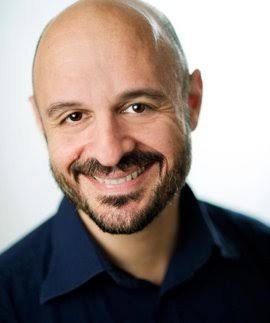
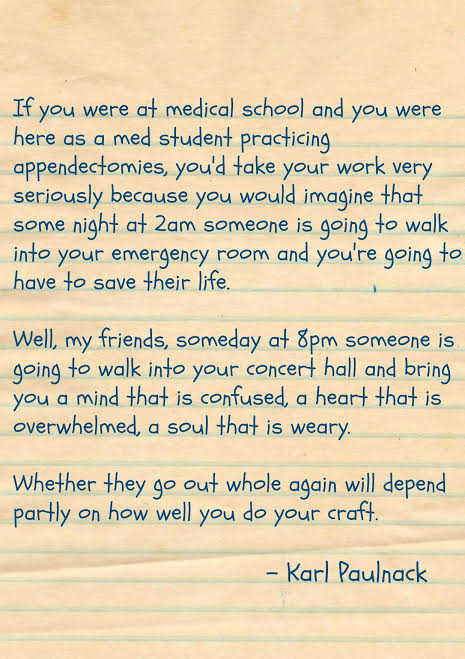
Dr. KARL PAULNACK :

🎵🎼🎵Hailed by the Roston Globe as “a firecracker of a pianist” and “master of his instrument” Karl paulnack has partnered vocal and instrumental soloists, chamber groups,orchestras, conductors and opera companies in nearly a thousand concerts throughout North America, Bulgaria, Estonia, France, Macedonia, Norway, Romania and Russia. Engagements of recent and current seasons include the festivals of Bard College, Madeline Island, Round Top, Royaumont, Sonic Boom and Tangle wood, as well as the Bridge, Noe Valley, Stillwater, Walker Museum, Williams College, UC Davis, UT Austin and University of Oregon concert series. He has appeared in concert at Alice Tully, CAMI, Carnegie, Merkin and Weil recital halls, and also at Tangle Wood’s Ozawa Hall,the Library of Congress and the Hollywood Bowl. His regular recital partners include violinist Jorja Fleezanis, soprano Lucy Shelton and numerous chamber ensemble. A frequent performer of new music, Paulnack has been privileged to work closely with many of the important composers of our time including John Adams ,Elliott Carter George crumb ,Karel Husa, steva Reich and Joan Tower in preparating performance s of their works. In describing the Tangle wood premiere of Elliott Carter’s “of Of Challenge and of Love” with Lucy Shelton,the Boston Globe’s Richard Dyar cited Paulnack’s “commanding” performance as “a standard to aspire to”. Paulnack has appeared as a featured guest on such public radio programs a St. Paul Sunday, Performance Today, and Morning Pro Musica ,as well as on Minnesota Public Radio and BBC Television.

🎵🎼🎵Recording of his performance may be found on the Koch, Seamus, Innova and Capstone Labels. Early in his career, Paulnack served as rehearsal pianist and musical assistant to conductors Sir Charles Grove, Christopher Hogwood, Kurt Masur, Sriji Ozawa, Otto Werner Mueller and Michael Tilson Thomas. With the Los Angeles Opera Theater, he was assistant/cover conductor for his mentor Henry Holt, and served on the opera coaching and conducting staff of University of Southern California (USC) and the los Angeles Philiharmonic Institute. His work in opera includes conduction and coaching position at several universities as well as the Tangle wood Music Center,Where he was a member of the team responsible for the historic 50th anniversary performance of Peter Grimes, an event marking Tangle Wood’s renewed commitment to opera in it’s Fellowship programs. Committed to a diverse comprehensive practice of collaborative musicianship as an artist teacher for more than two decades, Paulnack has served as music division director of The Boston Conservatory since 2002. He also serves as music director and conductor of the contemporary opera Lab of Winnipeg and chef de chant of the Orchestra de Picardie in Amiens, France. He co-chaired the highly acclaimed accompanying and coaching department of the University of Southern California, Ithaca College and Music Academy of the West. He holds an undergraduate degree in solo piano from Eastman and completed theM.M. and D.M.A. degree at USC , where his teachers included Gwendolyn Kolofsky and Brooks Smith.

🎵🎼🎵As an advocate for music and the arts, Dr. Paulnack is increasingly in demand as keynote speaker and lecture. His speech “Why Music Matters” ,has been translated into six languages and appeared on nearly 50,000 web pages, in print publications such as the Christian Science Monitor, and in the program books of numerous symphony orchestras and concerts series around the world. In spring 2009, Linda Ronstadt quoted his speech during her official testimony to the United States Congress on behalf of funding for the arts.

PANGONG LAKE

Pangong Lake also known as Pangong Tso is a beautiful endorheic lake situated in the Himalayas and is 134 km long, extending from India to China. Pangong Lake is situated at a height of 4350 m and is one of the biggest tourist attractions of the country. The beauty and allure of this lake has attracted people from all over the country and beyond. The lake is said to be in the process of being identified as a wetland with international significance under the Ramsar Convention and if everything goes as expected then the Pangong Lake will be the first in South Asia to be a trans-boundary wetland and that too under this convention.

The one factor that makes this Lake so popular is the fact that it keeps changing colors. Situated in the Himalayan range it is approximately 140 km from Leh in Jammu and Kashmir. The name of the lake Pangong was got from a Tibetan word Banggong Co that means a narrow and enchanted lake. And now you know that the lake has got its name rightfully. You will know this when you visit the beautiful lake of Pangong. You are sure to be enchanted by the charm. And because the lake is a long stretch, one third area of the lake lies within our country and the other two third portion lies with Tibet and is controlled by China.