IS SOCIAL MEDIA TOXIC?

BY: VAIBHAVI MENON

We live in a generation where everything is controlled by social media and it is something that is normalized now. But if social media is seen as neither positive nor negative, what is true is that it leaves people fighting for views, claps, likes or praise. That affects both the younger and the older generations. The constant search for recognition and attention can have detrimental effects on our lives and leave us hurt or needing more attention. Increased use of social media can lead to a high chance of people feeling depressed, anxious etc.

Technically, you can switch off your mobile phone, or you can set up a time limit for your social media use. This will simply prevent you from using these platforms. Of course this is not so easy, as everyone is online, including our friends and families, with whom we would like to keep contact. This means we should be more ‘news literate’ and more educated about the news and any information we read online. For example, we should always check the source or the profile of the person who shares a suspicious post. We should also read from a wide range of sources, and not limit ourselves. Sharing something without reading it is a big no. Social media is toxic not just because it is addictive by design, but also because platforms spread disinformation and they encourage their users to engage with these fake news more than with fact checked ‘real’ news. As a consequence, disinformation spreads faster and reaches a wider audience. This has a toxic impact on public trust in democratic institutions like elections, governments or any public services. What it means is that our own democracy can be established and undermined by outside influences simply by exploiting the loopholes in today’s social media. Social media allows people to share their lives, but it also allows others to criticize, belittle, bully, and berate others on such a grand scale that it sometimes leads to depression and in extreme cases, suicide. I Young children are often hounded by “influencers” to buy merchandise, dress a certain way, eat certain foods, listen to specific music, and think a specific way in order to be accepted. The Logan Pauls and Kardashians of the Internet feed off of the image hungry youth. Even on Youtube and TikTok, everyone is wearing the same brand names, doing the same dance memes, and promoting the same diet or lifestyle products to cash in on the hoards of people watching and envious of the success. Showing off your newest car, handbag, watch, condo, or remote island beach house is no longer considered vain, shallow, or superficial. It’s now considered lucrative. Even on Medium, where words and ideas are King, the first step to getting anyone to read your story is the title and image. And to further cement your superior status, having a boat-load of claps and being published in a successful publication boosts your credibility.

taken control on our life and it makes the decision of what is right and what is wrong which can prove to be toxic because nothing is what it seems on social media. Its not reality.

Dr.A.P.J. Abdul Kalam ‘s vision for the Nation

A.P.J. Abdul Kalam was born in a necessitous and little educated Tamil family on 15 October 1931, at Rameswaram district of Tamil Nadu, India. His father, Jainulabdeen Marakayar, was a boat owner and imam of a local mosque; and his mother, Ashiamma Jainulabiddin, was a homemaker.

Dr. APJ Abdul Kalam’s vision for the Nation:

Vision of the Nation from India 2020 India vision,2020 is a planned proposal by former Indian President Dr. A.P.J. Abdul Kalam ,to make India a developed country by 2020

Overview :

India vision 2020 was initially a document prepared by the Information Technology,Forecasting & Assessment Council (TIFAC) of India's Department of science & Technology under the chairmanship of Dr.A.P.J. Abdul Kalam & a team of 500 experts. The plan is further detailed in the book India 2020 ; a vision for new millennium,which Dr.A.P.J. Abdul Kalam co-authoref with Dr.Y.S. Rajan.

Kalam describes the plan as follows :

“In transforming the Nation into a developed country,five areas in combination have been identified.Based on India’s core competencies , natural Resources & Talented manpower for integrated action to double the growth eate of GCD and realize the vision for developed India.

The fiver Areas :

⭐ agriculture & food processing; Aimed at doubling the present production of agricultural processing &food

⭐ Infrastructure with relible electric power; Providing urban amenities to rural areas,& increasing solar power operations

⭐ Education & health care; Directed towards abolishing illiteracy ,social security & and overall health for all.

⭐ Information & Communication Technology ; Increased E-governance to promote education, Telecommunication & Telemedicine (in Remote Areas,)

⭐ Critical Technology & Strategic Industries ; The growth of nuclear technology, spacy technology &defence technology.

The land of snow :

Trekking is an exciting adventure. Athushi Despande travels to the Land of snow,the Himalayas,aware of it's dangers. He walked to the Milam Glacier on the edge of Tibet. He took a guide , Mr.Khem Nam and a sturdy Porter, Laxmi with him.

The path :

The Indo-China war had affected the villages and the people had field from the path to Milam. Most if the villages were abandoned and appeared to be the ghost villages (Burfu and Bilju) His four day trekking was adventure.

The Weather Conditions :


On their sixth day of trekking,it had rained a whole day and night that made the conditions worse for further travel. They took shelter in a cave Occasional sunshine,Hailstorms,wind chases one another.

The View of glaciers :

The summit of Mandayo spiralled up the blue sky like a cork screw. It had steep cliffs on all faces it looked surmountable. There was the Nanda pal glacier which had icy waters below. It was snow everywhere. To their trained eye,their goal was near. They saw nine small glaciers. Crevasse dotted their way. They marked their route carefully with black stones. They reached twin ponds of Dudh and Suraj Kund with a stunning ice fall as the back drop. The author drank the sweetest water of the pond.

Conclusion :

The author was fortunate to see the deity,Nanda Devi. He paid his obeisance to the Goddess and returned Munnusiyari happily. He cherishes his experiences happily.

Best inspired quotes:

THE DOUBLE SLIT EXPERIMENT

One of the most famous experiments in physics is the double slit experiment. It demonstrates, with unparalleled strangeness, that little particles of matter have something of a wave about them, and suggests that the very act of observing a particle has a dramatic effect on its behaviour.

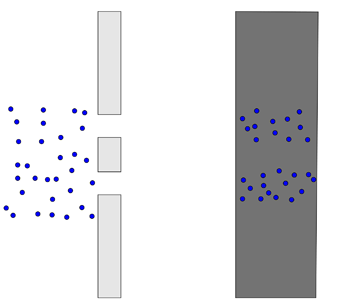
To start off, imagine a wall with two slits in it. Imagine throwing tennis balls at the wall. Some will bounce off the wall, but some will travel through the slits. If there’s another wall behind the first, the tennis balls that have travelled through the slits will hit it. If you mark all the spots where a ball has hit the second wall, what do you expect to see? That’s right. Two strips of marks roughly the same shape as the slits.

In the image below, the first wall is shown from the top, and the second wall is shown from the front.

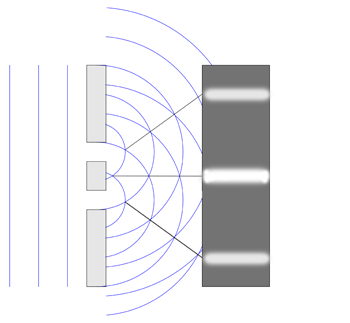
Now imagine shining a light (of a single colour, that is, of a single wavelength) at a wall with two slits (where the distance between the slits is roughly the same as the light’s wavelength). In the image below, we show the light wave and the wall from the top. The blue lines represent the peaks of the wave. As the wave passes though both slits, it essentially splits into two new waves, each spreading out from one of the slits. These two waves then interfere with each other. At some points, where a peak meets a trough, they will cancel each other out. And at others, where peak meets peak (that’s where the blue curves cross in the diagram), they will reinforce each other. Places where the waves reinforce each other give the brightest light. When the light meets a second wall placed behind the first, you will see a stripy pattern, called an interference pattern. The bright stripes come from the waves reinforcing each other.

Here is a picture of a real interference pattern. There are more stripes because the picture captures more detail than our diagram.

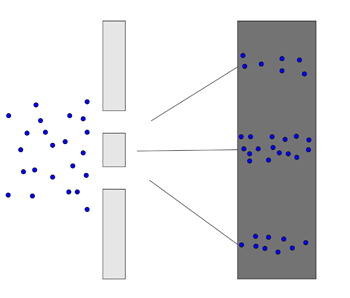
Now let’s go into the quantum realm. Imagine firing electrons at our wall with the two slits, but block one of those slits off for the moment. You’ll find that some of the electrons will pass through the open slit and strike the second wall just as tennis balls would: the spots they arrive at form a strip roughly the same shape as the slit.

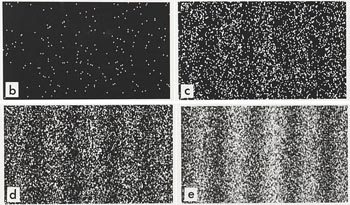
Now open the second slit. You’d expect two rectangular strips on the second wall, as with the tennis balls, but what you actually see is very different: the spots where electrons hit build up to replicate the interference pattern from a wave.

Here is an image of a real double slit experiment with electrons. The individual pictures show the pattern you get on the second wall as more and more electrons are fired. The result is a stripy interference pattern.

What does the experiment tell us? It suggests that what we call “particles”, such as electrons, somehow combine characteristics of particles and characteristics of waves. That’s the famous wave particle duality of quantum mechanics.

‘FAST FASHION’ a boon or bane

Have you ever wondered how you contributed to sabotaging the environment? If not it’s high time to dig deeper into the treasure, which is a greener Earth. You know what I’m speaking about. Yes, it’s about the fashion industry and the need for sustainable fashion. The fashion industry is one of the top industrial sectors in the world, with a value of 3 trillion dollars and produces 2% of the global GDP according to global fashion industry statistics. Accordingly, 1 in 6 people work in fashion or related industry Furthermore moving closer, the Indian fashion and apparel industry produces 1586 dollars in GDP per capita and enabled 45 million recruitments within the country. It is presently the second-largest employer within the country. Hence proving to be one of the top industries carrying out Apparel manufacturing process involving Product Design, Fabric Selection and Inspection, Patternmaking, Grading, Marking, Spreading, Cutting, Bundling, Sewing, Pressing or Folding, Finishing and Detailing, Dyeing and Washing, QC etc. 100 billion items of clothing are produced annually.

Adding onto the positives, there are many drawbacks to the very fortunate industry. It had been and is still on the top list of the contaminating industries in the world. Say, the textile industry is the second largest pollutant in the economy. The facts that had been put into due negligence till now is being brought to the limelight by Brands and fashion enthusiasts.

Blights of the fast fashion

1. Savagery towards animals

It is not a new fact to us that animals are manipulated to produce clothes or apparel items that seems to be a top trend. Most items produced from fur, leather, wool, feathers are obtained from the mass pestering of innocent animals. Sumanthran tigers and American alligators in the endangered category were still poached for cloth production. 

2. Unfair wages and working conditions

As to the latest protests and struggles to achieve a full-fledged fashion revolution, we see the campaigns with people holding placards written ‘who made my clothes’ and ‘i made your clothes’. It wasn’t any happy day speech, they are the behind the scene labour workers under hardships produce all the commodities as to the recent demands. We often tend to forget them blindsided by the white-collar workers.it had been brought to the mainframe that blue-collar workers of Bangladesh, India, China, Indonesia, Vietnam, etc had minimal protection towards worker’s rights. Under prevailing pandemic conditions, these marginal workers were reported losing jobs, being underpaid, cancelled from orders or being not even adequately paid in which they suffered meeting even the food demands of their family. On the other hand, it has become a custom to exploit farmers to the company and middle-men needs.

3. Customer attitude

The next crucial factor towards non-circular fashion is the growing needs of customers for top quality, yet cheap and mind-blowing colourful garments. consumers are well aware of the upcoming trends and glams of the industry, leading to the fast adoption of these newbies. Speaking of which is a necessary evil. It is brought to the view that one in every three young women restricts herself from wearing a cloth multiple times. As to its blitzscaling, fashion companies are compelled to showcase more attire than the actual need.

4. Water pollution

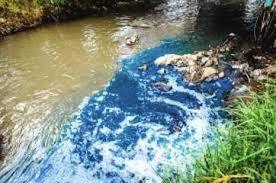
We have come to the major part of the discussion on fast fashion. It is every living being’s responsibility to safeguard the natural resources and pass on the same to the forthcoming generations. Water consumption of the textile industry had met its way beyond the danger zone. It takes 2720 litres of water to manufacture one cotton shirt and 7000 litres to make a pair of jeans. The pollution made to the water bodies doesn’t end there, the chemicals used for the mass production of the garments are disposed of directly or indirectly to the same. It is estimated that one-third of microplastics prolonging in the oceans is the impact of synthetic textiles. These are more deadly as the tiny they are, wouldn’t pass through the filters. The Aral sea, renowned as the world’s fourth-largest lake, has almost dried up as a result of the nearby cotton cultivation. The Kitex industry was recently accused of dumping excessive waste into the nearby waterbody.

5. Excessive carbon emissions

It is said to be true that the fashion industry is responsible for 8-10% of the total greenhouse gas emissions in the atmosphere. The major cause of this is the extensive use of synthetic fabrics like polyester, nylon and acrylic, spandex, faux fur, rayon, etc. Polyester ranks top on the intake of crude oil compared to all others by 70 million barrels annually. Transportation is the other means of carbon ejaculation contributed by the global distribution strategies.

6. Textile waste

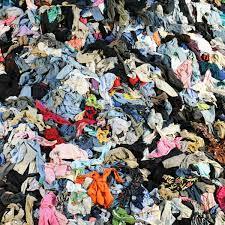
It is said that one garbage truck of textile waste is disposed of every second. This breathtaking fact does prove the intensity of the issue we are dealing with. This directly points out the rising rage for unsustainable fashion culture. For example, polyester is made from the polymerization of petroleum-derived ethylene glycol and purified terephthalic acid, which meltdown to produce polyethylene terephthalate (PET). As such many synthetic fibres are either termed plastic or made out of non-renewable substitutes that concern the ecology.

How can changes be made? How would fashion statements or the industry as a whole regain its fortune? Is the zero-waste fashion possible? Would buyers change their outlook on fashion?

 It is time to join hands on the fashion revolutions put forth by fashion creators and promoters on ideas like sustainability, circular economy, zero waste fashion and so on. The idea of the fashion economy sabotaging ecology is given a better view as a result in modern days. Brands now are looking into logical practices to ensure sustainability and restrain themselves from misfortune. Let’s get to know the efforts taken by the industry dignitaries to achieve a stable eco-friendly fashion culture.

Overhaul to fad fashion

1. Sustainable brands

Brands that prove accountable to safeguard bionomics, sacrificing the trend sets should be promoted. Brands those prioritise natural fibres, work with local artisans and so on to gain environmental, economic and social well being. These companies tend to visualise customers as creatives. For example Reff jeans and Girlfriend collective

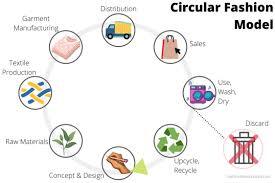
2. Circular fashion

‘Circular fashion’ can be defined as clothes, shoes or accessories that are designed, sourced, produced and provided with the intention to be used and circulate responsibly and effectively in society for as long as possible in their most valuable form, and hereafter return safely to the biosphere when no longer of human use. (Anna Brismar, Green Strategy, 2017). This is the basic idea of the longevity of any garment cycle.

“The circular economy refers to an industrial economy that is restorative by intention; aims to rely on renewable energy; minimize, tracks and eliminates the use of toxic chemicals; and eradicates waste through careful design.” (Ellen MacArthur Foundation)

3. Zero waste fashion

It is the concept of reducing the waste produced with the garment during its life cycle. Furthermore, it is divided into two categories, pre-consumer zero-waste fashion and post-consumer zero-waste fashion. Pre-consumer zero-waste fashion is a holistic approach towards the removal of waste during the manufacture of garments. post-consumer zero waste fashion, on the other hand, is the approach towards post-consumer garments, what more the garment could be used for.

4. Natural dyeing

These are the ancestral dyeing methods using degradable and natural materials like plant sources like roots, fruits, etc. yet the wide-ranging possibilities of this are still in doubt. Whereas a bit of sacrifice towards betterment wouldn’t hurt.

5. Mutating customer attitude

Nowadays customers are more aware of the rising issues on the planet and do agree to take responsive mutation to the outbreaking situations. Social media has had a great influence in making this change possible. When buying an outfit, consumers should ask themselves questions like how is this made, is it a need, how long it would stand, and what to do after. Renting and swapping is too given better focus

6. Personal style 

Rather than buying all the so-called latest trends, customers should be aware of their personal style. Personal style does mean the unique way you dress, determining what suits you well, colours favouring, vulgar eliminating, defining yourself and gives you much confidence.

7. Recycling commodities

Brands have come up with the idea of accepting their old products in store. Moreover, specific recycling methods are being conducted and succeeded to a certain level that includes unbinding the fibres to yarns and reforming them to new ones so the focus centralises virgin fibres. As of now, only 13% of clothing and footwear is recycled but in the near future, this is to be a big number. And take care the brands don’t blindside you with mere greenwashing recycling programs.

8. Aquatic treatment

Brands now maintain a ‘water budget’ to not exceed the water demands. It is also noted that natural fibres take in less water for manufacture. There are more ethical ways to dye clothes without the use of water is a plus. Whereas to solve the issue of microplastics, using guppy friend washing bags and installing Girlfriend Collectives microfibre filters in laundry machines is recommended.

9. Ban on poaching

This year London fashion week has been announced prohibiting animal fur due to the rising concerns and brands like Burberry, Gucci and Versace guaranteed to go fur-free. At the same time, Adidas and G-Star RAW introduced apparel produced of ocean plastic. Companies now are developing materials that substitute animal-based leather to the ones made with grape and orange skins which are more laboratory-made. 

10. Reducing carbon outrush

The profound carbon emissions are put to a stop by altering synthetic fabrics made of crude oil to natural ones like peach palm fabrics. Transportation caused pollution could be eliminated by procuring and sourcing local resources and employing local artisans.

11. Neat and intact employment

Sustainability couldn’t be possible without fair wages, constant job opportunities with regular and stable working hours. Meanwhile, farmers and blue collars should ensure a safe environment with right protecting laws and policies from the government. So that they could be self honoured with at least meeting the daily living standards which every person of the democracy should enjoy.

12. Minimalism

This isn’t a very pleasing method compared to others on the list. Yet leading a simplistic life could make a big change. Demand is directly proportional to supply. So when demand decreases supply decreases and so will production. Less production leads to the concentration of ones being produced and existing ones, this is where the difference would be visible.

Hunger watch report

News

Source: Department of Consumer Affairs, Hunger Watch

• Impacts of Covid-19 pandemic, lockdown – on
personal income and food consumption.

• Hunger watch report analysed to provide
important information.
Income drop.

• In October 2020 – compared to pre lockdown
level
 27% of respondents lost their income due to
the national lockdown
 24% of its respondents record that they lost
50% of their income
 6% responded that their income did not change
despite the lockdown
Source: Department of Consumer Affairs, Hunger Watch

Retail inflation

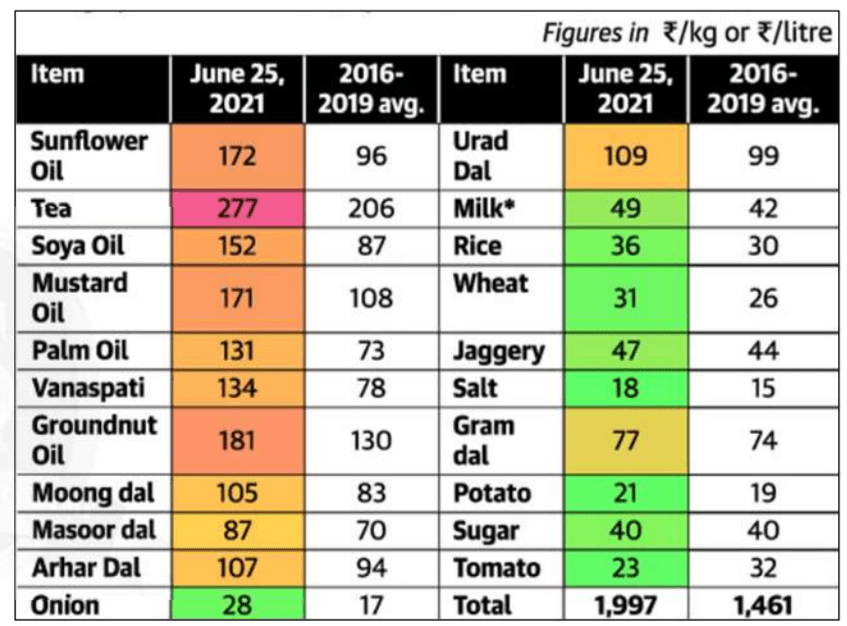
• In June 2021 – the prices of edible oil and pulses are increasing significantly .

• retail price analysis of 21 essential items across India.

• In June 2021- a Consumer – to buy a kg of essential item – has to spend rs.500 more compared to average cost between the year 2016 and 2019 .

• table given – indicates the retail price difference in various occasions .

• with retail inflation – the drop in income level has burdened the consumers.

hold Consumption of Commodities

• the impact of income factor and inflation
factor can be seen from the change in consumption level
 data of October 2020 is compared with March 2020.

• Report – level of household consumption of all
commodities listed have decreased.

• In October 2020 – 38% of households reported
that the consumption of vegetables decreased a lot.

• consumption of egg/meat commodities have also decreased – another problem in ensuring nutrient security.

Conclusion

adequate policy responses are the need of the hour to address both food and nutrition security in the country.

Why java is important?

Java is one in all the foremost standard programming languages wont to produce internet applications and platforms. it absolutely was designed for flexibility, permitting developers to write down code that may run on any machine, in spite of design or platform.
Java may be a artificial language, designed to be coinciding, class-based and object-oriented, similarly as a computing platform 1st discharged by Sun Microsystems in 1995. a colossal quantity of applications and websites won’t work unless you’ve got Java put in, and additional ar created daily. Denying yourself Java is equivalent to denying yourself access to a technological infrastructure. Java is publicised, and honored for its quick performance, security, and dependability.

About
Career Hub
Diploma Program
Education Partners
Log in
Contact
What is Java and why is it important?

What is Java
Photo Credit epSos.de

What is Java and why is it important?
Java, not not like several of the technologies that influence our everyday lives to the present terribly day, originated in Golden State, below the reach of Sun Microsystems, a corporation supported in 1982 by Andreas Bechtolsheim, Vinod Khosla, and Scott McNeally. thereupon aforesaid, tech-savvy varieties tend to seem additional to the longer term than the past, thus if you discover yourself additional interested by the trendy world of cryptography, or end up questioning simply however cogent Java has been to the planet of technology, you don’t notably need a lesson. You’re presumably searching for the trendy relevance and influence of a technology that has continuing to evolve systematically so as to stay up with the days.

Java may be a artificial language, designed to be coinciding, class-based and object-oriented, similarly as a computing platform 1st discharged by Sun Microsystems in 1995. a colossal quantity of applications and websites won’t work unless you’ve got Java put in, and additional ar created daily. Denying yourself Java is equivalent to denying yourself access to a technological infrastructure. Java is publicised, and honored for its quick performance, security, and dependability.

From laptops to datacenters, game consoles to scientific supercomputers, cell phones to the web, Java is omnipresent.
‘Java may be a artificial language expressly designed to be used within the distributed setting of the web. it absolutely was designed to possess the “look and feel” of the C++ artificial language, however it’s less complicated to use than C++ associate degreed enforces an object-oriented programming model.’

‘Java will be wont to produce complete applications which will run on one laptop or be distributed among servers and purchasers in a very network. It may also be wont to build alittle application module or application program (a merely designed, little application) to be used as a part of an online page. Applets build it potential for an online page user to move with the page.’
Tech Target- The necessities of Java.

Why is Java such a preferred alternative among modern software package developers?
The answer lies primarily with the complete testing, change and consistency of delivery that Java has traditionally provided. Java has been tested, refined, extended, and well-tried by an infatuated community of Java developers, architects and enthusiasts. Despite origins chemical analysis back virtually twenty years, Java has systematically evolved over the years.
Java is meant to alter development of moveable, superior applications for the widest vary of computing platforms potential, therefore sanctioning the elemental tenets of overarching accessibility similarly as cross-platform interaction. By creating applications on the market across heterogeneous environments, businesses will offer additional services and boost end-user productivity, communication, and collaboration—and dramatically scale back the value of possession of each enterprise and client applications

Why Polar Bears are on The Verge of Extinction

The loss sea ice habitat from climate change is the biggest threat to the survival pf polar bears. Other reasons include human-polar bear conflict, toxic pollution, oil spills and potential hunting of some subpopulations.

Polar Bear-Human Conflicts

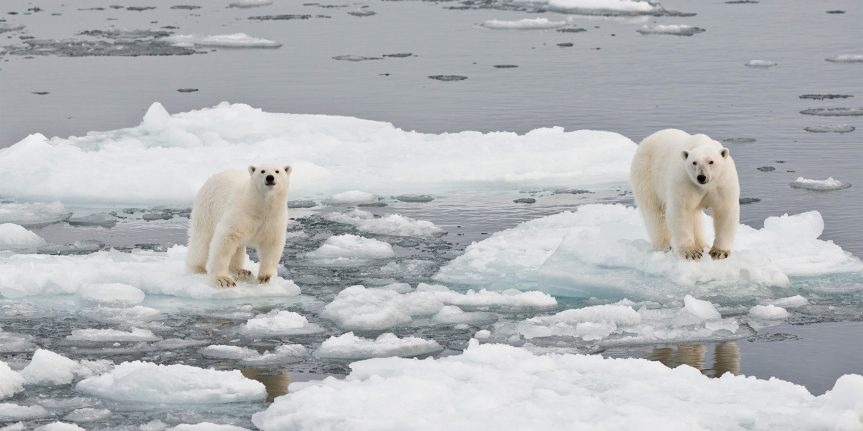
As the sea ice of the Arctic thins and disperses, increasing number of polar bears spend longer periods in along the Arctic coastlines. Here their powerful sense of smell attracts them to human communities. Scent leading to garbage, stored food, dog teams, and animal carcasses bring them into greater conflict with people residing in the Arctic.

As apex predators, polar bears pose a significant threat to human life and property. In recent years the attacks on humans, who come within the polar bear’s range, continue to rise.

Effects of Climate Change

Due to climate change the Arctic is heating up twice as fast as anywhere in the world, melting the sea ice cover by 14% per decade. Comparing the data recorded between 1981-2010, we have lost about 770,000 square miles.

Polar bears rely on sea ice as their hunting ground and to rest, breed, and store energy for the summer and sutumn, when food can be scarce. The bears health decline as they go longer periods without food. Bears that come ashore, after the ice breaks up, are roughly 22 pounds lighter and in poorer condition. They also must travel long distances to stay with the rapidly receding ice.

Polar bears suffering from malnutrition can face extreme starvation -especially females with cubs. Scientists have found the main cause of death for cubs to be either lack of food or lack of fat on nursing mothers.

Industrial Impacts

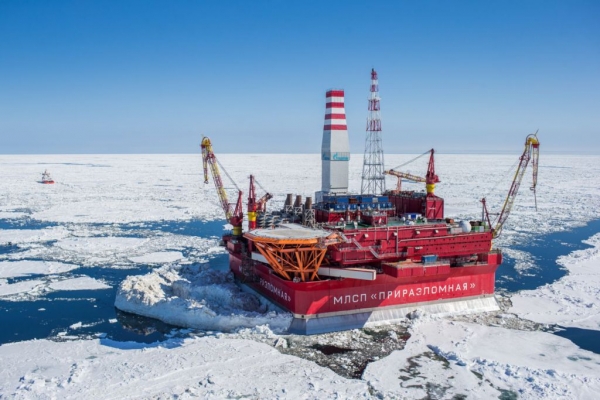
As summer ice retreats, a new ocean is emerging, which allows more opportunities for industrial development at sea, and on large parcels of land. Offshore petroleum installations and operations in the Arctic are expected to increase in number. This results in destruction of habitat, poisoning of the bears when they ingest oil and contaminated prey which causes disturbance in the food web. As traffic by oil tankers and cargo ships in Arctic waters increases, so do the oil spills and human disturbance to their habitat.

SAVITRIBAI PHULE

Before India’s freedom ladies in our Nation need to deal with numerous issues like absence of legitimate training, early marriages, not given equivalent rights as men and so forth.

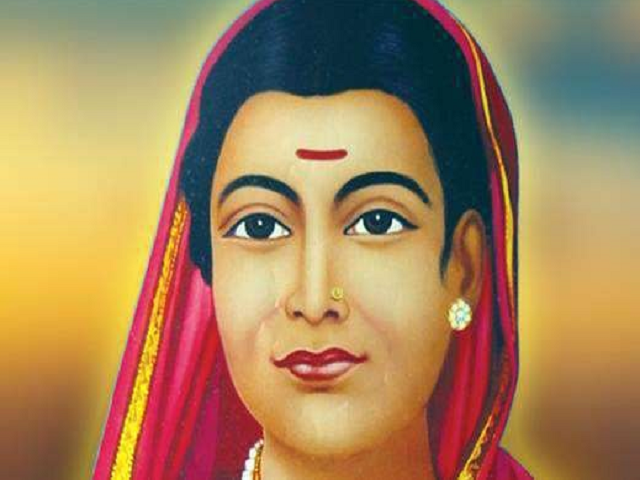
There were numerous social reformers who worked in improvement of our general public. One of them was Savitribai Phule. Alongside being a social reformer, she was likewise a poet, educationist and philanthropist.

She was the initial one to open a young ladies school in Pune. She additionally attempted to cancel segregation and out of line treatment of individual on based on rank and sexual Orientation.

EARLY LIFE AND EDUCATION

Savitribai Phule was born on 3January 1831 in the village of Naigaon in Satara District.  She was oldest little girl of her folks. She got hitched to Jyotirao Phule who himself was a social dissident. At the hour of her marriage, she was only 9 years of age furthermore uneducated as around then, there were no ladies rights to contemplate.

After marriage, with her better half’s support, she figured out how to peruse and compose and the two of them in the long run proceeded to track down India’s first school for young ladies called Bhidewade in Pune in 1848.

OTHER WORKS

Her books of sonnet’’Kavya Phule’’ and ‘’Bavan Kashi Subodh Ratanakar’’ were distributed in 1934and 1982.

She unequivocally accepted that training was one of the focal boards through which ladies and the discouraged classes could get enabled and desire to remain on an equivalent balance with rest of the general public. She is a motivation to every one of the ladies, without her work it would have been hard for ladies to battle for their privileges around then.

Reference Links

https://en.wikipedia.org/wiki/Savitribai_Phule

https://indianexpress.com/article/opinion/columns/savitribai-phule-education-feminism-women-empowerment-7131478/


PRADHAN MANTRI UJJWALA YOJANA

In India, around 10 crore households out of more than 24 crore households lack LPG connections and so use coal, firewood, cow dung cakes and other such fuels as primary fuels for cooking. The emission from these are extremely harmful for the human body. To save the women and children from the health risk the PMUY scheme was released.

Pradhan Mantri Ujjwala Yojana was launched on 1st May 2016, by honorable Prime Minister Narendra Modi, in Ballia, Uttar Pradesh. The scheme aims at providing safe cooking fuel- LPG. 5 crore LPG connections will be provided to the families belonging to Below Poverty Line (BPL) with a financial support which is an interest free loan for each connection, for the purchase of gas stove and refill to be provided in next 3 years. The government would bare a cost of 1600 per connection for the purchase of other support items for LPG connection such as a cylinder, regulator, safety hose, booklet, etc.

According to report of WHO, smoke generation from the burning of unclean fuel for cooking such as wood, coal, cow dung cakes, and other such unclean fuel is equally toxic to burning 400 cigarettes in an hour. Inhalation of such unclean fuel smoke affects the health adversely. WHO estimates 5 lakh deaths in India take place because of inhalation of such toxic smoke from household pollution causing several pulmonary, heart and lung diseases to the women and children.

The Pradhan Mantri Ujjwala Yojana was formulated keeping in mind the health of the women and children and to keep them away from the toil of collection firewood from unsafe areas. This scheme also took to the empowerment of women, especially the women in rural areas, by providing LPG connections in the name of the women of the household. An amount of Rs 8000 crore was allocated for this scheme, for The BPL families identified on the basis of the Socio-Economic Caste Census Data.

The Pradhan Mantri Ujjwala Yojana not only empowers the women of the rural areas and safeguard the health of women and children, but also provides business opportunity of at least Rs 10000 by providing employment to around 1 lakh people. It provided a boost in the ‘Make in India’ project as all the gas stoves, LPG cylinders, gas hose and regulators are manufactured domestically for the implementation and fulfilment of this scheme.

Impact

714 districts have been covered under this scheme an 7,19,06,812 PMUY connections have been released, as per the records of ‘pmuy.gov.in’, the official website of government of India for Pradhan Mantri Ujjwala Yojana. Against the target of 15 million for the first year of launch, 22 million connections were provided. 30 million connections were provided by 23rd October 2017. 44% of these connections were provided to the Scheduled Castes and Scheduled Tribes families. In 2018 included 80 million poor households to provide them with LPG connections. An increase of 56% in 2019 was achieved as compared to 2014. This scheme provided the women for prevention against respiratory diseases because of unclean cooking fuel and also provided for the upliftment of social status of women by making it mandatory to take LPG connection on the name of the women of the family.

360 WANDER WRITER

WELCOME TO TECHIE WORLD

CODING


if(brain!=empty)

{

keep coding();

}

else

{

order Coffee();

}


Coding is nothing but the computer language through which we can develop apps and any other software required for this technological world.

Most of them think it to be a difficult task . Actually it is not!. You have to be patient enough to learn and take effort to learn it with persistence. Do you know that all Indians have the capacity to be a good coder! Yes, Most Indians are good at mathematics. This logical thinking helps in problem-solving. Hence having a greater chance to be a good coder.

Computer coding is an important skill in the current job market. It serves as a valuable skill in several fields and job opportunities across the oceans. Knowing how to code is a valuable skill for anyone looking for a job in the technology or computer science fields.

Coding Languages

  • C Programming
  • HTML
  • CSS
  • JAVASCRIPT
  • C++
  • PYTHON
  • PHP
  • SQL …and many more

Careers to coders

  • Database Administrator 
  • Web Developer 
  • Information Security Analyst
  • Applications Developer
  • Instructional Designer
  • Digital Marketing Manager

sharpen the coding skills

Reading Books

Reading books to acquire knowledge is a primary way. The technology might have changed but the importance of books and its impact on human minds on gaining knowledge remains the same. Here are some books listed for reference:

Something new each day…

You should take some time out each day and challenge yourself with something new. Of course, it doesn’t have to be complicated.

Play a coding game 

Here are some :

Platforms to practice:

  • geek for geeks
  • Leetcode
  • Hackerrank
  • Codechef
  • Topcoder

Rani of Jhansi

Birth of Lakshmibai

Her father Moropant Tambe worked as an adviser to the court of the peshwa,of the Maratha empire,Baji Rao II.As Manikarnika’s mother lost her mother at her age of four,she moved to the court along with her father.Bai had an unusual upbringing for a Brahmin girl.She was educated,and was more independent in her childhood than others of her age.She was trained with martial arts and became proficient in sword Fighting and horse riding.

Early life of Jhansi

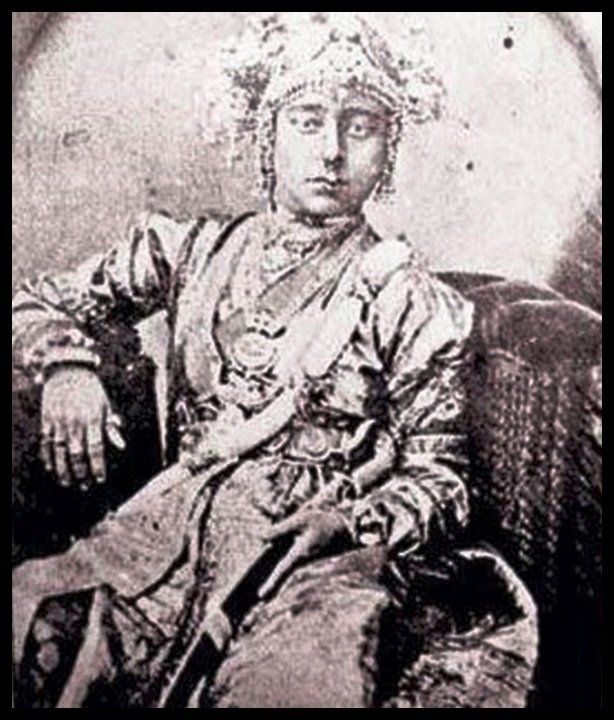
Lakshmibai,Rani of Jhansi,was born on 19th November 1828 at Varanasi.She was born into a Marathi karhade Brahmin family.She was named Manikarnika and was nicknamed Manu.Rani Lakshmibai one of the warriors of India’s struggle for independence,lost her mother at the age of four.

Marriage with Maharaj of jhansi

She married the Maharaja of Jhansi,Gangadhar Rao in 1842.After wedding she changed her name to lakshmibai,in honour of goddess Lakshmi.In the year of 1851,she gave birth to a boy.But he died when he was only few months old.Once,Maharaj became ill.By following the Hindu tradition they adopted a five year old boy .He was named Damodhar Rao and declared to be the heir of the throne of Jhansi.

Doctrine of lapse

The east India company took advantage of the maharaj’s death and applied the doctorine of lapse.

Doctorine of lapse is an annexation policy followed by Lord Dalhousie. ⭐According to this, any princely state under the direct or indirect control of the East India Company where the ruler did not have a legal male heir would be annexed by the company.

⭐As per this, any adopted son of the Indian ruler could not be proclaimed as heir to the kingdom.

So ,due to this policy,Britishers did not accept Damodhar Rao as the legal heir.

By applying the doctorine of policy, Dalhousie annexed the states of Satara,Jaitpur and Sambalpur,Baghat,Udaipur,Nagpur.The plan of the Britishers was to annex Jhansi.They seized the state jewels,granted her pension and asked her to leave the fort forever.

Revolt of 1857

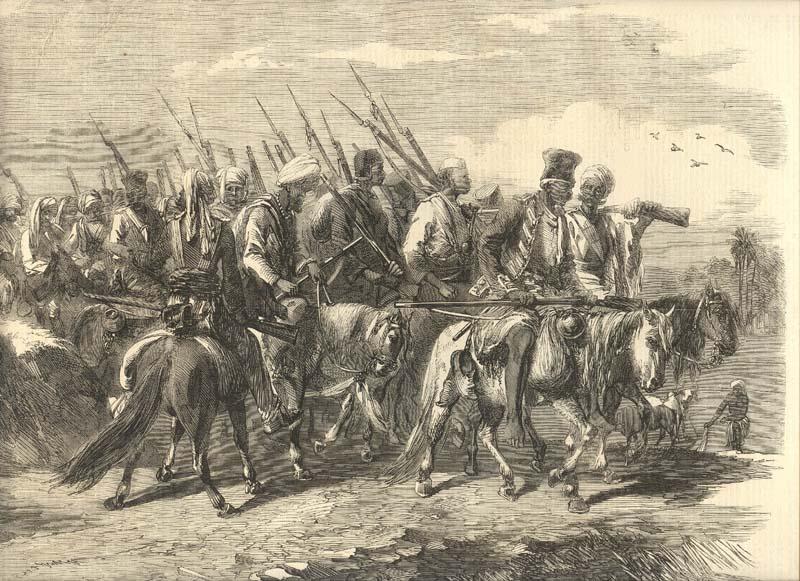
The Revolt of 1857 had broken out in Meerut and the Rani was ruling over Jhansi as regent for her minor son. British forces under the command of Sir Hugh Rose arrived at Jhansi fort with the intention of capturing it in 1858. He demanded that the city surrender to him or else it would be destroyed.

⭐ As many factor led to the revolt,the main factor is the introduction of greased cartridges by the East Indian company.

⭐The sepoys had to bite the cartridges by their teeth.This was unaccepted by the soldiers as the cartridges were greased with beef and pork.

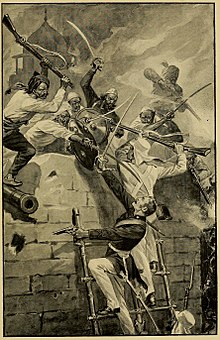
⭐In January 1858, the English army started marching towards Jhansi and besieged the city. Lakshmibai gave a great fight against the British as the siege of jhansi lasted for about two weeks.

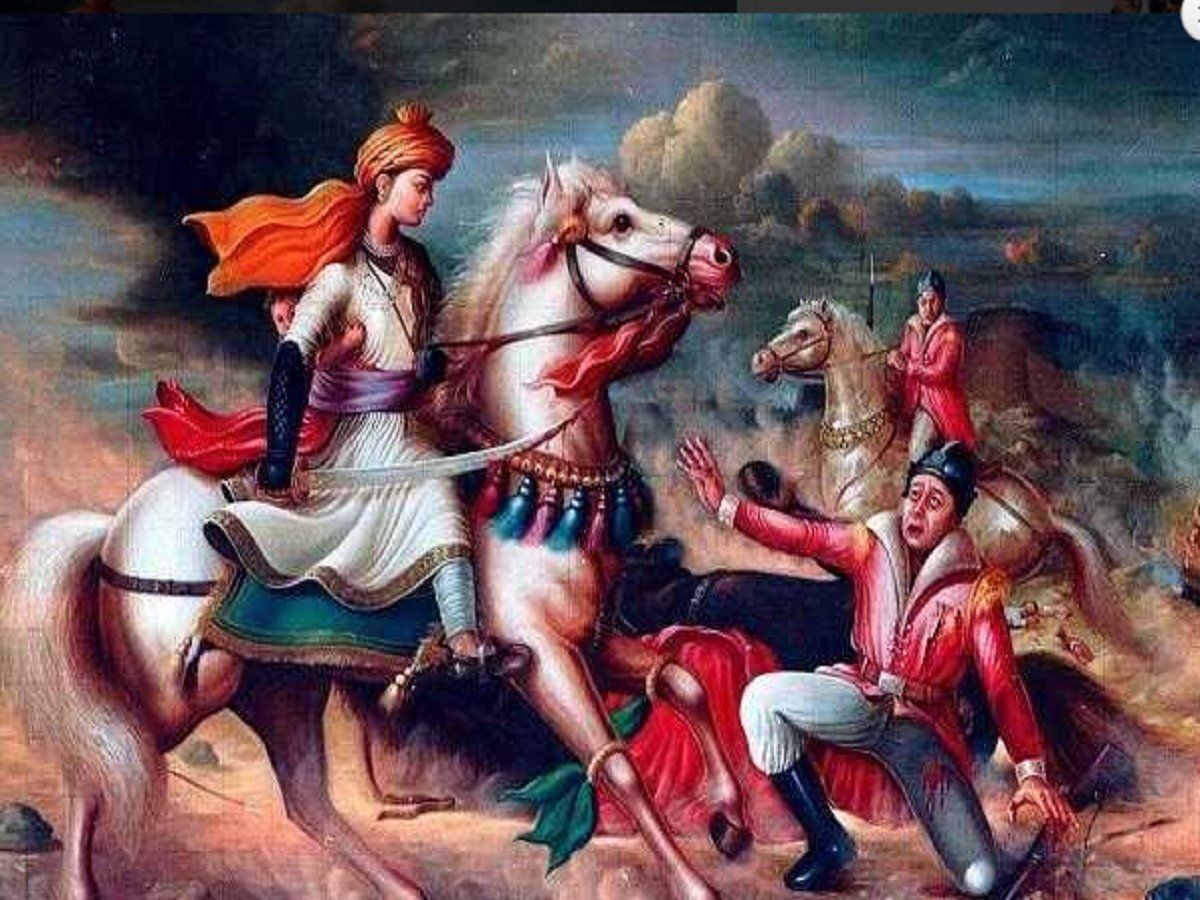
⭐After a fierce war,when the British army entered jhansi,Rani lakshmibai tied her son Damodhar rao to her back and faught bravely .

⭐She escaped to kalpi and was accompanied with other rebellions.She then departed to gwalior and a fierce battle was taught between the British and lakshmibai’s army.

Death of lakshmibai

On June 18th 1858, Rani Lakshmibai of Jhansi, one of the most important figures of India’s First War of Independence, died while fighting against the British in Gwalior.

India’s freedom struggle had seen many freedom fighters over the years, but the name of Rani Lakshmibai stands out among them. Lakshmibai, the Rani of the princely state of Jhansi, was a brave and fearless woman who fought courageously against the British and eventually lost her life in battle on June 18th 1858 in Gwalior.

“If defeated and killed on the field of battle ,we shall surely earn eternal glory and salvation”

CONSTITUTIONAL BODIES IN INDIA

What is a Constitutional Body?

1. Those bodies whose formation is prescribed by the Indian Constitution itself are known as Constitutional Bodies.

2.They derive their powers and authority from the Indian Constitution.

3. A constitutional amendment is often required to change any powers or functions related to such bodies.

List of Constitutional Bodies in India

  1. ATTORNEY GENERAL OF INDIA

● Article 76 of the Constitution provides for the Attorney General of India.

● He is considered the highest law officer in the country.

● He is appointed by the president and holds office during his pleasure.

● A person who is qualified to be appointed as the judge of the Supreme Court is eligible for the office of Attorney General of India.

Duties of AG:

• To advise the government on the legal matters referred to him by the president.

• To appear on behalf of the GOI in SC in all the cases concerning the government.

• To represent GOI in the references made by the president to the SC under Article 143.

• To appear in HC in the cases concerning GOI when required.

Rights of AG:

• AG has the right to audience in all the courts in the territory of India.

• He has the right to speak and take part in the parliamentary proceedings. However, he doesn’t enjoy the right to vote.

• All the privileges and immunities available to a member of parliament are granted to the AG

2. COMPTROLLER AND AUDITOR GENERAL OF INDIA

● Article 148 of the Constitution provides for an independent office of Comptroller and Auditor General of india.

• CAG is considered as the guardian of the public purse. Along with the Supreme Court, the Election Commission, and the Union Public Service Commission, the office of CAG is treated as one of the bulwarks of the democratic system.

Appointment:

• President of India appoints CAG by a warrant under his hand and seal.

• He holds office for a period of six years or up to the age of 65 years, whichever is earlier.

• CAG can be removed from his office in the same manner as a judge of the Supreme Court.

Independence:

● CAG is provided with the security of tenure.

• His rights cannot be altered to his disadvantage after his appointment.

• All the expenses of the office of CAG are charged on the Consolidated Fund of India.

• His salary is equal to that of a judge of the Supreme Court.

Duties:

● The duties and powers of CAG are mentioned in article 149 of the Constitution.

• All the accounts related to the expenses from the Consolidated Fund of India, Consolidated Fund of the States, and Union Territories are audited by CAG.

● Also, the expenditure from Contingency Fund and Public Account of India and States are audited by CAG.

• CAG acts as a guide, friend, and philosopher of the Public Accounts Committee.

● All the receipts and expenditure of bodies financed from the central or state revenue are also audited by CAG.

• The audits of any other body as and when requested by the President or Governor are audited by CAG.

• Three reports are submitted by CAG to the President. They are:

(1) Audit report on appropriation accounts

(2) Audit report on finance accounts

(3) Audit report on public undertakings

Role of CAG:

• The office of CAG secures the accountability of the executive to the Parliament in the sphere of financial administration.

• The CAG acts as an agent of the Parliament and is responsible only to the Parliament.

● Along with legal and regulatory audits, CAG also conducts propriety audits.

3.ADVOCATE GENERAL OF THE STATE

● Article 165 of the Constitution provides for Advocate General for the states.

● He is considered the highest law officer in the state.

● The Advocate General is appointed by the governor and holds the office during his pleasure.

• A person qualified to be appointed as a judge of a high court is eligible for the office of Advocate General.

Duties and Rights of Advocate General:

• To advise the government of the state on the matters referred to him by the governor.

• To discharge those functions conferred upon him by the Constitution of India.

• He has the right to speak and take part in the proceedings of both the houses of the state legislature. However, he doesn’t enjoy the right to vote.

4. STATE FINANCE COMMISSION

● The governor of a state shall, after every five years, constitute a finance commission.

• Articles 243-1 and 243-Y deal with the formation of this body.

• The composition, qualifications of members, and the manner of their selection is decided by the concerned state legislature.

Functions:

● The distribution of the net proceeds of taxes, tolls, and fees between the state and local bodies.

• The determination of such taxes, duties, and tolls to be assigned to local bodies.

The grants-in-aid to be given to the local bodies from the consolidated fund of the state.

• Measures to be taken for improving the financial position of local bodies.

●Any other matter referred to the commission by the governor of the state.

5.STATE ELECTION COMMISSION

• The elections to the panchayats and municipalities are looked after by the State Election Commission.

● Articles 243-K and 243-ZA deal with the elections to the rural and urban local bodies.

● SEC consists of a state election commissioner who is appointed by the governor.

• The removal of the state election commissioner is the same as that of a judge of the state high court.

6.DISTRICT PLANNING COMMITTEE

• A district planning committee is constituted and given the task to consolidate the plans of both panchayats and municipalities.

• It prepares a draft development plan for the district.

• Article 243-ZD deals with the committee for district planning.

• The composition, manner of election of chairperson and members is decided by the state legislature.

● Four-fifths of the committee are elected by the elected members of panchayats and municipalities.

• The representation of these members is proportional to the ratio of the rural and urban population in the district.

• In preparing the plan, DPC should consider the following:

  1. Matters of common interest between the rural and urban local bodies regarding sharing of resources, infrastructure development, and conservation of environment.
  2. Extent and type of resources available.

7. METROPOLITAN PLANNING COMMITTEE

• A metropolitan planning committee is constituted for every metropolitan area.

• Article 243 -ZE deals with the committee for metropolitan planning.

• The composition, manner of election of chairpersons and members, functions, etc are decided by the concerned state legislature.

There are many other bodies also ….

HOW TO BECOME A SOCIAL MEDIA MANAGER

Social Media the world in which almost everybody is living ,you can hardly heard someone saying “I don’t use social media” . This is the keychain that connects us with the world , with its fastest growing usage it has started getting into other field other than just being a communication service provider , people had started using it for their business growth , big companies had started using social media as a tool to connect with their customers and provide their services directly to them it has converted into Marketing media , this extra usage has given rise to the post of “Social Media Manager”.

Who is a Social Media Manager?

Manager are those who manage certain thing for some specific purpose , so Social Media Manager is the one who manages the social media handles of various Companies , Business, NGO , Non-profit organization . With the world going digital every other person need their space in the social media for their business growth . All the business , companies , organization need to be active on social media , to expand their work , to connect with their target audience for which they hire a social media manager to handle their social media platforms.

What does Social Media Manager DO?

The work of Social Media Manager involve working on different social media platforms, managing the social media handle in an effective way to bring the best out of it , posting , creating content ,communicating with the audience , updating about new features , managing the websites , making strategies to expand the business online , creating traffic , making ads campaign , all these are the role of social media manager it may differ as per the requirement of the client but these are the most basics role that a social media manager need to perform.

Qualification and Skills required.

For being a Social Media Manager one need to have a Bachelor Degree in Marketing or Mass Communication or in any field related to marketing .

For skills , you need to have a knowledge of atleast 4 to 5 social media platform such as ” Youtube , Facebook , Pinterest , LinkedIn and Instagram , now knowledge here does not just mean, a raw idea about these platforms but you need to be expertise in using these platform . You need to have a good knowledge of marketing strategies as using the right platform for the right information does play a great role . You need to be aware of the SEO optimizer , have some Graphic designing skill also as this will help alot.

How to start and Growth aspects.

This field has a very wider scope as compared to other as it is very sure that social media is going to expand in the upcoming days , that means more gates will get open for you . The average pay of a Social media manager in “USA is $45K – 55K and in “India is RS 3 lAKHS ,in the initial it might be low but as per your work experience it will increase afterward. Initially you can start your work in this field as a social media coordinator , or marketing coordinator or work as a freelancer .By freelancing you can get the experience of working with many companies which will help you to get your feet fixed strongly , firstly do prefer to take 1 or 2 projects as it will help to give better work , then after getting fully aware of the work, you can take as many projects as you want . Do build portfolio or portfolio websites for better projects .

So , IF you are willing to build a career in this field and have the above mentioned skills than you should go for it as it a great career option to choose for the upcoming future and even if you don’t have the skills , and want to get into this field , than you can learn these skills online as there are so many courses available these days like you can try skill share , or there are courses in google also .Go give it a try

Basic rules of netiquette

Successful relationships, whether in our personal or professional lives, depend on effective communication.

In today’s world most of the meetings occur online, communication isn’t just a nice skill to have – it’s essential. Good communication can be the difference the way you answer an email or what you say on social media directly affects people’s perceptions of you.

Now that such a considerable amount of our daily lives is facilitated by the internet, digital communication skills are essential to ensure messages are delivered and received correctly. We are lucky to have incredible 4G connectivity to help us communicate digitally.

Teleconferencing programs, group chat apps, and other digital tools are part of everyday life now as we attempt to strike a balance between isolation and connection. 

As we all know, there aren’t many chances to improve the first impression. Some of you may have heard the term “netiquette” being used in online circles. Netiquette defined simply refers to the code of courtesy and respect followed when communicating with others on the Internet. 

Start speaking at a normal volume when talking over the phone or video chat. Be as polite as you would be in offline encounters.

Do not send emails and text messages in ALL CAPS. Writing in all caps can oftentimes be interpreted as YELLING! and will be viewed as impolite. Make sure your emails are easy to read.

Avoid sending spam to others, keep your messages meaningful. Don’t send forwarded content created by others. 

Be yourself. Don’t say anything to anyone you wouldn’t say in person. Don’t be funny, sarcastic, passive or aggressive. A joke can oftentimes be perceived as a rude remark. A light-hearted joke can be viewed differently in text. While in-person, we communicate with the help of facial expressions and gestures. Conveying the same message online can prove more challenging.

Tone is important when you can’t speak in person. Chances of miscommunication are high when you’re relying on communication through the phone or computer. Sometimes things just go wrong. 

Stay on topic. When there is a discussion happening, it’s crucial that everyone stays on topic. Make sure that you understand what the discussion is about and only reply with things relevant to it. 

Use respectful language. It’s not just what you say, but how you say it.

Don’t let your point get lost in translation by typing too many unnecessary words. 

Online communication can easily be improved through proofreading. Check for: Grammar and punctuation errors, Poor sentence structure, Incorrect use of tenses. Use real words and complete sentences, and skip the emojis.

Verify facts before sharing information. You should be careful when providing information. It’s important to fact-check everything you read and possibly include sources when giving advice or information.

Being open to guidance and feedback, which means researching different options and tools of communication. 

Your day with some Motivation

Change your life today. Don’t gamble on the future, act now, without delay.

Simone de Beauvoir

What’s stopping you, is it your fear ?

From whom you are running , is it a failure ?

When to start , am I getting late ?

What if I hesitate , will they understand ?

How am I going to talk to them ?

In different phases of our life we faced different challenges that may be hard to accept and makes you feel ashamed of yourself.

Most of the time we think our fear might harm us but what we don’t understand is that , if we don’t face them it would never leave .

We hesitate , we fear , we run , we ignore , we lack and in the end we loose hope .

And what we are going to is to reconstruct that hope and trust ourselves . We might need some tools for that and one of them is MOTIVATION .

What is MOTIVATION ? How it works? Will it help ? And so on … There are many questions and the time is limited. So let’s begin .

Introduction

Being successful is not enough in today’s world . To keep the success we need a companion and that is Motivation.

Motivation has a powerful aura it can be your solution if only you used directly on your aim . I might play some tricks with you but the result will always be on your side .

Well it is going to be very hummy dumpy article but who cares (that’s not me ) . What’s important is what you learn from it .

The author Steven Pressfield wrote a great line in his book , The War of Art, which I think gets at the core of motivation.

“At some point, the pain of not doing it becomes greater than the pain of doing it.”

Well said pressfield , in other words (or my words) It is easier to take action , rather than sitting and self,- petrified ourselves.

Like it is easier for MOJO to prepare for his exam rather than think about the result OR It is easier for OJO to workout in the gym rather than sitting in the chair eating junk food . (Well I prefer junk food over gym , just ignore I said that .)

This I think is the core of motivation . To gain something we need to pay the price first . It may be time , energy , sacrifice , risk or it can be anything .

Take action

A lot of people get confused that how to find motivation and when to take action . They are wasting too much time for making plans and than for process . To make it easy find motivation and get started. The more you delay the more it get difficult.

If you waste resources trying to decide when or where to work, you’ll impede your capacity to do the work.

Their are some rituals needs to perform if you want to get motivated :

1. Exercise daily .

2. Become more creative.

3. Start your day stress free .

4. Sleep better .

5. Last but not the least do whatever makes you happy . ( But don’t do nasty things ) .

You’ve gotta dance like there’s nobody watching, love like you’ll never be hurt, sing like there’s nobody listening, and live like it’s heaven on earth.”

― William W. Purkey

Link