Types of Software

Software categories are groups of software. They allow software to be understood in terms of those categories, instead of the particularities of each package. Different classification schemes consider different aspects of software. 

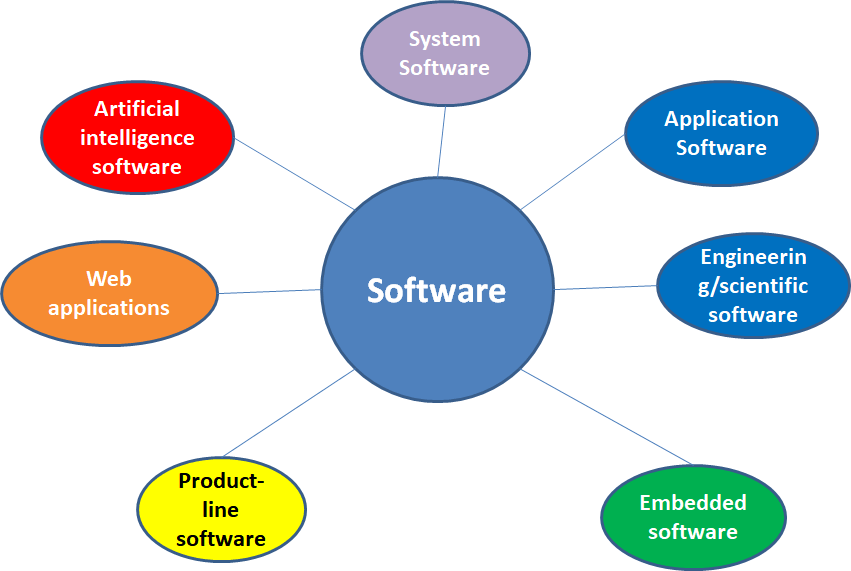
  1. System Software

 System software is a collection of programs written to service other programs.
 Ex. Compilers, Editor, operating system, drivers etc

2. Real – Time Software

 Software that monitors or analyzes or controls real-world events as they occur is called real time.
 Elements of real-time software include a data gathering component that collects and formats
information from an external environment, an analysis component that transforms information as
required by the application.
 A control/output component that responds to the external environment and a monitoring component
that coordinates all other components so that real-time response can be maintained.
 Ex. Weather Forecasting

3. Application Software

 Application software consists of standalone programs that solve a specific business need.
 Application software is used to control the business function in real-time.
 Application software processes business or technical data.

 Ex. Transaction Processing, Sales Processing, Manufacturing Software etc.

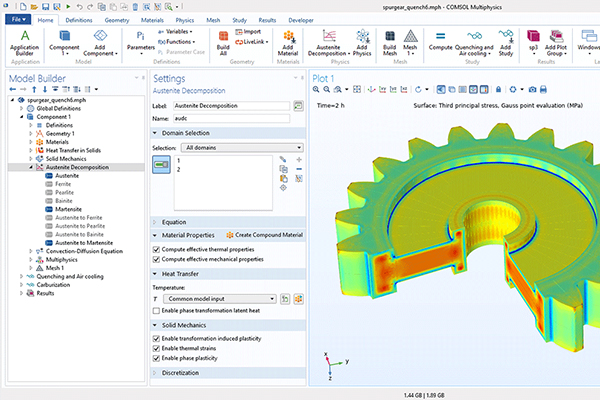
4. Engineering/Scientific Software

 Characterized by “number crunching” algorithms.
 Application software is set of programs designed for engineering and scientific purposes.
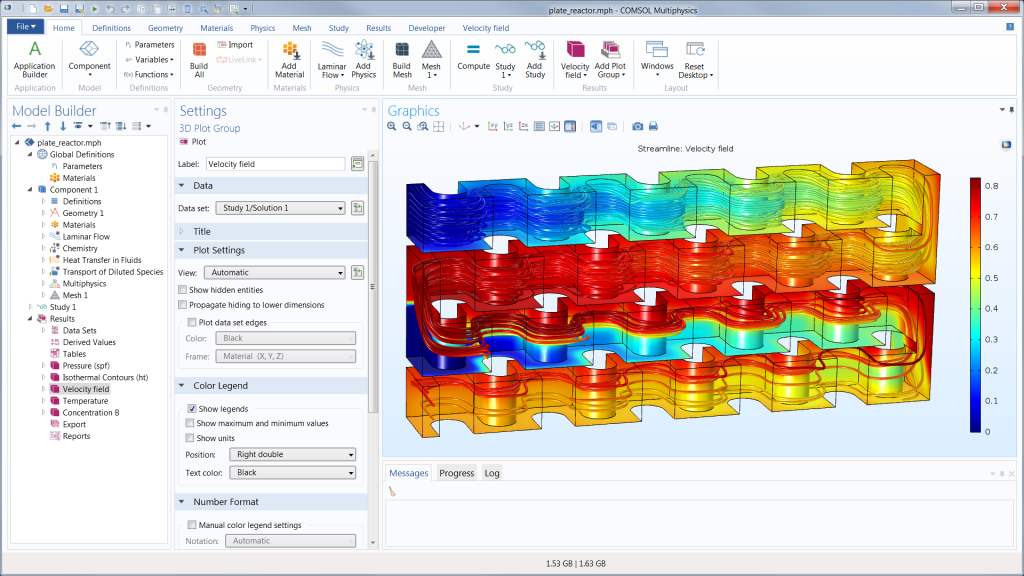
 Applications range from astronomy to volcano logy, from automotive stress analysis to space shuttle
orbital dynamics, and from molecular biology to automated manufacturing.
 Ex. Computer Aided Design (CAD), system stimulation etc.

5. Embedded Software

 Intelligent products have become common place in nearly every consumer and industrial market.
 Embedded Software resides within product and is used to control products and systems for the
consumer.
 Embedded software can perform limited and esoteric functions.
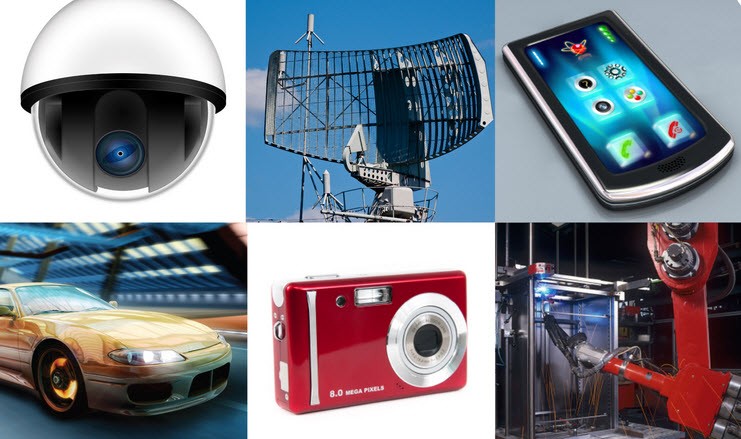
 Ex. Keypad control for a microwave oven, digital functions in an automobile such as fuel control,
dashboard displays, and braking systems.

6. Product line Software

 Designed to provide a specific capability for use by many different customers.
 Product line software can focus on a limited and esoteric marketplace.
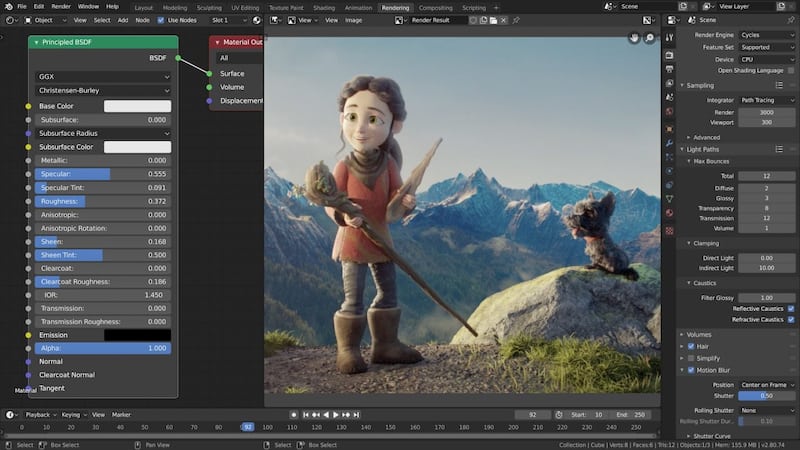
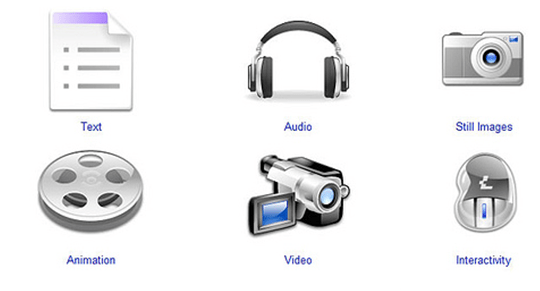
 Ex. Word processing, spreadsheet, CG, multimedia, etc.

7. Web Based Software

 The Web pages retrieved by a browser are software that incorporates executable instructions and data.
 Web apps can be little more than a set of linked hypertext files.
 It evolves into sophisticated computing environments that not only provide standalone features,
functions but also integrated with corporate database and business applications.

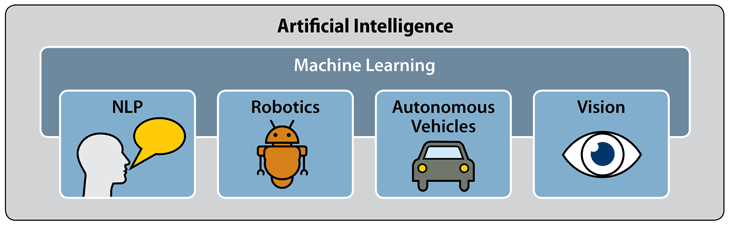
8. Artificial Intelligence Software

 AI software makes use of non-numerical algorithms to solve complex problems that are not amenable
to computation or straightforward analysis
 Ex. Robotics, expert system, game playing, pattern recognition, theorem providing etc.

How artificial intelligence is replacing humans?

Artificial intelligence, this is not a new name. This is the most trending subject in this 21st century. Examples of artificial intelligence Alexa, google assistant, Siri etc. In this blog, we are going to see what is artificial intelligence? Type of artificial intelligence, Can machines think? How artificial intelligence is replacing humans? Advantages and disadvantages of AI?

WHAT IS ARTIFICIAL INTELLIGENCE ?

Artificial Intelligence commonly known as AI is the intelligence represented by machines, as opposed to natural intelligence display by humans. AI is an interdisciplinary science with multiple approaches. Based on capabilities AI can be classified into weak AI, strong AI, and super AI. Weak AI can focus on only one task and it cannot go beyond its limitations. Strong AI can understand and learn that much of a human. Super AI suppresses human intelligence and can perform task better and beyond human intelligence.

TYPES OF ARTIFICIAL INTELLIGENCE

There are four types of artificial intelligence, they are Reactive machines, Limited memory, Theory of mind, Self awareness.

  1. Reactive machines

This is the simplest level of Artificial Intelligence. Reactive machines performs basic operations. No learning occurs in this type. This is the first stage of artificial intelligence system. It doesn’t have past memory and cannot use past memory for future actions. Examples of reactive memory are Static machine learning models, and IBM chess program.

2. Limited memory

Limited memory of AI has the ability to store past memory and predictions and use the data to make future predictions. With limited memory, machine learning architecture become more complex. The examples of limited memory are self-driving cars are the best example. There are three types of limited memory –

i) Reinforcement learning

ii) Long short term memory(LSTM)

iii) Evolutionary Generative Adversarial Networks(EGAN)

3. Theory of Mind

This is the advanced type of artificial intelligence. Theory of mind refers to the ability of human mind to attribute mental states or others is a key component of human cognition.

4. Self awareness

Self awareness is more advanced type of artificial intelligence. It is the final step of AI development to build systems that can form representation of themselves.

CAN MACHINES THINK?

The biggest question in our mind is can machines think like humans? machines do not have feeling, emotions and consciousness. Therefore the artificial intelligence cannot think like us. The artificial intelligence is in the beginning stage in this world right now. But in future when artificial intelligence is in the advanced stage, scientist suggests that there may be a possibility. AI is programmed by humans into every machine to perform a certain task. Therefore AI cannot think and take decisions on its own. Therefore AI cannot think.

HOW ARTIFICIAL INTELLIGENCE IS REPLACING HUMANS?

In earlier day, people used to work in the factories but now machines are working in place of humans. Now the question comes Can artificial intelligence is replace humans? the answer is yes, we have seen robots replacing human works in a organization. As we known that AI is in the beginning stage of development. Experts suggest that AI can replace human work in the future. A study suggests that AI will replace 30 percent of human labor in 2030.

ADVANTAGES OF ARTIFICIAL INTELLIGENCE

  1. AI takes only certain time to perform a task.
  2. AI can do the complex tasks in seconds.
  3. AI is available for 24×7 by a day.
  4. AI can reduce error and increase accuracy.

DISADVANTAGES OF ARTIFICIAL INTELLIGENCE

  1. Creating a machine that could simulate human intelligence requires a lot of time and lot of money.
  2. AI cannot think beyond its box. There is no creativity for AI.
  3. AI will increase the unemployment rate, as it will replace human labor.

Health and Fitness

Staying healthy and fit are directly proportional to each other. In order to lead a healthy and fit life we need to focus on some prime practices which will not only make us physically fit but will also provide us with peace of mind. Staying heathy and fit keeps us away from diseases and thus its medications and side effects. A healthy body homes a healthy mind, and a healthy mind boosts the productive thoughts help us to deal life with positivity in a healthy way. But staying healthy and fit requires discipline, one must have a balanced diet, eating less never makes someone healthy and fit whereas eating the right nutritious food in the right quantity does so. A healthy diet must constitute of all the five nutrients as well as water and roughage. Starving is highly not recommended, giving the body the required nutrients is important. In order to stay fit and healthy one must also regularly practice yoga and physical exercise; these enables movement of each and every part of the body and thus ensures its flexibility also ensures growth and increases stamina. Staying away from negative environment and people is another major practice which is encouraged in order to ensure a healthy and fit body.

If you want to start your journey a having a better body to feel great, here are some tips :

* Exercise daily for at least an hour

* Eat the Right foods and portion each meal.

* keep track of calories and food intake per day.

* Be sure to get sleep.

* Stay motivated.

5 components of physical Fitness :

* cardiovascular Endurance.

* Musular strength.

* Muscular endurance.

* Flexibility

* Body composition.

* The difference between fitness and health is Health is defined as a state of complete mental, physical and social well- being, not merely the absence of illness or infirmity. Fitness is the ability to meet the demands of the environment.

* The connection between health and fitness is physical fitness, by its very nature, significantly strengthens the bod’s immune system. Therefore, it may substantially reduce the likelihood of liness and disesase, and well as improve the way the body copes with illnesses when they occur.

* The three categories of health fitness and wellbeing is physical, emotional and social wellbeing.

Why is health and fitness so important?

Regular exercise and physical activity promotes strong muscles and bones. It improves respiratory, cardiovascular health, and overall health. Staying active can also help you maintain a healthy weight reduce your risk for type 2 diabetes heart disease and reduce your risk for some cancers.

* There are six skill- related fitness components: agility, balance, coordination speed, power and reaction time. skilled athletes typically excel in all six areas. Agility is the ability to rapidly and accurately change the direction of the body

* The principles of specificity, progression, overload, adaption, and reversibility are why practising frequently and consistenly are so important if you want to improve your performance.

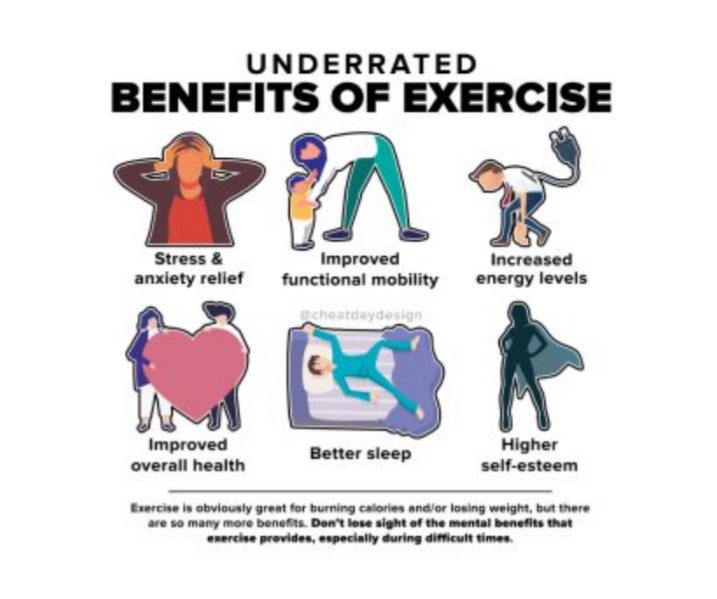
The health benifits of exercise :

* helps you contro your weight.

* Reduce your risk of heart disease.

* Help your body manage blood sugar and insulin levels.

* Help you quiet smoking

* Improve your mental helath and mood.

* Help keep your thinking , learning and judgement skills sharp as your age.

* Exercise prescription is based on 5 priniciples are type, duration, frequency, intensity and volume.

So stay healthy and stay safe . This pandemic days wants more food to our bodies to get more immunity. Be fit and Be happy . We fight with this covid with our lifes . Be strong these are all will helps to us.

Ethics

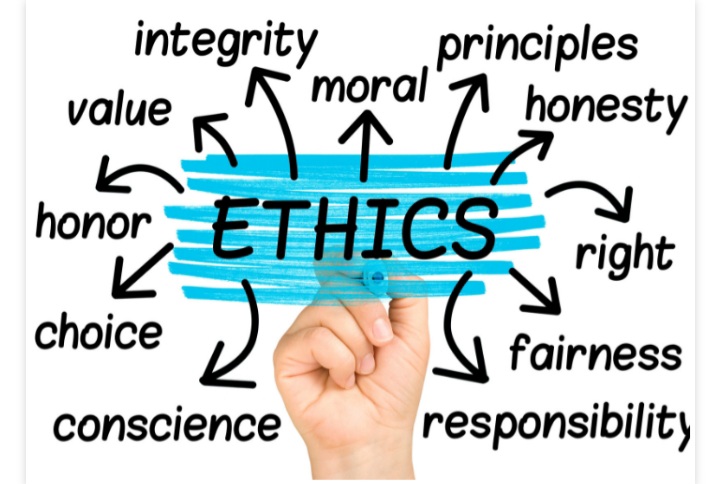
Ethics is a branch of philosophy dealing with the issue of morality. It implies the concepts of what right and wrong conducts are. Ethics define how a person should act in some specific situations. It is not a new term, but it has been there since the Stone Age. Different religions and many philosophers have also made a substantial contribution to ethics.

There are different branches of ethics. First of all, comes descriptive ethics. Descriptive ethics include what people actually consider right and wrong. Accordingly, laws are made regarding that and if they are even acceptable or not. The moral principles of society keep on changing from time to time. However, the basic ethics remain the same. Descriptive ethics are also called comparative ethics. They are given the name comparative ethics as they are used to compare the ethics of past and present scenarios. Also, they are used to compare the ethics of different societies as well.

Then comes the next branch of ethics- Normative Ethics. Normative Ethics deals with some specific norms or a set of considerations. These norms indicate how people should act in some given situations. These ethics set out the rightness or wrongness of people’s actions. Normative Ethics are also known as prescriptive ethics. This name is given as there are principles involved with these ethics and those principles determine whether the actions of people are right or wrong in different situations.

Types of ethics :

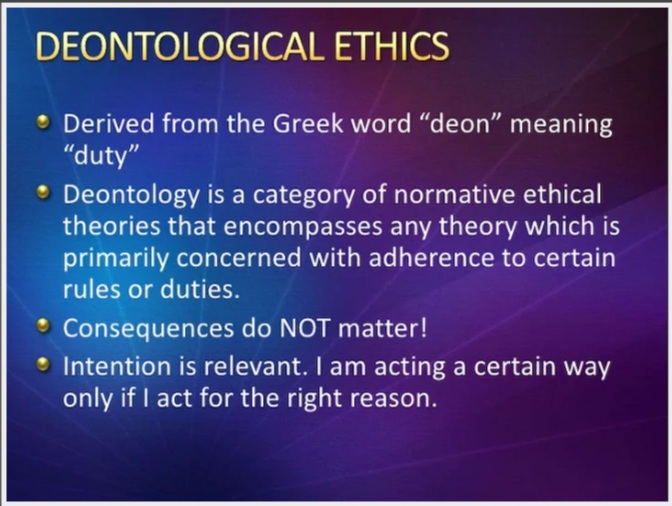
1. Deontological Ethics :

* In moral philosophy, deontological ethics or deontology is the normative ethical theory that the morality of an action should be based on whether that action itself

* Deontology is an ethical theory that uses rules to discern the moral course of action. Diffusion of responsibility. Diffusion of responsibility occurs when people fail

* Deontology morality is about following a system of rules, like ” Do Not Lie ” or ” Do Not Steal” .

* Ethics or moral philosophy is a branch of philosophy that involves systematizing, defending Deontological ethics.

2. Utilitarianism :

* The most common example of normative ethical theories are utilitarianism, kantian duty- based ethics and divine command theory.

* utilitarianism means, act in your own self- interest. Utilitarianism is that which is moral only if the act produces the greatest.

* Utilitarianism is a moral theory that implements fair choices is an effort to ensure the least amount of harm is done to all parties involved.

* However, some contemporary utilitarians , such as peter singer, are concerned with maximizing the satisfaction of preferences, hence prefernce utilitarianism.

* utilitarianism is an ethical theory that asserts that right and wrong are best determined by focusing on outcomes.

3. Consequentialism :

* consequentialism refers to moral theories that hold the consequences of a particular action form the basis for any valid moral judgment about that action.

* consequentialism is a class of normative, teleological ethical theories that holds that the consequences of one’s conduct are the ultimate basis for any judgment.

* consequentialism is an ethical theory that judges an action’s moral correctness by its consequenes. Corporate social Responsibility.

* on our definition of consequentialism, only the direct view is a genuinely consequentialist position, and rule consequentialism.

4. Professional Ethics :

* Rules imposed on an employee in a company, or as member of a profession. For instance, journalists, doctors, lawyers. Etc.

* professional ethics encompass the personal and corporate standards of behavior expected by professionals.

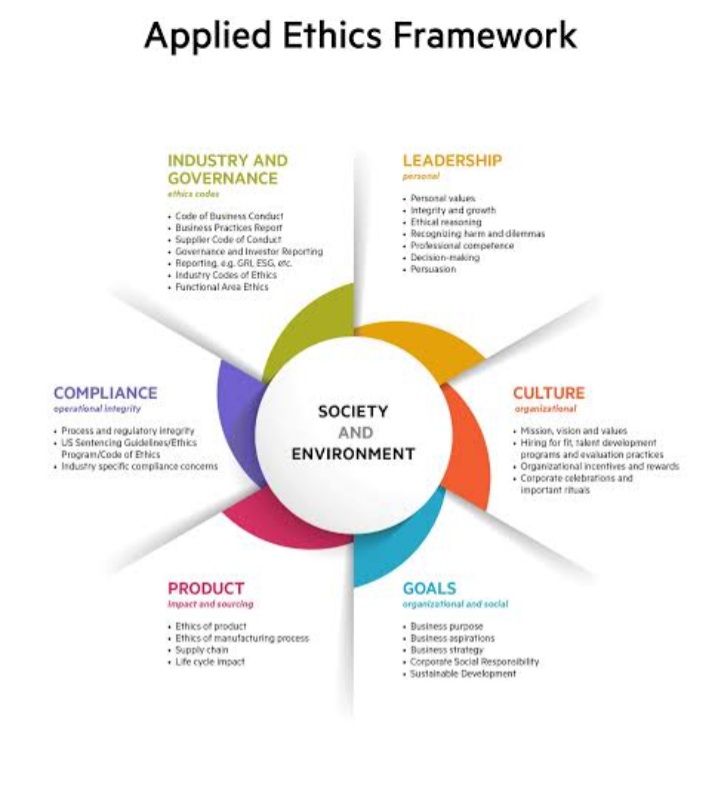
5. Applied ethics :

* Applied ethics is the branch of ethics which consists of the analysis od specific, controversial moral issues such ad abortion, animal rights, or euthanasia.

*Applied Ethics includes a philosophical examination of certain public and private life problems. The examination of those issues generally takes place from a moral standpoint. This branch of ethics is generally used by professions like doctors, teachers, etc.

* Applied ethics which deals with the actual application of ethical priniciples to a particular situation. While it is helpful to approach the field of ethics.

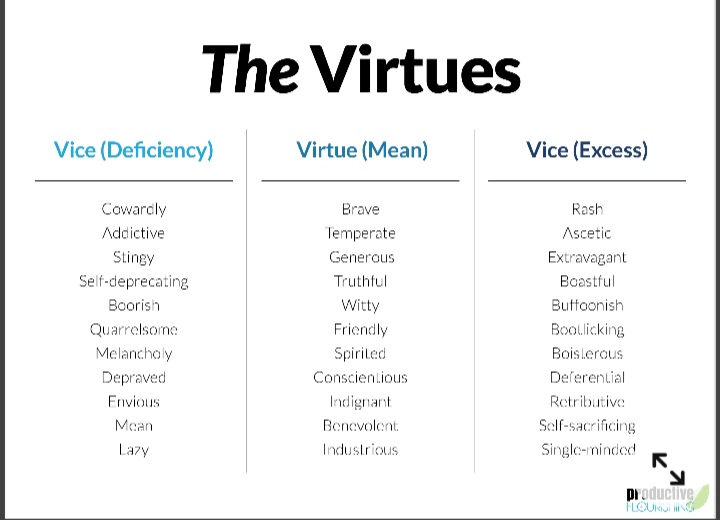
6. Virtue Ethics :

* virtue ethics is an approach to ethics that emphasizes an individual’s character as the key element of ethical thinking, rather than rules about the acts themselves.

* virtue ethics not only idea deals with the rightness or wrongness of individual actions, it provides guidenece as to the sort of characteristics and behaviour a good person will seek to achieve.

An abstract way of analyzing ethics is called Meta-Ethics. They do not deal with whether the actions are right or wrong, rather they question what morality is.

Steam Deck: Nintendo Switch’s newest competitor

Steam is a digital marketplace and is owned by Valve Corporation. Valve Corporation has published numerous games but in recent years they have been trying to enter the space of hardware. On November 10, 2015 Valve launched its first game controller for connecting to PCs and their own Steam machines (A prebuilt PC developed by Valve which was designed to operate Valve’s Linux-based SteamOS via the Steam client). The Steam controller was discontinued in 2019 and with modest sales.

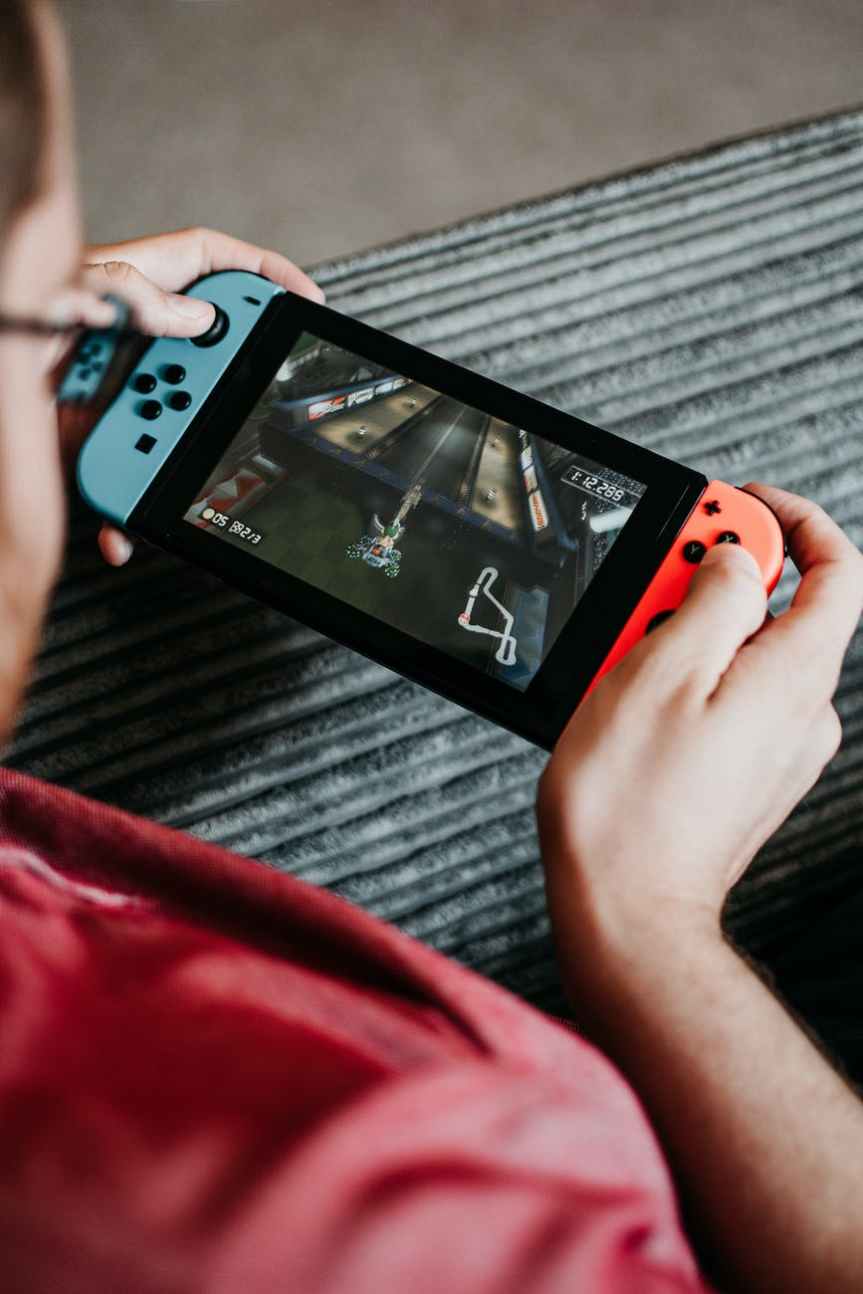
Steam deck is Valve’s foray into the handheld console space. The Handheld space is currently dominated by Nintendo Switch. With 84.59 million of units sold since its launch in 2017, Switch has been one of the most successful consoles in the current gaming generation.  The most unique thing about Switch is that it can be switched from a handheld design to a home console with the help of a dock accessory.

Steam deck is essentially a PC on the go with very impressive hardware specifications. The handheld is equipped with a 7-inch diagonal display with 1200x800 pixels and 60 Hz refresh rate. It has an AMD APU (Processor) with Zen 2 architectures and 4 cores/8 threads. With 16GB LPDDR5 RAM and storage options ranging from 64GB eMMC($399) , 256GB SSD($ 529) and 512GB SSD($ 649).

Since the late 80s, Nintendo has been the reigning king in the portable gaming space. After the success of Switch, Nintendo revealed the new switch pro which has an OLED display upgrade. This will surely enhance the experience in the console but many were disappointed with no hardware upgrade. Nintendo Switch is still running an Nvidia Tegra custom chip which is severely underpowered and the console struggles to even play Nintendo’s core games with 30 FPS. This means that compromises have to be made to make a game run of the system. Another aspect is that the failure of Sony’s PS Vita (Sony’s portable handheld) failed against the Nintendo 3DS of the previous generation. Sony did not attempt to compete against Nintendo. This meant that there were no major competitors against Nintendo and the company has become somewhat complacent. The launch of Steam Deck also means that there is another competitor against the Switch and this will lead to healthy competition and ultimately it’s a win for the consumers. With 1.6 TFLOPS of GPU power its significantly more powerful than the Switch. Another point to be noted is the versatility that the Steam ex provides. The Deck essentially is a PC and this means that it runs on Valve’s version of Linux OS and by connecting it to a dock via a USB C and it also has full Bluetooth 5.0. This means that you can use it to hook the device up to a full-sized monitor and work on any productivity applications as well. Due to its open nature, even Windows can be installed on the deck. This means that it will be much more flexible than any of its competitors. There have been many recent smaller projects that have attempted a similar portable gaming PC, but Valve (Steam’s parent company) has a much deeper pocket and experience in its hands. The console will be shipped by the end of December 2021. There is no guarantee that this system will be a success but it surely will make the handheld space more exciting.    

What if we are living in a Video Game?

Kids these days are so head over heels into video games, do you ever think what if we are pawns in a video games ourselves, some alien species with the controller?

Rizwan Virk, a computer scientist and video game designer, published a 2019 book, The Simulation Hypothesis, that traces the path from today’s technology to what he calls the “Simulation Point,” the moment at which we could realistically build a Matrix-like simulation.

I know nothing about computer science, but this idea that we’re all characters in an advanced civilization’s video game is, well, kind of awesome.

Pretend I know absolutely nothing about the “simulation hypothesis.” What is the simulation hypothesis?

The simulation hypothesis is the modern equivalent of an idea that’s been around for a while, and it is the idea that the physical world that we live in, including the Earth and the rest of the physical universe, is actually part of a computer simulation.

You can think of it like a high resolution or high-fidelity video game in which we are all characters, and the best way to understand it within Western culture is the movie The Matrix, it’s become a cultural phenomenon now beyond the film industry.

In that movie, Keanu Reeves plays the character Neo, who meets a guy names Morpheus, who is aptly named after the Greek god of dreams, and Morpheus gives him a choice of taking a red pill or a blue pill. And if he takes the red pill, he wakes up and realizes that his entire life, including his job, the building he lived in, and everything else, was part of this elaborate video game, and he wakes up in a world outside of the game, which he did. That is the basic version of the simulation hypothesis.

Are we living in a simulated universe right now?

There are lots of mysteries in physics that are better explained by the simulation hypothesis than by what would be a material hypothesis.

The truth is that there’s much we simply don’t understand about our reality, and I think it’s more likely than not that we are in some kind of a simulated universe. Now, it’s a much more sophisticated video game than the games we produce, just like today World of Warcraft and Fortnite are way more sophisticated than Pac-Man or Space Invaders. They took a couple of decades of figuring out how to model physical objects using 3D models and then how to render them with limited computing power, which eventually led to this spate of shared online video games.

I think there’s a very good chance we are, in fact, living in a simulation, though we can’t say that with 100 percent confidence. But there is plenty of evidence that points in that direction.

Watch season 18, episode 7 of South Park if you haven’t gotten the hint already!

Think of how sometimes when you walk into a room with a purpose but the moment you enter, you forget the reason you walked in for? Who knows some work might have come up so the gamer playing you had to leave? So, you go blank for a few seconds, but when the gamer comes back, you are back on track as well.

Think of how every time you fell down. Who knows that isn’t because the controller from the gamer’s hand maybe because he was balancing his plate of food in his hand while playing?

What if the old people are being played by the gamers with low frame rate and bad internet connectivity?

When I say there are aspects of our world that would make more sense if they were part of a simulation, I mean there are a few different aspects, one of which is quantum indeterminacy, which is the idea that a particle is in one of multiple states and you don’t know that unless you observe the particle.

Probably a better way to understand it is the now-infamous example of Schrödinger’s cat, which is a cat that the physicist Erwin Schrödinger theorized would be in a box with some radioactive material and there was a 50 percent chance the cat is dead and a 50 percent chance the cat is alive. Now, common sense would tell us that the cat is already either alive or it’s dead. We just don’t know because we haven’t looked in the box. We open the box and it’ll be revealed to us whether the cat is alive or dead. But quantum physics tells us that the cat is both alive and dead at the same time until somebody opens up the box to observe it. The cardinal rule is the universe renders only that which needs to be observed.

Isn’t the hypothesis that we’re living in a flesh-and-blood physical world the simpler explanation?

A very famous physicist, John Wheeler, was one of the last physicists who worked with Albert Einstein and many of the great physicists of the 20th century. He said that physics was initially thought to be about the study of physical objects, that everything was reducible to particles. This is what’s often called the Newtonian model.

But then we discovered quantum physics and we realized that everything was a field of probabilities and it wasn’t actually physical objects. That was the second wave in Wheeler’s career.

The third wave in his career was the discovery that at the core level, everything is information, everything is based on bits. So Wheeler came up with a famous phrase called “it from bit,” which is the idea that anything we see as physical is really the result of bits of information. He didn’t live to see quantum computers come into reality, but it’s looking more like that.

So I would say that if the world isn’t really physical, if it’s based on information, then a simpler explanation might in fact be that we are in a simulation that is generated based on computer science and information.

How close are we to having the technological capacity to build an artificial world that’s as realistic and plausible as The Matrix?

There are 10 stages of technology development that a civilization would have to go through to create a hyper realistic simulation. We’re at about stage five, which is around virtual reality and augmented reality. Stage six is about learning to render these things without us having to put on glasses, and the fact that 3D printers now can print 3D pixels of objects shows us that most objects can be broken down as information.

But the really difficult part — and this is something not a lot of technologists have talked about — is in The Matrix, the reason they thought they were fully immersed was they had this cord going into the cerebral cortex, and that’s where the signal was beamed. This brain-computer interface is the area that we haven’t yet made that much progress in, but we are making progress in it. It’s in the early stages.

So my guess is within a few decades to 100 years from now, we will reach the simulation point.

GRAMMARLY vs PROWRITINGAID

What is grammarly?

Grammarly is AI-powered application. It help people communication more effectively, millions of users rely on grammarly everyday to make their message, document, and social media post.
Grammarly is an app that you can use to improve your grammar and vocabulary.

Usage grammarly

Grammarly has simple user interface that allows anyone to use it without any hindrance.

FEATURES

• Grammarly offers a great keyboard for IOS and android, a desktop and web version, and add-in for Microsoft word.

• Grammarly checks your work in following categories, including but not limited for to spelling, grammar, punctuation, word variety, vocabulary and style.

Translate features grammarly
• It is necessary to translate text sometimes according to the requirements of the clients. But unfortunately, grammarly does not support this feature.

Plagiarism checker grammarly
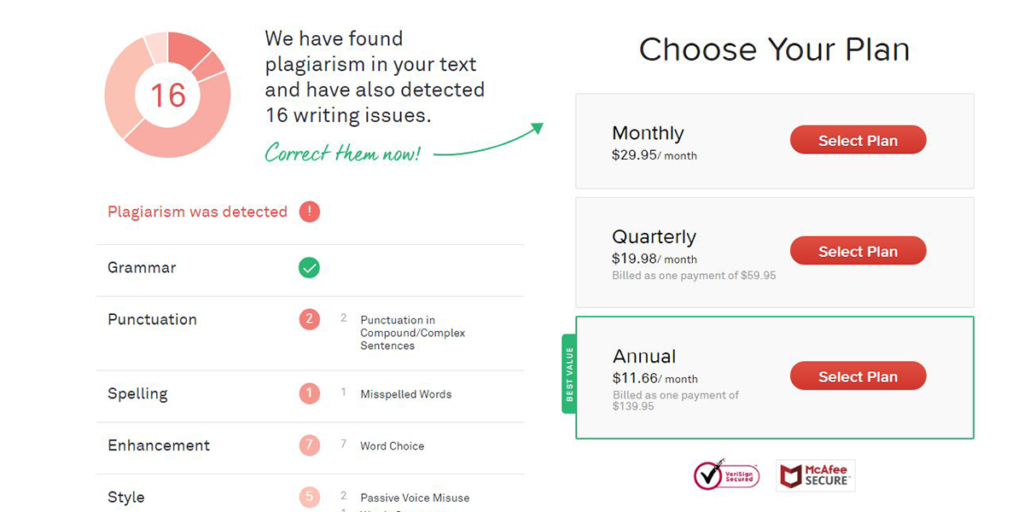
• It supports this valuable feature that is known as plagiarism checker. This tool is so helpful that is saves the time, money and reputation in the market.It supports this valuable feature that is known as plagiarism checker. This tool is so helpful that is saves the time, money and reputation in the market.

Pricing

Grammarly charges $29.95  monthly and discounts to $11.66 on monthly basis when you go for the 1 year plan

What is pro-writingAid?

• Pro-writingAid offers world-class grammar and style checking, combined with more in-depth reports to help you strengthen your writing.

• It allows you to checker grammatical and punctuation mistakes while also checking for structural issues like overuse, repetition, clinches, and a writing style and sentence length.

Usage ProwritingAid

• ProwritingAid is little bit difficult user interface, it takes times to understand it. It does not facilitate every of user.

Features
• Pro-writingAid offers for more grammar and spelling checks than grammarly. “spelling, grammar, style, overused words, diction, dialogue checks and homonyms.

Translate feature ProwritingAid
• It provides this amazing features like ginger. It helps to translate the text in different language.

Plagiarism checker ProwritingAid

• It also supports plagiarism checker feature like every online proofreading tool but there is one issue.
• It provides this support to only premium plans.
• It is not for basic plans.

Pricing
• Pro writing aid premium plan is available for $ 40 on annual basis and premium plus plan is available for $45 on annual basis.

Which one is the best?
• Grammarly is highly advanced and effectively available in market.
• Pro-writingAid is also a good tool to improve your grammar and vocabulary.
• Both app are doing good in market people use both app.

IMPORTANCE OF SOCIAL MEDIA

                                                 ROLE PLAYED BY MEDIA IN CONNECTING US

The virtual world for people nowadays to stay updated, be aware of uprising events or issues happening all over the country and Globe. It connects viewers mutually to support or protest against problems that will create a tremendous impact on culture, traditional, safety or any other primary aspect of every individual.

Media has power to gather and publish information preciously to outworld to reveal the injustice, criminal and ill-legal kinds of acts in society. A platform that unites human beings together without any type of discrimination.” A world inside a gadget that literally reflects us a future upcoming”. You create connections based on your active performance via these online portals as you spread your awareness to others.

An expanding and yet growing platform to share talents, request support for any motive of happenings of our own and much more. In this pandemic even education and guidance are taken to teenagers via this media platform visually or just as speeches. Social media has the power of connecting people more than you can do in reality with much as possible.

Make sure you deliver your speech with a reason and a situation that must be told to the society. This platform is used as an age-restricted one where from infants till elders are addicted to it. “Let the addiction of media be because of you but you don’t be a victim of addiction”. Media consists from small areas (videos) till big platforms like Bollywood that keeps public entertained. In 2021 there is an enhanced usage of 99.8% in these portals and guides even market fields to promote their brand by sharing with consumers every product. Each individual has each requirement to be utilized under this platform but the concept is how you use them wisely to travel and train you in better ways.

Various application with wide range of viewers along with unique features and with special specifications are created generally to help and improve connectivity among every individual by uniting them as a society for a fruitful environment. Hence a key component for mingling every emotion and industry with various amenities embedded in it.

Software Engineering – A Layered Approach

What is layered approach of Software Engineering ?

Software engineering deals with process, methods, and their implementation tools and finally the quality of the product.This is known as the layered approach of software engineering

  1. Quality Focus

 Software engineering is a layered technology. Referring to Figure 1.1, any engineering approach must
rest on an organizational commitment to quality.
 Total quality management, Six Sigma and similar principles help a continuous software process
improvement, and this ultimately leads to the development of increasingly more mature approaches to
software engineering.
 The bedrock that supports software engineering is a quality focus.

2. Process Layer

 The foundation for software engineering is the process layer.
 Software engineering process is the glue that holds the technology layers together and enables balanced
and timely development of computer software.
 Process defines a framework for a set of key process areas that must be established for effective
delivery of software engineering technology.
 Process defines the context in which technical methods can be applied, work products are produced,
milestones are established, quality is ensured etc.

3. Method Layer

 Software engineering methods provide the technical how-to’s for building software.
 Methods encompass a broad array of tasks that include communication, requirements analysis, design,program construction, testing, and support.

4. Tools Layer

 Software engineering tools provide automated or semi-automated support for the process and the
methods.
 Tools are combines so that information created by one tool can be used by another, a system that is
developed for the support of software development, is called as computer-aided software engineering(CASE). CASE combines software, hardware, and a software engineering database.

Characteristics of a Good Software

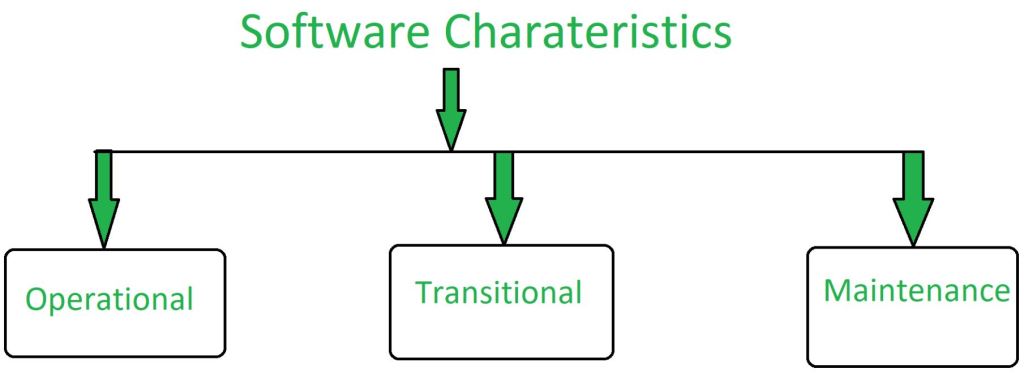
A software product can be judged by what it offers and how well it can be used. This software must satisfy on the following grounds: Operational, Transitional, Maintenance Well-engineered and crafted software is expected to have the following characteristics:

  1. Operational:

This tells us how well software works in operations. It can be measured on:

  • Budget
  • Usability
  • Efficiency
  • Correctness
  • Functionality
  • Dependability
  • Security
  • Safety

2. Transitional:

This aspect is important when the software is moved from one platform to another:

  • Portability
  • Interoperability
  • Reusability
  • Adaptability

3. Maintenance:

This aspect briefs about how well software has the capabilities to maintain itself in the ever-
changing environment:

  • Modularity
  • Maintainability
  • Flexibility
  • Scalability

Basics of Software Engineering

What is a Software ?

  • It is a set of instructions (computer programs) that when executed provide desired function and performance.
  • It is a Data structures that enable the programs to adequately manipulate information.
  • It is a Documents that describe the operation and use of the programs.

What is Embedded Software ?

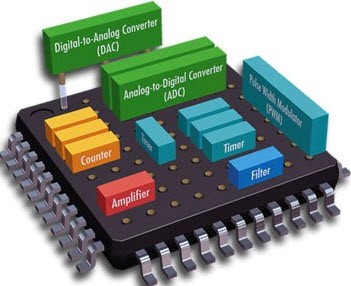
 Intelligent products have become commonplace in nearly every consumer and industrial market.
 Embedded software resides in read-only memory and is used to control products and systems for the
consumer and industrial markets.
 Embedded software can perform very limited and esoteric functions (e.g., keypad control for a
microwave oven) or provide significant function and control capability (e.g., digital functions in an
automobile such as fuel control, dashboard displays, and braking systems).
 A function point extension called feature points.
 It is a superset of the function point measure that can be applied to systems and engineering software applications.

 The feature point measure accommodates applications in which algorithmic complexity is high. Real-
time, process control and embedded software applications tend to have high algorithmic complexity and are therefore amenable to the feature point.

Changing Nature of Software

 Whenever one starts with the software implementation changes can occur any time.
 The software can be change due to any reason.
 But while implementing software one should be ready for such changes as if changes occur there shall not be drastic change in the system.
 The development team should manage to implement/mould the implemented system so that the
changes can be reflected and the user requirements meet.
 When change occur the team look for the current status of the system and from there onwards they starts implementing a system with new requirements of a user or changes which is to be implemented in a system.

17 Sustainable Goals by United Nations.

Sustainable development is development that meets the needs of the present without compromising the ability of future generations to meet their own needs. Sustainable development has continued to evolve as that of protecting the world’s resources while its true agenda is to control the world’s resources. Environmentally sustainable economic growth refers to economic development that meets the needs of all without leaving future generations with fewer natural resources than those we enjoy today. Let us know 17 Sustainable Goals set by UN and their progress by now.

1) Poverty Eradication:

The 2030 Agenda acknowledges that eradicating poverty in all its forms and dimensions, including extreme poverty, is the greatest global challenge and an indispensable requirement for sustainable development.

2) ENDING HUNGER:

The total number of persons suffering from severe food insecurity has been on the rise since 2015, and there are still millions of malnourished children. The economic slowdown and the disruption of food value chains caused by the pandemic are exacerbating hunger and food insecurity.

3) Ensure healthy lives and promote well- being for all at all ages

Progress in many health areas continues, but the rate of improvement has slowed and will not be sufficient to meet most of the Goal 3 targets. Globally, an estimated 295,000 maternal deaths occurred in 2017, resulting in an overall maternal mortality ratio of 211 maternal deaths per 100,000 live births, a 4 per cent reduction compared with 2015 and a 38 per cent reduction compared with 2000. The majority of the deaths occurred in low- and lower-middle-income countries, and roughly 66 per cent of them occurred in sub-Saharan Africa. At the current pace of progress, the world will fall short of the target of the Goal.

4) Ensure inclusive and equitable quality education and promote lifelong learning opportunities for all:

At the end of 2019, millions of children and young people were still out of school, and more than half of those in school were not meeting minimum proficiency standards in reading and numeracy.

5)Achieve gender equality and empower all women and girls

The commitment to advancing gender equality has brought about improvements in some areas, but the promise of a world in which every woman and girl enjoy full gender equality and all legal, social and economic barriers to their empowerment have been removed remains unfulfilled.

6)Ensure availability and sustainable management of water and sanitation for all

In 2017, 3 billion persons lacked soap and water at home. In 2016, 47 per cent of schools worldwide lacked handwashing facilities with available soap and water, and 40 per cent of health-care facilities were not equipped to practise hand hygiene at points of care.

7) Ensure access to affordable, reliable, sustainable and modern energy for all

The world is making good progress on increasing access to electricity and improving energy efficiency. However, millions of people throughout the world still lack such access, and progress on facilitating access to clean cooking fuels and technologies is too slow.

8) Promote sustained, inclusive and sustainable economic growth, full and productive employment and decent work for all:

In 2018, the rate of growth of global real GDP per capita was 2 per cent. In addition, the rate for least developed countries was 4.5 per cent in 2018, less than the 7 per cent growth rate targeted in the 2030 Agenda.

9) Build resilient infrastructure, promote inclusive and sustainable industrialization and foster innovation:

In 2019, 14 per cent of the world’s workers were employed in manufacturing activities, a figure that has not changed much since 2000. The share of manufacturing employment was the largest in Eastern and South-Eastern Asia (18 per cent) and the smallest in sub- Saharan Africa (6 per cent).

10)Reduce inequality within and among countries

In 73 of the 90 countries with comparable data during the period 2012–2017, the bottom 40 per cent of the population saw its incomes grow. Moreover, in slightly more than half of those countries, the bottom 40 per cent experienced a growth rate in income that was higher than the overall national average.

11) Make cities and human settlements inclusive, safe, resilient and sustainable:

Rapid urbanization has resulted in a growing number of slum dwellers, inadequate and overburdened infrastructure and services and worsening air pollution.

12) Ensure sustainable consumption and production patterns:

As at 2019, 79 countries and the European Union reported on at least one national policy instrument that contributed to sustainable consumption and production in their efforts towards the implementation of the 10-Year Framework of Programmes on Sustainable Consumption and Production Patterns.

13) Take urgent action to combat climate change and its impacts.

The year 2019 was the second warmest on record and the end of the warmest decade, 2010 to 2019. In addition, with a global average temperature of 1.1°C above estimated pre-industrial levels, the global community is far off track to meet either the 1.5 or 2°C targets called for in the Paris Agreement.

14. Conserve and sustainably use the oceans, seas and marine resources for sustainable development:

Oceans and fisheries continued to support the global population’s economic, social and environmental needs while suffering unsustainable depletion, environmental deterioration and carbon dioxide saturation and acidification.

15) Protect, restore and promote sustainable use of terrestrial ecosystems, sustainably manage forests, combat desertification, and halt and reverse land degradation and halt biodiversity loss:

Forest areas continued to decline, protected areas were not concentrated in areas of key biodiversity and species remained threatened with extinction.

16) Promote peaceful and inclusive societies for sustainable development, provide access to justice for all and build effective, accountable and inclusive institutions at all levels:

Conflict, insecurity, weak institutions and limited access to justice remain a great threat to sustainable development. Millions of people have been deprived of their security, human rights and access to justice.

17) Strengthen the means of implementation and revitalize the global partnership for sustainable development:

Strengthening multilateralism and global partnerships is more important than ever before. The global nature of the pandemic requires the participation of all governments, the private sector, civil society organizations and people throughout the world.


ANALYSIS OF IT (INFORMATION TECHNOLOGY) ACT, 2021

This year in February the Ministry of Electronics and Information Technology announced the Information Technology (Intermediary Guidelines and Digital Media Ethics Code) Rules. the Information Technology Rules 2011 were superseded by the Digital Media Ethics Code) Rules 2021, which were framed, in the exercise of powers under section 87 (2) of the Information Technology Act,2000. As per the data gathered, In India, there are 530 million WhatsApp users. While YouTube has 448 million users, Facebook and Instagram each have 410 million and 210 million users, respectively. 

Social Media has grown into an arena for trade and commercial operations in addition to being a medium of entertainment. It has also preserved the fundamental standards for information transmission and provided a platform for individuals to openly express their ideas and beliefs. 

Therefore, in this growing trend of using social media, few rules must be there in order to make social media a secure place to open up and share ideas. So, IT RULES, 2021 came up which intended to provide ordinary users of social media platforms and over-the-top (OTT) platforms with a system for grievance redress and fast resolution through the employment of a Grievance Redressal Officer (GRO) who must be a resident of India. Special attention has been paid to protecting women and children from sexual assaults, fake news, and other forms of social media abuse.

On the other hand, OTT platforms, online news, and digital media organisations would be required to adhere to a Code of Ethics. Under the new guidelines, OTT platforms would be referred to as “publishers of online curated content.” They’d have to divide the content into five groups based on age, and apply parental controls for everyone above the age of 13. They must also provide procedures for age verification for adult related content.

Furthermore, three-tiered grievance resolution system has been established. The appointment of a GRO, self-regulatory entities registered with the Ministry of Information and Broadcasting (MIB) to oversee the Code of Ethics, and a Charter for the self-regulating bodies created by MIB are all part of this.

However, the new regulations have been criticized by some as a breach of free expression, the government has emphasized that they allow social media sites to operate freely in India while adhering to the law. The country’s Constitution and the Rule of Law must be followed by all entities. Furthermore, according to Article 19 of the Constitution, the right to free speech and expression is not absolute and is subject to legitimate limitations, particularly when national sovereignty and security are at risk.

The new restrictions were given a three-month grace period for social media intermediaries to comply. On May 26, the government sent a second notice to all social media intermediaries, requesting information on the status of compliance with the new laws that took effect that day. Various social media sites such as Google, LinkedIn did shared details as per the requirements but other sites such as twitter requested for the compliance window to be extended and demanded a collaborative approach from the government to protect public freedom of speech. WhatsApp has launched a lawsuit against the government in the Delhi High Court, alleging that the new restrictions infringed user privacy by breaking the end-to-end encryption in order to identify traceability.  The administration, on the other hand, has maintained that tracking will be necessary only in the event of “extremely serious offences” that endanger India’s sovereignty and integrity. It may also be done without compromising the end-to-end encryption. Companies, on the other hand, will be responsible for developing a technical solution

So, as we know that no freedom is a total freedom. It comes up with some level of restrictions and is not absolute unrestricted. Since the establishment of the Constitution of india, striking the appropriate balance between fundamental rights and determining the rationality of a limitation has been a continual struggle. Therefore, the battle between the governments that want to impose reasonable restrictions and users concerned about data privacy and restrictions on freedom of speech and expression vs the tech giants who own significant amount of huge data  is only going to get more complicated before optimal solutions are found. So, The IT Rules 2021 which preserves digital sovereignty and aim to answer people’ concerns without compromising on their privacy or personal rights should be properly followed by the social media sites which is only the best solution left.  

Transhumanism – saving grace or certain doom?

Imagine, one day you could wake up and have a robotic arm that could fetch you anything that is more than an arms distance away without you having to get up from your bed or that you could have a brain so powerful that you would memorise anything just by glancing over it for a second, imagine..

As one grows older, questions like can humans live forever? Is immortality possible? seem very bogus, however as technologies evolve along with new philosophical ideas that are born, the hypothetical situation that was thought to be impossible, may not seem too far off.

Growing up, watching movies like the matrix or the terminator or avatar where ideas like living forever and enhancement of the human body, made many people wish that the idea of living forever, was not an idea anymore. From ancient times, transhumanism was portrayed from Icarus flying too close to the sun to many others.

From the media to the mythos, the idea of incorporating technology into humans seems plausible. Thus a movement was born, to make all this advancement possible. So the movement that encourages this advancement, is called transhumanism.

According to the, ‘The Transhumanist Reader: Classical and Contemporary Essays on the Science, Technology and Philosophy of the Human Future,’ transhumanism is a scientific and philosophical movement that calls for the improvement of human existence via the advancement and increasing prevalence of advanced technology capable of significantly altering or enhancing human intelligence and physiology. The movement makes use of the scientific knowledge of human anatomy to allow people to transcend their current biological limitations.The fundamental belief of transhumanism will help cross humans biological limitations by augmentations. Human capabilities are enhanced by augmentations like objects, extensions or technologies. Spectacles, footwear and robotic arm are some of the augmentations.

Transhumanism is viewed as an extension of humanism. According to transhumanism, the present phase of homo sapiens can be seen as an intermediate stage on the road to post-human life forms, which can be achieved by modifying ourselves. Transhumanism originated as a philosophical movement that is currently a growing field.

Science and technology are used to enhance or alter body chemistry to stay healthy and be more in control of our lives. We are all transhumanists (people how advocate for transhumanism m to varying degrees. However, some people advocate transhumanism more broadly, where they advocate for mechanical parts in the body to make the biological figure more enhanced.

Inevitable Evolutions: Human-transhuman-post-human –: Homo sapiens have a range of emotions, experiences. Even though humans are considered the most intelligent species to ever exist, humans do face some limitations. Lifespan – Human character is cut short by death. Humans died and their intelligence dies with them. Intellectual capacity- Humans have cognitive limitations etc, are some of the limitations of the human form. Emotions- Sometimes, emotions may be seen as a disadvantage as, imagine you’re in an argument, and suddenly you start crying, it may show signs of weakness.

Transhuman refers to an intermediate form of being between the human and post-human. 

Being posthuman entails breaking free from the constraints that characterise the least favourable dimensions of the “human condition.” Disease, ageing, and death will no longer be a problem for posthumans. They will have much more physical capability and morphological independence. These beings may show a certain type of emotion or no emotion. The distinctions between post-human brains can not be as clear as they are between humans.

However, as every coin has two sides, transhumanism along with its pros also has its cons. Some of the most discussed cons of transhumanism are dehumanisation wherein our uniqueness will be lost and everyone will have the same beliefs, immortality though is regarded as a pro, sometimes maybe a con, as due to immortality, overpopulation may be an inevitable problem, as well as the laws of nature and science would be broken. Transhumanism may also lead to a social divide on the already existing divides in the society, it may just make the rich or the people who will be able to pay for augmentations, thus making the rich even more powerful. 

However, the situation is quite complex. Before this movement reaches its peak, one should know, if this movement could be our saving grace or our certain doom.


To know more about this movement, the following sources/books can be referred:

  1. The Transhumanist Reader: Classical and Contemporary Essays on the Science, Technology and Philosophy of the Human Future, First Edition. Edited by Max More and Natasha Vita-More. 2013 John Wiley & Sons, Inc. Published 2013 by John Wiley & Sons, Inc.
  2. Transhumanism: A Grimoire of Alchemical Agendas – by Scott D de Hart and Joseph P Farrell.

Right to repair

Right to repair is the movement started by the activist and oragination all around the world. Joe -Biden ,US president ,signed an executive order on Federal Trade Commission to institute rules to curb anticompetitive restrictions that limit consumers’ ability to repair gadgets on their own terms. The Uk too had introduced this .

The agenda of the movement is to get compinies to make spare parts of the gadget and the consumers can repair them rather than replacing the product.

Large tech compinies like Apple, Microsoft,Amazon and Tesla are opposing the movement stating that its opening up their intellectual property to third party to repair them.